Capability Maturity Model Integration 
Quality 
Frame 
works
What is CMMI? 
 CMMI (Capability Maturity Model Integration) is a proven 
industry framework to improve product quality and 
development efficiency for both hardware and software 
 Sponsored by US Department of Defence in cooperation 
with Carnegie Mellon University and the Software 
Engineering Institute (SEI) 
 Many companies have been involved in CMMI definition 
such as Motorola and Ericsson 
 CMMI has been established as a model to improve business 
results 
 CMMI, staged, uses 5 levels to describe the maturity of the 
organization, same as predecessor CMM 
 Vastly improved version of the CMM 
 Emphasis on business needs, integration and 
institutionalization
How can CMMI help? 
 CMMI provides a way to focus and manage hardware and 
software development from product inception through 
deployment and maintenance. 
 ISO/TL9000 are still required. CMMI interfaces well with 
them. CMMI and TL are complementary - both are needed 
since they address different aspects. 
 ISO/TL9000 is a process compliance standard 
 CMMI is a process improvement model 
 Behavioral changes are needed at both management and staff 
levels. Examples: 
 Increased personal accountability 
 Tighter links between Product Management, Development, 
SCN, etc. 
 Initially a lot of investment required – but, if properly 
managed, we will be more efficient and productive while 
turning out products with consistently higher quality.
CMMI Models within the Framework 
 Models: 
 Systems Engineering + Software Engineering (SE/SW) 
 Systems Engineering + Software Engineering + Integrated Product and 
Process Development (IPPD) 
 Systems Engineering + Software Engineering + Integrated Product and 
Process Development + Supplier Sourcing (SS) 
 Software Engineering only 
 Representation options: 
 Staged 
 Continuous 
 The CMMI definition of “Systems Engineering” - 
“The interdisciplinary approach governing the total technical and 
managerial effort required to transform a set of customer needs, expectations 
and constraints into a product solution and to support that solution 
throughout the product’s life.” This includes both hardware and 
software.
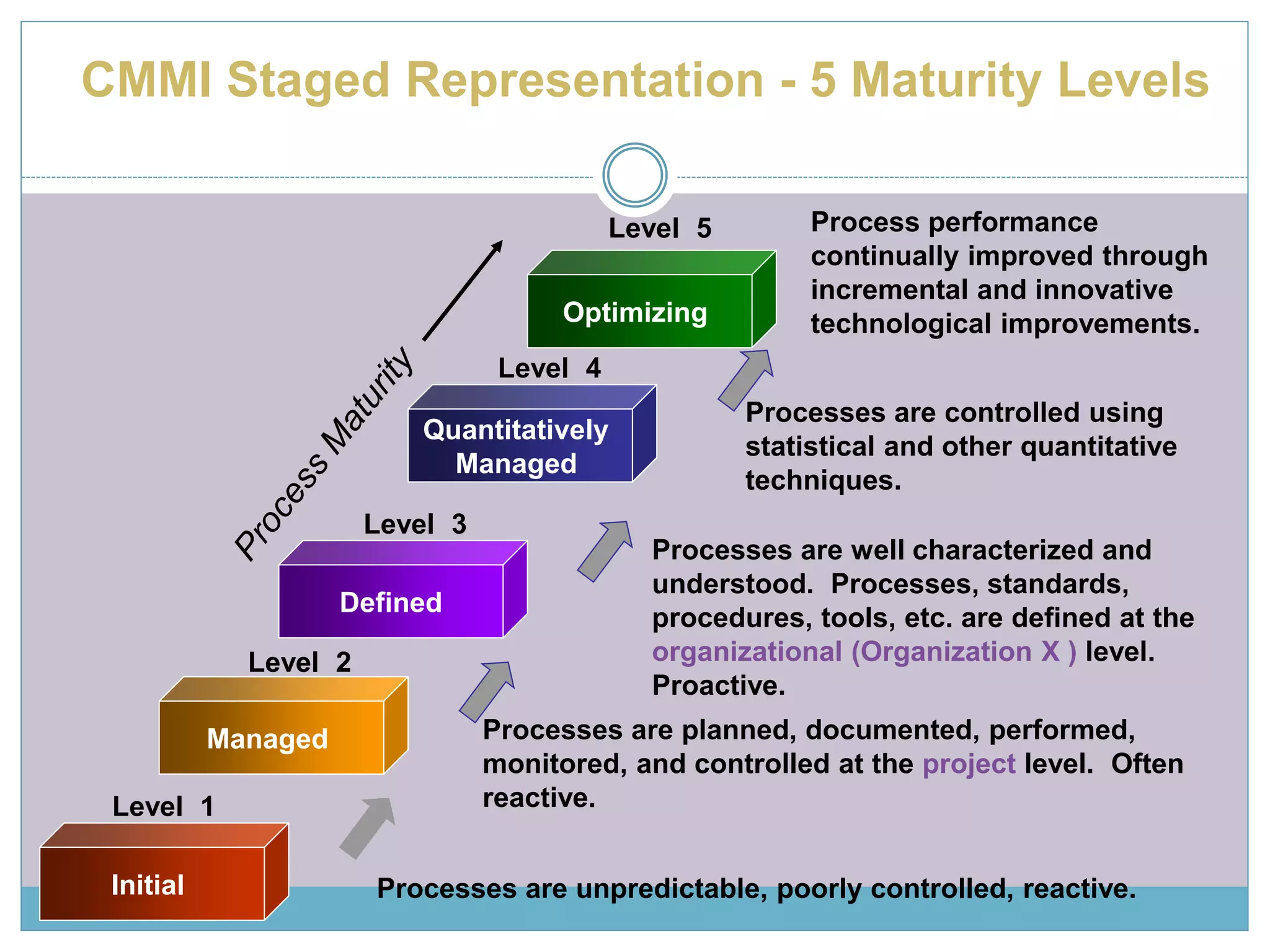
CMMI Staged Representation - 5 Maturity Levels 
Level 5 
Level 1 
Initial 
Level 3 
Level 4 
Processes are unpredictable, poorly controlled, reactive. 
Level 2 
Managed 
Processes are planned, documented, performed, 
monitored, and controlled at the project level. Often 
reactive. 
Defined 
Processes are well characterized and 
understood. Processes, standards, 
procedures, tools, etc. are defined at the 
organizational (Organization X ) level. 
Proactive. 
Quantitatively 
Managed 
Processes are controlled using 
statistical and other quantitative 
techniques. 
Optimizing 
Process performance 
continually improved through 
incremental and innovative 
technological improvements.
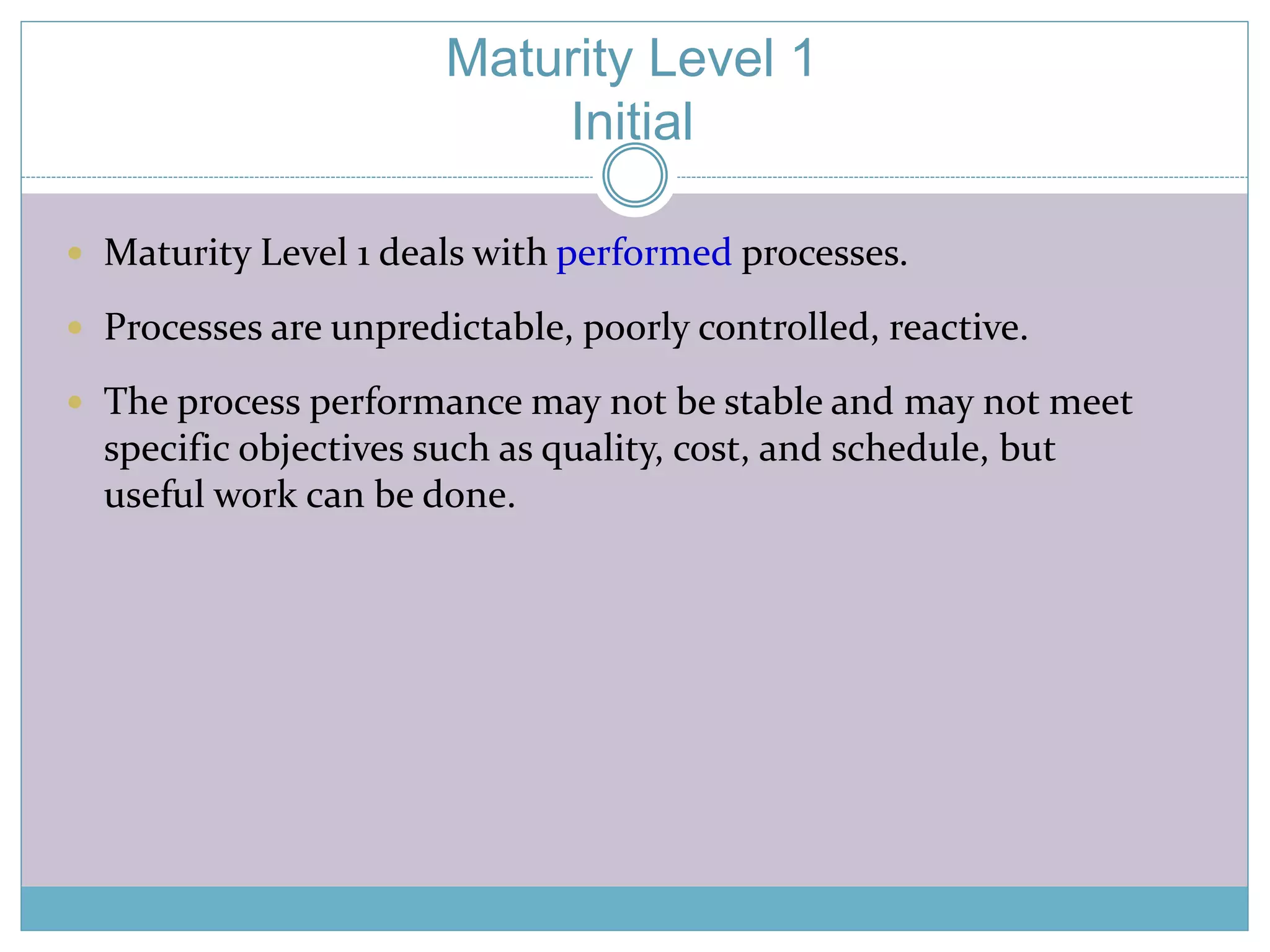
Maturity Level 1 
Initial 
 Maturity Level 1 deals with performed processes. 
 Processes are unpredictable, poorly controlled, reactive. 
 The process performance may not be stable and may not meet 
specific objectives such as quality, cost, and schedule, but 
useful work can be done.
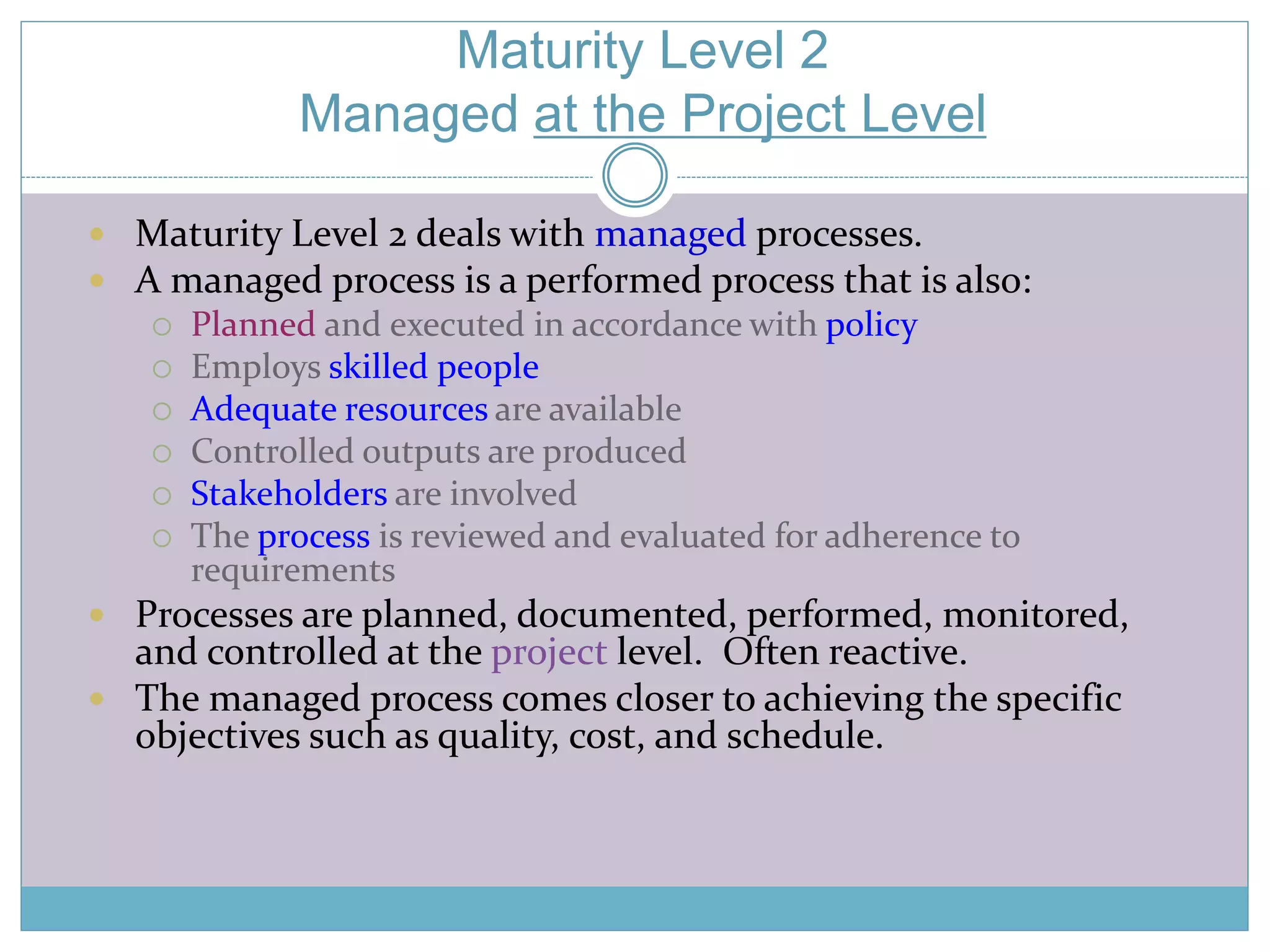
Maturity Level 2 
Managed at the Project Level 
 Maturity Level 2 deals with managed processes. 
 A managed process is a performed process that is also: 
 Planned and executed in accordance with policy 
 Employs skilled people 
 Adequate resources are available 
 Controlled outputs are produced 
 Stakeholders are involved 
 The process is reviewed and evaluated for adherence to 
requirements 
 Processes are planned, documented, performed, monitored, 
and controlled at the project level. Often reactive. 
 The managed process comes closer to achieving the specific 
objectives such as quality, cost, and schedule.
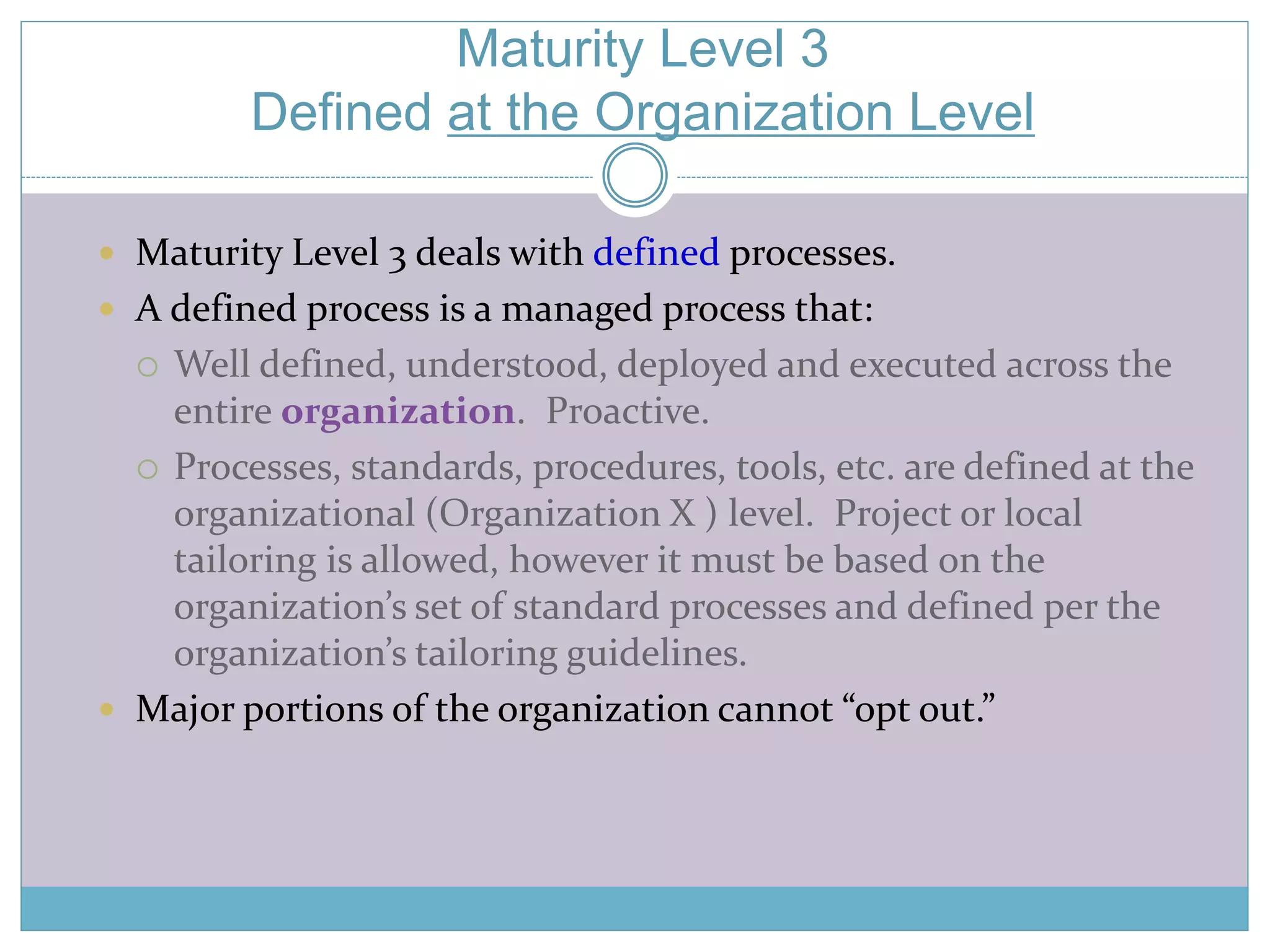
Maturity Level 3 
Defined at the Organization Level 
 Maturity Level 3 deals with defined processes. 
 A defined process is a managed process that: 
 Well defined, understood, deployed and executed across the 
entire organization. Proactive. 
 Processes, standards, procedures, tools, etc. are defined at the 
organizational (Organization X ) level. Project or local 
tailoring is allowed, however it must be based on the 
organization’s set of standard processes and defined per the 
organization’s tailoring guidelines. 
 Major portions of the organization cannot “opt out.”
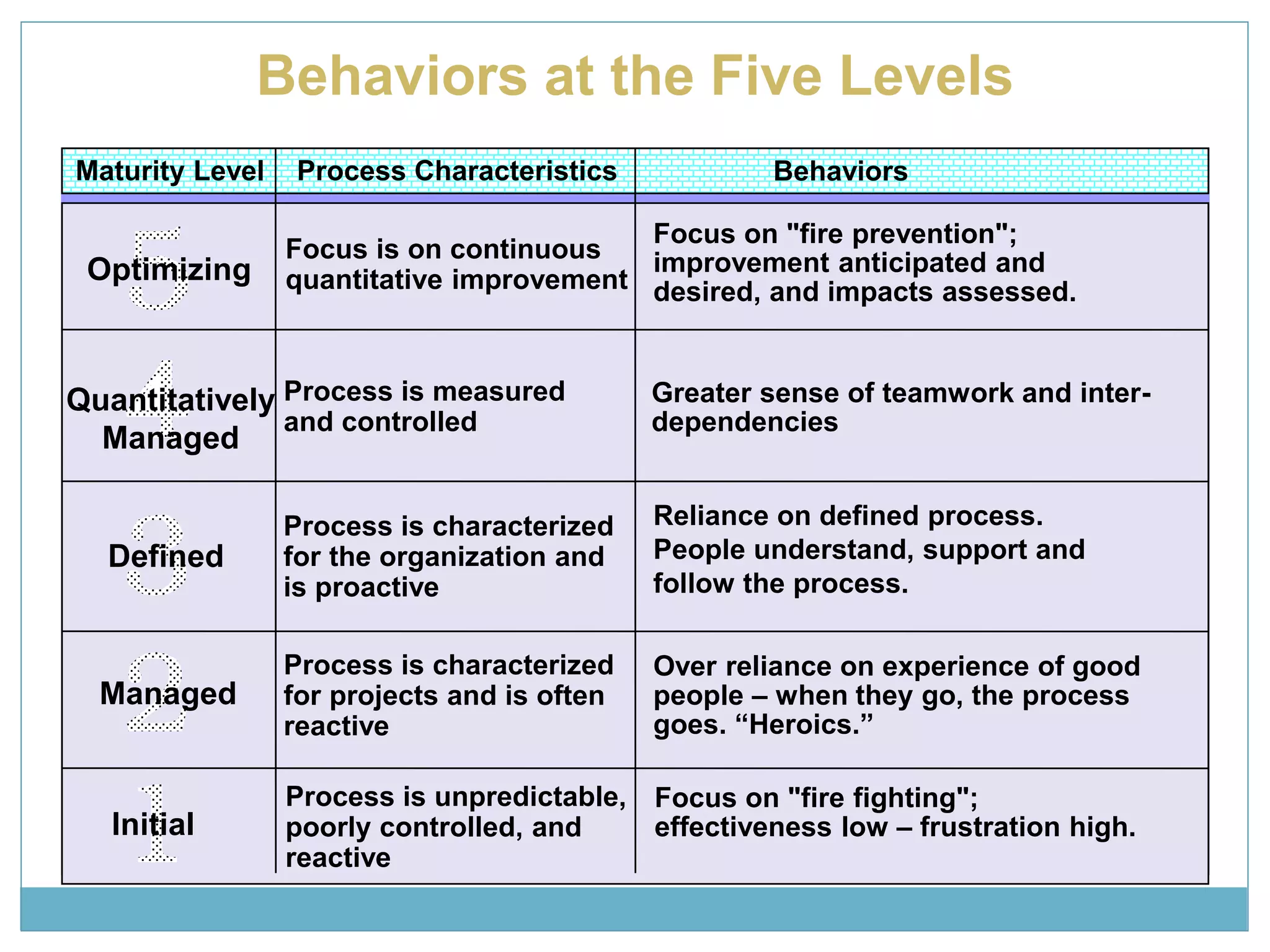
Behaviors at the Five Levels 
Maturity Level Process Characteristics Behaviors 
Optimizing 
Quantitatively 
Managed 
Defined 
Managed 
Initial 
Focus is on continuous 
quantitative improvement 
Process is measured 
and controlled 
Process is characterized 
for the organization and 
is proactive 
Process is characterized 
for projects and is often 
reactive 
Process is unpredictable, 
poorly controlled, and 
reactive 
Focus on "fire prevention"; 
improvement anticipated and 
desired, and impacts assessed. 
Greater sense of teamwork and inter-dependencies 
Reliance on defined process. 
People understand, support and 
follow the process. 
Over reliance on experience of good 
people – when they go, the process 
goes. “Heroics.” 
Focus on "fire fighting"; 
effectiveness low – frustration high.
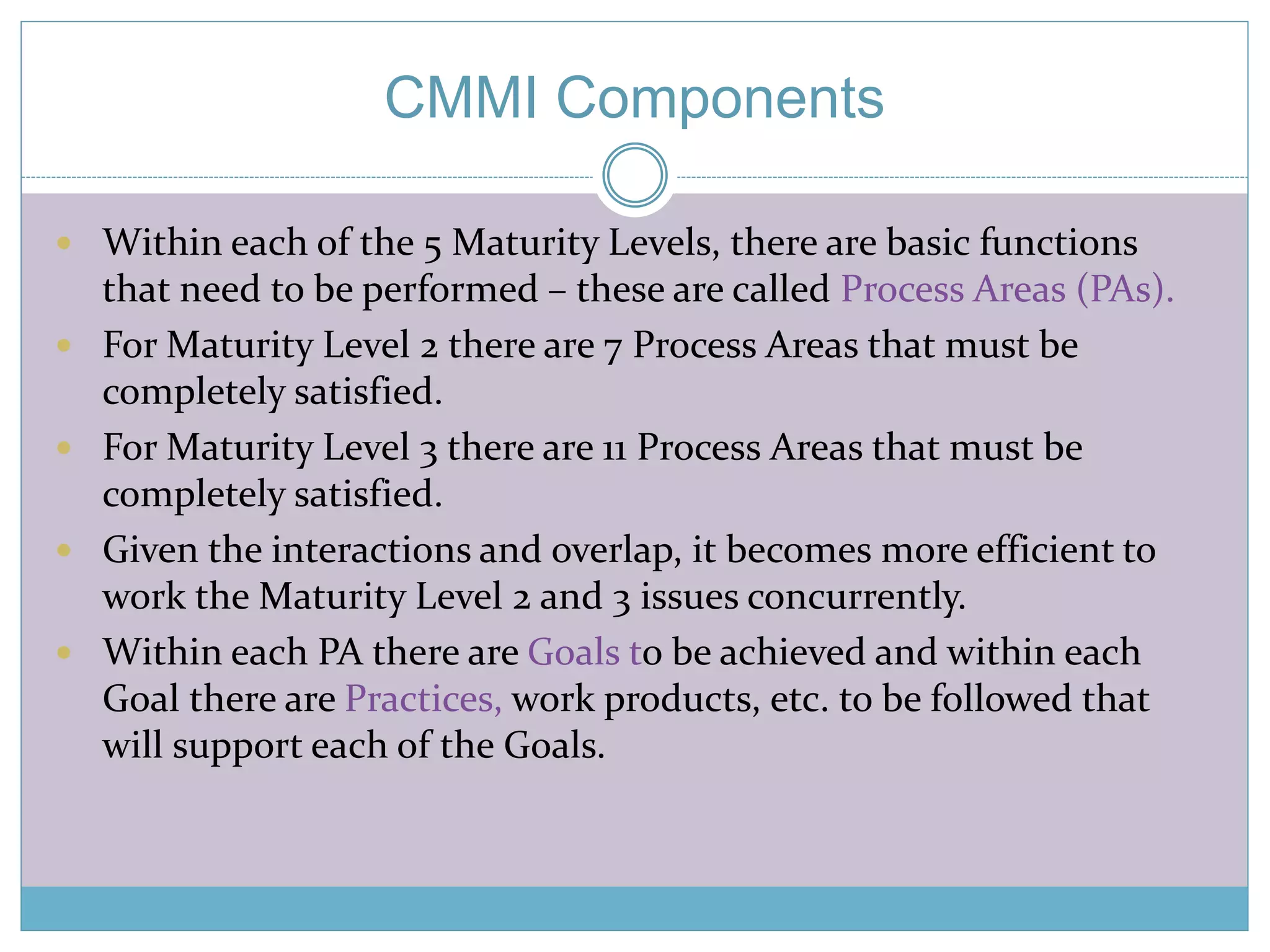
CMMI Components 
 Within each of the 5 Maturity Levels, there are basic functions 
that need to be performed – these are called Process Areas (PAs). 
 For Maturity Level 2 there are 7 Process Areas that must be 
completely satisfied. 
 For Maturity Level 3 there are 11 Process Areas that must be 
completely satisfied. 
 Given the interactions and overlap, it becomes more efficient to 
work the Maturity Level 2 and 3 issues concurrently. 
 Within each PA there are Goals to be achieved and within each 
Goal there are Practices, work products, etc. to be followed that 
will support each of the Goals.
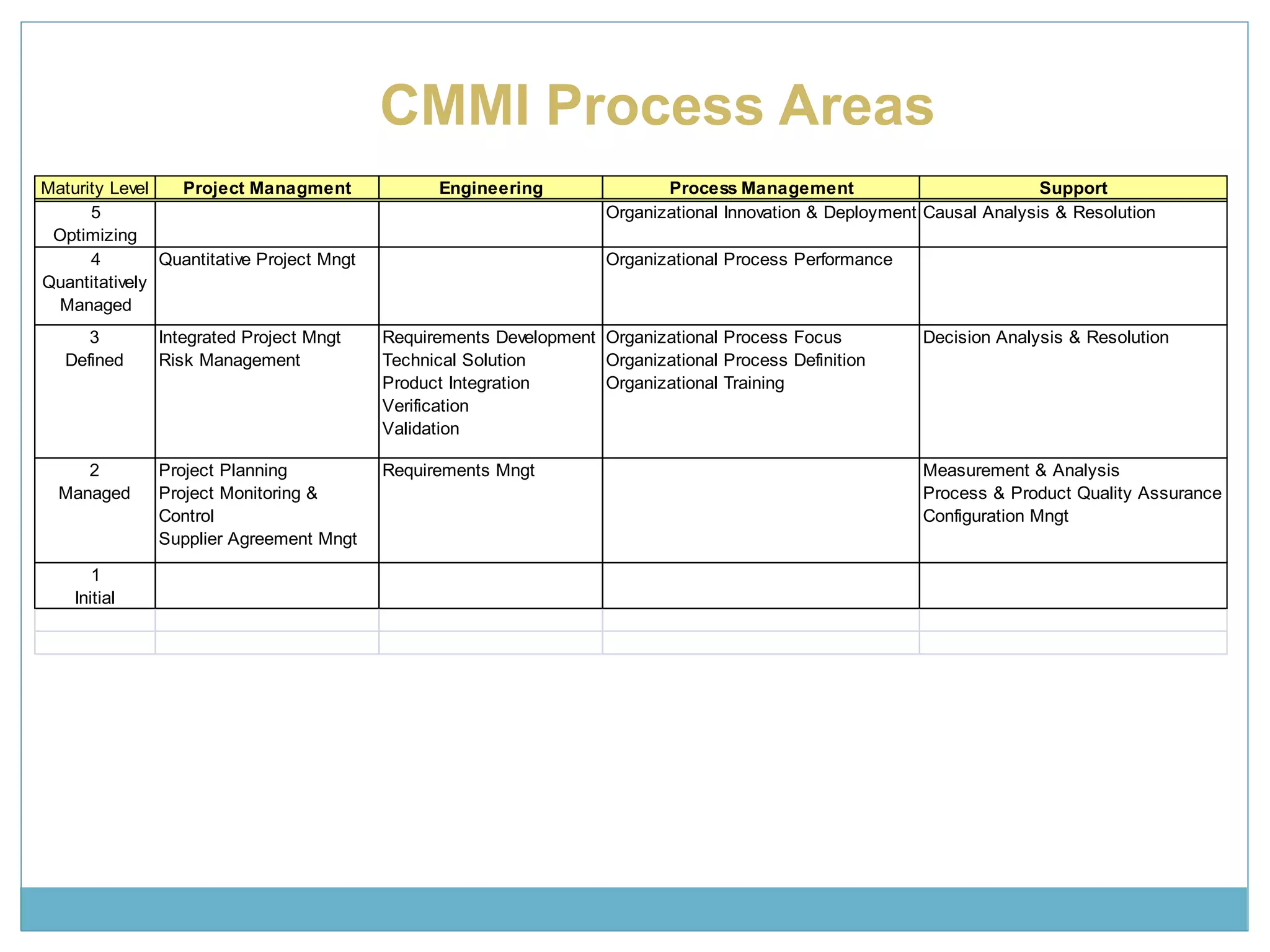
Maturity Level Project Managment Engineering Process Management Support 
5 
Optimizing 
Organizational Innovation & Deployment Causal Analysis & Resolution 
4 
Quantitatively 
Managed 
Quantitative Project Mngt Organizational Process Performance 
3 
Defined 
Integrated Project Mngt 
Risk Management 
Requirements Development 
Technical Solution 
Product Integration 
Verification 
Validation 
Organizational Process Focus 
Organizational Process Definition 
Organizational Training 
Decision Analysis & Resolution 
2 
Managed 
Project Planning 
Project Monitoring & 
Control 
Supplier Agreement Mngt 
Requirements Mngt Measurement & Analysis 
Process & Product Quality Assurance 
Configuration Mngt 
1 
Initial 
CMMI Process Areas
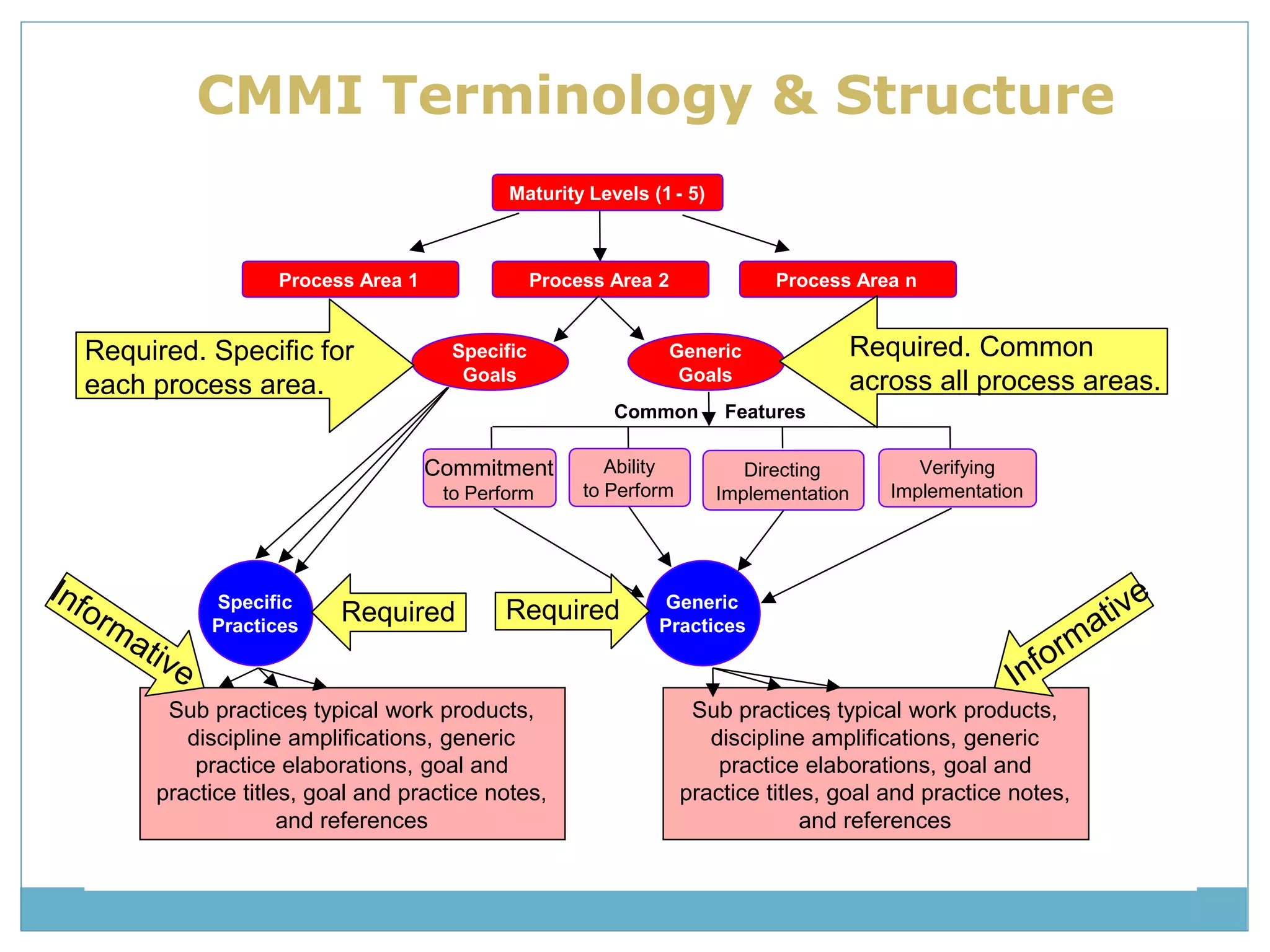
CMMI Terminology & Structure 
Maturity Levels (1 - 5) 
Process Area 1 Process Area 2 
Process Area n 
Generic 
Goals 
Common Features 
Generic 
Practices 
Verifying 
Implementation 
Specific 
Goals 
Specific 
Practices 
Ability 
to Perform 
Directing 
Implementation 
Commitment 
Required Required 
Sub practices, typical work products, 
discipline amplifications, generic 
practice elaborations, goal and 
practice titles, goal and practice notes, 
and references 
to Perform 
Sub practices, typical work products, 
discipline amplifications, generic 
practice elaborations, goal and 
practice titles, goal and practice notes, 
and references 
Required. Specific for 
each process area. 
Required. Common 
across all process areas.
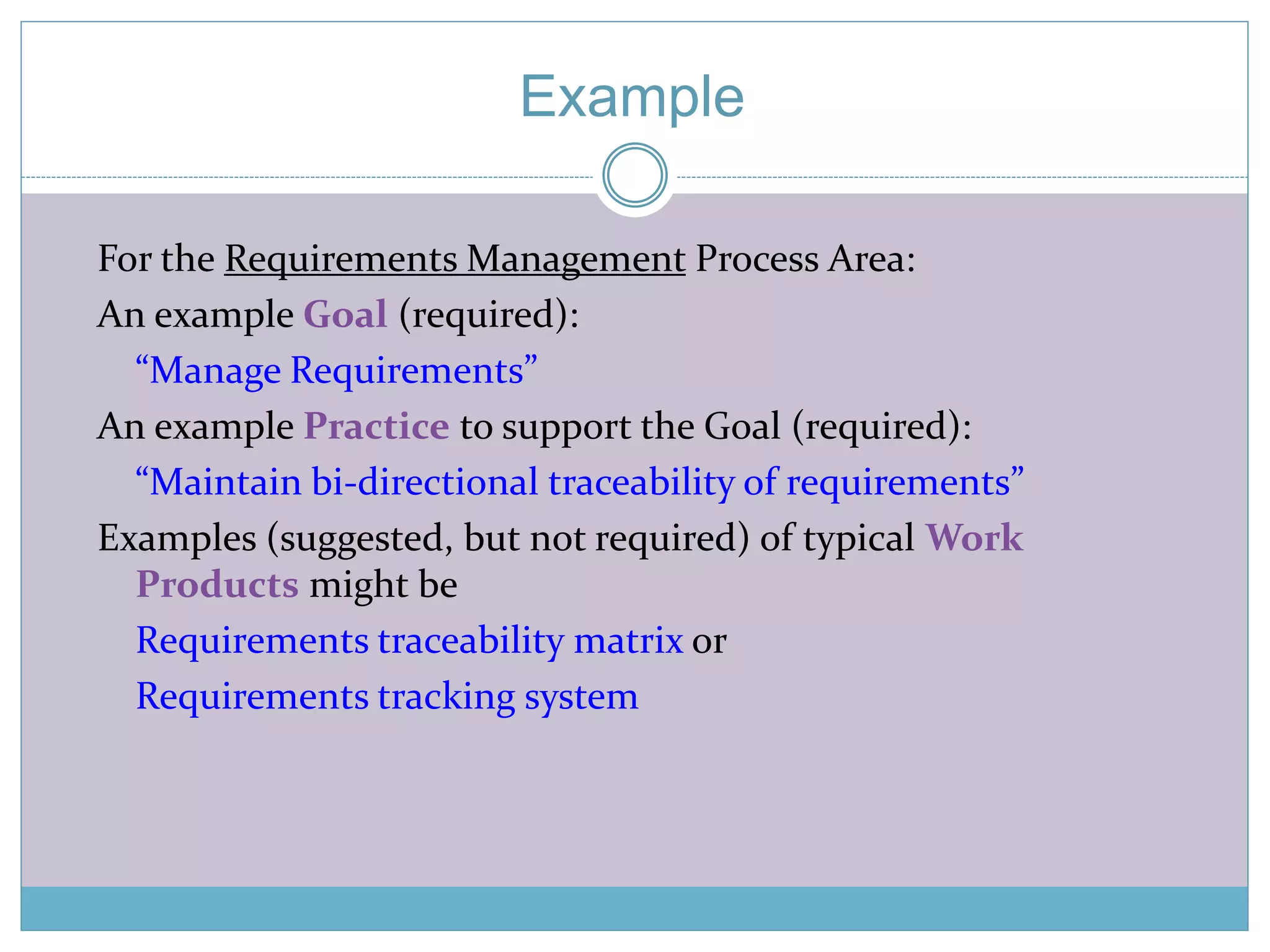
Example 
For the Requirements Management Process Area: 
An example Goal (required): 
“Manage Requirements” 
An example Practice to support the Goal (required): 
“Maintain bi-directional traceability of requirements” 
Examples (suggested, but not required) of typical Work 
Products might be 
Requirements traceability matrix or 
Requirements tracking system

Capability Maturity Model Integration

  • 1.
    Capability Maturity ModelIntegration Quality Frame works
  • 2.
    What is CMMI?  CMMI (Capability Maturity Model Integration) is a proven industry framework to improve product quality and development efficiency for both hardware and software  Sponsored by US Department of Defence in cooperation with Carnegie Mellon University and the Software Engineering Institute (SEI)  Many companies have been involved in CMMI definition such as Motorola and Ericsson  CMMI has been established as a model to improve business results  CMMI, staged, uses 5 levels to describe the maturity of the organization, same as predecessor CMM  Vastly improved version of the CMM  Emphasis on business needs, integration and institutionalization
  • 3.
    How can CMMIhelp?  CMMI provides a way to focus and manage hardware and software development from product inception through deployment and maintenance.  ISO/TL9000 are still required. CMMI interfaces well with them. CMMI and TL are complementary - both are needed since they address different aspects.  ISO/TL9000 is a process compliance standard  CMMI is a process improvement model  Behavioral changes are needed at both management and staff levels. Examples:  Increased personal accountability  Tighter links between Product Management, Development, SCN, etc.  Initially a lot of investment required – but, if properly managed, we will be more efficient and productive while turning out products with consistently higher quality.
  • 4.
    CMMI Models withinthe Framework  Models:  Systems Engineering + Software Engineering (SE/SW)  Systems Engineering + Software Engineering + Integrated Product and Process Development (IPPD)  Systems Engineering + Software Engineering + Integrated Product and Process Development + Supplier Sourcing (SS)  Software Engineering only  Representation options:  Staged  Continuous  The CMMI definition of “Systems Engineering” - “The interdisciplinary approach governing the total technical and managerial effort required to transform a set of customer needs, expectations and constraints into a product solution and to support that solution throughout the product’s life.” This includes both hardware and software.
  • 5.
    CMMI Staged Representation- 5 Maturity Levels Level 5 Level 1 Initial Level 3 Level 4 Processes are unpredictable, poorly controlled, reactive. Level 2 Managed Processes are planned, documented, performed, monitored, and controlled at the project level. Often reactive. Defined Processes are well characterized and understood. Processes, standards, procedures, tools, etc. are defined at the organizational (Organization X ) level. Proactive. Quantitatively Managed Processes are controlled using statistical and other quantitative techniques. Optimizing Process performance continually improved through incremental and innovative technological improvements.
  • 6.
    Maturity Level 1 Initial  Maturity Level 1 deals with performed processes.  Processes are unpredictable, poorly controlled, reactive.  The process performance may not be stable and may not meet specific objectives such as quality, cost, and schedule, but useful work can be done.
  • 7.
    Maturity Level 2 Managed at the Project Level  Maturity Level 2 deals with managed processes.  A managed process is a performed process that is also:  Planned and executed in accordance with policy  Employs skilled people  Adequate resources are available  Controlled outputs are produced  Stakeholders are involved  The process is reviewed and evaluated for adherence to requirements  Processes are planned, documented, performed, monitored, and controlled at the project level. Often reactive.  The managed process comes closer to achieving the specific objectives such as quality, cost, and schedule.
  • 8.
    Maturity Level 3 Defined at the Organization Level  Maturity Level 3 deals with defined processes.  A defined process is a managed process that:  Well defined, understood, deployed and executed across the entire organization. Proactive.  Processes, standards, procedures, tools, etc. are defined at the organizational (Organization X ) level. Project or local tailoring is allowed, however it must be based on the organization’s set of standard processes and defined per the organization’s tailoring guidelines.  Major portions of the organization cannot “opt out.”
  • 9.
    Behaviors at theFive Levels Maturity Level Process Characteristics Behaviors Optimizing Quantitatively Managed Defined Managed Initial Focus is on continuous quantitative improvement Process is measured and controlled Process is characterized for the organization and is proactive Process is characterized for projects and is often reactive Process is unpredictable, poorly controlled, and reactive Focus on "fire prevention"; improvement anticipated and desired, and impacts assessed. Greater sense of teamwork and inter-dependencies Reliance on defined process. People understand, support and follow the process. Over reliance on experience of good people – when they go, the process goes. “Heroics.” Focus on "fire fighting"; effectiveness low – frustration high.
  • 10.
    CMMI Components Within each of the 5 Maturity Levels, there are basic functions that need to be performed – these are called Process Areas (PAs).  For Maturity Level 2 there are 7 Process Areas that must be completely satisfied.  For Maturity Level 3 there are 11 Process Areas that must be completely satisfied.  Given the interactions and overlap, it becomes more efficient to work the Maturity Level 2 and 3 issues concurrently.  Within each PA there are Goals to be achieved and within each Goal there are Practices, work products, etc. to be followed that will support each of the Goals.
  • 11.
    Maturity Level ProjectManagment Engineering Process Management Support 5 Optimizing Organizational Innovation & Deployment Causal Analysis & Resolution 4 Quantitatively Managed Quantitative Project Mngt Organizational Process Performance 3 Defined Integrated Project Mngt Risk Management Requirements Development Technical Solution Product Integration Verification Validation Organizational Process Focus Organizational Process Definition Organizational Training Decision Analysis & Resolution 2 Managed Project Planning Project Monitoring & Control Supplier Agreement Mngt Requirements Mngt Measurement & Analysis Process & Product Quality Assurance Configuration Mngt 1 Initial CMMI Process Areas
  • 12.
    CMMI Terminology &Structure Maturity Levels (1 - 5) Process Area 1 Process Area 2 Process Area n Generic Goals Common Features Generic Practices Verifying Implementation Specific Goals Specific Practices Ability to Perform Directing Implementation Commitment Required Required Sub practices, typical work products, discipline amplifications, generic practice elaborations, goal and practice titles, goal and practice notes, and references to Perform Sub practices, typical work products, discipline amplifications, generic practice elaborations, goal and practice titles, goal and practice notes, and references Required. Specific for each process area. Required. Common across all process areas.
  • 13.
    Example For theRequirements Management Process Area: An example Goal (required): “Manage Requirements” An example Practice to support the Goal (required): “Maintain bi-directional traceability of requirements” Examples (suggested, but not required) of typical Work Products might be Requirements traceability matrix or Requirements tracking system