Presented by Ali Sadhik Shaik BE (ECE), PGDVLSI, PGDISA, MBA (IS) [email_address] The Capability Maturity Model (CMM)
Agenda Processes The Software Crisis The Capability Maturity Model (CMM) Drawbacks of CMM Conclusions
Let us play a game?
What Makes Organizations Better?
Some Answers... Great people Smart management Better tools Good processes, standards and policies that all team members know and follow
The Software Crisis Software is late, over budget, and low quality “ Software Engineering” was coined in 1960s to apply engineering practices to software Third generation of hardware more powerful, led to larger systems Need new techniques and methods to control complexity
Some Current Statistics Programmers tend to underestimate their tasks by 20 to 30%  (van Genuchten 1991) The average small-project estimate is off by more than 100 %  (Standish Group 1994) The average large project is a year late  (Jones 1994)
SEI-CMM Software Engineering Institute Capability Maturity Model (SEI-CMM, or CMM) CMM was developed by SEI at the request of the DoD in 1987 Based on  Statistical quality control (Deming’s TQM, Juran) Quality management (Crosby) Feedback from industry and government projects
Why CMM? Government needs predictability time, cost, quality Premises The process of constructing software can be defined, managed, measured, and progressively improved In a mature and adaptable process, people, methods, techniques, and technology are coupled to consistently produce quality software
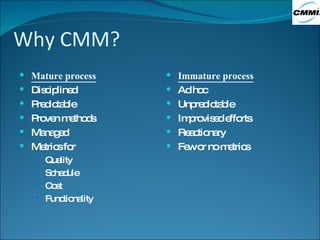
Why CMM?  Mature process Disciplined Predictable Proven methods Managed Metrics for Quality Schedule Cost Functionality Immature process Ad hoc Unpredictable Improvised efforts Reactionary Few or no metrics
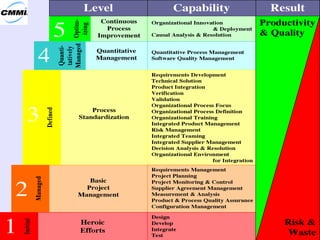
CMM Organization Evolutionary path to increase software process maturity Guide organizations in selecting improvement strategies Small but continuous improvements Descriptive, not prescriptive Describes goals but not how to achieve them Maturity characterized in five levels
CMM Components Maturity levels Process capabilities Key process areas Goals and common features Key practices
 
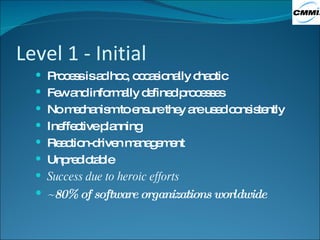
Level 1 - Initial Process is ad hoc, occasionally chaotic Few and informally defined processes No mechanism to ensure they are used consistently Ineffective planning Reaction-driven management Unpredictable Success due to heroic efforts ~80% of software organizations worldwide
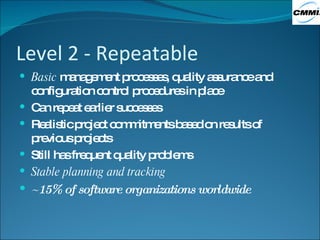
Level 2 - Repeatable Basic  management processes, quality assurance and configuration control procedures in place  Can repeat earlier successes  Realistic project commitments based on results of previous projects Still has frequent quality problems Stable planning and tracking ~15% of software organizations worldwide
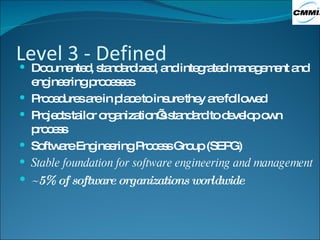
Level 3 - Defined Documented, standardized, and integrated management and engineering processes Procedures are in place to insure they are followed Projects tailor organization’s standard to develop own process Software Engineering Process Group (SEPG) Stable foundation for software engineering and management ~5% of software organizations worldwide
Level 4 - Managed Quality and performance is measured using metrics and can be predicted Quality and productivity  quantitative  goals are established Exceptional cases are identified and addressed Challenge of new domains can be managed Process is measured and operates within limits < 1% of software organizations worldwide
Level 5 - Optimizing Organization focuses on continuous process improvement Goal is to address and prevent problems by analyzing their cause in the process Process improvement is budgeted, planned, and part of the organization’s process Identify and quickly transfer best practices Only a handful of organizations worldwide
Key Process Areas (KPA) Issues to address to reach each maturity level Related activities for achieving goals
Key Process Areas—Repeatable(2) Requirements management Software project planning Software project tracking and oversight Software quality assurance Software configuration management Software subcontract management
Key Process Areas—Defined (3) Organization process focus Organization process definition Training program Integrated software management Software product engineering Intergroup coordination Peer reviews
Key Process Areas—Managed (4) Quantitative process management Software quality management
Key Process Areas—Optimized(5) Defect prevention Technology change management Process change management
CMM outcomes Fewer project overruns Better cost prediction (dollars, time) Predicted performance improvements
CMM in practice Raytheon 7.7:1 return on investment, savings of $4.48M Elimination of $15.8M in rework costs Twofold increase in productivity Hughes Aircraft Initially Level 2, progressed to Level 3 ~$45K for assessment, ~$400K to improve 5:1 ratio of ROI Annual savings of approximately $2M Decreased risk of missing cost and schedule estimates Improved quality of work life (less overtime) Tinker Air Force Base 6:1 ratio of ROI Savings of $3.8M for $0.64M investment
Drawbacks of CMM Lack of innovation? CMM says what you need, not how to do it Usually because processes done wrong Processes are supposed to routinize mundane aspects of work so you can focus on interesting aspects Do it right, and do it right once Even Microsoft has well defined processes, estimates itself to be at Level 3
Drawbacks of CMM (cont.) Two common complaints about CMM Does not focus on good design Does not focus on good people However, these are not the goals of CMM! Other models have been developed P-CMM (People Capability Maturity Model) Team Capability Maturity Model PSP - Personal Software Process
Drawbacks of CMM (cont.) Describes what an organization should have, does not say how to get there Clearly defined process != good process Favors narrow maintenance processes over innovative ones Process Assessment flaws Statistical problems, sparse coverage, process risk
Conclusions Conclusion
Thank You

Capability Maturity Model (CMM)

  • 1.
    Presented by AliSadhik Shaik BE (ECE), PGDVLSI, PGDISA, MBA (IS) [email_address] The Capability Maturity Model (CMM)
  • 2.
    Agenda Processes TheSoftware Crisis The Capability Maturity Model (CMM) Drawbacks of CMM Conclusions
  • 3.
    Let us playa game?
  • 4.
  • 5.
    Some Answers... Greatpeople Smart management Better tools Good processes, standards and policies that all team members know and follow
  • 6.
    The Software CrisisSoftware is late, over budget, and low quality “ Software Engineering” was coined in 1960s to apply engineering practices to software Third generation of hardware more powerful, led to larger systems Need new techniques and methods to control complexity
  • 7.
    Some Current StatisticsProgrammers tend to underestimate their tasks by 20 to 30% (van Genuchten 1991) The average small-project estimate is off by more than 100 % (Standish Group 1994) The average large project is a year late (Jones 1994)
  • 8.
    SEI-CMM Software EngineeringInstitute Capability Maturity Model (SEI-CMM, or CMM) CMM was developed by SEI at the request of the DoD in 1987 Based on Statistical quality control (Deming’s TQM, Juran) Quality management (Crosby) Feedback from industry and government projects
  • 9.
    Why CMM? Governmentneeds predictability time, cost, quality Premises The process of constructing software can be defined, managed, measured, and progressively improved In a mature and adaptable process, people, methods, techniques, and technology are coupled to consistently produce quality software
  • 10.
    Why CMM? Mature process Disciplined Predictable Proven methods Managed Metrics for Quality Schedule Cost Functionality Immature process Ad hoc Unpredictable Improvised efforts Reactionary Few or no metrics
  • 11.
    CMM Organization Evolutionarypath to increase software process maturity Guide organizations in selecting improvement strategies Small but continuous improvements Descriptive, not prescriptive Describes goals but not how to achieve them Maturity characterized in five levels
  • 12.
    CMM Components Maturitylevels Process capabilities Key process areas Goals and common features Key practices
  • 13.
  • 14.
    Level 1 -Initial Process is ad hoc, occasionally chaotic Few and informally defined processes No mechanism to ensure they are used consistently Ineffective planning Reaction-driven management Unpredictable Success due to heroic efforts ~80% of software organizations worldwide
  • 15.
    Level 2 -Repeatable Basic management processes, quality assurance and configuration control procedures in place Can repeat earlier successes Realistic project commitments based on results of previous projects Still has frequent quality problems Stable planning and tracking ~15% of software organizations worldwide
  • 16.
    Level 3 -Defined Documented, standardized, and integrated management and engineering processes Procedures are in place to insure they are followed Projects tailor organization’s standard to develop own process Software Engineering Process Group (SEPG) Stable foundation for software engineering and management ~5% of software organizations worldwide
  • 17.
    Level 4 -Managed Quality and performance is measured using metrics and can be predicted Quality and productivity quantitative goals are established Exceptional cases are identified and addressed Challenge of new domains can be managed Process is measured and operates within limits < 1% of software organizations worldwide
  • 18.
    Level 5 -Optimizing Organization focuses on continuous process improvement Goal is to address and prevent problems by analyzing their cause in the process Process improvement is budgeted, planned, and part of the organization’s process Identify and quickly transfer best practices Only a handful of organizations worldwide
  • 19.
    Key Process Areas(KPA) Issues to address to reach each maturity level Related activities for achieving goals
  • 20.
    Key Process Areas—Repeatable(2)Requirements management Software project planning Software project tracking and oversight Software quality assurance Software configuration management Software subcontract management
  • 21.
    Key Process Areas—Defined(3) Organization process focus Organization process definition Training program Integrated software management Software product engineering Intergroup coordination Peer reviews
  • 22.
    Key Process Areas—Managed(4) Quantitative process management Software quality management
  • 23.
    Key Process Areas—Optimized(5)Defect prevention Technology change management Process change management
  • 24.
    CMM outcomes Fewerproject overruns Better cost prediction (dollars, time) Predicted performance improvements
  • 25.
    CMM in practiceRaytheon 7.7:1 return on investment, savings of $4.48M Elimination of $15.8M in rework costs Twofold increase in productivity Hughes Aircraft Initially Level 2, progressed to Level 3 ~$45K for assessment, ~$400K to improve 5:1 ratio of ROI Annual savings of approximately $2M Decreased risk of missing cost and schedule estimates Improved quality of work life (less overtime) Tinker Air Force Base 6:1 ratio of ROI Savings of $3.8M for $0.64M investment
  • 26.
    Drawbacks of CMMLack of innovation? CMM says what you need, not how to do it Usually because processes done wrong Processes are supposed to routinize mundane aspects of work so you can focus on interesting aspects Do it right, and do it right once Even Microsoft has well defined processes, estimates itself to be at Level 3
  • 27.
    Drawbacks of CMM(cont.) Two common complaints about CMM Does not focus on good design Does not focus on good people However, these are not the goals of CMM! Other models have been developed P-CMM (People Capability Maturity Model) Team Capability Maturity Model PSP - Personal Software Process
  • 28.
    Drawbacks of CMM(cont.) Describes what an organization should have, does not say how to get there Clearly defined process != good process Favors narrow maintenance processes over innovative ones Process Assessment flaws Statistical problems, sparse coverage, process risk
  • 29.
  • 30.