Arbab Raza Badar Waseer
15-glc-423
M.Sc I.T 2nd
University of Sargodha,
Lyallpur Campus Faisalabad
•007 •Slide 1 of 146
CMMI
Overview
Usman Rafi
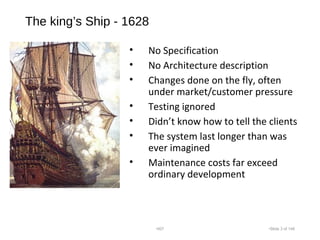
The king’s Ship - 1628
• No Specification
• No Architecture description
• Changes done on the fly, often
under market/customer pressure
• Testing ignored
• Didn’t know how to tell the clients
• The system last longer than was
ever imagined
• Maintenance costs far exceed
ordinary development
•007 •Slide 3 of 146
Underlying principle of Process Improvement
“The quality of a product is
determined by the quality
of the process that is used
to develop and maintain
it.”
•007 •Slide 4 of 146
What is CMMI?
•CMMI (Capability Maturity Model Integration) is a
proven industry framework to improve product
quality and development efficiency for both
hardware and software
• Sponsored by US Department of Defense in cooperation
with Carnegie Mellon University and the Software
Engineering Institute (SEI)
• Many other companies involved in CMMI definition such
as Motorola and Ericsson
• CMMI has been established as a model to improve
business results
•CMMI, staged, uses 5 levels to describe the
maturity of the organization.
• Vastly improved version of the CMM
• Emphasis on business needs, integration.
•007 •Slide 5 of 146
How can CMMI help?
•CMMI provides a way to focus and manage
hardware and software development from
product beginning through deployment and
maintenance.
•CMMI is a process improvement
model
•Initially a lot of investment required – but, if
properly managed, we will be more efficient
and productive while turning out products
with consistently higher quality.
•007 •Slide 6 of 146
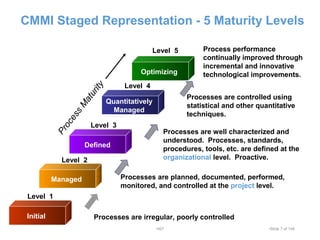
CMMI Staged Representation - 5 Maturity Levels
Level 5
Initial
Level 1
Processes are irregular, poorly controlled
Managed
Level 2
Processes are planned, documented, performed,
monitored, and controlled at the project level.
Defined
Level 3
Processes are well characterized and
understood. Processes, standards,
procedures, tools, etc. are defined at the
organizational level. Proactive.
Quantitatively
Managed
Level 4
Processes are controlled using
statistical and other quantitative
techniques.
Optimizing
ProcessM
aturity
Process performance
continually improved through
incremental and innovative
technological improvements.
•007 •Slide 7 of 146
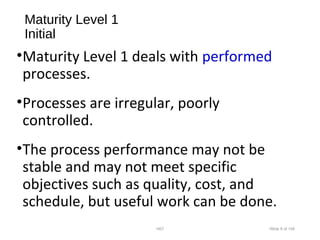
Maturity Level 1
Initial
•Maturity Level 1 deals with performed
processes.
•Processes are irregular, poorly
controlled.
•The process performance may not be
stable and may not meet specific
objectives such as quality, cost, and
schedule, but useful work can be done.
•007 •Slide 8 of 146
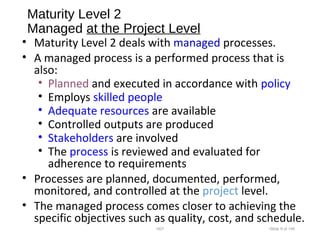
Maturity Level 2
Managed at the Project Level
• Maturity Level 2 deals with managed processes.
• A managed process is a performed process that is
also:
• Planned and executed in accordance with policy
• Employs skilled people
• Adequate resources are available
• Controlled outputs are produced
• Stakeholders are involved
• The process is reviewed and evaluated for
adherence to requirements
• Processes are planned, documented, performed,
monitored, and controlled at the project level.
• The managed process comes closer to achieving the
specific objectives such as quality, cost, and schedule.
•007 •Slide 9 of 146
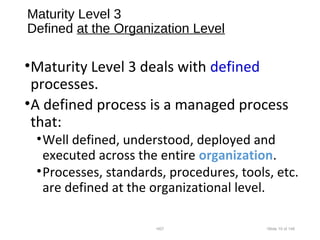
Maturity Level 3
Defined at the Organization Level
•Maturity Level 3 deals with defined
processes.
•A defined process is a managed process
that:
•Well defined, understood, deployed and
executed across the entire organization.
•Processes, standards, procedures, tools, etc.
are defined at the organizational level.
•007 •Slide 10 of 146
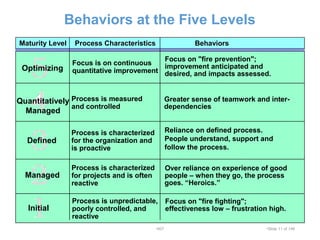
Behaviors at the Five Levels
Initial
Managed
Defined
Quantitatively
Managed
Optimizing
Process is unpredictable,
poorly controlled, and
reactive
Process is characterized
for projects and is often
reactive
Process is characterized
for the organization and
is proactive
Process is measured
and controlled
Focus is on continuous
quantitative improvement
Maturity Level Process Characteristics Behaviors
Focus on "fire prevention";
improvement anticipated and
desired, and impacts assessed.
Greater sense of teamwork and inter-
dependencies
Reliance on defined process.
People understand, support and
follow the process.
Over reliance on experience of good
people – when they go, the process
goes. “Heroics.”
Focus on "fire fighting";
effectiveness low – frustration high.
•007 •Slide 11 of 146
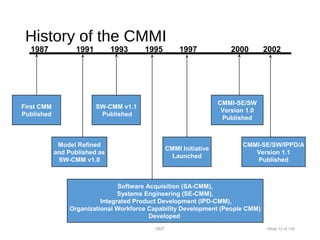
History of the CMMI
1987 1991 1995 1997 2000 2002
First CMM
Published
Model Refined
and Published as
SW-CMM v1.0
SW-CMM v1.1
Published
1993
Software Acquisition (SA-CMM),
Systems Engineering (SE-CMM),
Integrated Product Development (IPD-CMM),
Organizational Workforce Capability Development (People CMM)
Developed
CMMI Initiative
Launched
CMMI-SE/SW
Version 1.0
Published
CMMI-SE/SW/IPPD/A
Version 1.1
Published
•007 •Slide 12 of 146

Ch 13 s.e cmmi

  • 1.
    Arbab Raza BadarWaseer 15-glc-423 M.Sc I.T 2nd University of Sargodha, Lyallpur Campus Faisalabad •007 •Slide 1 of 146
  • 2.
  • 3.
    The king’s Ship- 1628 • No Specification • No Architecture description • Changes done on the fly, often under market/customer pressure • Testing ignored • Didn’t know how to tell the clients • The system last longer than was ever imagined • Maintenance costs far exceed ordinary development •007 •Slide 3 of 146
  • 4.
    Underlying principle ofProcess Improvement “The quality of a product is determined by the quality of the process that is used to develop and maintain it.” •007 •Slide 4 of 146
  • 5.
    What is CMMI? •CMMI(Capability Maturity Model Integration) is a proven industry framework to improve product quality and development efficiency for both hardware and software • Sponsored by US Department of Defense in cooperation with Carnegie Mellon University and the Software Engineering Institute (SEI) • Many other companies involved in CMMI definition such as Motorola and Ericsson • CMMI has been established as a model to improve business results •CMMI, staged, uses 5 levels to describe the maturity of the organization. • Vastly improved version of the CMM • Emphasis on business needs, integration. •007 •Slide 5 of 146
  • 6.
    How can CMMIhelp? •CMMI provides a way to focus and manage hardware and software development from product beginning through deployment and maintenance. •CMMI is a process improvement model •Initially a lot of investment required – but, if properly managed, we will be more efficient and productive while turning out products with consistently higher quality. •007 •Slide 6 of 146
  • 7.
    CMMI Staged Representation- 5 Maturity Levels Level 5 Initial Level 1 Processes are irregular, poorly controlled Managed Level 2 Processes are planned, documented, performed, monitored, and controlled at the project level. Defined Level 3 Processes are well characterized and understood. Processes, standards, procedures, tools, etc. are defined at the organizational level. Proactive. Quantitatively Managed Level 4 Processes are controlled using statistical and other quantitative techniques. Optimizing ProcessM aturity Process performance continually improved through incremental and innovative technological improvements. •007 •Slide 7 of 146
  • 8.
    Maturity Level 1 Initial •MaturityLevel 1 deals with performed processes. •Processes are irregular, poorly controlled. •The process performance may not be stable and may not meet specific objectives such as quality, cost, and schedule, but useful work can be done. •007 •Slide 8 of 146
  • 9.
    Maturity Level 2 Managedat the Project Level • Maturity Level 2 deals with managed processes. • A managed process is a performed process that is also: • Planned and executed in accordance with policy • Employs skilled people • Adequate resources are available • Controlled outputs are produced • Stakeholders are involved • The process is reviewed and evaluated for adherence to requirements • Processes are planned, documented, performed, monitored, and controlled at the project level. • The managed process comes closer to achieving the specific objectives such as quality, cost, and schedule. •007 •Slide 9 of 146
  • 10.
    Maturity Level 3 Definedat the Organization Level •Maturity Level 3 deals with defined processes. •A defined process is a managed process that: •Well defined, understood, deployed and executed across the entire organization. •Processes, standards, procedures, tools, etc. are defined at the organizational level. •007 •Slide 10 of 146
  • 11.
    Behaviors at theFive Levels Initial Managed Defined Quantitatively Managed Optimizing Process is unpredictable, poorly controlled, and reactive Process is characterized for projects and is often reactive Process is characterized for the organization and is proactive Process is measured and controlled Focus is on continuous quantitative improvement Maturity Level Process Characteristics Behaviors Focus on "fire prevention"; improvement anticipated and desired, and impacts assessed. Greater sense of teamwork and inter- dependencies Reliance on defined process. People understand, support and follow the process. Over reliance on experience of good people – when they go, the process goes. “Heroics.” Focus on "fire fighting"; effectiveness low – frustration high. •007 •Slide 11 of 146
  • 12.
    History of theCMMI 1987 1991 1995 1997 2000 2002 First CMM Published Model Refined and Published as SW-CMM v1.0 SW-CMM v1.1 Published 1993 Software Acquisition (SA-CMM), Systems Engineering (SE-CMM), Integrated Product Development (IPD-CMM), Organizational Workforce Capability Development (People CMM) Developed CMMI Initiative Launched CMMI-SE/SW Version 1.0 Published CMMI-SE/SW/IPPD/A Version 1.1 Published •007 •Slide 12 of 146