Level Integration and
it’s Level
PRESENTED BY ENG: SYED MINHAL ZAFAR ZAIDI
ENG: IRSHAD AHMED SOOMRO
Capability Maturity
What is CMMI ?
CMMI Capability Maturity Model Integration
• The Capability Maturity Model Integration, or CMMI, is a process
model that provides a clear definition of what an organization should
do to promote behaviors that lead to improved performance. With five
“Maturity Levels” or three “Capability Levels,” the CMMI defines the
most important elements that are required to build great products, or
deliver great services, and wraps them all up in a comprehensive
model.
The CMMI helps us understand the answer to the question “how do
we know?”
• How do we know what we are good at?
• How do we know if we’re improving?
• How do we know if the process we use is working well?
• How do we know if our requirements change process is useful?
• How do we know if our products are as good as they can be?
Main Goals of CMMI
History
• The CMMI was developed at the Software Engineering
Institute at Carnegie Mellon University with representation
from defense, industry, government, and academia, and is
now operated and maintained by the CMMI Institute, an
operating unit of CMU. It is the successor of the popular
Software CMM, or SW-CMM. The are multiple “flavors” of
the CMMI, called “Constellations,” that include CMMI for
Development (CMMI-DEV), CMMI for Services (CMMI-
SVC), and CMMI for Acquisition (CMMI-ACQ).
CMMI Maturity Levels
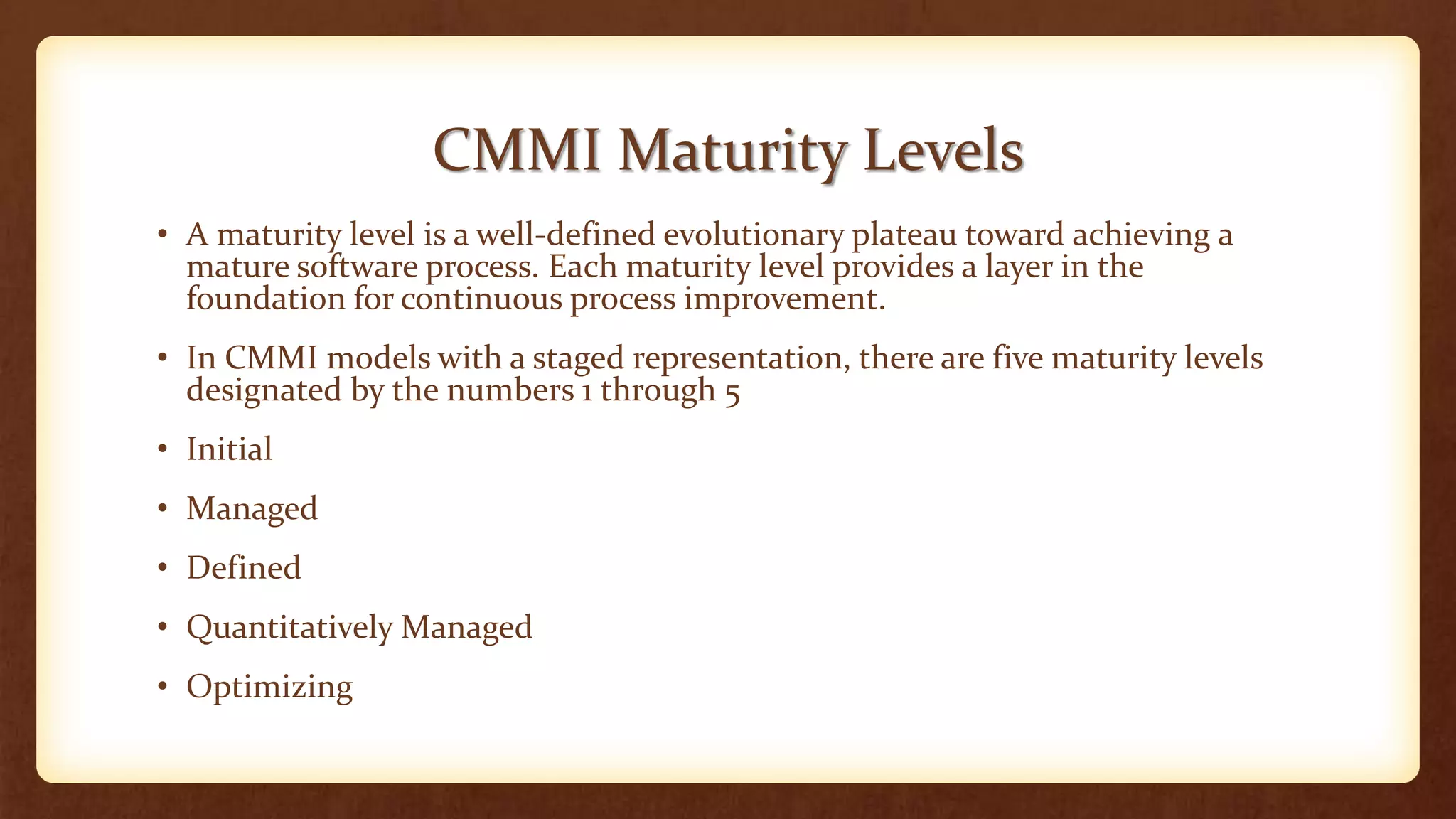
• A maturity level is a well-defined evolutionary plateau toward achieving a
mature software process. Each maturity level provides a layer in the
foundation for continuous process improvement.
• In CMMI models with a staged representation, there are five maturity levels
designated by the numbers 1 through 5
• Initial
• Managed
• Defined
• Quantitatively Managed
• Optimizing
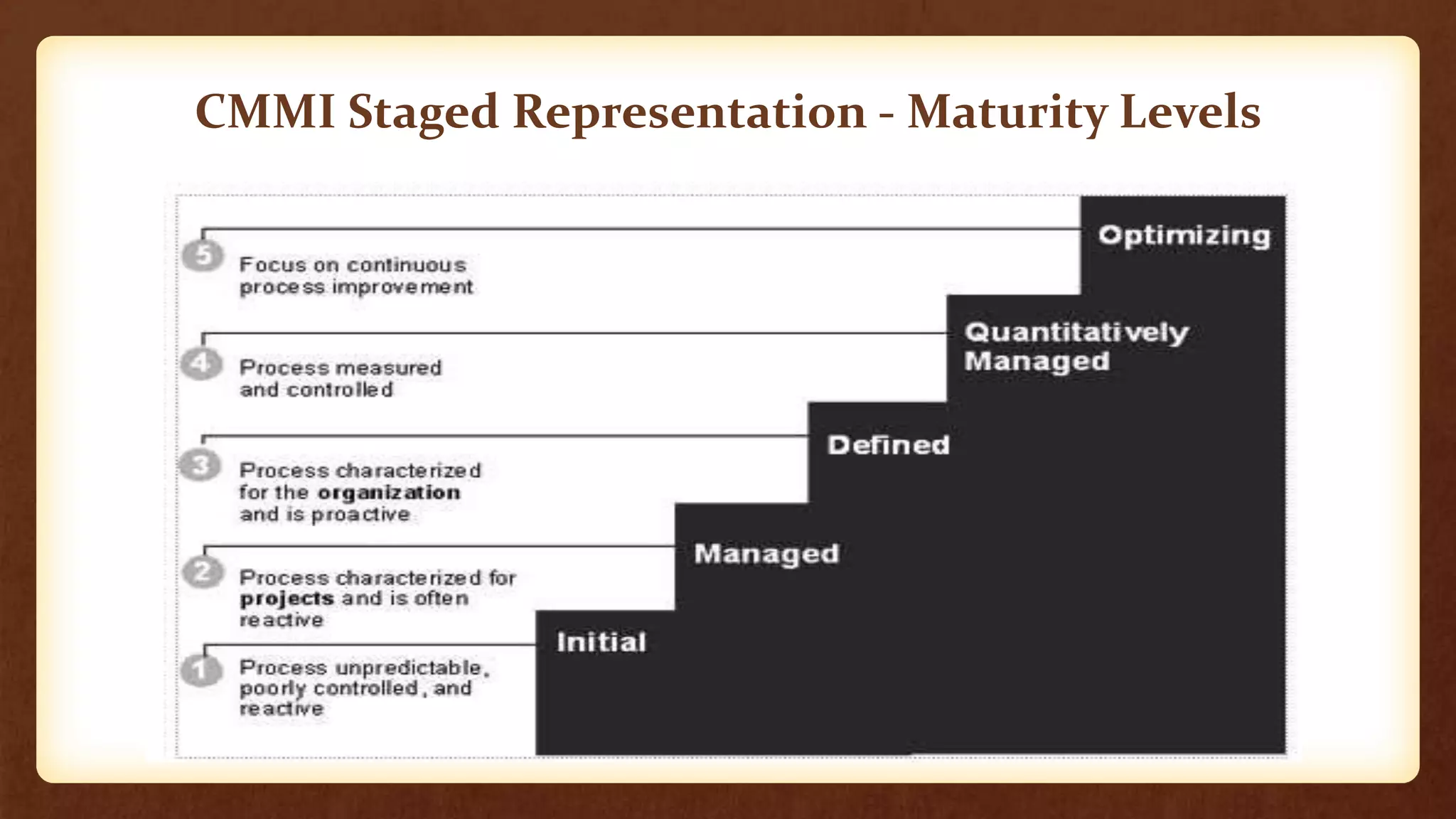
CMMI Staged Representation - Maturity Levels
Level 1 – Initial
Anything at all. Ad-hoc and chaotic. Will have some
successes, but will also have failures and badly missed
deadlines.
 Team tackles projects in different ways each time
 Can have strong successes, but may not repeat
 Some time/cost estimates are accurate, many far off
 Success comes from smart people doing the right things
 Hard to recover from good people leaving
 Most SW development organizations are Level 1.
Level 2 – Repeatable
Software processes are defined, documented, practiced,
and people are trained in them. Groups across an
organization may use different processes.
• Requirements management
• Software project planning
• Project tracking and oversight
• Subcontracts management
• Quality assurance
• Configuration management
Level 3 – Defined
Software processes are consistent and known across the
whole organization.
• Organization-wide process focus
• Organization-wide process definition
• Training program in above
• Integrated software management (above applied per project)
• Software product engineering (coding, etc.)
• Inter-group coordination
• Peer reviews
Level 4 – Managed
Software processes and results are measured quantitatively, and
processes are evaluated with this data.
• Quantitative process management (data gathering)
• Quality management (data-driven quality improvement)
Level 5 – Optimizing
Continuous process improvement. Experimenting with new
methods and technologies. Change processes when find
something that works better.
• Defect prevention
• Technology change management (bring in new methods)
• Process change management (improve processes)
• The optimizing level (Level 5) is not the destination of process management.
• The destination is better products for a better price: economic survival
• The optimizing level is a foundation for building an ever-improving capability.

Cmmi and its level

  • 1.
    Level Integration and it’sLevel PRESENTED BY ENG: SYED MINHAL ZAFAR ZAIDI ENG: IRSHAD AHMED SOOMRO Capability Maturity
  • 2.
    What is CMMI? CMMI Capability Maturity Model Integration • The Capability Maturity Model Integration, or CMMI, is a process model that provides a clear definition of what an organization should do to promote behaviors that lead to improved performance. With five “Maturity Levels” or three “Capability Levels,” the CMMI defines the most important elements that are required to build great products, or deliver great services, and wraps them all up in a comprehensive model.
  • 3.
    The CMMI helpsus understand the answer to the question “how do we know?” • How do we know what we are good at? • How do we know if we’re improving? • How do we know if the process we use is working well? • How do we know if our requirements change process is useful? • How do we know if our products are as good as they can be? Main Goals of CMMI
  • 4.
    History • The CMMIwas developed at the Software Engineering Institute at Carnegie Mellon University with representation from defense, industry, government, and academia, and is now operated and maintained by the CMMI Institute, an operating unit of CMU. It is the successor of the popular Software CMM, or SW-CMM. The are multiple “flavors” of the CMMI, called “Constellations,” that include CMMI for Development (CMMI-DEV), CMMI for Services (CMMI- SVC), and CMMI for Acquisition (CMMI-ACQ).
  • 5.
    CMMI Maturity Levels •A maturity level is a well-defined evolutionary plateau toward achieving a mature software process. Each maturity level provides a layer in the foundation for continuous process improvement. • In CMMI models with a staged representation, there are five maturity levels designated by the numbers 1 through 5 • Initial • Managed • Defined • Quantitatively Managed • Optimizing
  • 6.
    CMMI Staged Representation- Maturity Levels
  • 7.
    Level 1 –Initial Anything at all. Ad-hoc and chaotic. Will have some successes, but will also have failures and badly missed deadlines.  Team tackles projects in different ways each time  Can have strong successes, but may not repeat  Some time/cost estimates are accurate, many far off  Success comes from smart people doing the right things  Hard to recover from good people leaving  Most SW development organizations are Level 1.
  • 8.
    Level 2 –Repeatable Software processes are defined, documented, practiced, and people are trained in them. Groups across an organization may use different processes. • Requirements management • Software project planning • Project tracking and oversight • Subcontracts management • Quality assurance • Configuration management
  • 9.
    Level 3 –Defined Software processes are consistent and known across the whole organization. • Organization-wide process focus • Organization-wide process definition • Training program in above • Integrated software management (above applied per project) • Software product engineering (coding, etc.) • Inter-group coordination • Peer reviews
  • 10.
    Level 4 –Managed Software processes and results are measured quantitatively, and processes are evaluated with this data. • Quantitative process management (data gathering) • Quality management (data-driven quality improvement)
  • 11.
    Level 5 –Optimizing Continuous process improvement. Experimenting with new methods and technologies. Change processes when find something that works better. • Defect prevention • Technology change management (bring in new methods) • Process change management (improve processes) • The optimizing level (Level 5) is not the destination of process management. • The destination is better products for a better price: economic survival • The optimizing level is a foundation for building an ever-improving capability.