CERTIFICATION
CMMI
Introduction
 CMMI (Capability Maturity Model Integration) is a proven
industry framework to improve product quality and
development efficiency for both hardware and software
 CMMI, staged, uses 5 levels to describe the maturity of the
organization
 CMMI has been established as a model to improve business
results
Different Levels
of CMMI
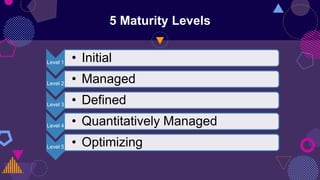
5 Maturity Levels
Level 1 • Initial
Level 2 • Managed
Level 3 • Defined
Level 4 • Quantitatively Managed
Level 5 • Optimizing
CMMI helps in:
 CMMI provides a way to focus and manage
hardware and software development from product
inception through deployment and maintenance.
 Initially a lot of investment required but, if properly
managed, we will be more efficient and productive
while turning out products with consistently higher
quality.
Brief about different
CMMI level
 Level 1 (Initial)
Processes are unpredictable, poorly controlled,
reactive
 Level 2 (Managed)
Processes are planned, documented, performed,
monitored, and controlled at the project level.
Brief about different CMMI
level
 Level 3 (Defined)
Processes are well characterized and understood.
Processes, standards, procedures, tools, etc. are
defined at the organizational level.
 Level 4 (Quantitatively Managed)
Processes are controlled using statistical and other
quantitative techniques.
Brief about different CMMI
level
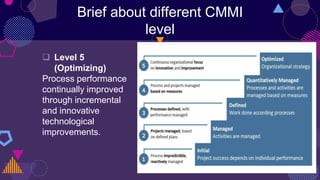
 Level 5
(Optimizing)
Process performance
continually improved
through incremental
and innovative
technological
improvements.
CMMI Level 1
CMMI Level 1
 Maturity Level 1 deals with performed
processes.
 Processes are unpredictable, poorly controlled,
reactive.
 The process performance may not be stable
and may not meet specific objectives such as
quality, cost, and schedule, but useful work can
be done.
Why not CMMI Level 1
 It is distinctive of processes at this level that processes are
typically undocumented and in a state of lively change,
tending to be driven in an ad hoc basis (Need based
process), uncontrolled and reactive manner by users or
events / requirements.
 This provides a confused or wobbly environment for the
processes.
Why not CMMI Level 1
 This state can even be identified by the organisation via
internal audit itself. There is no need for third party audit for
the Level 1.
 Even not having certification is better option than
acquiring CMMI Level 1.
CMMI Level 2
CMMI Level 2
 It is characteristic of processes at this level that some
processes are repeatable, possibly with consistent
results.
 Process discipline is unlikely to be rigorous, but where it
exists it may help to ensure that existing processes are
maintained during times of stress.
CMMI Level 2
 Organisation may perform its task in efficient manner, but
it reflect that organisation may not handle the different
task simultaneously.
 Such organisation may requires time to establish the
system in the organisation to handle new task
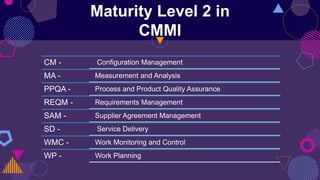
Maturity Level 2 in
CMMI
CM - Configuration Management
MA - Measurement and Analysis
PPQA - Process and Product Quality Assurance
REQM - Requirements Management
SAM - Supplier Agreement Management
SD - Service Delivery
WMC - Work Monitoring and Control
WP - Work Planning
CMMI Level 3
CMMI Level 3
 This means that organization’s engineering processes are defined
for process areas such as Decision Analysis and Resolution,
Integrated Project Management, Organizational Process Definition,
Organizational Training, etc.
 Rating for Maturity Levels are awarded for levels 2 through 5.
◍Note:
That the CMMI is not intended as a ranking system, however. The CMMI is a model that
guides us on how to be a great products and engineering company.
Maturity Level 3 in
CMMI
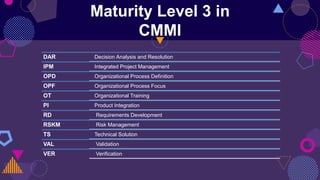
DAR Decision Analysis and Resolution
IPM Integrated Project Management
OPD Organizational Process Definition
OPF Organizational Process Focus
OT Organizational Training
PI Product Integration
RD Requirements Development
RSKM Risk Management
TS Technical Solution
VAL Validation
VER Verification
CMMI Level 4
CMMI Level 4
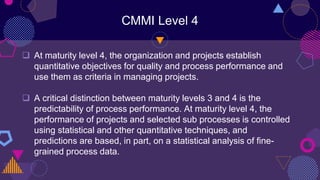
 At maturity level 4, the organization and projects establish
quantitative objectives for quality and process performance and
use them as criteria in managing projects.
 A critical distinction between maturity levels 3 and 4 is the
predictability of process performance. At maturity level 4, the
performance of projects and selected sub processes is controlled
using statistical and other quantitative techniques, and
predictions are based, in part, on a statistical analysis of fine-
grained process data.
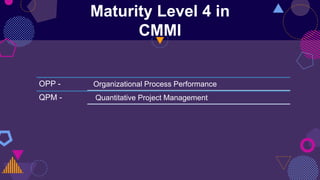
Maturity Level 4 in
CMMI
OPP - Organizational Process Performance
QPM - Quantitative Project Management
CMMI Level 5
CMMI Level 5
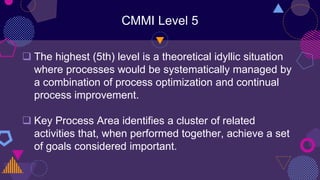
 The highest (5th) level is a theoretical idyllic situation
where processes would be systematically managed by
a combination of process optimization and continual
process improvement.
 Key Process Area identifies a cluster of related
activities that, when performed together, achieve a set
of goals considered important.
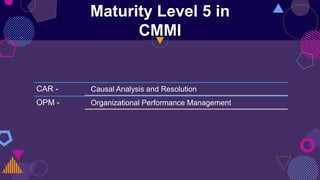
Maturity Level 5 in
CMMI
CAR - Causal Analysis and Resolution
OPM - Organizational Performance Management
Benefits of
CMMI Level
BENEFITS OF IMPLEMENTING
CMMI
 Principles for maintaining Quality in projects starts in the
mind of the subordinate programmers to the senior
programmers and project managers.
 Centralized QMS for implementation in projects to ensure
uniformity in the documentation which means less learning
cycle for new resources, improved management of project
status.
 Integration of Software Engineering Best Practices in the
Organizations as described in CMMI Model.
Benefits of implementing CMMI in
an IT / Software Development
Organization
 Market Demand
 Performance Demand
 Process Improvement
 Cost saving in terms of lesser effort due to less defects and less
rework.
 This also results in increased Productivity
 On-Time Deliveries
 Increased Customer Satisfaction
 Consistency
 Overall increased Return on Investment
 Decreased Costs
Disadvantage of
CMMI
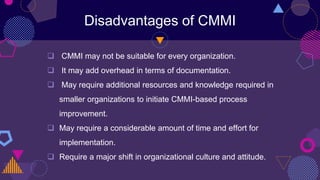
Disadvantages of CMMI
 CMMI may not be suitable for every organization.
 It may add overhead in terms of documentation.
 May require additional resources and knowledge required in
smaller organizations to initiate CMMI-based process
improvement.
 May require a considerable amount of time and effort for
implementation.
 Require a major shift in organizational culture and attitude.
Procedure
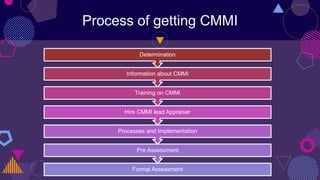
Process of getting CMMI
Formal Assessment
Pre Assessment
Processes and Implementation
Hire CMMI lead Appraiser
Training on CMMI
Information about CMMI
Determination
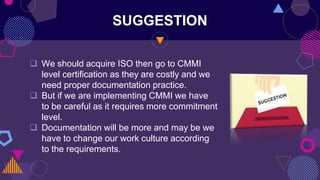
SUGGESTION
 We should acquire ISO then go to CMMI
level certification as they are costly and we
need proper documentation practice.
 But if we are implementing CMMI we have
to be careful as it requires more commitment
level.
 Documentation will be more and may be we
have to change our work culture according
to the requirements.
Thank You
Presentation By:
Akshat Gupta

CMMI Certification (Level 1-5)

  • 1.
  • 2.
    Introduction  CMMI (CapabilityMaturity Model Integration) is a proven industry framework to improve product quality and development efficiency for both hardware and software  CMMI, staged, uses 5 levels to describe the maturity of the organization  CMMI has been established as a model to improve business results
  • 3.
  • 4.
    5 Maturity Levels Level1 • Initial Level 2 • Managed Level 3 • Defined Level 4 • Quantitatively Managed Level 5 • Optimizing
  • 5.
    CMMI helps in: CMMI provides a way to focus and manage hardware and software development from product inception through deployment and maintenance.  Initially a lot of investment required but, if properly managed, we will be more efficient and productive while turning out products with consistently higher quality.
  • 6.
    Brief about different CMMIlevel  Level 1 (Initial) Processes are unpredictable, poorly controlled, reactive  Level 2 (Managed) Processes are planned, documented, performed, monitored, and controlled at the project level.
  • 7.
    Brief about differentCMMI level  Level 3 (Defined) Processes are well characterized and understood. Processes, standards, procedures, tools, etc. are defined at the organizational level.  Level 4 (Quantitatively Managed) Processes are controlled using statistical and other quantitative techniques.
  • 8.
    Brief about differentCMMI level  Level 5 (Optimizing) Process performance continually improved through incremental and innovative technological improvements.
  • 9.
  • 10.
    CMMI Level 1 Maturity Level 1 deals with performed processes.  Processes are unpredictable, poorly controlled, reactive.  The process performance may not be stable and may not meet specific objectives such as quality, cost, and schedule, but useful work can be done.
  • 11.
    Why not CMMILevel 1  It is distinctive of processes at this level that processes are typically undocumented and in a state of lively change, tending to be driven in an ad hoc basis (Need based process), uncontrolled and reactive manner by users or events / requirements.  This provides a confused or wobbly environment for the processes.
  • 12.
    Why not CMMILevel 1  This state can even be identified by the organisation via internal audit itself. There is no need for third party audit for the Level 1.  Even not having certification is better option than acquiring CMMI Level 1.
  • 13.
  • 14.
    CMMI Level 2 It is characteristic of processes at this level that some processes are repeatable, possibly with consistent results.  Process discipline is unlikely to be rigorous, but where it exists it may help to ensure that existing processes are maintained during times of stress.

  • 15.
    CMMI Level 2 Organisation may perform its task in efficient manner, but it reflect that organisation may not handle the different task simultaneously.  Such organisation may requires time to establish the system in the organisation to handle new task
  • 16.
    Maturity Level 2in CMMI CM - Configuration Management MA - Measurement and Analysis PPQA - Process and Product Quality Assurance REQM - Requirements Management SAM - Supplier Agreement Management SD - Service Delivery WMC - Work Monitoring and Control WP - Work Planning
  • 17.
  • 18.
    CMMI Level 3 This means that organization’s engineering processes are defined for process areas such as Decision Analysis and Resolution, Integrated Project Management, Organizational Process Definition, Organizational Training, etc.  Rating for Maturity Levels are awarded for levels 2 through 5. ◍Note: That the CMMI is not intended as a ranking system, however. The CMMI is a model that guides us on how to be a great products and engineering company.
  • 19.
    Maturity Level 3in CMMI DAR Decision Analysis and Resolution IPM Integrated Project Management OPD Organizational Process Definition OPF Organizational Process Focus OT Organizational Training PI Product Integration RD Requirements Development RSKM Risk Management TS Technical Solution VAL Validation VER Verification
  • 20.
  • 21.
    CMMI Level 4 At maturity level 4, the organization and projects establish quantitative objectives for quality and process performance and use them as criteria in managing projects.  A critical distinction between maturity levels 3 and 4 is the predictability of process performance. At maturity level 4, the performance of projects and selected sub processes is controlled using statistical and other quantitative techniques, and predictions are based, in part, on a statistical analysis of fine- grained process data.
  • 22.
    Maturity Level 4in CMMI OPP - Organizational Process Performance QPM - Quantitative Project Management
  • 23.
  • 24.
    CMMI Level 5 The highest (5th) level is a theoretical idyllic situation where processes would be systematically managed by a combination of process optimization and continual process improvement.  Key Process Area identifies a cluster of related activities that, when performed together, achieve a set of goals considered important.
  • 25.
    Maturity Level 5in CMMI CAR - Causal Analysis and Resolution OPM - Organizational Performance Management
  • 26.
  • 27.
    BENEFITS OF IMPLEMENTING CMMI Principles for maintaining Quality in projects starts in the mind of the subordinate programmers to the senior programmers and project managers.  Centralized QMS for implementation in projects to ensure uniformity in the documentation which means less learning cycle for new resources, improved management of project status.  Integration of Software Engineering Best Practices in the Organizations as described in CMMI Model.
  • 28.
    Benefits of implementingCMMI in an IT / Software Development Organization  Market Demand  Performance Demand  Process Improvement  Cost saving in terms of lesser effort due to less defects and less rework.  This also results in increased Productivity  On-Time Deliveries  Increased Customer Satisfaction  Consistency  Overall increased Return on Investment  Decreased Costs
  • 29.
  • 30.
    Disadvantages of CMMI CMMI may not be suitable for every organization.  It may add overhead in terms of documentation.  May require additional resources and knowledge required in smaller organizations to initiate CMMI-based process improvement.  May require a considerable amount of time and effort for implementation.  Require a major shift in organizational culture and attitude.
  • 31.
  • 32.
    Process of gettingCMMI Formal Assessment Pre Assessment Processes and Implementation Hire CMMI lead Appraiser Training on CMMI Information about CMMI Determination
  • 33.
    SUGGESTION  We shouldacquire ISO then go to CMMI level certification as they are costly and we need proper documentation practice.  But if we are implementing CMMI we have to be careful as it requires more commitment level.  Documentation will be more and may be we have to change our work culture according to the requirements.
  • 34.