

HI-tecH medIa networks
-:Reviewed By:-
Sasmita Patra.
-:Presented By:-
Manas Ranjan Das
Ankit Anand.
1
Presents
Presents
HIGHLIGHTSHIGHLIGHTS
 What is CMMI ?
 Characteristics Of CMMI Maturity levels.
 Maturity Levels of CMMI.
 Goals and Practices.
 Advantages Of CMMI
 Conclusion
2
What is CMMI ?What is CMMI ?
 CMMI (Capability Maturity Model Integration) is a proven industry
framework to improve product quality and development efficiency
for both hardware and software.
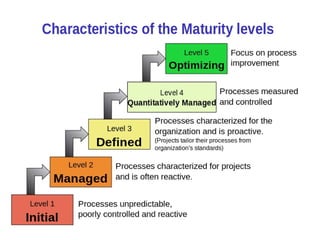
 CMMI, staged, uses 5 levels to describe the maturity of the
organization.
 CMMI is an evolutionary improvement path for software
organizations from immature process to a mature process,
disciplined one.
 Provides guidance on how to gain control of processes for
developing and maintaining software.
 CMMI describes the key elements of an effective software
process.
3
4
Maturity Level 1: InitialMaturity Level 1: Initial
 Maturity level 1 organizations often produce products and
services that work; however, they frequently exceed the budget
and schedule of their projects.
 An "incomplete process" is a process that is either not performed
or partially performed. One or more of the specific goals of the
process area are not satisfied and no goals exist for this level
since there is no reason to institutionalize a partially performed
process.
5
Maturity Level 2: ManagedMaturity Level 2: Managed
 At this level organization set a quantitative quality goal for both
software process and software maintenance.
 Set a documentation and mention what is requirement from
client side.
 How much time taken to finished the process.
 it follow the proper documentation.
 According to project well experienced people are work on it.
 Projects of the organization have ensured that:
− -Processes are planned
− -Performed, measured, and controlled.
6
7
Clear documentation .
Documentation usually consists of four important parts-
- The Problem.
- The Context in which the problem occurs.
- The Solution.
- The context within which the solution would work and would not work.
Documentation related Diagram (ERD, DFD, USE CASE) are present in
it, which is easy to understand how to solve the problem.
Processes are divided into modules, planned, Performed, measured,
and controlled.
Why our company is in level 2Why our company is in level 2
 Time to time changes of customer requirement & it goes to cyclic
process.
 Due to this, module should be change and for that total process
cycle of the project change.
 For this reason project time schedule exceed which affect the future
improvement.
 Level2 is reactive and repeatable.
8
Problems in level2Problems in level2
 Processes are well characterized, and understood, are described
in standards, procedures, tools and methods.
 Process are described more detail than level2
 To Establish and maintain a description of the process.
 To collect information derived from planning and performing the
process.
 Process are managed proactively using an understanding of the
interrelationship of the process activities
 Detailed measures of the process its work products and its
services.
9
Maturity Level 3: DefinedMaturity Level 3: Defined
GG-1: Achieve Specific Goals.
GP-1.1: Perform Specific Practices.
GG-2: Institutionalize a Managed Process.
GP-2.1: Establish an Organizational Policy.
GP-2.2: Plan the Process.
GP-2.3: Provide Resources.
GP-2.4: Assign Responsibility.
GP-2.5: Train People.
GP-2.6: Identify and Involve Relevant Stakeholders.
GP-2.7: Monitor and Control the Process.
10
Goals and PracticesGoals and Practices
 PLAN:
=Define the problem.
=Establish improvement objectives.
 DO:
-- Identify possible problem causes.
-- Establish baselines.
--Test change.
11
General Improvement ProcessGeneral Improvement Process
 ACT:
>Implement system change.
>Determine effectiveness.
 CHECK:
*Collect data.
*Evaluate data.
12
Advantages Of CMMIAdvantages Of CMMI
 Provides a framework for benchmarking the process.
 CMM is not prescriptive; it does not tell an organization how to
improve, but what to improve.
 Provides good “common sense” engineering and management
practices.
 Quality Improvement in service and product.
 Better Project Management and Control in the Organization.
 Helps in Adopting Newer Technologies in Quick time.
 Higher customer satisfaction due to project control and
communication.
ConclusionConclusion
13
 If we are achieving CMMI level 3 then it is a new milestone for us,
it is an important endorsement of our processes, engineering
capabilities and system that delivers value tour customer.
 Achieve all these things through the successful planning,
development, integration and maintenance of IT salutation.
14

Getting Started With CMMi level 3

  • 1.
    HI-tecH medIa networks HI-tecHmedIa networks -:Reviewed By:- Sasmita Patra. -:Presented By:- Manas Ranjan Das Ankit Anand. 1 Presents Presents
  • 2.
    HIGHLIGHTSHIGHLIGHTS  What isCMMI ?  Characteristics Of CMMI Maturity levels.  Maturity Levels of CMMI.  Goals and Practices.  Advantages Of CMMI  Conclusion 2
  • 3.
    What is CMMI?What is CMMI ?  CMMI (Capability Maturity Model Integration) is a proven industry framework to improve product quality and development efficiency for both hardware and software.  CMMI, staged, uses 5 levels to describe the maturity of the organization.  CMMI is an evolutionary improvement path for software organizations from immature process to a mature process, disciplined one.  Provides guidance on how to gain control of processes for developing and maintaining software.  CMMI describes the key elements of an effective software process. 3
  • 4.
  • 5.
    Maturity Level 1:InitialMaturity Level 1: Initial  Maturity level 1 organizations often produce products and services that work; however, they frequently exceed the budget and schedule of their projects.  An "incomplete process" is a process that is either not performed or partially performed. One or more of the specific goals of the process area are not satisfied and no goals exist for this level since there is no reason to institutionalize a partially performed process. 5
  • 6.
    Maturity Level 2:ManagedMaturity Level 2: Managed  At this level organization set a quantitative quality goal for both software process and software maintenance.  Set a documentation and mention what is requirement from client side.  How much time taken to finished the process.  it follow the proper documentation.  According to project well experienced people are work on it.  Projects of the organization have ensured that: − -Processes are planned − -Performed, measured, and controlled. 6
  • 7.
    7 Clear documentation . Documentationusually consists of four important parts- - The Problem. - The Context in which the problem occurs. - The Solution. - The context within which the solution would work and would not work. Documentation related Diagram (ERD, DFD, USE CASE) are present in it, which is easy to understand how to solve the problem. Processes are divided into modules, planned, Performed, measured, and controlled. Why our company is in level 2Why our company is in level 2
  • 8.
     Time totime changes of customer requirement & it goes to cyclic process.  Due to this, module should be change and for that total process cycle of the project change.  For this reason project time schedule exceed which affect the future improvement.  Level2 is reactive and repeatable. 8 Problems in level2Problems in level2
  • 9.
     Processes arewell characterized, and understood, are described in standards, procedures, tools and methods.  Process are described more detail than level2  To Establish and maintain a description of the process.  To collect information derived from planning and performing the process.  Process are managed proactively using an understanding of the interrelationship of the process activities  Detailed measures of the process its work products and its services. 9 Maturity Level 3: DefinedMaturity Level 3: Defined
  • 10.
    GG-1: Achieve SpecificGoals. GP-1.1: Perform Specific Practices. GG-2: Institutionalize a Managed Process. GP-2.1: Establish an Organizational Policy. GP-2.2: Plan the Process. GP-2.3: Provide Resources. GP-2.4: Assign Responsibility. GP-2.5: Train People. GP-2.6: Identify and Involve Relevant Stakeholders. GP-2.7: Monitor and Control the Process. 10 Goals and PracticesGoals and Practices
  • 11.
     PLAN: =Define theproblem. =Establish improvement objectives.  DO: -- Identify possible problem causes. -- Establish baselines. --Test change. 11 General Improvement ProcessGeneral Improvement Process  ACT: >Implement system change. >Determine effectiveness.  CHECK: *Collect data. *Evaluate data.
  • 12.
    12 Advantages Of CMMIAdvantagesOf CMMI  Provides a framework for benchmarking the process.  CMM is not prescriptive; it does not tell an organization how to improve, but what to improve.  Provides good “common sense” engineering and management practices.  Quality Improvement in service and product.  Better Project Management and Control in the Organization.  Helps in Adopting Newer Technologies in Quick time.  Higher customer satisfaction due to project control and communication.
  • 13.
    ConclusionConclusion 13  If weare achieving CMMI level 3 then it is a new milestone for us, it is an important endorsement of our processes, engineering capabilities and system that delivers value tour customer.  Achieve all these things through the successful planning, development, integration and maintenance of IT salutation.
  • 14.