






















Descriptive Number: 		N 101Descriptive Name:		Health AssessmentCourse Description:		The course deals with concepts, principles and techniques of history taking using various tools, physical examination (head to toe), psychosocial assessment and interpretation of laboratory findings to arrive at a nursing diagnosis on the client across the lifespan in varied settings.
Course Outline:I. Conceptual Overview of the Nursing Health Assessment	- review of the phases of the Nursing Process	A. Nurse’s Role in Health Assessment:		Collecting and Analyzing Data		Evolution of nurse’s role in health assessmentB. Critical Thinking in Health AssessmentII. Data Collection Documentation and Analysis	A. Data Collection Process	- General Survey	- Interview Techniques	B. Collecting Subjective Data	- COLD SPA
- Health History	a. Biographical data	b. Chief Complaints	c. Present Health History	d. Past Health History	e. Family History	f. Psychosocial History	g. Activities of Daily Living (ADLs)	h. Review of Systems
C. Collecting Objective Data	- Vital signs (TPR, BP)	- Physical Assessment (IPPA)	-   Diagnostic ProceduresD. Validation/ Rationalization of Subjective/ ObjectiveDataE. Documentation of Data	- Purposes of Assessment Documentation	- Guidelines for Documentation	- Assessment forms used for documentation
INTERMEDIATE COMPETENCIESGiven a hypothetical case, the student will be able to:1. Analyze the different phases of the nursing process2. Utilize the nursing process in health assessment3. Describe the critical thinking process with relevance to health  assessment4. Demonstrate critical thinking skills in health assessment5. Collect relevant data6. Classify subjective from objective data7. Utilize interview techniques
8. Conduct health history9. Perform accurately	a. Vital signs	b. Physical Examination (IPPA)10. Assist client before, during and after diagnostic procedures 11. Differentiate normal from abnormal findings12. Explain deviations from normal results13. Demonstrate legal practices in documentation
NURSING                PROCESS"the cornerstone of the nursing profession"
What is a Process?It is a series of planned actions or operations directed towards a particular result or goal.
Nursing ProcessIt is a systematic, rational method of planning and providing individualized nursing care.
Characteristics of the Nursing ProcessDynamicClient-centeredPlannedInterpersonal and collaborativeUniversally applicableCan focus on problems or strengths
Open, flexibe  Humanistic and individualized Cyclical Outcome focused ( results oriented) Emphasizes feedback and validation
Purpose of Nursing ProcessTo identify a client’s health status, actual or potential health care problems or needs, to establish plans to meet the identified needs, and to deliver specific nursing interventions to meet those needs. It helps nurses in arriving at decisions and in predicting and evaluating consequences.It was developed as a specific method for applying a scientific approach or a problem solving approach to nursing practice.
Nursing Process...SystematicOrganizedGoal-OrientedHumanistic CareEfficient  Effective
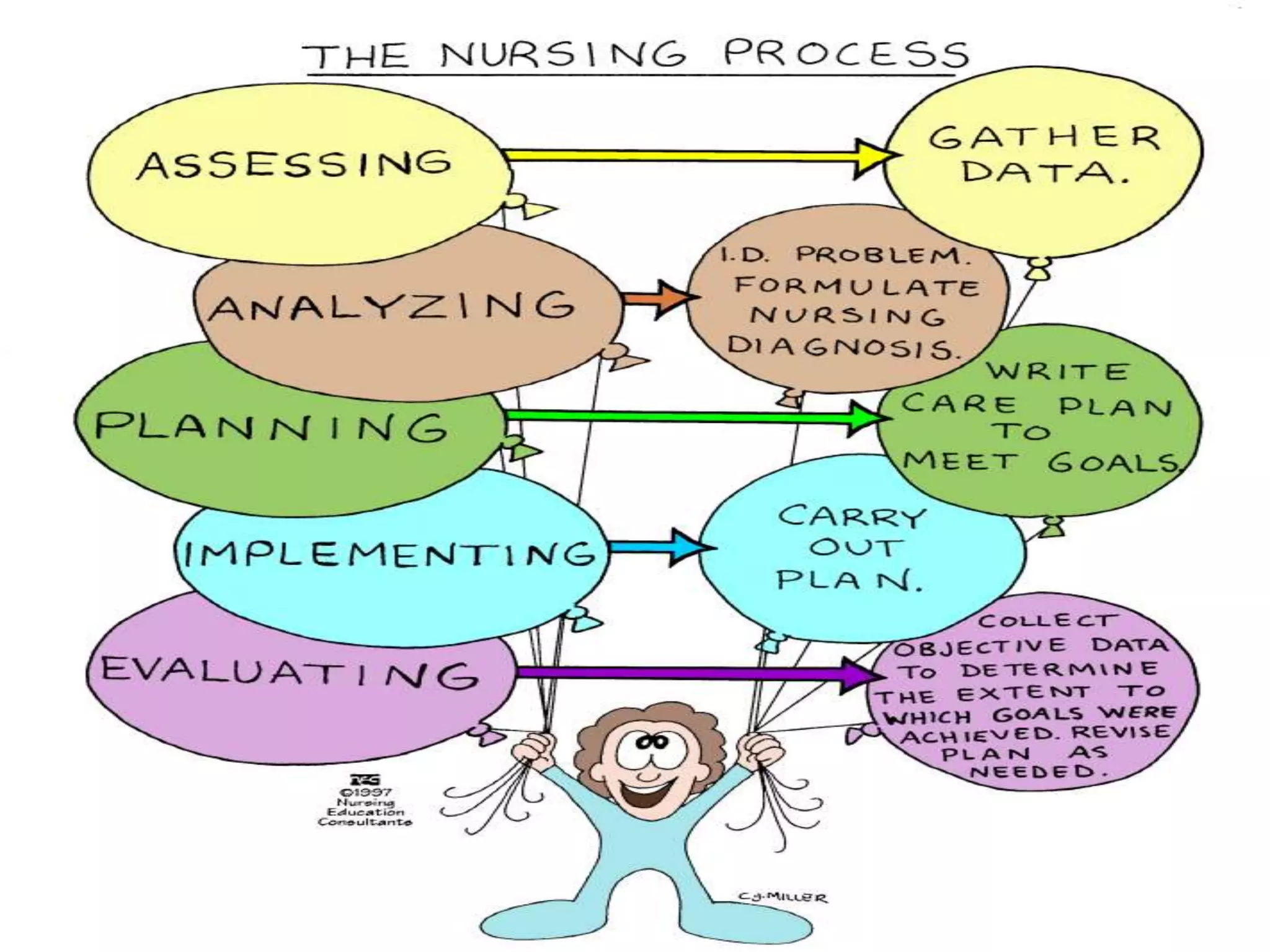
PHASES OF THE NURSING PROCESSAssessmentDiagnosisOutcome IdentificationPlanningImplementationEvaluation
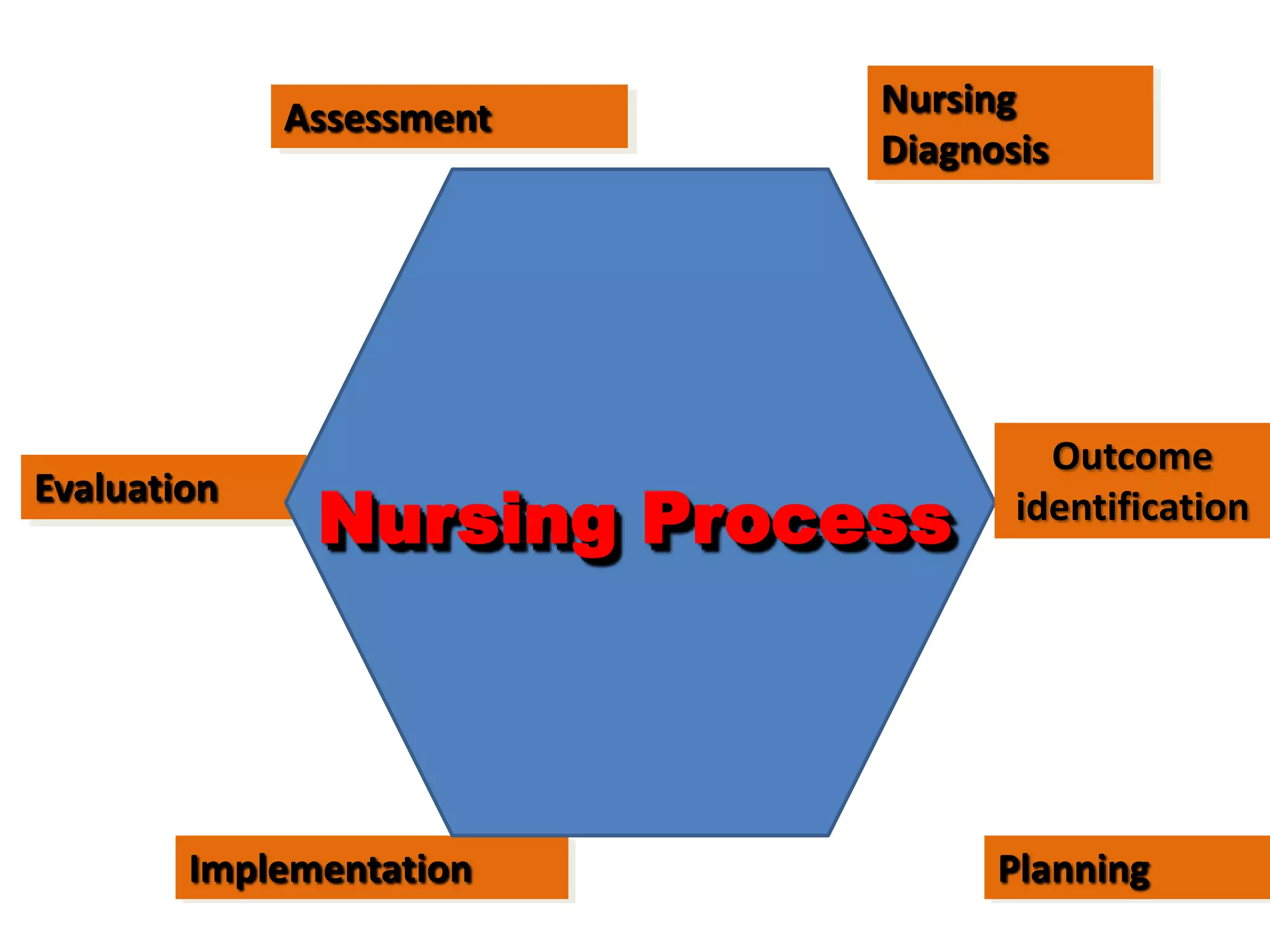
Nursing DiagnosisAssessmentEvaluationPlanningImplementationNursing ProcessOutcome identification
Benefits of using the nursing processContinuity of carePrevention of duplicationIndividualized careStandards of careIncreased client participationCollaboration of care
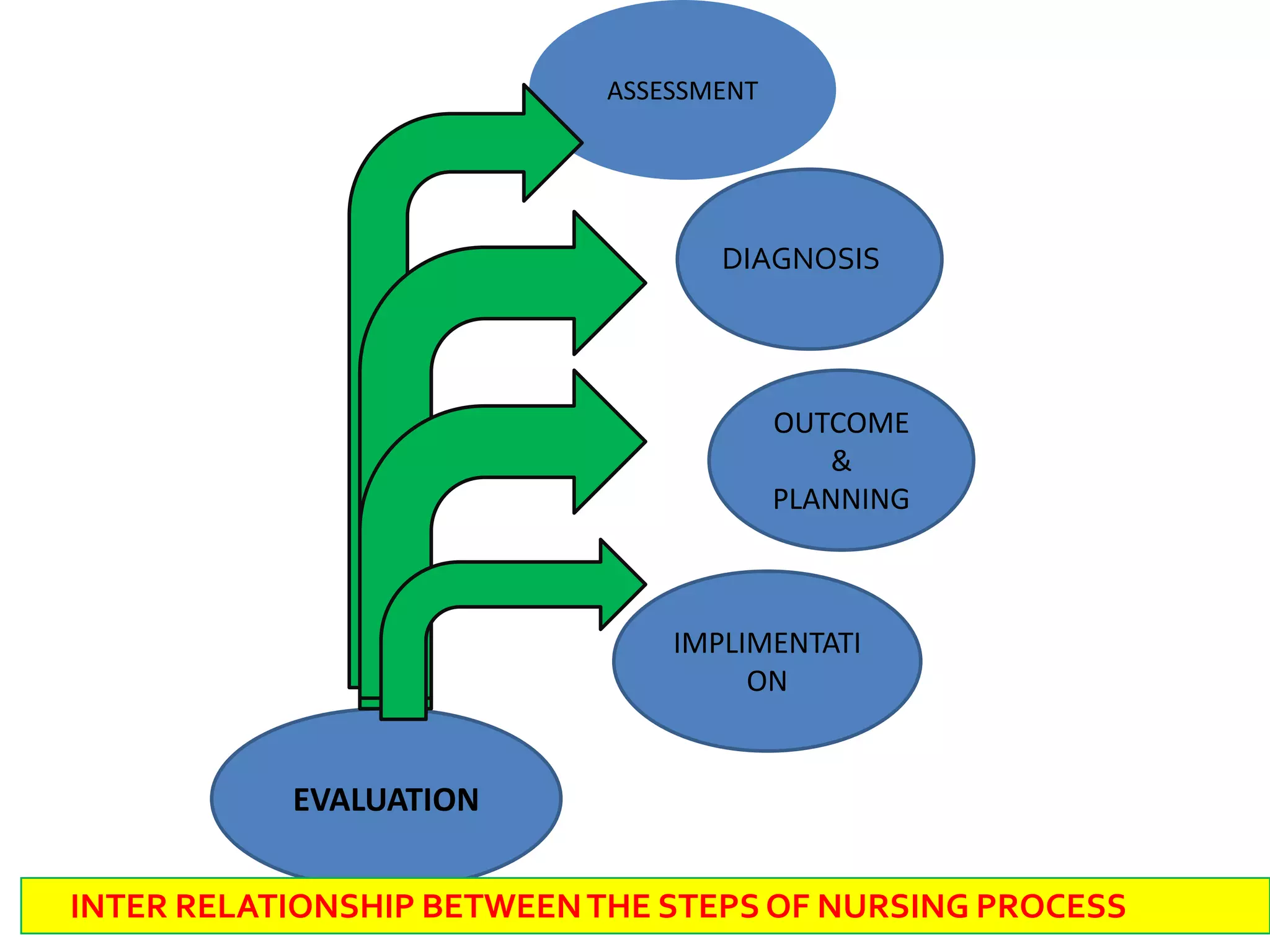
ASSESSMENTDIAGNOSISOUTCOME &PLANNINGIMPLIMENTATIONEVALUATION     INTER RELATIONSHIP BETWEEN THE STEPS OF NURSING PROCESS
ASSESSMENT
Assessing is a continuous process carried out during all phases of nursing process. All phases of the nursing process depend on the accurate and complete collection of data.Assessing is the systematic and continuous collection, organization, validation and documentation of data.                           - Potter and Perry( 2006)
Assessment is the deliberate and systematic collection of data to determine a clients current and past health status and to determine the clients present and past coping patterns				- Carpenito 2004Assessment is the systematic and continuous collection, validation and communication of patient data.                          - Carol Taylor 
To establish baseline information on the client.To determine the client’s normal function.To determine the client’s risk for diagnosis function.To determine presence or absence of diagnosis function.To determine client’s strengths.To provide data for the diagnostic phase.
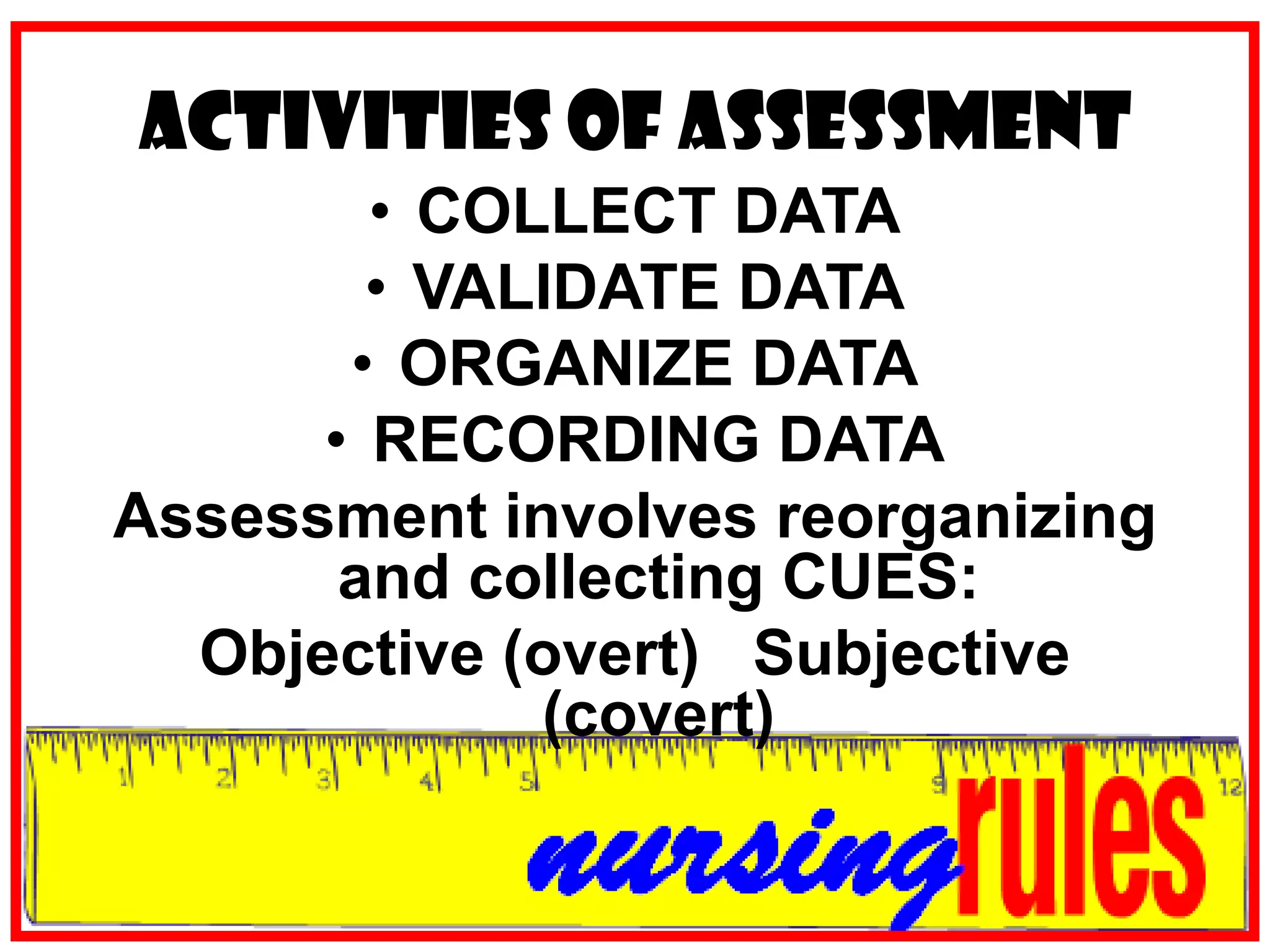
Activities of AssessmentCOLLECT DATAVALIDATE DATAORGANIZE DATARECORDING DATAAssessment involves reorganizing and collecting CUES:Objective (overt)   Subjective (covert)
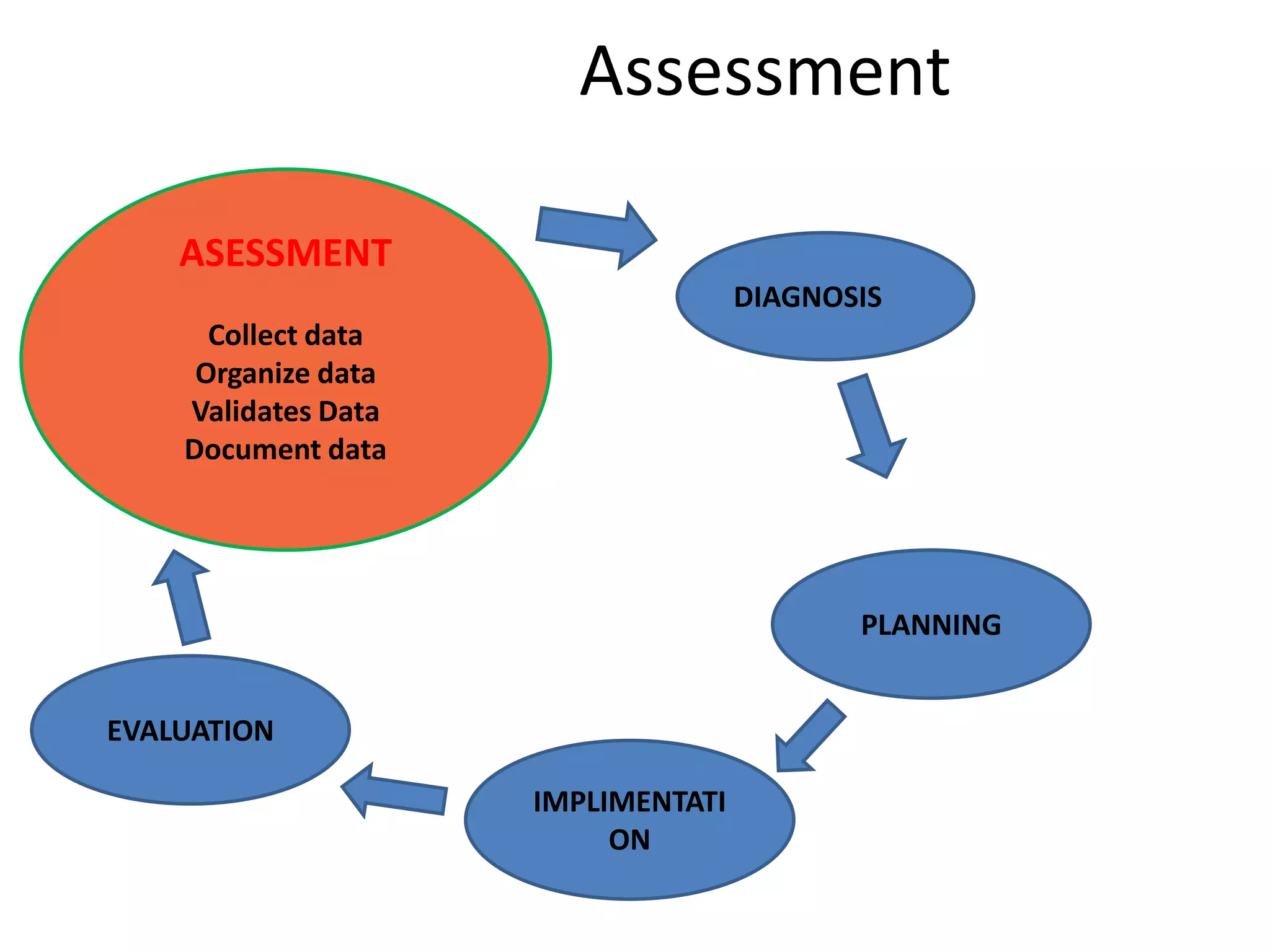
             AssessmentASESSMENTCollect dataOrganize dataValidates DataDocument dataDIAGNOSISPLANNINGEVALUATIONIMPLIMENTATION
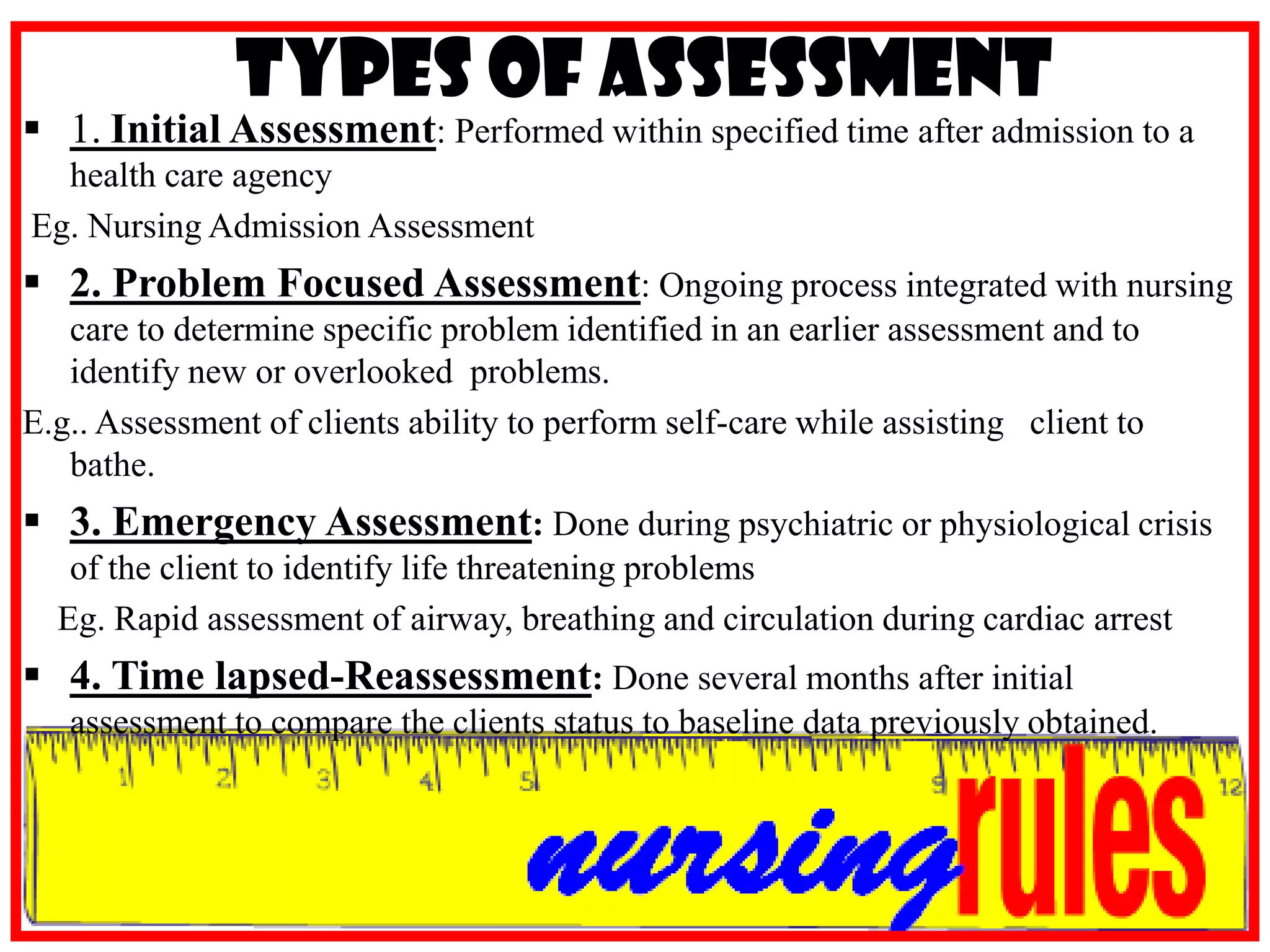
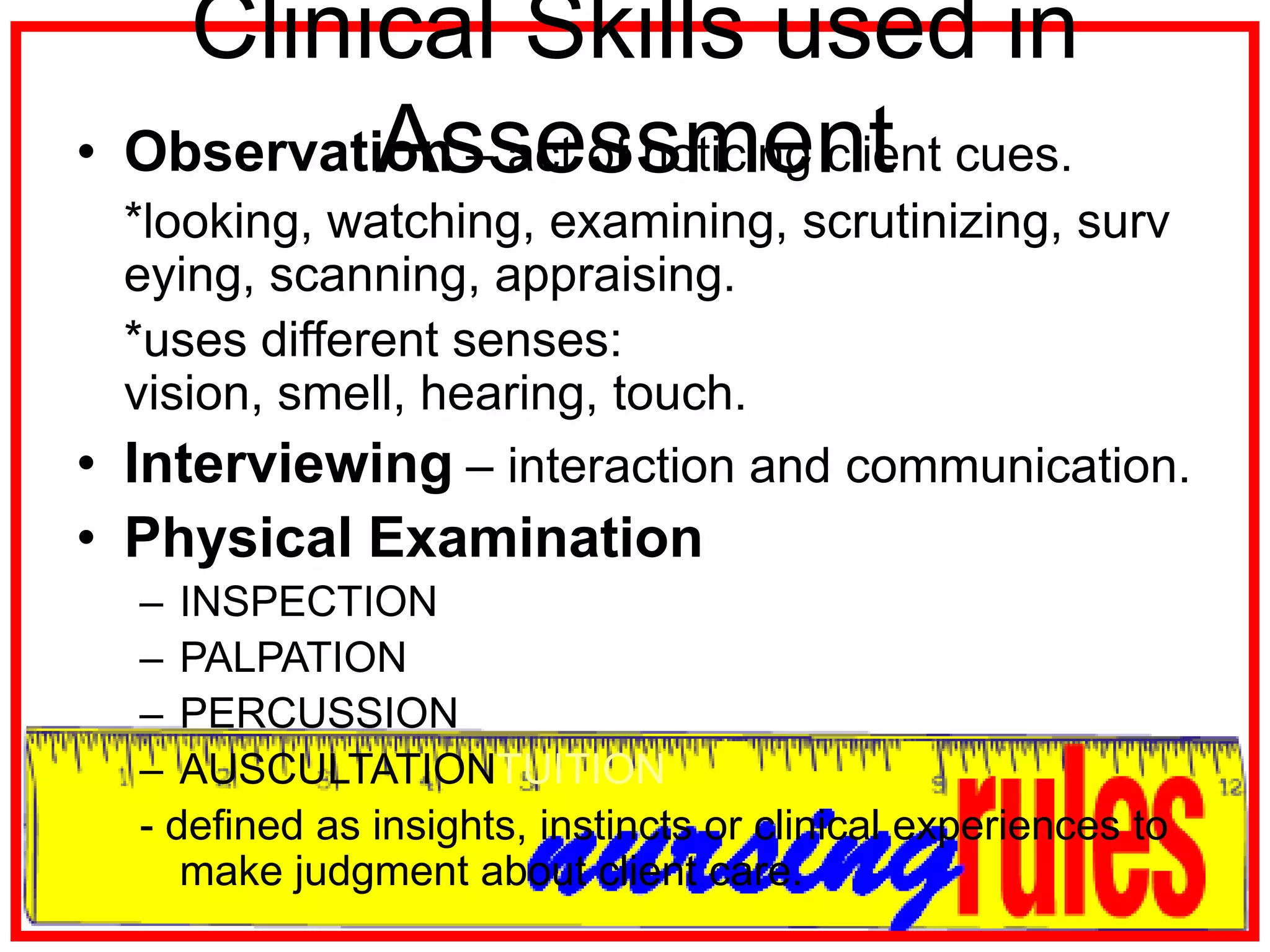
Types of Assessment1.Initial Assessment: Performed within specified time after admission to a health care agencyEg. Nursing Admission Assessment2. Problem Focused Assessment: Ongoing process integrated with nursing care to determine specific problem identified in an earlier assessment and to identify new or overlooked  problems.E.g.. Assessment of clients ability to perform self-care while assisting   client to bathe.3. Emergency Assessment: Done during psychiatric or physiological crisis of the client to identify life threatening problemsEg. Rapid assessment of airway, breathing and circulation during cardiac arrest4. Time lapsed-Reassessment: Done several months after initial assessment to compare the clients status to baseline data previously obtained.Clinical Skills used in AssessmentObservation – act of noticing client cues.	*looking, watching, examining, scrutinizing, surveying, scanning, appraising.	*uses different senses: vision, smell, hearing, touch.Interviewing – interaction and communication.Physical ExaminationINSPECTIONPALPATIONPERCUSSIONAUSCULTATIONTUITION- defined as insights, instincts or clinical experiences to make judgment about client care.
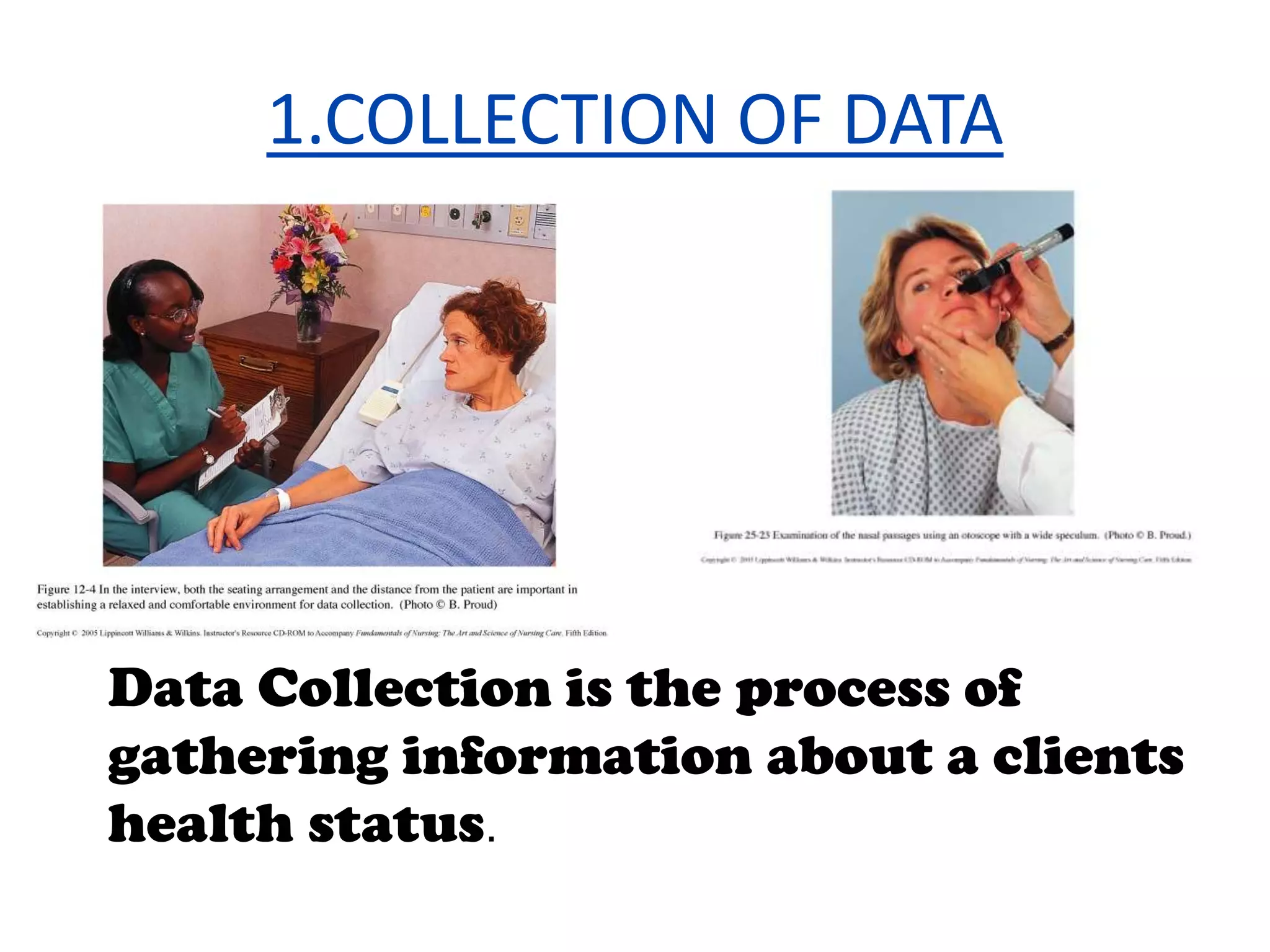
1.COLLECTION OF DATAData Collection is the process of gathering information about a clients health status.
Collection of Data: Data base: A data base is all information about a client. It includes the nursing health history, physical assessment, the physician’s history, physical examination, results of laboratory and diagnostic tests and material contributed by other health personnel.   
Medical vs. Nursing AssessmentsMedical assessmentsTarget data pointing to pathologic conditionsNursing assessmentsFocus on the patient’s response to health problems
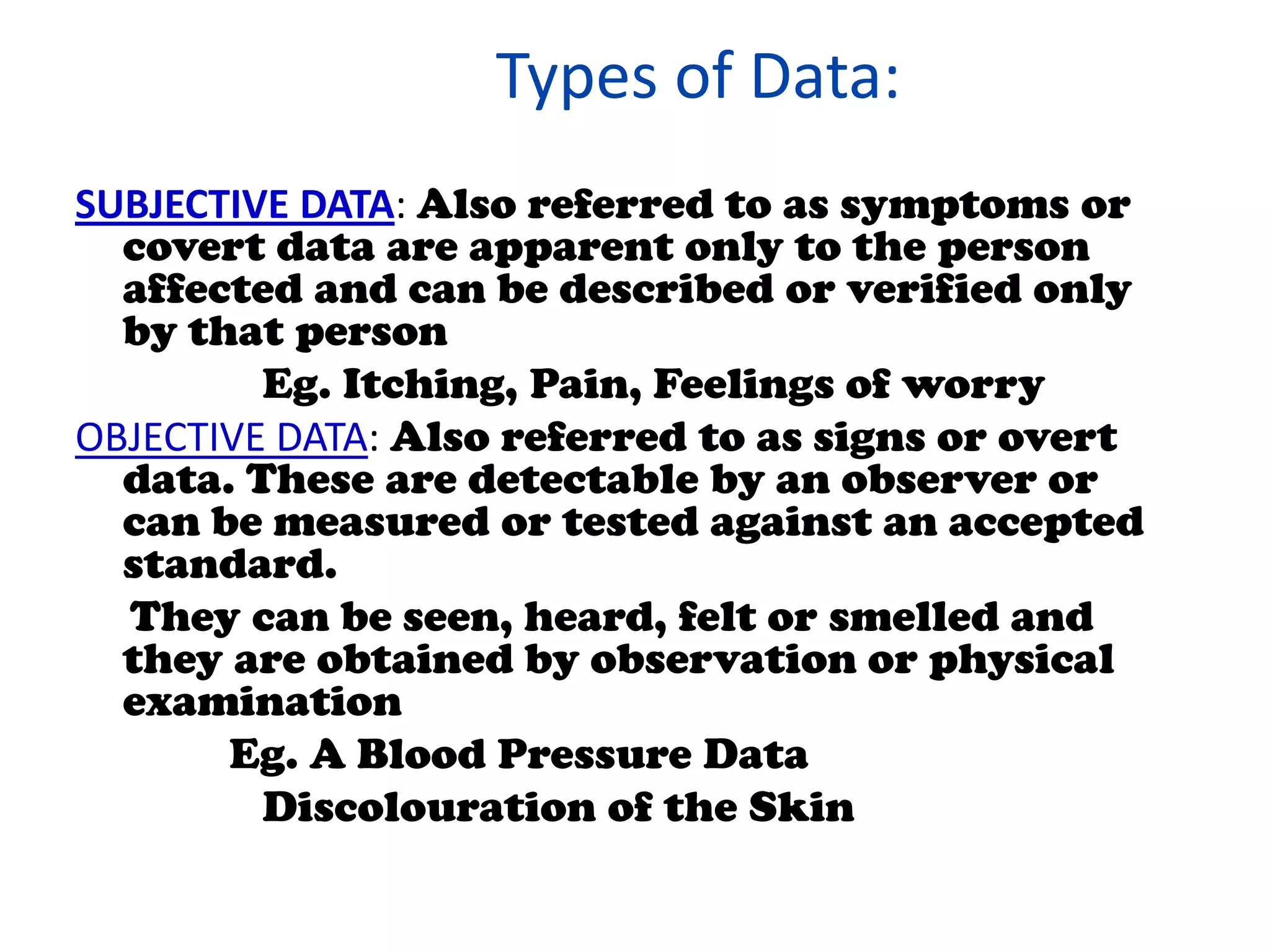
            Types of Data: SUBJECTIVE DATA: Also referred to as symptoms or covert data are apparent only to the person affected and can be described or verified only by that person                 Eg. Itching, Pain, Feelings of worryOBJECTIVE DATA: Also referred to as signs or overt data. These are detectable by an observer or can be measured or tested against an accepted standard.     They can be seen, heard, felt or smelled and they are obtained by observation or physical examination              Eg. A Blood Pressure Data                 Discolouration of the Skin 
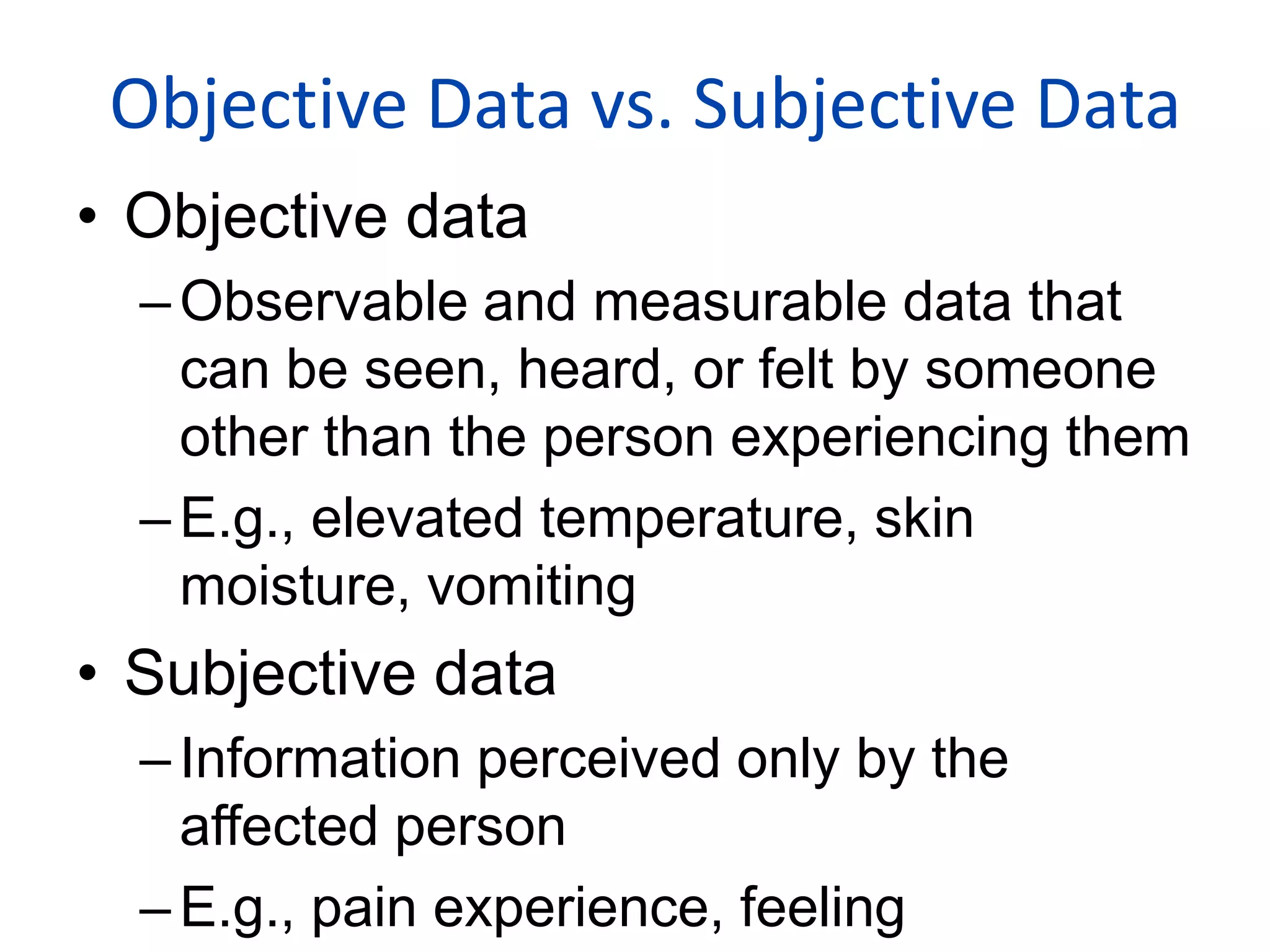
Objective Data vs. Subjective DataObjective dataObservable and measurable data that can be seen, heard, or felt by someone other than the person experiencing themE.g., elevated temperature, skin moisture, vomitingSubjective dataInformation perceived only by the affected personE.g., pain experience, feeling dizzy, feeling anxious
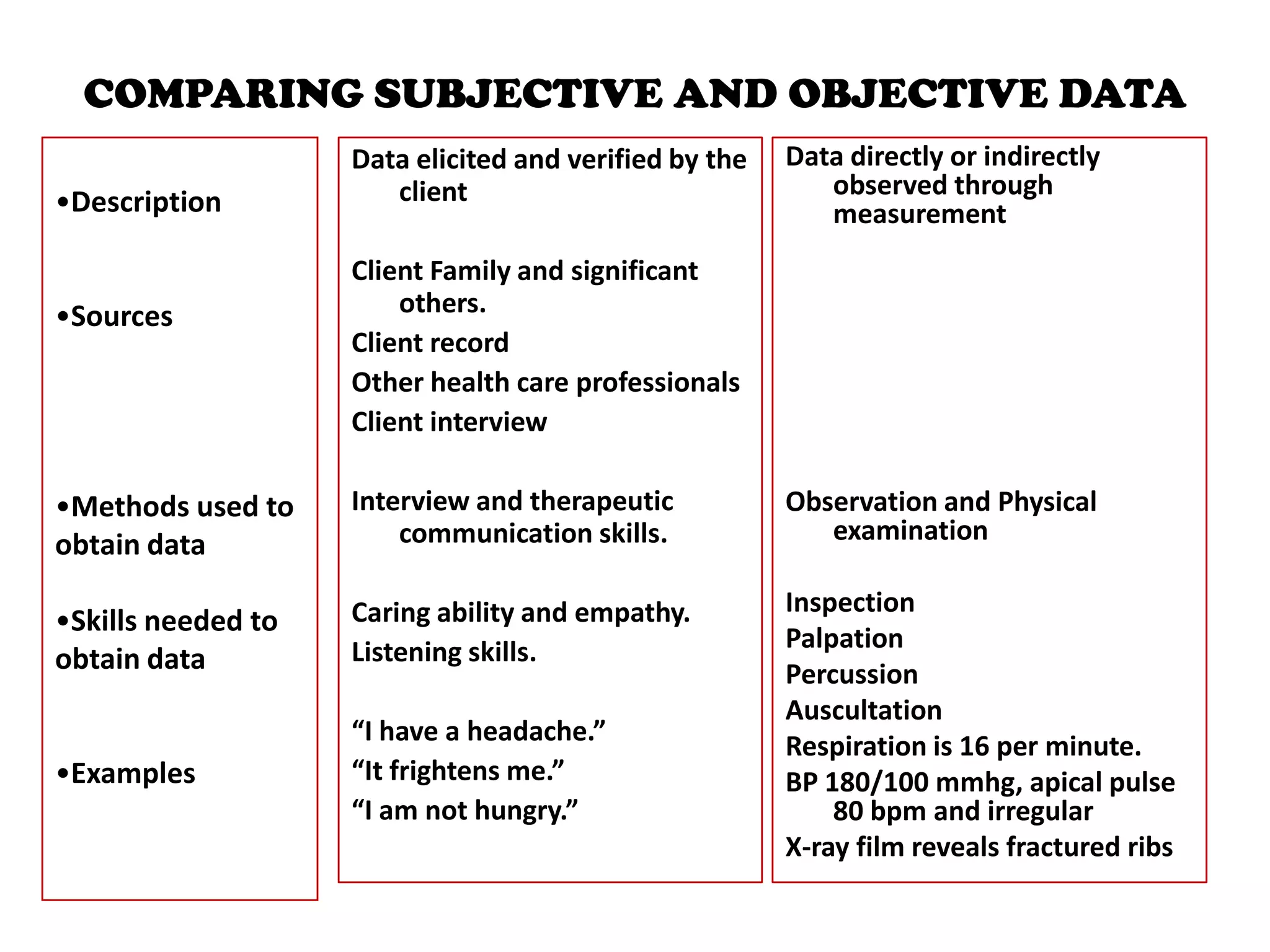
COMPARING SUBJECTIVE AND OBJECTIVE DATAData elicited and verified by the clientClient Family and significant others.Client recordOther health care professionalsClient interviewInterview and therapeutic communication skills.Caring ability and empathy.Listening skills.“I have a headache.”“It frightens me.”“I am not hungry.”Data directly or indirectly observed through measurement Observation and Physical examinationInspectionPalpationPercussionAuscultationRespiration is 16 per minute.BP 180/100 mmhg, apical pulse 80 bpm and irregularX-ray film reveals fractured ribsDescription
Sources
Methods used to obtain data
Skills needed to obtain data
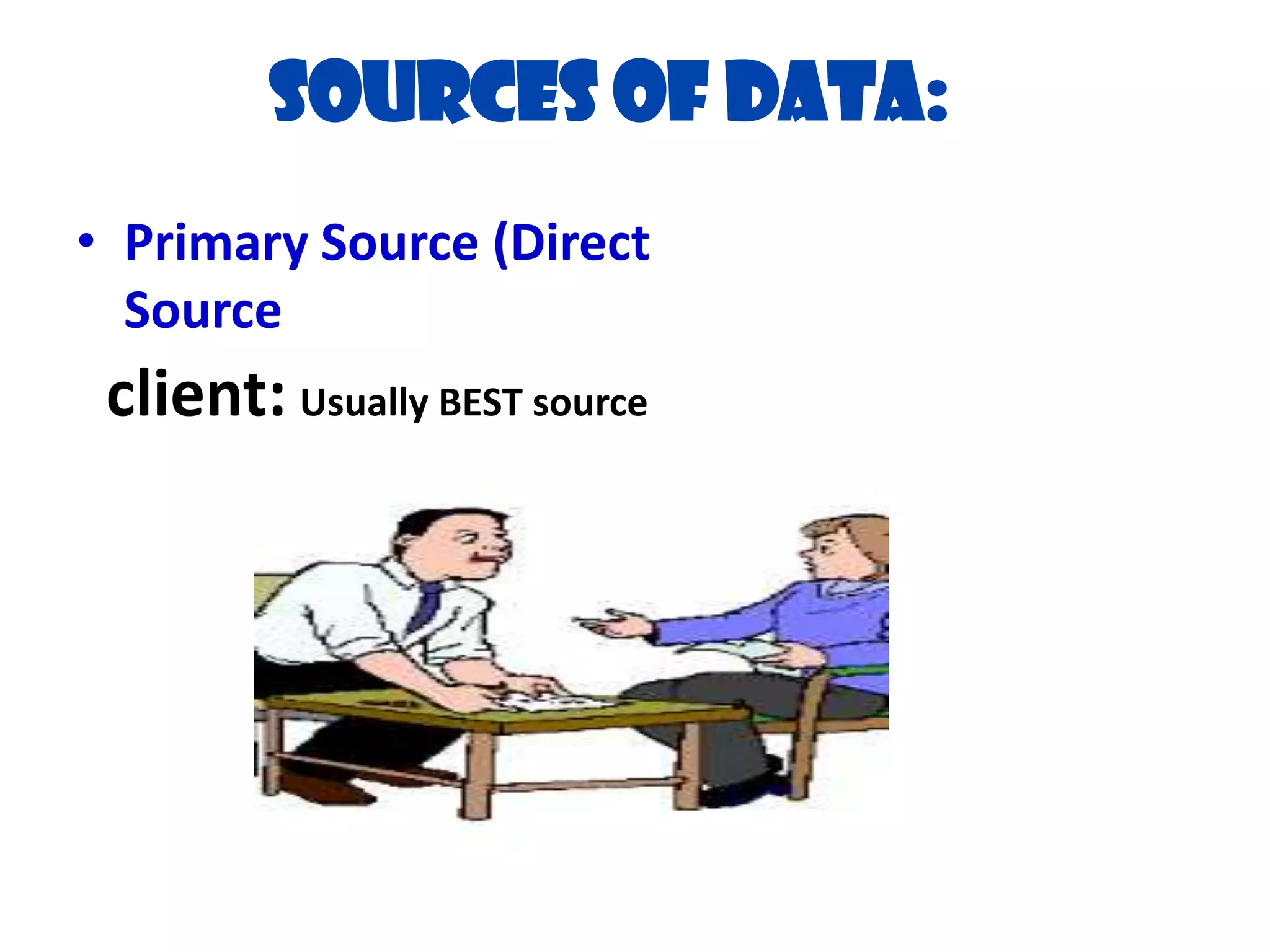
ExamplesSources of Data:Primary Source (Direct Sourceclient:Usually BEST source
Secondary Source (Indirect Source)Family Members
 Client’s records  1. Medical Records             Eg. Medical History, Physical Examination,               Operation   notes, Progress notes,                Consultation done by Physicians  2. Records of therapies done by other health professionals          Eg. Social Workers, Dieticians, Physical 	Therapist 3. Laboratory Records Other health care professionals Verbal reportsData CollectionConsider timeneeds of patientdevelopmental stagephysical surroundingspast and present coping patterns
Data CharacteristicsComplete
Factual
Accurate
RelevantData collection methodsOBSERVATIONINTERVIEWING PHYSICAL ASSESSMENT
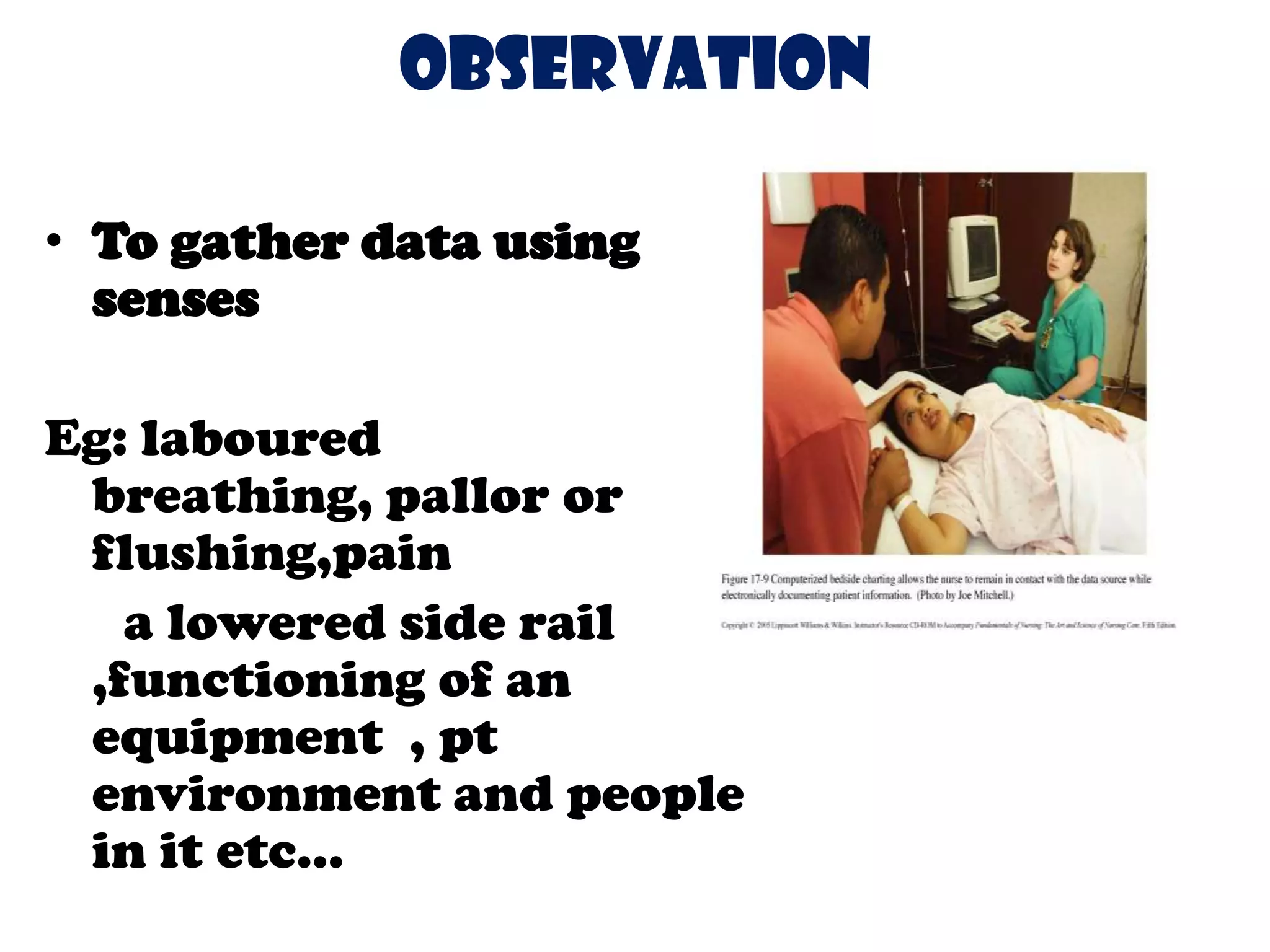
ObservationTo gather data using sensesEg: laboured breathing, pallor or flushing,pain      a lowered side rail ,functioning of an equipment  , pt environment and people in it etc…
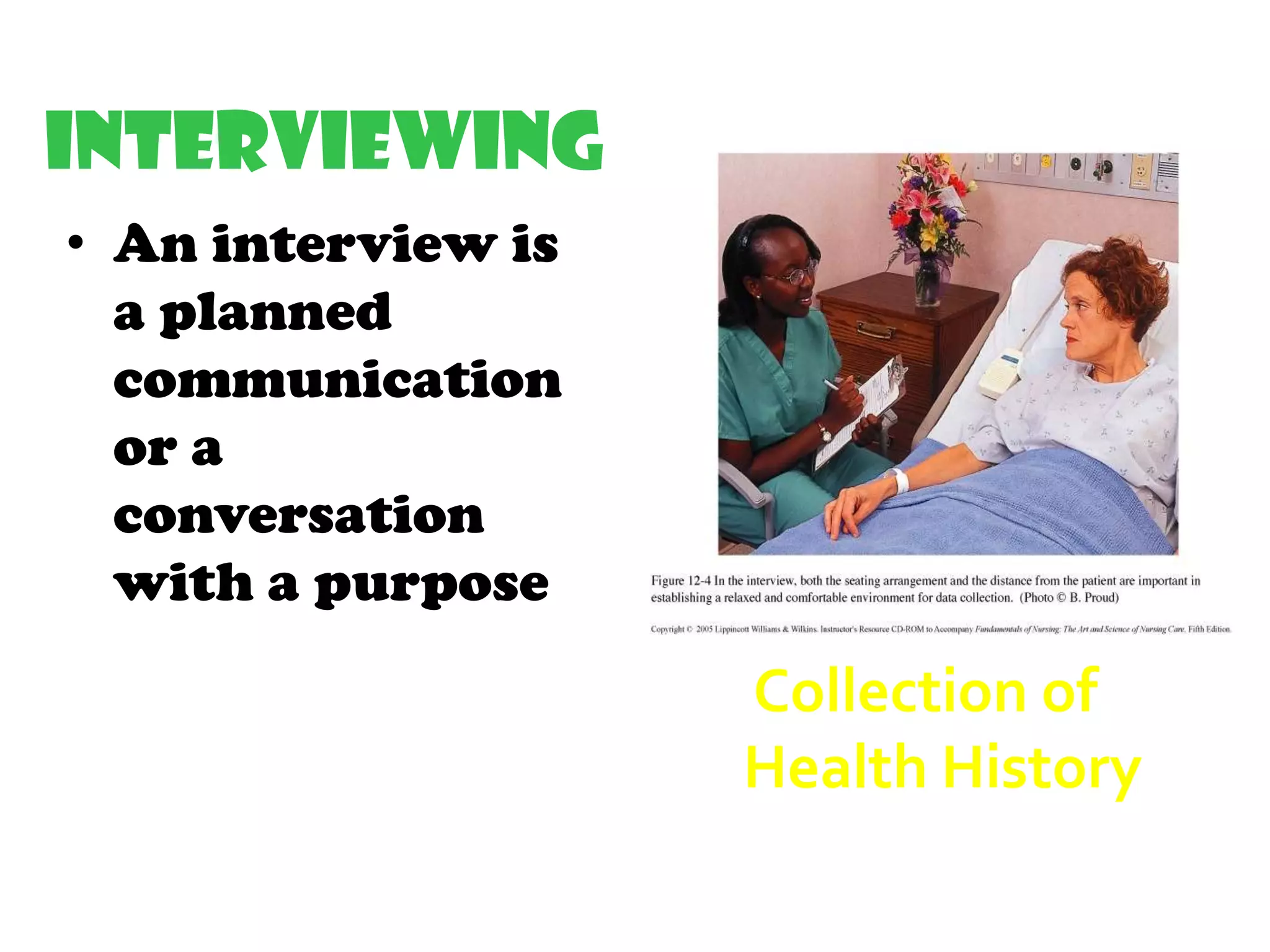
InterviewingAn interview is a planned communication or a conversation with a purposeCollection of Health History
Four Phases of a Nursing InterviewPreparatory phase
Introduction
Working phase
TerminationInterview PhasesPreparatory
Nurse collects background info from previous charts
Ensure environment is conducive
Arrange seating
3 – 4 ft apart
Interviewer at 45° angle to patient
Allow adequate time IntroductionNurse introduces self
Identifies purpose of interview
Ensure confidentiality of information
Provide for patient needs before startingWorkingNurse gathers info for subjective data
Excellent communication skills are needed
Active listening
Eye contact
Open-ended questions TerminationInform patient when nearing end of interview
Ensure patient knows what will happen with info
Offer patient chance to add anything
COLLECTING OBJECTIVE DATAVITAL SIGNS
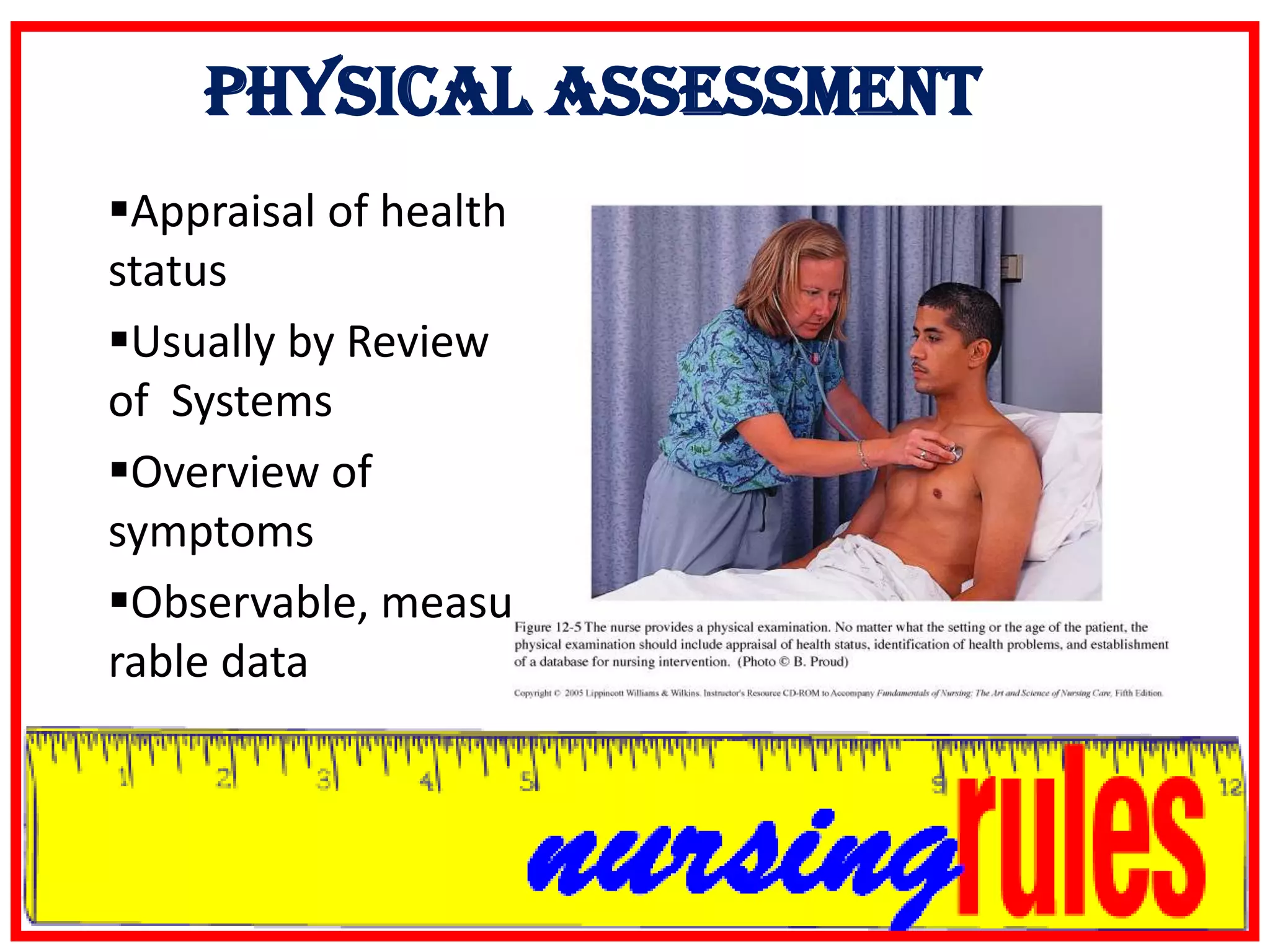
PHYSICAL  ASSESSMENT
DIAGNOSTIC PROCEDUREPhysical assessmentAppraisal of health status
Usually by Review of  Systems
Overview of symptoms
Observable, measurable dataPossible approaches—body systems, head to toe, or functional health patternsMethods of physical assessmentInspection
Percussion
Palpation
AuscultationDIAGNOSTIC PROCEDURESURINE ANALYSIS
STOOL EXAM
SPUTUM
BLOOD STUDIES
CHEST X-RAY
ULTRASOUNDChest x-ray film (radiograph)1. Description: provides information regarding the anatomical location and appearance of the lungs.2. Preprocedure	a. Remove all jewelry and other metal objects from the chest area.	b. Assess the client’s ability to inhale and hold breath.	c. Question females regarding pregnancy or the possibility of pregnancy.3. Postprocedure: 	Assist the client to dress.
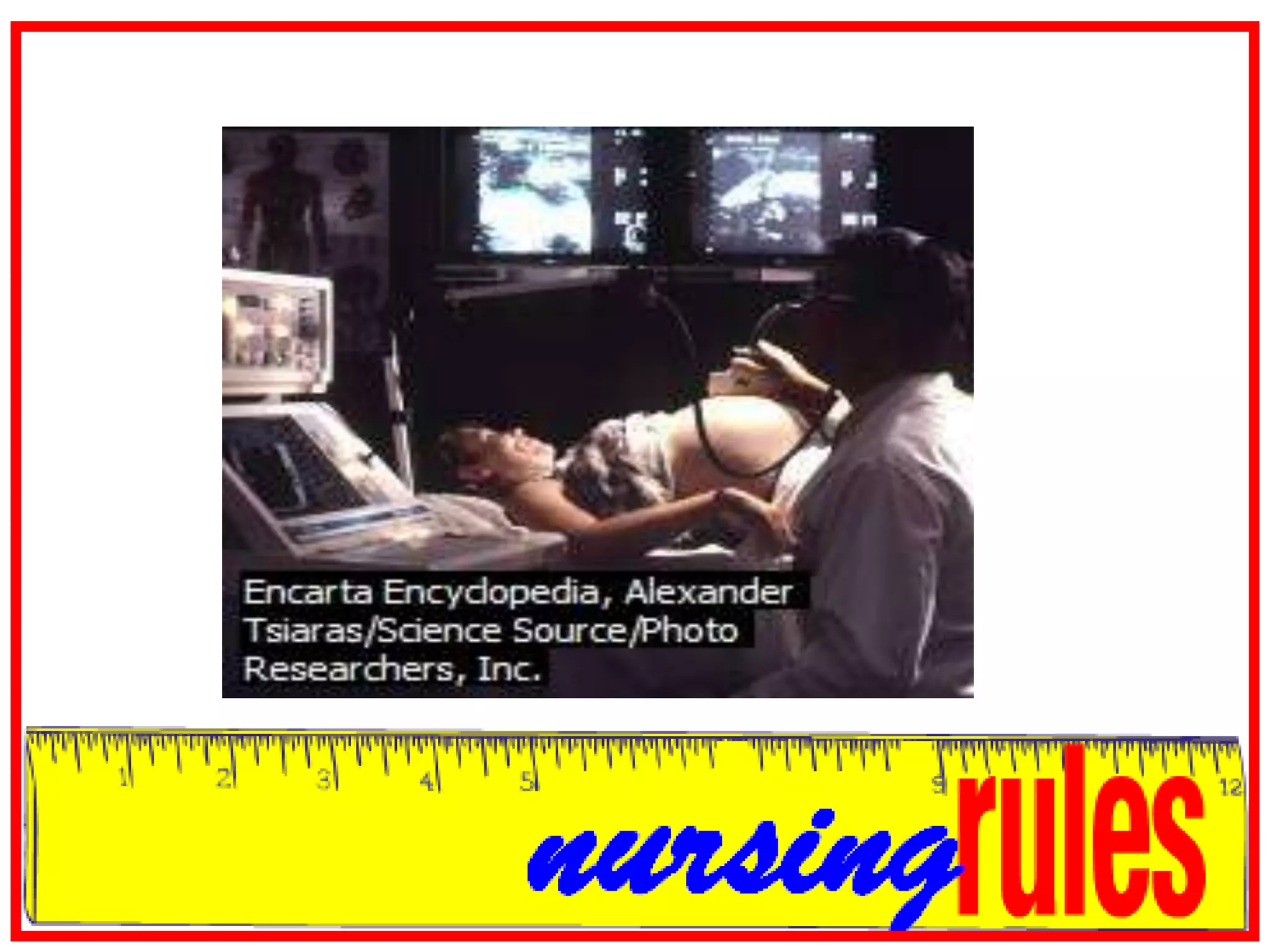
UltrasoundImaging, medical diagnostic technique in which very high frequency sound is directed into the body. The tissue interfaces reflect the sound, and the resulting pattern of sound reflection is processed by a computer to produce a photograph or a moving image on a television. Ultrasound can be used to examine many parts of the body, but its best known application is the examination of the fetus during pregnancy.
REVIEW ACTIVITIESONE WHOLE SHEET OF PAPER
 You will be given a scenario, that you would analyze as CUES for your nursing assessment.Identify  subjective to objective data.You will be given points to every correct assessment.
W.T. a 22 year old male, presented to ER with a chief complaint  “bad” abdominal pain. The generalized abdominal pain started 24 hours ago but seem to “ease up” after he vomited. Several hours later the pain returned but had shifted to the RLQ and has remained there. The pain is steadily getting worse that he is guarding that area, maintaining a fetal position, profusely sweating and BP when up to 150/100 mmhg from the baseline 120/70 mmhg.
	W.T. reports marked nausea and “dry heaves” and he has no appetite. He has also had diarrhea for the last day. VS are 150/100mmhg, 92 bpm, 25 breaths/min, 38.8C  temp. Started to have chills, weakness, trembling toes and redness of the face and neck. He vomited again to a greenish gastric secretions with undigested foods. The patient states “dawmapataynagidkosakasakit” appears to anxious and uneasy.
Ana-physio. What organ(s) are located in the RLQ?Priority problem identified?Based on the scenario, identify the subjective dataBased on the scenario, identify the objective dataGiven the scenario, how are you going to approach the patient?State all the cues that can be collected by means of observation.
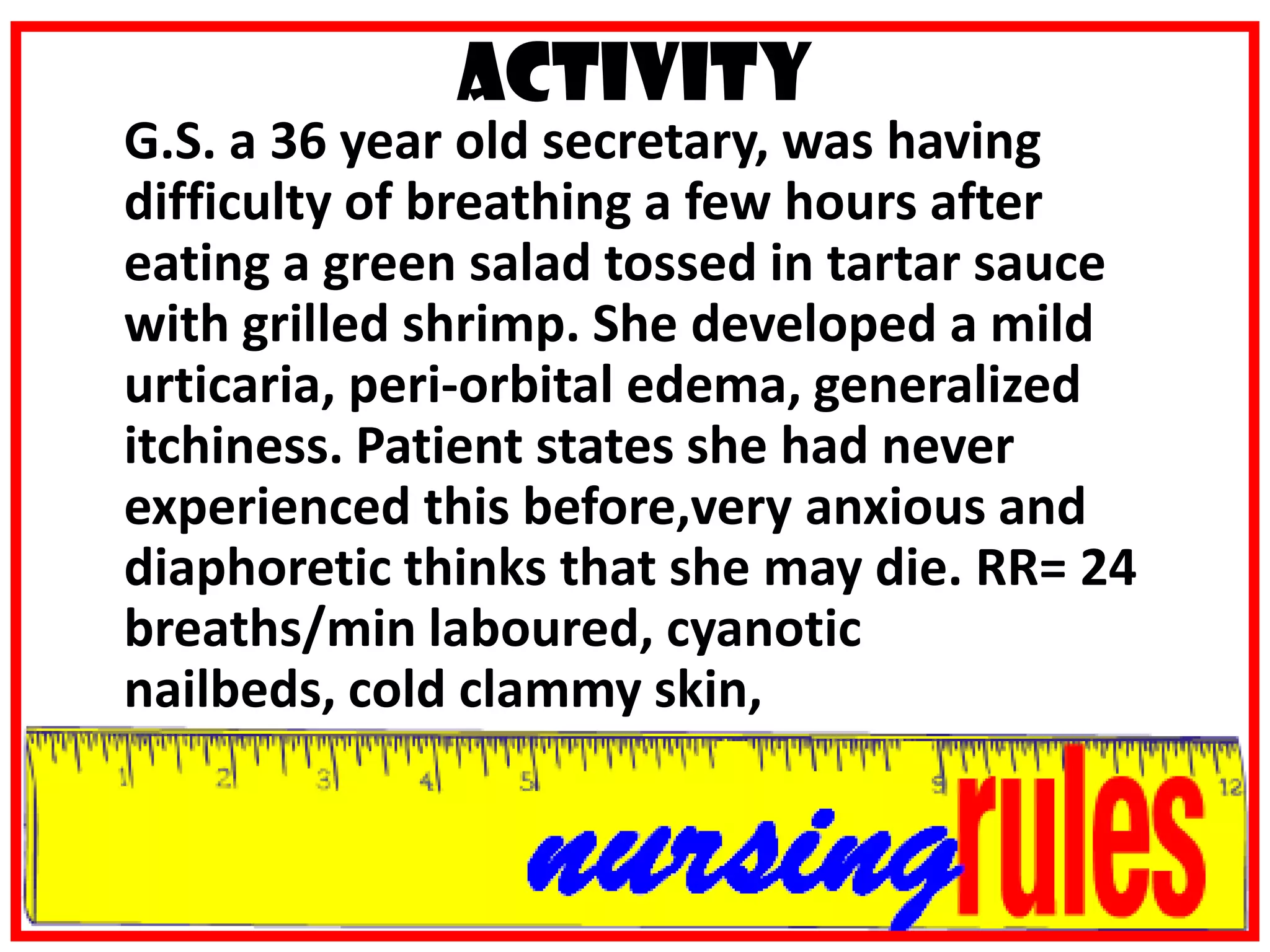
ACTIVITY	G.S. a 36 year old secretary, was having difficulty of breathing a few hours after eating a green salad tossed in tartar sauce with grilled shrimp. She developed a mild urticaria, peri-orbital edema, generalized itchiness. Patient states she had never experienced this before,very anxious and diaphoretic thinks that she may die. RR= 24 breaths/min laboured, cyanotic nailbeds, cold clammy skin,
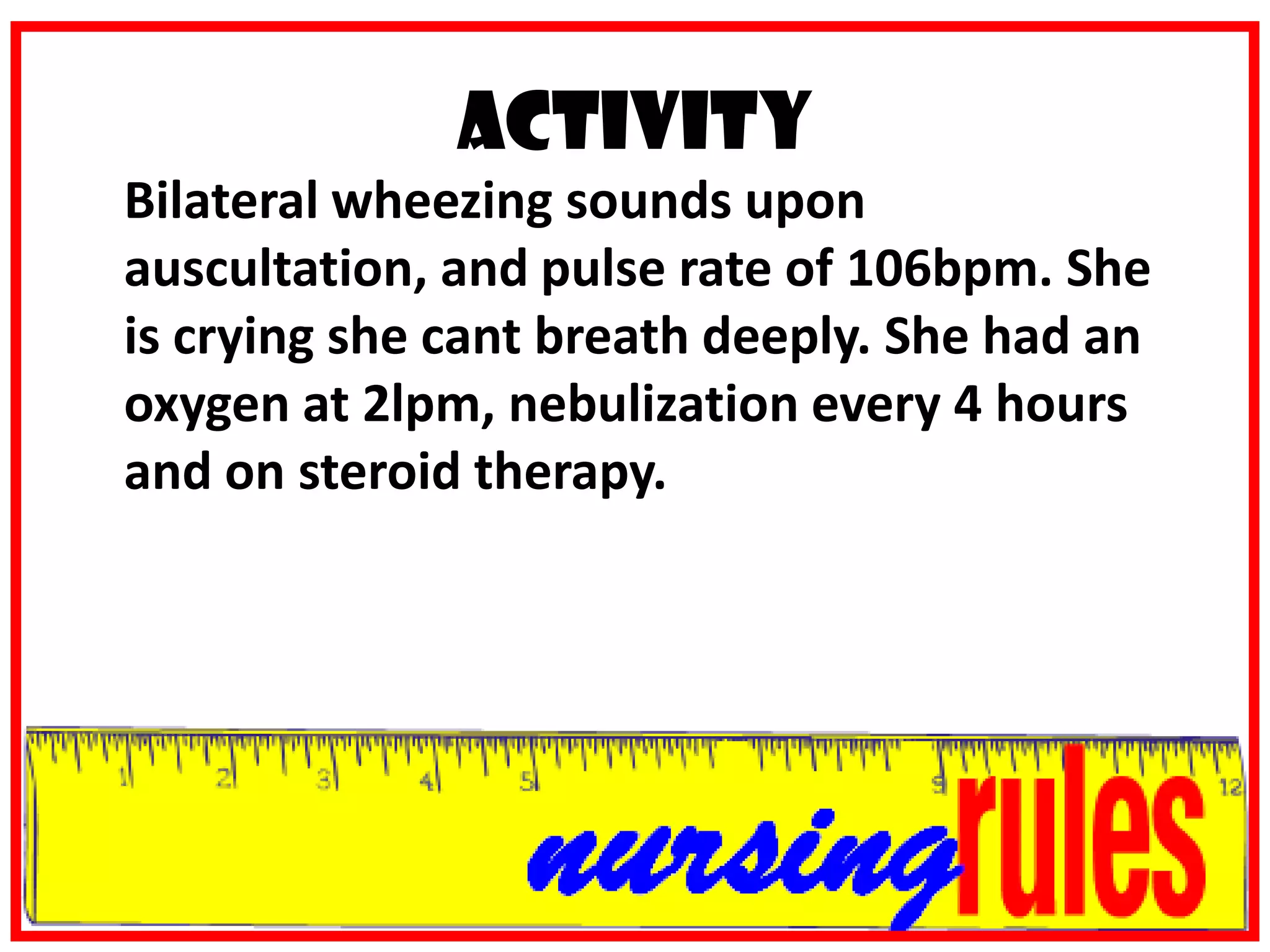
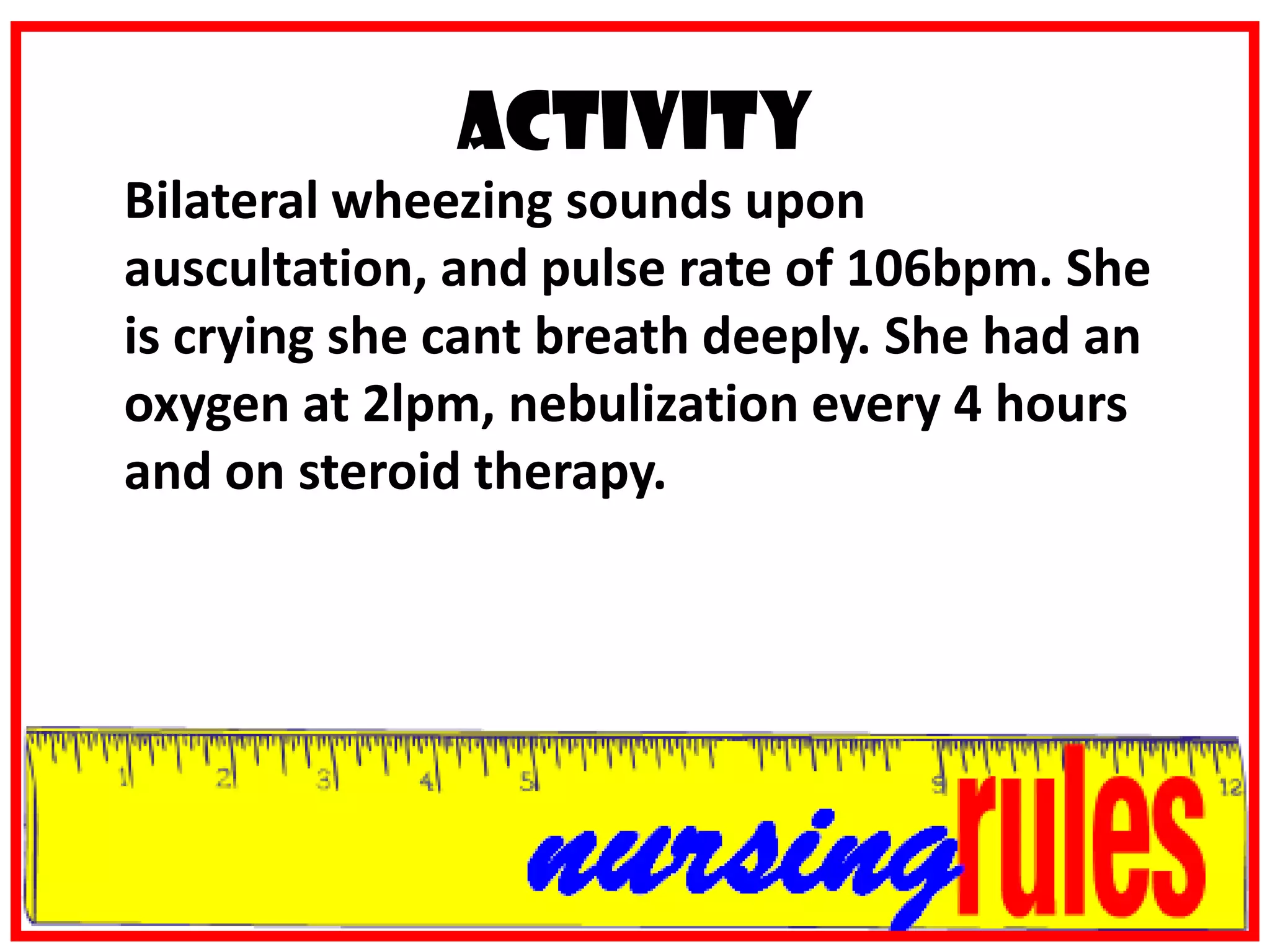
ACTIVITY	Bilateral wheezing sounds upon auscultation, and pulse rate of 106bpm. She is crying she cant breath deeply. She had an oxygen at 2lpm, nebulization every 4 hours and on steroid therapy.
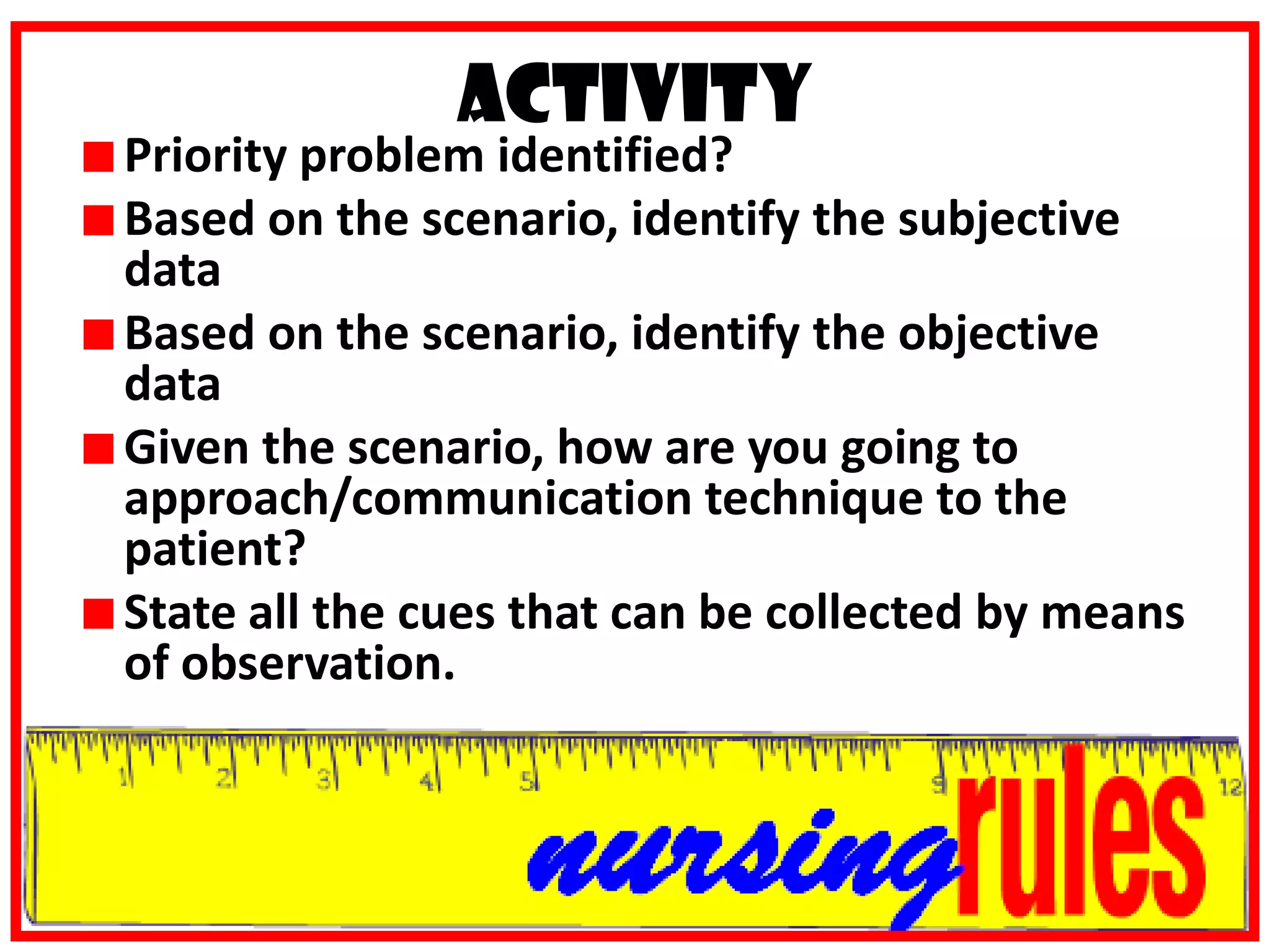
ACTIVITYPriority problem identified?Based on the scenario, identify the subjective dataBased on the scenario, identify the objective dataGiven the scenario, how are you going to approach/communication technique to the patient?State all the cues that can be collected by means of observation.
Kindly bring your Nursing Care Plan Book, Nursing Process, and any pocket guide to nursing diagnosis or nursing process.
ORGANISING DATA    Nurses uses a written or computerized format for arranging he data systematically
Clustering facts into groups of information.VALIDATING  DATAVALIDATING -THE ACT OF DOUBLE CHECKING
Verifies understanding of information
Comparison with another  source        -patient or family member   	-record   	-health team member
DOCUMENTING  DATARecord in permanent record ASAP
Use patient’s own words in subjective data – enclose in “ ___” (quotation marks)
Avoid generalizations – be specific
Don’t make summative statements Document what you saw the patient doing or what you believe he’s doing.
SIX PHASESNURSING PROCESS
ASSESSMENTTo establish data base.Sources of Data:Primary: Patient / ClientSecondary: Family members, SOs, Record/Chart, Health team members, Related Lit.
Approaches to Collecting Data for Assessing Client’s Health:ABDELLAH’S 21 Nursing ProblemsDOROTHEA OREM’S Components of Universal Self-CareGORDON’S Functional Health PatternsCorrelating a Body Systems Physical Examination with Data Gathered by Functional Health Area.
DIAGNOSINGNursing Diagnosis- terminology used for a clinical judgment by the professional nurse that identifies the client’s actual, risk, wellness, or syndrome responses to a health state, problem, or condition.
Purposes of Nursing DiagnosisIdentifies areas that nurses can resolve or enhance.Demonstrates professional judgment.Organizes decision making as part of  the nursing process.Promotes accountability.Provides communication among nurses and other health care personnel.Promotes use of standardized language and process.A means to individualize care.Provides a mechanism for conducting nursing research.
Categories of Nursing DiagnosesActual DiagnosesRisk DiagnosesWellness Diagnoses
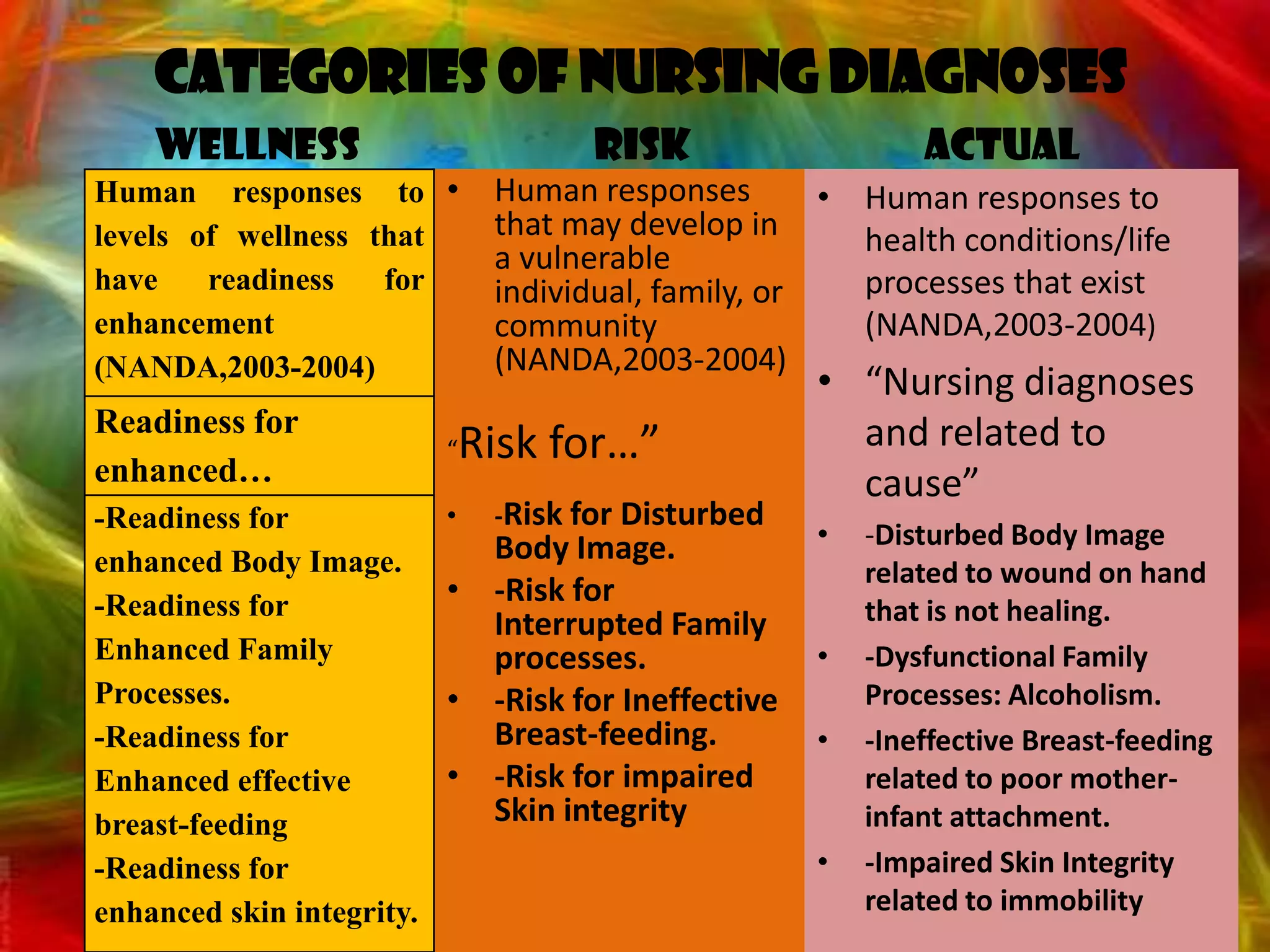
       Categories of Nursing DiagnosesWELLNESS RISK ACTUALHuman responses that may develop in a vulnerable individual, family, or community (NANDA,2003-2004)“Risk for…”-Risk for Disturbed Body Image.-Risk for Interrupted Family processes.-Risk for Ineffective Breast-feeding.-Risk for impaired Skin integrityHuman responses to health conditions/life processes that exist (NANDA,2003-2004)“Nursing diagnoses and related to cause”-Disturbed Body Image related to wound on hand that is not healing.-Dysfunctional Family Processes: Alcoholism.-Ineffective Breast-feeding related to poor mother-infant attachment.-Impaired Skin Integrity related to immobility
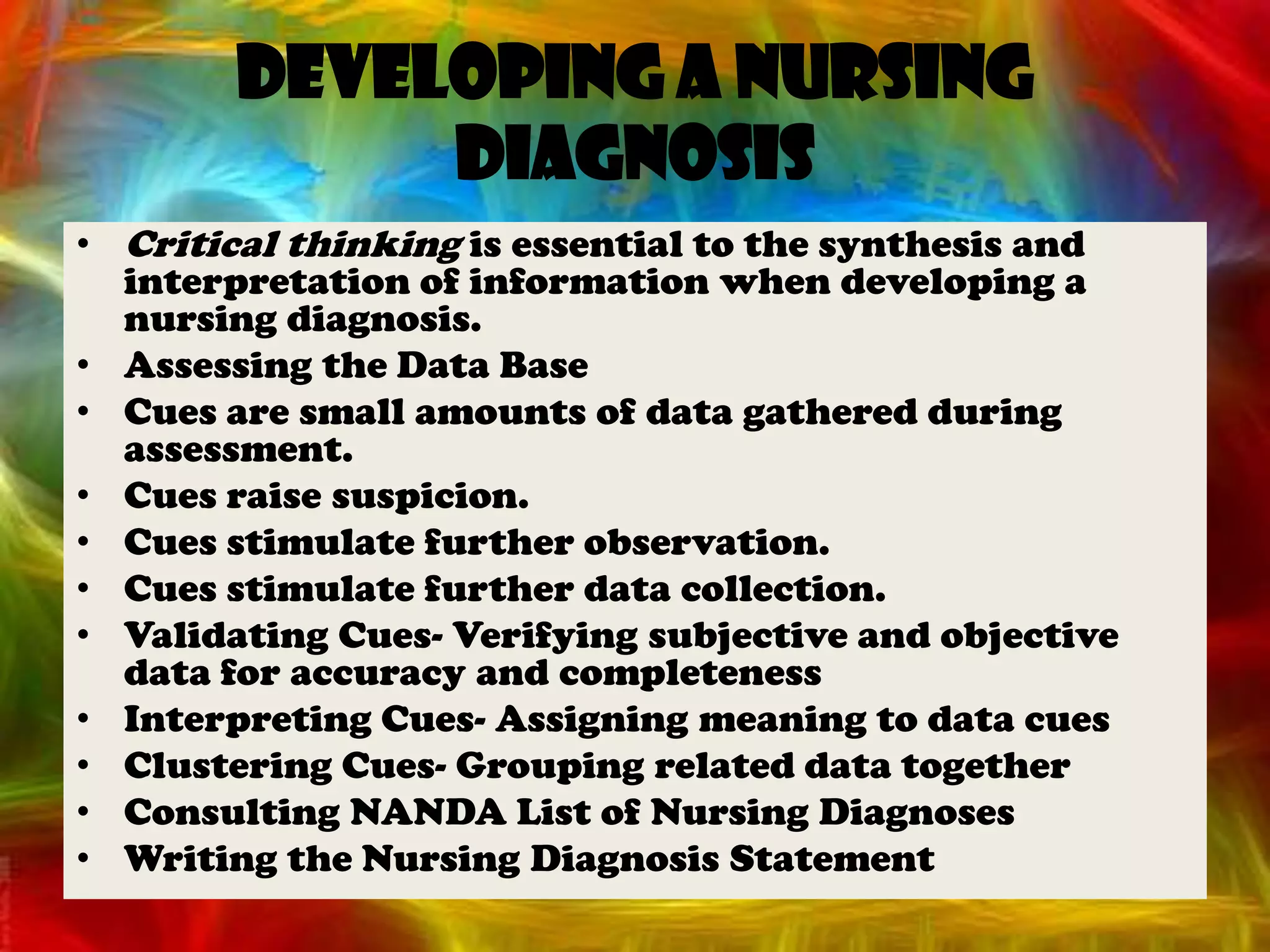
Developing a Nursing DiagnosisCritical thinking is essential to the synthesis and interpretation of information when developing a nursing diagnosis.Assessing the Data Base Cues are small amounts of data gathered during assessment.Cues raise suspicion.Cues stimulate further observation.Cues stimulate further data collection.Validating Cues- Verifying subjective and objective data for accuracy and completenessInterpreting Cues- Assigning meaning to data cuesClustering Cues- Grouping related data togetherConsulting NANDA List of Nursing DiagnosesWriting the Nursing Diagnosis Statement
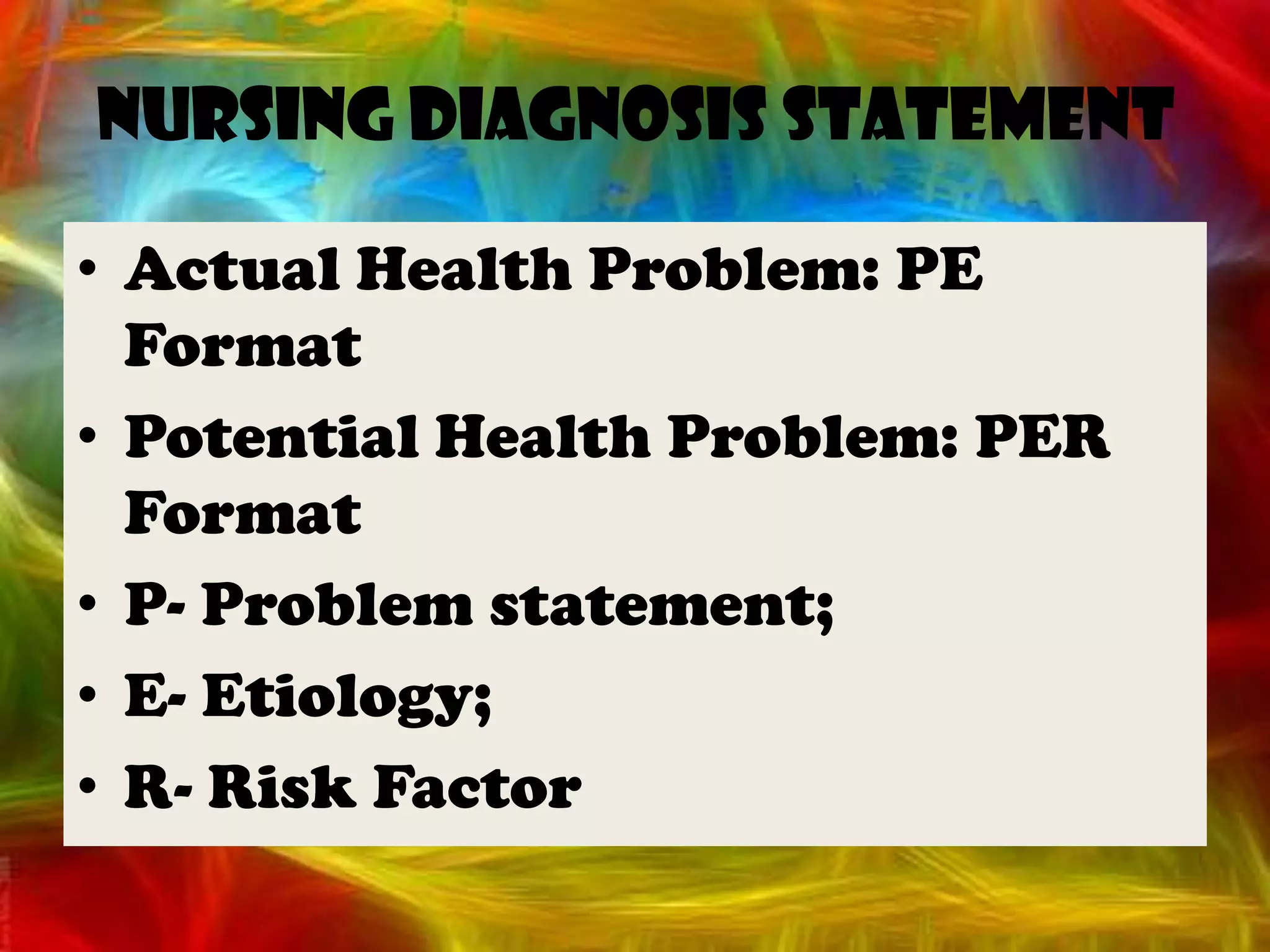
Nursing diagnosis statementActual Health Problem: PE FormatPotential Health Problem: PER FormatP- Problem statement;E- Etiology;R- Risk Factor
Classification of NURSING DIAGNOSIS:High – priority	- life threatening and requires immediate attention.Medium – priority	- resulting to unhealthy consequences.Low – priority	- can be resolve with minimal interventions.
Outcome Identificationrefers to formulating and documenting measurable, realistic, client-focused goals.PURPOSES:To provide individualized careTo promote client participationTo plan care that is realistic and measurableTo allow involvement of support peopleESTABLISH PRIORITIES!!!
Characteristics ofOutcome Criteria:S		-	SPECIFICM 	- 	MEASURABLEA  	- 	ATTAINABLER		- 	REALISTICT		- 	TIME – FRAMEDCAN BE SHORT TERM OR LONG TERM GOAL.
PLANNINGInvolves determining beforehand the strategies or course of actions to be taken before implementation of nursing care.  To be effective, involve the client and his family in planning!
IMPLEMENTATIONPutting nursing care plan into ACTION!To help client attain goals and achieve optimal level of health.Requires: Knowledge, Technical skills, Communication skills, Therapeutic Use of Self.…..SOMETHING THAT IS NOT WRITTEN IS CONSIDERED AS NOT DONE!!!
Planning Nursing InterventionsCategories of Nursing InterventionsIndependent Nursing Interventions:-Actions initiated by the nurse-Do not require direction or an order from another health care professional.-Sanctioned by professional nurse practice acts.
Planning Nursing InterventionsCategories of Nursing InterventionsInterdependent Nursing Interventions:Collaboration
Consultation	Planning Nursing InterventionsCategories of Nursing InterventionsDependent Nursing Interventions:-Require an order from another health care professional.
Nursing intervention activitiesReassessing
Set priorities
Perform nursing intervention
Record actionsRequirements of implementing:KNOWLEDGE- include intellectual skills like problem solving, decision making, and teaching.TECHNICAL SKILLS- to carry out treatments and procedures.COMMUNICATION SKILLS- use of verbal and non-verbal communication to carry out planned nsg. Intervention.THERAPEUTIC USE OF  SELF- being willing and being able to care.
EVALUATIONIS ASSESSING THE CLIENT’S RESPONSE TO NURSING INTERVENTIONS.COMPARING THE RESPONSE TO PREDETERMINED STANDARDS OR OUTCOME CRITERIA.FOUR POSSIBLE JUDGMENTS:The goal was completely met.The goal was partially met.The goal was completely unmet.New problems or nursing diagnoses have developed.
ACTIVITY	G.S. a 36 year old secretary, was having difficulty of breathing a few hours after eating a green salad tossed in tartar sauce with grilled shrimp. She developed a mild urticaria, peri-orbital edema, generalized itchiness. Patient states she had never experienced this before,very anxious and diaphoretic thinks that she may die. RR= 24 breaths/min laboured, cyanotic nailbeds, cold clammy skin,
ACTIVITY	Bilateral wheezing sounds upon auscultation, and pulse rate of 106bpm. She is crying she cant breath deeply. She had an oxygen at 2lpm, nebulization every 4 hours and on steroid therapy.
ACTIVITYPriority problem identified?Based on the scenario, identify the subjective dataBased on the scenario, identify the objective dataMake an actual and risk nursing diagnosis with rationale.
Characteristics of NURSING PROCESS…Problem-oriented.Goal oriented.Orderly, planned, step by step.	(systematic)Open to new information.Interpersonal.Permits creativity.Cyclical.
Benefits of the NURSING PROCESS: for the ClientQUALITY CLIENT CARECONTINUITY OF CAREPARTICIPATION BY CLIENTS IN THEIR HEALTH CARE
Benefits of the NURSING PROCESS: for the NurseCONSISTENT AND SYSTEMATIC NURSING EDUCATION.JOB SATISFACTION.PROFESSIONAL GROWTH.AVOIDANCE OF LEGAL ACTION.MEETING PROFESSIONAL NURSING STANDARDS.MEETING STANDARDS OF ACCREDITED HOSPITALS.
HEART OF THE NURSING PROCESS…KNOWLEDGESKILLS- manual, intellectual, interpersonal.CARING- willingness and ability to care.
Willingness to CAREKeep the focus on what is best for the patient.Respect the beliefs / values of others.Stay involved.Maintain a healthy lifestyle.
CARING BEHAVIORSInspiring someone / instilling hope and faith.Demonstrating patience, compassion, and willingness to persevere.Offering companionship.Helping someone stay in touch with positive aspect of his life.
Demonstrating thoughtfulness.Bending the rules when it really counts.Doing the “little things”Keeping someone informed.Showing your human side by sharing “stories”
Any Questions???
COLLECTING SUBJECTIVE DATAby: CMG
CHIEF COMPLAINT/REASON FOR SEEKING HEALTH CARE:Guide Questions: “what is your major health problem or concern at this time?”“why are you here?”“how can I help you?”Subjective: Translation:by: CMGCLIENT’S HEALTH HISTORY
ADMITTING IMPRESSION : Physicians initial findings (No Abbreviations)by: CMG
BIOGRAPHICAL DATA       Name:(use initials)	     Age:     Sex:Marital Status:					      Religion/Spiritual practices:		     Address:     Birth date:Birthplace:by: CMG
Race or ethnic background:Who lives with the client:Significant others:Educational Level:Occupation: (active/laid off/retired)Nationality:Physician:Date of interview:Time of interview:Date of admission:Time of admission:Room/ Ward:by: CMG
Provider of history:						Primary:					Secondary:Vital Signs upon Admission:by: CMG
HISTORY OF PRESENT ILLNESSCharacter ( How does it feel, look, smell, sound, etc.?)Onset( When did it begin; is it better, worse, or the same since it began?)Location (Where is it? Does it radiate?)Duration (How long it last? Does it recur?)Severity ( How bad is it on a scale 1 [barely noticeable] to 10 [worst pain ever experienced])?Pattern ( What makes it better? What makes it worse?)Associated factors (What other symptoms do you have with it? Will you be able to continue doing your work or other activities? by: CMG
(In chronological order, include specifications for signs and symptoms, interventions or treatment done, response and compliance. For medications, include the name of the drug, dosage, frequency, time).by: CMGHISTORY OF PRESENT ILLNESS
Problems at birthChildhood IllnessesImmunizations to dateAdult illnesses (physical, emotional, mental)SurgeriesAccidentsProlonged pain or pain patternsAllergiesby: CMGPAST HEALTH HISTORY
Purpose: More health problems that seem to run in the families and that are genetically based; the family history assumes greater importance.by: CMGFAMILY HISTORY
(Focused Interview based on the chief complaint and the admitting impression of the patient).Purpose: How the client views herself and investigation of all behaviors that a person does to promote her health. This will help to point out clients strengths and needs     for health maintenance and determine client’s level of social development.by: CMGSOCIO-CULTURAL HISTORY
(Focused Interview based on the chief complaint and the admitting impression of the patient).Purpose: Questions regarding the client’s environment to assess health hazards unique to the clients living situation and lifestyle that may put the client at risk. They may be controllable or uncontrollableby: CMGENVIRONMENTAL HISTORY
MEDICATION AND SUBSTANCE USEPurpose: The information gathered about medication and substance use provides the nurse with information concerning lifestyle and a client’s self care ability. Medication and substance use can affect the client’s health and cause loss of function or impaired senses and can increase the client’s risk for a disease.by: CMG
OBSTETRICAL HISTORY (For Ob-Gyne Cases)GROWTH AND DEVELOPMENT(For Pediatric Patients, significance must be indicated if the growth and development of a child is delayed, advanced or normal. State the reason for the abnormalities.)by: CMG
Using GORDON’S  functional Health Pattern with comparison to Home and Hospitalby: CMGPATTERNS OF FUNCTIONING
Example:CBC, Blood studiesUrine analysisStool ExamSputum ExamChest x-rayUltrasoundby: CMGDIAGNOSTIC EXAMINATION
General Appearance-Vital statistics, vital signs, Contraptions like tubings (IVF, 02 catheter, Wound dressing, Urinary catheter, Nasogastric tubes and etc.) consciousness, coherence and orientation, hygiene/dress, mood and affect, gait obvious signs of discomfort, body build, speech, by: CMGPHYSICAL EXAMINATION
Ht.: 5 foot 5 inches; Wt: 145 lbs; Radial pulse: 71; respiration:16; BP: Right arm= 120/70 mmHg, Left arm= 120/70 mmhg; Temp: 36.7 C(date and time taken) Client alert and cooperative. Sitting comfortably on the table with arms crossed and shoulder slightly slouched forward. Smiling with mild anxiety. Dress is neat and clean. Walks steadily with posture slightly stooped. by: CMGGeneral AppearanceExample:
Physical Assessment (Cephalo-caudal Approach with emphasis on the specific area which is related to the chief complaint/ admitting impression. Highlight the abnormal findings). by: CMG
TRANSFUSIONS-Blood and blood products transfusions (if any) by: CMG
TREATMENT AND NURSING CARE with specific Rationaleby: CMG

Nursing Process

  • 1.
    Descriptive Number: N101Descriptive Name: Health AssessmentCourse Description: The course deals with concepts, principles and techniques of history taking using various tools, physical examination (head to toe), psychosocial assessment and interpretation of laboratory findings to arrive at a nursing diagnosis on the client across the lifespan in varied settings.
  • 2.
    Course Outline:I. ConceptualOverview of the Nursing Health Assessment - review of the phases of the Nursing Process A. Nurse’s Role in Health Assessment: Collecting and Analyzing Data Evolution of nurse’s role in health assessmentB. Critical Thinking in Health AssessmentII. Data Collection Documentation and Analysis A. Data Collection Process - General Survey - Interview Techniques B. Collecting Subjective Data - COLD SPA
  • 3.
    - Health History a.Biographical data b. Chief Complaints c. Present Health History d. Past Health History e. Family History f. Psychosocial History g. Activities of Daily Living (ADLs) h. Review of Systems
  • 4.
    C. Collecting ObjectiveData - Vital signs (TPR, BP) - Physical Assessment (IPPA) - Diagnostic ProceduresD. Validation/ Rationalization of Subjective/ ObjectiveDataE. Documentation of Data - Purposes of Assessment Documentation - Guidelines for Documentation - Assessment forms used for documentation
  • 5.
    INTERMEDIATE COMPETENCIESGiven ahypothetical case, the student will be able to:1. Analyze the different phases of the nursing process2. Utilize the nursing process in health assessment3. Describe the critical thinking process with relevance to health assessment4. Demonstrate critical thinking skills in health assessment5. Collect relevant data6. Classify subjective from objective data7. Utilize interview techniques
  • 6.
    8. Conduct healthhistory9. Perform accurately a. Vital signs b. Physical Examination (IPPA)10. Assist client before, during and after diagnostic procedures 11. Differentiate normal from abnormal findings12. Explain deviations from normal results13. Demonstrate legal practices in documentation
  • 7.
    NURSING PROCESS"the cornerstone of the nursing profession"
  • 8.
    What is aProcess?It is a series of planned actions or operations directed towards a particular result or goal.
  • 9.
    Nursing ProcessIt isa systematic, rational method of planning and providing individualized nursing care.
  • 10.
    Characteristics of theNursing ProcessDynamicClient-centeredPlannedInterpersonal and collaborativeUniversally applicableCan focus on problems or strengths
  • 11.
    Open, flexibe Humanistic and individualized Cyclical Outcome focused ( results oriented) Emphasizes feedback and validation
  • 12.
    Purpose of NursingProcessTo identify a client’s health status, actual or potential health care problems or needs, to establish plans to meet the identified needs, and to deliver specific nursing interventions to meet those needs. It helps nurses in arriving at decisions and in predicting and evaluating consequences.It was developed as a specific method for applying a scientific approach or a problem solving approach to nursing practice.
  • 13.
  • 14.
    PHASES OF THENURSING PROCESSAssessmentDiagnosisOutcome IdentificationPlanningImplementationEvaluation
  • 15.
  • 16.
    Benefits of usingthe nursing processContinuity of carePrevention of duplicationIndividualized careStandards of careIncreased client participationCollaboration of care
  • 17.
    ASSESSMENTDIAGNOSISOUTCOME &PLANNINGIMPLIMENTATIONEVALUATION INTER RELATIONSHIP BETWEEN THE STEPS OF NURSING PROCESS
  • 19.
  • 20.
    Assessing is acontinuous process carried out during all phases of nursing process. All phases of the nursing process depend on the accurate and complete collection of data.Assessing is the systematic and continuous collection, organization, validation and documentation of data. - Potter and Perry( 2006)
  • 21.
    Assessment is thedeliberate and systematic collection of data to determine a clients current and past health status and to determine the clients present and past coping patterns - Carpenito 2004Assessment is the systematic and continuous collection, validation and communication of patient data. - Carol Taylor 
  • 22.
    To establish baselineinformation on the client.To determine the client’s normal function.To determine the client’s risk for diagnosis function.To determine presence or absence of diagnosis function.To determine client’s strengths.To provide data for the diagnostic phase.
  • 23.
    Activities of AssessmentCOLLECTDATAVALIDATE DATAORGANIZE DATARECORDING DATAAssessment involves reorganizing and collecting CUES:Objective (overt) Subjective (covert)
  • 24.
    AssessmentASESSMENTCollect dataOrganize dataValidates DataDocument dataDIAGNOSISPLANNINGEVALUATIONIMPLIMENTATION
  • 25.
    Types of Assessment1.InitialAssessment: Performed within specified time after admission to a health care agencyEg. Nursing Admission Assessment2. Problem Focused Assessment: Ongoing process integrated with nursing care to determine specific problem identified in an earlier assessment and to identify new or overlooked problems.E.g.. Assessment of clients ability to perform self-care while assisting client to bathe.3. Emergency Assessment: Done during psychiatric or physiological crisis of the client to identify life threatening problemsEg. Rapid assessment of airway, breathing and circulation during cardiac arrest4. Time lapsed-Reassessment: Done several months after initial assessment to compare the clients status to baseline data previously obtained.Clinical Skills used in AssessmentObservation – act of noticing client cues. *looking, watching, examining, scrutinizing, surveying, scanning, appraising. *uses different senses: vision, smell, hearing, touch.Interviewing – interaction and communication.Physical ExaminationINSPECTIONPALPATIONPERCUSSIONAUSCULTATIONTUITION- defined as insights, instincts or clinical experiences to make judgment about client care.
  • 26.
    1.COLLECTION OF DATADataCollection is the process of gathering information about a clients health status.
  • 27.
    Collection of Data: Database: A data base is all information about a client. It includes the nursing health history, physical assessment, the physician’s history, physical examination, results of laboratory and diagnostic tests and material contributed by other health personnel.   
  • 28.
    Medical vs. NursingAssessmentsMedical assessmentsTarget data pointing to pathologic conditionsNursing assessmentsFocus on the patient’s response to health problems
  • 29.
    Types of Data: SUBJECTIVE DATA: Also referred to as symptoms or covert data are apparent only to the person affected and can be described or verified only by that person Eg. Itching, Pain, Feelings of worryOBJECTIVE DATA: Also referred to as signs or overt data. These are detectable by an observer or can be measured or tested against an accepted standard. They can be seen, heard, felt or smelled and they are obtained by observation or physical examination Eg. A Blood Pressure Data Discolouration of the Skin 
  • 30.
    Objective Data vs.Subjective DataObjective dataObservable and measurable data that can be seen, heard, or felt by someone other than the person experiencing themE.g., elevated temperature, skin moisture, vomitingSubjective dataInformation perceived only by the affected personE.g., pain experience, feeling dizzy, feeling anxious
  • 31.
    COMPARING SUBJECTIVE ANDOBJECTIVE DATAData elicited and verified by the clientClient Family and significant others.Client recordOther health care professionalsClient interviewInterview and therapeutic communication skills.Caring ability and empathy.Listening skills.“I have a headache.”“It frightens me.”“I am not hungry.”Data directly or indirectly observed through measurement Observation and Physical examinationInspectionPalpationPercussionAuscultationRespiration is 16 per minute.BP 180/100 mmhg, apical pulse 80 bpm and irregularX-ray film reveals fractured ribsDescription
  • 32.
  • 33.
    Methods used toobtain data
  • 34.
    Skills needed toobtain data
  • 35.
    ExamplesSources of Data:PrimarySource (Direct Sourceclient:Usually BEST source
  • 36.
    Secondary Source (IndirectSource)Family Members
  • 37.
    Client’s records 1. Medical Records Eg. Medical History, Physical Examination, Operation notes, Progress notes, Consultation done by Physicians 2. Records of therapies done by other health professionals Eg. Social Workers, Dieticians, Physical Therapist 3. Laboratory Records Other health care professionals Verbal reportsData CollectionConsider timeneeds of patientdevelopmental stagephysical surroundingspast and present coping patterns
  • 38.
  • 39.
  • 40.
  • 41.
  • 42.
    ObservationTo gather datausing sensesEg: laboured breathing, pallor or flushing,pain a lowered side rail ,functioning of an equipment , pt environment and people in it etc…
  • 43.
    InterviewingAn interview isa planned communication or a conversation with a purposeCollection of Health History
  • 44.
    Four Phases ofa Nursing InterviewPreparatory phase
  • 45.
  • 46.
  • 47.
  • 48.
    Nurse collects backgroundinfo from previous charts
  • 49.
  • 50.
  • 51.
    3 – 4ft apart
  • 52.
    Interviewer at 45°angle to patient
  • 53.
    Allow adequate timeIntroductionNurse introduces self
  • 54.
  • 55.
  • 56.
    Provide for patientneeds before startingWorkingNurse gathers info for subjective data
  • 57.
  • 58.
  • 59.
  • 60.
    Open-ended questions TerminationInformpatient when nearing end of interview
  • 61.
    Ensure patient knowswhat will happen with info
  • 62.
    Offer patient chanceto add anything
  • 88.
  • 89.
  • 90.
  • 91.
  • 92.
  • 93.
    Observable, measurable dataPossibleapproaches—body systems, head to toe, or functional health patternsMethods of physical assessmentInspection
  • 94.
  • 95.
  • 96.
  • 97.
  • 98.
  • 99.
  • 100.
  • 101.
    ULTRASOUNDChest x-ray film(radiograph)1. Description: provides information regarding the anatomical location and appearance of the lungs.2. Preprocedure a. Remove all jewelry and other metal objects from the chest area. b. Assess the client’s ability to inhale and hold breath. c. Question females regarding pregnancy or the possibility of pregnancy.3. Postprocedure: Assist the client to dress.
  • 102.
    UltrasoundImaging, medical diagnostic technique in whichvery high frequency sound is directed into the body. The tissue interfaces reflect the sound, and the resulting pattern of sound reflection is processed by a computer to produce a photograph or a moving image on a television. Ultrasound can be used to examine many parts of the body, but its best known application is the examination of the fetus during pregnancy.
  • 104.
  • 105.
    You willbe given a scenario, that you would analyze as CUES for your nursing assessment.Identify subjective to objective data.You will be given points to every correct assessment.
  • 106.
    W.T. a 22year old male, presented to ER with a chief complaint “bad” abdominal pain. The generalized abdominal pain started 24 hours ago but seem to “ease up” after he vomited. Several hours later the pain returned but had shifted to the RLQ and has remained there. The pain is steadily getting worse that he is guarding that area, maintaining a fetal position, profusely sweating and BP when up to 150/100 mmhg from the baseline 120/70 mmhg.
  • 107.
    W.T. reports markednausea and “dry heaves” and he has no appetite. He has also had diarrhea for the last day. VS are 150/100mmhg, 92 bpm, 25 breaths/min, 38.8C temp. Started to have chills, weakness, trembling toes and redness of the face and neck. He vomited again to a greenish gastric secretions with undigested foods. The patient states “dawmapataynagidkosakasakit” appears to anxious and uneasy.
  • 108.
    Ana-physio. What organ(s)are located in the RLQ?Priority problem identified?Based on the scenario, identify the subjective dataBased on the scenario, identify the objective dataGiven the scenario, how are you going to approach the patient?State all the cues that can be collected by means of observation.
  • 109.
    ACTIVITY G.S. a 36year old secretary, was having difficulty of breathing a few hours after eating a green salad tossed in tartar sauce with grilled shrimp. She developed a mild urticaria, peri-orbital edema, generalized itchiness. Patient states she had never experienced this before,very anxious and diaphoretic thinks that she may die. RR= 24 breaths/min laboured, cyanotic nailbeds, cold clammy skin,
  • 110.
    ACTIVITY Bilateral wheezing soundsupon auscultation, and pulse rate of 106bpm. She is crying she cant breath deeply. She had an oxygen at 2lpm, nebulization every 4 hours and on steroid therapy.
  • 111.
    ACTIVITYPriority problem identified?Basedon the scenario, identify the subjective dataBased on the scenario, identify the objective dataGiven the scenario, how are you going to approach/communication technique to the patient?State all the cues that can be collected by means of observation.
  • 112.
    Kindly bring yourNursing Care Plan Book, Nursing Process, and any pocket guide to nursing diagnosis or nursing process.
  • 113.
    ORGANISING DATA Nurses uses a written or computerized format for arranging he data systematically
  • 114.
    Clustering facts intogroups of information.VALIDATING DATAVALIDATING -THE ACT OF DOUBLE CHECKING
  • 115.
  • 116.
    Comparison with another source -patient or family member -record -health team member
  • 117.
    DOCUMENTING DATARecordin permanent record ASAP
  • 118.
    Use patient’s ownwords in subjective data – enclose in “ ___” (quotation marks)
  • 119.
  • 120.
    Don’t make summativestatements Document what you saw the patient doing or what you believe he’s doing.
  • 121.
  • 122.
    ASSESSMENTTo establish database.Sources of Data:Primary: Patient / ClientSecondary: Family members, SOs, Record/Chart, Health team members, Related Lit.
  • 123.
    Approaches to CollectingData for Assessing Client’s Health:ABDELLAH’S 21 Nursing ProblemsDOROTHEA OREM’S Components of Universal Self-CareGORDON’S Functional Health PatternsCorrelating a Body Systems Physical Examination with Data Gathered by Functional Health Area.
  • 124.
    DIAGNOSINGNursing Diagnosis- terminologyused for a clinical judgment by the professional nurse that identifies the client’s actual, risk, wellness, or syndrome responses to a health state, problem, or condition.
  • 125.
    Purposes of NursingDiagnosisIdentifies areas that nurses can resolve or enhance.Demonstrates professional judgment.Organizes decision making as part of the nursing process.Promotes accountability.Provides communication among nurses and other health care personnel.Promotes use of standardized language and process.A means to individualize care.Provides a mechanism for conducting nursing research.
  • 126.
    Categories of NursingDiagnosesActual DiagnosesRisk DiagnosesWellness Diagnoses
  • 127.
    Categories of Nursing DiagnosesWELLNESS RISK ACTUALHuman responses that may develop in a vulnerable individual, family, or community (NANDA,2003-2004)“Risk for…”-Risk for Disturbed Body Image.-Risk for Interrupted Family processes.-Risk for Ineffective Breast-feeding.-Risk for impaired Skin integrityHuman responses to health conditions/life processes that exist (NANDA,2003-2004)“Nursing diagnoses and related to cause”-Disturbed Body Image related to wound on hand that is not healing.-Dysfunctional Family Processes: Alcoholism.-Ineffective Breast-feeding related to poor mother-infant attachment.-Impaired Skin Integrity related to immobility
  • 128.
    Developing a NursingDiagnosisCritical thinking is essential to the synthesis and interpretation of information when developing a nursing diagnosis.Assessing the Data Base Cues are small amounts of data gathered during assessment.Cues raise suspicion.Cues stimulate further observation.Cues stimulate further data collection.Validating Cues- Verifying subjective and objective data for accuracy and completenessInterpreting Cues- Assigning meaning to data cuesClustering Cues- Grouping related data togetherConsulting NANDA List of Nursing DiagnosesWriting the Nursing Diagnosis Statement
  • 129.
    Nursing diagnosis statementActualHealth Problem: PE FormatPotential Health Problem: PER FormatP- Problem statement;E- Etiology;R- Risk Factor
  • 130.
    Classification of NURSINGDIAGNOSIS:High – priority - life threatening and requires immediate attention.Medium – priority - resulting to unhealthy consequences.Low – priority - can be resolve with minimal interventions.
  • 131.
    Outcome Identificationrefers toformulating and documenting measurable, realistic, client-focused goals.PURPOSES:To provide individualized careTo promote client participationTo plan care that is realistic and measurableTo allow involvement of support peopleESTABLISH PRIORITIES!!!
  • 132.
    Characteristics ofOutcome Criteria:S - SPECIFICM - MEASURABLEA - ATTAINABLER - REALISTICT - TIME – FRAMEDCAN BE SHORT TERM OR LONG TERM GOAL.
  • 133.
    PLANNINGInvolves determining beforehandthe strategies or course of actions to be taken before implementation of nursing care. To be effective, involve the client and his family in planning!
  • 134.
    IMPLEMENTATIONPutting nursing careplan into ACTION!To help client attain goals and achieve optimal level of health.Requires: Knowledge, Technical skills, Communication skills, Therapeutic Use of Self.…..SOMETHING THAT IS NOT WRITTEN IS CONSIDERED AS NOT DONE!!!
  • 135.
    Planning Nursing InterventionsCategoriesof Nursing InterventionsIndependent Nursing Interventions:-Actions initiated by the nurse-Do not require direction or an order from another health care professional.-Sanctioned by professional nurse practice acts.
  • 136.
    Planning Nursing InterventionsCategoriesof Nursing InterventionsInterdependent Nursing Interventions:Collaboration
  • 137.
    Consultation Planning Nursing InterventionsCategoriesof Nursing InterventionsDependent Nursing Interventions:-Require an order from another health care professional.
  • 138.
  • 139.
  • 140.
  • 141.
    Record actionsRequirements ofimplementing:KNOWLEDGE- include intellectual skills like problem solving, decision making, and teaching.TECHNICAL SKILLS- to carry out treatments and procedures.COMMUNICATION SKILLS- use of verbal and non-verbal communication to carry out planned nsg. Intervention.THERAPEUTIC USE OF SELF- being willing and being able to care.
  • 142.
    EVALUATIONIS ASSESSING THECLIENT’S RESPONSE TO NURSING INTERVENTIONS.COMPARING THE RESPONSE TO PREDETERMINED STANDARDS OR OUTCOME CRITERIA.FOUR POSSIBLE JUDGMENTS:The goal was completely met.The goal was partially met.The goal was completely unmet.New problems or nursing diagnoses have developed.
  • 143.
    ACTIVITY G.S. a 36year old secretary, was having difficulty of breathing a few hours after eating a green salad tossed in tartar sauce with grilled shrimp. She developed a mild urticaria, peri-orbital edema, generalized itchiness. Patient states she had never experienced this before,very anxious and diaphoretic thinks that she may die. RR= 24 breaths/min laboured, cyanotic nailbeds, cold clammy skin,
  • 144.
    ACTIVITY Bilateral wheezing soundsupon auscultation, and pulse rate of 106bpm. She is crying she cant breath deeply. She had an oxygen at 2lpm, nebulization every 4 hours and on steroid therapy.
  • 145.
    ACTIVITYPriority problem identified?Basedon the scenario, identify the subjective dataBased on the scenario, identify the objective dataMake an actual and risk nursing diagnosis with rationale.
  • 146.
    Characteristics of NURSINGPROCESS…Problem-oriented.Goal oriented.Orderly, planned, step by step. (systematic)Open to new information.Interpersonal.Permits creativity.Cyclical.
  • 147.
    Benefits of theNURSING PROCESS: for the ClientQUALITY CLIENT CARECONTINUITY OF CAREPARTICIPATION BY CLIENTS IN THEIR HEALTH CARE
  • 148.
    Benefits of theNURSING PROCESS: for the NurseCONSISTENT AND SYSTEMATIC NURSING EDUCATION.JOB SATISFACTION.PROFESSIONAL GROWTH.AVOIDANCE OF LEGAL ACTION.MEETING PROFESSIONAL NURSING STANDARDS.MEETING STANDARDS OF ACCREDITED HOSPITALS.
  • 149.
    HEART OF THENURSING PROCESS…KNOWLEDGESKILLS- manual, intellectual, interpersonal.CARING- willingness and ability to care.
  • 150.
    Willingness to CAREKeepthe focus on what is best for the patient.Respect the beliefs / values of others.Stay involved.Maintain a healthy lifestyle.
  • 151.
    CARING BEHAVIORSInspiring someone/ instilling hope and faith.Demonstrating patience, compassion, and willingness to persevere.Offering companionship.Helping someone stay in touch with positive aspect of his life.
  • 152.
    Demonstrating thoughtfulness.Bending therules when it really counts.Doing the “little things”Keeping someone informed.Showing your human side by sharing “stories”
  • 153.
  • 154.
  • 155.
    CHIEF COMPLAINT/REASON FORSEEKING HEALTH CARE:Guide Questions: “what is your major health problem or concern at this time?”“why are you here?”“how can I help you?”Subjective: Translation:by: CMGCLIENT’S HEALTH HISTORY
  • 156.
    ADMITTING IMPRESSION :Physicians initial findings (No Abbreviations)by: CMG
  • 157.
    BIOGRAPHICAL DATA  Name:(use initials) Age: Sex:Marital Status: Religion/Spiritual practices: Address: Birth date:Birthplace:by: CMG
  • 158.
    Race or ethnicbackground:Who lives with the client:Significant others:Educational Level:Occupation: (active/laid off/retired)Nationality:Physician:Date of interview:Time of interview:Date of admission:Time of admission:Room/ Ward:by: CMG
  • 159.
  • 160.
    HISTORY OF PRESENTILLNESSCharacter ( How does it feel, look, smell, sound, etc.?)Onset( When did it begin; is it better, worse, or the same since it began?)Location (Where is it? Does it radiate?)Duration (How long it last? Does it recur?)Severity ( How bad is it on a scale 1 [barely noticeable] to 10 [worst pain ever experienced])?Pattern ( What makes it better? What makes it worse?)Associated factors (What other symptoms do you have with it? Will you be able to continue doing your work or other activities? by: CMG
  • 161.
    (In chronological order,include specifications for signs and symptoms, interventions or treatment done, response and compliance. For medications, include the name of the drug, dosage, frequency, time).by: CMGHISTORY OF PRESENT ILLNESS
  • 162.
    Problems at birthChildhoodIllnessesImmunizations to dateAdult illnesses (physical, emotional, mental)SurgeriesAccidentsProlonged pain or pain patternsAllergiesby: CMGPAST HEALTH HISTORY
  • 163.
    Purpose: More healthproblems that seem to run in the families and that are genetically based; the family history assumes greater importance.by: CMGFAMILY HISTORY
  • 164.
    (Focused Interview basedon the chief complaint and the admitting impression of the patient).Purpose: How the client views herself and investigation of all behaviors that a person does to promote her health. This will help to point out clients strengths and needs for health maintenance and determine client’s level of social development.by: CMGSOCIO-CULTURAL HISTORY
  • 165.
    (Focused Interview basedon the chief complaint and the admitting impression of the patient).Purpose: Questions regarding the client’s environment to assess health hazards unique to the clients living situation and lifestyle that may put the client at risk. They may be controllable or uncontrollableby: CMGENVIRONMENTAL HISTORY
  • 166.
    MEDICATION AND SUBSTANCEUSEPurpose: The information gathered about medication and substance use provides the nurse with information concerning lifestyle and a client’s self care ability. Medication and substance use can affect the client’s health and cause loss of function or impaired senses and can increase the client’s risk for a disease.by: CMG
  • 167.
    OBSTETRICAL HISTORY (ForOb-Gyne Cases)GROWTH AND DEVELOPMENT(For Pediatric Patients, significance must be indicated if the growth and development of a child is delayed, advanced or normal. State the reason for the abnormalities.)by: CMG
  • 168.
    Using GORDON’S functional Health Pattern with comparison to Home and Hospitalby: CMGPATTERNS OF FUNCTIONING
  • 169.
    Example:CBC, Blood studiesUrineanalysisStool ExamSputum ExamChest x-rayUltrasoundby: CMGDIAGNOSTIC EXAMINATION
  • 170.
    General Appearance-Vital statistics,vital signs, Contraptions like tubings (IVF, 02 catheter, Wound dressing, Urinary catheter, Nasogastric tubes and etc.) consciousness, coherence and orientation, hygiene/dress, mood and affect, gait obvious signs of discomfort, body build, speech, by: CMGPHYSICAL EXAMINATION
  • 171.
    Ht.: 5 foot5 inches; Wt: 145 lbs; Radial pulse: 71; respiration:16; BP: Right arm= 120/70 mmHg, Left arm= 120/70 mmhg; Temp: 36.7 C(date and time taken) Client alert and cooperative. Sitting comfortably on the table with arms crossed and shoulder slightly slouched forward. Smiling with mild anxiety. Dress is neat and clean. Walks steadily with posture slightly stooped. by: CMGGeneral AppearanceExample:
  • 172.
    Physical Assessment (Cephalo-caudalApproach with emphasis on the specific area which is related to the chief complaint/ admitting impression. Highlight the abnormal findings). by: CMG
  • 173.
    TRANSFUSIONS-Blood and bloodproducts transfusions (if any) by: CMG
  • 174.
    TREATMENT AND NURSINGCARE with specific Rationaleby: CMG
  • 175.
    A. Overview ofthe System (Anatomy and Physiology)B. Definition (of the specific case)C. EpidemiologyD. EtiologyE. Clinical Manifestations by: CMGTEXTBOOK DISCUSSION
  • 176.
    F. PathogenesisG. ComplicationsH.Interventions 1. Medical 2. Surgical 3. Nursing Levels of Care: Promotive, Preventive,Curative, Rehabilitativeby: CMG
  • 177.
    ReferencesTitle of thebookAuthorEditionCopyrightPagesFor electronic source: website and location of topic by: CMG
  • 178.
    Actual Health Problem:PE FormatPotential Health Problem: PER FormatP- Problem statement;E- Etiology;R- Risk Factor Each Goal should have a set of independent, dependent, and collaborative nursing interventions.Definition of the problem statement should be under the column of Nursing Diagnosis with the REFERENCE.ALL rationales should have a reference.by: CMGNURSING CARE PLAN
  • 179.