Ms. Romana Javaid
Post RN BScN
OBJECTIVES
 By the end of this session students will be able to:
 Define nursing process
 Describe the purposes of nursing process
 Identify the components. of nursing process
 Describe the assessment phase of the nursing process
 Describe the methods of nursing assessment
 Differentiate between subjective & objective date
collection
 Describe source of data collection
NURSING PROCESS:
INTRODUCTION/ BACKGROUND
 Hall originated the term nursing process in 1955.
 Johnson, Orlando and Weidenbacirst use it to refer to
a series of phases describing the practice of nursing.
 Since then various nurses have described the process
of nursing and organized the phases in different ways.
Definition Of Nursing process
 The nursing process is a systematic, rational method of
planning and providing individualized nursing care.
 An organized sequence of problem-solving steps used to
identify and to manage the health problems of clients.
 It is accepted for clinical practice established by the
American Nurses Association
THE NURSING PROCESS
An organizational framework for the practice of
nursing
Orderly, systematic
Central to all nursing care
Encompasses all steps taken by the nurse in caring
for a patient
Purposes of nursing process
 To identify a client’s health status and actual or
potential problems
 To establish plans to meet the identified needs
 To deliver specific nursing interventions to
meet those needs
Characteristics of nursing process
 The nursing process is cyclical
 The nursing process is client centered
 Decision making is involved in every step of the
nursing process
 This process is collaborative and interpersonal
 The components are not separate entities but
overlapping
ASSESSMENT
 Assessment is the systematic and continuous
collection, organization, validation and documentation
of data (information)
 Assessment is a step which is applied in all the steps
of nursing process.
 Nursing assessment focus on client’s response to a
health problem.
ASSESSMENT
 Nursing assessment should include the client's
perceived needs, health problems, related experience,
health practices , values and life styles.
 Each client should have an initial assessment
consisting of a history and physical assessment
performed and documented within 24 hours of
admission as an inpatient.
ASSESSMENT
 The assessment process involves four closely
related activities:
1. Collecting the data
2. Organizing the data
3. Validating the data
4. Documenting the data
COLLECTING DATA
 Data collection is the process of gathering
information about a client’s health status.
 A database is all the information about a client. It
includes nursing health history, physical
assessment, physical examination, results of
laboratory and diagnostic tests and material
contributed by other health care professionals.
TYPES OF DATA
 Four types of data:
1. OBJECTIVE DATA: observable and
measurable facts (Signs)
2. SUBJECTIVE DATA: information that only
the client feels and can describe (Symptoms)
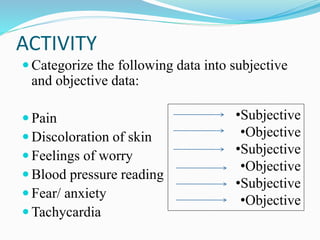
ACTIVITY
 Categorize the following data into subjective
and objective data:
 Pain
 Discoloration of skin
 Feelings of worry
 Blood pressure reading
 Fear/ anxiety
 Tachycardia
•Subjective
•Objective
•Subjective
•Objective
•Subjective
•Objective
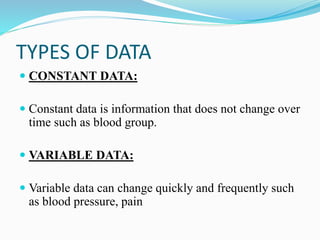
TYPES OF DATA
 CONSTANT DATA:
 Constant data is information that does not change over
time such as blood group.
 VARIABLE DATA:
 Variable data can change quickly and frequently such
as blood pressure, pain
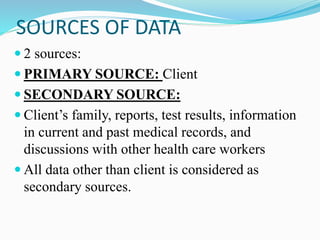
SOURCES OF DATA
 2 sources:
 PRIMARY SOURCE: Client
 SECONDARY SOURCE:
 Client’s family, reports, test results, information
in current and past medical records, and
discussions with other health care workers
 All data other than client is considered as
secondary sources.
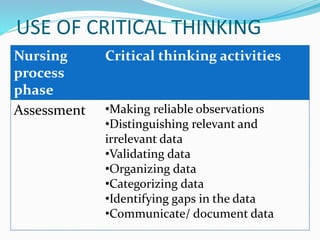
USE OF CRITICAL THINKING
Nursing
process
phase
Critical thinking activities
Assessment •Making reliable observations
•Distinguishing relevant and
irrelevant data
•Validating data
•Organizing data
•Categorizing data
•Identifying gaps in the data
•Communicate/ document data
DATA COLLECTION METHODS
1. OBSERVING:
 Gather data by using senses (vision, smell,
hearing and touch)
 Observation is conscious, deliberate skill that is
developed through efforts and with an organized
approach
DATA COLLECTION METHODS
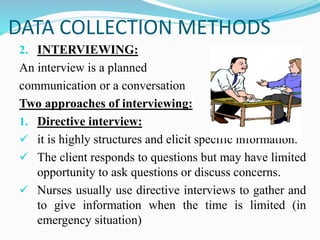
2. INTERVIEWING:
An interview is a planned
communication or a conversation
Two approaches of interviewing:
1. Directive interview:
✓ it is highly structures and elicit specific information.
✓ The client responds to questions but may have limited
opportunity to ask questions or discuss concerns.
✓ Nurses usually use directive interviews to gather and
to give information when the time is limited (in
emergency situation)
DATA COLLECTION
METHODS
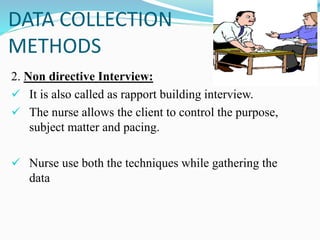
2. Non directive Interview:
✓ It is also called as rapport building interview.
✓ The nurse allows the client to control the purpose,
subject matter and pacing.
✓ Nurse use both the techniques while gathering the
data
TYPES OF INTERVIEW
QUESTIONS
 CLOSE ENDED QUESTIONS:
➢Often associated with directive interviews
➢Answers in Yes and no only
➢It begins with When, Where, Who, What
 OPEN ENDED QUESTIONS:
➢Often associated with the in-directive interviews
➢It may begins with Why, How, What
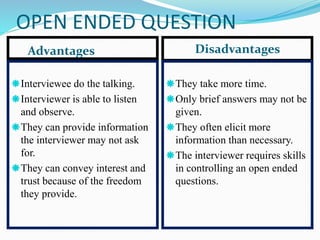
OPEN ENDED QUESTION
Advantages Disadvantages
Interviewee do the talking.
Interviewer is able to listen
and observe.
They can provide information
the interviewer may not ask
for.
They can convey interest and
trust because of the freedom
they provide.
They take more time.
Only brief answers may not be
given.
They often elicit more
information than necessary.
The interviewer requires skills
in controlling an open ended
questions.
ORGANIZING DATA
 The nurse uses a written format that organizes
the assessment data systematically.
 Many conceptual models or theories to
organize the data like wellness model, body
system model etc.
 Most commonly used model for organizing the
data is Functional Health Pattern (FHP)
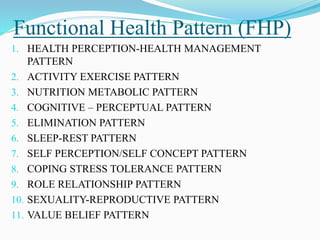
Functional Health Pattern (FHP)
1. HEALTH PERCEPTION-HEALTH MANAGEMENT
PATTERN
2. ACTIVITY EXERCISE PATTERN
3. NUTRITION METABOLIC PATTERN
4. COGNITIVE – PERCEPTUAL PATTERN
5. ELIMINATION PATTERN
6. SLEEP-REST PATTERN
7. SELF PERCEPTION/SELF CONCEPT PATTERN
8. COPING STRESS TOLERANCE PATTERN
9. ROLE RELATIONSHIP PATTERN
10. SEXUALITY-REPRODUCTIVE PATTERN
11. VALUE BELIEF PATTERN
VALIDATING DATA
✓ The information gathered during the
assessment phase must be complete, factual
and accurate because the nursing diagnosis
and interventions are based on this information.
✓ Validation is the act of double checking or
verifying data to confirm that it is accurate and
factual
VERIFYING DATA: GUIDELINES
 Double check personal observations
 Double check equipment
 Check with experts and team members
 Recheck out-liers
 Clarify statements
VERIFYING DATA: GUIDELINES
❖ Compare subjective and objective data to
verify the client’s statements with your
observations.
❖ Clarify any ambiguous or vague statements
❖ Double check data that are extremely
abnormal.
❖ Determine the presence of factors that may
interfere with accurate measurement.
References
 Kozier & Erb's Fundamentals of Nursing (10th
Edition) (Fundamentals of Nursing (Kozier)) 10th
Edition.

Nursing process (fundamental of nursing)

  • 1.
  • 2.
    OBJECTIVES  By theend of this session students will be able to:  Define nursing process  Describe the purposes of nursing process  Identify the components. of nursing process  Describe the assessment phase of the nursing process  Describe the methods of nursing assessment  Differentiate between subjective & objective date collection  Describe source of data collection
  • 3.
    NURSING PROCESS: INTRODUCTION/ BACKGROUND Hall originated the term nursing process in 1955.  Johnson, Orlando and Weidenbacirst use it to refer to a series of phases describing the practice of nursing.  Since then various nurses have described the process of nursing and organized the phases in different ways.
  • 4.
    Definition Of Nursingprocess  The nursing process is a systematic, rational method of planning and providing individualized nursing care.  An organized sequence of problem-solving steps used to identify and to manage the health problems of clients.  It is accepted for clinical practice established by the American Nurses Association
  • 5.
    THE NURSING PROCESS Anorganizational framework for the practice of nursing Orderly, systematic Central to all nursing care Encompasses all steps taken by the nurse in caring for a patient
  • 6.
    Purposes of nursingprocess  To identify a client’s health status and actual or potential problems  To establish plans to meet the identified needs  To deliver specific nursing interventions to meet those needs
  • 7.
    Characteristics of nursingprocess  The nursing process is cyclical  The nursing process is client centered  Decision making is involved in every step of the nursing process  This process is collaborative and interpersonal  The components are not separate entities but overlapping
  • 8.
    ASSESSMENT  Assessment isthe systematic and continuous collection, organization, validation and documentation of data (information)  Assessment is a step which is applied in all the steps of nursing process.  Nursing assessment focus on client’s response to a health problem.
  • 9.
    ASSESSMENT  Nursing assessmentshould include the client's perceived needs, health problems, related experience, health practices , values and life styles.  Each client should have an initial assessment consisting of a history and physical assessment performed and documented within 24 hours of admission as an inpatient.
  • 10.
    ASSESSMENT  The assessmentprocess involves four closely related activities: 1. Collecting the data 2. Organizing the data 3. Validating the data 4. Documenting the data
  • 11.
    COLLECTING DATA  Datacollection is the process of gathering information about a client’s health status.  A database is all the information about a client. It includes nursing health history, physical assessment, physical examination, results of laboratory and diagnostic tests and material contributed by other health care professionals.

  • 12.
    TYPES OF DATA Four types of data: 1. OBJECTIVE DATA: observable and measurable facts (Signs) 2. SUBJECTIVE DATA: information that only the client feels and can describe (Symptoms)
  • 13.
    ACTIVITY  Categorize thefollowing data into subjective and objective data:  Pain  Discoloration of skin  Feelings of worry  Blood pressure reading  Fear/ anxiety  Tachycardia •Subjective •Objective •Subjective •Objective •Subjective •Objective
  • 14.
    TYPES OF DATA CONSTANT DATA:  Constant data is information that does not change over time such as blood group.  VARIABLE DATA:  Variable data can change quickly and frequently such as blood pressure, pain
  • 15.
    SOURCES OF DATA 2 sources:  PRIMARY SOURCE: Client  SECONDARY SOURCE:  Client’s family, reports, test results, information in current and past medical records, and discussions with other health care workers  All data other than client is considered as secondary sources.
  • 16.
    USE OF CRITICALTHINKING Nursing process phase Critical thinking activities Assessment •Making reliable observations •Distinguishing relevant and irrelevant data •Validating data •Organizing data •Categorizing data •Identifying gaps in the data •Communicate/ document data
  • 17.
    DATA COLLECTION METHODS 1.OBSERVING:  Gather data by using senses (vision, smell, hearing and touch)  Observation is conscious, deliberate skill that is developed through efforts and with an organized approach
  • 18.
    DATA COLLECTION METHODS 2.INTERVIEWING: An interview is a planned communication or a conversation Two approaches of interviewing: 1. Directive interview: ✓ it is highly structures and elicit specific information. ✓ The client responds to questions but may have limited opportunity to ask questions or discuss concerns. ✓ Nurses usually use directive interviews to gather and to give information when the time is limited (in emergency situation)
  • 19.
    DATA COLLECTION METHODS 2. Nondirective Interview: ✓ It is also called as rapport building interview. ✓ The nurse allows the client to control the purpose, subject matter and pacing. ✓ Nurse use both the techniques while gathering the data
  • 20.
    TYPES OF INTERVIEW QUESTIONS CLOSE ENDED QUESTIONS: ➢Often associated with directive interviews ➢Answers in Yes and no only ➢It begins with When, Where, Who, What  OPEN ENDED QUESTIONS: ➢Often associated with the in-directive interviews ➢It may begins with Why, How, What
  • 22.
    OPEN ENDED QUESTION AdvantagesDisadvantages Interviewee do the talking. Interviewer is able to listen and observe. They can provide information the interviewer may not ask for. They can convey interest and trust because of the freedom they provide. They take more time. Only brief answers may not be given. They often elicit more information than necessary. The interviewer requires skills in controlling an open ended questions.
  • 23.
    ORGANIZING DATA  Thenurse uses a written format that organizes the assessment data systematically.  Many conceptual models or theories to organize the data like wellness model, body system model etc.  Most commonly used model for organizing the data is Functional Health Pattern (FHP)
  • 24.
    Functional Health Pattern(FHP) 1. HEALTH PERCEPTION-HEALTH MANAGEMENT PATTERN 2. ACTIVITY EXERCISE PATTERN 3. NUTRITION METABOLIC PATTERN 4. COGNITIVE – PERCEPTUAL PATTERN 5. ELIMINATION PATTERN 6. SLEEP-REST PATTERN 7. SELF PERCEPTION/SELF CONCEPT PATTERN 8. COPING STRESS TOLERANCE PATTERN 9. ROLE RELATIONSHIP PATTERN 10. SEXUALITY-REPRODUCTIVE PATTERN 11. VALUE BELIEF PATTERN
  • 25.
    VALIDATING DATA ✓ Theinformation gathered during the assessment phase must be complete, factual and accurate because the nursing diagnosis and interventions are based on this information. ✓ Validation is the act of double checking or verifying data to confirm that it is accurate and factual
  • 26.
    VERIFYING DATA: GUIDELINES Double check personal observations  Double check equipment  Check with experts and team members  Recheck out-liers  Clarify statements
  • 27.
    VERIFYING DATA: GUIDELINES ❖Compare subjective and objective data to verify the client’s statements with your observations. ❖ Clarify any ambiguous or vague statements ❖ Double check data that are extremely abnormal. ❖ Determine the presence of factors that may interfere with accurate measurement.
  • 28.
    References  Kozier &Erb's Fundamentals of Nursing (10th Edition) (Fundamentals of Nursing (Kozier)) 10th Edition.