Recording Systems and Their Effect on
Animal Breeding in Ethiopia
By; -
Nahom Ephrem
INTRODUCTION
• Cattle extension and breeding schemes depend on reliable recording
under existing production conditions.
• Performance recording is a pre-requisite to effective decision
making on breeding program.
• A growing demand for livestock products and technological change
is radically affecting the structure of the livestock production sector
in both developed and developing countries (FAO, 2009).
Cont’d…
• Livestock production in developing regions is generally
characterized by; -
-- small flock-size,
-- communally shared grazing,
-- uncontrolled mating, and
-- absence of pedigree and performance recording.
• These characteristics limit the implementation of effective
genetic improvement programs (Kosgey, 2004).
Objectives
General Objectives
 To review on recoding systems and their effect on animal
breeding in Ethiopia.
Specific Objectives
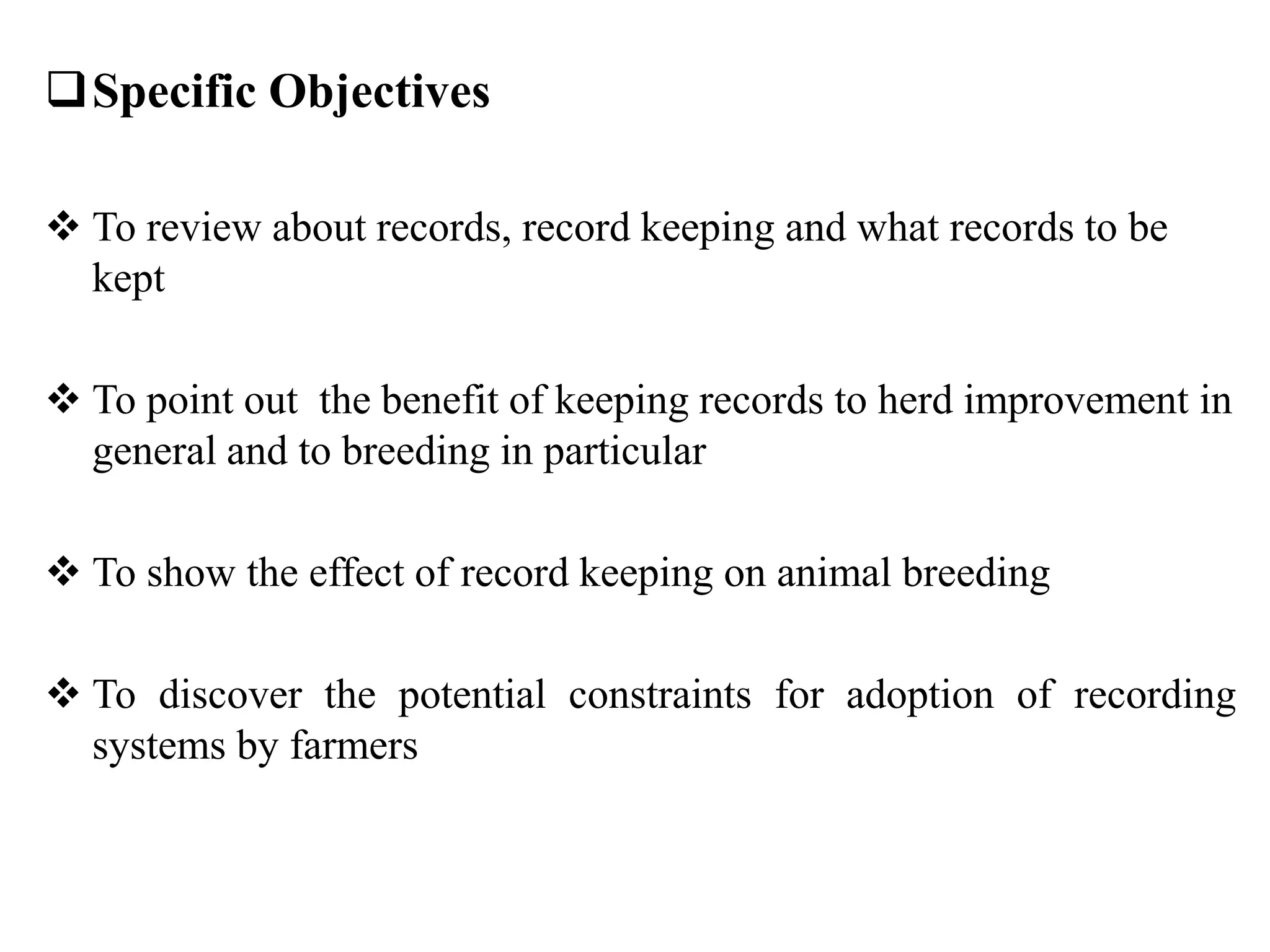
 To review about records, record keeping and what records to be
kept
 To point out the benefit of keeping records to herd improvement in
general and to breeding in particular
 To show the effect of record keeping on animal breeding
 To discover the potential constraints for adoption of recording
systems by farmers
LITERATURE REVIEW
What are Records?
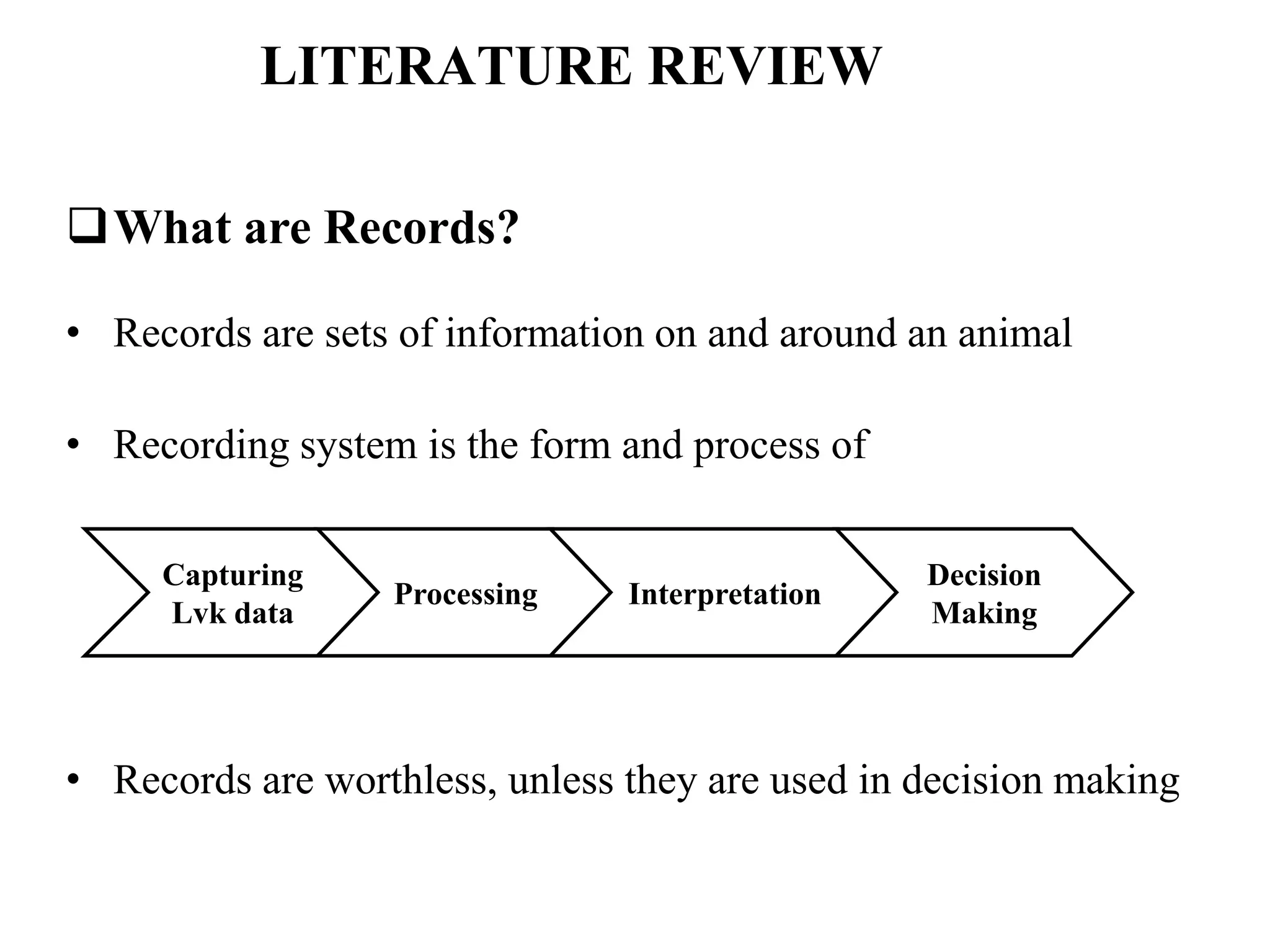
• Records are sets of information on and around an animal
• Recording system is the form and process of
• Records are worthless, unless they are used in decision making
Capturing
Lvk data
Processing Interpretation
Decision
Making
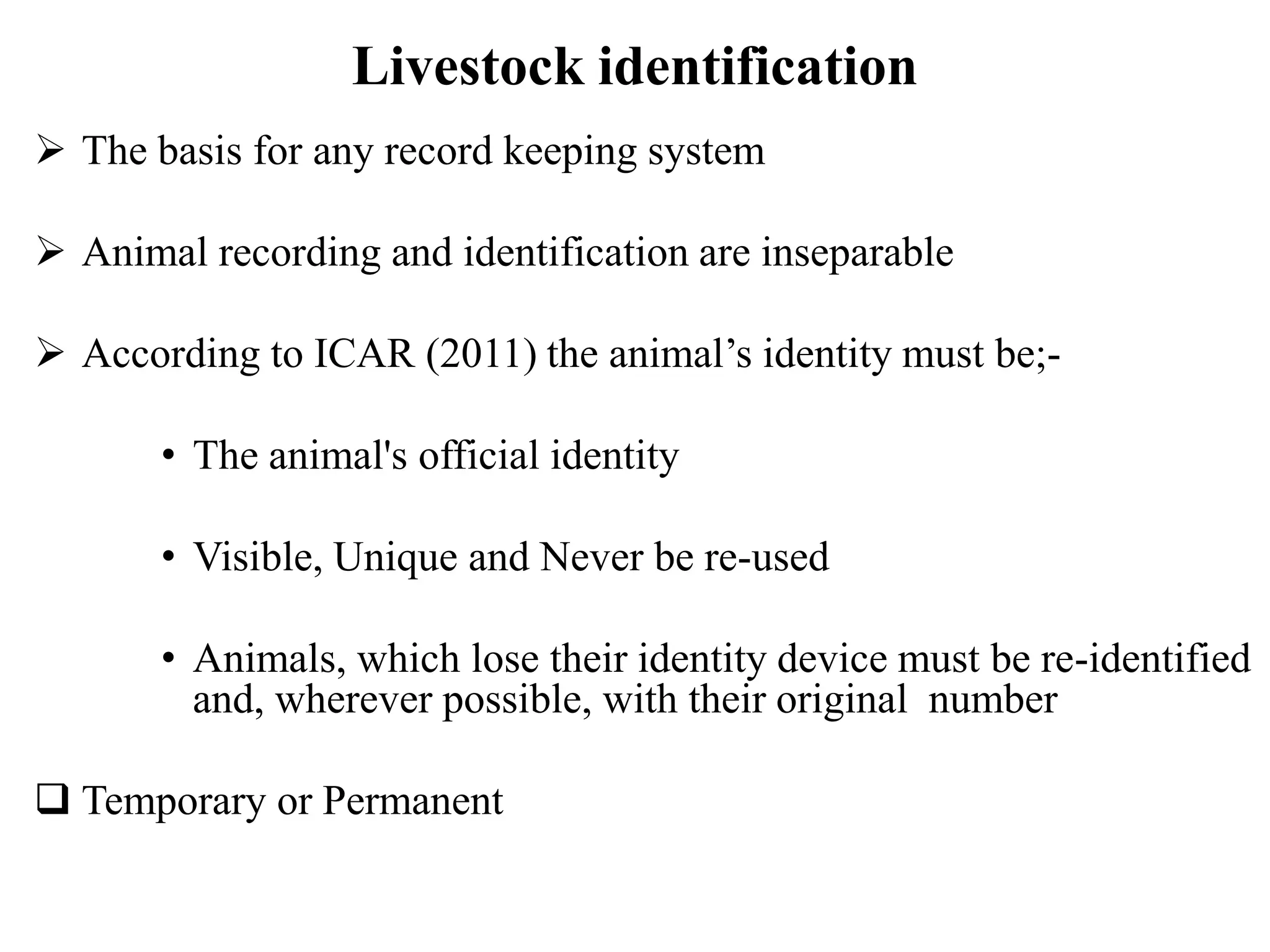
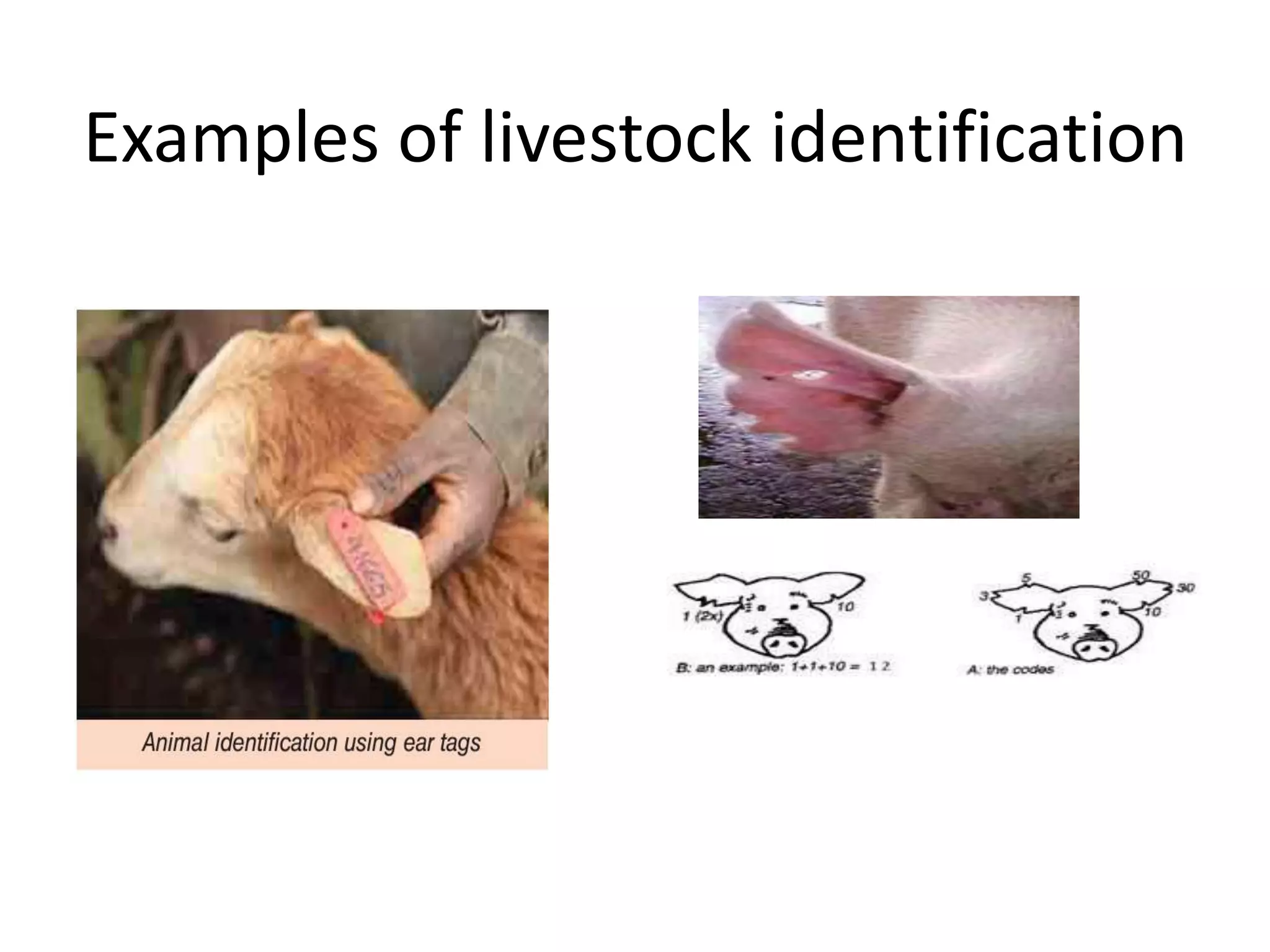
Livestock identification
 The basis for any record keeping system
 Animal recording and identification are inseparable
 According to ICAR (2011) the animal’s identity must be;-
• The animal's official identity
• Visible, Unique and Never be re-used
• Animals, which lose their identity device must be re-identified
and, wherever possible, with their original number
 Temporary or Permanent
Cont’d…
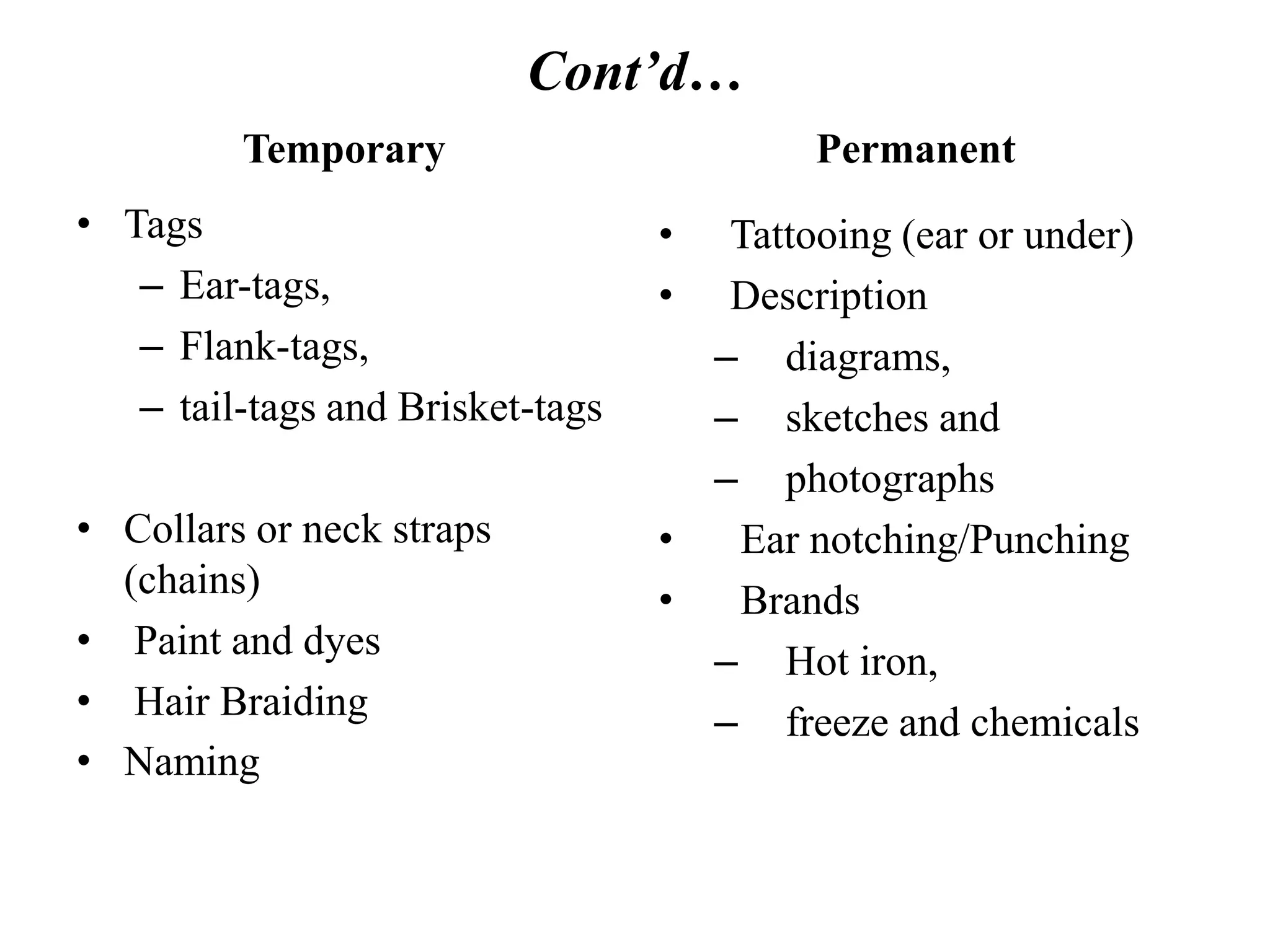
Temporary
• Tags
– Ear-tags,
– Flank-tags,
– tail-tags and Brisket-tags
• Collars or neck straps
(chains)
• Paint and dyes
• Hair Braiding
• Naming
Permanent
• Tattooing (ear or under)
• Description
– diagrams,
– sketches and
– photographs
• Ear notching/Punching
• Brands
– Hot iron,
– freeze and chemicals
Examples of livestock identification
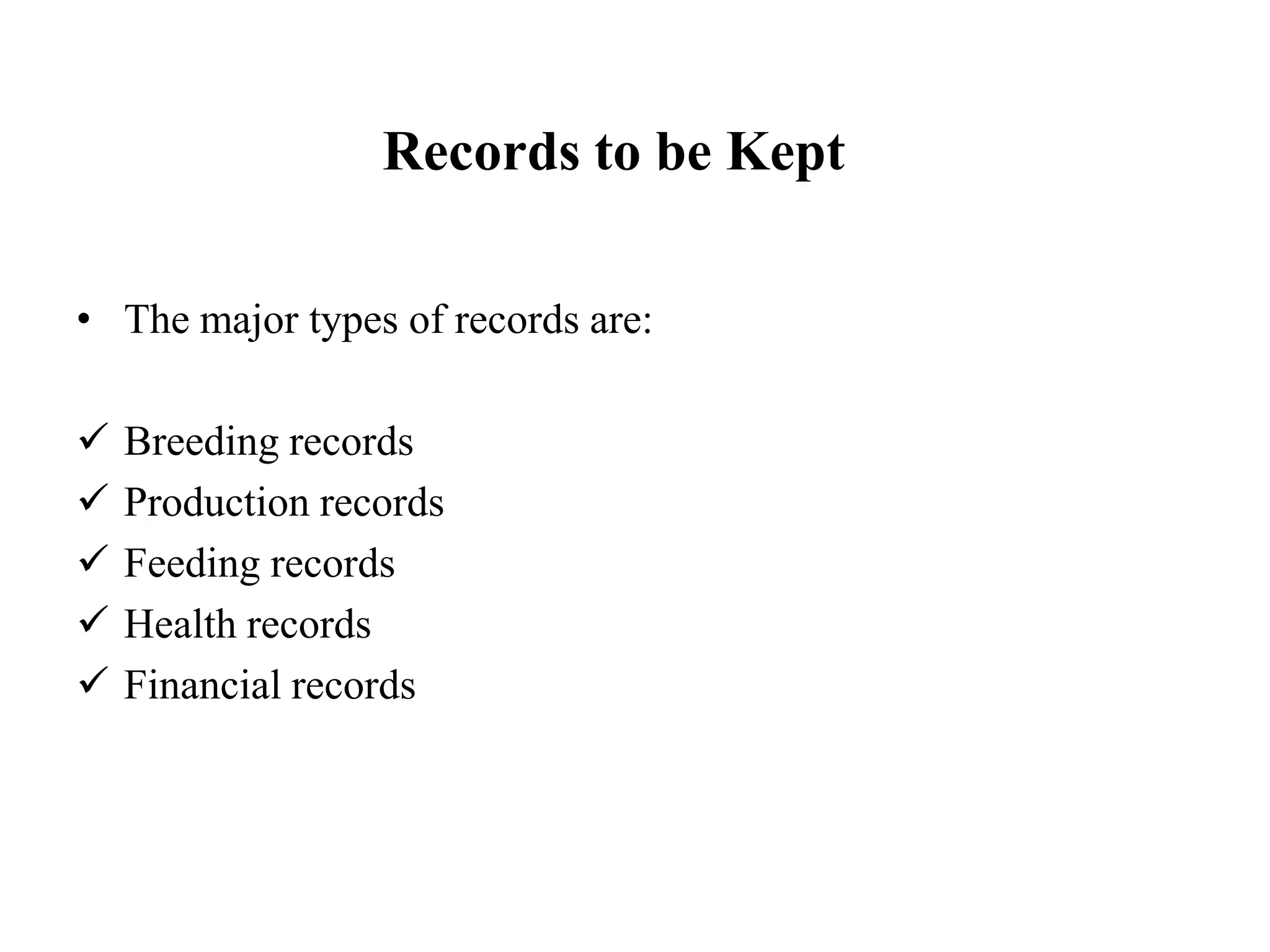
Records to be Kept
• The major types of records are:
 Breeding records
 Production records
 Feeding records
 Health records
 Financial records
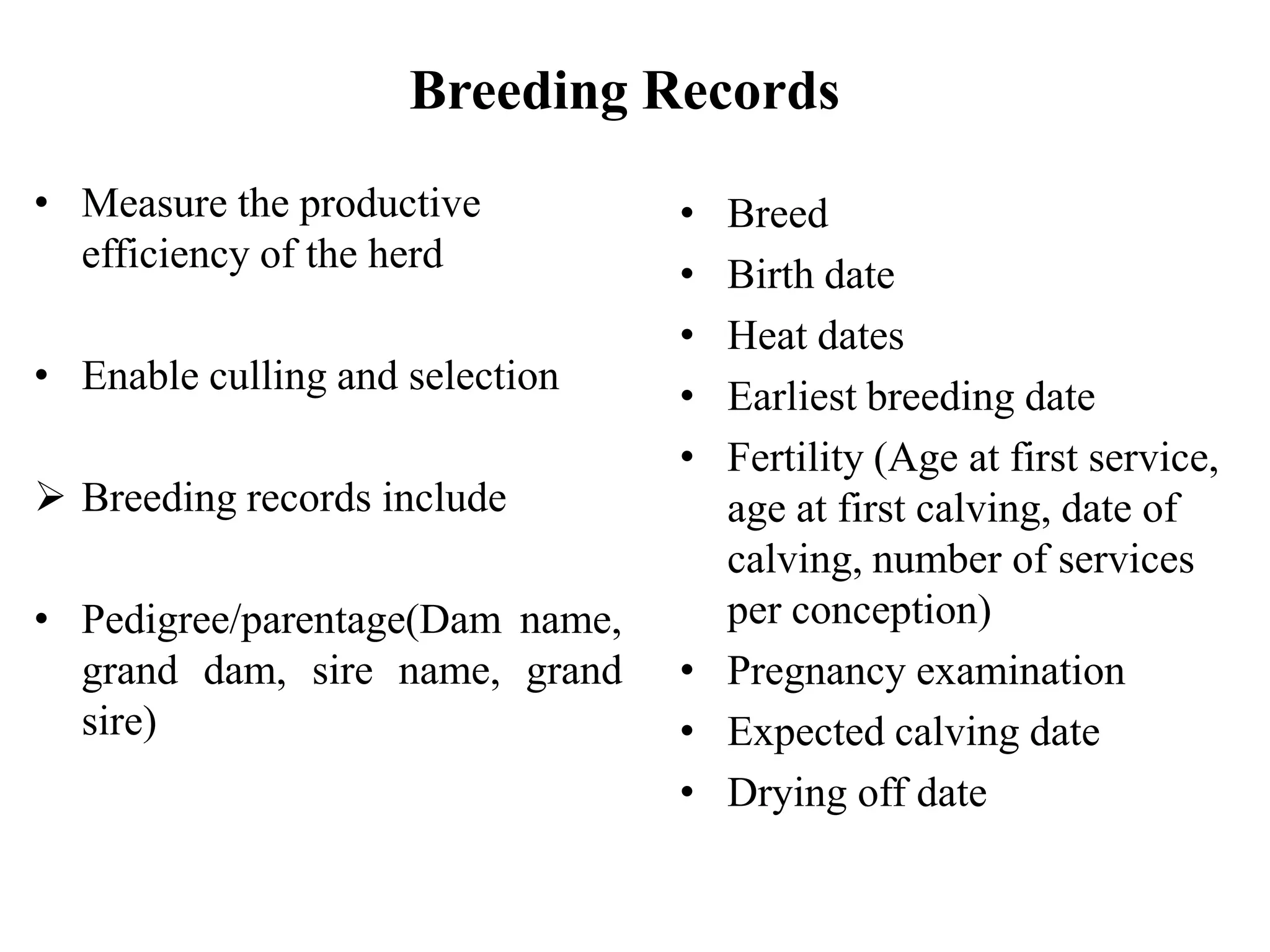
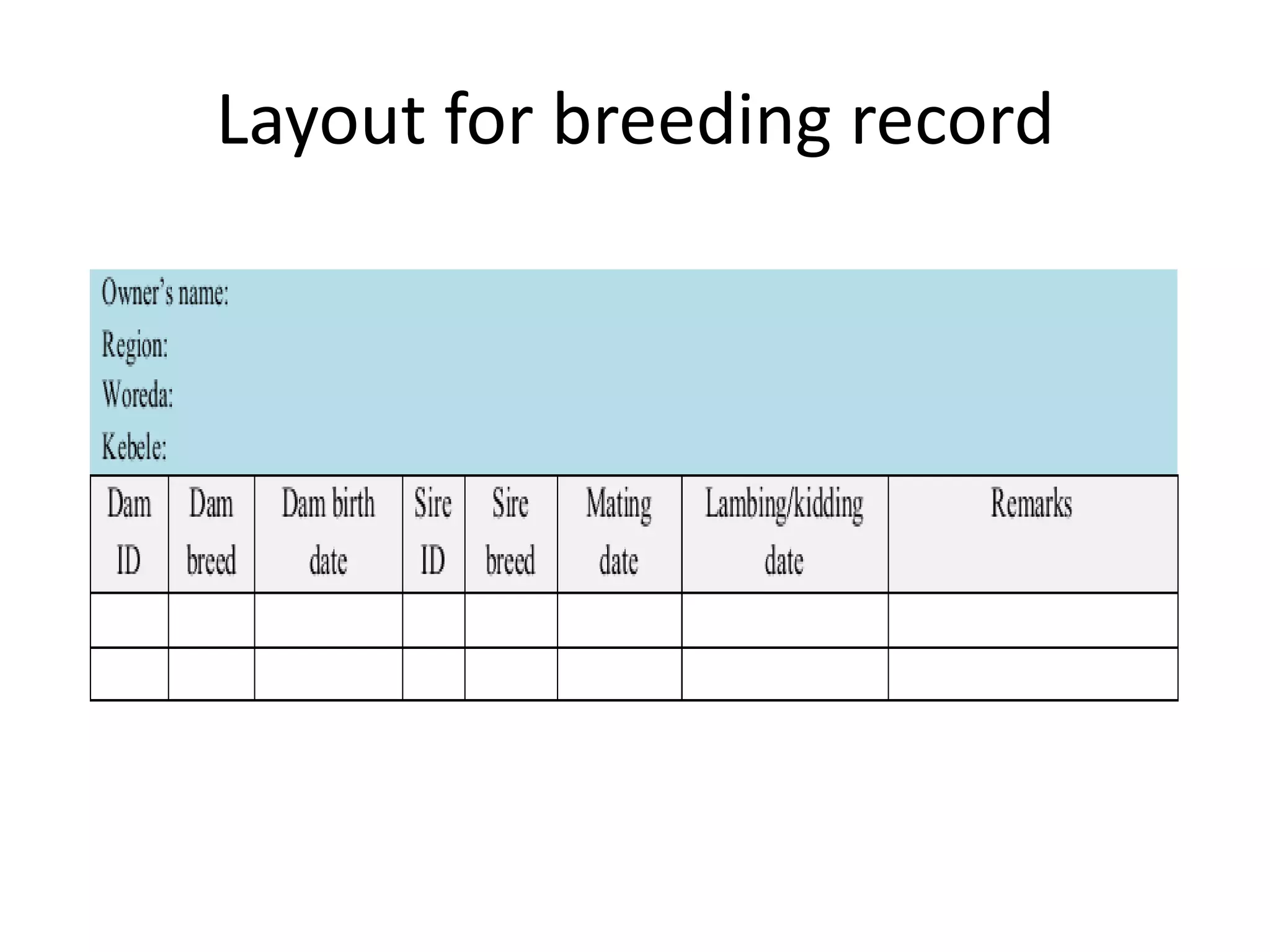
Breeding Records
• Measure the productive
efficiency of the herd
• Enable culling and selection
 Breeding records include
• Pedigree/parentage(Dam name,
grand dam, sire name, grand
sire)
• Breed
• Birth date
• Heat dates
• Earliest breeding date
• Fertility (Age at first service,
age at first calving, date of
calving, number of services
per conception)
• Pregnancy examination
• Expected calving date
• Drying off date
Layout for breeding record
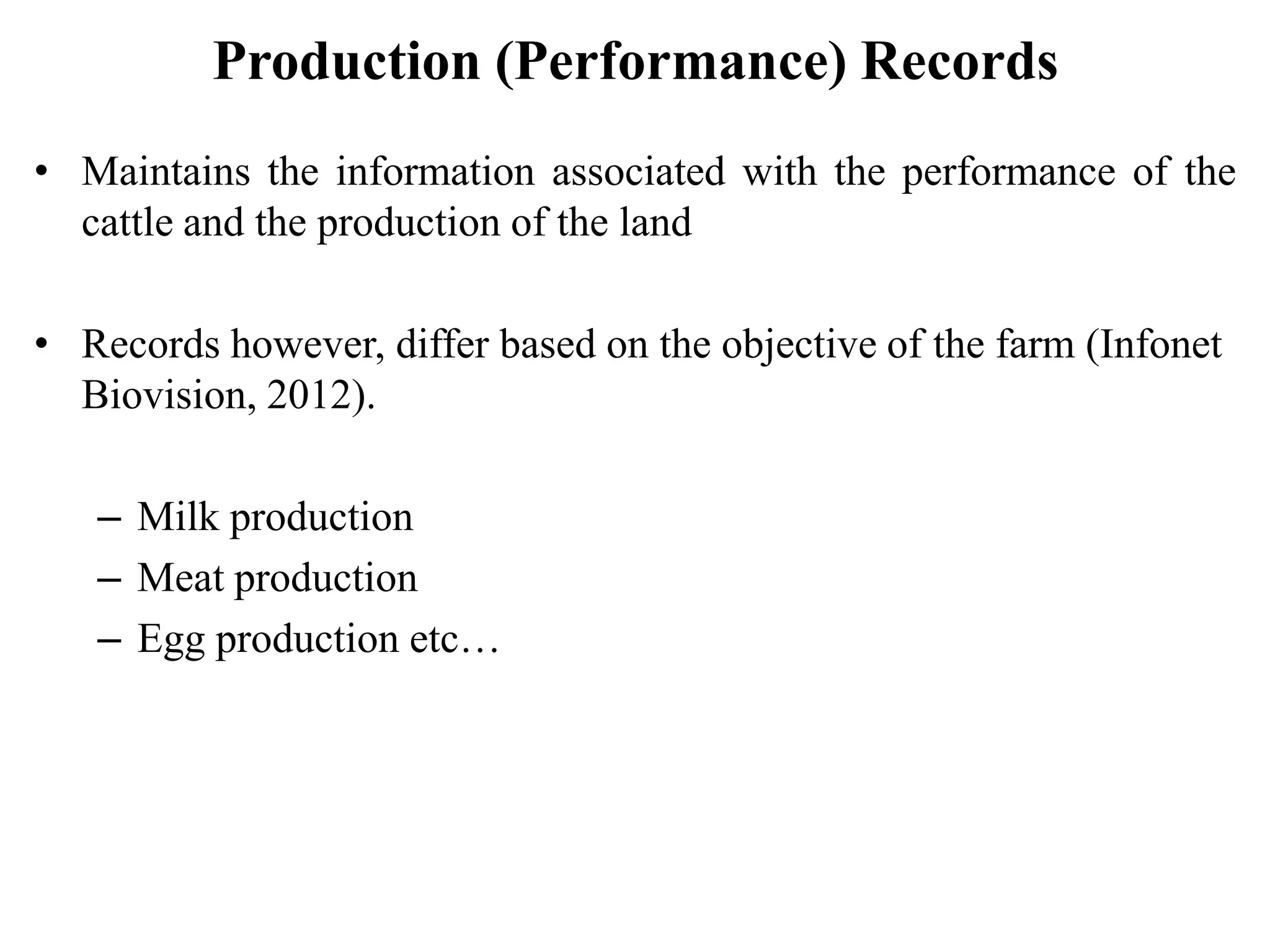
Production (Performance) Records
• Maintains the information associated with the performance of the
cattle and the production of the land
• Records however, differ based on the objective of the farm (Infonet
Biovision, 2012).
– Milk production
– Meat production
– Egg production etc…
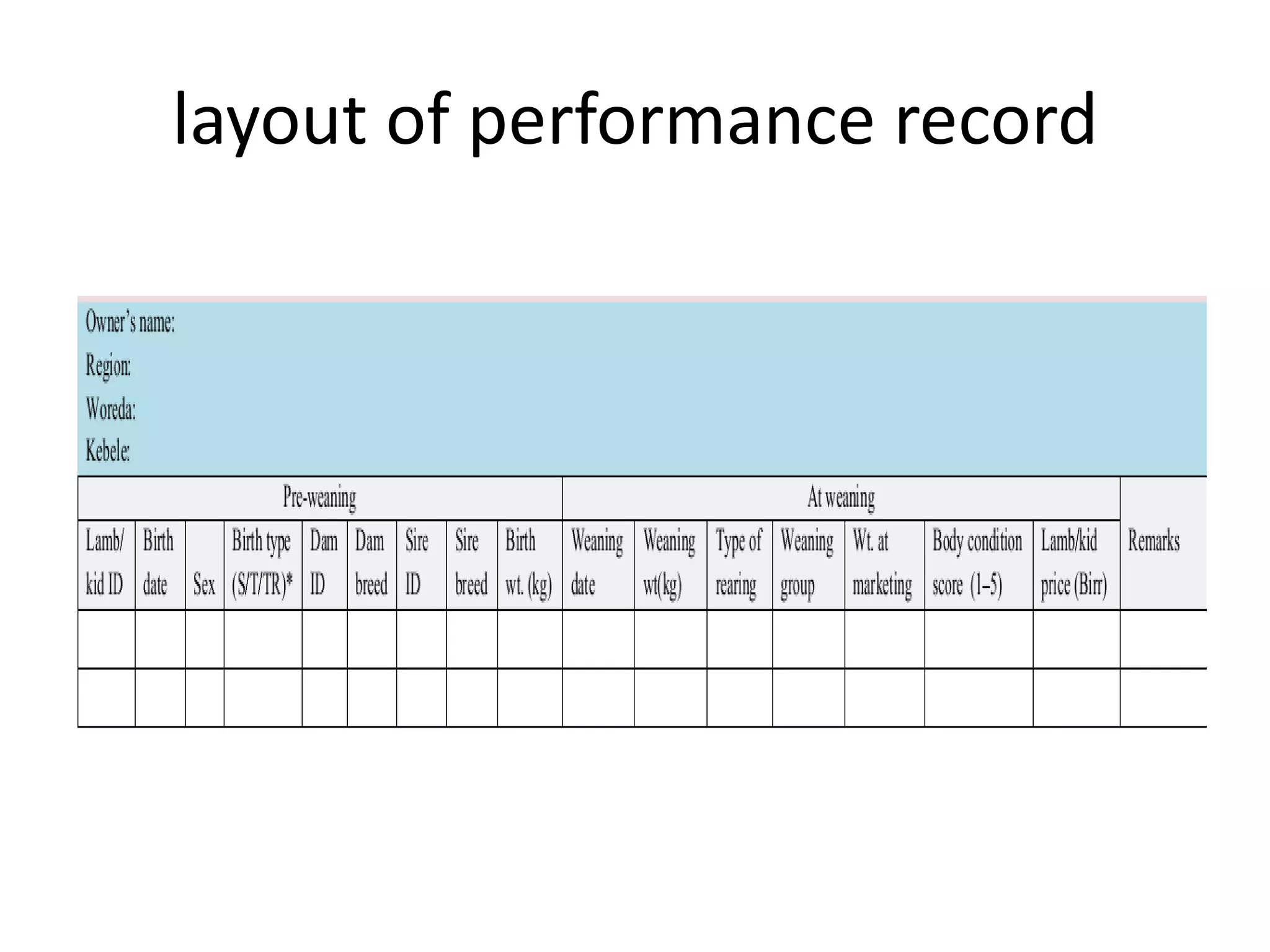
layout of performance record
Health Records
• Health records provides an over all health information about
the animals in the herd
• With the use of records, veterinarians can gain additional
information about the probable causes of ill health in an
individual animal ; -
Vaccination
Dipping/spraying
Treatment
De-worming
Postmortem
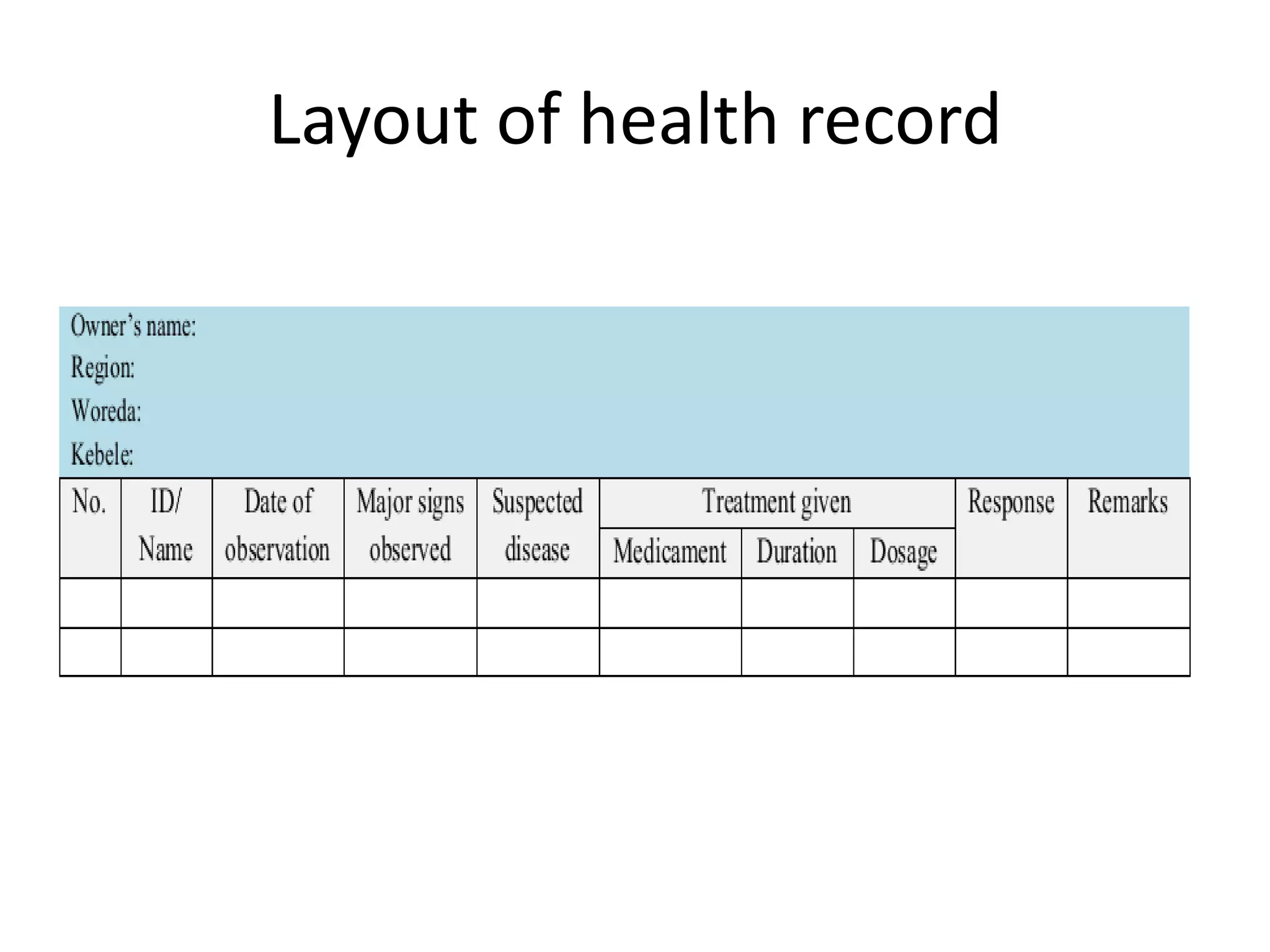
Layout of health record
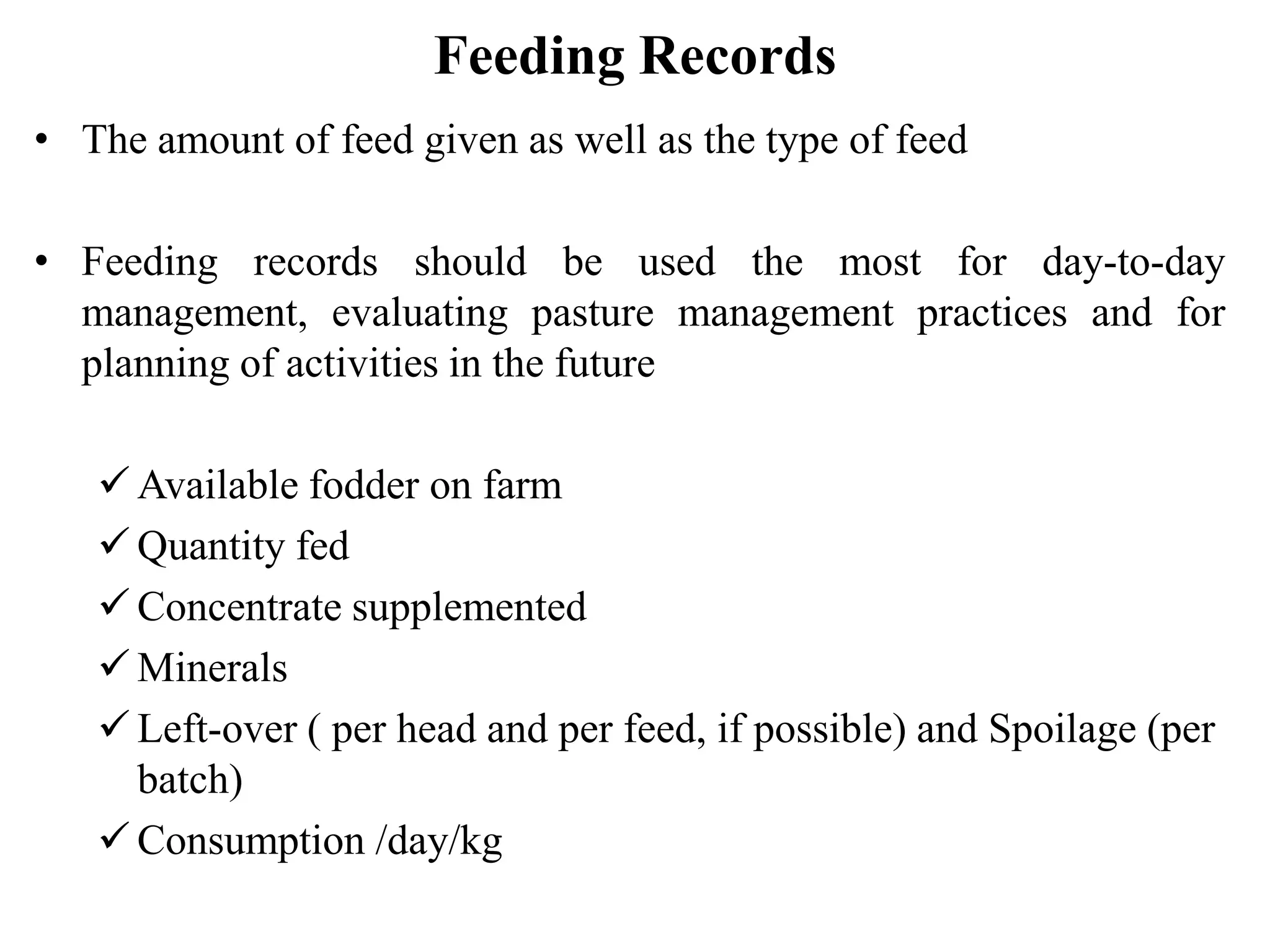
Feeding Records
• The amount of feed given as well as the type of feed
• Feeding records should be used the most for day-to-day
management, evaluating pasture management practices and for
planning of activities in the future
 Available fodder on farm
 Quantity fed
 Concentrate supplemented
 Minerals
 Left-over ( per head and per feed, if possible) and Spoilage (per
batch)
 Consumption /day/kg
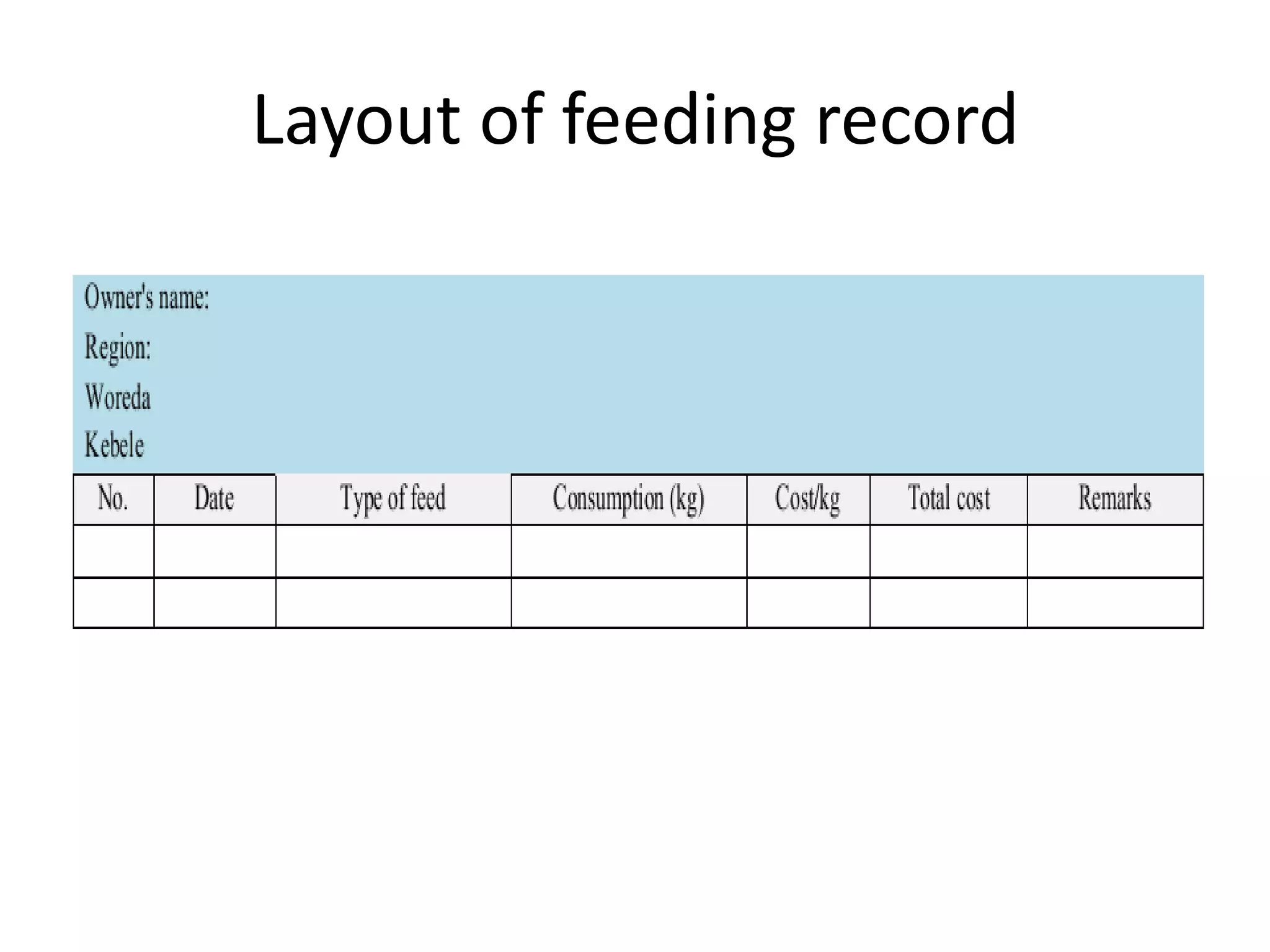
Layout of feeding record
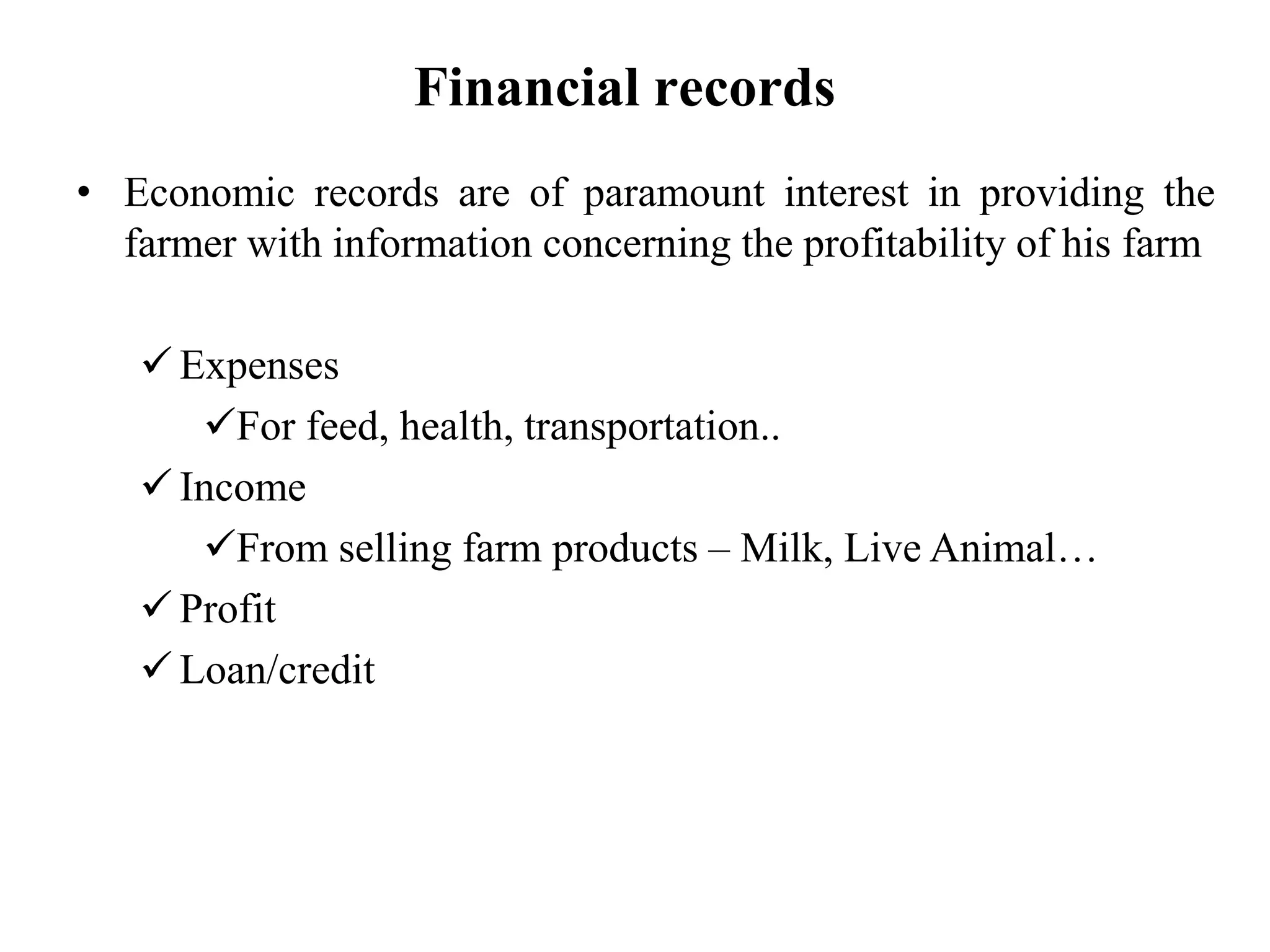
Financial records
• Economic records are of paramount interest in providing the
farmer with information concerning the profitability of his farm
 Expenses
For feed, health, transportation..
 Income
From selling farm products – Milk, Live Animal…
 Profit
 Loan/credit
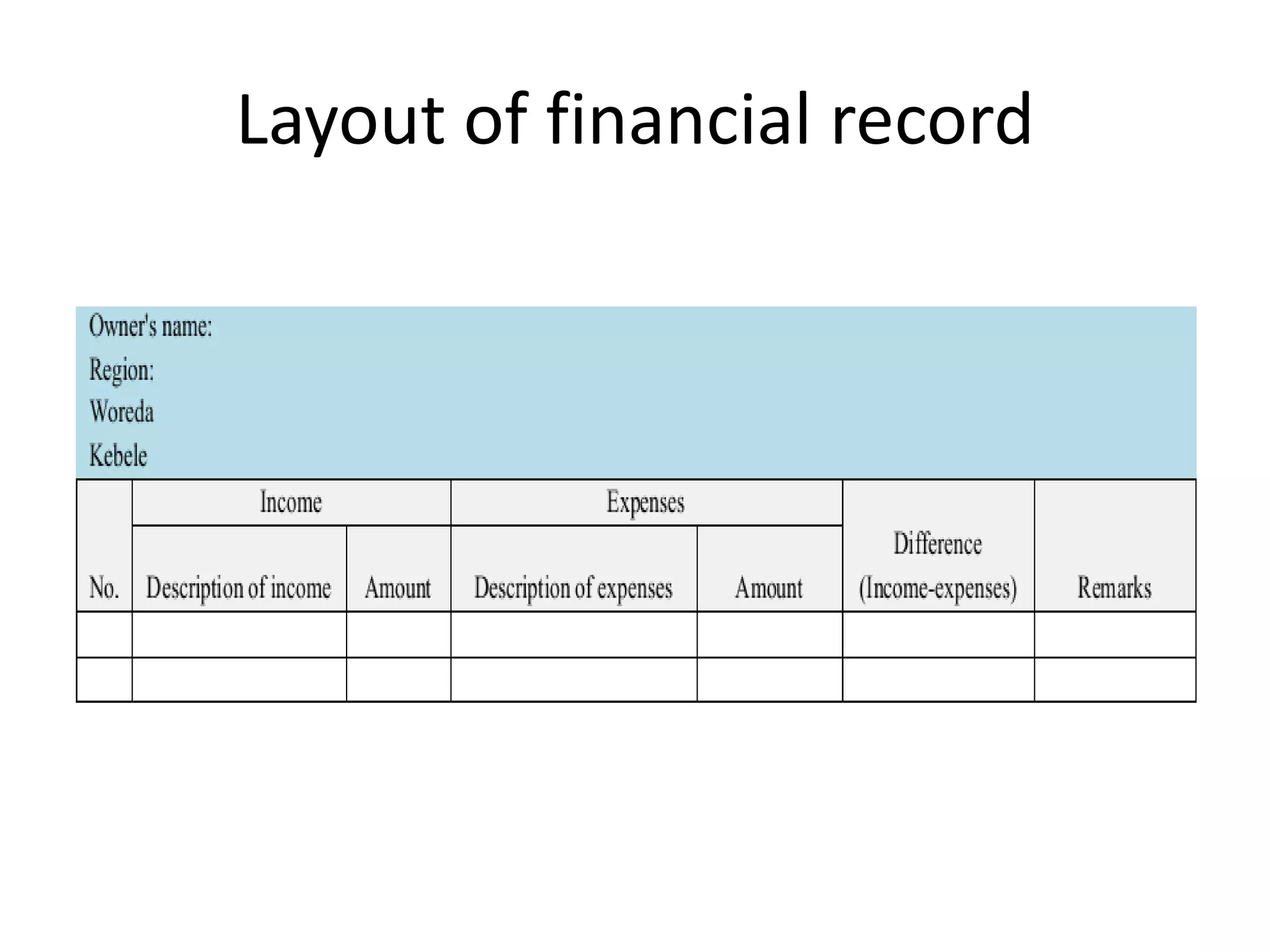
Layout of financial record
Benefits of Record Keeping
For Herd Improvement (in General)
 Aids in efficient management of the herd
 Aid in breeding planning
 Aid in gross margin analysis, to assess profitability/losses and
credit/loan access
 To rationalize labor
 Aids in disease management
 Aids in feed planning and management
Cont’d…
For Animal Breeding (in Particular)
 Setting up a breeding strategy and successful genetic improvement
 Success in genetic improvement to a larger extent depends, among
others, on accurate recording of the farm operations and periodic
analysis of the data (Aynalem Haile et al., 2011) in Chencha Chebo
and Kefyalew Alemayehu, 2012.
 Selection and culling
 Successful Cross breeding and control of Inbreeding
 Wise use of AnGRs
The Effect of Keeping Records on Animal Breeding in
Ethiopia
• Over the last three to four decades there has been interest to initiate
and develop a national dairy recording scheme at smallholder
production level
• Some dairy records are available in the country, but are limited to
research institutions (Alemu Gebrewold, 1997).
Cont’d…
Effect on Successful Genetic Improvement
• Genetic improvement for productive traits in livestock, particularly
in cattle, has been very slow and insignificant in the country.
• One of the main reasons for this is lack of well-organized and
usable recorded information on the performance of both the
indigenous and crossbreds (Belete Anteneh, 2006).
 Biased Selection
• Selection accuracy is strongly dependent on the degree of data
recording (Kassahun Awgichew, 2007).
Cont’d…
 Unplanned Cross Breeding & Incidence of Inbreeding
• In Ethiopia, lack of record keeping believed to have increased the
incidence of inbreeding in the country (Desalegn G/Medhin, 2011) in
Chencha Chebo and Kefyalew Alemayehu, 2012.
• The cheapest way of making sure no inbreeding takes place is to
keep close breeding records (Infonet Biovision, 2012).
• According to Timothy et al., (2003) inbreeding within flocks is
probably occurring due to inadequate and non - formalized cockerel
exchange system, long time use of parent stock and lack of record
keeping.
Cont’d…
 Effect on Wise use of Animal Genetic Resources(AnGRs)
• The wise use of AnGRs includes a broad mix of ongoing activities
that must be well planned and executed
• It requires careful definition of breeding objectives, and maintenance
of effective and efficient animal recording and breeding strategies
(ILRI, 2006)
• According to Fedlu et al., (2007), Ethiopian cattle genetic diversity is
currently under threat mainly due to unplanned as well as
indiscriminate crossbreeding, and to some extent interbreeding among
the local populations
Constraints that limit Adoption of Recording Systems
 The key constraints are:
 Inadequate and unsupportive policies and infrastructure
 Inadequate resource mobilization and allocation to support pilot
activities for livestock recording systems
 Limited capacity and understanding of livestock recording,
processing of information and feedback both at farmer level
(because of illiteracy) and at institutional level
 Small and dispersed herds/ flocks, leading to high transaction costs
 Weak or non-existent organizations and institutions to carry out and
support recording systems
 Lack of personal interest
Summary and Conclusions
• Record keeping is a platform for development and has various forms
related to different objectives in respect to the specific local conditions
of animal production systems
• Record keeping affects production and management through
improving the genetic merit of the herd, through selection and culling
• Our country is lacking those benefits, because most records in
Ethiopia are limited to institutions, though it leads us to the
uncontrolled breeding of animals, thus affecting the use, development
and conservation of AnGRs.
• Several constraints limit the adoption and practice of livestock
recording in Ethiopia, those factors lay on the hands of both the
farmer, and the government
Recommendations
• Adequate and supportive policies and effective breeding strategy
should be in place, Once the breeding plan is in place there has to
be a follow up of the whole operation.
• Farmers should be trained on the benefits of animal identification
for breed improvement and management and convince them to
take steps
• Appropriate legal frameworks resulting in adequate and strong
partnerships, networks and collaboration should be subjected
Thank you…!!!

Recording systems and their effect on animal breeding in Ethiopia

  • 1.
    Recording Systems andTheir Effect on Animal Breeding in Ethiopia By; - Nahom Ephrem
  • 2.
    INTRODUCTION • Cattle extensionand breeding schemes depend on reliable recording under existing production conditions. • Performance recording is a pre-requisite to effective decision making on breeding program. • A growing demand for livestock products and technological change is radically affecting the structure of the livestock production sector in both developed and developing countries (FAO, 2009).
  • 3.
    Cont’d… • Livestock productionin developing regions is generally characterized by; - -- small flock-size, -- communally shared grazing, -- uncontrolled mating, and -- absence of pedigree and performance recording. • These characteristics limit the implementation of effective genetic improvement programs (Kosgey, 2004).
  • 4.
    Objectives General Objectives  Toreview on recoding systems and their effect on animal breeding in Ethiopia.
  • 5.
    Specific Objectives  Toreview about records, record keeping and what records to be kept  To point out the benefit of keeping records to herd improvement in general and to breeding in particular  To show the effect of record keeping on animal breeding  To discover the potential constraints for adoption of recording systems by farmers
  • 6.
    LITERATURE REVIEW What areRecords? • Records are sets of information on and around an animal • Recording system is the form and process of • Records are worthless, unless they are used in decision making Capturing Lvk data Processing Interpretation Decision Making
  • 7.
    Livestock identification  Thebasis for any record keeping system  Animal recording and identification are inseparable  According to ICAR (2011) the animal’s identity must be;- • The animal's official identity • Visible, Unique and Never be re-used • Animals, which lose their identity device must be re-identified and, wherever possible, with their original number  Temporary or Permanent
  • 8.
    Cont’d… Temporary • Tags – Ear-tags, –Flank-tags, – tail-tags and Brisket-tags • Collars or neck straps (chains) • Paint and dyes • Hair Braiding • Naming Permanent • Tattooing (ear or under) • Description – diagrams, – sketches and – photographs • Ear notching/Punching • Brands – Hot iron, – freeze and chemicals
  • 9.
    Examples of livestockidentification
  • 10.
    Records to beKept • The major types of records are:  Breeding records  Production records  Feeding records  Health records  Financial records
  • 11.
    Breeding Records • Measurethe productive efficiency of the herd • Enable culling and selection  Breeding records include • Pedigree/parentage(Dam name, grand dam, sire name, grand sire) • Breed • Birth date • Heat dates • Earliest breeding date • Fertility (Age at first service, age at first calving, date of calving, number of services per conception) • Pregnancy examination • Expected calving date • Drying off date
  • 12.
  • 13.
    Production (Performance) Records •Maintains the information associated with the performance of the cattle and the production of the land • Records however, differ based on the objective of the farm (Infonet Biovision, 2012). – Milk production – Meat production – Egg production etc…
  • 14.
  • 15.
    Health Records • Healthrecords provides an over all health information about the animals in the herd • With the use of records, veterinarians can gain additional information about the probable causes of ill health in an individual animal ; - Vaccination Dipping/spraying Treatment De-worming Postmortem
  • 16.
  • 17.
    Feeding Records • Theamount of feed given as well as the type of feed • Feeding records should be used the most for day-to-day management, evaluating pasture management practices and for planning of activities in the future  Available fodder on farm  Quantity fed  Concentrate supplemented  Minerals  Left-over ( per head and per feed, if possible) and Spoilage (per batch)  Consumption /day/kg
  • 18.
  • 19.
    Financial records • Economicrecords are of paramount interest in providing the farmer with information concerning the profitability of his farm  Expenses For feed, health, transportation..  Income From selling farm products – Milk, Live Animal…  Profit  Loan/credit
  • 20.
  • 21.
    Benefits of RecordKeeping For Herd Improvement (in General)  Aids in efficient management of the herd  Aid in breeding planning  Aid in gross margin analysis, to assess profitability/losses and credit/loan access  To rationalize labor  Aids in disease management  Aids in feed planning and management
  • 22.
    Cont’d… For Animal Breeding(in Particular)  Setting up a breeding strategy and successful genetic improvement  Success in genetic improvement to a larger extent depends, among others, on accurate recording of the farm operations and periodic analysis of the data (Aynalem Haile et al., 2011) in Chencha Chebo and Kefyalew Alemayehu, 2012.  Selection and culling  Successful Cross breeding and control of Inbreeding  Wise use of AnGRs
  • 23.
    The Effect ofKeeping Records on Animal Breeding in Ethiopia • Over the last three to four decades there has been interest to initiate and develop a national dairy recording scheme at smallholder production level • Some dairy records are available in the country, but are limited to research institutions (Alemu Gebrewold, 1997).
  • 24.
    Cont’d… Effect on SuccessfulGenetic Improvement • Genetic improvement for productive traits in livestock, particularly in cattle, has been very slow and insignificant in the country. • One of the main reasons for this is lack of well-organized and usable recorded information on the performance of both the indigenous and crossbreds (Belete Anteneh, 2006).  Biased Selection • Selection accuracy is strongly dependent on the degree of data recording (Kassahun Awgichew, 2007).
  • 25.
    Cont’d…  Unplanned CrossBreeding & Incidence of Inbreeding • In Ethiopia, lack of record keeping believed to have increased the incidence of inbreeding in the country (Desalegn G/Medhin, 2011) in Chencha Chebo and Kefyalew Alemayehu, 2012. • The cheapest way of making sure no inbreeding takes place is to keep close breeding records (Infonet Biovision, 2012). • According to Timothy et al., (2003) inbreeding within flocks is probably occurring due to inadequate and non - formalized cockerel exchange system, long time use of parent stock and lack of record keeping.
  • 26.
    Cont’d…  Effect onWise use of Animal Genetic Resources(AnGRs) • The wise use of AnGRs includes a broad mix of ongoing activities that must be well planned and executed • It requires careful definition of breeding objectives, and maintenance of effective and efficient animal recording and breeding strategies (ILRI, 2006) • According to Fedlu et al., (2007), Ethiopian cattle genetic diversity is currently under threat mainly due to unplanned as well as indiscriminate crossbreeding, and to some extent interbreeding among the local populations
  • 27.
    Constraints that limitAdoption of Recording Systems  The key constraints are:  Inadequate and unsupportive policies and infrastructure  Inadequate resource mobilization and allocation to support pilot activities for livestock recording systems  Limited capacity and understanding of livestock recording, processing of information and feedback both at farmer level (because of illiteracy) and at institutional level  Small and dispersed herds/ flocks, leading to high transaction costs  Weak or non-existent organizations and institutions to carry out and support recording systems  Lack of personal interest
  • 28.
    Summary and Conclusions •Record keeping is a platform for development and has various forms related to different objectives in respect to the specific local conditions of animal production systems • Record keeping affects production and management through improving the genetic merit of the herd, through selection and culling • Our country is lacking those benefits, because most records in Ethiopia are limited to institutions, though it leads us to the uncontrolled breeding of animals, thus affecting the use, development and conservation of AnGRs. • Several constraints limit the adoption and practice of livestock recording in Ethiopia, those factors lay on the hands of both the farmer, and the government
  • 29.
    Recommendations • Adequate andsupportive policies and effective breeding strategy should be in place, Once the breeding plan is in place there has to be a follow up of the whole operation. • Farmers should be trained on the benefits of animal identification for breed improvement and management and convince them to take steps • Appropriate legal frameworks resulting in adequate and strong partnerships, networks and collaboration should be subjected
  • 30.