Chapter 17: Theories,
Frameworks, And Models
By: Minette Din
BSN2A
Nursing Informatics
Models
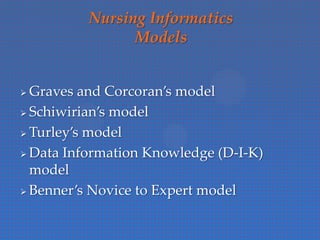
 Graves and Corcoran’s model
 Schiwirian’s model
 Turley’s model
 Data Information Knowledge (D-I-K)
model
 Benner’s Novice to Expert model
Nursing Informatics Models
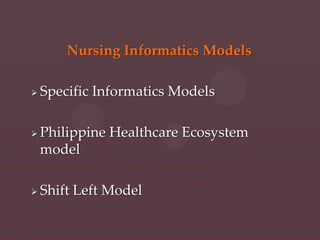
 Specific Informatics Models
 Philippine Healthcare Ecosystem
model
 Shift Left Model
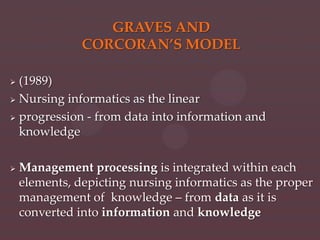
GRAVES AND
CORCORAN’S MODEL
 (1989)
 Nursing informatics as the linear
 progression - from data into information and
knowledge
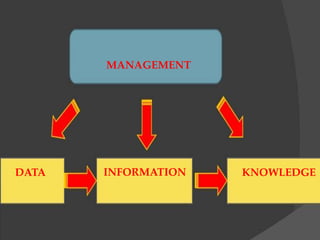
 Management processing is integrated within each
elements, depicting nursing informatics as the proper
management of knowledge – from data as it is
converted into information and knowledge
MANAGEMENT
DATA INFORMATION KNOWLEDGE
SCHWIRIAN’S
MODEL
(1986)
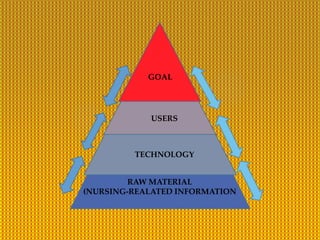
• Nursing informatics involves identification
of information needs, resolution of the
needs, and attainment of nursing
goals/objectives
• Patricia Schwirian – proposed a model
intended to stimulate and guide systematic
research in nursing informatics in 1986
• Model/framework that enables identification
of significant information needs, that can
foster research (some what similar to
Maslow’s hierarchy of needs)
GOAL
USERS
TECHNOLOGY
RAW MATERIAL
(NURSING-REALATED INFORMATION
TURLEY’S MODELS
(1996)
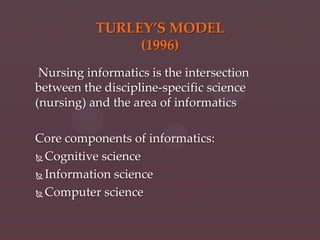
TURLEY’S MODEL
(1996)
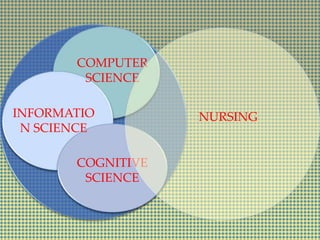
Nursing informatics is the intersection
between the discipline-specific science
(nursing) and the area of informatics
Core components of informatics:
 Cognitive science
 Information science
 Computer science
COMPUTER
SCIENCE
INFORMATIO
N SCIENCE
COGNITIVE
SCIENCE
NURSING
DATA-INFORMATION-
KNOWLEDGE
DATA-INFORMATION-
KNOWLEDGE MODEL
NI is a specialty that integrates nursing science,
computer science and information science to manage
and communicate data, information, knowledge and
wisdom into nursing practice (ANA)
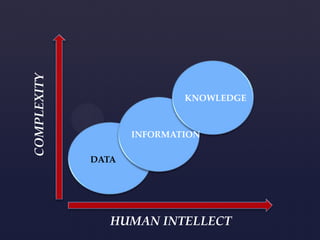
 Nursing informatics is an evolving, dynamic
process involving the conversion of data into
information, and subsequently knowledge
 Important Note: Processing of information does not
always result in the development of knowledge.
DATA
INFORMATION
KNOWLEDGE
COMPLEXITY
HUMAN INTELLECT
BENNER’S LEVEL OF
EXPERTISE MODEL
 Every nurse must be able to continuously exhibit
the capability to acquire skills (in this case,
computer literacy skills parallel with nursing
knowledge), and then demonstrate specific skills
beginning with the very first student experience
Levels of Expertise
(Benner):
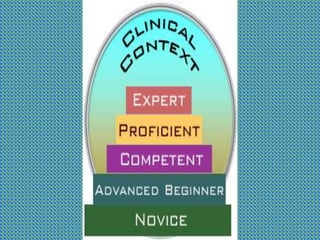
 Novice– individuals with no experience
of situations and related content in those situations
where they are expected to perform tasks
 Advanced Beginner – marginally demonstrate
acceptable performance having built on lessons
learned in their expanding experience base; needs
supervision
 Competent– enhanced mastery and the ability to
cope with and manage many contingencies
 Proficient– evolution through continuous
practice of skills, combined with professional
experience and knowledge; individual who
appreciates standards of practice as they apply in
nursing informatics
 Expert– individual with mastery of the concept
and capacity to intuitively understand the
situation and immediately target the problem
with minimal effort or problem solving
PHILIPPINE HEALTH CARE
ECOSYSTEM
 Nursing informatics is a huge network that
encompasses all the sectors of the health care
delivery system – government agencies, health
care facilities, practitioners, insurance companies,
pharmaceutical companies, academic
institutions, and suppliers
 the government, different nursing associations
and developmental agencies maintain and
balance the network
INTEL’S SHIFT LEFT
MODEL
 Patient care shifts/progresses from a high
quality delivery of life through technology
with increased costs (right side) into quality
of life with minimal health costs
 Inverse relationship between quality of life
and cost of care/day
PATIENT MEDICAL RECORD
INFORMATION MODEL (PMRI):
BASIS OF EHR
 The type and pattern of documentation in the
patient record will be dependent on 3 interacting
dimensions of health care:
 Personal health dimension – personal health record
maintained and controlled by the individual or
family; nonclinical information
 e.g. self-care trackers, directories of health care, and
other supports
 Health care provider dimension – promotes quality
patient care, access to complete accurate patient
data 24/7
 e.g. provider’s notes/prescription, clinical orders
decision support systems, practice guidelines
 Population health dimension – information on the
health of the population and the influences to
health; helps stakeholders identify and track health
threats, assess population health, create and monitor
programs and services, and conduct research
 e.g. Ushahidi program
*Important Terminologies
(Data Sets):
 ABC codes
 Perioperative Nursing Data Set (PNDS)
 SNOMED CT
 International Classification for Nursing
 Practice (ICNP)
 Patient Care Data Set (PCDS)
 NANDA
 LOINC
ABC CODES
mechanism for coding integrative health
interventions by clinician
for administrative billing and insurance
claims
includes complementary and alternative
medicine interventions and codes that map
all NIC, CCC, and Omaha system
interventions
Perioperative Nursing
Data Set (PNDS)
universal language for perioperative nursing
practice and education; standardize
documentation of perioperative data in all
perioperative settings
Diagnosis based on NANDA, interventions
based on NIC, and outcomes based on NOC
SNOMED CT
 core clinical terminology containing over
357,000 healthcare concepts with unique
meanings and formal logic-based definitions
organized into multiple hierarchies
International
Classification for
Nursing Practice (ICNP)
 integrated terminology for nursing practice
developed under sponsorship of ICN
ICNP elements:
 Nursing phenomena (nursing diagnosis)
 Nursing actions (nursing interventions)
 Nursing outcomes
Patient Care Data Set
(PCDS)
 terms and codes for patient problems,
therapeutic goals, and patient care orders
 developed by Dr. Judith Ozbolt
American Medical
Informatics Association
(AMIA)
 authoritative body in the field of medical
informatics and frequently represents the United
States in the informational area of medical
informatics in international forums
 dedicated to the development and application of
medical informatics in the support of patient care,
teaching, research, and healthcare administration
National League for
Nursing (NLN)
 Mission: To advance quality nursing education that
prepares the nursing workforce to meet the needs
of diverse populations in an ever-changing healthcare
environment
 Addresses faculty development and educational
research
*Educational Technology and Information
 Management Advisory Council (ETIMAC) – promote
effective use of technology in nursing education, as a
teaching tool and outcome for student-faculty learning
Healthcare information and
management systems
society (HIMSS)
 assumes leadership role in the
technology standards of nursing and
advocacy of key innovations in health
care delivery and administration
THE END


Theories, models, & frameworks

  • 1.
    Chapter 17: Theories, Frameworks,And Models By: Minette Din BSN2A
  • 3.
    Nursing Informatics Models  Gravesand Corcoran’s model  Schiwirian’s model  Turley’s model  Data Information Knowledge (D-I-K) model  Benner’s Novice to Expert model
  • 4.
    Nursing Informatics Models Specific Informatics Models  Philippine Healthcare Ecosystem model  Shift Left Model
  • 5.
    GRAVES AND CORCORAN’S MODEL (1989)  Nursing informatics as the linear  progression - from data into information and knowledge  Management processing is integrated within each elements, depicting nursing informatics as the proper management of knowledge – from data as it is converted into information and knowledge
  • 6.
  • 7.
  • 8.
    • Nursing informaticsinvolves identification of information needs, resolution of the needs, and attainment of nursing goals/objectives • Patricia Schwirian – proposed a model intended to stimulate and guide systematic research in nursing informatics in 1986 • Model/framework that enables identification of significant information needs, that can foster research (some what similar to Maslow’s hierarchy of needs)
  • 9.
  • 10.
  • 11.
    TURLEY’S MODEL (1996) Nursing informaticsis the intersection between the discipline-specific science (nursing) and the area of informatics Core components of informatics:  Cognitive science  Information science  Computer science
  • 12.
  • 13.
  • 14.
    DATA-INFORMATION- KNOWLEDGE MODEL NI isa specialty that integrates nursing science, computer science and information science to manage and communicate data, information, knowledge and wisdom into nursing practice (ANA)  Nursing informatics is an evolving, dynamic process involving the conversion of data into information, and subsequently knowledge  Important Note: Processing of information does not always result in the development of knowledge.
  • 15.
  • 16.
    BENNER’S LEVEL OF EXPERTISEMODEL  Every nurse must be able to continuously exhibit the capability to acquire skills (in this case, computer literacy skills parallel with nursing knowledge), and then demonstrate specific skills beginning with the very first student experience
  • 19.
    Levels of Expertise (Benner): Novice– individuals with no experience of situations and related content in those situations where they are expected to perform tasks  Advanced Beginner – marginally demonstrate acceptable performance having built on lessons learned in their expanding experience base; needs supervision  Competent– enhanced mastery and the ability to cope with and manage many contingencies
  • 20.
     Proficient– evolutionthrough continuous practice of skills, combined with professional experience and knowledge; individual who appreciates standards of practice as they apply in nursing informatics  Expert– individual with mastery of the concept and capacity to intuitively understand the situation and immediately target the problem with minimal effort or problem solving
  • 21.
    PHILIPPINE HEALTH CARE ECOSYSTEM Nursing informatics is a huge network that encompasses all the sectors of the health care delivery system – government agencies, health care facilities, practitioners, insurance companies, pharmaceutical companies, academic institutions, and suppliers  the government, different nursing associations and developmental agencies maintain and balance the network
  • 22.
    INTEL’S SHIFT LEFT MODEL Patient care shifts/progresses from a high quality delivery of life through technology with increased costs (right side) into quality of life with minimal health costs  Inverse relationship between quality of life and cost of care/day
  • 23.
    PATIENT MEDICAL RECORD INFORMATIONMODEL (PMRI): BASIS OF EHR  The type and pattern of documentation in the patient record will be dependent on 3 interacting dimensions of health care:  Personal health dimension – personal health record maintained and controlled by the individual or family; nonclinical information  e.g. self-care trackers, directories of health care, and other supports
  • 24.
     Health careprovider dimension – promotes quality patient care, access to complete accurate patient data 24/7  e.g. provider’s notes/prescription, clinical orders decision support systems, practice guidelines  Population health dimension – information on the health of the population and the influences to health; helps stakeholders identify and track health threats, assess population health, create and monitor programs and services, and conduct research  e.g. Ushahidi program
  • 25.
    *Important Terminologies (Data Sets): ABC codes  Perioperative Nursing Data Set (PNDS)  SNOMED CT  International Classification for Nursing  Practice (ICNP)  Patient Care Data Set (PCDS)  NANDA  LOINC
  • 26.
    ABC CODES mechanism forcoding integrative health interventions by clinician for administrative billing and insurance claims includes complementary and alternative medicine interventions and codes that map all NIC, CCC, and Omaha system interventions
  • 27.
    Perioperative Nursing Data Set(PNDS) universal language for perioperative nursing practice and education; standardize documentation of perioperative data in all perioperative settings Diagnosis based on NANDA, interventions based on NIC, and outcomes based on NOC
  • 28.
    SNOMED CT  coreclinical terminology containing over 357,000 healthcare concepts with unique meanings and formal logic-based definitions organized into multiple hierarchies
  • 29.
    International Classification for Nursing Practice(ICNP)  integrated terminology for nursing practice developed under sponsorship of ICN ICNP elements:  Nursing phenomena (nursing diagnosis)  Nursing actions (nursing interventions)  Nursing outcomes
  • 30.
    Patient Care DataSet (PCDS)  terms and codes for patient problems, therapeutic goals, and patient care orders  developed by Dr. Judith Ozbolt
  • 31.
    American Medical Informatics Association (AMIA) authoritative body in the field of medical informatics and frequently represents the United States in the informational area of medical informatics in international forums  dedicated to the development and application of medical informatics in the support of patient care, teaching, research, and healthcare administration
  • 32.
    National League for Nursing(NLN)  Mission: To advance quality nursing education that prepares the nursing workforce to meet the needs of diverse populations in an ever-changing healthcare environment  Addresses faculty development and educational research *Educational Technology and Information  Management Advisory Council (ETIMAC) – promote effective use of technology in nursing education, as a teaching tool and outcome for student-faculty learning
  • 33.
    Healthcare information and managementsystems society (HIMSS)  assumes leadership role in the technology standards of nursing and advocacy of key innovations in health care delivery and administration
  • 34.