Water Quality
4 hours
Water quality parameters
Physical, chemical and biological water quality
• Organoleptic properties
• Acidity, Alkalinity and Hardness
• Solids (Turbidity, TSS, conductivity and TDS)
• Fluorides, Chlorides, Sulfates, Nitrates and Iron
• Biological water quality (MPN or Coliform count)
• Heavy metals, radioactive substances and pesticides
IS 10500: 2012 – Drinking Water Specifications (3rd revision)
WHO guidelines for drinking water quality: 4th Edition, 2011.
IS 10500: 2012 – Drinking Water Specifications
IS 10500: 2012 – Drinking Water Specifications (3rd revision)
• Prescribes requirements and methods for sampling and testing of
drinking water
• Specifies Acceptable Limits and Permissible Limits in the absence of
alternate source
– If the values exceed the limits indicated under the permissible
limits, the water source will have to be rejected
Includes 6 tables
– Table-1: Organoleptic and physical parameters
– Table-2: General parameters concerning the substances
undesirable in excess amounts
– Table-3: Parameters concerning toxic substances
– Table-4: Parameters concernng radioactive substances
– Table-5: Pesticides residues
– Table-6: Bacteriological requirement
Water Quality Parameters
• Organoleptic and physical parameters - 6 parameters (table-1
of IS 10500: 2012)
– Colour, Odour, Taste, Turbidity, Dissolved solids, and pH
• General parameters – 25 (table-2 of IS 10500: 2012)
• Aluminum, Barium, Calcium, Boron, Copper, Iron, Magnesium,
Molybdenum, Manganese, Selenium, Silver, and Zinc (12)
• Alkalinity, Total hardness, Ammonia, Chloramines, and Free
residual chlorine (5)
• Fluoride, Chloride, Nitrate, Sulfate and Sulfide (5)
• Phenolic compounds, Mineral oil, and Anionic detergents (3)
Water Quality Parameters
• Toxic parameters – 10 (table-3 of IS 10500: 2012)
– Heavy metals and metalloids (4): Mercury, cadmium, arsenic,
and nickel
– Pesticide residues (18) (table-5 of IS 10500: 2012)
– Polynucleated aromatic hydrocarbons (PAH) and Polychlorinated
biphenyls (PCB)
– Trihalomethanes (Bromoform, Chloroform, Dibromo chloro
methane, and Bromo dichloro methane)
– Hexavalent chromium and Cyanide
• Parameters concerning radioactive substances -2 (table-4 of IS
10500: 2012)
– Alpha emitters and Beta emitters
Water Quality Parameters
Bacteriological, Virological and Biological requirements
• Bacteriological requirements (table-6 of IS 10500:2012)
– MPN test for E. coli (or thermotolerant coliform bacteria)
• Virological requirements
– Enterovirus, Reovirus and Adinovirus PCR (Polymerase Chain
Reaction) test method - Annex-B of IS 10500: 2012)
• Biological requirements
– Algae, Zooplankton, Flagellates, Parasites and Toxin producing
organisms.
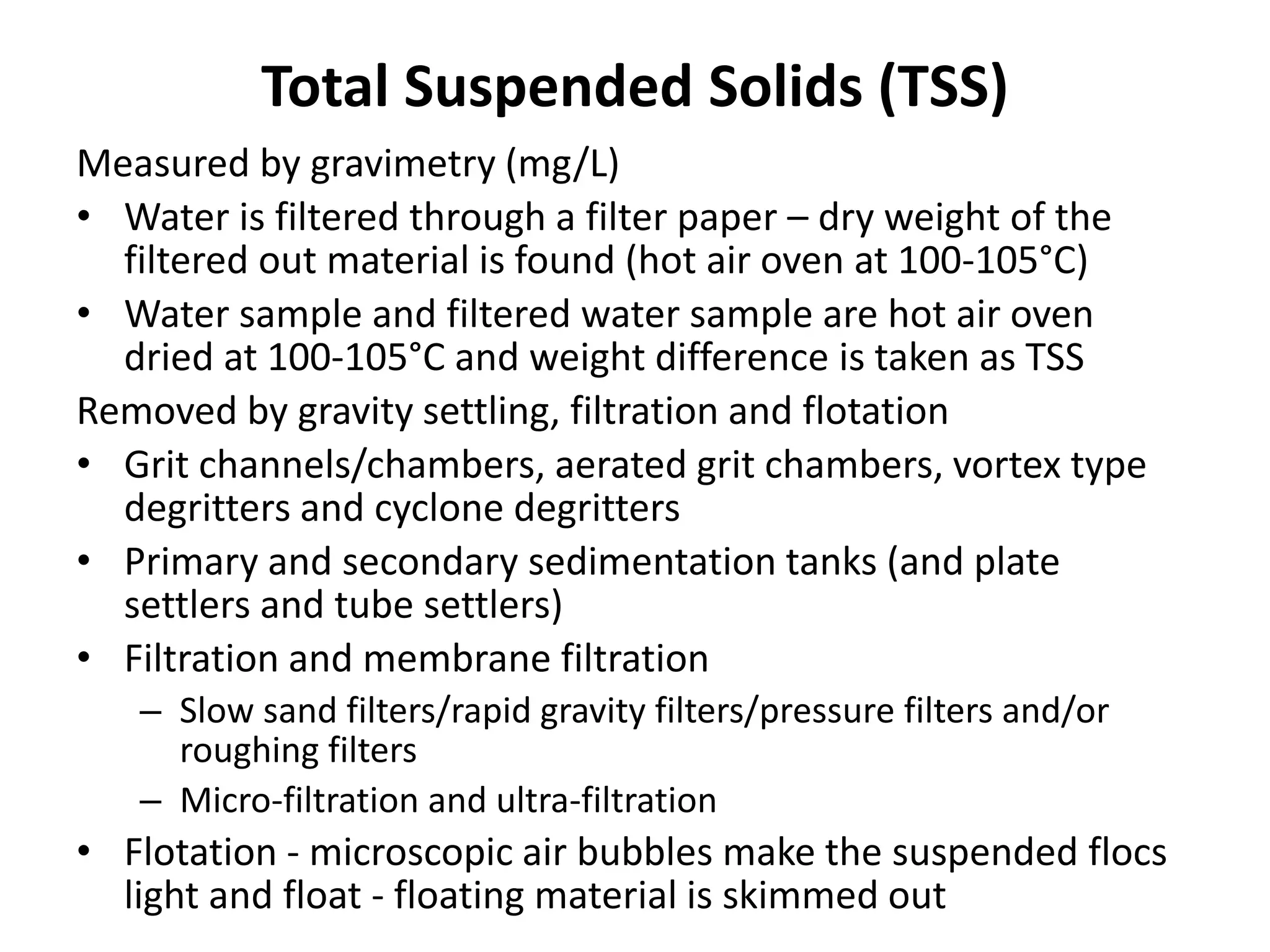
Total Suspended Solids (TSS)
Measured by gravimetry (mg/L)
• Water is filtered through a filter paper – dry weight of the
filtered out material is found (hot air oven at 100-105°C)
• Water sample and filtered water sample are hot air oven
dried at 100-105°C and weight difference is taken as TSS
Removed by gravity settling, filtration and flotation
• Grit channels/chambers, aerated grit chambers, vortex type
degritters and cyclone degritters
• Primary and secondary sedimentation tanks (and plate
settlers and tube settlers)
• Filtration and membrane filtration
– Slow sand filters/rapid gravity filters/pressure filters and/or
roughing filters
– Micro-filtration and ultra-filtration
• Flotation - microscopic air bubbles make the suspended flocs
light and float - floating material is skimmed out
Colloidal solids
• Imparts turbidity and contributes to taste & odor
• Measured by turbidimetry as NTU and JTU
– NTU – light passing through the sample is scattered and the
scattered light is measured – calibrated by turbidity standards
– JTU – a white disc is dipped in water uptill that depth at which it
disappears – scattering results in attenuation of light
• Removed by coagulation-flocculation-settling
– Using coagulating agents (alum, ferrous sulfate, etc.) the colloids
are destabilized
– Destabilized colloidal particles are transformed into suspended
flocs – flocculating agents (polyelectrolites) are used
– Zeta meter is used to measure the level of stability of the
colloidal particles
• Removal by elecrocoagulation/electroflocculation
• Slow sand filters also reduce the turbidity
Total Dissolved Solids (TDS)
Measured directly by gravimetry and indirectly through
conductivity measurement
• Gravimetric measurement involves hot air oven drying of the
filtered water sample
• Drying at 100-105°C for dissolved solids and at 180°C for
dissolved salts!
• Estimation through conductivity measurement involves use of
a multiplying factor
TDS removal or reduction can be by
• Ion exchange process
– Demineralization, dealkalization and water softening
• Membrane process
– RO process and Nanofiltration
• Distillation process (vacuum evaporation and condensation,
MEE)
– Solar water stills!
Biological Water Quality Requirements
Water samples should test negative for E.coli or thermotolerant
coliform bacteria in 100 mL sample
– Over 12 months 95% of the samples from a distribution system
must test negative
– Rest 5% of the samples should have the MPN <10/100 mL
• In case of positive test results
– Resample to confirm the results
– Immediately investigate and discover the source of
contamination and recommend removal of the source of
contamination
• MPN testing - IS 1622: 1981 – Methods of sampling and
microbial examination of water
All samples of a water distribution system should be free from
enterovirus, reovirus and adinovirus
Water should be free from algae, zooplankton, flagellates,
parasites and toxin producing organisms.
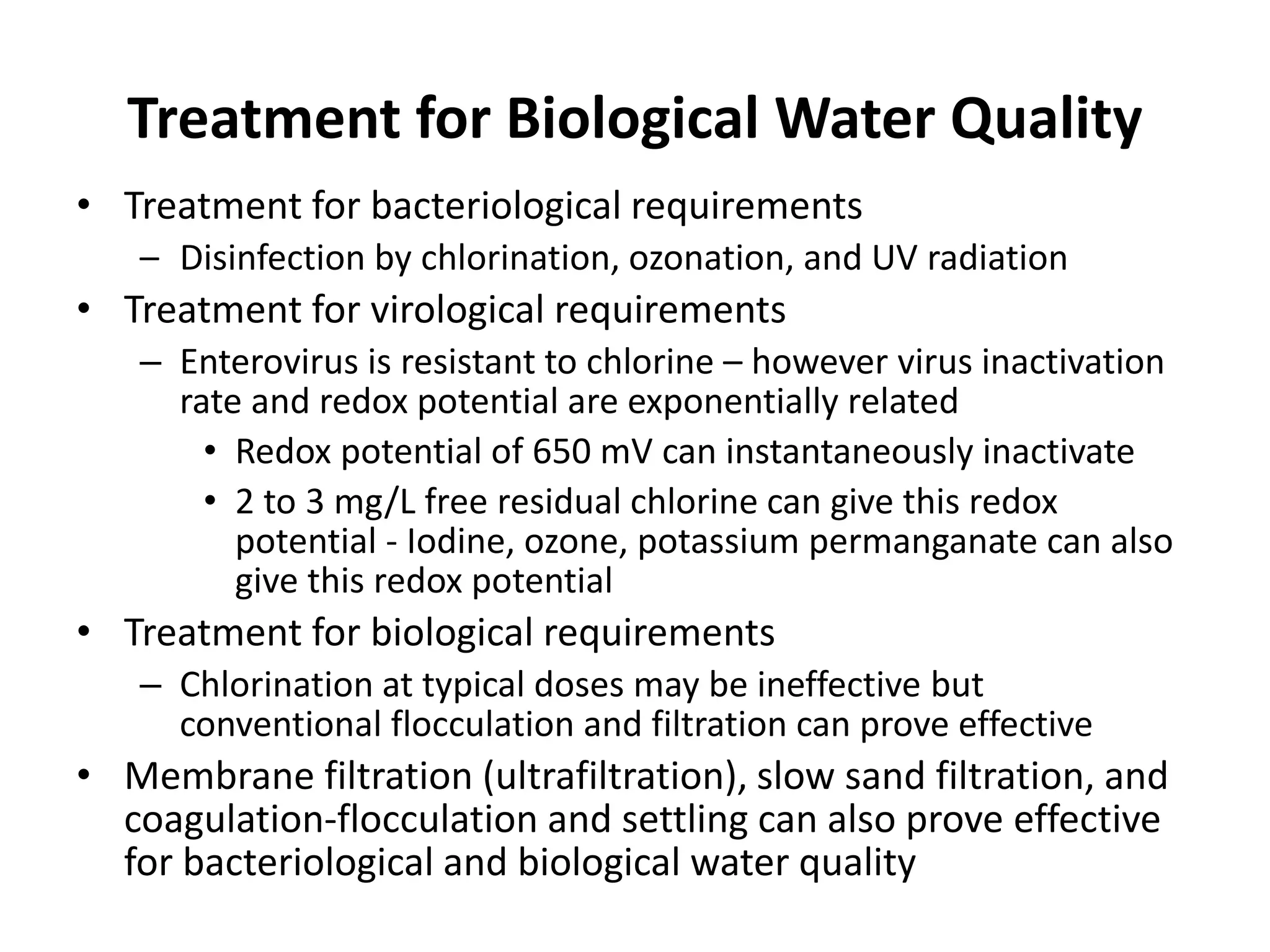
Treatment for Biological Water Quality
• Treatment for bacteriological requirements
– Disinfection by chlorination, ozonation, and UV radiation
• Treatment for virological requirements
– Enterovirus is resistant to chlorine – however virus inactivation
rate and redox potential are exponentially related
• Redox potential of 650 mV can instantaneously inactivate
• 2 to 3 mg/L free residual chlorine can give this redox
potential - Iodine, ozone, potassium permanganate can also
give this redox potential
• Treatment for biological requirements
– Chlorination at typical doses may be ineffective but
conventional flocculation and filtration can prove effective
• Membrane filtration (ultrafiltration), slow sand filtration, and
coagulation-flocculation and settling can also prove effective
for bacteriological and biological water quality
• Metals having toxicity, and metals with SG > 4 to 5
• Aluminum, arsenic, cadmium, chromium, lead, mercury, nickel,
selenium, strontium, zinc, etc.
• Bioaccumulation and toxicity – affecting nervous system and
kidneys, carcinogenic & mutagenic
• Sources- industrial processes, mining and mineral processing,
contaminated ground water
• Sample preparation and analysis by flame photometer, AAS
and ICP (mg/L as the metal)
• Effluent standards (Entries -9, 42 and 43 of Schedule-1, EP
Rules, 1986) prescribe limits for total metal content as 10 and
7 mg/L, but silent about the metals included in total metals
• Neutralization and precipitation (as hydroxide and/or sulfides),
and settling/filtration
• Ion exchange process and membrane processes (RO) can also
remove the heavy metals
Heavy Metals
• Pesticides (insecticides, fungicides and rodenticides) and
herbicides – agricultural activity, public health and
industrial production
• Synthetic organic pesticides – organochlorines,
organophosphates and carbamates
– Organochlorine compounds (DDT, endrin, endosulfan,
heptachlor, etc.) - bioaccumulation
– Organophosphates (parathion, malathion, etc.) –
replacement to organochlorines – more toxic
– Carbamates (aldicarb, carbaryl, etc.) – toxic
• GC and HPLC are used for measurement
• Banning and regulating use, replacing with biopesticides,
and integrated pest control, natural farming
• Adsorption, Membrane processes (nanofiltration and RO),
Oxidation and advanced oxidation processes (free radical
degradation) can remove pesticides from water
Pesticides
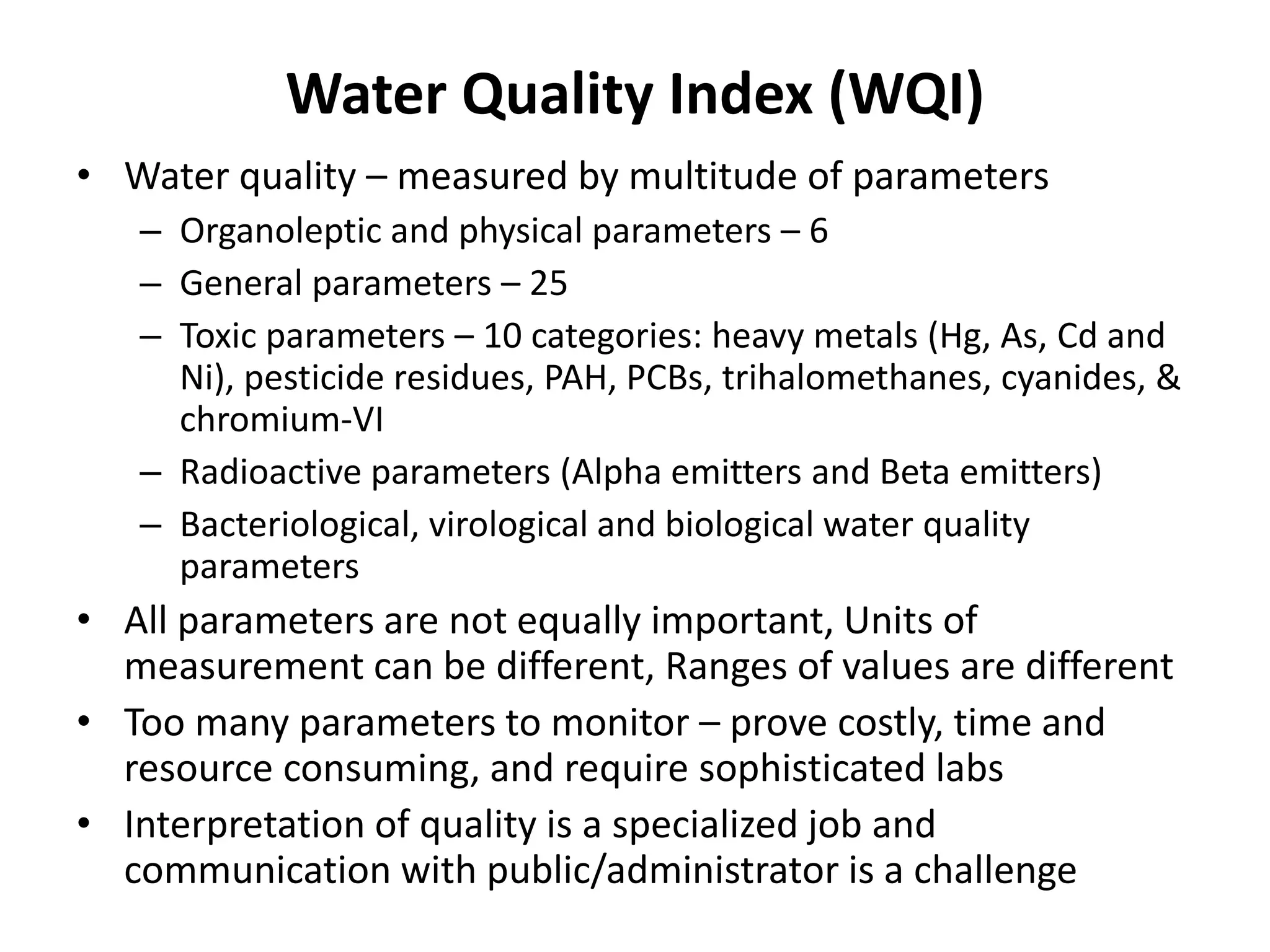
Water Quality Index (WQI)
• Water quality – measured by multitude of parameters
– Organoleptic and physical parameters – 6
– General parameters – 25
– Toxic parameters – 10 categories: heavy metals (Hg, As, Cd and
Ni), pesticide residues, PAH, PCBs, trihalomethanes, cyanides, &
chromium-VI
– Radioactive parameters (Alpha emitters and Beta emitters)
– Bacteriological, virological and biological water quality
parameters
• All parameters are not equally important, Units of
measurement can be different, Ranges of values are different
• Too many parameters to monitor – prove costly, time and
resource consuming, and require sophisticated labs
• Interpretation of quality is a specialized job and
communication with public/administrator is a challenge
Water Quality Index (WQI)
Can be use specific (industrial, municipal, irrigational, ecological)
Transforms the vast and complicated water quality data into a
simple number that is easily understood by all
Water Quality Index calculation
• Select finite number of parameters and monitor water quality
against the parameters
• Develop transformation functions/curves and use them to
transform the monitored values into Environ. common scale units
• Assign relative importance values to the parameters and obtain
weighted values to the parameters
• Aggregate the parameter values
– Take a) sum or b) average or c) geometric mean or combination of
these
– Or use maximum operator or minimum operator
– Obtain sub-indices and aggregate the sub-indices into WQI
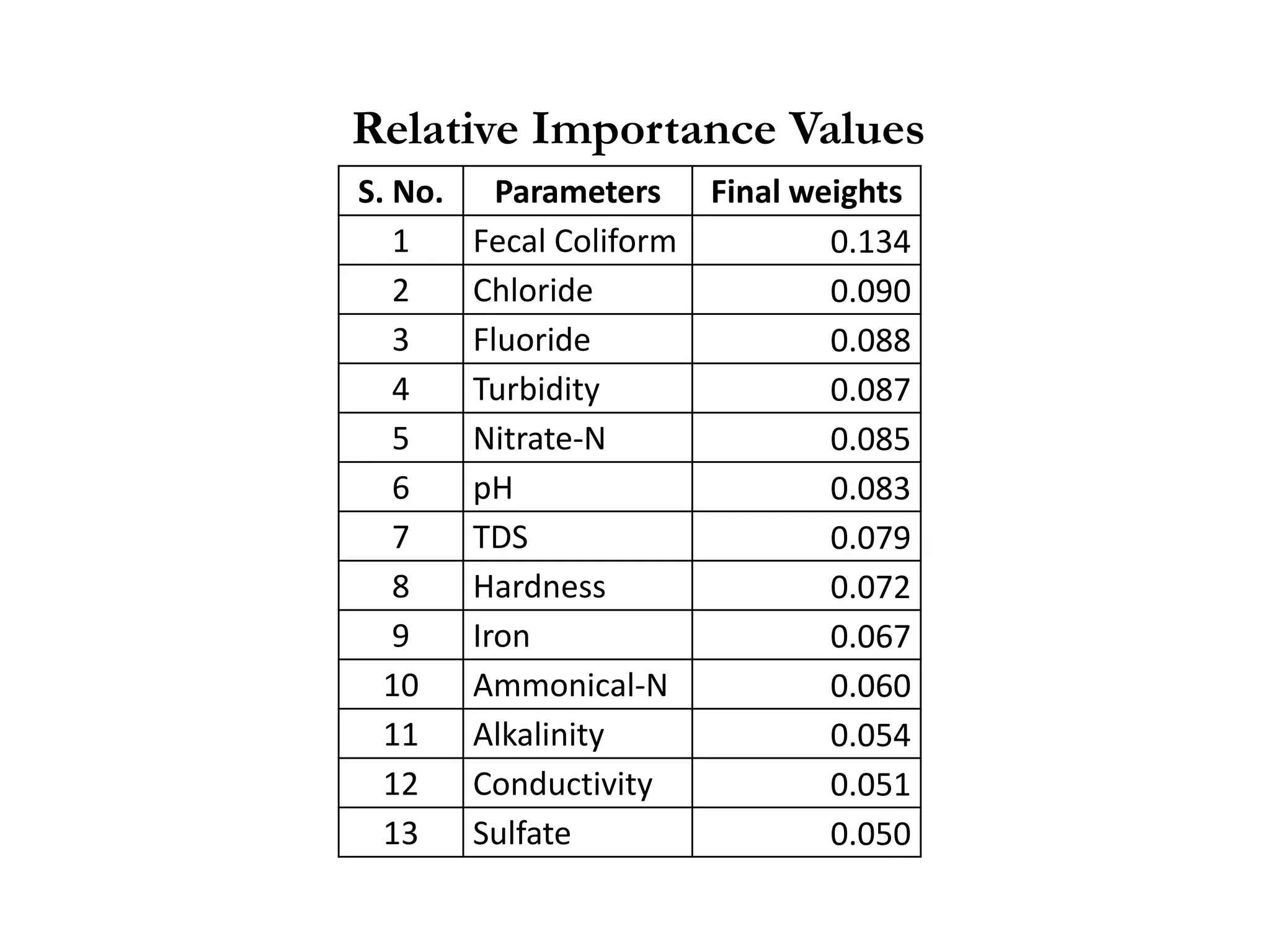
S. No. Parameters Final weights
1 Fecal Coliform 0.134
2 Chloride 0.090
3 Fluoride 0.088
4 Turbidity 0.087
5 Nitrate-N 0.085
6 pH 0.083
7 TDS 0.079
8 Hardness 0.072
9 Iron 0.067
10 Ammonical-N 0.060
11 Alkalinity 0.054
12 Conductivity 0.051
13 Sulfate 0.050
Relative Importance Values
Parameters Concentration Range Transformation Equation
pH
2.7 – 5.0 y = 6.889x2 - 40.00x + 57.79
5.0 – 7.5 y = -10.66x2 + 161.9x - 513.8
7.5 – 9.5 y = -22.33x2 + 346.3x - 1242.8
9.5 – 12.0 y = 2.666x2 - 69.33x + 448
Conductivity 0 – 4500 (µS/cm) y = 8E-07x2 - 0.025x + 104.1
Turbidity
0-5 (NTU) y = 99.42e-0.07x
5-80 (NTU) y = -22.3ln(x) + 102.9
TDS 50 – 3000 (mg/L) y = 6E-06x2 - 0.046x + 96.90
Total Alkalinity 0-1000 (mg/L) y = 7E-05x2 - 0.158x + 100.7
Total Hardness 0-600 (mg/L) y = -35.1ln(x) + 234.4
Ammonical-N
0 – 2 (mg/L) y = -7x2 - 1x + 100
2 – 40 (mg/L) y = -20.5ln(x) + 84.61
Nitrate-N 0 – 23 (mg/L) y = 0.161x2 - 7.953x + 104.5
Fluoride
0 – 1.5 (mg/L) y = -24x2+16x+100
1.5 – 8.0 (mg/L) y = 105.61e-0.327x
Iron 0 – 30 (mg/L) y = -18.0ln(x) + 70.32
Chloride 0-1200 (mg/L) y = 7E-05x2 - 0.157x + 99.60
Sulfate 0-1000 (mg/L) y = 7E-05x2 - 0.158x + 100.7
Fecal Coliform
0 – 1000 (mpn/100ml) y = 80.702e-0.001x
1000-100000 (mpn/100ml) y = -4.7772ln(x) + 63
Heavy metal conc.
ratio
0 – 16 y = 101.9e-0.15x
Pesticides and toxic
organics conc. ratio
0 – 16 y = 101.9e-0.15x
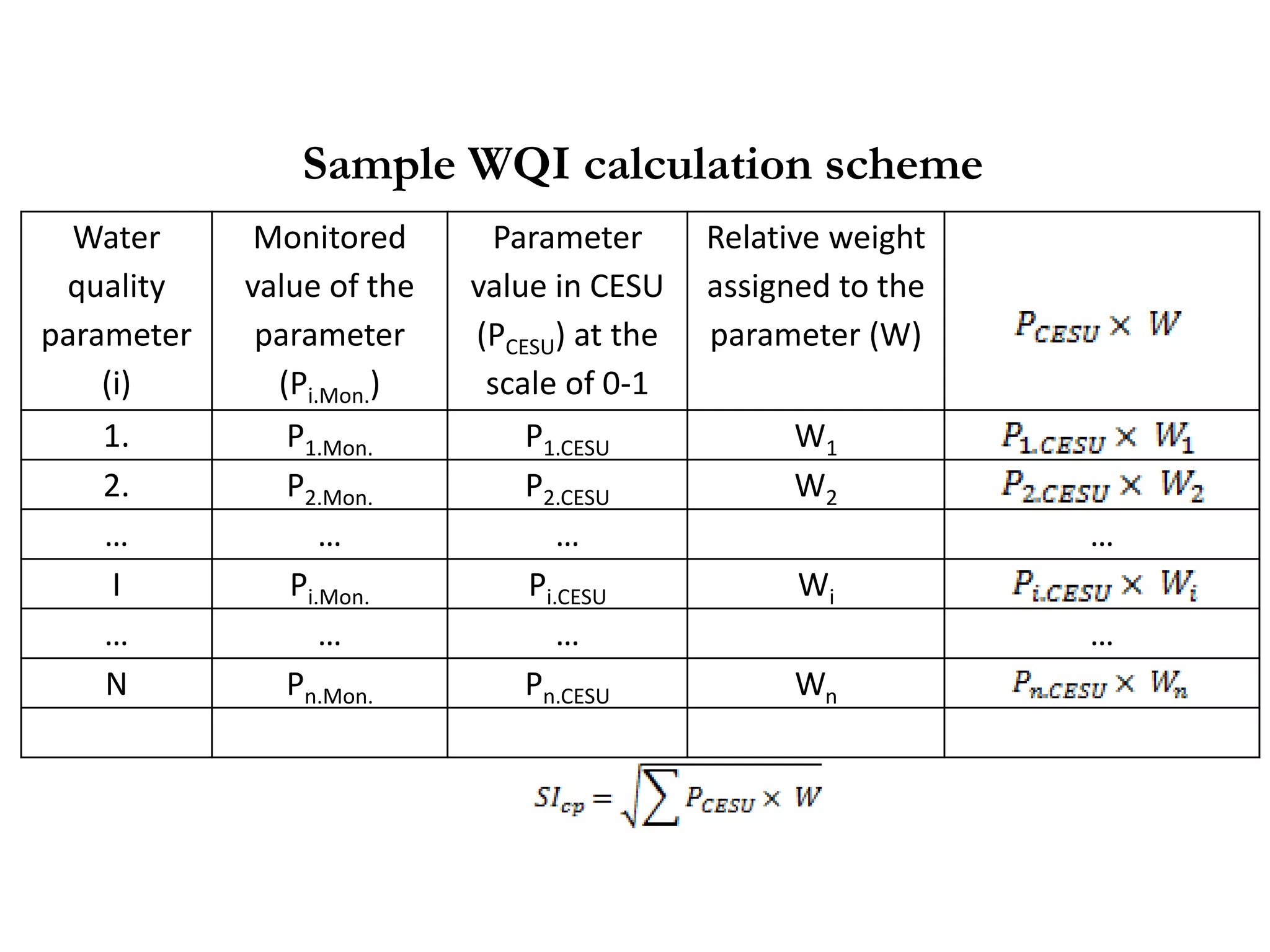
Transformation functions or curves
Water
quality
parameter
(i)
Monitored
value of the
parameter
(Pi.Mon.)
Parameter
value in CESU
(PCESU) at the
scale of 0-1
Relative weight
assigned to the
parameter (W)
1. P1.Mon. P1.CESU W1
2. P2.Mon. P2.CESU W2
… … … …
I Pi.Mon. Pi.CESU Wi
… … … …
N Pn.Mon. Pn.CESU Wn
Sample WQI calculation scheme
Classification of Waters
• Designations applied to surface water bodies
– Rivers, streams and canals or their stretches
– Lakes, reservoirs and impounded waters
• Define the best uses to be protected within a water body
– Water uses can be off-stream and in-stream uses
• Aqua-cultural and ecological use (fish, wildlife and aquatic life)
• Agricultural (and aqua-cultural), municipal and industrial uses
• Power generation !
– Further or next level of classification is also possible
• Class-A to Class-E and MS-1 to MS-5 classes
• Same water body can become subject of more than one
classifications
• Classifications of waters are used as tools for the
management and protection of water bodies
– Water quality standards are also specified for the best uses to
be protected within the water bodies
Classification of waters
IS 2296: 1982 specifies tolerance limits for different classes of water
(Primary recreation and secondary recreation)
Tolerance limits for class A surface water
Tolerance limits for class B surface water
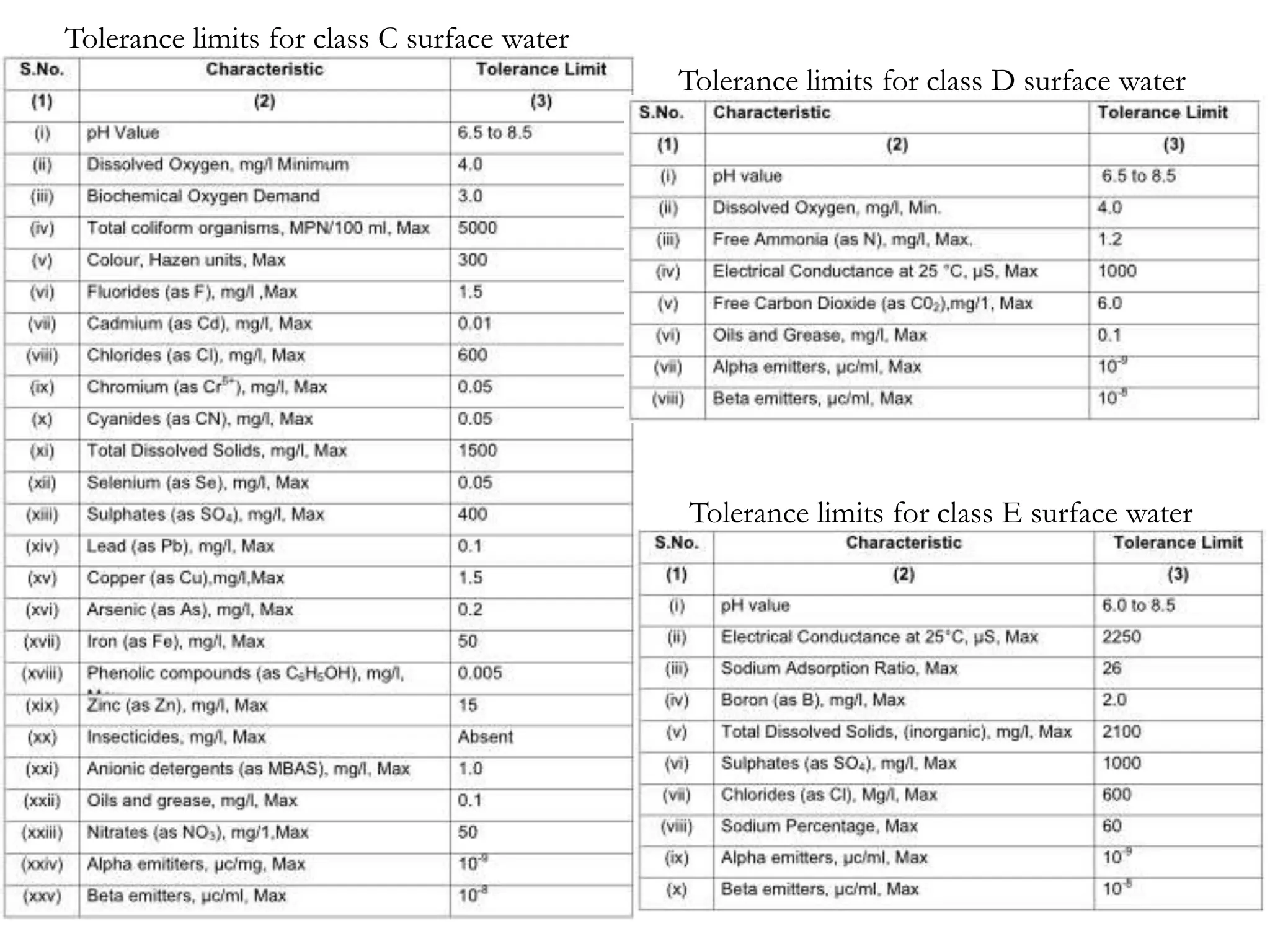
Tolerance limits for class C surface water
Tolerance limits for class D surface water
Tolerance limits for class E surface water
Water Quality Management
• Water quality criteria & standards - applicable to water sources
• Effluent quality & standards - quality and quantity of the
effluent discharged influences the water source quality
– Schedule -1 (Standards for discharge/emission of pollutants from
various industries), EP Rules, 1986 (EPA, 1986)
– Schedule-6 (General standards for discharge of environmental
pollutants), EP Rules, 1986 (EPA, 1986)
• Fate of the pollutants discharged depends on the waste
assimilative and self-cleansing capacities of the water source
• Water quality modeling: relates the effluent quality with the
water source quality
• Water quality management:
– Monitoring the water source quality
– Identification and characterization of pollution sources
– Water quality modeling
– Regulating the pollution sources

01 water quality

  • 1.
  • 2.
    Water quality parameters Physical,chemical and biological water quality • Organoleptic properties • Acidity, Alkalinity and Hardness • Solids (Turbidity, TSS, conductivity and TDS) • Fluorides, Chlorides, Sulfates, Nitrates and Iron • Biological water quality (MPN or Coliform count) • Heavy metals, radioactive substances and pesticides IS 10500: 2012 – Drinking Water Specifications (3rd revision) WHO guidelines for drinking water quality: 4th Edition, 2011.
  • 3.
    IS 10500: 2012– Drinking Water Specifications IS 10500: 2012 – Drinking Water Specifications (3rd revision) • Prescribes requirements and methods for sampling and testing of drinking water • Specifies Acceptable Limits and Permissible Limits in the absence of alternate source – If the values exceed the limits indicated under the permissible limits, the water source will have to be rejected Includes 6 tables – Table-1: Organoleptic and physical parameters – Table-2: General parameters concerning the substances undesirable in excess amounts – Table-3: Parameters concerning toxic substances – Table-4: Parameters concernng radioactive substances – Table-5: Pesticides residues – Table-6: Bacteriological requirement
  • 4.
    Water Quality Parameters •Organoleptic and physical parameters - 6 parameters (table-1 of IS 10500: 2012) – Colour, Odour, Taste, Turbidity, Dissolved solids, and pH • General parameters – 25 (table-2 of IS 10500: 2012) • Aluminum, Barium, Calcium, Boron, Copper, Iron, Magnesium, Molybdenum, Manganese, Selenium, Silver, and Zinc (12) • Alkalinity, Total hardness, Ammonia, Chloramines, and Free residual chlorine (5) • Fluoride, Chloride, Nitrate, Sulfate and Sulfide (5) • Phenolic compounds, Mineral oil, and Anionic detergents (3)
  • 5.
    Water Quality Parameters •Toxic parameters – 10 (table-3 of IS 10500: 2012) – Heavy metals and metalloids (4): Mercury, cadmium, arsenic, and nickel – Pesticide residues (18) (table-5 of IS 10500: 2012) – Polynucleated aromatic hydrocarbons (PAH) and Polychlorinated biphenyls (PCB) – Trihalomethanes (Bromoform, Chloroform, Dibromo chloro methane, and Bromo dichloro methane) – Hexavalent chromium and Cyanide • Parameters concerning radioactive substances -2 (table-4 of IS 10500: 2012) – Alpha emitters and Beta emitters
  • 6.
    Water Quality Parameters Bacteriological,Virological and Biological requirements • Bacteriological requirements (table-6 of IS 10500:2012) – MPN test for E. coli (or thermotolerant coliform bacteria) • Virological requirements – Enterovirus, Reovirus and Adinovirus PCR (Polymerase Chain Reaction) test method - Annex-B of IS 10500: 2012) • Biological requirements – Algae, Zooplankton, Flagellates, Parasites and Toxin producing organisms.
  • 7.
    Total Suspended Solids(TSS) Measured by gravimetry (mg/L) • Water is filtered through a filter paper – dry weight of the filtered out material is found (hot air oven at 100-105°C) • Water sample and filtered water sample are hot air oven dried at 100-105°C and weight difference is taken as TSS Removed by gravity settling, filtration and flotation • Grit channels/chambers, aerated grit chambers, vortex type degritters and cyclone degritters • Primary and secondary sedimentation tanks (and plate settlers and tube settlers) • Filtration and membrane filtration – Slow sand filters/rapid gravity filters/pressure filters and/or roughing filters – Micro-filtration and ultra-filtration • Flotation - microscopic air bubbles make the suspended flocs light and float - floating material is skimmed out
  • 8.
    Colloidal solids • Impartsturbidity and contributes to taste & odor • Measured by turbidimetry as NTU and JTU – NTU – light passing through the sample is scattered and the scattered light is measured – calibrated by turbidity standards – JTU – a white disc is dipped in water uptill that depth at which it disappears – scattering results in attenuation of light • Removed by coagulation-flocculation-settling – Using coagulating agents (alum, ferrous sulfate, etc.) the colloids are destabilized – Destabilized colloidal particles are transformed into suspended flocs – flocculating agents (polyelectrolites) are used – Zeta meter is used to measure the level of stability of the colloidal particles • Removal by elecrocoagulation/electroflocculation • Slow sand filters also reduce the turbidity
  • 9.
    Total Dissolved Solids(TDS) Measured directly by gravimetry and indirectly through conductivity measurement • Gravimetric measurement involves hot air oven drying of the filtered water sample • Drying at 100-105°C for dissolved solids and at 180°C for dissolved salts! • Estimation through conductivity measurement involves use of a multiplying factor TDS removal or reduction can be by • Ion exchange process – Demineralization, dealkalization and water softening • Membrane process – RO process and Nanofiltration • Distillation process (vacuum evaporation and condensation, MEE) – Solar water stills!
  • 10.
    Biological Water QualityRequirements Water samples should test negative for E.coli or thermotolerant coliform bacteria in 100 mL sample – Over 12 months 95% of the samples from a distribution system must test negative – Rest 5% of the samples should have the MPN <10/100 mL • In case of positive test results – Resample to confirm the results – Immediately investigate and discover the source of contamination and recommend removal of the source of contamination • MPN testing - IS 1622: 1981 – Methods of sampling and microbial examination of water All samples of a water distribution system should be free from enterovirus, reovirus and adinovirus Water should be free from algae, zooplankton, flagellates, parasites and toxin producing organisms.
  • 11.
    Treatment for BiologicalWater Quality • Treatment for bacteriological requirements – Disinfection by chlorination, ozonation, and UV radiation • Treatment for virological requirements – Enterovirus is resistant to chlorine – however virus inactivation rate and redox potential are exponentially related • Redox potential of 650 mV can instantaneously inactivate • 2 to 3 mg/L free residual chlorine can give this redox potential - Iodine, ozone, potassium permanganate can also give this redox potential • Treatment for biological requirements – Chlorination at typical doses may be ineffective but conventional flocculation and filtration can prove effective • Membrane filtration (ultrafiltration), slow sand filtration, and coagulation-flocculation and settling can also prove effective for bacteriological and biological water quality
  • 12.
    • Metals havingtoxicity, and metals with SG > 4 to 5 • Aluminum, arsenic, cadmium, chromium, lead, mercury, nickel, selenium, strontium, zinc, etc. • Bioaccumulation and toxicity – affecting nervous system and kidneys, carcinogenic & mutagenic • Sources- industrial processes, mining and mineral processing, contaminated ground water • Sample preparation and analysis by flame photometer, AAS and ICP (mg/L as the metal) • Effluent standards (Entries -9, 42 and 43 of Schedule-1, EP Rules, 1986) prescribe limits for total metal content as 10 and 7 mg/L, but silent about the metals included in total metals • Neutralization and precipitation (as hydroxide and/or sulfides), and settling/filtration • Ion exchange process and membrane processes (RO) can also remove the heavy metals Heavy Metals
  • 13.
    • Pesticides (insecticides,fungicides and rodenticides) and herbicides – agricultural activity, public health and industrial production • Synthetic organic pesticides – organochlorines, organophosphates and carbamates – Organochlorine compounds (DDT, endrin, endosulfan, heptachlor, etc.) - bioaccumulation – Organophosphates (parathion, malathion, etc.) – replacement to organochlorines – more toxic – Carbamates (aldicarb, carbaryl, etc.) – toxic • GC and HPLC are used for measurement • Banning and regulating use, replacing with biopesticides, and integrated pest control, natural farming • Adsorption, Membrane processes (nanofiltration and RO), Oxidation and advanced oxidation processes (free radical degradation) can remove pesticides from water Pesticides
  • 14.
    Water Quality Index(WQI) • Water quality – measured by multitude of parameters – Organoleptic and physical parameters – 6 – General parameters – 25 – Toxic parameters – 10 categories: heavy metals (Hg, As, Cd and Ni), pesticide residues, PAH, PCBs, trihalomethanes, cyanides, & chromium-VI – Radioactive parameters (Alpha emitters and Beta emitters) – Bacteriological, virological and biological water quality parameters • All parameters are not equally important, Units of measurement can be different, Ranges of values are different • Too many parameters to monitor – prove costly, time and resource consuming, and require sophisticated labs • Interpretation of quality is a specialized job and communication with public/administrator is a challenge
  • 15.
    Water Quality Index(WQI) Can be use specific (industrial, municipal, irrigational, ecological) Transforms the vast and complicated water quality data into a simple number that is easily understood by all Water Quality Index calculation • Select finite number of parameters and monitor water quality against the parameters • Develop transformation functions/curves and use them to transform the monitored values into Environ. common scale units • Assign relative importance values to the parameters and obtain weighted values to the parameters • Aggregate the parameter values – Take a) sum or b) average or c) geometric mean or combination of these – Or use maximum operator or minimum operator – Obtain sub-indices and aggregate the sub-indices into WQI
  • 16.
    S. No. ParametersFinal weights 1 Fecal Coliform 0.134 2 Chloride 0.090 3 Fluoride 0.088 4 Turbidity 0.087 5 Nitrate-N 0.085 6 pH 0.083 7 TDS 0.079 8 Hardness 0.072 9 Iron 0.067 10 Ammonical-N 0.060 11 Alkalinity 0.054 12 Conductivity 0.051 13 Sulfate 0.050 Relative Importance Values
  • 17.
    Parameters Concentration RangeTransformation Equation pH 2.7 – 5.0 y = 6.889x2 - 40.00x + 57.79 5.0 – 7.5 y = -10.66x2 + 161.9x - 513.8 7.5 – 9.5 y = -22.33x2 + 346.3x - 1242.8 9.5 – 12.0 y = 2.666x2 - 69.33x + 448 Conductivity 0 – 4500 (µS/cm) y = 8E-07x2 - 0.025x + 104.1 Turbidity 0-5 (NTU) y = 99.42e-0.07x 5-80 (NTU) y = -22.3ln(x) + 102.9 TDS 50 – 3000 (mg/L) y = 6E-06x2 - 0.046x + 96.90 Total Alkalinity 0-1000 (mg/L) y = 7E-05x2 - 0.158x + 100.7 Total Hardness 0-600 (mg/L) y = -35.1ln(x) + 234.4 Ammonical-N 0 – 2 (mg/L) y = -7x2 - 1x + 100 2 – 40 (mg/L) y = -20.5ln(x) + 84.61 Nitrate-N 0 – 23 (mg/L) y = 0.161x2 - 7.953x + 104.5 Fluoride 0 – 1.5 (mg/L) y = -24x2+16x+100 1.5 – 8.0 (mg/L) y = 105.61e-0.327x Iron 0 – 30 (mg/L) y = -18.0ln(x) + 70.32 Chloride 0-1200 (mg/L) y = 7E-05x2 - 0.157x + 99.60 Sulfate 0-1000 (mg/L) y = 7E-05x2 - 0.158x + 100.7 Fecal Coliform 0 – 1000 (mpn/100ml) y = 80.702e-0.001x 1000-100000 (mpn/100ml) y = -4.7772ln(x) + 63 Heavy metal conc. ratio 0 – 16 y = 101.9e-0.15x Pesticides and toxic organics conc. ratio 0 – 16 y = 101.9e-0.15x Transformation functions or curves
  • 18.
    Water quality parameter (i) Monitored value of the parameter (Pi.Mon.) Parameter valuein CESU (PCESU) at the scale of 0-1 Relative weight assigned to the parameter (W) 1. P1.Mon. P1.CESU W1 2. P2.Mon. P2.CESU W2 … … … … I Pi.Mon. Pi.CESU Wi … … … … N Pn.Mon. Pn.CESU Wn Sample WQI calculation scheme
  • 19.
    Classification of Waters •Designations applied to surface water bodies – Rivers, streams and canals or their stretches – Lakes, reservoirs and impounded waters • Define the best uses to be protected within a water body – Water uses can be off-stream and in-stream uses • Aqua-cultural and ecological use (fish, wildlife and aquatic life) • Agricultural (and aqua-cultural), municipal and industrial uses • Power generation ! – Further or next level of classification is also possible • Class-A to Class-E and MS-1 to MS-5 classes • Same water body can become subject of more than one classifications • Classifications of waters are used as tools for the management and protection of water bodies – Water quality standards are also specified for the best uses to be protected within the water bodies
  • 20.
    Classification of waters IS2296: 1982 specifies tolerance limits for different classes of water (Primary recreation and secondary recreation)
  • 21.
    Tolerance limits forclass A surface water Tolerance limits for class B surface water
  • 22.
    Tolerance limits forclass C surface water Tolerance limits for class D surface water Tolerance limits for class E surface water
  • 23.
    Water Quality Management •Water quality criteria & standards - applicable to water sources • Effluent quality & standards - quality and quantity of the effluent discharged influences the water source quality – Schedule -1 (Standards for discharge/emission of pollutants from various industries), EP Rules, 1986 (EPA, 1986) – Schedule-6 (General standards for discharge of environmental pollutants), EP Rules, 1986 (EPA, 1986) • Fate of the pollutants discharged depends on the waste assimilative and self-cleansing capacities of the water source • Water quality modeling: relates the effluent quality with the water source quality • Water quality management: – Monitoring the water source quality – Identification and characterization of pollution sources – Water quality modeling – Regulating the pollution sources

Editor's Notes

  • #5 1. Which of the following is an organoleptic parameter? Dissolved solids; Akalinity, hardness; none of these 2. Which of the following is not considered as a heavy metal or metalloid parameter? Zinc; selenium; Boron; all the above 3. Which of the following is not considered as a heavy metal or metalloid parameter by IS 10500-2012? Cadmium, Arsenic, nickel, zinc 4. Which of the following is considered as a toxic parameter by IS-10500-2012 standard? Phenolic compounds, mineral oil, trihalometahnes’ none of these
  • #6 1. Which of the following is not considered as a toxic parameter by IS-10500-2012 standard? Phenolic compounds, pesticide residues; polynucleated aromatic hydrocarbons; Trihalomethanes 2. Which of the following is not a heavy metal or metalloid parameter? Cadmium; arsenic; heaxvalent chromium; none of these. 3. Cyanide is Organoleptic parameter; general parameters; toxic parameters; none of these 4. Which of these parameters of water are believed as the consequence of water treatment? Pesticide residues; polynucleated aromatic hydrocarbons; trihalomethanes; cyanides.
  • #7 Membrane filtration technique is used to check the following parameters in water? Bacteriological; virological; biological; none of these. PCR test method is used for testing the following parameters in water Bacteriological; virological; biological; none of these MPN test is used to measure Total coliform count; fecal coliform count; enterococci count; all the above. MPN test method is given in IS 1622; IS 10500; IS 14194; none of these.
  • #11 List the technologies that can be used for the removal dissolved solids and indicate when what technology is preferred and why? TDS and conductivity have overlaping effect and why? Differentiate salinity from chlorinity? What is hardness and indicate the alternate methods that can be used for the hardness removal? List the technologies that can be used for the removal of nutrients (nitrogen and phosphorus from wastewaters? Differentiate nitrification from denitrification?
  • #12 List the technologies that can be used for the removal dissolved solids and indicate when what technology is preferred and why? TDS and conductivity have overlaping effect and why? Differentiate salinity from chlorinity? What is hardness and indicate the alternate methods that can be used for the hardness removal? List the technologies that can be used for the removal of nutrients (nitrogen and phosphorus from wastewaters? Differentiate nitrification from denitrification?
  • #13 Writ note on chlorination and dechlorination? Write note on break point chlorination? List alternate techniques of disinfection and pathogen removal from wastewater? Write note on MPN? What is the fundamental difference between the ICP and the AAS? List the alternate techniques of heavy metal removal from wastewaters?
  • #14 GC and/or HPLC are used for the measurement of what wastewater contaminants?