Drinking Water Quality
Contents:
1. Types of drinking water and its characteristics
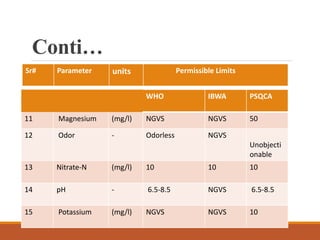
2. WHO standards & Pakistan water standards
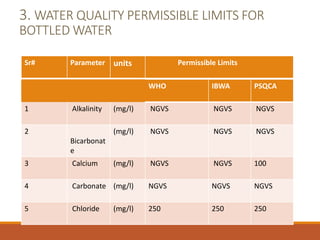
3. Water Quality Permissible Limits For Bottle water
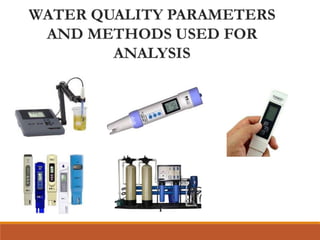
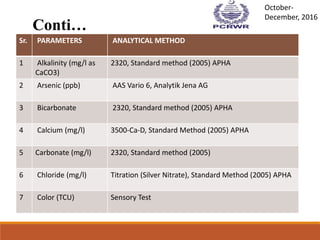
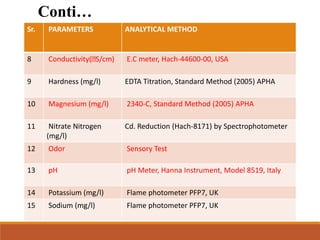
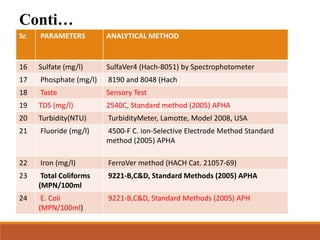
4. Water quality Parameters and Method Use for Analysis
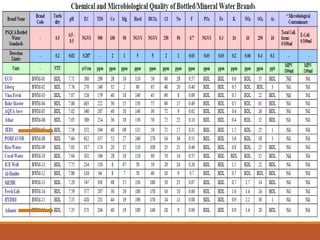
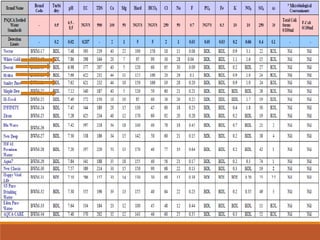
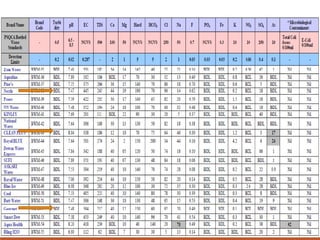
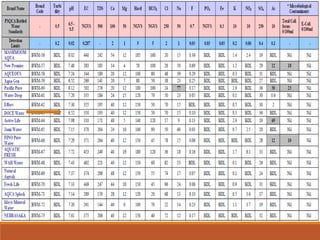
5. Available brands in Pakistan and its standards
6. To introduce a new brand what should be its standards to compete market
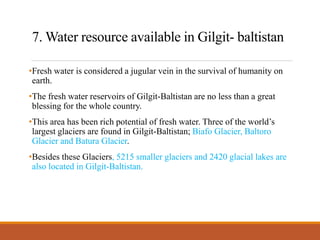
7. Water resource available in Gilgit- baltistan
8. Websites
1. Types of Drinking Water
a) Ground water
b) Surface water
c) Artesian water
d) Mineral water
e) Spring water
f) Prepared water
g) Glacier Water
Conti...
a. Groundwater:
Water in the zone of saturation. The fresh water located
in the pore space of soil and rocks is known as groundwater. It is also
water that is flowing within aquifers below the water table.
b. Surface water:
The water flowing over the earth’s surface in the form
river, lake, streams etc. is known as Surface water.
c. Artesian Water:
When an aquifer is "capped" by a confining layer it
cause the water to be pressurized. This forces the water out of a well
without pumping. This would be called an artesian water.
Conti…
d. Mineral Water:
Mineral Water is water from a mineral spring that
contains various minerals, such as salts and sulfur compounds. Mineral
water may be effervescent or sparkling due to contained gases.
e. Spring water:
If the water table intersects the land surface, water
flows out on to the land. This is called spring Water.
f. Prepared Water:
The Water that is obtained from a public or private
source, filtered, passed through reverse osmosis membranes and the
treated with ozone. In some cases mineral are added.
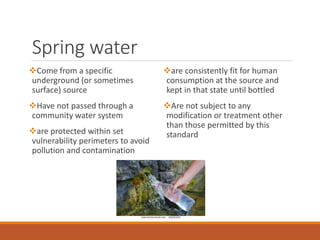
Spring water
Come from a specific
underground (or sometimes
surface) source
Have not passed through a
community water system
are protected within set
vulnerability perimeters to avoid
pollution and contamination
are consistently fit for human
consumption at the source and
kept in that state until bottled
Are not subject to any
modification or treatment other
than those permitted by this
standard
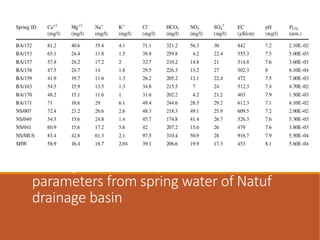
Average values of hydrochemical
parameters from spring water of Natuf
drainage basin
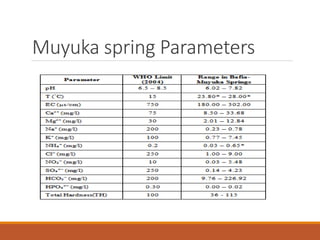
Muyuka spring Parameters
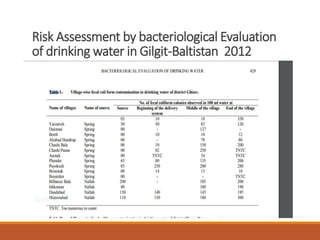
Risk Assessment by bacteriological Evaluation
of drinking water in Gilgit-Baltistan 2012
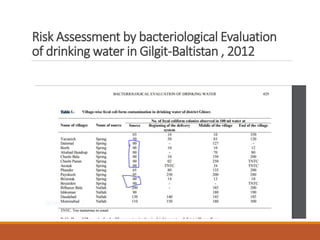
Risk Assessment by bacteriological Evaluation
of drinking water in Gilgit-Baltistan , 2012
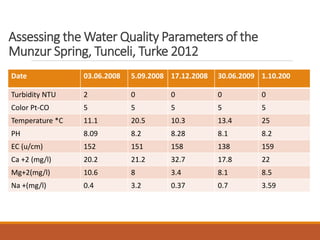
Assessing the Water Quality Parameters of the
Munzur Spring, Tunceli, Turke 2012
Date 03.06.2008 5.09.2008 17.12.2008 30.06.2009 1.10.200
Turbidity NTU 2 0 0 0 0
Color Pt-CO 5 5 5 5 5
Temperature *C 11.1 20.5 10.3 13.4 25
PH 8.09 8.2 8.28 8.1 8.2
EC (u/cm) 152 151 158 138 159
Ca +2 (mg/l) 20.2 21.2 32.7 17.8 22
Mg+2(mg/l) 10.6 8 3.4 8.1 8.5
Na +(mg/l) 0.4 3.2 0.37 0.7 3.59
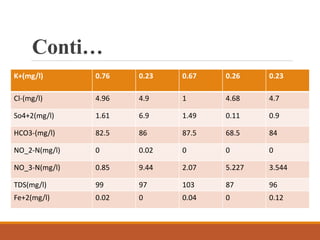
Conti…
K+(mg/l) 0.76 0.23 0.67 0.26 0.23
Cl-(mg/l) 4.96 4.9 1 4.68 4.7
So4+2(mg/l) 1.61 6.9 1.49 0.11 0.9
HCO3-(mg/l) 82.5 86 87.5 68.5 84
NO_2-N(mg/l) 0 0.02 0 0 0
NO_3-N(mg/l) 0.85 9.44 2.07 5.227 3.544
TDS(mg/l) 99 97 103 87 96
Fe+2(mg/l) 0.02 0 0.04 0 0.12
Conti…
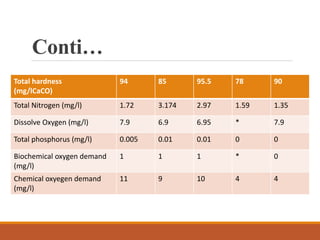
Total hardness
(mg/lCaCO)
94 85 95.5 78 90
Total Nitrogen (mg/l) 1.72 3.174 2.97 1.59 1.35
Dissolve Oxygen (mg/l) 7.9 6.9 6.95 * 7.9
Total phosphorus (mg/l) 0.005 0.01 0.01 0 0
Biochemical oxygen demand
(mg/l)
1 1 1 * 0
Chemical oxyegen demand
(mg/l)
11 9 10 4 4
Conti…
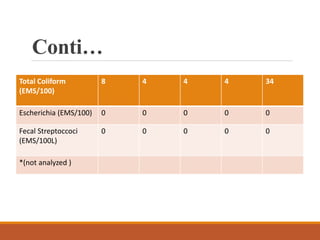
Total Coliform
(EMS/100)
8 4 4 4 34
Escherichia (EMS/100) 0 0 0 0 0
Fecal Streptoccoci
(EMS/100L)
0 0 0 0 0
*(not analyzed )
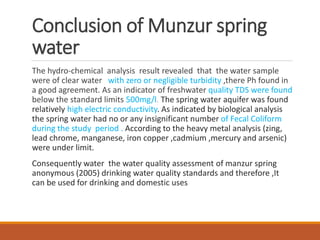
Conclusion of Munzur spring
water
The hydro-chemical analysis result revealed that the water sample
were of clear water with zero or negligible turbidity ,there Ph found in
a good agreement. As an indicator of freshwater quality TDS were found
below the standard limits 500mg/l. The spring water aquifer was found
relatively high electric conductivity. As indicated by biological analysis
the spring water had no or any insignificant number of Fecal Coliform
during the study period . According to the heavy metal analysis (zing,
lead chrome, manganese, iron copper ,cadmium ,mercury and arsenic)
were under limit.
Consequently water the water quality assessment of manzur spring
anonymous (2005) drinking water quality standards and therefore ,It
can be used for drinking and domestic uses
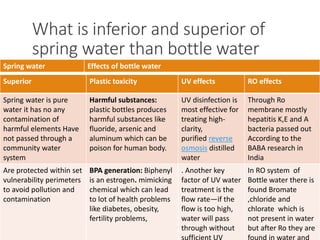
What is inferior and superior of
spring water than bottle water
Superior Plastic toxicity UV effects RO effects
Spring water is pure
water it has no any
contamination of
harmful elements Have
not passed through a
community water
system
Harmful substances:
plastic bottles produces
harmful substances like
fluoride, arsenic and
aluminum which can be
poison for human body.
UV disinfection is
most effective for
treating high-
clarity,
purified reverse
osmosis distilled
water
Through Ro
membrane mostly
hepatitis K,E and A
bacteria passed out
According to the
BABA research in
India
Are protected within set
vulnerability perimeters
to avoid pollution and
contamination
BPA generation: Biphenyl
is an estrogen. mimicking
chemical which can lead
to lot of health problems
like diabetes, obesity,
fertility problems,
. Another key
factor of UV water
treatment is the
flow rate—if the
flow is too high,
water will pass
through without
In RO system of
Bottle water there is
found Bromate
,chloride and
chlorate which is
not present in water
but after Ro they are
Spring water Effects of bottle water
Conti…
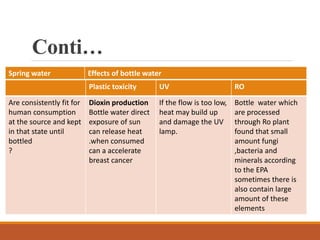
Spring water Effects of bottle water
Plastic toxicity UV RO
Are consistently fit for
human consumption
at the source and kept
in that state until
bottled
?
Dioxin production
Bottle water direct
exposure of sun
can release heat
.when consumed
can a accelerate
breast cancer
If the flow is too low,
heat may build up
and damage the UV
lamp.
Bottle water which
are processed
through Ro plant
found that small
amount fungi
,bacteria and
minerals according
to the EPA
sometimes there is
also contain large
amount of these
elements
Conti…
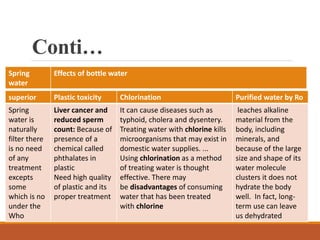
Spring
water
Effects of bottle water
superior Plastic toxicity Chlorination Purified water by Ro
Spring
water is
naturally
filter there
is no need
of any
treatment
excepts
some
which is no
under the
Who
Liver cancer and
reduced sperm
count: Because of
presence of a
chemical called
phthalates in
plastic
Need high quality
of plastic and its
proper treatment
It can cause diseases such as
typhoid, cholera and dysentery.
Treating water with chlorine kills
microorganisms that may exist in
domestic water supplies. ...
Using chlorination as a method
of treating water is thought
effective. There may
be disadvantages of consuming
water that has been treated
with chlorine
leaches alkaline
material from the
body, including
minerals, and
because of the large
size and shape of its
water molecule
clusters it does not
hydrate the body
well. In fact, long-
term use can leave
us dehydrated
Conti…
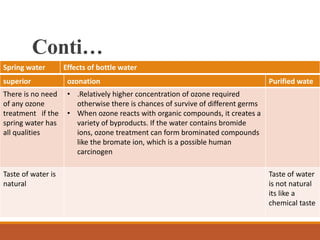
Spring water Effects of bottle water
superior ozonation Purified wate
There is no need
of any ozone
treatment if the
spring water has
all qualities
• .Relatively higher concentration of ozone required
otherwise there is chances of survive of different germs
• When ozone reacts with organic compounds, it creates a
variety of byproducts. If the water contains bromide
ions, ozone treatment can form brominated compounds
like the bromate ion, which is a possible human
carcinogen
Taste of water is
natural
Taste of water
is not natural
its like a
chemical taste
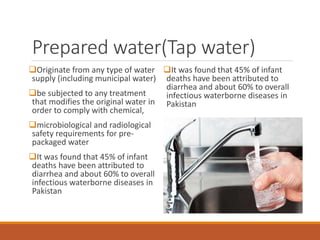
Prepared water(Tap water)
Originate from any type of water
supply (including municipal water)
be subjected to any treatment
that modifies the original water in
order to comply with chemical,
microbiological and radiological
safety requirements for pre-
packaged water
It was found that 45% of infant
deaths have been attributed to
diarrhea and about 60% to overall
infectious waterborne diseases in
Pakistan
It was found that 45% of infant
deaths have been attributed to
diarrhea and about 60% to overall
infectious waterborne diseases in
Pakistan
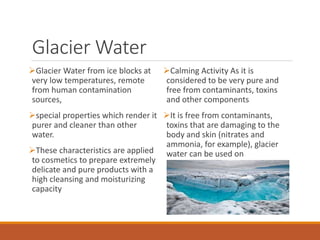
Glacier Water
Glacier Water from ice blocks at
very low temperatures, remote
from human contamination
sources,
special properties which render it
purer and cleaner than other
water.
These characteristics are applied
to cosmetics to prepare extremely
delicate and pure products with a
high cleansing and moisturizing
capacity
Calming Activity As it is
considered to be very pure and
free from contaminants, toxins
and other components
It is free from contaminants,
toxins that are damaging to the
body and skin (nitrates and
ammonia, for example), glacier
water can be used on
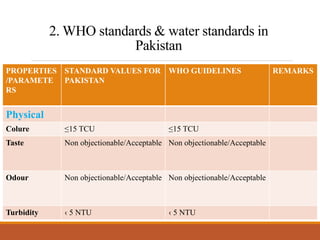
2. WHO standards & water standards in
Pakistan
PROPERTIES
/PARAMETE
RS
STANDARD VALUES FOR
PAKISTAN
WHO GUIDELINES REMARKS
Physical
Colure ≤15 TCU ≤15 TCU
Taste Non objectionable/Acceptable Non objectionable/Acceptable
Odour Non objectionable/Acceptable Non objectionable/Acceptable
Turbidity ‹ 5 NTU ‹ 5 NTU
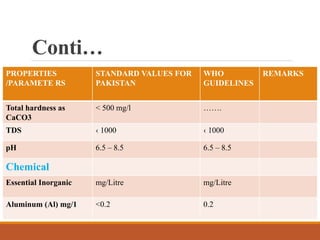
PROPERTIES
/PARAMETE RS
STANDARD VALUES FOR
PAKISTAN
WHO
GUIDELINES
REMARKS
Total hardness as
CaCO3
< 500 mg/l …….
TDS ‹ 1000 ‹ 1000
pH 6.5 – 8.5 6.5 – 8.5
Chemical
Essential Inorganic mg/Litre mg/Litre
Aluminum (Al) mg/1 <0.2 0.2
Conti…
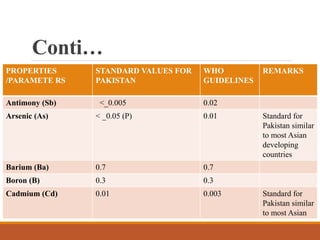
PROPERTIES
/PARAMETE RS
STANDARD VALUES FOR
PAKISTAN
WHO
GUIDELINES
REMARKS
Antimony (Sb) <_0.005 0.02
Arsenic (As) < _0.05 (P) 0.01 Standard for
Pakistan similar
to most Asian
developing
countries
Barium (Ba) 0.7 0.7
Boron (B) 0.3 0.3
Cadmium (Cd) 0.01 0.003 Standard for
Pakistan similar
to most Asian
Conti…
PROPERTIES
/PARAMETE RS
STANDARD VALUES FOR
PAKISTAN
WHO
GUIDELINES
REMARKS
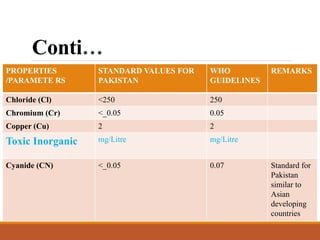
Chloride (Cl) <250 250
Chromium (Cr) <_0.05 0.05
Copper (Cu) 2 2
Toxic Inorganic mg/Litre mg/Litre
Cyanide (CN) <_0.05 0.07 Standard for
Pakistan
similar to
Asian
developing
countries
Conti…
PROPERTIES
/PARAMETE RS
STANDARD
VALUES FOR
PAKISTAN
WHO
GUIDELINES
REMARKS
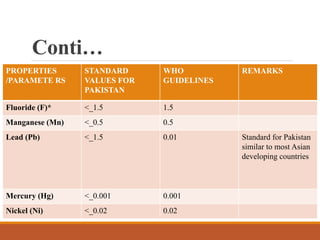
Fluoride (F)* <_1.5 1.5
Manganese (Mn) <_0.5 0.5
Lead (Pb) <_1.5 0.01 Standard for Pakistan
similar to most Asian
developing countries
Mercury (Hg) <_0.001 0.001
Nickel (Ni) <_0.02 0.02
Conti…
PROPERTIES
/PARAMETE RS
STANDARD
VALUES FOR
PAKISTAN
WHO
GUIDELINES
REMARKS
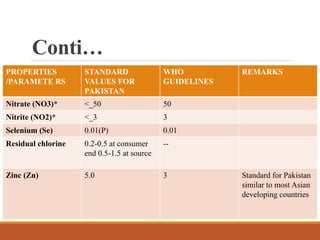
Nitrate (NO3)* <_50 50
Nitrite (NO2)* <_3 3
Selenium (Se) 0.01(P) 0.01
Residual chlorine 0.2-0.5 at consumer
end 0.5-1.5 at source
--
Zinc (Zn) 5.0 3 Standard for Pakistan
similar to most Asian
developing countries
Conti…
PROPERTIES
/PARAMETE RS
STANDARD
VALUES FOR
PAKISTAN
WHO
GUIDELINES
REMARKS
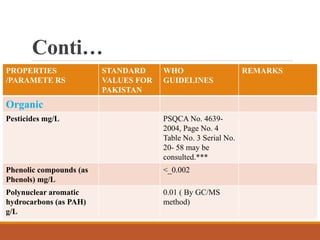
Organic
Pesticides mg/L PSQCA No. 4639-
2004, Page No. 4
Table No. 3 Serial No.
20- 58 may be
consulted.***
Phenolic compounds (as
Phenols) mg/L
<_0.002
Polynuclear aromatic
hydrocarbons (as PAH)
g/L
0.01 ( By GC/MS
method)
Conti…
PROPERTIES
/PARAMETE RS
STANDARD
VALUES FOR
PAKISTAN
WHO
GUIDELINES
REMARKS
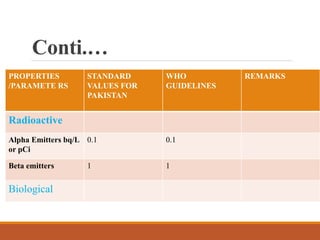
Radioactive
Alpha Emitters bq/L
or pCi
0.1 0.1
Beta emitters 1 1
Biological
Conti.…
Conti.…
PROPERTIES
/PARAMETE RS
STANDARD
VALUES FOR
PAKISTAN
WHO GUIDELINES REMARKS
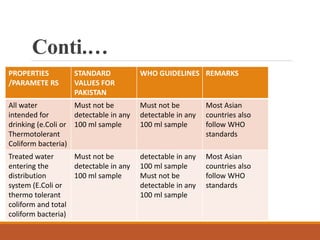
All water
intended for
drinking (e.Coli or
Thermotolerant
Coliform bacteria)
Must not be
detectable in any
100 ml sample
Must not be
detectable in any
100 ml sample
Most Asian
countries also
follow WHO
standards
Treated water
entering the
distribution
system (E.Coli or
thermo tolerant
coliform and total
coliform bacteria)
Must not be
detectable in any
100 ml sample
detectable in any
100 ml sample
Must not be
detectable in any
100 ml sample
Most Asian
countries also
follow WHO
standards
Conti.…
PROPERTIES
/PARAMETE RS
STANDARD
VALUES FOR
PAKISTAN
WHO GUIDELINES REMARKS
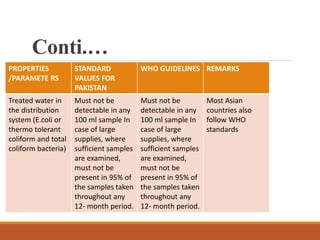
Treated water in
the distribution
system (E.coli or
thermo tolerant
coliform and total
coliform bacteria)
Must not be
detectable in any
100 ml sample In
case of large
supplies, where
sufficient samples
are examined,
must not be
present in 95% of
the samples taken
throughout any
12- month period.
Must not be
detectable in any
100 ml sample In
case of large
supplies, where
sufficient samples
are examined,
must not be
present in 95% of
the samples taken
throughout any
12- month period.
Most Asian
countries also
follow WHO
standards
October-
December, 2016
Sr. PARAMETERS ANALYTICAL METHOD
1 Alkalinity (mg/l as
CaCO3)
2320, Standard method (2005) APHA
2 Arsenic (ppb) AAS Vario 6, Analytik Jena AG
3 Bicarbonate 2320, Standard method (2005) APHA
4 Calcium (mg/l) 3500-Ca-D, Standard Method (2005) APHA
5 Carbonate (mg/l) 2320, Standard method (2005)
6 Chloride (mg/l) Titration (Silver Nitrate), Standard Method (2005) APHA
7 Color (TCU) Sensory Test
Conti…
Sr. PARAMETERS ANALYTICAL METHOD
8 Conductivity( S/cm) E.C meter, Hach-44600-00, USA
9 Hardness (mg/l) EDTA Titration, Standard Method (2005) APHA
10 Magnesium (mg/l) 2340-C, Standard Method (2005) APHA
11 Nitrate Nitrogen
(mg/l)
Cd. Reduction (Hach-8171) by Spectrophotometer
12 Odor Sensory Test
13 pH pH Meter, Hanna Instrument, Model 8519, Italy
14 Potassium (mg/l) Flame photometer PFP7, UK
15 Sodium (mg/l) Flame photometer PFP7, UK
Conti…
Sr. PARAMETERS ANALYTICAL METHOD
16 Sulfate (mg/l) SulfaVer4 (Hach-8051) by Spectrophotometer
17 Phosphate (mg/l) 8190 and 8048 (Hach
18 Taste Sensory Test
19 TDS (mg/l) 2540C, Standard method (2005) APHA
20 Turbidity(NTU) TurbidityMeter, Lamotte, Model 2008, USA
21 Fluoride (mg/l) 4500-F C. ion-Selective Electrode Method Standard
method (2005) APHA
22 Iron (mg/l) FerroVer method (HACH Cat. 21057-69)
23 Total Coliforms
(MPN/100ml
9221-B,C&D, Standard Methods (2005) APHA
24 E. Coli
(MPN/100ml)
9221-B,C&D, Standard Methods (2005) APH
Conti…
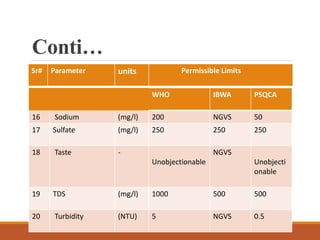
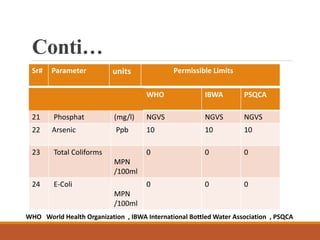
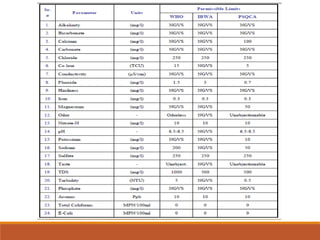
3. WATER QUALITY PERMISSIBLE LIMITS FOR
BOTTLED WATER
Sr# Parameter units Permissible Limits
WHO IBWA PSQCA
1 Alkalinity (mg/l) NGVS NGVS NGVS
2
Bicarbonat
e
(mg/l) NGVS NGVS NGVS
3 Calcium (mg/l) NGVS NGVS 100
4 Carbonate (mg/l) NGVS NGVS NGVS
5 Chloride (mg/l) 250 250 250
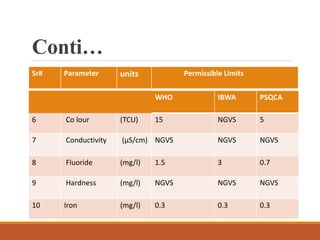
Conti…
Sr# Parameter units Permissible Limits
WHO IBWA PSQCA
6 Co lour (TCU) 15 NGVS 5
7 Conductivity (µS/cm) NGVS NGVS NGVS
8 Fluoride (mg/l) 1.5 3 0.7
9 Hardness (mg/l) NGVS NGVS NGVS
10 Iron (mg/l) 0.3 0.3 0.3
Conti…
Sr# Parameter units Permissible Limits
WHO IBWA PSQCA
11 Magnesium (mg/l) NGVS NGVS 50
12 Odor - Odorless NGVS
Unobjecti
onable
13 Nitrate-N (mg/l) 10 10 10
14 pH - 6.5-8.5 NGVS 6.5-8.5
15 Potassium (mg/l) NGVS NGVS 10
Conti…
Sr# Parameter units Permissible Limits
WHO IBWA PSQCA
16 Sodium (mg/l) 200 NGVS 50
17 Sulfate (mg/l) 250 250 250
18 Taste -
Unobjectionable
NGVS
Unobjecti
onable
19 TDS (mg/l) 1000 500 500
20 Turbidity (NTU) 5 NGVS 0.5
Conti…
Sr# Parameter units Permissible Limits
WHO IBWA PSQCA
21 Phosphat (mg/l) NGVS NGVS NGVS
22 Arsenic Ppb 10 10 10
23 Total Coliforms
MPN
/100ml
0 0 0
24 E-Coli
MPN
/100ml
0 0 0
WHO World Health Organization , IBWA International Bottled Water Association , PSQCA
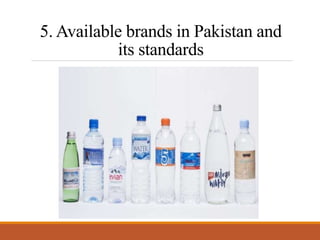
5. Available brands in Pakistan and
its standards
Conti…
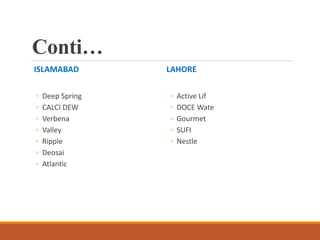
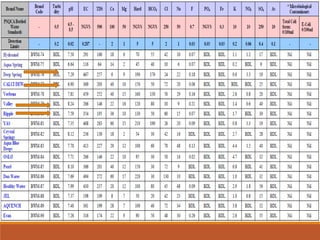
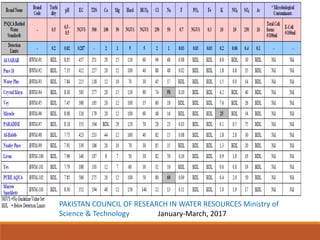
ISLAMABAD
◦ Deep Spring
◦ CALCI DEW
◦ Verbena
◦ Valley
◦ Ripple
◦ Deosai
◦ Atlantic
LAHORE
◦ Active Lif
◦ DOCE Wate
◦ Gourmet
◦ SUFI
◦ Nestle
PAKISTAN COUNCIL OF RESEARCH IN WATER RESOURCES Ministry of
Science & Technology January-March, 2017
6. To introduce a new brand what should be its
standards to compete market
•For a brand to compete the market, it must have some unique
characteristics like high minerals , good quality etc.
•People prefer quality, means that if the brand has a good quality water
then its easy to attract people’s attention towards the new brand.
•Cost also matter; in order to make the brand popular then its cost should
be kept minimum.
•If we want to introduce a new brand then it must have all the parameters
within safe range and according to WHO and PCRWR standards
•The Water Quality permissible limits for bottled water are given in next
slide.
Recommendation
By discussing with PCRWR Director , Many Professors, Teachers and
study of huge literature I personally recommend fresh water like spring
water ,glacier water , these water have rich of minerals ,there is no
need of any big treatment Like Ro, and UV process , But the cost of
these water is much more then other water . This water is fresh water
people adopt this water easly in addition to this I also recommended
Glass bottle instead of plastic bottle , by investigation of many agencies
According to PCRWR recent report January , 2017 The poor quality of
drinking water has forced a large cross-section of citizens to buy bottled
water. As a consequence of this expanding market a mushroom growth
of bottled water industry in the country is witnessed during the last few
years.
7. Water resource available in Gilgit- baltistan
•Fresh water is considered a jugular vein in the survival of humanity on
earth.
•The fresh water reservoirs of Gilgit-Baltistan are no less than a great
blessing for the whole country.
•This area has been rich potential of fresh water. Three of the world’s
largest glaciers are found in Gilgit-Baltistan; Biafo Glacier, Baltoro
Glacier and Batura Glacier.
•Besides these Glaciers, 5215 smaller glaciers and 2420 glacial lakes are
also located in Gilgit-Baltistan.
Conti...
•The water of all these Glaciers flows into the river Indus.
•There is a potential of producing around 52000 MW Hydroelectric
powers in Gilgit-Baltistan.
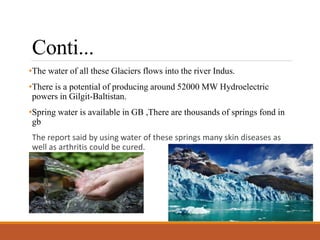
•Spring water is available in GB ,There are thousands of springs fond in
gb
The report said by using water of these springs many skin diseases as
well as arthritis could be cured.
•
8.WEBSITES
PAKISTAN
www.pcrwr,gov.pk
www.wateraid.org
www.psqca.gov.pk
www.epa.gov.pk
INTERNATIONAL
www.thewho.com
IBWI
http://apps.who.int/iris
www.who.int/water_sanitation_he
alth/water-quality/guidelines/en/
Wqpma.com
water quality and its parameters

water quality and its parameters

  • 3.
    Drinking Water Quality Contents: 1.Types of drinking water and its characteristics 2. WHO standards & Pakistan water standards 3. Water Quality Permissible Limits For Bottle water 4. Water quality Parameters and Method Use for Analysis 5. Available brands in Pakistan and its standards 6. To introduce a new brand what should be its standards to compete market 7. Water resource available in Gilgit- baltistan 8. Websites
  • 4.
    1. Types ofDrinking Water a) Ground water b) Surface water c) Artesian water d) Mineral water e) Spring water f) Prepared water g) Glacier Water
  • 5.
    Conti... a. Groundwater: Water inthe zone of saturation. The fresh water located in the pore space of soil and rocks is known as groundwater. It is also water that is flowing within aquifers below the water table. b. Surface water: The water flowing over the earth’s surface in the form river, lake, streams etc. is known as Surface water. c. Artesian Water: When an aquifer is "capped" by a confining layer it cause the water to be pressurized. This forces the water out of a well without pumping. This would be called an artesian water.
  • 6.
    Conti… d. Mineral Water: MineralWater is water from a mineral spring that contains various minerals, such as salts and sulfur compounds. Mineral water may be effervescent or sparkling due to contained gases. e. Spring water: If the water table intersects the land surface, water flows out on to the land. This is called spring Water. f. Prepared Water: The Water that is obtained from a public or private source, filtered, passed through reverse osmosis membranes and the treated with ozone. In some cases mineral are added.
  • 7.
    Spring water Come froma specific underground (or sometimes surface) source Have not passed through a community water system are protected within set vulnerability perimeters to avoid pollution and contamination are consistently fit for human consumption at the source and kept in that state until bottled Are not subject to any modification or treatment other than those permitted by this standard
  • 8.
    Average values ofhydrochemical parameters from spring water of Natuf drainage basin
  • 9.
  • 10.
    Risk Assessment bybacteriological Evaluation of drinking water in Gilgit-Baltistan 2012
  • 11.
    Risk Assessment bybacteriological Evaluation of drinking water in Gilgit-Baltistan , 2012
  • 12.
    Assessing the WaterQuality Parameters of the Munzur Spring, Tunceli, Turke 2012 Date 03.06.2008 5.09.2008 17.12.2008 30.06.2009 1.10.200 Turbidity NTU 2 0 0 0 0 Color Pt-CO 5 5 5 5 5 Temperature *C 11.1 20.5 10.3 13.4 25 PH 8.09 8.2 8.28 8.1 8.2 EC (u/cm) 152 151 158 138 159 Ca +2 (mg/l) 20.2 21.2 32.7 17.8 22 Mg+2(mg/l) 10.6 8 3.4 8.1 8.5 Na +(mg/l) 0.4 3.2 0.37 0.7 3.59
  • 13.
    Conti… K+(mg/l) 0.76 0.230.67 0.26 0.23 Cl-(mg/l) 4.96 4.9 1 4.68 4.7 So4+2(mg/l) 1.61 6.9 1.49 0.11 0.9 HCO3-(mg/l) 82.5 86 87.5 68.5 84 NO_2-N(mg/l) 0 0.02 0 0 0 NO_3-N(mg/l) 0.85 9.44 2.07 5.227 3.544 TDS(mg/l) 99 97 103 87 96 Fe+2(mg/l) 0.02 0 0.04 0 0.12
  • 14.
    Conti… Total hardness (mg/lCaCO) 94 8595.5 78 90 Total Nitrogen (mg/l) 1.72 3.174 2.97 1.59 1.35 Dissolve Oxygen (mg/l) 7.9 6.9 6.95 * 7.9 Total phosphorus (mg/l) 0.005 0.01 0.01 0 0 Biochemical oxygen demand (mg/l) 1 1 1 * 0 Chemical oxyegen demand (mg/l) 11 9 10 4 4
  • 15.
    Conti… Total Coliform (EMS/100) 8 44 4 34 Escherichia (EMS/100) 0 0 0 0 0 Fecal Streptoccoci (EMS/100L) 0 0 0 0 0 *(not analyzed )
  • 16.
    Conclusion of Munzurspring water The hydro-chemical analysis result revealed that the water sample were of clear water with zero or negligible turbidity ,there Ph found in a good agreement. As an indicator of freshwater quality TDS were found below the standard limits 500mg/l. The spring water aquifer was found relatively high electric conductivity. As indicated by biological analysis the spring water had no or any insignificant number of Fecal Coliform during the study period . According to the heavy metal analysis (zing, lead chrome, manganese, iron copper ,cadmium ,mercury and arsenic) were under limit. Consequently water the water quality assessment of manzur spring anonymous (2005) drinking water quality standards and therefore ,It can be used for drinking and domestic uses
  • 17.
    What is inferiorand superior of spring water than bottle water Superior Plastic toxicity UV effects RO effects Spring water is pure water it has no any contamination of harmful elements Have not passed through a community water system Harmful substances: plastic bottles produces harmful substances like fluoride, arsenic and aluminum which can be poison for human body. UV disinfection is most effective for treating high- clarity, purified reverse osmosis distilled water Through Ro membrane mostly hepatitis K,E and A bacteria passed out According to the BABA research in India Are protected within set vulnerability perimeters to avoid pollution and contamination BPA generation: Biphenyl is an estrogen. mimicking chemical which can lead to lot of health problems like diabetes, obesity, fertility problems, . Another key factor of UV water treatment is the flow rate—if the flow is too high, water will pass through without In RO system of Bottle water there is found Bromate ,chloride and chlorate which is not present in water but after Ro they are Spring water Effects of bottle water
  • 18.
    Conti… Spring water Effectsof bottle water Plastic toxicity UV RO Are consistently fit for human consumption at the source and kept in that state until bottled ? Dioxin production Bottle water direct exposure of sun can release heat .when consumed can a accelerate breast cancer If the flow is too low, heat may build up and damage the UV lamp. Bottle water which are processed through Ro plant found that small amount fungi ,bacteria and minerals according to the EPA sometimes there is also contain large amount of these elements
  • 19.
    Conti… Spring water Effects of bottlewater superior Plastic toxicity Chlorination Purified water by Ro Spring water is naturally filter there is no need of any treatment excepts some which is no under the Who Liver cancer and reduced sperm count: Because of presence of a chemical called phthalates in plastic Need high quality of plastic and its proper treatment It can cause diseases such as typhoid, cholera and dysentery. Treating water with chlorine kills microorganisms that may exist in domestic water supplies. ... Using chlorination as a method of treating water is thought effective. There may be disadvantages of consuming water that has been treated with chlorine leaches alkaline material from the body, including minerals, and because of the large size and shape of its water molecule clusters it does not hydrate the body well. In fact, long- term use can leave us dehydrated
  • 20.
    Conti… Spring water Effectsof bottle water superior ozonation Purified wate There is no need of any ozone treatment if the spring water has all qualities • .Relatively higher concentration of ozone required otherwise there is chances of survive of different germs • When ozone reacts with organic compounds, it creates a variety of byproducts. If the water contains bromide ions, ozone treatment can form brominated compounds like the bromate ion, which is a possible human carcinogen Taste of water is natural Taste of water is not natural its like a chemical taste
  • 21.
    Prepared water(Tap water) Originatefrom any type of water supply (including municipal water) be subjected to any treatment that modifies the original water in order to comply with chemical, microbiological and radiological safety requirements for pre- packaged water It was found that 45% of infant deaths have been attributed to diarrhea and about 60% to overall infectious waterborne diseases in Pakistan It was found that 45% of infant deaths have been attributed to diarrhea and about 60% to overall infectious waterborne diseases in Pakistan
  • 22.
    Glacier Water Glacier Waterfrom ice blocks at very low temperatures, remote from human contamination sources, special properties which render it purer and cleaner than other water. These characteristics are applied to cosmetics to prepare extremely delicate and pure products with a high cleansing and moisturizing capacity Calming Activity As it is considered to be very pure and free from contaminants, toxins and other components It is free from contaminants, toxins that are damaging to the body and skin (nitrates and ammonia, for example), glacier water can be used on
  • 23.
    2. WHO standards& water standards in Pakistan PROPERTIES /PARAMETE RS STANDARD VALUES FOR PAKISTAN WHO GUIDELINES REMARKS Physical Colure ≤15 TCU ≤15 TCU Taste Non objectionable/Acceptable Non objectionable/Acceptable Odour Non objectionable/Acceptable Non objectionable/Acceptable Turbidity ‹ 5 NTU ‹ 5 NTU
  • 24.
    PROPERTIES /PARAMETE RS STANDARD VALUESFOR PAKISTAN WHO GUIDELINES REMARKS Total hardness as CaCO3 < 500 mg/l ……. TDS ‹ 1000 ‹ 1000 pH 6.5 – 8.5 6.5 – 8.5 Chemical Essential Inorganic mg/Litre mg/Litre Aluminum (Al) mg/1 <0.2 0.2 Conti…
  • 25.
    PROPERTIES /PARAMETE RS STANDARD VALUESFOR PAKISTAN WHO GUIDELINES REMARKS Antimony (Sb) <_0.005 0.02 Arsenic (As) < _0.05 (P) 0.01 Standard for Pakistan similar to most Asian developing countries Barium (Ba) 0.7 0.7 Boron (B) 0.3 0.3 Cadmium (Cd) 0.01 0.003 Standard for Pakistan similar to most Asian Conti…
  • 26.
    PROPERTIES /PARAMETE RS STANDARD VALUESFOR PAKISTAN WHO GUIDELINES REMARKS Chloride (Cl) <250 250 Chromium (Cr) <_0.05 0.05 Copper (Cu) 2 2 Toxic Inorganic mg/Litre mg/Litre Cyanide (CN) <_0.05 0.07 Standard for Pakistan similar to Asian developing countries Conti…
  • 27.
    PROPERTIES /PARAMETE RS STANDARD VALUES FOR PAKISTAN WHO GUIDELINES REMARKS Fluoride(F)* <_1.5 1.5 Manganese (Mn) <_0.5 0.5 Lead (Pb) <_1.5 0.01 Standard for Pakistan similar to most Asian developing countries Mercury (Hg) <_0.001 0.001 Nickel (Ni) <_0.02 0.02 Conti…
  • 28.
    PROPERTIES /PARAMETE RS STANDARD VALUES FOR PAKISTAN WHO GUIDELINES REMARKS Nitrate(NO3)* <_50 50 Nitrite (NO2)* <_3 3 Selenium (Se) 0.01(P) 0.01 Residual chlorine 0.2-0.5 at consumer end 0.5-1.5 at source -- Zinc (Zn) 5.0 3 Standard for Pakistan similar to most Asian developing countries Conti…
  • 29.
    PROPERTIES /PARAMETE RS STANDARD VALUES FOR PAKISTAN WHO GUIDELINES REMARKS Organic Pesticidesmg/L PSQCA No. 4639- 2004, Page No. 4 Table No. 3 Serial No. 20- 58 may be consulted.*** Phenolic compounds (as Phenols) mg/L <_0.002 Polynuclear aromatic hydrocarbons (as PAH) g/L 0.01 ( By GC/MS method) Conti…
  • 30.
    PROPERTIES /PARAMETE RS STANDARD VALUES FOR PAKISTAN WHO GUIDELINES REMARKS Radioactive AlphaEmitters bq/L or pCi 0.1 0.1 Beta emitters 1 1 Biological Conti.…
  • 31.
    Conti.… PROPERTIES /PARAMETE RS STANDARD VALUES FOR PAKISTAN WHOGUIDELINES REMARKS All water intended for drinking (e.Coli or Thermotolerant Coliform bacteria) Must not be detectable in any 100 ml sample Must not be detectable in any 100 ml sample Most Asian countries also follow WHO standards Treated water entering the distribution system (E.Coli or thermo tolerant coliform and total coliform bacteria) Must not be detectable in any 100 ml sample detectable in any 100 ml sample Must not be detectable in any 100 ml sample Most Asian countries also follow WHO standards
  • 32.
    Conti.… PROPERTIES /PARAMETE RS STANDARD VALUES FOR PAKISTAN WHOGUIDELINES REMARKS Treated water in the distribution system (E.coli or thermo tolerant coliform and total coliform bacteria) Must not be detectable in any 100 ml sample In case of large supplies, where sufficient samples are examined, must not be present in 95% of the samples taken throughout any 12- month period. Must not be detectable in any 100 ml sample In case of large supplies, where sufficient samples are examined, must not be present in 95% of the samples taken throughout any 12- month period. Most Asian countries also follow WHO standards
  • 34.
    October- December, 2016 Sr. PARAMETERSANALYTICAL METHOD 1 Alkalinity (mg/l as CaCO3) 2320, Standard method (2005) APHA 2 Arsenic (ppb) AAS Vario 6, Analytik Jena AG 3 Bicarbonate 2320, Standard method (2005) APHA 4 Calcium (mg/l) 3500-Ca-D, Standard Method (2005) APHA 5 Carbonate (mg/l) 2320, Standard method (2005) 6 Chloride (mg/l) Titration (Silver Nitrate), Standard Method (2005) APHA 7 Color (TCU) Sensory Test Conti…
  • 35.
    Sr. PARAMETERS ANALYTICALMETHOD 8 Conductivity( S/cm) E.C meter, Hach-44600-00, USA 9 Hardness (mg/l) EDTA Titration, Standard Method (2005) APHA 10 Magnesium (mg/l) 2340-C, Standard Method (2005) APHA 11 Nitrate Nitrogen (mg/l) Cd. Reduction (Hach-8171) by Spectrophotometer 12 Odor Sensory Test 13 pH pH Meter, Hanna Instrument, Model 8519, Italy 14 Potassium (mg/l) Flame photometer PFP7, UK 15 Sodium (mg/l) Flame photometer PFP7, UK Conti…
  • 36.
    Sr. PARAMETERS ANALYTICALMETHOD 16 Sulfate (mg/l) SulfaVer4 (Hach-8051) by Spectrophotometer 17 Phosphate (mg/l) 8190 and 8048 (Hach 18 Taste Sensory Test 19 TDS (mg/l) 2540C, Standard method (2005) APHA 20 Turbidity(NTU) TurbidityMeter, Lamotte, Model 2008, USA 21 Fluoride (mg/l) 4500-F C. ion-Selective Electrode Method Standard method (2005) APHA 22 Iron (mg/l) FerroVer method (HACH Cat. 21057-69) 23 Total Coliforms (MPN/100ml 9221-B,C&D, Standard Methods (2005) APHA 24 E. Coli (MPN/100ml) 9221-B,C&D, Standard Methods (2005) APH Conti…
  • 37.
    3. WATER QUALITYPERMISSIBLE LIMITS FOR BOTTLED WATER Sr# Parameter units Permissible Limits WHO IBWA PSQCA 1 Alkalinity (mg/l) NGVS NGVS NGVS 2 Bicarbonat e (mg/l) NGVS NGVS NGVS 3 Calcium (mg/l) NGVS NGVS 100 4 Carbonate (mg/l) NGVS NGVS NGVS 5 Chloride (mg/l) 250 250 250
  • 38.
    Conti… Sr# Parameter unitsPermissible Limits WHO IBWA PSQCA 6 Co lour (TCU) 15 NGVS 5 7 Conductivity (µS/cm) NGVS NGVS NGVS 8 Fluoride (mg/l) 1.5 3 0.7 9 Hardness (mg/l) NGVS NGVS NGVS 10 Iron (mg/l) 0.3 0.3 0.3
  • 39.
    Conti… Sr# Parameter unitsPermissible Limits WHO IBWA PSQCA 11 Magnesium (mg/l) NGVS NGVS 50 12 Odor - Odorless NGVS Unobjecti onable 13 Nitrate-N (mg/l) 10 10 10 14 pH - 6.5-8.5 NGVS 6.5-8.5 15 Potassium (mg/l) NGVS NGVS 10
  • 40.
    Conti… Sr# Parameter unitsPermissible Limits WHO IBWA PSQCA 16 Sodium (mg/l) 200 NGVS 50 17 Sulfate (mg/l) 250 250 250 18 Taste - Unobjectionable NGVS Unobjecti onable 19 TDS (mg/l) 1000 500 500 20 Turbidity (NTU) 5 NGVS 0.5
  • 41.
    Conti… Sr# Parameter unitsPermissible Limits WHO IBWA PSQCA 21 Phosphat (mg/l) NGVS NGVS NGVS 22 Arsenic Ppb 10 10 10 23 Total Coliforms MPN /100ml 0 0 0 24 E-Coli MPN /100ml 0 0 0 WHO World Health Organization , IBWA International Bottled Water Association , PSQCA
  • 42.
    5. Available brandsin Pakistan and its standards
  • 43.
    Conti… ISLAMABAD ◦ Deep Spring ◦CALCI DEW ◦ Verbena ◦ Valley ◦ Ripple ◦ Deosai ◦ Atlantic LAHORE ◦ Active Lif ◦ DOCE Wate ◦ Gourmet ◦ SUFI ◦ Nestle
  • 49.
    PAKISTAN COUNCIL OFRESEARCH IN WATER RESOURCES Ministry of Science & Technology January-March, 2017
  • 50.
    6. To introducea new brand what should be its standards to compete market •For a brand to compete the market, it must have some unique characteristics like high minerals , good quality etc. •People prefer quality, means that if the brand has a good quality water then its easy to attract people’s attention towards the new brand. •Cost also matter; in order to make the brand popular then its cost should be kept minimum. •If we want to introduce a new brand then it must have all the parameters within safe range and according to WHO and PCRWR standards •The Water Quality permissible limits for bottled water are given in next slide.
  • 52.
    Recommendation By discussing withPCRWR Director , Many Professors, Teachers and study of huge literature I personally recommend fresh water like spring water ,glacier water , these water have rich of minerals ,there is no need of any big treatment Like Ro, and UV process , But the cost of these water is much more then other water . This water is fresh water people adopt this water easly in addition to this I also recommended Glass bottle instead of plastic bottle , by investigation of many agencies According to PCRWR recent report January , 2017 The poor quality of drinking water has forced a large cross-section of citizens to buy bottled water. As a consequence of this expanding market a mushroom growth of bottled water industry in the country is witnessed during the last few years.
  • 53.
    7. Water resourceavailable in Gilgit- baltistan •Fresh water is considered a jugular vein in the survival of humanity on earth. •The fresh water reservoirs of Gilgit-Baltistan are no less than a great blessing for the whole country. •This area has been rich potential of fresh water. Three of the world’s largest glaciers are found in Gilgit-Baltistan; Biafo Glacier, Baltoro Glacier and Batura Glacier. •Besides these Glaciers, 5215 smaller glaciers and 2420 glacial lakes are also located in Gilgit-Baltistan.
  • 54.
    Conti... •The water ofall these Glaciers flows into the river Indus. •There is a potential of producing around 52000 MW Hydroelectric powers in Gilgit-Baltistan. •Spring water is available in GB ,There are thousands of springs fond in gb The report said by using water of these springs many skin diseases as well as arthritis could be cured. •
  • 55.

Editor's Notes

  • #19 oun A compound produced by combining a substance chemically with water. Many minerals and crystalline substances are hydrates. Verb. To combine a compound with water, especially to form a hydrate. To supply water to a person in order to restore or maintain a balance of fluids