WATER QUALITY PARAMETERS
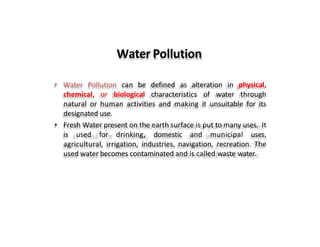
Water Pollution
• Water Pollution can be defined as alteration in physical,
chemical, or biological characteristics of water through
natural or human activities and making it unsuitable for its
designated use.
• Fresh Water present on the earth surface is put to many uses. It
is used for drinking, domestic and municipal uses,
agricultural, irrigation, industries, navigation, recreation. The
used water becomes contaminated and is called waste water.
• The on the intended use of the water which may be
either human consumption or it may be for
industries, irrigation, recreation etc..
• Depending upon the proposed use of water, certain
water quality criteria are established and based on
these criteria quality standards are specified by
health and other regulation agencies.
• Different types of water require different level of
water purity.
• Drinking water requires highest standard of purity
Water Quality Standards
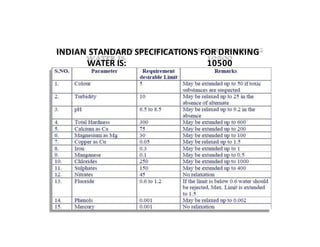
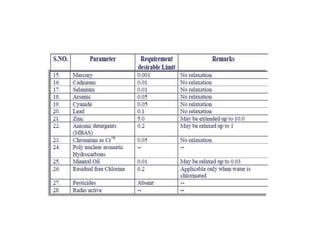
INDIAN STANDARD SPECIFICATIONS FOR DRINKING
WATER IS: 10500
RAWWA
TER TREATMENT
WHOLESOME
WATER
W
A
TER
QUALITYTESTS
W
A
TER
QUALITYTESTS
• Water is one of the most important material required to sustain life &
is considered as the source of human illness.
• It is rarely available in nature because it has great tendency to
dissolve various substances in it while flowing on the surface of
earth.
• The topic of water quality focuses on the presence of foreign
substances in it & their effect on human & other aquaticlife.
• Where as WHO listed over 100 chemicals in guide lines for
drinking water.
• In addition, the public need water that is soft, non-corrosive, free
from pathogens & suspended solids.
• Due to inferior quality of water millions of children die every year.In
the world under the age of 5years, due to water borndiseases.
• Water quality for one purpose is not good / suitable for other
purpose.
IMPORTANT REQUIRMENTS OFWATERFOR DOMESTIC USE:
• It should be colorless and sparkling water
• It should be of good taste , free from odour.
• It should be reasonablysoft.
• It should be free from disease producing bacteria or
pathogens.
• It should be free from objectionable dissolved gases.
• It should be free from harmful salts.
• It should be free from objectionable minerals such as iron ,
manganese ,lead, arsenic and other poisonous metals.
• It should be free from radio active substance such as
radium,stronsium etc.
• It should not lead to scale formation and should be non-
corrosive.
THEABOVE REQUIRMENTSARE ONLYQUALITATIVE.
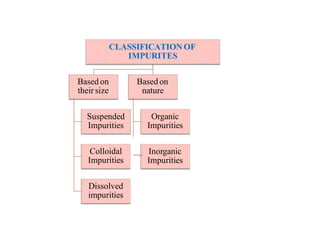
CLASSIFICATION OF
IMPURITES
Based on
their size
Suspended
Impurities
Colloidal
Impurities
Dissolved
impurities
Based on
nature
Organic
Impurities
Inorganic
Impurities
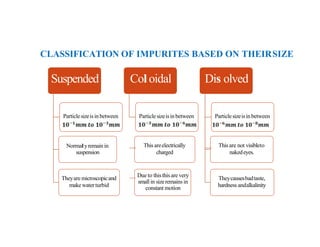
CLASSIFICATION OF IMPURITES BASED ON THEIRSIZE
Particlesizeisinbetween
Normalyremainin
suspension
Theyare microscopicand
makewaterturbid
Particlesizeisinbetween
This areelectrically
charged
Due to thisthisare very
small in sizeremains in
constant motion
Suspended Col oidal Dis olved
Particlesizeisinbetween
This are not visibleto
nakedeyes.
Theycausesbadtaste,
hardness andalkalinity
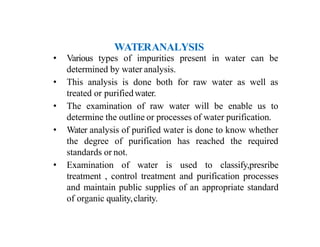
WATERANALYSIS
• Various types of impurities present in water can be
determined by water analysis.
• This analysis is done both for raw water as well as
treated or purifiedwater.
• The examination of raw water will be enable us to
determine the outline or processes of water purification.
• Water analysis of purified water is done to know whether
the degree of purification has reached the required
standards or not.
• Examination of water is used to classify,presribe
treatment , control treatment and purification processes
and maintain public supplies of an appropriate standard
of organic quality,clarity.
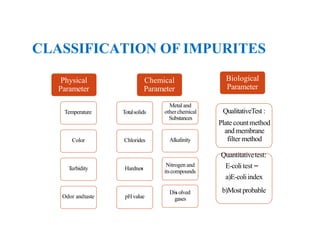
CLASSIFICATION OF IMPURITES
Physical
Parameter
Temperature
Color
T
urbidity
Chemical
Parameter
Totalsolids
Chlorides
Hardnes
QualitativeTest :
Plate countmethod
and membrane
filter method
Alkalinity
Nitrogen and
itscompounds
Dis olved
gases
Biological
Parameter
Metal and
otherchemical
Substances
Quantitativetest:
E-colitest –
a)E-coliindex
b)Mostprobable
Odor andtaste pHvalue
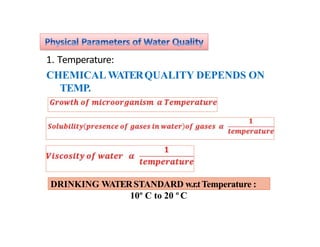
1. Temperature:
CHEMICAL WATERQUALITY DEPENDS ON
TEMP.
DRINKING WATERSTANDARD w.r.tTemperature :
10º C to 20 º C
2. Color:
5 TCU to 20TCU
• color of water is due to presence of colloidal matter,
decaying vegetation.
• Color in water is measured by a device known as “
TINTOMETER” on burgage scale ( Platinum cobalt
scale) in terms of true color units(TCU)
• scale of color from 0 to 70 units.
DRINKING WATERSTANDARD w.r.t COLOR :
1 TCU = 1 mg of platinum as a chloroplatnium iron
mixed in 1 liter. Of distilled water , the color produced is
taken as 1 TCU (mg/ltr)
3. Turbidity:
• It is measure of resistance offered by the particle present
in water to the passage of light throughwater.
• It is caused by suspended or colloidalparticles.
• Turbidity in water is measured on silica scale and
expressed in terms of turbidi units.
• Turbidity in water measured by device works on the
light absorption.
THIS IS PROPOSED BYJACKSON
1 Std turbidity unit = 1 mg of finely devided silica mixed
in 1 ltr of distilled water, turbidity is taken as 1 STU
(JTU).
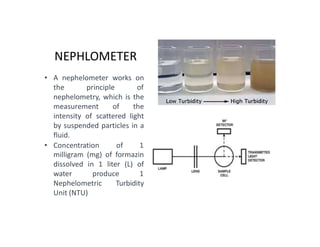
NEPHLOMETER
• A nephelometer works on
the principle of
nephelometry, which is the
measurement of the
intensity of scattered light
by suspended particles in a
fluid.
• Concentration of 1
milligram (mg) of formazin
dissolved in 1 liter (L) of
water produce 1
Nephelometric Turbidity
Unit (NTU)
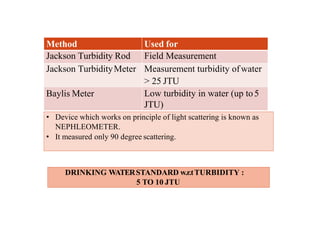
Method
Jackson Turbidity Rod
Jackson TurbidityMeter
Used for
Field Measurement
Measurement turbidity ofwater
> 25 JTU
Low turbidity in water (up to5
JTU)
Baylis Meter
• Device which works on principle of light scattering is known as
NEPHLEOMETER.
• It measured only 90 degree scattering.
DRINKING WATERSTANDARD w.r.tTURBIDITY :
5 TO 10 JTU
Turbidity Rod
Jackson Turbidity
Meter (25-1000
mg/L)
Baylis Turbidimeter
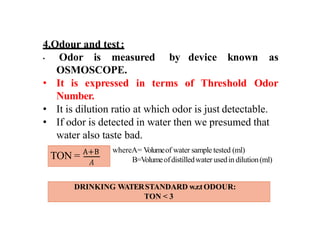
4.Odour and test:
• Odor is measured by device known as
OSMOSCOPE.
• It is expressed
Number.
in terms of Threshold Odor
• It is dilution ratio at which odor is just detectable.
• If odor is detected in water then we presumed that
water also taste bad.
TON =
whereA= V
olumeof water sample tested (ml)
B=Volumeofdistilledwater usedin dilution(ml)
DRINKING WATERSTANDARD w.r.tODOUR:
TON < 3
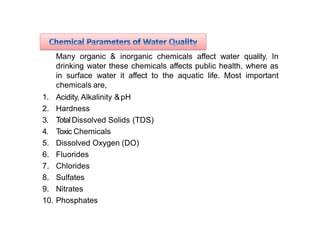
Many organic & inorganic chemicals affect water quality. In
drinking water these chemicals affects public health, where as
in surface water it affect to the aquatic life. Most important
chemicals are,
1. Acidity, Alkalinity &pH
2. Hardness
3. TotalDissolved Solids (TDS)
4. Toxic Chemicals
5. Dissolved Oxygen (DO)
6. Fluorides
7. Chlorides
8. Sulfates
9. Nitrates
10. Phosphates
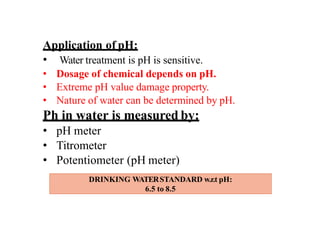
Application of pH:
• Water treatment is pH is sensitive.
• Dosage of chemical depends on pH.
• Extreme pH value damage property.
• Nature of water can be determined by pH.
Ph in water is measured by:
• pH meter
• Titrometer
• Potentiometer (pH meter)
DRINKING WATERSTANDARD w.r.t pH:
6.5 to 8.5
Derivation of pH
Numerical
• [OH] ion concentration in water is 10^(-5.8) mole/L. Find the ph of
water?
Numerical
• Two water sources of equal volume are mixed together. W1 has pH of
7.2 and W2 has pH of 8.2. What is the finalpH?
Numerical
•A: Vol:300 ml, pH=7;
B: V: 700 ml, pH=5
What is the pH of mixture?
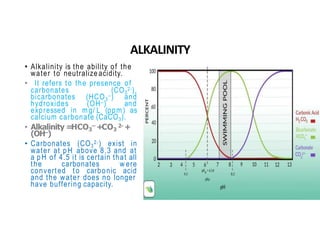
ALKALINITY
• Alkalinity is the ability of the
water to neutralize acidity.
• It refers to the presence of
carbonates (CO3
2-),
bicarbonates (HCO3
–) and
hydroxides (OH–) and
expressed in mg/ L (ppm) as
calcium carbonate (CaCO3).
• Alkalinity =HCO3
– +CO3
2- +
(OH–)
• Carbonates (CO3
2-) exist in
water at pH above 8.3 and at
a pH of 4.5 it is certain that all
the carbonates w ere
converted to carbonic acid
and the water does no longer
have buffering capacity.
Handerson-Hallesbach Equation
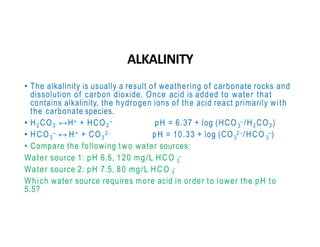
ALKALINITY
• The alkalinity is usually a result of weathering of carbonate rocks and
dissolution of carbon dioxide. Once acid is added to water that
contains alkalinity, the hydrogen ions of the acid react primarily with
the carbonate species.
3
• H2 CO3 ↔H+ + HCO3
– pH = 6.37 + log (HCO – /H2 CO3 )
3 3 3 3
• HCO – ↔ H+ + CO 2- pH = 10.33 + log (CO 2 - /HCO –)
• Compare the following two water sources:
3
Water source 1: pH 6.5, 120 mg/L HCO –
Water source 2: pH 7.5, 80 mg/L HCO -
3
Which water source requires more acid in order to lower the pH to
5.5?
MATHEMATICAL EXPRESSION
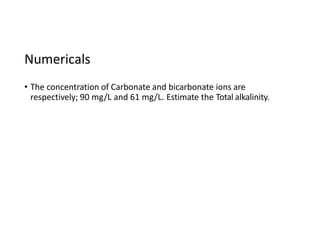
Numericals
• The concentration of Carbonate and bicarbonate ions are
respectively; 90 mg/L and 61 mg/L. Estimate the Total alkalinity.
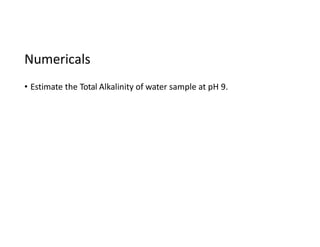
Numericals
• Estimate the Total Alkalinity of water sample at pH 9.
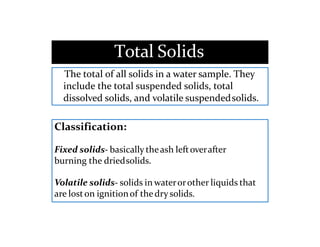
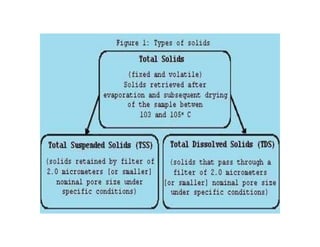
Total Solids
The total of all solids in a water sample. They
include the total suspended solids, total
dissolved solids, and volatile suspendedsolids.
Classification:
Fixed solids- basically theash leftoverafter
burning the driedsolids.
Volatile solids- solids in waterorother liquids that
are loston ignitionof thedrysolids.
➢In stream water,
dissolved solids
consist of calcium,
chlorides, nitrate,
phosphorus, iron,
sulfur, and other
ions particles that
will pass through a
filter with pores of
around 2 microns
(0.002 cm) insize.
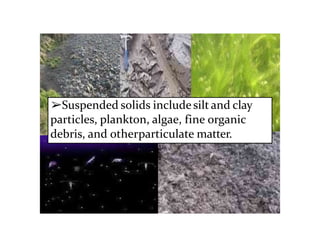
➢Suspended solids include silt and clay
particles, plankton, algae, fine organic
debris, and otherparticulate matter.
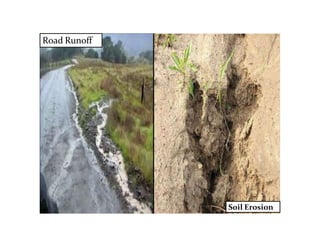
Source of Solids
Sewage
Industrial Discharge
Road Runoff
Soil Erosion
Significance
Solids in wastewater contribute to
sediment formation; volatilesolids may be
associated with oxygendemand.
Solid analysesare important in thecontrol
of biological and physical wastewater
treatmentprocesses.
Forassessing compliancewith regulatory
agency watertreatment.
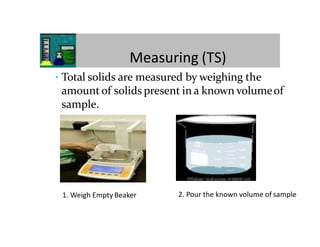
Measuring (TS)
▪ Total solids are measured by weighing the
amount of solids present in a known volumeof
sample.
1. Weigh Empty Beaker 2. Pour the known volume of sample
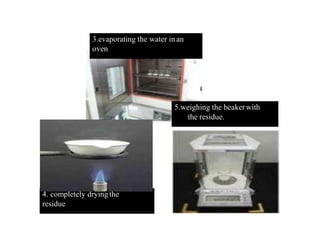
5.weighing the beakerwith
the residue.
4. completely dryingthe
residue
3.evaporating the water in an
oven
➢The total solids concentration isequal to
the difference between the weight of the
beaker with the residue and the weight
of the beaker withoutit.
Total Solids (mg/L) :
Total solids(TS) = [(TSA – TSB)] /V
TSA = Weightof dried residue + dish in milligrams
TSB = Weight of dish inmilligrams
V= Volume of Sample(mL)
WATER QUALITY PARAMETERS-1-1.pptx

WATER QUALITY PARAMETERS-1-1.pptx

  • 1.
  • 2.
    Water Pollution • WaterPollution can be defined as alteration in physical, chemical, or biological characteristics of water through natural or human activities and making it unsuitable for its designated use. • Fresh Water present on the earth surface is put to many uses. It is used for drinking, domestic and municipal uses, agricultural, irrigation, industries, navigation, recreation. The used water becomes contaminated and is called waste water.
  • 3.
    • The onthe intended use of the water which may be either human consumption or it may be for industries, irrigation, recreation etc.. • Depending upon the proposed use of water, certain water quality criteria are established and based on these criteria quality standards are specified by health and other regulation agencies. • Different types of water require different level of water purity. • Drinking water requires highest standard of purity Water Quality Standards
  • 4.
    INDIAN STANDARD SPECIFICATIONSFOR DRINKING WATER IS: 10500
  • 6.
  • 7.
    • Water isone of the most important material required to sustain life & is considered as the source of human illness. • It is rarely available in nature because it has great tendency to dissolve various substances in it while flowing on the surface of earth. • The topic of water quality focuses on the presence of foreign substances in it & their effect on human & other aquaticlife. • Where as WHO listed over 100 chemicals in guide lines for drinking water. • In addition, the public need water that is soft, non-corrosive, free from pathogens & suspended solids. • Due to inferior quality of water millions of children die every year.In the world under the age of 5years, due to water borndiseases. • Water quality for one purpose is not good / suitable for other purpose.
  • 8.
    IMPORTANT REQUIRMENTS OFWATERFORDOMESTIC USE: • It should be colorless and sparkling water • It should be of good taste , free from odour. • It should be reasonablysoft. • It should be free from disease producing bacteria or pathogens. • It should be free from objectionable dissolved gases. • It should be free from harmful salts. • It should be free from objectionable minerals such as iron , manganese ,lead, arsenic and other poisonous metals. • It should be free from radio active substance such as radium,stronsium etc. • It should not lead to scale formation and should be non- corrosive. THEABOVE REQUIRMENTSARE ONLYQUALITATIVE.
  • 9.
    CLASSIFICATION OF IMPURITES Based on theirsize Suspended Impurities Colloidal Impurities Dissolved impurities Based on nature Organic Impurities Inorganic Impurities
  • 10.
    CLASSIFICATION OF IMPURITESBASED ON THEIRSIZE Particlesizeisinbetween Normalyremainin suspension Theyare microscopicand makewaterturbid Particlesizeisinbetween This areelectrically charged Due to thisthisare very small in sizeremains in constant motion Suspended Col oidal Dis olved Particlesizeisinbetween This are not visibleto nakedeyes. Theycausesbadtaste, hardness andalkalinity
  • 11.
    WATERANALYSIS • Various typesof impurities present in water can be determined by water analysis. • This analysis is done both for raw water as well as treated or purifiedwater. • The examination of raw water will be enable us to determine the outline or processes of water purification. • Water analysis of purified water is done to know whether the degree of purification has reached the required standards or not. • Examination of water is used to classify,presribe treatment , control treatment and purification processes and maintain public supplies of an appropriate standard of organic quality,clarity.
  • 12.
    CLASSIFICATION OF IMPURITES Physical Parameter Temperature Color T urbidity Chemical Parameter Totalsolids Chlorides Hardnes QualitativeTest: Plate countmethod and membrane filter method Alkalinity Nitrogen and itscompounds Dis olved gases Biological Parameter Metal and otherchemical Substances Quantitativetest: E-colitest – a)E-coliindex b)Mostprobable Odor andtaste pHvalue
  • 13.
    1. Temperature: CHEMICAL WATERQUALITYDEPENDS ON TEMP. DRINKING WATERSTANDARD w.r.tTemperature : 10º C to 20 º C
  • 14.
    2. Color: 5 TCUto 20TCU • color of water is due to presence of colloidal matter, decaying vegetation. • Color in water is measured by a device known as “ TINTOMETER” on burgage scale ( Platinum cobalt scale) in terms of true color units(TCU) • scale of color from 0 to 70 units. DRINKING WATERSTANDARD w.r.t COLOR : 1 TCU = 1 mg of platinum as a chloroplatnium iron mixed in 1 liter. Of distilled water , the color produced is taken as 1 TCU (mg/ltr)
  • 15.
    3. Turbidity: • Itis measure of resistance offered by the particle present in water to the passage of light throughwater. • It is caused by suspended or colloidalparticles. • Turbidity in water is measured on silica scale and expressed in terms of turbidi units. • Turbidity in water measured by device works on the light absorption. THIS IS PROPOSED BYJACKSON 1 Std turbidity unit = 1 mg of finely devided silica mixed in 1 ltr of distilled water, turbidity is taken as 1 STU (JTU).
  • 16.
    NEPHLOMETER • A nephelometerworks on the principle of nephelometry, which is the measurement of the intensity of scattered light by suspended particles in a fluid. • Concentration of 1 milligram (mg) of formazin dissolved in 1 liter (L) of water produce 1 Nephelometric Turbidity Unit (NTU)
  • 17.
    Method Jackson Turbidity Rod JacksonTurbidityMeter Used for Field Measurement Measurement turbidity ofwater > 25 JTU Low turbidity in water (up to5 JTU) Baylis Meter • Device which works on principle of light scattering is known as NEPHLEOMETER. • It measured only 90 degree scattering. DRINKING WATERSTANDARD w.r.tTURBIDITY : 5 TO 10 JTU
  • 18.
    Turbidity Rod Jackson Turbidity Meter(25-1000 mg/L) Baylis Turbidimeter
  • 19.
    4.Odour and test: •Odor is measured by device known as OSMOSCOPE. • It is expressed Number. in terms of Threshold Odor • It is dilution ratio at which odor is just detectable. • If odor is detected in water then we presumed that water also taste bad. TON = whereA= V olumeof water sample tested (ml) B=Volumeofdistilledwater usedin dilution(ml) DRINKING WATERSTANDARD w.r.tODOUR: TON < 3
  • 20.
    Many organic &inorganic chemicals affect water quality. In drinking water these chemicals affects public health, where as in surface water it affect to the aquatic life. Most important chemicals are, 1. Acidity, Alkalinity &pH 2. Hardness 3. TotalDissolved Solids (TDS) 4. Toxic Chemicals 5. Dissolved Oxygen (DO) 6. Fluorides 7. Chlorides 8. Sulfates 9. Nitrates 10. Phosphates
  • 21.
    Application of pH: •Water treatment is pH is sensitive. • Dosage of chemical depends on pH. • Extreme pH value damage property. • Nature of water can be determined by pH. Ph in water is measured by: • pH meter • Titrometer • Potentiometer (pH meter) DRINKING WATERSTANDARD w.r.t pH: 6.5 to 8.5
  • 23.
  • 24.
    Numerical • [OH] ionconcentration in water is 10^(-5.8) mole/L. Find the ph of water?
  • 25.
    Numerical • Two watersources of equal volume are mixed together. W1 has pH of 7.2 and W2 has pH of 8.2. What is the finalpH?
  • 26.
    Numerical •A: Vol:300 ml,pH=7; B: V: 700 ml, pH=5 What is the pH of mixture?
  • 27.
    ALKALINITY • Alkalinity isthe ability of the water to neutralize acidity. • It refers to the presence of carbonates (CO3 2-), bicarbonates (HCO3 –) and hydroxides (OH–) and expressed in mg/ L (ppm) as calcium carbonate (CaCO3). • Alkalinity =HCO3 – +CO3 2- + (OH–) • Carbonates (CO3 2-) exist in water at pH above 8.3 and at a pH of 4.5 it is certain that all the carbonates w ere converted to carbonic acid and the water does no longer have buffering capacity.
  • 28.
  • 29.
    ALKALINITY • The alkalinityis usually a result of weathering of carbonate rocks and dissolution of carbon dioxide. Once acid is added to water that contains alkalinity, the hydrogen ions of the acid react primarily with the carbonate species. 3 • H2 CO3 ↔H+ + HCO3 – pH = 6.37 + log (HCO – /H2 CO3 ) 3 3 3 3 • HCO – ↔ H+ + CO 2- pH = 10.33 + log (CO 2 - /HCO –) • Compare the following two water sources: 3 Water source 1: pH 6.5, 120 mg/L HCO – Water source 2: pH 7.5, 80 mg/L HCO - 3 Which water source requires more acid in order to lower the pH to 5.5?
  • 30.
  • 31.
    Numericals • The concentrationof Carbonate and bicarbonate ions are respectively; 90 mg/L and 61 mg/L. Estimate the Total alkalinity.
  • 32.
    Numericals • Estimate theTotal Alkalinity of water sample at pH 9.
  • 33.
    Total Solids The totalof all solids in a water sample. They include the total suspended solids, total dissolved solids, and volatile suspendedsolids. Classification: Fixed solids- basically theash leftoverafter burning the driedsolids. Volatile solids- solids in waterorother liquids that are loston ignitionof thedrysolids.
  • 35.
    ➢In stream water, dissolvedsolids consist of calcium, chlorides, nitrate, phosphorus, iron, sulfur, and other ions particles that will pass through a filter with pores of around 2 microns (0.002 cm) insize.
  • 36.
    ➢Suspended solids includesilt and clay particles, plankton, algae, fine organic debris, and otherparticulate matter.
  • 37.
  • 38.
  • 39.
    Significance Solids in wastewatercontribute to sediment formation; volatilesolids may be associated with oxygendemand. Solid analysesare important in thecontrol of biological and physical wastewater treatmentprocesses. Forassessing compliancewith regulatory agency watertreatment.
  • 40.
    Measuring (TS) ▪ Totalsolids are measured by weighing the amount of solids present in a known volumeof sample. 1. Weigh Empty Beaker 2. Pour the known volume of sample
  • 41.
    5.weighing the beakerwith theresidue. 4. completely dryingthe residue 3.evaporating the water in an oven
  • 42.
    ➢The total solidsconcentration isequal to the difference between the weight of the beaker with the residue and the weight of the beaker withoutit. Total Solids (mg/L) : Total solids(TS) = [(TSA – TSB)] /V TSA = Weightof dried residue + dish in milligrams TSB = Weight of dish inmilligrams V= Volume of Sample(mL)