Industrial Robotics

Sections:
2. Robot Anatomy
3. Robot Control Systems
4. End Effectors
5. Industrial Robot Applications
6. Robot Programming
Industrial Robot Defined

A general-purpose, programmable machine possessing
  certain anthropomorphic characteristics

   Hazardous work environments
   Repetitive work cycle
   Consistency and accuracy
   Difficult handling task for humans
   Multishift operations
   Reprogrammable, flexible
   Interfaced to other computer systems
Robot Anatomy

 Manipulator consists of joints and links                  Link3
                                                   Joint3
    Joints provide relative motion
                                                                            End of Arm
    Links are rigid members between joints
    Various joint types: linear and rotary
    Each joint provides a “degree-of-                              Link2
     freedom”                                       Link1
    Most robots possess five or six
     degrees-of-freedom                                                      Joint2
 Robot manipulator consists of two
  sections:                                 Joint1
    Body-and-arm – for positioning of       Link0
     objects in the robot's work volume                                Base
    Wrist assembly – for orientation of
     objects
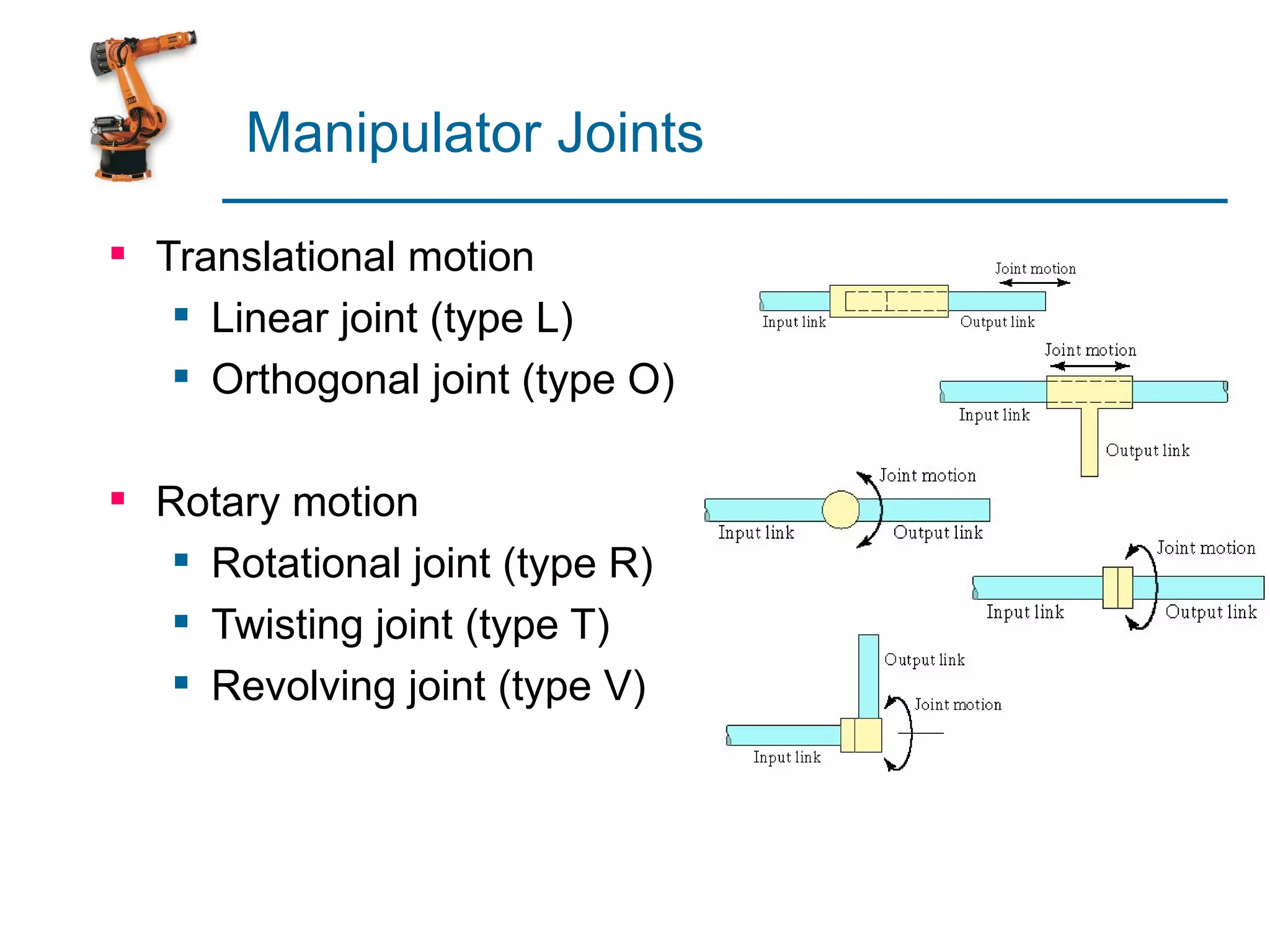
Manipulator Joints

 Translational motion
    Linear joint (type L)
    Orthogonal joint (type O)

 Rotary motion
    Rotational joint (type R)
    Twisting joint (type T)
    Revolving joint (type V)
Joint Notation Scheme

 Uses the joint symbols (L, O, R, T, V) to designate joint
  types used to construct robot manipulator
 Separates body-and-arm assembly from wrist assembly
  using a colon (:)

 Example: TLR : TR

 Common body-and-arm configurations …
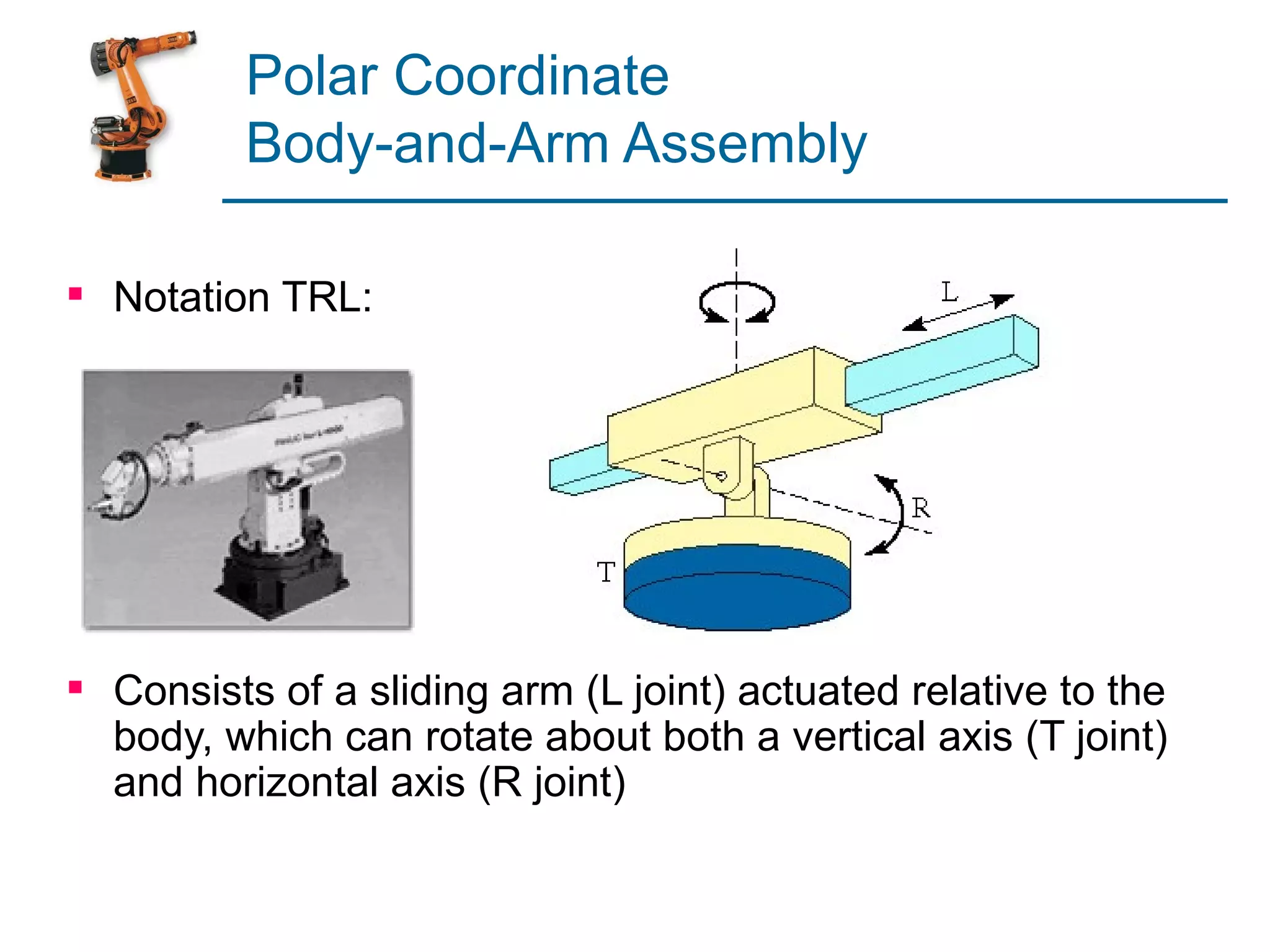
Polar Coordinate
          Body-and-Arm Assembly

 Notation TRL:


 Consists of a sliding arm (L joint) actuated relative to the
  body, which can rotate about both a vertical axis (T joint)
  and horizontal axis (R joint)
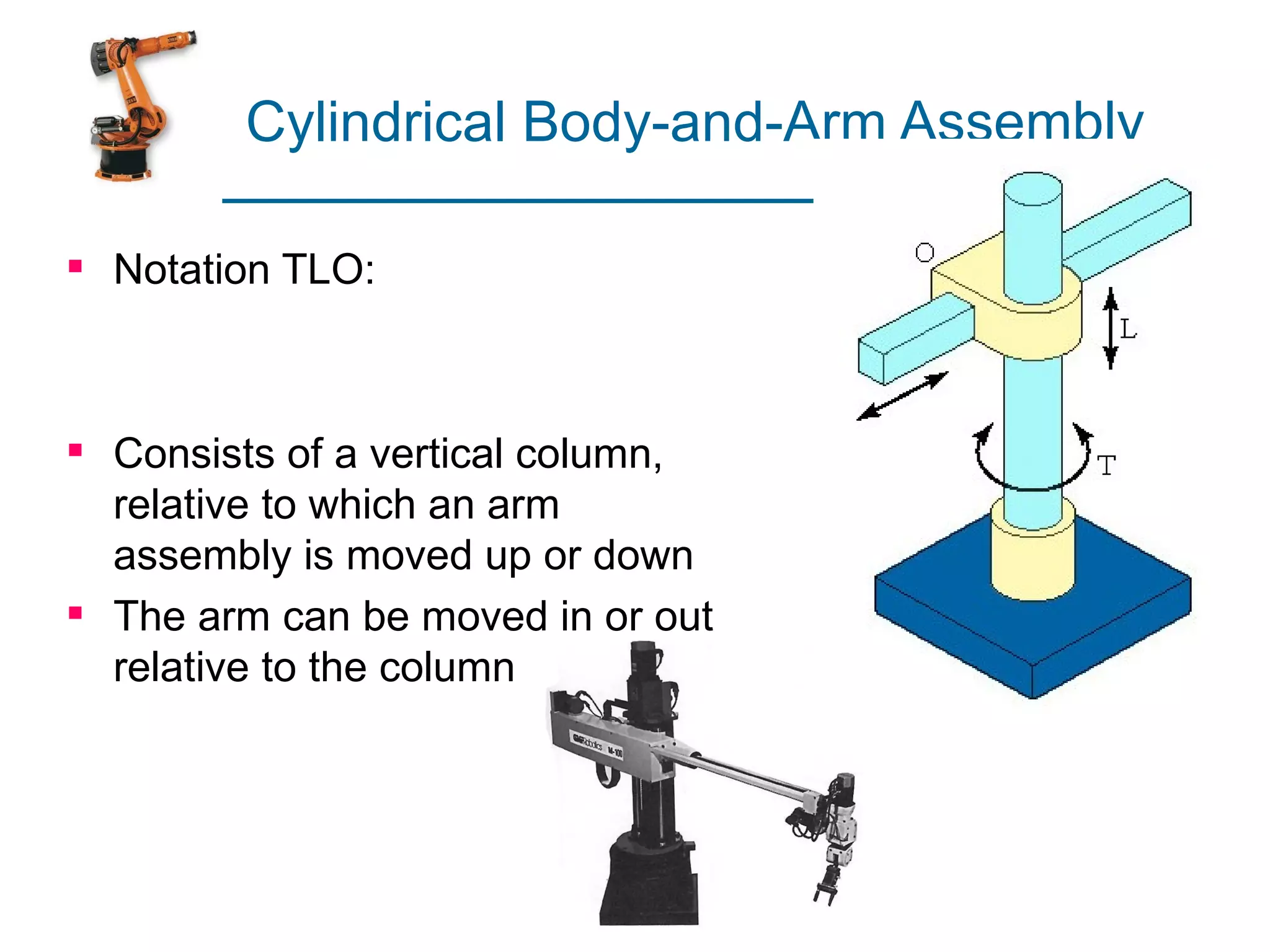
Cylindrical Body-and-Arm Assembly

 Notation TLO:


 Consists of a vertical column,
  relative to which an arm
  assembly is moved up or down
 The arm can be moved in or out
  relative to the column
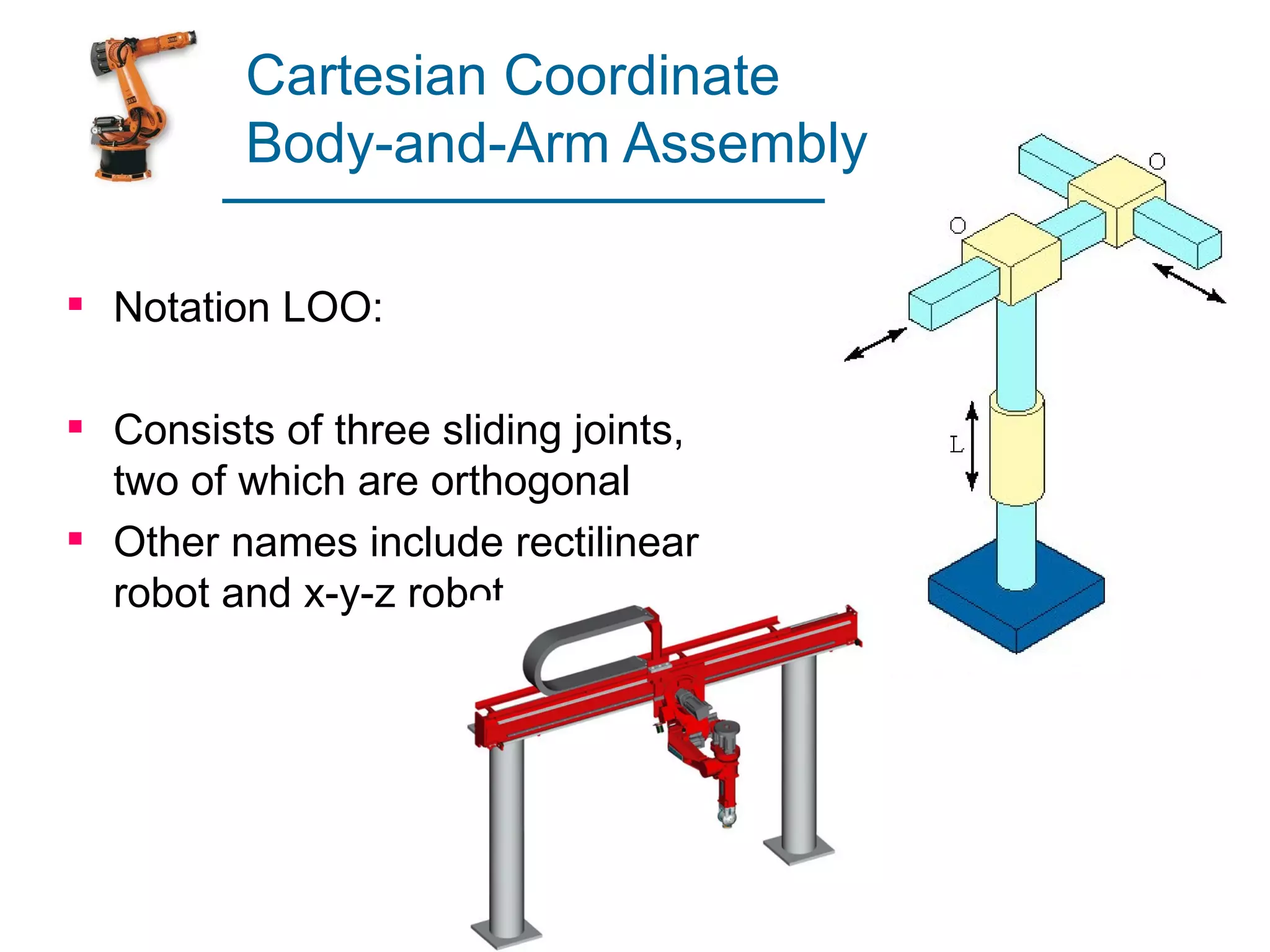
Cartesian Coordinate
         Body-and-Arm Assembly

 Notation LOO:

 Consists of three sliding joints,
  two of which are orthogonal
 Other names include rectilinear
  robot and x-y-z robot
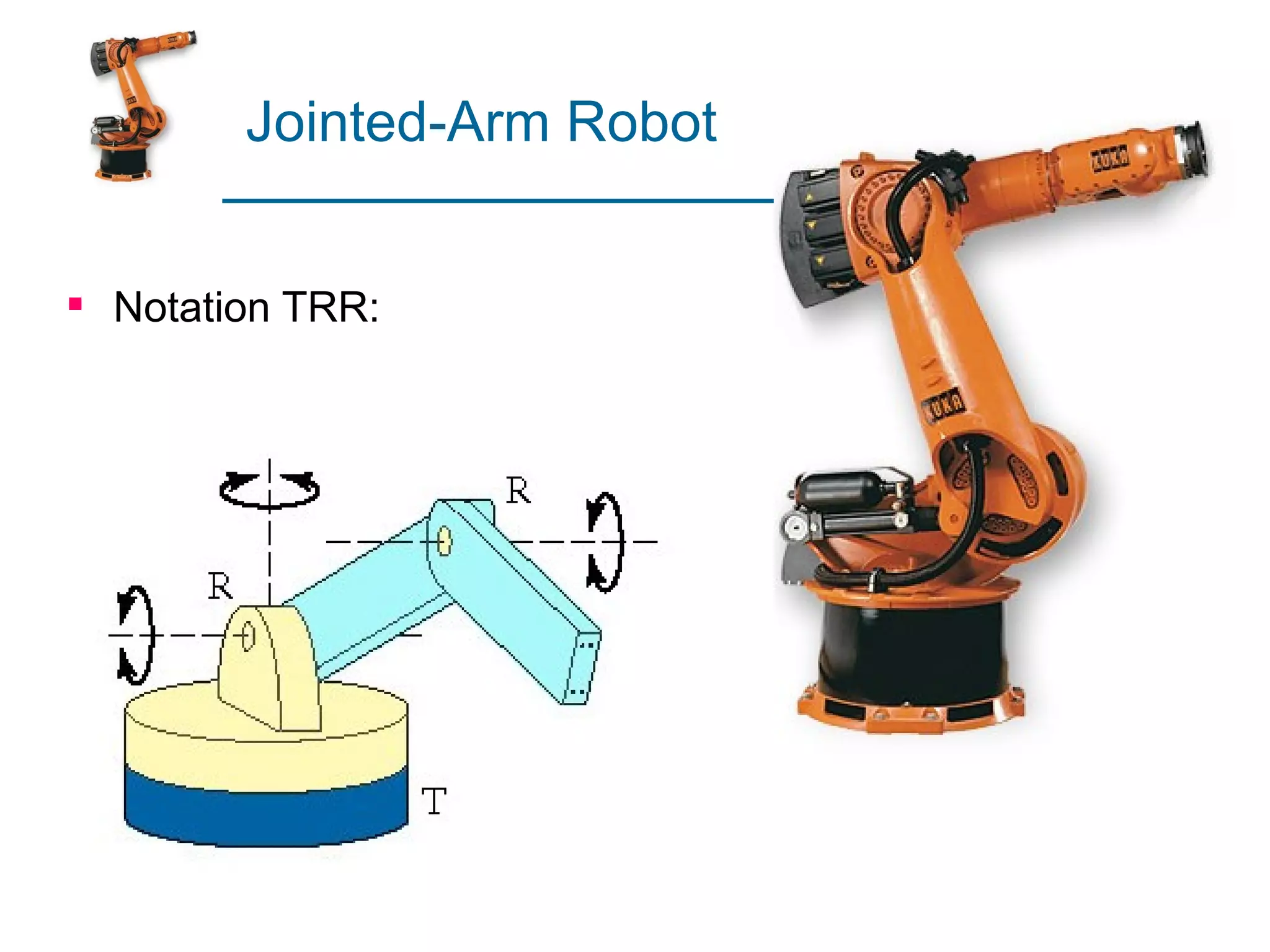
Jointed-Arm Robot


 Notation TRR:
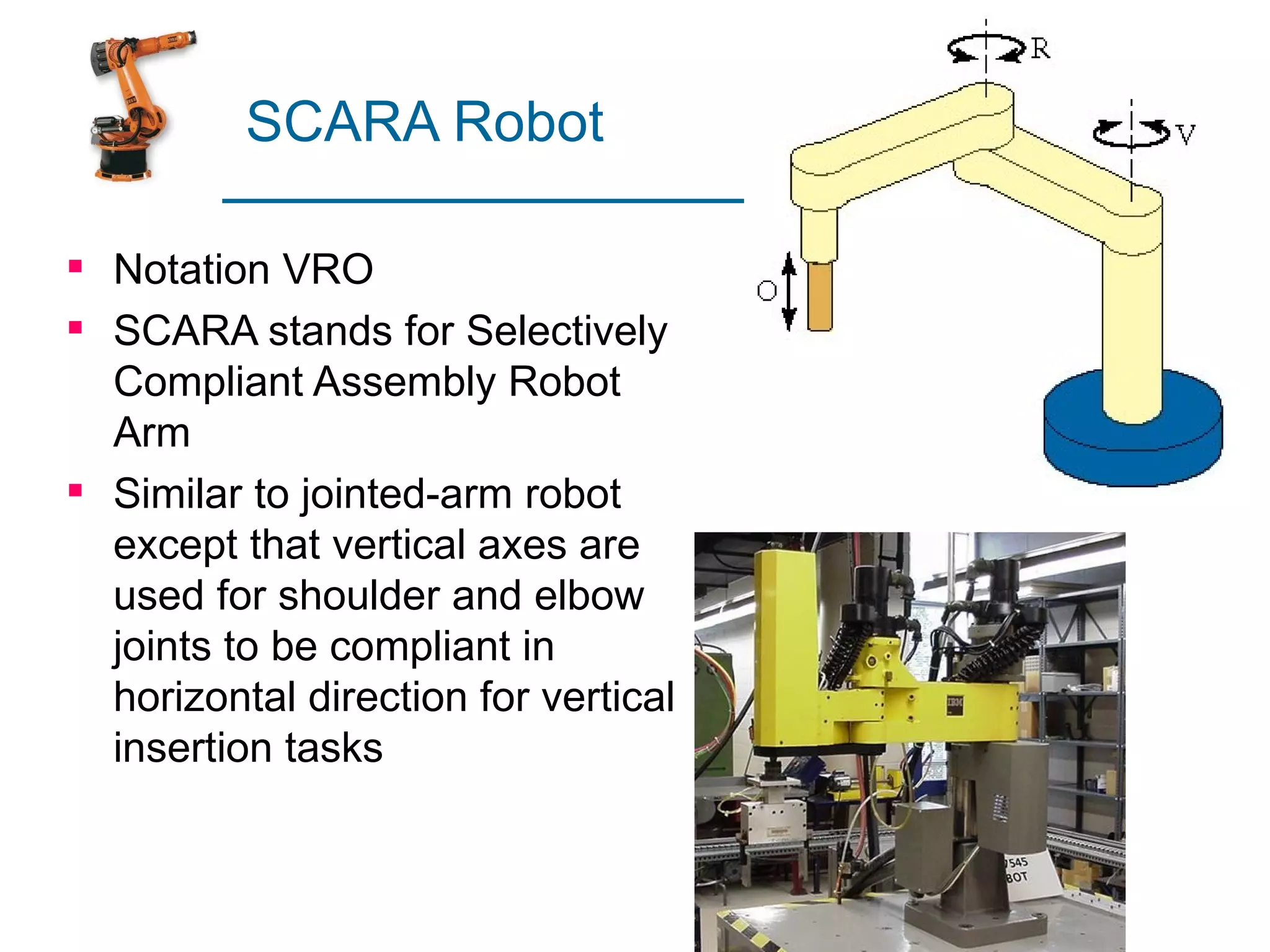
SCARA Robot

 Notation VRO
 SCARA stands for Selectively
  Compliant Assembly Robot
  Arm
 Similar to jointed-arm robot
  except that vertical axes are
  used for shoulder and elbow
  joints to be compliant in
  horizontal direction for vertical
  insertion tasks
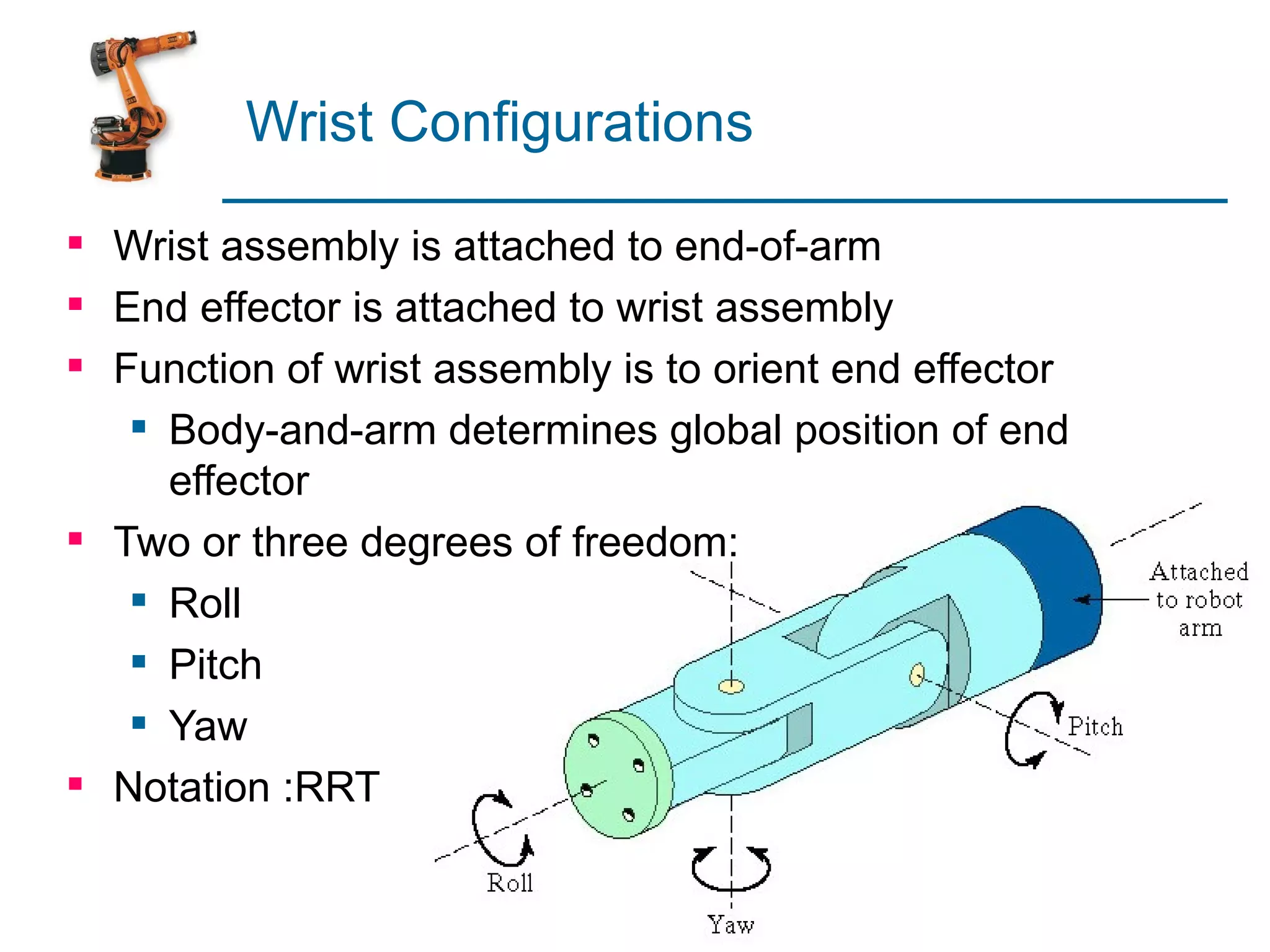
Wrist Configurations

 Wrist assembly is attached to end-of-arm
 End effector is attached to wrist assembly
 Function of wrist assembly is to orient end effector
    Body-and-arm determines global position of end
     effector
 Two or three degrees of freedom:
    Roll
    Pitch
    Yaw
 Notation :RRT
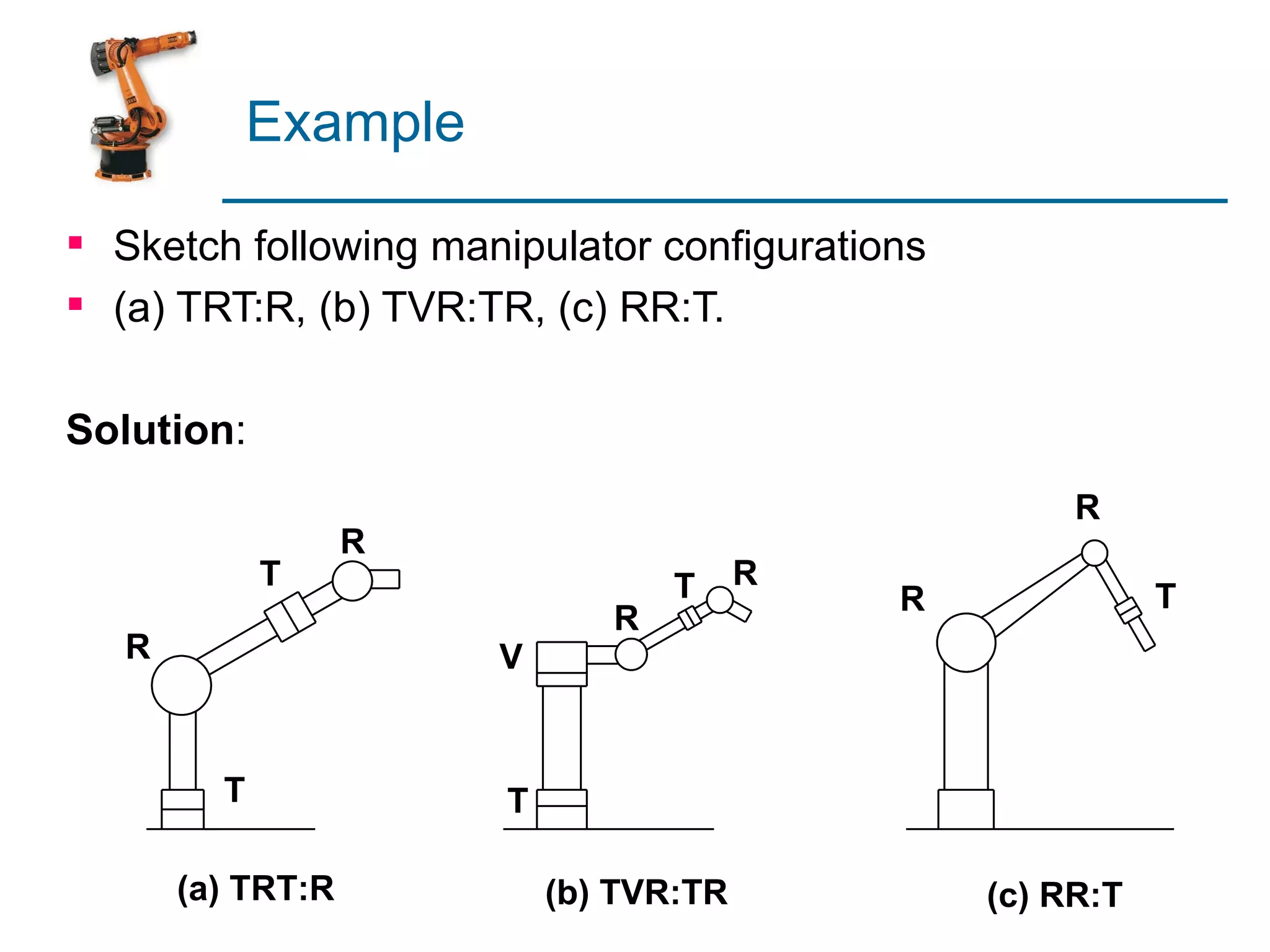
Example

 Sketch following manipulator configurations
 (a) TRT:R, (b) TVR:TR, (c) RR:T.

Solution:
                                                     R
                   R
             T                    T     R
                                            R              T
                              R
   R                   V


         T             T

       (a) TRT:R           (b) TVR:TR           (c) RR:T
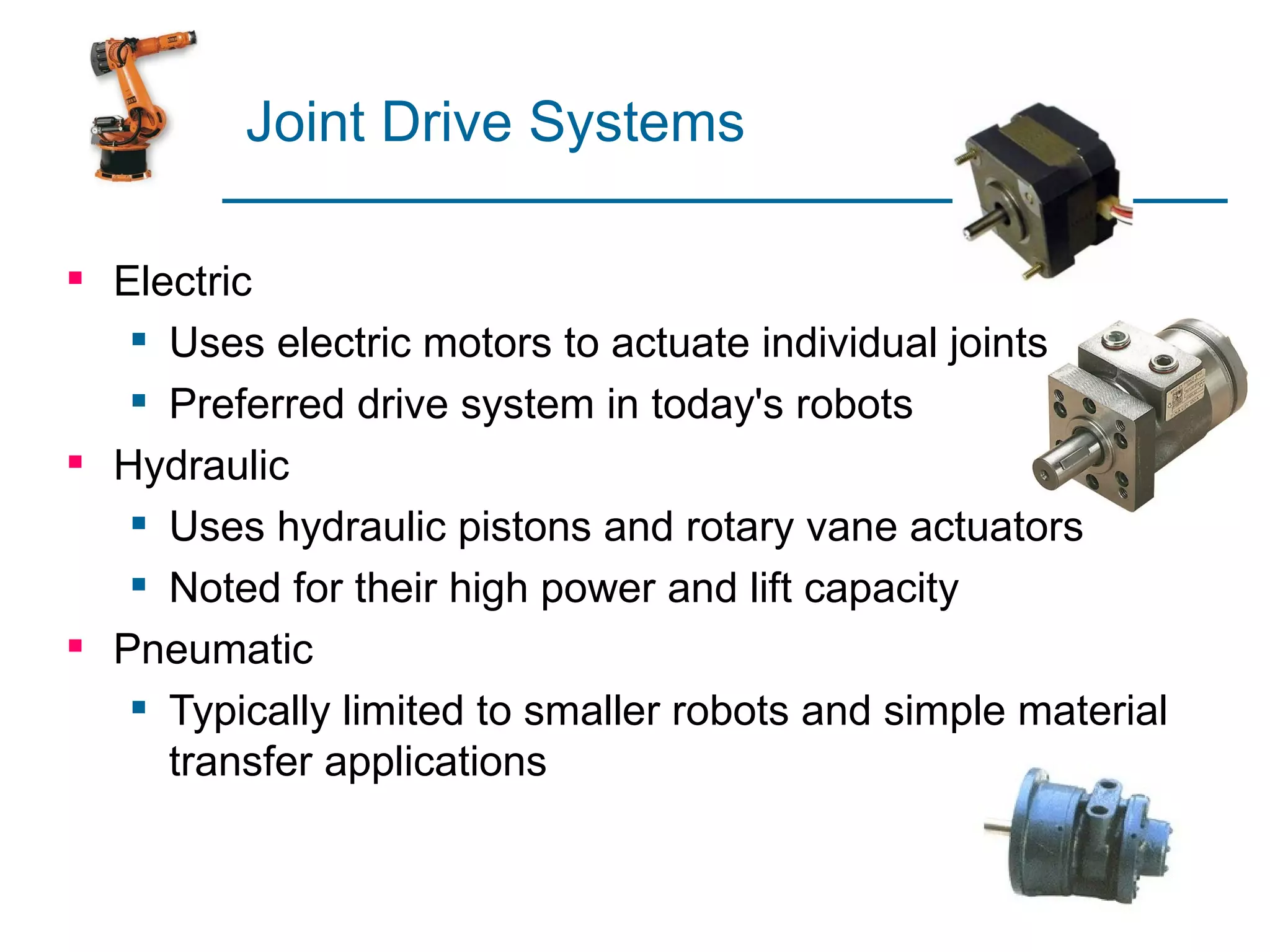
Joint Drive Systems

 Electric
    Uses electric motors to actuate individual joints
    Preferred drive system in today's robots
 Hydraulic
    Uses hydraulic pistons and rotary vane actuators
    Noted for their high power and lift capacity
 Pneumatic
    Typically limited to smaller robots and simple material
     transfer applications
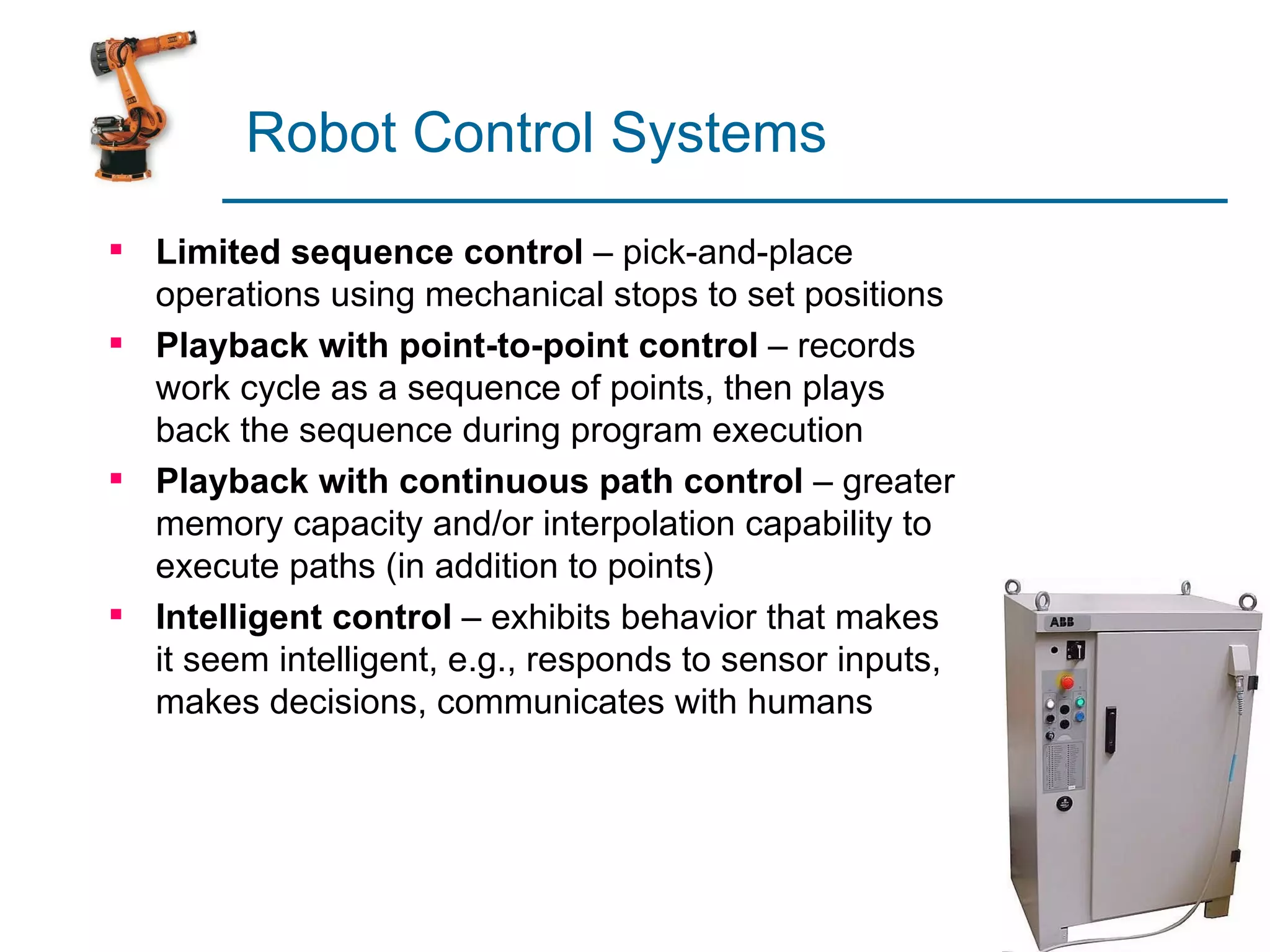
Robot Control Systems
 Limited sequence control – pick-and-place
  operations using mechanical stops to set positions
 Playback with point-to-point control – records
  work cycle as a sequence of points, then plays
  back the sequence during program execution
 Playback with continuous path control – greater
  memory capacity and/or interpolation capability to
  execute paths (in addition to points)
 Intelligent control – exhibits behavior that makes
  it seem intelligent, e.g., responds to sensor inputs,
  makes decisions, communicates with humans
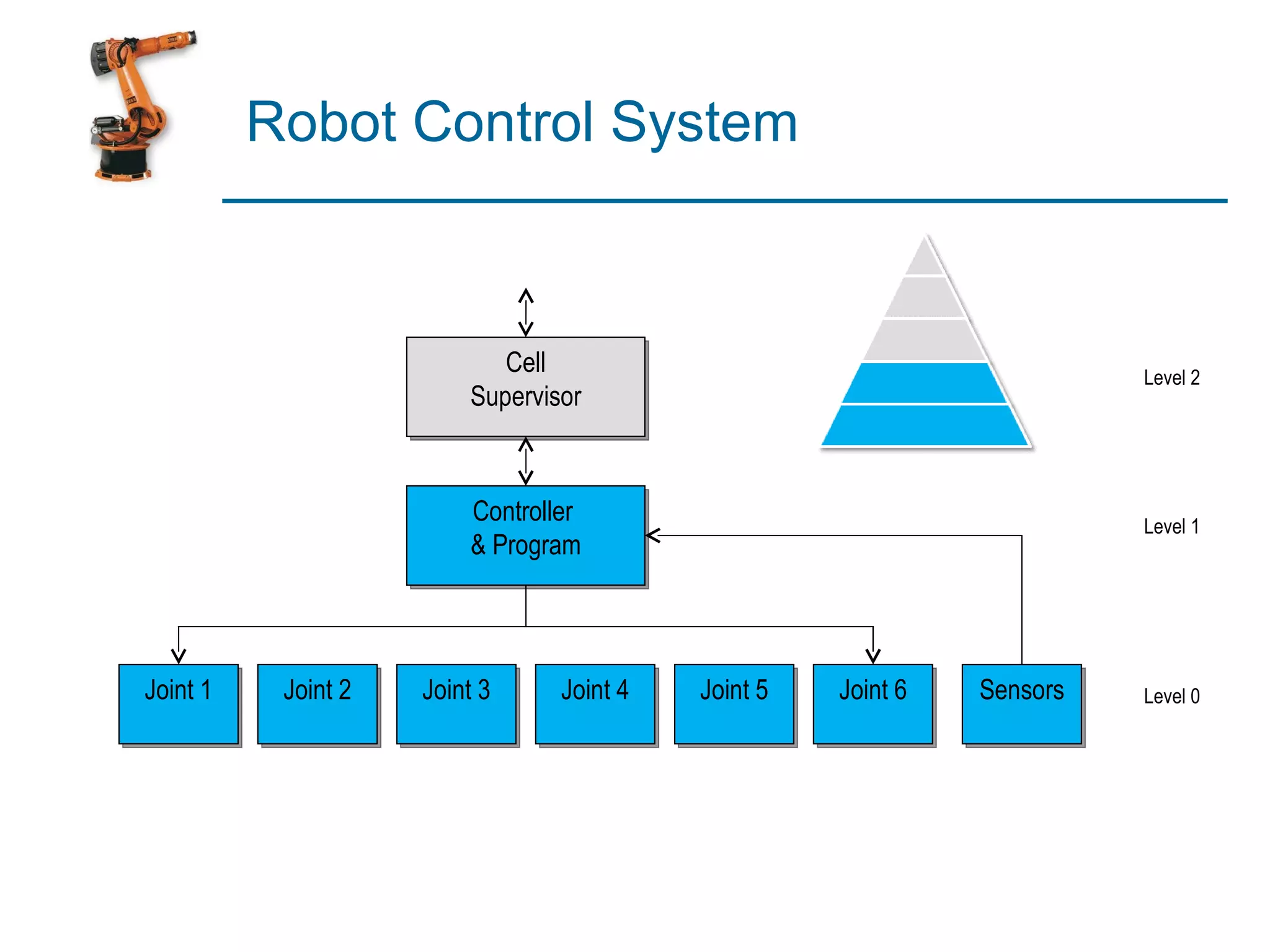
Robot Control System


                            Cell                                         Level 2
                         Supervisor


                         Controller                                      Level 1
                         & Program


Joint 1    Joint 2   Joint 3     Joint 4   Joint 5   Joint 6   Sensors   Level 0
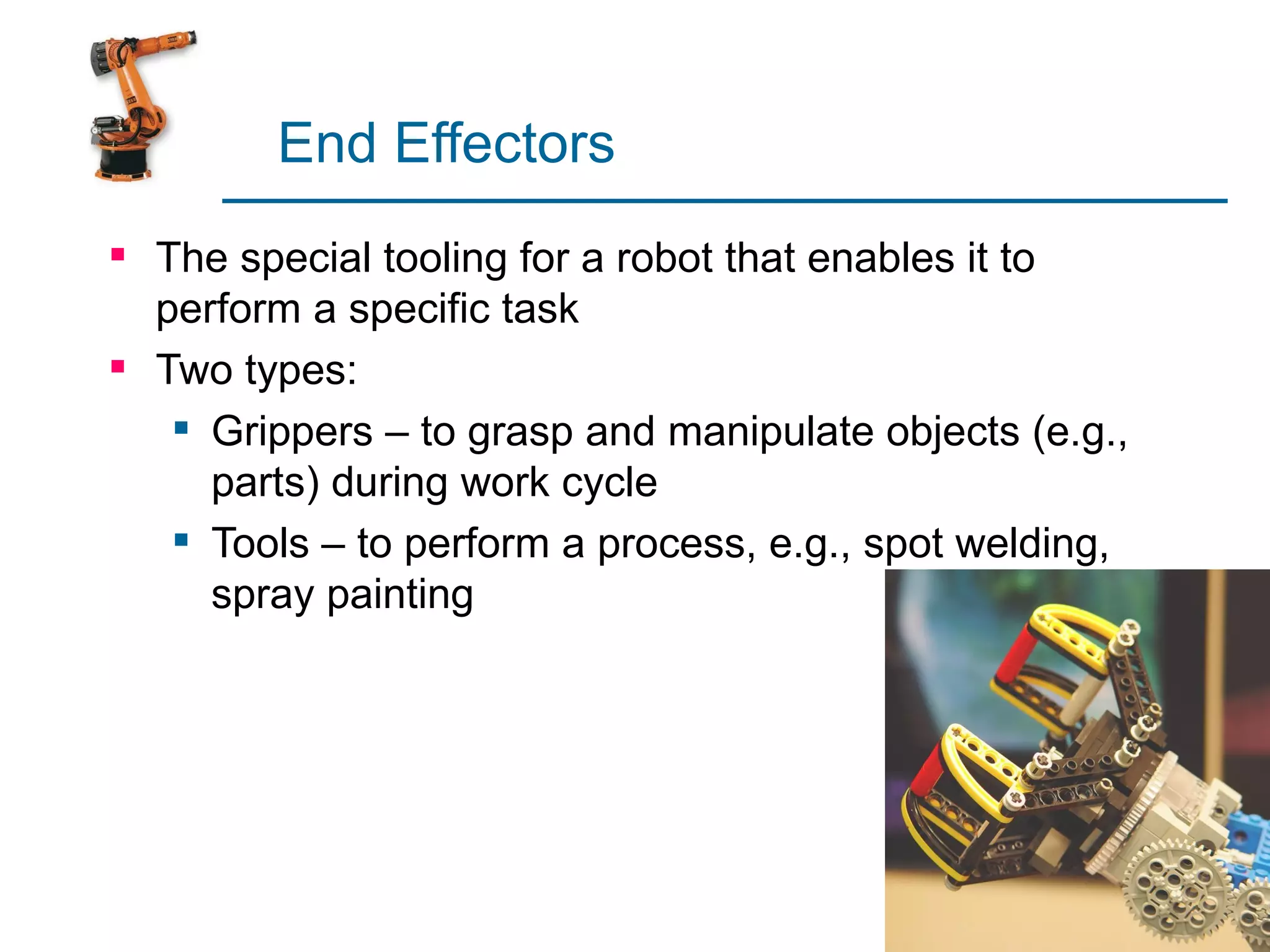
End Effectors
 The special tooling for a robot that enables it to
  perform a specific task
 Two types:
    Grippers – to grasp and manipulate objects (e.g.,
     parts) during work cycle
    Tools – to perform a process, e.g., spot welding,
     spray painting
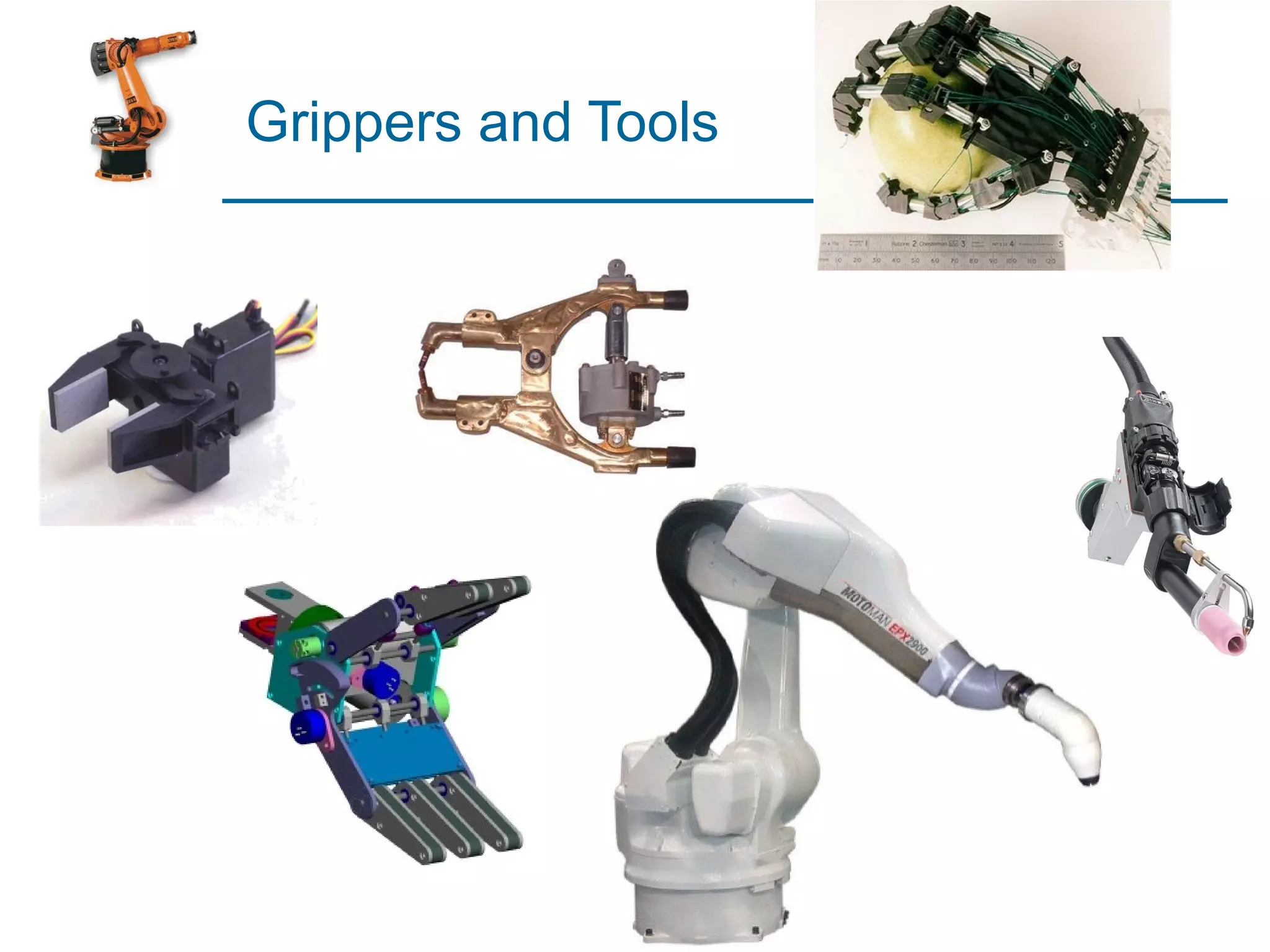
Grippers and Tools
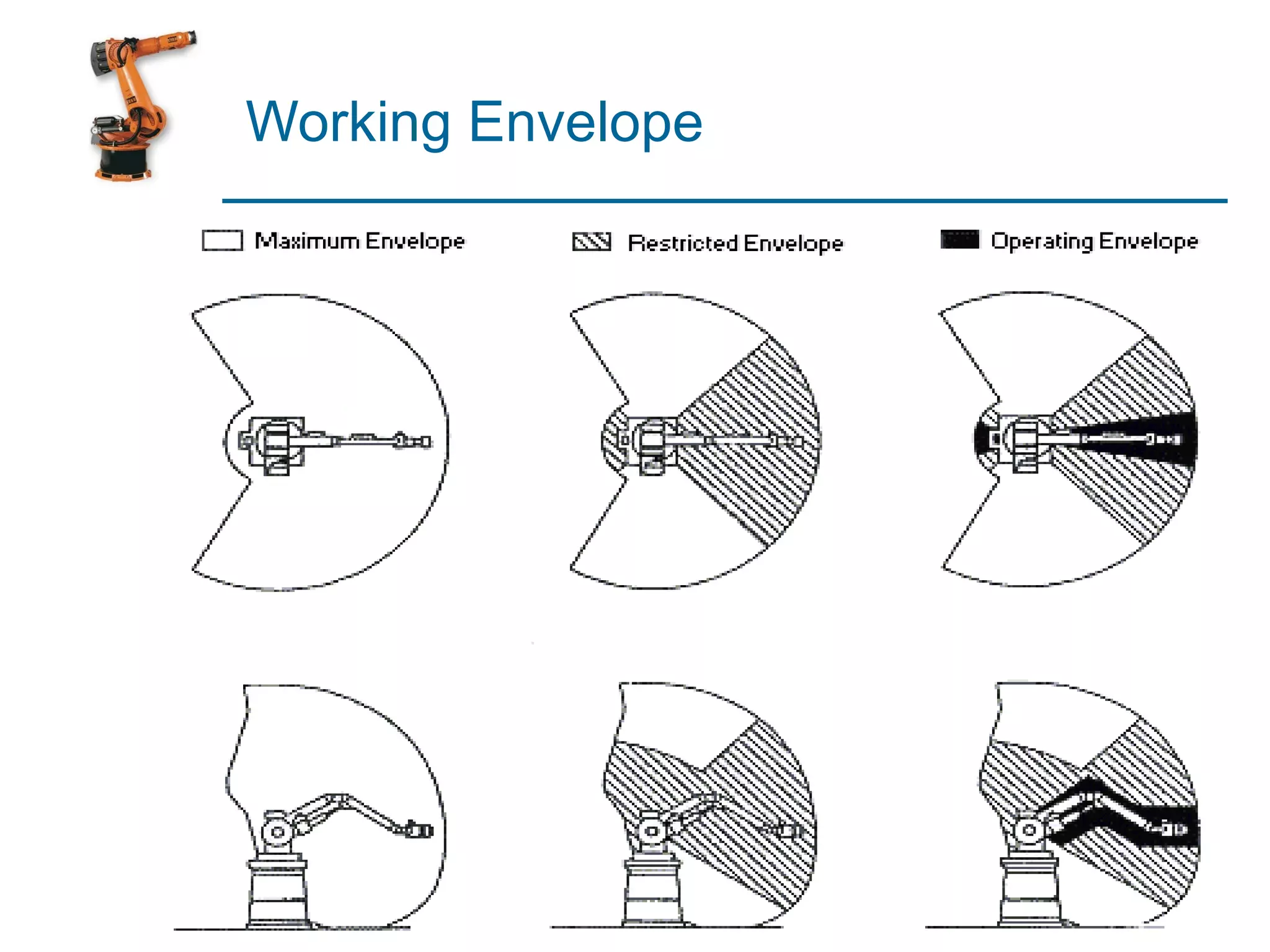
Working Envelope
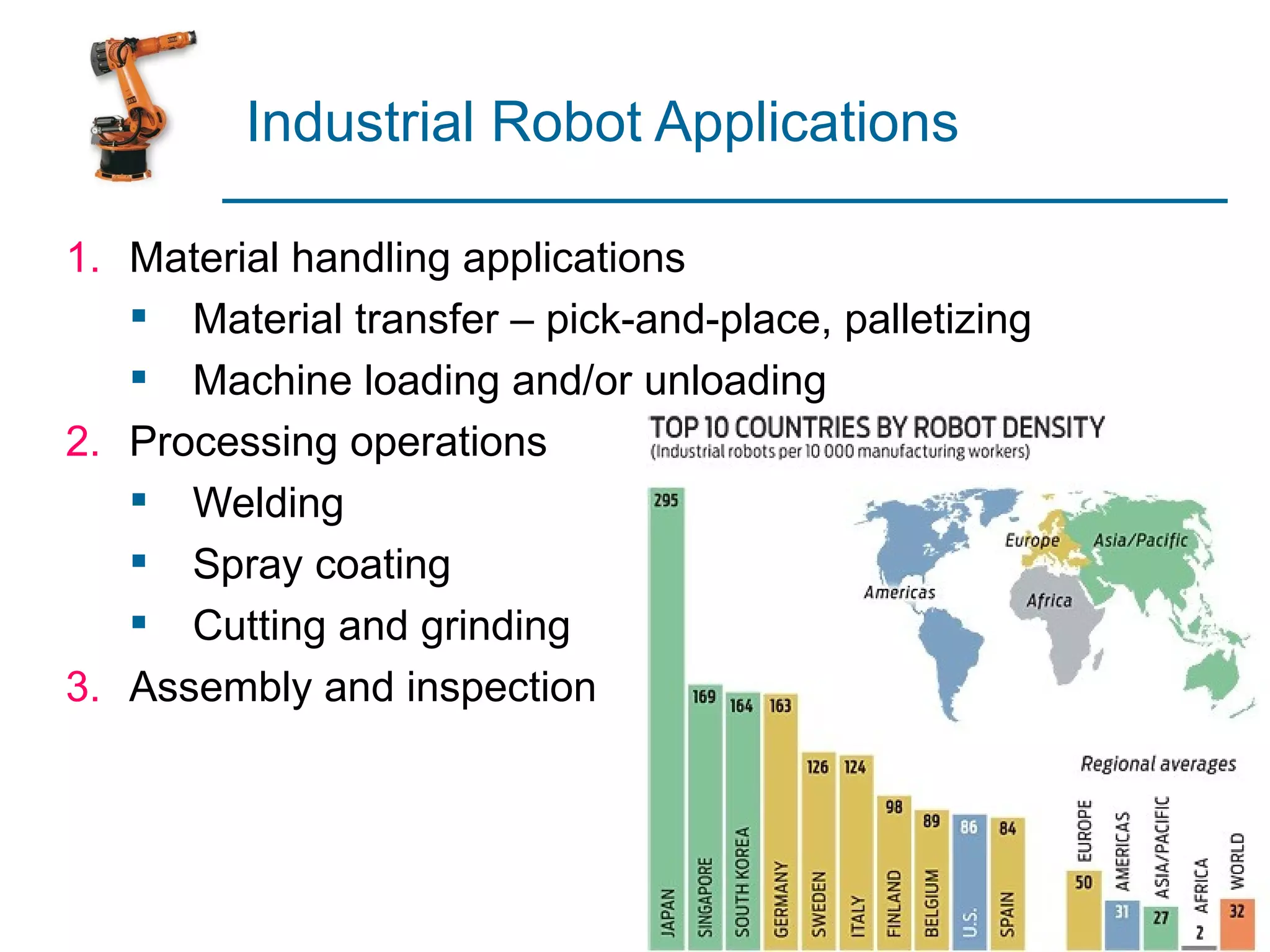
Industrial Robot Applications

1. Material handling applications
    Material transfer – pick-and-place, palletizing
    Machine loading and/or unloading
2. Processing operations
    Welding
    Spray coating
    Cutting and grinding
3. Assembly and inspection
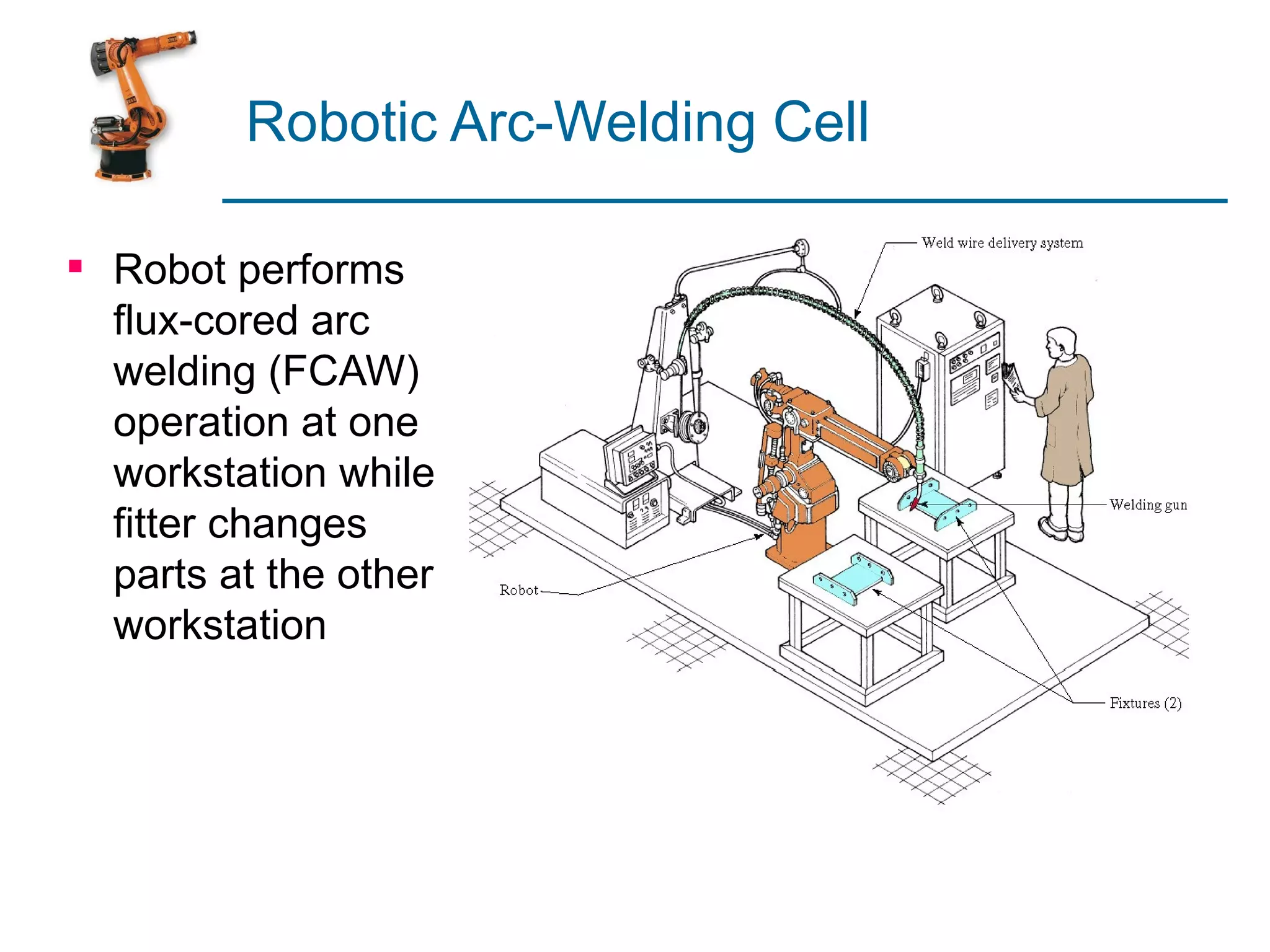
Robotic Arc-Welding Cell

 Robot performs
  flux-cored arc
  welding (FCAW)
  operation at one
  workstation while
  fitter changes
  parts at the other
  workstation
Robot Programming

 Leadthrough programming
    Work cycle is taught to robot by moving the
     manipulator through the required motion cycle and
     simultaneously entering the program into controller
     memory for later playback
 Robot programming languages
    Textual programming language to enter
     commands into robot controller
 Simulation and off-line programming
    Program is prepared at a remote computer
     terminal and downloaded to robot controller for
     execution without need for leadthrough methods
Leadthrough Programming

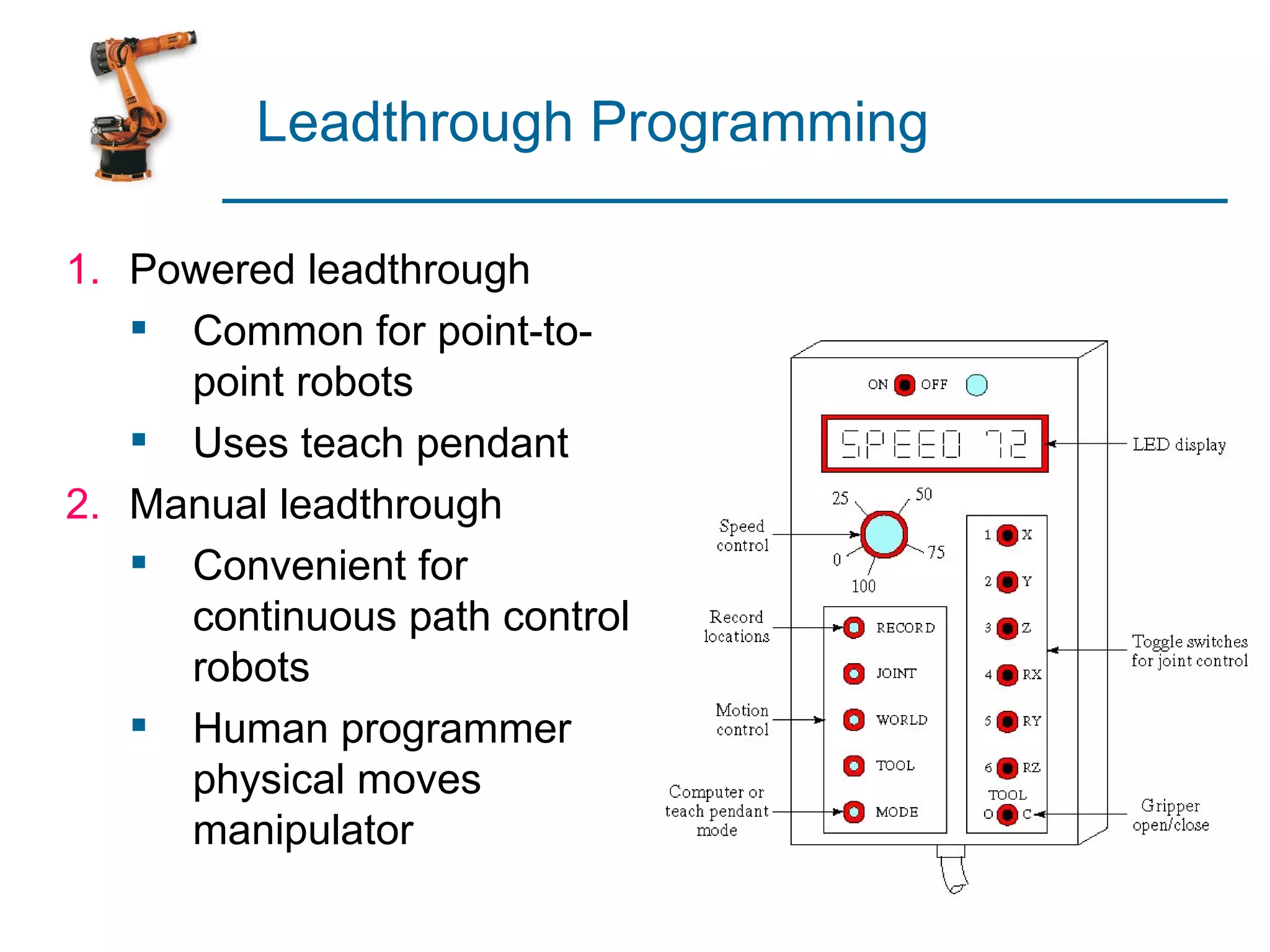
1. Powered leadthrough
    Common for point-to-
     point robots
    Uses teach pendant
2. Manual leadthrough
    Convenient for
     continuous path control
     robots
    Human programmer
     physical moves
     manipulator
Leadthrough Programming
              Advantages
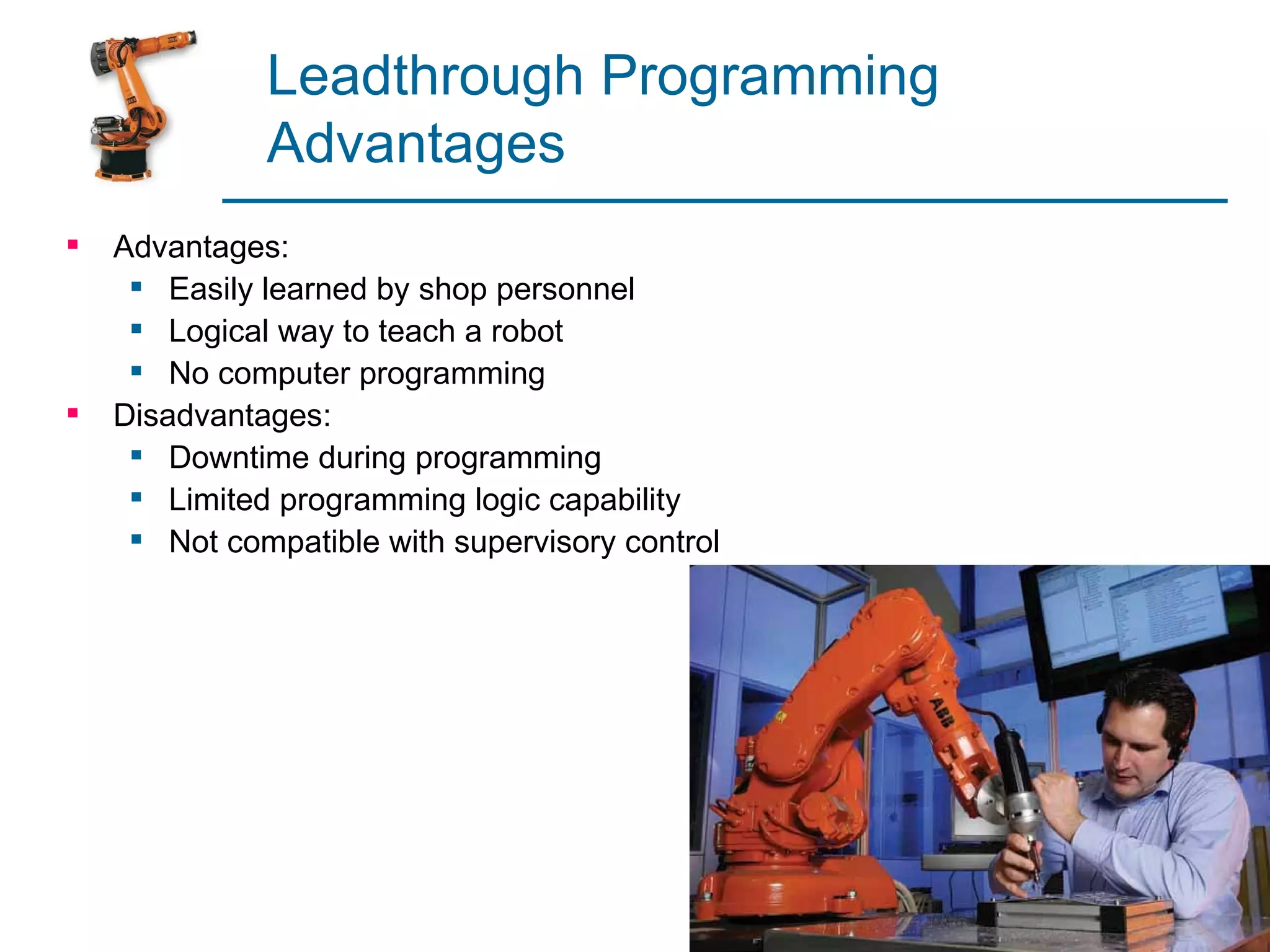
   Advantages:
      Easily learned by shop personnel
      Logical way to teach a robot
      No computer programming
   Disadvantages:
      Downtime during programming
      Limited programming logic capability
      Not compatible with supervisory control
Robot Programming

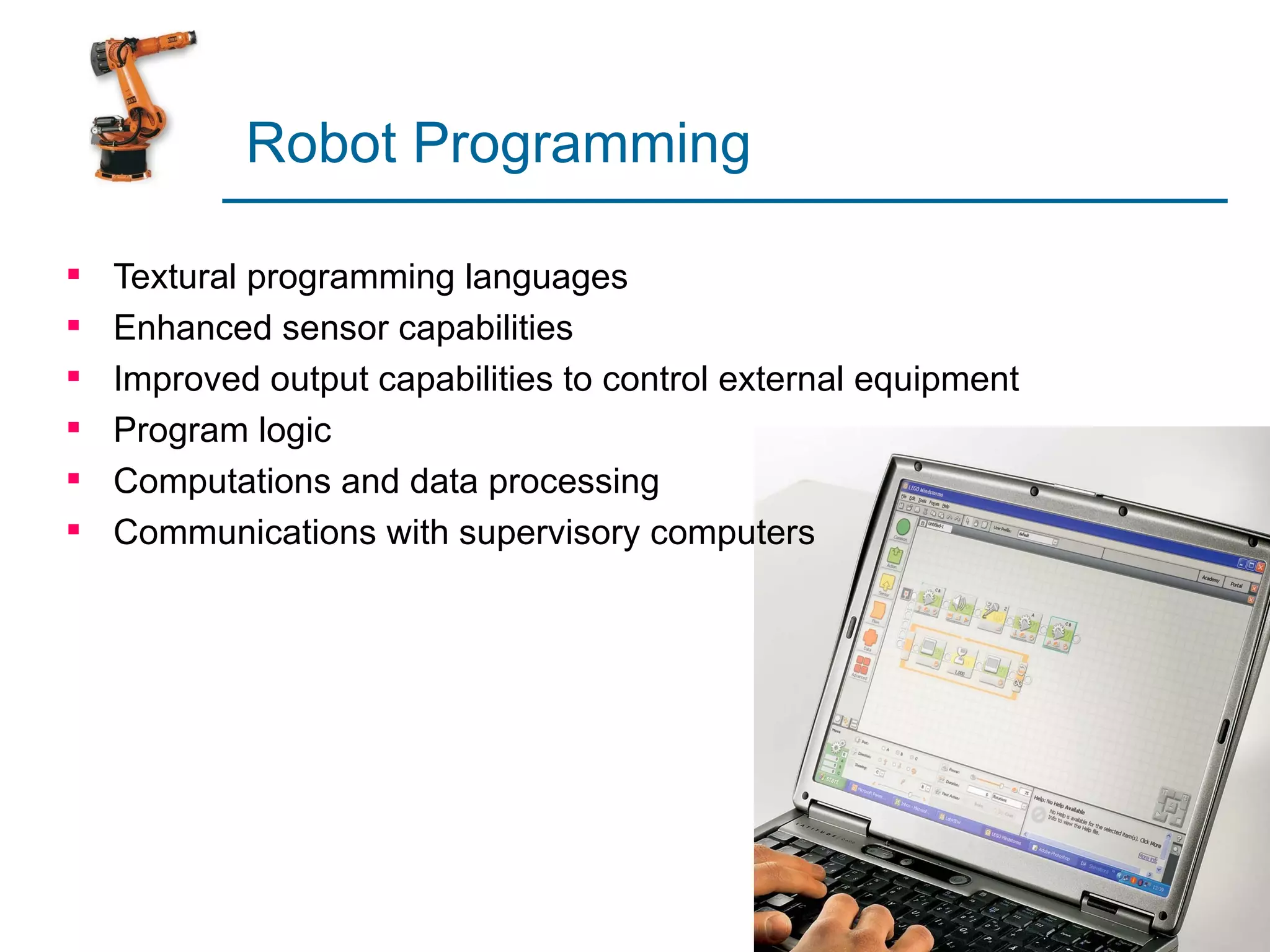
   Textural programming languages
   Enhanced sensor capabilities
   Improved output capabilities to control external equipment
   Program logic
   Computations and data processing
   Communications with supervisory computers
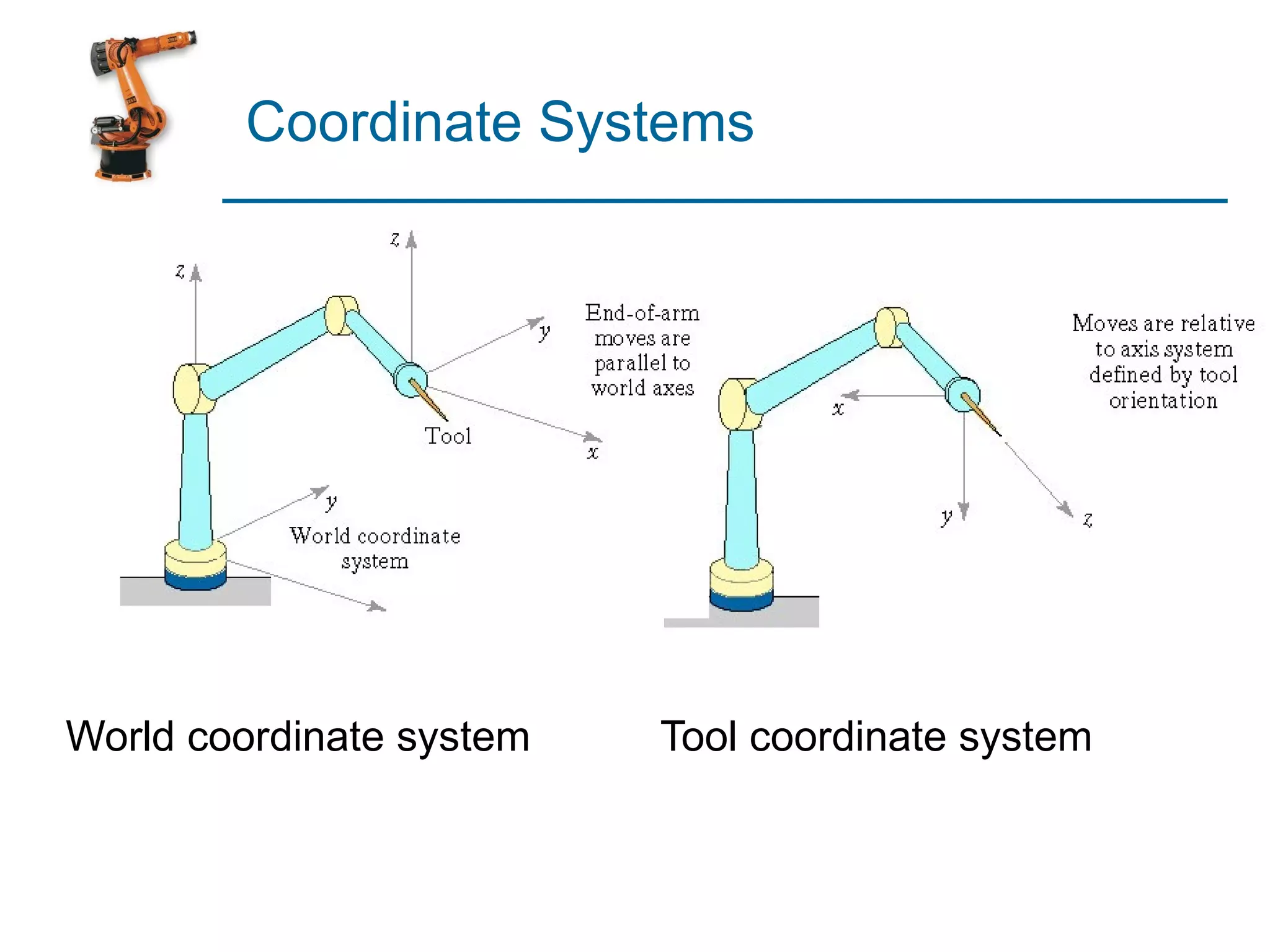
Coordinate Systems


World coordinate system   Tool coordinate system
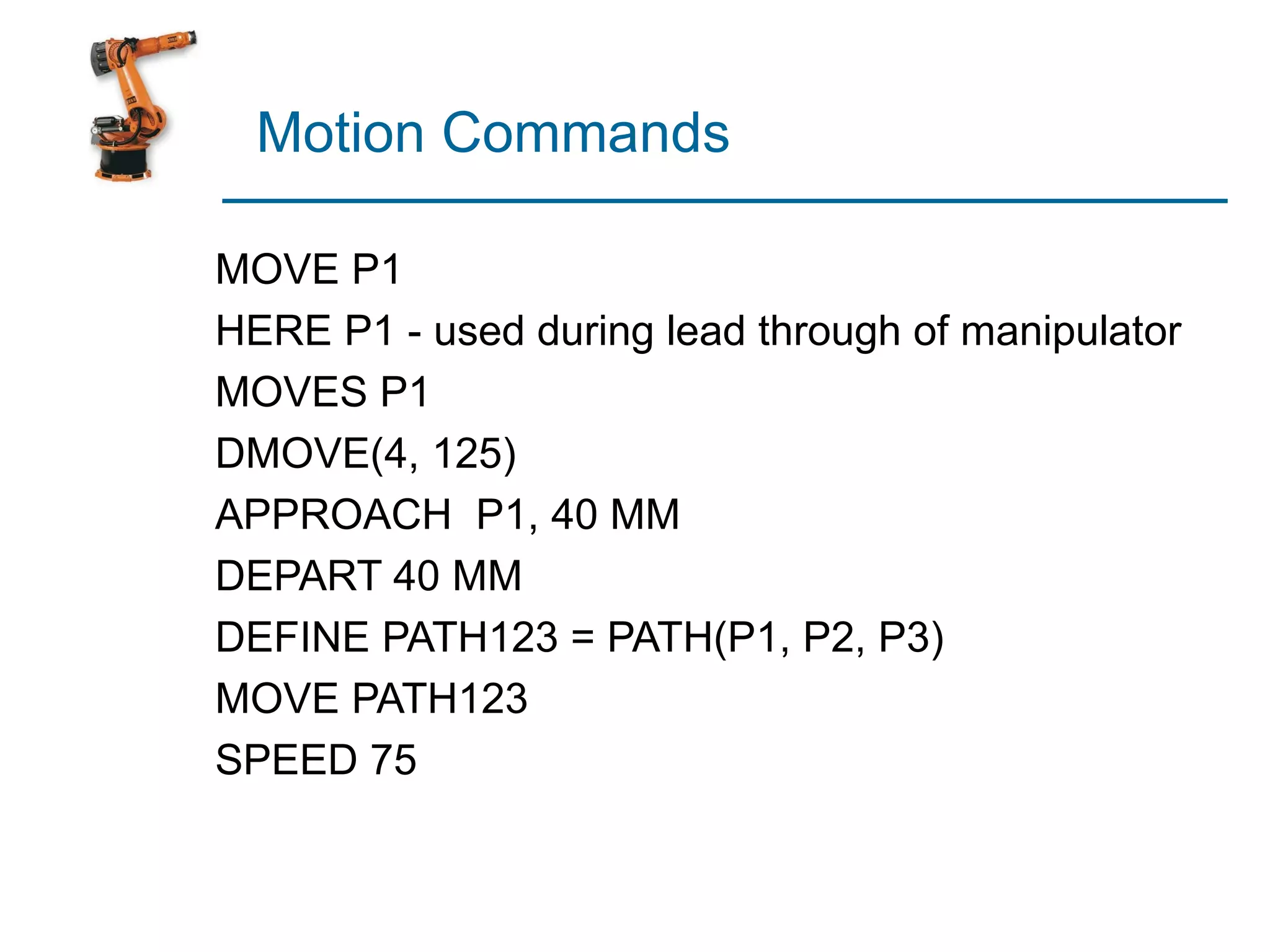
Motion Commands

MOVE P1
HERE P1 - used during lead through of manipulator
MOVES P1
DMOVE(4, 125)
APPROACH P1, 40 MM
DEPART 40 MM
DEFINE PATH123 = PATH(P1, P2, P3)
MOVE PATH123
SPEED 75
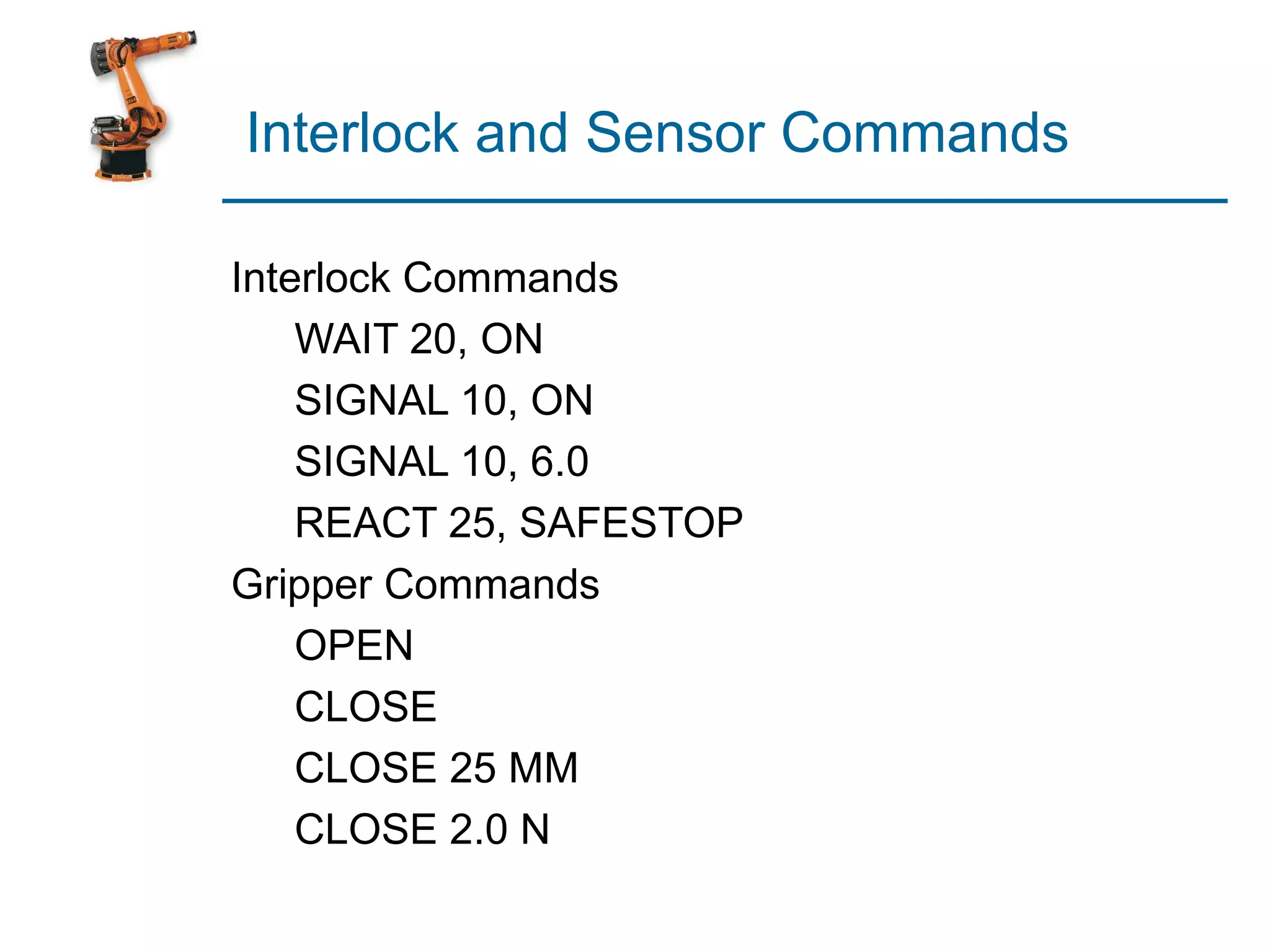
Interlock and Sensor Commands

Interlock Commands
    WAIT 20, ON
    SIGNAL 10, ON
    SIGNAL 10, 6.0
    REACT 25, SAFESTOP
Gripper Commands
    OPEN
    CLOSE
    CLOSE 25 MM
    CLOSE 2.0 N
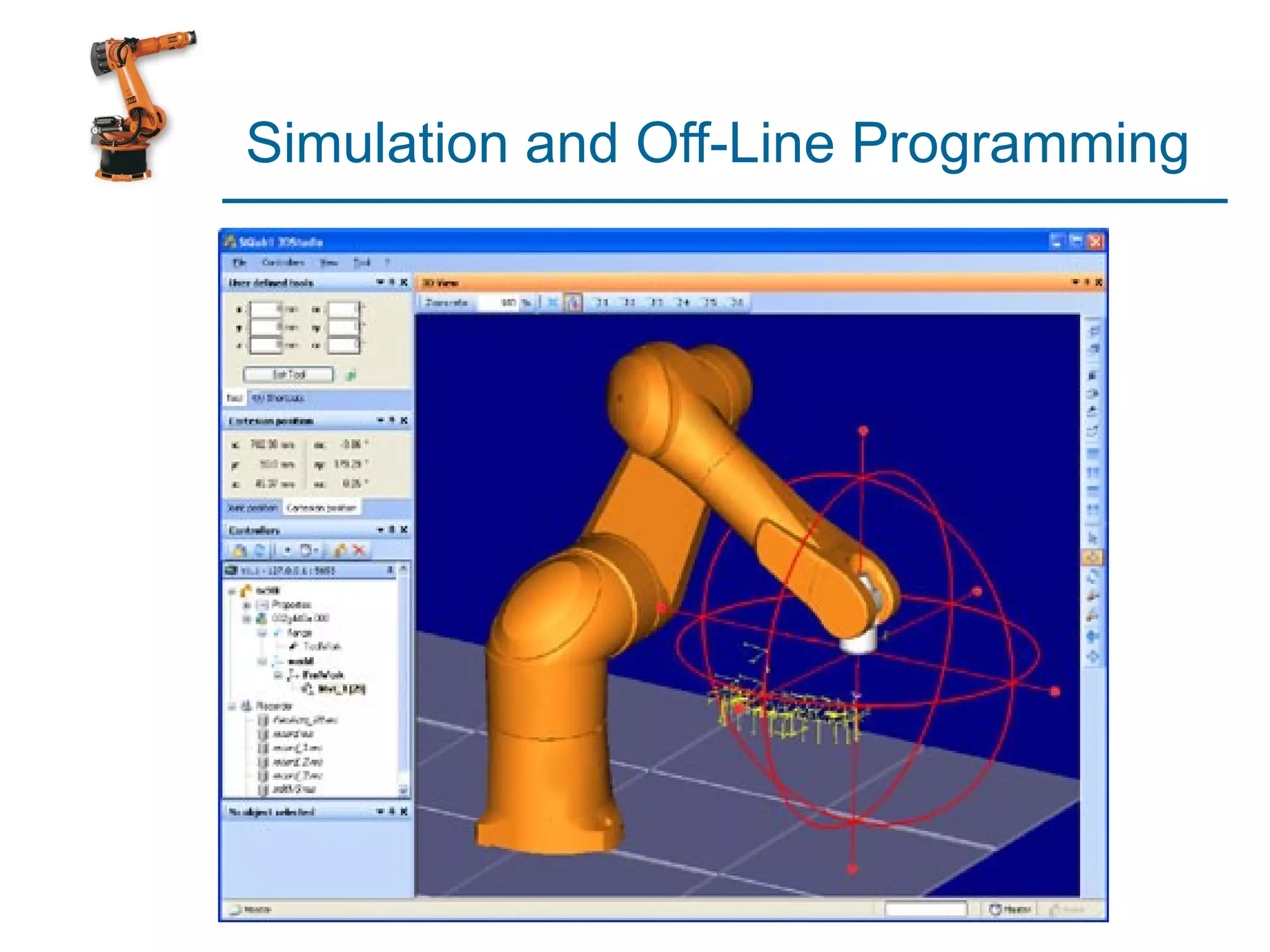
Simulation and Off-Line Programming
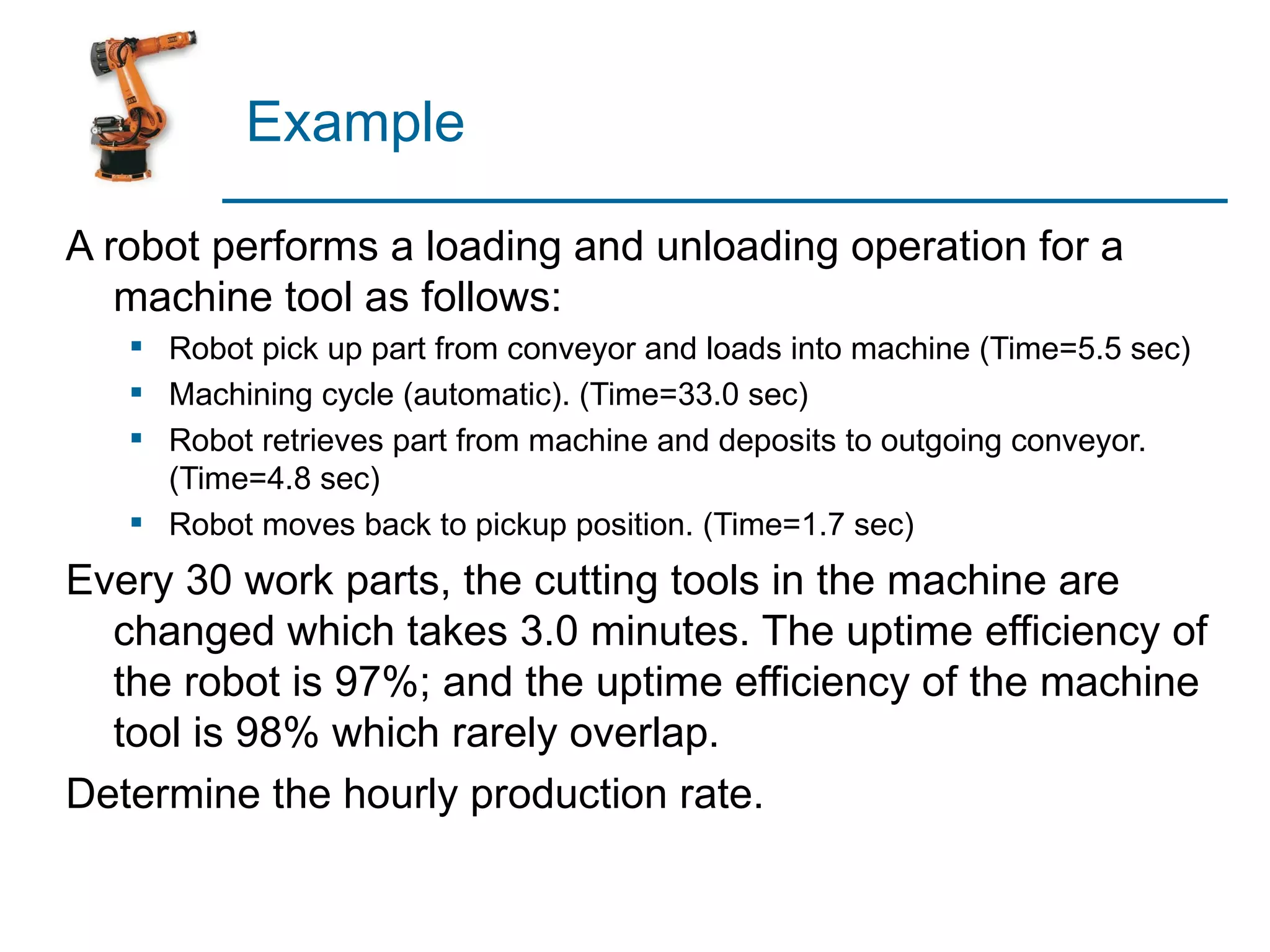
Example

A robot performs a loading and unloading operation for a
   machine tool as follows:
    Robot pick up part from conveyor and loads into machine (Time=5.5 sec)
    Machining cycle (automatic). (Time=33.0 sec)
    Robot retrieves part from machine and deposits to outgoing conveyor.
     (Time=4.8 sec)
    Robot moves back to pickup position. (Time=1.7 sec)
Every 30 work parts, the cutting tools in the machine are
  changed which takes 3.0 minutes. The uptime efficiency of
  the robot is 97%; and the uptime efficiency of the machine
  tool is 98% which rarely overlap.
Determine the hourly production rate.
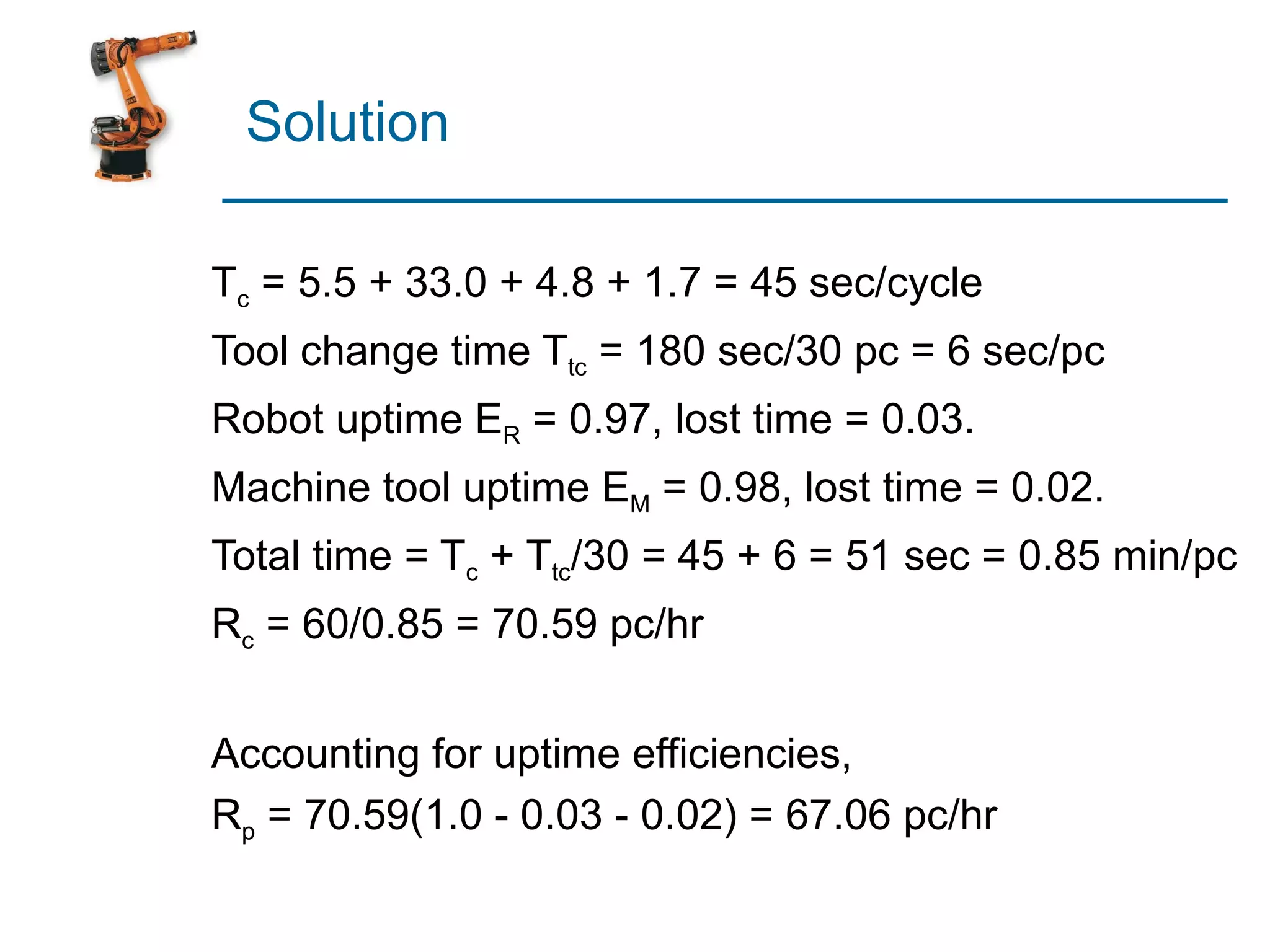
Solution

Tc = 5.5 + 33.0 + 4.8 + 1.7 = 45 sec/cycle
Tool change time Ttc = 180 sec/30 pc = 6 sec/pc
Robot uptime ER = 0.97, lost time = 0.03.
Machine tool uptime EM = 0.98, lost time = 0.02.
Total time = Tc + Ttc/30 = 45 + 6 = 51 sec = 0.85 min/pc
Rc = 60/0.85 = 70.59 pc/hr


Accounting for uptime efficiencies,
Rp = 70.59(1.0 - 0.03 - 0.02) = 67.06 pc/hr

Industrial robotics

  • 1.
    Industrial Robotics Sections: 2. RobotAnatomy 3. Robot Control Systems 4. End Effectors 5. Industrial Robot Applications 6. Robot Programming
  • 2.
    Industrial Robot Defined Ageneral-purpose, programmable machine possessing certain anthropomorphic characteristics  Hazardous work environments  Repetitive work cycle  Consistency and accuracy  Difficult handling task for humans  Multishift operations  Reprogrammable, flexible  Interfaced to other computer systems
  • 3.
    Robot Anatomy  Manipulatorconsists of joints and links Link3 Joint3  Joints provide relative motion End of Arm  Links are rigid members between joints  Various joint types: linear and rotary  Each joint provides a “degree-of- Link2 freedom” Link1  Most robots possess five or six degrees-of-freedom Joint2  Robot manipulator consists of two sections: Joint1  Body-and-arm – for positioning of Link0 objects in the robot's work volume Base  Wrist assembly – for orientation of objects
  • 4.
    Manipulator Joints  Translationalmotion  Linear joint (type L)  Orthogonal joint (type O)  Rotary motion  Rotational joint (type R)  Twisting joint (type T)  Revolving joint (type V)
  • 5.
    Joint Notation Scheme Uses the joint symbols (L, O, R, T, V) to designate joint types used to construct robot manipulator  Separates body-and-arm assembly from wrist assembly using a colon (:)  Example: TLR : TR  Common body-and-arm configurations …
  • 6.
    Polar Coordinate Body-and-Arm Assembly  Notation TRL:  Consists of a sliding arm (L joint) actuated relative to the body, which can rotate about both a vertical axis (T joint) and horizontal axis (R joint)
  • 7.
    Cylindrical Body-and-Arm Assembly Notation TLO:  Consists of a vertical column, relative to which an arm assembly is moved up or down  The arm can be moved in or out relative to the column
  • 8.
    Cartesian Coordinate Body-and-Arm Assembly  Notation LOO:  Consists of three sliding joints, two of which are orthogonal  Other names include rectilinear robot and x-y-z robot
  • 9.
  • 10.
    SCARA Robot  NotationVRO  SCARA stands for Selectively Compliant Assembly Robot Arm  Similar to jointed-arm robot except that vertical axes are used for shoulder and elbow joints to be compliant in horizontal direction for vertical insertion tasks
  • 11.
    Wrist Configurations  Wristassembly is attached to end-of-arm  End effector is attached to wrist assembly  Function of wrist assembly is to orient end effector  Body-and-arm determines global position of end effector  Two or three degrees of freedom:  Roll  Pitch  Yaw  Notation :RRT
  • 12.
    Example  Sketch followingmanipulator configurations  (a) TRT:R, (b) TVR:TR, (c) RR:T. Solution: R R T T R R T R R V T T (a) TRT:R (b) TVR:TR (c) RR:T
  • 13.
    Joint Drive Systems Electric  Uses electric motors to actuate individual joints  Preferred drive system in today's robots  Hydraulic  Uses hydraulic pistons and rotary vane actuators  Noted for their high power and lift capacity  Pneumatic  Typically limited to smaller robots and simple material transfer applications
  • 14.
    Robot Control Systems Limited sequence control – pick-and-place operations using mechanical stops to set positions  Playback with point-to-point control – records work cycle as a sequence of points, then plays back the sequence during program execution  Playback with continuous path control – greater memory capacity and/or interpolation capability to execute paths (in addition to points)  Intelligent control – exhibits behavior that makes it seem intelligent, e.g., responds to sensor inputs, makes decisions, communicates with humans
  • 15.
    Robot Control System Cell Level 2 Supervisor Controller Level 1 & Program Joint 1 Joint 2 Joint 3 Joint 4 Joint 5 Joint 6 Sensors Level 0
  • 16.
    End Effectors  Thespecial tooling for a robot that enables it to perform a specific task  Two types:  Grippers – to grasp and manipulate objects (e.g., parts) during work cycle  Tools – to perform a process, e.g., spot welding, spray painting
  • 17.
  • 18.
  • 19.
    Industrial Robot Applications 1.Material handling applications  Material transfer – pick-and-place, palletizing  Machine loading and/or unloading 2. Processing operations  Welding  Spray coating  Cutting and grinding 3. Assembly and inspection
  • 20.
    Robotic Arc-Welding Cell Robot performs flux-cored arc welding (FCAW) operation at one workstation while fitter changes parts at the other workstation
  • 21.
    Robot Programming  Leadthroughprogramming  Work cycle is taught to robot by moving the manipulator through the required motion cycle and simultaneously entering the program into controller memory for later playback  Robot programming languages  Textual programming language to enter commands into robot controller  Simulation and off-line programming  Program is prepared at a remote computer terminal and downloaded to robot controller for execution without need for leadthrough methods
  • 22.
    Leadthrough Programming 1. Poweredleadthrough  Common for point-to- point robots  Uses teach pendant 2. Manual leadthrough  Convenient for continuous path control robots  Human programmer physical moves manipulator
  • 23.
    Leadthrough Programming Advantages  Advantages:  Easily learned by shop personnel  Logical way to teach a robot  No computer programming  Disadvantages:  Downtime during programming  Limited programming logic capability  Not compatible with supervisory control
  • 24.
    Robot Programming  Textural programming languages  Enhanced sensor capabilities  Improved output capabilities to control external equipment  Program logic  Computations and data processing  Communications with supervisory computers
  • 25.
    Coordinate Systems World coordinatesystem Tool coordinate system
  • 26.
    Motion Commands MOVE P1 HEREP1 - used during lead through of manipulator MOVES P1 DMOVE(4, 125) APPROACH P1, 40 MM DEPART 40 MM DEFINE PATH123 = PATH(P1, P2, P3) MOVE PATH123 SPEED 75
  • 27.
    Interlock and SensorCommands Interlock Commands WAIT 20, ON SIGNAL 10, ON SIGNAL 10, 6.0 REACT 25, SAFESTOP Gripper Commands OPEN CLOSE CLOSE 25 MM CLOSE 2.0 N
  • 28.
  • 29.
    Example A robot performsa loading and unloading operation for a machine tool as follows:  Robot pick up part from conveyor and loads into machine (Time=5.5 sec)  Machining cycle (automatic). (Time=33.0 sec)  Robot retrieves part from machine and deposits to outgoing conveyor. (Time=4.8 sec)  Robot moves back to pickup position. (Time=1.7 sec) Every 30 work parts, the cutting tools in the machine are changed which takes 3.0 minutes. The uptime efficiency of the robot is 97%; and the uptime efficiency of the machine tool is 98% which rarely overlap. Determine the hourly production rate.
  • 30.
    Solution Tc = 5.5+ 33.0 + 4.8 + 1.7 = 45 sec/cycle Tool change time Ttc = 180 sec/30 pc = 6 sec/pc Robot uptime ER = 0.97, lost time = 0.03. Machine tool uptime EM = 0.98, lost time = 0.02. Total time = Tc + Ttc/30 = 45 + 6 = 51 sec = 0.85 min/pc Rc = 60/0.85 = 70.59 pc/hr Accounting for uptime efficiencies, Rp = 70.59(1.0 - 0.03 - 0.02) = 67.06 pc/hr