ME-181
Introduction to Mechanical
Engineering
LEVEL-1, TERM-I
Adib Bin Rashid
Capt
Instructor Class C
Mechanical Engineering Department
Robotics
Adib Bin Rashid
Capt
Instructor Class C
Mechanical Engineering Department
Classification of Robot
According to the Robotics Institute of America
 Variable-Sequence Robot : A device that performs the successive
stages of a task according to a predetermined method easy to modify
 Playback Robot :A human operator performs the task manually by
leading the Robot
 Numerical Control Robot : The operator supplies the movement
program rather than teaching it the task manually.
 Intelligent Robot : A robot with the means to understand its
environment and the ability to successfully complete a task despite
changes to the environment.
Classification of Robot
Types of Robot
• Mobile Robot
• Stationary Robot
• Autonomous Robot
• Remote-Controlled Robot
• Virtual Robots
Mobile Robots
Mobile robots are of two
types…..
Rolling Robots-
Rolling robots have wheels to
move around they can quickly
and easily search. However they
are only useful in flat areas.
Walking Robots –
Robots on lags are usually
brought in when the terrain is
rocky. Most robot have at least 4
lags usually they have 6 or more.
Types of Robot
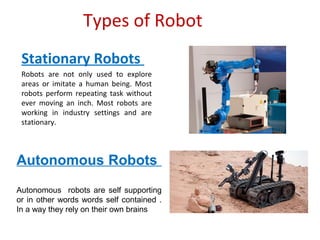
Stationary Robots
Robots are not only used to explore
areas or imitate a human being. Most
robots perform repeating task without
ever moving an inch. Most robots are
working in industry settings and are
stationary.
Autonomous Robots
Autonomous robots are self supporting
or in other words words self contained .
In a way they rely on their own brains
Types of Robot
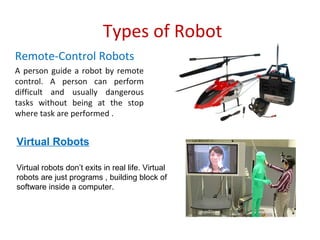
Remote-Control Robots
A person guide a robot by remote
control. A person can perform
difficult and usually dangerous
tasks without being at the stop
where task are performed .
Virtual Robots
Virtual robots don’t exits in real life. Virtual
robots are just programs , building block of
software inside a computer.
• Advantages
• Popular in automation for safe, efficient and quality product.
• It is useful for hazardous environment. For example, Going far down into the
unknown waters and mines where humans would be crushed .
• It can work in dull and dirty environment.
• They can perform task faster than human and much more consistently and
accurately.
• It has no emotion , so never get tired. Working at places without any salary and food.
• It can do repetitive work.
• Disadvantages
• People can lose jobs in factories
• It needs a supply of power
• It needs maintenance to keep it running
• It costs money to make or buy a robot
Robot Anatomy
Robot system consists of following components:
 Manipulators or the rover
 End effecter
 Actuators
 Sensors
 Controller
 Processor
 Software
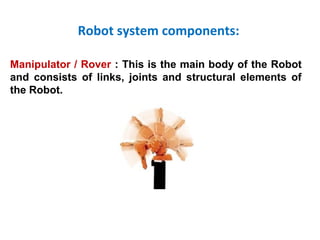
Manipulator / Rover : This is the main body of the Robot
and consists of links, joints and structural elements of
the Robot.
Robot system components:
Manipulator
• Manipulator consists of joints and links
– Joints provide relative motion
– Links are rigid members between
joints
– Various joint types: linear and rotary
– Each joint provides a “degree-of-
freedom”
– Most robots possess five or six
degrees-of-freedom
• Robot manipulator consists of two
sections:
– Body-and-arm – for positioning of
objects in the robot's work volume
– Wrist assembly – for orientation of
objects
Base
Link0
Joint1
Link2
Link3Joint3
End of Arm
Link1
Joint2
Manipulator Joints
• Translational motion
– Linear joint (type L)
– Orthogonal joint (type O)
• Rotary motion
– Rotational joint (type R)
– Twisting joint (type T)
– Revolving joint (type V)
Standard Notation Symbol for Joints:
• Linear/Translation/Prismatic: P ( any L or O
joint)
• Rotary: R (any R, T or V joint)
• Example: TLR = RPR = P2R
Standard Notation Symbol for Joints:
Notation 3P:
• Consists of three sliding
joints,
• Other names include
rectilinear robot and x-y-z
robot
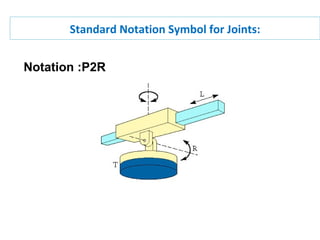
Notation :P2R
Standard Notation Symbol for Joints:
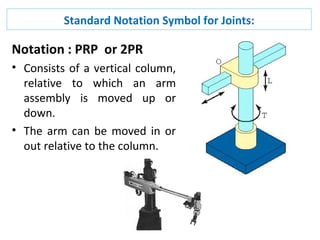
Notation : PRP or 2PR
• Consists of a vertical column,
relative to which an arm
assembly is moved up or
down.
• The arm can be moved in or
out relative to the column.
Jointed-Arm Robot
Notation: 3R
Standard Notation Symbol for Joints:
Notation : 3R
• SCARA stands for Selectively
Compliant Assembly Robot
Arm
• Similar to jointed-arm robot
except that vertical axes are
used for shoulder and elbow
joints to be compliant in
horizontal direction for
vertical insertion tasks
Standard Notation Symbol
for Joints:
SCARA Robot
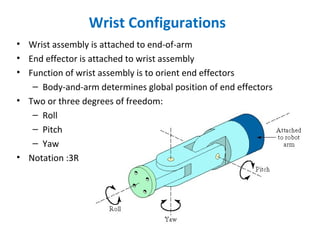
Wrist Configurations
• Wrist assembly is attached to end-of-arm
• End effector is attached to wrist assembly
• Function of wrist assembly is to orient end effectors
– Body-and-arm determines global position of end effectors
• Two or three degrees of freedom:
– Roll
– Pitch
– Yaw
• Notation :3R
Example
• Sketch following manipulator configurations
• (a) TRT:R, (b) TVR:TR, (c) RR:T.
Solution:
T
R
T
V
(a) TRT:R
R
T
R
T R
TR
R
(c) RR:T(b) TVR:TR
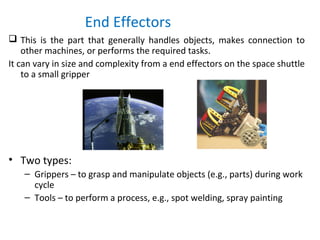
End Effectors
 This is the part that generally handles objects, makes connection to
other machines, or performs the required tasks.
It can vary in size and complexity from a end effectors on the space shuttle
to a small gripper
• Two types:
– Grippers – to grasp and manipulate objects (e.g., parts) during work
cycle
– Tools – to perform a process, e.g., spot welding, spray painting
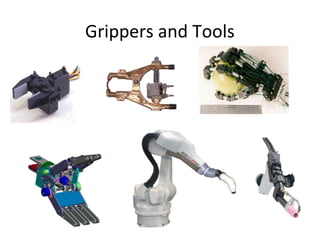
Grippers and Tools
Types of Robot Grippers
 Mechanical grippers consist of 2 or more fingers that
can be actuated by the robot controller to open and
close to grasp the work piece.
 Vacuum grippers, in which the suction cups are used
to hold flat objects.
 Magnetized devices, for holding ferrous parts.
 Adhesive devices, where an adhesive substance is
used to hold a flexible material such as fabric.
 Simple Mechanical devices such as hooks and scoops.
Robot Coordinates, Reference frames and
Work space
Robot Configurations
Work Envelope concept
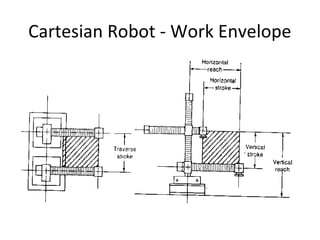
• Depending on the configuration and size of the links
and wrist joints, robots can reach a collection of
points called a Workspace.
• Alternately Workspace may be found empirically, by
moving each joint through its range of motions and
combining all space it can reach and subtracting
what space it cannot reach
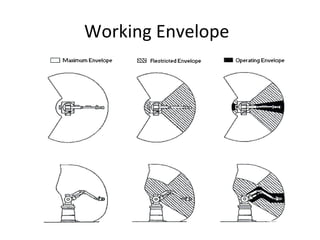
Working Envelope
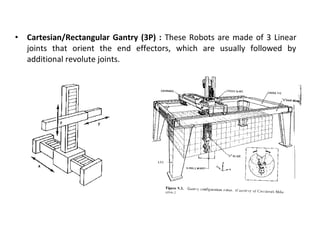
• Cartesian/Rectangular Gantry (3P) : These Robots are made of 3 Linear
joints that orient the end effectors, which are usually followed by
additional revolute joints.
Cartesian Robot - Work Envelope
• Cylindrical (R2P): Cylindrical coordinate Robots have 2 prismatic joints
and one revolute joint.
Cylindrical Robot - Work Envelope
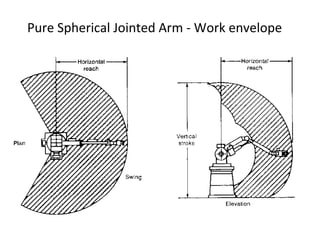
• Spherical joint (2RP): They follow a spherical coordinate system, which
has one Prismatic and two revolute joints.
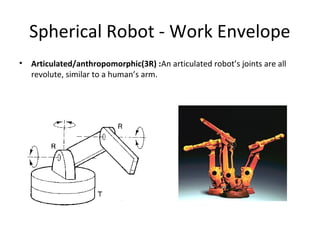
Spherical Robot - Work Envelope
• Articulated/anthropomorphic(3R) :An articulated robot’s joints are all
revolute, similar to a human’s arm.
Pure Spherical Jointed Arm - Work envelope
• Selective Compliance Assembly Robot Arm (SCARA) (2R1P): They have
two revolute joints that are parallel and allow the Robot to move in a
horizontal plane, plus an additional prismatic joint that moves vertically
Reference Frames
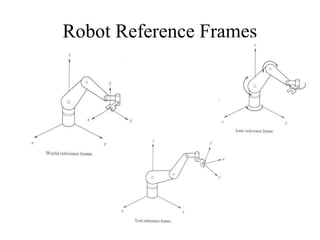
• World Reference Frame which is a universal coordinate frame, as
defined by the x-y-z axes. In this case the joints of the robot move
simultaneously so as to create motions along the three major axes.
• Joint Reference Frame which is used to specify movements of each
individual joint of the Robot. In this case each joint may be accessed
individually and thus only one joint moves at a time.
• Tool Reference Frame which specifies the movements of the
Robots hand relative to the frame attached to the hand. The x’, y’
and z’ axes attached to the hand define the motions of the hand
relative to this local frame. All joints of the Robot move
simultaneously to create coordinated motions about the Tool frame.
Robot Reference Frames
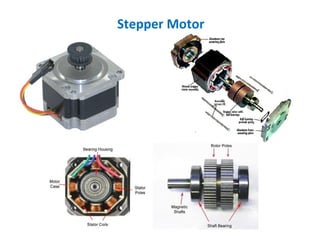
Actuators : Actuators are the muscles of the manipulators. Common
types of actuators are servomotors, stepper motors, pneumatic
cylinders etc.
Robot system components:
Stepper Motor
Servo Motor
Robot system components:
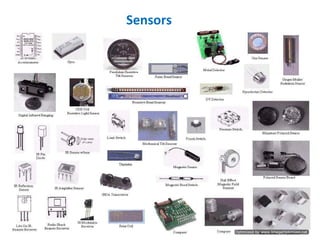
• Sensors : Sensors are used to collect information about the
internal state of the robot or to communicate with the
outside environment. Robots are often equipped with
external sensory devices such as a vision system, touch and
tactile sensors etc which help to communicate with the
environment.
Robotic Control 44
Sensors
Robot system components:
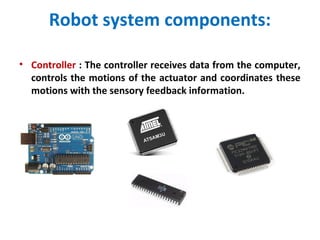
• Controller : The controller receives data from the computer,
controls the motions of the actuator and coordinates these
motions with the sensory feedback information.
Energy:
Robot system components:
2. robotics

2. robotics

  • 1.
    ME-181 Introduction to Mechanical Engineering LEVEL-1,TERM-I Adib Bin Rashid Capt Instructor Class C Mechanical Engineering Department
  • 2.
    Robotics Adib Bin Rashid Capt InstructorClass C Mechanical Engineering Department
  • 3.
  • 4.
    According to theRobotics Institute of America  Variable-Sequence Robot : A device that performs the successive stages of a task according to a predetermined method easy to modify  Playback Robot :A human operator performs the task manually by leading the Robot  Numerical Control Robot : The operator supplies the movement program rather than teaching it the task manually.  Intelligent Robot : A robot with the means to understand its environment and the ability to successfully complete a task despite changes to the environment. Classification of Robot
  • 5.
    Types of Robot •Mobile Robot • Stationary Robot • Autonomous Robot • Remote-Controlled Robot • Virtual Robots
  • 6.
    Mobile Robots Mobile robotsare of two types….. Rolling Robots- Rolling robots have wheels to move around they can quickly and easily search. However they are only useful in flat areas. Walking Robots – Robots on lags are usually brought in when the terrain is rocky. Most robot have at least 4 lags usually they have 6 or more.
  • 7.
    Types of Robot StationaryRobots Robots are not only used to explore areas or imitate a human being. Most robots perform repeating task without ever moving an inch. Most robots are working in industry settings and are stationary. Autonomous Robots Autonomous robots are self supporting or in other words words self contained . In a way they rely on their own brains
  • 8.
    Types of Robot Remote-ControlRobots A person guide a robot by remote control. A person can perform difficult and usually dangerous tasks without being at the stop where task are performed . Virtual Robots Virtual robots don’t exits in real life. Virtual robots are just programs , building block of software inside a computer.
  • 9.
    • Advantages • Popularin automation for safe, efficient and quality product. • It is useful for hazardous environment. For example, Going far down into the unknown waters and mines where humans would be crushed . • It can work in dull and dirty environment. • They can perform task faster than human and much more consistently and accurately. • It has no emotion , so never get tired. Working at places without any salary and food. • It can do repetitive work. • Disadvantages • People can lose jobs in factories • It needs a supply of power • It needs maintenance to keep it running • It costs money to make or buy a robot
  • 10.
  • 11.
    Robot system consistsof following components:  Manipulators or the rover  End effecter  Actuators  Sensors  Controller  Processor  Software
  • 12.
    Manipulator / Rover: This is the main body of the Robot and consists of links, joints and structural elements of the Robot. Robot system components:
  • 13.
    Manipulator • Manipulator consistsof joints and links – Joints provide relative motion – Links are rigid members between joints – Various joint types: linear and rotary – Each joint provides a “degree-of- freedom” – Most robots possess five or six degrees-of-freedom • Robot manipulator consists of two sections: – Body-and-arm – for positioning of objects in the robot's work volume – Wrist assembly – for orientation of objects Base Link0 Joint1 Link2 Link3Joint3 End of Arm Link1 Joint2
  • 14.
    Manipulator Joints • Translationalmotion – Linear joint (type L) – Orthogonal joint (type O) • Rotary motion – Rotational joint (type R) – Twisting joint (type T) – Revolving joint (type V)
  • 15.
    Standard Notation Symbolfor Joints: • Linear/Translation/Prismatic: P ( any L or O joint) • Rotary: R (any R, T or V joint) • Example: TLR = RPR = P2R
  • 16.
    Standard Notation Symbolfor Joints: Notation 3P: • Consists of three sliding joints, • Other names include rectilinear robot and x-y-z robot
  • 17.
  • 18.
    Standard Notation Symbolfor Joints: Notation : PRP or 2PR • Consists of a vertical column, relative to which an arm assembly is moved up or down. • The arm can be moved in or out relative to the column.
  • 19.
    Jointed-Arm Robot Notation: 3R StandardNotation Symbol for Joints:
  • 20.
    Notation : 3R •SCARA stands for Selectively Compliant Assembly Robot Arm • Similar to jointed-arm robot except that vertical axes are used for shoulder and elbow joints to be compliant in horizontal direction for vertical insertion tasks Standard Notation Symbol for Joints: SCARA Robot
  • 21.
    Wrist Configurations • Wristassembly is attached to end-of-arm • End effector is attached to wrist assembly • Function of wrist assembly is to orient end effectors – Body-and-arm determines global position of end effectors • Two or three degrees of freedom: – Roll – Pitch – Yaw • Notation :3R
  • 22.
    Example • Sketch followingmanipulator configurations • (a) TRT:R, (b) TVR:TR, (c) RR:T. Solution: T R T V (a) TRT:R R T R T R TR R (c) RR:T(b) TVR:TR
  • 23.
    End Effectors  Thisis the part that generally handles objects, makes connection to other machines, or performs the required tasks. It can vary in size and complexity from a end effectors on the space shuttle to a small gripper • Two types: – Grippers – to grasp and manipulate objects (e.g., parts) during work cycle – Tools – to perform a process, e.g., spot welding, spray painting
  • 24.
  • 25.
    Types of RobotGrippers  Mechanical grippers consist of 2 or more fingers that can be actuated by the robot controller to open and close to grasp the work piece.  Vacuum grippers, in which the suction cups are used to hold flat objects.  Magnetized devices, for holding ferrous parts.  Adhesive devices, where an adhesive substance is used to hold a flexible material such as fabric.  Simple Mechanical devices such as hooks and scoops.
  • 26.
    Robot Coordinates, Referenceframes and Work space
  • 27.
  • 28.
    Work Envelope concept •Depending on the configuration and size of the links and wrist joints, robots can reach a collection of points called a Workspace. • Alternately Workspace may be found empirically, by moving each joint through its range of motions and combining all space it can reach and subtracting what space it cannot reach
  • 29.
  • 30.
    • Cartesian/Rectangular Gantry(3P) : These Robots are made of 3 Linear joints that orient the end effectors, which are usually followed by additional revolute joints.
  • 31.
    Cartesian Robot -Work Envelope
  • 32.
    Cartesian Robot -Work Envelope • Cylindrical (R2P): Cylindrical coordinate Robots have 2 prismatic joints and one revolute joint.
  • 33.
    Cylindrical Robot -Work Envelope
  • 34.
    Cylindrical Robot -Work Envelope • Spherical joint (2RP): They follow a spherical coordinate system, which has one Prismatic and two revolute joints.
  • 35.
    Spherical Robot -Work Envelope
  • 36.
    Spherical Robot -Work Envelope • Articulated/anthropomorphic(3R) :An articulated robot’s joints are all revolute, similar to a human’s arm.
  • 37.
    Pure Spherical JointedArm - Work envelope
  • 38.
    • Selective ComplianceAssembly Robot Arm (SCARA) (2R1P): They have two revolute joints that are parallel and allow the Robot to move in a horizontal plane, plus an additional prismatic joint that moves vertically
  • 39.
    Reference Frames • WorldReference Frame which is a universal coordinate frame, as defined by the x-y-z axes. In this case the joints of the robot move simultaneously so as to create motions along the three major axes. • Joint Reference Frame which is used to specify movements of each individual joint of the Robot. In this case each joint may be accessed individually and thus only one joint moves at a time. • Tool Reference Frame which specifies the movements of the Robots hand relative to the frame attached to the hand. The x’, y’ and z’ axes attached to the hand define the motions of the hand relative to this local frame. All joints of the Robot move simultaneously to create coordinated motions about the Tool frame.
  • 40.
  • 41.
    Actuators : Actuatorsare the muscles of the manipulators. Common types of actuators are servomotors, stepper motors, pneumatic cylinders etc. Robot system components:
  • 42.
  • 43.
  • 44.
    Robot system components: •Sensors : Sensors are used to collect information about the internal state of the robot or to communicate with the outside environment. Robots are often equipped with external sensory devices such as a vision system, touch and tactile sensors etc which help to communicate with the environment. Robotic Control 44
  • 45.
  • 46.
    Robot system components: •Controller : The controller receives data from the computer, controls the motions of the actuator and coordinates these motions with the sensory feedback information.
  • 47.