Operationally Defining Concepts:
Measurement
Dr. Serena
Outline:
1. An overview of research questions and
hypotheses
2. Constructs and operational definitions
3. Scales of measurement
4. Modalities of measurement
5. Other Aspects of measurement
Research Questions. . .
• Are a question
• Either describe behavior/perception
– Qualitative
– Can involve one variable/concept
• Or relate behaviors/perceptions to other
variables
– Quantitative
– Must involve two variables/concepts
Hypothesis
• A predictive statement of relationship
between 2 concepts.
– An educated guess or prediction
– Always involves two variables
• Associational relationship: where you find
one, the other occurs.
• Causal relationship: one causes a change in
the direction of the other one.
Hypotheses can. . .
• Predict a positive relationship
• Predict a negative relationship
• Predict a curvilinear relationship
• Predict a relationship
Positive Linear Relationship
0
2
4
a1 a2 a3
a
b
Negative (Inverse) Linear Relationship
0
2
4
a1 a2 a3
a
b
Curvilinear
1-5 6-10 11-20 21+
Years Experience
42.00
44.00
46.00
48.00
MeanWraparoundFidelityScore
Inverted Curvilinear
3 or less From 4-6 From 7-10 From 11-15
Meeting Attendees
1.6
1.7
1.8
1.9
2
2.1
MeanWraparoundFidelity
Relationship
• Nondirectional hypothesis/research question
– E.g., How do Tribe A and Tribe B differ in their
child-rearing practices?
Directional or Nondirectional?
• Children of immigrants and children of native-
born citizens differ in their job satisfaction.
• College students who have firm career goals
achieve higher GPAs than those who do not
have firm career goals.
Restate into Research Question
• H1: Individuals who exercise regularly and
individuals who do not exercise regularly
differ in their confidence levels.
RQs and Hypotheses Exercise
• State the purpose of your research
• State a few hypotheses related to your
research
• State some research questions
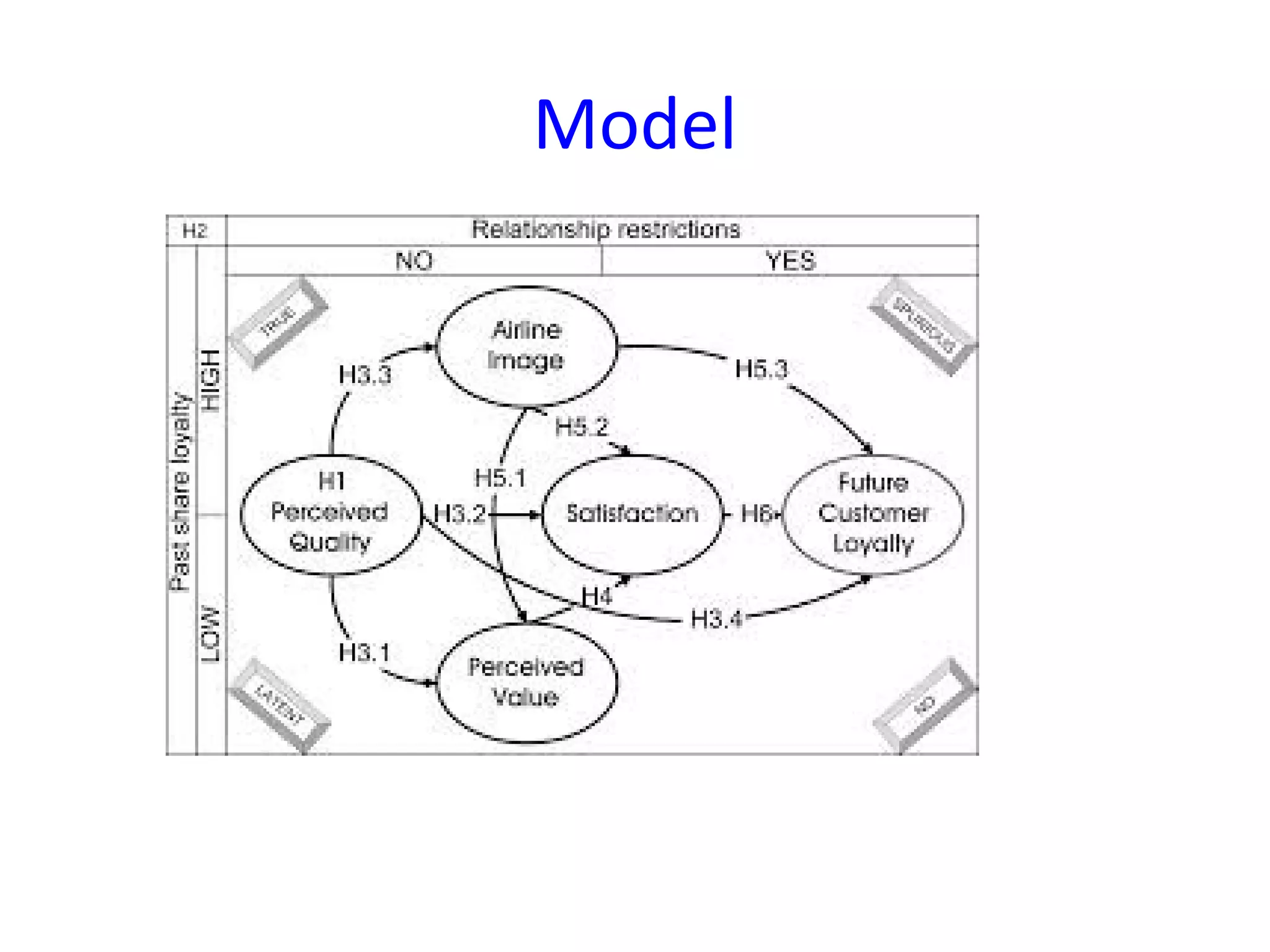
Model
Measurement
• The assignment of numerals to
objects or events according to rules.
Empiricism
• What to observe
• Whom to observe
• How to observe
• When to observe
• How to analyze the data
Operationalization Choices
• Conceptualization is the refinement and
specification of abstract concepts
• Then we operationalize (developing rules for
inclusion and exclusion) based on previous
definitions or based on concepts in
conceptual definition
Concepts as Constructs
• Concepts are constructs derived by
mutual agreement
Theory
• Theories summarize our observations,
explain mechanisms underlying a particular
behavior and make predictions about the
behavior.
Reward  Motivation  Performance
Overview of Measurement
• Two aspects of measurement are particularly
important in… planning a research study or reading a
research report:
– Often there is not a one-to-one relationship
between the variable measured and the
measurement obtained (knowledge, performance
and exam grade)
• Usually several different options for measuring
any particular variable (types of exams and
questions on exams)
– Direct measurement (height, weight) vs indirect
measurement (motivation, knowledge, memory,
marital satisfaction)
Variables
• A variable is any concept that varies.
– Between persons
– In time
– In intensity
– Etc.
Variables Must be Defined
• Conceptual definition
• Operational definition
• Conceptual fit
Operational Definitions
• Operational Definition: is the definition of
a variable in terms of the actual procedures
used by the researcher to measure and/or
manipulate it.
• Similar to a ‘recipe,’ operational definitions
specify exactly how to measure and/or
manipulate the variables in a study.
• Good operational definitions define
procedures precisely so that other
researchers can replicate the study.
Latent (Hidden) Variables
• Latent variables correspond to some type of
hypothetical construct
• Require a specific operational definition with
indicators measuring the construct
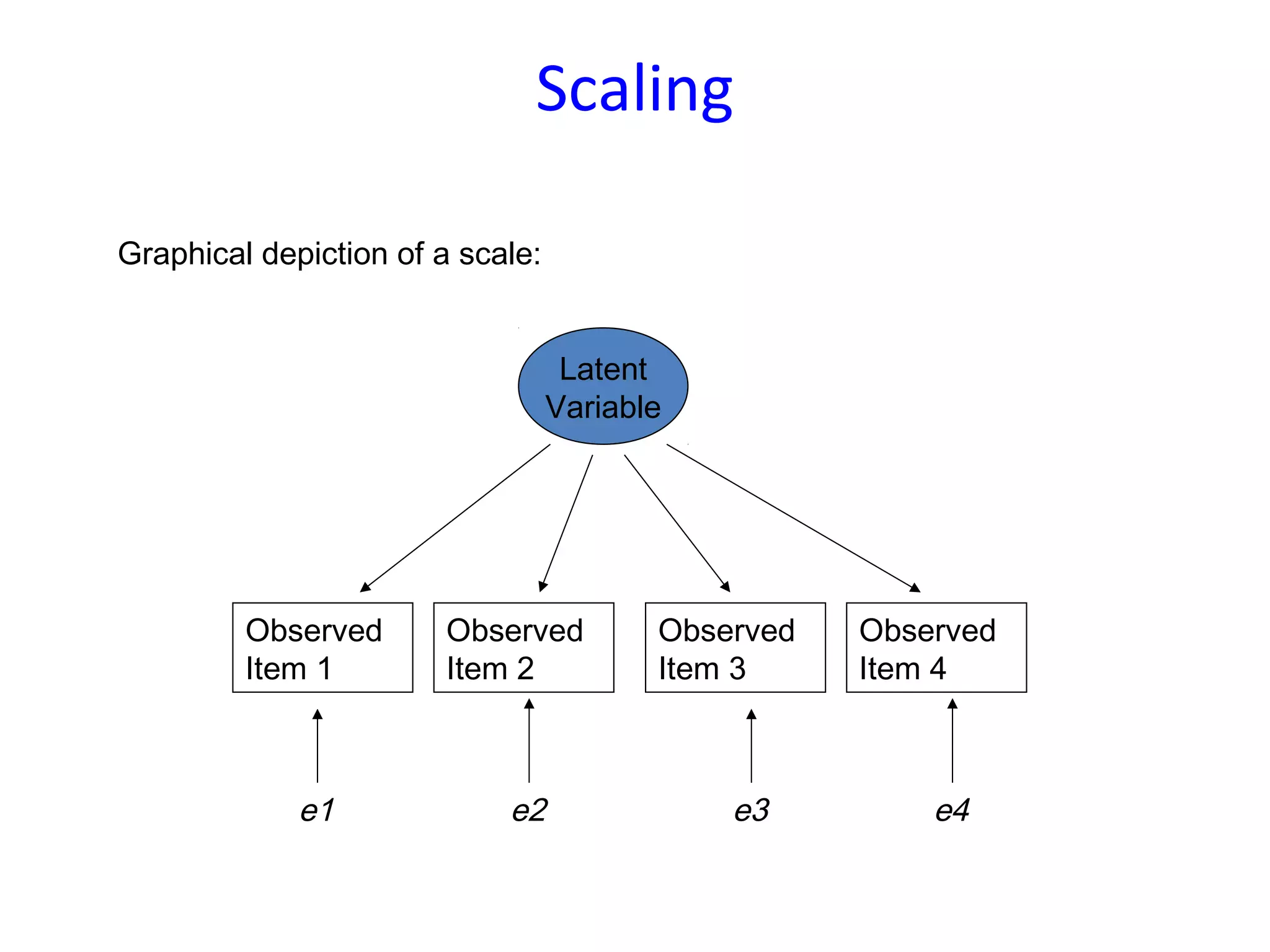
Scaling
Latent
Variable
Observed
Item 1
Observed
Item 2
Observed
Item 3
Observed
Item 4
e1 e2 e3 e4
Graphical depiction of a scale:
Scale
• Scales typically denote sets of questions which
become mathematical combinations of
concepts.
Scaling
• How do we define or “capture” or measure a nebulous
concept?
• By “taking stabs” from several directions, we can get a more
complete picture of a concept we know exists but cannot see.
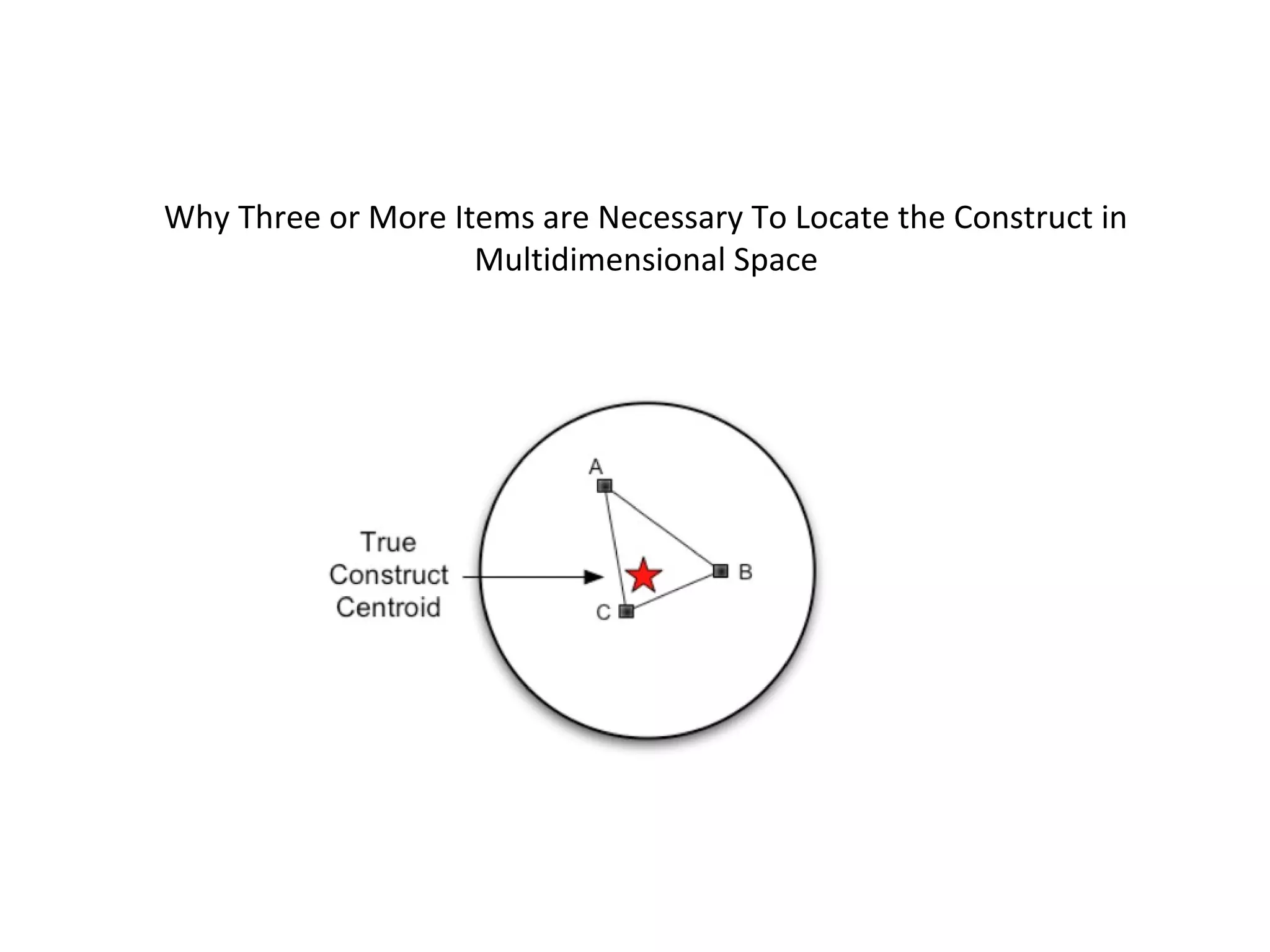
Why Three or More Items are Necessary To Locate the Construct in
Multidimensional Space
Indicators and Dimensions
• Indicator
– An observation that we choose to
consider as a reflection of a variable we
wish to study.
• Dimension
– A specifiable aspect of a concept.
Variable Dimensions
• Multidimensional
• Unidimensional
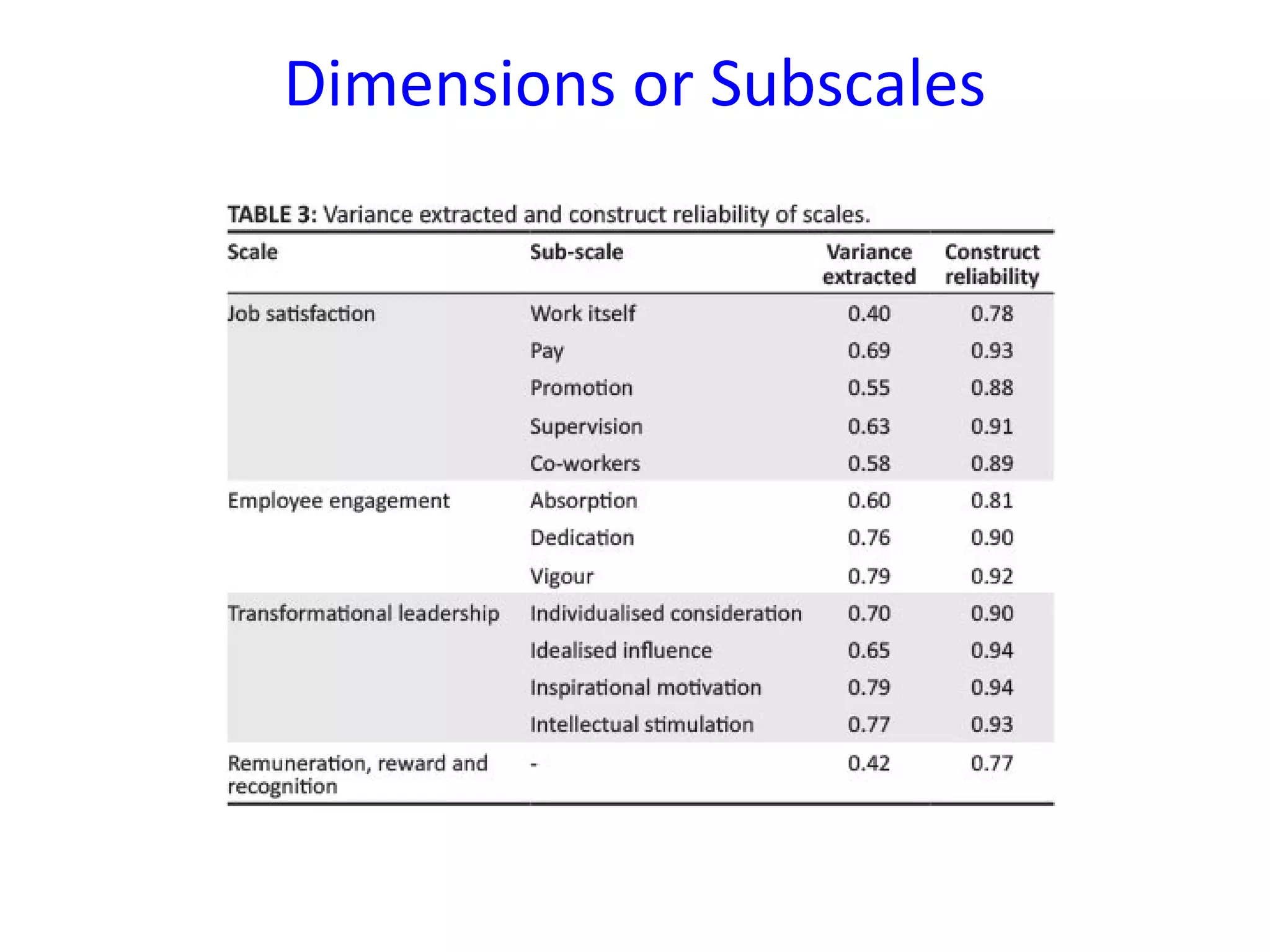
Dimensions or Subscales
Scale Exercise
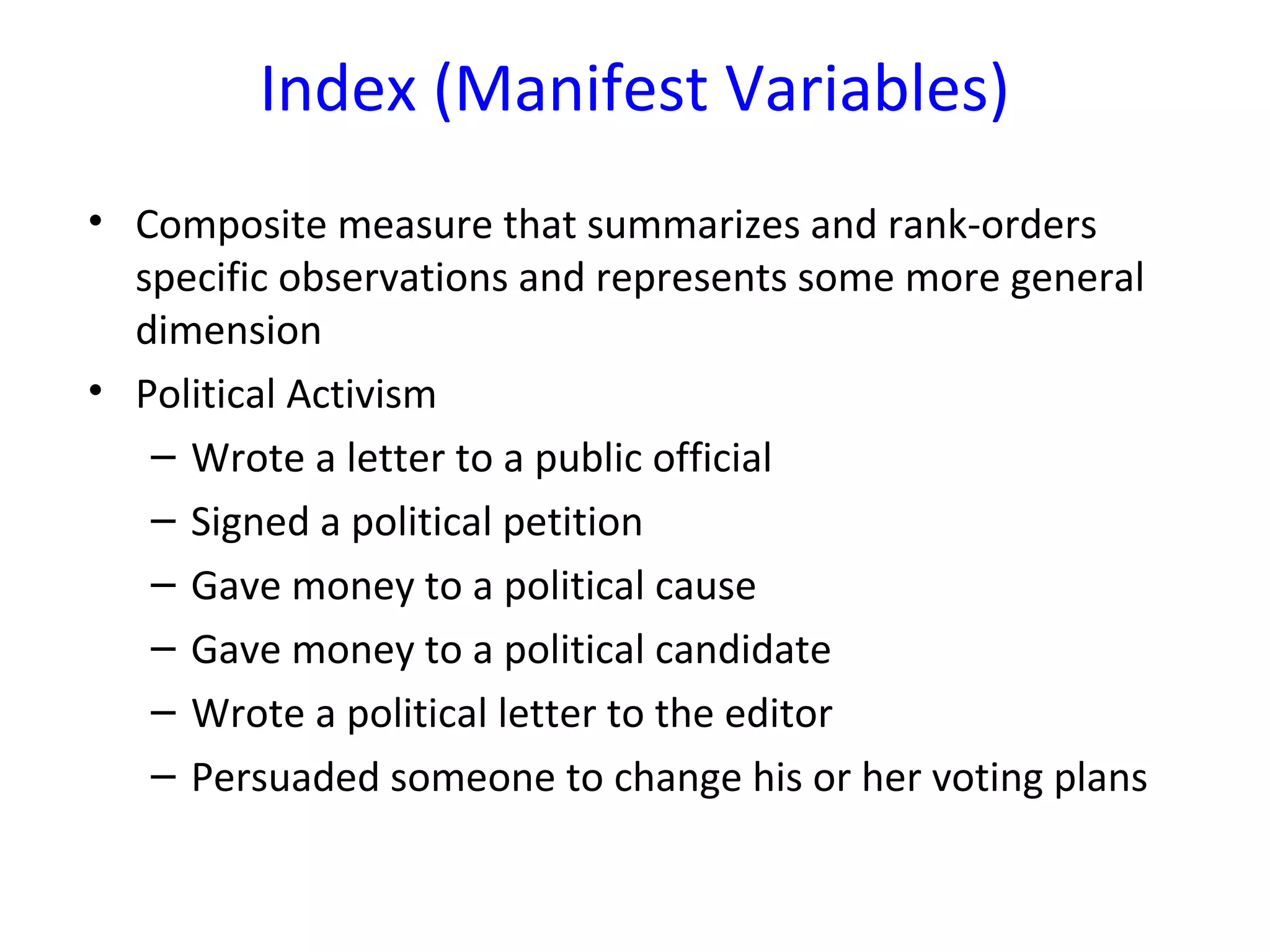
Index (Manifest Variables)
• Composite measure that summarizes and rank-orders
specific observations and represents some more general
dimension
• Political Activism
– Wrote a letter to a public official
– Signed a political petition
– Gave money to a political cause
– Gave money to a political candidate
– Wrote a political letter to the editor
– Persuaded someone to change his or her voting plans
Validity and Reliability of Measurement
• How do you decide which method of
measurement (operational definition of a
construct) is the best?
• there are two general criteria for evaluating
the quality of any measurement procedure
– validity
– reliability
Modalities of Measurement
• One can measure a construct by selecting a
measure from three main categories
• There are three basic modalities of
measurement:
– self-report
– physiological measurement
– behavioral measurement
• behavioral observation
• content analysis and archival research
Self-report Measures
• You ask a participant:
– To describe his/her behavior
– To express his/her opinion
– To characterize his/her experience in an interview
– To characterize his/her experience by using a
questionnaire with ratings
Physiological Measures
• Physiological manifestations of the underlying
construct
– e.g., EEG, EKG, galvanic skin response, perspiration,
fMRI
Behavioral Measures
• Behaviors that can be observed and measured
– E.g., reaction time, reading speed, focus of
attention, disruptive behavior, number of words
recalled on a memory test
• How to select the right behavioral measure?
– Depends on the purpose of the study
• In clinical setting, the same disorder can reveal itself through
different symptoms
• In studying memory, we want to have the same measure for
all subjects to be able to compare them
Measures
• Identify one concept related to your research
• How did other scholars measure it?
Exam
• Readings
• Understand terms
• Understand how to read a journal article
• References
• Required to cite readings
Work Camp
• Research Purpose (Introduction Section)
• Model
– Come to class with a few models
• Hypotheses/Research Questions
• Measures (Method Section)

Operational definitions

  • 1.
  • 2.
    Outline: 1. An overviewof research questions and hypotheses 2. Constructs and operational definitions 3. Scales of measurement 4. Modalities of measurement 5. Other Aspects of measurement
  • 3.
    Research Questions. .. • Are a question • Either describe behavior/perception – Qualitative – Can involve one variable/concept • Or relate behaviors/perceptions to other variables – Quantitative – Must involve two variables/concepts
  • 4.
    Hypothesis • A predictivestatement of relationship between 2 concepts. – An educated guess or prediction – Always involves two variables • Associational relationship: where you find one, the other occurs. • Causal relationship: one causes a change in the direction of the other one.
  • 5.
    Hypotheses can. .. • Predict a positive relationship • Predict a negative relationship • Predict a curvilinear relationship • Predict a relationship
  • 6.
  • 7.
    Negative (Inverse) LinearRelationship 0 2 4 a1 a2 a3 a b
  • 8.
    Curvilinear 1-5 6-10 11-2021+ Years Experience 42.00 44.00 46.00 48.00 MeanWraparoundFidelityScore
  • 9.
    Inverted Curvilinear 3 orless From 4-6 From 7-10 From 11-15 Meeting Attendees 1.6 1.7 1.8 1.9 2 2.1 MeanWraparoundFidelity
  • 10.
    Relationship • Nondirectional hypothesis/researchquestion – E.g., How do Tribe A and Tribe B differ in their child-rearing practices?
  • 11.
    Directional or Nondirectional? •Children of immigrants and children of native- born citizens differ in their job satisfaction. • College students who have firm career goals achieve higher GPAs than those who do not have firm career goals.
  • 12.
    Restate into ResearchQuestion • H1: Individuals who exercise regularly and individuals who do not exercise regularly differ in their confidence levels.
  • 13.
    RQs and HypothesesExercise • State the purpose of your research • State a few hypotheses related to your research • State some research questions
  • 14.
  • 15.
    Measurement • The assignmentof numerals to objects or events according to rules.
  • 16.
    Empiricism • What toobserve • Whom to observe • How to observe • When to observe • How to analyze the data
  • 17.
    Operationalization Choices • Conceptualizationis the refinement and specification of abstract concepts • Then we operationalize (developing rules for inclusion and exclusion) based on previous definitions or based on concepts in conceptual definition
  • 18.
    Concepts as Constructs •Concepts are constructs derived by mutual agreement
  • 19.
    Theory • Theories summarizeour observations, explain mechanisms underlying a particular behavior and make predictions about the behavior. Reward  Motivation  Performance
  • 20.
    Overview of Measurement •Two aspects of measurement are particularly important in… planning a research study or reading a research report: – Often there is not a one-to-one relationship between the variable measured and the measurement obtained (knowledge, performance and exam grade) • Usually several different options for measuring any particular variable (types of exams and questions on exams) – Direct measurement (height, weight) vs indirect measurement (motivation, knowledge, memory, marital satisfaction)
  • 21.
    Variables • A variableis any concept that varies. – Between persons – In time – In intensity – Etc.
  • 22.
    Variables Must beDefined • Conceptual definition • Operational definition • Conceptual fit
  • 23.
    Operational Definitions • OperationalDefinition: is the definition of a variable in terms of the actual procedures used by the researcher to measure and/or manipulate it. • Similar to a ‘recipe,’ operational definitions specify exactly how to measure and/or manipulate the variables in a study. • Good operational definitions define procedures precisely so that other researchers can replicate the study.
  • 24.
    Latent (Hidden) Variables •Latent variables correspond to some type of hypothetical construct • Require a specific operational definition with indicators measuring the construct
  • 25.
    Scaling Latent Variable Observed Item 1 Observed Item 2 Observed Item3 Observed Item 4 e1 e2 e3 e4 Graphical depiction of a scale:
  • 26.
    Scale • Scales typicallydenote sets of questions which become mathematical combinations of concepts.
  • 27.
    Scaling • How dowe define or “capture” or measure a nebulous concept? • By “taking stabs” from several directions, we can get a more complete picture of a concept we know exists but cannot see.
  • 28.
    Why Three orMore Items are Necessary To Locate the Construct in Multidimensional Space
  • 29.
    Indicators and Dimensions •Indicator – An observation that we choose to consider as a reflection of a variable we wish to study. • Dimension – A specifiable aspect of a concept.
  • 30.
  • 31.
  • 32.
  • 33.
    Index (Manifest Variables) •Composite measure that summarizes and rank-orders specific observations and represents some more general dimension • Political Activism – Wrote a letter to a public official – Signed a political petition – Gave money to a political cause – Gave money to a political candidate – Wrote a political letter to the editor – Persuaded someone to change his or her voting plans
  • 34.
    Validity and Reliabilityof Measurement • How do you decide which method of measurement (operational definition of a construct) is the best? • there are two general criteria for evaluating the quality of any measurement procedure – validity – reliability
  • 35.
    Modalities of Measurement •One can measure a construct by selecting a measure from three main categories • There are three basic modalities of measurement: – self-report – physiological measurement – behavioral measurement • behavioral observation • content analysis and archival research
  • 36.
    Self-report Measures • Youask a participant: – To describe his/her behavior – To express his/her opinion – To characterize his/her experience in an interview – To characterize his/her experience by using a questionnaire with ratings
  • 37.
    Physiological Measures • Physiologicalmanifestations of the underlying construct – e.g., EEG, EKG, galvanic skin response, perspiration, fMRI
  • 38.
    Behavioral Measures • Behaviorsthat can be observed and measured – E.g., reaction time, reading speed, focus of attention, disruptive behavior, number of words recalled on a memory test • How to select the right behavioral measure? – Depends on the purpose of the study • In clinical setting, the same disorder can reveal itself through different symptoms • In studying memory, we want to have the same measure for all subjects to be able to compare them
  • 39.
    Measures • Identify oneconcept related to your research • How did other scholars measure it?
  • 40.
    Exam • Readings • Understandterms • Understand how to read a journal article • References • Required to cite readings
  • 41.
    Work Camp • ResearchPurpose (Introduction Section) • Model – Come to class with a few models • Hypotheses/Research Questions • Measures (Method Section)

Editor's Notes

  • #2 The goal is literacy, literacy takes place by learning a new language. If you say that you are going to conduct research on behalf of a client or for intellectual interests, you must identify measures to capture behaviors or perceptions of company. Many companies are interested in brand loyalty
  • #5 A prediction related to the outcome of a study. Girls will have higher reading comprension scores than boys. What are the two variables/concepts?
  • #6 Predict a relationship of association
  • #7 So since it has at least two variables… you have to tell me what you expect the relationship to be between those two variables. That prediction or hypothesis is based on your research. What does research say is the relationship between those two variables?
  • #8 Notice that the first variable is always an increase. Statistics is the reason we express hypotheses in this way.
  • #9 A relationship between two or more variables which is depicted graphically by anything other than a straight line. For example, if one has extremely low or extremely high fear, little attitudinal conformity takes place. However, when someone is moderately fearful by listening to persuasive message, then behavior conformity takes place. Change only takes place with people at a moderate level of fear from listening to a specific message or recommendations of a message. These listeners strive to reduce fear. For example an accelerating rate of increase in deaths with age is represented by a steepening curve. Curvilinear relationships are very variable, and more complex and less easily identified than simple linear relationships
  • #11 We simply want to know how they differ, but we don’t know or research is mixed. We think that there might be a relaionship based on evidence, so we are going to explore that with our research
  • #12 Nondirectionbecause it does not predict which group will have greater job satisfaction
  • #13 How do individuals who exercise regularly and individuals who do not exercise regularly differ in confidence levels
  • #14 The goal of this study is study college students attitudes toward religion. We
  • #15 A model is an abstract* explanatory device that captures structure in the data. A model is a conceptual system. Three types of conceptual systems are models, theories and hypotheses. To be scientific, they need to be subjected to empirical testing. Most research reflects a few Hs that are connected to a higher level proposition. Building a model and getting explicit about how its parts function may cause us to make new discoveries about how entities behave or are related Coquitt aruged that you can advance theory by studying models and adding variables to help explain some phenomena. Review that taxonomy to look for ideas and verbage as to how you are contributing to theory We have to propose entities that exist in the model We have to propose ways in which those entities behave or interact We have to carefully define those elements or entities and their relations
  • #16 Remember in any conceptual definition, we want to highlight the concepts and think about what they mean. Stevens in the 1950s. Endorsement within social sciences. He believe any psychological state. Objects and events that are measured, not magnitudes. Careful, deliberate observations of the real world we can describing objects and events. They are most often described in terms of the attributes…. Objects(room) and events (rooms changing color) … attributes of objects (length of a room) and attributes of events (time it takes to paint a room). His definition focuses on objects, however it is really attributes of objects that are being measured. Numerals, not numbers. Numerals - a figure, symbol, or group could be denote a number… meaning that numerals could be assigned to anything. Assignment (representation) and rules…. Methods are the set of rules that you learn. As we learned last class, we should be concerned with how we make those decisions. Numerical representation. Map measurement.
  • #17 Making planned observations Boredom in the Classroom – that is our concept. What concepts do you plan to select for your research Students- elementary Should we interview them or observe them Friday afteroon may be a difficult time Percentage bored? Percentage participating. Correlate boredom with other variables
  • #18 A few did a nice job of stating your concepts in your annotated bib, and then explained what was meant by the concept. What is meant by participatory engagement. Then how do we measure it? Identifying the concepts in the conceptual definitions is key to conceptualizing Observations are checked against data Operationalization is the development of specific research procedures that will result in empirical observations representing those concepts in the real world.
  • #19 Remember when selecting your measures, you must first review how others have measured it and are those measures appropriate. It is much easier to use existing measured. Developing measures is quite difficult.
  • #20 Theories are what we know, what our specific field considers knowledge, particularly variables of interest to behavioral scientists, What are
  • #21 Many ways to measure a concept, you need to defend which way.
  • #24 constructs can not be directly observed or measured, so you must develop procedures Procedure for measuring and defining a construct, indirect method of measuring something that can not be measured directly however, researchers can measure external, observable events as an indirect method of measuring the construct itself e.g., IQ test is an operational definition for the construct intelligence
  • #25 For example a persons bank account may difficult to observe, but what other measures could we use to identify income. We begin with an intuitive approach. Quality of life could related to indicates such as mobility, quality of sleep, eating problems… but it also could include air and water quality, noise levels, pollutants… so we have be conceptually clear. And if we dichotoumous info, we are throwing away info
  • #27 Variable that has more thnan one item Composite measure of a variable
  • #28 Single items such news media use should be measured with multiple items rather how often do you visit news websites. Evidence that the unosbservalble does exist. If there are high interrcorrelations among the items, one could argue that one primary construct does exist. 1 and 2 items scales are suspect because how much true variance can you have
  • #29 3 factors per variable. A third variable is needed to capture the true central. Can use two items, but should have at least 4-6 items. One or two items are not recommended because you fear that your questionnaire is to long because reliability may not be achievable Therefore asking more than one question reduce rather than increases the accuracy of our evidence. We no idea of correctness, but we can measure consistency.
  • #32 A scale can have any number of dimensions in it. Most scales that we develop have only a few dimensions. What's a dimension? If you think you can measure a person's self-esteem well with a single ruler that goes from low to high, then you probably have a unidimensional construct. Dimensions are also known as factors
  • #33 have your students take a survey that is horribly designed. After a few minutes I tell them to stop and ask what they think of the survey. They uniformly say it's awful. Students really like this activity- typically they laugh out loud when reading the questions. I then have them pair up and identify everything that is wrong with the questions. As a class we go through each question picking it apart. We then formulate new questions that don't violate any of the basic survey design rules.
  • #34 Adding up scores assigned to individual attributes Give 1 point for each of the actions taken Obviously people who are The key is that you want variance. You want reponses to items to vary.
  • #35 Validity of measurement concerns the “truth” of the measurement it is the degree to which the measurement process measures the variable it claims to measure Is the IQ score truly measuring intelligence? What about size of the brain and bumps on the scull?
  • #37 Positive aspect: Only the individual has direct access to information about his state of mind More direct measure Negative aspects Participants may distort the responses to create a better self-image or to please the experimenter The response can also be influenced by wording of the questions and other aspects of the situation
  • #38 Advantages provides accurate, reliable, and well-defined measurements that are not dependent on subjective interpretation Disadvantages equipment is usually expensive or unavailable Presence of monitoring devices may create unnatural situation question: Are these procedures a valid measure of the construct (e.g. increase in heart rate to fear, arousal)
  • #39 Beware of situational changes in behavior (e.g., disruptive behavior in school vs when observed) and different behavioral indicators of a construct
  • #41 Concepts, constructs, variables, research questions, research goals, independent variable, dependent variables, operational definition – Name a problem in your field of study that would probably lend itself more to quantitative than the qualitative approach. The late Carl Sagan wrote, “Science is more than a body of knowledge; it is a way of thinking (1996, p.25). What do you think he meant by this? What is the difference between manifest and latent content? Give me an example as well. Assume that you are interested in creating a new measure for a communication concept of interest. Operationally define it. Double-spaced, APA style with references, 5-page