Practical Research 1
Senior High School Applied - Academic
ENGAGE EXPLORE EXPLAIN EXTEND
EVALUAT
How could you
best describe
the mountain?
2
Learning
Objectives
ENGAGE EXPLORE EXPLAIN EXTEND
EVALUAT
At the end of the
lesson, you should
be able to do the
following:
3
● Identify a qualitative research
problem from a general topic of
interest.
● Develop a working title based on the
research problem.
● Justify the relevance of the research
problem.
3
ENGAGE EXPLORE EXPLAIN EXTEND
EVALUAT 4
4
Enumerate three specific areas that
you are interested in based on this
topic: social media.
Activity
ENGAGE EXPLORE EXPLAIN EXTEND
EVALUAT
Identifying a Research Problem
Studies always start with a problem to solve.
5
ENGAGE EXPLORE EXPLAIN EXTEND
EVALUAT
Identifying a Research Problem
Read available source materials about your
topic to identify what is already known and
what is still unknown about your topic.
6
ENGAGE EXPLORE EXPLAIN EXTEND
EVALUAT
Identifying a Research Problem
Formulate research problems that are SMART!
7
ENGAGE EXPLORE EXPLAIN EXTEND
EVALUAT
Identifying a Research Problem
8
Tips
9
● A good research problem is usually
based on unknown information about
the topic.
● Consider the constraints or limitations,
such as time and budget, when refining
the research problem.
ENGAGE EXPLORE EXPLAIN EXTEND
EVALUAT
Narrowing Down a General or Broad Topic
10
10
With the research problem I have
in my mind, can I solve the
research gap? How am I going to fill
in that gap?
11
ENGAGE EXPLORE EXPLAIN EXTEND
EVALUAT
Qualitative Research Problem
A research problem is considered to be
qualitative when the nature of answering it is
on making meanings from nonnumerical
information.
12
ENGAGE EXPLORE EXPLAIN EXTEND
EVALUAT
Styles of conflict
management in start-
up businesses
Business
Use of instant online
loans among
different age groups
Qualitative Research Problem
Accounting
13
ENGAGE EXPLORE EXPLAIN EXTEND
EVALUAT
Qualitative Research Problem
14
Earth Science
Disaster
management in key
cities
Health Science
Vaccination
confidence across
generations
ENGAGE EXPLORE EXPLAIN EXTEND
EVALUAT
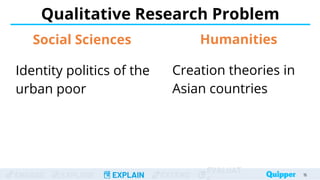
Creation theories in
Asian countries
Humanities
Identity politics of the
urban poor
Qualitative Research Problem
Social Sciences
15
ENGAGE EXPLORE EXPLAIN EXTEND
EVALUAT
Research Title
To guide you in writing a working study
title, answer the following questions:
● What type of research will it use?
● What is the study all about?
● Who is involved in the research?
● Where will the study happen?
16
ENGAGE EXPLORE EXPLAIN EXTEND
EVALUAT
Relevance of the Research
The relevance of the research
describes the reasons or justifications
for the conduct of the study.
17
18
What makes a research problem
relevant?
Remember
19
A good research problem has clear
scientific, social, and practical
relevance.
ENGAGE EXPLORE EXPLAIN EXTEND
EVALUAT
Activity
20
1. Think of a general topic that you are familiar
with and interests you the most.
ENGAGE EXPLORE EXPLAIN EXTEND
EVALUAT
Activity
21
2. Make a list of three specific areas of
knowledge from your topic of interest.
ENGAGE EXPLORE EXPLAIN EXTEND
EVALUAT
Activity
22
3. Write a working title for your research on
the chosen specific area of knowledge based
on your answers in #2.
ENGAGE EXPLORE EXPLAIN EXTEND
EVALUAT
ENGAGE EXPLORE EXPLAIN EXTEND
EVALUAT
Quick Check
It deals with interpreting nonnumerical data.
23
ENGAGE EXPLORE EXPLAIN EXTEND
EVALUAT
ENGAGE EXPLORE EXPLAIN EXTEND
EVALUAT
Quick Check
It describes the reasons or justifications for
the conduct of the study.
24
ENGAGE EXPLORE EXPLAIN EXTEND
EVALUAT
ENGAGE EXPLORE EXPLAIN EXTEND
EVALUAT
Quick Check
Based on the given general topic, give one
qualitative research problem that can be
studied.
HEAVY TRAFFIC
25
Wrap Up
26
The research problem is the central
basis for the other parts of the
research.
The research process starts with
identifying a broad topic of interest
and narrowing it down to a more
specific topic.
Wrap Up
27
Qualitative research deals with
understanding, describing, and
drawing out meaning from
nonnumerical information.
Wrap Up
28
The research title describes what the
research is about and is based on
the statement of the research
problem.
Wrap Up
29
The relevance of the research
describes the importance and
justification for conducting the
research.
Wrap Up
30
Bibliography
31
Ballenger, Bruce P. The Curious Researcher: A Guide to Writing Research Papers.
4th ed. New York: Pearson/Longman, 2004.
Ellis, Timothy J., and Yair Levy. "Framework of Problem-Based Research: A Guide
for Novice Researchers on the Development of a Research-worthy Problem."
Informing Science: The International Journal of an Emerging Transdiscipline
11 (2008): 17-33.
Haggan, Madeline. "Research Paper Titles in Literature, Linguistics and Science:
Dimensions of Attraction." Journal of Pragmatics 36, no. 2 (2004): 293-317.
Bibliography
32
Lester, James D. Sr., and James D. Lester. Writing Research Papers: A Complete
Guide. 4th ed. Boston: Pearson, 2012.
Lincoln, Norman K., and Yvonna S. Denzin. The Sage Handbook of Qualitative
Research. 3rd ed. California: Sage, 2005.
McBride, Allan. "Teaching Research Methods Using Appropriate Technology." PS:
Political Science & Politics 27, no. 3 (1994): 553-557.
Schneider, Zevia, and Dean Whitehead. "Identifying Research Ideas, Questions,
Statements and Hypotheses." In Nursing and Midwifery Research: Methods
and Appraisal for Evidence-Based Practice, 57-76. Australia: Elsevier-Mosby,
2012.

Identifying a Qualitative Research Problem.pptx

  • 1.
    Practical Research 1 SeniorHigh School Applied - Academic
  • 2.
    ENGAGE EXPLORE EXPLAINEXTEND EVALUAT How could you best describe the mountain? 2
  • 3.
    Learning Objectives ENGAGE EXPLORE EXPLAINEXTEND EVALUAT At the end of the lesson, you should be able to do the following: 3 ● Identify a qualitative research problem from a general topic of interest. ● Develop a working title based on the research problem. ● Justify the relevance of the research problem. 3
  • 4.
    ENGAGE EXPLORE EXPLAINEXTEND EVALUAT 4 4 Enumerate three specific areas that you are interested in based on this topic: social media. Activity
  • 5.
    ENGAGE EXPLORE EXPLAINEXTEND EVALUAT Identifying a Research Problem Studies always start with a problem to solve. 5
  • 6.
    ENGAGE EXPLORE EXPLAINEXTEND EVALUAT Identifying a Research Problem Read available source materials about your topic to identify what is already known and what is still unknown about your topic. 6
  • 7.
    ENGAGE EXPLORE EXPLAINEXTEND EVALUAT Identifying a Research Problem Formulate research problems that are SMART! 7
  • 8.
    ENGAGE EXPLORE EXPLAINEXTEND EVALUAT Identifying a Research Problem 8
  • 9.
    Tips 9 ● A goodresearch problem is usually based on unknown information about the topic. ● Consider the constraints or limitations, such as time and budget, when refining the research problem.
  • 10.
    ENGAGE EXPLORE EXPLAINEXTEND EVALUAT Narrowing Down a General or Broad Topic 10 10
  • 11.
    With the researchproblem I have in my mind, can I solve the research gap? How am I going to fill in that gap? 11
  • 12.
    ENGAGE EXPLORE EXPLAINEXTEND EVALUAT Qualitative Research Problem A research problem is considered to be qualitative when the nature of answering it is on making meanings from nonnumerical information. 12
  • 13.
    ENGAGE EXPLORE EXPLAINEXTEND EVALUAT Styles of conflict management in start- up businesses Business Use of instant online loans among different age groups Qualitative Research Problem Accounting 13
  • 14.
    ENGAGE EXPLORE EXPLAINEXTEND EVALUAT Qualitative Research Problem 14 Earth Science Disaster management in key cities Health Science Vaccination confidence across generations
  • 15.
    ENGAGE EXPLORE EXPLAINEXTEND EVALUAT Creation theories in Asian countries Humanities Identity politics of the urban poor Qualitative Research Problem Social Sciences 15
  • 16.
    ENGAGE EXPLORE EXPLAINEXTEND EVALUAT Research Title To guide you in writing a working study title, answer the following questions: ● What type of research will it use? ● What is the study all about? ● Who is involved in the research? ● Where will the study happen? 16
  • 17.
    ENGAGE EXPLORE EXPLAINEXTEND EVALUAT Relevance of the Research The relevance of the research describes the reasons or justifications for the conduct of the study. 17
  • 18.
    18 What makes aresearch problem relevant?
  • 19.
    Remember 19 A good researchproblem has clear scientific, social, and practical relevance.
  • 20.
    ENGAGE EXPLORE EXPLAINEXTEND EVALUAT Activity 20 1. Think of a general topic that you are familiar with and interests you the most.
  • 21.
    ENGAGE EXPLORE EXPLAINEXTEND EVALUAT Activity 21 2. Make a list of three specific areas of knowledge from your topic of interest.
  • 22.
    ENGAGE EXPLORE EXPLAINEXTEND EVALUAT Activity 22 3. Write a working title for your research on the chosen specific area of knowledge based on your answers in #2.
  • 23.
    ENGAGE EXPLORE EXPLAINEXTEND EVALUAT ENGAGE EXPLORE EXPLAIN EXTEND EVALUAT Quick Check It deals with interpreting nonnumerical data. 23
  • 24.
    ENGAGE EXPLORE EXPLAINEXTEND EVALUAT ENGAGE EXPLORE EXPLAIN EXTEND EVALUAT Quick Check It describes the reasons or justifications for the conduct of the study. 24
  • 25.
    ENGAGE EXPLORE EXPLAINEXTEND EVALUAT ENGAGE EXPLORE EXPLAIN EXTEND EVALUAT Quick Check Based on the given general topic, give one qualitative research problem that can be studied. HEAVY TRAFFIC 25
  • 26.
    Wrap Up 26 The researchproblem is the central basis for the other parts of the research. The research process starts with identifying a broad topic of interest and narrowing it down to a more specific topic.
  • 27.
    Wrap Up 27 Qualitative researchdeals with understanding, describing, and drawing out meaning from nonnumerical information.
  • 28.
    Wrap Up 28 The researchtitle describes what the research is about and is based on the statement of the research problem.
  • 29.
    Wrap Up 29 The relevanceof the research describes the importance and justification for conducting the research.
  • 30.
  • 31.
    Bibliography 31 Ballenger, Bruce P.The Curious Researcher: A Guide to Writing Research Papers. 4th ed. New York: Pearson/Longman, 2004. Ellis, Timothy J., and Yair Levy. "Framework of Problem-Based Research: A Guide for Novice Researchers on the Development of a Research-worthy Problem." Informing Science: The International Journal of an Emerging Transdiscipline 11 (2008): 17-33. Haggan, Madeline. "Research Paper Titles in Literature, Linguistics and Science: Dimensions of Attraction." Journal of Pragmatics 36, no. 2 (2004): 293-317.
  • 32.
    Bibliography 32 Lester, James D.Sr., and James D. Lester. Writing Research Papers: A Complete Guide. 4th ed. Boston: Pearson, 2012. Lincoln, Norman K., and Yvonna S. Denzin. The Sage Handbook of Qualitative Research. 3rd ed. California: Sage, 2005. McBride, Allan. "Teaching Research Methods Using Appropriate Technology." PS: Political Science & Politics 27, no. 3 (1994): 553-557. Schneider, Zevia, and Dean Whitehead. "Identifying Research Ideas, Questions, Statements and Hypotheses." In Nursing and Midwifery Research: Methods and Appraisal for Evidence-Based Practice, 57-76. Australia: Elsevier-Mosby, 2012.

Editor's Notes

  • #5 It is recommended to let the students accomplish this with a partner. Use these for follow-up questions: What is/are your reason(s) for choosing the topics that you have listed? Why do you think coming up with specific topics from a general topic of choice is important when doing research?
  • #22 Prompt: Ask the students to provide explanations on the relevance of their chosen topic. The following can serve as your guide in checking for student’s explanations (Lincoln and Denzin 2005): its usefulness in the scientific advancement of the chosen area of knowledge; importance to the community or society; and, its practical application to present issues or problems.
  • #23 A good guide in writing a working study title is by answering the following questions: What type of research will it use? What is the study all about? Who is involved in the research? Where will the study happen?”
  • #24 Answer: Qualitative research
  • #25 Answer: Relevance of the research
  • #26 Sample answers: Health risks due to heavy traffic Traffic flow analysis Work productivity of employees