Career Point Cares
PROCESS CAPABILITY
MAJOR ASINGNMENT
Career Point Cares
content
 INTRODUCTION
 WHY STUDY PROCESS CAPABILITY
 ABOUT PROCESS CAPABILITY
 POCESS CAPABILITY BY GRAPH
 PRINCIPLE OF PROCESS CAPABILITY
 METHODS OF PROCESS CAPABILITY
 REFERENCES
 THANKYOU SLIDE
Career Point Cares
Introduction
Why study process capability
Process capability studies provide a baseline for us to how to
understand the process is operating relative to the
specifications.
It is the first, thorough look at how variability is affecting the
process, and gives us Metris for quantifying that variability.
Such studies also provide information regarding what the
process could do under best conditions, and thus give a
performance target to shoot for.
Career Point Cares
Process Capability
The main objectives of process management are to prevent the defects and
to minimize the variability in manufacturing process. To reduce the
variability it needs to establish the relationship between process variable
and product results.
Even though product meets the specification limits and the process is in
the state of control, the actions may be initiated to Quantify and further
reducing the process variability to gain marvelous advantages. The
statistical techniques can be used to quantify the variability of the
manufacturing process.
The Process capability analysis helps in quantifying the process variability
and assists Manufacturing by eliminating or greatly reducing the variability.
Career Point Cares
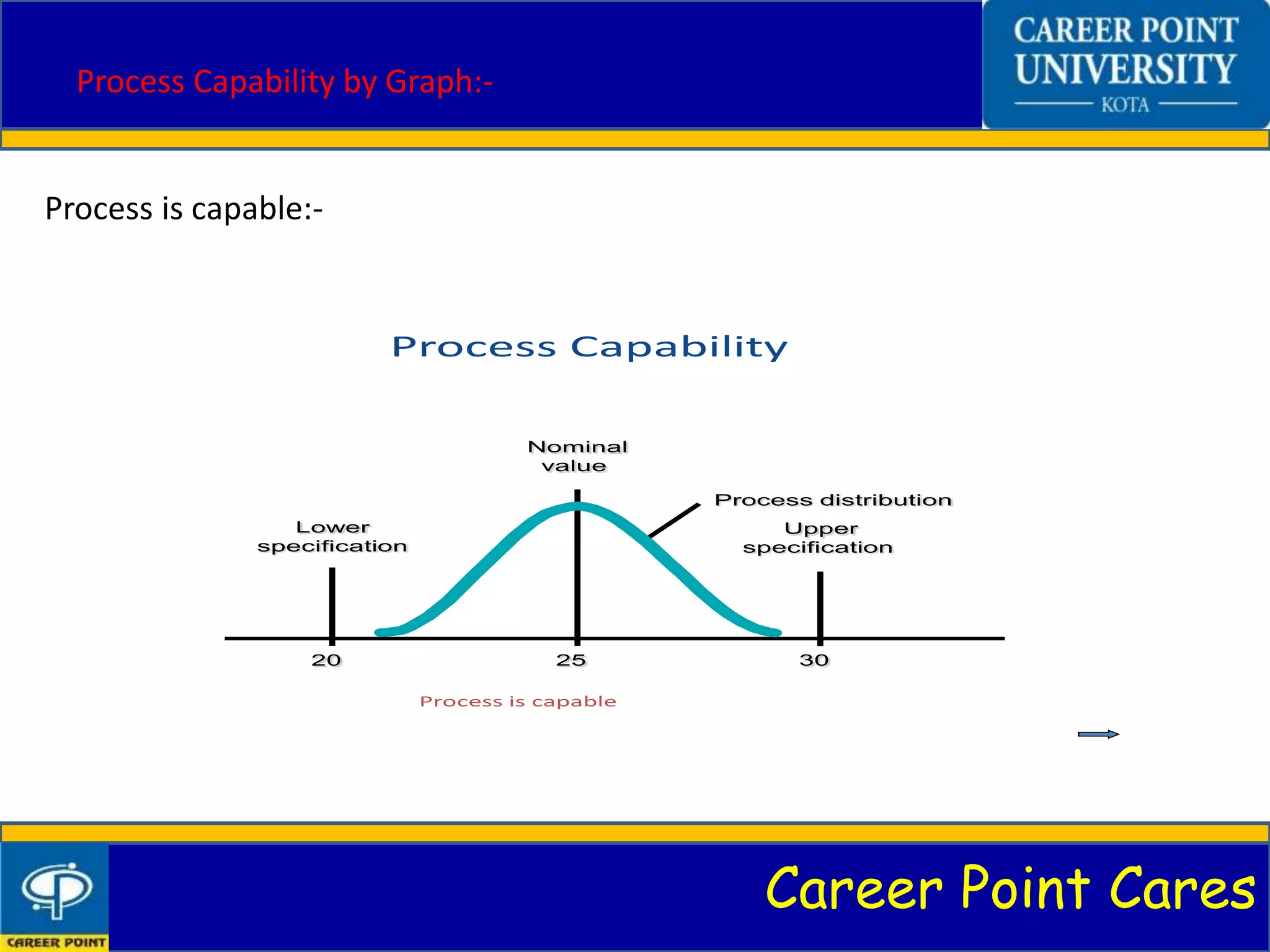
Process Capability by Graph:-
Process is capable:-
20 25 30
Upper
specification
Lower
specification
Nominal
value
Process Capability
Process is capable
Process distribution
Career Point Cares
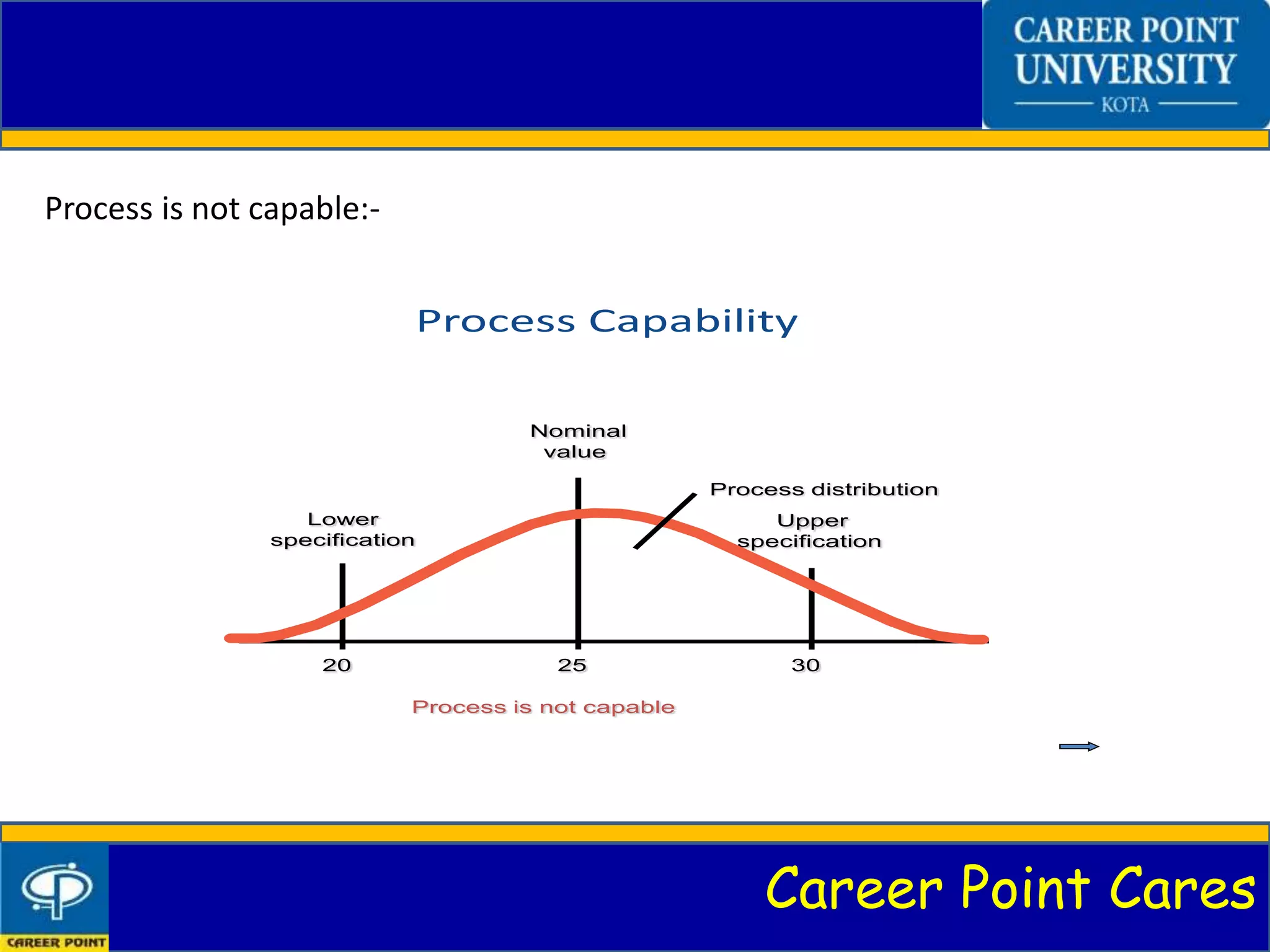
Process is not capable:-
Process is not capable
20 25 30
Upper
specification
Lower
specification
Nominal
value
Process distribution
Process Capability
Career Point Cares
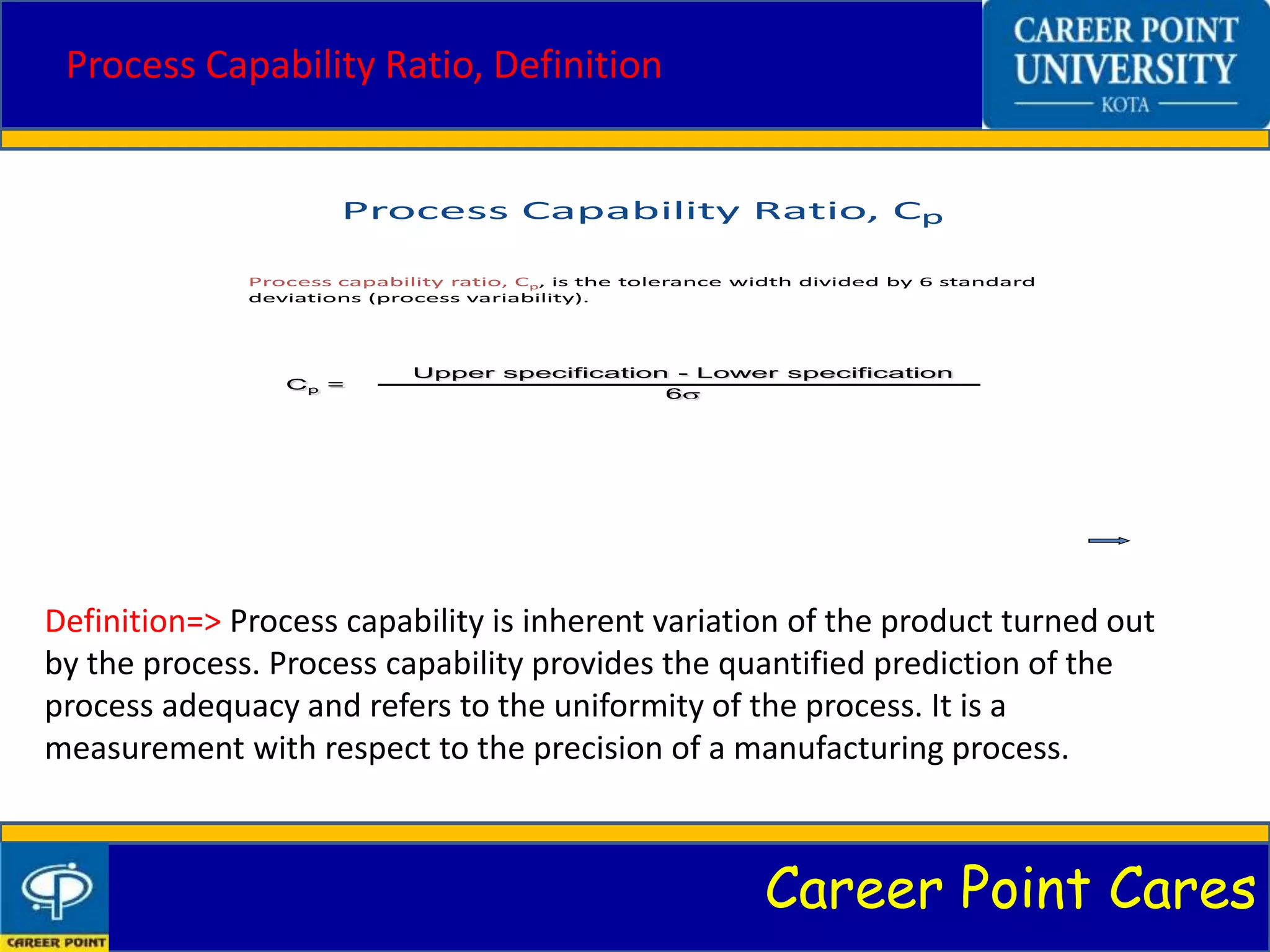
Process capability ratio, Cp, is the tolerance width divided by 6 standard
deviations (process variability).
Process Capability Ratio, Cp
Cp =
Upper specification - Lower specification
6
Process Capability Ratio, Definition
Definition=> Process capability is inherent variation of the product turned out
by the process. Process capability provides the quantified prediction of the
process adequacy and refers to the uniformity of the process. It is a
measurement with respect to the precision of a manufacturing process.
Career Point Cares
Principle of Process Capability:-
· Predicting the extent of variability that process will
exhibit.
· Capability information helps designers to set realistic
specifications limits.
· Planning the interrelationship of sequential process.
· Selecting between the competing vendors.
· Reducing the variability of the manufacturing process
Career Point Cares
Methods:-
1. Analytical method of measuring process capability:
The capability of a manufacturing process is measured
through process capability ratios. These ratios are evaluated
and tested with respect to the process centering. The
process capability ratios are tested with confidence
intervals. Hypothesis about the process capability ratio is
carried out to demonstrate whether process capability ratio,
Cp meets or exceeds the target value.
Career Point Cares
2.Process Capability Ratios (PCR) and Equations:-
The assessment of process capability analysis is done through computations
of various process capability ratios. It is frequently convenient to have a
quantitative way to express process capability. One way to do so is through
the process capability ratio. This measures the ability of process to
manufacture product that meets specification.
Process capability ratio (pcr) = Cp = (USL – LSL)/6M
Where; USL = upper specification limit
LSL= lower specification limit
M = process standard deviation..
Career Point Cares
Advantages / Dis-advantages of process capability:-
Advantages:-
1. It is used for big companies how made product.
2. It is used for big scale map of companies.
3.It is used for product is capable or not.
4. It is uses for product service are good or not.
Dis-advantages:-
1.It is used for big companies because of big companies are made product &
by this company check product is capable or not.
2.By, this company checks service & capability.
Career Point Cares
Control Charts
Two types of error are possible with control
charts
• A type I error occurs when a process is
thought to be out of control when in fact
it is not
• A type II error occurs when a process is
thought to be in control when it is
actually out of statistical control
These errors can be controlled by the choice
of control limits
Career Point Cares
Conclusion
The results of process capability study of the given manufacturing process
reveal that, graphical values of parameters approaches very nearer to the
magnitude of the analytical values and hence graphical approach could be
treated as equivalent to analytical method.
Graphical approach can be used to study the variability of manufacturing
process. It is one of the tools to convey the results through which it is easy to
make inference on the data. The approach helps a worker in the shop floor
can make the assessment about the process parameters. Thus it also helps to
process management and identifies opportunities for improving quality and
operational performance.
Career Point Cares
References
[1] P. D. Chow and K. L. Wang, ―A new AC technique for accurate
determination of channel charge and mobility in very thin gate MOSFETs,‖
IEEE Trans. Electron Devices, vol. ED-33, no. 9, pp. 1299–1304, Sep. 1986
[2] J. Koomen, ―Investigation of the MOST channel conductance in weak
inversion,‖ Solid State Electron., vol. 16, no. 7, pp. 801–810, 1973.
[3] Z. Ji, J. F. Zhang, W. Zhang, G. Groeseneken, L. Pantisano, S. De
Gendt, and M. M. Heyns, ―An assessment of the mobility degradation
induced by remote charge scattering,‖ Appl. Phys. Lett., vol. 95, no. 26, pp.
263 502– 263 503, 2009.
[4] R. Chau, S. Datta, M. Doczy, B. Doyle, J. Kavalieros, and M. Metz,
―High-kappa/metal-gate stack and its MOSFET characteristics,‖ IEEE
Electron Device Lett., vol. 25, no. 6, pp. 408–410, Jun. 2004.
Process capability

Process capability

  • 1.
    Career Point Cares PROCESSCAPABILITY MAJOR ASINGNMENT
  • 2.
    Career Point Cares content INTRODUCTION  WHY STUDY PROCESS CAPABILITY  ABOUT PROCESS CAPABILITY  POCESS CAPABILITY BY GRAPH  PRINCIPLE OF PROCESS CAPABILITY  METHODS OF PROCESS CAPABILITY  REFERENCES  THANKYOU SLIDE
  • 3.
    Career Point Cares Introduction Whystudy process capability Process capability studies provide a baseline for us to how to understand the process is operating relative to the specifications. It is the first, thorough look at how variability is affecting the process, and gives us Metris for quantifying that variability. Such studies also provide information regarding what the process could do under best conditions, and thus give a performance target to shoot for.
  • 4.
    Career Point Cares ProcessCapability The main objectives of process management are to prevent the defects and to minimize the variability in manufacturing process. To reduce the variability it needs to establish the relationship between process variable and product results. Even though product meets the specification limits and the process is in the state of control, the actions may be initiated to Quantify and further reducing the process variability to gain marvelous advantages. The statistical techniques can be used to quantify the variability of the manufacturing process. The Process capability analysis helps in quantifying the process variability and assists Manufacturing by eliminating or greatly reducing the variability.
  • 5.
    Career Point Cares ProcessCapability by Graph:- Process is capable:- 20 25 30 Upper specification Lower specification Nominal value Process Capability Process is capable Process distribution
  • 6.
    Career Point Cares Processis not capable:- Process is not capable 20 25 30 Upper specification Lower specification Nominal value Process distribution Process Capability
  • 7.
    Career Point Cares Processcapability ratio, Cp, is the tolerance width divided by 6 standard deviations (process variability). Process Capability Ratio, Cp Cp = Upper specification - Lower specification 6 Process Capability Ratio, Definition Definition=> Process capability is inherent variation of the product turned out by the process. Process capability provides the quantified prediction of the process adequacy and refers to the uniformity of the process. It is a measurement with respect to the precision of a manufacturing process.
  • 8.
    Career Point Cares Principleof Process Capability:- · Predicting the extent of variability that process will exhibit. · Capability information helps designers to set realistic specifications limits. · Planning the interrelationship of sequential process. · Selecting between the competing vendors. · Reducing the variability of the manufacturing process
  • 9.
    Career Point Cares Methods:- 1.Analytical method of measuring process capability: The capability of a manufacturing process is measured through process capability ratios. These ratios are evaluated and tested with respect to the process centering. The process capability ratios are tested with confidence intervals. Hypothesis about the process capability ratio is carried out to demonstrate whether process capability ratio, Cp meets or exceeds the target value.
  • 10.
    Career Point Cares 2.ProcessCapability Ratios (PCR) and Equations:- The assessment of process capability analysis is done through computations of various process capability ratios. It is frequently convenient to have a quantitative way to express process capability. One way to do so is through the process capability ratio. This measures the ability of process to manufacture product that meets specification. Process capability ratio (pcr) = Cp = (USL – LSL)/6M Where; USL = upper specification limit LSL= lower specification limit M = process standard deviation..
  • 11.
    Career Point Cares Advantages/ Dis-advantages of process capability:- Advantages:- 1. It is used for big companies how made product. 2. It is used for big scale map of companies. 3.It is used for product is capable or not. 4. It is uses for product service are good or not. Dis-advantages:- 1.It is used for big companies because of big companies are made product & by this company check product is capable or not. 2.By, this company checks service & capability.
  • 12.
    Career Point Cares ControlCharts Two types of error are possible with control charts • A type I error occurs when a process is thought to be out of control when in fact it is not • A type II error occurs when a process is thought to be in control when it is actually out of statistical control These errors can be controlled by the choice of control limits
  • 13.
    Career Point Cares Conclusion Theresults of process capability study of the given manufacturing process reveal that, graphical values of parameters approaches very nearer to the magnitude of the analytical values and hence graphical approach could be treated as equivalent to analytical method. Graphical approach can be used to study the variability of manufacturing process. It is one of the tools to convey the results through which it is easy to make inference on the data. The approach helps a worker in the shop floor can make the assessment about the process parameters. Thus it also helps to process management and identifies opportunities for improving quality and operational performance.
  • 14.
    Career Point Cares References [1]P. D. Chow and K. L. Wang, ―A new AC technique for accurate determination of channel charge and mobility in very thin gate MOSFETs,‖ IEEE Trans. Electron Devices, vol. ED-33, no. 9, pp. 1299–1304, Sep. 1986 [2] J. Koomen, ―Investigation of the MOST channel conductance in weak inversion,‖ Solid State Electron., vol. 16, no. 7, pp. 801–810, 1973. [3] Z. Ji, J. F. Zhang, W. Zhang, G. Groeseneken, L. Pantisano, S. De Gendt, and M. M. Heyns, ―An assessment of the mobility degradation induced by remote charge scattering,‖ Appl. Phys. Lett., vol. 95, no. 26, pp. 263 502– 263 503, 2009. [4] R. Chau, S. Datta, M. Doczy, B. Doyle, J. Kavalieros, and M. Metz, ―High-kappa/metal-gate stack and its MOSFET characteristics,‖ IEEE Electron Device Lett., vol. 25, no. 6, pp. 408–410, Jun. 2004.