POST-LINTEL STRUCTURE
STRUCTURAL METHOD
POST-LINTEL STRUCTURE
POST-SLAB STRUCTURE
WALL SLAB STRUCTURE
STEEL STRUCTURE
COMPOSITE STRUCTURE
POST & LINTEL
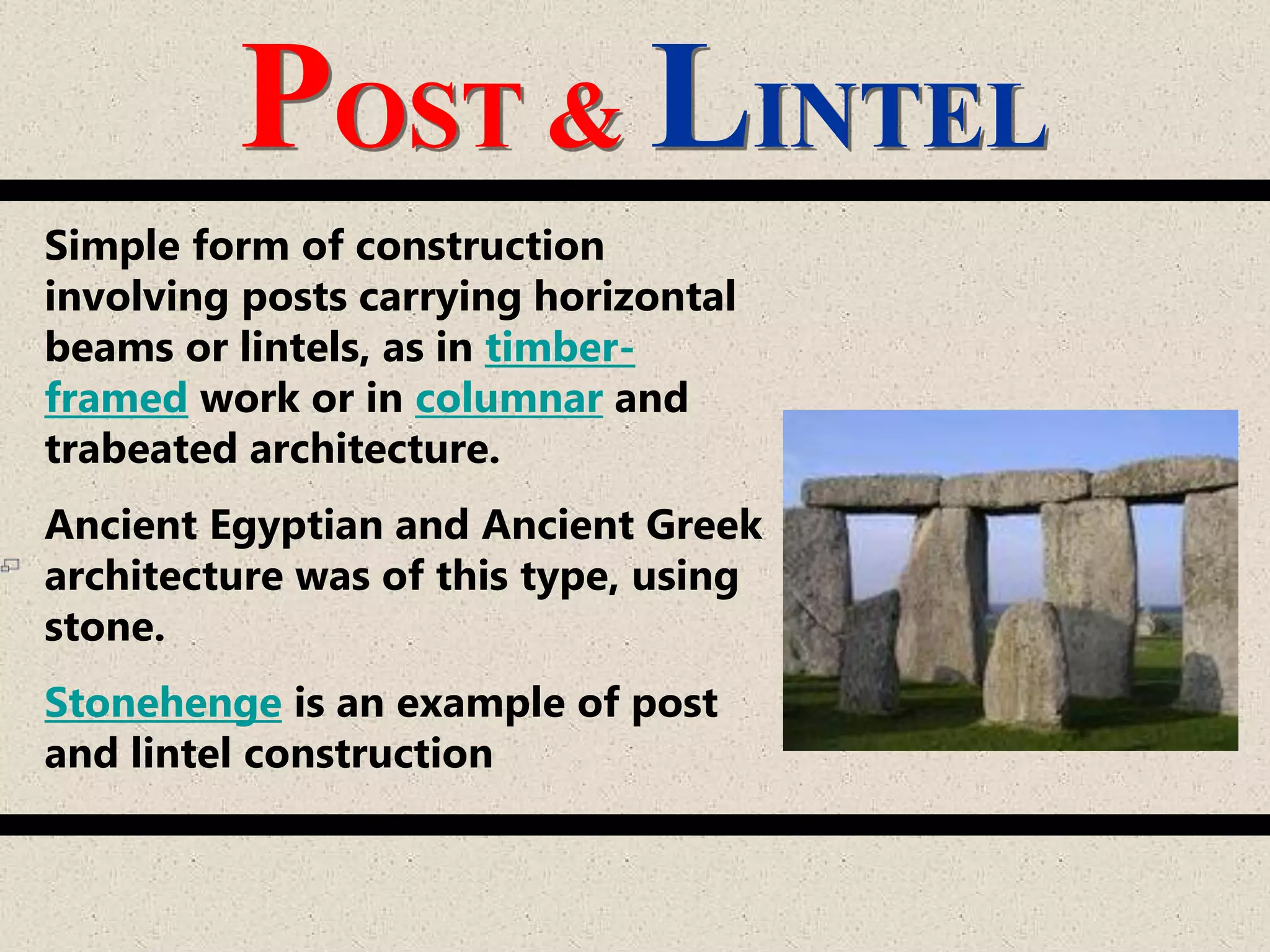
Simple form of construction
involving posts carrying horizontal
beams or lintels, as in timber-
framed work or in columnar and
trabeated architecture.
Ancient Egyptian and Ancient Greek
architecture was of this type, using
stone.
Stonehenge is an example of post
and lintel construction
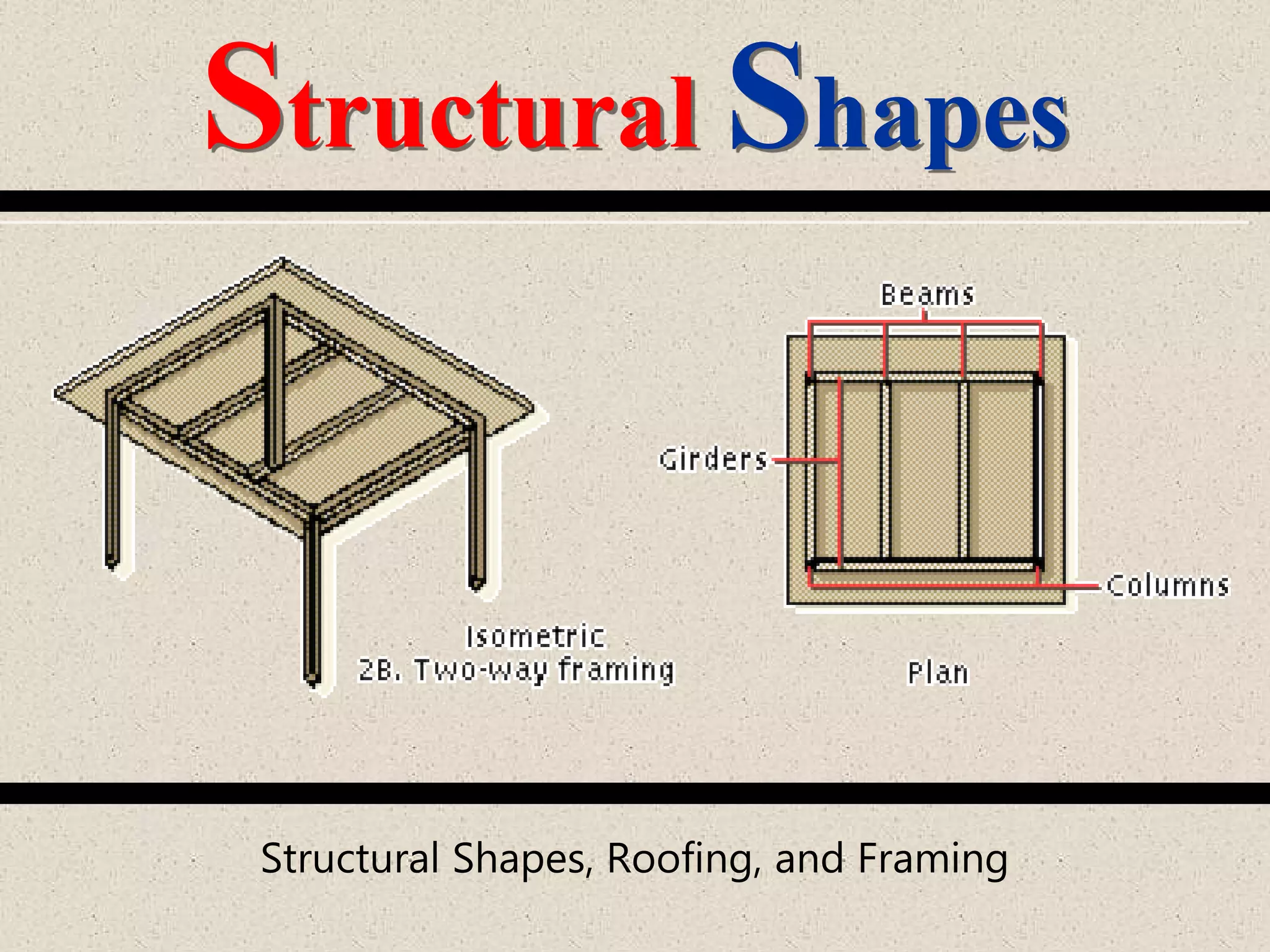
Structural Shapes
Structural Shapes, Roofing, and Framing
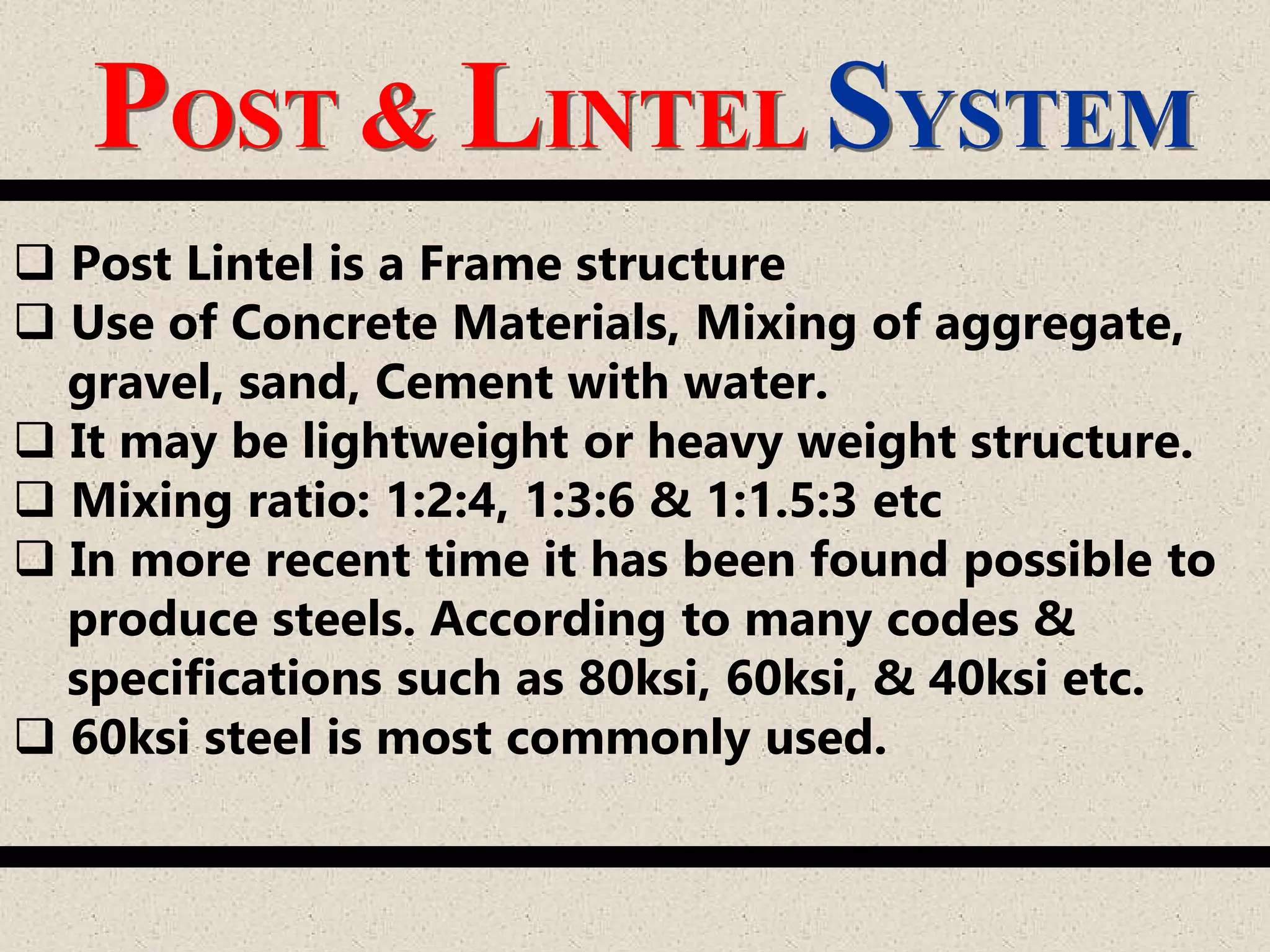
POST & LINTEL SYSTEM
 Post Lintel is a Frame structure
 Use of Concrete Materials, Mixing of aggregate,
gravel, sand, Cement with water.
 It may be lightweight or heavy weight structure.
 Mixing ratio: 1:2:4, 1:3:6 & 1:1.5:3 etc
 In more recent time it has been found possible to
produce steels. According to many codes &
specifications such as 80ksi, 60ksi, & 40ksi etc.
 60ksi steel is most commonly used.
FOUNDATION
The foundation is the part of a structure
that is usually placed below the surface
of the ground & that transmits the load
to the underlying soil or rock.
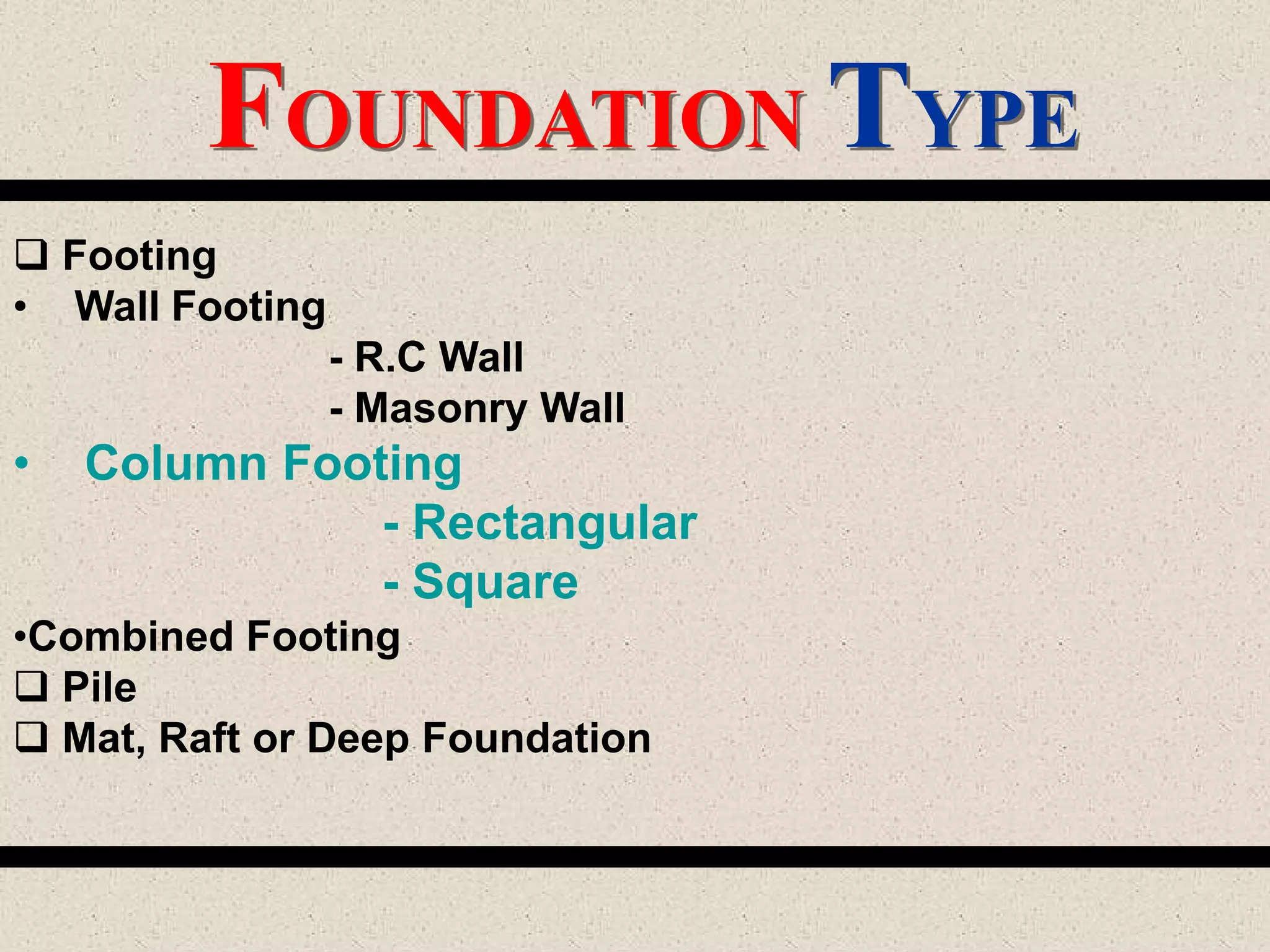
FOUNDATION TYPE
 Footing
• Wall Footing
- R.C Wall
- Masonry Wall
• Column Footing
- Rectangular
- Square
•Combined Footing
 Pile
 Mat, Raft or Deep Foundation
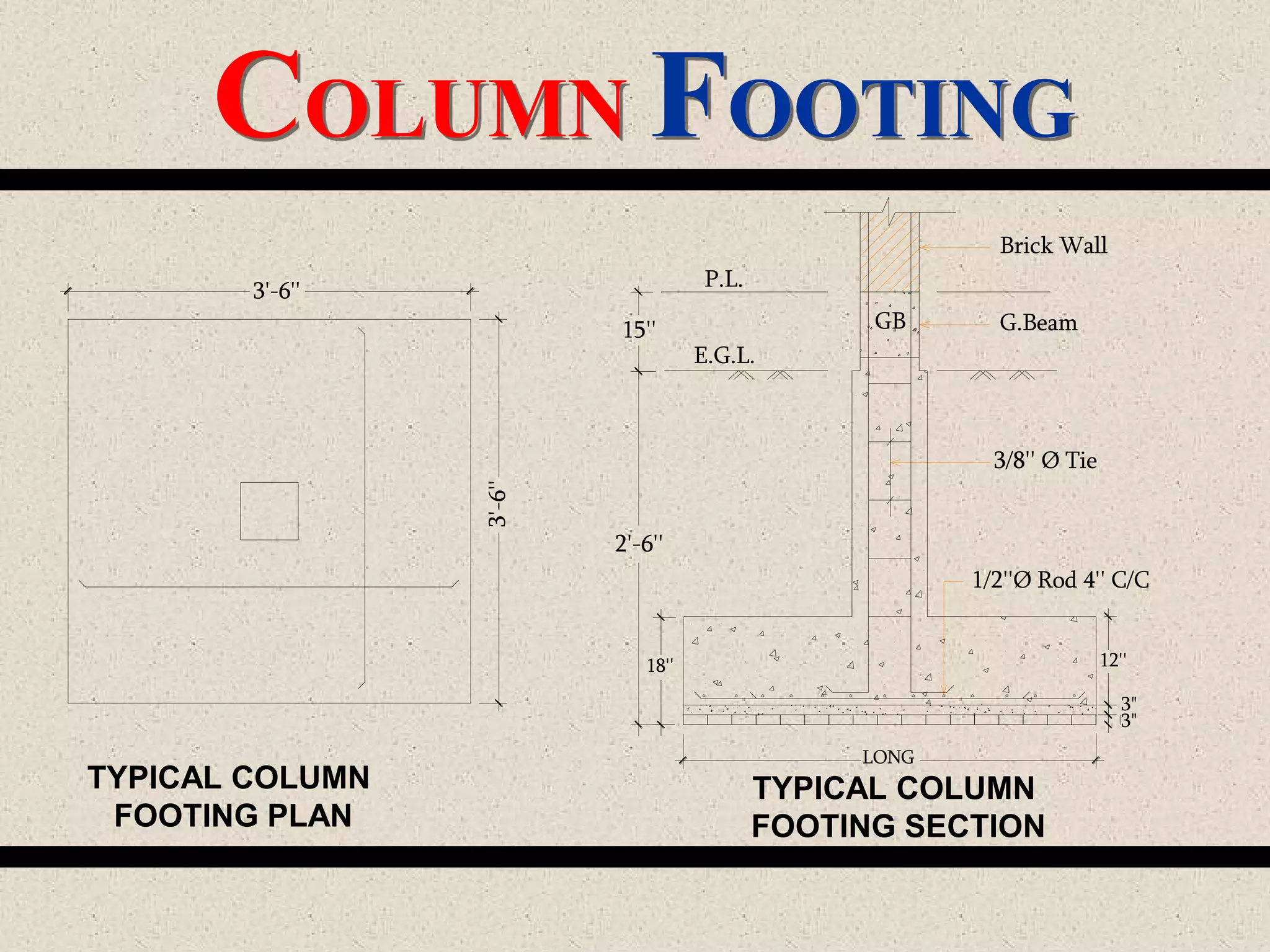
COLUMN FOOTING
1/2''Ø Rod 4'' C/C
3/8'' Ø Tie
G.Beam
Brick Wall
LONG
GB
3"
3"
P.L.
E.G.L.
18''
2'-6''
15''
12''
3'-6''
3'-6''
TYPICAL COLUMN
FOOTING PLAN
TYPICAL COLUMN
FOOTING SECTION
COLUMN
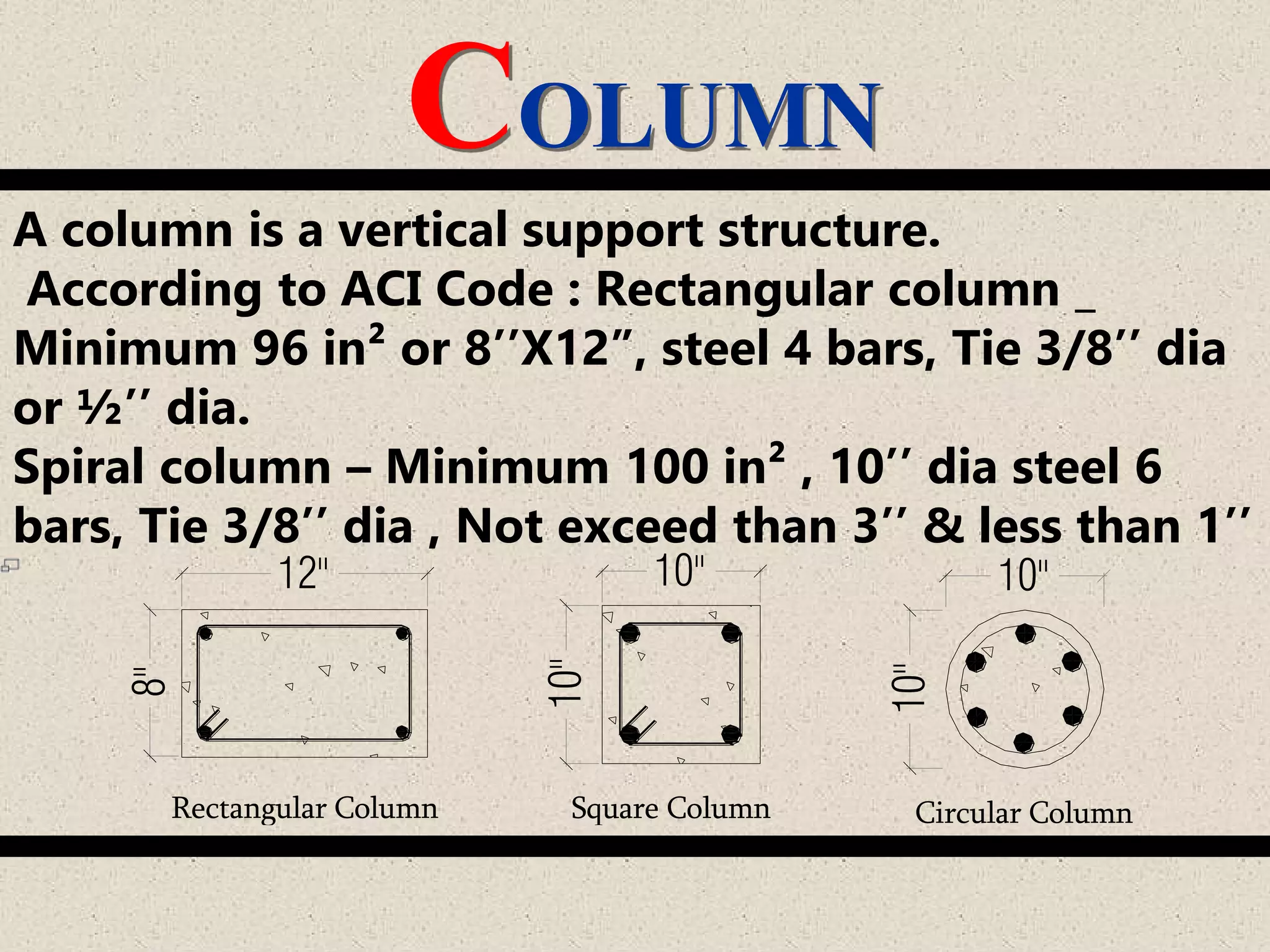
A column is a vertical support structure.
According to ACI Code : Rectangular column _
Minimum 96 in² or 8’’X12”, steel 4 bars, Tie 3/8’’ dia
or ½’’ dia.
Spiral column – Minimum 100 in² , 10’’ dia steel 6
bars, Tie 3/8’’ dia , Not exceed than 3’’ & less than 1’’
Circular Column
10''
10''10'' 10''
8''
12''
Rectangular Column Square Column
ECONOMICAL COLUMN
SPAN
COLUMN SIZE
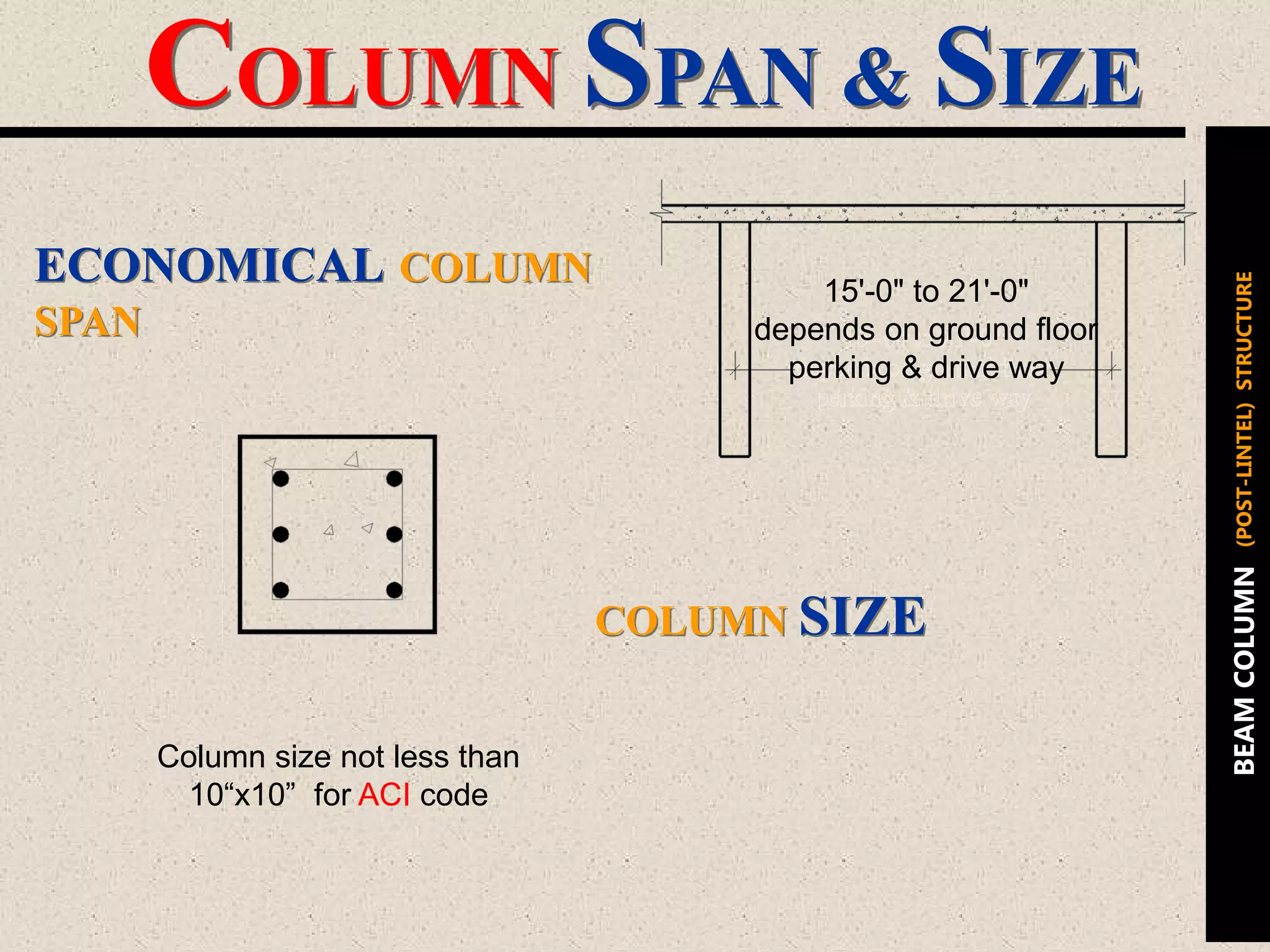
Column size not less than
10“x10” for ACI code
15'-0" to 21'-0"
depends on ground floor
perking & drive way
BEAMCOLUMN(POST-LINTEL)STRUCTURE
COLUMN SPAN & SIZE
DOUBLE HEIGHT COLUMN THICKNESS
POST-LINTESTRUCTURE
Double height column depends on slender test of
column or effective length of column buckling For
member with h/t up to 10 (approximately h/r up to
35) For column with h/t = 20 (approximately h/r up
to 70) R became 0.07
Team roll of dabble height column thickness, If
column length is upward for axial load then column
section is enlarge for a column.
BEAM
The beam is a very sturdy structure. A beam is a
horizontal pole. It is usually shaped as a rectangle so
there is more balance between the poles. A beam is
held up by one or two columns. If there are two
columns, they are placed on either side of the beam.
If there is one column, it is placed in the middle of
the beam so each side is balanced. Beams are found
in many places - in buildings, in homes, and in
moving structures.
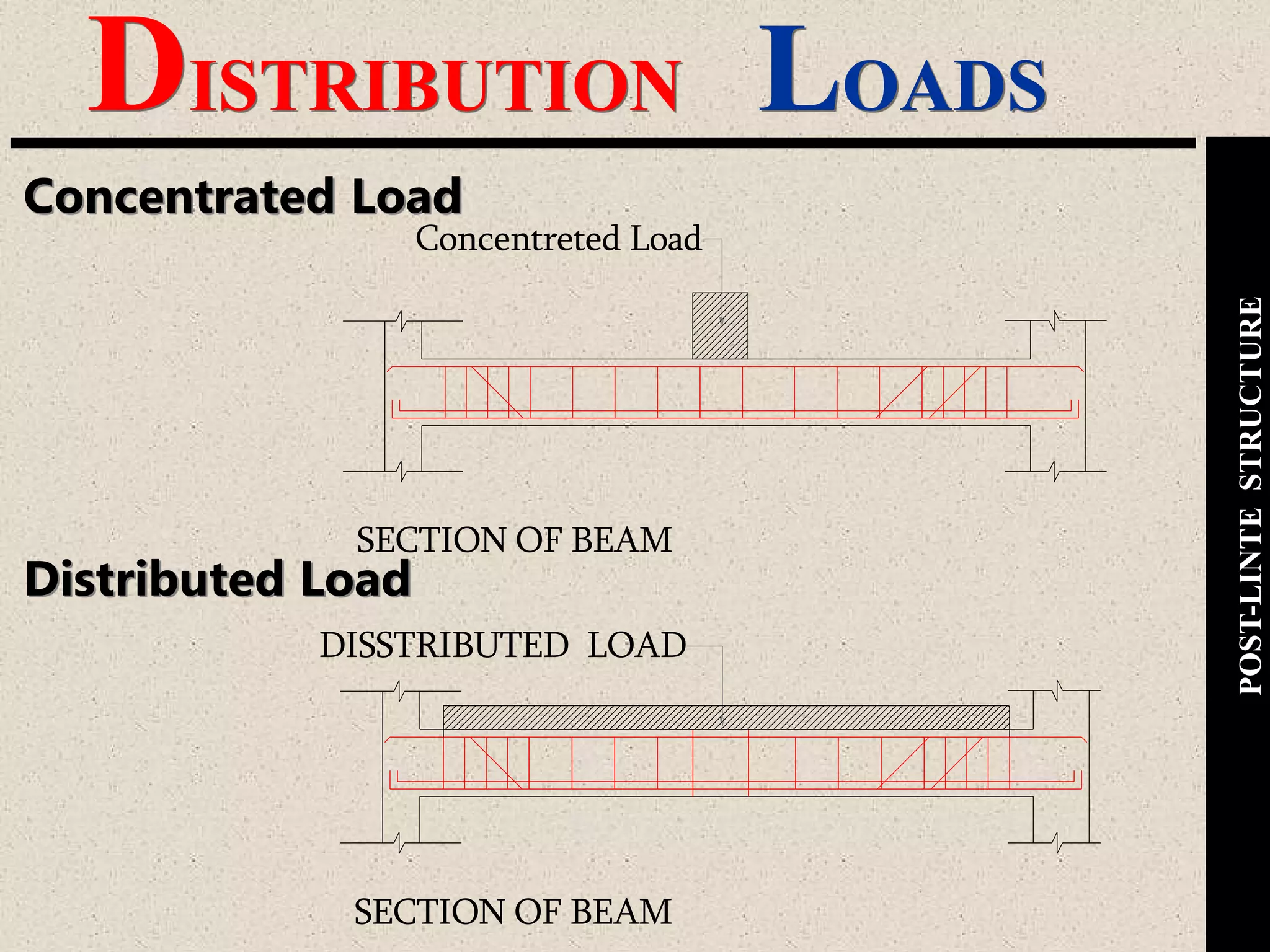
DISTRIBUTION LOADS
POST-LINTESTRUCTURE
Distributed Load
DISSTRIBUTED LOAD
SECTION OF BEAM
Concentreted Load
SECTION OF BEAM
Concentrated Load
BEAM TYPES
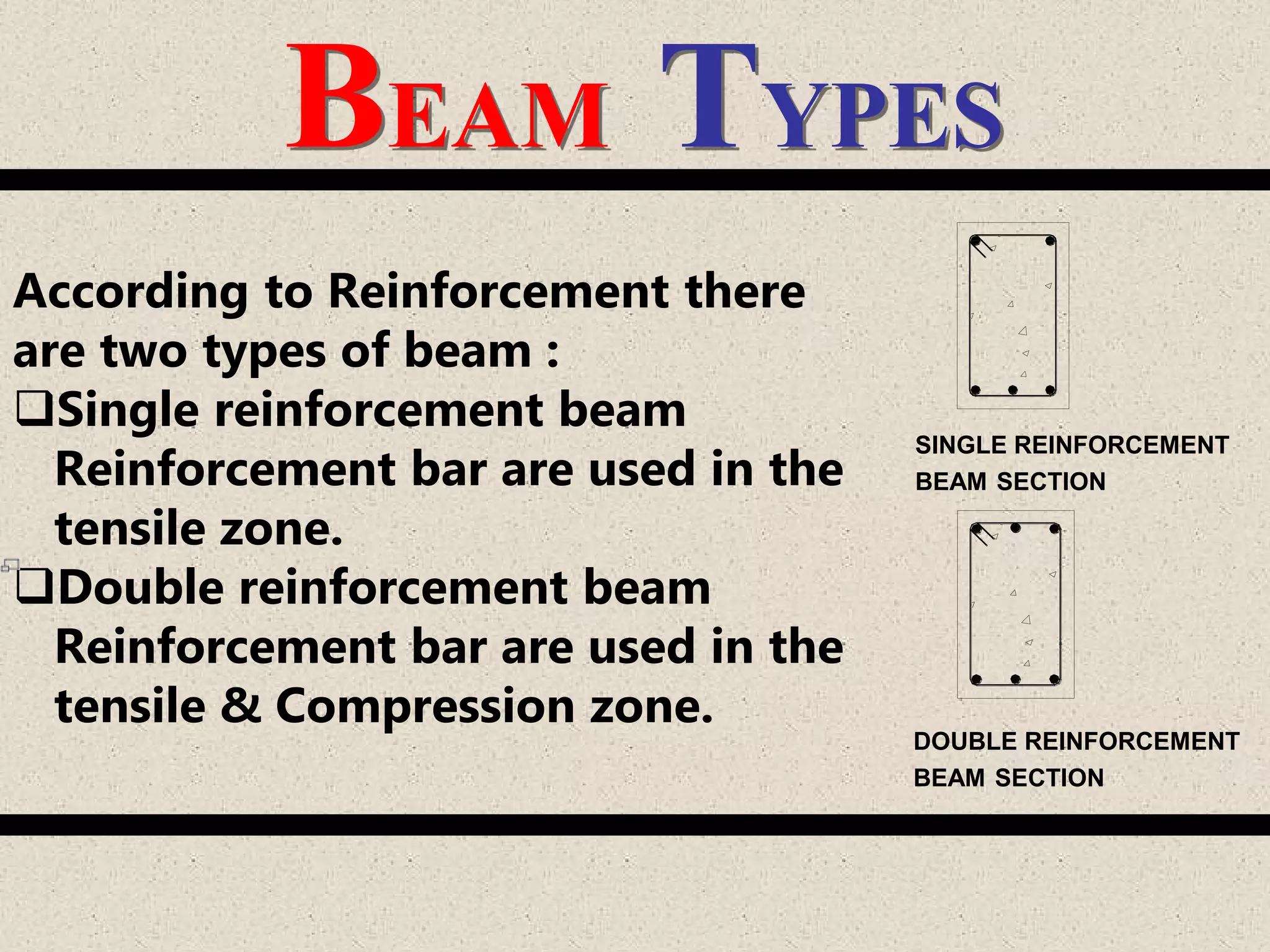
According to Reinforcement there
are two types of beam :
Single reinforcement beam
Reinforcement bar are used in the
tensile zone.
Double reinforcement beam
Reinforcement bar are used in the
tensile & Compression zone.
SINGLE REINFORCEMENT
BEAM SECTION
DOUBLE REINFORCEMENT
BEAM SECTION
BEAM TYPES
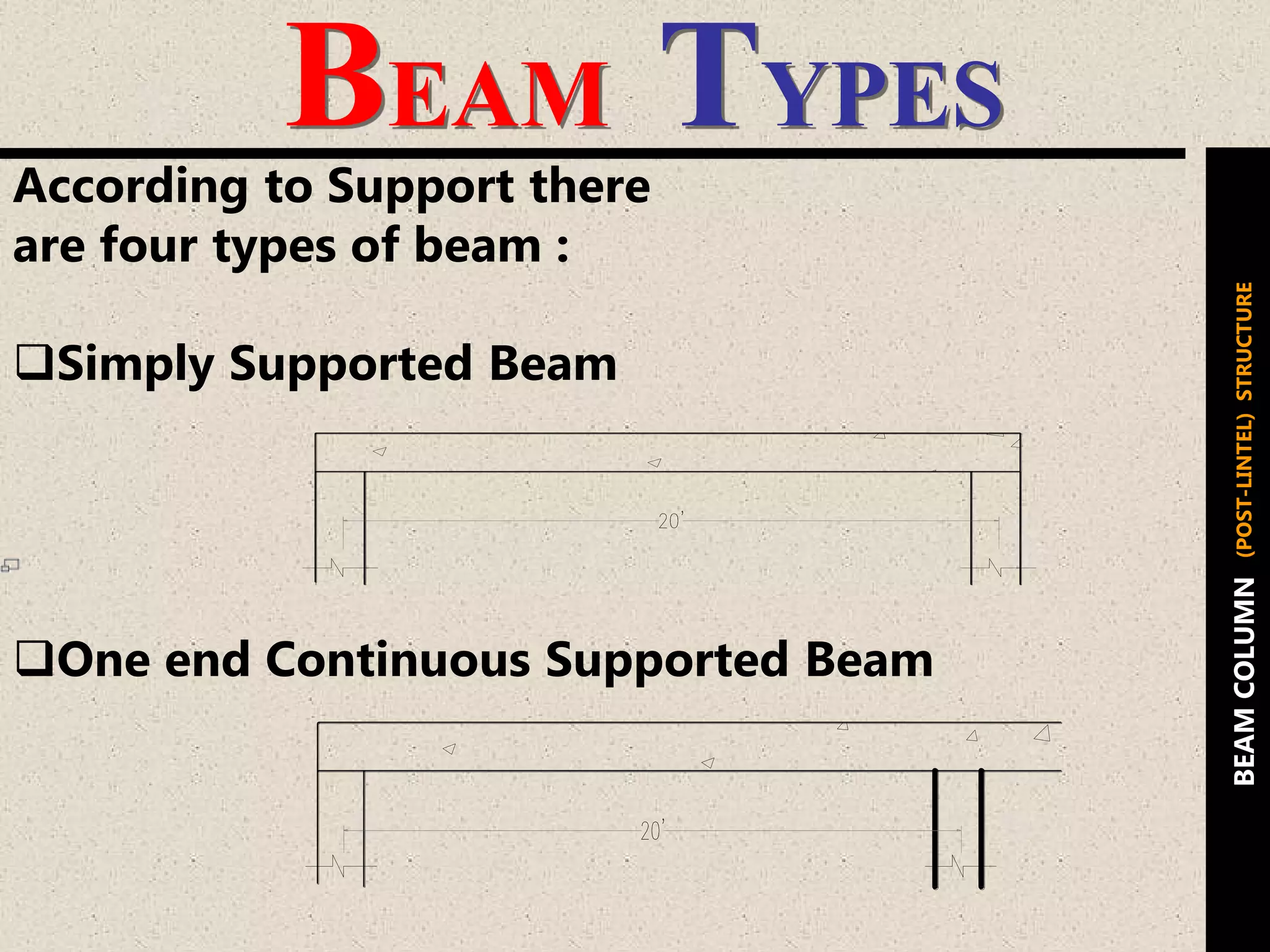
According to Support there
are four types of beam :
Simply Supported Beam
One end Continuous Supported Beam
BEAMCOLUMN(POST-LINTEL)STRUCTURE
BEAM TYPES
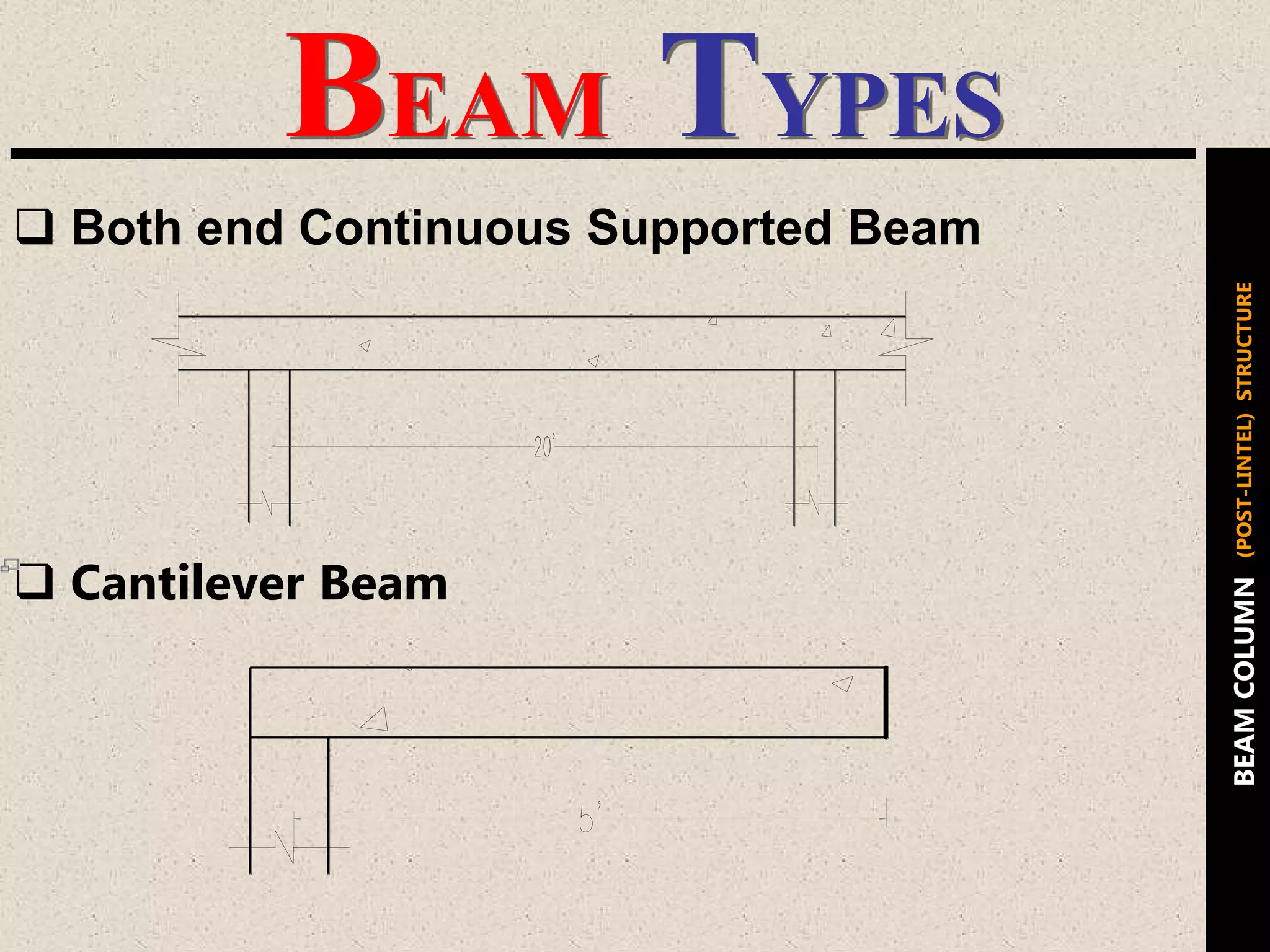
 Both end Continuous Supported Beam
 Cantilever Beam
BEAMCOLUMN(POST-LINTEL)STRUCTURE
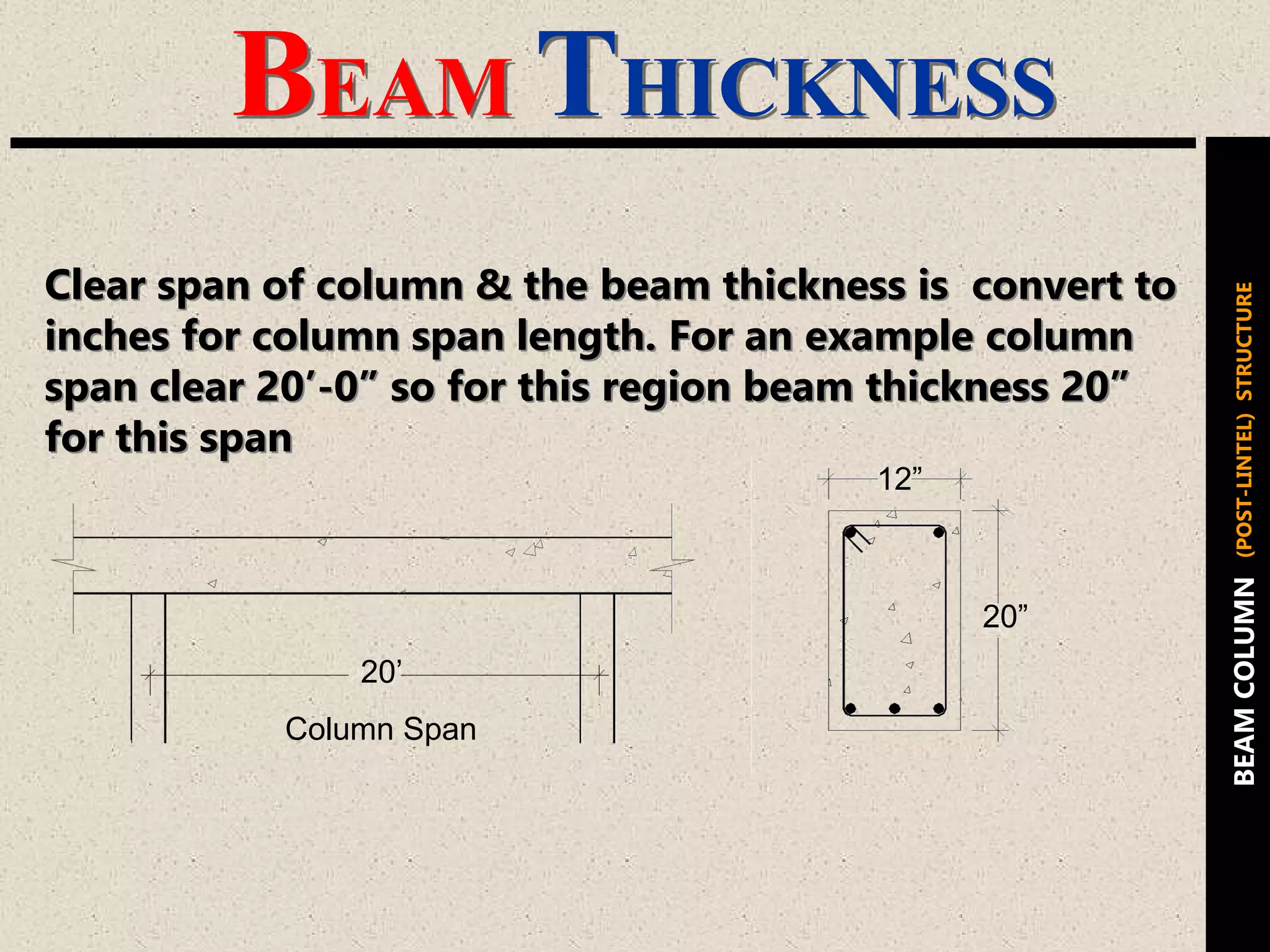
Clear span of column & the beam thickness is convert to
inches for column span length. For an example column
span clear 20’-0” so for this region beam thickness 20”
for this span
BEAMCOLUMN(POST-LINTEL)STRUCTURE
20’
Column Span
12”
20”
BEAM THICKNESS
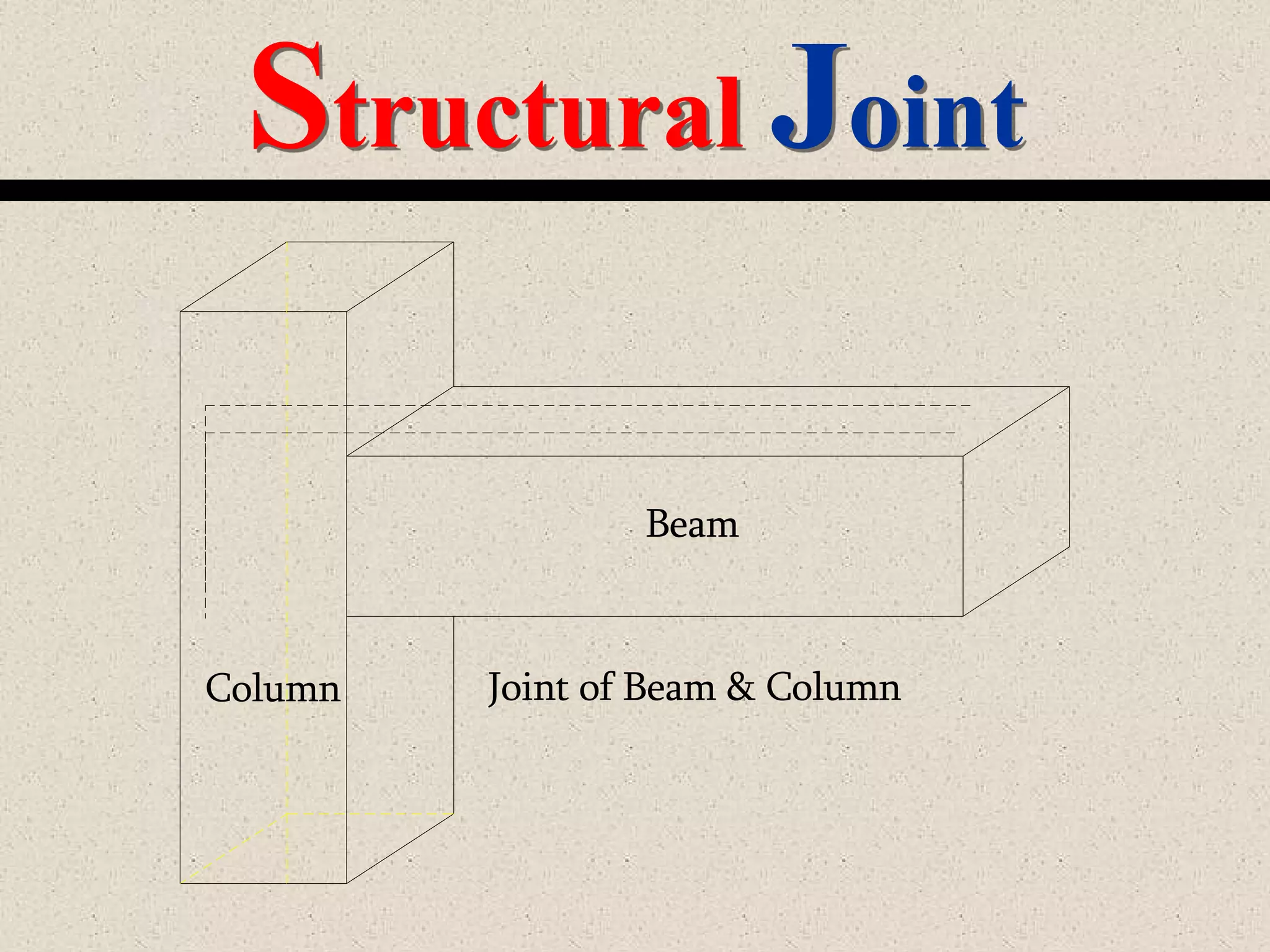
Structural Joint
Joint of Beam & Column
Beam
Column
ECONOMICAL CANTILEVER PORTION
POST-LINTESTRUCTURE
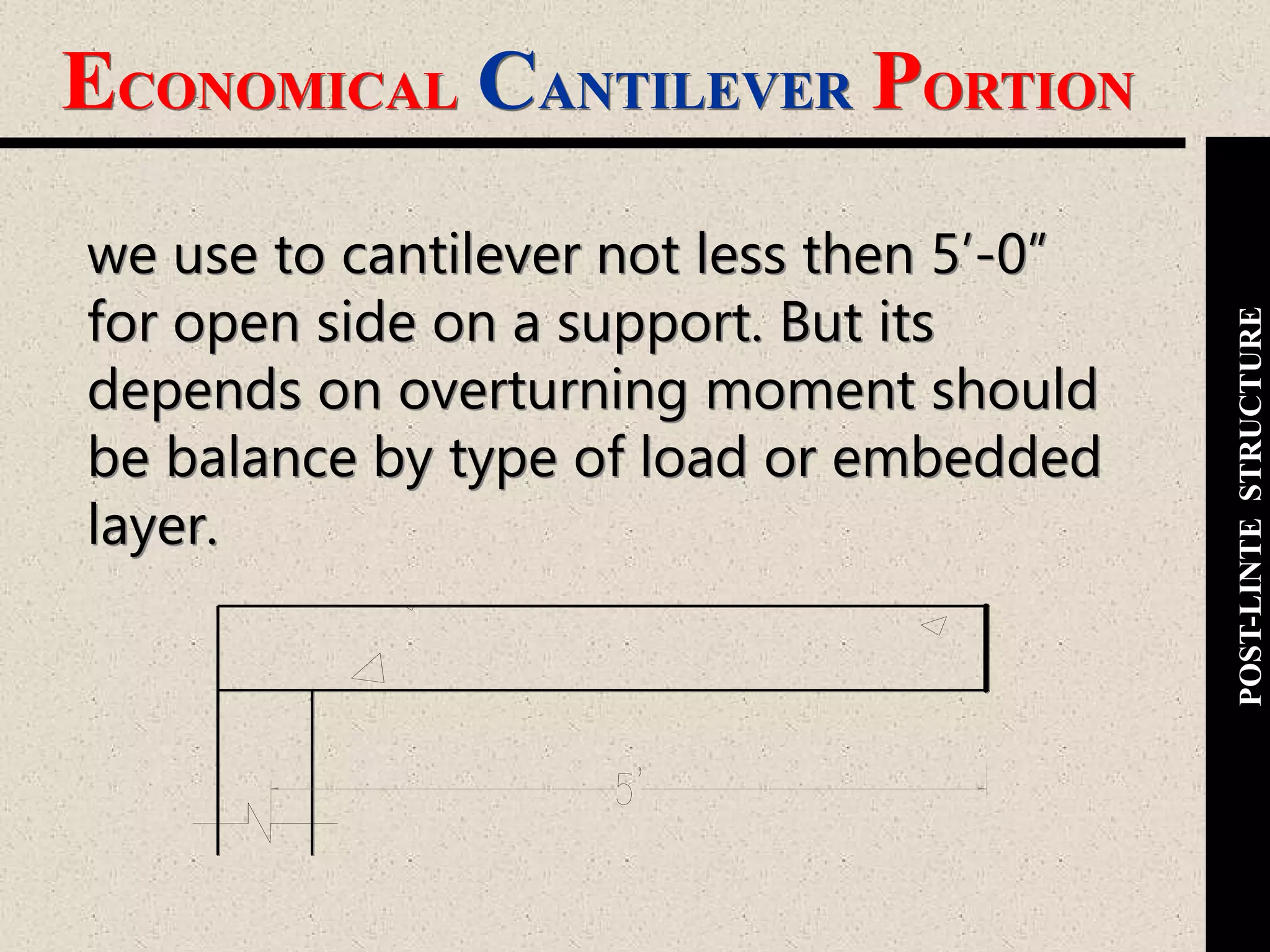
we use to cantilever not less then 5’-0”
for open side on a support. But its
depends on overturning moment should
be balance by type of load or embedded
layer.
POST-LINTE STRUCTURE SLAB
POST-LINTESTRUCTURE
SLAB
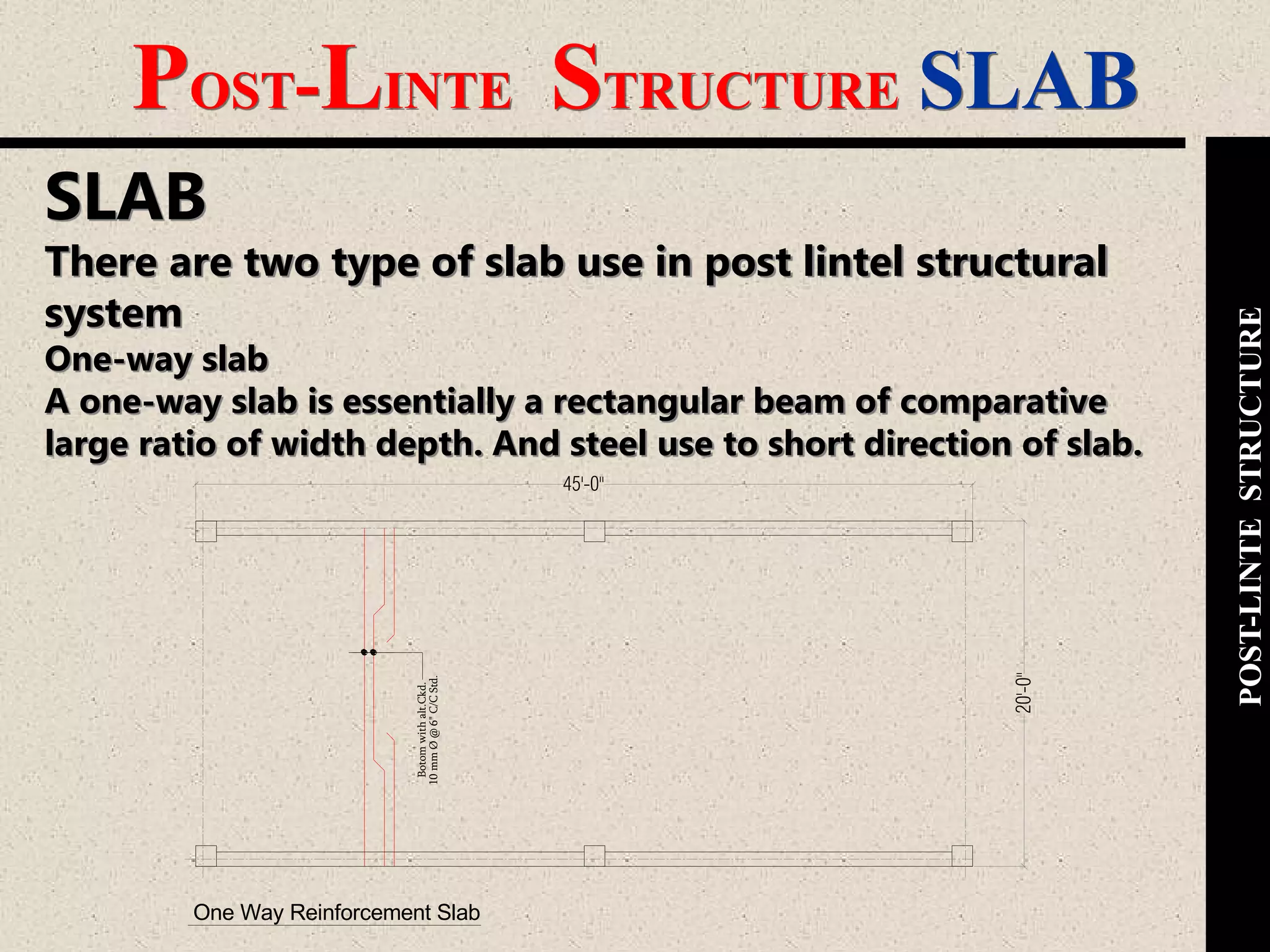
There are two type of slab use in post lintel structural
system
One-way slab
A one-way slab is essentially a rectangular beam of comparative
large ratio of width depth. And steel use to short direction of slab.
One Way Reinforcement Slab
20'-0"
45'-0"
Botomwithalt.Ckd.
10mmØ@6"C/CStd.
POST-LINTE STRUCTURE SLAB
POST-LINTESTRUCTURE
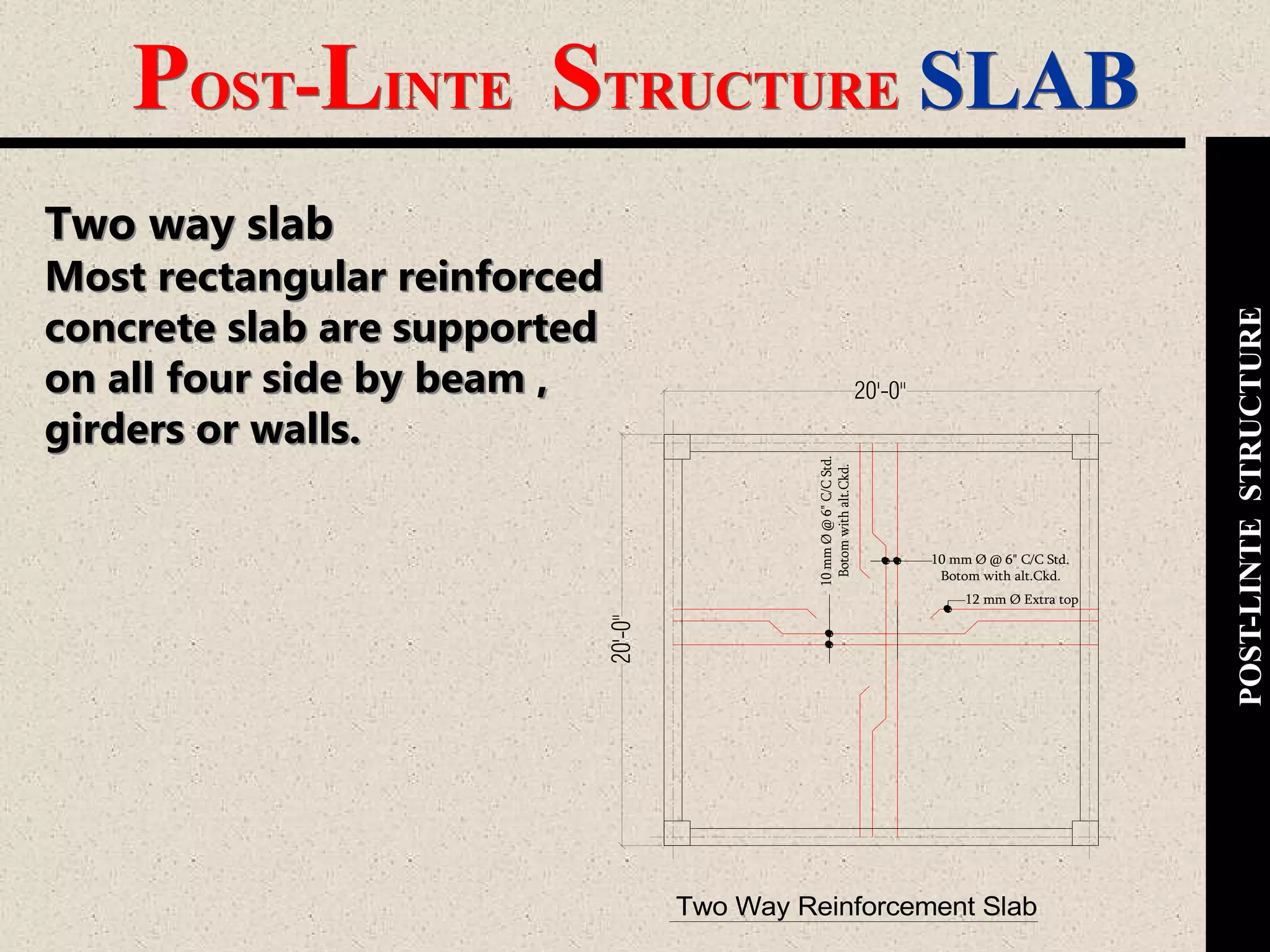
Two way slab
Most rectangular reinforced
concrete slab are supported
on all four side by beam ,
girders or walls.
20'-0"
20'-0"
Botom with alt.Ckd.
10 mm Ø @ 6" C/C Std.
Botomwithalt.Ckd.
10mmØ@6"C/CStd.
12 mm Ø Extra top
Two Way Reinforcement Slab
POST-LINTE STRUCTURE SLAB
POST-LINTESTRUCTURE
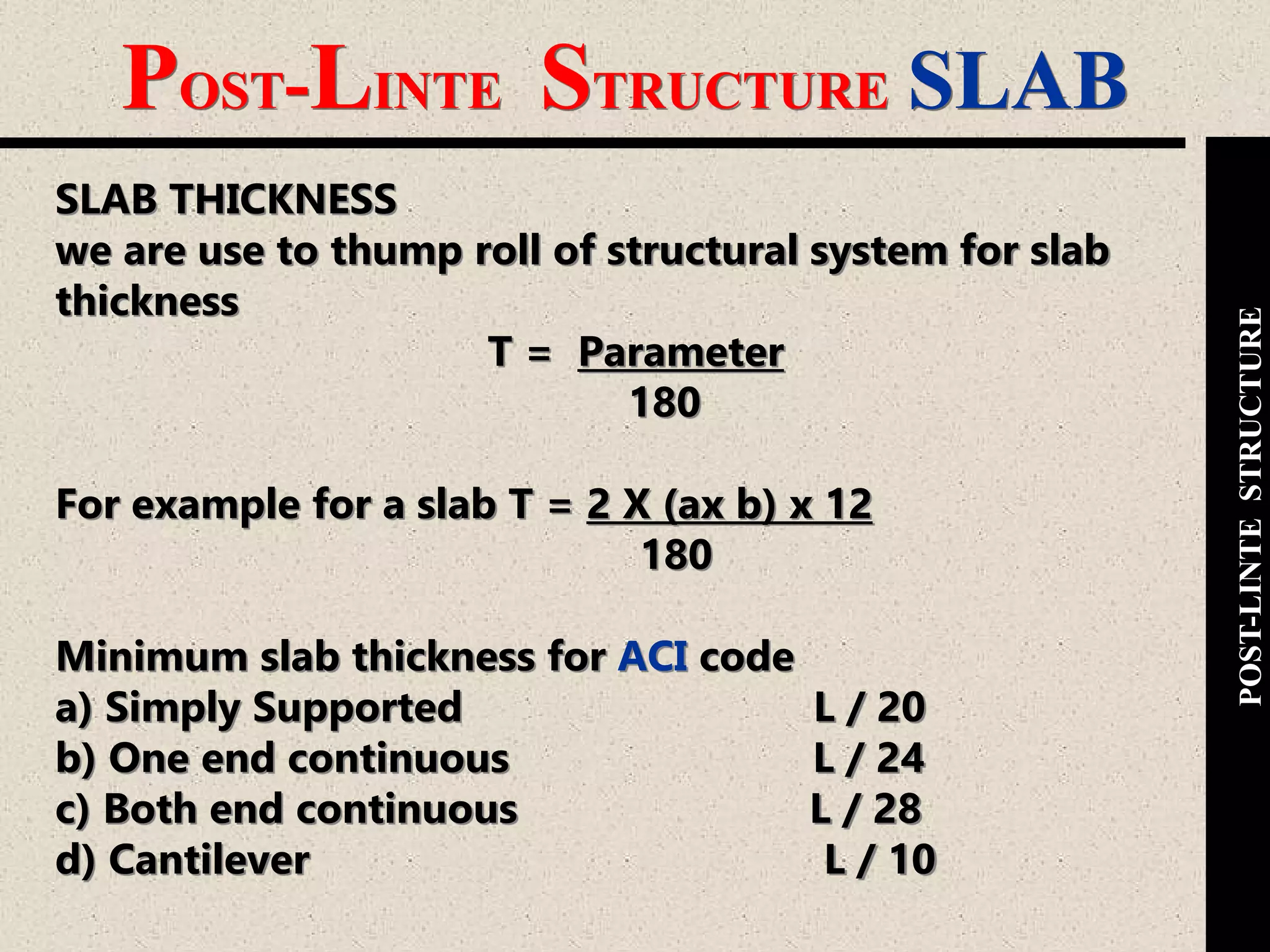
SLAB THICKNESS
we are use to thump roll of structural system for slab
thickness
T = Parameter
180
For example for a slab T = 2 X (ax b) x 12
180
Minimum slab thickness for ACI code
a) Simply Supported L / 20
b) One end continuous L / 24
c) Both end continuous L / 28
d) Cantilever L / 10
STAIR
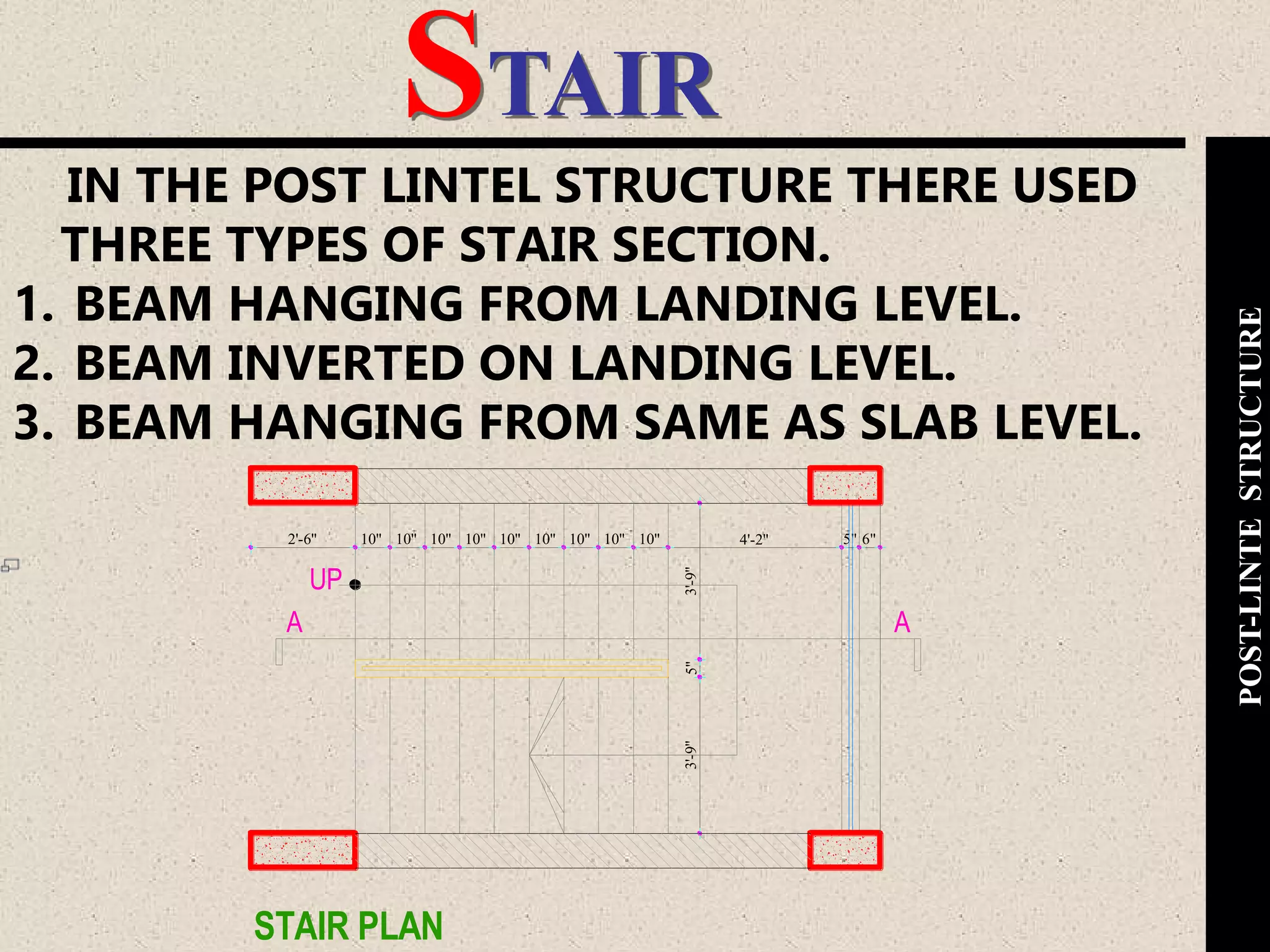
IN THE POST LINTEL STRUCTURE THERE USED
THREE TYPES OF STAIR SECTION.
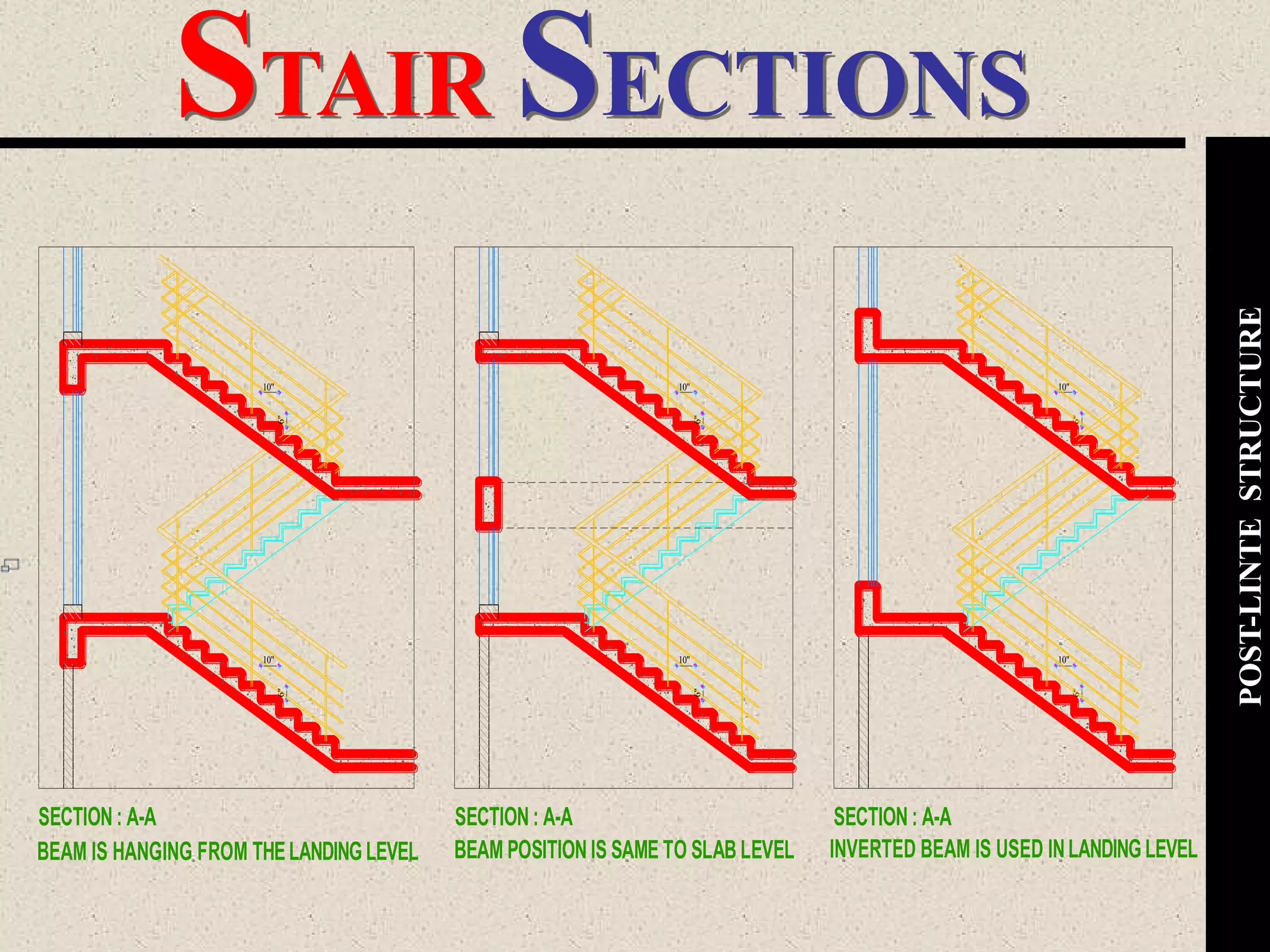
1. BEAM HANGING FROM LANDING LEVEL.
2. BEAM INVERTED ON LANDING LEVEL.
3. BEAM HANGING FROM SAME AS SLAB LEVEL.
POST-LINTESTRUCTURE
3'-9"5"3'-9"
6"5"4'-2"10"10"10"10"10"10"10"10"10"2'-6"
AA
UP
STAIR PLAN
STAIR SECTIONS
POST-LINTESTRUCTURE
10"
6"
10"
6"
SECTION : A-A
INVERTED BEAM IS USED INLANDINGLEVELBEAM IS HANGING FROM THELANDINGLEVEL BEAM POSITION IS SAME TO SLAB LEVEL
SECTION : A-ASECTION : A-A
6"
10"
6"
10"10"
6"
10"
6"
1'-9"1'-0"3"
7'-0"
10'-0"
3'-0"
3'-0"
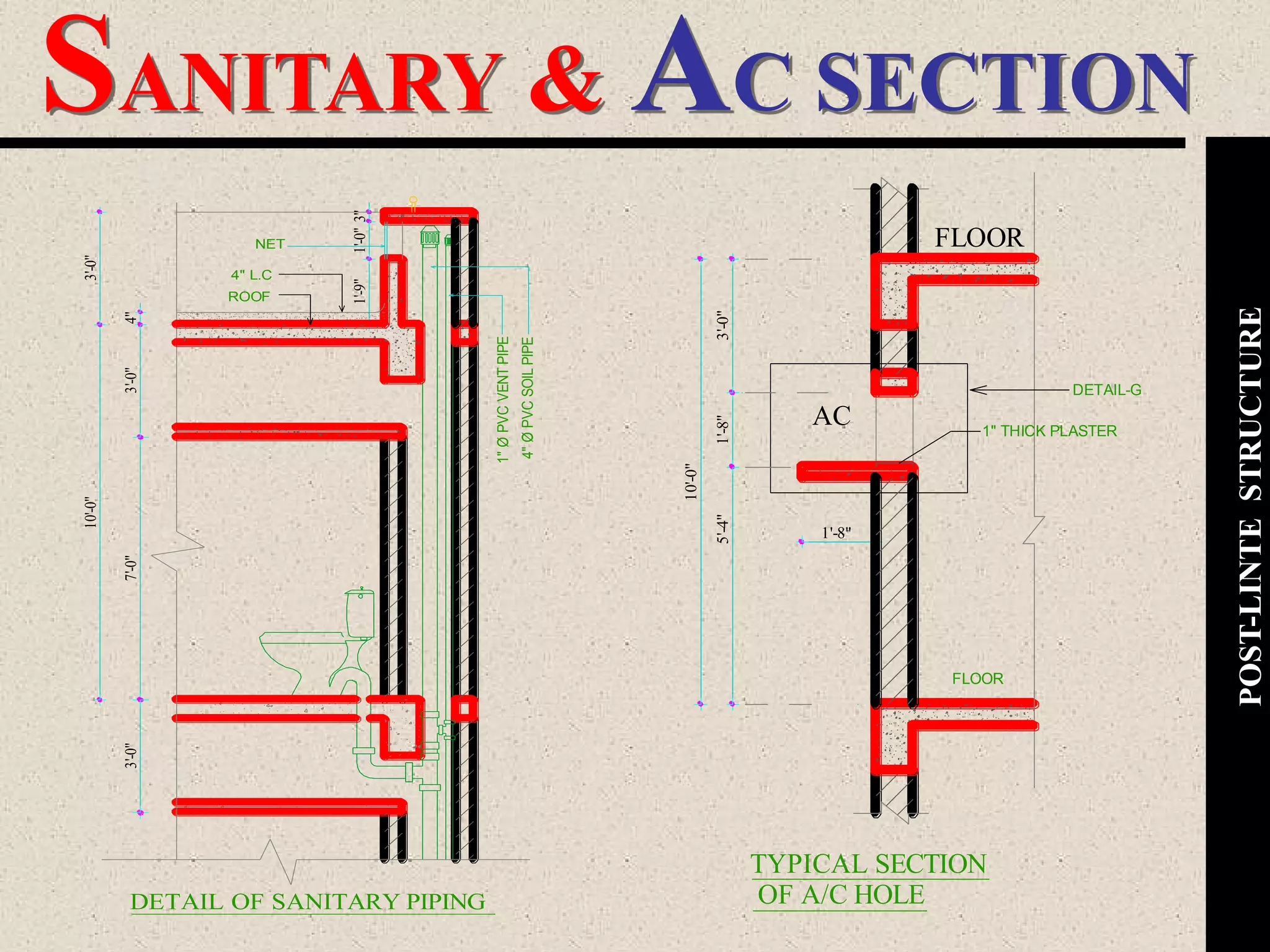
3'-0"4"
ROOF
4" L.C
NET
4"ØPVCSOILPIPE
1"ØPVCVENTPIPE
DETAIL OF SANITARY PIPING
TYPICAL SECTION
OF A/C HOLE
1'-8"
AC
10'-0"
1'-8"
FLOOR
5'-4"3'-0"
FLOOR
DETAIL-G
1" THICK PLASTER
SANITARY & AC SECTION
POST-LINTESTRUCTURE
Post lentil it self a farm structure
Out side exposed
structurally sound
structurally sustainable
usually it is economical
environmentally and earth quick save.
Beam-Column Image of Architecture
BEAMCOLUMN(POST-LINTEL)STRUCTURE
Expression
 Post & lintels are shown as frame
structures. But columns & louvers.
 Solid & void relationship is less.
 The invert beam can be seen from above.
 Presence of continuous beam
 Columns are placed along the age of the
building.
BEAMCOLUMN(POST-LINTEL)STRUCTURE
POST-LINTE ADVANTAGES
POST-LINTESTRUCTURE
AESTHETICS
Aesthetically this structural system seems quite sound by using
the expression of post-lintel structure in the exterior facades.
Sometimes the heavy or rigid masses are treated politely by
using the framework of the post-lintel which gives an extra
ordinary looks.
SPAN & SPACE
Larger span (column to column distance) of building is possible
to design in this system.
For the large span the lintel height become larger for this a large
space seems small, as the lacking of clear height.
Sometimes this problem creates visual disturbance, which is
avoided, in flat slab.
POST-LINTE ADVANTAGES
POST-LINTESTRUCTURE
ECONOMIC
The construction cost of this system is slightly high for the time
consuming casting of beam and slab and the use of R.C.C.
The maintenance cost of this system remains lower than the other
structural system for its long lasting characteristics.
CLIMATE
Considering the climate this system is more suitable for our country.
The admission of heat become reduced in this system, as the heat
transferred from the slab to beam and then from the beam to floor.
The control of openings admits the little amount of heat in the
building.
For the free flowing plan light and ventilation can easily insert the
building.
POST-LINTE ADVANTAGES
POST-LINTESTRUCTURE
ENVIRONMENT
This structural system having less self-loads which reduces the risk of
danger of earth quack.
It can resist the buckling or bending effect of the building from the strong
wind flow.
It has the capability of fire resistance for the construction material (R.C.C.).
So this system is very much suiting with respect to our environment.
CONSTRUCTION TECHNICS
In this structural system construction process takes a long time for the
casting of beam and slab because at first column and beam cast and after
that the slab cast.
High cost materials are used in this system.
In post-lintel system ducting process is not so easier compared to Post-slab.
POST-LINTE ADVANTAGES
POST-LINTESTRUCTURE
OPENNINGS
In post-lintel system 50% area of the external facade is remaining for
the openings of the building. For this there is a control over use of
openings. The admass of light and ventilation is smaller compared to
post-slab.
SUSTAINABILITY
Sustainability means the ultimate capacity of individual members and
as well as the whole structure against any types of overloading such as
cyclones, earth quacks, etc. Sustainability of structures may also
termed as factor of safety because overloading is allowed only up to
the safety level which was taken in considering at the time of design.
Stability of any structure is the critical point of failure. If stability is
not satisfied it limits the values, then the failure may come suddenly.
This system has less possibility of failure than the other structural
system.
POST-LINTE ADVANTAGES
POST-LINTESTRUCTURE
FLOOR SLAB
Floor slab is a slab supported on ground generally distribute load to
the ground uniformly. It also increases the bearing capacity of soil as
the load distributes combined.
SOLID-VOID RATIO
By using the framework of post-lintel system we can make a sense full
solid-void ratio which illuminate the monotonous effect.
CANTILEVER OR OVERHANG
The portion of any structure that is over hanged without any support
termed as cantilever. Sometimes cantilever construction is economical
and looks aesthetically attractive which may become a useful part of
that structure.
Limitation
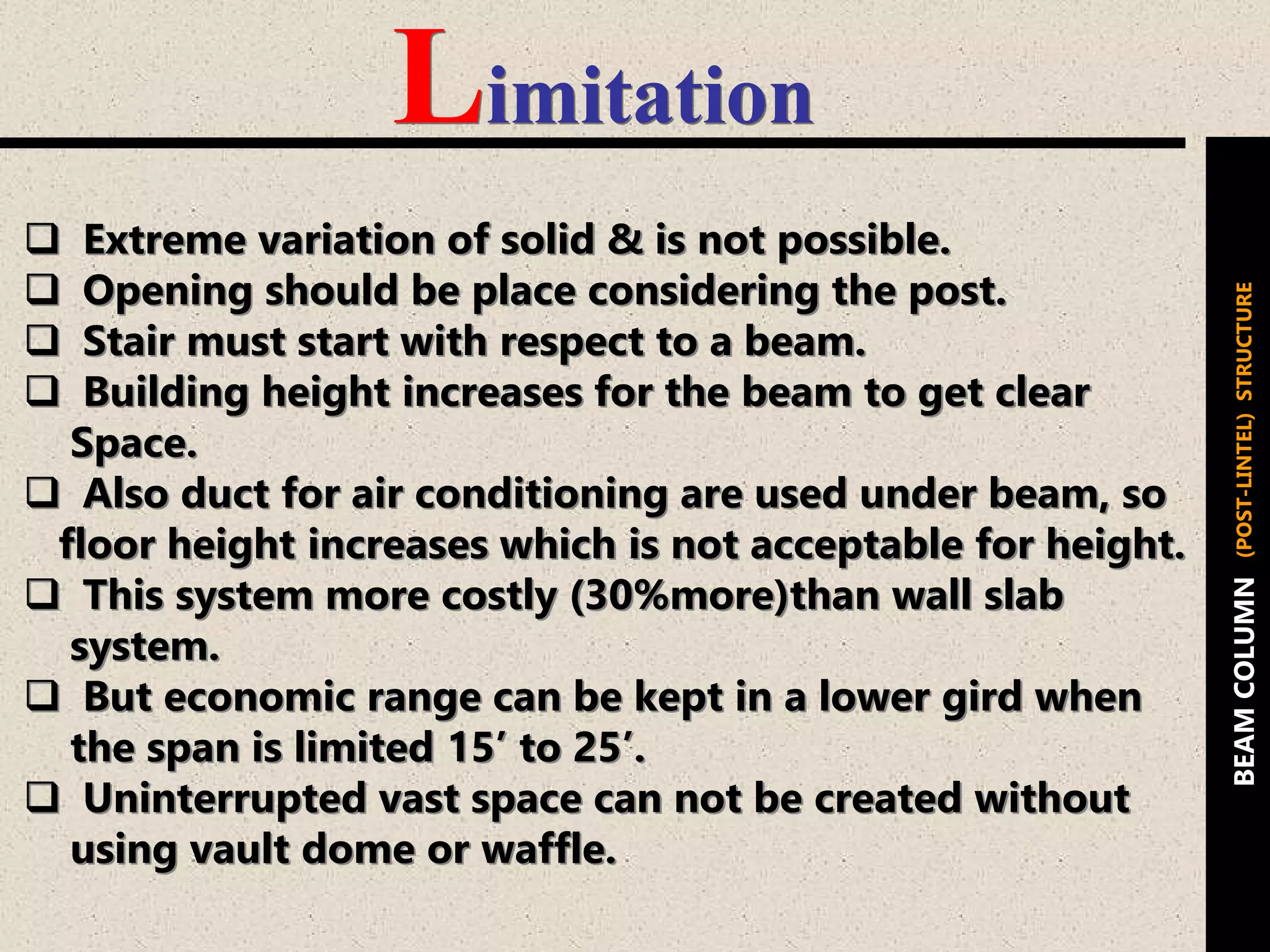
 Extreme variation of solid & is not possible.
 Opening should be place considering the post.
 Stair must start with respect to a beam.
 Building height increases for the beam to get clear
Space.
 Also duct for air conditioning are used under beam, so
floor height increases which is not acceptable for height.
 This system more costly (30%more)than wall slab
system.
 But economic range can be kept in a lower gird when
the span is limited 15’ to 25’.
 Uninterrupted vast space can not be created without
using vault dome or waffle.
BEAMCOLUMN(POST-LINTEL)STRUCTURE
POST-LINTEL STRUCTURE
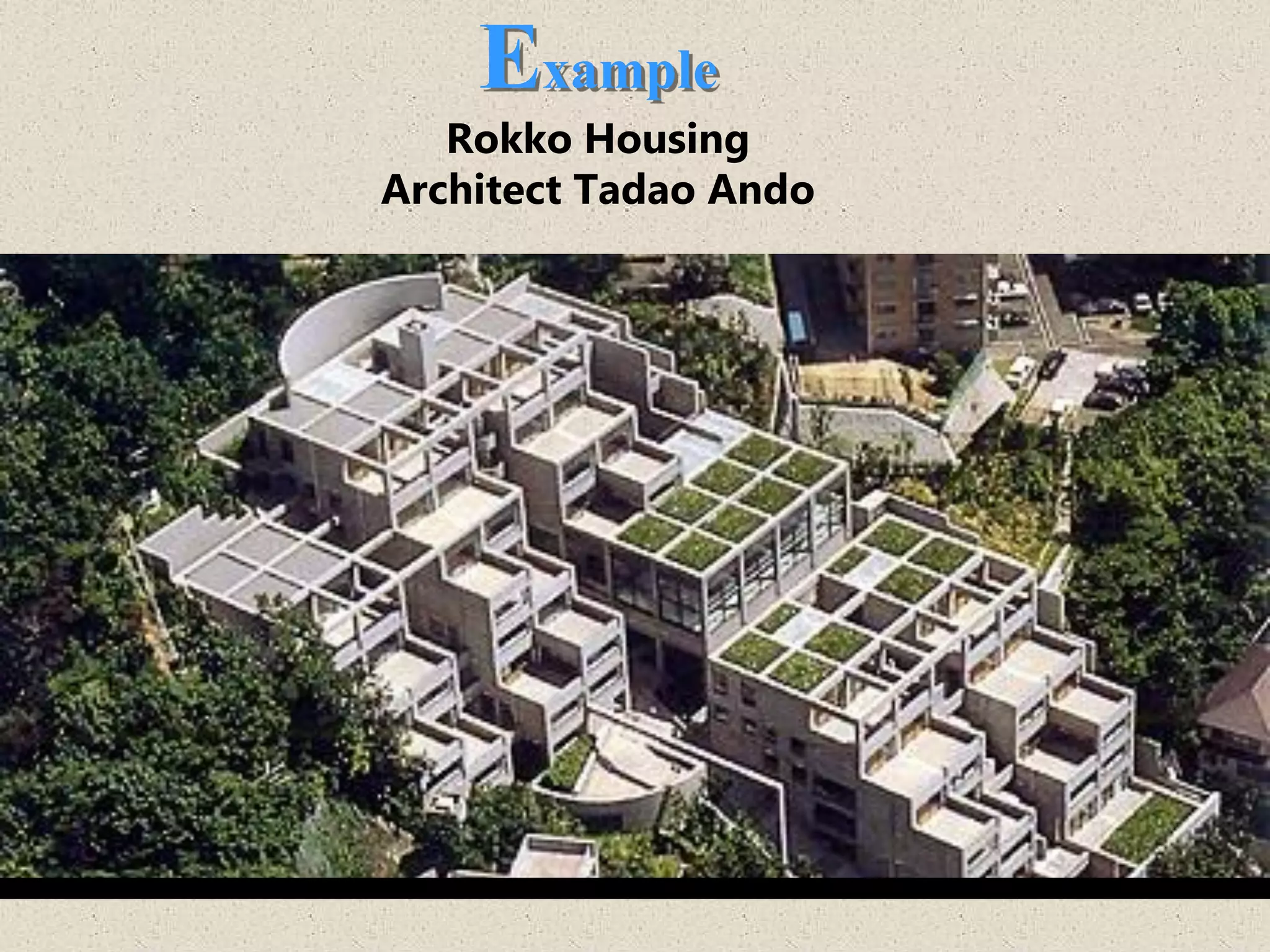
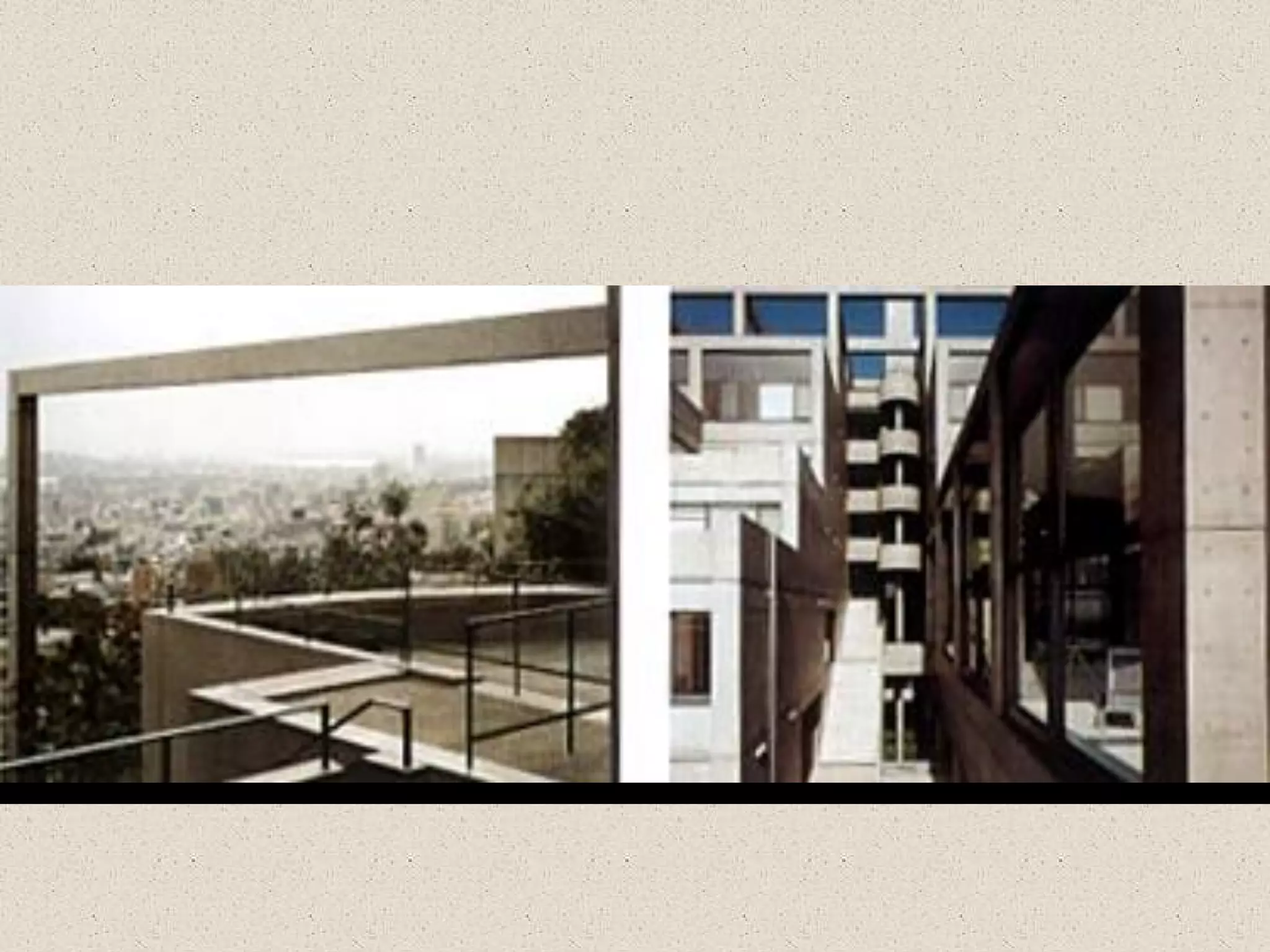
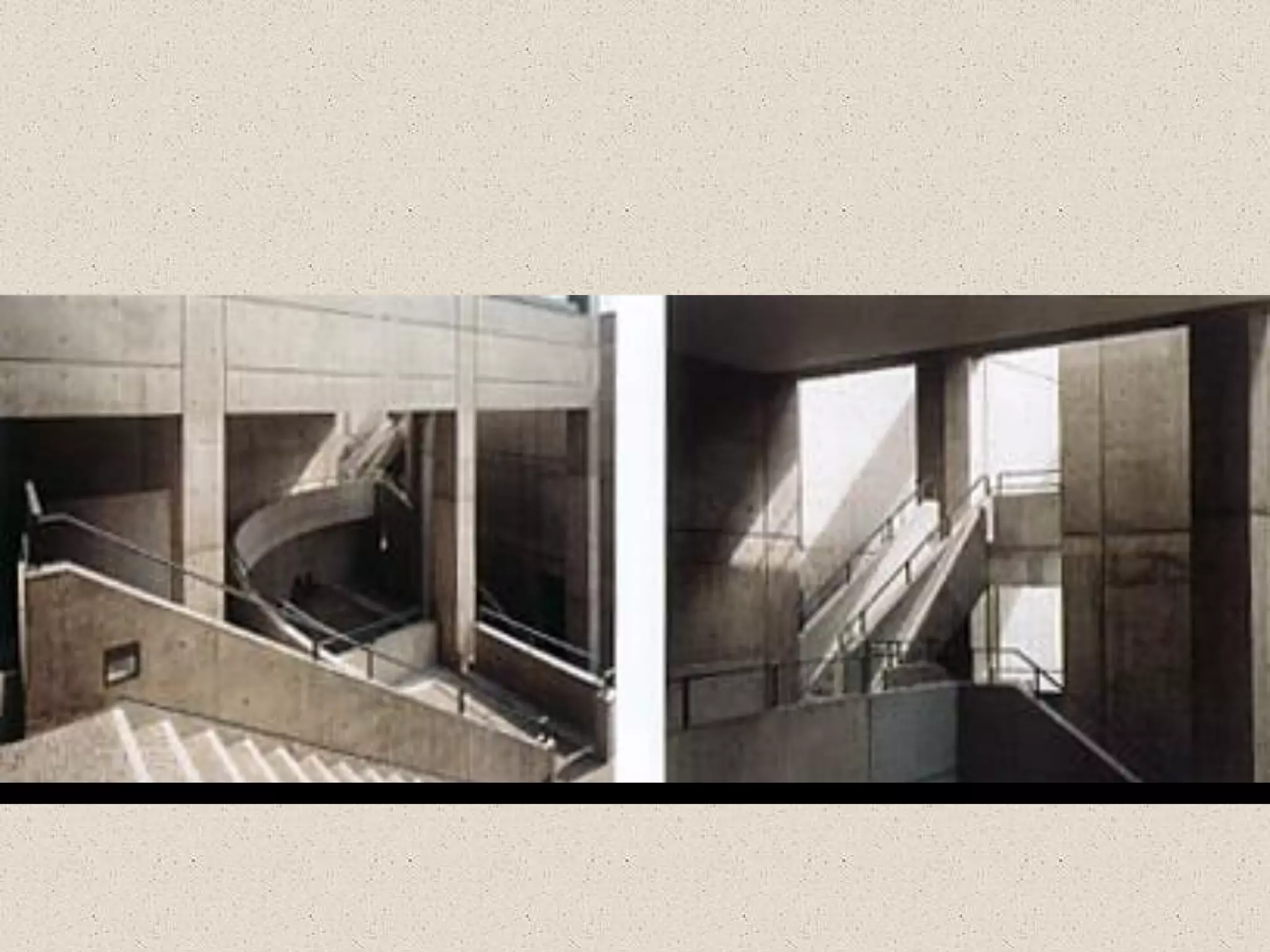
Rokko Housing
Architect Tadao Ando
Example
ROKOKO HOUSING
ARCHITECT
ANDO
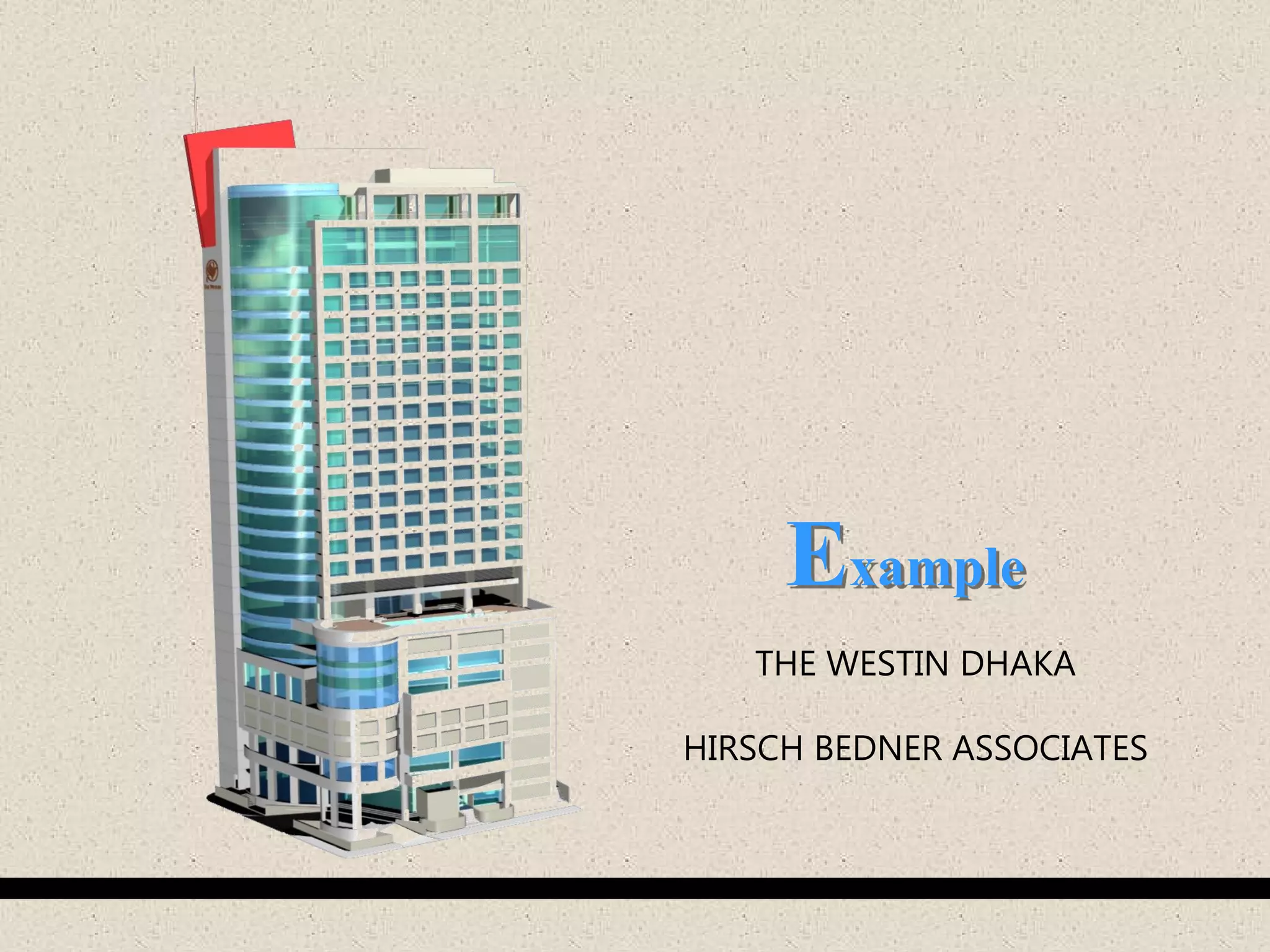
THE WESTIN DHAKA
HIRSCH BEDNER ASSOCIATES
Example
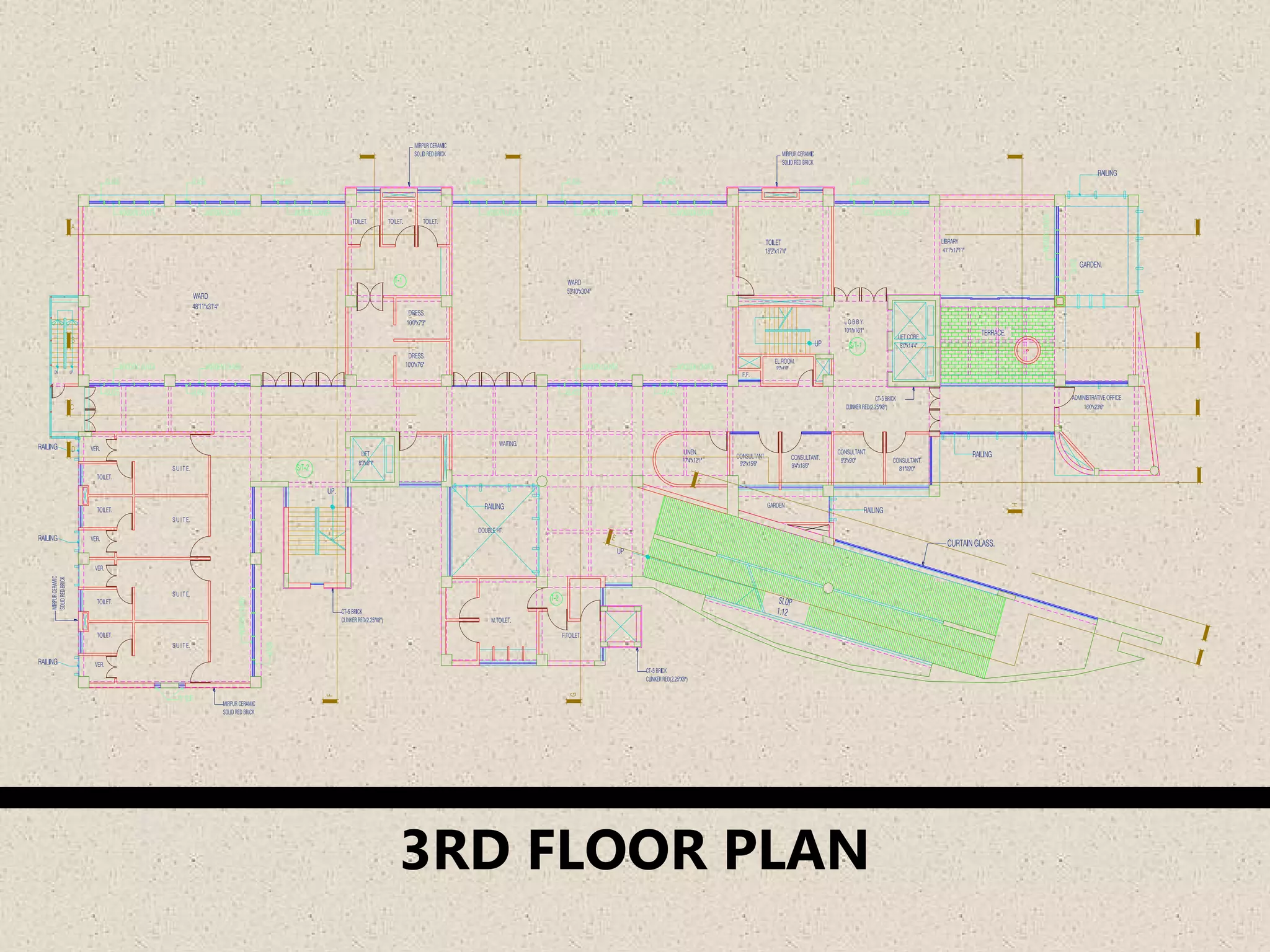
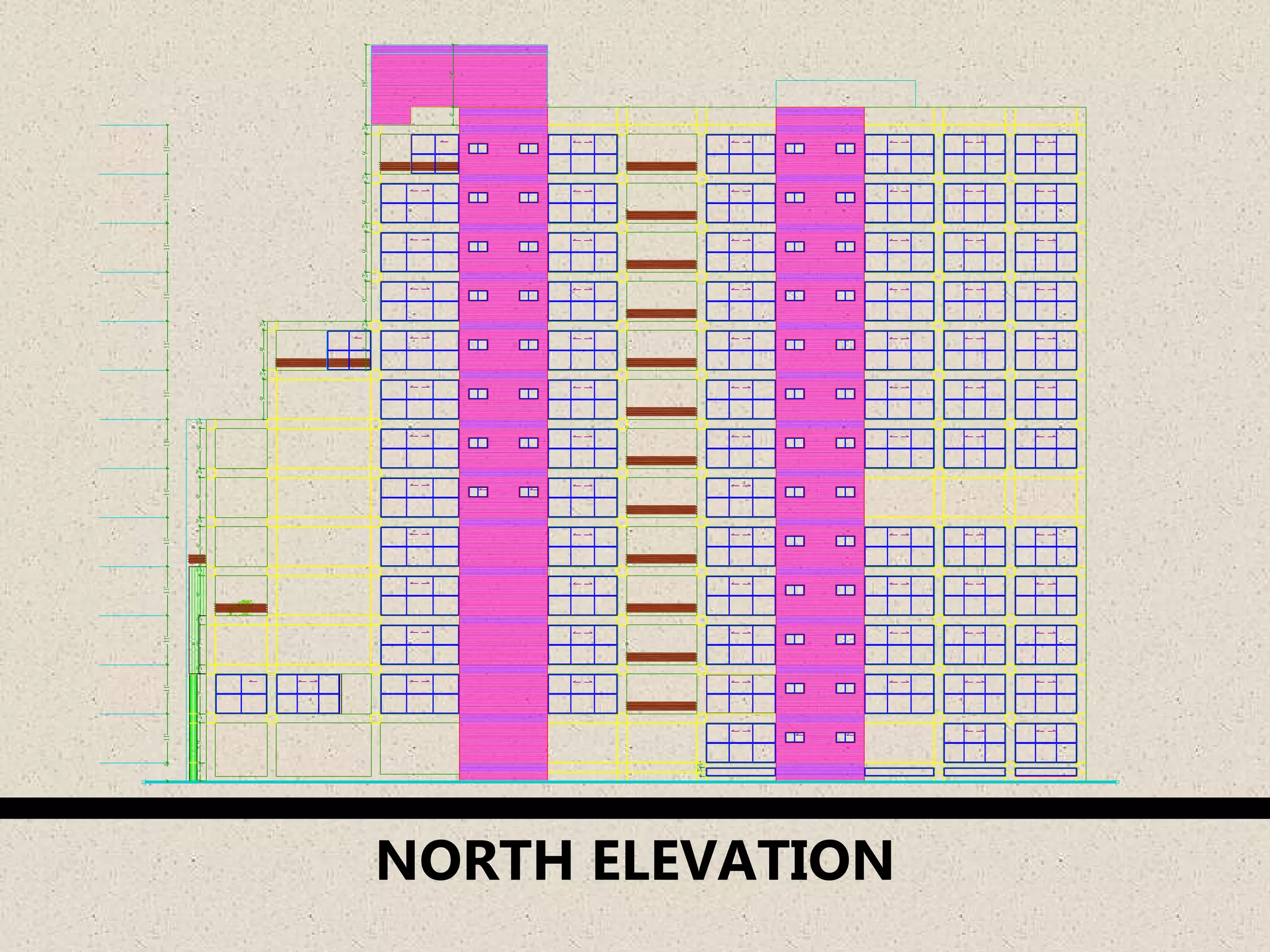
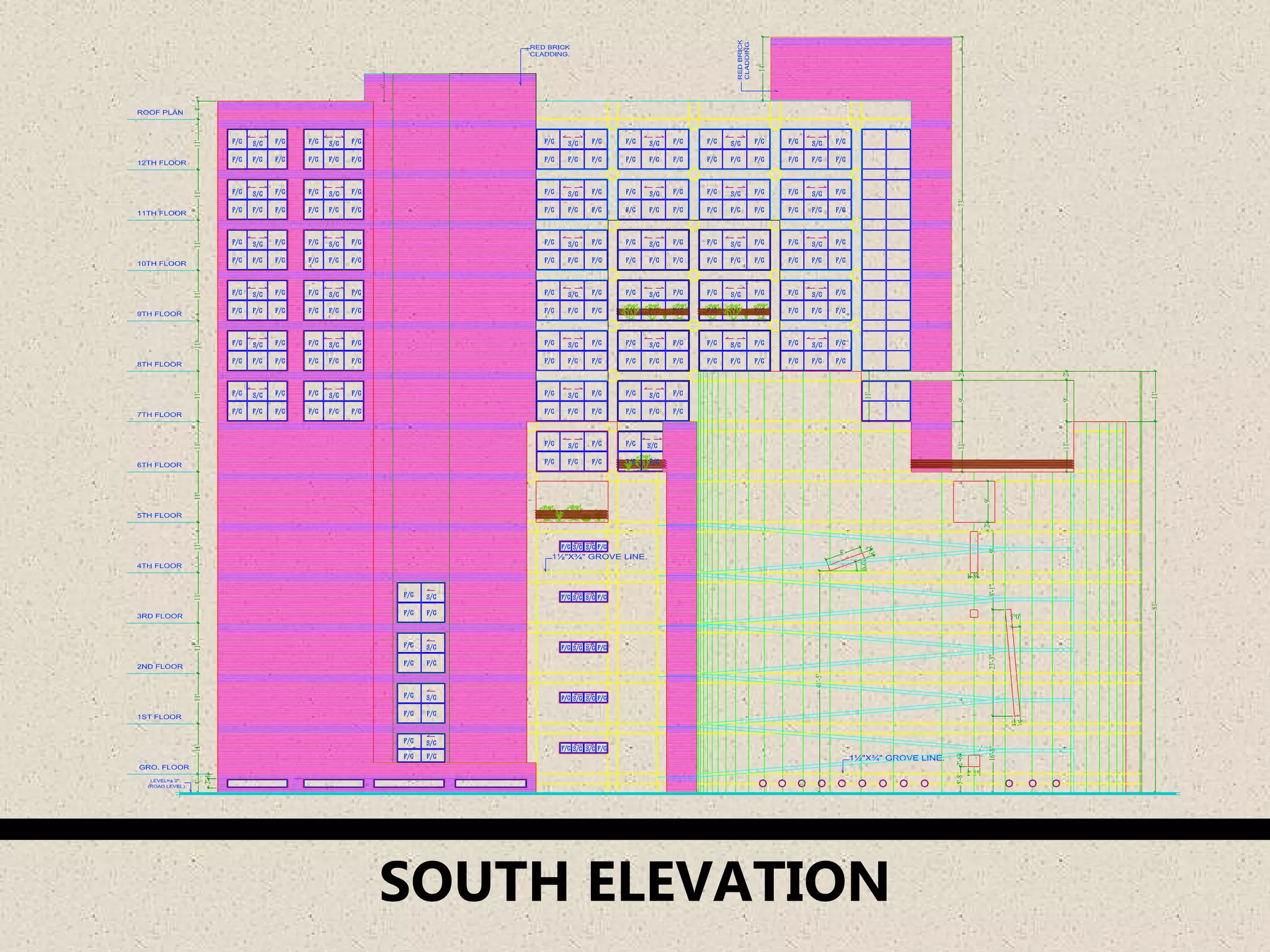
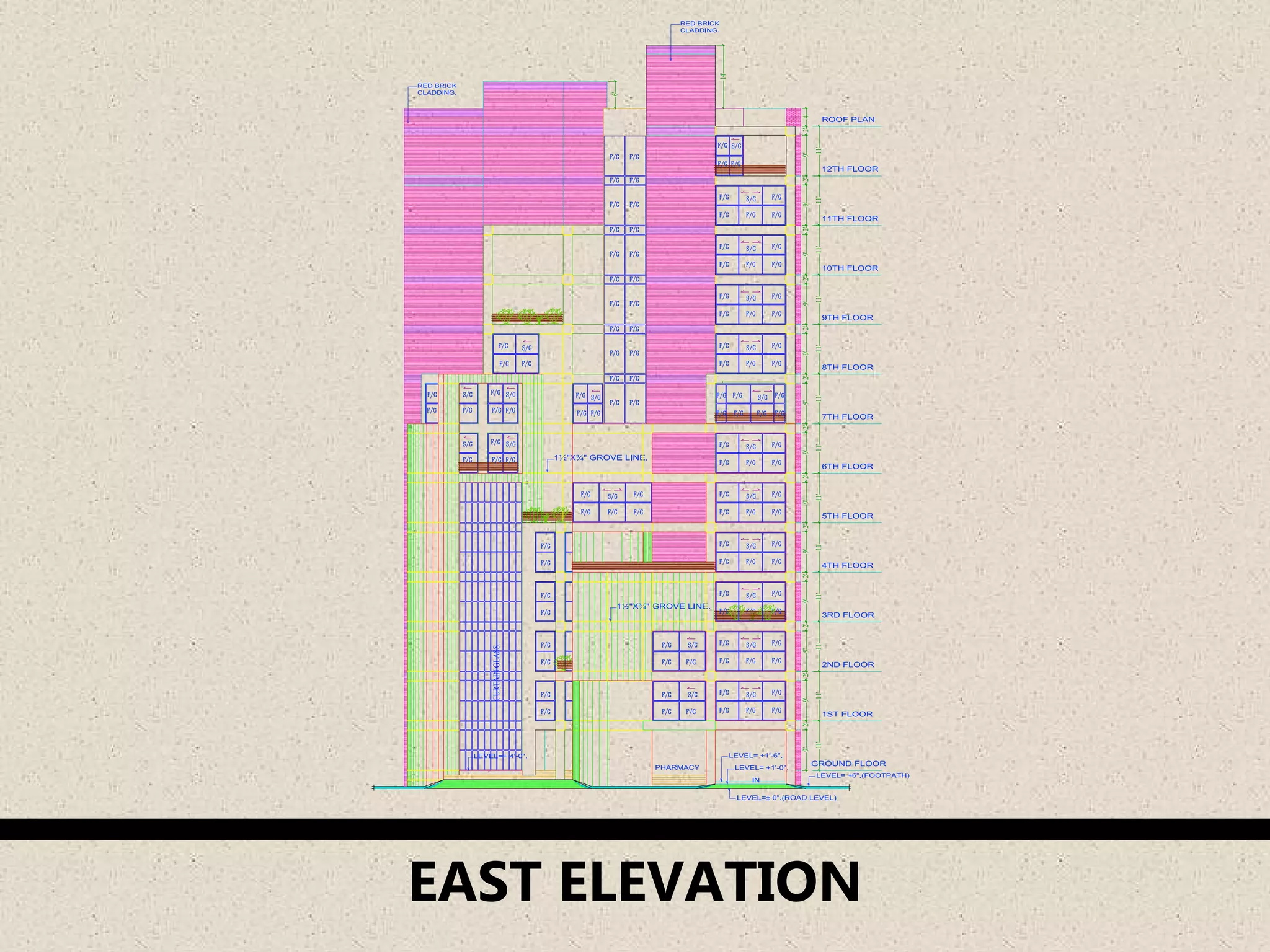
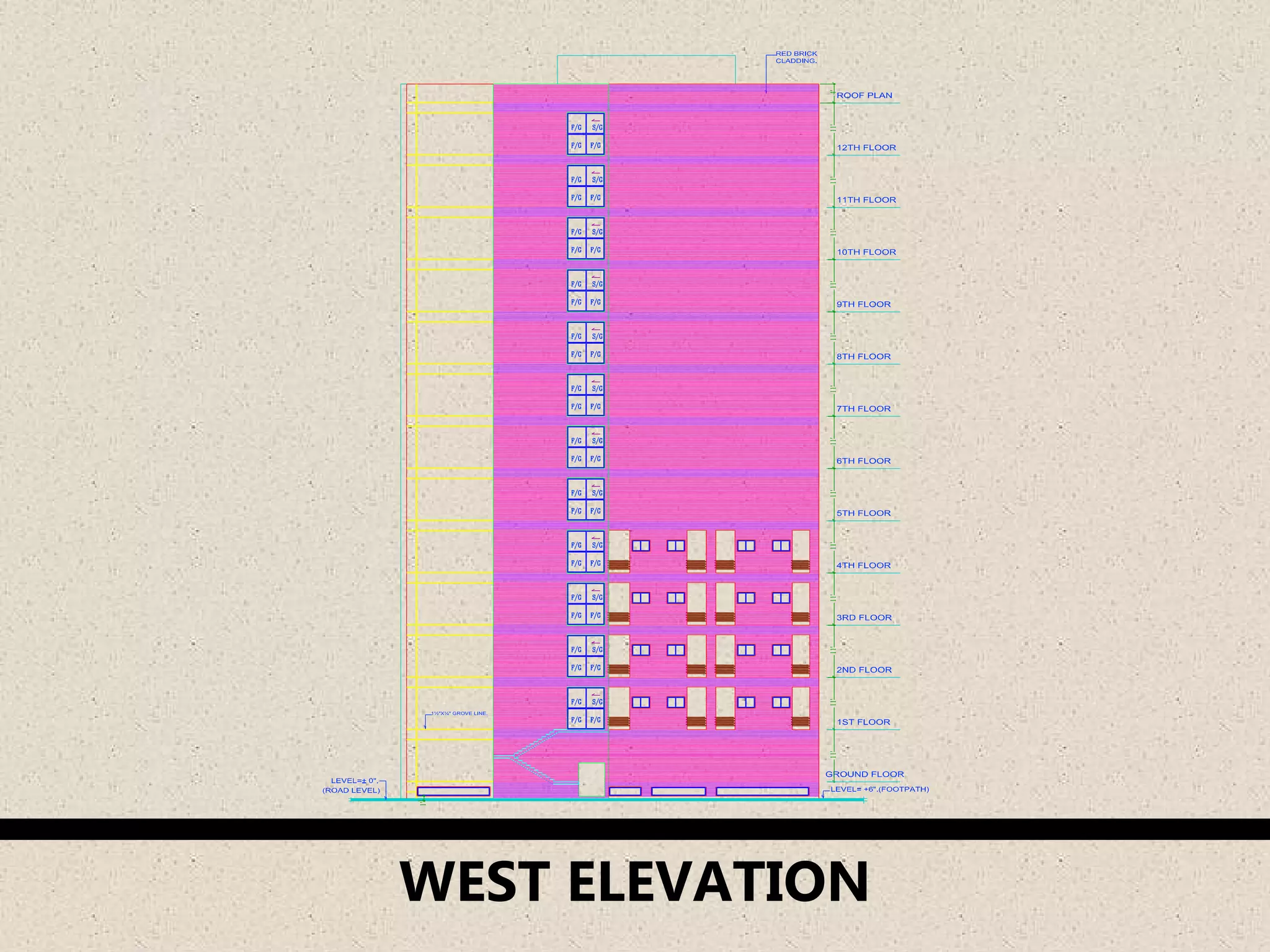
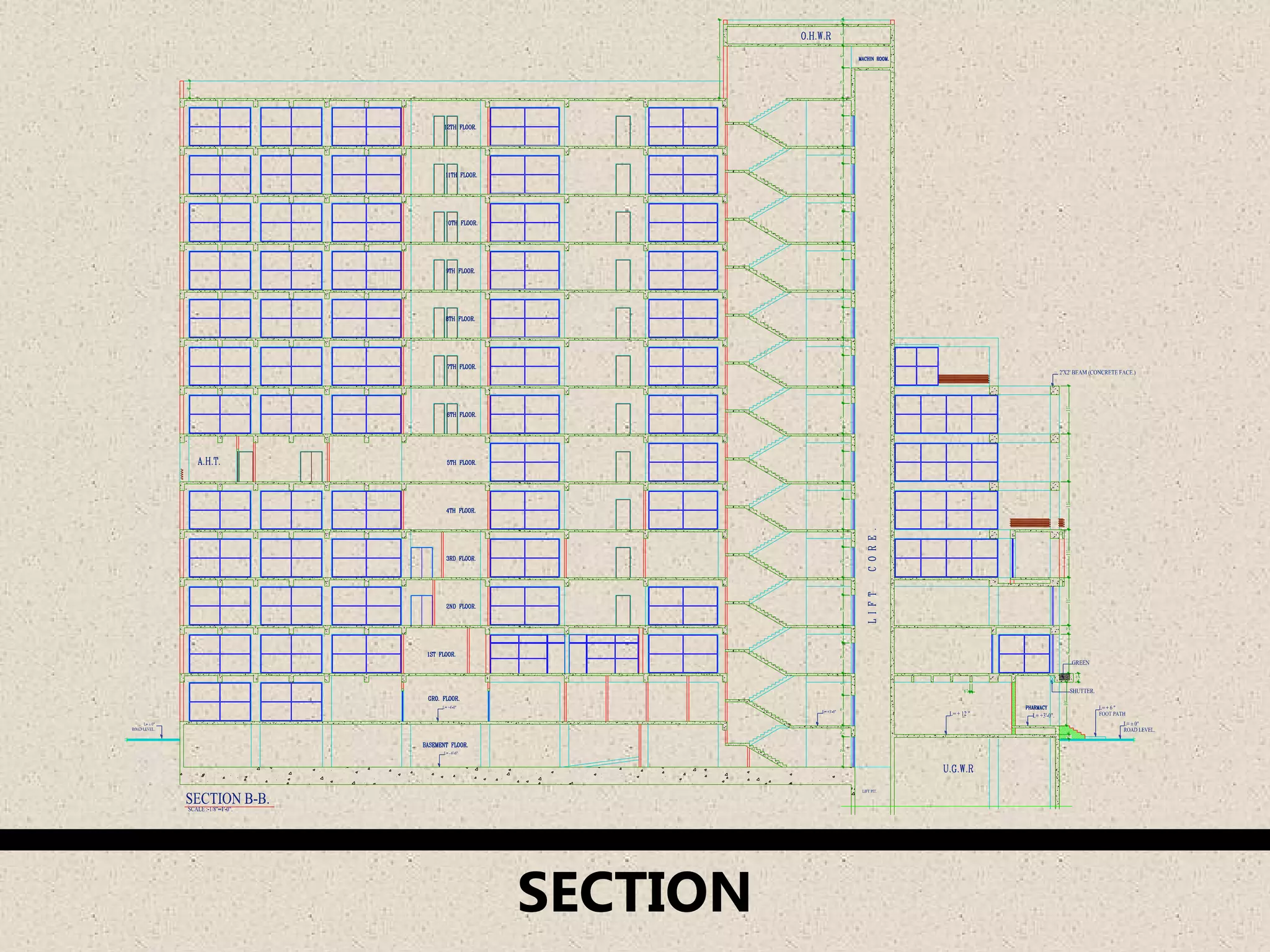
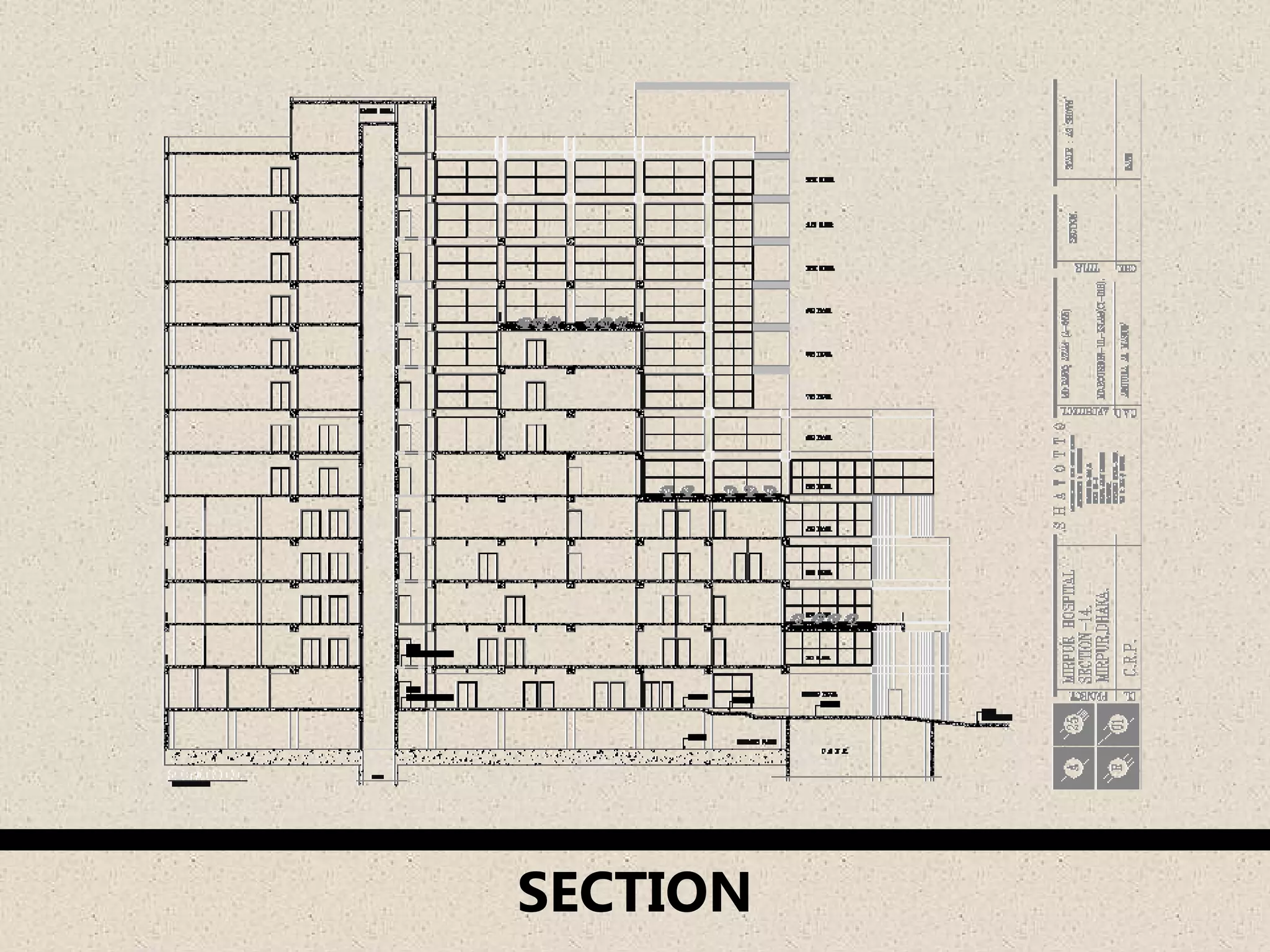
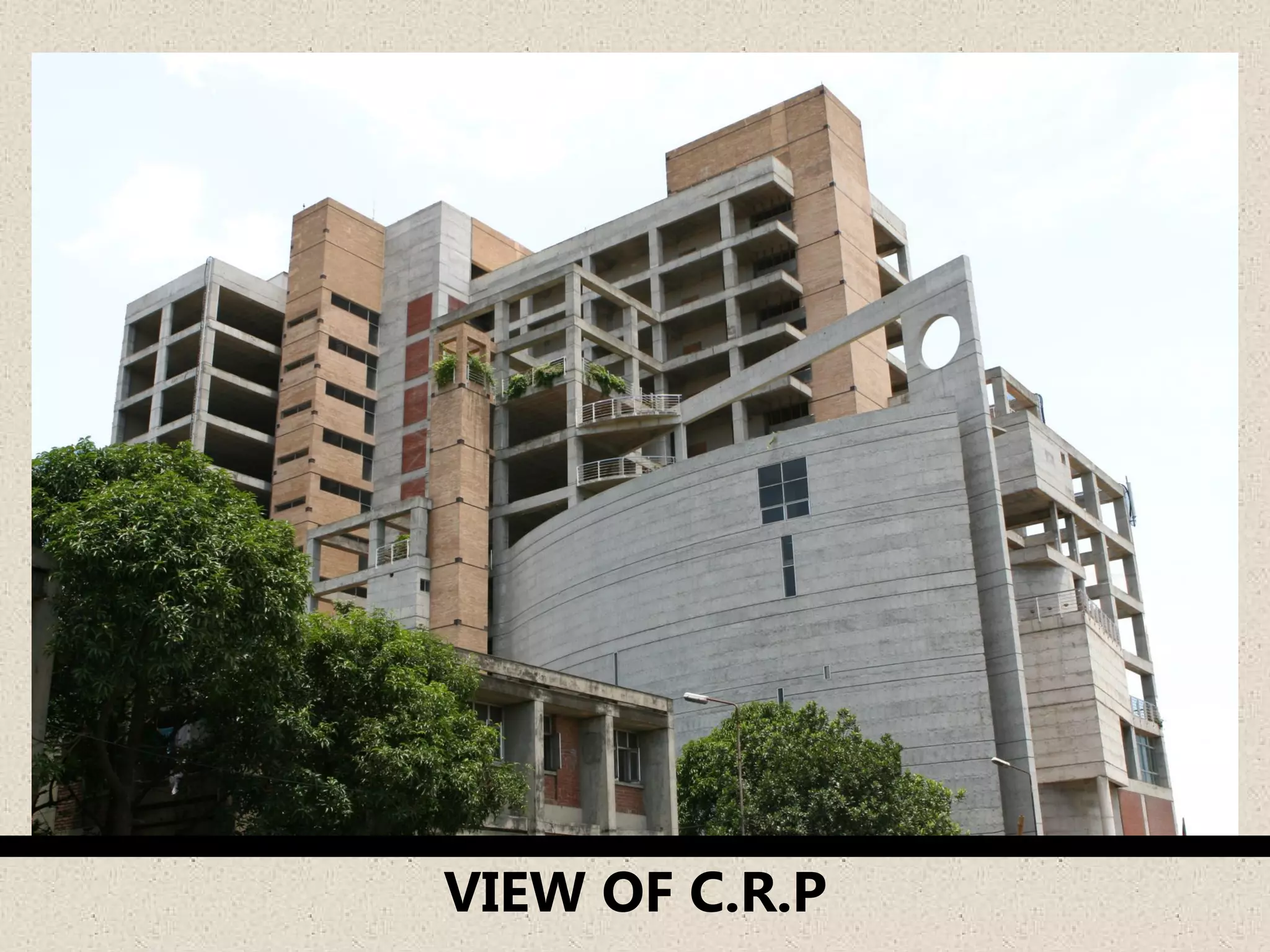
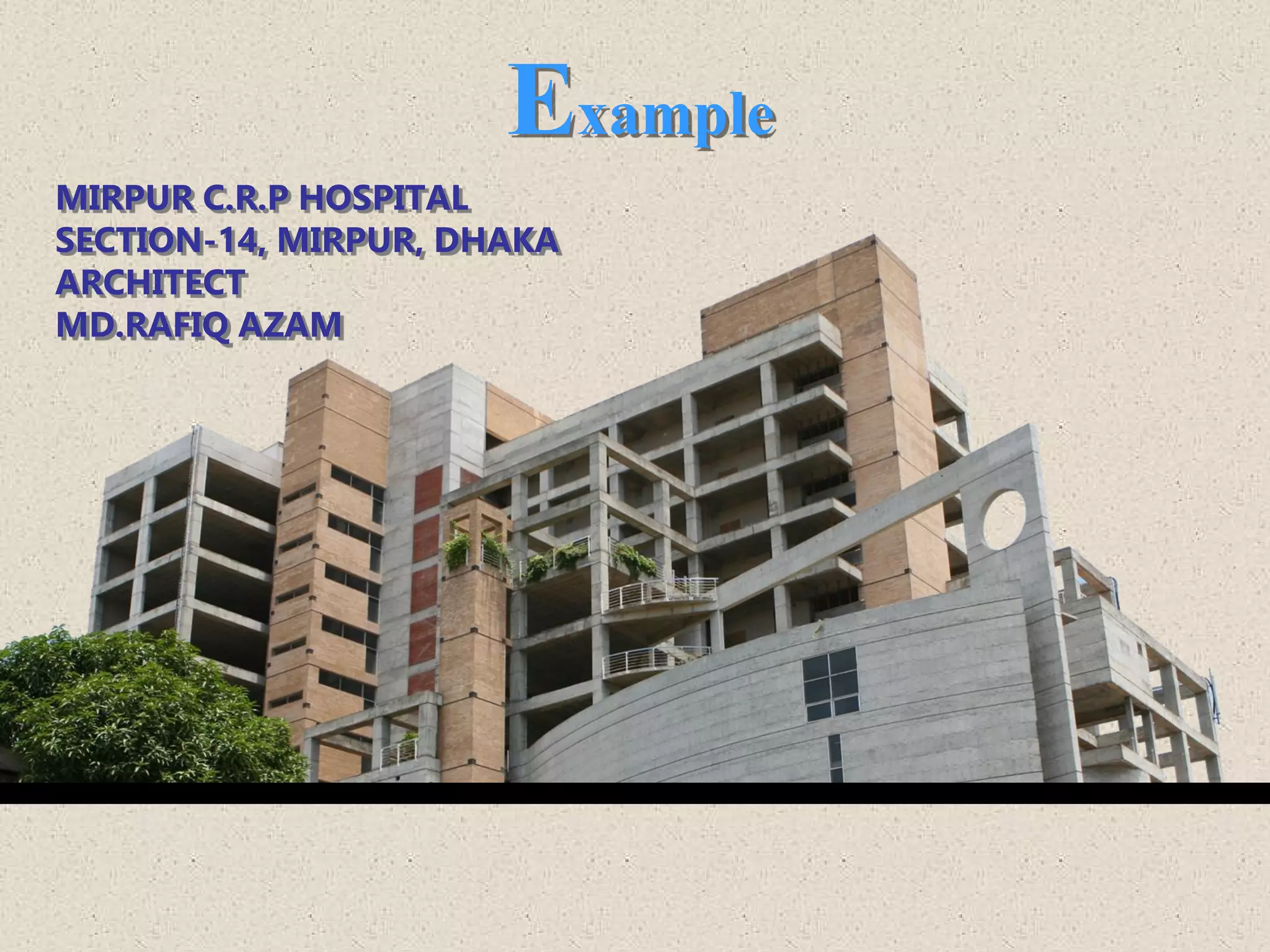
MIRPUR C.R.P HOSPITAL
SECTION-14, MIRPUR, DHAKA
ARCHITECT
MD.RAFIQ AZAM
Example
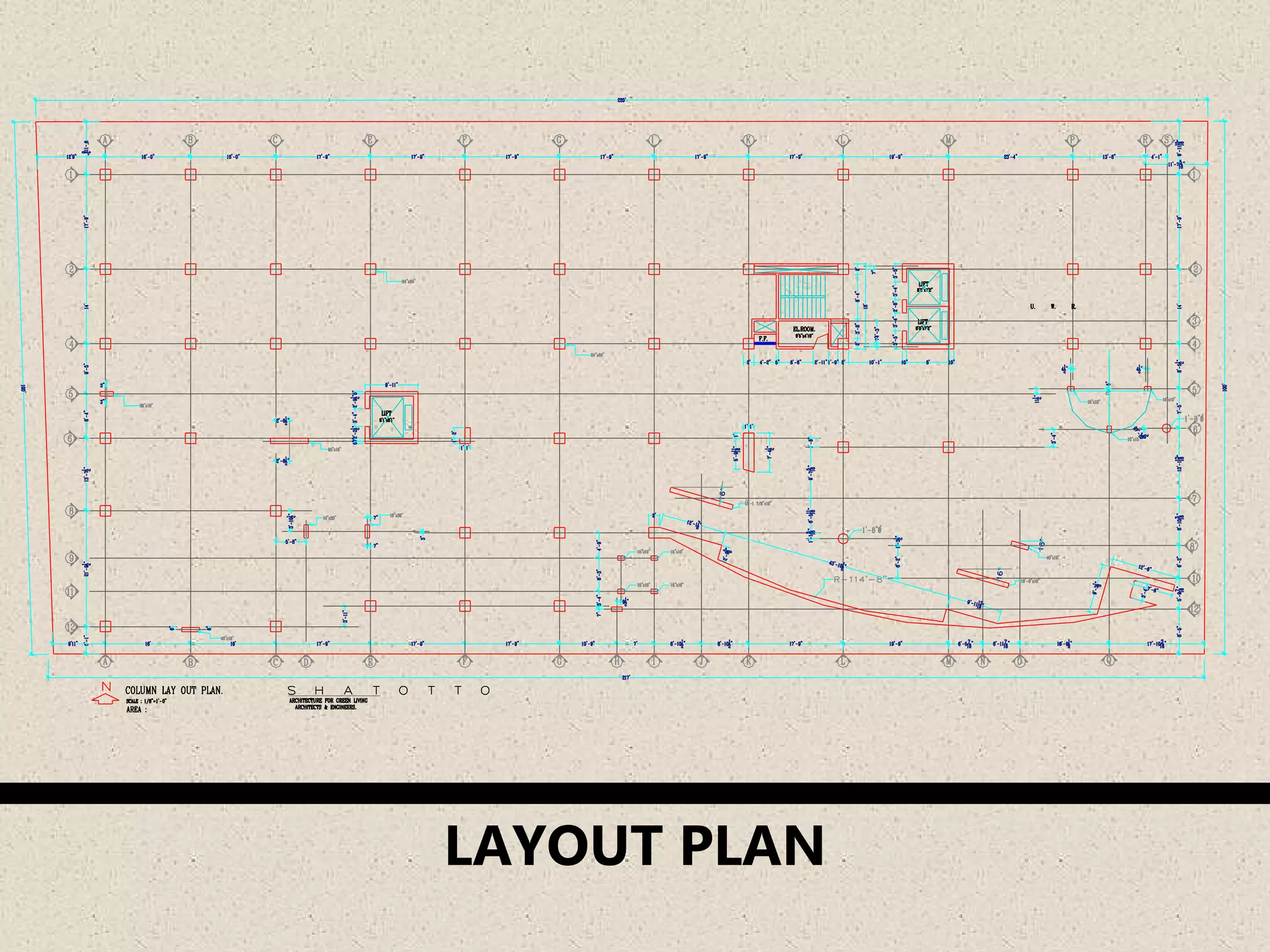
LAYOUT PLAN
BASEMENT PLAN
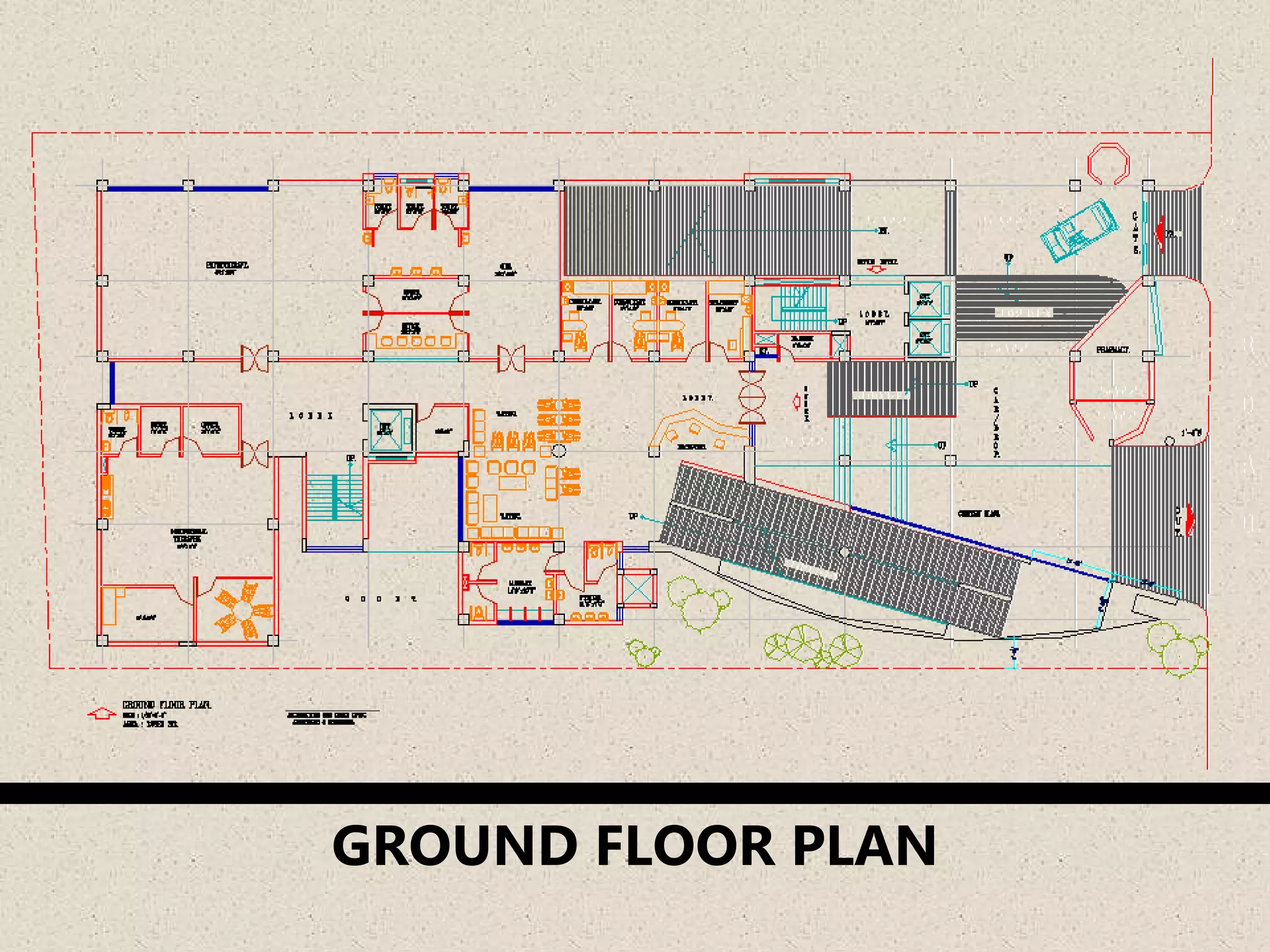
GROUND FLOOR PLAN
3RD FLOOR PLAN
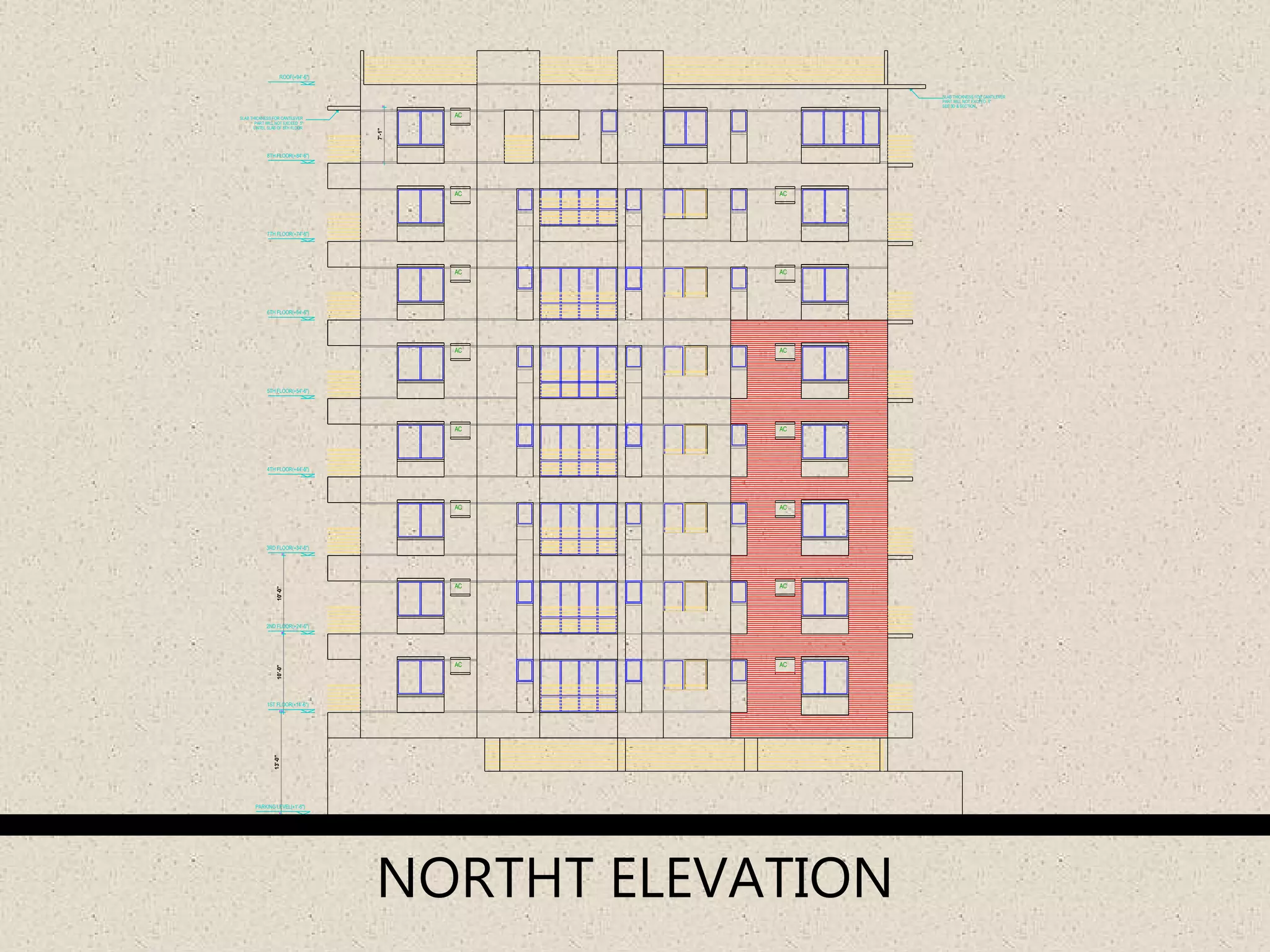
NORTH ELEVATION
SOUTH ELEVATION
EAST ELEVATION
WEST ELEVATION
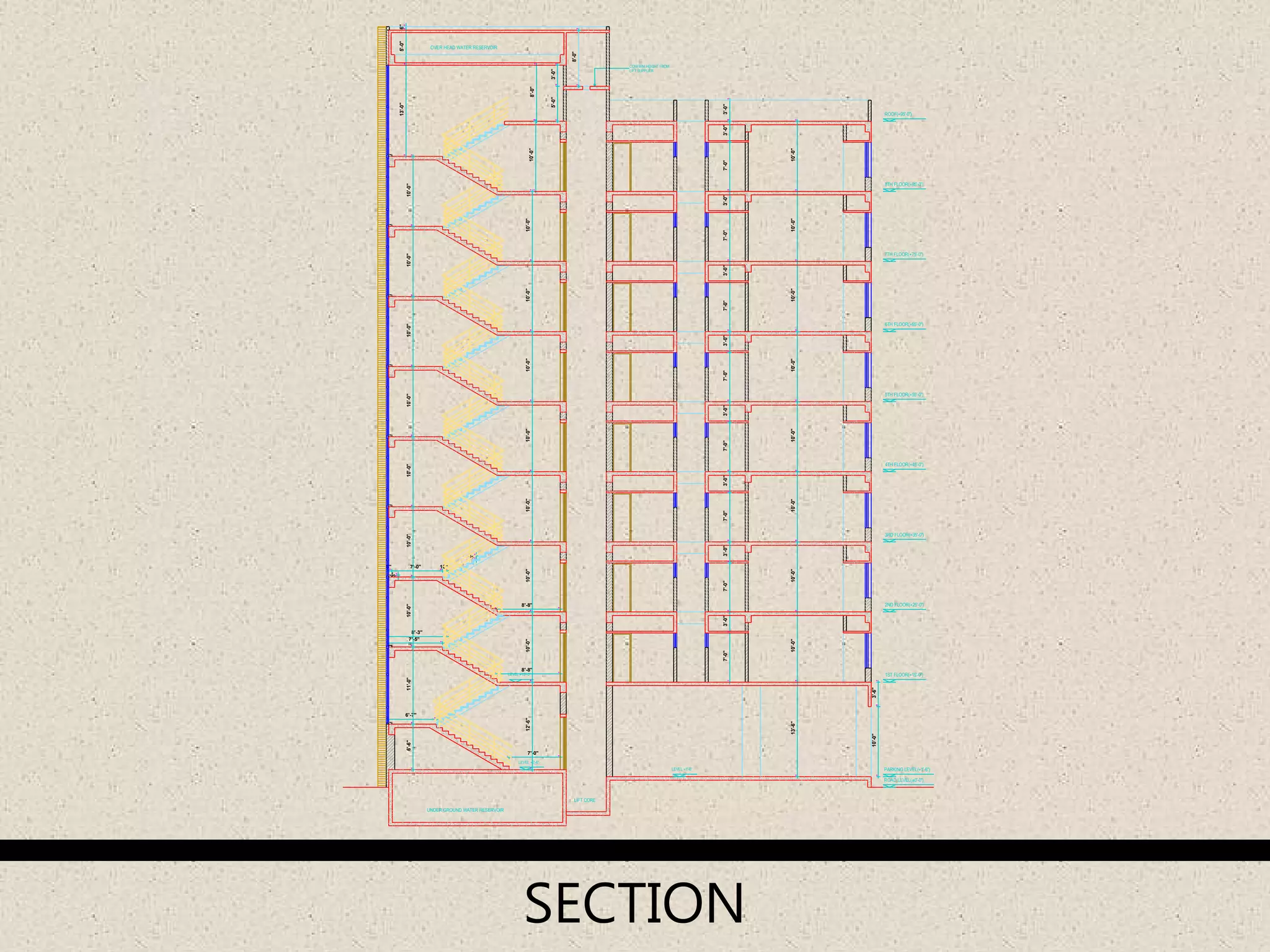
SECTION
SECTION
VIEW OF C.R.P
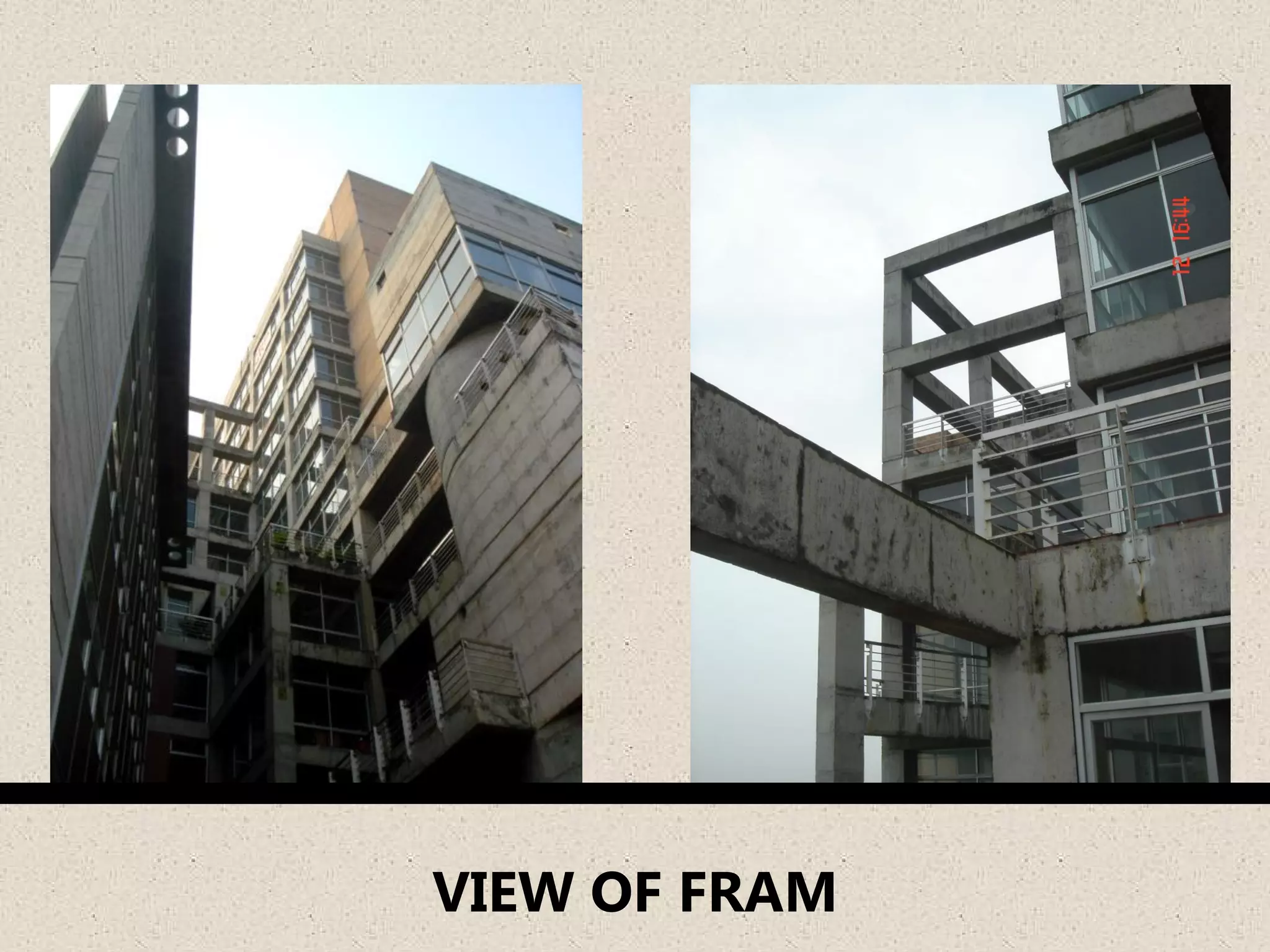
VIEW OF FRAM
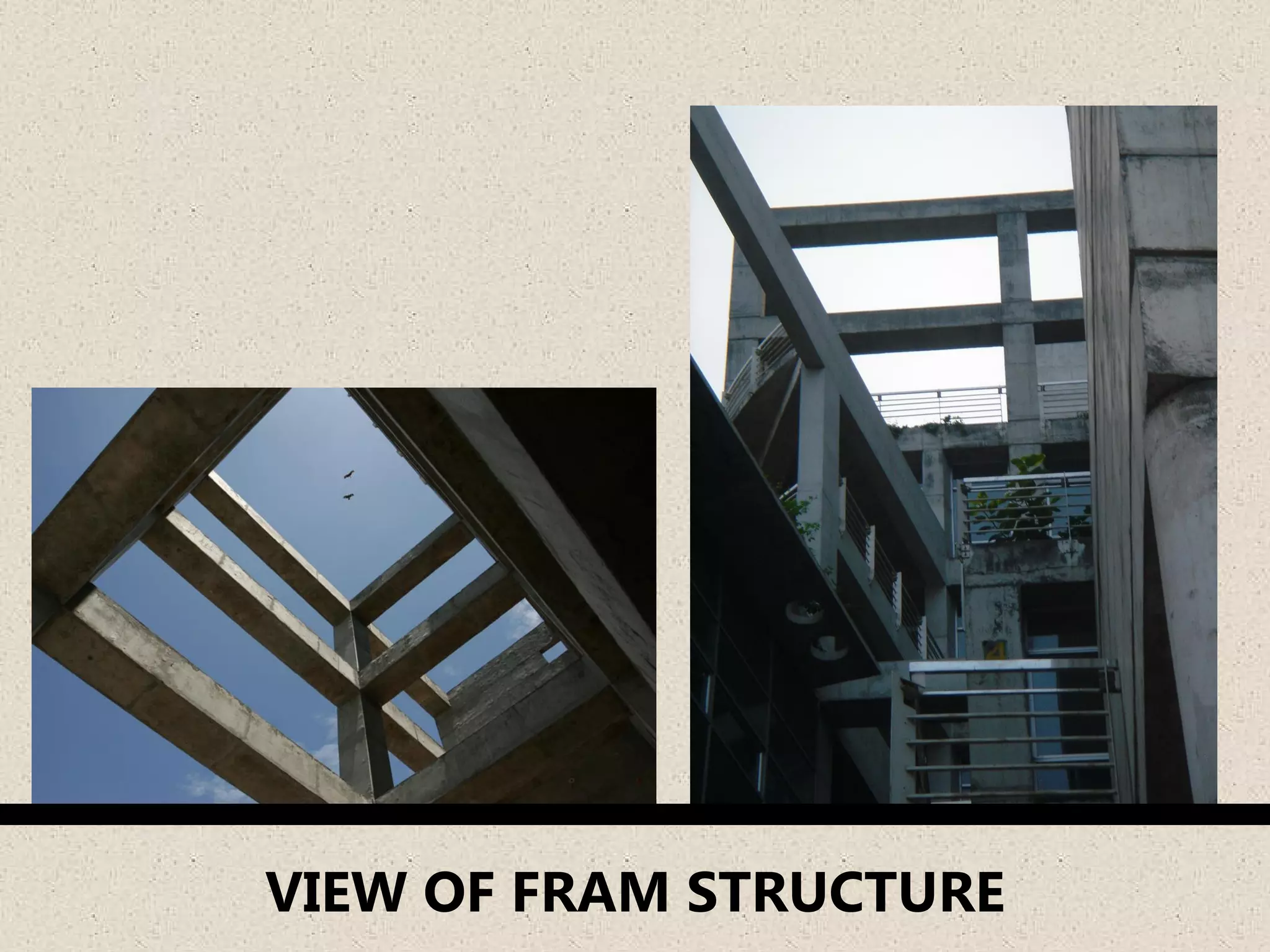
VIEW OF FRAM STRUCTURE
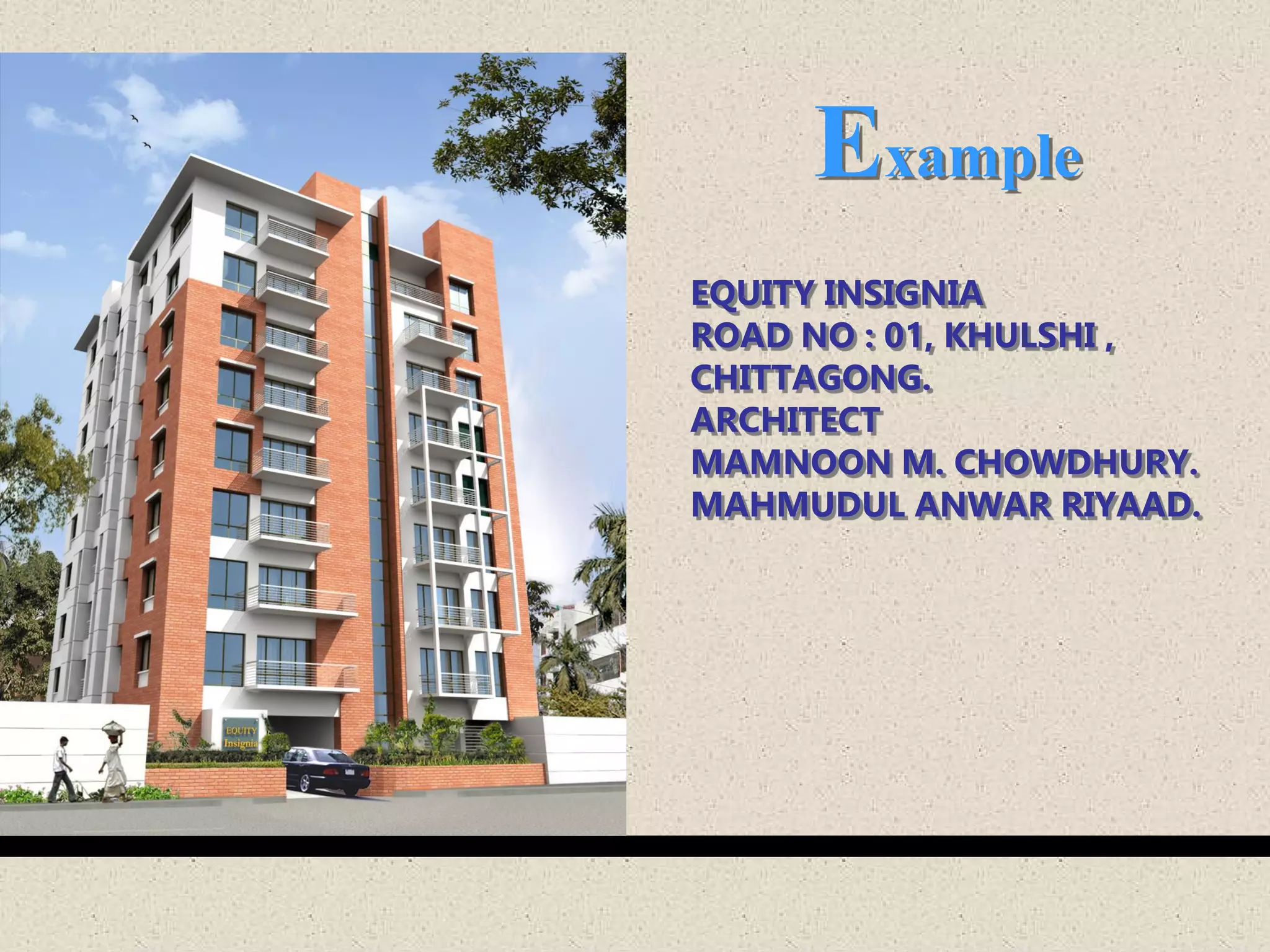
Example
EQUITY INSIGNIA
ROAD NO : 01, KHULSHI ,
CHITTAGONG.
ARCHITECT
MAMNOON M. CHOWDHURY.
MAHMUDUL ANWAR RIYAAD.
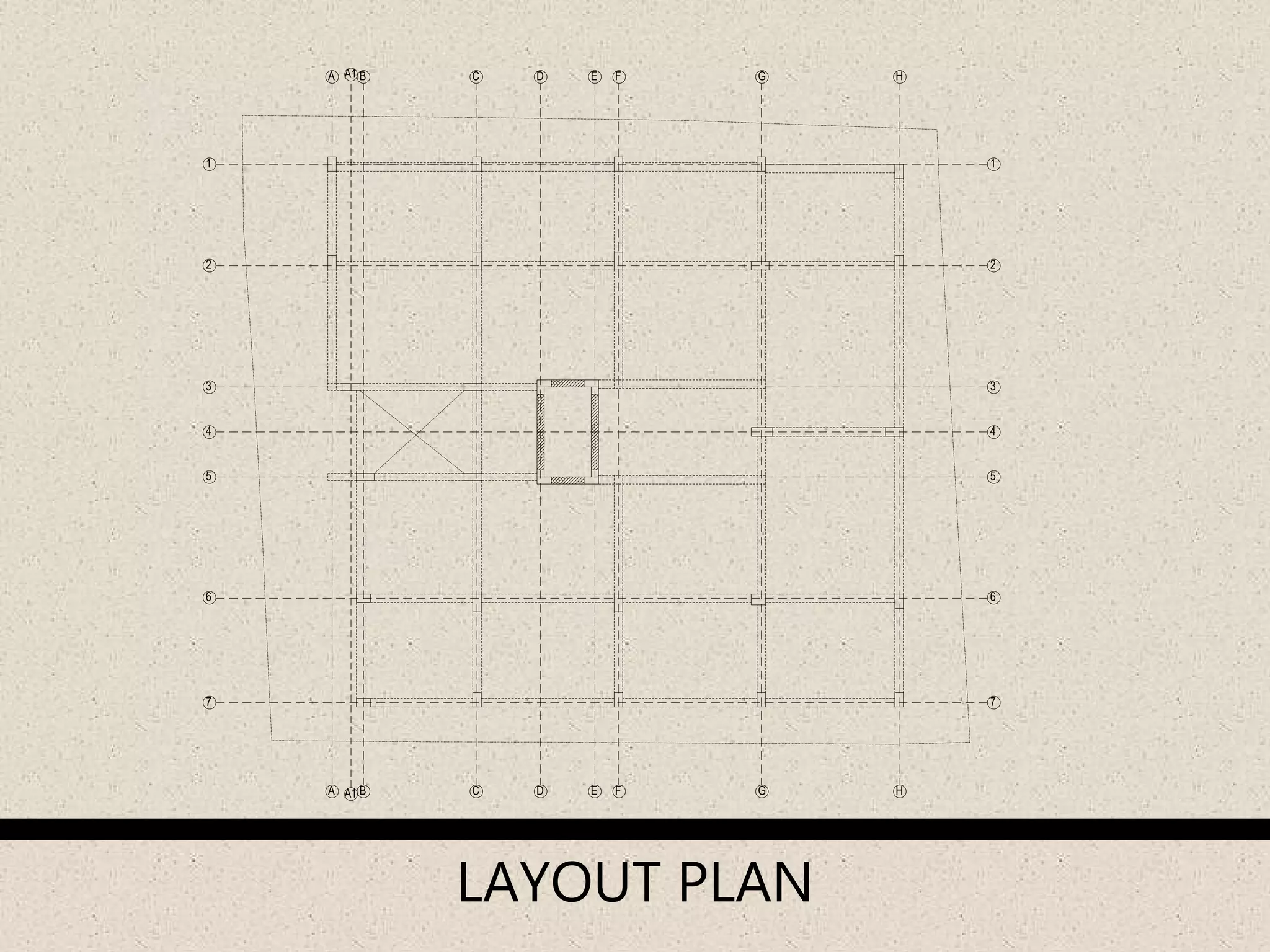
LAYOUT PLAN
7
6
5
4
3
2
1
A B C D E F G H
HGFEDCBA
1
2
3
4
5
6
7
A1
A1
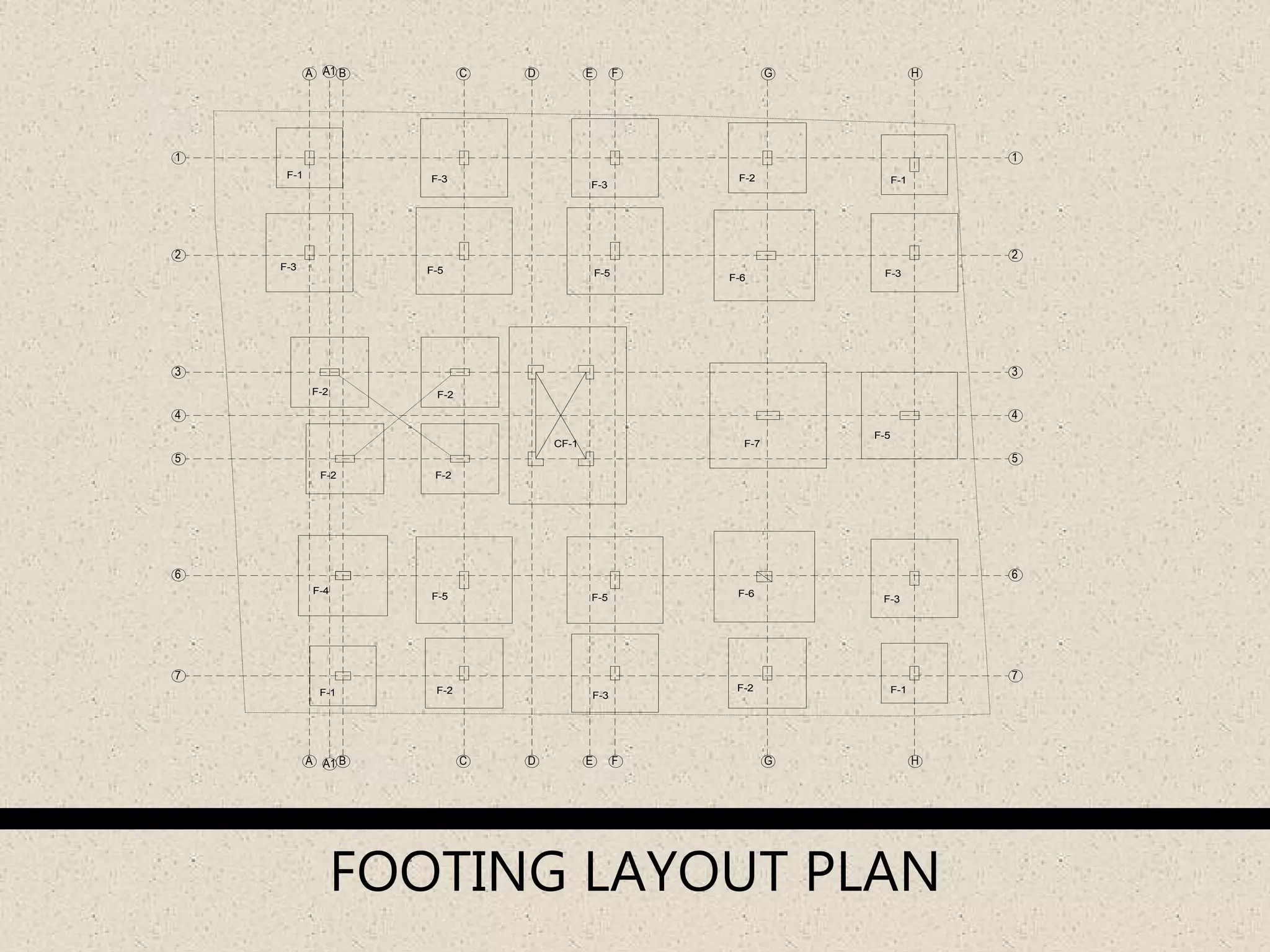
FOOTING LAYOUT PLAN
CF-1
A1
A1
F-1
F-1 F-1
F-1
F-2 F-2
F-2 F-2
F-2 F-2
F-2F-3
F-3
F-3
F-3
F-3
F-3
F-4
F-5 F-5
F-5 F-5
F-5
F-6
F-7
F-6
1
2
3
4
5
6
7 7
6
5
4
3
2
1
A B C D E F G H
HGFEDCBA
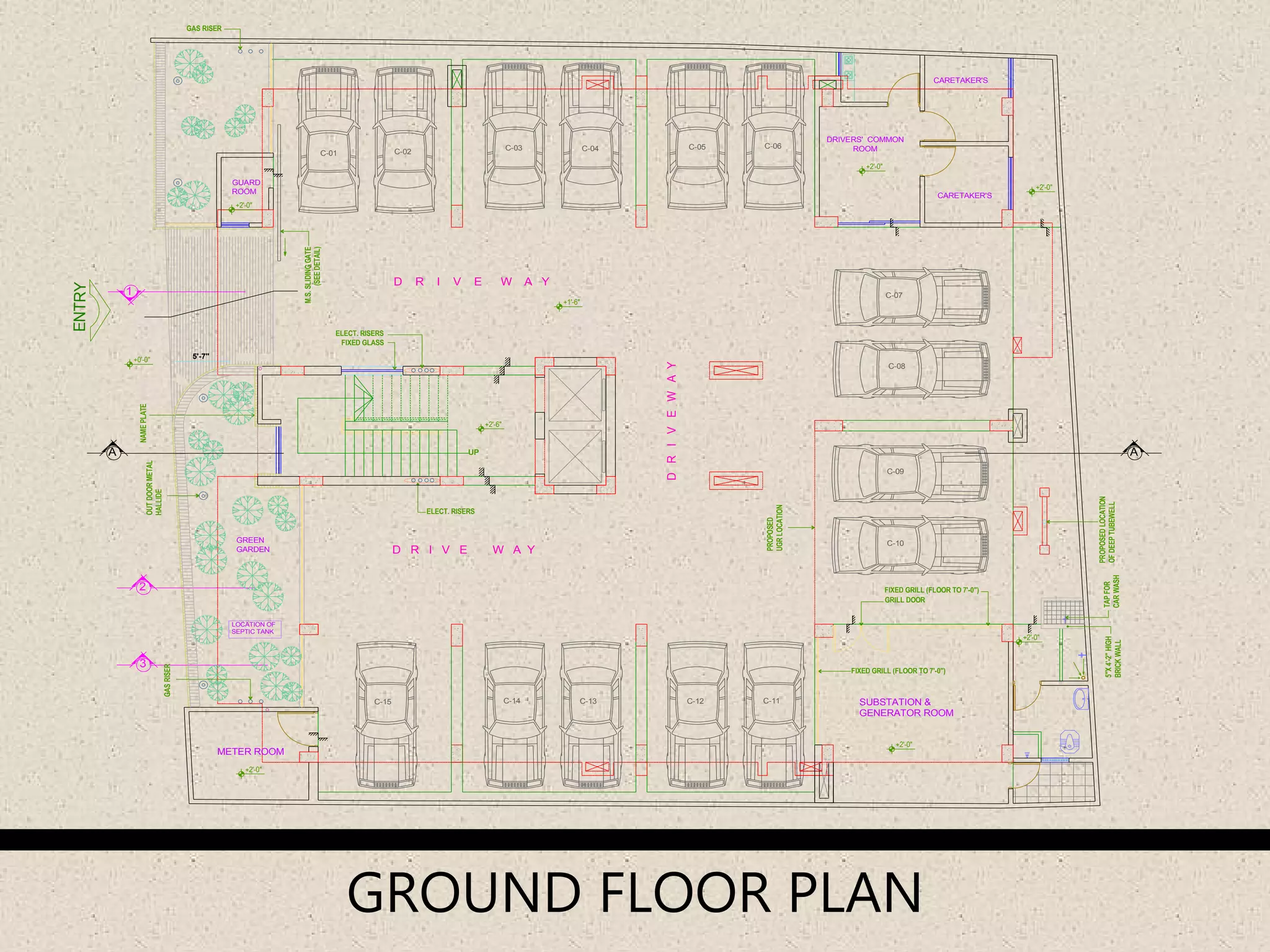
GROUND FLOOR PLAN
5'-7"
FIXED GRILL (FLOOR TO 7'-0")
GRILL DOOR
FIXED GRILL (FLOOR TO 7'-0")
FIXED GLASS
ELECT. RISERS
ELECT. RISERS
1
2
3
SUBSTATION &
GENERATOR ROOM
UP
+2'-0"
+2'-0"
+2'-0"
+2'-0"
+2'-0"
+2'-0"
SEPTIC TANK
LOCATION OF
OUTDOORMETAL
HALLIDE
PROPOSED
UGRLOCATION
TAPFOR
CARWASH
5"X4'-2"HIGH
BRICKWALL
PROPOSEDLOCATION
OFDEEPTUBEWELL
GAS RISER
NAMEPLATE DRIVERS' COMMON
ROOM
CARETAKER'S
CARETAKER'S
GASRISER
D R I V E W A Y
+1'-6"
ENTRY
A
D R I V E W A Y
+0'-0"
C-01
A
C-02 C-03 C-04 C-05 C-06
C-15 C-14 C-13 C-12 C-11
C-07
C-08
C-09
C-10
METER ROOM
M.S.SLIDINGGATE
(SEEDETAIL)
GUARD
ROOM
GREEN
GARDEN
DRIVEWAY
+2'-6"
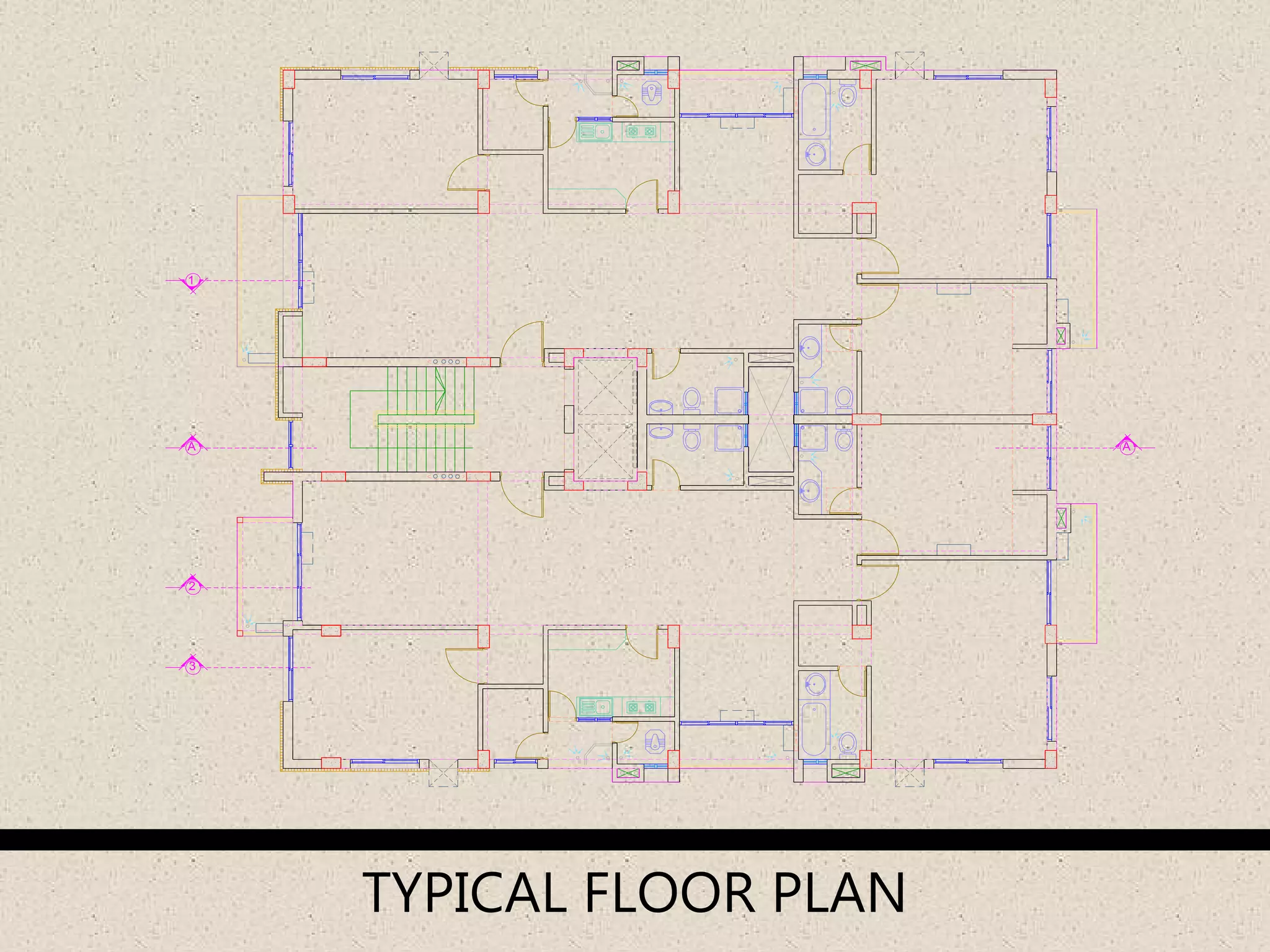
TYPICAL FLOOR PLAN
2
3
1
A A
2ND FLOOR(+24'-6")
1ST FLOOR(+14'-6")
3RD FLOOR(+34'-6")
4TH FLOOR(+44'-6")
5TH FLOOR(+54'-6")
6TH FLOOR(+64'-6")
7TH FLOOR(+74'-6")
8TH FLOOR(+84'-6")
ROOF(+94'-6")
SLAB THICKNESS FOR
CANTILEVER PART WILL
NOT EXCEED 5"
PARKING LEVEL(+1'-6")
ROAD LEVEL(±0'-0")
BRICK CLADDED SURFACE
PLASTERED SURFACE PAINT
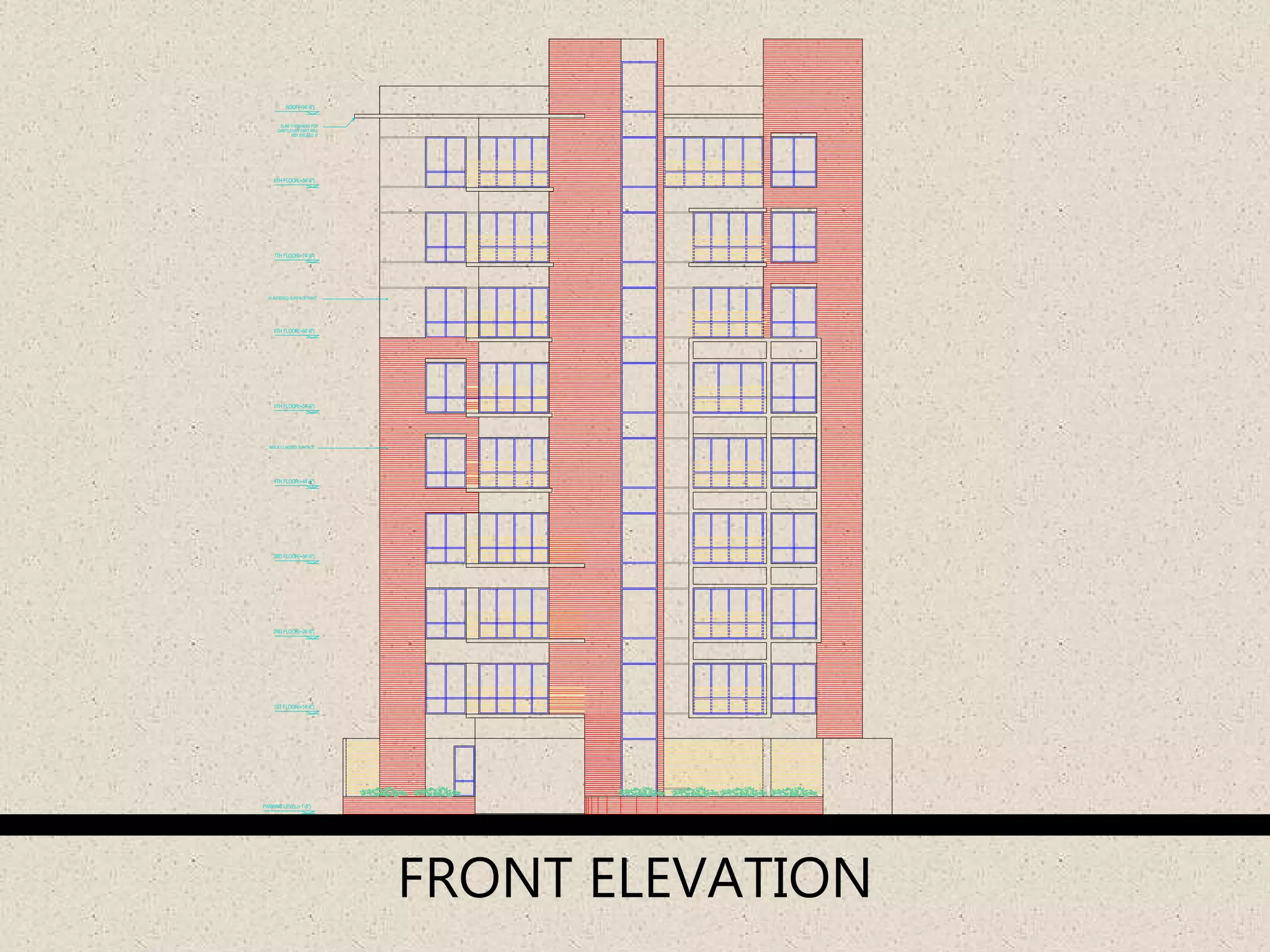
FRONT ELEVATION
SLAB THICKNESS FOR CANTILEVER
PART WILL NOT EXCEED 5"
SEE 3D & SECTION
SLAB THICKNESS FOR CANTILEVER
PART WILL NOT EXCEED 5"
LINTEL SLAB OF 8TH FLOOR
13'-0"10'-0"10'-0"
7'-1"
AC
AC
AC
AC
AC
AC
AC
AC
AC
AC
AC
AC
AC
AC
AC
2ND FLOOR(+24'-6")
1ST FLOOR(+14'-6")
3RD FLOOR(+34'-6")
4TH FLOOR(+44'-6")
5TH FLOOR(+54'-6")
6TH FLOOR(+64'-6")
7TH FLOOR(+74'-6")
8TH FLOOR(+84'-6")
ROOF(+94'-6")
PARKING LEVEL(+1'-6")
ROAD LEVEL(±0'-0")
NORTHT ELEVATION
SECTION
6'-7"
7'-0"
7'-5"
8'-8"
8'-3"
5"
3"
LEVEL +15'-0"
8'-8"
7'-0" 10"
6"
10'-0"3'-6"
CONFIRM HEIGHT FROM
LIFT SUPPLIER
3'-0"
8'-0"
13'-0"5'-0"6"
OVER HEAD WATER RESERVOIR
10'-0"
3'-0"
3RD FLOOR(+35'-0")
4TH FLOOR(+45'-0")
5TH FLOOR(+55'-0")
6TH FLOOR(+65'-0")
7TH FLOOR(+75'-0")
8TH FLOOR(+85'-0")
ROOF(+95'-0")
8'-0"
5'-0"
10'-0"
10'-0"
10'-0"
10'-0"
10'-0"
10'-0"
10'-0"
10'-0"
10'-0"
10'-0"
10'-0"
10'-0"
10'-0"
7'-0"3'-0"3'-0"7'-0"
10'-0"
3'-0"7'-0"
10'-0"10'-0"
7'-0"3'-0"
10'-0"
7'-0"3'-0"
10'-0"
7'-0"3'-0"
10'-0"
7'-0"3'-0"
10'-0"11'-0"6'-6"
LIFT CORE
LEVEL +1'-6"
LEVEL +2'-6"
UNDER GROUND WATER RESERVOIR
10'-0"12'-6"
3'-0"7'-0"
10'-0"13'-6"
PARKING LEVEL(+1'-6")
ROAD LEVEL(±0'-0")
2ND FLOOR(+25'-0")
1ST FLOOR(+15'-0")
0"1'-3"
3'-6"
2ND FLOOR(+25'-0")
1ST FLOOR(+15'-0")
3RD FLOOR(+35'-0")
4TH FLOOR(+45'-0")
5TH FLOOR(+55'-0")
6TH FLOOR(+65'-0")
7TH FLOOR(+75'-0")
8TH FLOOR(+85'-0")
ROOF(+95'-0")
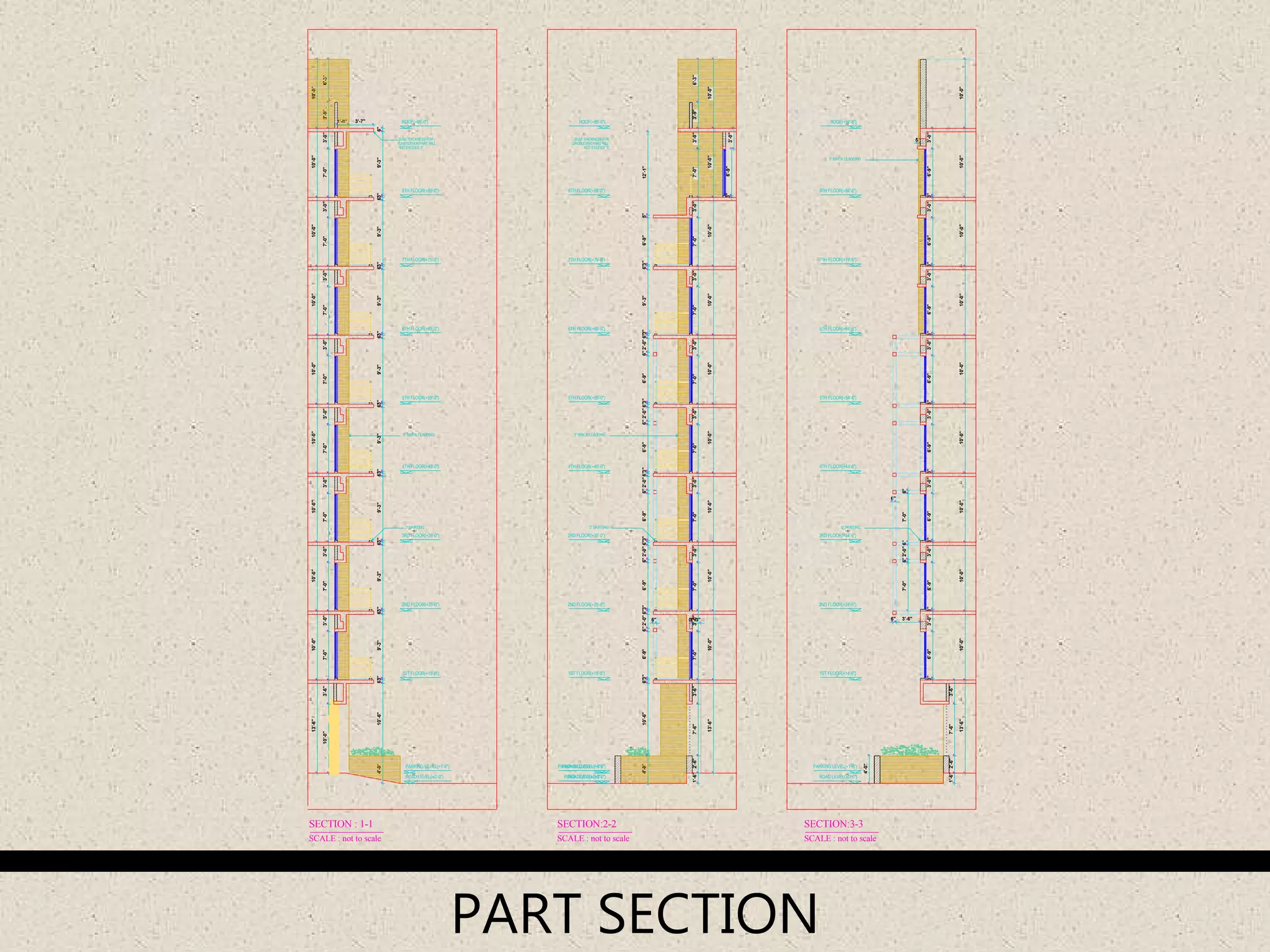
3" BRICK CLADDING
SLAB THICKNESS FOR
CANTILEVER PART WILL
NOT EXCEED 5"
3" SKIRTING
PARKING LEVEL(+1'-6")
ROAD LEVEL(±0'-0")
3'-7"
4'-0"10'-6"6"3"9'-3"9'-3"3"6"9'-3"3"6"9'-3"3"6"9'-3"3"6"
3"
3"
7'-0"
4'-0"
6"
5"
6"
3'-0"3"6'-9"3'-0"3"6'-9"3'-0"3"6'-9"3'-0"
3" SKIRTING
ROAD LEVEL(±0'-0")
PARKING LEVEL(+1'-6")
ROOF(+94'-6")
8TH FLOOR(+84'-6")
7TH FLOOR(+74'-6")
6TH FLOOR(+64'-6")
5TH FLOOR(+54'-6")
4TH FLOOR(+44'-6")
3RD FLOOR(+34'-6")
1ST FLOOR(+14'-6")
2ND FLOOR(+24'-6")
13'-6"10'-0"10'-0"10'-0"10'-0"10'-0"10'-0"10'-0"10'-0"10'-0"
2'-6"7'-6"3'-6"
3"6'-9"3'-0"3"6'-9"3'-0"3"6'-9"3'-0"3"6'-9"3'-0"3"6'-9"
6'-9"3'-0"
6"3"9'-3"6"3"9'-3"6"3"9'-3"6"
3" BRICK CLADDING
1'-6"
1'-6"
6"2'-0"6"7'-0"6"
6" 3'-6"
10'-0"3'-6"7'-0"3'-0"3'-0"7'-0"3'-0"7'-0"3'-0"7'-0"3'-0"7'-0"3'-0"7'-0"3'-0"7'-0"3'-0"7'-0"3'-9"6'-3"
10'-0"10'-0"10'-0"10'-0"10'-0"10'-0"10'-0"10'-0"10'-0"13'-6"
1'-8"
SCALE : not to scale
SECTION : 1-1
ROOF(+95'-0")
8TH FLOOR(+85'-0")
7TH FLOOR(+75'-0")
6TH FLOOR(+65'-0")
5TH FLOOR(+55'-0")
4TH FLOOR(+45'-0")
3RD FLOOR(+35'-0")
1ST FLOOR(+15'-0")
2ND FLOOR(+25'-0")
SECTION:2-2
SCALE : not to scale
PARKING LEVEL(+1'-6")
ROAD LEVEL(±0'-0")
3" SKIRTING
SLAB THICKNESS FOR
CANTILEVER PART WILL
NOT EXCEED 5"
ROAD LEVEL(±0'-0")
PARKING LEVEL(+1'-6")
3" BRICK CLADDING
3'-0"7'-0"3'-0"7'-0"3'-0"3'-9"6'-3"
6'-9"5"12'-1"
13'-6"10'-0"10'-0"10'-0"10'-0"10'-0"10'-0"10'-0"10'-0"10'-0"
2'-6"7'-6"7'-0"3'-0"7'-0"3'-0"7'-0"3'-0"7'-0"3'-0"7'-0"3'-0"7'-0"
SCALE : not to scale
SECTION:3-3
4'-0"10'-6"6"6'-9"6"2'-0"6"3"6'-9"6"2'-0"6"3"6'-9"6"2'-0"6"3"3"6"2'-0"6"6'-9"3"6"2'-0"6"6'-9"3"6"9'-3"
PART SECTION
Niaz ahmad zawad-ug-09-06-05-007
Md. Jahangiralam-ug-09-06-05-014
Shirin akhter-ug-09-06-05-018
THANK YOU EVERYBODY.

Post lintel structre

  • 1.
  • 2.
    STRUCTURAL METHOD POST-LINTEL STRUCTURE POST-SLABSTRUCTURE WALL SLAB STRUCTURE STEEL STRUCTURE COMPOSITE STRUCTURE
  • 3.
    POST & LINTEL Simpleform of construction involving posts carrying horizontal beams or lintels, as in timber- framed work or in columnar and trabeated architecture. Ancient Egyptian and Ancient Greek architecture was of this type, using stone. Stonehenge is an example of post and lintel construction
  • 4.
  • 5.
    POST & LINTELSYSTEM  Post Lintel is a Frame structure  Use of Concrete Materials, Mixing of aggregate, gravel, sand, Cement with water.  It may be lightweight or heavy weight structure.  Mixing ratio: 1:2:4, 1:3:6 & 1:1.5:3 etc  In more recent time it has been found possible to produce steels. According to many codes & specifications such as 80ksi, 60ksi, & 40ksi etc.  60ksi steel is most commonly used.
  • 6.
    FOUNDATION The foundation isthe part of a structure that is usually placed below the surface of the ground & that transmits the load to the underlying soil or rock.
  • 7.
    FOUNDATION TYPE  Footing •Wall Footing - R.C Wall - Masonry Wall • Column Footing - Rectangular - Square •Combined Footing  Pile  Mat, Raft or Deep Foundation
  • 8.
    COLUMN FOOTING 1/2''Ø Rod4'' C/C 3/8'' Ø Tie G.Beam Brick Wall LONG GB 3" 3" P.L. E.G.L. 18'' 2'-6'' 15'' 12'' 3'-6'' 3'-6'' TYPICAL COLUMN FOOTING PLAN TYPICAL COLUMN FOOTING SECTION
  • 9.
    COLUMN A column isa vertical support structure. According to ACI Code : Rectangular column _ Minimum 96 in² or 8’’X12”, steel 4 bars, Tie 3/8’’ dia or ½’’ dia. Spiral column – Minimum 100 in² , 10’’ dia steel 6 bars, Tie 3/8’’ dia , Not exceed than 3’’ & less than 1’’ Circular Column 10'' 10''10'' 10'' 8'' 12'' Rectangular Column Square Column
  • 10.
    ECONOMICAL COLUMN SPAN COLUMN SIZE Columnsize not less than 10“x10” for ACI code 15'-0" to 21'-0" depends on ground floor perking & drive way BEAMCOLUMN(POST-LINTEL)STRUCTURE COLUMN SPAN & SIZE
  • 11.
    DOUBLE HEIGHT COLUMNTHICKNESS POST-LINTESTRUCTURE Double height column depends on slender test of column or effective length of column buckling For member with h/t up to 10 (approximately h/r up to 35) For column with h/t = 20 (approximately h/r up to 70) R became 0.07 Team roll of dabble height column thickness, If column length is upward for axial load then column section is enlarge for a column.
  • 12.
    BEAM The beam isa very sturdy structure. A beam is a horizontal pole. It is usually shaped as a rectangle so there is more balance between the poles. A beam is held up by one or two columns. If there are two columns, they are placed on either side of the beam. If there is one column, it is placed in the middle of the beam so each side is balanced. Beams are found in many places - in buildings, in homes, and in moving structures.
  • 13.
    DISTRIBUTION LOADS POST-LINTESTRUCTURE Distributed Load DISSTRIBUTEDLOAD SECTION OF BEAM Concentreted Load SECTION OF BEAM Concentrated Load
  • 14.
    BEAM TYPES According toReinforcement there are two types of beam : Single reinforcement beam Reinforcement bar are used in the tensile zone. Double reinforcement beam Reinforcement bar are used in the tensile & Compression zone. SINGLE REINFORCEMENT BEAM SECTION DOUBLE REINFORCEMENT BEAM SECTION
  • 15.
    BEAM TYPES According toSupport there are four types of beam : Simply Supported Beam One end Continuous Supported Beam BEAMCOLUMN(POST-LINTEL)STRUCTURE
  • 16.
    BEAM TYPES  Bothend Continuous Supported Beam  Cantilever Beam BEAMCOLUMN(POST-LINTEL)STRUCTURE
  • 17.
    Clear span ofcolumn & the beam thickness is convert to inches for column span length. For an example column span clear 20’-0” so for this region beam thickness 20” for this span BEAMCOLUMN(POST-LINTEL)STRUCTURE 20’ Column Span 12” 20” BEAM THICKNESS
  • 18.
    Structural Joint Joint ofBeam & Column Beam Column
  • 19.
    ECONOMICAL CANTILEVER PORTION POST-LINTESTRUCTURE weuse to cantilever not less then 5’-0” for open side on a support. But its depends on overturning moment should be balance by type of load or embedded layer.
  • 20.
    POST-LINTE STRUCTURE SLAB POST-LINTESTRUCTURE SLAB Thereare two type of slab use in post lintel structural system One-way slab A one-way slab is essentially a rectangular beam of comparative large ratio of width depth. And steel use to short direction of slab. One Way Reinforcement Slab 20'-0" 45'-0" Botomwithalt.Ckd. 10mmØ@6"C/CStd.
  • 21.
    POST-LINTE STRUCTURE SLAB POST-LINTESTRUCTURE Twoway slab Most rectangular reinforced concrete slab are supported on all four side by beam , girders or walls. 20'-0" 20'-0" Botom with alt.Ckd. 10 mm Ø @ 6" C/C Std. Botomwithalt.Ckd. 10mmØ@6"C/CStd. 12 mm Ø Extra top Two Way Reinforcement Slab
  • 22.
    POST-LINTE STRUCTURE SLAB POST-LINTESTRUCTURE SLABTHICKNESS we are use to thump roll of structural system for slab thickness T = Parameter 180 For example for a slab T = 2 X (ax b) x 12 180 Minimum slab thickness for ACI code a) Simply Supported L / 20 b) One end continuous L / 24 c) Both end continuous L / 28 d) Cantilever L / 10
  • 23.
    STAIR IN THE POSTLINTEL STRUCTURE THERE USED THREE TYPES OF STAIR SECTION. 1. BEAM HANGING FROM LANDING LEVEL. 2. BEAM INVERTED ON LANDING LEVEL. 3. BEAM HANGING FROM SAME AS SLAB LEVEL. POST-LINTESTRUCTURE 3'-9"5"3'-9" 6"5"4'-2"10"10"10"10"10"10"10"10"10"2'-6" AA UP STAIR PLAN
  • 24.
    STAIR SECTIONS POST-LINTESTRUCTURE 10" 6" 10" 6" SECTION :A-A INVERTED BEAM IS USED INLANDINGLEVELBEAM IS HANGING FROM THELANDINGLEVEL BEAM POSITION IS SAME TO SLAB LEVEL SECTION : A-ASECTION : A-A 6" 10" 6" 10"10" 6" 10" 6"
  • 25.
    1'-9"1'-0"3" 7'-0" 10'-0" 3'-0" 3'-0" 3'-0"4" ROOF 4" L.C NET 4"ØPVCSOILPIPE 1"ØPVCVENTPIPE DETAIL OFSANITARY PIPING TYPICAL SECTION OF A/C HOLE 1'-8" AC 10'-0" 1'-8" FLOOR 5'-4"3'-0" FLOOR DETAIL-G 1" THICK PLASTER SANITARY & AC SECTION POST-LINTESTRUCTURE
  • 26.
    Post lentil itself a farm structure Out side exposed structurally sound structurally sustainable usually it is economical environmentally and earth quick save. Beam-Column Image of Architecture BEAMCOLUMN(POST-LINTEL)STRUCTURE
  • 27.
    Expression  Post &lintels are shown as frame structures. But columns & louvers.  Solid & void relationship is less.  The invert beam can be seen from above.  Presence of continuous beam  Columns are placed along the age of the building. BEAMCOLUMN(POST-LINTEL)STRUCTURE
  • 28.
    POST-LINTE ADVANTAGES POST-LINTESTRUCTURE AESTHETICS Aesthetically thisstructural system seems quite sound by using the expression of post-lintel structure in the exterior facades. Sometimes the heavy or rigid masses are treated politely by using the framework of the post-lintel which gives an extra ordinary looks. SPAN & SPACE Larger span (column to column distance) of building is possible to design in this system. For the large span the lintel height become larger for this a large space seems small, as the lacking of clear height. Sometimes this problem creates visual disturbance, which is avoided, in flat slab.
  • 29.
    POST-LINTE ADVANTAGES POST-LINTESTRUCTURE ECONOMIC The constructioncost of this system is slightly high for the time consuming casting of beam and slab and the use of R.C.C. The maintenance cost of this system remains lower than the other structural system for its long lasting characteristics. CLIMATE Considering the climate this system is more suitable for our country. The admission of heat become reduced in this system, as the heat transferred from the slab to beam and then from the beam to floor. The control of openings admits the little amount of heat in the building. For the free flowing plan light and ventilation can easily insert the building.
  • 30.
    POST-LINTE ADVANTAGES POST-LINTESTRUCTURE ENVIRONMENT This structuralsystem having less self-loads which reduces the risk of danger of earth quack. It can resist the buckling or bending effect of the building from the strong wind flow. It has the capability of fire resistance for the construction material (R.C.C.). So this system is very much suiting with respect to our environment. CONSTRUCTION TECHNICS In this structural system construction process takes a long time for the casting of beam and slab because at first column and beam cast and after that the slab cast. High cost materials are used in this system. In post-lintel system ducting process is not so easier compared to Post-slab.
  • 31.
    POST-LINTE ADVANTAGES POST-LINTESTRUCTURE OPENNINGS In post-lintelsystem 50% area of the external facade is remaining for the openings of the building. For this there is a control over use of openings. The admass of light and ventilation is smaller compared to post-slab. SUSTAINABILITY Sustainability means the ultimate capacity of individual members and as well as the whole structure against any types of overloading such as cyclones, earth quacks, etc. Sustainability of structures may also termed as factor of safety because overloading is allowed only up to the safety level which was taken in considering at the time of design. Stability of any structure is the critical point of failure. If stability is not satisfied it limits the values, then the failure may come suddenly. This system has less possibility of failure than the other structural system.
  • 32.
    POST-LINTE ADVANTAGES POST-LINTESTRUCTURE FLOOR SLAB Floorslab is a slab supported on ground generally distribute load to the ground uniformly. It also increases the bearing capacity of soil as the load distributes combined. SOLID-VOID RATIO By using the framework of post-lintel system we can make a sense full solid-void ratio which illuminate the monotonous effect. CANTILEVER OR OVERHANG The portion of any structure that is over hanged without any support termed as cantilever. Sometimes cantilever construction is economical and looks aesthetically attractive which may become a useful part of that structure.
  • 33.
    Limitation  Extreme variationof solid & is not possible.  Opening should be place considering the post.  Stair must start with respect to a beam.  Building height increases for the beam to get clear Space.  Also duct for air conditioning are used under beam, so floor height increases which is not acceptable for height.  This system more costly (30%more)than wall slab system.  But economic range can be kept in a lower gird when the span is limited 15’ to 25’.  Uninterrupted vast space can not be created without using vault dome or waffle. BEAMCOLUMN(POST-LINTEL)STRUCTURE
  • 34.
  • 35.
  • 37.
  • 38.
    THE WESTIN DHAKA HIRSCHBEDNER ASSOCIATES Example
  • 39.
    MIRPUR C.R.P HOSPITAL SECTION-14,MIRPUR, DHAKA ARCHITECT MD.RAFIQ AZAM Example
  • 40.
  • 41.
  • 42.
  • 43.
  • 44.
  • 45.
  • 46.
  • 47.
  • 48.
  • 49.
  • 50.
  • 51.
  • 52.
    VIEW OF FRAMSTRUCTURE
  • 53.
    Example EQUITY INSIGNIA ROAD NO: 01, KHULSHI , CHITTAGONG. ARCHITECT MAMNOON M. CHOWDHURY. MAHMUDUL ANWAR RIYAAD.
  • 54.
    LAYOUT PLAN 7 6 5 4 3 2 1 A BC D E F G H HGFEDCBA 1 2 3 4 5 6 7 A1 A1
  • 55.
    FOOTING LAYOUT PLAN CF-1 A1 A1 F-1 F-1F-1 F-1 F-2 F-2 F-2 F-2 F-2 F-2 F-2F-3 F-3 F-3 F-3 F-3 F-3 F-4 F-5 F-5 F-5 F-5 F-5 F-6 F-7 F-6 1 2 3 4 5 6 7 7 6 5 4 3 2 1 A B C D E F G H HGFEDCBA
  • 56.
    GROUND FLOOR PLAN 5'-7" FIXEDGRILL (FLOOR TO 7'-0") GRILL DOOR FIXED GRILL (FLOOR TO 7'-0") FIXED GLASS ELECT. RISERS ELECT. RISERS 1 2 3 SUBSTATION & GENERATOR ROOM UP +2'-0" +2'-0" +2'-0" +2'-0" +2'-0" +2'-0" SEPTIC TANK LOCATION OF OUTDOORMETAL HALLIDE PROPOSED UGRLOCATION TAPFOR CARWASH 5"X4'-2"HIGH BRICKWALL PROPOSEDLOCATION OFDEEPTUBEWELL GAS RISER NAMEPLATE DRIVERS' COMMON ROOM CARETAKER'S CARETAKER'S GASRISER D R I V E W A Y +1'-6" ENTRY A D R I V E W A Y +0'-0" C-01 A C-02 C-03 C-04 C-05 C-06 C-15 C-14 C-13 C-12 C-11 C-07 C-08 C-09 C-10 METER ROOM M.S.SLIDINGGATE (SEEDETAIL) GUARD ROOM GREEN GARDEN DRIVEWAY +2'-6"
  • 57.
  • 58.
    2ND FLOOR(+24'-6") 1ST FLOOR(+14'-6") 3RDFLOOR(+34'-6") 4TH FLOOR(+44'-6") 5TH FLOOR(+54'-6") 6TH FLOOR(+64'-6") 7TH FLOOR(+74'-6") 8TH FLOOR(+84'-6") ROOF(+94'-6") SLAB THICKNESS FOR CANTILEVER PART WILL NOT EXCEED 5" PARKING LEVEL(+1'-6") ROAD LEVEL(±0'-0") BRICK CLADDED SURFACE PLASTERED SURFACE PAINT FRONT ELEVATION
  • 59.
    SLAB THICKNESS FORCANTILEVER PART WILL NOT EXCEED 5" SEE 3D & SECTION SLAB THICKNESS FOR CANTILEVER PART WILL NOT EXCEED 5" LINTEL SLAB OF 8TH FLOOR 13'-0"10'-0"10'-0" 7'-1" AC AC AC AC AC AC AC AC AC AC AC AC AC AC AC 2ND FLOOR(+24'-6") 1ST FLOOR(+14'-6") 3RD FLOOR(+34'-6") 4TH FLOOR(+44'-6") 5TH FLOOR(+54'-6") 6TH FLOOR(+64'-6") 7TH FLOOR(+74'-6") 8TH FLOOR(+84'-6") ROOF(+94'-6") PARKING LEVEL(+1'-6") ROAD LEVEL(±0'-0") NORTHT ELEVATION
  • 60.
    SECTION 6'-7" 7'-0" 7'-5" 8'-8" 8'-3" 5" 3" LEVEL +15'-0" 8'-8" 7'-0" 10" 6" 10'-0"3'-6" CONFIRMHEIGHT FROM LIFT SUPPLIER 3'-0" 8'-0" 13'-0"5'-0"6" OVER HEAD WATER RESERVOIR 10'-0" 3'-0" 3RD FLOOR(+35'-0") 4TH FLOOR(+45'-0") 5TH FLOOR(+55'-0") 6TH FLOOR(+65'-0") 7TH FLOOR(+75'-0") 8TH FLOOR(+85'-0") ROOF(+95'-0") 8'-0" 5'-0" 10'-0" 10'-0" 10'-0" 10'-0" 10'-0" 10'-0" 10'-0" 10'-0" 10'-0" 10'-0" 10'-0" 10'-0" 10'-0" 7'-0"3'-0"3'-0"7'-0" 10'-0" 3'-0"7'-0" 10'-0"10'-0" 7'-0"3'-0" 10'-0" 7'-0"3'-0" 10'-0" 7'-0"3'-0" 10'-0" 7'-0"3'-0" 10'-0"11'-0"6'-6" LIFT CORE LEVEL +1'-6" LEVEL +2'-6" UNDER GROUND WATER RESERVOIR 10'-0"12'-6" 3'-0"7'-0" 10'-0"13'-6" PARKING LEVEL(+1'-6") ROAD LEVEL(±0'-0") 2ND FLOOR(+25'-0") 1ST FLOOR(+15'-0")
  • 61.
    0"1'-3" 3'-6" 2ND FLOOR(+25'-0") 1ST FLOOR(+15'-0") 3RDFLOOR(+35'-0") 4TH FLOOR(+45'-0") 5TH FLOOR(+55'-0") 6TH FLOOR(+65'-0") 7TH FLOOR(+75'-0") 8TH FLOOR(+85'-0") ROOF(+95'-0") 3" BRICK CLADDING SLAB THICKNESS FOR CANTILEVER PART WILL NOT EXCEED 5" 3" SKIRTING PARKING LEVEL(+1'-6") ROAD LEVEL(±0'-0") 3'-7" 4'-0"10'-6"6"3"9'-3"9'-3"3"6"9'-3"3"6"9'-3"3"6"9'-3"3"6" 3" 3" 7'-0" 4'-0" 6" 5" 6" 3'-0"3"6'-9"3'-0"3"6'-9"3'-0"3"6'-9"3'-0" 3" SKIRTING ROAD LEVEL(±0'-0") PARKING LEVEL(+1'-6") ROOF(+94'-6") 8TH FLOOR(+84'-6") 7TH FLOOR(+74'-6") 6TH FLOOR(+64'-6") 5TH FLOOR(+54'-6") 4TH FLOOR(+44'-6") 3RD FLOOR(+34'-6") 1ST FLOOR(+14'-6") 2ND FLOOR(+24'-6") 13'-6"10'-0"10'-0"10'-0"10'-0"10'-0"10'-0"10'-0"10'-0"10'-0" 2'-6"7'-6"3'-6" 3"6'-9"3'-0"3"6'-9"3'-0"3"6'-9"3'-0"3"6'-9"3'-0"3"6'-9" 6'-9"3'-0" 6"3"9'-3"6"3"9'-3"6"3"9'-3"6" 3" BRICK CLADDING 1'-6" 1'-6" 6"2'-0"6"7'-0"6" 6" 3'-6" 10'-0"3'-6"7'-0"3'-0"3'-0"7'-0"3'-0"7'-0"3'-0"7'-0"3'-0"7'-0"3'-0"7'-0"3'-0"7'-0"3'-0"7'-0"3'-9"6'-3" 10'-0"10'-0"10'-0"10'-0"10'-0"10'-0"10'-0"10'-0"10'-0"13'-6" 1'-8" SCALE : not to scale SECTION : 1-1 ROOF(+95'-0") 8TH FLOOR(+85'-0") 7TH FLOOR(+75'-0") 6TH FLOOR(+65'-0") 5TH FLOOR(+55'-0") 4TH FLOOR(+45'-0") 3RD FLOOR(+35'-0") 1ST FLOOR(+15'-0") 2ND FLOOR(+25'-0") SECTION:2-2 SCALE : not to scale PARKING LEVEL(+1'-6") ROAD LEVEL(±0'-0") 3" SKIRTING SLAB THICKNESS FOR CANTILEVER PART WILL NOT EXCEED 5" ROAD LEVEL(±0'-0") PARKING LEVEL(+1'-6") 3" BRICK CLADDING 3'-0"7'-0"3'-0"7'-0"3'-0"3'-9"6'-3" 6'-9"5"12'-1" 13'-6"10'-0"10'-0"10'-0"10'-0"10'-0"10'-0"10'-0"10'-0"10'-0" 2'-6"7'-6"7'-0"3'-0"7'-0"3'-0"7'-0"3'-0"7'-0"3'-0"7'-0"3'-0"7'-0" SCALE : not to scale SECTION:3-3 4'-0"10'-6"6"6'-9"6"2'-0"6"3"6'-9"6"2'-0"6"3"6'-9"6"2'-0"6"3"3"6"2'-0"6"6'-9"3"6"2'-0"6"6'-9"3"6"9'-3" PART SECTION
  • 62.
    Niaz ahmad zawad-ug-09-06-05-007 Md.Jahangiralam-ug-09-06-05-014 Shirin akhter-ug-09-06-05-018 THANK YOU EVERYBODY.