Presentation on Post-lintel
structure
Presented by
Tonmoy Barua 132082001
Nizam Uddin 141081005
Presented to,
Ar. Mehreen Hossain
Dept. of Architecture
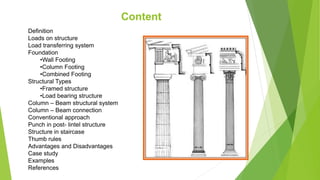
Content
Definition
Loads on structure
Load transferring system
Foundation
•Wall Footing
•Column Footing
•Combined Footing
Structural Types
•Framed structure
•Load bearing structure
Column – Beam structural system
Column – Beam connection
Conventional approach
Punch in post- lintel structure
Structure in staircase
Thumb rules
Advantages and Disadvantages
Case study
Examples
References
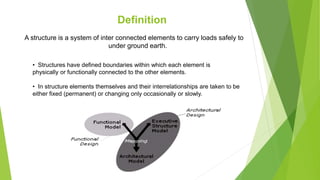
Definition
A structure is a system of inter connected elements to carry loads safely to
under ground earth.
• Structures have defined boundaries within which each element is
physically or functionally connected to the other elements.
• In structure elements themselves and their interrelationships are taken to be
either fixed (permanent) or changing only occasionally or slowly.
Loads on structure
• DEAD LOAD
• LIVE LOAD
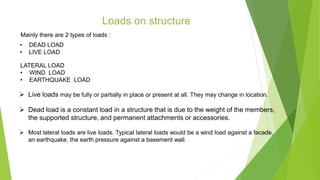
 Live loads may be fully or partially in place or present at all. They may change in location.
 Dead load is a constant load in a structure that is due to the weight of the members,
the supported structure, and permanent attachments or accessories.
 Most lateral loads are live loads. Typical lateral loads would be a wind load against a facade,
an earthquake, the earth pressure against a basement wall.
Mainly there are 2 types of loads :
LATERAL LOAD
• WIND LOAD
• EARTHQUAKE LOAD
Load transferring system
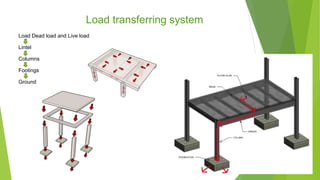
Load Dead load and Live load
Lintel
Columns
Footings
Ground
Foundation
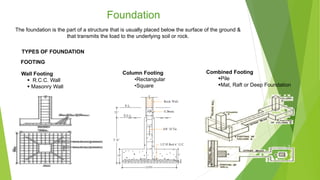
The foundation is the part of a structure that is usually placed below the surface of the ground &
that transmits the load to the underlying soil or rock.
TYPES OF FOUNDATION
FOOTING
Wall Footing
 R.C.C. Wall
 Masonry Wall
Column Footing
•Rectangular
•Square
Combined Footing
Pile
Mat, Raft or Deep Foundation
Structural Types
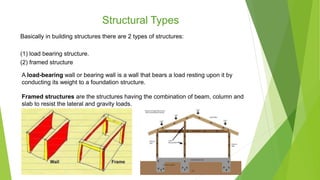
Basically in building structures there are 2 types of structures:
(1) load bearing structure.
(2) framed structure
A load-bearing wall or bearing wall is a wall that bears a load resting upon it by
conducting its weight to a foundation structure.
Framed structures are the structures having the combination of beam, column and
slab to resist the lateral and gravity loads.
COLUMN-BEAM STRUCTURAL SYSTEM
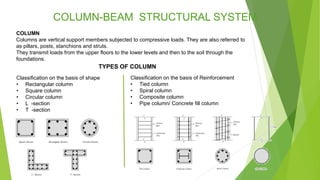
COLUMN
Columns are vertical support members subjected to compressive loads. They are also referred to
as pillars, posts, stanchions and struts.
They transmit loads from the upper floors to the lower levels and then to the soil through the
foundations.
Classification on the basis of shape
• Rectangular column
• Square column
• Circular column
• L -section
• T -section
TYPES OF COLUMN
Classification on the basis of Reinforcement
• Tied column
• Spiral column
• Composite column
• Pipe column/ Concrete fill column
COLUMN-BEAM STRUCTURAL SYSTEM
BEAM
A beam is a horizontal pole. It is usually shaped as a rectangle so there is more balance between
the poles. A beam is held up by one or two columns.
• If there are two columns, they are placed on either side of the beam.
• If there is one column, it is placed in the middle of the beam so each side is balanced.
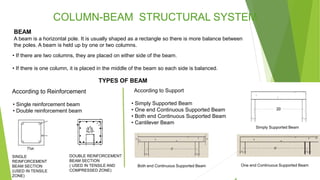
TYPES OF BEAM
According to Reinforcement
• Single reinforcement beam
• Double reinforcement beam
SINGLE
REINFORCEMENT
BEAM SECTION
(USED IN TENSILE
ZONE)
DOUBLE REINFORCEMENT
BEAM SECTION
( USED IN TENSILE AND
COMPRESSED ZONE)
According to Support
• Simply Supported Beam
• One end Continuous Supported Beam
• Both end Continuous Supported Beam
• Cantilever Beam
Simply Supported Beam
20
One end Continuous Supported BeamBoth end Continuous Supported Beam
COLUMN-BEAM STRUCTURAL SYSTEM
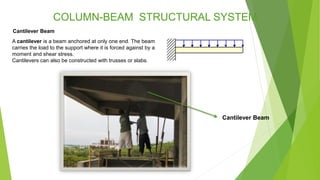
Cantilever Beam
A cantilever is a beam anchored at only one end. The beam
carries the load to the support where it is forced against by a
moment and shear stress.
Cantilevers can also be constructed with trusses or slabs.
Cantilever Beam
COLUMN-BEAM (SLAB) STRUCTURAL SYSTEM
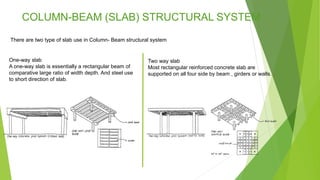
One-way slab
A one-way slab is essentially a rectangular beam of
comparative large ratio of width depth. And steel use
to short direction of slab.
There are two type of slab use in Column- Beam structural system
Two way slab
Most rectangular reinforced concrete slab are
supported on all four side by beam , girders or walls.
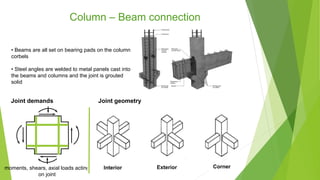
Column – Beam connection
• Beams are all set on bearing pads on the column
corbels
• Steel angles are welded to metal panels cast into
the beams and columns and the joint is grouted
solid
Joint demands
moments, shears, axial loads acting
on joint
Joint geometry
Interior CornerExterior
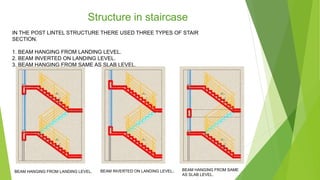
Structure in staircase
IN THE POST LINTEL STRUCTURE THERE USED THREE TYPES OF STAIR
SECTION.
1. BEAM HANGING FROM LANDING LEVEL.
2. BEAM INVERTED ON LANDING LEVEL.
3. BEAM HANGING FROM SAME AS SLAB LEVEL.
BEAM HANGING FROM LANDING LEVEL. BEAM INVERTED ON LANDING LEVEL. BEAM HANGING FROM SAME
AS SLAB LEVEL.
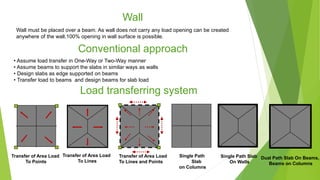
Conventional approach
• Assume load transfer in One-Way or Two-Way manner
• Assume beams to support the slabs in similar ways as walls
• Design slabs as edge supported on beams
• Transfer load to beams and design beams for slab load
Load transferring system
Transfer of Area Load
To Points
Transfer of Area Load
To Lines and Points
Transfer of Area Load
To Lines
Single Path Slab
On Walls
Single Path
Slab
on Columns
Dual Path Slab On Beams,
Beams on Columns
Wall
Wall must be placed over a beam. As wall does not carry any load opening can be created
anywhere of the wall,100% opening in wall surface is possible.
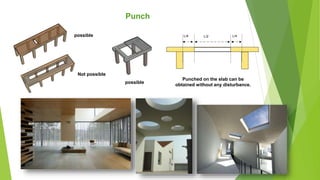
Punch
Punched on the slab can be
obtained without any disturbance.
L/2 L/4L/4
Not possible
possible
possible
Thumb rules
Three thumb rules of column to be followed are as follows:
Size of the Columns
Distance between Columns
Alignment of columns
Thumb rule no.1- Size of the columns:
• The size of the columns depends on the total load on the columns.
• Minimum size of the column should not be less than 9”x9”.
9”x9” columns are to be used for a single storey structure with M15 grade
of concrete.
In case, 9”x9” column size is to be used for 1 and half storey structure, then it is
advised to use M20 grade concrete.
• A safe and structurally sound column size for a 1 and half storey structure
should not be less
than 12”x9” using M15 grade concrete. This should be in your most preferred
and practical options list.
Thumb rule no.2: Distance between the columns
• Try to maintain equal distance between the centers of two columns.
Always plan a column layout on a grid.
• The distance between two columns of size 9”x9” should not be more
than 4m centre to centre of column.
• If larger barrier free distances are required then going for larger column
size is to be used
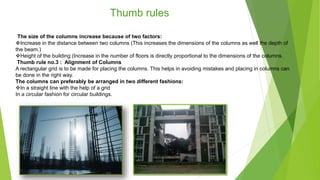
The size of the columns increase because of two factors:
Increase in the distance between two columns (This increases the dimensions of the columns as well the depth of
the beam.)
Height of the building (Increase in the number of floors is directly proportional to the dimensions of the columns.
Thumb rule no.3 : Alignment of Columns
A rectangular grid is to be made for placing the columns. This helps in avoiding mistakes and placing in columns can
be done in the right way.
The columns can preferably be arranged in two different fashions:
In a straight line with the help of a grid
In a circular fashion for circular buildings.
Thumb rules
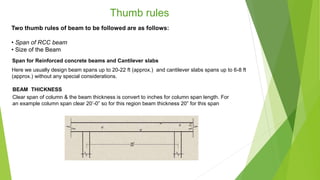
Here we usually design beam spans up to 20-22 ft (approx.) and cantilever slabs spans up to 6-8 ft
(approx.) without any special considerations.
Span for Reinforced concrete beams and Cantilever slabs
BEAM THICKNESS
Clear span of column & the beam thickness is convert to inches for column span length. For
an example column span clear 20’-0” so for this region beam thickness 20” for this span
Thumb rules
Two thumb rules of beam to be followed are as follows:
• Span of RCC beam
• Size of the Beam
Advantages and Disadvantages
ADVANTAGES
AESTHETICS
•Sometimes the heavy or rigid masses are treated politely by using the framework of the post-lintel which
gives an extra ordinary looks.
SPAN & SPACE
•Larger span (column to column distance) of building is possible.
ECONOMIC
•The maintenance cost of this system remains lower than the other structural system for its long lasting
characteristics.
CLIMATE
•Considering the climate this system is more suitable for our country.
•The control of openings admits the little amount of heat in the building.
•For the free flowing plan light and ventilation can easily insert the building.
ENVIRONMENT
• This structural system having less self-loads which reduces the risk of danger of earthquake.
• It can resist the buckling or bending effect of the building from the strong wind flow.
• It has the capability of fire resistance for the construction material (R.C.C.).
CONSTRUCTION TECHNICS
•In this structural system construction process takes a long time for the casting of beam and slab
•In post-lintel system ducting process is not so easier compared to Post-slab.
OPENNINGS
•In post-lintel system 50% area of the external facade is remaining for the openings of the building.
•For this there is a control over use of openings.
SUSTAINABILITY
•This system has less possibility of failure than the other structural system.
Advantages and Disadvantages
ADVANTAGES
Advantages and Disadvantages
FLOOR SLAB
•Floor slab is a slab supported on ground generally distribute load to the ground uniformly.
• It also increases the bearing capacity of soil as the load distributes combined.
SOLID-VOID RATIO
•By using the framework of post-lintel system we can make a sense full solid-void ratio which illuminate the
monotonous effect.
CANTILEVER OR OVERHANG
•The portion of any structure that is over hanged without any support termed as cantilever.
•Sometimes cantilever construction is economical and looks aesthetically attractive which may become a
useful part of that structure.
ADVANTAGES
Advantages and Disadvantages
• Extreme variation of solid is not possible.
• Opening should be place considering the post.
• Stair must start with respect to a beam.
• Building height increases for the beam to get clear Space.
• Also duct for air conditioning are used under beam, so floor height increases which is not acceptable for height.
• This system more costly (30%more)than wall slab system but economic range can be kept in a lower gird when
the span is limited 15’ to 25’.
• Uninterrupted vast space can not be created without using vault dome or waffle.
•Sometimes this problem creates visual disturbance, which is avoided, in flat slab.

•The construction cost of this system is slightly high for the time consuming costing of beam and slab and the use
of R.C.C.
DISADVANTAGES
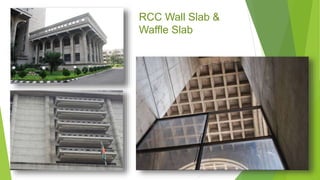
Case Study 1 ( Nagar Bhaban)
NAGAR
BHABAN
ARCHITECT: LAILUN NAHAR &
ABU H IMAM UDDIN
LOCATON:DHAKA
LEVEL: 15
BUILDING CONTAINING :
•Mayor's Office
•Offices
•a bank
•meeting rooms
•a museum
•dining facilities
•a prayer hall
•public terraces.
RCC Wall Slab &
Waffle Slab
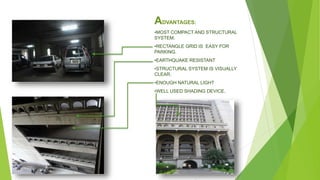
ADVANTAGES:
•MOST COMPACT AND STRUCTURAL
SYSTEM.
•RECTANGLE GRID IS EASY FOR
PARKING.
•EARTHQUAKE RESISTANT
•STRUCTURAL SYSTEM IS VISUALLY
CLEAR.
•ENOUGH NATURAL LIGHT
•WELL USED SHADING DEVICE.
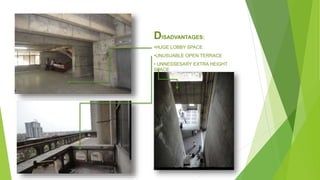
DISADVANTAGES:
•HUGE LOBBY SPACE
•UNUSUABLE OPEN TERRACE
• UNNESSESARY EXTRA HEIGHT
SPACE
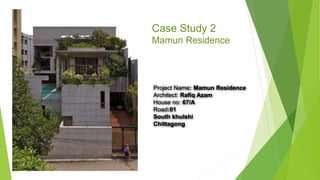
Project Name: Mamun Residence
Architect: Rafiq Azam
House no: 67/A
Road:01
South khulshi
Chittagong
Case Study 2
Mamun Residence
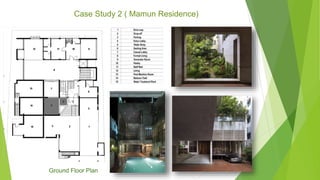
Case Study 2 ( Mamun Residence)
Ground Floor Plan
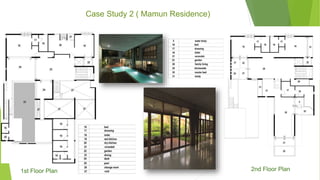
Case Study 2 ( Mamun Residence)
1st Floor Plan 2nd Floor Plan
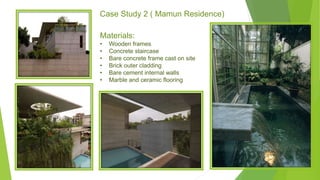
Materials:
• Wooden frames
• Concrete staircase
• Bare concrete frame cast on site
• Brick outer cladding
• Bare cement internal walls
• Marble and ceramic flooring
Case Study 2 ( Mamun Residence)
Case Study 3
( SA House)
Project name : SA House
Architect : Rahiq Azam
Total useable surface area : 20667 m2
Plot size : 11970 m2
Location : Road100,
Gulshan 1, Dhaka
Case Study 3 ( SA House)
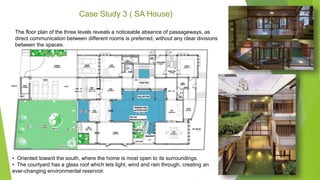
• Oriented toward the south, where the home is most open to its surroundings.
• The courtyard has a glass roof which lets light, wind and rain through, creating an
ever-changing environmental reservoir.
The floor plan of the three levels reveals a noticeable absence of passageways, as
direct communication between different rooms is preferred, without any clear divisions
between the spaces.
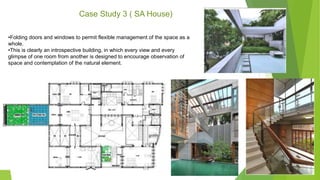
•Folding doors and windows to permit flexible management of the space as a
whole.
•This is clearly an introspective building, in which every view and every
glimpse of one room from another is designed to encourage observation of
space and contemplation of the natural element.
Case Study 3 ( SA House)
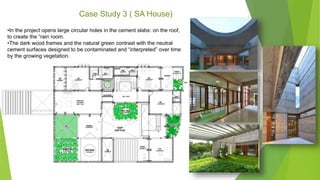
•In the project opens large circular holes in the cement slabs: on the roof,
to create the “rain room.
•The dark wood frames and the natural green contrast with the neutral
cement surfaces designed to be contaminated and “interpreted” over time
by the growing vegetation.
Case Study 3 ( SA House)
Reinforced Concrete Building Construction
ANY QUESTIONS ????

Post lintel structure

  • 1.
    Presentation on Post-lintel structure Presentedby Tonmoy Barua 132082001 Nizam Uddin 141081005 Presented to, Ar. Mehreen Hossain Dept. of Architecture
  • 2.
    Content Definition Loads on structure Loadtransferring system Foundation •Wall Footing •Column Footing •Combined Footing Structural Types •Framed structure •Load bearing structure Column – Beam structural system Column – Beam connection Conventional approach Punch in post- lintel structure Structure in staircase Thumb rules Advantages and Disadvantages Case study Examples References
  • 3.
    Definition A structure isa system of inter connected elements to carry loads safely to under ground earth. • Structures have defined boundaries within which each element is physically or functionally connected to the other elements. • In structure elements themselves and their interrelationships are taken to be either fixed (permanent) or changing only occasionally or slowly.
  • 4.
    Loads on structure •DEAD LOAD • LIVE LOAD  Live loads may be fully or partially in place or present at all. They may change in location.  Dead load is a constant load in a structure that is due to the weight of the members, the supported structure, and permanent attachments or accessories.  Most lateral loads are live loads. Typical lateral loads would be a wind load against a facade, an earthquake, the earth pressure against a basement wall. Mainly there are 2 types of loads : LATERAL LOAD • WIND LOAD • EARTHQUAKE LOAD
  • 5.
    Load transferring system LoadDead load and Live load Lintel Columns Footings Ground
  • 6.
    Foundation The foundation isthe part of a structure that is usually placed below the surface of the ground & that transmits the load to the underlying soil or rock. TYPES OF FOUNDATION FOOTING Wall Footing  R.C.C. Wall  Masonry Wall Column Footing •Rectangular •Square Combined Footing Pile Mat, Raft or Deep Foundation
  • 7.
    Structural Types Basically inbuilding structures there are 2 types of structures: (1) load bearing structure. (2) framed structure A load-bearing wall or bearing wall is a wall that bears a load resting upon it by conducting its weight to a foundation structure. Framed structures are the structures having the combination of beam, column and slab to resist the lateral and gravity loads.
  • 8.
    COLUMN-BEAM STRUCTURAL SYSTEM COLUMN Columnsare vertical support members subjected to compressive loads. They are also referred to as pillars, posts, stanchions and struts. They transmit loads from the upper floors to the lower levels and then to the soil through the foundations. Classification on the basis of shape • Rectangular column • Square column • Circular column • L -section • T -section TYPES OF COLUMN Classification on the basis of Reinforcement • Tied column • Spiral column • Composite column • Pipe column/ Concrete fill column
  • 9.
    COLUMN-BEAM STRUCTURAL SYSTEM BEAM Abeam is a horizontal pole. It is usually shaped as a rectangle so there is more balance between the poles. A beam is held up by one or two columns. • If there are two columns, they are placed on either side of the beam. • If there is one column, it is placed in the middle of the beam so each side is balanced. TYPES OF BEAM According to Reinforcement • Single reinforcement beam • Double reinforcement beam SINGLE REINFORCEMENT BEAM SECTION (USED IN TENSILE ZONE) DOUBLE REINFORCEMENT BEAM SECTION ( USED IN TENSILE AND COMPRESSED ZONE) According to Support • Simply Supported Beam • One end Continuous Supported Beam • Both end Continuous Supported Beam • Cantilever Beam Simply Supported Beam 20 One end Continuous Supported BeamBoth end Continuous Supported Beam
  • 10.
    COLUMN-BEAM STRUCTURAL SYSTEM CantileverBeam A cantilever is a beam anchored at only one end. The beam carries the load to the support where it is forced against by a moment and shear stress. Cantilevers can also be constructed with trusses or slabs. Cantilever Beam
  • 11.
    COLUMN-BEAM (SLAB) STRUCTURALSYSTEM One-way slab A one-way slab is essentially a rectangular beam of comparative large ratio of width depth. And steel use to short direction of slab. There are two type of slab use in Column- Beam structural system Two way slab Most rectangular reinforced concrete slab are supported on all four side by beam , girders or walls.
  • 12.
    Column – Beamconnection • Beams are all set on bearing pads on the column corbels • Steel angles are welded to metal panels cast into the beams and columns and the joint is grouted solid Joint demands moments, shears, axial loads acting on joint Joint geometry Interior CornerExterior
  • 13.
    Structure in staircase INTHE POST LINTEL STRUCTURE THERE USED THREE TYPES OF STAIR SECTION. 1. BEAM HANGING FROM LANDING LEVEL. 2. BEAM INVERTED ON LANDING LEVEL. 3. BEAM HANGING FROM SAME AS SLAB LEVEL. BEAM HANGING FROM LANDING LEVEL. BEAM INVERTED ON LANDING LEVEL. BEAM HANGING FROM SAME AS SLAB LEVEL.
  • 14.
    Conventional approach • Assumeload transfer in One-Way or Two-Way manner • Assume beams to support the slabs in similar ways as walls • Design slabs as edge supported on beams • Transfer load to beams and design beams for slab load Load transferring system Transfer of Area Load To Points Transfer of Area Load To Lines and Points Transfer of Area Load To Lines Single Path Slab On Walls Single Path Slab on Columns Dual Path Slab On Beams, Beams on Columns Wall Wall must be placed over a beam. As wall does not carry any load opening can be created anywhere of the wall,100% opening in wall surface is possible.
  • 15.
    Punch Punched on theslab can be obtained without any disturbance. L/2 L/4L/4 Not possible possible possible
  • 16.
    Thumb rules Three thumbrules of column to be followed are as follows: Size of the Columns Distance between Columns Alignment of columns Thumb rule no.1- Size of the columns: • The size of the columns depends on the total load on the columns. • Minimum size of the column should not be less than 9”x9”. 9”x9” columns are to be used for a single storey structure with M15 grade of concrete. In case, 9”x9” column size is to be used for 1 and half storey structure, then it is advised to use M20 grade concrete. • A safe and structurally sound column size for a 1 and half storey structure should not be less than 12”x9” using M15 grade concrete. This should be in your most preferred and practical options list. Thumb rule no.2: Distance between the columns • Try to maintain equal distance between the centers of two columns. Always plan a column layout on a grid. • The distance between two columns of size 9”x9” should not be more than 4m centre to centre of column. • If larger barrier free distances are required then going for larger column size is to be used
  • 17.
    The size ofthe columns increase because of two factors: Increase in the distance between two columns (This increases the dimensions of the columns as well the depth of the beam.) Height of the building (Increase in the number of floors is directly proportional to the dimensions of the columns. Thumb rule no.3 : Alignment of Columns A rectangular grid is to be made for placing the columns. This helps in avoiding mistakes and placing in columns can be done in the right way. The columns can preferably be arranged in two different fashions: In a straight line with the help of a grid In a circular fashion for circular buildings. Thumb rules
  • 18.
    Here we usuallydesign beam spans up to 20-22 ft (approx.) and cantilever slabs spans up to 6-8 ft (approx.) without any special considerations. Span for Reinforced concrete beams and Cantilever slabs BEAM THICKNESS Clear span of column & the beam thickness is convert to inches for column span length. For an example column span clear 20’-0” so for this region beam thickness 20” for this span Thumb rules Two thumb rules of beam to be followed are as follows: • Span of RCC beam • Size of the Beam
  • 19.
    Advantages and Disadvantages ADVANTAGES AESTHETICS •Sometimesthe heavy or rigid masses are treated politely by using the framework of the post-lintel which gives an extra ordinary looks. SPAN & SPACE •Larger span (column to column distance) of building is possible. ECONOMIC •The maintenance cost of this system remains lower than the other structural system for its long lasting characteristics. CLIMATE •Considering the climate this system is more suitable for our country. •The control of openings admits the little amount of heat in the building. •For the free flowing plan light and ventilation can easily insert the building.
  • 20.
    ENVIRONMENT • This structuralsystem having less self-loads which reduces the risk of danger of earthquake. • It can resist the buckling or bending effect of the building from the strong wind flow. • It has the capability of fire resistance for the construction material (R.C.C.). CONSTRUCTION TECHNICS •In this structural system construction process takes a long time for the casting of beam and slab •In post-lintel system ducting process is not so easier compared to Post-slab. OPENNINGS •In post-lintel system 50% area of the external facade is remaining for the openings of the building. •For this there is a control over use of openings. SUSTAINABILITY •This system has less possibility of failure than the other structural system. Advantages and Disadvantages ADVANTAGES
  • 21.
    Advantages and Disadvantages FLOORSLAB •Floor slab is a slab supported on ground generally distribute load to the ground uniformly. • It also increases the bearing capacity of soil as the load distributes combined. SOLID-VOID RATIO •By using the framework of post-lintel system we can make a sense full solid-void ratio which illuminate the monotonous effect. CANTILEVER OR OVERHANG •The portion of any structure that is over hanged without any support termed as cantilever. •Sometimes cantilever construction is economical and looks aesthetically attractive which may become a useful part of that structure. ADVANTAGES
  • 22.
    Advantages and Disadvantages •Extreme variation of solid is not possible. • Opening should be place considering the post. • Stair must start with respect to a beam. • Building height increases for the beam to get clear Space. • Also duct for air conditioning are used under beam, so floor height increases which is not acceptable for height. • This system more costly (30%more)than wall slab system but economic range can be kept in a lower gird when the span is limited 15’ to 25’. • Uninterrupted vast space can not be created without using vault dome or waffle. •Sometimes this problem creates visual disturbance, which is avoided, in flat slab. •The construction cost of this system is slightly high for the time consuming costing of beam and slab and the use of R.C.C. DISADVANTAGES
  • 23.
    Case Study 1( Nagar Bhaban) NAGAR BHABAN ARCHITECT: LAILUN NAHAR & ABU H IMAM UDDIN LOCATON:DHAKA LEVEL: 15 BUILDING CONTAINING : •Mayor's Office •Offices •a bank •meeting rooms •a museum •dining facilities •a prayer hall •public terraces.
  • 24.
    RCC Wall Slab& Waffle Slab
  • 25.
    ADVANTAGES: •MOST COMPACT ANDSTRUCTURAL SYSTEM. •RECTANGLE GRID IS EASY FOR PARKING. •EARTHQUAKE RESISTANT •STRUCTURAL SYSTEM IS VISUALLY CLEAR. •ENOUGH NATURAL LIGHT •WELL USED SHADING DEVICE.
  • 26.
    DISADVANTAGES: •HUGE LOBBY SPACE •UNUSUABLEOPEN TERRACE • UNNESSESARY EXTRA HEIGHT SPACE
  • 27.
    Project Name: MamunResidence Architect: Rafiq Azam House no: 67/A Road:01 South khulshi Chittagong Case Study 2 Mamun Residence
  • 28.
    Case Study 2( Mamun Residence) Ground Floor Plan
  • 29.
    Case Study 2( Mamun Residence) 1st Floor Plan 2nd Floor Plan
  • 30.
    Materials: • Wooden frames •Concrete staircase • Bare concrete frame cast on site • Brick outer cladding • Bare cement internal walls • Marble and ceramic flooring Case Study 2 ( Mamun Residence)
  • 31.
    Case Study 3 (SA House) Project name : SA House Architect : Rahiq Azam Total useable surface area : 20667 m2 Plot size : 11970 m2 Location : Road100, Gulshan 1, Dhaka
  • 32.
    Case Study 3( SA House) • Oriented toward the south, where the home is most open to its surroundings. • The courtyard has a glass roof which lets light, wind and rain through, creating an ever-changing environmental reservoir. The floor plan of the three levels reveals a noticeable absence of passageways, as direct communication between different rooms is preferred, without any clear divisions between the spaces.
  • 33.
    •Folding doors andwindows to permit flexible management of the space as a whole. •This is clearly an introspective building, in which every view and every glimpse of one room from another is designed to encourage observation of space and contemplation of the natural element. Case Study 3 ( SA House)
  • 34.
    •In the projectopens large circular holes in the cement slabs: on the roof, to create the “rain room. •The dark wood frames and the natural green contrast with the neutral cement surfaces designed to be contaminated and “interpreted” over time by the growing vegetation. Case Study 3 ( SA House)
  • 35.
  • 36.