-An overview
By Nikhil R
CONTENTS:-
 INTRODUCTION
 PRINCIPLE OF ACC
 PHYSICAL OVERVIEW
 DEFINITIONS/TERMINOLOGIES
 COMPONENTS OF ACC SYSTEM
 CONTROL SYSTEM INTERFACE
 PHYSICAL LAYOUT OF AN ACC
SYSTEM
 ADVANTAGES
 DISADVANTAGES
 APPLICATIONS
 CONCLUSION
INTRODUCTION:-
What is Adaptive Cruise Control?
Adaptive Cruise Control (ACC) is an automotive
feature that allows a vehicle's cruise control system
to adapt the vehicle's speed to the traffic
environment. A radar system attached to the front of
the vehicle is used to detect whether slower moving
vehicles are in the ACC vehicle's path.
Introduced in 1970’s in USA. This system is now
available in luxury cars like Mercedes S-class,
Jaguar XJ, Volvo trucks etc…
PRINCIPLE:-
How does it work?
If a slower moving vehicle is detected, the ACC
system will slow the vehicle down and control the
clearance, or time gap, between the ACC vehicle
and the forward vehicle. If the system detects that
the forward vehicle is no longer in the ACC vehicle's
path, the ACC system will accelerate the vehicle
back to its set cruise control speed. This operation
allows the ACC vehicle to autonomously slow down
and speed up with traffic without intervention from
the driver. The method by which the ACC vehicle's
speed is controlled is via engine throttle control and
limited brake operation.
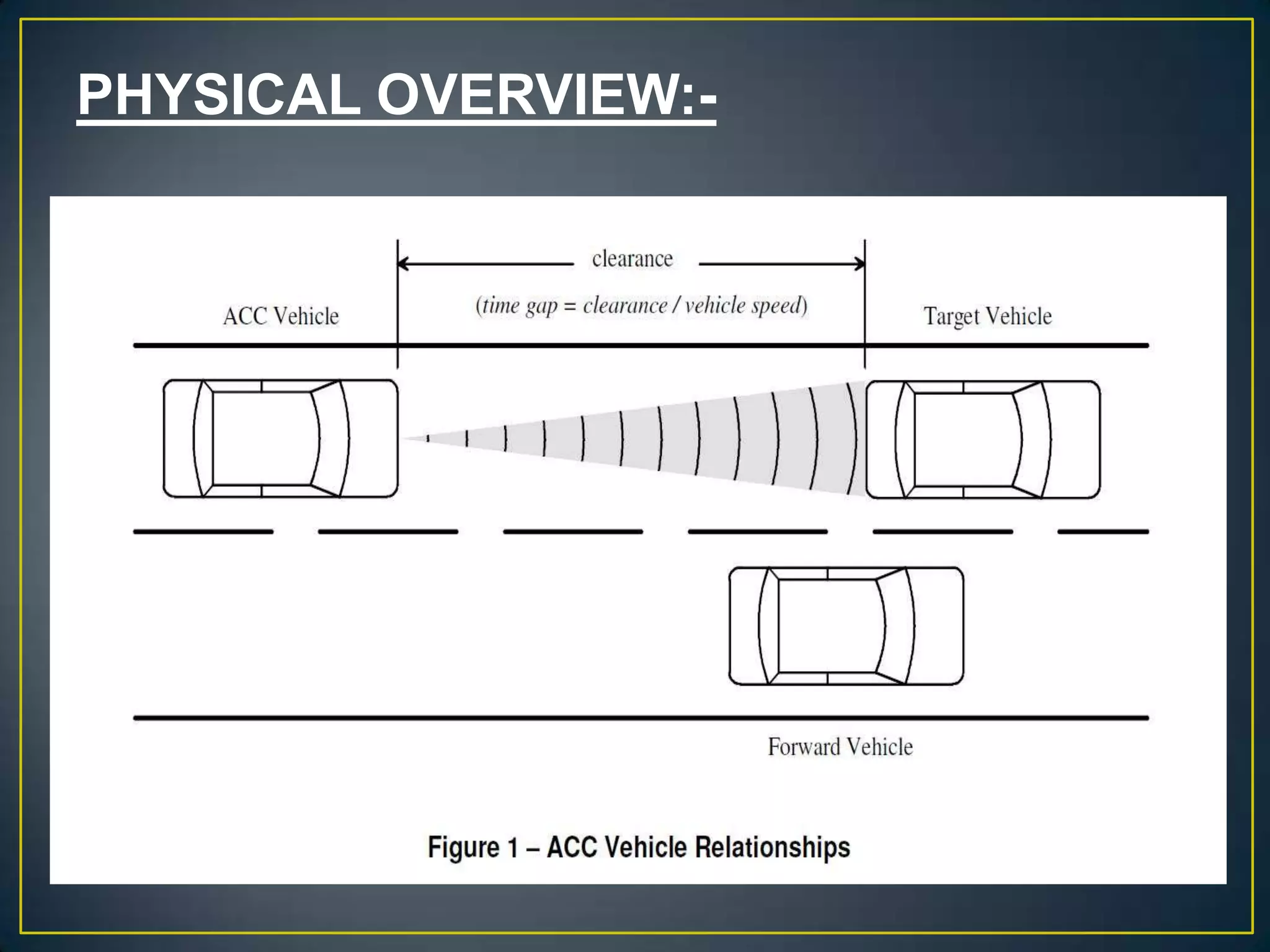
PHYSICAL OVERVIEW:-
DEFINITIONS:-
 Adaptive Cruise Control (ACC) – An
enhancement to a conventional cruise control
system which allows the ACC vehicle to follow a
forward vehicle at an appropriate distance.
 ACC vehicle – the subject vehicle equipped with
the ACC system.
 Active brake control – a function which causes
application of the brakes without driver application
of the brake pedal.
 Clearance – distance from the forward vehicle's
trailing surface to the ACC vehicle's leading
surface.
 Forward vehicle – any one of the vehicles in front
of and moving in the same direction and traveling
on the same roadway as the ACC vehicle.
 Set speed – the desired cruise control travel speed
set by the driver and is the maximum desired speed
of the vehicle while under ACC control.
 Target vehicle – one of the forward vehicles in the
path of the ACC vehicle that is closest to the ACC
vehicle.
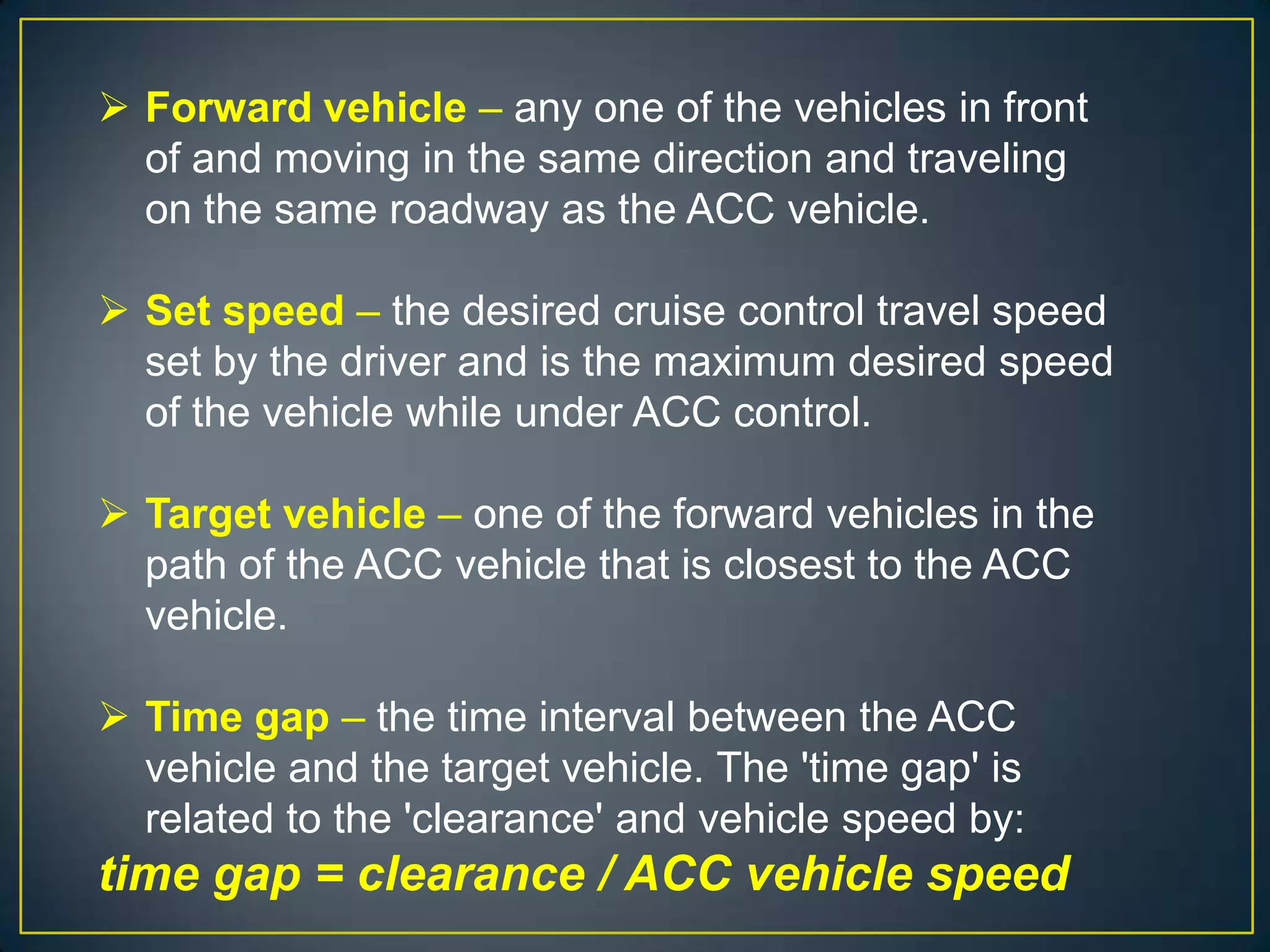
 Time gap – the time interval between the ACC
vehicle and the target vehicle. The 'time gap' is
related to the 'clearance' and vehicle speed by:
time gap = clearance / ACC vehicle speed
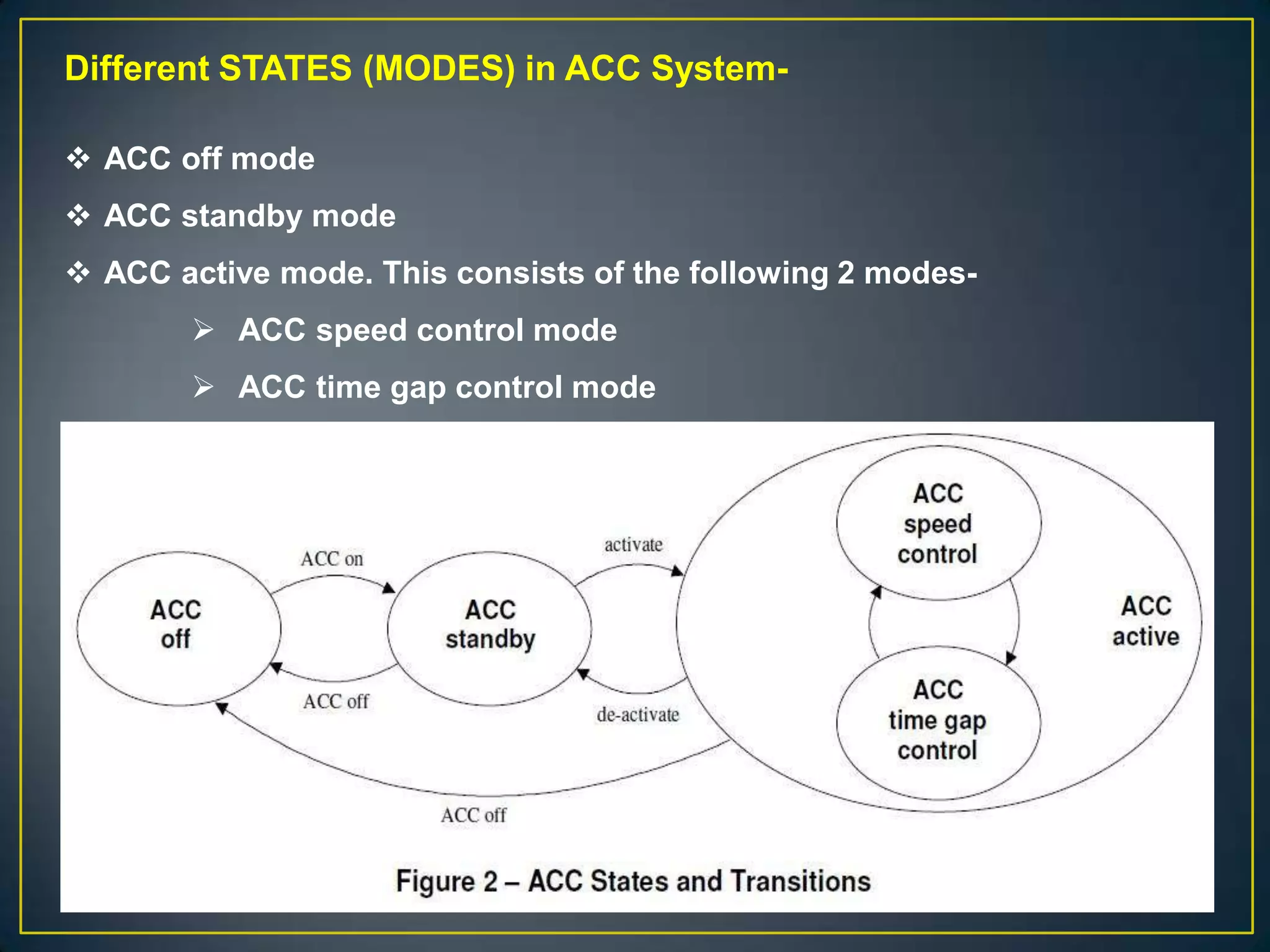
Different STATES (MODES) in ACC System-
 ACC off mode
 ACC standby mode
 ACC active mode. This consists of the following 2 modes-
 ACC speed control mode
 ACC time gap control mode
COMPONENTS OF AN ACC SYSTEM:-
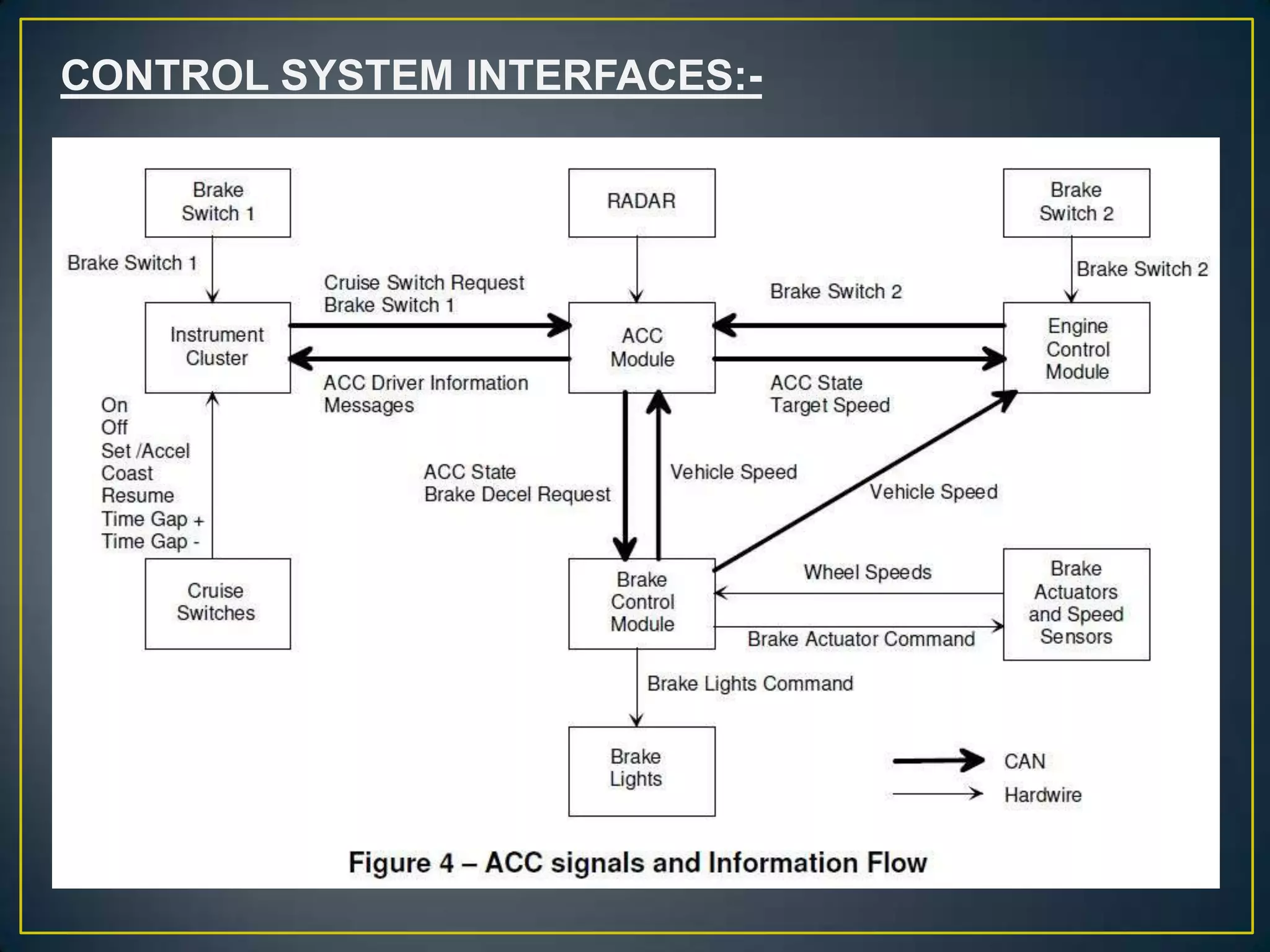
1) ACC Module – The primary function of the ACC module is to process
the radar information and determine if a forward vehicle is present.
2) Engine Control Module – The primary function of the Engine Control
Module is to receive information from the ACC module and Instrument
Cluster and control the vehicle's speed based on this information.
3) Brake Control Module – The primary function of the Brake Control
Module is to determine vehicle speed via each wheel and to decelerate
the vehicle by applying the brakes when requested by the ACC Module.
4) Instrument Cluster – The primary function of the Instrument Cluster
is to process the Cruise Switches and send their information to the
ACC and Engine Control Modules.
5) CAN – The Controller Area Network (CAN) is an automotive standard
network that utilizes a 2 wire bus to transmit and receive data. Each
node on the network has the capability to transmit 0 to 8 bytes of data in
a message frame.
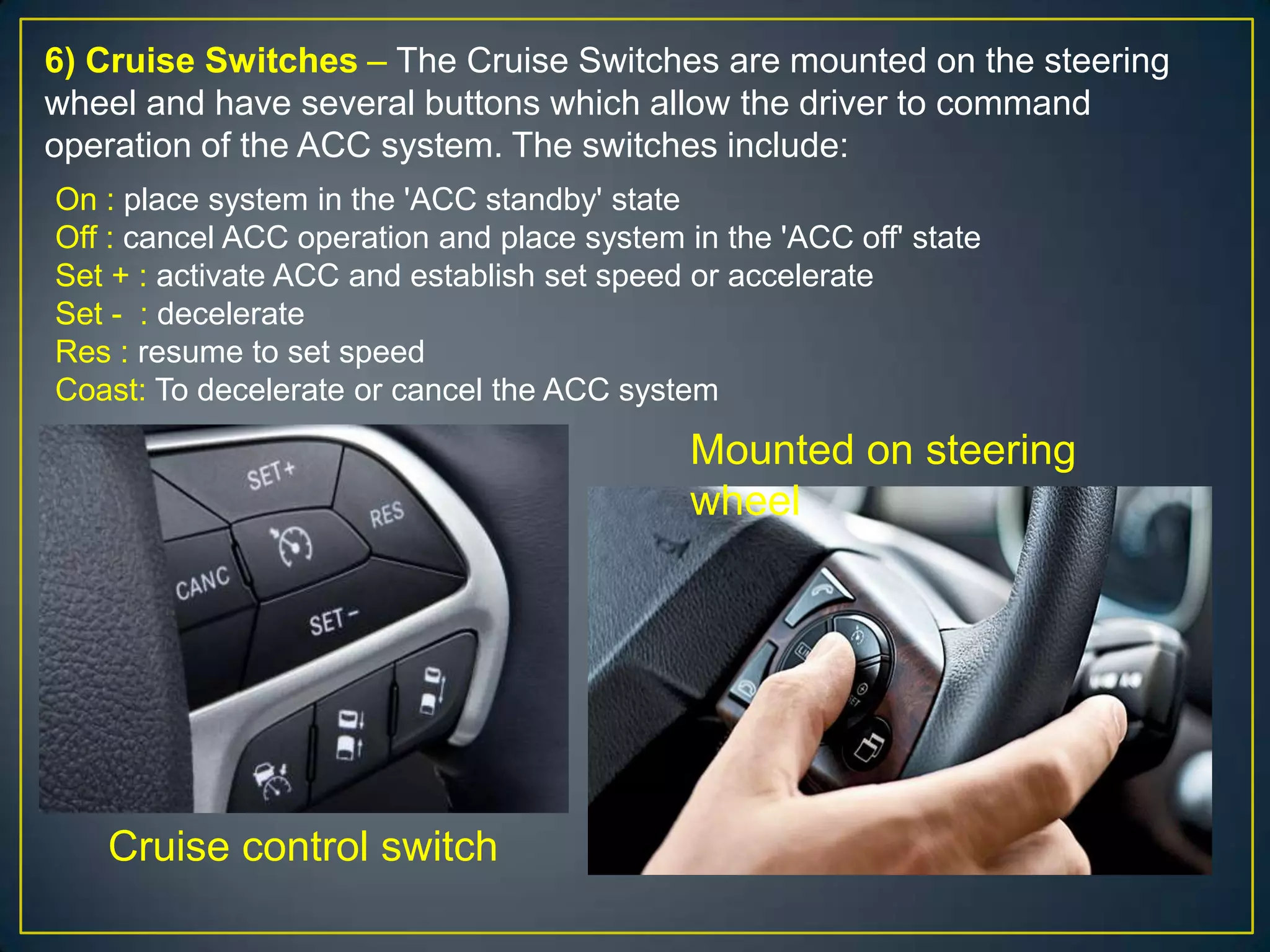
6) Cruise Switches – The Cruise Switches are mounted on the steering
wheel and have several buttons which allow the driver to command
operation of the ACC system. The switches include:
On : place system in the 'ACC standby' state
Off : cancel ACC operation and place system in the 'ACC off' state
Set + : activate ACC and establish set speed or accelerate
Set - : decelerate
Res : resume to set speed
Coast: To decelerate or cancel the ACC system
Cruise control switch
Mounted on steering
wheel
7) Brake Switches (BS) – There are two brake switches, Brake Switch 1
(BS1) and Brake Switch 2 (BS2). When either brake switch is
activated, Cruise Control operation is deactivated and the system enters
'ACC standby' state.
8) Brake Lights – When the Brake Control Module applies the brakes in
response to an ACC request, it will illuminate the brake lights to warn
vehicles behind the ACC vehicle that it is decelerating.
9) Sensors/Radars – Currently 4 types of radars are available. They are-
 LIDAR (Light Detection and Ranging)
 RADAR ( Radio Detection and Ranging)
 VISION SENSORS
 ULTRASONIC SENSOR
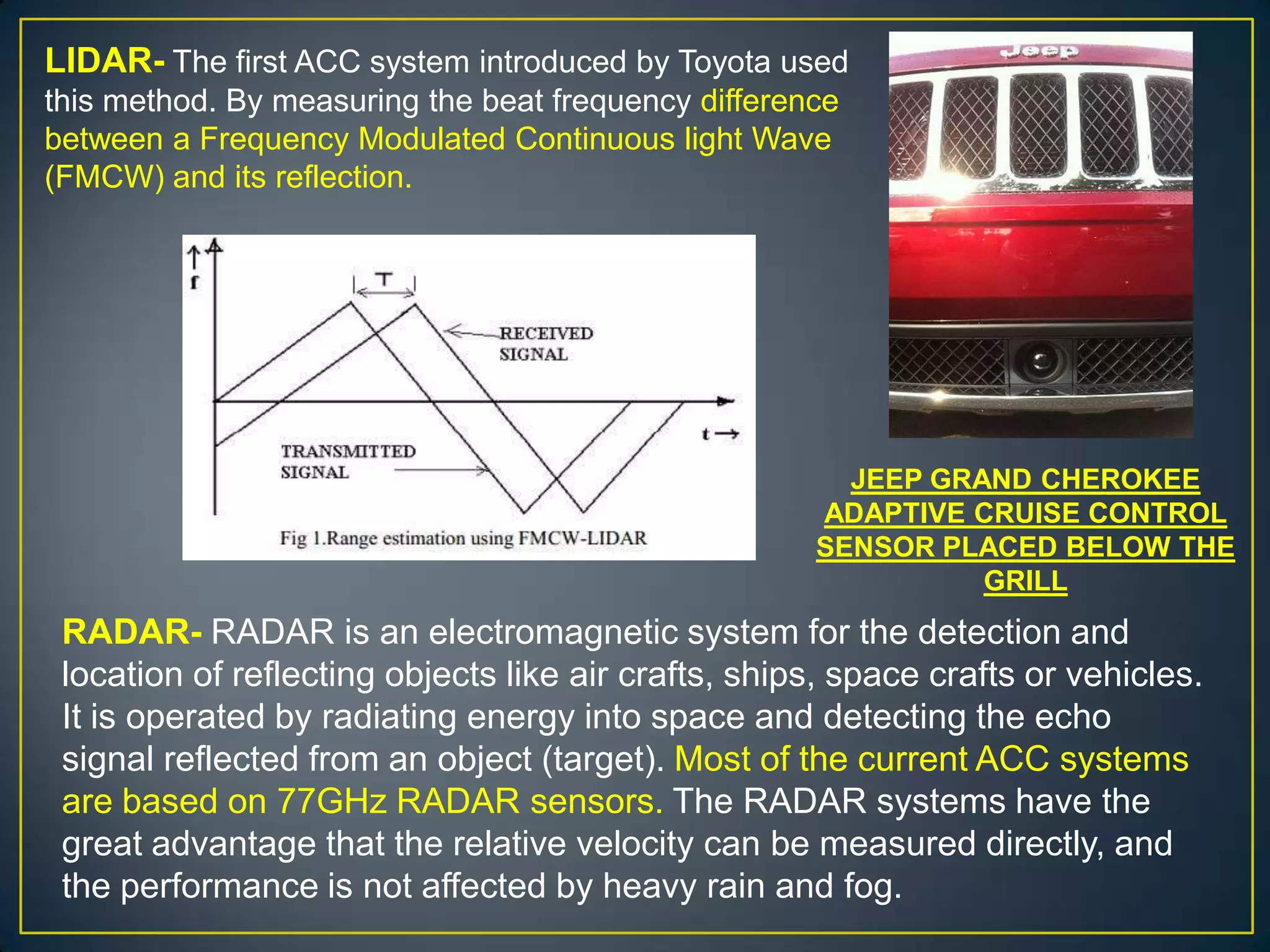
LIDAR- The first ACC system introduced by Toyota used
this method. By measuring the beat frequency difference
between a Frequency Modulated Continuous light Wave
(FMCW) and its reflection.
RADAR- RADAR is an electromagnetic system for the detection and
location of reflecting objects like air crafts, ships, space crafts or vehicles.
It is operated by radiating energy into space and detecting the echo
signal reflected from an object (target). Most of the current ACC systems
are based on 77GHz RADAR sensors. The RADAR systems have the
great advantage that the relative velocity can be measured directly, and
the performance is not affected by heavy rain and fog.
JEEP GRAND CHEROKEE
ADAPTIVE CRUISE CONTROL
SENSOR PLACED BELOW THE
GRILL
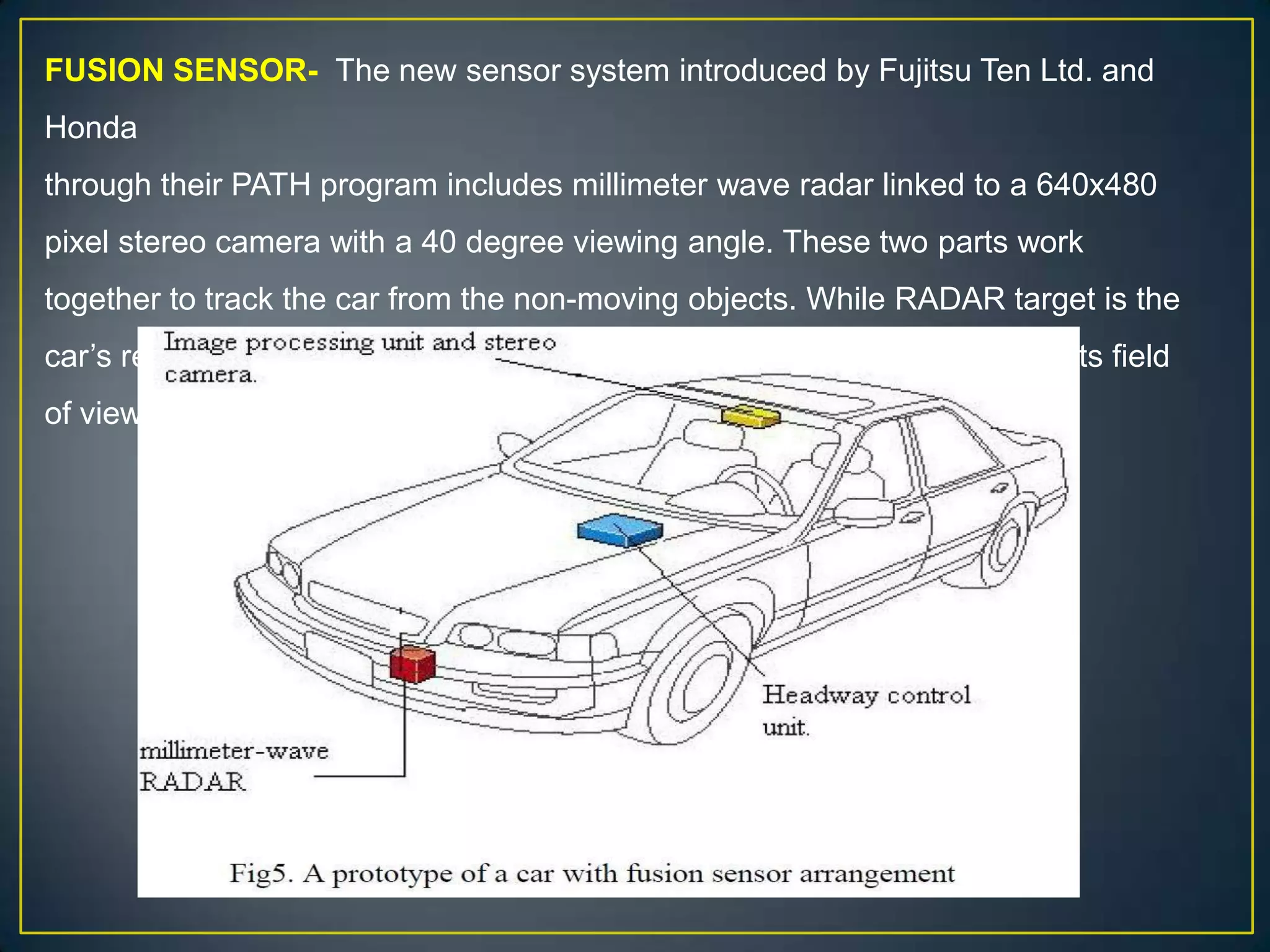
FUSION SENSOR- The new sensor system introduced by Fujitsu Ten Ltd. and
Honda
through their PATH program includes millimeter wave radar linked to a 640x480
pixel stereo camera with a 40 degree viewing angle. These two parts work
together to track the car from the non-moving objects. While RADAR target is the
car’s rear bumper, the stereo camera is constantly captures all objects in its field
of view.
CONTROL SYSTEM INTERFACES:-
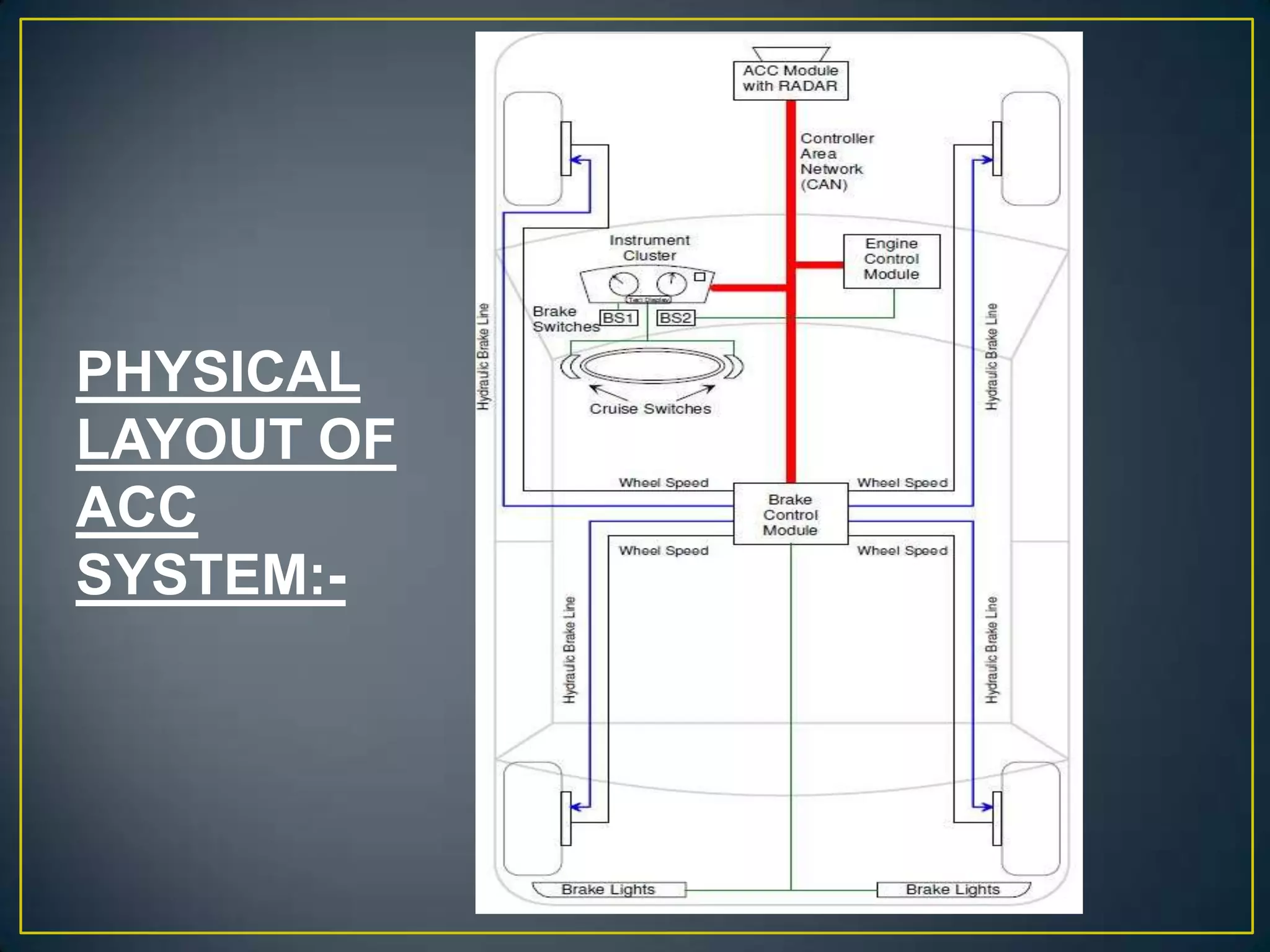
PHYSICAL
LAYOUT OF
ACC
SYSTEM:-
ADVANTAGES:-
1. The driver is relieved from the task of careful
acceleration, deceleration and braking in
congested traffics.
2. A highly responsive traffic system that adjusts
itself to avoid accidents can be developed.
3. Since the braking and acceleration are done in a
systematic way, the fuel efficiency of the vehicle is
increased.
DISADVANTAGES:-
1.A cheap version is not yet realized.
2.A high market penetration is required if a
society of intelligent vehicles is to be formed.
3.Encourages the driver to become careless. It
can lead to severe accidents if the system is
malfunctioning.
4.The ACC systems yet evolved enable vehicles
to co-operate with each other vehicles and
hence do not respond directly to traffic
signals.
APPLICATIONS:-
 Mitsubishi was the first automaker to offer a laser-based ACC system
in 1995 on the Japanese Mitsubishi Daimante.
 In August 1997, Toyota began to offer a "radar cruise control" system
on the Celsior.
 Mercedes Benz introduced “DISTRONIC” in late 1998 on the S-
Class. For 2006, they refined the system to completely halt the car if
necessary . No called “DISTRONIC PLUS” available in E-class and
S-class luxury sedans.
 Jaguar began offering this system in 1999.
 BMW’s Active Cruise Control system launched in 2000 in 7-series.
 Volkswagen and Audi introduced their own systems in 2002.
CONCLUSION:-
The accidents caused by automobiles are injuring lakhs of people every
year. The safety measures starting from air bags and seat belts have now
reached to ACC, SACC and CACC systems. The researchers of Intelligent
Vehicles Initiative in USA and the Ertico program of Europe are working on
technologies that may ultimately lead to vehicles that are wrapped in a
cocoon
of sensors with a 360 –degree view of their surroundings. It will probably
take
decades, but car accidents may eventually become as rare as plane
accidents are
now, even though the road laws will have to be changed, up to an extent
since
Adaptive cruise control system by NIKHIL R

Adaptive cruise control system by NIKHIL R

  • 1.
  • 2.
    CONTENTS:-  INTRODUCTION  PRINCIPLEOF ACC  PHYSICAL OVERVIEW  DEFINITIONS/TERMINOLOGIES  COMPONENTS OF ACC SYSTEM  CONTROL SYSTEM INTERFACE  PHYSICAL LAYOUT OF AN ACC SYSTEM  ADVANTAGES  DISADVANTAGES  APPLICATIONS  CONCLUSION
  • 3.
    INTRODUCTION:- What is AdaptiveCruise Control? Adaptive Cruise Control (ACC) is an automotive feature that allows a vehicle's cruise control system to adapt the vehicle's speed to the traffic environment. A radar system attached to the front of the vehicle is used to detect whether slower moving vehicles are in the ACC vehicle's path. Introduced in 1970’s in USA. This system is now available in luxury cars like Mercedes S-class, Jaguar XJ, Volvo trucks etc…
  • 4.
    PRINCIPLE:- How does itwork? If a slower moving vehicle is detected, the ACC system will slow the vehicle down and control the clearance, or time gap, between the ACC vehicle and the forward vehicle. If the system detects that the forward vehicle is no longer in the ACC vehicle's path, the ACC system will accelerate the vehicle back to its set cruise control speed. This operation allows the ACC vehicle to autonomously slow down and speed up with traffic without intervention from the driver. The method by which the ACC vehicle's speed is controlled is via engine throttle control and limited brake operation.
  • 5.
  • 6.
    DEFINITIONS:-  Adaptive CruiseControl (ACC) – An enhancement to a conventional cruise control system which allows the ACC vehicle to follow a forward vehicle at an appropriate distance.  ACC vehicle – the subject vehicle equipped with the ACC system.  Active brake control – a function which causes application of the brakes without driver application of the brake pedal.  Clearance – distance from the forward vehicle's trailing surface to the ACC vehicle's leading surface.
  • 7.
     Forward vehicle– any one of the vehicles in front of and moving in the same direction and traveling on the same roadway as the ACC vehicle.  Set speed – the desired cruise control travel speed set by the driver and is the maximum desired speed of the vehicle while under ACC control.  Target vehicle – one of the forward vehicles in the path of the ACC vehicle that is closest to the ACC vehicle.  Time gap – the time interval between the ACC vehicle and the target vehicle. The 'time gap' is related to the 'clearance' and vehicle speed by: time gap = clearance / ACC vehicle speed
  • 8.
    Different STATES (MODES)in ACC System-  ACC off mode  ACC standby mode  ACC active mode. This consists of the following 2 modes-  ACC speed control mode  ACC time gap control mode
  • 9.
    COMPONENTS OF ANACC SYSTEM:- 1) ACC Module – The primary function of the ACC module is to process the radar information and determine if a forward vehicle is present. 2) Engine Control Module – The primary function of the Engine Control Module is to receive information from the ACC module and Instrument Cluster and control the vehicle's speed based on this information. 3) Brake Control Module – The primary function of the Brake Control Module is to determine vehicle speed via each wheel and to decelerate the vehicle by applying the brakes when requested by the ACC Module. 4) Instrument Cluster – The primary function of the Instrument Cluster is to process the Cruise Switches and send their information to the ACC and Engine Control Modules. 5) CAN – The Controller Area Network (CAN) is an automotive standard network that utilizes a 2 wire bus to transmit and receive data. Each node on the network has the capability to transmit 0 to 8 bytes of data in a message frame.
  • 10.
    6) Cruise Switches– The Cruise Switches are mounted on the steering wheel and have several buttons which allow the driver to command operation of the ACC system. The switches include: On : place system in the 'ACC standby' state Off : cancel ACC operation and place system in the 'ACC off' state Set + : activate ACC and establish set speed or accelerate Set - : decelerate Res : resume to set speed Coast: To decelerate or cancel the ACC system Cruise control switch Mounted on steering wheel
  • 11.
    7) Brake Switches(BS) – There are two brake switches, Brake Switch 1 (BS1) and Brake Switch 2 (BS2). When either brake switch is activated, Cruise Control operation is deactivated and the system enters 'ACC standby' state. 8) Brake Lights – When the Brake Control Module applies the brakes in response to an ACC request, it will illuminate the brake lights to warn vehicles behind the ACC vehicle that it is decelerating. 9) Sensors/Radars – Currently 4 types of radars are available. They are-  LIDAR (Light Detection and Ranging)  RADAR ( Radio Detection and Ranging)  VISION SENSORS  ULTRASONIC SENSOR
  • 12.
    LIDAR- The firstACC system introduced by Toyota used this method. By measuring the beat frequency difference between a Frequency Modulated Continuous light Wave (FMCW) and its reflection. RADAR- RADAR is an electromagnetic system for the detection and location of reflecting objects like air crafts, ships, space crafts or vehicles. It is operated by radiating energy into space and detecting the echo signal reflected from an object (target). Most of the current ACC systems are based on 77GHz RADAR sensors. The RADAR systems have the great advantage that the relative velocity can be measured directly, and the performance is not affected by heavy rain and fog. JEEP GRAND CHEROKEE ADAPTIVE CRUISE CONTROL SENSOR PLACED BELOW THE GRILL
  • 13.
    FUSION SENSOR- Thenew sensor system introduced by Fujitsu Ten Ltd. and Honda through their PATH program includes millimeter wave radar linked to a 640x480 pixel stereo camera with a 40 degree viewing angle. These two parts work together to track the car from the non-moving objects. While RADAR target is the car’s rear bumper, the stereo camera is constantly captures all objects in its field of view.
  • 14.
  • 15.
  • 16.
    ADVANTAGES:- 1. The driveris relieved from the task of careful acceleration, deceleration and braking in congested traffics. 2. A highly responsive traffic system that adjusts itself to avoid accidents can be developed. 3. Since the braking and acceleration are done in a systematic way, the fuel efficiency of the vehicle is increased.
  • 17.
    DISADVANTAGES:- 1.A cheap versionis not yet realized. 2.A high market penetration is required if a society of intelligent vehicles is to be formed. 3.Encourages the driver to become careless. It can lead to severe accidents if the system is malfunctioning. 4.The ACC systems yet evolved enable vehicles to co-operate with each other vehicles and hence do not respond directly to traffic signals.
  • 18.
    APPLICATIONS:-  Mitsubishi wasthe first automaker to offer a laser-based ACC system in 1995 on the Japanese Mitsubishi Daimante.  In August 1997, Toyota began to offer a "radar cruise control" system on the Celsior.  Mercedes Benz introduced “DISTRONIC” in late 1998 on the S- Class. For 2006, they refined the system to completely halt the car if necessary . No called “DISTRONIC PLUS” available in E-class and S-class luxury sedans.  Jaguar began offering this system in 1999.  BMW’s Active Cruise Control system launched in 2000 in 7-series.  Volkswagen and Audi introduced their own systems in 2002.
  • 19.
    CONCLUSION:- The accidents causedby automobiles are injuring lakhs of people every year. The safety measures starting from air bags and seat belts have now reached to ACC, SACC and CACC systems. The researchers of Intelligent Vehicles Initiative in USA and the Ertico program of Europe are working on technologies that may ultimately lead to vehicles that are wrapped in a cocoon of sensors with a 360 –degree view of their surroundings. It will probably take decades, but car accidents may eventually become as rare as plane accidents are now, even though the road laws will have to be changed, up to an extent since