Normal Development in the First Year Julie Wattenberg, MPT, DPT Adventist Paulson Pediatric Rehabilitation Center July 10, 2007
Goals of today’s lecture You will be familiar with the roles of pediatric physical, occupational and speech therapist. You will have a general idea of typical development in the first year. You will be able to describe some “red flags” that may assist you in making appropriate referrals. You will understand why therapists advise parents not to use Baby Walkers, Exersaucers and Johnny Jumpers.  You will be able to understand the common conditions Torticollis and Positional Plagiocephaly in order to make appropriate referrals.
The Role of Pediatric Therapists Pediatric Physical Therapists  assist infants and children with gross motor skills such as prone skills, sitting, crawling, walking, jumping, skipping and transitions between these skills.  Pediatric Occupational Therapists  work with children who have sensory integration (e.g. sensory integration dysfunction, autism, pervasive developmental disorder) difficulties and have difficulties with fine motor skills that will impact their ability to explore their environment.  They also work on self-help skills such as dressing, self feeding etc. Pediatric Speech Therapists  work with children who have difficulties with feeding.  They also assist children with communication including speech production, articulation, receptive and expressive language, language processing and fluency.

Typical Development  In the First Year
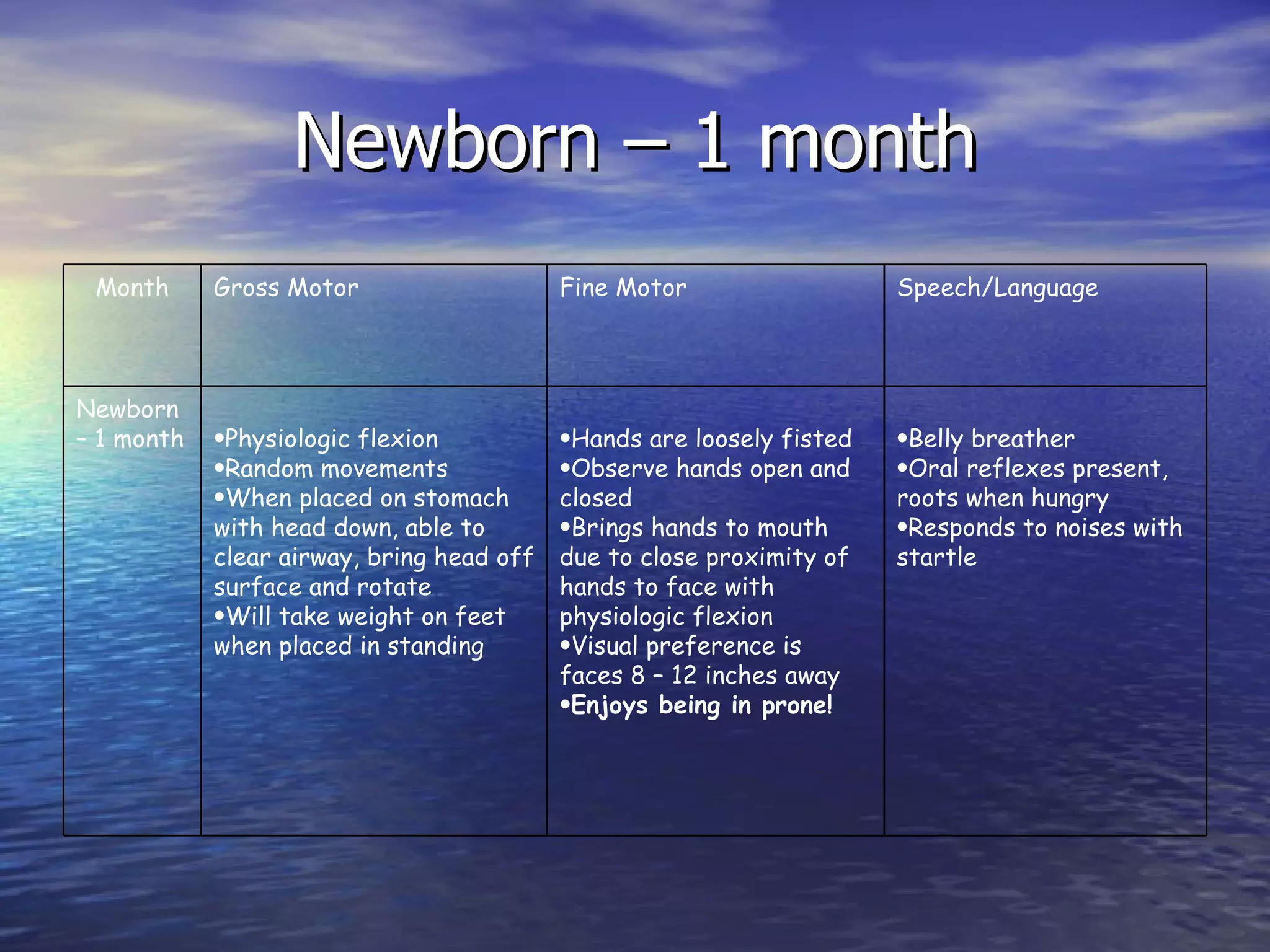
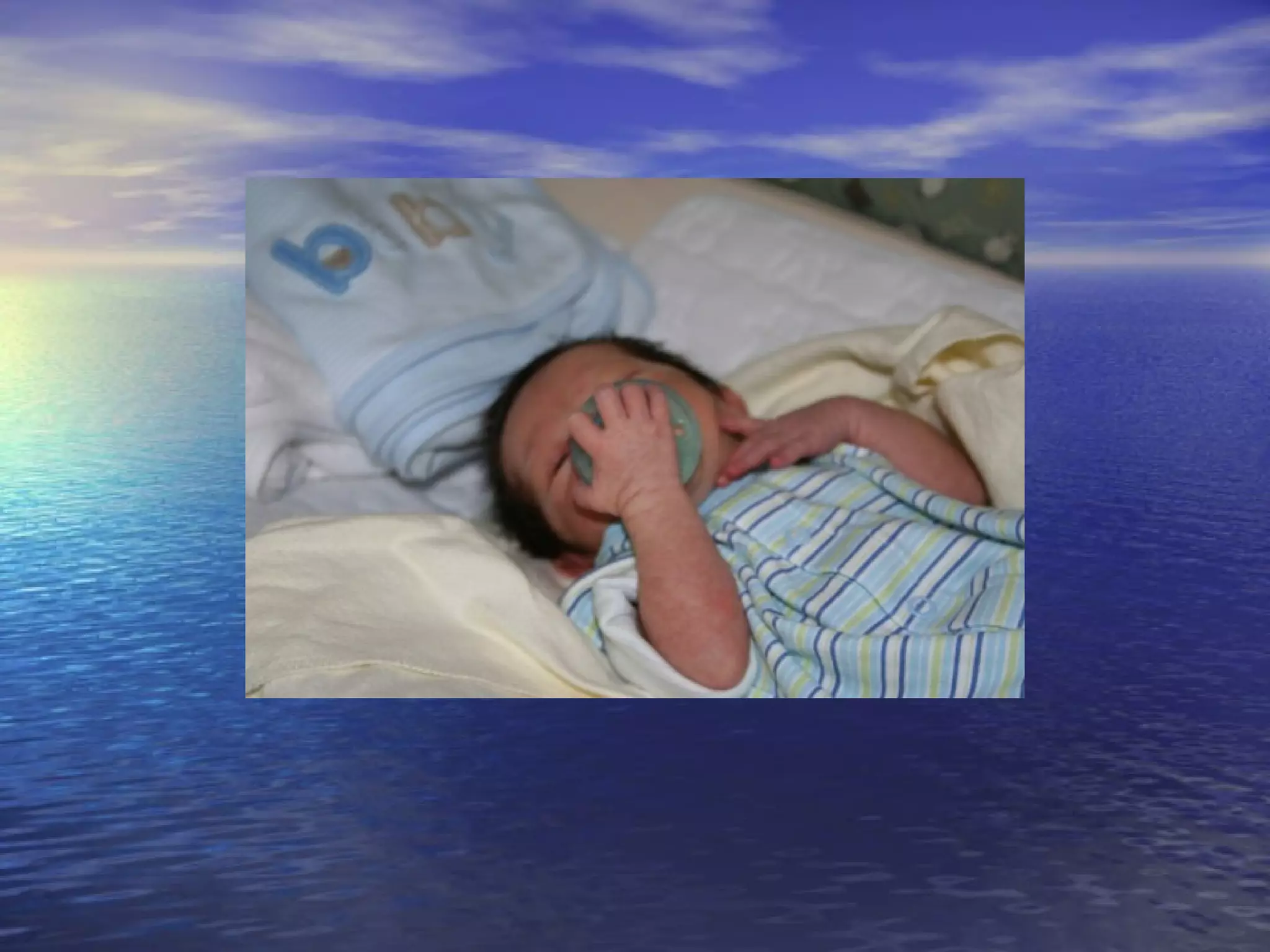
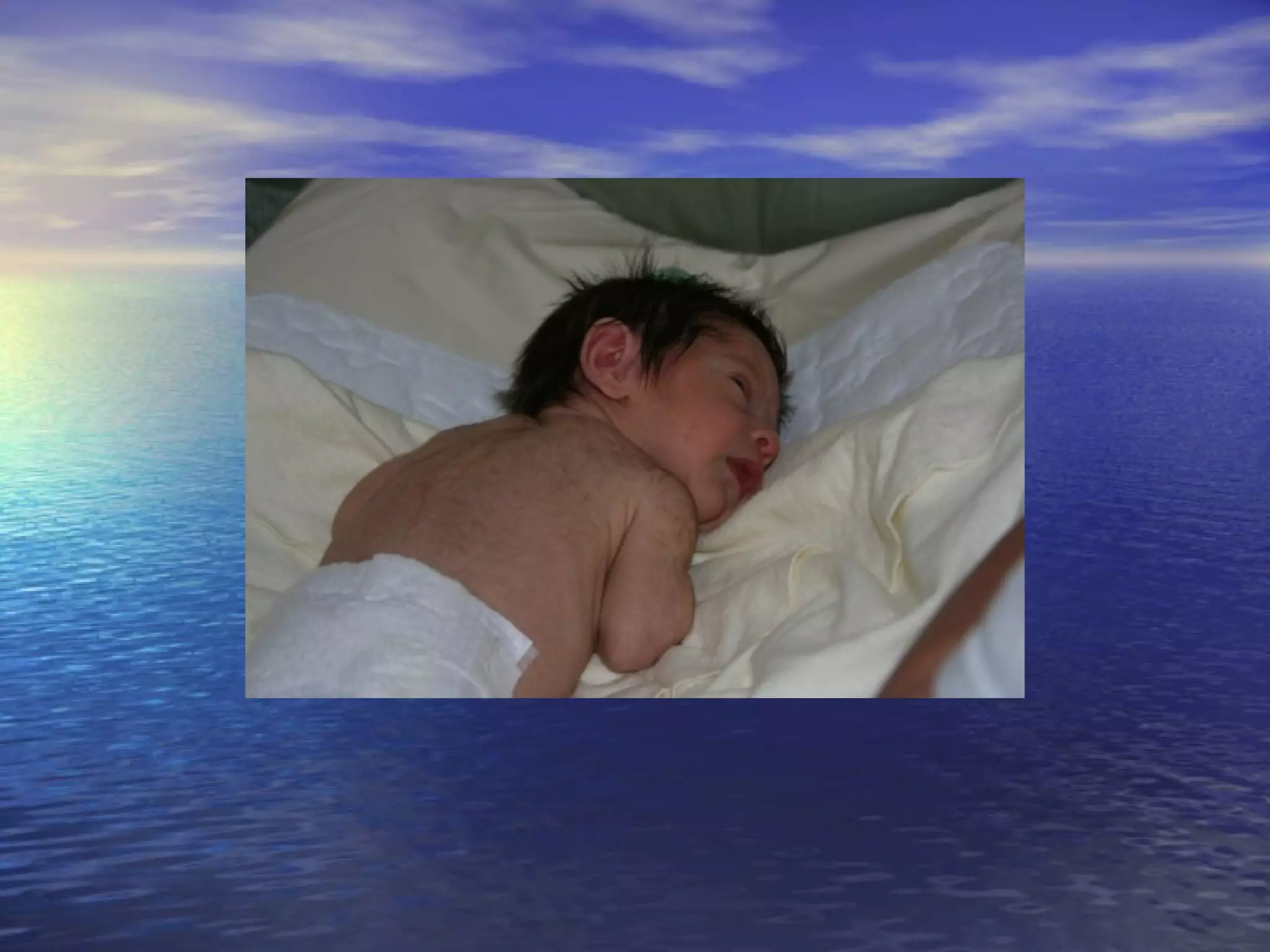
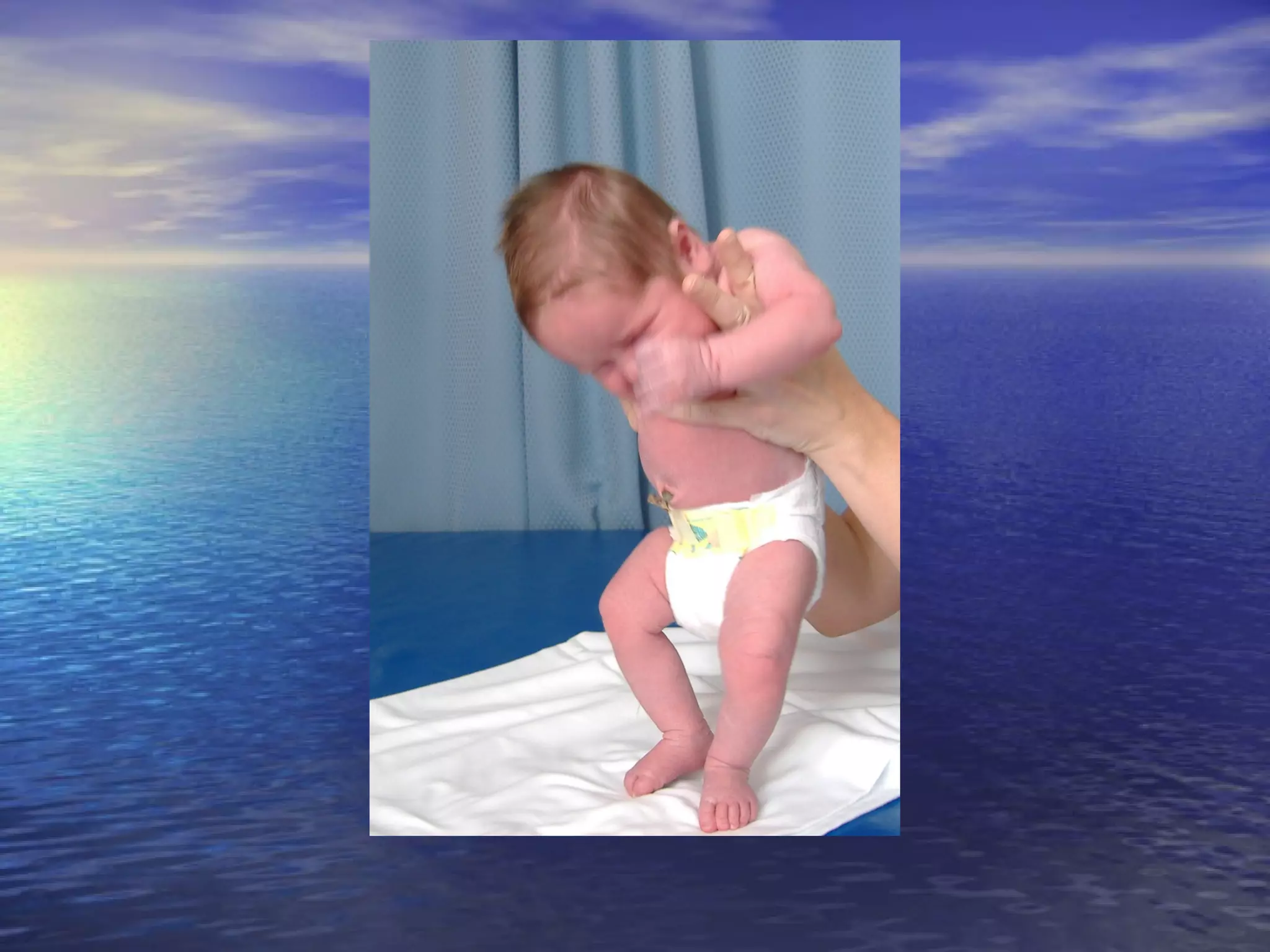
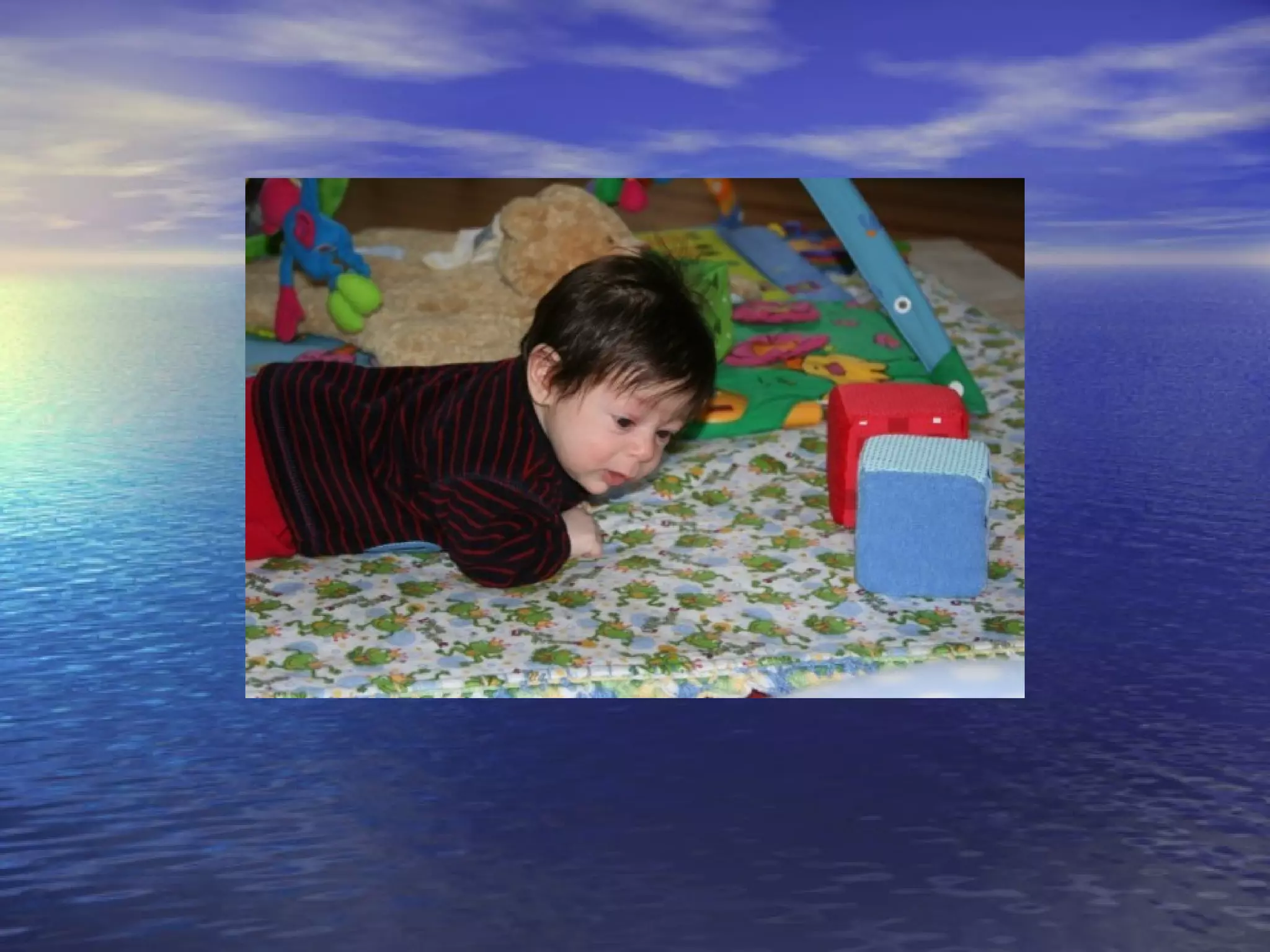
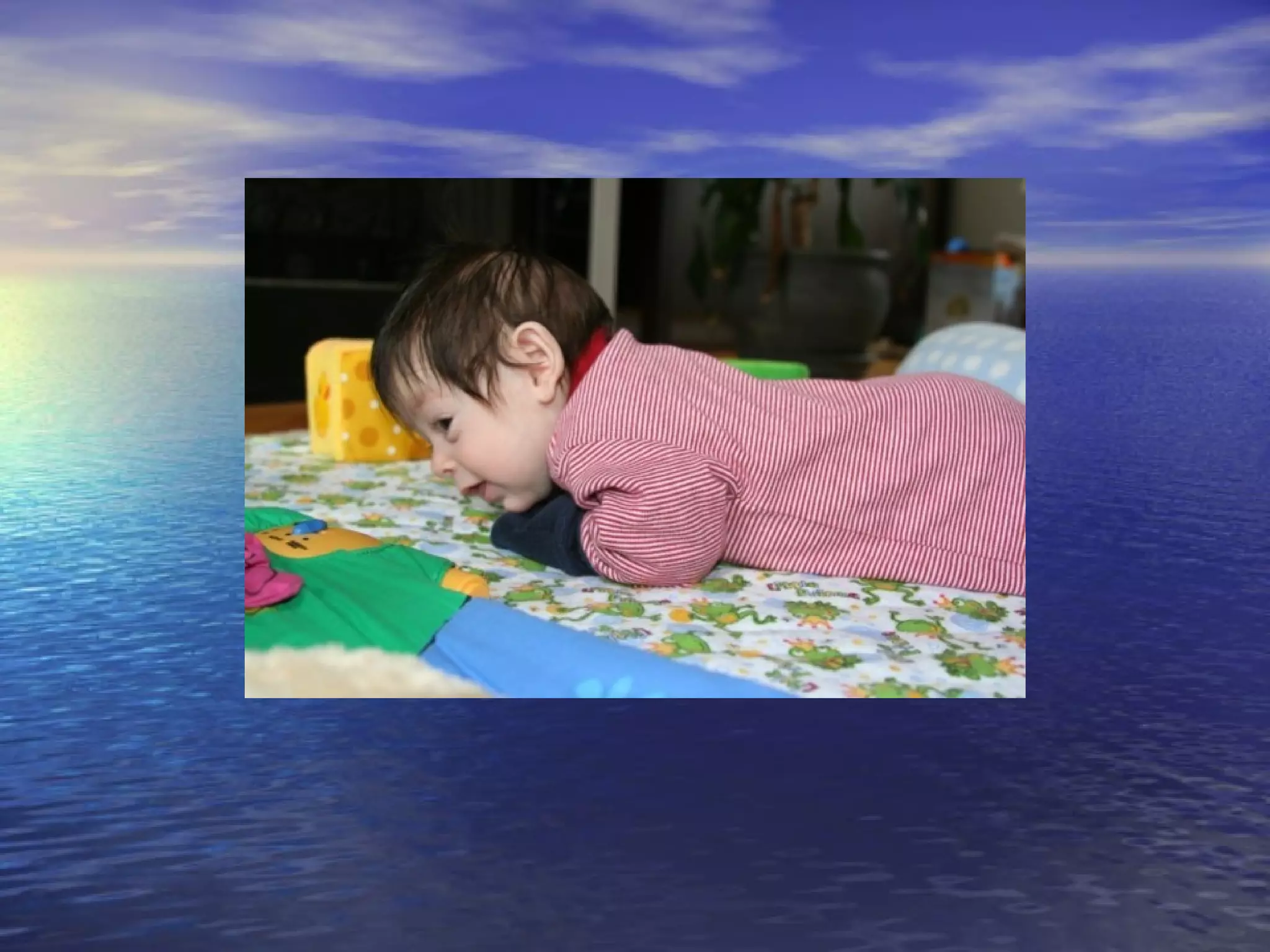
Newborn – 1 month Belly breather Oral reflexes present, roots when hungry Responds to noises with startle Hands are loosely fisted Observe hands open and closed Brings hands to mouth due to close proximity of hands to face with physiologic flexion Visual preference is faces 8 – 12 inches away Enjoys being in prone! Physiologic flexion Random movements When placed on stomach with head down, able to clear airway, bring head off surface and rotate Will take weight on feet when placed in standing Newborn – 1 month Speech/Language Fine Motor Gross Motor Month
NEWBORN JAKE – 4 DAYS


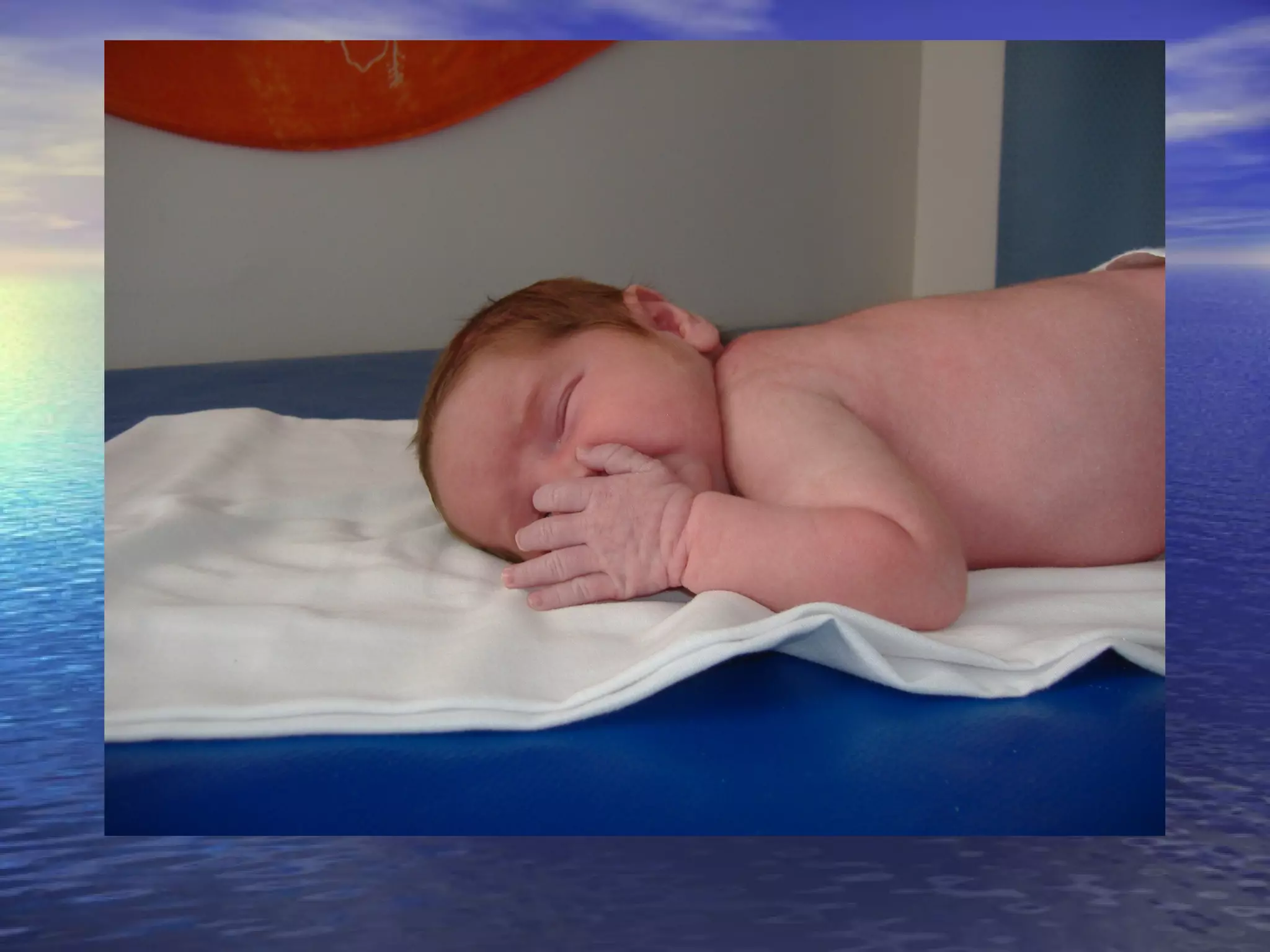
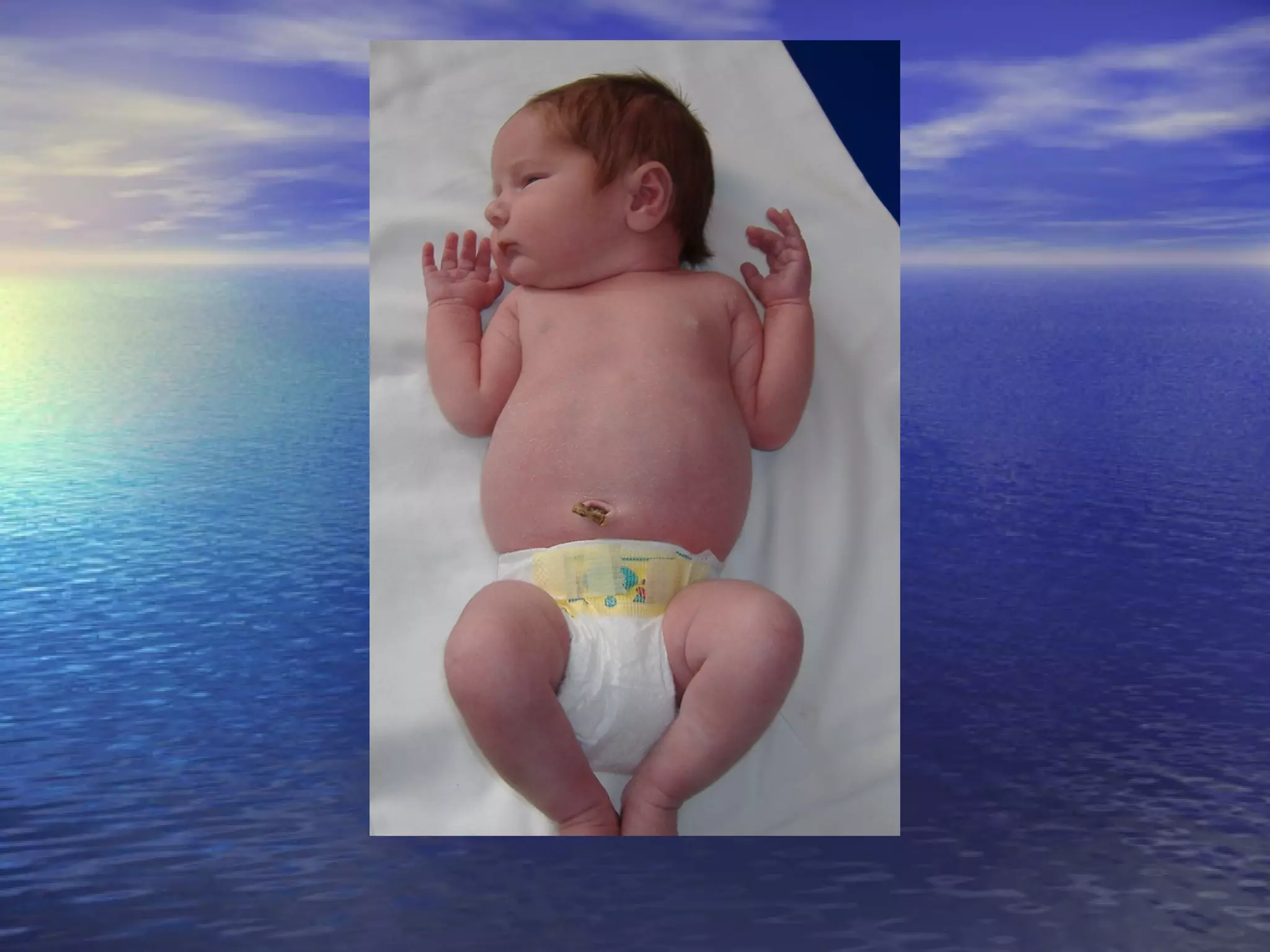
NEWBORN MASON – 2 WEEKS


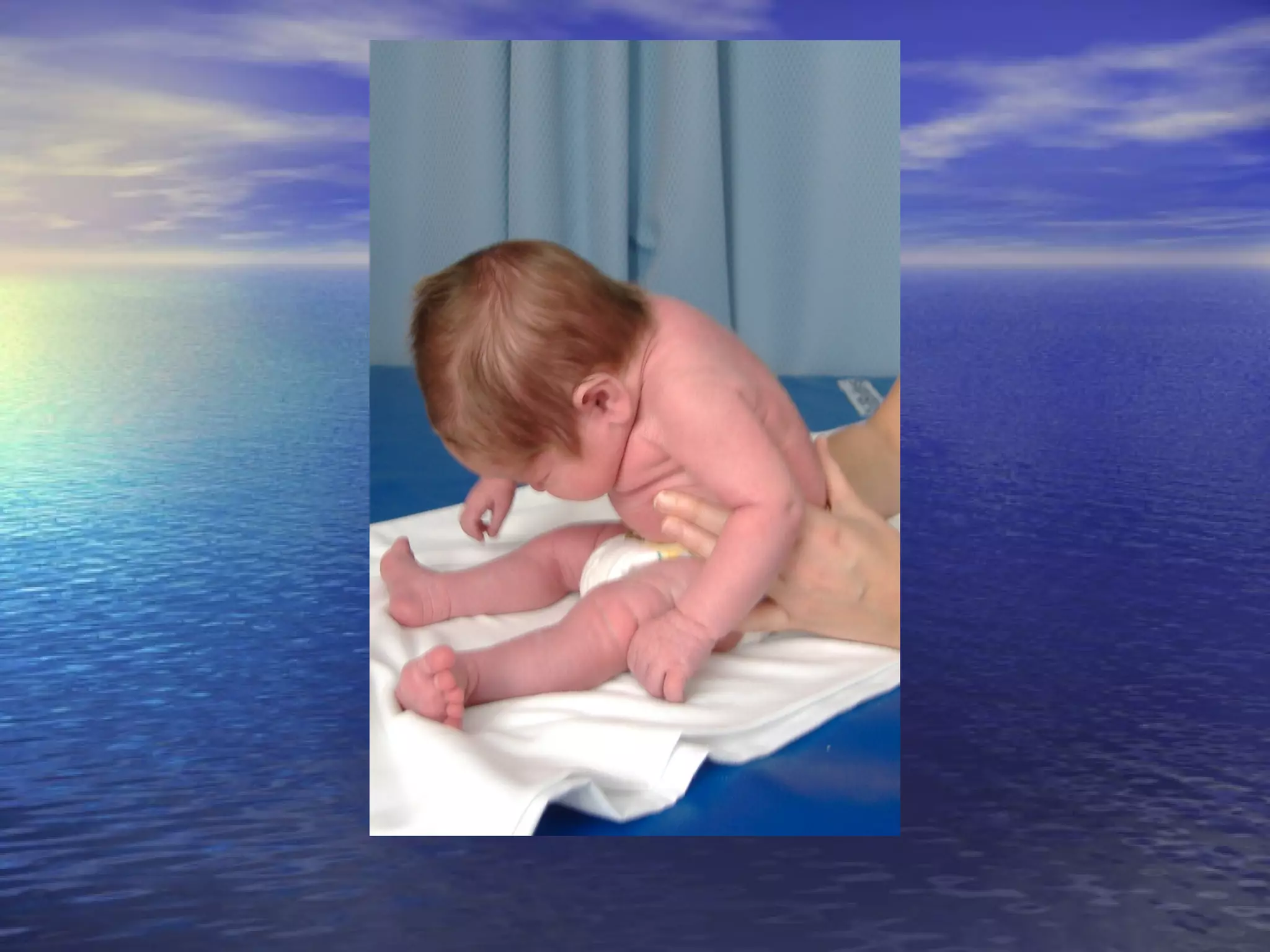
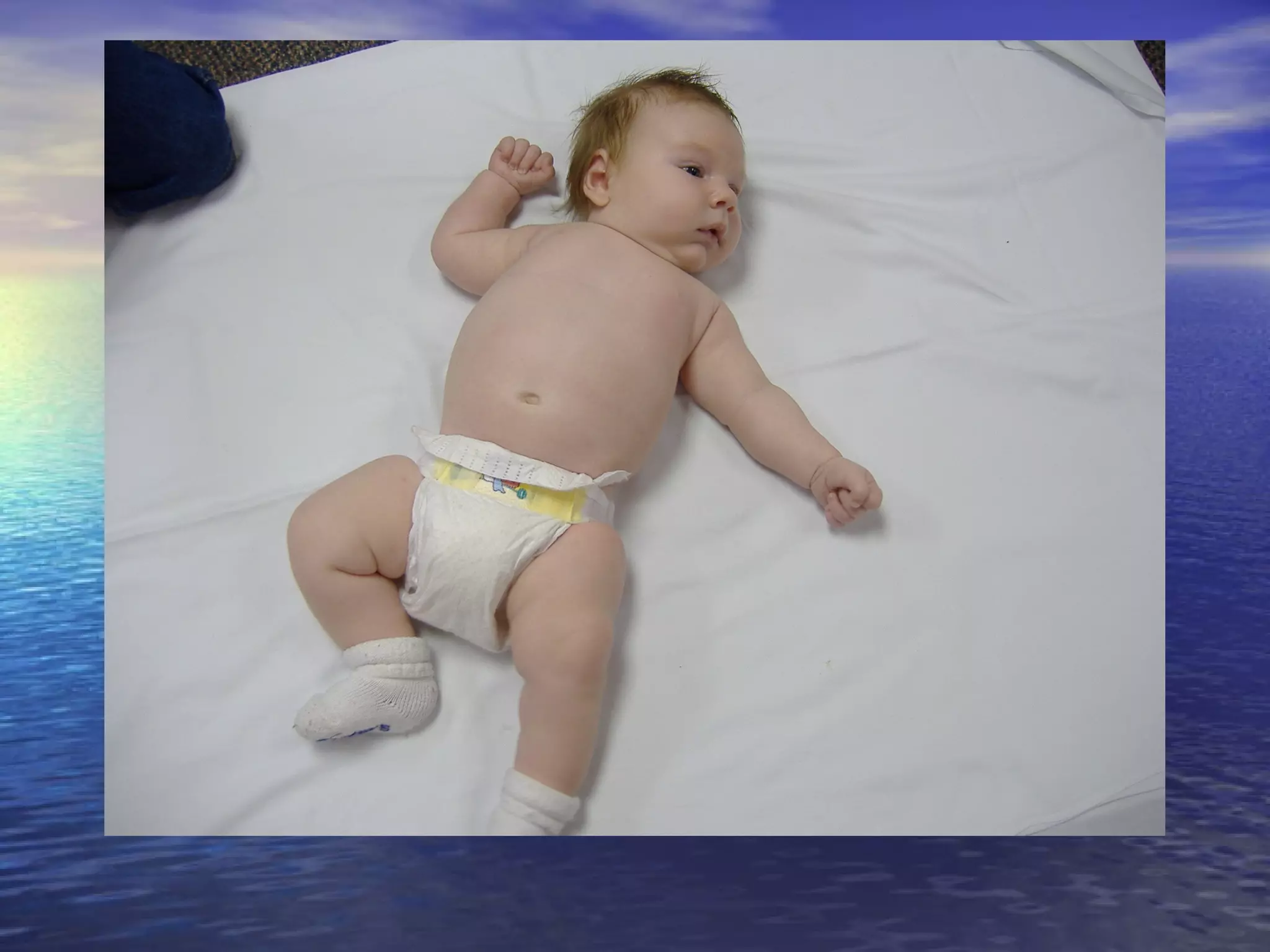
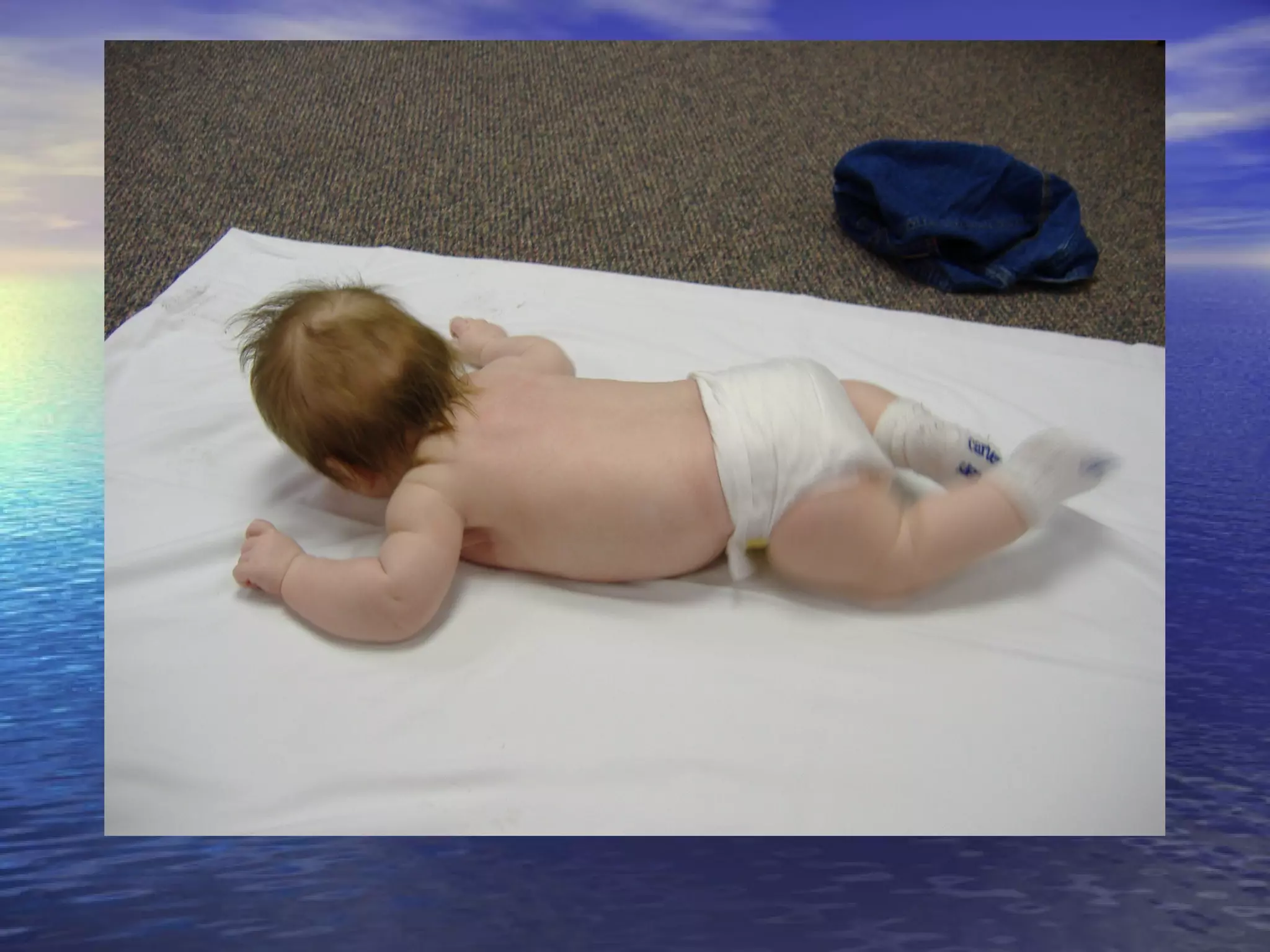
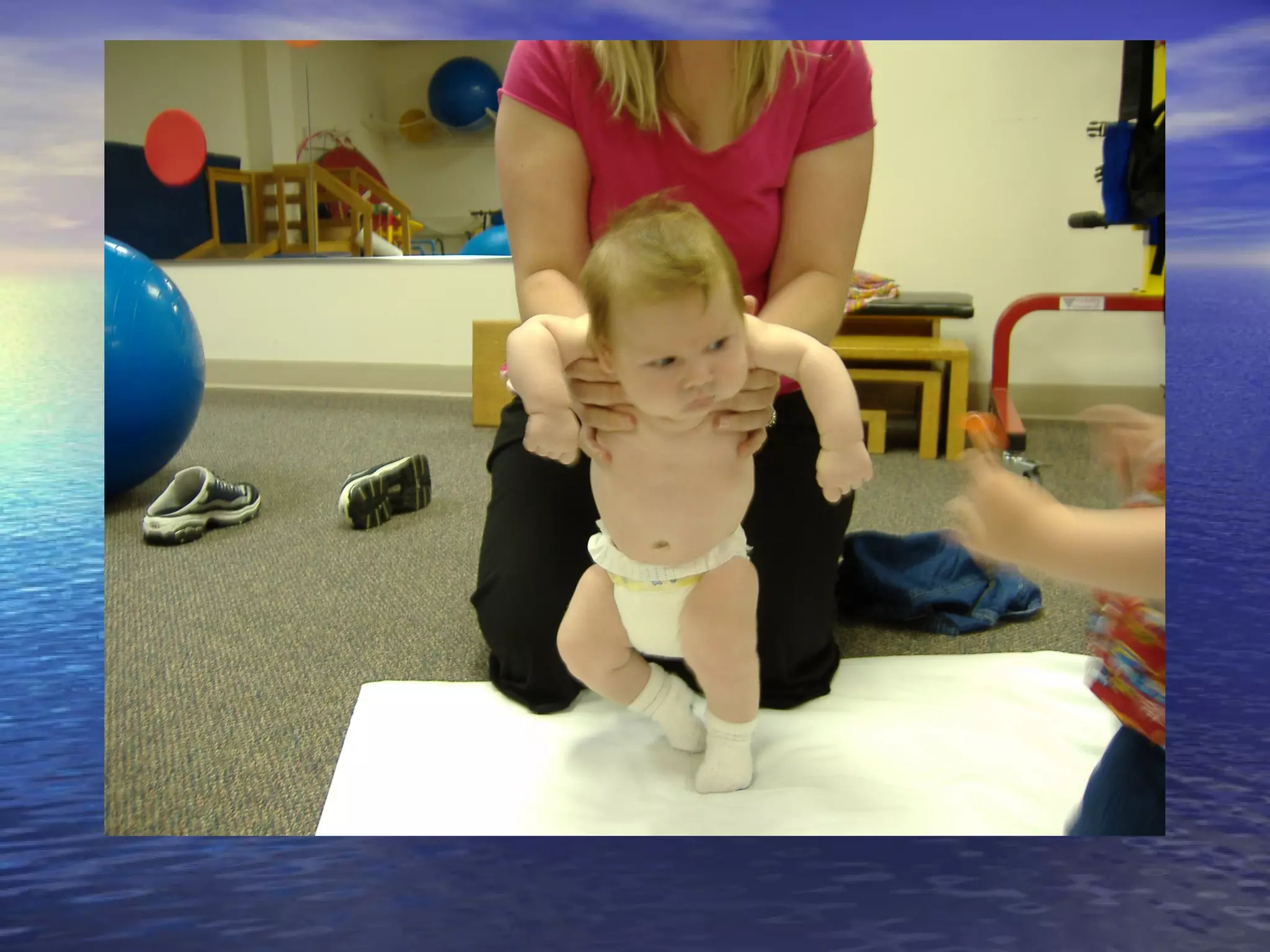
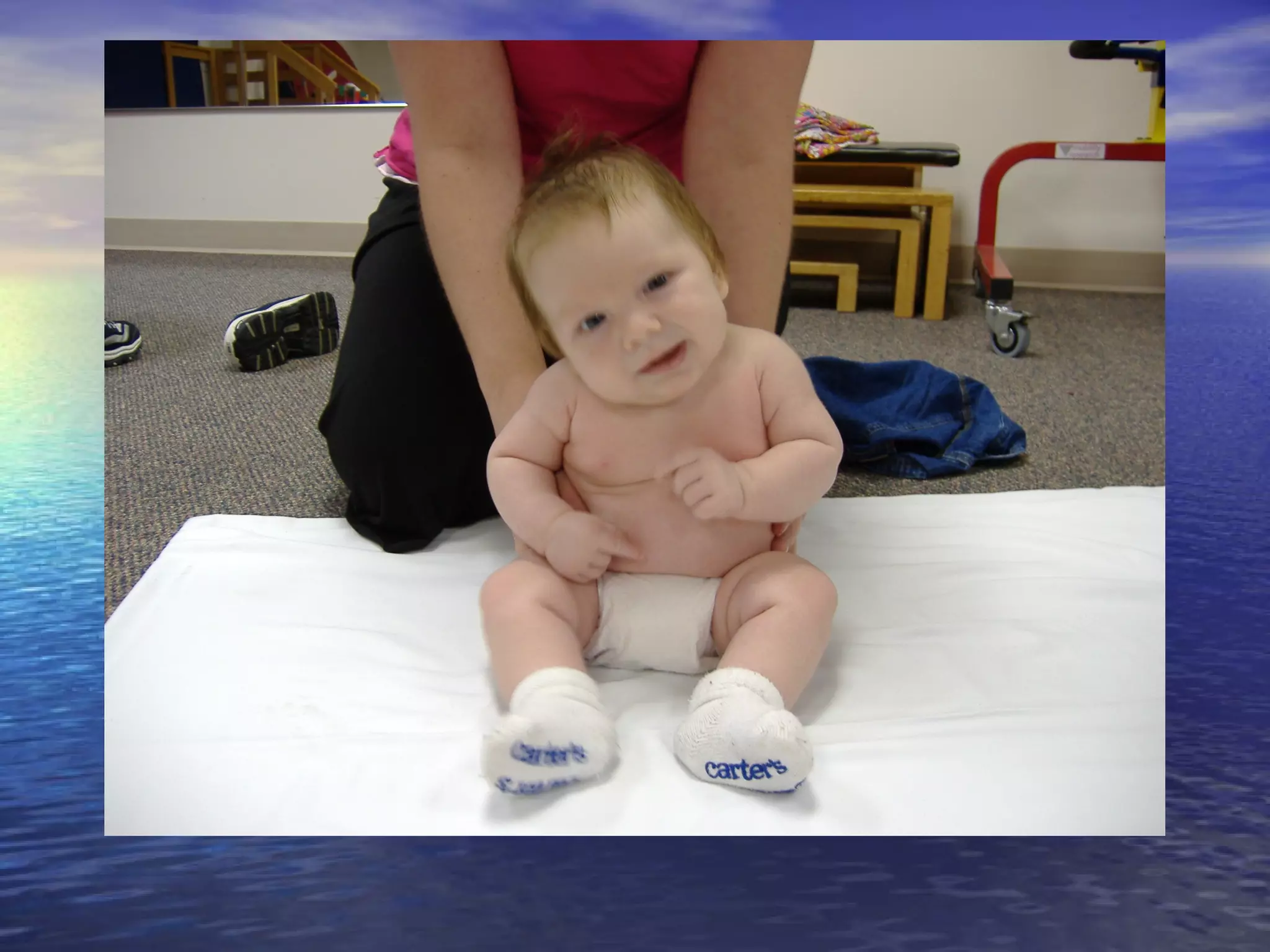
2 months Social smile  Baby attending to more sounds by orienting head towards the sound Continues with random upper extremity movements Hands open and closed Visual tracking uses head and eyes together Tracking with eyes across midline horizontally Period of maximal asymmetry Head rarely in midline, but observe head to both sides Do not observe as much physiologic flexion Lifts head to 45 degrees when placed on tummy Pushes through elbows when placed on tummy May not take weight in standing 2 months Speech/Language Fine Motor Gross Motor Month
2 MONTHS  LANDEN 2 MONTHS


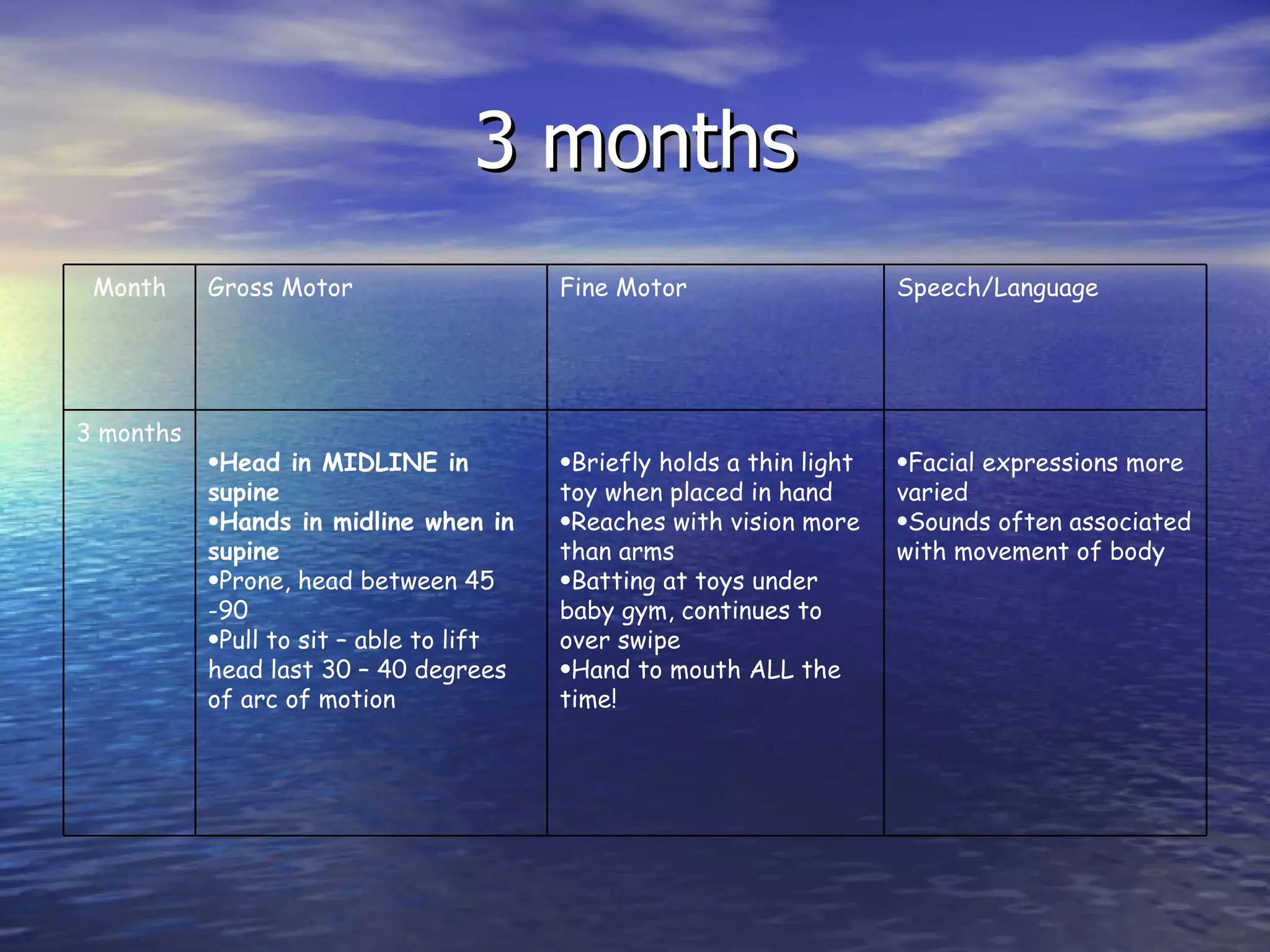
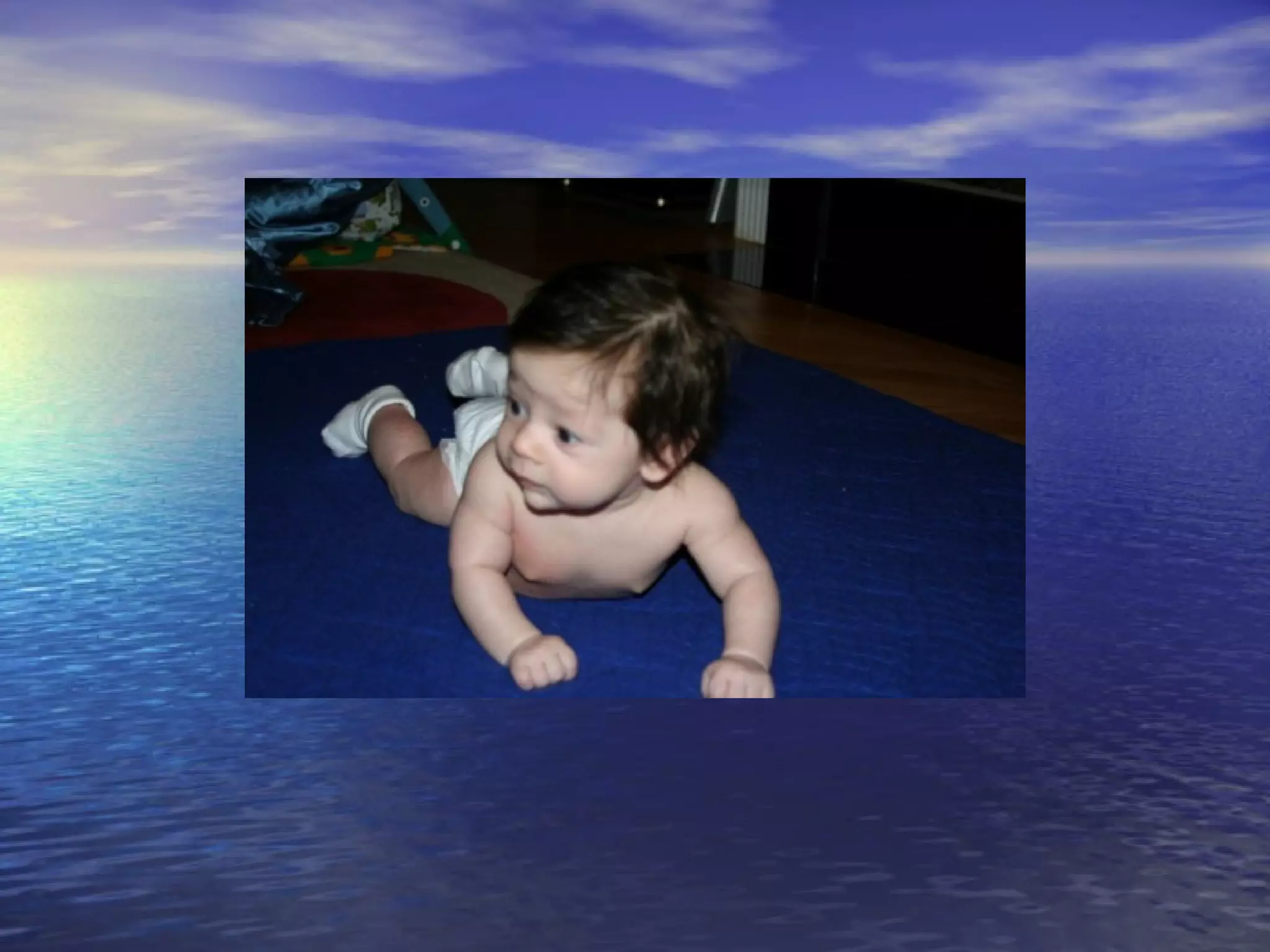
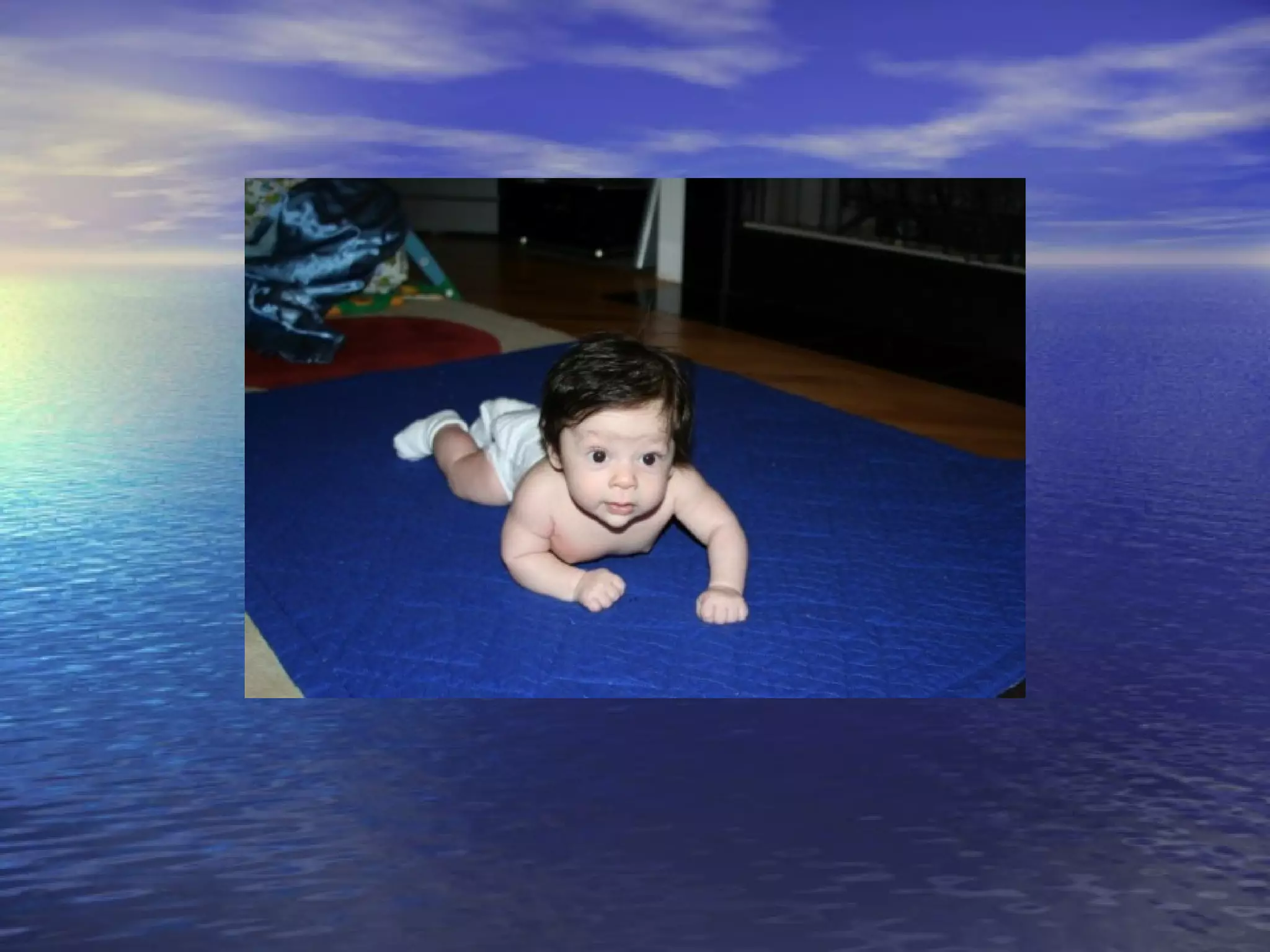
3 months Facial expressions more varied Sounds often associated with movement of body Briefly holds a thin light toy when placed in hand Reaches with vision more than arms Batting at toys under baby gym, continues to over swipe Hand to mouth ALL the time! Head in MIDLINE in supine Hands in midline when in supine Prone, head between 45 -90  Pull to sit – able to lift head last 30 – 40 degrees of arc of motion 3 months Speech/Language Fine Motor Gross Motor Month


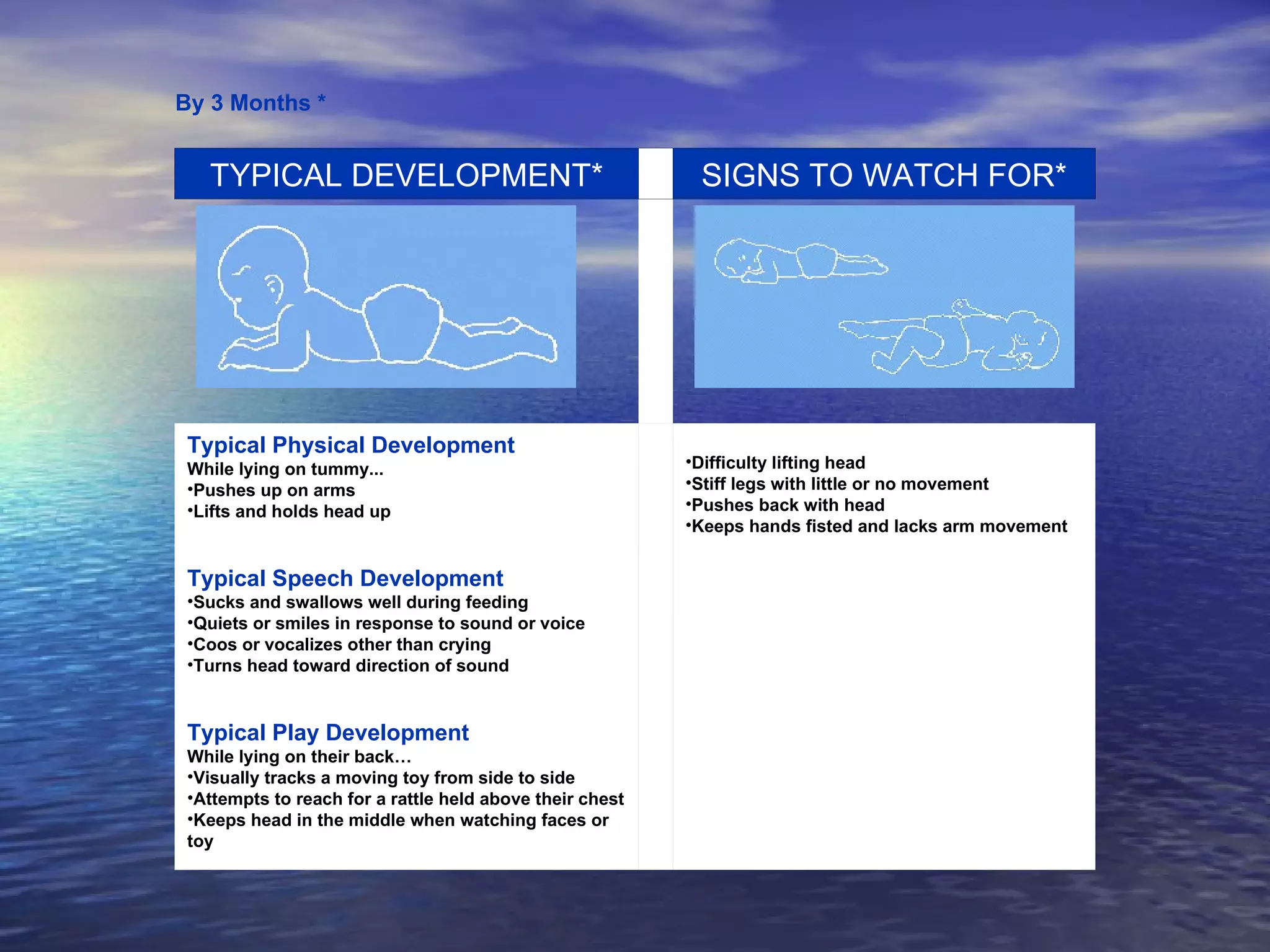
By 3 Months * Difficulty lifting head  Stiff legs with little or no movement  Pushes back with head  Keeps hands fisted and lacks arm movement    Typical Physical Development While lying on tummy... Pushes up on arms  Lifts and holds head up  Typical Speech Development Sucks and swallows well during feeding  Quiets or smiles in response to sound or voice  Coos or vocalizes other than crying  Turns head toward direction of sound  Typical Play Development While lying on their back…  Visually tracks a moving toy from side to side  Attempts to reach for a rattle held above their chest  Keeps head in the middle when watching faces or toy                                                                                              SIGNS TO WATCH FOR*   TYPICAL DEVELOPMENT*
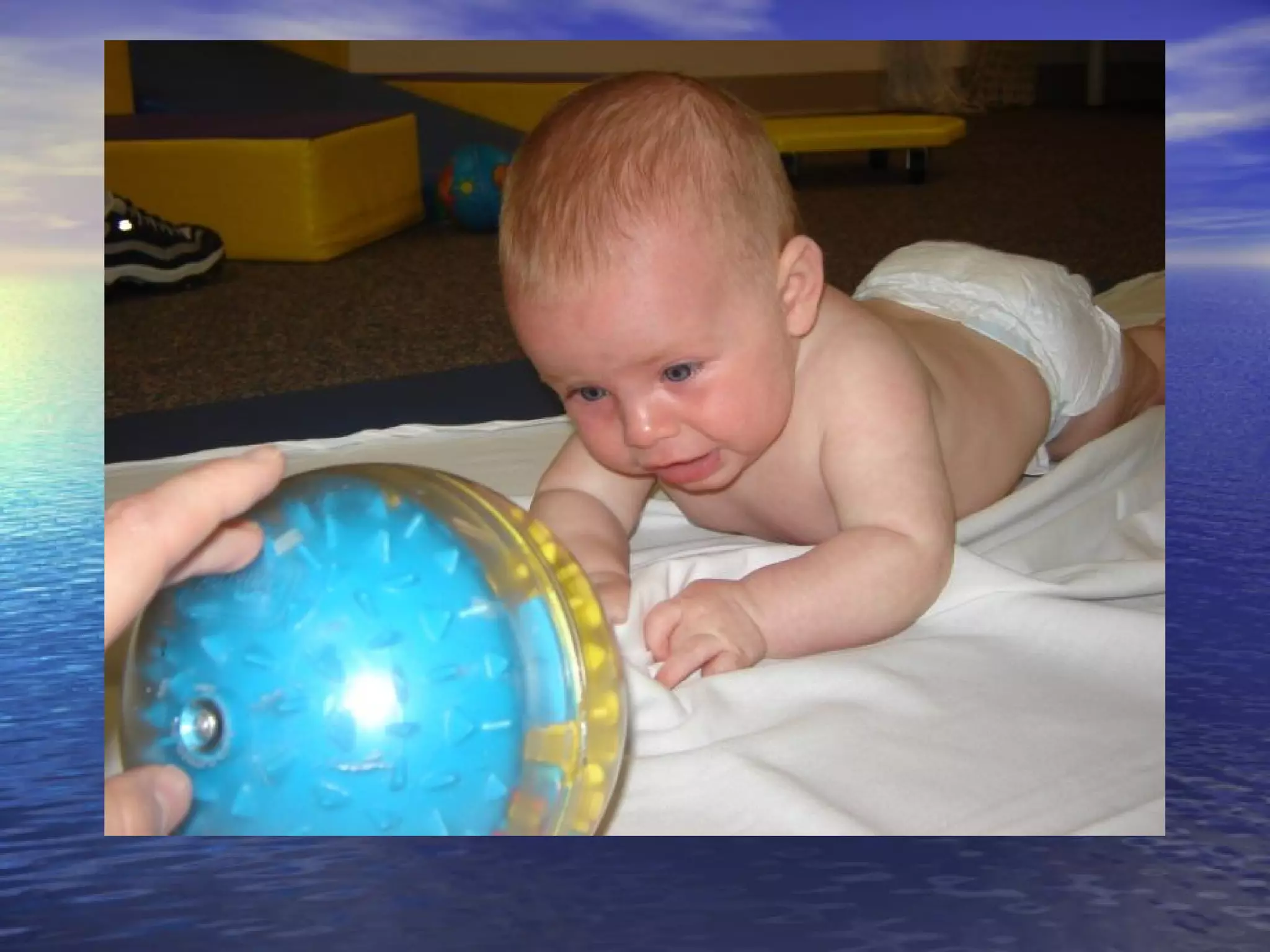
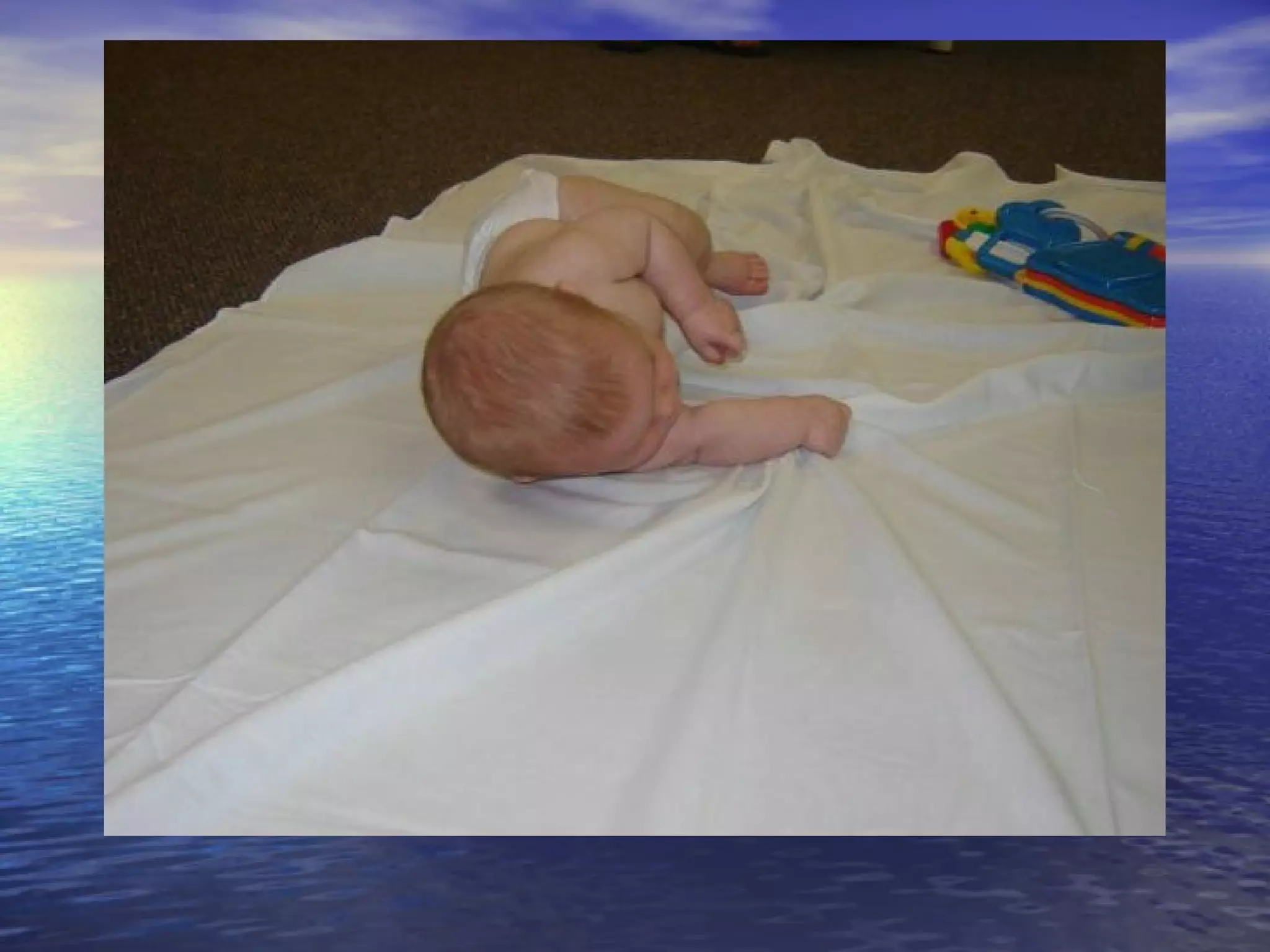
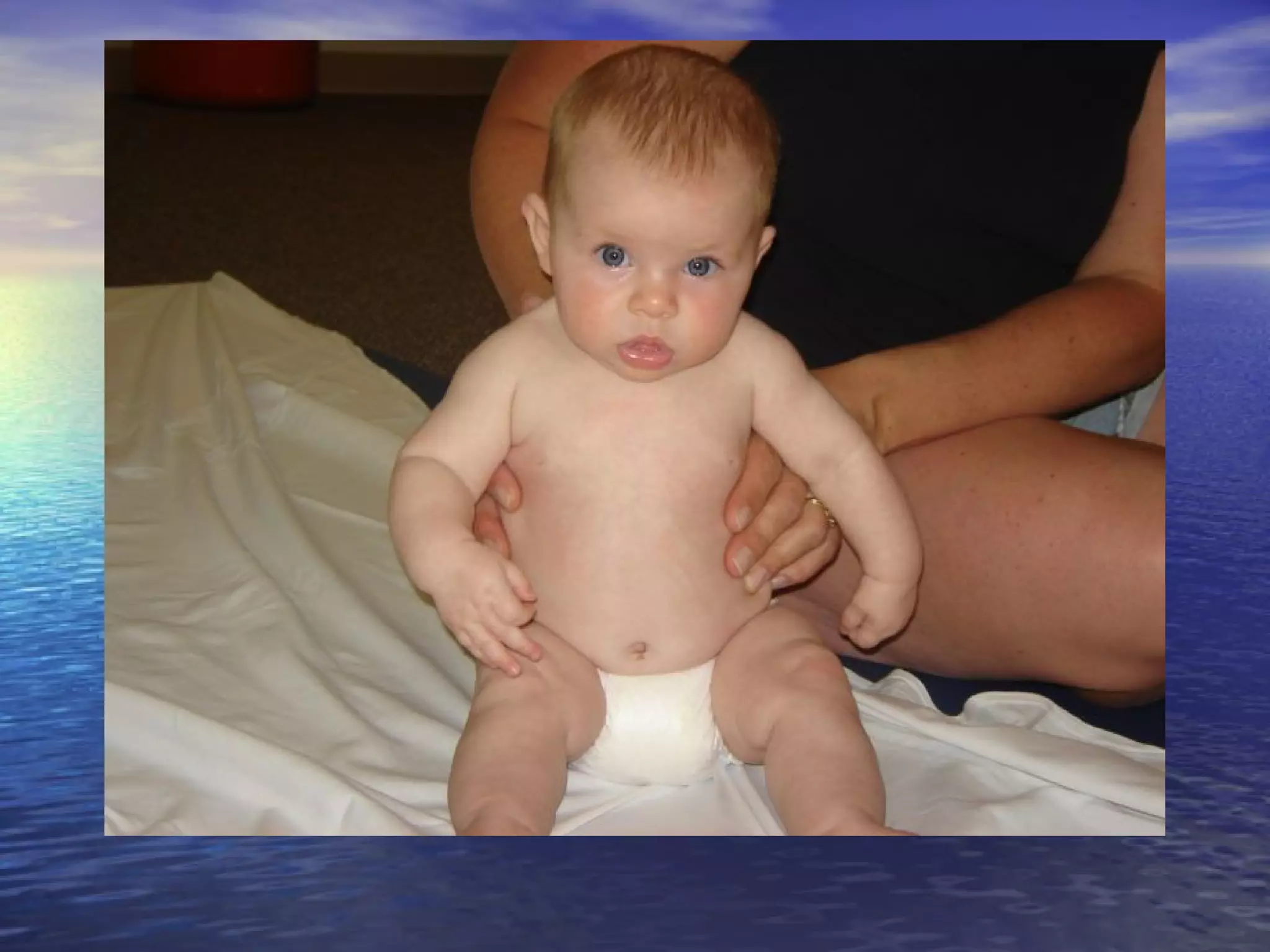
4 months Variation of vowel sounds Begins consonant sound production Begins babbling Recognizes and responds to own name Hands open most of the time Hand to hand play Starting to grab objects with more directed movement of arms Tolerates/enjoys a variety of sensory input in daily routines Able to dissociate eye movement from head movement Smooth tracking horizontally and vertically across midline Period of active symmetry Mirrored movements of arms and legs Hands to knees when in supine Rolls to side when in hands to knees position Prone on elbows with head 45 – 90 degrees Elbows below or in front of shoulders When in standing legs are loose, not locked, will play with small bend/straighten of knees Likes to stand with hands held 4 months Speech/Language Fine Motor Gross Motor Month


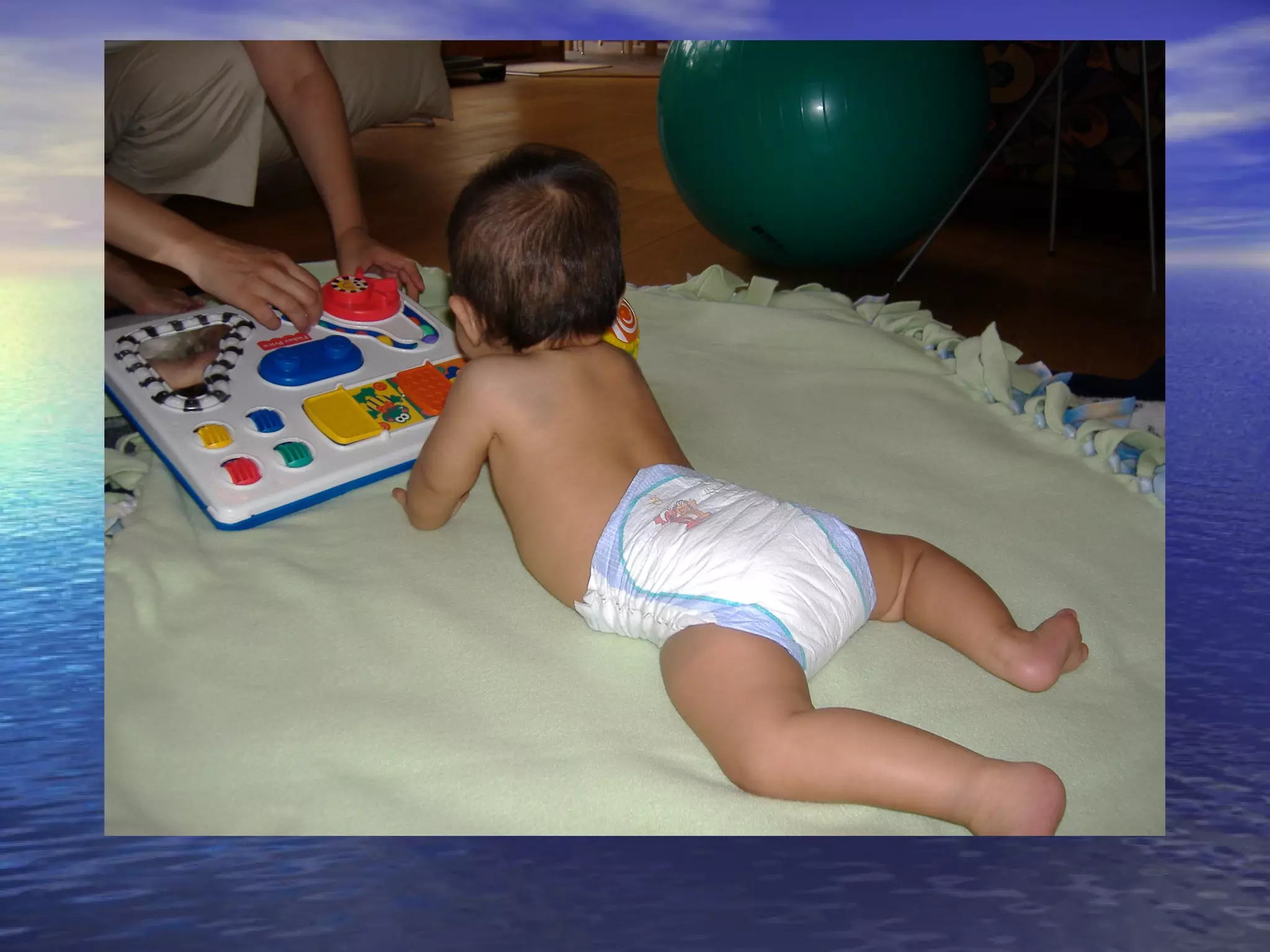
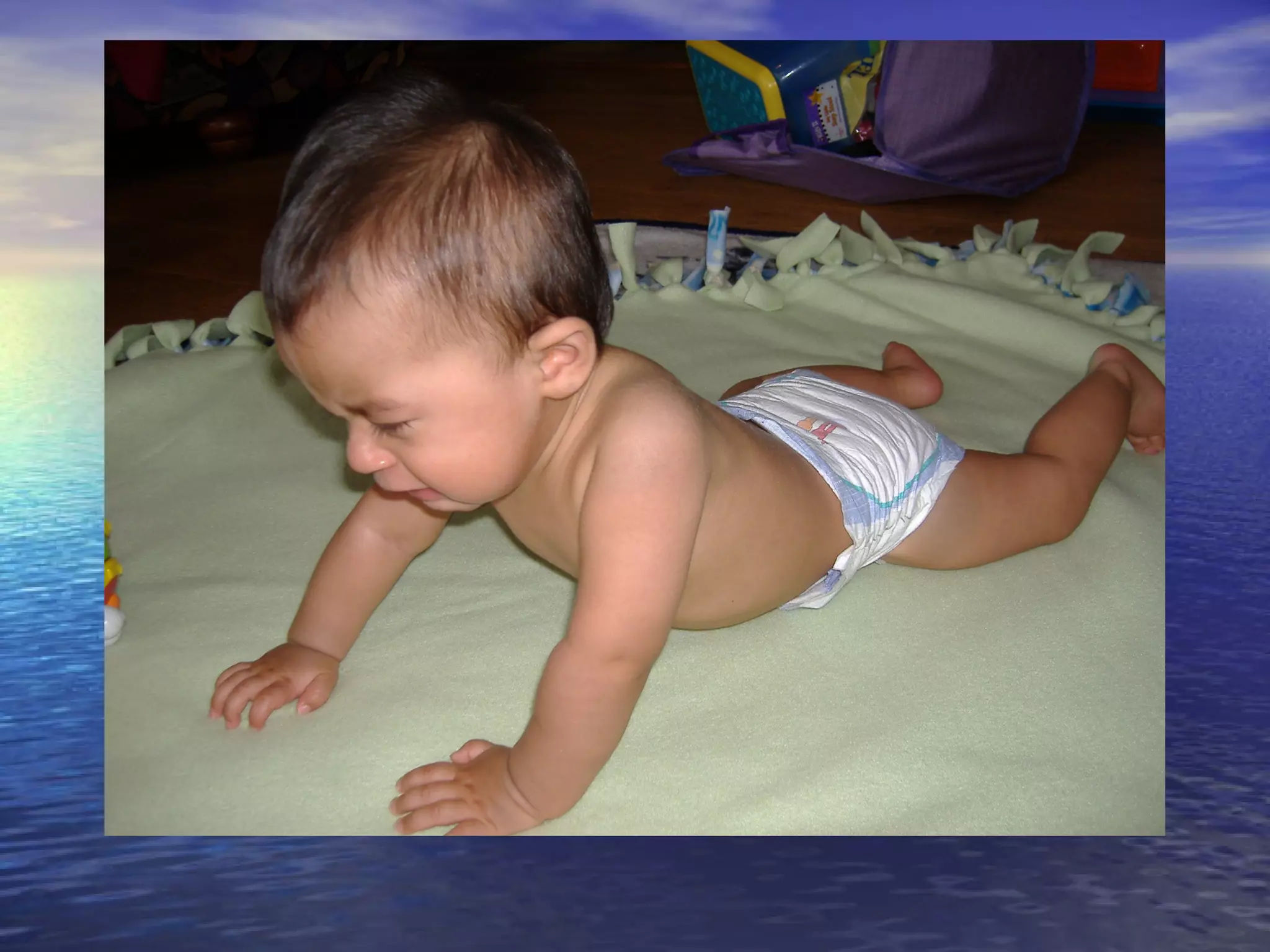
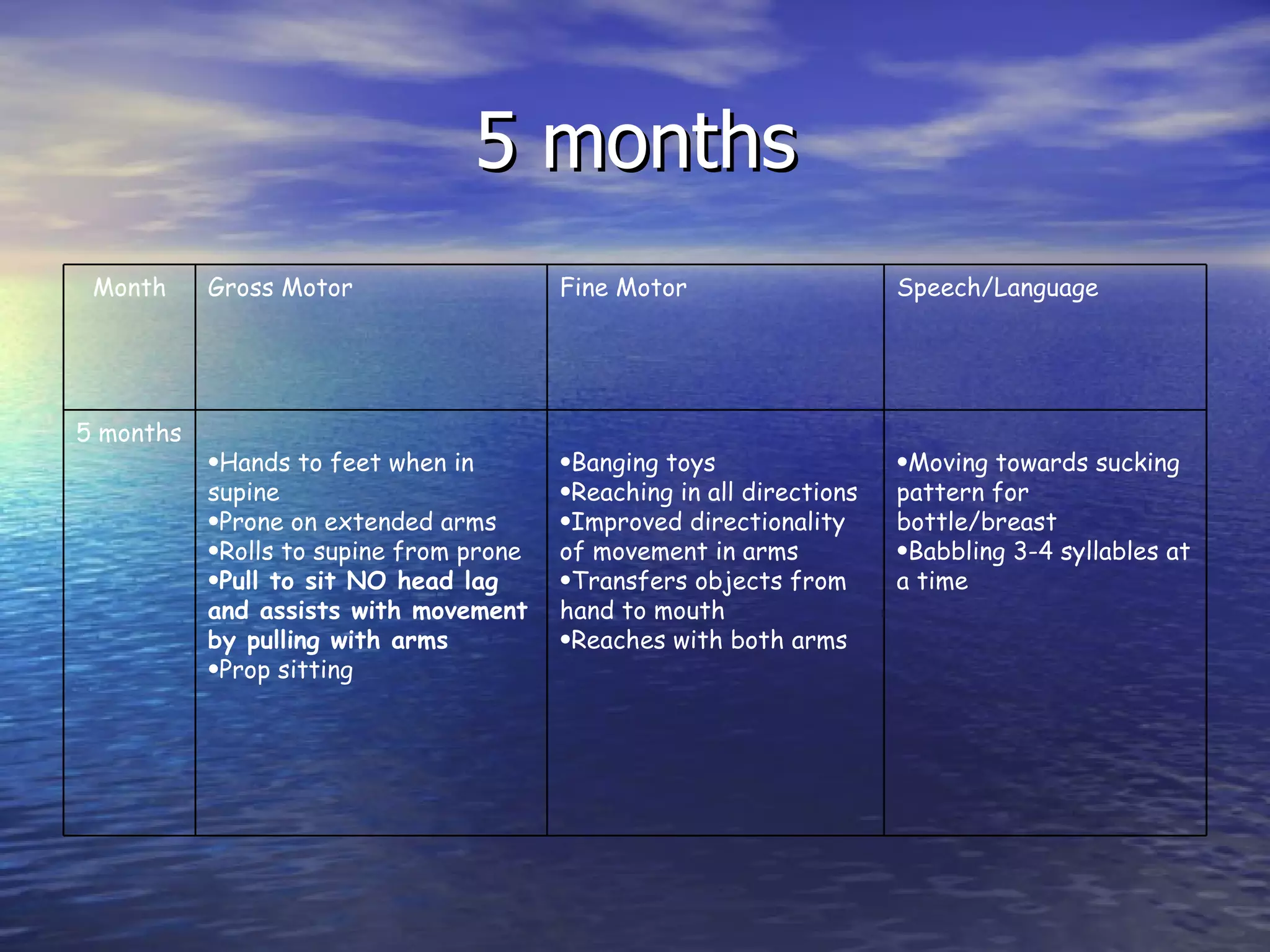
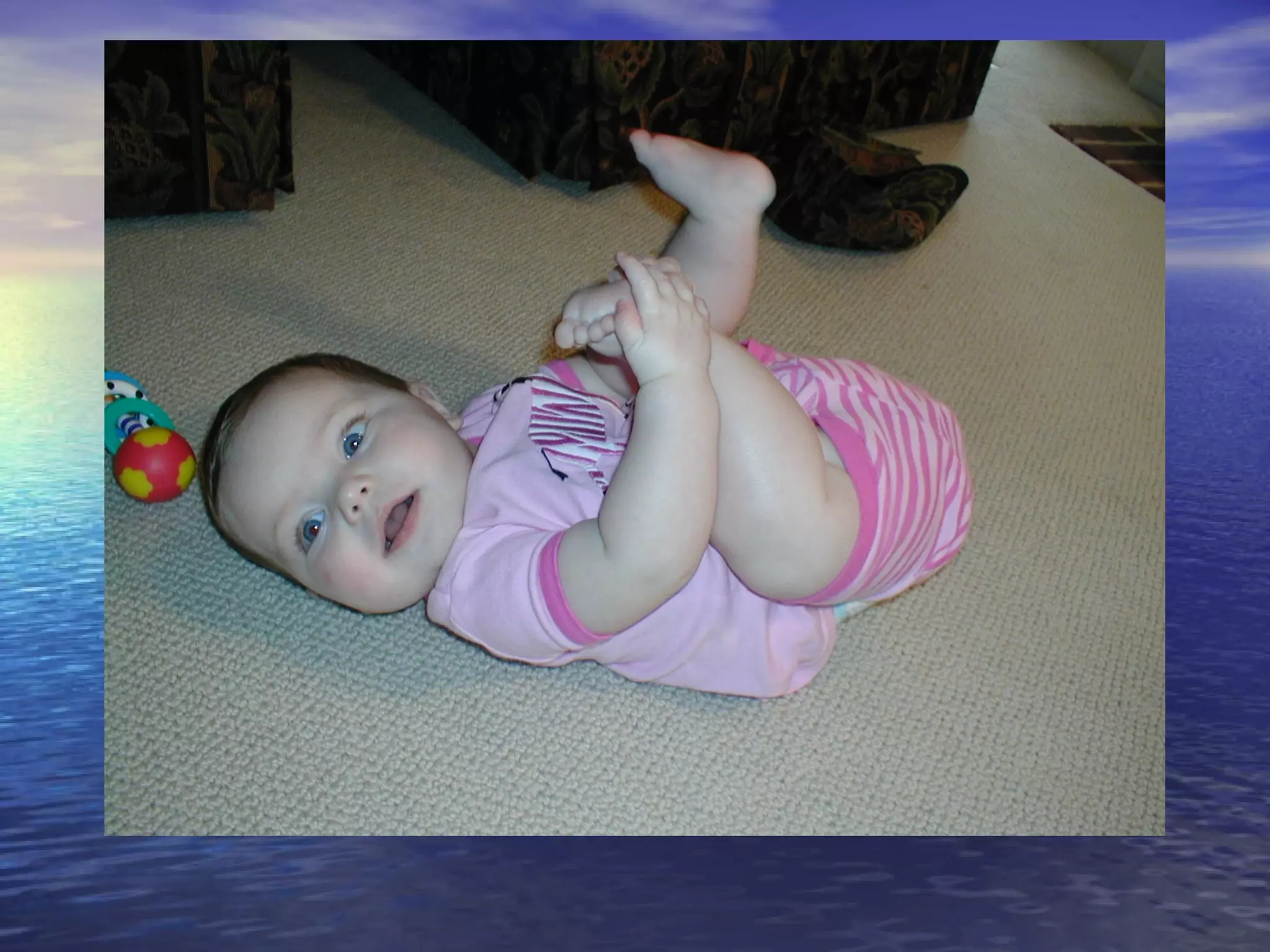
5 months Moving towards sucking pattern for bottle/breast Babbling 3-4 syllables at a time Banging toys Reaching in all directions Improved directionality of movement in arms Transfers objects from hand to mouth Reaches with both arms Hands to feet when in supine Prone on extended arms Rolls to supine from prone Pull to sit NO head lag and assists with movement by pulling with arms Prop sitting 5 months Speech/Language Fine Motor Gross Motor Month
 
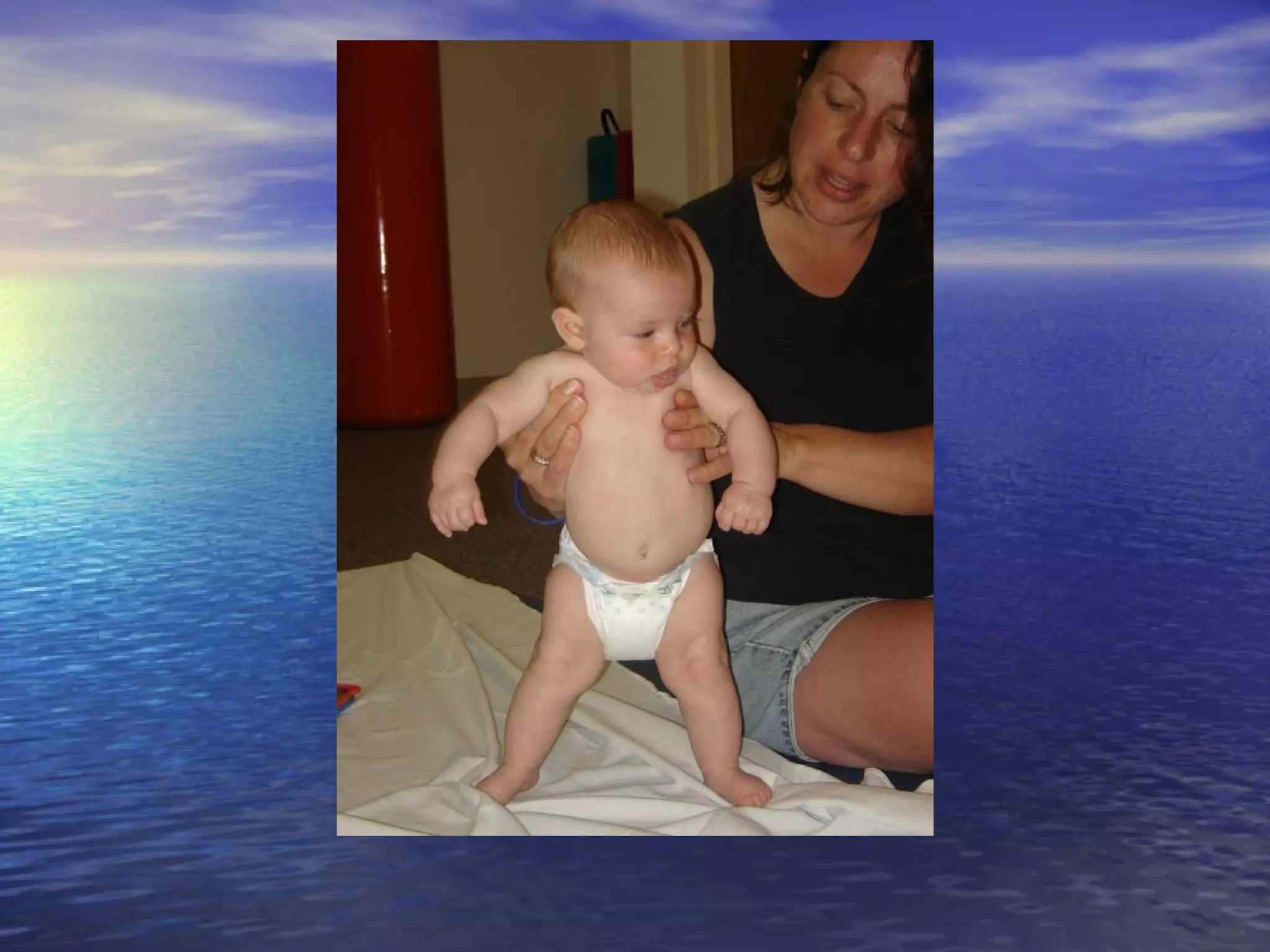
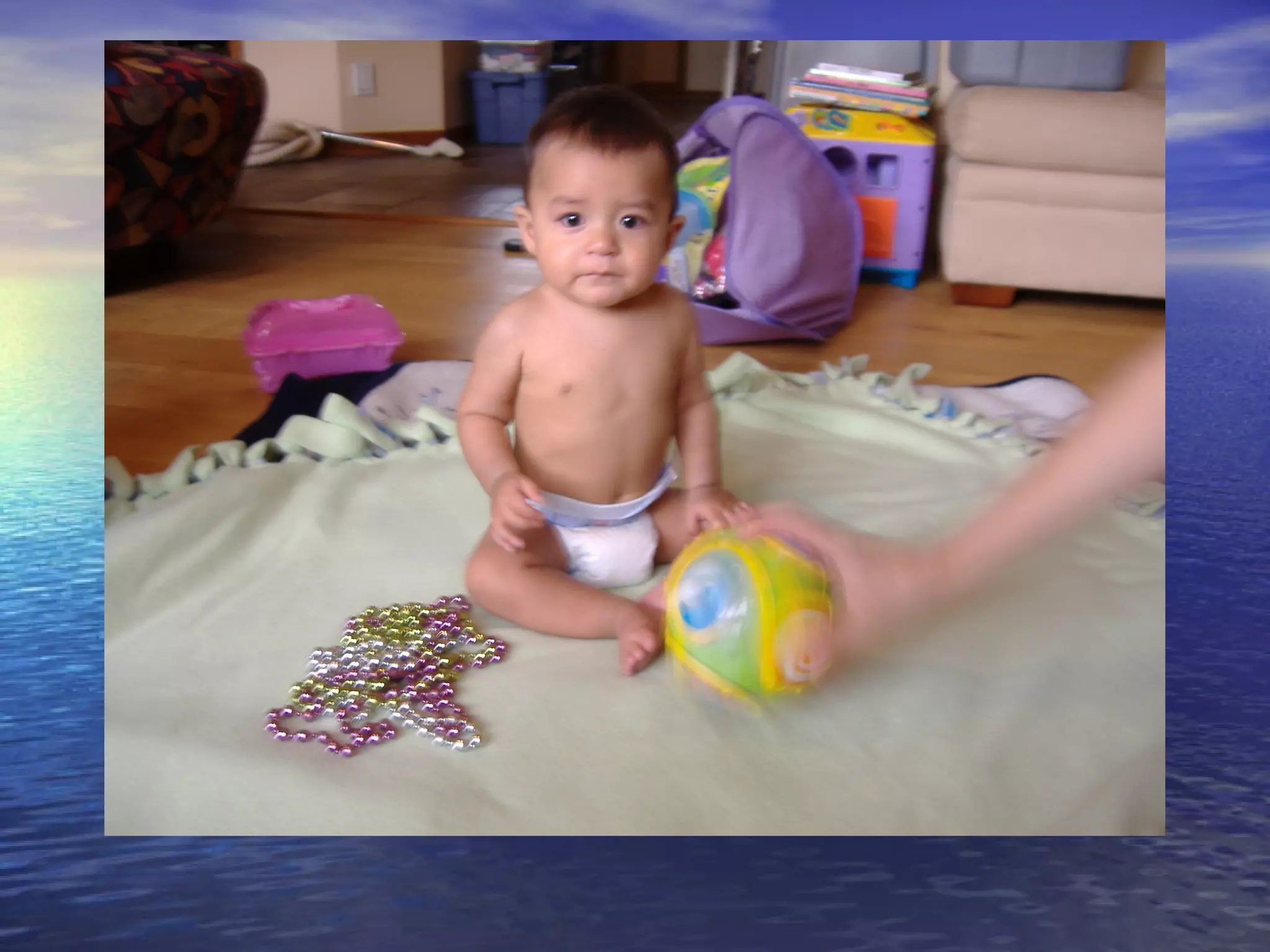
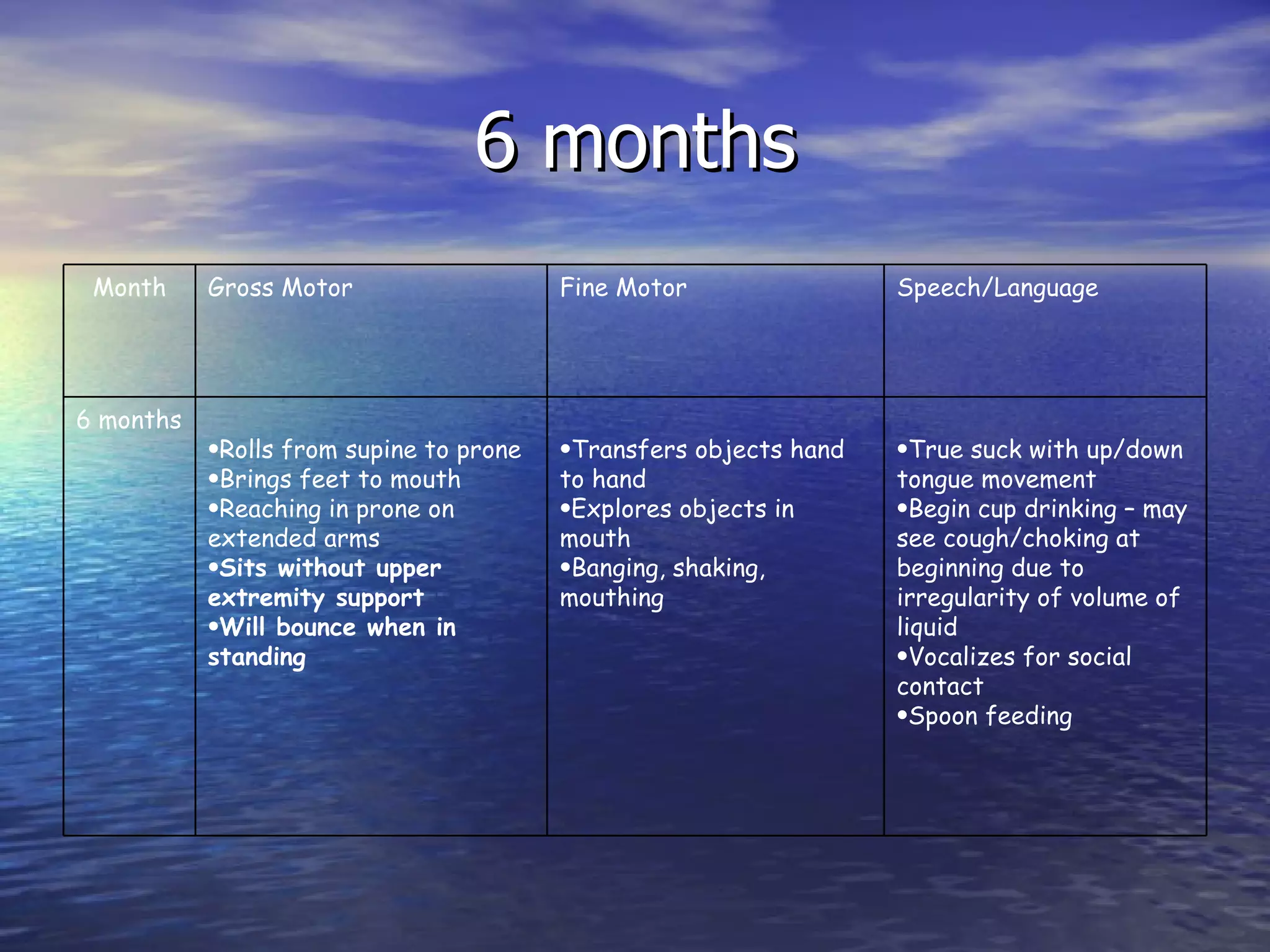
6 months True suck with up/down tongue movement Begin cup drinking – may see cough/choking at beginning due to irregularity of volume of liquid Vocalizes for social contact Spoon feeding Transfers objects hand to hand Explores objects in mouth Banging, shaking, mouthing Rolls from supine to prone Brings feet to mouth Reaching in prone on extended arms Sits without upper extremity support  Will bounce when in standing 6 months Speech/Language Fine Motor Gross Motor Month
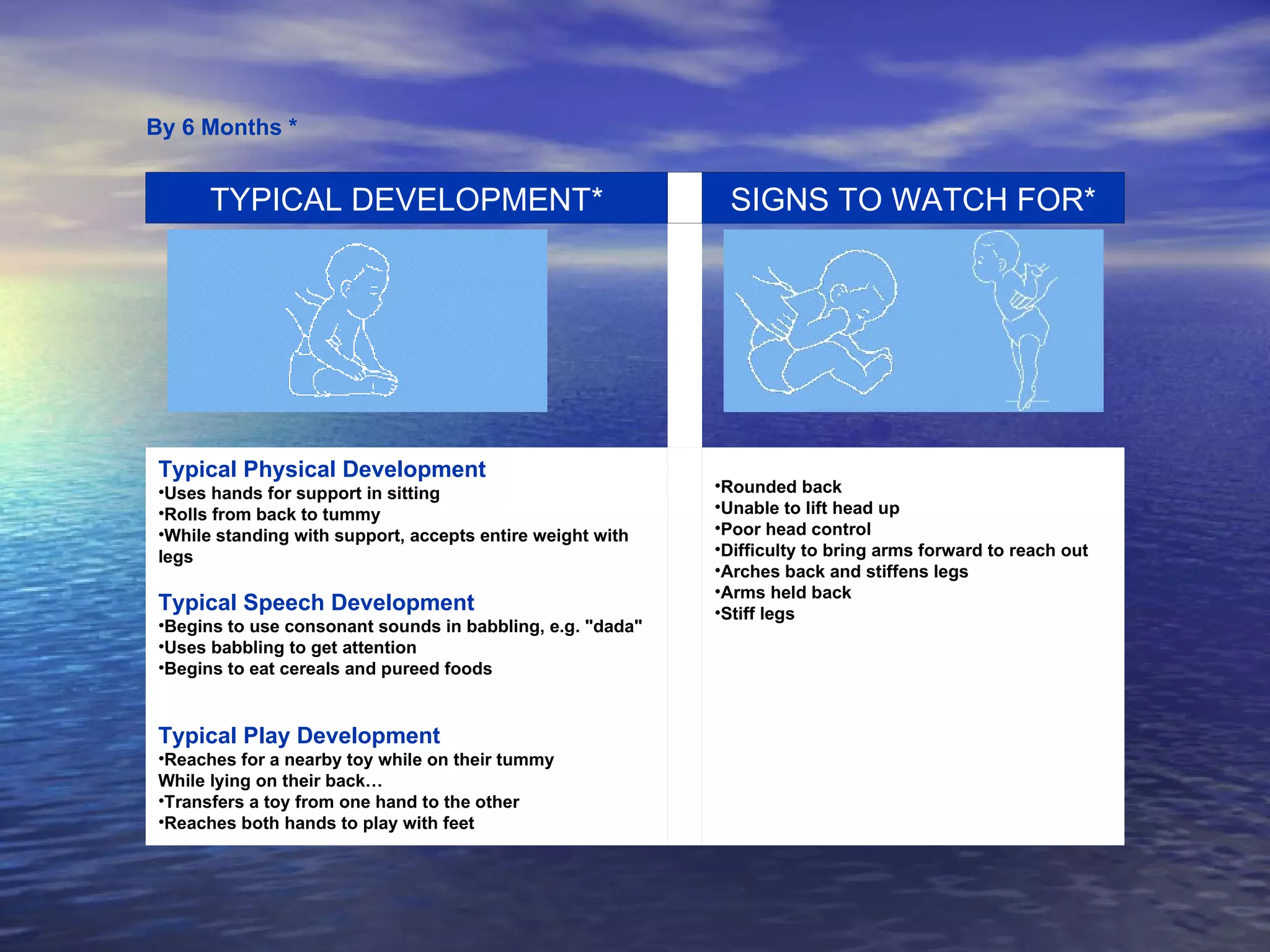
By 6 Months * Rounded back  Unable to lift head up  Poor head control  Difficulty to bring arms forward to reach out  Arches back and stiffens legs  Arms held back  Stiff legs    Typical Physical Development Uses hands for support in sitting  Rolls from back to tummy  While standing with support, accepts entire weight with legs    Typical Speech Development Begins to use consonant sounds in babbling, e.g. "dada"  Uses babbling to get attention  Begins to eat cereals and pureed foods  Typical Play Development Reaches for a nearby toy while on their tummy  While lying on their back…  Transfers a toy from one hand to the other  Reaches both hands to play with feet                                                                                              SIGNS TO WATCH FOR*   TYPICAL DEVELOPMENT*
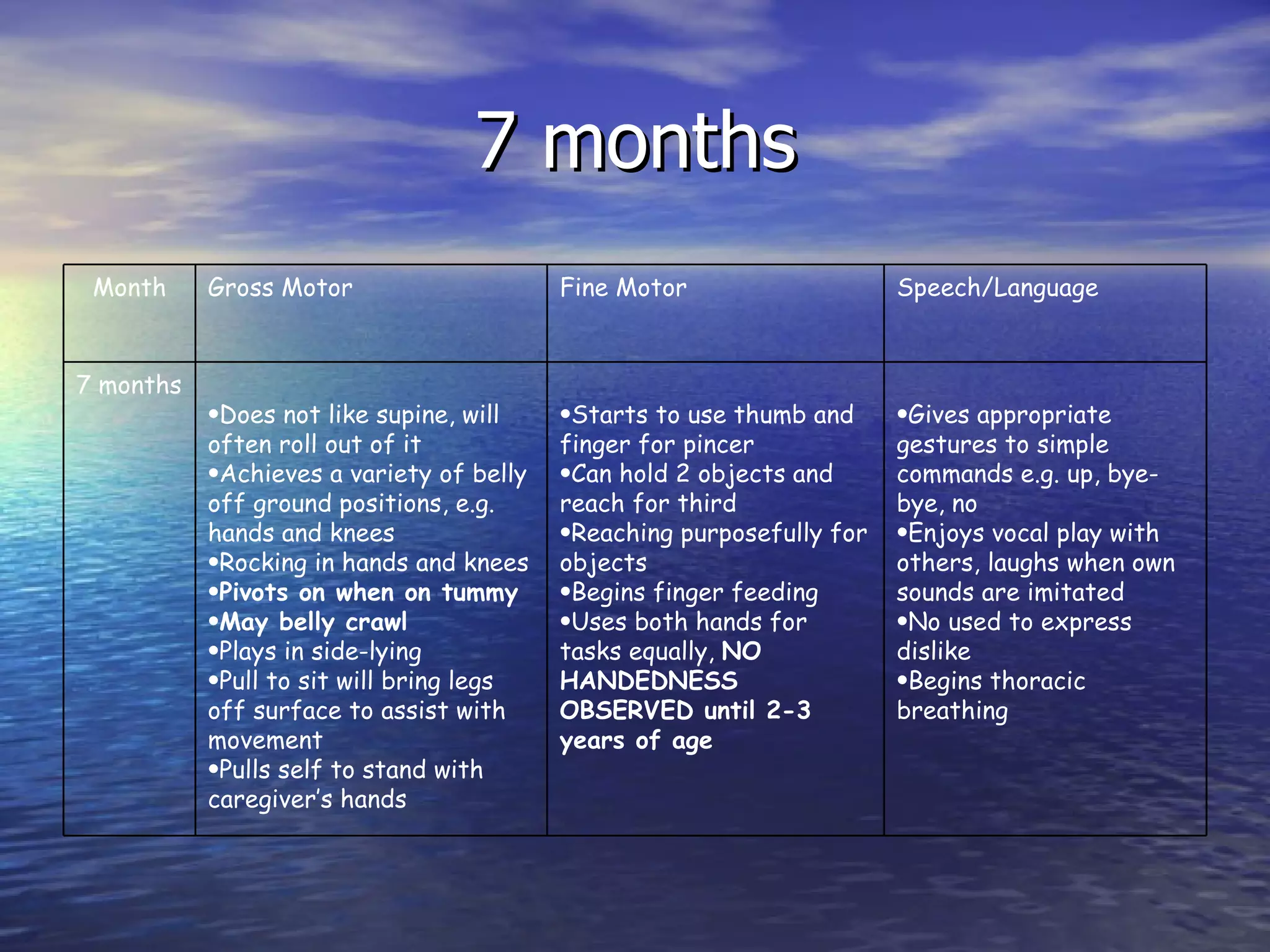
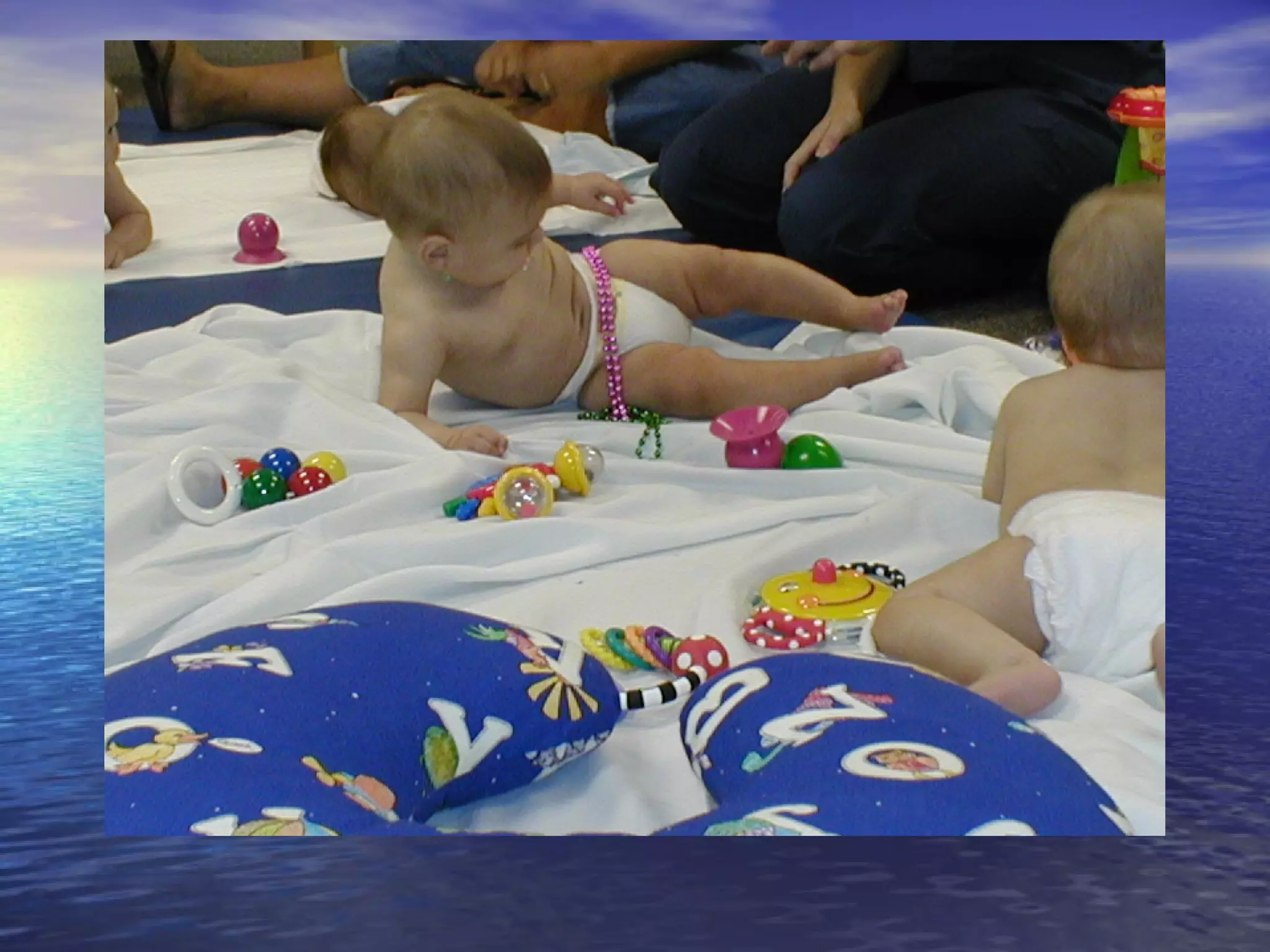
7 months Gives appropriate gestures to simple commands e.g. up, bye-bye, no Enjoys vocal play with others, laughs when own sounds are imitated No used to express dislike Begins thoracic breathing Starts to use thumb and finger for pincer Can hold 2 objects and reach for third Reaching purposefully for objects Begins finger feeding Uses both hands for tasks equally,  NO HANDEDNESS OBSERVED until 2-3 years of age Does not like supine, will often roll out of it Achieves a variety of belly off ground positions, e.g. hands and knees Rocking in hands and knees Pivots on when on tummy May belly crawl Plays in side-lying Pull to sit will bring legs off surface to assist with movement Pulls self to stand with caregiver’s hands 7 months Speech/Language Fine Motor Gross Motor Month


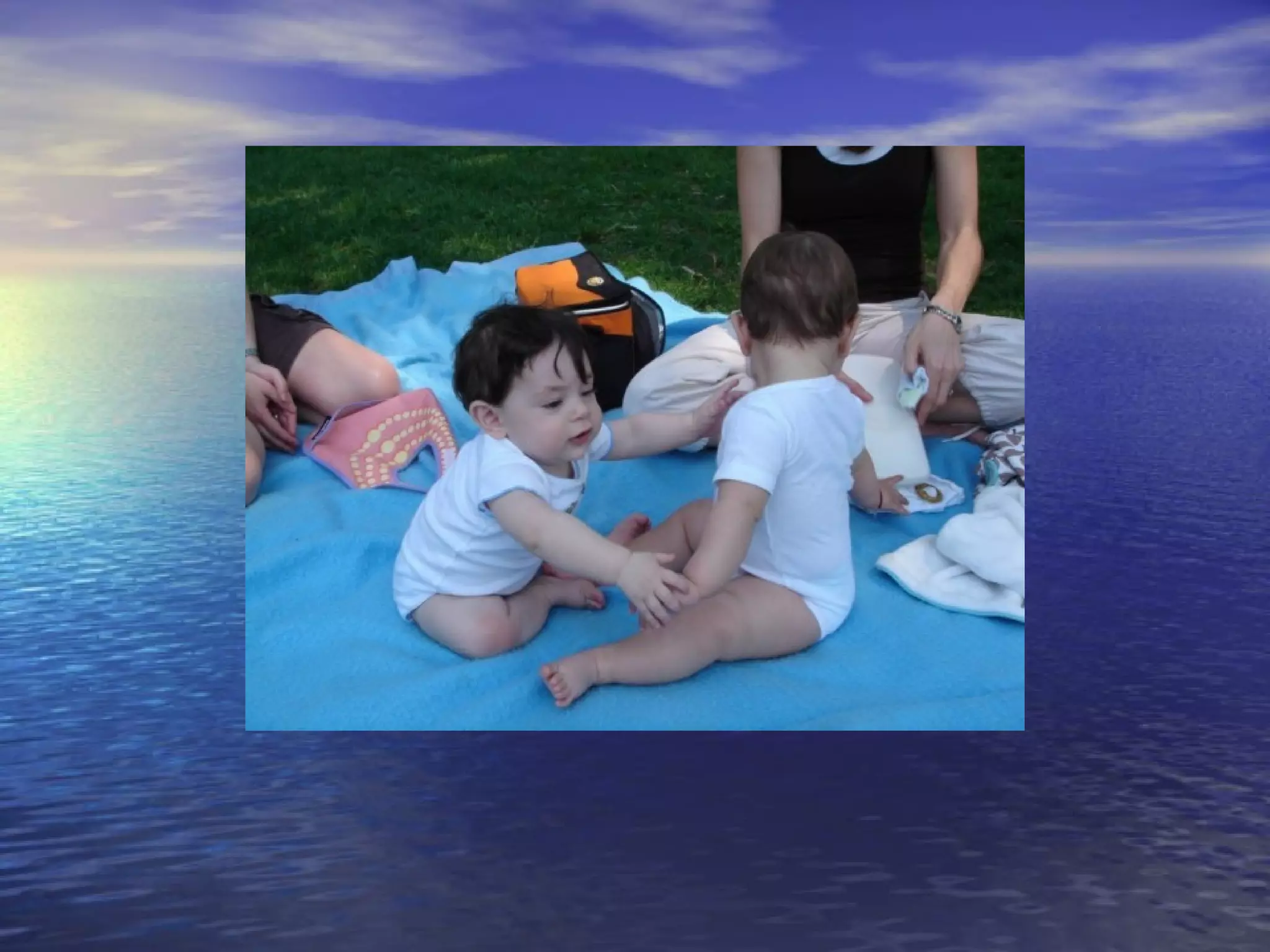
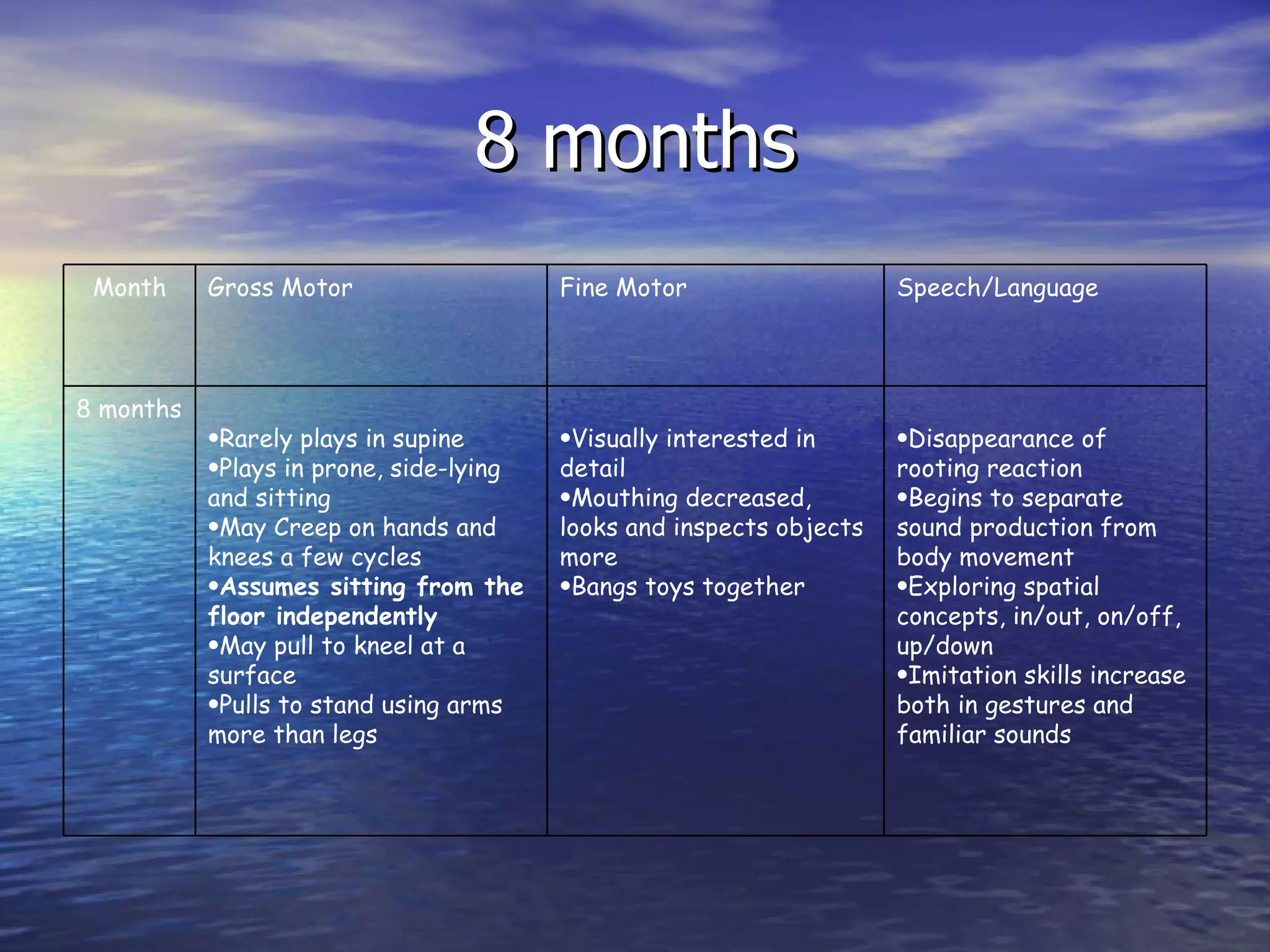
8 months Disappearance of rooting reaction Begins to separate sound production from body movement Exploring spatial concepts, in/out, on/off, up/down Imitation skills increase both in gestures and familiar sounds Visually interested in detail Mouthing decreased, looks and inspects objects more Bangs toys together Rarely plays in supine Plays in prone, side-lying and sitting May Creep on hands and knees a few cycles  Assumes sitting from the floor independently May pull to kneel at a surface Pulls to stand using arms more than legs 8 months Speech/Language Fine Motor Gross Motor Month
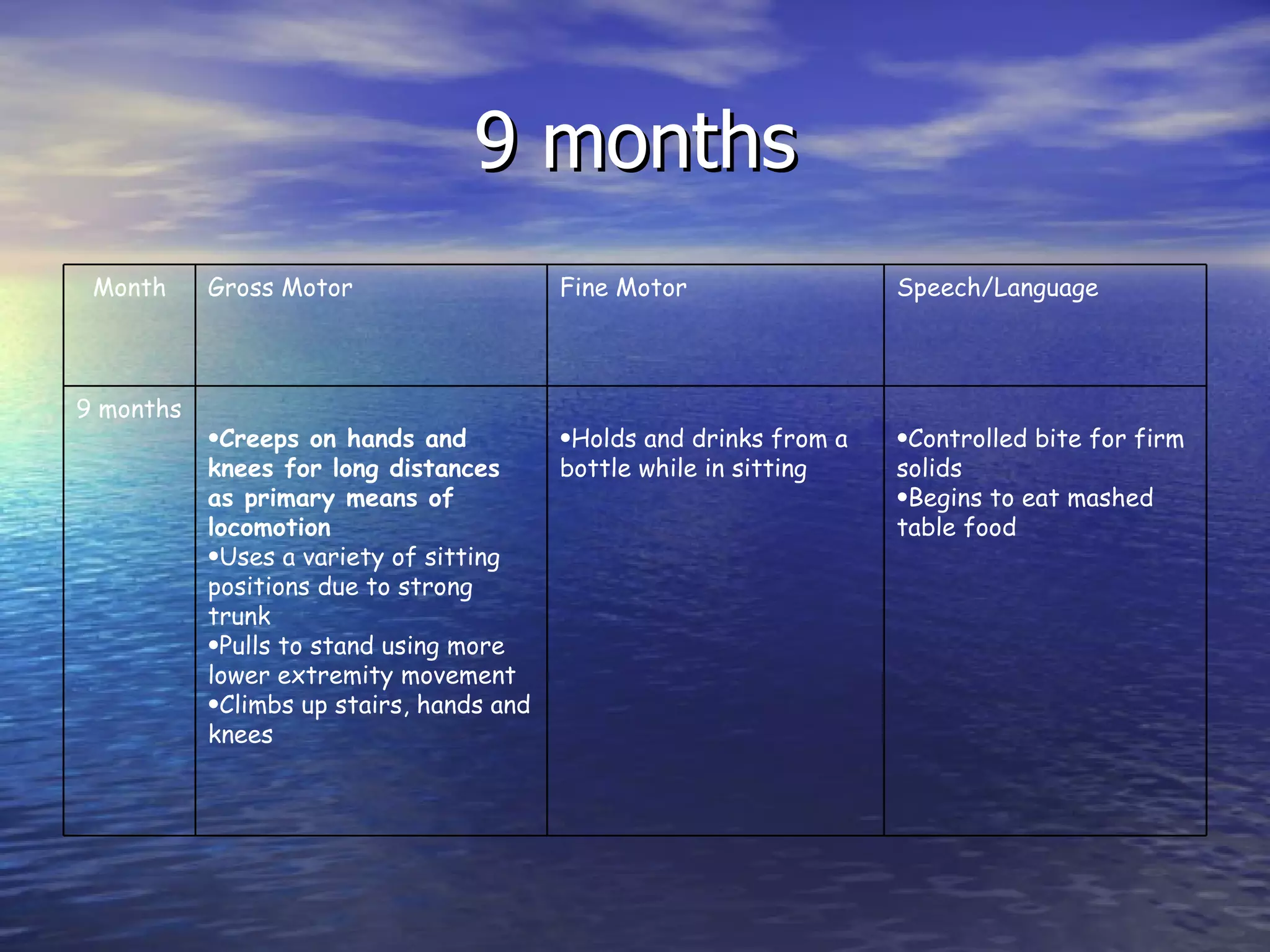
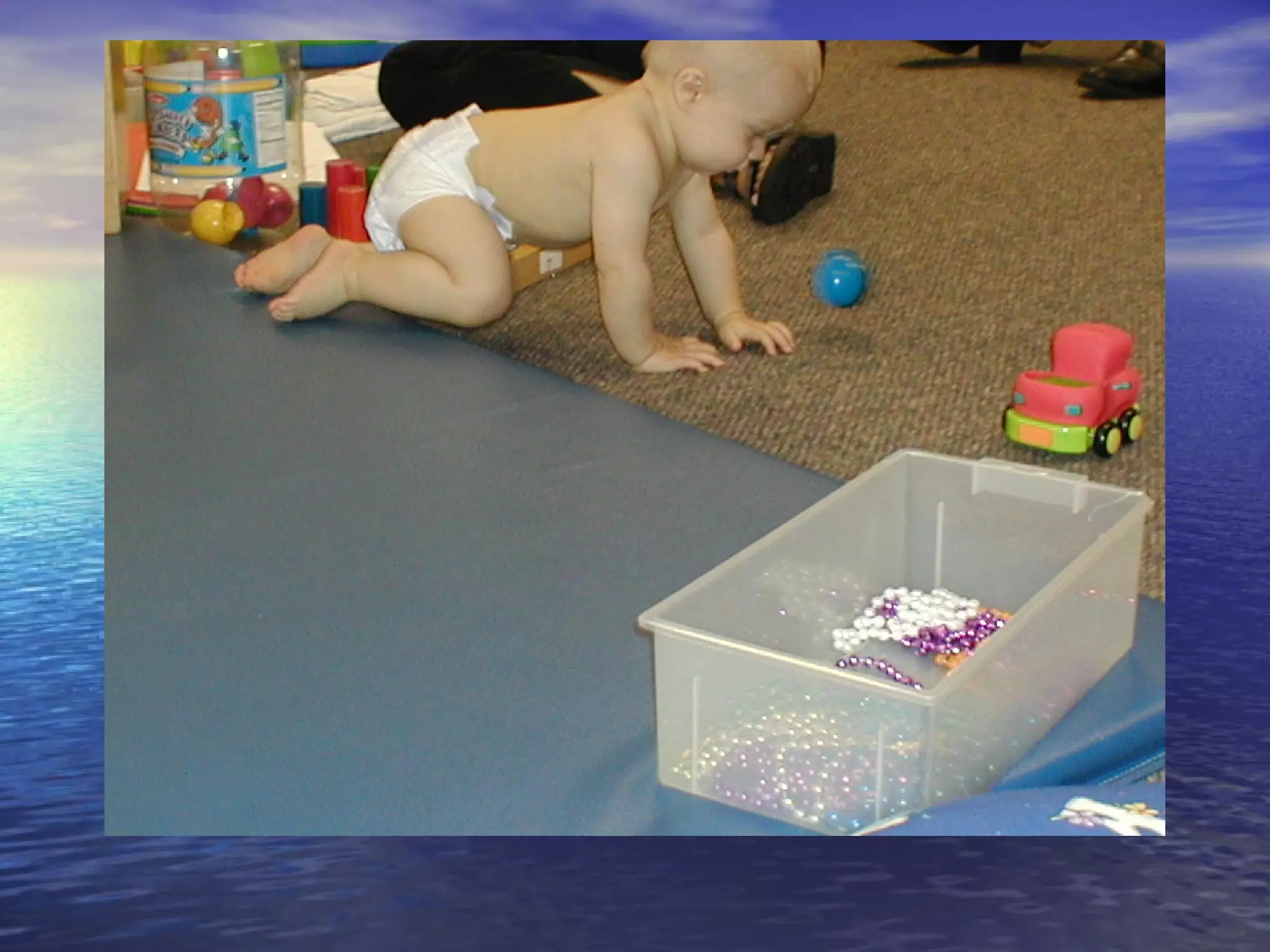
9 months Controlled bite for firm solids Begins to eat mashed table food Holds and drinks from a bottle while in sitting Creeps on hands and knees for long distances as primary means of locomotion Uses a variety of sitting positions due to strong trunk Pulls to stand using more lower extremity movement Climbs up stairs, hands and knees 9 months Speech/Language Fine Motor Gross Motor Month


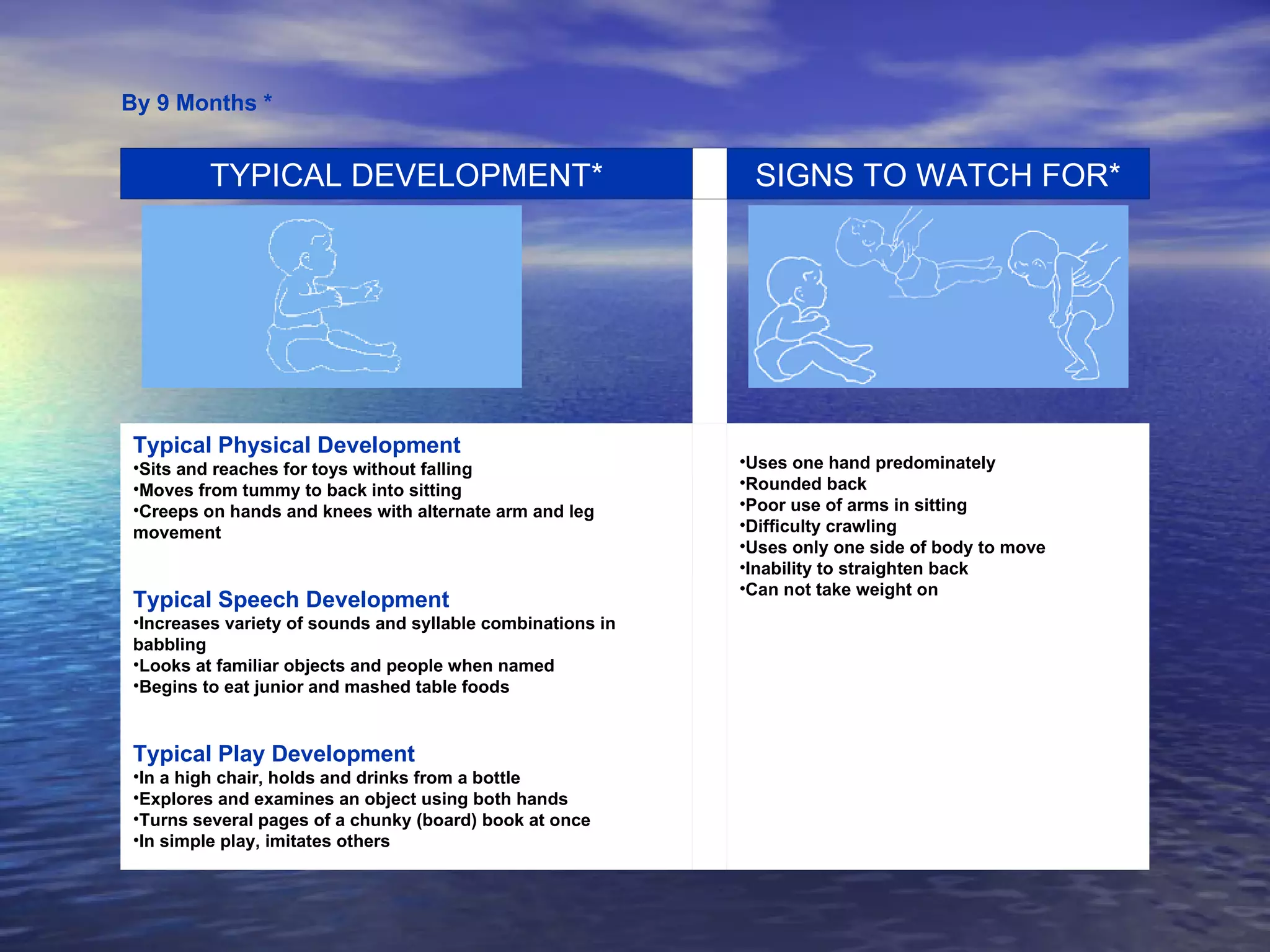
By 9 Months * Uses one hand predominately  Rounded back  Poor use of arms in sitting  Difficulty crawling  Uses only one side of body to move  Inability to straighten back  Can not take weight on   Typical Physical Development Sits and reaches for toys without falling  Moves from tummy to back into sitting  Creeps on hands and knees with alternate arm and leg movement  Typical Speech Development Increases variety of sounds and syllable combinations in babbling  Looks at familiar objects and people when named  Begins to eat junior and mashed table foods  Typical Play Development In a high chair, holds and drinks from a bottle  Explores and examines an object using both hands  Turns several pages of a chunky (board) book at once  In simple play, imitates others                                                                                              SIGNS TO WATCH FOR*   TYPICAL DEVELOPMENT*
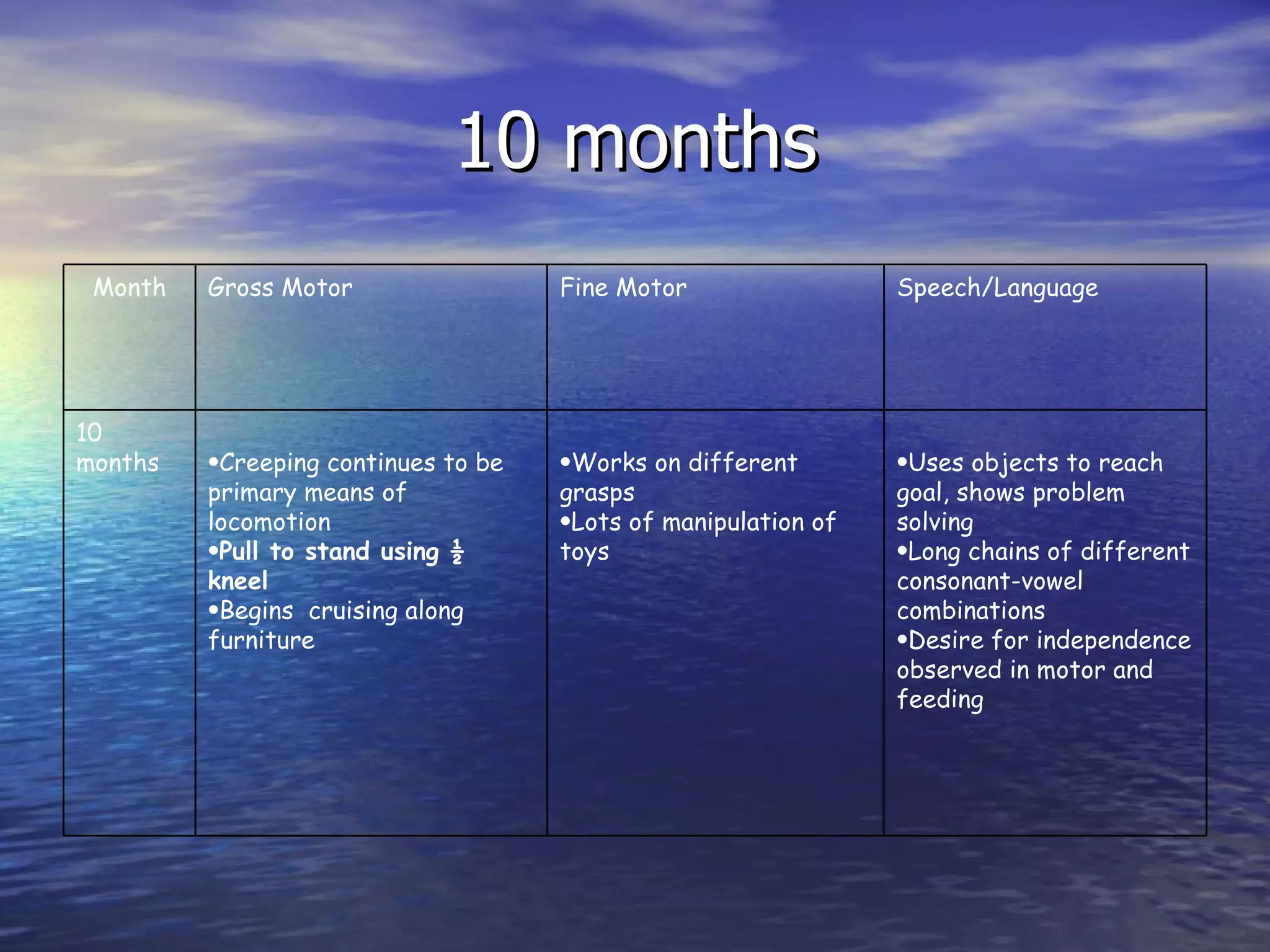
10 months Uses objects to reach goal, shows problem solving Long chains of different consonant-vowel combinations  Desire for independence observed in motor and feeding Works on different grasps Lots of manipulation of toys Creeping continues to be primary means of locomotion Pull to stand using ½ kneel Begins  cruising along furniture 10 months Speech/Language Fine Motor Gross Motor Month


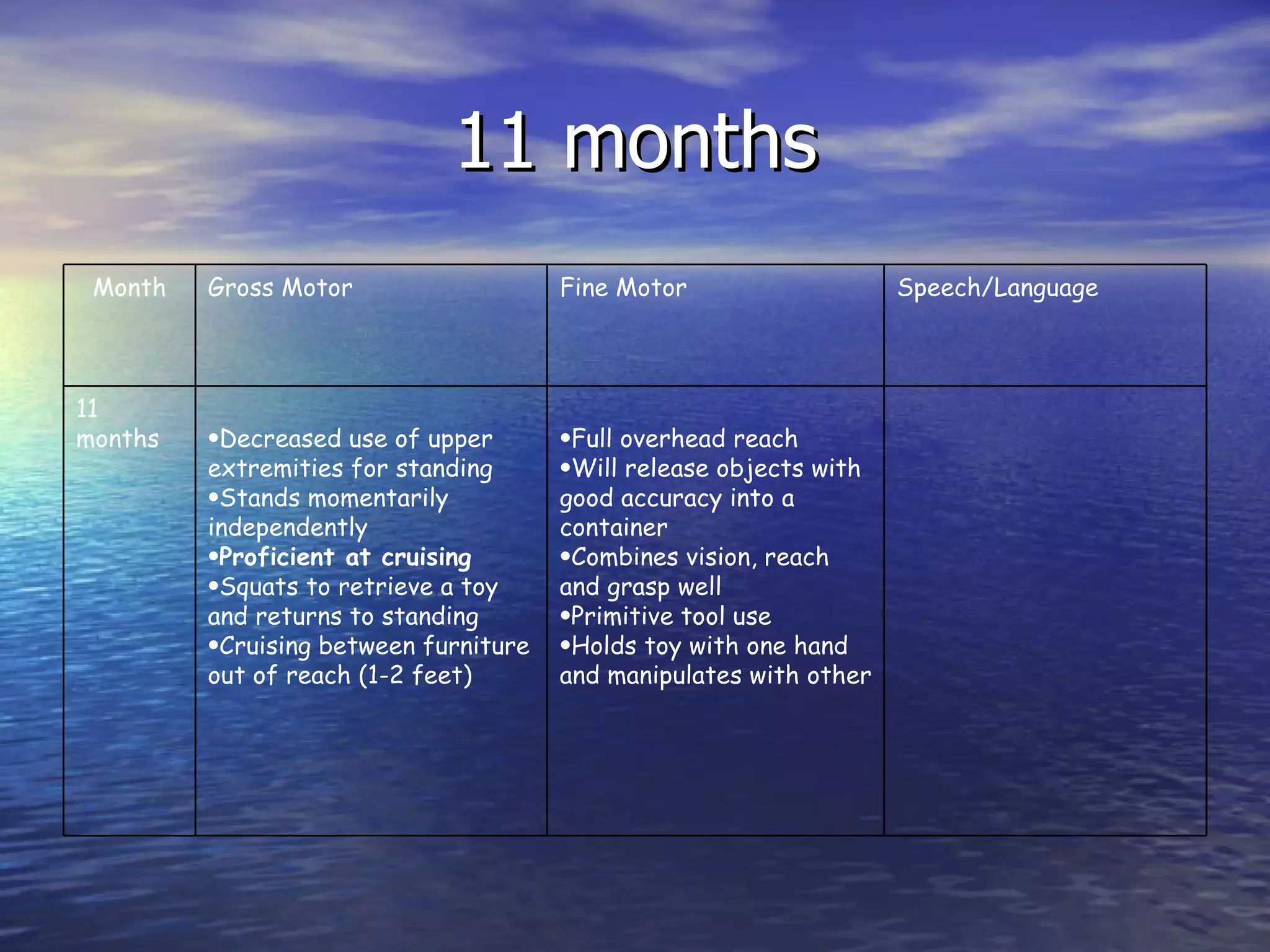
11 months Full overhead reach Will release objects with good accuracy into a container Combines vision, reach and grasp well Primitive tool use Holds toy with one hand and manipulates with other Decreased use of upper extremities for standing Stands momentarily independently Proficient at cruising Squats to retrieve a toy and returns to standing Cruising between furniture out of reach (1-2 feet) 11 months Speech/Language Fine Motor Gross Motor Month
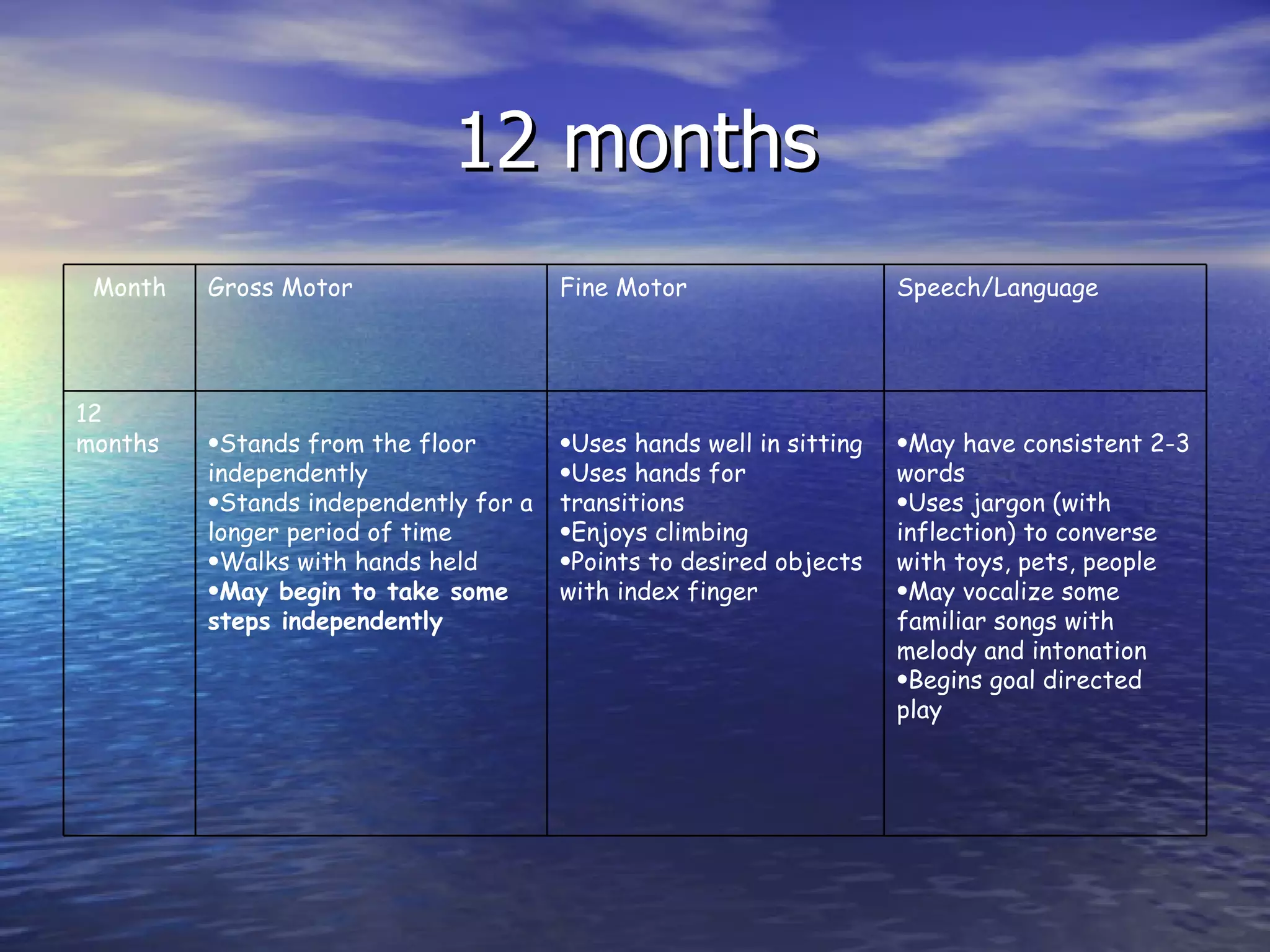
12 months May have consistent 2-3 words Uses jargon (with inflection) to converse with toys, pets, people May vocalize some familiar songs with melody and intonation Begins goal directed play Uses hands well in sitting Uses hands for transitions Enjoys climbing Points to desired objects with index finger Stands from the floor independently Stands independently for a longer period of time Walks with hands held May begin to take some steps independently 12 months Speech/Language Fine Motor Gross Motor Month
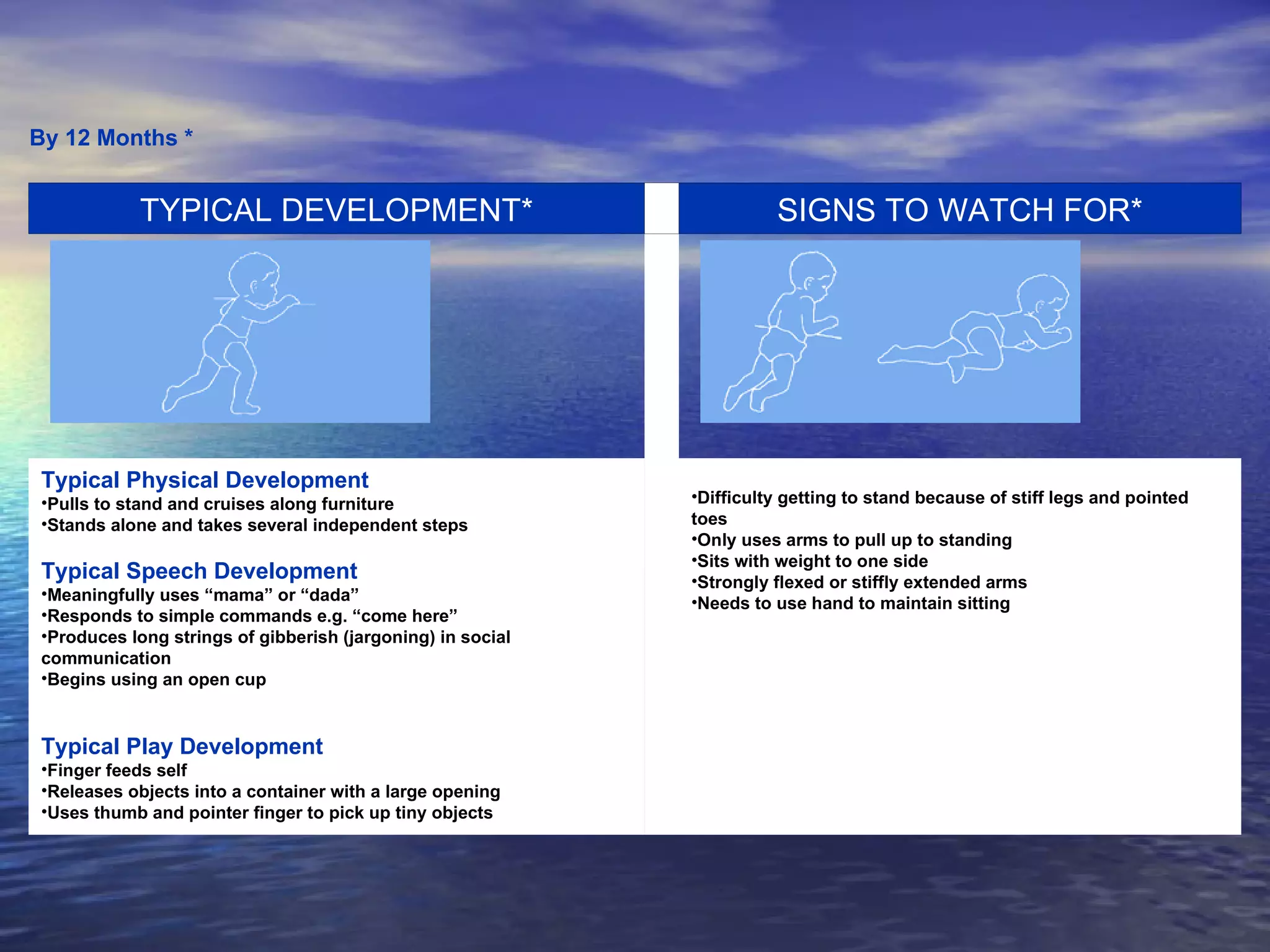
By 12 Months * Difficulty getting to stand because of stiff legs and pointed toes  Only uses arms to pull up to standing  Sits with weight to one side  Strongly flexed or stiffly extended arms  Needs to use hand to maintain sitting    Typical Physical Development Pulls to stand and cruises along furniture  Stands alone and takes several independent steps    Typical Speech Development Meaningfully uses “mama” or “dada”  Responds to simple commands e.g. “come here”  Produces long strings of gibberish (jargoning) in social communication  Begins using an open cup  Typical Play Development Finger feeds self  Releases objects into a container with a large opening  Uses thumb and pointer finger to pick up tiny objects                                                                                              SIGNS TO WATCH FOR*   TYPICAL DEVELOPMENT*
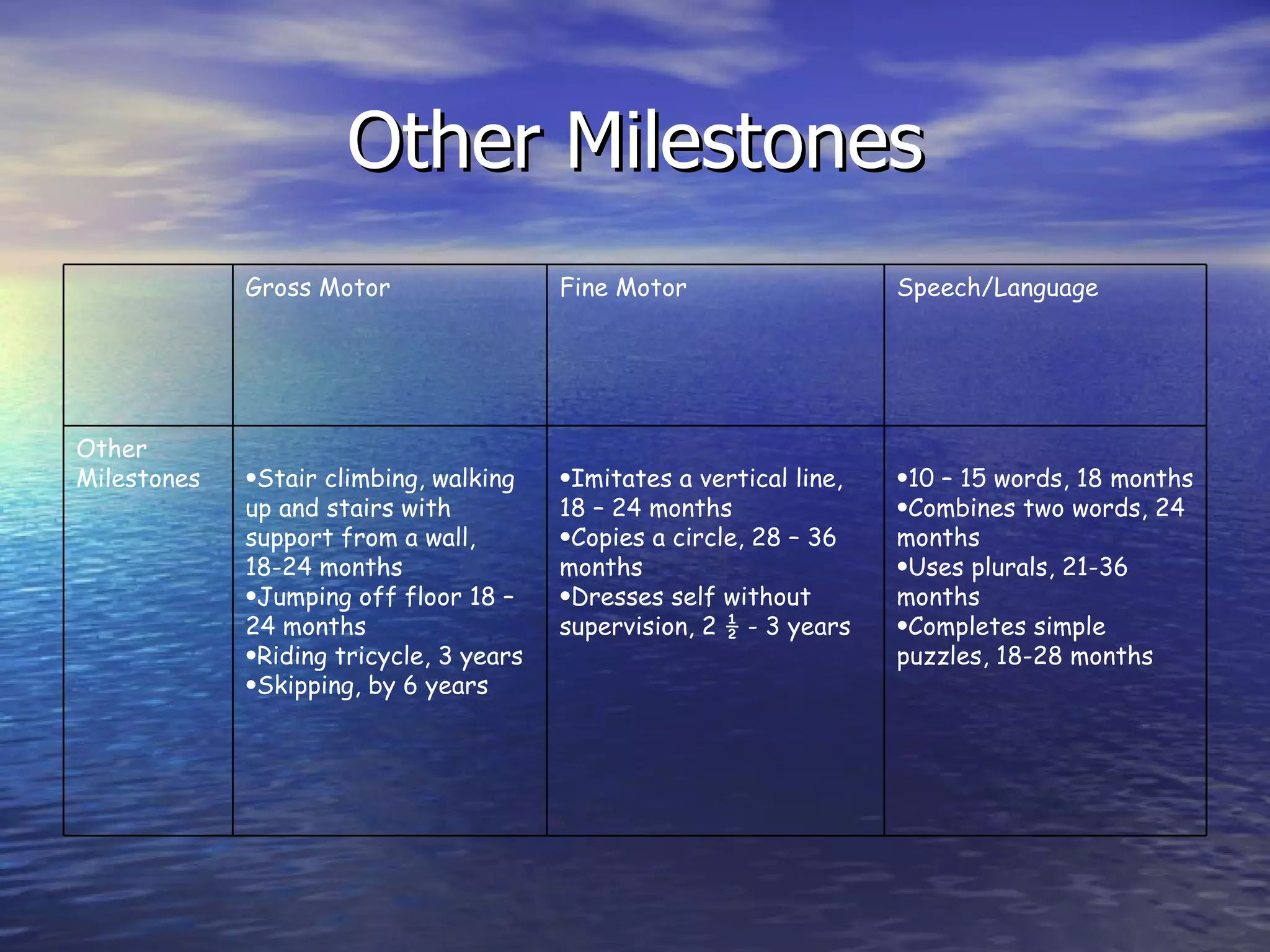
Other Milestones 10 – 15 words, 18 months Combines two words, 24 months Uses plurals, 21-36 months Completes simple puzzles, 18-28 months Imitates a vertical line, 18 – 24 months Copies a circle, 28 – 36 months Dresses self without supervision, 2 ½ - 3 years Stair climbing, walking up and stairs with support from a wall, 18-24 months Jumping off floor 18 – 24 months Riding tricycle, 3 years Skipping, by 6 years Other  Milestones Speech/Language Fine Motor Gross Motor
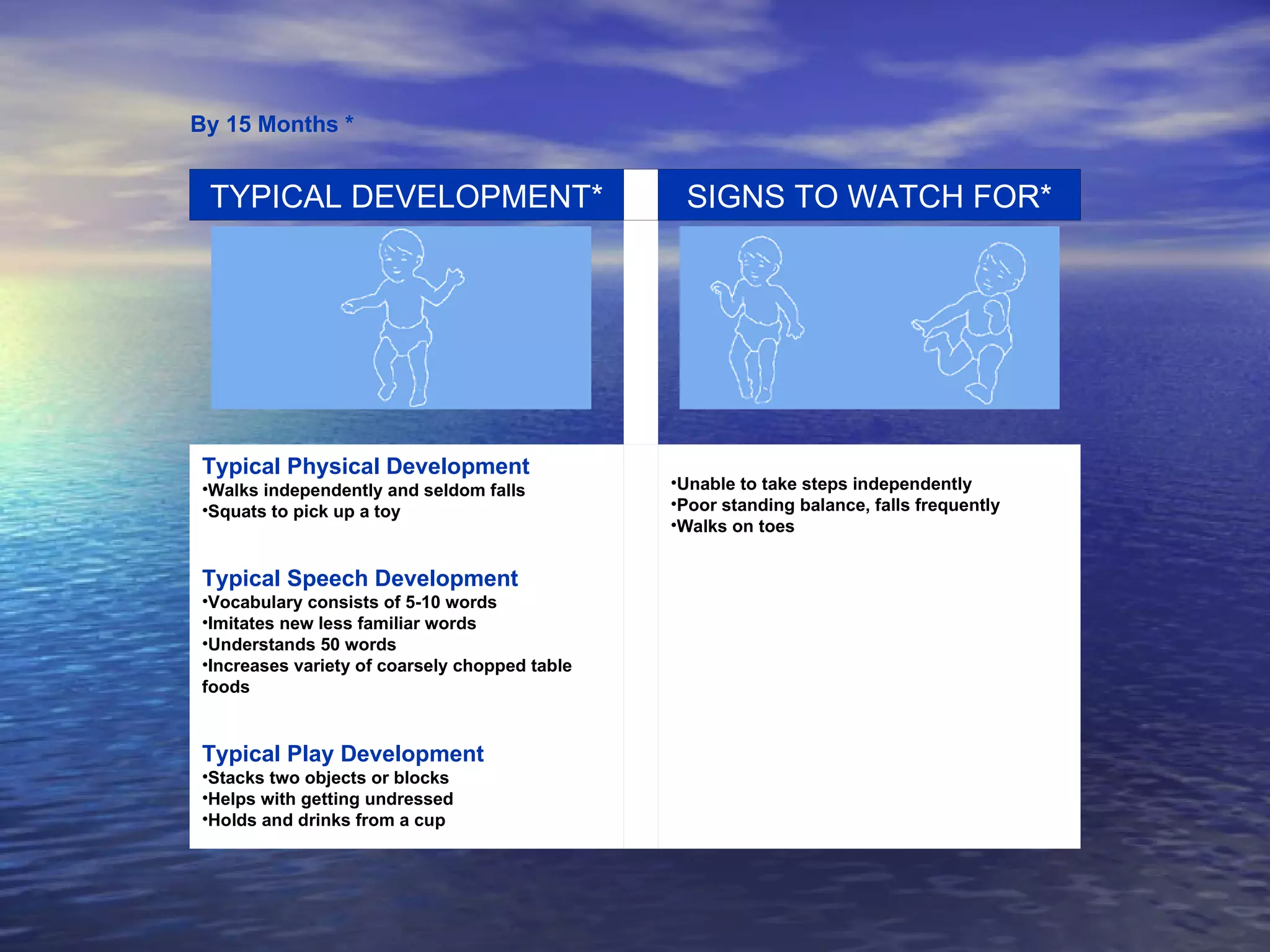
By 15 Months * Unable to take steps independently  Poor standing balance, falls frequently  Walks on toes     Typical Physical Development Walks independently and seldom falls  Squats to pick up a toy  Typical Speech Development Vocabulary consists of 5-10 words  Imitates new less familiar words  Understands 50 words  Increases variety of coarsely chopped table foods  Typical Play Development Stacks two objects or blocks  Helps with getting undressed  Holds and drinks from a cup                                                                                              SIGNS TO WATCH FOR*   TYPICAL DEVELOPMENT*
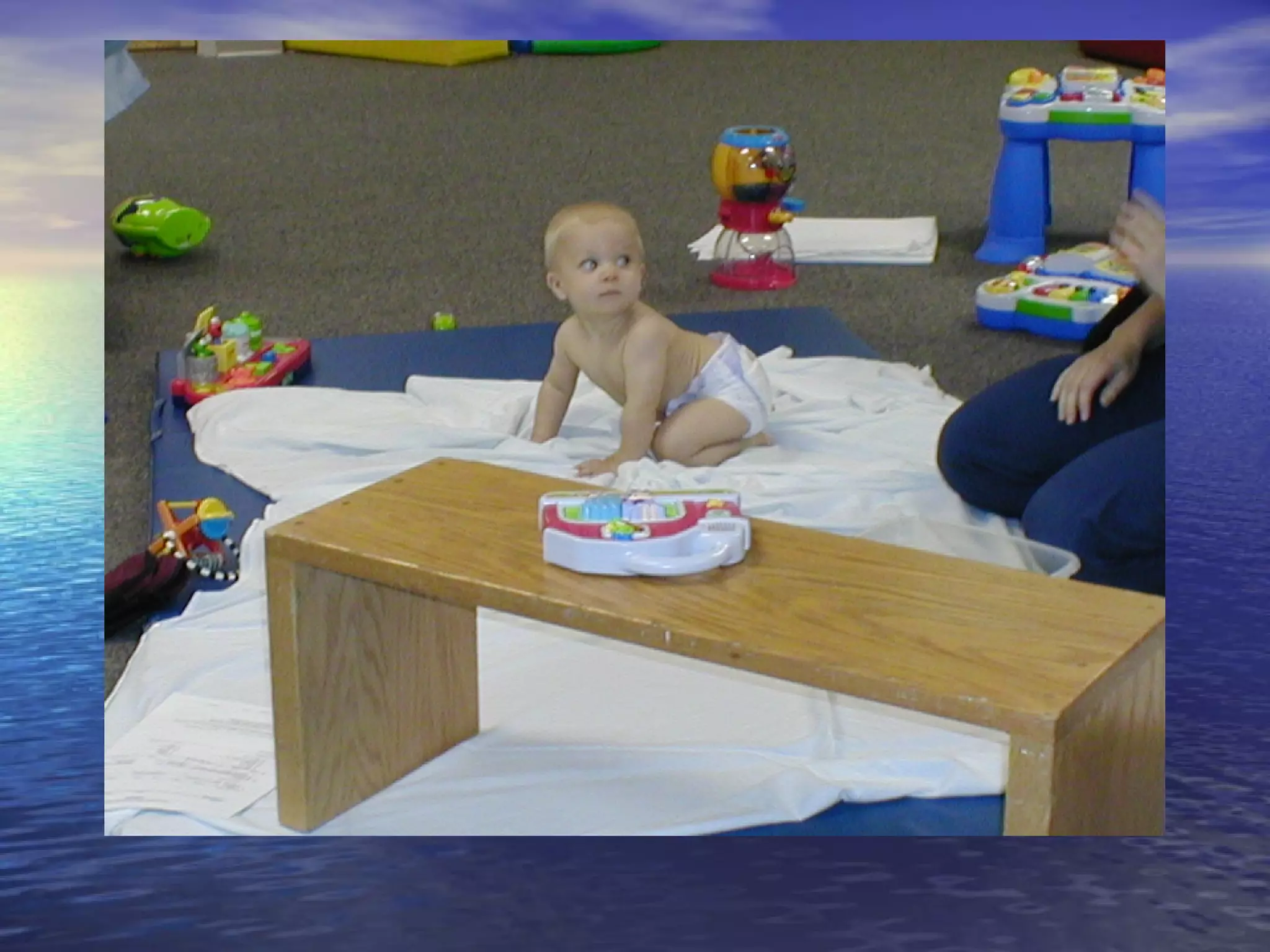
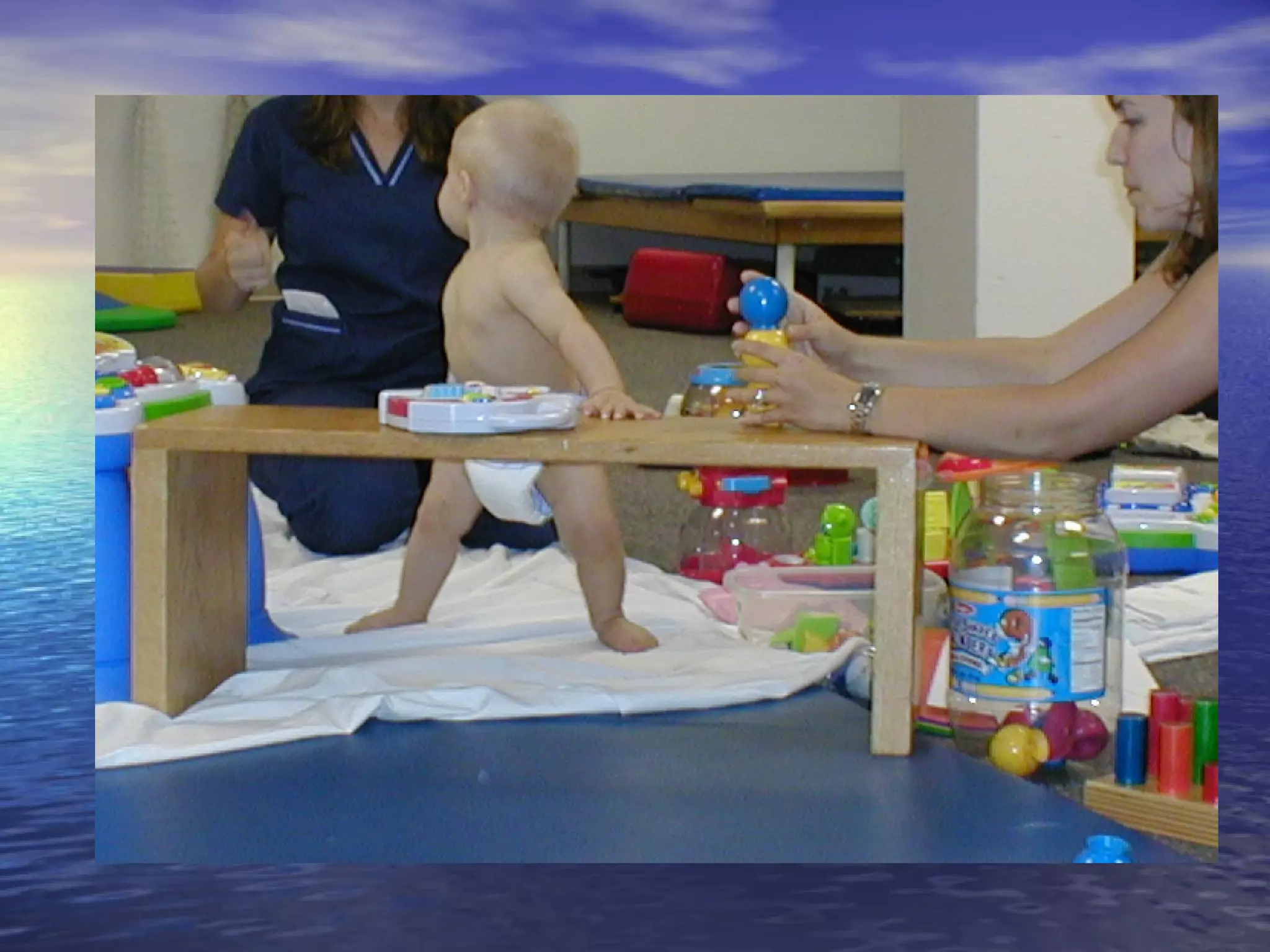
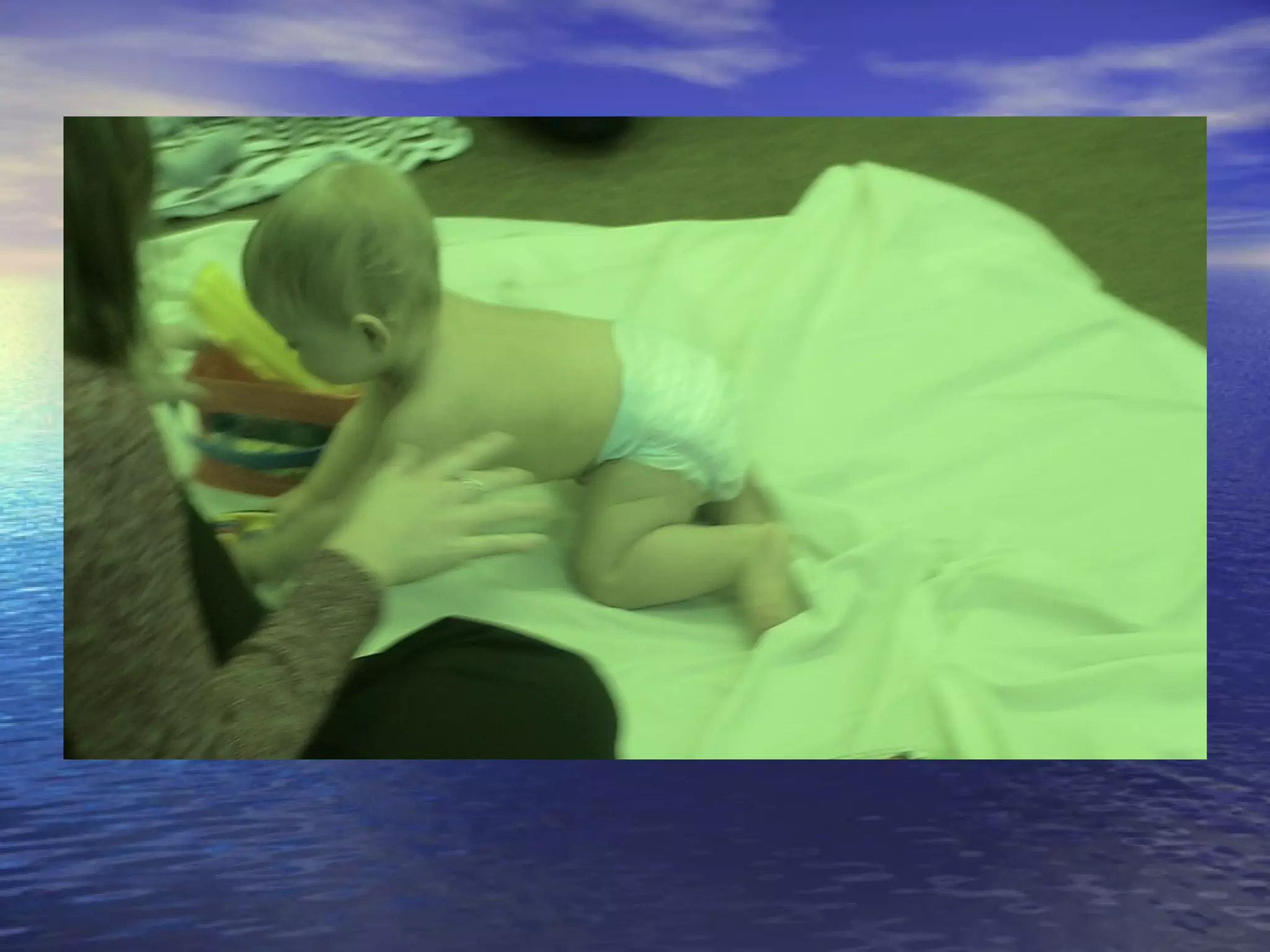
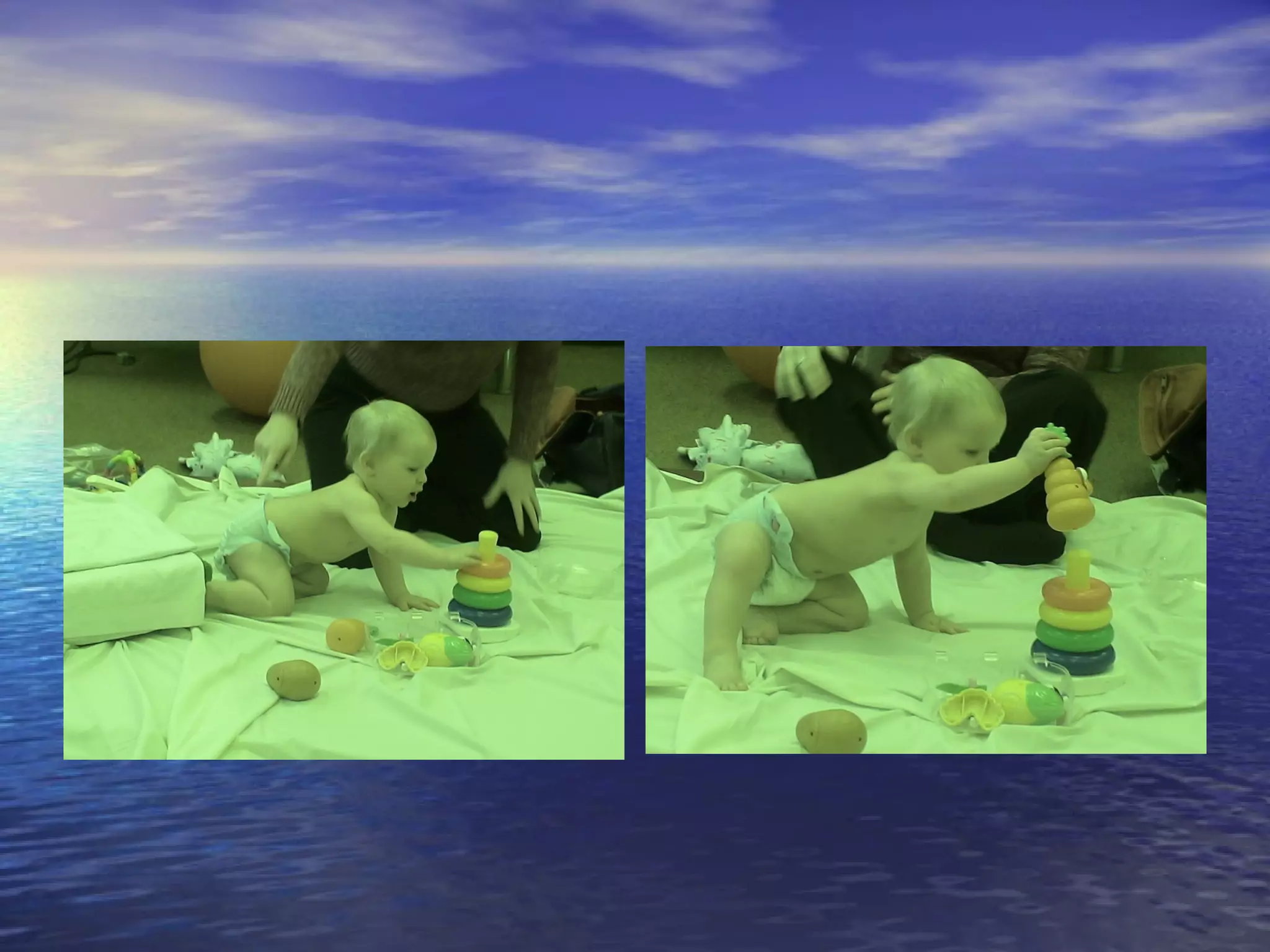
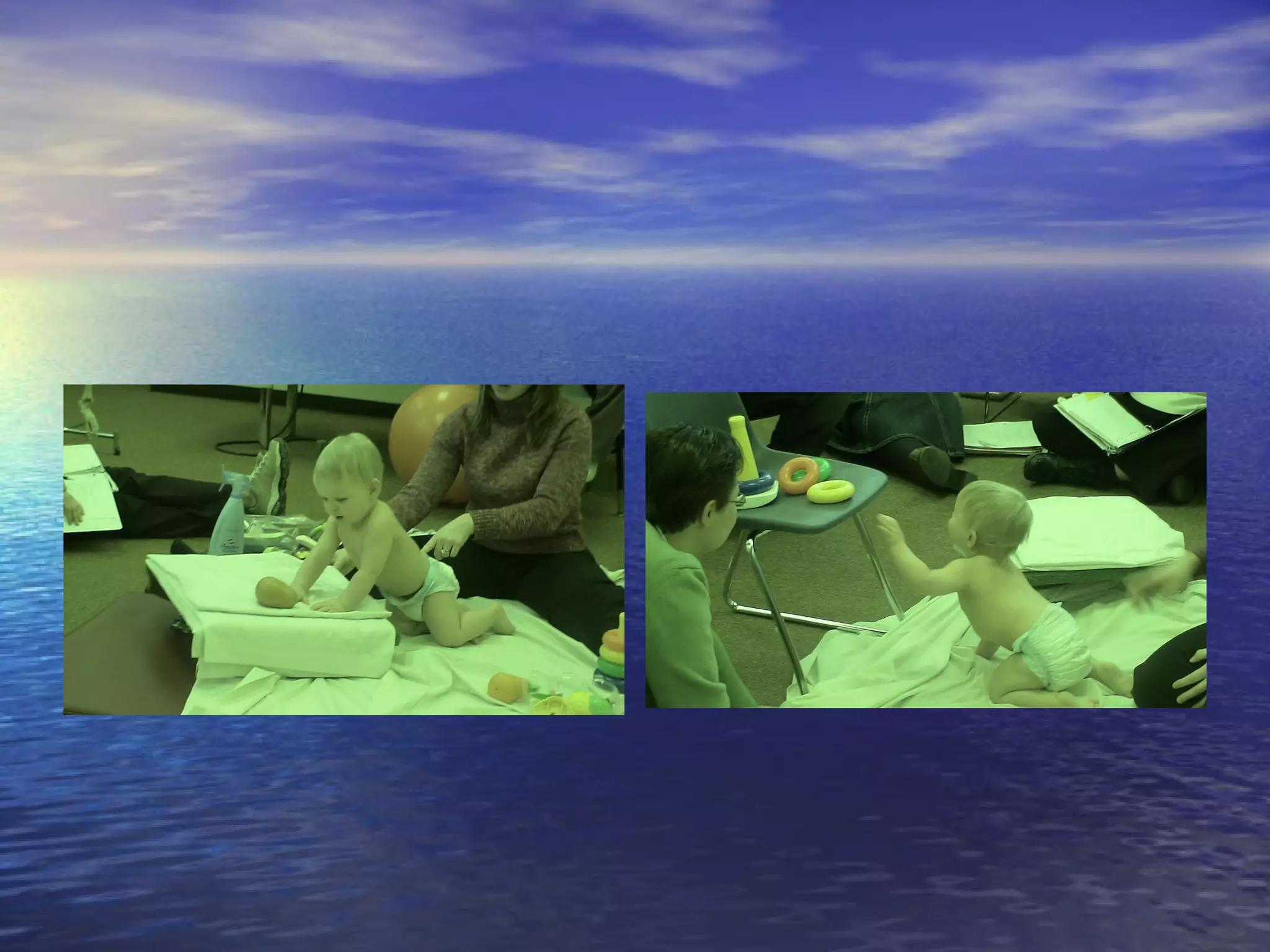
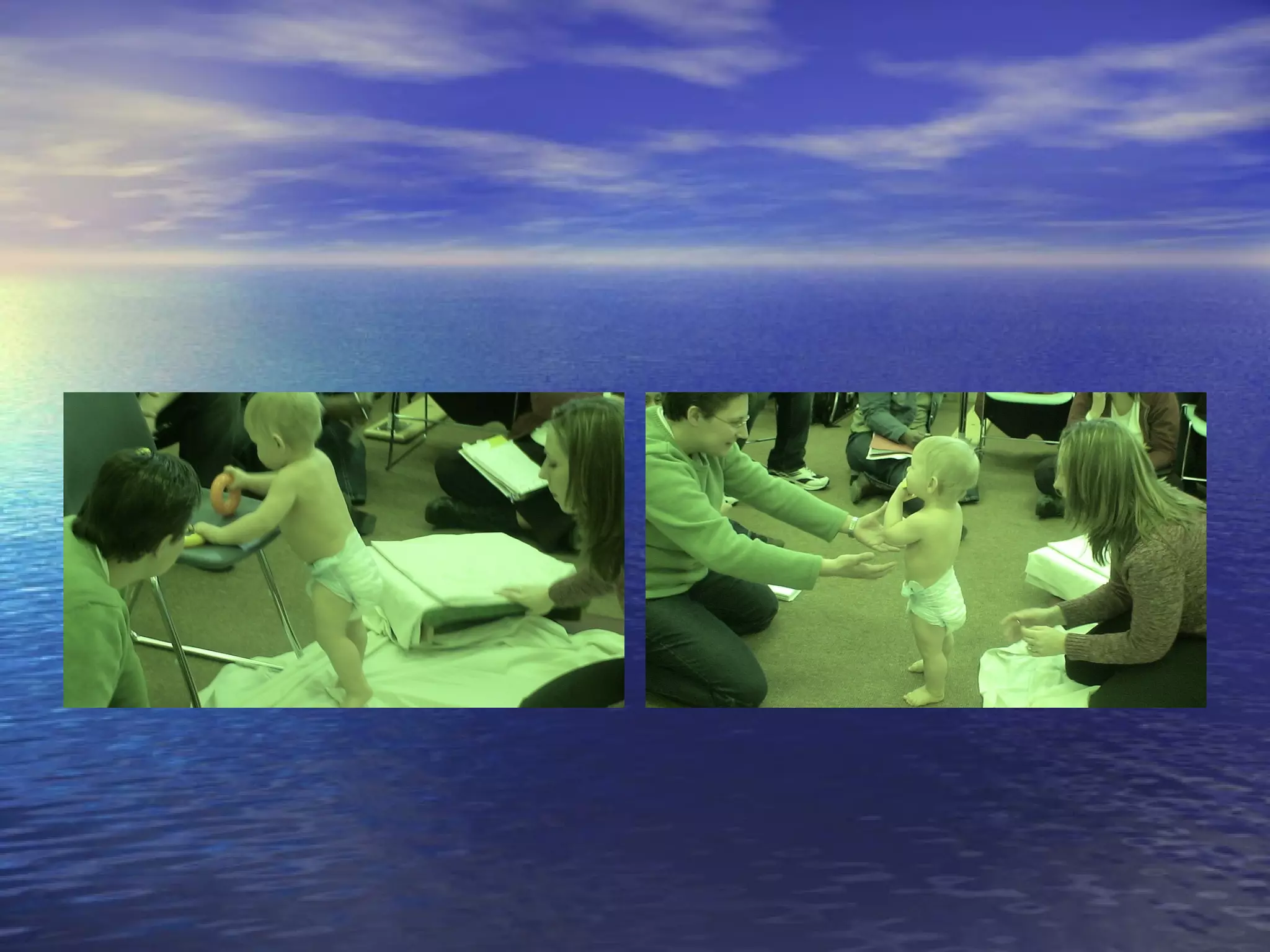
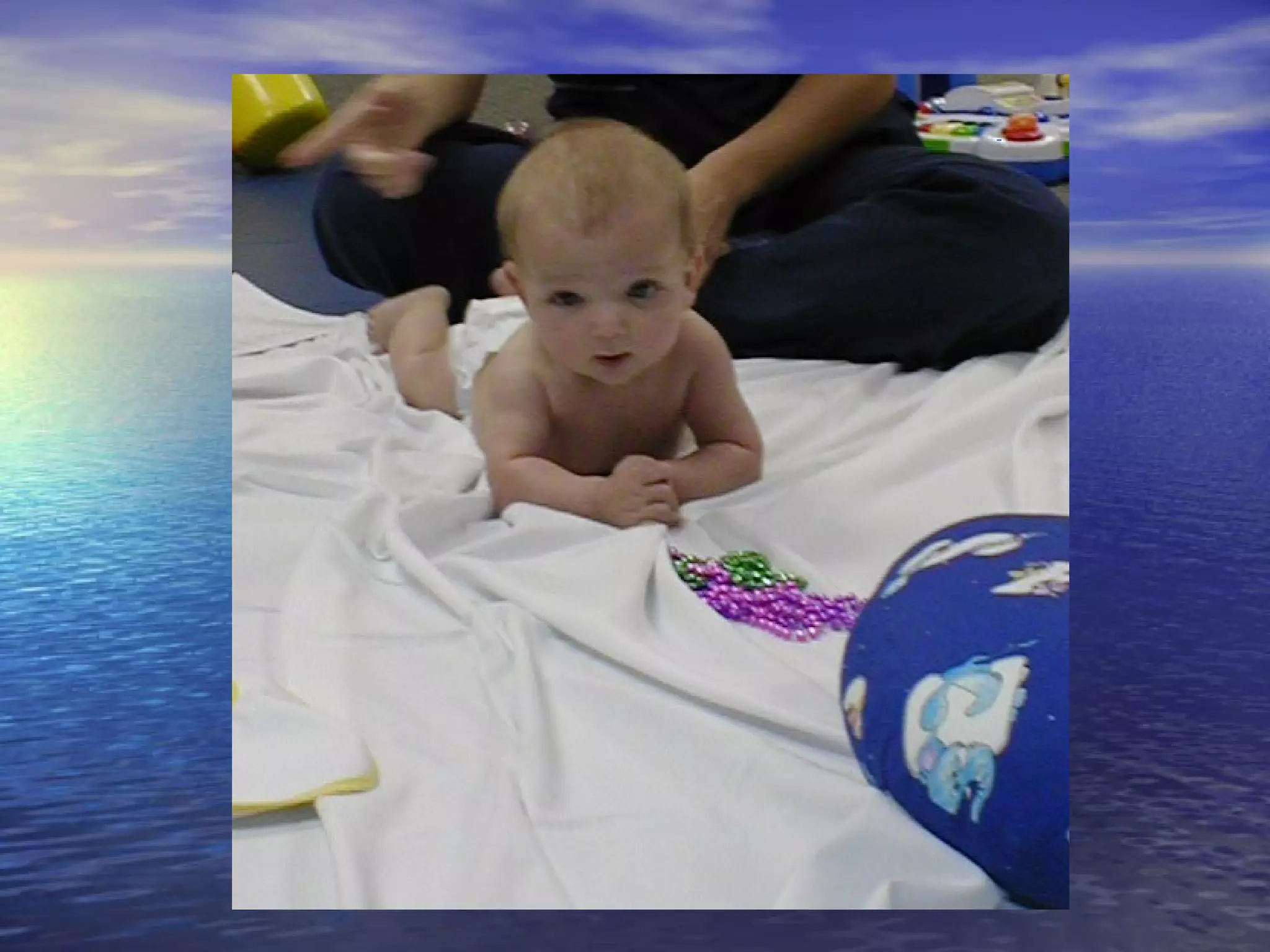
An example of abnormal movement. . . .  Some kids can be tricky!!


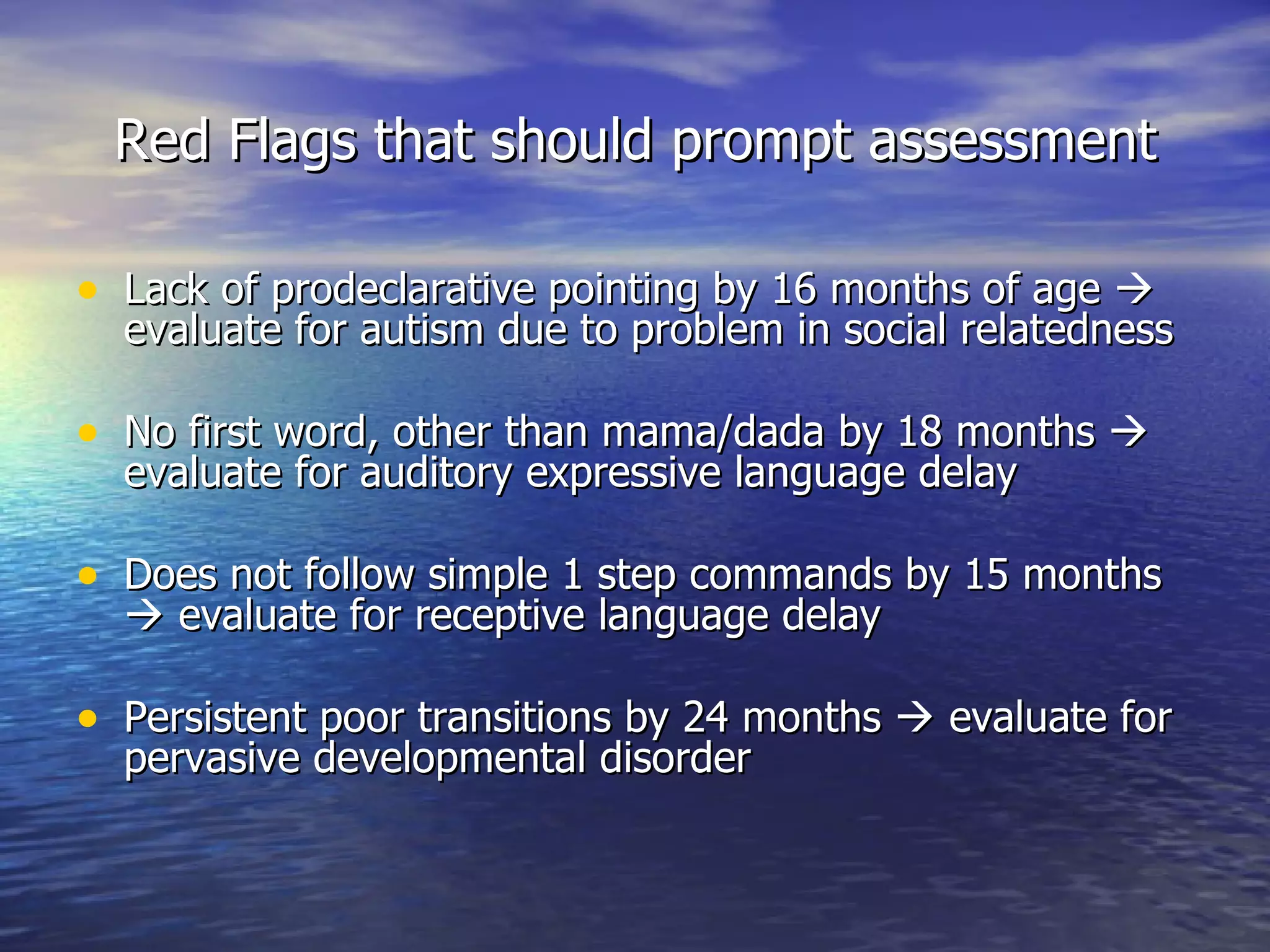
Red Flags that should  prompt assessment
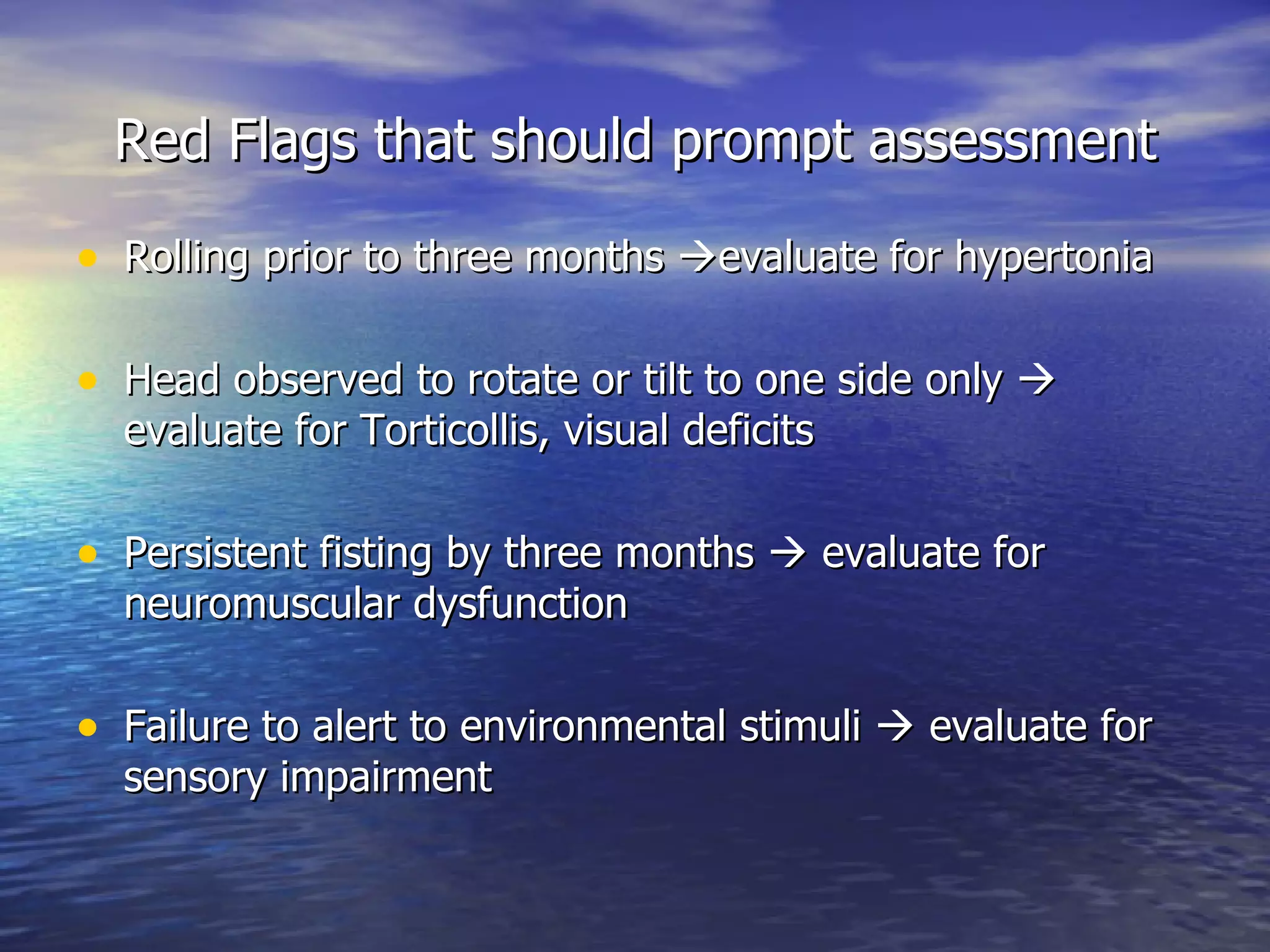
Red Flags that should prompt assessment Rolling prior to three months   evaluate for hypertonia Head observed to rotate or tilt to one side only    evaluate for Torticollis, visual deficits Persistent fisting by three months    evaluate for neuromuscular dysfunction Failure to alert to environmental stimuli    evaluate for sensory impairment
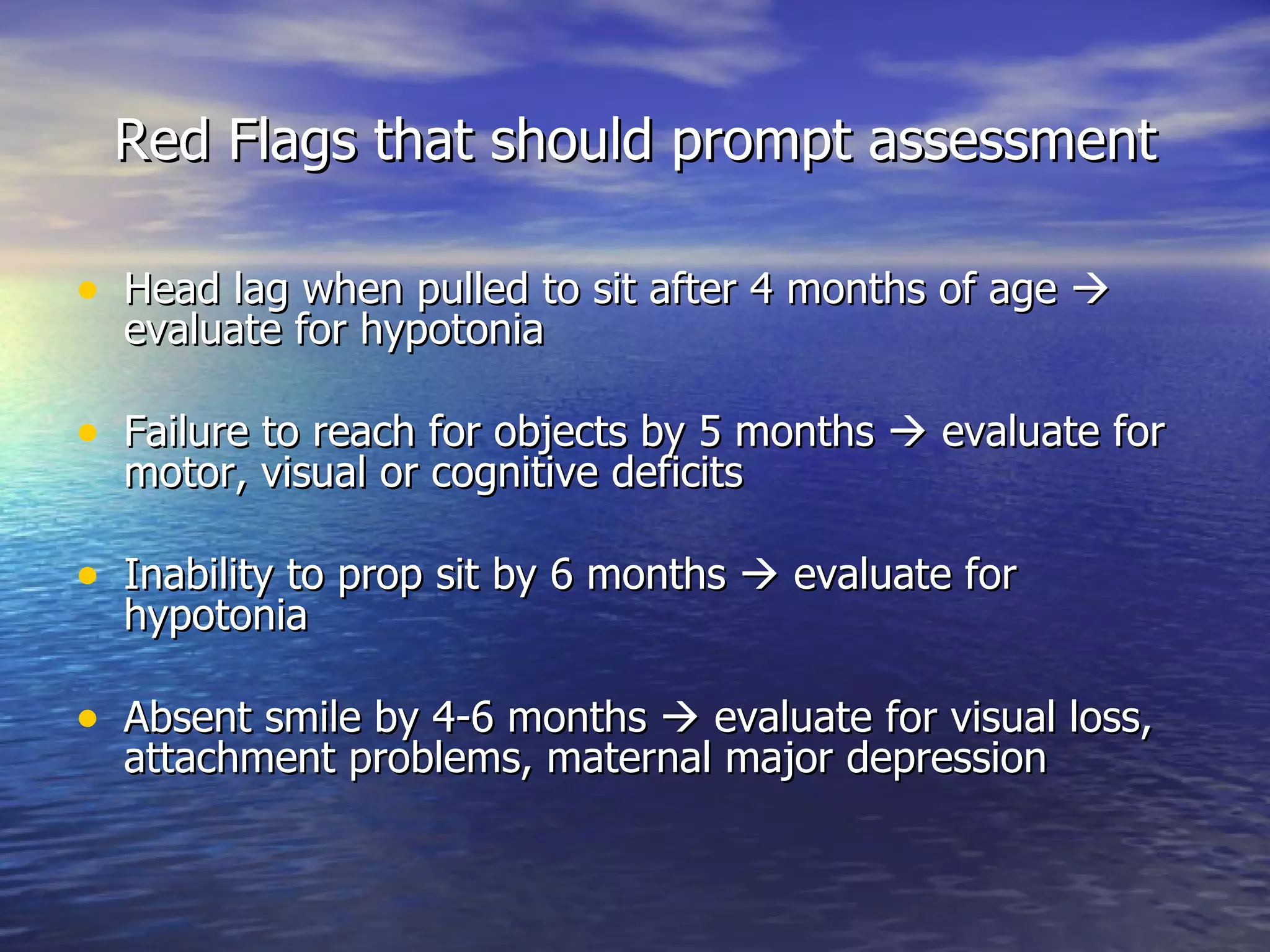
Red Flags that should prompt assessment Head lag when pulled to sit after 4 months of age    evaluate for hypotonia Failure to reach for objects by 5 months    evaluate for motor, visual or cognitive deficits Inability to prop sit by 6 months    evaluate for hypotonia Absent smile by 4-6 months    evaluate for visual loss, attachment problems, maternal major depression
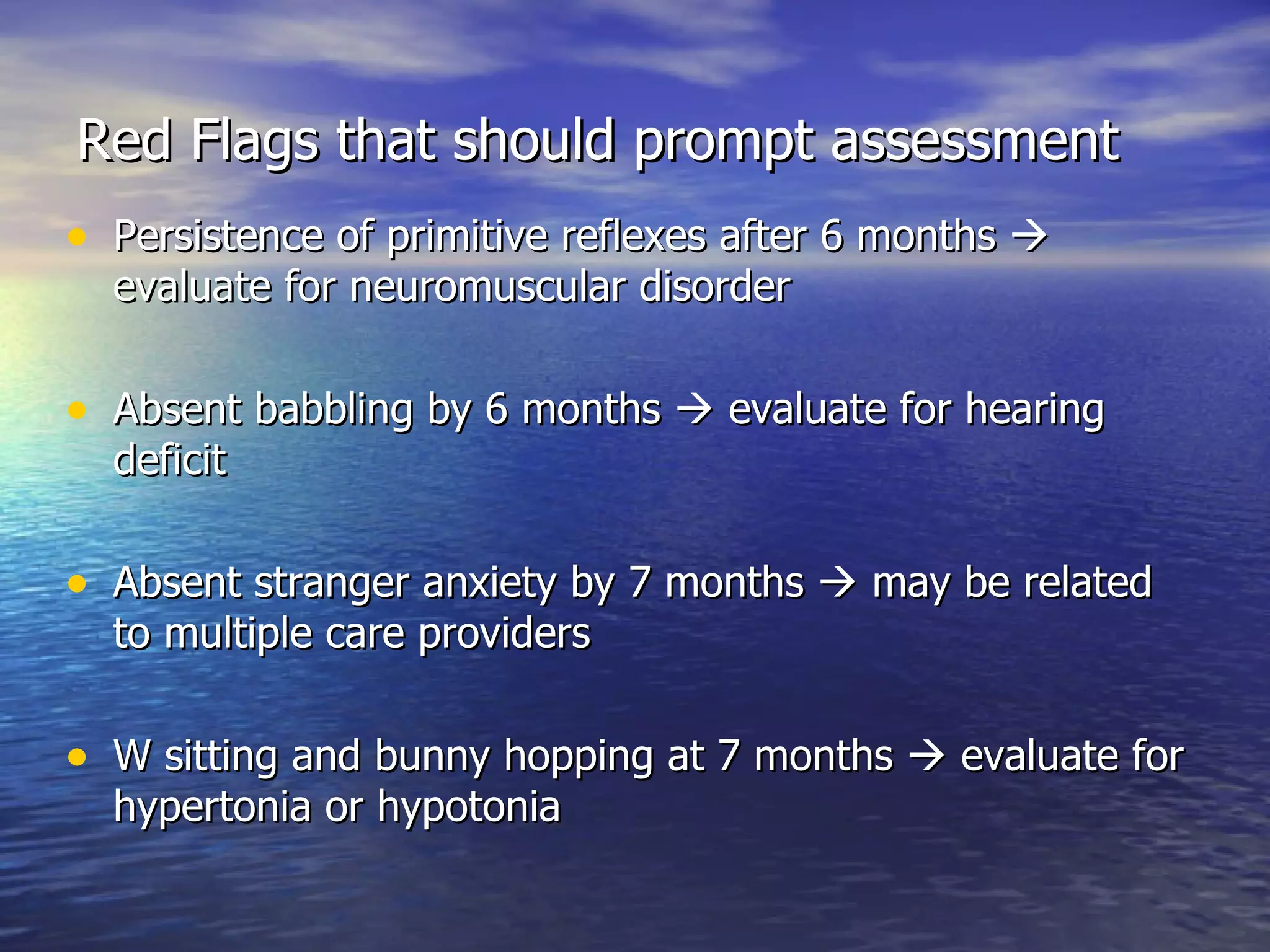
Red Flags that should prompt assessment Persistence of primitive reflexes after 6 months    evaluate for neuromuscular disorder Absent babbling by 6 months    evaluate for hearing deficit Absent stranger anxiety by 7 months    may be related to multiple care providers W sitting and bunny hopping at 7 months    evaluate for hypertonia or hypotonia
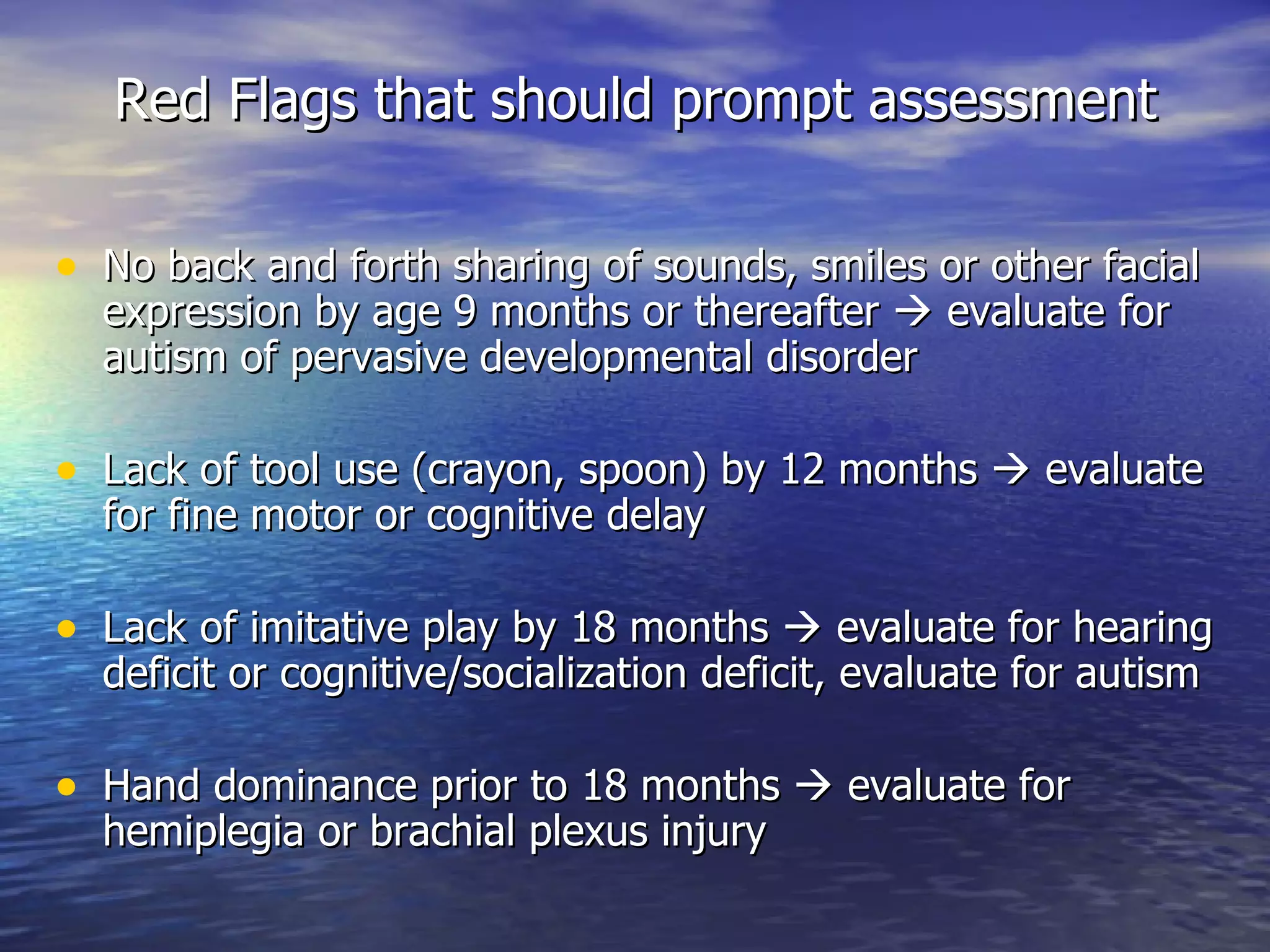
Red Flags that should prompt assessment No back and forth sharing of sounds, smiles or other facial expression by age 9 months or thereafter    evaluate for autism of pervasive developmental disorder Lack of tool use (crayon, spoon) by 12 months    evaluate for fine motor or cognitive delay Lack of imitative play by 18 months    evaluate for hearing deficit or cognitive/socialization deficit, evaluate for autism Hand dominance prior to 18 months    evaluate for hemiplegia or brachial plexus injury
Red Flags that should prompt assessment Lack of prodeclarative pointing by 16 months of age    evaluate for autism due to problem in social relatedness No first word, other than mama/dada by 18 months    evaluate for auditory expressive language delay Does not follow simple 1 step commands by 15 months    evaluate for receptive language delay Persistent poor transitions by 24 months    evaluate for pervasive developmental disorder
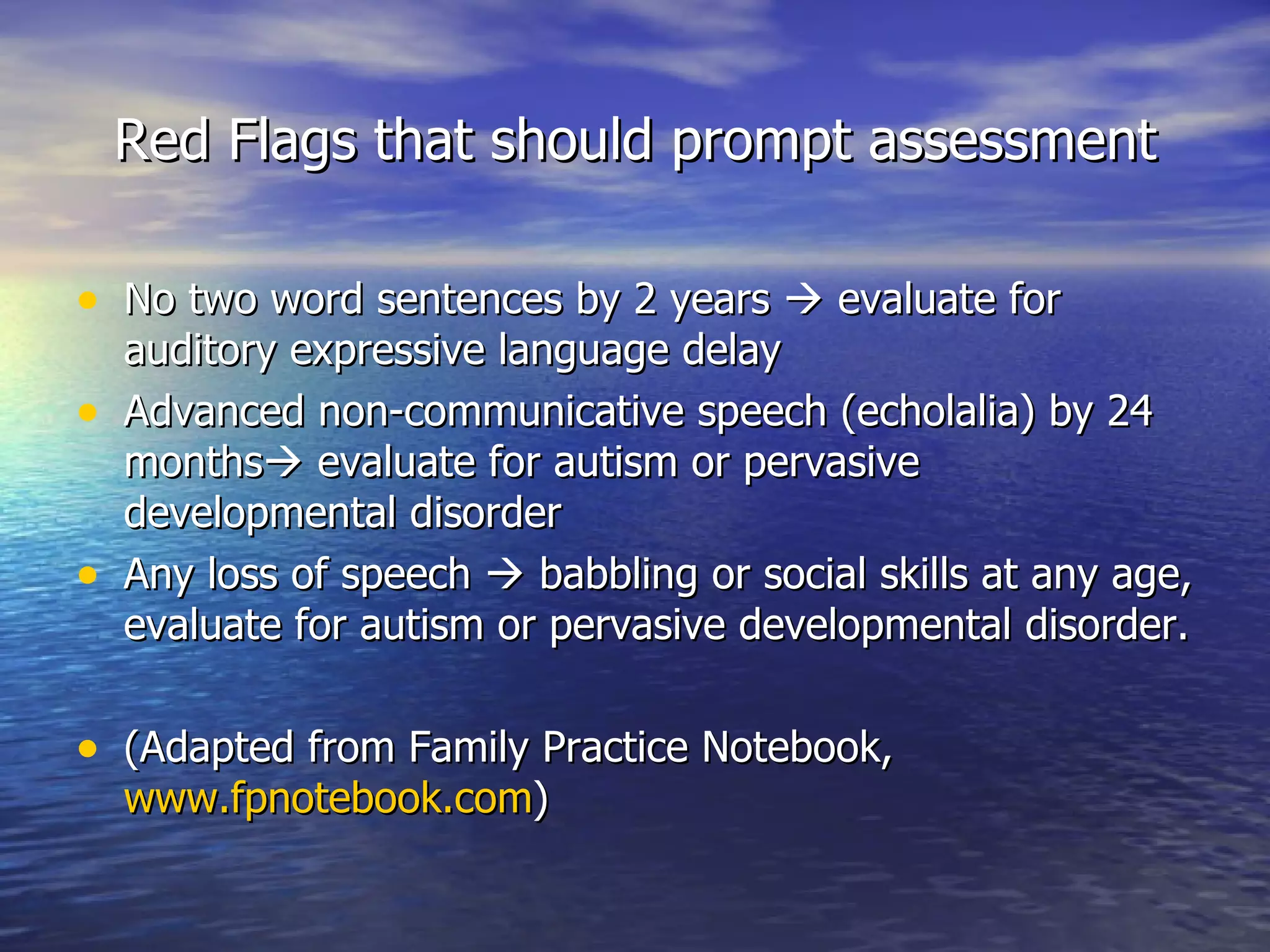
Red Flags that should prompt assessment No two word sentences by 2 years    evaluate for auditory expressive language delay Advanced non-communicative speech (echolalia) by 24 months   evaluate for autism or pervasive developmental disorder Any loss of speech    babbling or social skills at any age, evaluate for autism or pervasive developmental disorder. (Adapted from Family Practice Notebook,  www.fpnotebook.com )
Torticollis and Positional Plagiocephaly
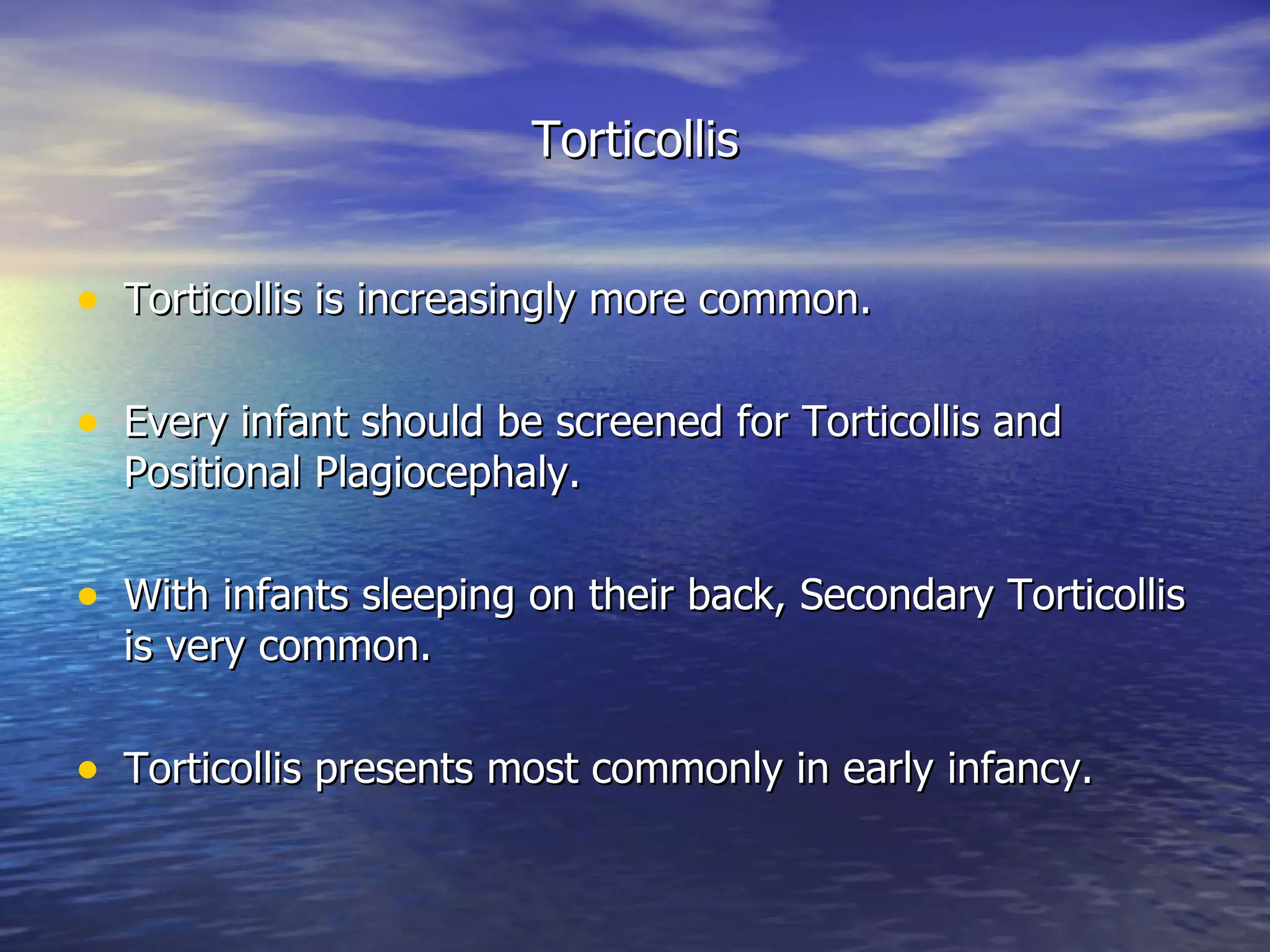
Torticollis Torticollis is increasingly more common. Every infant should be screened for Torticollis and Positional Plagiocephaly.  With infants sleeping on their back, Secondary Torticollis is very common. Torticollis presents most commonly in early infancy.
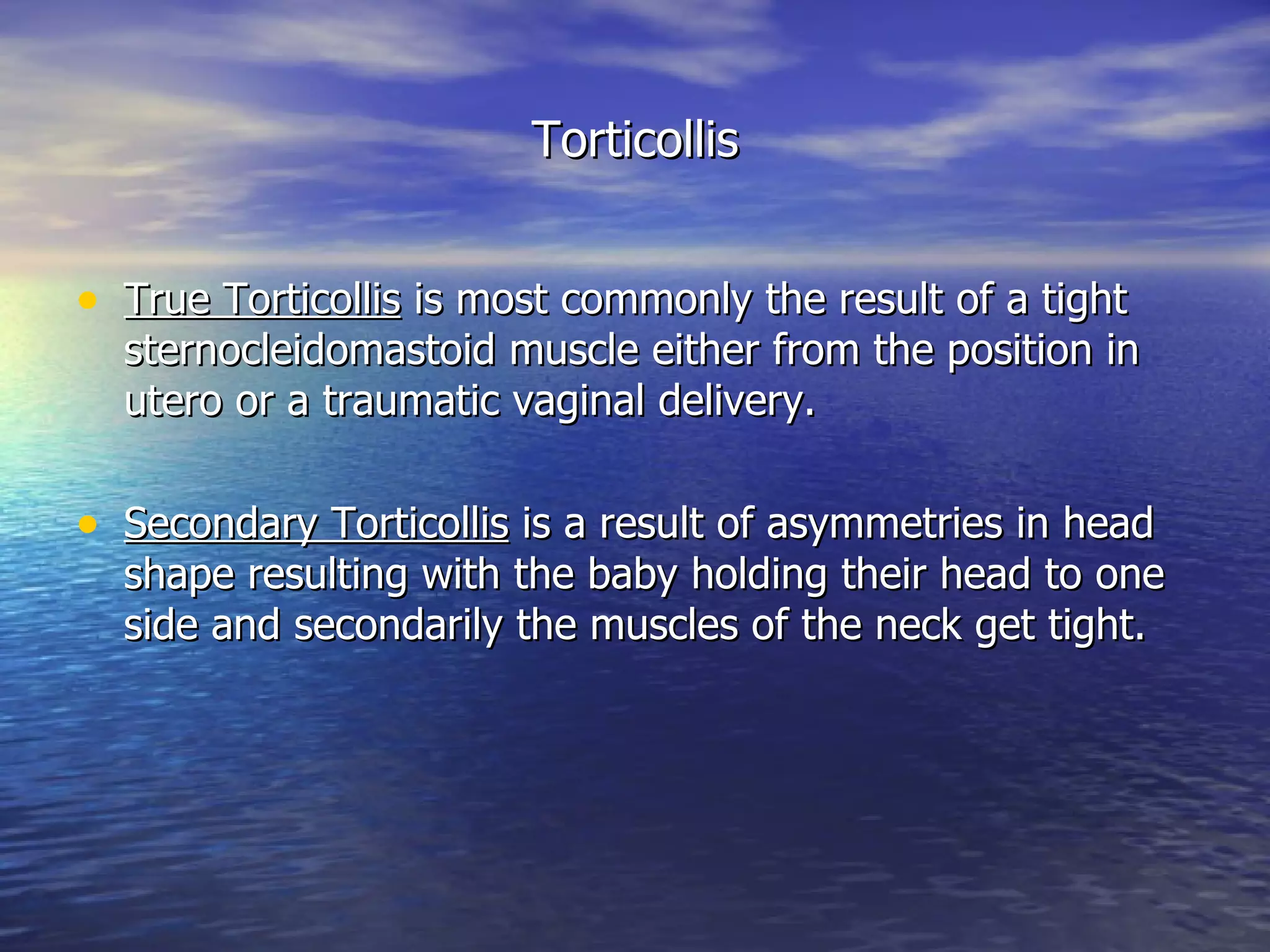
Torticollis True Torticollis  is most commonly the result of a tight sternocleidomastoid muscle either from the position in utero or a traumatic vaginal delivery. Secondary Torticollis  is a result of asymmetries in head shape resulting with the baby holding their head to one side and secondarily the muscles of the neck get tight.
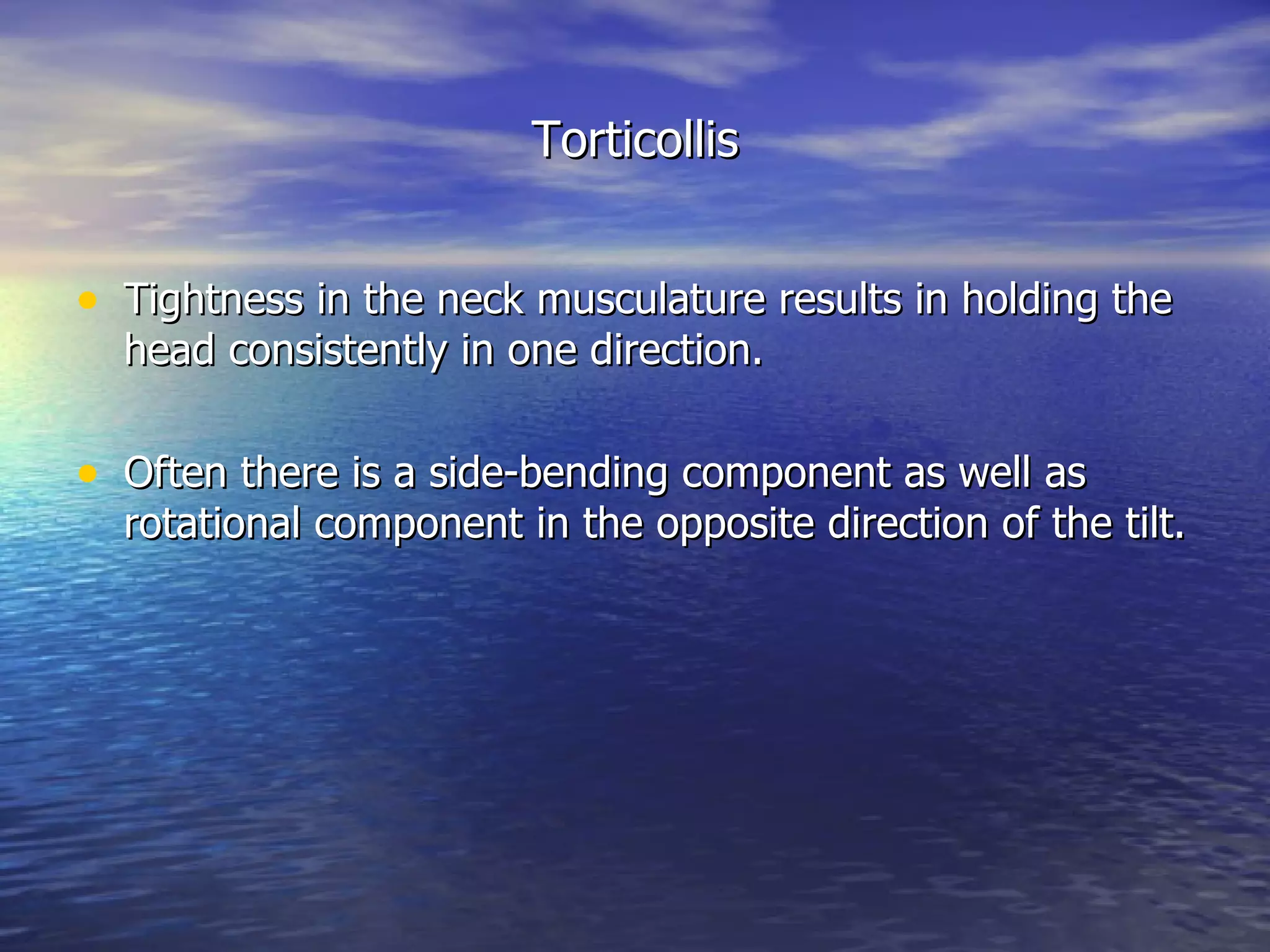
Torticollis Tightness in the neck musculature results in holding the head consistently in one direction.  Often there is a side-bending component as well as rotational component in the opposite direction of the tilt.
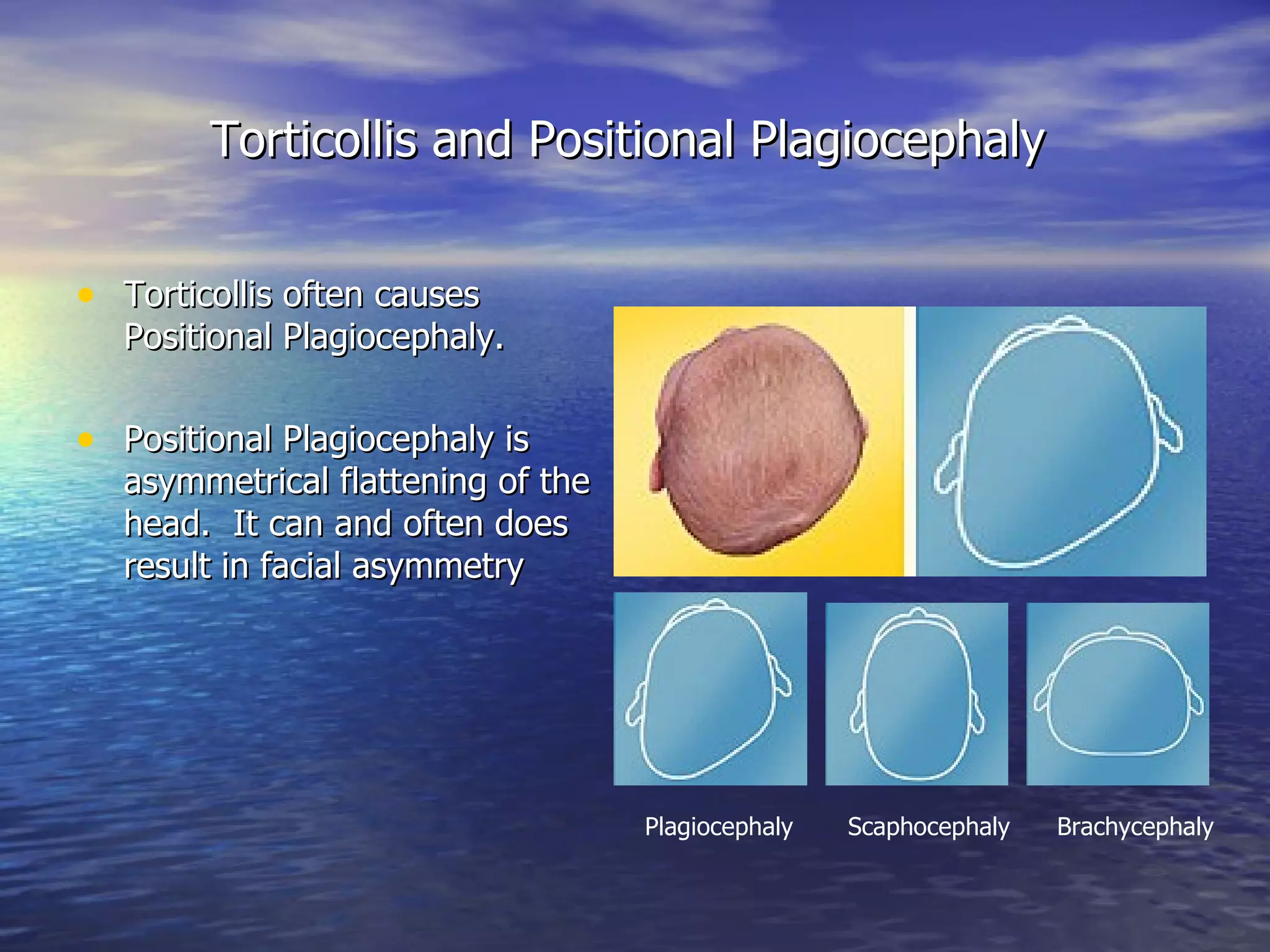
Torticollis and Positional Plagiocephaly  Torticollis often causes Positional Plagiocephaly.  Positional Plagiocephaly is asymmetrical flattening of the head.  It can and often does result in facial asymmetry  Plagiocephaly  Scaphocephaly  Brachycephaly
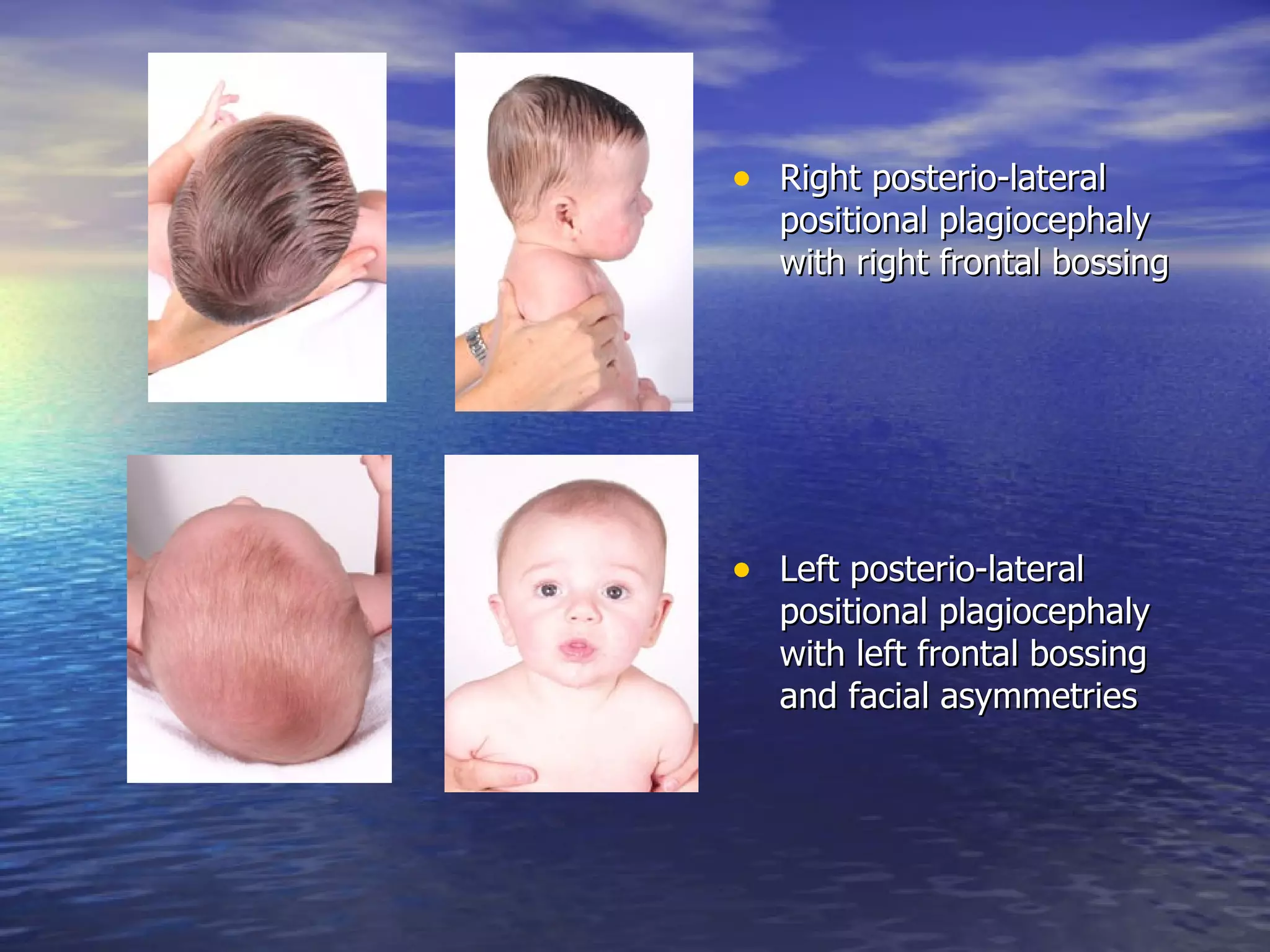
Right posterio-lateral positional plagiocephaly with right frontal bossing Left posterio-lateral positional plagiocephaly with left frontal bossing and facial asymmetries
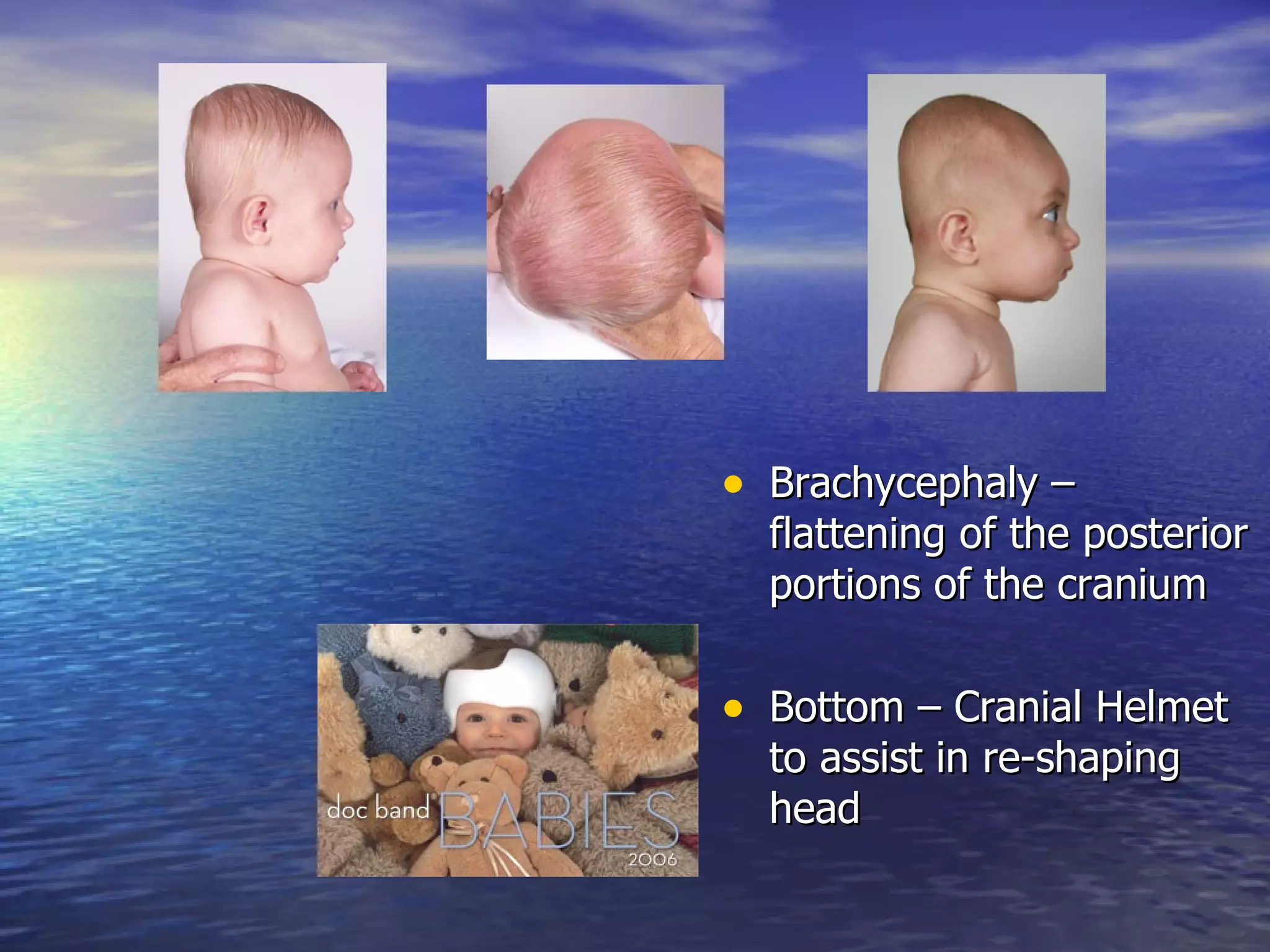
Brachycephaly – flattening of the posterior portions of the cranium Bottom – Cranial Helmet to assist in re-shaping head
Why should these babies be referred early?   Torticollis is not only a problem with the neck; it affects the development of the whole body.  The rotation of the head provides the first weight shifts for an infant.  These weight shifts provide sensory feedback as well as opportunities for the baby to push against the surface to strengthen their musculature.  If the baby does not have these experiences of equal weight shift they will not develop equal muscular strength. The rotation of the head to one side strengthens the small muscles of the eye into internal and external rotation respectively resulting often in asymmetrical eye strength and increased attention to one side of body.  This further increases the likelihood of minor disability. Therapists can help teach the parents stretching exercises for the tight musculature, strengthening for the weak musculature and positioning to avoid further head shape asymmetries. Babies with Torticollis are often seen from infancy until they walk as the strong sternocleidomastoid muscle to ensure symmetry of movement throughout development.
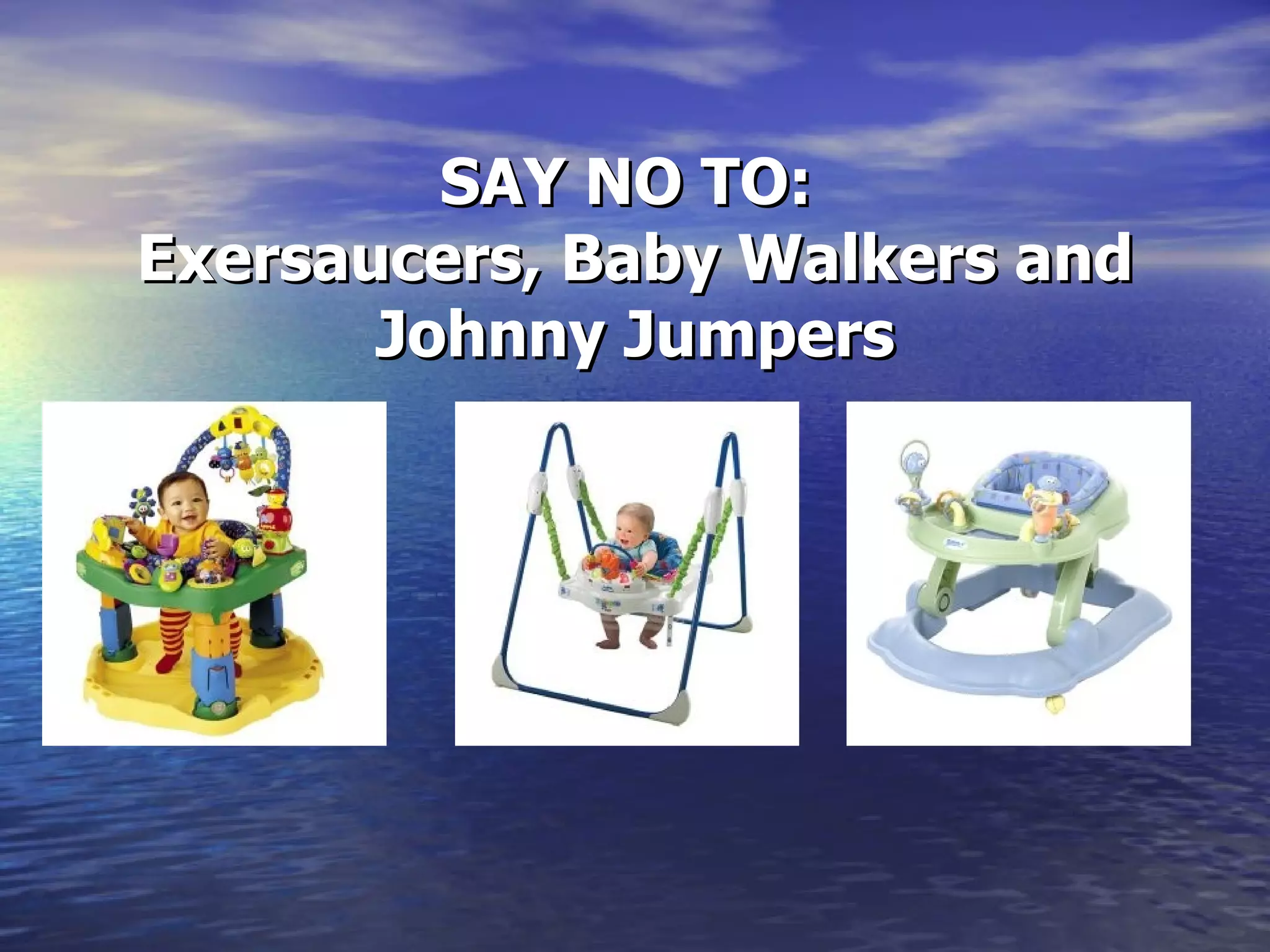
SAY NO TO:  Exersaucers, Baby Walkers and Johnny Jumpers
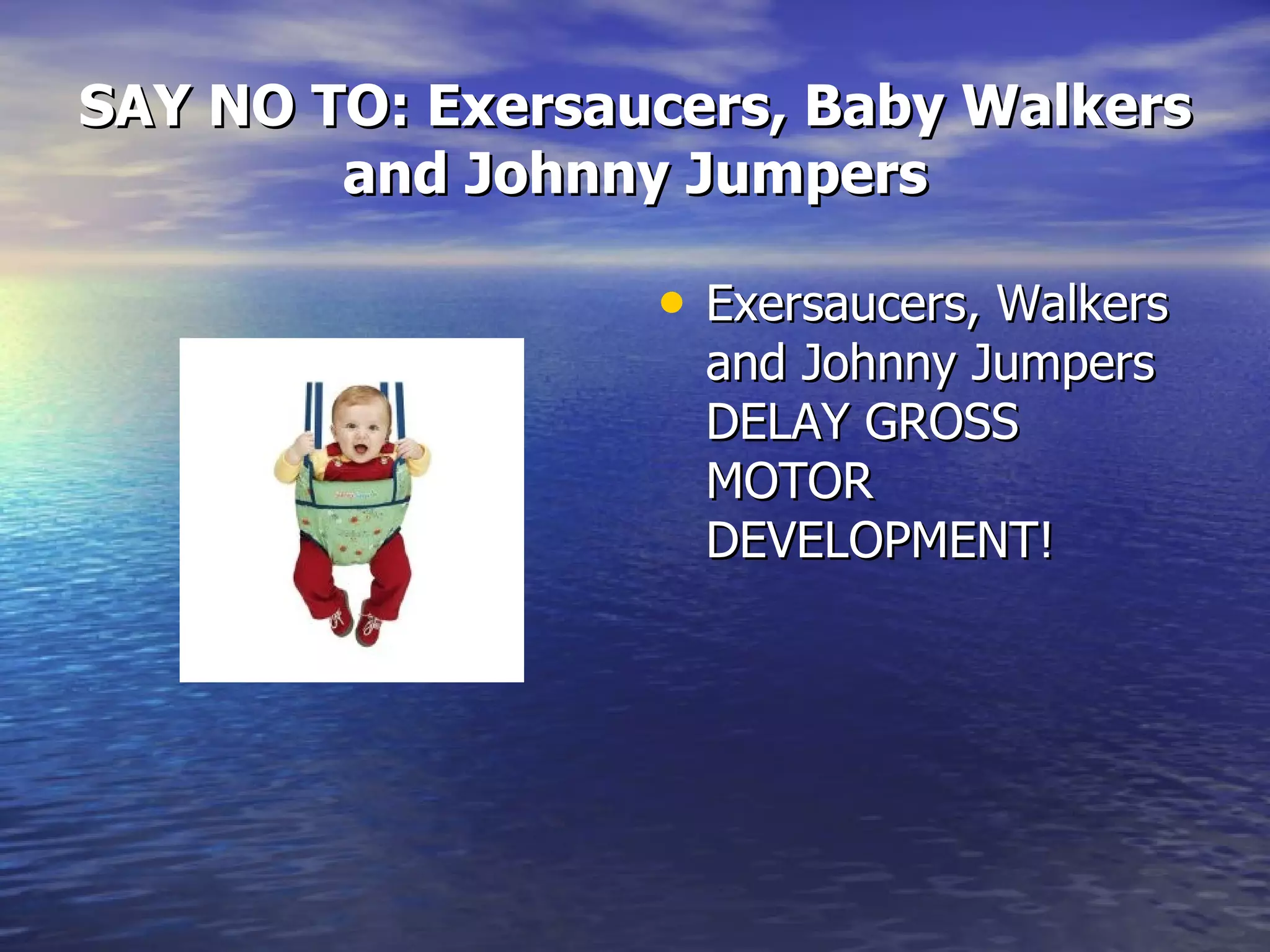
SAY NO TO: Exersaucers, Baby Walkers and Johnny Jumpers Exersaucers, Walkers and Johnny Jumpers DELAY GROSS MOTOR DEVELOPMENT!
SAY NO TO: Exersaucers, Baby Walkers and Johnny Jumpers Studies have shown that babies have what are termed exuberant projections.  They have a greater than needed number of motor projections to their musculature when they are born.  If they use certain muscles a lot, they will strengthen those connections, if they do not use other muscles the connections will decrease.  This means that they will be able to more effectively recruit the musculature that has had more practice.  When you place a baby in an Exersaucer or baby walker, you are allowing them to strengthen their extensor musculature.  Although it seems that with tummy time being such an important component of development that this would be good.  IT IS NOT!!  Good tummy skills are only good when they are balanced by effective and equal abdominal and flexor activation which is strengthened when the baby does tummy time on the floor.  Exersaucers, baby walkers and Johnny Jumpers allow UNOPPOSED EXTENSION . . . this is not good for development.  These devices DO NOT help children develop faster, it actually delays them.
SAY NO TO: Exersaucers, Baby Walkers and Johnny Jumpers We are seeing a lot of toe walkers in the clinic.  One possible reason for this goes back to the previous point.  These children were likely in Exersaucers for increased duration, which resulted in increased tendency for the plantar-flexors to be overly active, resulting in toe walking. Studies have shown that some babies who learned to walk using walkers demonstrated similar EMG muscle activation patterns of children with cerebral palsy.
SAY NO TO: Exersaucers, Baby Walkers and Johnny Jumpers Baby walkers are a dangerous stair risk.  Johnny Jumpers are dangerous head injury risks. Babies should not be using their lower extremities to stand with these devices due to the configuration of their hip sockets.  Their hips are not meant to bear weight until they have mastered the gross motor skills to change the bony alignment of their lower extremities.  They are ready to stand when they pull to stand on their own.
SAY NO TO: Exersaucers, Baby Walkers and Johnny Jumpers Suggest that parents use play pens, pack and play, baby gates for their infant’s safety instead of these devices. Talk to parents early about not using these devices.
Research Articles on Infant Home Equipment American Academy of Pediatrics, Committee on Injury and Poison Prevention.  Injuries associated with infant walkers  Pediatrics  2001; 108: 790-792. Board of Trustees, American Medical Association.  Use of infant walkers.  Am J Dis Child  1991; 145: 933-934. Crouchman M.  Environmentally induced transient motor signs.  Dev Med Child Neurol  1987; 29: 685-688. Crouchman M.  The effects of babywalkers on early locomotor development.  Dev Med Child Neurol  1986l 28: 757-761. Coats TJ, Allen M.  Baby walker related injuries – a continuing problem.  Arch Emerg Med  1997;8:52-55. Thein MM, Lee J, Tay V, Ling SL.  Infant walker use, injuries and motor development.  Inj Prev  1997; 3:63-66. Kauffman IB, Redenour M.  Influence of an infant walker on onset and quality of walking pattern of locomotion: an electromyographyic investigation.  Percept Mot Skills  1977; 45: 1323-1329. Kavanagh CA, Banco L.  The infant walkers: a previously unrecognized health hazard.  Am J Dis Child  1982l 136: 205-206. Holm VA, Harthun-Smith L.  Infant walkers and cerebral palsy.  Am J Dis Child  1983; 137:1189-1190. Reidnour MV.  Infant walkers: developmental tool of inherent danger.  Perceptual and Motor Skills  1982; 55: 1201-1202. Siegel AC, Burton RV.  Effects of baby walkers on motor and mental development in human infants.  J Dev Behav Pediatr  1999; 20: 355-361. Taylor B.  Babywalkers  BMJ  2002; 325:612. Walker JM, Breau L, McNeill D.  Hazardous baby walkers: a survey of use.  Pediatric Physical Thearpy  1996; 8: 25-30.
Pathways Awareness Foundation www.pathwaysawareness.org
Alternatives to the “Wait and See” Approach Consider referring the parent to a  Developmental Pediatrician Pediatric Neurologist Developmental Evaluation Center: physical therapy, occupational therapy, speech therapy evaluation
Alternatives to the “Wait and See” Approach Ask the parent to keep a detailed log of child’s typical and atypical behavior or movements between appointments Schedule next well baby appointment earlier than usual – in two or three weeks versus two or three months
Alternatives to the “Wait and See” Approach Become familiar with and use a developmental screening using a standardized test that you are familiar with (e.g. Denver Developmental Screening) noting any atypical movements or behaviors Screen for developmental concerns early Trust the parent’s instincts and concerns
Early Intervention  is the  BEST prevention!
 

Normal Development In The First Year Power Point

  • 1.
    Normal Development inthe First Year Julie Wattenberg, MPT, DPT Adventist Paulson Pediatric Rehabilitation Center July 10, 2007
  • 2.
    Goals of today’slecture You will be familiar with the roles of pediatric physical, occupational and speech therapist. You will have a general idea of typical development in the first year. You will be able to describe some “red flags” that may assist you in making appropriate referrals. You will understand why therapists advise parents not to use Baby Walkers, Exersaucers and Johnny Jumpers. You will be able to understand the common conditions Torticollis and Positional Plagiocephaly in order to make appropriate referrals.
  • 3.
    The Role ofPediatric Therapists Pediatric Physical Therapists assist infants and children with gross motor skills such as prone skills, sitting, crawling, walking, jumping, skipping and transitions between these skills. Pediatric Occupational Therapists work with children who have sensory integration (e.g. sensory integration dysfunction, autism, pervasive developmental disorder) difficulties and have difficulties with fine motor skills that will impact their ability to explore their environment. They also work on self-help skills such as dressing, self feeding etc. Pediatric Speech Therapists work with children who have difficulties with feeding. They also assist children with communication including speech production, articulation, receptive and expressive language, language processing and fluency.
  • 4.
    Typical Development In the First Year
  • 5.
    Newborn – 1month Belly breather Oral reflexes present, roots when hungry Responds to noises with startle Hands are loosely fisted Observe hands open and closed Brings hands to mouth due to close proximity of hands to face with physiologic flexion Visual preference is faces 8 – 12 inches away Enjoys being in prone! Physiologic flexion Random movements When placed on stomach with head down, able to clear airway, bring head off surface and rotate Will take weight on feet when placed in standing Newborn – 1 month Speech/Language Fine Motor Gross Motor Month
  • 6.
  • 7.
  • 8.
  • 9.
  • 10.
  • 11.
  • 12.
  • 13.
  • 14.
  • 15.
  • 16.
  • 17.
    2 months Socialsmile Baby attending to more sounds by orienting head towards the sound Continues with random upper extremity movements Hands open and closed Visual tracking uses head and eyes together Tracking with eyes across midline horizontally Period of maximal asymmetry Head rarely in midline, but observe head to both sides Do not observe as much physiologic flexion Lifts head to 45 degrees when placed on tummy Pushes through elbows when placed on tummy May not take weight in standing 2 months Speech/Language Fine Motor Gross Motor Month
  • 18.
    2 MONTHS LANDEN 2 MONTHS
  • 19.
  • 20.
  • 21.
  • 22.
  • 23.
  • 24.
  • 25.
    3 months Facialexpressions more varied Sounds often associated with movement of body Briefly holds a thin light toy when placed in hand Reaches with vision more than arms Batting at toys under baby gym, continues to over swipe Hand to mouth ALL the time! Head in MIDLINE in supine Hands in midline when in supine Prone, head between 45 -90 Pull to sit – able to lift head last 30 – 40 degrees of arc of motion 3 months Speech/Language Fine Motor Gross Motor Month
  • 26.
  • 27.
  • 28.
  • 29.
    By 3 Months* Difficulty lifting head Stiff legs with little or no movement Pushes back with head Keeps hands fisted and lacks arm movement   Typical Physical Development While lying on tummy... Pushes up on arms Lifts and holds head up Typical Speech Development Sucks and swallows well during feeding Quiets or smiles in response to sound or voice Coos or vocalizes other than crying Turns head toward direction of sound Typical Play Development While lying on their back… Visually tracks a moving toy from side to side Attempts to reach for a rattle held above their chest Keeps head in the middle when watching faces or toy                                                                                             SIGNS TO WATCH FOR*   TYPICAL DEVELOPMENT*
  • 30.
    4 months Variationof vowel sounds Begins consonant sound production Begins babbling Recognizes and responds to own name Hands open most of the time Hand to hand play Starting to grab objects with more directed movement of arms Tolerates/enjoys a variety of sensory input in daily routines Able to dissociate eye movement from head movement Smooth tracking horizontally and vertically across midline Period of active symmetry Mirrored movements of arms and legs Hands to knees when in supine Rolls to side when in hands to knees position Prone on elbows with head 45 – 90 degrees Elbows below or in front of shoulders When in standing legs are loose, not locked, will play with small bend/straighten of knees Likes to stand with hands held 4 months Speech/Language Fine Motor Gross Motor Month
  • 31.
  • 32.
  • 33.
  • 34.
  • 35.
  • 36.
  • 37.
    5 months Movingtowards sucking pattern for bottle/breast Babbling 3-4 syllables at a time Banging toys Reaching in all directions Improved directionality of movement in arms Transfers objects from hand to mouth Reaches with both arms Hands to feet when in supine Prone on extended arms Rolls to supine from prone Pull to sit NO head lag and assists with movement by pulling with arms Prop sitting 5 months Speech/Language Fine Motor Gross Motor Month
  • 38.
  • 39.
    6 months Truesuck with up/down tongue movement Begin cup drinking – may see cough/choking at beginning due to irregularity of volume of liquid Vocalizes for social contact Spoon feeding Transfers objects hand to hand Explores objects in mouth Banging, shaking, mouthing Rolls from supine to prone Brings feet to mouth Reaching in prone on extended arms Sits without upper extremity support Will bounce when in standing 6 months Speech/Language Fine Motor Gross Motor Month
  • 40.
    By 6 Months* Rounded back Unable to lift head up Poor head control Difficulty to bring arms forward to reach out Arches back and stiffens legs Arms held back Stiff legs   Typical Physical Development Uses hands for support in sitting Rolls from back to tummy While standing with support, accepts entire weight with legs   Typical Speech Development Begins to use consonant sounds in babbling, e.g. "dada" Uses babbling to get attention Begins to eat cereals and pureed foods Typical Play Development Reaches for a nearby toy while on their tummy While lying on their back… Transfers a toy from one hand to the other Reaches both hands to play with feet                                                                                             SIGNS TO WATCH FOR*   TYPICAL DEVELOPMENT*
  • 41.
    7 months Givesappropriate gestures to simple commands e.g. up, bye-bye, no Enjoys vocal play with others, laughs when own sounds are imitated No used to express dislike Begins thoracic breathing Starts to use thumb and finger for pincer Can hold 2 objects and reach for third Reaching purposefully for objects Begins finger feeding Uses both hands for tasks equally, NO HANDEDNESS OBSERVED until 2-3 years of age Does not like supine, will often roll out of it Achieves a variety of belly off ground positions, e.g. hands and knees Rocking in hands and knees Pivots on when on tummy May belly crawl Plays in side-lying Pull to sit will bring legs off surface to assist with movement Pulls self to stand with caregiver’s hands 7 months Speech/Language Fine Motor Gross Motor Month
  • 42.
  • 43.
  • 44.
  • 45.
  • 46.
    8 months Disappearanceof rooting reaction Begins to separate sound production from body movement Exploring spatial concepts, in/out, on/off, up/down Imitation skills increase both in gestures and familiar sounds Visually interested in detail Mouthing decreased, looks and inspects objects more Bangs toys together Rarely plays in supine Plays in prone, side-lying and sitting May Creep on hands and knees a few cycles Assumes sitting from the floor independently May pull to kneel at a surface Pulls to stand using arms more than legs 8 months Speech/Language Fine Motor Gross Motor Month
  • 47.
    9 months Controlledbite for firm solids Begins to eat mashed table food Holds and drinks from a bottle while in sitting Creeps on hands and knees for long distances as primary means of locomotion Uses a variety of sitting positions due to strong trunk Pulls to stand using more lower extremity movement Climbs up stairs, hands and knees 9 months Speech/Language Fine Motor Gross Motor Month
  • 48.
  • 49.
  • 50.
  • 51.
    By 9 Months* Uses one hand predominately Rounded back Poor use of arms in sitting Difficulty crawling Uses only one side of body to move Inability to straighten back Can not take weight on   Typical Physical Development Sits and reaches for toys without falling Moves from tummy to back into sitting Creeps on hands and knees with alternate arm and leg movement Typical Speech Development Increases variety of sounds and syllable combinations in babbling Looks at familiar objects and people when named Begins to eat junior and mashed table foods Typical Play Development In a high chair, holds and drinks from a bottle Explores and examines an object using both hands Turns several pages of a chunky (board) book at once In simple play, imitates others                                                                                             SIGNS TO WATCH FOR*   TYPICAL DEVELOPMENT*
  • 52.
    10 months Usesobjects to reach goal, shows problem solving Long chains of different consonant-vowel combinations Desire for independence observed in motor and feeding Works on different grasps Lots of manipulation of toys Creeping continues to be primary means of locomotion Pull to stand using ½ kneel Begins cruising along furniture 10 months Speech/Language Fine Motor Gross Motor Month
  • 53.
  • 54.
  • 55.
  • 56.
  • 57.
    11 months Fulloverhead reach Will release objects with good accuracy into a container Combines vision, reach and grasp well Primitive tool use Holds toy with one hand and manipulates with other Decreased use of upper extremities for standing Stands momentarily independently Proficient at cruising Squats to retrieve a toy and returns to standing Cruising between furniture out of reach (1-2 feet) 11 months Speech/Language Fine Motor Gross Motor Month
  • 58.
    12 months Mayhave consistent 2-3 words Uses jargon (with inflection) to converse with toys, pets, people May vocalize some familiar songs with melody and intonation Begins goal directed play Uses hands well in sitting Uses hands for transitions Enjoys climbing Points to desired objects with index finger Stands from the floor independently Stands independently for a longer period of time Walks with hands held May begin to take some steps independently 12 months Speech/Language Fine Motor Gross Motor Month
  • 59.
    By 12 Months* Difficulty getting to stand because of stiff legs and pointed toes Only uses arms to pull up to standing Sits with weight to one side Strongly flexed or stiffly extended arms Needs to use hand to maintain sitting   Typical Physical Development Pulls to stand and cruises along furniture Stands alone and takes several independent steps   Typical Speech Development Meaningfully uses “mama” or “dada” Responds to simple commands e.g. “come here” Produces long strings of gibberish (jargoning) in social communication Begins using an open cup Typical Play Development Finger feeds self Releases objects into a container with a large opening Uses thumb and pointer finger to pick up tiny objects                                                                                             SIGNS TO WATCH FOR*   TYPICAL DEVELOPMENT*
  • 60.
    Other Milestones 10– 15 words, 18 months Combines two words, 24 months Uses plurals, 21-36 months Completes simple puzzles, 18-28 months Imitates a vertical line, 18 – 24 months Copies a circle, 28 – 36 months Dresses self without supervision, 2 ½ - 3 years Stair climbing, walking up and stairs with support from a wall, 18-24 months Jumping off floor 18 – 24 months Riding tricycle, 3 years Skipping, by 6 years Other Milestones Speech/Language Fine Motor Gross Motor
  • 61.
    By 15 Months* Unable to take steps independently Poor standing balance, falls frequently Walks on toes    Typical Physical Development Walks independently and seldom falls Squats to pick up a toy Typical Speech Development Vocabulary consists of 5-10 words Imitates new less familiar words Understands 50 words Increases variety of coarsely chopped table foods Typical Play Development Stacks two objects or blocks Helps with getting undressed Holds and drinks from a cup                                                                                             SIGNS TO WATCH FOR*   TYPICAL DEVELOPMENT*
  • 62.
    An example ofabnormal movement. . . . Some kids can be tricky!!
  • 63.
  • 64.
  • 65.
  • 66.
    Red Flags thatshould prompt assessment
  • 67.
    Red Flags thatshould prompt assessment Rolling prior to three months  evaluate for hypertonia Head observed to rotate or tilt to one side only  evaluate for Torticollis, visual deficits Persistent fisting by three months  evaluate for neuromuscular dysfunction Failure to alert to environmental stimuli  evaluate for sensory impairment
  • 68.
    Red Flags thatshould prompt assessment Head lag when pulled to sit after 4 months of age  evaluate for hypotonia Failure to reach for objects by 5 months  evaluate for motor, visual or cognitive deficits Inability to prop sit by 6 months  evaluate for hypotonia Absent smile by 4-6 months  evaluate for visual loss, attachment problems, maternal major depression
  • 69.
    Red Flags thatshould prompt assessment Persistence of primitive reflexes after 6 months  evaluate for neuromuscular disorder Absent babbling by 6 months  evaluate for hearing deficit Absent stranger anxiety by 7 months  may be related to multiple care providers W sitting and bunny hopping at 7 months  evaluate for hypertonia or hypotonia
  • 70.
    Red Flags thatshould prompt assessment No back and forth sharing of sounds, smiles or other facial expression by age 9 months or thereafter  evaluate for autism of pervasive developmental disorder Lack of tool use (crayon, spoon) by 12 months  evaluate for fine motor or cognitive delay Lack of imitative play by 18 months  evaluate for hearing deficit or cognitive/socialization deficit, evaluate for autism Hand dominance prior to 18 months  evaluate for hemiplegia or brachial plexus injury
  • 71.
    Red Flags thatshould prompt assessment Lack of prodeclarative pointing by 16 months of age  evaluate for autism due to problem in social relatedness No first word, other than mama/dada by 18 months  evaluate for auditory expressive language delay Does not follow simple 1 step commands by 15 months  evaluate for receptive language delay Persistent poor transitions by 24 months  evaluate for pervasive developmental disorder
  • 72.
    Red Flags thatshould prompt assessment No two word sentences by 2 years  evaluate for auditory expressive language delay Advanced non-communicative speech (echolalia) by 24 months  evaluate for autism or pervasive developmental disorder Any loss of speech  babbling or social skills at any age, evaluate for autism or pervasive developmental disorder. (Adapted from Family Practice Notebook, www.fpnotebook.com )
  • 73.
  • 74.
    Torticollis Torticollis isincreasingly more common. Every infant should be screened for Torticollis and Positional Plagiocephaly. With infants sleeping on their back, Secondary Torticollis is very common. Torticollis presents most commonly in early infancy.
  • 75.
    Torticollis True Torticollis is most commonly the result of a tight sternocleidomastoid muscle either from the position in utero or a traumatic vaginal delivery. Secondary Torticollis is a result of asymmetries in head shape resulting with the baby holding their head to one side and secondarily the muscles of the neck get tight.
  • 76.
    Torticollis Tightness inthe neck musculature results in holding the head consistently in one direction. Often there is a side-bending component as well as rotational component in the opposite direction of the tilt.
  • 77.
    Torticollis and PositionalPlagiocephaly Torticollis often causes Positional Plagiocephaly. Positional Plagiocephaly is asymmetrical flattening of the head. It can and often does result in facial asymmetry Plagiocephaly Scaphocephaly Brachycephaly
  • 78.
    Right posterio-lateral positionalplagiocephaly with right frontal bossing Left posterio-lateral positional plagiocephaly with left frontal bossing and facial asymmetries
  • 79.
    Brachycephaly – flatteningof the posterior portions of the cranium Bottom – Cranial Helmet to assist in re-shaping head
  • 80.
    Why should thesebabies be referred early? Torticollis is not only a problem with the neck; it affects the development of the whole body. The rotation of the head provides the first weight shifts for an infant. These weight shifts provide sensory feedback as well as opportunities for the baby to push against the surface to strengthen their musculature. If the baby does not have these experiences of equal weight shift they will not develop equal muscular strength. The rotation of the head to one side strengthens the small muscles of the eye into internal and external rotation respectively resulting often in asymmetrical eye strength and increased attention to one side of body. This further increases the likelihood of minor disability. Therapists can help teach the parents stretching exercises for the tight musculature, strengthening for the weak musculature and positioning to avoid further head shape asymmetries. Babies with Torticollis are often seen from infancy until they walk as the strong sternocleidomastoid muscle to ensure symmetry of movement throughout development.
  • 81.
    SAY NO TO: Exersaucers, Baby Walkers and Johnny Jumpers
  • 82.
    SAY NO TO:Exersaucers, Baby Walkers and Johnny Jumpers Exersaucers, Walkers and Johnny Jumpers DELAY GROSS MOTOR DEVELOPMENT!
  • 83.
    SAY NO TO:Exersaucers, Baby Walkers and Johnny Jumpers Studies have shown that babies have what are termed exuberant projections. They have a greater than needed number of motor projections to their musculature when they are born. If they use certain muscles a lot, they will strengthen those connections, if they do not use other muscles the connections will decrease. This means that they will be able to more effectively recruit the musculature that has had more practice. When you place a baby in an Exersaucer or baby walker, you are allowing them to strengthen their extensor musculature. Although it seems that with tummy time being such an important component of development that this would be good. IT IS NOT!! Good tummy skills are only good when they are balanced by effective and equal abdominal and flexor activation which is strengthened when the baby does tummy time on the floor. Exersaucers, baby walkers and Johnny Jumpers allow UNOPPOSED EXTENSION . . . this is not good for development. These devices DO NOT help children develop faster, it actually delays them.
  • 84.
    SAY NO TO:Exersaucers, Baby Walkers and Johnny Jumpers We are seeing a lot of toe walkers in the clinic. One possible reason for this goes back to the previous point. These children were likely in Exersaucers for increased duration, which resulted in increased tendency for the plantar-flexors to be overly active, resulting in toe walking. Studies have shown that some babies who learned to walk using walkers demonstrated similar EMG muscle activation patterns of children with cerebral palsy.
  • 85.
    SAY NO TO:Exersaucers, Baby Walkers and Johnny Jumpers Baby walkers are a dangerous stair risk. Johnny Jumpers are dangerous head injury risks. Babies should not be using their lower extremities to stand with these devices due to the configuration of their hip sockets. Their hips are not meant to bear weight until they have mastered the gross motor skills to change the bony alignment of their lower extremities. They are ready to stand when they pull to stand on their own.
  • 86.
    SAY NO TO:Exersaucers, Baby Walkers and Johnny Jumpers Suggest that parents use play pens, pack and play, baby gates for their infant’s safety instead of these devices. Talk to parents early about not using these devices.
  • 87.
    Research Articles onInfant Home Equipment American Academy of Pediatrics, Committee on Injury and Poison Prevention. Injuries associated with infant walkers Pediatrics 2001; 108: 790-792. Board of Trustees, American Medical Association. Use of infant walkers. Am J Dis Child 1991; 145: 933-934. Crouchman M. Environmentally induced transient motor signs. Dev Med Child Neurol 1987; 29: 685-688. Crouchman M. The effects of babywalkers on early locomotor development. Dev Med Child Neurol 1986l 28: 757-761. Coats TJ, Allen M. Baby walker related injuries – a continuing problem. Arch Emerg Med 1997;8:52-55. Thein MM, Lee J, Tay V, Ling SL. Infant walker use, injuries and motor development. Inj Prev 1997; 3:63-66. Kauffman IB, Redenour M. Influence of an infant walker on onset and quality of walking pattern of locomotion: an electromyographyic investigation. Percept Mot Skills 1977; 45: 1323-1329. Kavanagh CA, Banco L. The infant walkers: a previously unrecognized health hazard. Am J Dis Child 1982l 136: 205-206. Holm VA, Harthun-Smith L. Infant walkers and cerebral palsy. Am J Dis Child 1983; 137:1189-1190. Reidnour MV. Infant walkers: developmental tool of inherent danger. Perceptual and Motor Skills 1982; 55: 1201-1202. Siegel AC, Burton RV. Effects of baby walkers on motor and mental development in human infants. J Dev Behav Pediatr 1999; 20: 355-361. Taylor B. Babywalkers BMJ 2002; 325:612. Walker JM, Breau L, McNeill D. Hazardous baby walkers: a survey of use. Pediatric Physical Thearpy 1996; 8: 25-30.
  • 88.
    Pathways Awareness Foundationwww.pathwaysawareness.org
  • 89.
    Alternatives to the“Wait and See” Approach Consider referring the parent to a Developmental Pediatrician Pediatric Neurologist Developmental Evaluation Center: physical therapy, occupational therapy, speech therapy evaluation
  • 90.
    Alternatives to the“Wait and See” Approach Ask the parent to keep a detailed log of child’s typical and atypical behavior or movements between appointments Schedule next well baby appointment earlier than usual – in two or three weeks versus two or three months
  • 91.
    Alternatives to the“Wait and See” Approach Become familiar with and use a developmental screening using a standardized test that you are familiar with (e.g. Denver Developmental Screening) noting any atypical movements or behaviors Screen for developmental concerns early Trust the parent’s instincts and concerns
  • 92.
    Early Intervention is the BEST prevention!
  • 93.