‫الرحيم‬ ‫الرحمن‬ ‫هللا‬ ‫بسم‬
Developmental assessment
Group 26
Supervisor Dr.Tasneem Awad
Sudan university of science and technology
What is the difference between
GROWTH &
DEVELOPMENT
Growth: Increase in size which can be measured in
physical attributes (QUANTATIVE CHANGES)
Development: Maturation of organ and systems,
gaining of skills…(QUALITATIVE CHANGES)
Objectives:
Introduction
Factors affecting development
Gross motor development
Fine motor development
Personal & social development
Language
Vision & hearing
Evaluation of the development
Quiz
INTRODUCTION:
 Development is a continuous process.
 Related to maturation of the nervous system
 Progress cephalocaudal direction
 The sequences of development is similar in all
children but its rate varies from child to child
 Primitive reflexes lost before relevant milestone is
attained
Factors affecting development
Development is affected by several factors :
Prenatal factors:
Any things that interferes with brain growth
1. Genetics: parents , chromosomal abnormalities
that lead to mental retardation (down
syndrome..)
2. Maternal factors: nutrition, exposure to certain
drugs or toxins, maternal diseases and
infections
Factors affecting development
Development is affected by several factors :
Neonatal risk factors:
low weight birth and neonatal seizures.
Postnatal risk factors:
nutritional factors ,acquired insult to brain ,endocrine factors
,associated impairments & others.
Social factors:
parenting ,poverty and abuse, and lack of stimulations.
NORMAL DEVELOPMENT
Gross motor development
Fine motor skill development
Personal & social development & general understanding
Language
Vision and hearing
Gross motor development
Motor development progresses in an orderly
sequence to ultimate attainment of locomotion and
more complex motor tasks thereafter .
1
1.Prone position
• Newborn can avoid suffocation by turning his head from sideto
sideo
The infant lies on the bed with
high pelvis and knees drawn
up at 2 weeks
The infant lies with flat pelvis
and extended hips at 6 week
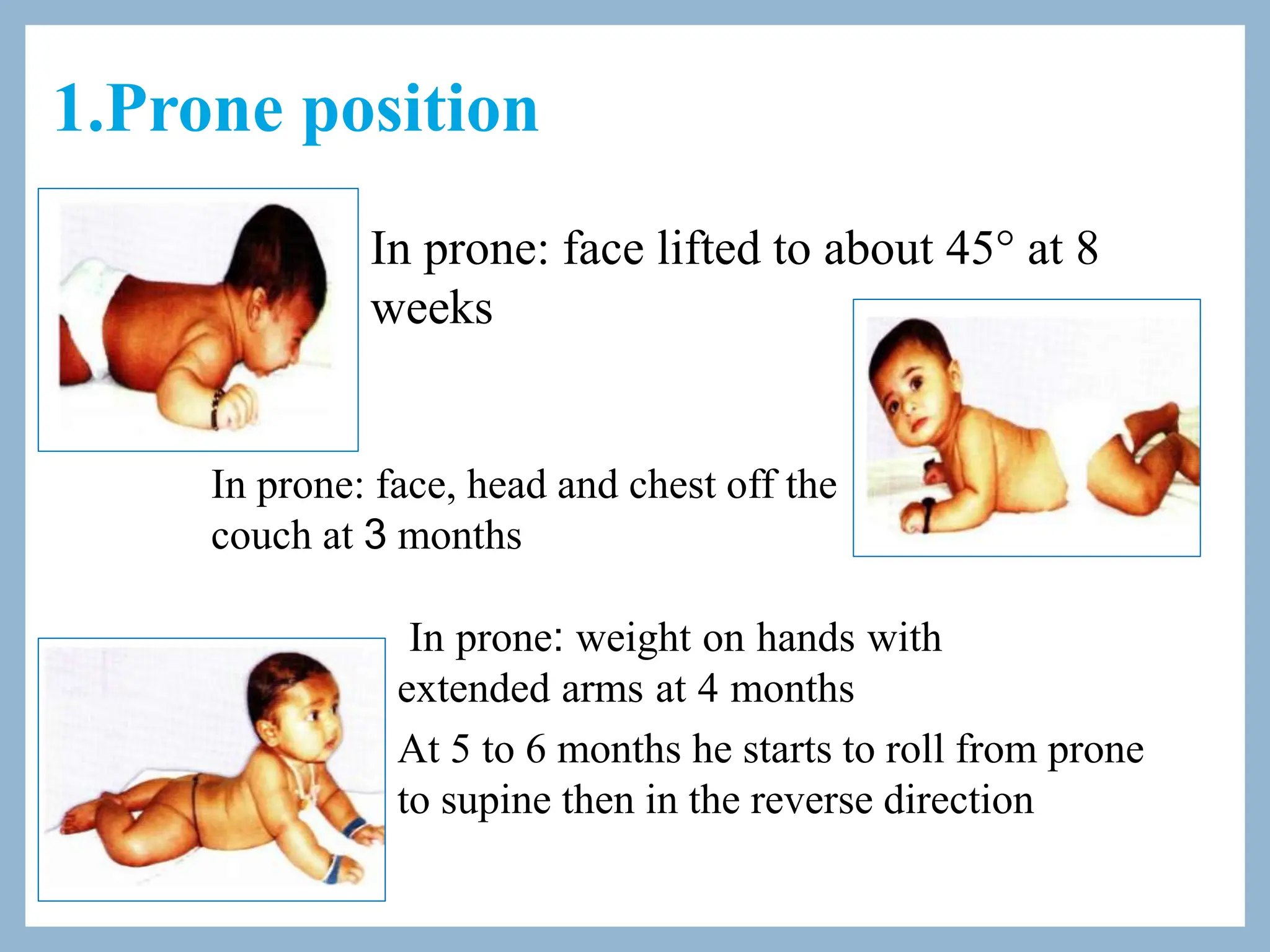
1.Prone position
In prone: face, head and chest off the
couch at 3 months
In prone: weight on hands with
extended arms at 4 months
In prone: face lifted to about 45° at 8
weeks
At 5 to 6 months he starts to roll from prone
to supine then in the reverse direction
2.Supine & pull to sit
• Infant is observed in a supine and then gently
pulled to sitting position
• Control of the head and spine is then observed
No head lag
at 4 months
Flexes the head on to
chest at 5 months
Complete head lag
in a new born
3.Ventral suspension
Head above the
plane of trunk at 4
month
Unable to hold neck
in the line with
trunk at 4 weeks
Head in line with
the trunk at 8
-
10
weeks
4.Sitting
Back rounded but
able to hold head
at 8weeks
Back much
straighter at 4
months
Sitting with
support of hands
at 6 months
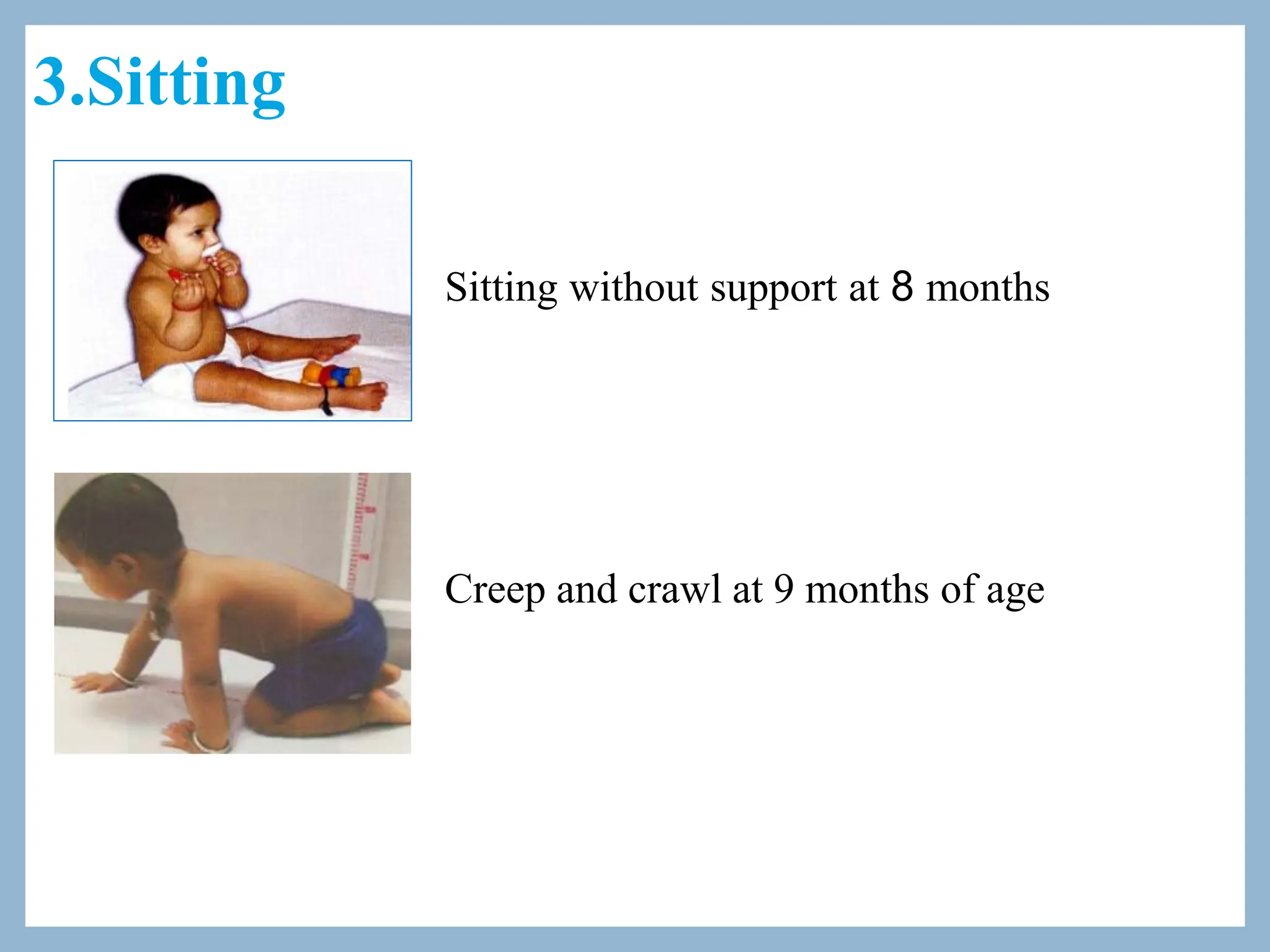
3.Sitting
Creep and crawl at 9 months of age
Sitting without support at 8 months
5.standing and walking
Stand unsupported
at 11 months
Stands supported
at 10 months Walks supported
one year
1.5 years: walks upstairs with one hand held,
Seats himself on a chair ,run stiffly
2 years: runs, walks up and down stairs one step at time
2.5 years: walks stairs with alternating feet
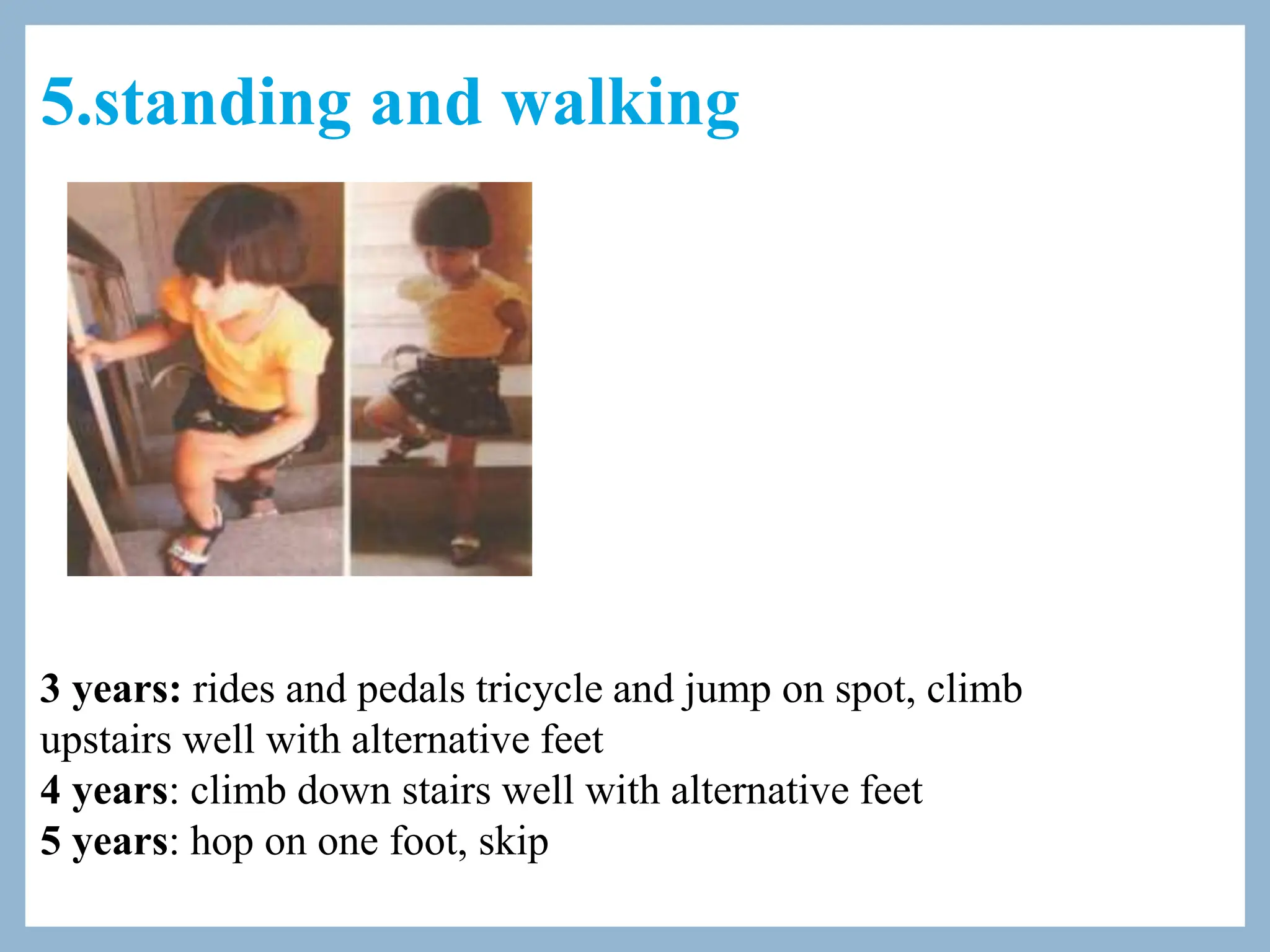
5.standing and walking
3 years: rides and pedals tricycle and jump on spot, climb
upstairs well with alternative feet
4 years: climb down stairs well with alternative feet
5 years: hop on one foot, skip
Causes of delayed walking
1. Physiological delay
2. Pathological (usually physical problems)
Brain: Cerebral palsy, mental retardation
Lower limbs: myopathies, innervations
Bone problems: rickets
Neuropathy: GBS
Fine motor skill development
This primarily involves the development of
fine manipulation skills and coordination
with age.
2
1. Hand and eye coordination
Hand regard between
12 and 20 weeks
The child observes his own hands very intently, this its
persistence after 20 weeks is considered abnormal
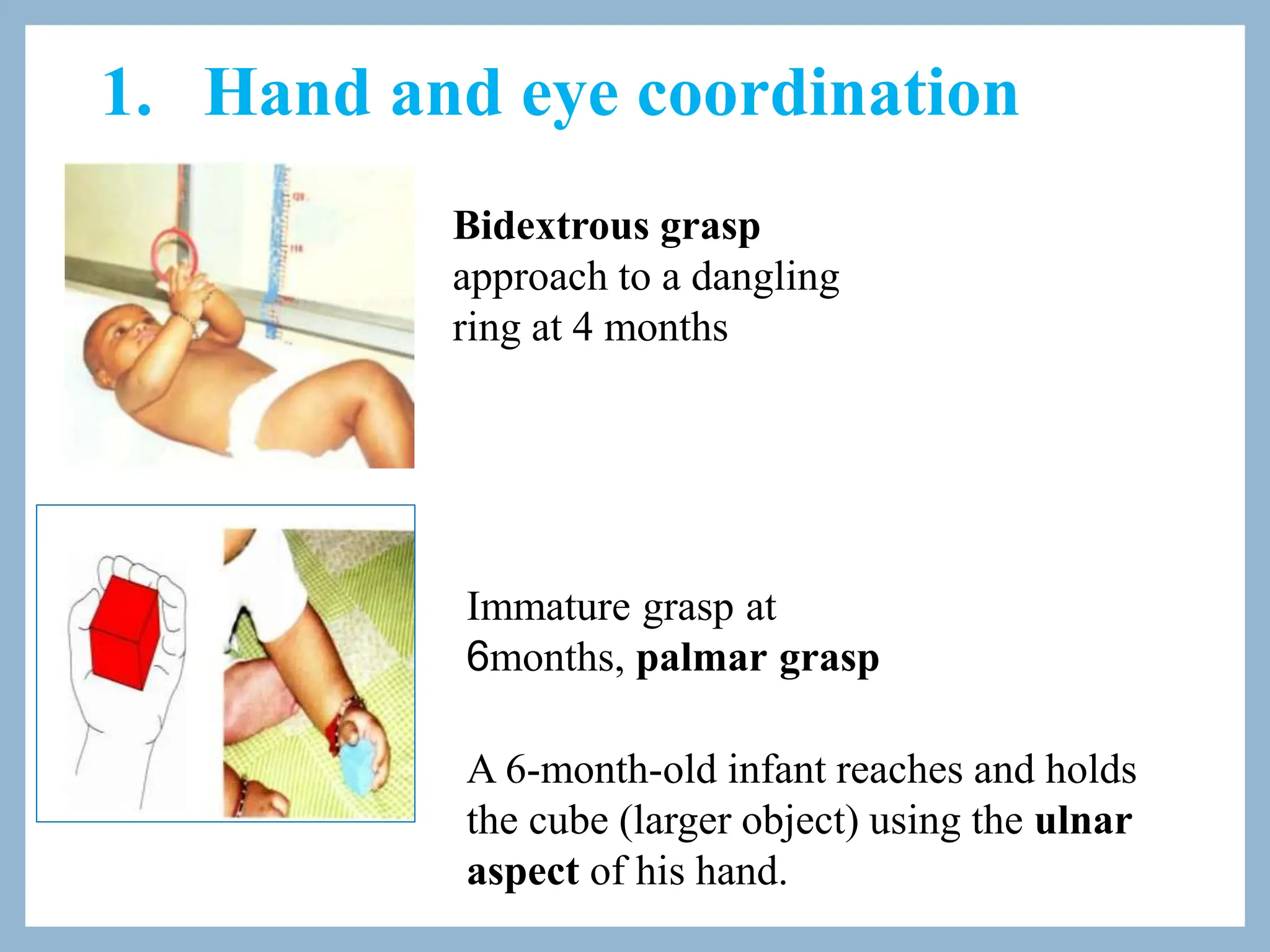
1. Hand and eye coordination
Bidextrous grasp
approach to a dangling
ring at 4 months
Immature grasp at
6months, palmar grasp
A 6-month-old infant reaches and holds
the cube (larger object) using the ulnar
aspect of his hand.
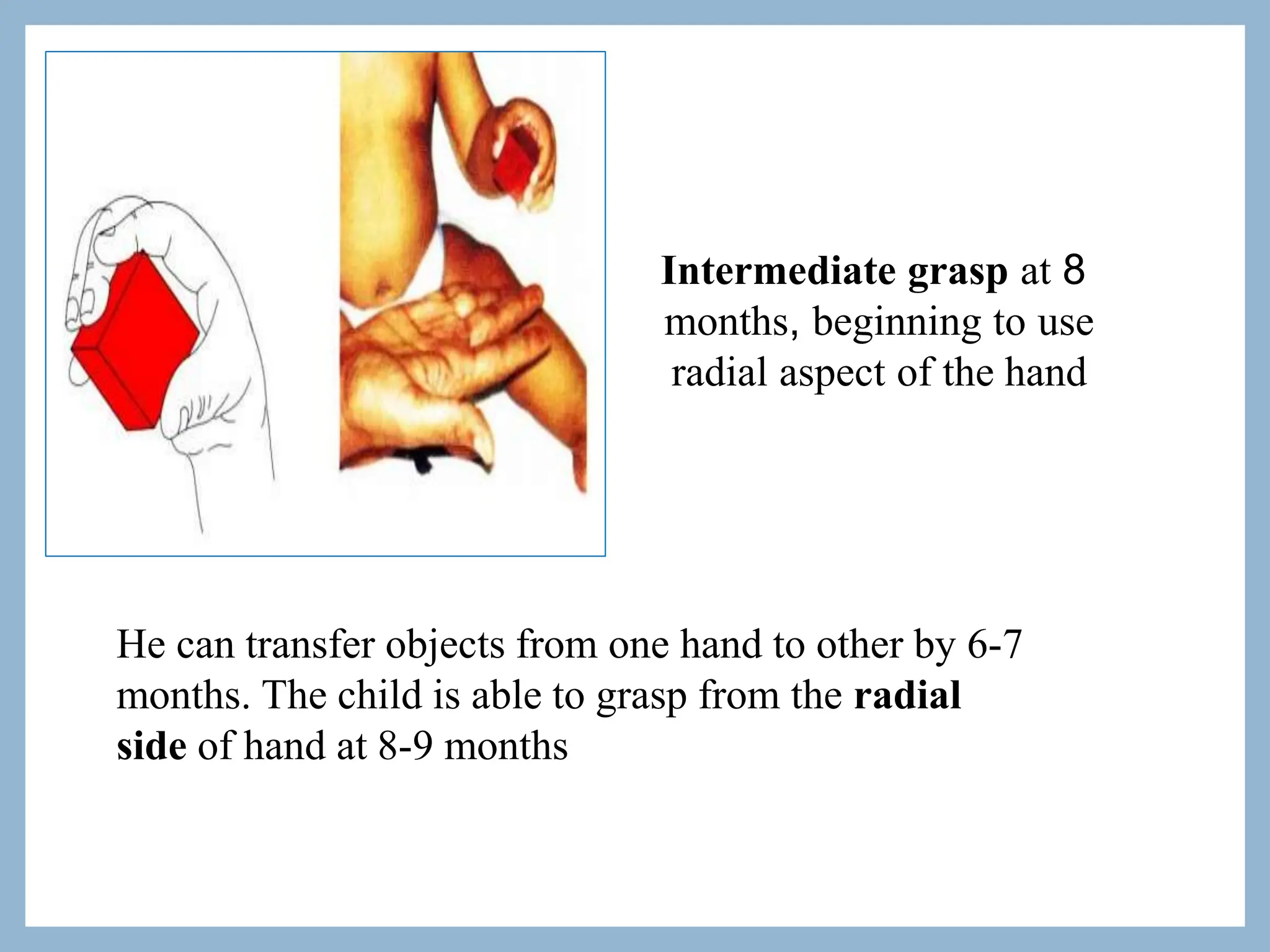
Intermediate grasp at 8
months, beginning to use
radial aspect of the hand
He can transfer objects from one hand to other by 6-7
months. The child is able to grasp from the radial
side of hand at 8-9 months
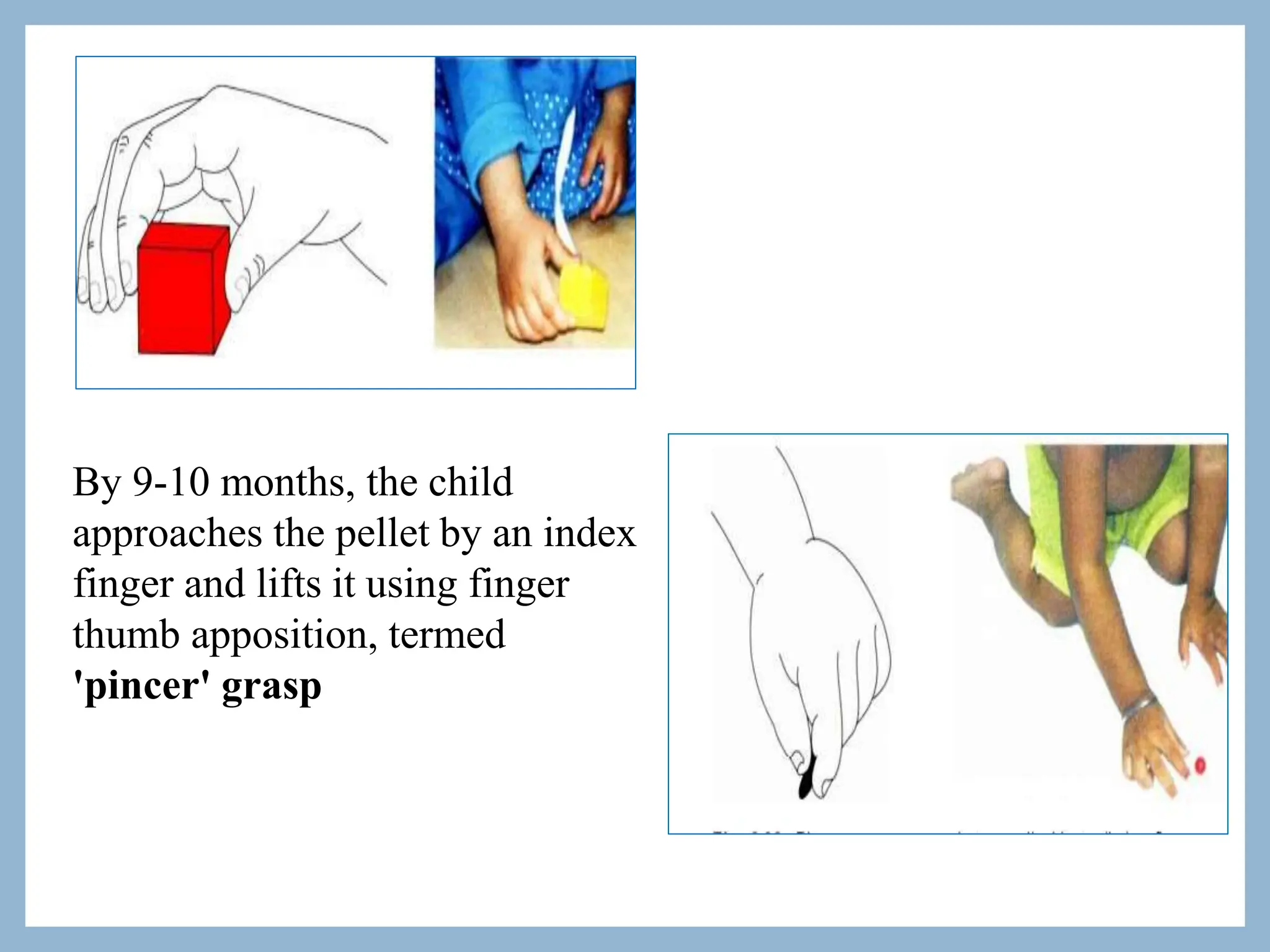
By 9-10 months, the child
approaches the pellet by an index
finger and lifts it using finger
thumb apposition, termed
'pincer' grasp
2. Hand to mouth coordination
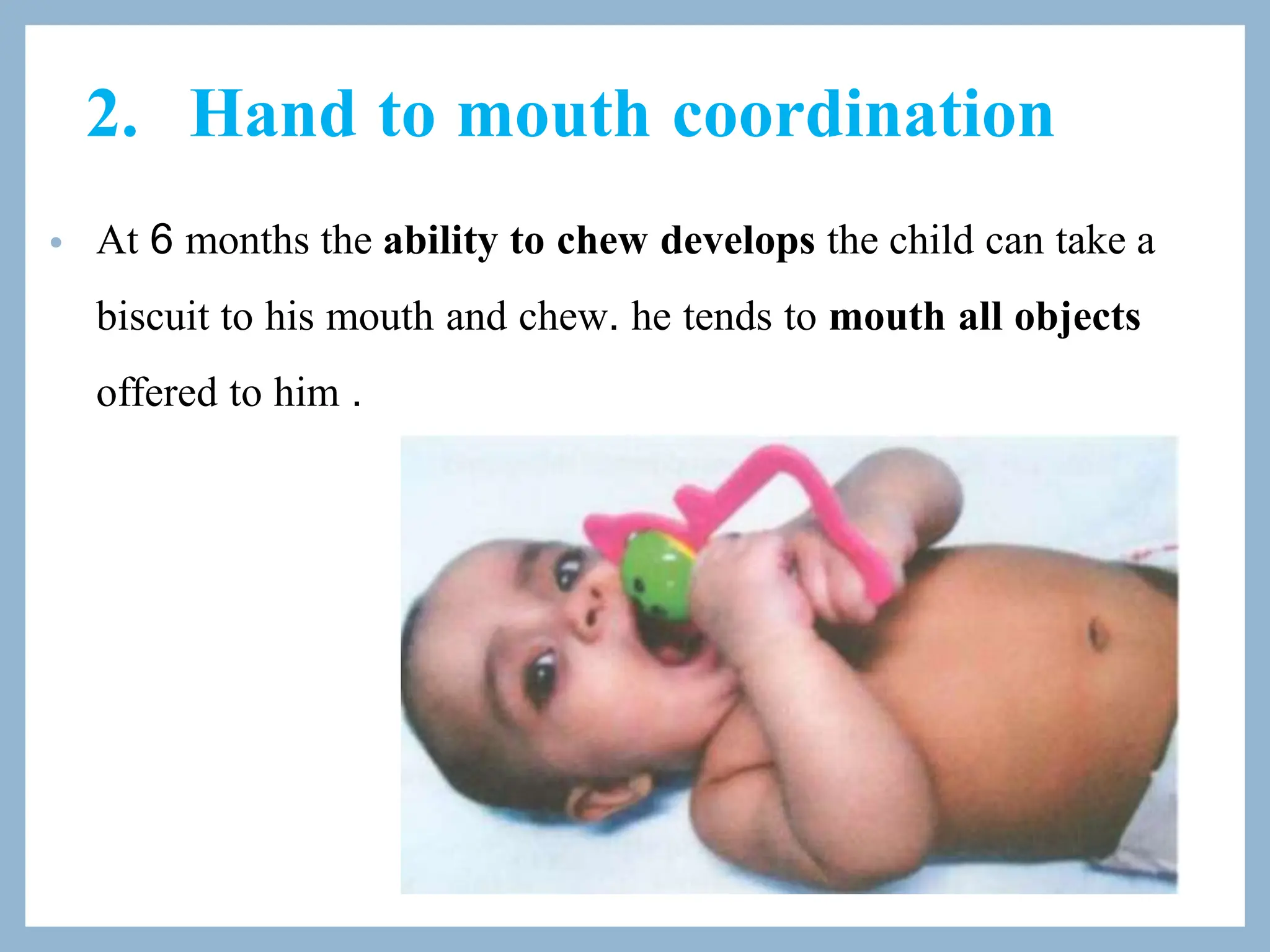
• At 6 months the ability to chew develops the child can take a
biscuit to his mouth and chew. he tends to mouth all objects
offered to him .
2. Hand to mouth coordination
• This tendency abates by around 1 year of age. By this age he
tries to feed self from a cup but spills some of the contents.
• By 15 months the child can pick up a cup and drink from it
without much spilling .
• By 18m feeds himself using spoon.
3. Advanced Hand Skills
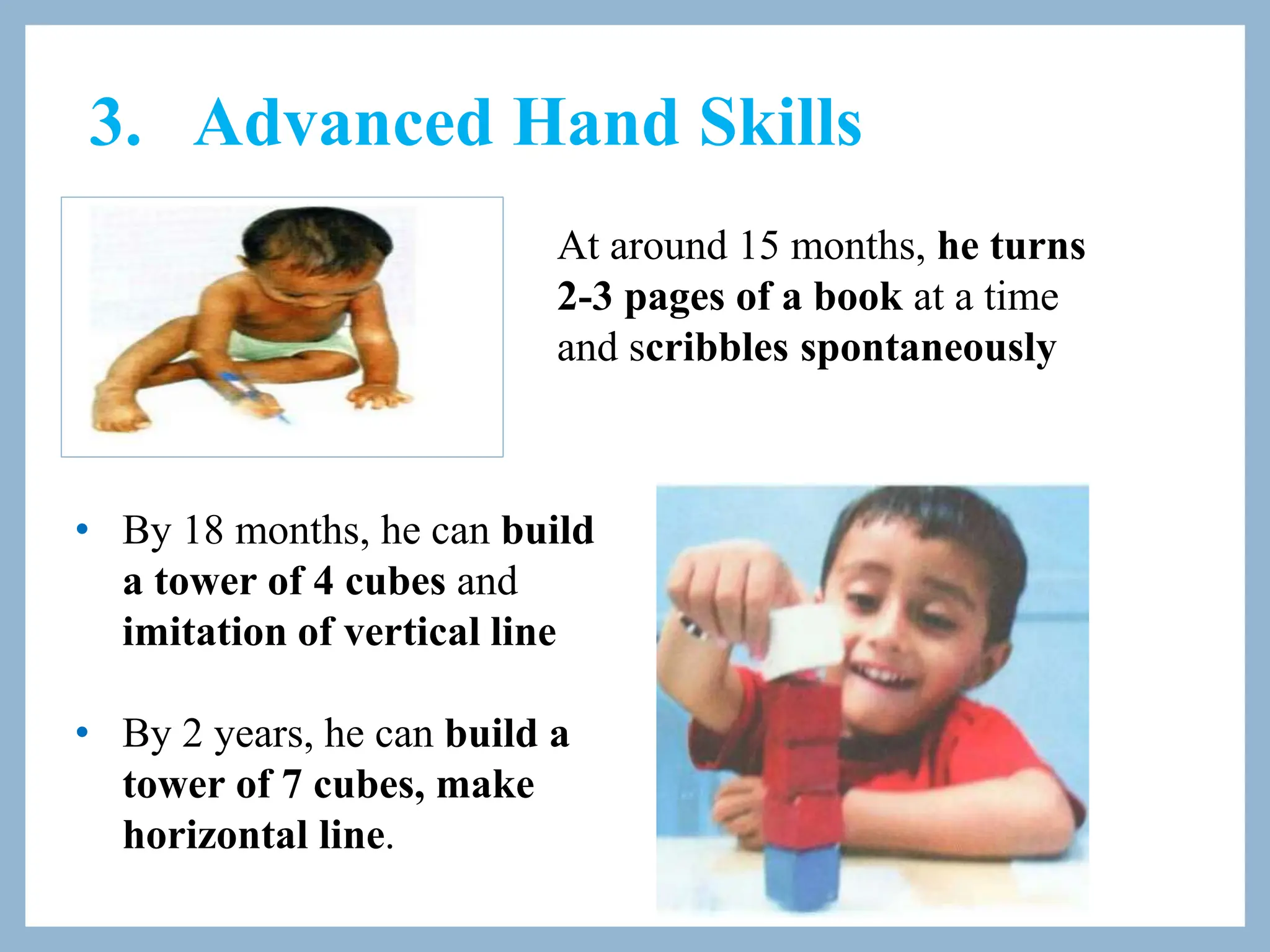
At around 15 months, he turns
2-3 pages of a book at a time
and scribbles spontaneously
• By 18 months, he can build
a tower of 4 cubes and
imitation of vertical line
• By 2 years, he can build a
tower of 7 cubes, make
horizontal line.
Drawing skills at various ages
Block skills at various ages
4. Dressing
Undressing being easier, is learned before dressing.
• At 1 year the child cooperate in dressing
• By 3 years he can dress with supervision
• By 4years ,bottom up, dress without supervision
personal and social development
3
1 month, the child intently
watches his mother when she
talks to him
He starts smiling back (social
smile) when anyone talks to him or
smiles at him by 6-8 weeks of age
By 4 months, he laugh loud at
pleasurable contact and
displasuer by crying…
By the end of 6 months, he
show social preference and
fear of stranger and
separation anxiety
Spontaneous smile (smile without
any social interaction), which is
present even in neonates
• (Stranger anxiety) by 6-7 months of age. At this age
he inhibits to "no".
• At 9 months, he waves "bye-bye" and also repeats
any performance
• By 18 to 24 months he is able to verbalize his toilet
needs
• At 3 years he is able to control his sphincter by day
Causes of delayed smiling
1. Perceptual, Blindness
2. Mental handicap
3. Lack of stimulation
4. Emotional deprivation
5. Autism
Language
4
Throughout the development of language it is
the receptive ability and understanding which
precedes expressive abilities
• Soon after appearance of social smile at around 6 to 8
weeks, the child begins to vocalize with vowel
sounds such as 'ah, uh’
• First language is crying
• 2-7 months: jargons
• After 7 months, he uses monosyllables (ba, da,
pa). Later, he joins consonants to form bisyllables
(mama, baba, dada).
• At around 9-10 months the child learns to imitate
sounds derived from his native language.
• At his first birthday, he can usually say 1-2 words
with meaning.
• At 18 months, he has a vocabulary of 8-10 words.
• By 2 year 2-3 words are joined to form simple
sentences.
• By 3 year, short sentences knows his age, sex
• by the age of 4 year, long sentences
Causes of delayed speech
1. physiological (bilingualism)
2. Pathological:
Organic: deafness, paralysis of muscle of
articulation or tongue, mental retardation
Psychological: autism…
Language
Vision
At birth a baby can fixate on and follow a moving
person or dangling ring held 8
-
10 inches away upto a
range of 45°
.
sihT
sesaercni
ot
90° by 4 weeks and 180°
by 12 weeks.
Vision and hearing
5
At around 1month the
baby can fixate on
his mother as she
talks to him.
Vision
At about 3 months the child
fixates intently on an
object shown to him
(grasping with eyes) it
appears that the child wants
to reach for the object
Vision and hearing
5
• Binocular vision snigeb
ta
dnuora
6 weeks and is
well established by 4 months .
• By 6 months the child adjusts his position to
follow objects of interest, tub
nac
wollof
yldipar
gnivom
stcejbo
ylno
yb
1 year .
• Later the child displays more maturity in vision by
not only identifying smaller objects but also
being able to recognize them.
Hearing
• Newborns respond to sounds by startle, blink, cry,
quieting or change in ongoing activity.
• By 3 to 4 months the child turns his head towards the
source of sound.
• At 5 to 6 months the child turns the head to one side and
then downwards if a sound is made below the level of ears.
• In a similar fashion, one month later he is able to localize
sounds made above the level of ears .
Hearing
• By the age of 10 months the child directly looks at the
source of sound diagonally.
Pubirty
Saccual maturation rate in females
 1st sign of maturation in girls is breast budding
(Thelarche)
 Occurs about 11 years and adult breast at 15 years
 Pubicarche is 1st sign in about 15% of girls
 Menarche (1st menstrual cycle)occurs about 12years
 There is growth spurts just before the age of Puberty
Pubirty
Saccual maturation rate in males
 1st sign of maturation in males is testicular enlargement
and pubic hair at 12 years
 Increase of penis size and change of voice at 13 years
 Axillary hair at age of 14 years
 Facial hair at age of 15 years
 There is growth spurts just before the age of Puberty
Precocious Puberty
Apears of secondary sexual charachtristic before age of 8
years in females and 9 years in males
Causes
 central precocious puberty (CPP), which is
gonadotropin-dependent
Peripheral precocious puberty (PPP), which is
gonadotropin-independent
EVALUATION OF THE
DEVELOPMENT
History and physical examination
Developmental testing
Developmental quotient (DQ)
Is numerical indicator to assess growth and development
DQ=
A DQ below 70% is taken as delay and warrants
detailed evaluation.
Developmental age (DA)
Chronological age (CA)
X 100
While drawing any conclusions about development, should
remember the wide variations in normality (The average
age for attainment of this milestone)
Development Screening
Screening is a "brief assessment procedure designed to identify
children who should receive more intensive diagnosis or
assessment".
• Aids early intervention services
• Provides an opportunity for early identification of comorbid
developmental disabilities
• At least those with perinatal risk factors should be screened
Development Screening
• Denver developmental screening test
• Parents’ Evaluation of Developmental Status (PEDS)
• Modified Checklist for Autism in Toddlers— Revised (M-
CHAT-R)
• Language screening (expressive receptive) language
• Academic achievement and behavior for school age children and
adolescence
Developmental Surveillance
• Child development is a dynamic process and difficult to
quantitate by a one time assessment.
• Repeated observations on development are made
• Periodic screening helps to detect emerging disabilities as the
child grows.
Definitive Tests
• These tests are required once screening tests or clinical
assessment is abnormal .
• They are primarily aimed to accurately define the impairments in
both degree and sphere .
Early Stimulation
Infants who show suspect or early signs development delay need to
be provided opportunities that promote body control, acquisition of
motor skills, language development and psychosocial maturity.
These inputs, termed early stimulation.
This include:
• Making additional efforts to make the child sit or walk
• Giving toys to manipulate, playing with the child, showing
objects
• Speaking to the child and encouraging him to speak
• Prompting the child to interact with others, etc
Television Viewing and Development
Television viewing in younger children has been shown to
retard language development. It is a passive mode of
entertainment and impairs children's ability to learn and read,
and also limits creativity.
Child Development in the Developing World
In developing countries childrenyounger than 5 years
are exposed to multiple risks, including poverty,
malnutrition, poor health, and unstimulating home
environments, which impair their cognitive, motor, and
social emotional development .
References
1. Ghai essential of pediatric
2. Nelson essential of pediatric
3. Naseer gamal essential of pediatric
4. Kaplan pediatric
Quiz
At 3 years of age a child can…
1. Copy a circle
2. Run
3. Recognize 3 colures
4. Take off his clothes
A 9 months of age expected to all of the
following except?
1. Support his head
2. laugh
3. Sit without support
4. Climb stairs
An infant who sits only with minimal support
attempts to attain a toy beyond reach, and
rolls over from the supine to prone position
but has not a pincer grip. Is at development of
1. 2 months
2. 4 months
3. 6 months
4. 9 months
5. 1 year
‫عبد‬
‫هللا‬
‫مصطفى‬
‫جنان‬
‫جعفر‬
‫إيمان‬
‫محمد‬
‫إسراء‬
‫دفع‬
‫هللا‬
Group 26
Thank you

developmental milestones assessment.pptx

  • 1.
    ‫الرحيم‬ ‫الرحمن‬ ‫هللا‬‫بسم‬ Developmental assessment Group 26 Supervisor Dr.Tasneem Awad Sudan university of science and technology
  • 2.
    What is thedifference between GROWTH & DEVELOPMENT Growth: Increase in size which can be measured in physical attributes (QUANTATIVE CHANGES) Development: Maturation of organ and systems, gaining of skills…(QUALITATIVE CHANGES)
  • 3.
    Objectives: Introduction Factors affecting development Grossmotor development Fine motor development Personal & social development Language Vision & hearing Evaluation of the development Quiz
  • 4.
    INTRODUCTION:  Development isa continuous process.  Related to maturation of the nervous system  Progress cephalocaudal direction  The sequences of development is similar in all children but its rate varies from child to child  Primitive reflexes lost before relevant milestone is attained
  • 5.
    Factors affecting development Developmentis affected by several factors : Prenatal factors: Any things that interferes with brain growth 1. Genetics: parents , chromosomal abnormalities that lead to mental retardation (down syndrome..) 2. Maternal factors: nutrition, exposure to certain drugs or toxins, maternal diseases and infections
  • 6.
    Factors affecting development Developmentis affected by several factors : Neonatal risk factors: low weight birth and neonatal seizures. Postnatal risk factors: nutritional factors ,acquired insult to brain ,endocrine factors ,associated impairments & others. Social factors: parenting ,poverty and abuse, and lack of stimulations.
  • 7.
    NORMAL DEVELOPMENT Gross motordevelopment Fine motor skill development Personal & social development & general understanding Language Vision and hearing
  • 8.
    Gross motor development Motordevelopment progresses in an orderly sequence to ultimate attainment of locomotion and more complex motor tasks thereafter . 1
  • 9.
    1.Prone position • Newborncan avoid suffocation by turning his head from sideto sideo The infant lies on the bed with high pelvis and knees drawn up at 2 weeks The infant lies with flat pelvis and extended hips at 6 week
  • 10.
    1.Prone position In prone:face, head and chest off the couch at 3 months In prone: weight on hands with extended arms at 4 months In prone: face lifted to about 45° at 8 weeks At 5 to 6 months he starts to roll from prone to supine then in the reverse direction
  • 11.
    2.Supine & pullto sit • Infant is observed in a supine and then gently pulled to sitting position • Control of the head and spine is then observed No head lag at 4 months Flexes the head on to chest at 5 months Complete head lag in a new born
  • 12.
    3.Ventral suspension Head abovethe plane of trunk at 4 month Unable to hold neck in the line with trunk at 4 weeks Head in line with the trunk at 8 - 10 weeks
  • 13.
    4.Sitting Back rounded but ableto hold head at 8weeks Back much straighter at 4 months Sitting with support of hands at 6 months
  • 14.
    3.Sitting Creep and crawlat 9 months of age Sitting without support at 8 months
  • 15.
    5.standing and walking Standunsupported at 11 months Stands supported at 10 months Walks supported one year 1.5 years: walks upstairs with one hand held, Seats himself on a chair ,run stiffly 2 years: runs, walks up and down stairs one step at time 2.5 years: walks stairs with alternating feet
  • 16.
    5.standing and walking 3years: rides and pedals tricycle and jump on spot, climb upstairs well with alternative feet 4 years: climb down stairs well with alternative feet 5 years: hop on one foot, skip
  • 18.
    Causes of delayedwalking 1. Physiological delay 2. Pathological (usually physical problems) Brain: Cerebral palsy, mental retardation Lower limbs: myopathies, innervations Bone problems: rickets Neuropathy: GBS
  • 19.
    Fine motor skilldevelopment This primarily involves the development of fine manipulation skills and coordination with age. 2
  • 20.
    1. Hand andeye coordination Hand regard between 12 and 20 weeks The child observes his own hands very intently, this its persistence after 20 weeks is considered abnormal
  • 21.
    1. Hand andeye coordination Bidextrous grasp approach to a dangling ring at 4 months Immature grasp at 6months, palmar grasp A 6-month-old infant reaches and holds the cube (larger object) using the ulnar aspect of his hand.
  • 22.
    Intermediate grasp at8 months, beginning to use radial aspect of the hand He can transfer objects from one hand to other by 6-7 months. The child is able to grasp from the radial side of hand at 8-9 months
  • 23.
    By 9-10 months,the child approaches the pellet by an index finger and lifts it using finger thumb apposition, termed 'pincer' grasp
  • 24.
    2. Hand tomouth coordination • At 6 months the ability to chew develops the child can take a biscuit to his mouth and chew. he tends to mouth all objects offered to him .
  • 25.
    2. Hand tomouth coordination • This tendency abates by around 1 year of age. By this age he tries to feed self from a cup but spills some of the contents. • By 15 months the child can pick up a cup and drink from it without much spilling . • By 18m feeds himself using spoon.
  • 26.
    3. Advanced HandSkills At around 15 months, he turns 2-3 pages of a book at a time and scribbles spontaneously • By 18 months, he can build a tower of 4 cubes and imitation of vertical line • By 2 years, he can build a tower of 7 cubes, make horizontal line.
  • 27.
    Drawing skills atvarious ages
  • 28.
    Block skills atvarious ages
  • 29.
    4. Dressing Undressing beingeasier, is learned before dressing. • At 1 year the child cooperate in dressing • By 3 years he can dress with supervision • By 4years ,bottom up, dress without supervision
  • 31.
    personal and socialdevelopment 3 1 month, the child intently watches his mother when she talks to him He starts smiling back (social smile) when anyone talks to him or smiles at him by 6-8 weeks of age
  • 32.
    By 4 months,he laugh loud at pleasurable contact and displasuer by crying… By the end of 6 months, he show social preference and fear of stranger and separation anxiety Spontaneous smile (smile without any social interaction), which is present even in neonates
  • 33.
    • (Stranger anxiety)by 6-7 months of age. At this age he inhibits to "no". • At 9 months, he waves "bye-bye" and also repeats any performance • By 18 to 24 months he is able to verbalize his toilet needs • At 3 years he is able to control his sphincter by day
  • 34.
    Causes of delayedsmiling 1. Perceptual, Blindness 2. Mental handicap 3. Lack of stimulation 4. Emotional deprivation 5. Autism
  • 36.
    Language 4 Throughout the developmentof language it is the receptive ability and understanding which precedes expressive abilities • Soon after appearance of social smile at around 6 to 8 weeks, the child begins to vocalize with vowel sounds such as 'ah, uh’
  • 37.
    • First languageis crying • 2-7 months: jargons • After 7 months, he uses monosyllables (ba, da, pa). Later, he joins consonants to form bisyllables (mama, baba, dada). • At around 9-10 months the child learns to imitate sounds derived from his native language.
  • 38.
    • At hisfirst birthday, he can usually say 1-2 words with meaning. • At 18 months, he has a vocabulary of 8-10 words. • By 2 year 2-3 words are joined to form simple sentences. • By 3 year, short sentences knows his age, sex • by the age of 4 year, long sentences
  • 39.
    Causes of delayedspeech 1. physiological (bilingualism) 2. Pathological: Organic: deafness, paralysis of muscle of articulation or tongue, mental retardation Psychological: autism…
  • 40.
  • 41.
    Vision At birth ababy can fixate on and follow a moving person or dangling ring held 8 - 10 inches away upto a range of 45° . sihT sesaercni ot 90° by 4 weeks and 180° by 12 weeks. Vision and hearing 5 At around 1month the baby can fixate on his mother as she talks to him.
  • 42.
    Vision At about 3months the child fixates intently on an object shown to him (grasping with eyes) it appears that the child wants to reach for the object Vision and hearing 5
  • 43.
    • Binocular visionsnigeb ta dnuora 6 weeks and is well established by 4 months . • By 6 months the child adjusts his position to follow objects of interest, tub nac wollof yldipar gnivom stcejbo ylno yb 1 year . • Later the child displays more maturity in vision by not only identifying smaller objects but also being able to recognize them.
  • 44.
    Hearing • Newborns respondto sounds by startle, blink, cry, quieting or change in ongoing activity. • By 3 to 4 months the child turns his head towards the source of sound. • At 5 to 6 months the child turns the head to one side and then downwards if a sound is made below the level of ears. • In a similar fashion, one month later he is able to localize sounds made above the level of ears .
  • 45.
    Hearing • By theage of 10 months the child directly looks at the source of sound diagonally.
  • 46.
    Pubirty Saccual maturation ratein females  1st sign of maturation in girls is breast budding (Thelarche)  Occurs about 11 years and adult breast at 15 years  Pubicarche is 1st sign in about 15% of girls  Menarche (1st menstrual cycle)occurs about 12years  There is growth spurts just before the age of Puberty
  • 47.
    Pubirty Saccual maturation ratein males  1st sign of maturation in males is testicular enlargement and pubic hair at 12 years  Increase of penis size and change of voice at 13 years  Axillary hair at age of 14 years  Facial hair at age of 15 years  There is growth spurts just before the age of Puberty
  • 48.
    Precocious Puberty Apears ofsecondary sexual charachtristic before age of 8 years in females and 9 years in males Causes  central precocious puberty (CPP), which is gonadotropin-dependent Peripheral precocious puberty (PPP), which is gonadotropin-independent
  • 49.
    EVALUATION OF THE DEVELOPMENT Historyand physical examination Developmental testing
  • 50.
    Developmental quotient (DQ) Isnumerical indicator to assess growth and development DQ= A DQ below 70% is taken as delay and warrants detailed evaluation. Developmental age (DA) Chronological age (CA) X 100
  • 51.
    While drawing anyconclusions about development, should remember the wide variations in normality (The average age for attainment of this milestone)
  • 53.
    Development Screening Screening isa "brief assessment procedure designed to identify children who should receive more intensive diagnosis or assessment". • Aids early intervention services • Provides an opportunity for early identification of comorbid developmental disabilities • At least those with perinatal risk factors should be screened
  • 54.
    Development Screening • Denverdevelopmental screening test • Parents’ Evaluation of Developmental Status (PEDS) • Modified Checklist for Autism in Toddlers— Revised (M- CHAT-R) • Language screening (expressive receptive) language • Academic achievement and behavior for school age children and adolescence
  • 55.
    Developmental Surveillance • Childdevelopment is a dynamic process and difficult to quantitate by a one time assessment. • Repeated observations on development are made • Periodic screening helps to detect emerging disabilities as the child grows.
  • 56.
    Definitive Tests • Thesetests are required once screening tests or clinical assessment is abnormal . • They are primarily aimed to accurately define the impairments in both degree and sphere .
  • 57.
    Early Stimulation Infants whoshow suspect or early signs development delay need to be provided opportunities that promote body control, acquisition of motor skills, language development and psychosocial maturity. These inputs, termed early stimulation. This include: • Making additional efforts to make the child sit or walk • Giving toys to manipulate, playing with the child, showing objects • Speaking to the child and encouraging him to speak • Prompting the child to interact with others, etc
  • 58.
    Television Viewing andDevelopment Television viewing in younger children has been shown to retard language development. It is a passive mode of entertainment and impairs children's ability to learn and read, and also limits creativity.
  • 59.
    Child Development inthe Developing World In developing countries childrenyounger than 5 years are exposed to multiple risks, including poverty, malnutrition, poor health, and unstimulating home environments, which impair their cognitive, motor, and social emotional development .
  • 60.
    References 1. Ghai essentialof pediatric 2. Nelson essential of pediatric 3. Naseer gamal essential of pediatric 4. Kaplan pediatric
  • 61.
  • 62.
    At 3 yearsof age a child can… 1. Copy a circle 2. Run 3. Recognize 3 colures 4. Take off his clothes
  • 63.
    A 9 monthsof age expected to all of the following except? 1. Support his head 2. laugh 3. Sit without support 4. Climb stairs
  • 64.
    An infant whosits only with minimal support attempts to attain a toy beyond reach, and rolls over from the supine to prone position but has not a pincer grip. Is at development of 1. 2 months 2. 4 months 3. 6 months 4. 9 months 5. 1 year
  • 65.
  • 66.