MODERATORMODERATOR
DR.R.GANDHIBABUDR.R.GANDHIBABU
DR.V.K. MOHANDAS KURUPDR.V.K. MOHANDAS KURUP
PRESENTORPRESENTOR
Dr.R.Balamurugan
M.D PMR II YR P.G
DEPARTMENT OF PHYSICAL
MEDICINE&REHABILITATION
“AS MODERN MEDICINE ADDS
YEARS TO LIFE,REHABILITATION
BECOMES INCREASINGLY
NECESSARY TO ADD LIFE TO THOSE
YEARS”
-RUSK
“Healthy aging is the process of developing and
maintaining the functional ability that
enables wellbeing in older age”.
 Functional ability is about having the capabilities that
enable all people to be and do what they have reason to value.
  This includes a person’s ability to:
 meet their basic needs;
 learn, grow and make decisions;
 be mobile;
 build and maintain relationships;
 contribute to society.
 The elderly are not a homogenous group
 According to the WHO,
>=65 yrs is accepted as definition of ‘older
or Elderly ‘ persons
 According to the UN,
60+ age is considered as older population
or elderly
 65 to 75 - YOUNG OLD
 75 to 85 - OLD OLD
 >85 - VERY OLD
 20% of population >65 by 2025
 Vulnerability to stressors
 Need to treat underlying conditions
 Minimize risk for falls, disability, hospitilaztion,& mortality
 Primary &secondary prevention
 Immobility
 Intellectual impairment
 Incontinence
 Impaired homeostasis/Instability
 Insomnia & Sleep disorders
 Iatrogenic
 Parkinson disease
 Dementia
 Normal pressure hydrocephalus
 Malignancy
 Osteoarthritis
 Traumatic brain injury and spinal cord injury
 Disuse, immobilization, and decompensation
 Pain
 Falls
 Sleep disorders
Physiologic changes are
 Posture
 Proprioception
 Gait
Pathologic changes are
 Vertebral compression fractures with kyphosis,
 Arthritis,
 Degenerative cerebral changes,
 Cerebral infarcts
 Spinal Cord Injury
 Poliomyelitis
 Cerebral Palsy
 Sarcopenia – decreased muscle mass
& strength
 Osteopenia & Osteoporosis –
decreased bone strength
 Osteoarthritis – degenerative changes
in joints
 In muscle fibro-connective tissue build
up and fat accumulation affects its
quality& function
 Increased stride to stride variability in length
 Increased stride to stride variability in speed
 Increased time of double-support phase
 1/3 of elderly have a history of falls
 20% result in injury (5% end in fracture)
 Risk factors of falls include
 Poor muscle strength ,
 Neural damage on basal ganglia and cerebellum
 Diabetes & Peripheral neuropathy
 Interventions to prevent or reduce instability &
falls include
 Medical
 Rehabilitative
 Environmental modification approach
INTRINSIC
(1) Musculo-skeletal:
-poor muscle strength
-decreased flexibility
(2) Neurological:
-cognitive dysfunction
-inco-ordination
-peripheralneuropathy
(3) Others:
-poor vision
-vestibular disorders
-postural hypotension
-medications
EXTRINSIC
(1) Environmental:
- obstacles
- slippery floors
- poor lighting
(2) Others:
- inappropriate clothing
- improper footwear
 Instability phase ( balance is lost)
 Descent phase
 Impact phase
 Postimpact phase
 Greater challenges than the young amputee
 Less reserve in many systems
 Pre-amputation deconditioning
 Contractures
 Congestive Cardiac Failure
 COPD
 History
 Physical Examination
 Functional assessment
 Family
 Social support
 Environment & Architectural Problems
 Economic problems
 I Inflammation of joints (or joint deformity)
 H Hypotension (orthostatic blood pressure changes)
 A Auditory and visual abnormalities
 T Tremor (Parkinson's disease or other causes of
tremor)
 E Equilibrium (balance) problem
 F Foot problems
 A Arrhythmia, heart block or valvular disease
 L Leg-length discrepancy
 L Lack of conditioning (generalized weakness)
 I Illness
 N Nutrition (poor; weight loss)
 G Gait disturbance
 Activities of Daily Living (ADL)
 Instrumental Activities of Daily Living (IADLS)
 Functional Independence Measure Scale(FIMS)
 Barthel Index
 Mobility questionnaire
 Short Physical performance battery
 Berg balance scale
 Walking speed
 6-minute walk
 Long distance corridor walk
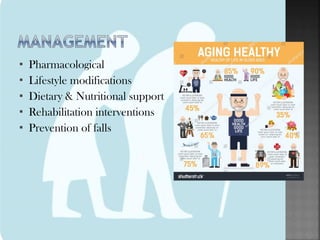
 Pharmacological
 Lifestyle modifications
 Dietary & Nutritional support
 Rehabilitation interventions
 Prevention of falls
 Highest priority for most elderly people for a
satisfying Quality Of Life(QOL) is to
MAINTAIN INDEPENDENCE
 Functional assessment
 Realistic goal setting
 Interdisciplinary Team care
 Efficacious Adjustment of Therapy interventions
1.Stabilization of primary problem
2.Prevent secondary complications
3.Restore lost function
4.Adaptation of person to new disability
5.Adaptation of the living facility
6.Working with family
 Medical assessment
 Assessment of nursing needs
 Assessment of impairments
 Assessment of disabilities
 Assessment of cognitive function
 Assessment of the patient’s strengths / resources
 Assessment of the patient’s and family’s priorities
 Patient education
 Rest, Exercise, Ergonomics
 Physical Modalities
 Orthosis, Assistive devices & Ambulatory aids
 Environmental modifications
 Surgery & post-surgery rehabilitation
 Frequency
 Intensity
 Type
 Time
 Significant gains in muscle strength as well as functional
mobility have been demonstrated in older indivuials
with a structured high intensity program
 Increase muscle strength, endurance and maximal
aerobic capacity
 Increase flexibility, coordination and balance
 Reduce risk for falling & enhance mobility
 Promote socialization & self-esteem
 Helps in maintaining or promoting independence in
ADLs
FLOOR :
 use nonslip tiles in Bathrooms
 use nonslip adhesive strips on floor
 next to tub, sink and toilet
 carpeting (low pile & border)
Lighting :
 lighting in high-risk areas eg.stairs, bathroom,
bedroom
 Floor glare by reposition of light source
Stairs :
 Place light switches at top and bottom of stairway,
 Apply coloured non-skid adhesive strips to stair edges,
 Set maximum step rise at 6 inches
Handrails :
 Place cylindrical rails 1-2 in away from wall on both
sides
Bed Height:
 Bed ht. from patella to floor (18 in. from top of mattress
to floor)
Chair Height:
 14- 16 in. from seat edge to floor armrests ~ 7 in above
the seat and extend 1-2 in beyond the seat edge
Shelf Height:
 Rearrange frequently used items to avoid excessive
reaching and bending
Toilet seat :
 Use of elevated toilet with grab bars placed on wall
next to the toilet
Shower floor surfaces :
 Use of shower chair and flexible hand-held shower
 Health faucet for ablutions
 Avoid serious, debilitating diseases and
disability.
 Engage independently in most normal
activities of daily living.
 Maintain cognitive function.
 Able to cope with physical, social, and
emotional changes
Healthy aging

Healthy aging

  • 1.
    MODERATORMODERATOR DR.R.GANDHIBABUDR.R.GANDHIBABU DR.V.K. MOHANDAS KURUPDR.V.K.MOHANDAS KURUP PRESENTORPRESENTOR Dr.R.Balamurugan M.D PMR II YR P.G DEPARTMENT OF PHYSICAL MEDICINE&REHABILITATION
  • 2.
    “AS MODERN MEDICINEADDS YEARS TO LIFE,REHABILITATION BECOMES INCREASINGLY NECESSARY TO ADD LIFE TO THOSE YEARS” -RUSK
  • 4.
    “Healthy aging isthe process of developing and maintaining the functional ability that enables wellbeing in older age”.  Functional ability is about having the capabilities that enable all people to be and do what they have reason to value.   This includes a person’s ability to:  meet their basic needs;  learn, grow and make decisions;  be mobile;  build and maintain relationships;  contribute to society.
  • 7.
     The elderlyare not a homogenous group  According to the WHO, >=65 yrs is accepted as definition of ‘older or Elderly ‘ persons  According to the UN, 60+ age is considered as older population or elderly  65 to 75 - YOUNG OLD  75 to 85 - OLD OLD  >85 - VERY OLD  20% of population >65 by 2025
  • 9.
     Vulnerability tostressors  Need to treat underlying conditions  Minimize risk for falls, disability, hospitilaztion,& mortality  Primary &secondary prevention
  • 10.
     Immobility  Intellectualimpairment  Incontinence  Impaired homeostasis/Instability  Insomnia & Sleep disorders  Iatrogenic
  • 12.
     Parkinson disease Dementia  Normal pressure hydrocephalus  Malignancy  Osteoarthritis  Traumatic brain injury and spinal cord injury  Disuse, immobilization, and decompensation  Pain  Falls  Sleep disorders
  • 13.
    Physiologic changes are Posture  Proprioception  Gait Pathologic changes are  Vertebral compression fractures with kyphosis,  Arthritis,  Degenerative cerebral changes,  Cerebral infarcts
  • 14.
     Spinal CordInjury  Poliomyelitis  Cerebral Palsy
  • 15.
     Sarcopenia –decreased muscle mass & strength  Osteopenia & Osteoporosis – decreased bone strength  Osteoarthritis – degenerative changes in joints  In muscle fibro-connective tissue build up and fat accumulation affects its quality& function
  • 16.
     Increased strideto stride variability in length  Increased stride to stride variability in speed  Increased time of double-support phase
  • 17.
     1/3 ofelderly have a history of falls  20% result in injury (5% end in fracture)  Risk factors of falls include  Poor muscle strength ,  Neural damage on basal ganglia and cerebellum  Diabetes & Peripheral neuropathy  Interventions to prevent or reduce instability & falls include  Medical  Rehabilitative  Environmental modification approach
  • 18.
    INTRINSIC (1) Musculo-skeletal: -poor musclestrength -decreased flexibility (2) Neurological: -cognitive dysfunction -inco-ordination -peripheralneuropathy (3) Others: -poor vision -vestibular disorders -postural hypotension -medications EXTRINSIC (1) Environmental: - obstacles - slippery floors - poor lighting (2) Others: - inappropriate clothing - improper footwear
  • 19.
     Instability phase( balance is lost)  Descent phase  Impact phase  Postimpact phase
  • 20.
     Greater challengesthan the young amputee  Less reserve in many systems  Pre-amputation deconditioning  Contractures  Congestive Cardiac Failure  COPD
  • 21.
     History  PhysicalExamination  Functional assessment  Family  Social support  Environment & Architectural Problems  Economic problems
  • 22.
     I Inflammationof joints (or joint deformity)  H Hypotension (orthostatic blood pressure changes)  A Auditory and visual abnormalities  T Tremor (Parkinson's disease or other causes of tremor)  E Equilibrium (balance) problem  F Foot problems  A Arrhythmia, heart block or valvular disease  L Leg-length discrepancy  L Lack of conditioning (generalized weakness)  I Illness  N Nutrition (poor; weight loss)  G Gait disturbance
  • 23.
     Activities ofDaily Living (ADL)  Instrumental Activities of Daily Living (IADLS)  Functional Independence Measure Scale(FIMS)  Barthel Index  Mobility questionnaire  Short Physical performance battery  Berg balance scale  Walking speed  6-minute walk  Long distance corridor walk
  • 24.
     Pharmacological  Lifestylemodifications  Dietary & Nutritional support  Rehabilitation interventions  Prevention of falls
  • 25.
     Highest priorityfor most elderly people for a satisfying Quality Of Life(QOL) is to MAINTAIN INDEPENDENCE
  • 26.
     Functional assessment Realistic goal setting  Interdisciplinary Team care  Efficacious Adjustment of Therapy interventions
  • 27.
    1.Stabilization of primaryproblem 2.Prevent secondary complications 3.Restore lost function 4.Adaptation of person to new disability 5.Adaptation of the living facility 6.Working with family
  • 28.
     Medical assessment Assessment of nursing needs  Assessment of impairments  Assessment of disabilities  Assessment of cognitive function  Assessment of the patient’s strengths / resources  Assessment of the patient’s and family’s priorities
  • 30.
     Patient education Rest, Exercise, Ergonomics  Physical Modalities  Orthosis, Assistive devices & Ambulatory aids  Environmental modifications  Surgery & post-surgery rehabilitation
  • 31.
  • 32.
     Significant gainsin muscle strength as well as functional mobility have been demonstrated in older indivuials with a structured high intensity program  Increase muscle strength, endurance and maximal aerobic capacity  Increase flexibility, coordination and balance  Reduce risk for falling & enhance mobility  Promote socialization & self-esteem  Helps in maintaining or promoting independence in ADLs
  • 33.
    FLOOR :  usenonslip tiles in Bathrooms  use nonslip adhesive strips on floor  next to tub, sink and toilet  carpeting (low pile & border) Lighting :  lighting in high-risk areas eg.stairs, bathroom, bedroom  Floor glare by reposition of light source
  • 34.
    Stairs :  Placelight switches at top and bottom of stairway,  Apply coloured non-skid adhesive strips to stair edges,  Set maximum step rise at 6 inches Handrails :  Place cylindrical rails 1-2 in away from wall on both sides
  • 35.
    Bed Height:  Bedht. from patella to floor (18 in. from top of mattress to floor) Chair Height:  14- 16 in. from seat edge to floor armrests ~ 7 in above the seat and extend 1-2 in beyond the seat edge Shelf Height:  Rearrange frequently used items to avoid excessive reaching and bending
  • 36.
    Toilet seat : Use of elevated toilet with grab bars placed on wall next to the toilet Shower floor surfaces :  Use of shower chair and flexible hand-held shower  Health faucet for ablutions
  • 37.
     Avoid serious,debilitating diseases and disability.  Engage independently in most normal activities of daily living.  Maintain cognitive function.  Able to cope with physical, social, and emotional changes

Editor's Notes

  • #5 Functional ability is made up of the intrinsic capacity of the individual, relevant environmental characteristics and the interaction between them It may be defined as “evaluative, diagnostic, and therapeutic interventions whose purpose is to restore functional ability or enhance residual functional capability in elderly people with disabling impairments
  • #9 Frailty can be defined as age- and disease-related loss of adaptation, such that events of previously minor stress result in disproportionate biomedical and social consequences
  • #10 like weakness, under-nutrition
  • #16 Post-menopausal age most vulnerable A ‘silent disease’ till a # occursHip, vertebral, distal radial & humeral neck fractures most common sequele All except Hip fractures treated conservatively Common in geriatric population Primary generalised OA –affects hands with formation of Heberden’s & Bouchard’s Nodes Mostly affects the knees, hips and spine Pain, deformity and decreased mobility