CRITICAL PATH METHOD
                               (CEE 320 – VDC SEMINAR)


4 February 2009   Jesse Santiago & Desirae Magallon
Overview
 Background & History
 CPM Defined
 The CPM approach
 Definitions
 Class Exercise
Background & History
 Developed in the 1950s by the US Navy
 Originally, the critical path method considered only logical
 dependencies between terminal elements
 Since then, it has been expanded to allow for the inclusion of
 resources related to each activity, through processes called
 activity-based resource assignments and resource leveling.
 Critical Path Method for the construction industry
   Non-computer approach
   John Fondahl
John Fondahl
 Stanford CE Professor Emeritus – 35 years
 Passed away last September 13th, 2008
 US Marine Corps Sergeant in Iwo Jima
   His father was USMC LtCol
 Co-founder of the CEM program
 1961 Paper for the US Navy – "Non-Computer
 Approach to the Critical Path Method for the
 Construction Industry"
What is CPM?
 The Critical Path Method or Critical Path Analysis, is a
 mathematically based algorithm for scheduling a set of project
 activities
 It is an important tool for effective project management
 Commonly used with all forms of projects, including
 construction, software development, research projects, product
 development, engineering, and plant maintenance, among
 others
 Any project with interdependent activities can apply this
 method of scheduling
What is CPM?
 The essential technique for using CPM is to construct
 a model of the project that includes the following:
   A list of all activities required to complete the project
   (also known as Work Breakdown Structure)
   The time (duration) that each activity will take to
   completion
   The dependencies between the activities.
What is CPM?
 CPM calculates
   The longest path of planned activities to the end of the project
   The earliest and latest that each activity can start and finish without
   making the project longer
 Determines “critical” activities (on the longest path)
 Prioritize activities for the effective management and to
 shorten the planned critical path of a project by:
   Pruning critical path activities
   “Fast tracking" (performing more activities in parallel)
   “Crashing the critical path" (shortening the durations of critical path
   activities by adding resources)
The CPM Approach
 Phase I
   Break project into operations necessary for completion
   Determine sequential relationship of operations
     Every operation must have event to mark commencement –
     i.e. completion of preceding operation
     Can operations overlap?
The CPM Approach
 Phase II
   Create time estimates for each operation
   Determine earliest possible start date, earliest possible
   finish date , latest start & finish
     Determine “free float” and “total float”
   Revised after completion of Phase III
The CPM Approach
 Phase III
   Establish time-cost relationship
   Establish scheduling variations
     Determine most favorable balance between time-cost
   Normal Start – normal time, least cost
   All-Crash Start – least time, higher cost
The CPM Approach
Definitions
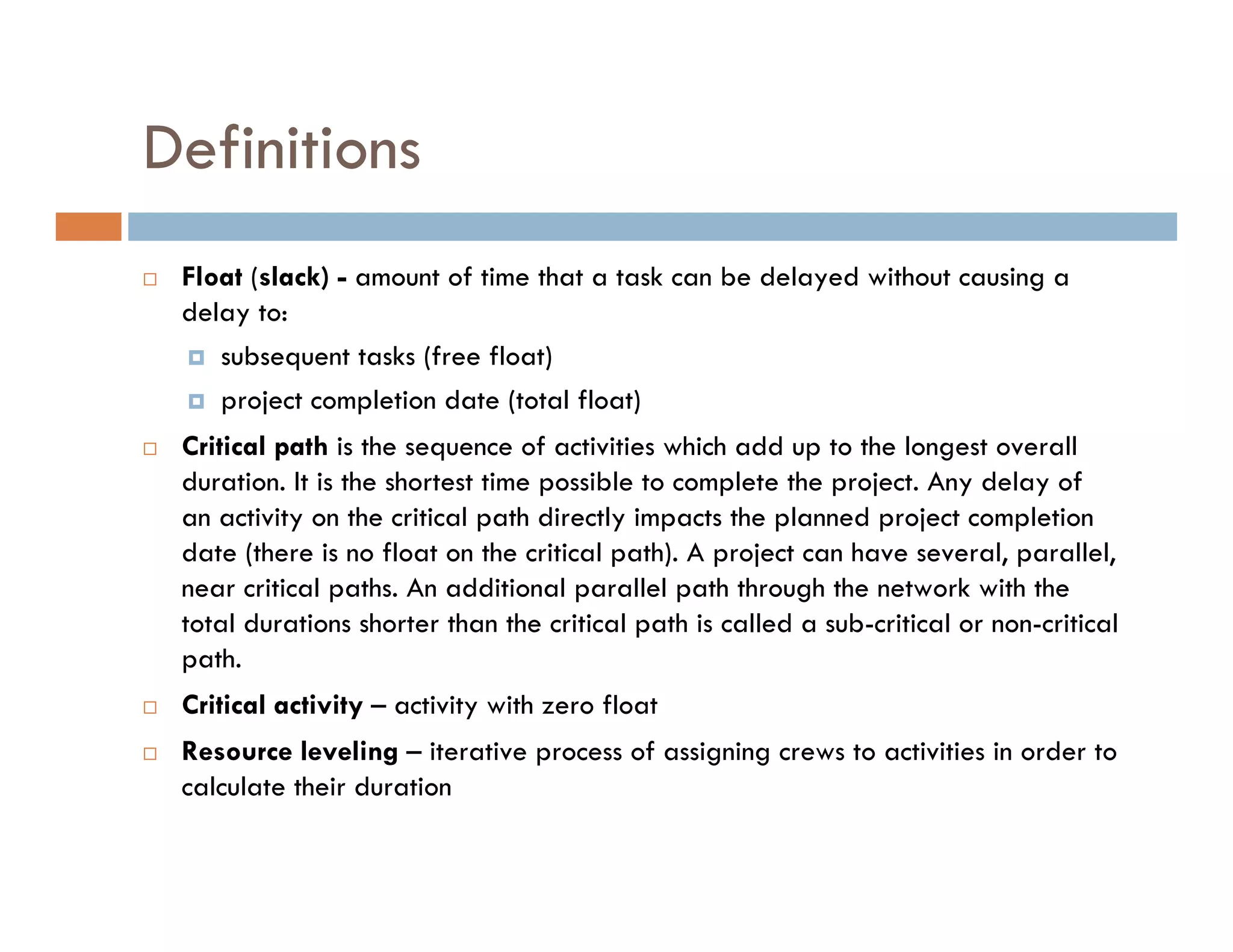
 Float (slack) - amount of time that a task can be delayed without causing a
 delay to:
    subsequent tasks (free float)
    project completion date (total float)
 Critical path is the sequence of activities which add up to the longest overall
 duration. It is the shortest time possible to complete the project. Any delay of
 an activity on the critical path directly impacts the planned project completion
 date (there is no float on the critical path). A project can have several, parallel,
 near critical paths. An additional parallel path through the network with the
 total durations shorter than the critical path is called a sub-critical or non-critical
 path.
 Critical activity – activity with zero float
 Resource leveling – iterative process of assigning crews to activities in order to
 calculate their duration
Definitions

Activity Identity box

        Early Start                 Early Finish
           (ES)                         (EF)


                      Activity ID

         Late Start                 Late Finish
            (LS)        Duration
                                       (LF)
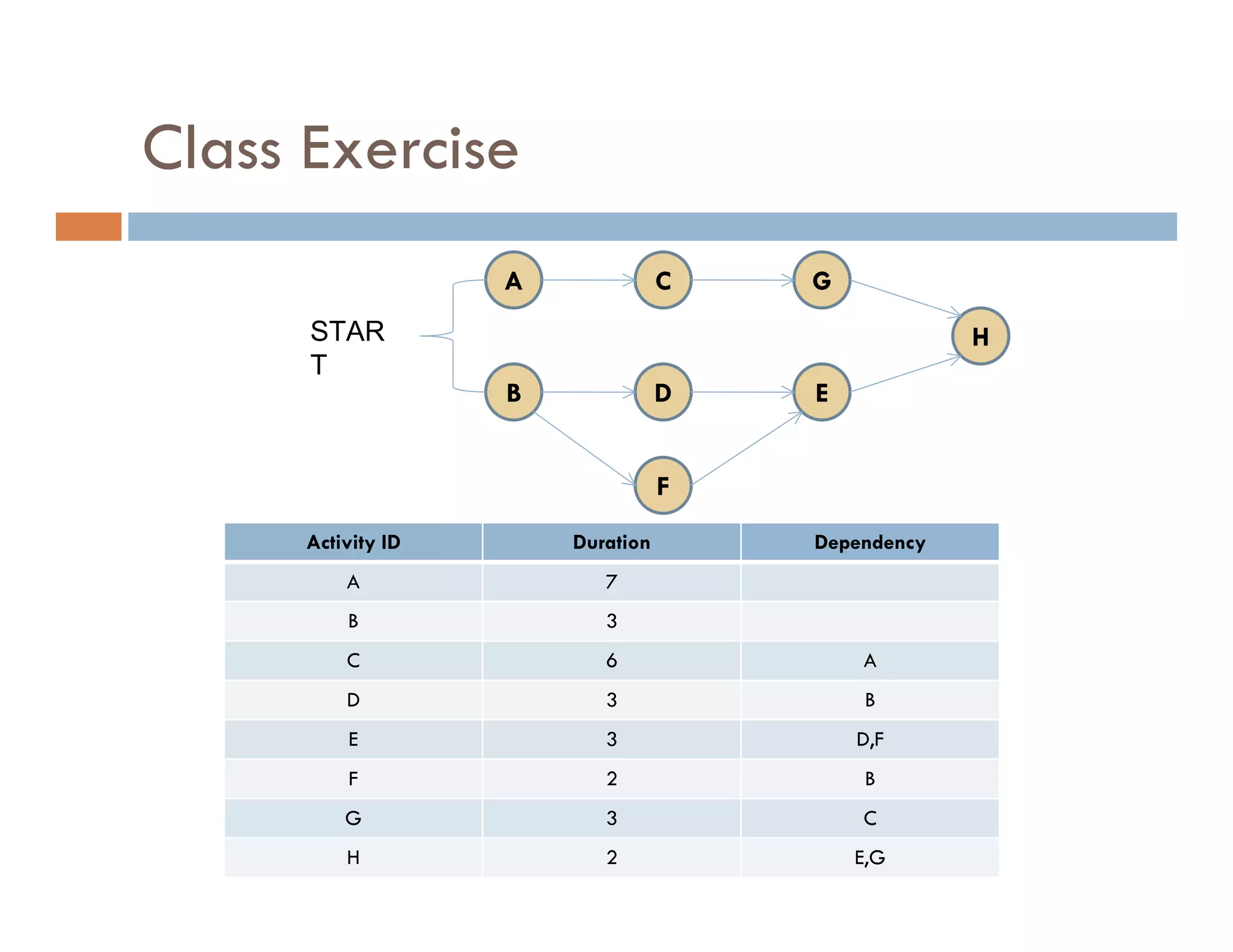
Class Exercise
                    A              C   G
      STAR                                          H
      T
                    B              D   E


                                   F
      Activity ID       Duration       Dependency
          A                7
          B                3
          C                6               A
          D                3               B
          E                3               D,F
          F                2               B
          G                3               C
          H                2               E,G
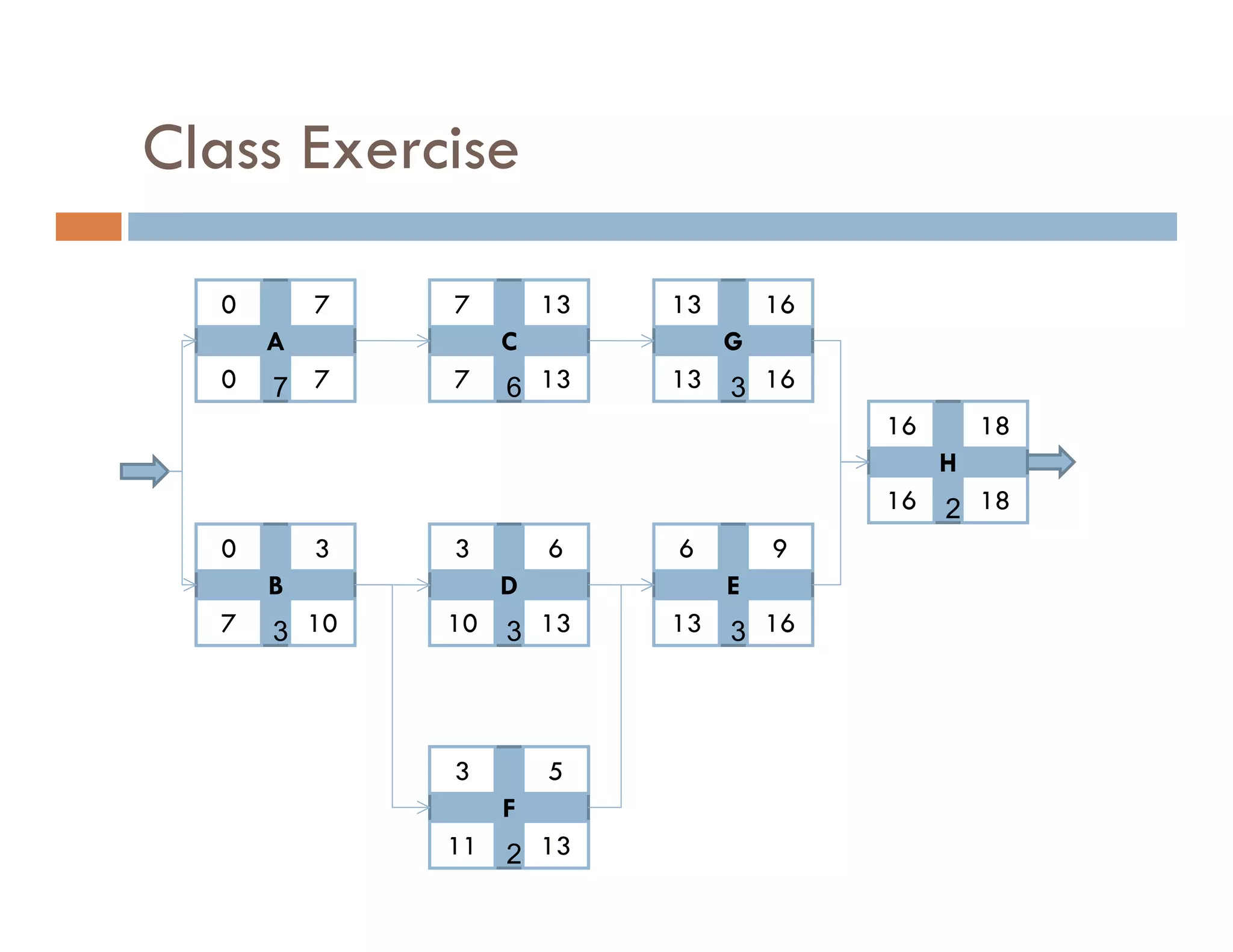
Class Exercise

  0       7   7        13   13       16
      A            C             G
  0   7 7     7    6 13     13   3 16
                                          16       18
                                               H
                                          16   2 18
  0       3   3        6    6        9
      B            D             E
  7   3 10    10   3 13     13   3 16


              3        5
                   F
              11   2 13
Class Exercise

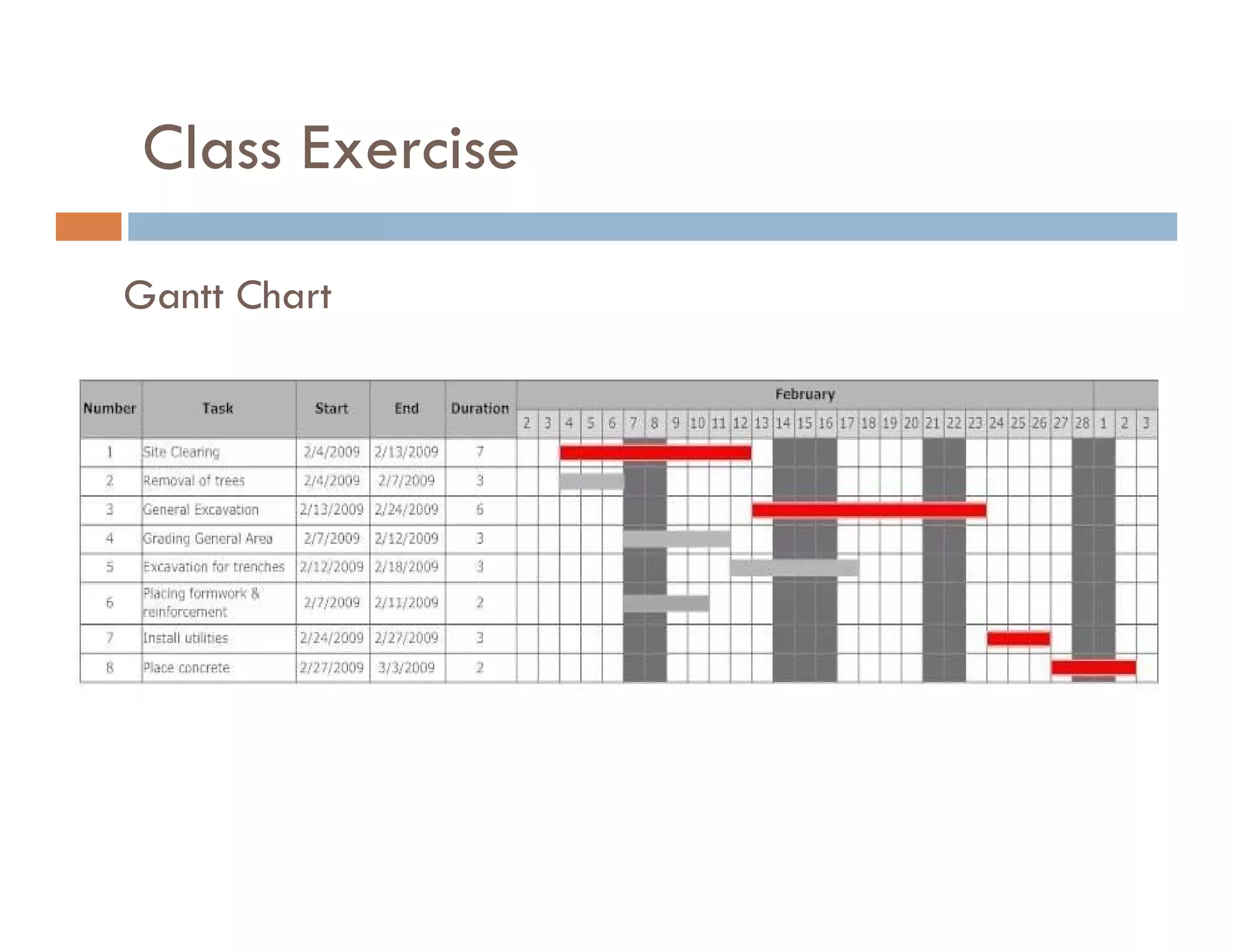
Gantt Chart
Summary

 Critical Path Analysis is an effective and powerful method of
 assessing:
    Tasks which must be carried out
    Where parallel activity can be carried out
    The shortest time in which a project can be completed
    Resources needed to achieve a project
    The sequence of activities, scheduling, and timings involved
    Task priorities
References
 Fondahl, John W., “Non-Computer Approach to the Critical Path Method for
 the Construction Industry”, Report #9, Stanford University, 1961
 Fondahl, John W. “The History of Modern Project Management –
 Precedence Diagramming Methods: Origins and Early Development”.
 Project Management Journal. Volume XVIII. No. 2. June 1987.
 Hendrickson, Chris & Au, Tung, Project Management for Construction,
 Prentice Hall, 1989
 Weber, Sandra C., Scheduling Construction Projects: Principles and Practices,
 Prentice Hall, 2005
Questions???

Cpm (critical path method)

  • 1.
    CRITICAL PATH METHOD (CEE 320 – VDC SEMINAR) 4 February 2009 Jesse Santiago & Desirae Magallon
  • 2.
    Overview Background &History CPM Defined The CPM approach Definitions Class Exercise
  • 3.
    Background & History Developed in the 1950s by the US Navy Originally, the critical path method considered only logical dependencies between terminal elements Since then, it has been expanded to allow for the inclusion of resources related to each activity, through processes called activity-based resource assignments and resource leveling. Critical Path Method for the construction industry Non-computer approach John Fondahl
  • 4.
    John Fondahl StanfordCE Professor Emeritus – 35 years Passed away last September 13th, 2008 US Marine Corps Sergeant in Iwo Jima His father was USMC LtCol Co-founder of the CEM program 1961 Paper for the US Navy – "Non-Computer Approach to the Critical Path Method for the Construction Industry"
  • 5.
    What is CPM? The Critical Path Method or Critical Path Analysis, is a mathematically based algorithm for scheduling a set of project activities It is an important tool for effective project management Commonly used with all forms of projects, including construction, software development, research projects, product development, engineering, and plant maintenance, among others Any project with interdependent activities can apply this method of scheduling
  • 6.
    What is CPM? The essential technique for using CPM is to construct a model of the project that includes the following: A list of all activities required to complete the project (also known as Work Breakdown Structure) The time (duration) that each activity will take to completion The dependencies between the activities.
  • 7.
    What is CPM? CPM calculates The longest path of planned activities to the end of the project The earliest and latest that each activity can start and finish without making the project longer Determines “critical” activities (on the longest path) Prioritize activities for the effective management and to shorten the planned critical path of a project by: Pruning critical path activities “Fast tracking" (performing more activities in parallel) “Crashing the critical path" (shortening the durations of critical path activities by adding resources)
  • 8.
    The CPM Approach Phase I Break project into operations necessary for completion Determine sequential relationship of operations Every operation must have event to mark commencement – i.e. completion of preceding operation Can operations overlap?
  • 9.
    The CPM Approach Phase II Create time estimates for each operation Determine earliest possible start date, earliest possible finish date , latest start & finish Determine “free float” and “total float” Revised after completion of Phase III
  • 10.
    The CPM Approach Phase III Establish time-cost relationship Establish scheduling variations Determine most favorable balance between time-cost Normal Start – normal time, least cost All-Crash Start – least time, higher cost
  • 11.
  • 12.
    Definitions Float (slack)- amount of time that a task can be delayed without causing a delay to: subsequent tasks (free float) project completion date (total float) Critical path is the sequence of activities which add up to the longest overall duration. It is the shortest time possible to complete the project. Any delay of an activity on the critical path directly impacts the planned project completion date (there is no float on the critical path). A project can have several, parallel, near critical paths. An additional parallel path through the network with the total durations shorter than the critical path is called a sub-critical or non-critical path. Critical activity – activity with zero float Resource leveling – iterative process of assigning crews to activities in order to calculate their duration
  • 13.
    Definitions Activity Identity box Early Start Early Finish (ES) (EF) Activity ID Late Start Late Finish (LS) Duration (LF)
  • 14.
    Class Exercise A C G STAR H T B D E F Activity ID Duration Dependency A 7 B 3 C 6 A D 3 B E 3 D,F F 2 B G 3 C H 2 E,G
  • 15.
    Class Exercise 0 7 7 13 13 16 A C G 0 7 7 7 6 13 13 3 16 16 18 H 16 2 18 0 3 3 6 6 9 B D E 7 3 10 10 3 13 13 3 16 3 5 F 11 2 13
  • 16.
  • 17.
    Summary Critical PathAnalysis is an effective and powerful method of assessing: Tasks which must be carried out Where parallel activity can be carried out The shortest time in which a project can be completed Resources needed to achieve a project The sequence of activities, scheduling, and timings involved Task priorities
  • 18.
    References Fondahl, JohnW., “Non-Computer Approach to the Critical Path Method for the Construction Industry”, Report #9, Stanford University, 1961 Fondahl, John W. “The History of Modern Project Management – Precedence Diagramming Methods: Origins and Early Development”. Project Management Journal. Volume XVIII. No. 2. June 1987. Hendrickson, Chris & Au, Tung, Project Management for Construction, Prentice Hall, 1989 Weber, Sandra C., Scheduling Construction Projects: Principles and Practices, Prentice Hall, 2005
  • 19.