Chapter 12 Critical Path Analysis


12 CRITICAL
   PATH
   ANALYSIS
Objectives
After studying this chapter you should
•   be able to construct activity networks;
•   be able to find earliest and latest starting times;
•   be able to identify the critical path;
•   be able to translate appropriate real problems into a suitable
    form for the use of critical path analysis.


12.0 Introduction
A complex project must be well planned, especially if a number
of people are involved. It is the task of management to
undertake the planning and to ensure that the various tasks
required in the project are completed in time.

Operational researchers developed a method of scheduling
complex projects shortly after the Second World War. It is
sometimes called network analysis, but is more usually known
as critical path analysis (CPA). Its virtue is that it can be
used in a wide variety of projects, and was, for example,
employed in such diverse projects as the Apollo moonshot, the
development of Concorde, the Polaris missile project and the
privatisation of the electricity and water boards. Essentially,
CPA can be used for any multi-task complex project to ensure
that the complete scheme is completed in the minimum time.

Although its real potential is for helping to schedule complex
projects, we will illustrate the use of CPA by applying it to
rather simpler problems. You will often be able to solve these
problems without using CPA, but it is an understanding of the
concepts involved in CPA which is being developed here.


                                                                                                 189
Chapter 12 Critical Path Analysis


12.1 Activity networks
In order to be able to use CPA, you first need to be able to form
what is called an activity network. This is essentially a way of
illustrating the given project data concerning the tasks to be
completed, how long each task takes and the constraints on the
order in which the tasks are to be completed. As an example,
consider the activities shown below for the construction of a
garage.

                 activity                      duration (in days)

      A    prepare foundations                         7
      B    make and position door frame                2
      C    lay drains, floor base and screed          15
      D    install services and fittings               8
      E    erect walls                                10
      F    plaster ceiling                             2
      G    erect roof                                  5
      H    install door and windows                    8
      I    fit gutters and pipes                       2
      J    paint outside                               3


Clearly, some of these activities cannot be started until other
activities have been completed. For example
          activity G - erect roof
cannot begin until
          activity E - erect walls
has been completed. The following table shows which activities
must precede which.
          D must follow E
          E must follow A and B
          F must follow D and G
          G must follow E
          H must follow G
          I   must follow C and F
          J   must follow I.

We call these the precedence relations.


190
Chapter 12 Critical Path Analysis

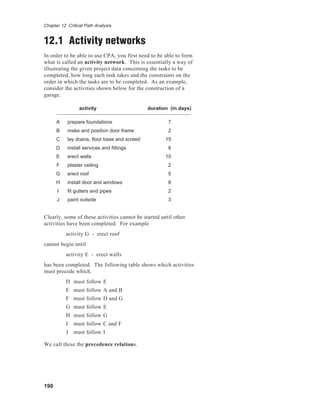
All this information can be represented by the network shown
below.


                                                               5
                              A                    G                   H
                                             10
                                     7
                  0                                        5                           8
                                         E

                                     2            10
                      0                                    8               2       2                  3
          Start               B                        D           F           I            J             Finish


                                                           15
                      0

                              C


In this network
    each activity is represented by a vertex;

    joining vertex X to vertex Y shows that
    activity X must be completed before Y can be started;

    the number marked on each arc shows the duration of the
    activity from which the arc starts.
Note the use of 'arc' here to mean a directed edge.
Sometimes we can easily form the activity network, but not
always, so we need to have a formal method. First try the
following activity.


Activity 1                Making a settee
A furniture maker is going to produce a new wooden framed
settee with cloth-covered foam cushions. These are the tasks
that have to be done by the furniture maker and his assistants
and the times they will take :
                          activity                         time in days

      A       make wooden arms and legs                            3
      B       make wooden back                                     1
      C       make wooden base                                     2
      D       cut foam for back and base                           1
      E       make covers                                          3
      F       fit covers                                           1
      G       put everything together                              1

Each activity can only be undertaken by one individual.

                                                                                                                       191
Chapter 12 Critical Path Analysis


The following list gives the order in which the jobs must be done:
               B must be after                       C
               A must be after                       B and C
               D must be after                       B and C
               E must be after                       D
               F must be after                       E
               G must be after                       A, B, C, D, E and F
Construct an appropriate activity network to illustrate this
information.


12.2 Algorithm for constructing
     activity networks
For simple problems it is often relatively easy to construct activity
networks but, as the complete project becomes more complex, the
need for a formal method of constructing activity networks
increases. Such an algorithm is summarised below.
For simple problems it is often easy to construct activity networks, but as the complete project becomes more
complex, the need for a formal method of constructing activity networks increases. Such an algorithm is         Original   Shadow
summarised below.
                                                                                                                vertices   vertices
    Start        Write down the original vertices and then a second copy
                 of them alongside, as illustrated on the right. If activity                                      A             A
                 Y must follow activity X draw an arc from original                                               B             B
                                                                                                                  C   .     .   C
                 vertex Y to shadow vertex X. (In this way you construct                                              .
                                                                                                                      .     .
                                                                                                                            .
                 a bipartite graph.)                                                                                  .
                                                                                                                      .     .
                                                                                                                            .
                                                                                                                  X             X
                                                                                                                  Y             Y
    Step 1 Make a list of all the original vertices which have no arcs
           incident to them.

    Step 2 Delete all the vertices found in Step 1 and their
           corresponding shadow vertices and all arcs incident to
           these vertices.

    Step 3 Repeat Steps 1 and 2 until all the vertices have been
           used.


The use of this algorithm will be illustrated using the first case
study, constructing a garage, from Section 12.1.


192
Chapter 12 Critical Path Analysis

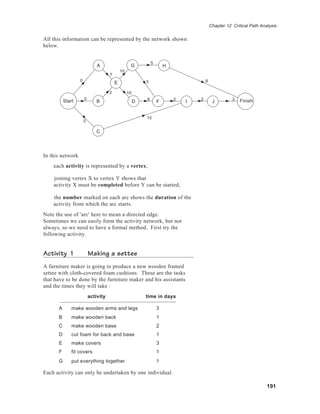
The precedence relations are:
         D must follow E                                               A                  A
         E must follow A and B                                         B                  B
         F must follow D and G                                         C                  C
                                                                       D                  D
         G must follow E                                               E                  E
         H must follow G                                               F                  F
         I   must follow C and F                                       G                  G
                                                                       H                  H
         J   must follow I                                             I                  I
These are illustrated opposite.                                        J                  J


Applying the algorithm until all vertices have been chosen is shown
below.

  Step 1 - original vertices with no arcs                                     A, B, C

  Step 2 - delete all arcs incident on A, B, C and redraw as           D                  D
           shown                                                       E                  E
                                                                       F                  F
  Step 3 - repeat iteration                                            G                  G
                                                                       H                  H
                                                                       I                  I
                                                                       J                  J

  Step 1 - original vertices with no arcs                                        E

  Step 2 - delete all arcs incident on E and redraw as shown           D                  D
                                                                       F                  F
  Step 3 - repeat iteration                                            G                  G
                                                                       H                  H
                                                                       I                  I
                                                                       J                  J


  Step 1 - original vertices with no arcs                                      D, G

  Step 2 - delete all arcs incident on D, G and redraw as shown        F                  F
                                                                       H                  H
  Step 3 - repeat iteration                                            I                  I
                                                                       J                  J


  Step 1 - original vertices with no arcs                                      F, H

  Step 2 - delete all arcs incident on F, H and redraw as shown         I                 I
                                                                        J                 J
  Step 3 - repeat iteration


  Step 1 - original vertices with no arcs                                        I

  Step 2 - delete all arcs incident on I and redraw as shown            J                 J

                                                                                                  193
Chapter 12 Critical Path Analysis


   Step 3 - stop as all vertices have been chosen


So the vertices have been chosen in the following order:

       A
                                  D             F
       B                E                                       I             J
                                  G             H
       C


The activity diagram as shown belowcan now be drawn.


Iterations                  1st           2nd             3rd           4th           5th           6th
                                                                    8
                            A                             D             F

                0                               10
                                    7                                             2
                                                                5

                    0                 2                                                         2         3
      Start                 B              E                                          I              J        Finish
                                                     10

                    0                                               5                       8
                                                          G             H

                            C
                                                    15


From the 'start' vertex, draw arcs to A, B and C, the first
iteration vertices, putting zero on each arc. In the original
bipartite graph the shadow vertex A was joined to the original
vertex E - so join A to E. Similarly join B to E and C to I.

Indicate the duration of the activity on any arc coming from the
vertex representing the activity.

Continue in this way and complete the activity network with a
'finish' vertex into which any free vertices lead, again indicating
the duration of the activity on the arc.

Note that the duration of the activity is shown on every arc
coming from the vertex representing the activity. (So, for
example, arc ED and arc EG are both given 10.)


194
Chapter 12 Critical Path Analysis


Exercise 12A
1. Use the algorithm to find the activity network for      The following chart shows the order of doing the
   the problem in Activity 1.                              jobs.
2. Suppose you want to redecorate a room and put               B must be after A
   in new self-assembly units. These are the jobs              C must be after A
   that need to be done, together with the time each
   takes:                                                      D must be after A
                          time                                 E must be after D
       activity         (in hrs)    preceded by                F must be after D and E
                                                               G must be after D and E
   paint woodwork (A)       8             -
                                                               H must be after A, B, C, D, E, F and G
   assemble units (B)       4             -
                                                           Draw an activity network to show this
   fit carpet (C)           5      hang wallpaper
                                   paint woodwork
                                                           information.

   hang wallpaper (D)       12     paint woodwork       4. An extension is to be built to a sports hall.
                                                           Details of the activities are given below.
   hang curtains (E)        2      hang wallpaper
                                   paint woodwork                                                  time
                                                               activity                         (in days)
   Complete an activity network for this problem.
3. The Spodleigh Bicycle Company is getting its            A lay foundations                        7
   assembly section ready for putting together as          B build walls                           10
   many bicycles as possible for the Christmas
   market. This diagram shows the basic                    C lay drains and floor                  15
   components of a bicycle.                                D install fittings                       8
                                                           E   make and fit door frames             2
                                                           F   erect roof                           5
                                                           G plaster ceiling                        2
                                                           H fit and paint doors and windows        8
                                                           I   fit gutters and pipes                2

                                                           J   paint outside                        3

                                                           Some of these activities cannot be started until
                                                           others have been completed:

   Putting together a bicycle is split up into small           B must be after C
   jobs which can be done by different people.
                                                               C must be after A
   These are:
                                                time           D must be after B
           activity                            (mins)          E must be after C

   A preparation of the frame                     9
                                                               F must be after D and E
                                                               G must be after F
   B mounting and aligning the front wheel        7
                                                               H must be after G
   C mounting and aligning the back wheel         7
                                                               I must be after F
   D attaching the chain wheel to the crank       2
                                                               J must be after H
   E attaching the chain wheel and crank
                                                           Complete an activity network for this problem.
     to the frame                                 2
   F   mounting the right pedal                   8
   G mounting the left pedal                      8
   H final attachments such as saddle,
     chain, stickers, etc.                       21


                                                                                                            195
Chapter 12 Critical Path Analysis


12.3 Critical path
You have seen how to construct an activity network. In this
section you will see how this can be used to find the critical
path. This will first involve finding the earliest possible start
for each activity, by going forwards through the network.
Secondly, the latest possible start time for each activity is found
by going backwards through the network. Activities which
have equal earliest and latest start time are on the critical path.
The technique will be illustrated using the 'garage construction'
problem from Sections 12.1 and 12.2.

The activity network for this problem is shown below, where
sufficient space is made at each activity node to insert two
numbers.

                      A                           D            F
                      0                                    8


              0                           10
                               7                                        2
                      B             E                  5                                        Finish
                                                                            I           J
                  0   0         2                                                   2       3
    Start
                                            10    G            H
                  0                                        5                    8
                      C
                      0
                                           15


The numbers in the top half of each circle will indicate the
earliest possible starting time. So, for activities A, B and C, the
number zero is inserted.

Moving forward through the network, the activity E is reached
next. Since both A and B have to be completed before E can be
started, the earliest start time for E is 7. This is put into the top
half of the circle at E. The earliest times at D and G are then
both 17, and for H, 22. Since F cannot be started until both D
and G are completed, its earliest start time is 25, and
consequently, 27 for I. The earliest start time for J is then 29,
which gives an earliest completion time of 32.


196
Chapter 12 Critical Path Analysis


                        A                                 D                F
                        0                                 17       8       25


            0                                  10
                                7                                                2
                        B                 E                    5                                                    Finish
                                                                                     I                  J
                0       0       2         7                                          27            2    29     3     32
   Start
                                                                                                                     32
                                                 10       G                H
                 0                                        17       5       22                  8
                        C
                        0
                                                15

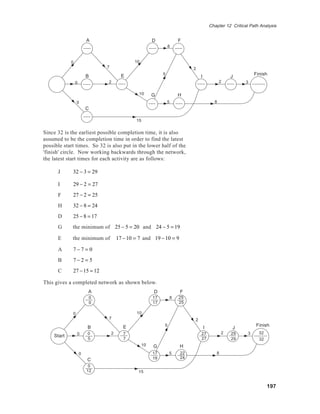
Since 32 is the earliest possible completion time, it is also
assumed to be the completion time in order to find the latest
possible start times. So 32 is also put in the lower half of the
'finish' circle. Now working backwards through the network,
the latest start times for each activity are as follows:

      J      32 − 3 = 29

      I      29 − 2 = 27
      F      27 − 2 = 25
      H      32 − 8 = 24
      D      25 − 8 = 17
      G      the minimum of 25 − 5 = 20 and 24 − 5 = 19

      E      the minimum of             17 − 10 = 7 and 19 − 10 = 9

      A      7−7= 0
      B      7−2 = 5
      C      27 − 15 = 12

This gives a completed network as shown below.
                            A                              D                F
                            0                             17           8   25
                            0                             17               25

             0                                  10
                                7                                                2
                        B                  E                   5                                                    Finish
                                                                                         I               J
                 0      0           2      7                                         27             2   29      3     32
    Start
                        5                  7                                         27                 29            32
                                                     10    G                H
                    0                                     17       5        22                  8
                                                          19                24
                        C
                         0
                        12                       15


                                                                                                                           197
Chapter 12 Critical Path Analysis


The vertices with equal earliest and latest starting times define
the critical path. This is clearly seen to be

                         A E D F I J.

Another way of identifying the critical path is to define the

          float time = latest start time − earliest start time.

The information for the activities can now be summarised in the
table below.

                        start times
   activity       earliest       latest       float

      A              0               0         0           ←
      B              0               5         5
      C              0              12        12
      E              7               7         0           ←
      D             17              17         0           ←
      G             17              19         2
      F
                    25
                                    25
                                               0           ←
      H             22              24         2
      I             27              27         0           ←
      J             29              29         0           ←


So now you know that if there are enough workers the job can
be completed in 32 days. The activities on the critical path (i.e.
those with zero float time) must be started punctually; for
example, A must start immediately, E after 7 days, F after 25
days, etc. For activities with a non-zero float time there is scope
for varying their start times; for example activity G can be
started any time after 17, 18 or 19 days' work. Assuming that all
the work is completed on time, you will see that this does indeed
give a working schedule for the construction of the garage in the
minimum time of 32 days. However it does mean, for example,
that on the 18th day activities D and C will definitely be in
progress and G may be as well. The solution could well be
affected if there was a limit to the number of workers available,
but you will consider that sort of problem in the next chapter.

Is a critical path always uniquely defined?


198
Chapter 12 Critical Path Analysis

Activity 2                         Bicycle construction
From the activity network for Question 3 in Exercise 12A find
the critical path and the possible start times for all the activities
in order to complete the job in the shortest possible time.


Exercise 12B
1. Find the critical paths for each of the activity
   networks shown below.

                                                             1                2
       (a)                                          C                 E               H
                                           11                    1                        2

               0           7                            11                        5                   4
   Start           A               B                                  F                       I            Finish


                                       7                         10                   3
                                                                                                                                                    5
                                                                                                            (c)                            B                E
                                                    D                 G
                                                             10
                                                                                                                                 10
                                                                                                                                                        7       4


                                                                 8                                                       0            10                    7               6
       (b)                                  B                                 E
                                                                                                             Start           A             C                        G             Finish

                                                                                                                                                        7           8
                               5                                      5                                                               10
                                                         8                                12
                                                                                                                                           D                F
                   0                                                                                  3                                             3
       Start           A                                     D                                    G       Finish

                                                    7
                                   5                                      5               11


                                                C                             F
                                                                 7


2. Find the critical path for the activity network in                                                               K decide on musical                                 1 week
   Question 4, Exercise 12A.
                                                                                                                    L   organise lighting                               1 week
3. Your local school decides to put on a musical.
                                                                                                                    M dress rehearsals                                  2 days
   These are the many jobs to be done by the
   organising committee, and the times they take:                                                                   N invite local radio/press                          1 day
                                                                                                                    P choose stage hands                                1 day
   A make the costumes                                                                6 weeks
                                                                                                                    Q choose programme sellers                          1 day
   B rehearsals                                                                   12 weeks
                                                                                                                                                                        1
   C get posters and tickets printed                                                  3 weeks                       R choose performance dates                          2
                                                                                                                                                                            day
                                                                                                                                                                        1
   D get programmes printed                                                           3 weeks                       S arrange seating                                   2
                                                                                                                                                                            day
   E make scenery and props                                                           7 weeks                       T   sell tickets                                last 4 weeks
   F     get rights to perform the musical                                            2 weeks                       V display posters                               last 3 weeks
   G choose cast                                                                      1 week
   H hire hall                                                                        1 week                        (a) Decide on the precedence relationships.
   I     arrange refreshments                                         1 week                                        (b) Construct the activity network.
   J     organise make-up                                                             1 week                        (c) Find the critical path and minimum
                                                                                                                        completion time.


                                                                                                                                                                                  199
Chapter 12 Critical Path Analysis


12.4 Miscellaneous Exercises
1. Consider the following activity network, in                           3. A project consists of eight activities whose
   which the vertices represent activities and the                          durations are as follows:
   numbers next to the arcs represent time in days.
                                                                            activity          A   B    C   D   E   F   G   H
                                8
                    A                            G
           0                                 2         3                    duration          4    4   3   5   4   1   6    5
                        3       D
            0                                          4                    The precedence relations are as follows:
  Start             B                    2       H              Finish
                            3                3
                0               E
                                                                                B must follow A
                    C   4                        9                              D must follow A and C
                        4       F                                               F must follow C and E
                                                                                G must follow C and E
    (a) Assuming that an unlimited number of
                                                                                H must follow B and D.
        workers is available, write down:
                                                                            (a) Draw an activity network in which the
          (i) the minimum completion time of the
                                                                                activities are represented by vertices.
              project;
                                                                            (b) Find a critical path by inspection, and write
          (ii)the corresponding critical path.
                                                                                down the earliest and latest starting times for
    (b) Find the float time of activity E.                                      each activity.
2. A project consists of ten activities, A-J. The                        4. The eleven activities A to K which make up a
   duration (in days) of each activity, and the                             project are subject to the following precedence
   activities preceding each of them, are as follows:                       relations.

                                                     preceding                 preceding
          activity              duration             activities                activities          activity            duration

                                                                                 C, F, J               A                   7
                A                   10                     -
                                                                                   E                   B                   6
                B                   4                      -
                                                                                    -                  C                   9
                C                   8                      B
                                                                                  B, H                 D                   7
                D                   6                      C
                                                                                  C, J                 E                   3
                E                   8                      I
                                                                                    -                  F                   8
                F                   5                      -
                                                                                  A, I                 G                   4
                G                   10                 A, D
                                                                                    J                  H                   9
                H                   2                      G
                                                                                  E, F                 I                   9
                I                   4                      -
                                                                                    -                  J                   7
                J                   10                D, F, I
                                                                                 B, H, I               K                   5

    Using the algorithms in Section 12.2,                                   (a) Construct an activity network for the project.
    (a) construct an activity network for this project;
                                                                            (b) Find:
    (b) find a critical path in this activity network;
                                                                                (i) the earliest starting time of each activity
    (c) find the latest starting time for each activity.                            in the network;
                                                                                (ii) the latest starting time of each activity.
                                                                            (c) Calculate the float of each activity, and
                                                                                hence determine the critical path.


200
Chapter 12 Critical Path Analysis

5. The activities needed to replace a broken                                                             duration preceding
   window pane are given below.                                               activity                   (in days) activities

                                       duration preceding              A      prepare site                  2           -
           activity                    (in mins) activities
                                                                       B      build retaining wall for      3          A
                                                                              patio
    A      order glass                      10           -
                                                                       C      lay patio * (see below)       4          A
    B      collect glass                    30           A
                                                                       D      lay lawn                      1          A
    C      remove broken pane               15          B, D
                                                                       E      lay paths                     3         AB
    D      buy putty                        20           -
                                                                       F      erect pergola,                1       ABDG
    E      put putty in frame                   3        C
                                                                              trellis, etc.
    F      put in new pane                      2        E
                                                                       G      prepare flower                1        ABD
    G      putty outside and smooth 10                   F                    beds and border
    H      sweep up broken glass                5        C             H      plant out                     3       ABDG
    I      clean up                             5       all            I      clean up                      1          all
                                                                       * Note also that the patio cannot begin to be laid
   (a) Construct an activity network.
                                                                       until 2 days after the start of the building of the
   (b) What is the minimum time to complete the                        retaining wall.
       replacement?                                                    (a) Construct an activity network for this
   (c) What is the critical path?                                          problem.

6. Write the major activities, duration time and                       (b) Find the earliest and latest start time for each
   precedence relationship for a real life project                         activity, state the minimum time for
   with which you are involved. Use the methods                            completion of the work and identify the
   in this chapter to find the critical path for your                      critical path.
   project.                                                            (c) Which activities have the greatest float time?
7. Consider the following activity network, in
                                                                                                                       (AEB)
   which the vertices represent activities and the
   the numbers next to the arcs represent time in                  9. At 4.30 pm one day the BBC news team hear of a
   weeks:                                                             Government Minister resigning. They wish to
                                                                      prepare an item on the event for that evening's
                                   6
                    A                               G                 6 o'clock news. The table below lists the jobs
            0                               4            2
                                   D                                  needed to prepare this news item, the time each
                         2
   Start
            0
                                        4                3
                                                               Finish
                                                                      job takes and the constraints on when the work
                    B                               H
                               2            5
                                                                      can commence.
                0                  E
                           4                        7
                                                                                          Time needed           Constraints
                    C
                                                                           Job              (in minutes)
                           4       F
                                                                   A       Interview the              15    Starts at 4.30 pm
   (a) Write down the minimum completion time of                           resigning Minister
       the project, if an unlimited number of                      B       Film Downing St.           20    None
       workers is available, and the corresponding
       critical path.                                              C       Get reaction from           25   Cannot start until
                                                                           regions                          A and B are
   (b) Find the float times of activities D and B.                                                          completed
                                                                   D       Review possible            40    Cannot start until
8. A firm of landscape gardeners is asked to quote                         replacements                     B is completed
   for constructing a garden on a new site. The
   activities involved are shown in the table.                     E       Review the Minister's      25    Cannot start until
                                                                           career                           A is completed
                                                                   F       Prepare film for           20    Cannot start until
                                                                           archives                         C and E are
                                                                                                            completed
                                                                   G       Edit                       20    Cannot start until
                                                                                                            A, B, C, D, E and
                                                                                                            F are completed


                                                                                                                             201
Chapter 12 Critical Path Analysis

    (a) Construct an activity network for this         (b) If each of the jobs A, B, C, D, E and F needs
        problem and, by finding the critical path in       a reporter, and once a reporter has started a
        your network, show that the news item can be       job that same reporter alone must complete
        ready before 6.00 pm that day.                     it; explain how three reporters can have the
                                                           news item ready before 6.00 pm, but that two
                                                           reporters cannot.                       (AEB)


202

04 b50d01

  • 1.
    Chapter 12 CriticalPath Analysis 12 CRITICAL PATH ANALYSIS Objectives After studying this chapter you should • be able to construct activity networks; • be able to find earliest and latest starting times; • be able to identify the critical path; • be able to translate appropriate real problems into a suitable form for the use of critical path analysis. 12.0 Introduction A complex project must be well planned, especially if a number of people are involved. It is the task of management to undertake the planning and to ensure that the various tasks required in the project are completed in time. Operational researchers developed a method of scheduling complex projects shortly after the Second World War. It is sometimes called network analysis, but is more usually known as critical path analysis (CPA). Its virtue is that it can be used in a wide variety of projects, and was, for example, employed in such diverse projects as the Apollo moonshot, the development of Concorde, the Polaris missile project and the privatisation of the electricity and water boards. Essentially, CPA can be used for any multi-task complex project to ensure that the complete scheme is completed in the minimum time. Although its real potential is for helping to schedule complex projects, we will illustrate the use of CPA by applying it to rather simpler problems. You will often be able to solve these problems without using CPA, but it is an understanding of the concepts involved in CPA which is being developed here. 189
  • 2.
    Chapter 12 CriticalPath Analysis 12.1 Activity networks In order to be able to use CPA, you first need to be able to form what is called an activity network. This is essentially a way of illustrating the given project data concerning the tasks to be completed, how long each task takes and the constraints on the order in which the tasks are to be completed. As an example, consider the activities shown below for the construction of a garage. activity duration (in days) A prepare foundations 7 B make and position door frame 2 C lay drains, floor base and screed 15 D install services and fittings 8 E erect walls 10 F plaster ceiling 2 G erect roof 5 H install door and windows 8 I fit gutters and pipes 2 J paint outside 3 Clearly, some of these activities cannot be started until other activities have been completed. For example activity G - erect roof cannot begin until activity E - erect walls has been completed. The following table shows which activities must precede which. D must follow E E must follow A and B F must follow D and G G must follow E H must follow G I must follow C and F J must follow I. We call these the precedence relations. 190
  • 3.
    Chapter 12 CriticalPath Analysis All this information can be represented by the network shown below. 5 A G H 10 7 0 5 8 E 2 10 0 8 2 2 3 Start B D F I J Finish 15 0 C In this network each activity is represented by a vertex; joining vertex X to vertex Y shows that activity X must be completed before Y can be started; the number marked on each arc shows the duration of the activity from which the arc starts. Note the use of 'arc' here to mean a directed edge. Sometimes we can easily form the activity network, but not always, so we need to have a formal method. First try the following activity. Activity 1 Making a settee A furniture maker is going to produce a new wooden framed settee with cloth-covered foam cushions. These are the tasks that have to be done by the furniture maker and his assistants and the times they will take : activity time in days A make wooden arms and legs 3 B make wooden back 1 C make wooden base 2 D cut foam for back and base 1 E make covers 3 F fit covers 1 G put everything together 1 Each activity can only be undertaken by one individual. 191
  • 4.
    Chapter 12 CriticalPath Analysis The following list gives the order in which the jobs must be done: B must be after C A must be after B and C D must be after B and C E must be after D F must be after E G must be after A, B, C, D, E and F Construct an appropriate activity network to illustrate this information. 12.2 Algorithm for constructing activity networks For simple problems it is often relatively easy to construct activity networks but, as the complete project becomes more complex, the need for a formal method of constructing activity networks increases. Such an algorithm is summarised below. For simple problems it is often easy to construct activity networks, but as the complete project becomes more complex, the need for a formal method of constructing activity networks increases. Such an algorithm is Original Shadow summarised below. vertices vertices Start Write down the original vertices and then a second copy of them alongside, as illustrated on the right. If activity A A Y must follow activity X draw an arc from original B B C . . C vertex Y to shadow vertex X. (In this way you construct . . . . a bipartite graph.) . . . . X X Y Y Step 1 Make a list of all the original vertices which have no arcs incident to them. Step 2 Delete all the vertices found in Step 1 and their corresponding shadow vertices and all arcs incident to these vertices. Step 3 Repeat Steps 1 and 2 until all the vertices have been used. The use of this algorithm will be illustrated using the first case study, constructing a garage, from Section 12.1. 192
  • 5.
    Chapter 12 CriticalPath Analysis The precedence relations are: D must follow E A A E must follow A and B B B F must follow D and G C C D D G must follow E E E H must follow G F F I must follow C and F G G H H J must follow I I I These are illustrated opposite. J J Applying the algorithm until all vertices have been chosen is shown below. Step 1 - original vertices with no arcs A, B, C Step 2 - delete all arcs incident on A, B, C and redraw as D D shown E E F F Step 3 - repeat iteration G G H H I I J J Step 1 - original vertices with no arcs E Step 2 - delete all arcs incident on E and redraw as shown D D F F Step 3 - repeat iteration G G H H I I J J Step 1 - original vertices with no arcs D, G Step 2 - delete all arcs incident on D, G and redraw as shown F F H H Step 3 - repeat iteration I I J J Step 1 - original vertices with no arcs F, H Step 2 - delete all arcs incident on F, H and redraw as shown I I J J Step 3 - repeat iteration Step 1 - original vertices with no arcs I Step 2 - delete all arcs incident on I and redraw as shown J J 193
  • 6.
    Chapter 12 CriticalPath Analysis Step 3 - stop as all vertices have been chosen So the vertices have been chosen in the following order: A D F B E I J G H C The activity diagram as shown belowcan now be drawn. Iterations 1st 2nd 3rd 4th 5th 6th 8 A D F 0 10 7 2 5 0 2 2 3 Start B E I J Finish 10 0 5 8 G H C 15 From the 'start' vertex, draw arcs to A, B and C, the first iteration vertices, putting zero on each arc. In the original bipartite graph the shadow vertex A was joined to the original vertex E - so join A to E. Similarly join B to E and C to I. Indicate the duration of the activity on any arc coming from the vertex representing the activity. Continue in this way and complete the activity network with a 'finish' vertex into which any free vertices lead, again indicating the duration of the activity on the arc. Note that the duration of the activity is shown on every arc coming from the vertex representing the activity. (So, for example, arc ED and arc EG are both given 10.) 194
  • 7.
    Chapter 12 CriticalPath Analysis Exercise 12A 1. Use the algorithm to find the activity network for The following chart shows the order of doing the the problem in Activity 1. jobs. 2. Suppose you want to redecorate a room and put B must be after A in new self-assembly units. These are the jobs C must be after A that need to be done, together with the time each takes: D must be after A time E must be after D activity (in hrs) preceded by F must be after D and E G must be after D and E paint woodwork (A) 8 - H must be after A, B, C, D, E, F and G assemble units (B) 4 - Draw an activity network to show this fit carpet (C) 5 hang wallpaper paint woodwork information. hang wallpaper (D) 12 paint woodwork 4. An extension is to be built to a sports hall. Details of the activities are given below. hang curtains (E) 2 hang wallpaper paint woodwork time activity (in days) Complete an activity network for this problem. 3. The Spodleigh Bicycle Company is getting its A lay foundations 7 assembly section ready for putting together as B build walls 10 many bicycles as possible for the Christmas market. This diagram shows the basic C lay drains and floor 15 components of a bicycle. D install fittings 8 E make and fit door frames 2 F erect roof 5 G plaster ceiling 2 H fit and paint doors and windows 8 I fit gutters and pipes 2 J paint outside 3 Some of these activities cannot be started until others have been completed: Putting together a bicycle is split up into small B must be after C jobs which can be done by different people. C must be after A These are: time D must be after B activity (mins) E must be after C A preparation of the frame 9 F must be after D and E G must be after F B mounting and aligning the front wheel 7 H must be after G C mounting and aligning the back wheel 7 I must be after F D attaching the chain wheel to the crank 2 J must be after H E attaching the chain wheel and crank Complete an activity network for this problem. to the frame 2 F mounting the right pedal 8 G mounting the left pedal 8 H final attachments such as saddle, chain, stickers, etc. 21 195
  • 8.
    Chapter 12 CriticalPath Analysis 12.3 Critical path You have seen how to construct an activity network. In this section you will see how this can be used to find the critical path. This will first involve finding the earliest possible start for each activity, by going forwards through the network. Secondly, the latest possible start time for each activity is found by going backwards through the network. Activities which have equal earliest and latest start time are on the critical path. The technique will be illustrated using the 'garage construction' problem from Sections 12.1 and 12.2. The activity network for this problem is shown below, where sufficient space is made at each activity node to insert two numbers. A D F 0 8 0 10 7 2 B E 5 Finish I J 0 0 2 2 3 Start 10 G H 0 5 8 C 0 15 The numbers in the top half of each circle will indicate the earliest possible starting time. So, for activities A, B and C, the number zero is inserted. Moving forward through the network, the activity E is reached next. Since both A and B have to be completed before E can be started, the earliest start time for E is 7. This is put into the top half of the circle at E. The earliest times at D and G are then both 17, and for H, 22. Since F cannot be started until both D and G are completed, its earliest start time is 25, and consequently, 27 for I. The earliest start time for J is then 29, which gives an earliest completion time of 32. 196
  • 9.
    Chapter 12 CriticalPath Analysis A D F 0 17 8 25 0 10 7 2 B E 5 Finish I J 0 0 2 7 27 2 29 3 32 Start 32 10 G H 0 17 5 22 8 C 0 15 Since 32 is the earliest possible completion time, it is also assumed to be the completion time in order to find the latest possible start times. So 32 is also put in the lower half of the 'finish' circle. Now working backwards through the network, the latest start times for each activity are as follows: J 32 − 3 = 29 I 29 − 2 = 27 F 27 − 2 = 25 H 32 − 8 = 24 D 25 − 8 = 17 G the minimum of 25 − 5 = 20 and 24 − 5 = 19 E the minimum of 17 − 10 = 7 and 19 − 10 = 9 A 7−7= 0 B 7−2 = 5 C 27 − 15 = 12 This gives a completed network as shown below. A D F 0 17 8 25 0 17 25 0 10 7 2 B E 5 Finish I J 0 0 2 7 27 2 29 3 32 Start 5 7 27 29 32 10 G H 0 17 5 22 8 19 24 C 0 12 15 197
  • 10.
    Chapter 12 CriticalPath Analysis The vertices with equal earliest and latest starting times define the critical path. This is clearly seen to be A E D F I J. Another way of identifying the critical path is to define the float time = latest start time − earliest start time. The information for the activities can now be summarised in the table below. start times activity earliest latest float A 0 0 0 ← B 0 5 5 C 0 12 12 E 7 7 0 ← D 17 17 0 ← G 17 19 2 F 25 25 0 ← H 22 24 2 I 27 27 0 ← J 29 29 0 ← So now you know that if there are enough workers the job can be completed in 32 days. The activities on the critical path (i.e. those with zero float time) must be started punctually; for example, A must start immediately, E after 7 days, F after 25 days, etc. For activities with a non-zero float time there is scope for varying their start times; for example activity G can be started any time after 17, 18 or 19 days' work. Assuming that all the work is completed on time, you will see that this does indeed give a working schedule for the construction of the garage in the minimum time of 32 days. However it does mean, for example, that on the 18th day activities D and C will definitely be in progress and G may be as well. The solution could well be affected if there was a limit to the number of workers available, but you will consider that sort of problem in the next chapter. Is a critical path always uniquely defined? 198
  • 11.
    Chapter 12 CriticalPath Analysis Activity 2 Bicycle construction From the activity network for Question 3 in Exercise 12A find the critical path and the possible start times for all the activities in order to complete the job in the shortest possible time. Exercise 12B 1. Find the critical paths for each of the activity networks shown below. 1 2 (a) C E H 11 1 2 0 7 11 5 4 Start A B F I Finish 7 10 3 5 (c) B E D G 10 10 7 4 8 0 10 7 6 (b) B E Start A C G Finish 7 8 5 5 10 8 12 D F 0 3 3 Start A D G Finish 7 5 5 11 C F 7 2. Find the critical path for the activity network in K decide on musical 1 week Question 4, Exercise 12A. L organise lighting 1 week 3. Your local school decides to put on a musical. M dress rehearsals 2 days These are the many jobs to be done by the organising committee, and the times they take: N invite local radio/press 1 day P choose stage hands 1 day A make the costumes 6 weeks Q choose programme sellers 1 day B rehearsals 12 weeks 1 C get posters and tickets printed 3 weeks R choose performance dates 2 day 1 D get programmes printed 3 weeks S arrange seating 2 day E make scenery and props 7 weeks T sell tickets last 4 weeks F get rights to perform the musical 2 weeks V display posters last 3 weeks G choose cast 1 week H hire hall 1 week (a) Decide on the precedence relationships. I arrange refreshments 1 week (b) Construct the activity network. J organise make-up 1 week (c) Find the critical path and minimum completion time. 199
  • 12.
    Chapter 12 CriticalPath Analysis 12.4 Miscellaneous Exercises 1. Consider the following activity network, in 3. A project consists of eight activities whose which the vertices represent activities and the durations are as follows: numbers next to the arcs represent time in days. activity A B C D E F G H 8 A G 0 2 3 duration 4 4 3 5 4 1 6 5 3 D 0 4 The precedence relations are as follows: Start B 2 H Finish 3 3 0 E B must follow A C 4 9 D must follow A and C 4 F F must follow C and E G must follow C and E (a) Assuming that an unlimited number of H must follow B and D. workers is available, write down: (a) Draw an activity network in which the (i) the minimum completion time of the activities are represented by vertices. project; (b) Find a critical path by inspection, and write (ii)the corresponding critical path. down the earliest and latest starting times for (b) Find the float time of activity E. each activity. 2. A project consists of ten activities, A-J. The 4. The eleven activities A to K which make up a duration (in days) of each activity, and the project are subject to the following precedence activities preceding each of them, are as follows: relations. preceding preceding activity duration activities activities activity duration C, F, J A 7 A 10 - E B 6 B 4 - - C 9 C 8 B B, H D 7 D 6 C C, J E 3 E 8 I - F 8 F 5 - A, I G 4 G 10 A, D J H 9 H 2 G E, F I 9 I 4 - - J 7 J 10 D, F, I B, H, I K 5 Using the algorithms in Section 12.2, (a) Construct an activity network for the project. (a) construct an activity network for this project; (b) Find: (b) find a critical path in this activity network; (i) the earliest starting time of each activity (c) find the latest starting time for each activity. in the network; (ii) the latest starting time of each activity. (c) Calculate the float of each activity, and hence determine the critical path. 200
  • 13.
    Chapter 12 CriticalPath Analysis 5. The activities needed to replace a broken duration preceding window pane are given below. activity (in days) activities duration preceding A prepare site 2 - activity (in mins) activities B build retaining wall for 3 A patio A order glass 10 - C lay patio * (see below) 4 A B collect glass 30 A D lay lawn 1 A C remove broken pane 15 B, D E lay paths 3 AB D buy putty 20 - F erect pergola, 1 ABDG E put putty in frame 3 C trellis, etc. F put in new pane 2 E G prepare flower 1 ABD G putty outside and smooth 10 F beds and border H sweep up broken glass 5 C H plant out 3 ABDG I clean up 5 all I clean up 1 all * Note also that the patio cannot begin to be laid (a) Construct an activity network. until 2 days after the start of the building of the (b) What is the minimum time to complete the retaining wall. replacement? (a) Construct an activity network for this (c) What is the critical path? problem. 6. Write the major activities, duration time and (b) Find the earliest and latest start time for each precedence relationship for a real life project activity, state the minimum time for with which you are involved. Use the methods completion of the work and identify the in this chapter to find the critical path for your critical path. project. (c) Which activities have the greatest float time? 7. Consider the following activity network, in (AEB) which the vertices represent activities and the the numbers next to the arcs represent time in 9. At 4.30 pm one day the BBC news team hear of a weeks: Government Minister resigning. They wish to prepare an item on the event for that evening's 6 A G 6 o'clock news. The table below lists the jobs 0 4 2 D needed to prepare this news item, the time each 2 Start 0 4 3 Finish job takes and the constraints on when the work B H 2 5 can commence. 0 E 4 7 Time needed Constraints C Job (in minutes) 4 F A Interview the 15 Starts at 4.30 pm (a) Write down the minimum completion time of resigning Minister the project, if an unlimited number of B Film Downing St. 20 None workers is available, and the corresponding critical path. C Get reaction from 25 Cannot start until regions A and B are (b) Find the float times of activities D and B. completed D Review possible 40 Cannot start until 8. A firm of landscape gardeners is asked to quote replacements B is completed for constructing a garden on a new site. The activities involved are shown in the table. E Review the Minister's 25 Cannot start until career A is completed F Prepare film for 20 Cannot start until archives C and E are completed G Edit 20 Cannot start until A, B, C, D, E and F are completed 201
  • 14.
    Chapter 12 CriticalPath Analysis (a) Construct an activity network for this (b) If each of the jobs A, B, C, D, E and F needs problem and, by finding the critical path in a reporter, and once a reporter has started a your network, show that the news item can be job that same reporter alone must complete ready before 6.00 pm that day. it; explain how three reporters can have the news item ready before 6.00 pm, but that two reporters cannot. (AEB) 202