Introduction to Fire Protection 3rd Edition
Chapter 6 Fire Department Resources
Objectives List fire department facilities List advantages of a department having its own facilities Describe the purpose of each of the fire department facilities Describe the types of fire apparatus and their functions List the types of tools carried on fire apparatus
Objectives (con’t.) Describe the use of the various tools carried on fire apparatus Describe the different types of personal protective equipment firefighters use Describe the types and uses of aircraft in fire fighting
Introduction The modern fire department relies on facilities and equipment as resources Some facilities are not available at every fire department due to need or budget constraints Equipment has evolved over a period of many years Varies in fire departments according to situations and types of fires
Fire Department Facilities Includes the following: Headquarters Automotive repair facility Training center Warehouse/central stores Communications center Fire stations
Headquarters Houses managerial/command staff Concentrates decision makers in one location May be located at main fire station or at other location
Automotive Repair Facility Fleet maintenance Apparatus build up Mechanical expertise for fire equipment
Training Center Training center Specially constructed or improvised Drill tower (see Figure 6-4) Ladder training (ground/aerial) Hi-rise training High angle rescue
Training Center (con’t.) Burn building Search and interior attack drills Fire environment demonstrations Ventilation drills Hazardous materials drills, including simulated drug labs Safety Note : Follow NFPA 1403 standards for live  drills
Training Center (con’t.) Classrooms Equipment VCR, TV, white boards Clean/controlled environment Lighting, seating May be shared with other agencies Storage rooms Apparatus, equipment, supplies
Training Center (con’t.) Drafting pit Operating training On-site hydrants For drill tower and burn building Testing on hydrant hookups Driver training/testing course Emergency stops, high-speed lane changes
Training Center (con’t.) Hazardous materials props Plumbing props, railroad tank cars, large tanks Useful for confined space rescue training Studio Create and duplicate training materials Produce closed-circuit TV programs Offices Instructor support Library of training materials
Warehouse/Central Stores Stock day-to-day needs, from toilet paper to PPE Keep items readily available Maintain equipment SCBA and medical oxygen refill  Hose repair
Communications Center Receives calls for emergency assistance Relevant 911 calls routed to fire department dispatcher Dispatcher enters call information into CAD system CAD system displays information to dispatch required units Enhanced 911 and CAD systems give incident address and equipment information
Fire Stations Began as apparatus storage sheds Provide living quarters, office space, and apparatus room Accommodate women in the fire service Provide handicapped access Blend in with neighborhood
Fire Stations (con’t.) Keep well maintained Occupy a large, secured lot Supply room for maneuvering apparatus to perform drills House equipment for vehicle maintenance Motor block heater, electric and air hose reels, air compressor, hose tower Store turnouts in ventilated storage cabinets
Fire Apparatus Many types required Build up from cab and chassis Commercial or custom cabs Meet NFPA 1901  Automotive Fire Apparatus  requirements Safety Note :   Wear seat belts, remain seated and  belted in until told to exit
Cab and Chassis Tour of cab Large mirrors Air brake pressure gauge Oil pressure gauge Fuel level gauge Manual or automatic transmission
Cab and Chassis (con’t.) Pump transfer case Transfers power to pump Automatics equipped with brake and throttle pedals Diesel may have “jake brake” Turns motor into air compressor for braking Saves vehicle brakes from wear/overheating
Cab and Chassis (con’t.) Switches for lights and siren Light bar on cab includes alley and red lights Air horns in front bumper Electronic siren with several tones Radio system has multi-channel capability Administrative and emergency operations channels Communications with other jurisdictions
Cab and Chassis (con’t.) Intercom system allows intra-cab communications SCBA mounted in cab for quick donning Mobile Data Computer (MDC) connect to  CAD and AVL Global positioning system (GPS) allows vehicle tracking and relay of position to aircraft Double battery setup for startup power and warning lights
Motor Diesel becoming most common Long life and durability Abundance of torque Turbo and/or supercharged Oversized alternator High idle switch keeps amperage up
Modular Apparatus Cab and chassis Replaceable buildup Flat bed with skid unit Allows greater flexibility
Pumper/Engine Triple combination most common Hose Water tank Pump
Water Tanks Various sized water tanks 200 to 1,500 gallons Baffles to prevent sloshing and weight shift Plastic gaining popularity as tank material Unharmed by foam Does not rust
Foam Systems Foam systems Class A Superior knockdown on ordinary combustibles Class B For hydrocarbon fuels Often uses flow meter CAFS Uses compressed air
Pumps Main purpose is to lift water Centrifugal most common as main pump Construction Impeller is the vaned wheel inside case Suction inlets introduce water into eye of impeller Impeller spins, forcing water outward against walls of casing
Centrifugal Pumps Casing uses volute area to convert centrifugal energy to pressure Volute discharges water into plumbing Plumbing connects to various outlets (discharges)
Centrifugal Pumps (con’t.) Relief valve Reroutes excess pressure to suction side Prevents pressure surges Pressure governor Controls motor speed Less speed = less pressure Prevents pressure surges Safety Note : Should always be set at a safe operating  pressure to provide firefighter safety
Centrifugal Pumps (con’t.) Advantages Can spin without discharging water Take advantage of pressure from inlet side Can pump dirty water Equipped with screens to limit size of debris entering pump Safety   Note :   If no water is discharged, it can reach scalding temperatures
Centrifugal Pumps (con’t.) Disadvantages Can only act on the water that enters Cannot draw water from a static source Cavitation can occur if the discharge exceeds intake pressure  May damage pump impeller
Positive Displacement Pumps Types include rotary gear, piston and diaphragm Discharge volume equals intake volume Used to “prime” centrifugal pumps Evacuates air from pump housing Creates vacuum Atmospheric pressure forces water into pump Used in some high pressure applications
Positive Displacement Pumps (con’t.) Advantages Self-priming (can pump air) Disadvantages Must keep a discharge open at all times due to pressure buildup Cannot pump debris Heavy and expensive
Aerial Ladder and Elevated Platform Apparatus Two basic configurations Tractor/trailer with tiller Straight chassis Ladder types Extendable with flies With or without basket/platform 108 feet of ground ladders needed to qualify as a ladder truck
Aerial Ladder and Elevated Platform Apparatus (con’t.) Additional features Articulated boom Intercom system Breathing air system in platform Plumbing for elevated streams Remote controls in platform
Quint Quint apparatus ladder truck/pumper combination includes: Pump Water tank Hose bed Aerial ladder Ground ladders
Squads Specialty vehicles to serve department’s special needs  Examples Special lighting vehicle Medical and hazardous materials vans Tactical command post and support Rehab Terra torch (for wildland firefighting)
Aircraft Rescue Fire Fighting (ARFF) Large water tank Foam and dry chemical extinguishing systems  All-wheel drive for off-runway operation Turret and ground sweep nozzles Pump and roll capability Hand lines and ladders for fuselage access
Fire Tools and Appliances Includes the following: Hose Nozzles Ladders Fittings SCBA Hand Tools Wildland Firefighting Hand Tools
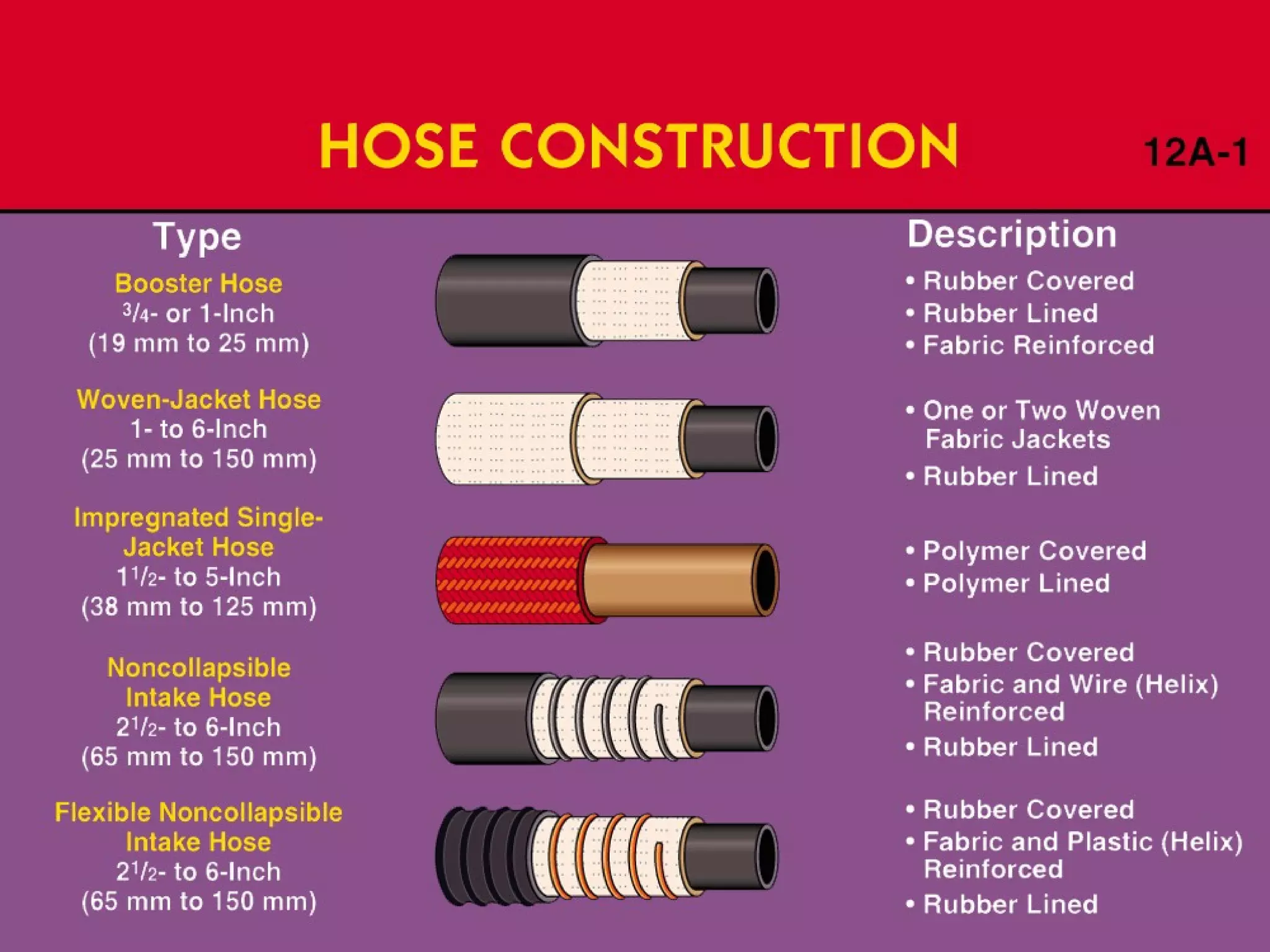
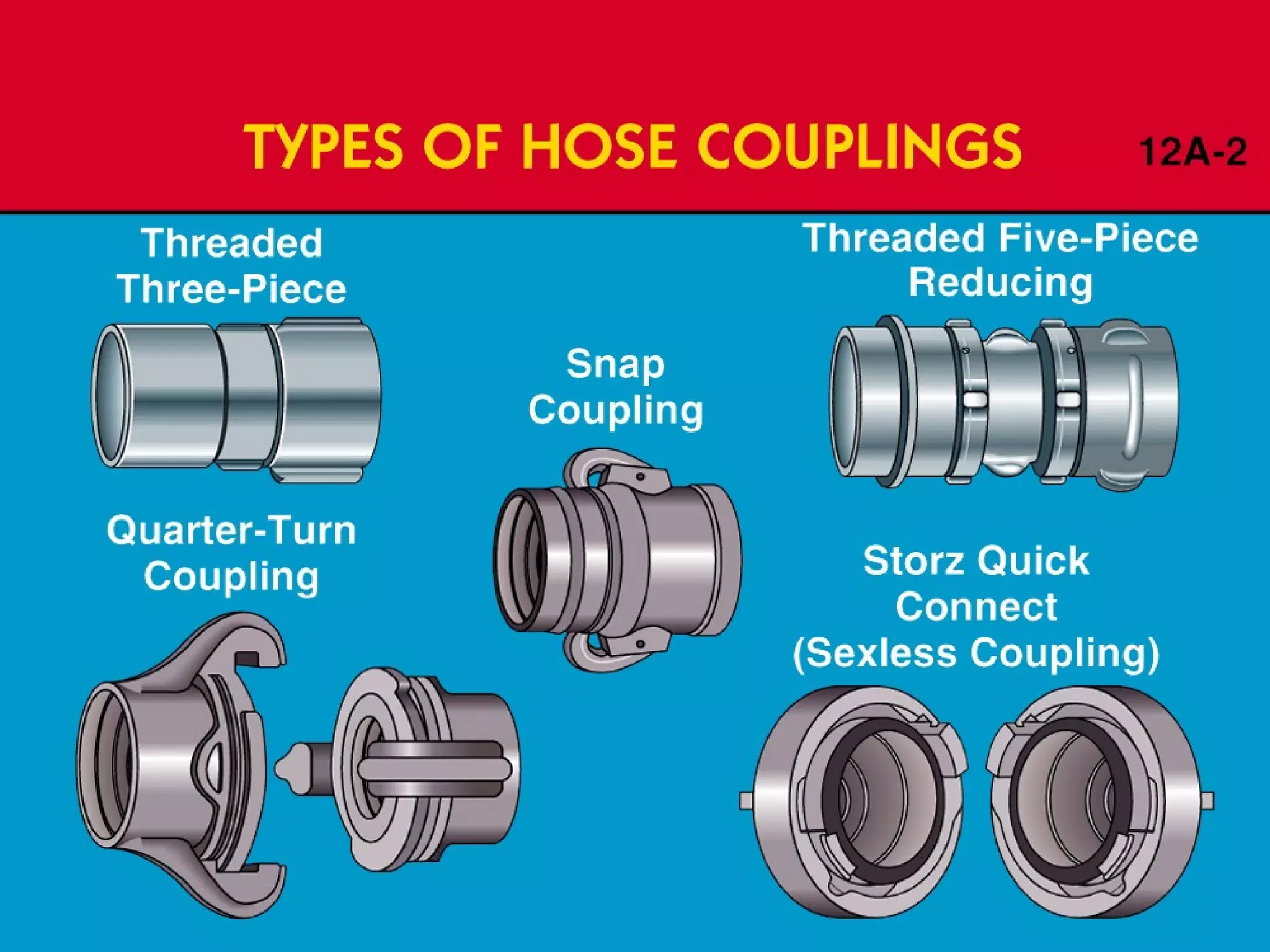
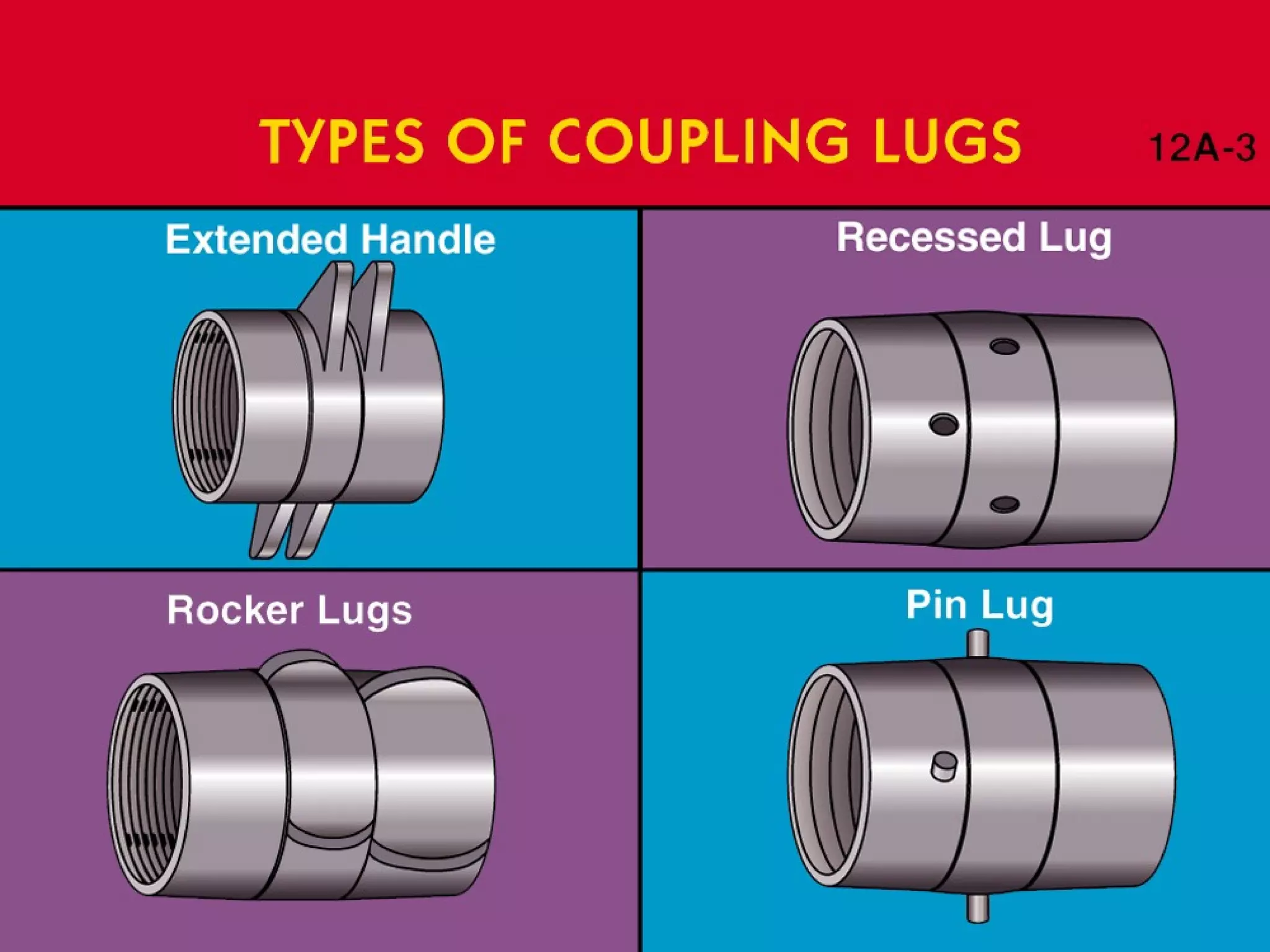
Hose Come in various sizes and construction types Use couplings Carried in apparatus hose beds Used for various applications Attack Supply
 
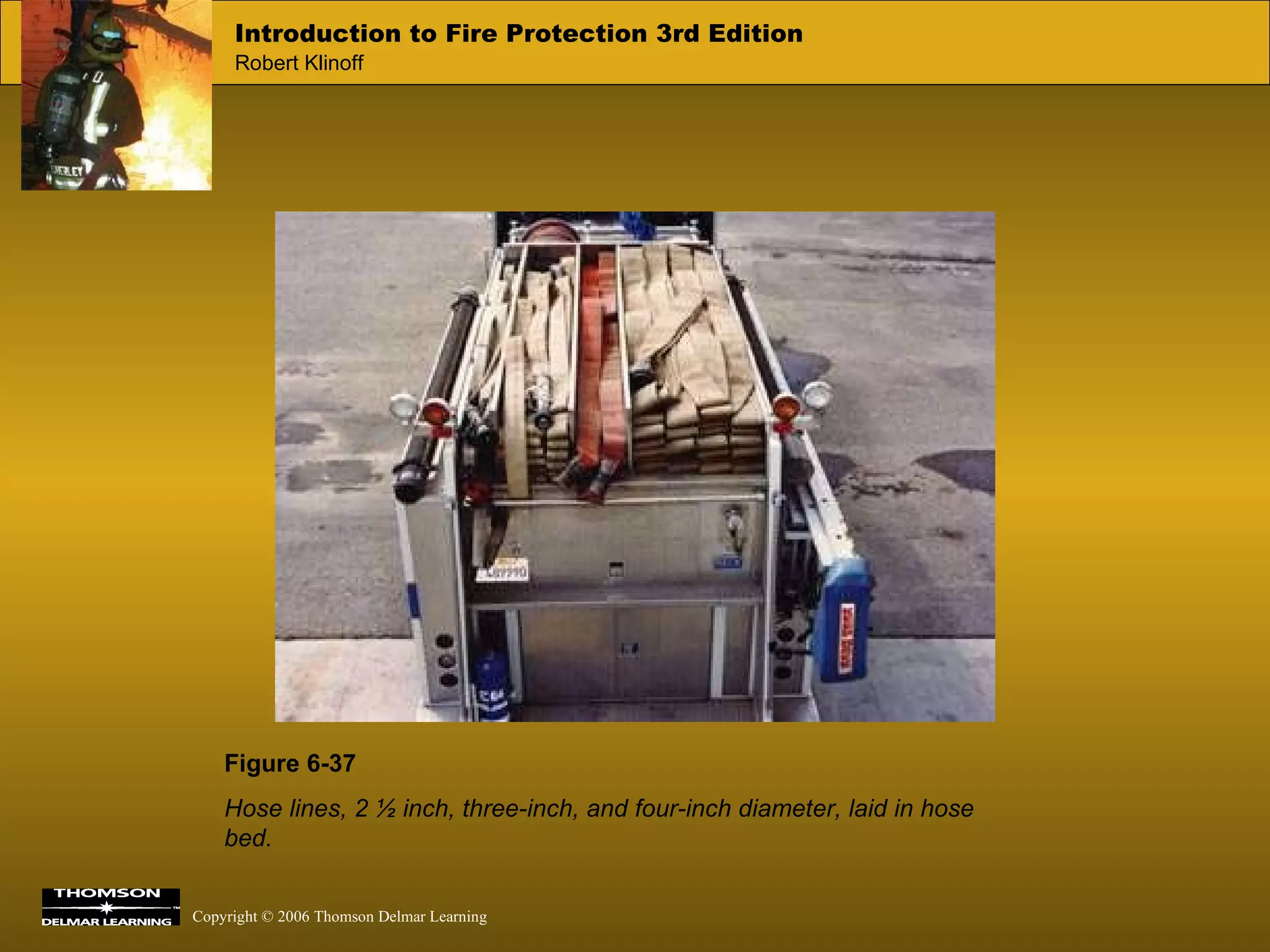
Figure 6-37   Hose lines, 2 ½ inch, three-inch, and four-inch diameter, laid in hose bed.
 
 
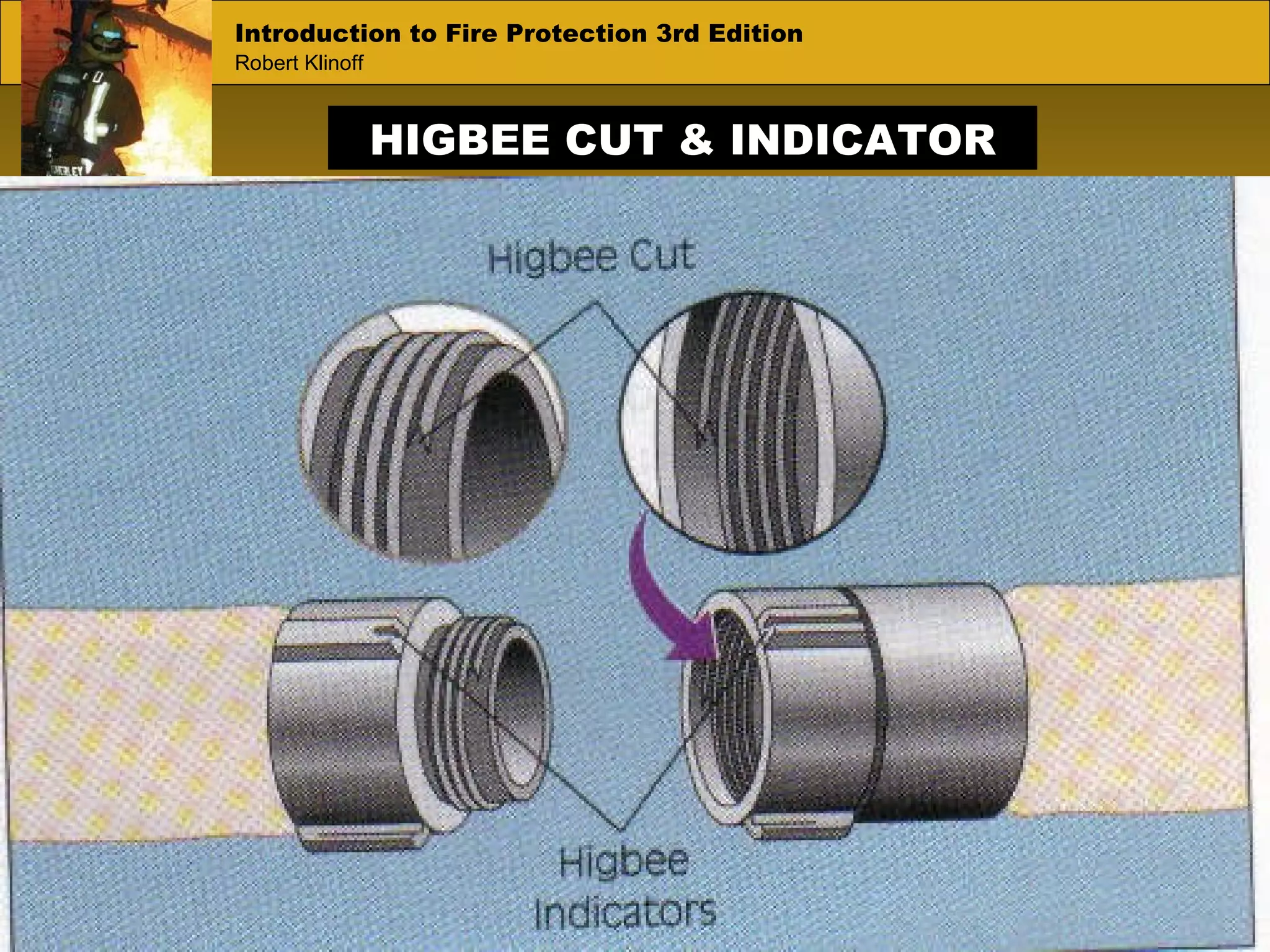
HIGBEE CUT & INDICATOR
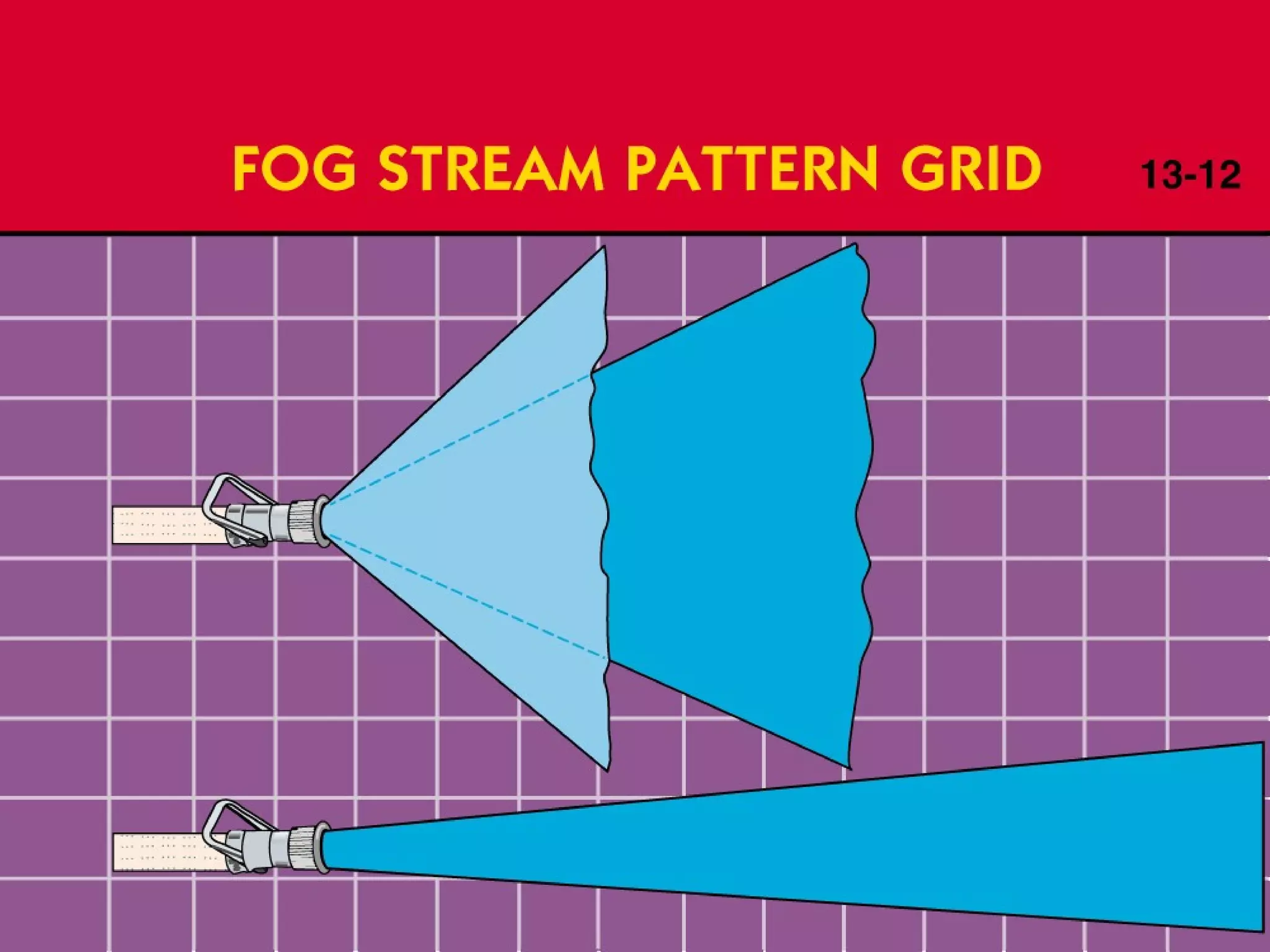
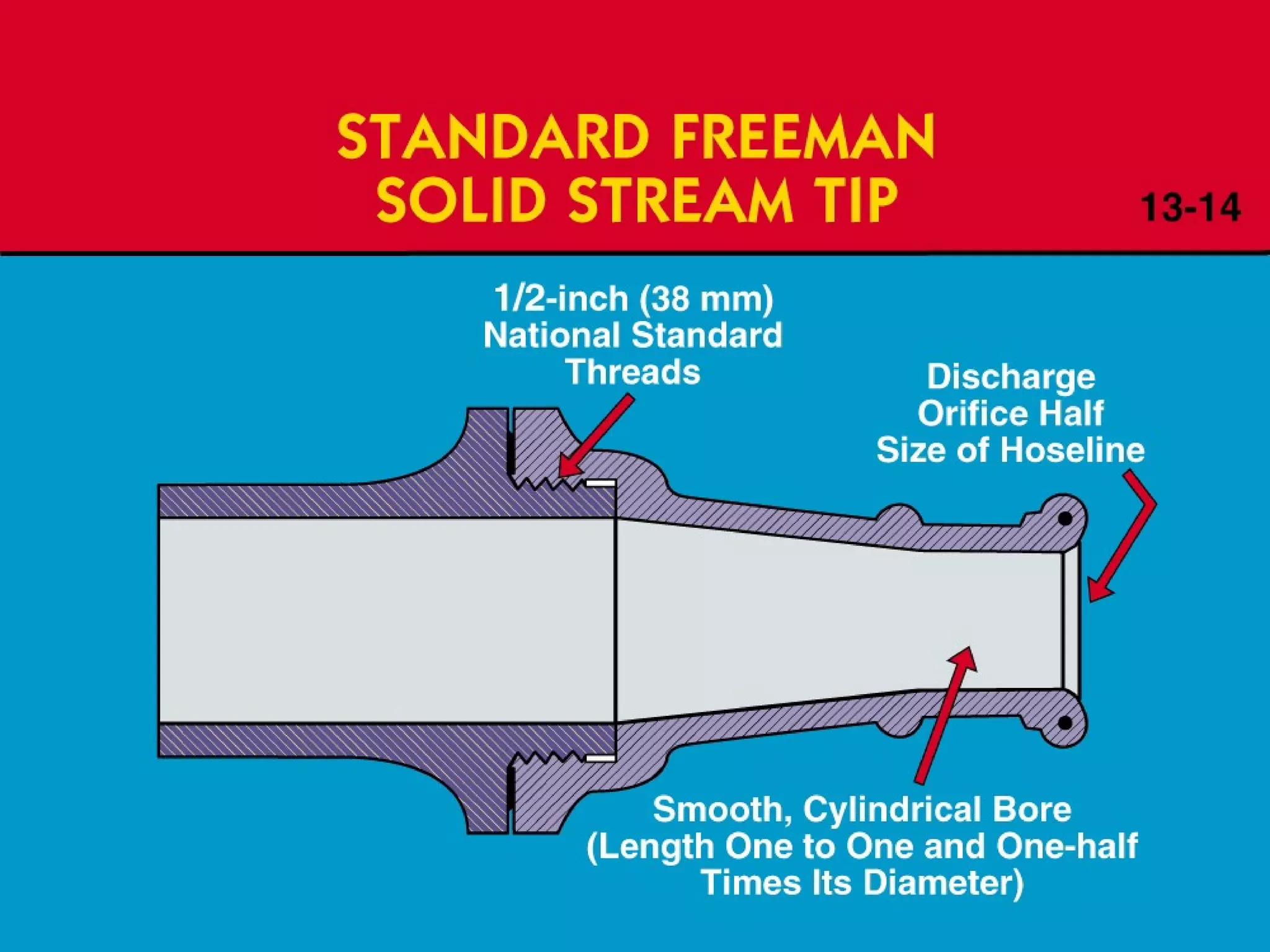
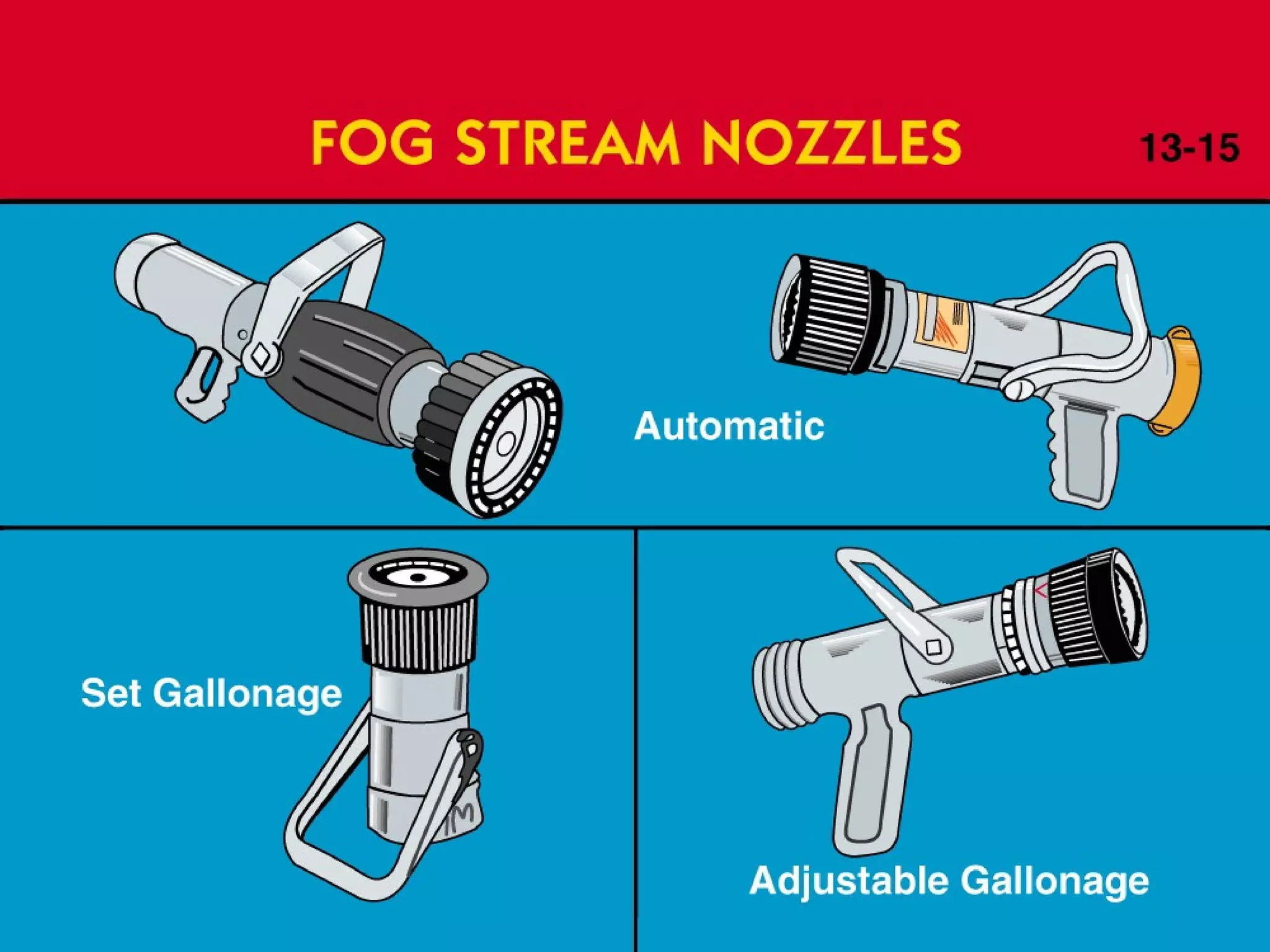
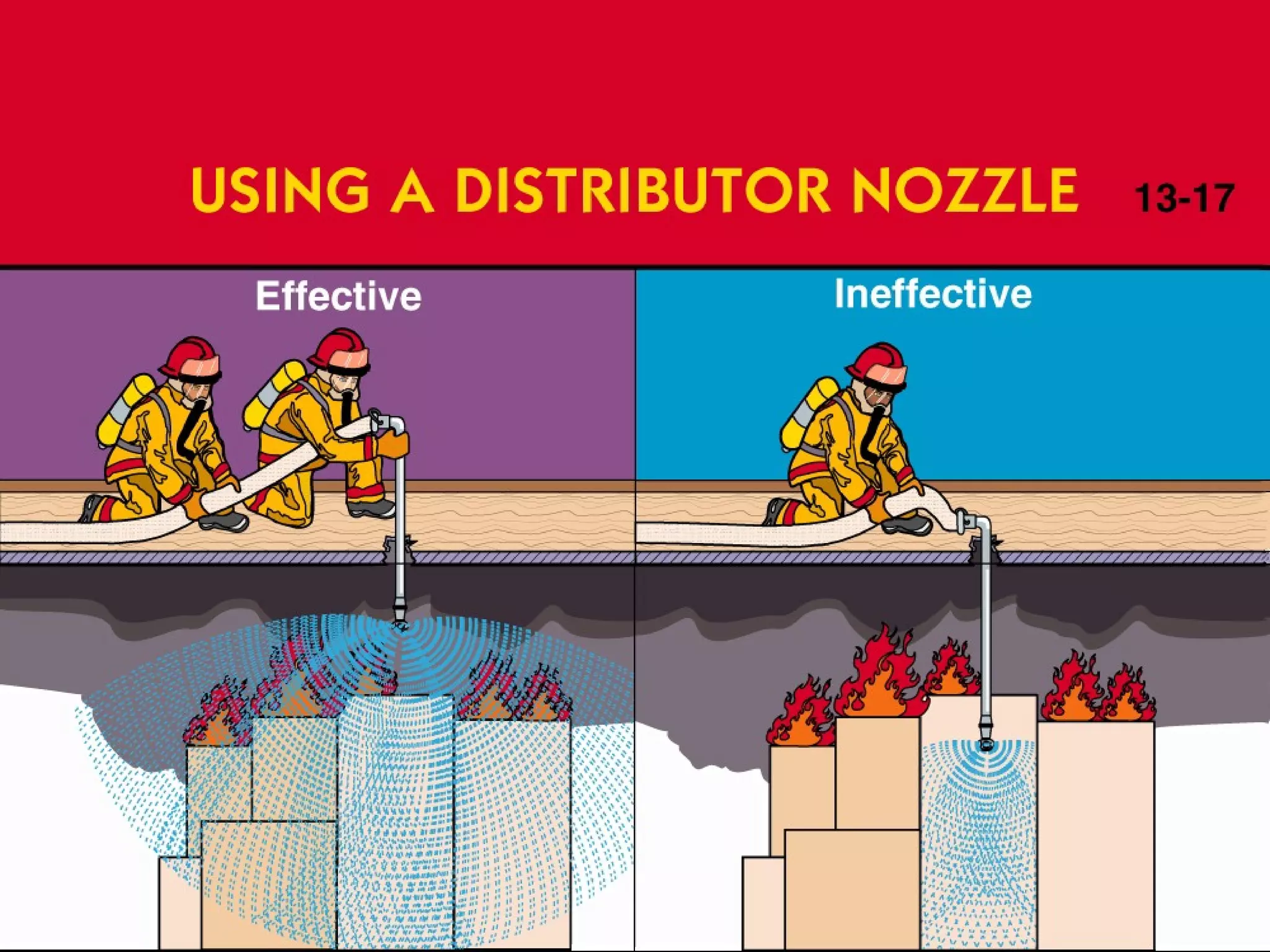
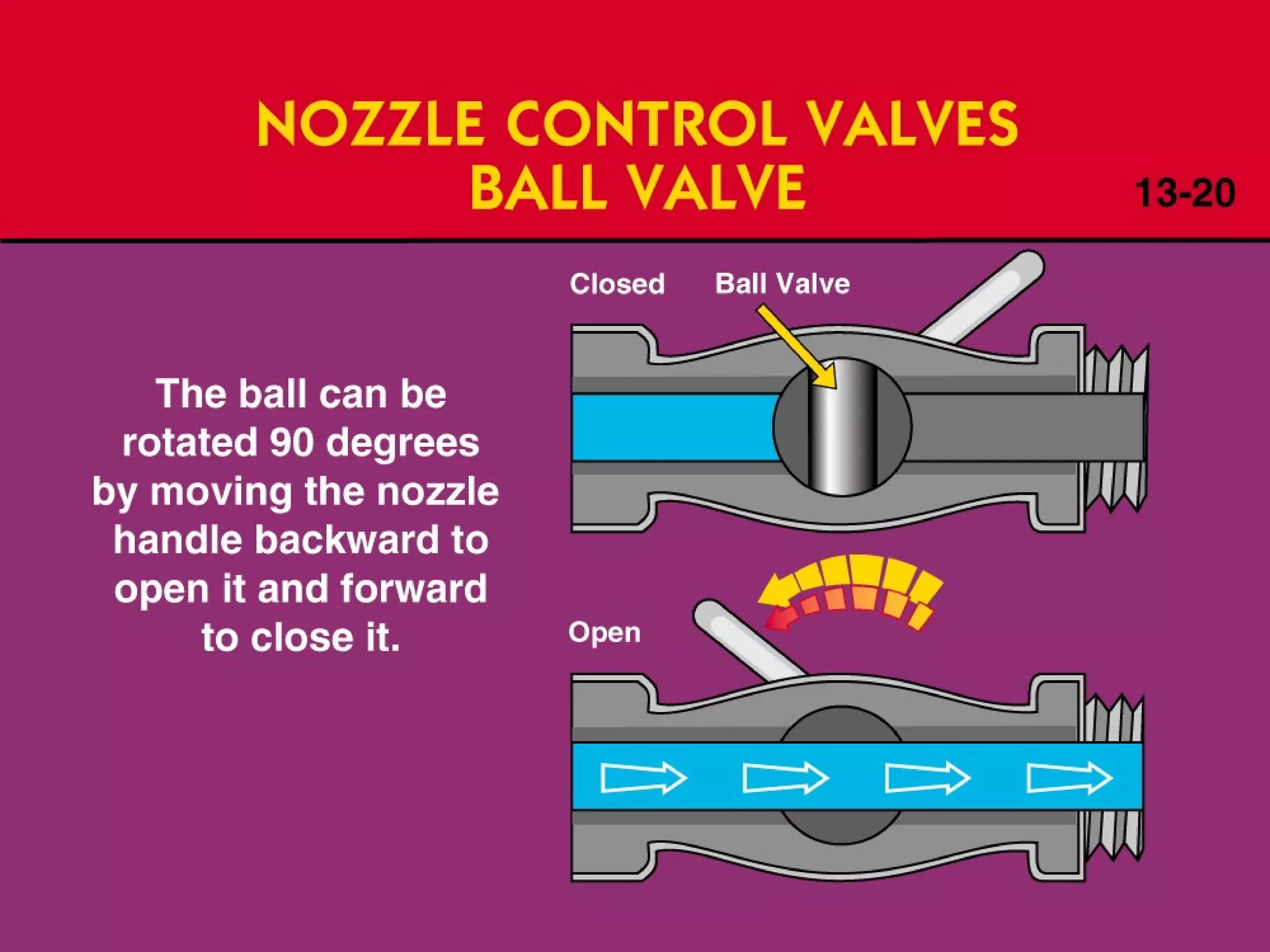
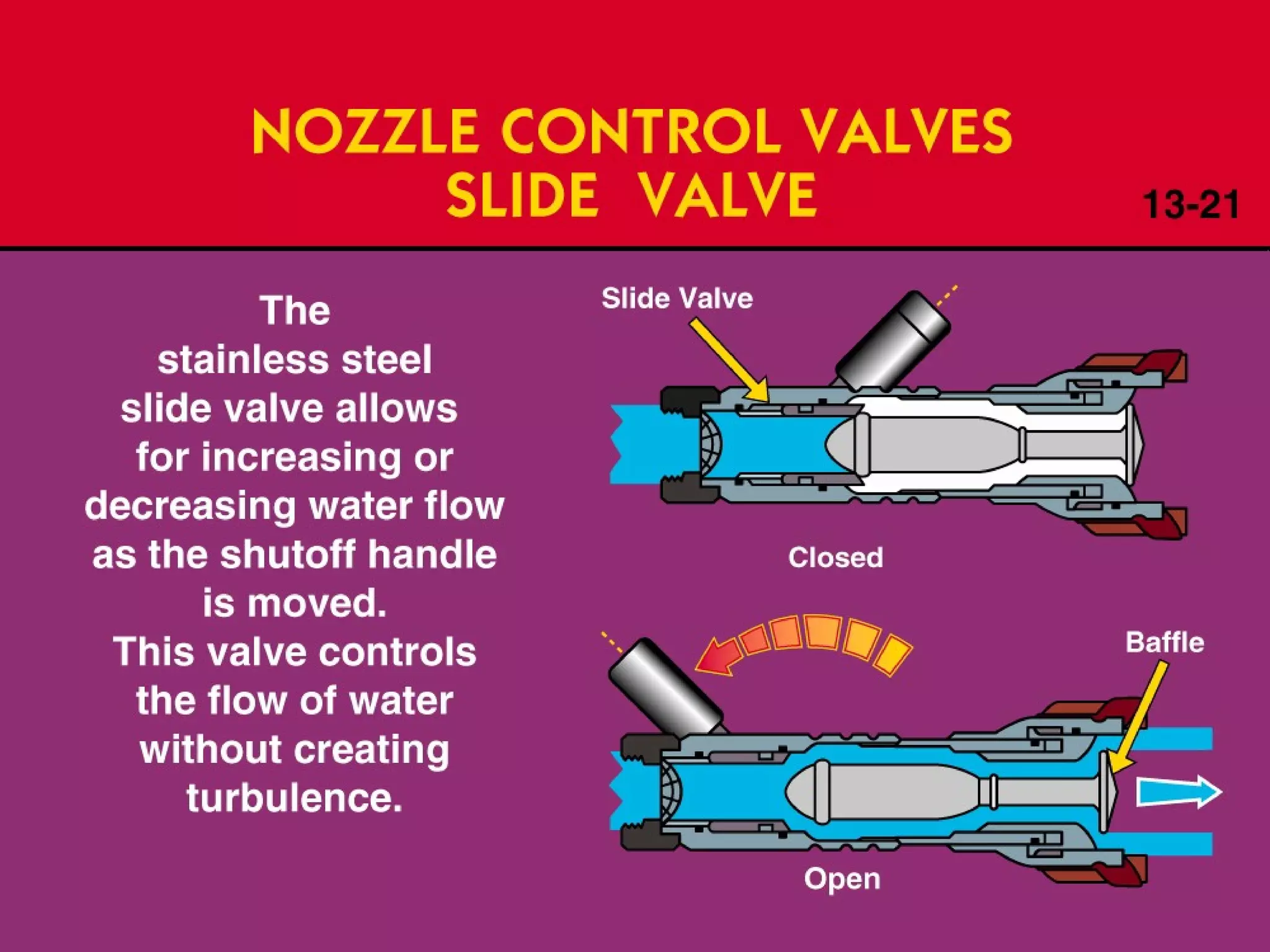
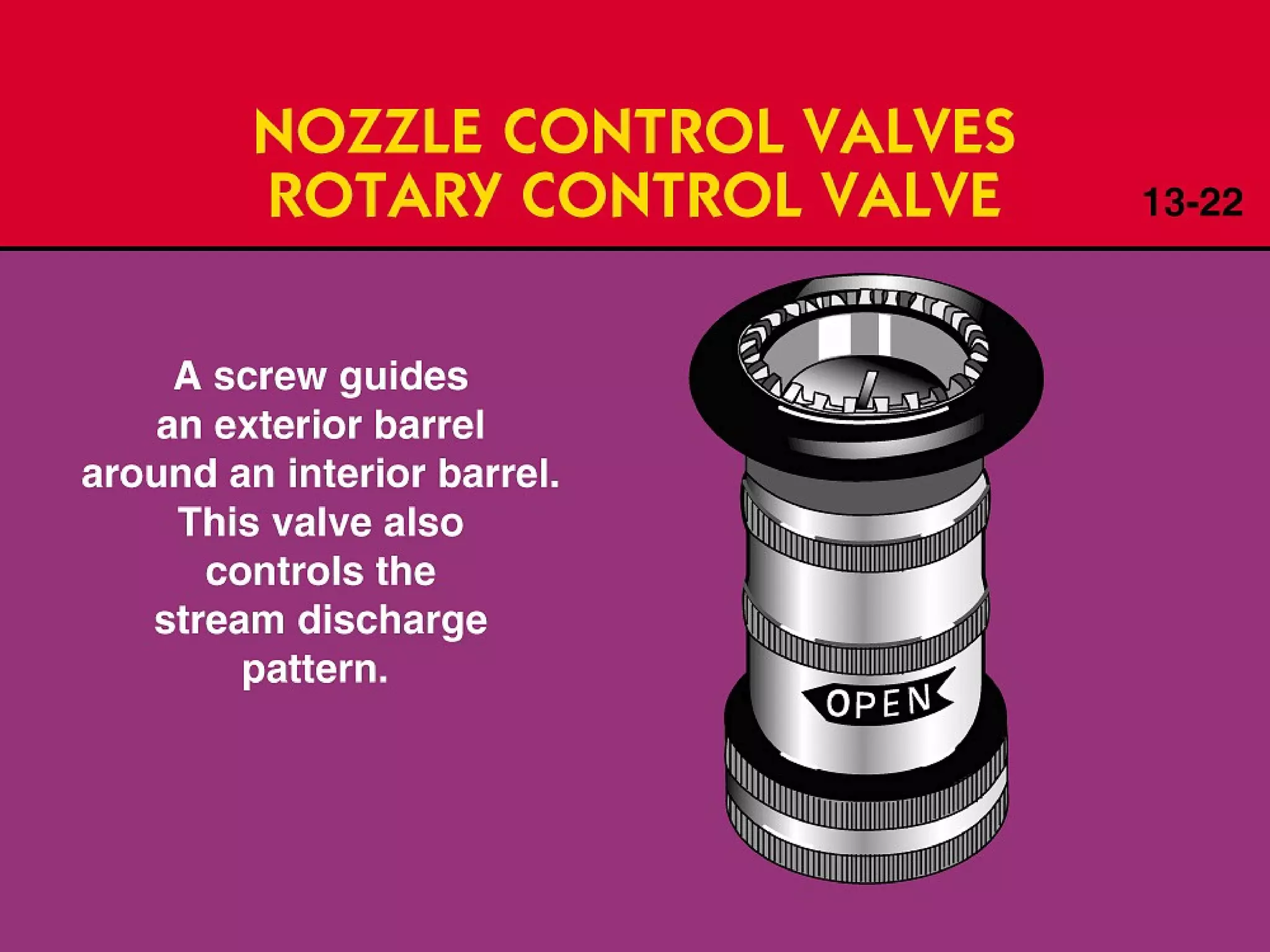
Nozzles Numerous sizes and designs Combination Fog or straight stream patterns Straight tip/smooth bore  Bail handle turns on and off  Designed to turn itself off if dropped
Nozzles (con’t.) Foam inductors Based on venturi principle Draws concentrate from pail and introduces it into the hose stream Must follow manufacturer’s instructions or quality foam will not be produced


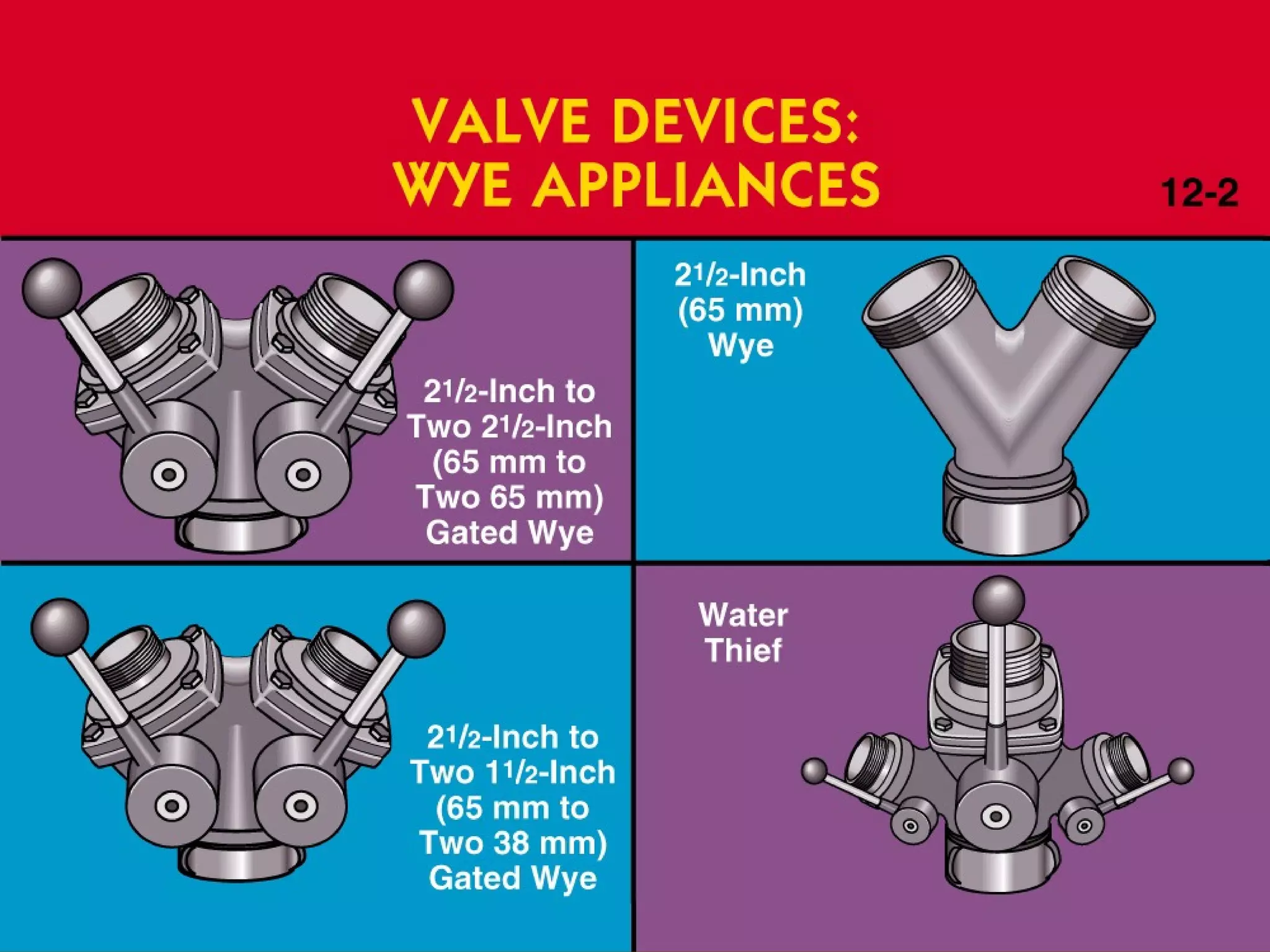
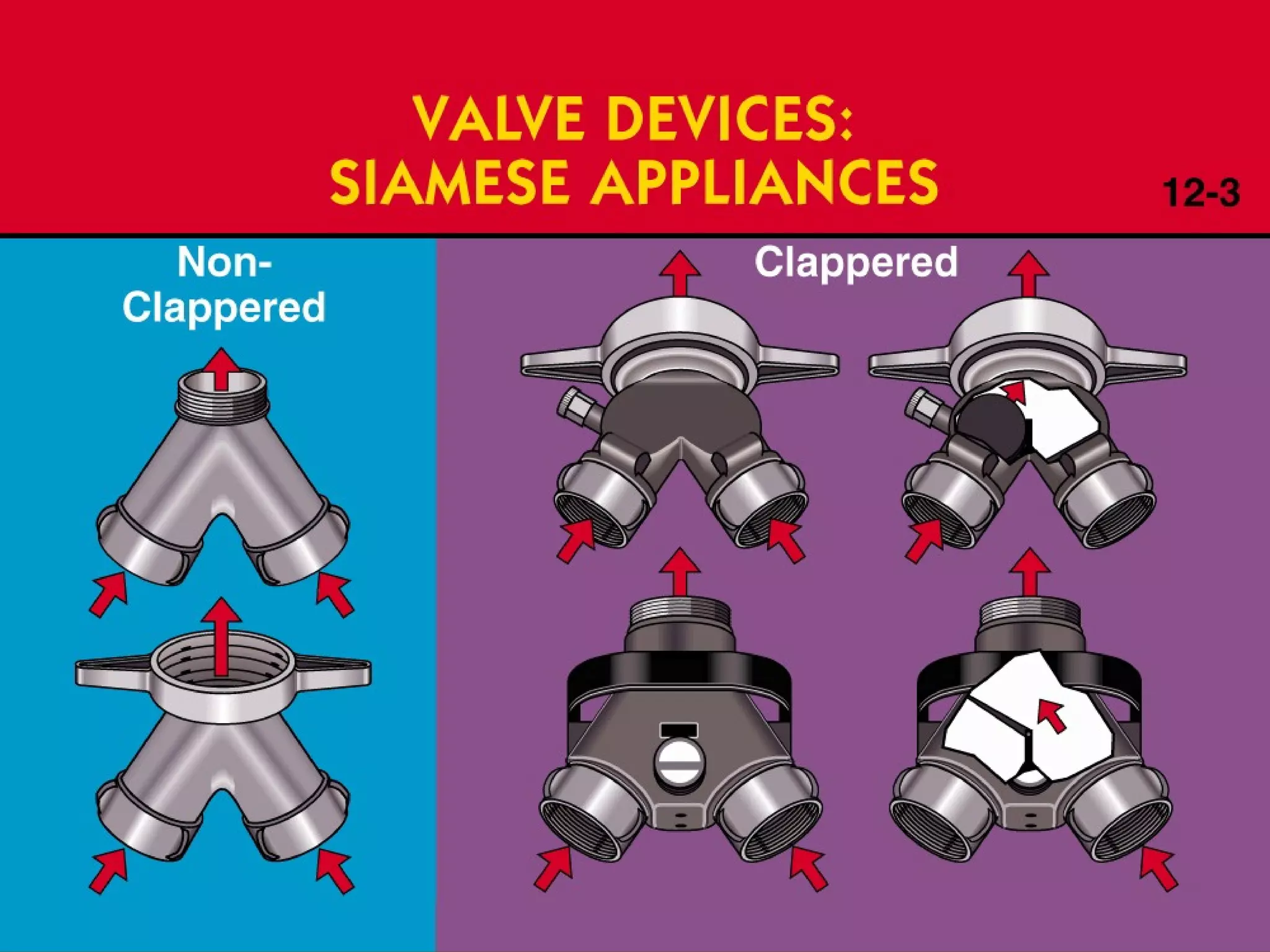
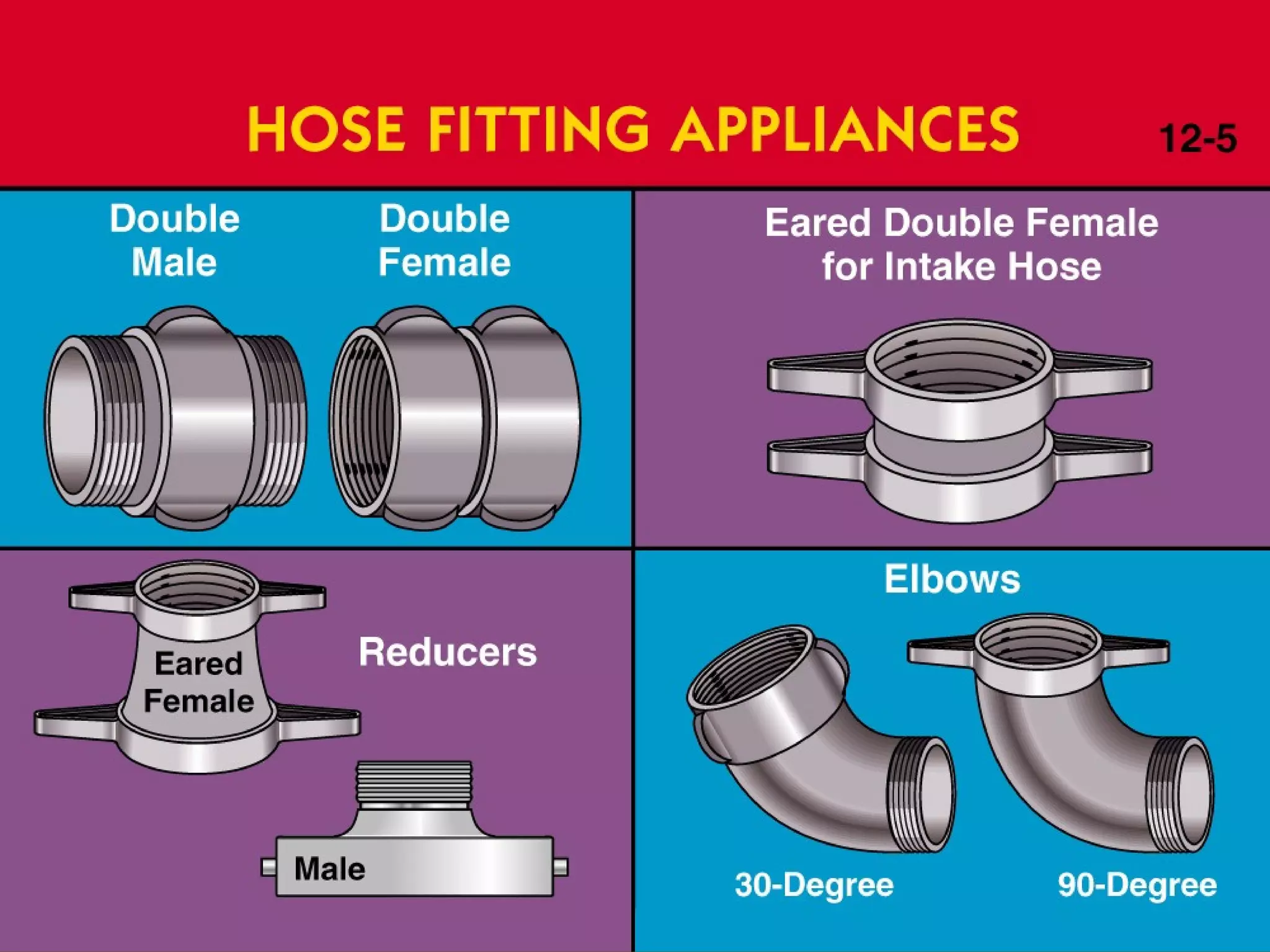
Fittings Connect hoses and appliances Allows versatility Reverse direction of hose lays Change hose size or thread type Combine or divide hose lays


Ladders Attic ladder: folding 10-foot most common Roof ladder: 14-foot with fold out hooks Extension ladder: bed ladder with one or more flies, various lengths Safety Note :   Ladders used  must  be designed for  firefighting use
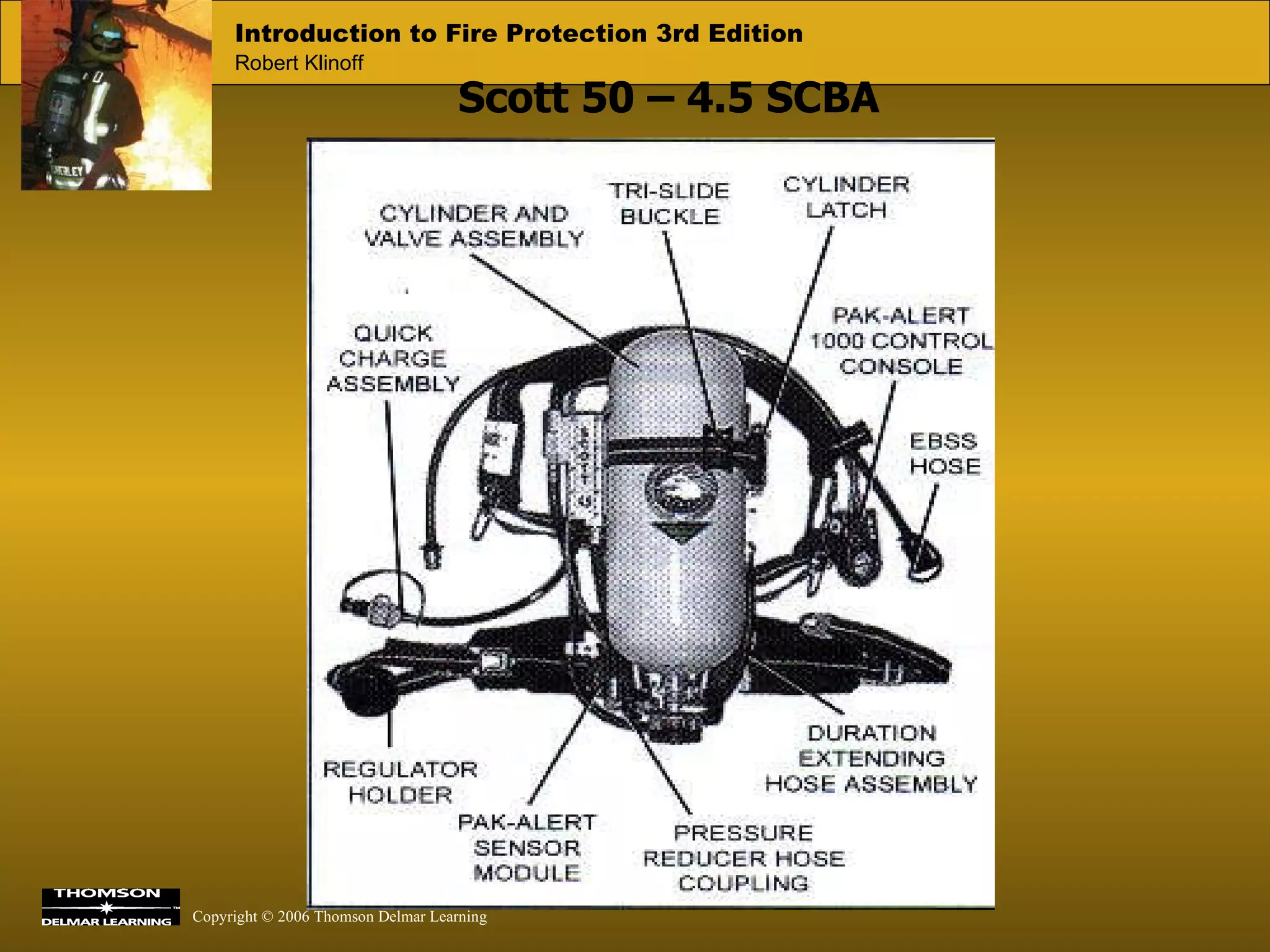
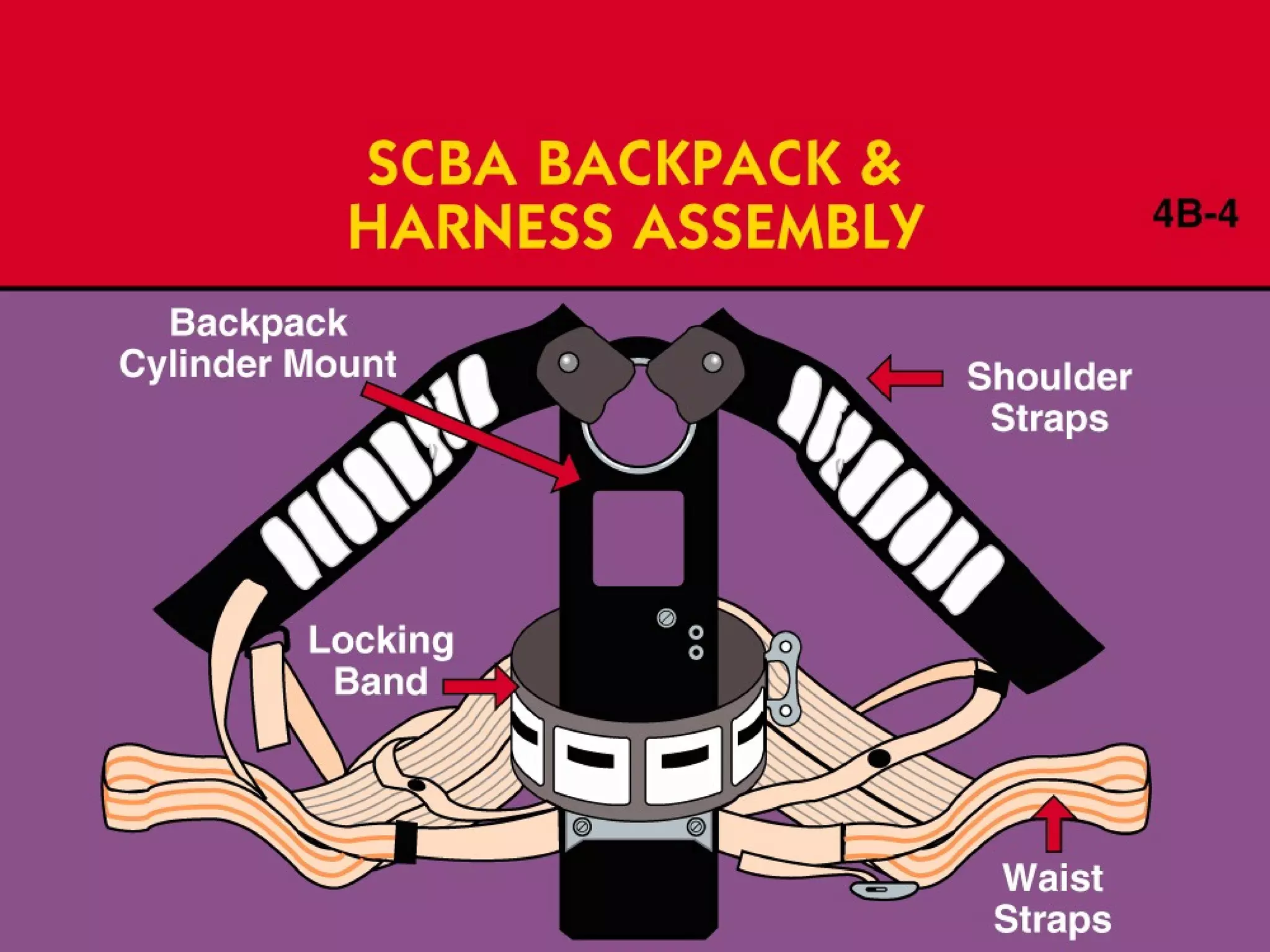
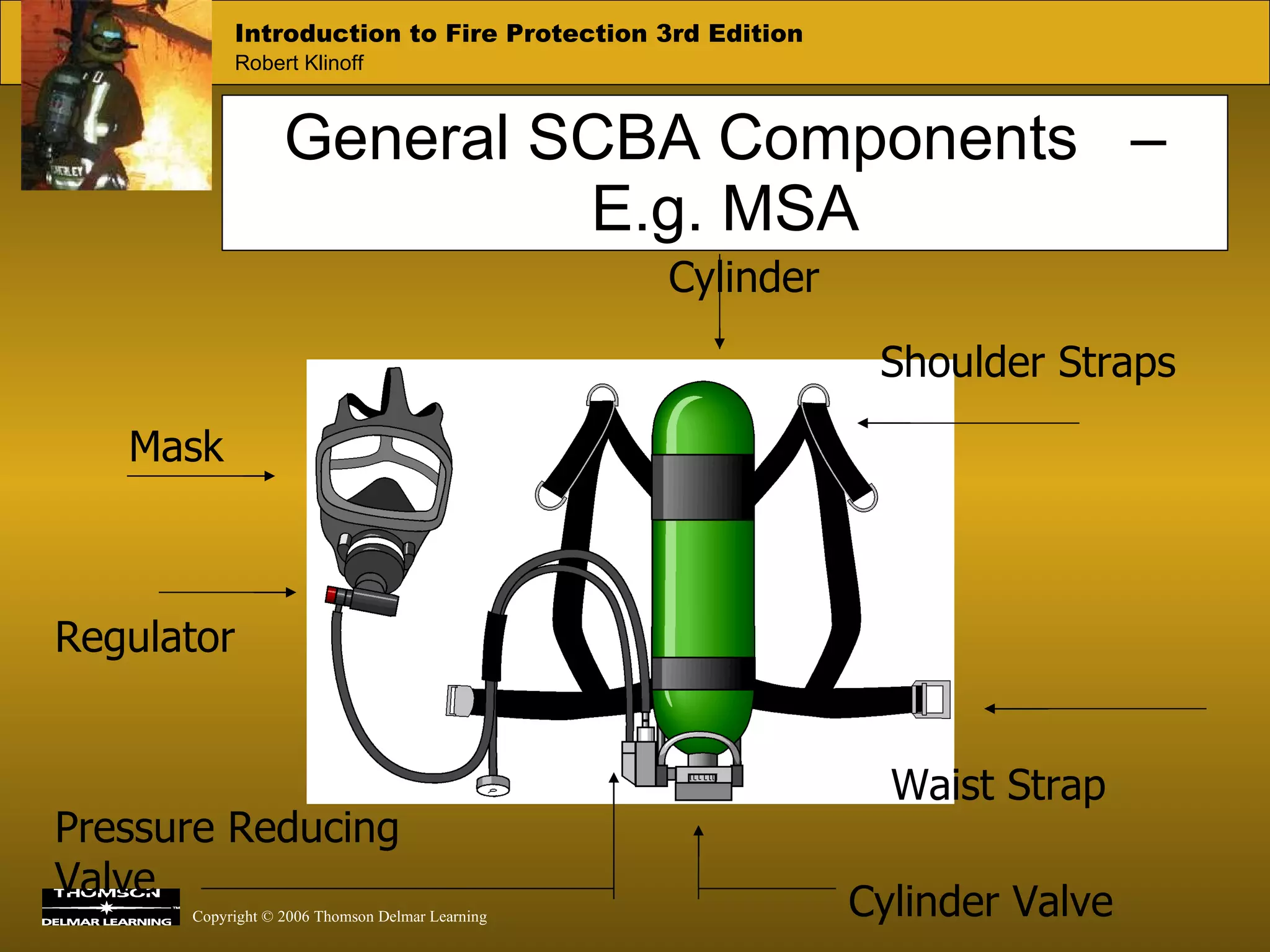
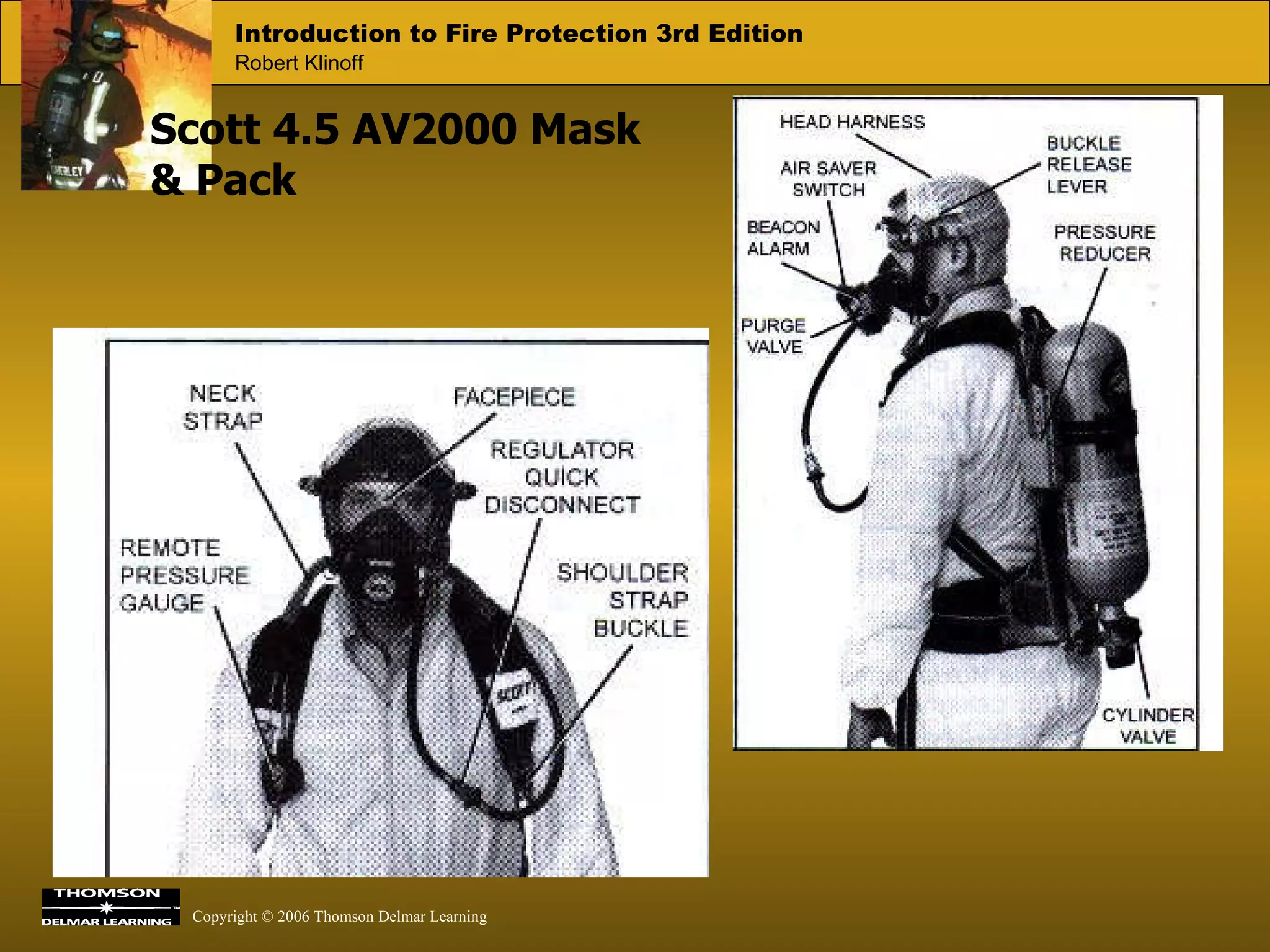
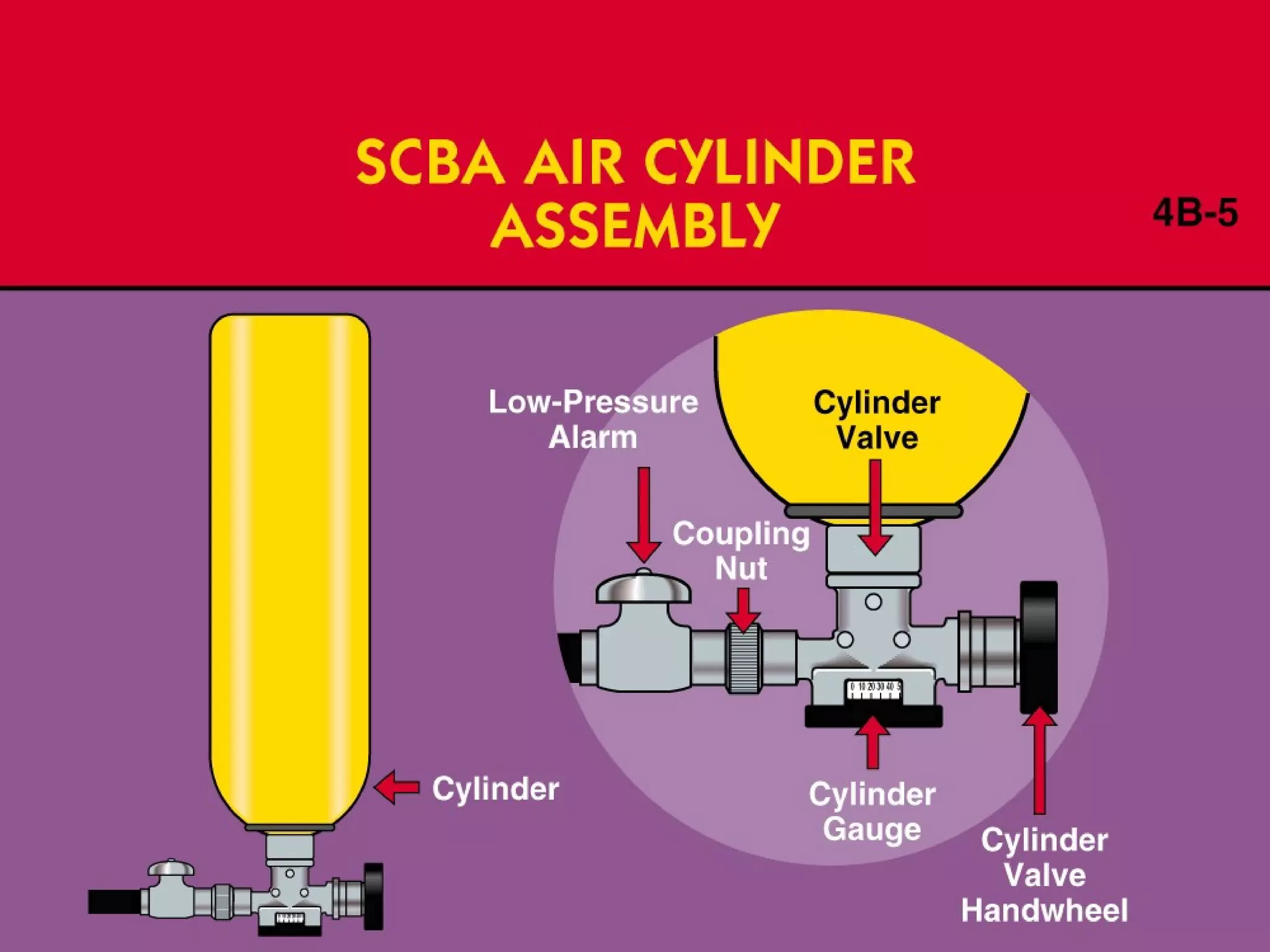
SCBA Self-contained breathing apparatus Four main components Face mask Air bottle Backpack Regulator Low pressure alarm
SCBA (con’t.) Protect firefighters from Low oxygen concentration Toxic byproducts Smoke Superheated gases Regulator operates in positive pressure mode to prevent toxic gases from entering face mask
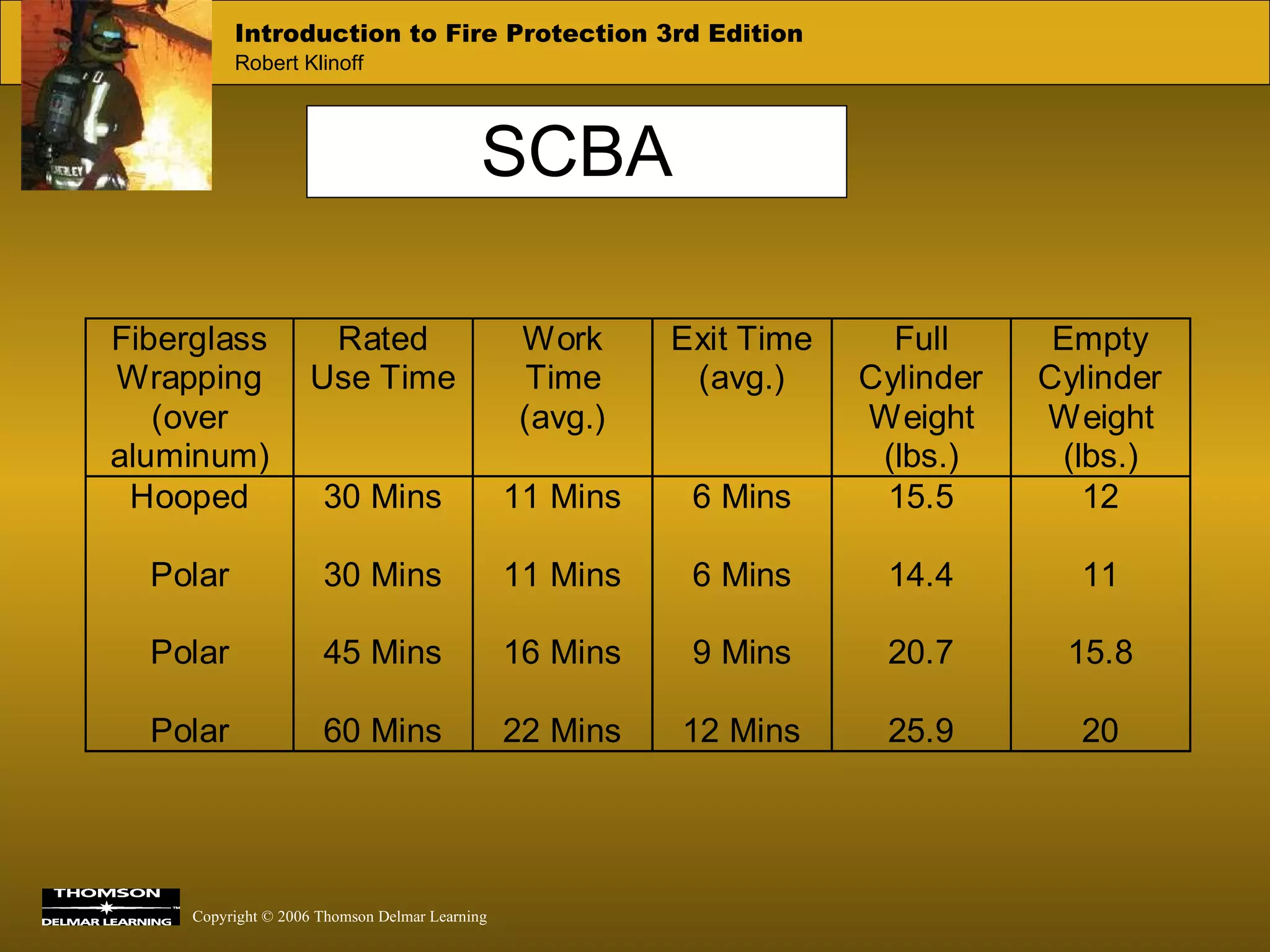
SCBA
Scott 50 – 4.5 SCBA
 
General SCBA Components  – E.g. MSA Mask Regulator Cylinder Shoulder Straps Waist Strap Cylinder Valve Pressure Reducing Valve
Scott 4.5 AV2000 Mask & Pack
 
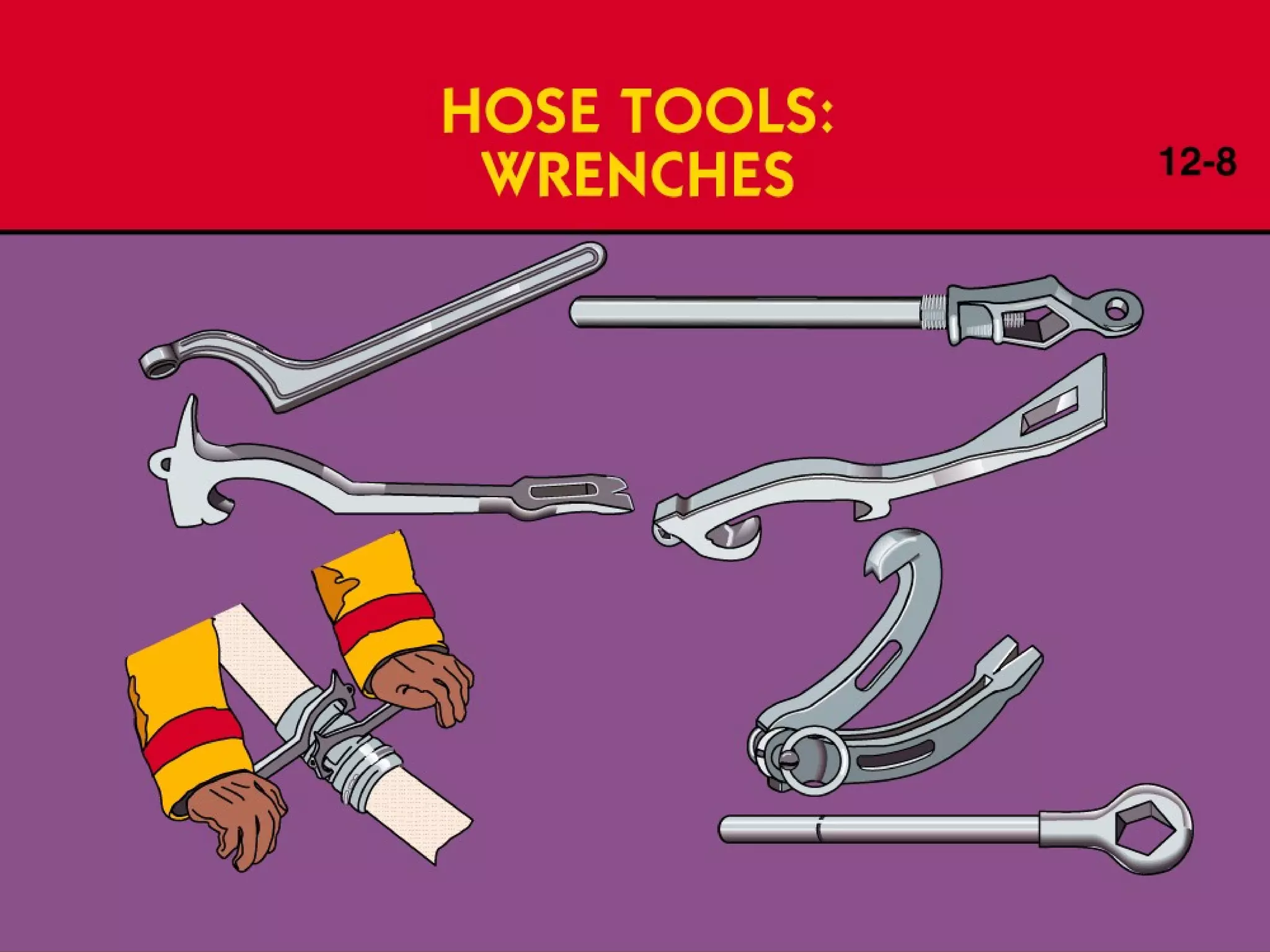
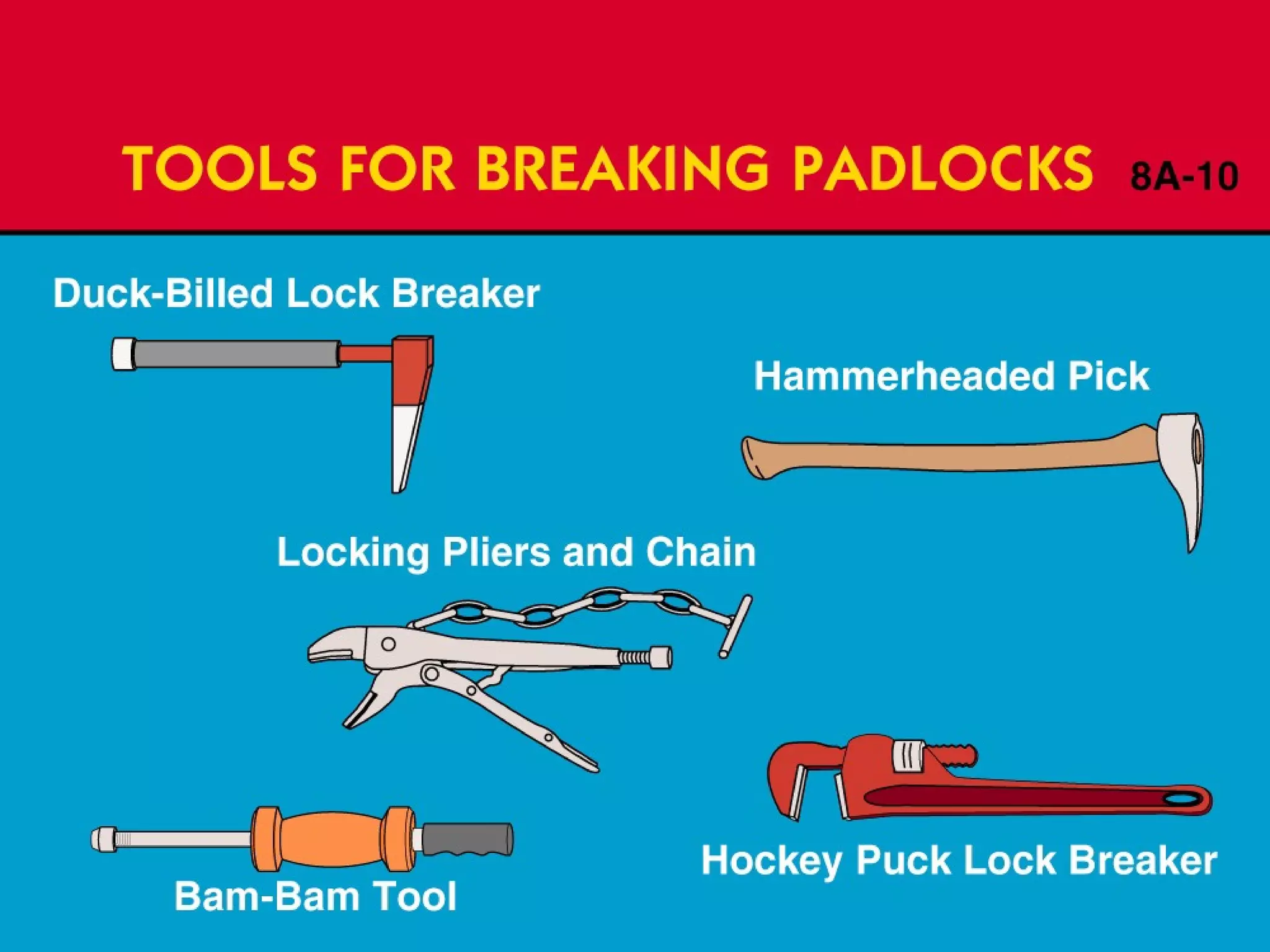
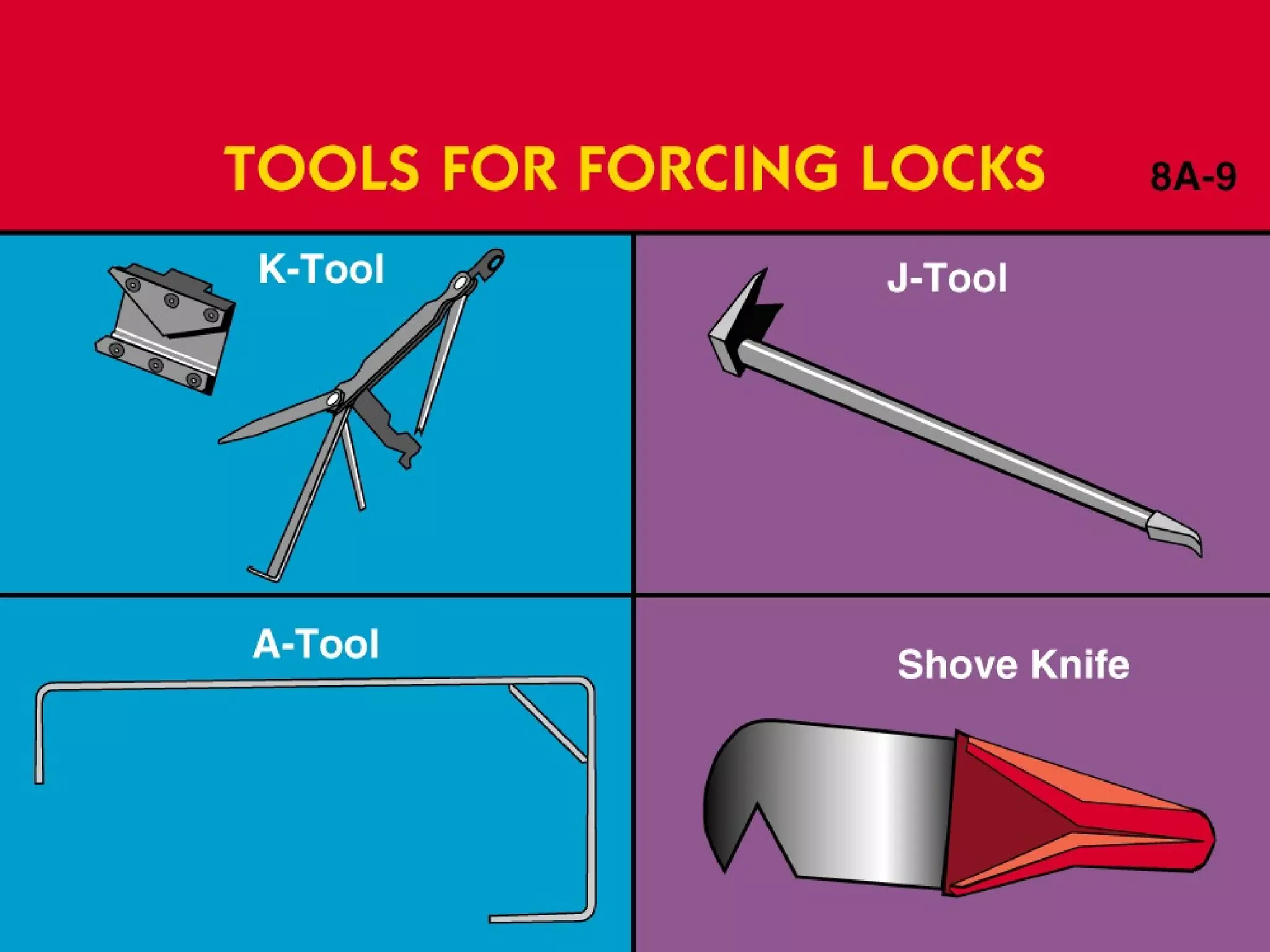
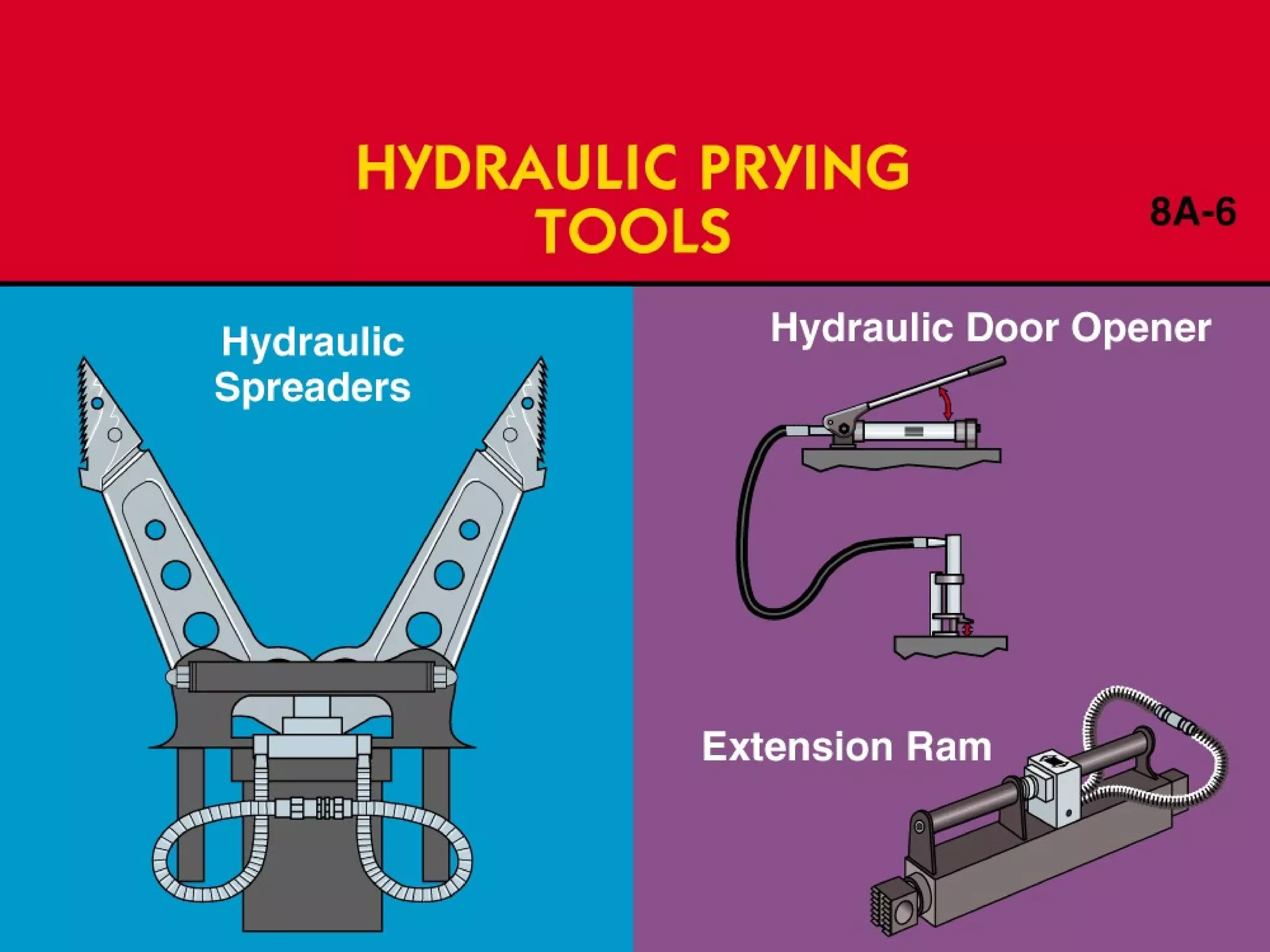
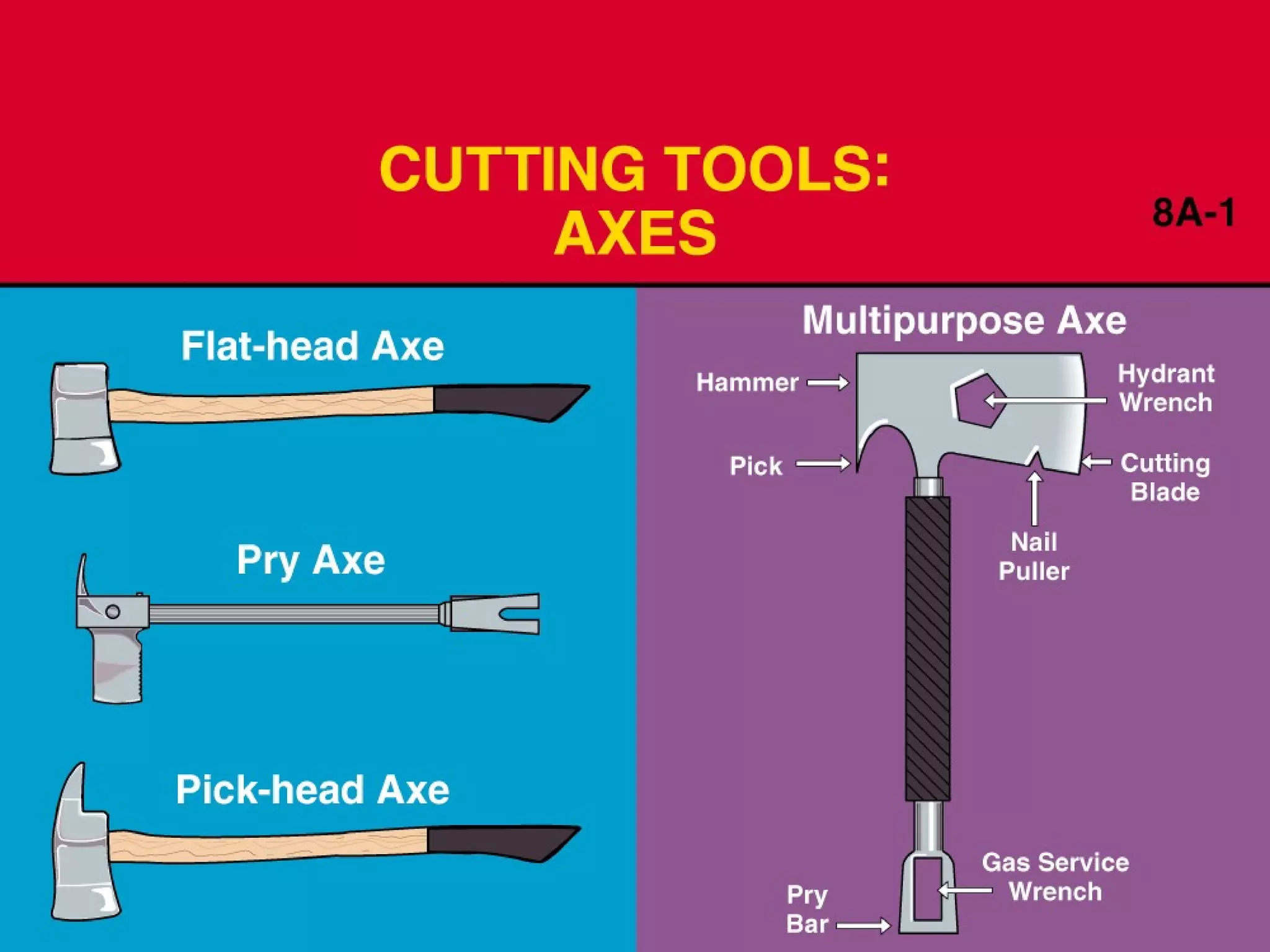
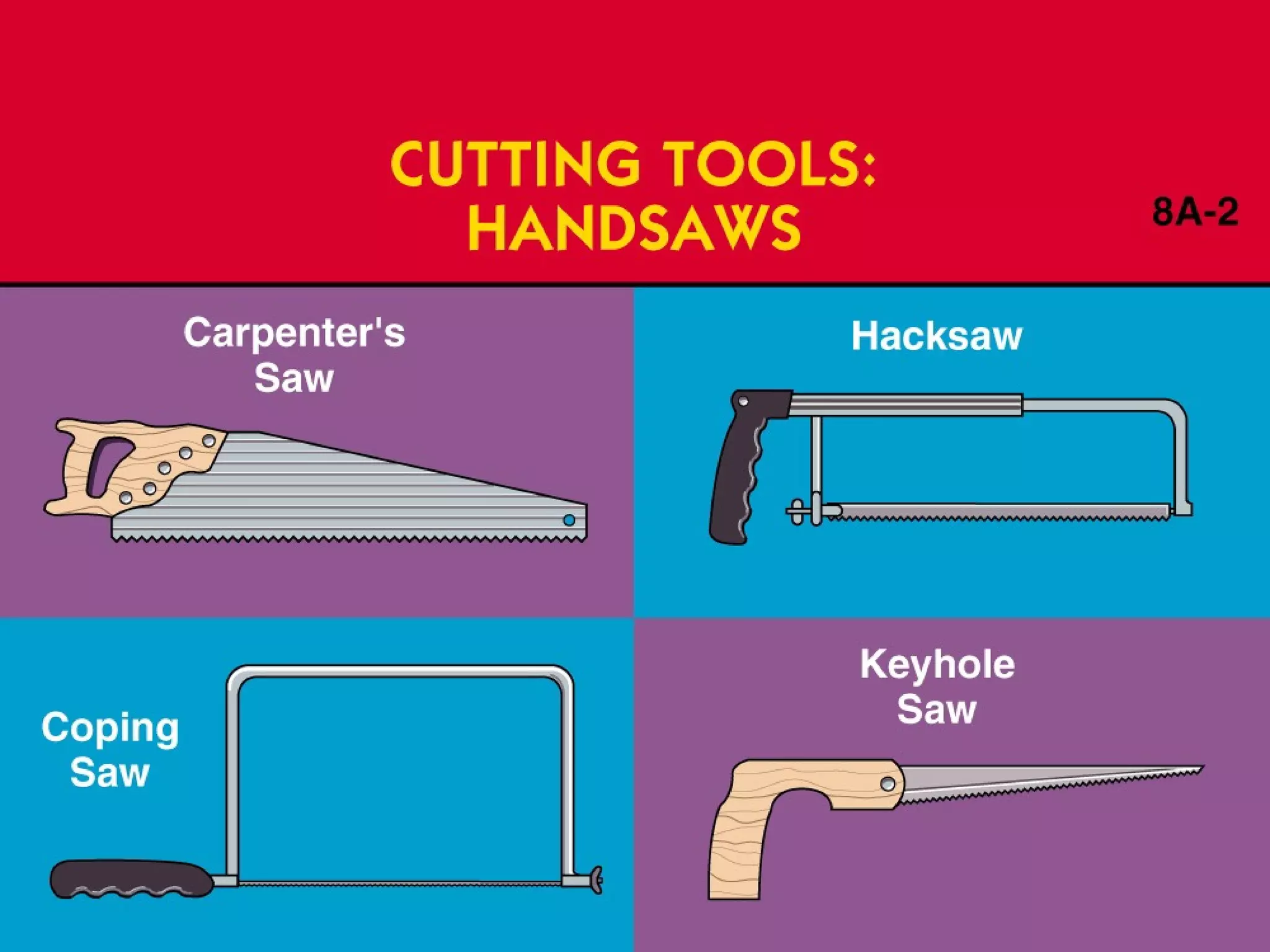
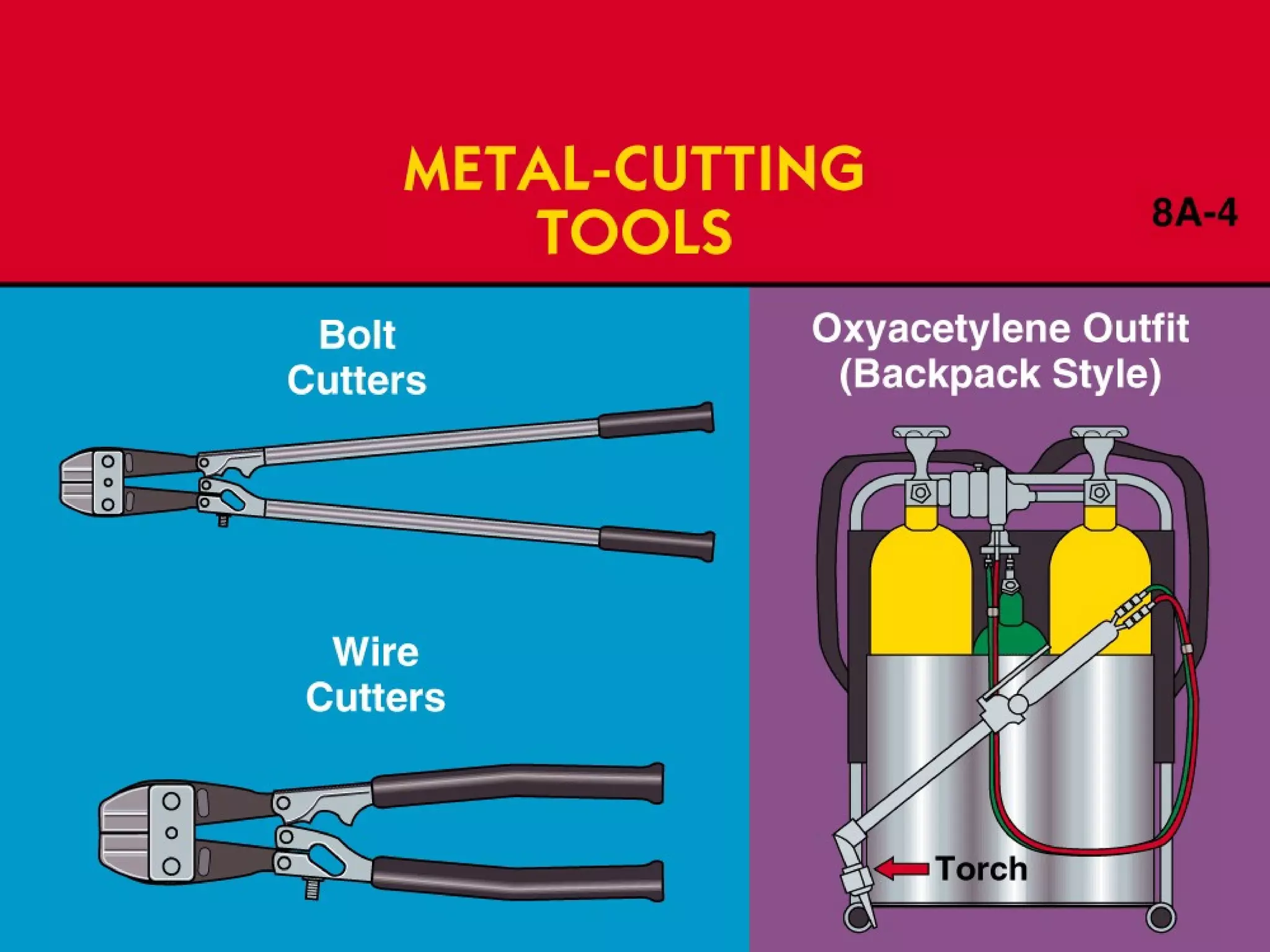
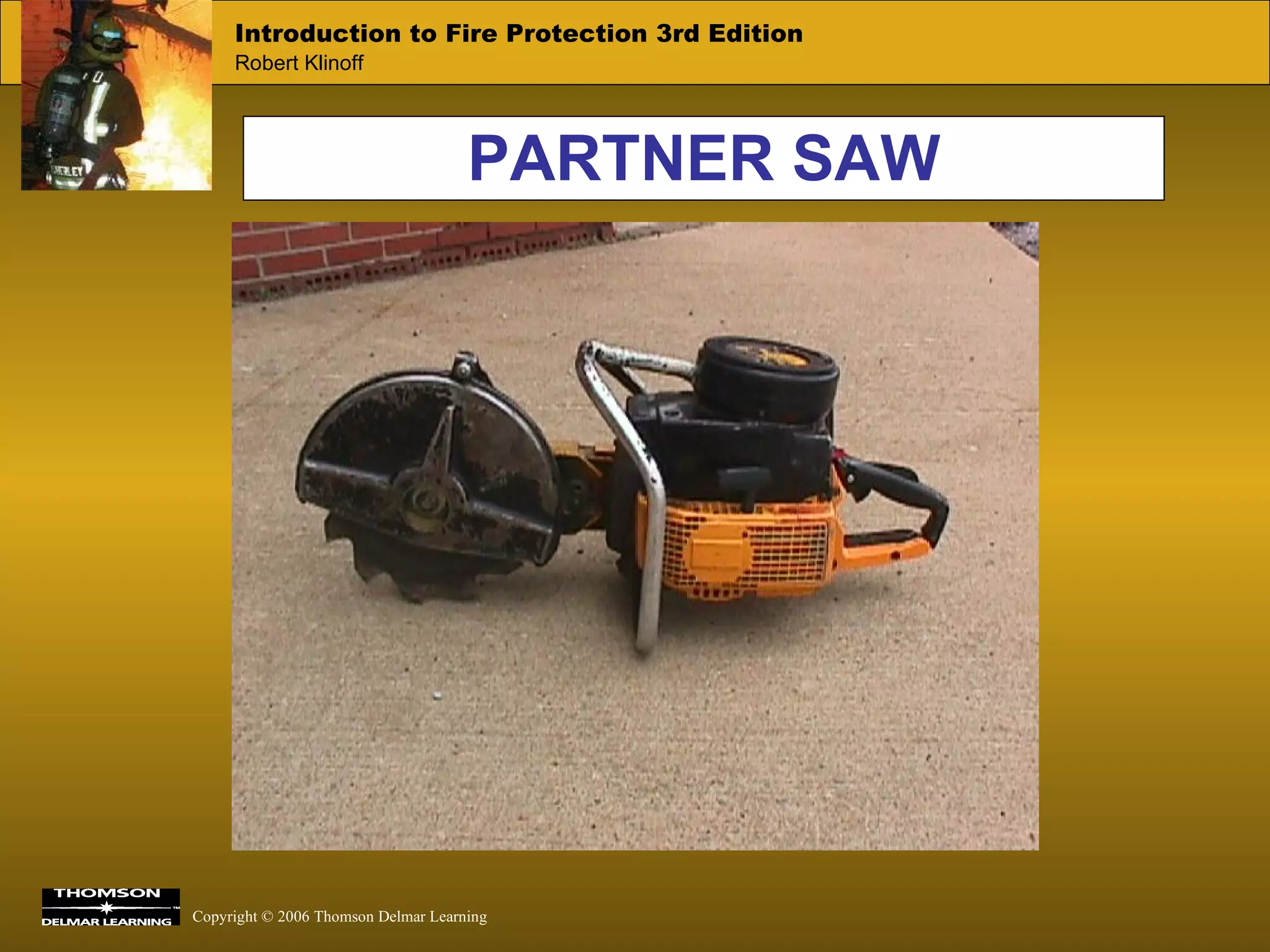
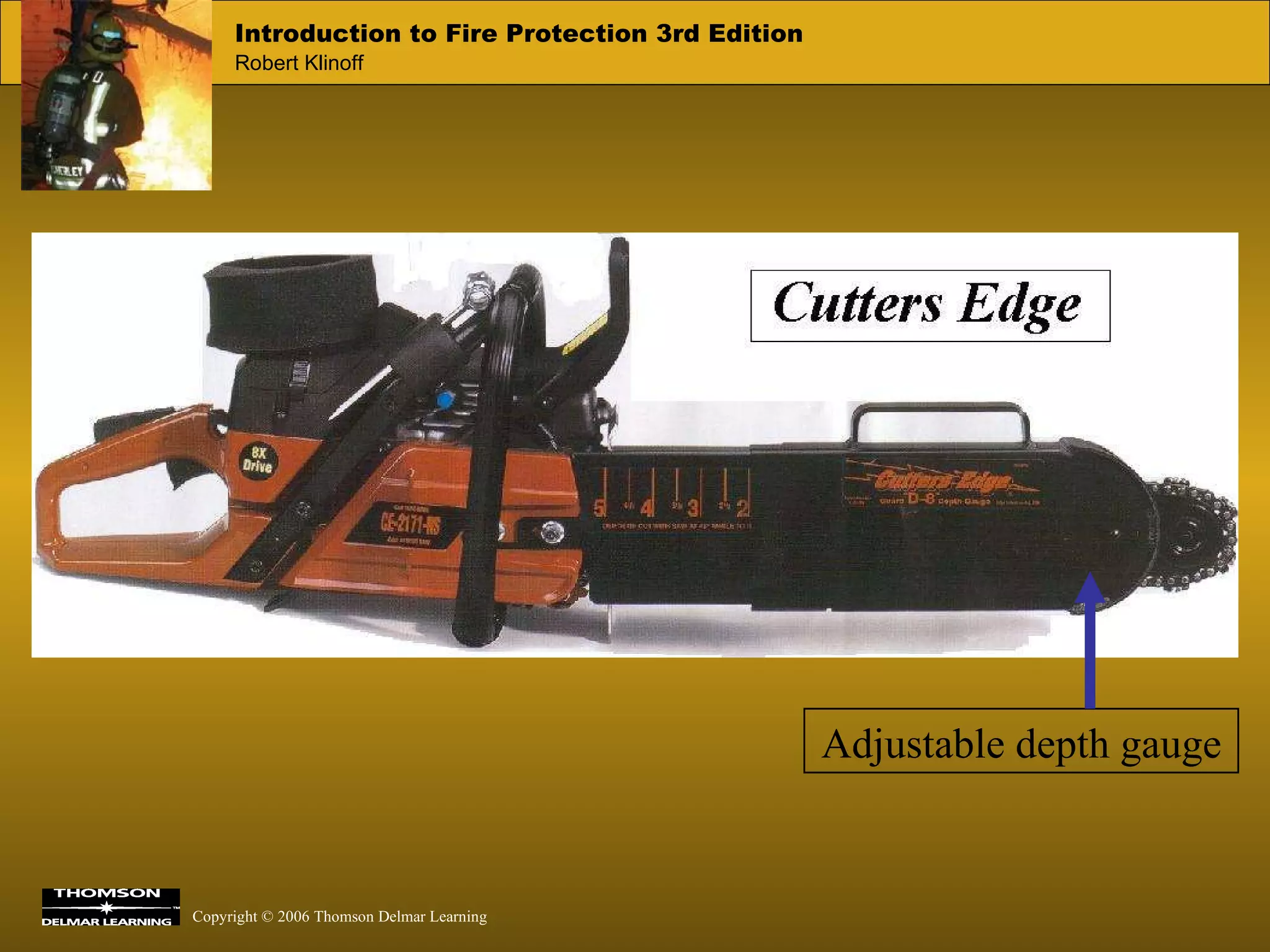
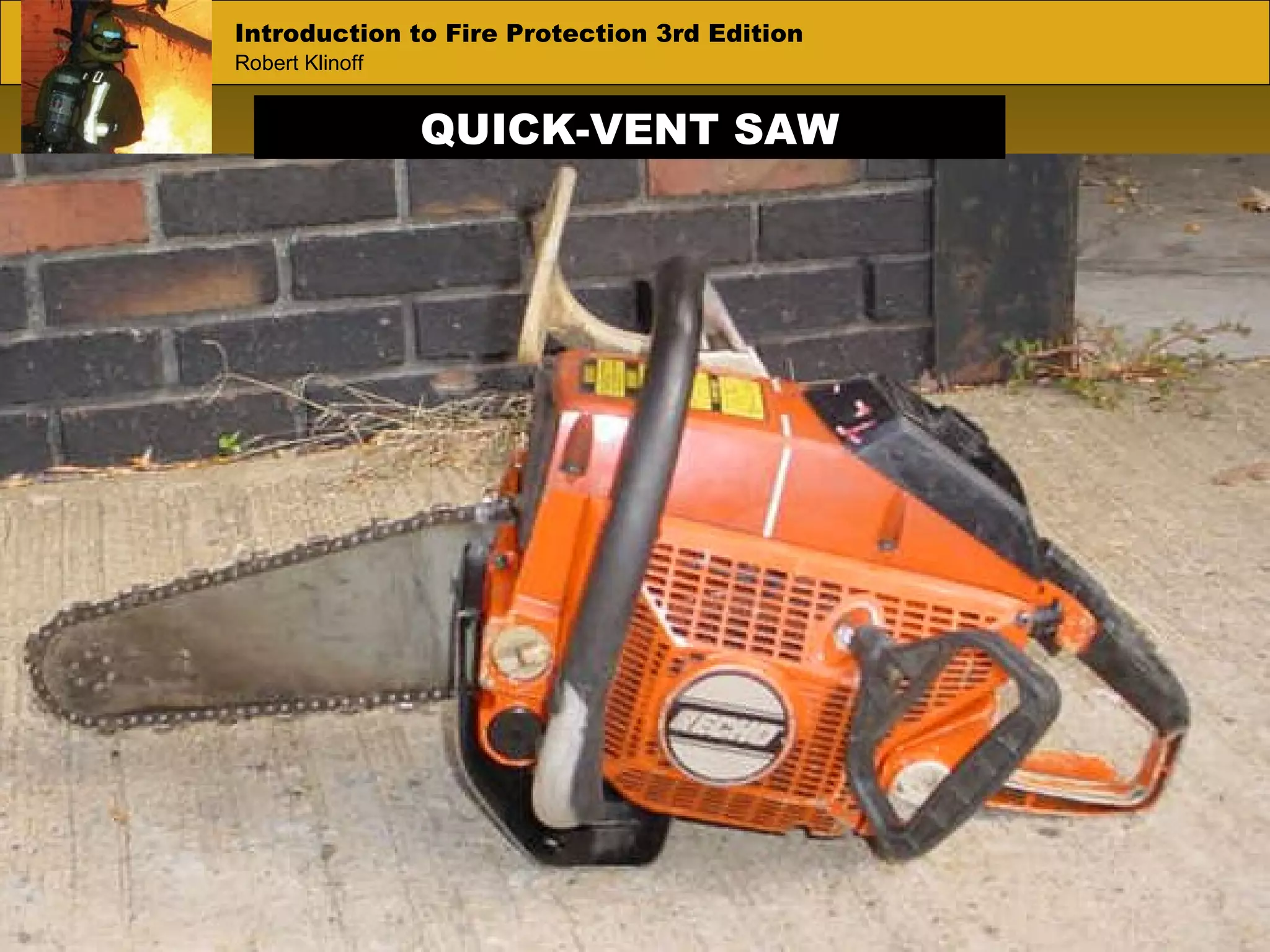
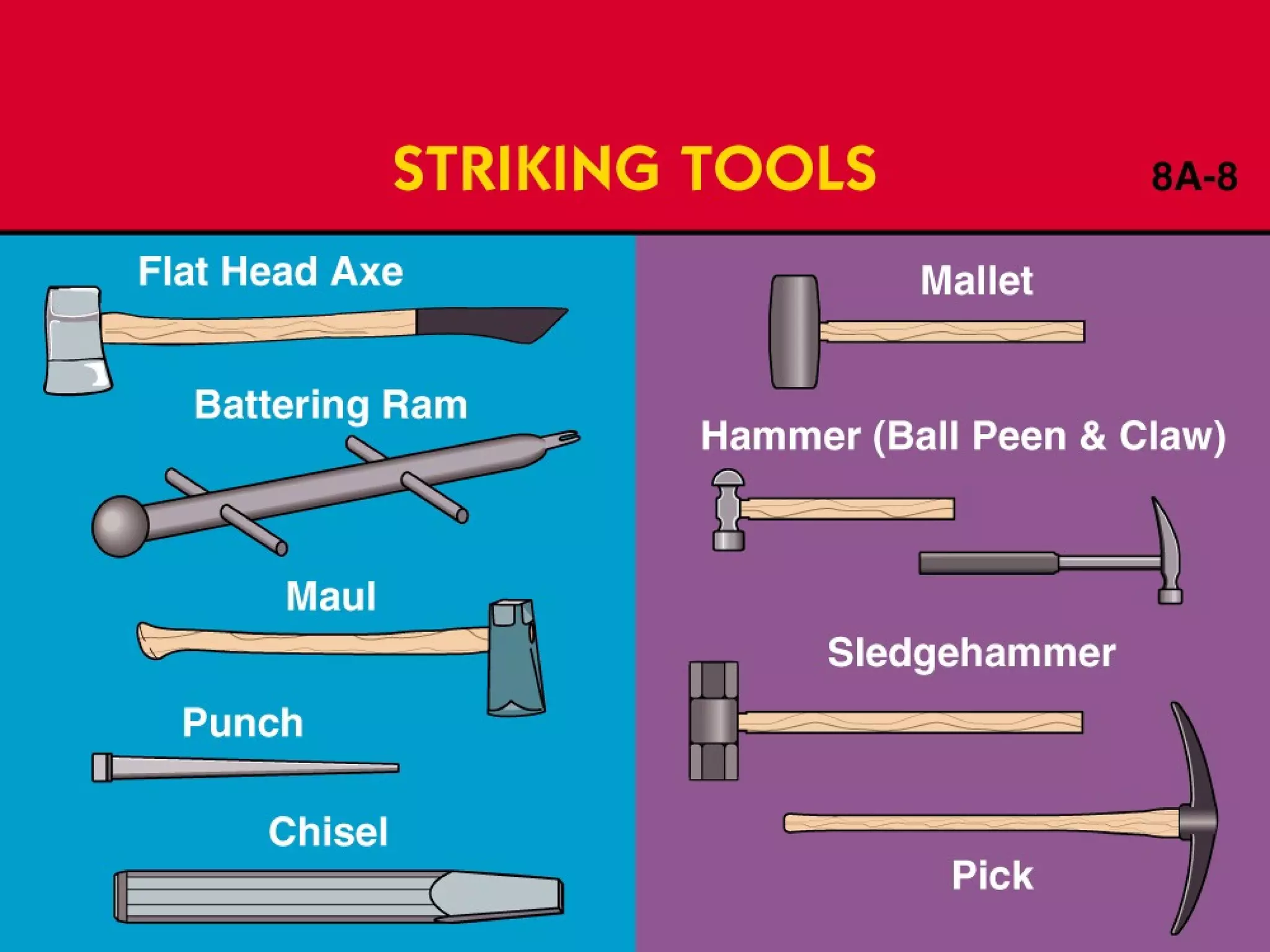
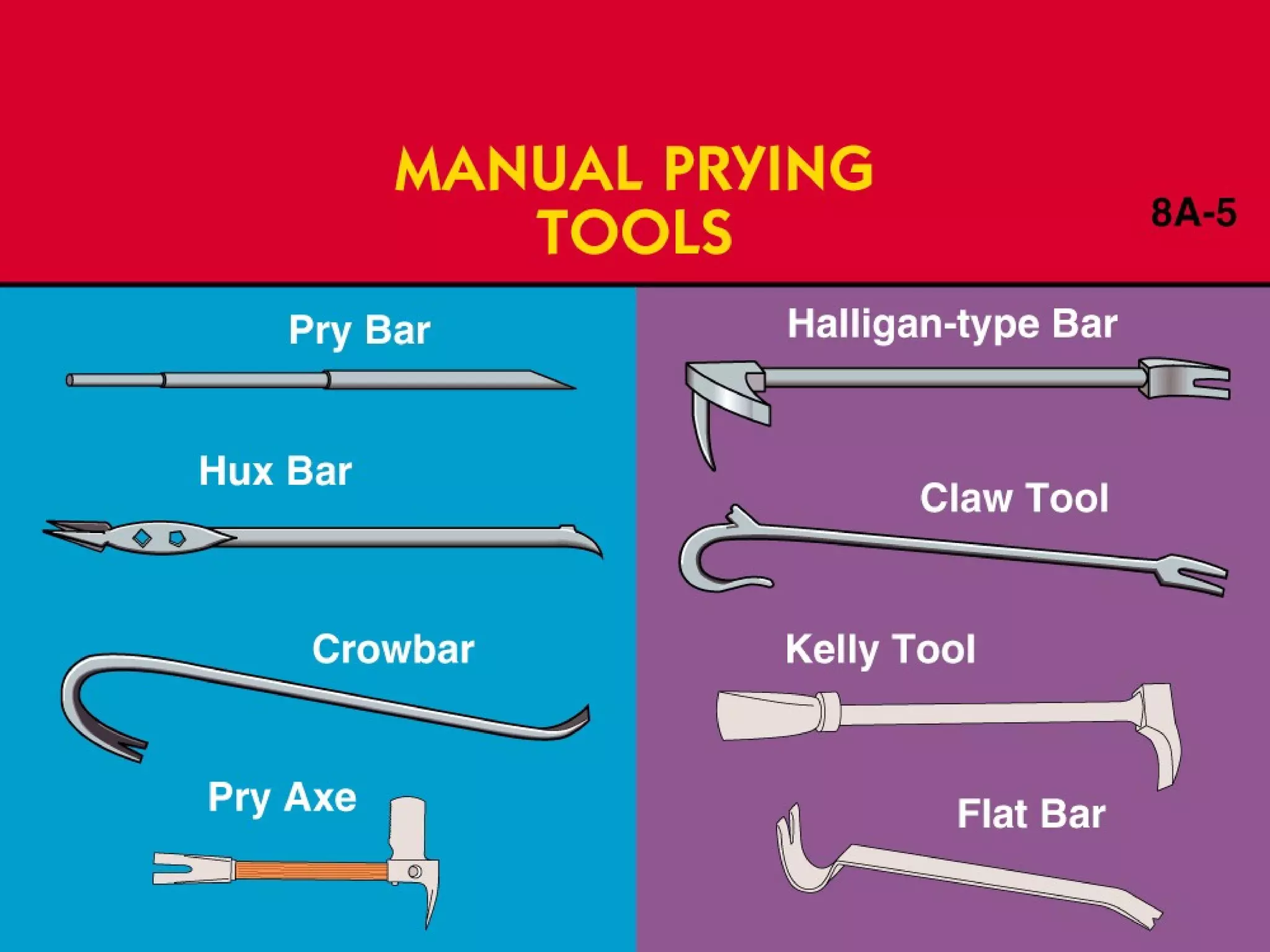
Hand Tools General and specialized tools for cutting, forcing, lighting, tightening Hose tools (spanners) Hydraulic rescue tools Air bags  Axes Circular saws Chain saws


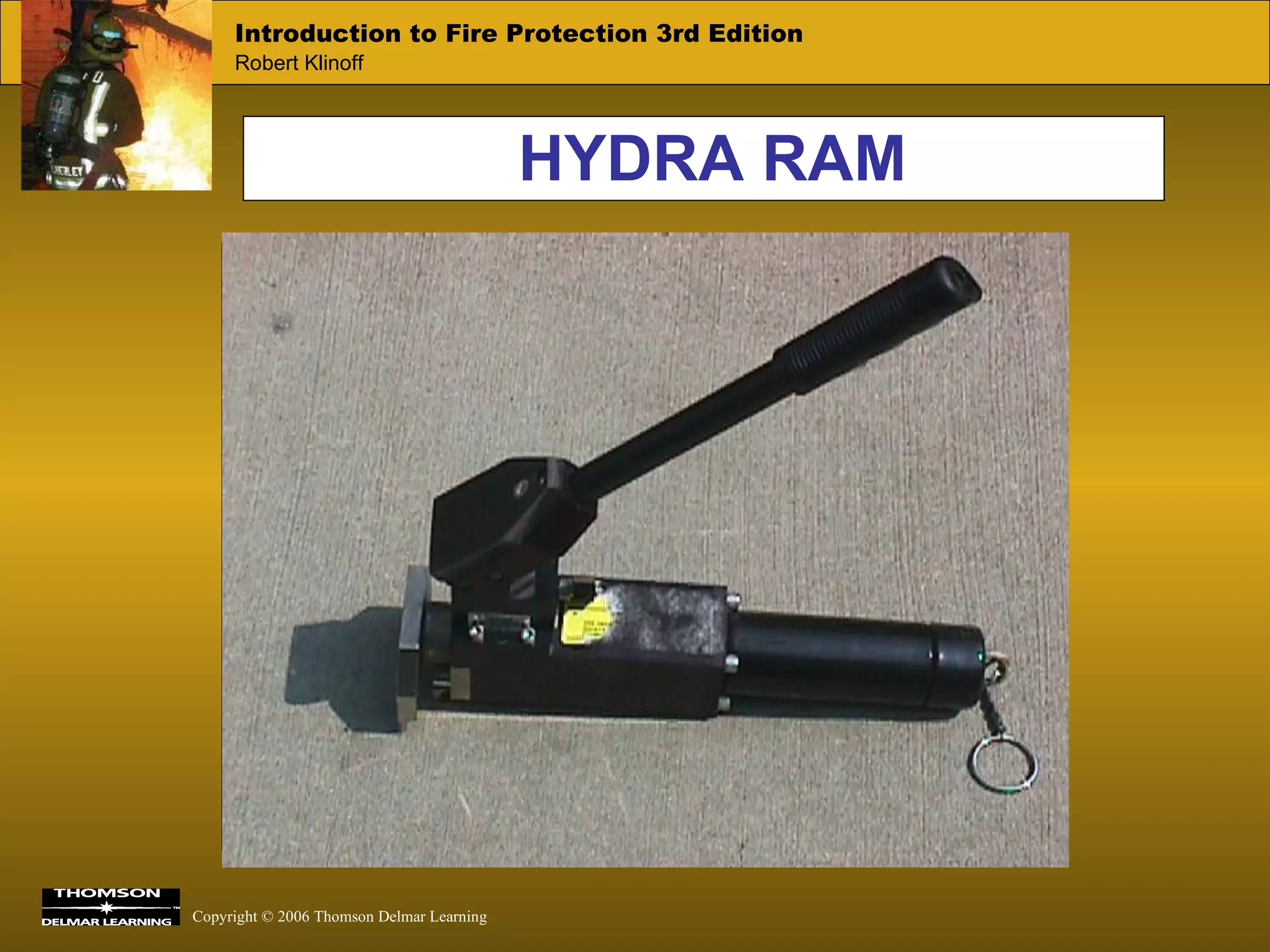
HYDRA RAM Add picture


PARTNER SAW
Adjustable depth gauge
QUICK-VENT SAW
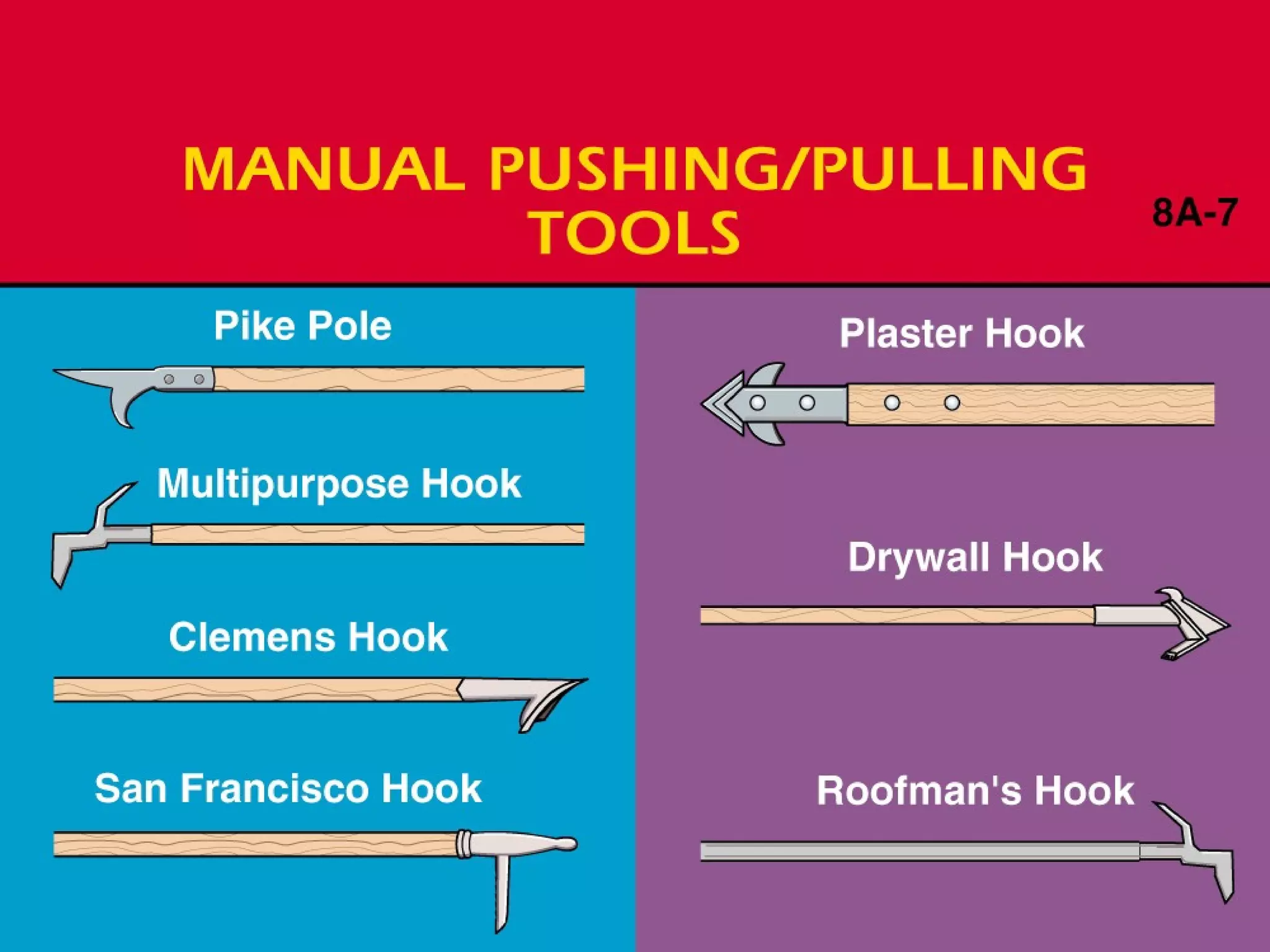
Hand Tools (con’t.) More tools Sledge hammers Pike poles Rubbish hooks Power fans Smoke ejectors Salvage covers/rolled plastic Fire extinguishers


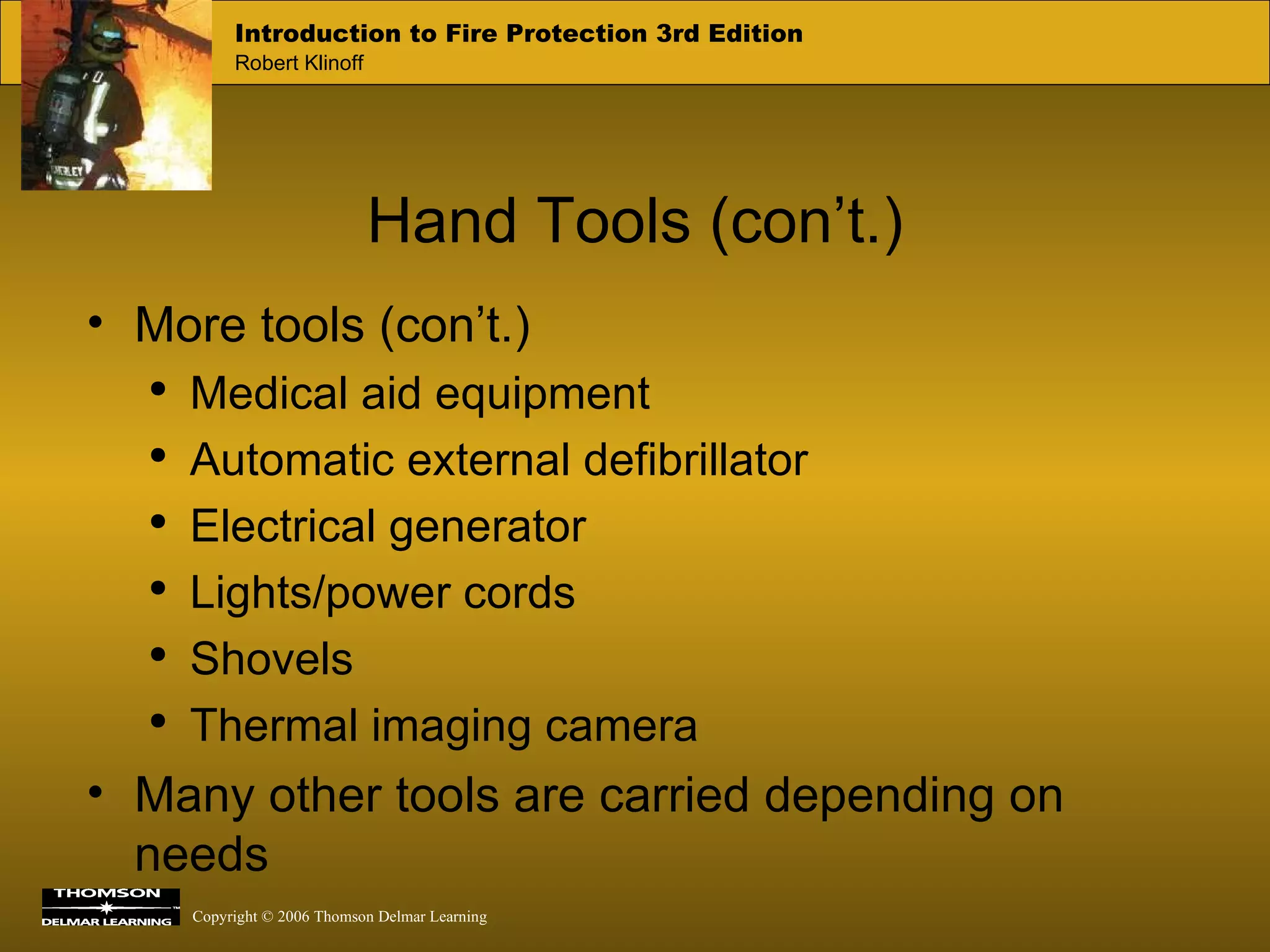
Hand Tools (con’t.) More tools (con’t.) Medical aid equipment Automatic external defibrillator Electrical generator Lights/power cords Shovels Thermal imaging camera Many other tools are carried depending on needs
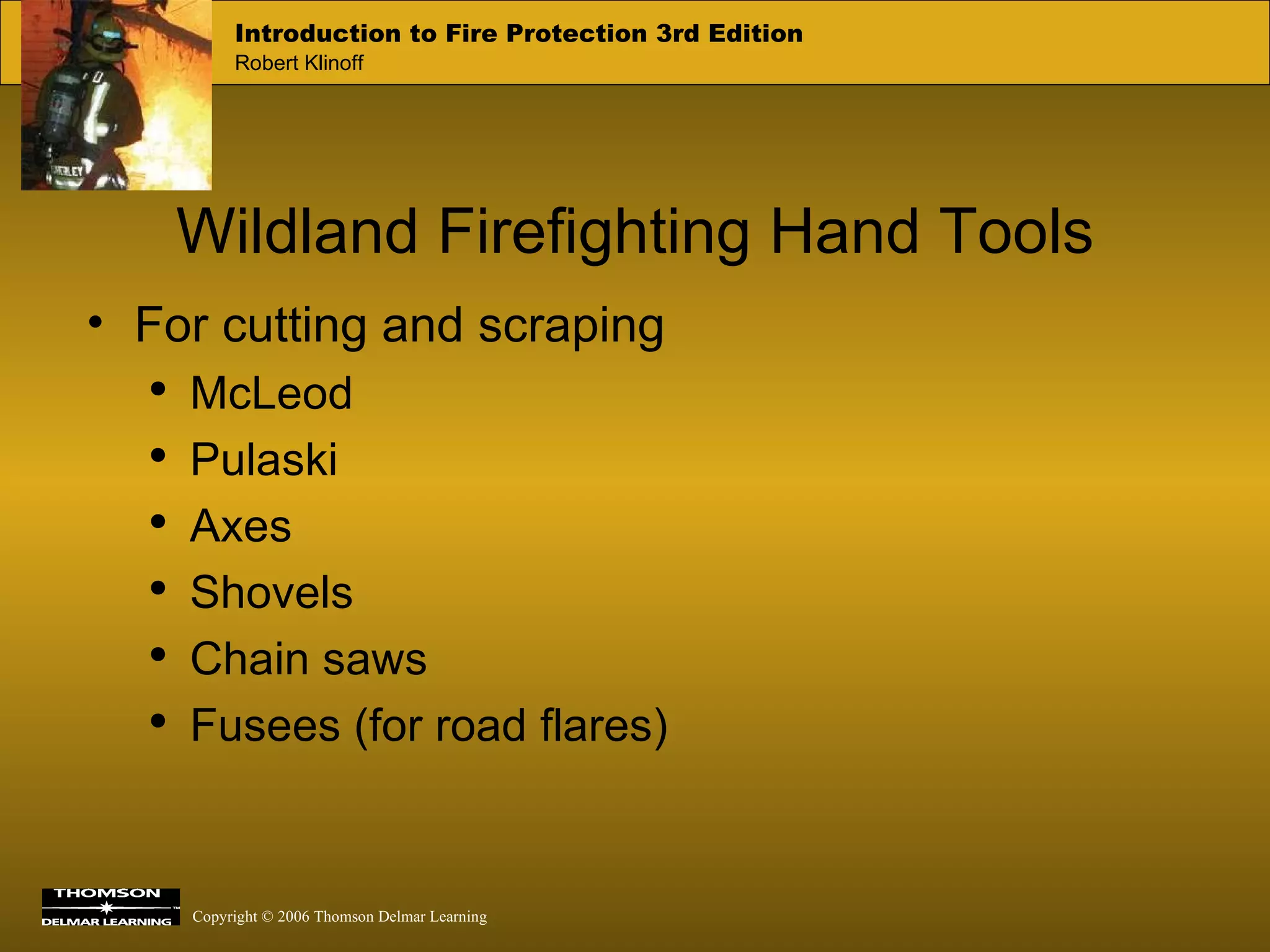
Wildland Firefighting Hand Tools For cutting and scraping McLeod Pulaski Axes Shovels Chain saws Fusees (for road flares)
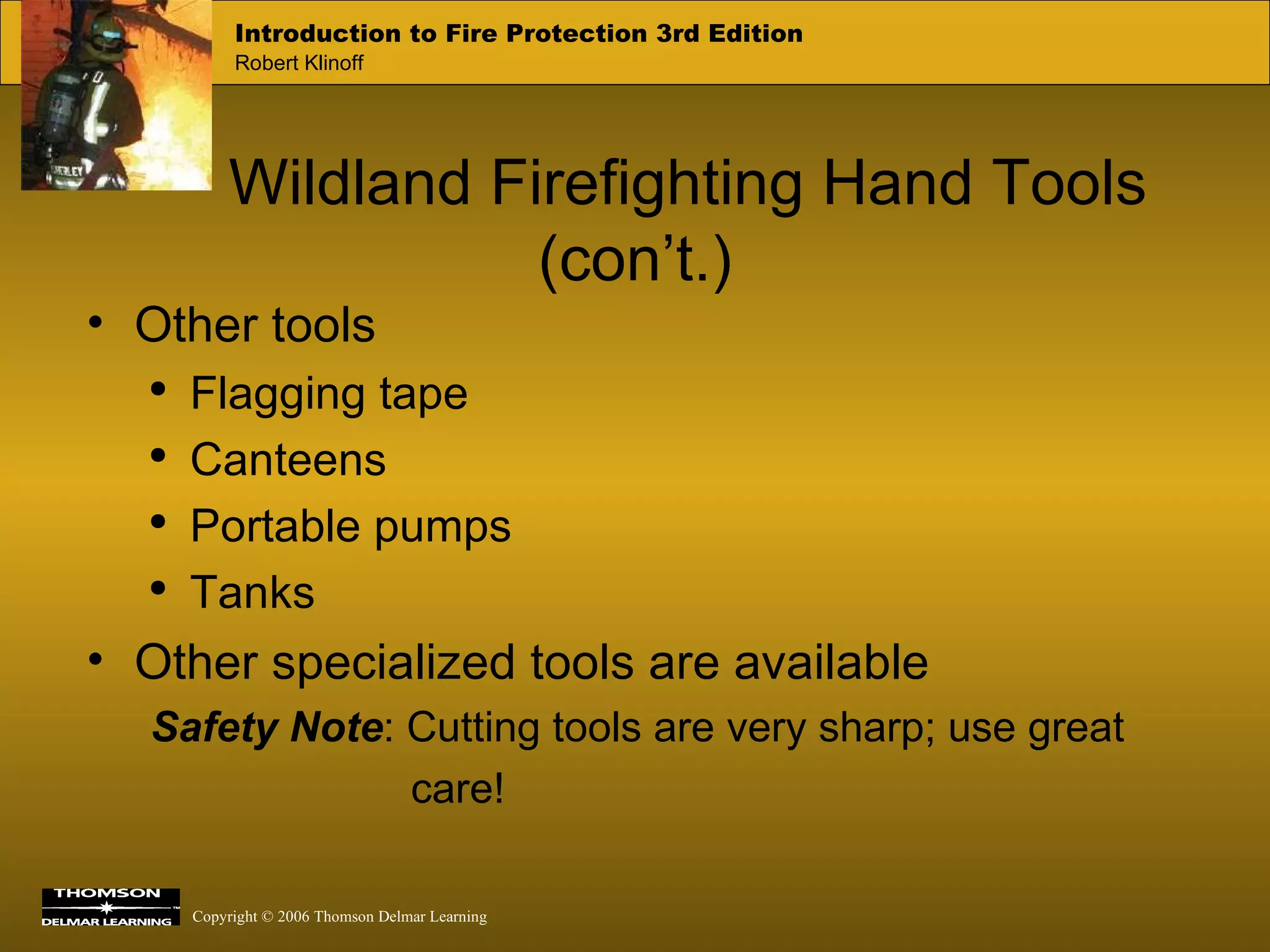
Wildland Firefighting Hand Tools (con’t.) Other tools Flagging tape Canteens Portable pumps Tanks Other specialized tools are available Safety Note :   Cutting tools are very sharp; use great  care!
Heavy Equipment Bulldozers create firelines Scrape earth Knock down trees Pumper Cat has water tank on board Special foam units for oil firefighting
Personal Protective Equipment (PPE) Includes the following: Station/work uniform Structure fire PPE Personal alarm/personal safety system Proximity suits Wildland PPE
Station/Work Uniforms May be flame-resistant material, cotton or cotton blend Cotton underwear Additional layers help to protect from radiant heat Safety Note : Any clothing made of nylon or related synthetic fabrics can melt to your skin
Structure Fire PPE Designed as a system Helmet and hood or ear protection SCBA  Coat  Pants Boots and gloves Safety Note : PPE must  all  be worn  every  time to provide proper protection
Personal Alarm / Proximity Suits Personal Alarm Device (PAL or PASS) Required to carry on SCBA suit Emits signal when no motion is detected for approximately 30 seconds Proximity Suits Used to approach flaming fuel Not designed  for walking in flames
Wildland PPE Designed as a system Hard hat, ear and face protection, and goggles Fire shirt with T-shirt underneath Flame-resistant pants Lace-up boots with lug soles Gloves Fire shelter Safety Note : Never leave vehicle without shelter
Emergency Medical PPE Universal precautions Moisture-resistant long-sleeved shirt Latex or vinyl gloves Eye, nose, and mouth protection
Aircraft Fixed wing Lead plane Air tankers Smoke jumper transport Rotary wing Troop/materiel transport Water dropping EMS transport
Tools and equipment constantly developed or adapted for firefighters Equipment varies according to department needs  New tools make job easier and safer Do not become so dependent on power tools that you are ineffective without them Facilities in this chapter are only a representative sample  Most important resource: the firefighter Summary

Chapter 06

  • 1.
    Introduction to FireProtection 3rd Edition
  • 2.
    Chapter 6 FireDepartment Resources
  • 3.
    Objectives List firedepartment facilities List advantages of a department having its own facilities Describe the purpose of each of the fire department facilities Describe the types of fire apparatus and their functions List the types of tools carried on fire apparatus
  • 4.
    Objectives (con’t.) Describethe use of the various tools carried on fire apparatus Describe the different types of personal protective equipment firefighters use Describe the types and uses of aircraft in fire fighting
  • 5.
    Introduction The modernfire department relies on facilities and equipment as resources Some facilities are not available at every fire department due to need or budget constraints Equipment has evolved over a period of many years Varies in fire departments according to situations and types of fires
  • 6.
    Fire Department FacilitiesIncludes the following: Headquarters Automotive repair facility Training center Warehouse/central stores Communications center Fire stations
  • 7.
    Headquarters Houses managerial/commandstaff Concentrates decision makers in one location May be located at main fire station or at other location
  • 8.
    Automotive Repair FacilityFleet maintenance Apparatus build up Mechanical expertise for fire equipment
  • 9.
    Training Center Trainingcenter Specially constructed or improvised Drill tower (see Figure 6-4) Ladder training (ground/aerial) Hi-rise training High angle rescue
  • 10.
    Training Center (con’t.)Burn building Search and interior attack drills Fire environment demonstrations Ventilation drills Hazardous materials drills, including simulated drug labs Safety Note : Follow NFPA 1403 standards for live drills
  • 11.
    Training Center (con’t.)Classrooms Equipment VCR, TV, white boards Clean/controlled environment Lighting, seating May be shared with other agencies Storage rooms Apparatus, equipment, supplies
  • 12.
    Training Center (con’t.)Drafting pit Operating training On-site hydrants For drill tower and burn building Testing on hydrant hookups Driver training/testing course Emergency stops, high-speed lane changes
  • 13.
    Training Center (con’t.)Hazardous materials props Plumbing props, railroad tank cars, large tanks Useful for confined space rescue training Studio Create and duplicate training materials Produce closed-circuit TV programs Offices Instructor support Library of training materials
  • 14.
    Warehouse/Central Stores Stockday-to-day needs, from toilet paper to PPE Keep items readily available Maintain equipment SCBA and medical oxygen refill Hose repair
  • 15.
    Communications Center Receivescalls for emergency assistance Relevant 911 calls routed to fire department dispatcher Dispatcher enters call information into CAD system CAD system displays information to dispatch required units Enhanced 911 and CAD systems give incident address and equipment information
  • 16.
    Fire Stations Beganas apparatus storage sheds Provide living quarters, office space, and apparatus room Accommodate women in the fire service Provide handicapped access Blend in with neighborhood
  • 17.
    Fire Stations (con’t.)Keep well maintained Occupy a large, secured lot Supply room for maneuvering apparatus to perform drills House equipment for vehicle maintenance Motor block heater, electric and air hose reels, air compressor, hose tower Store turnouts in ventilated storage cabinets
  • 18.
    Fire Apparatus Manytypes required Build up from cab and chassis Commercial or custom cabs Meet NFPA 1901 Automotive Fire Apparatus requirements Safety Note : Wear seat belts, remain seated and belted in until told to exit
  • 19.
    Cab and ChassisTour of cab Large mirrors Air brake pressure gauge Oil pressure gauge Fuel level gauge Manual or automatic transmission
  • 20.
    Cab and Chassis(con’t.) Pump transfer case Transfers power to pump Automatics equipped with brake and throttle pedals Diesel may have “jake brake” Turns motor into air compressor for braking Saves vehicle brakes from wear/overheating
  • 21.
    Cab and Chassis(con’t.) Switches for lights and siren Light bar on cab includes alley and red lights Air horns in front bumper Electronic siren with several tones Radio system has multi-channel capability Administrative and emergency operations channels Communications with other jurisdictions
  • 22.
    Cab and Chassis(con’t.) Intercom system allows intra-cab communications SCBA mounted in cab for quick donning Mobile Data Computer (MDC) connect to CAD and AVL Global positioning system (GPS) allows vehicle tracking and relay of position to aircraft Double battery setup for startup power and warning lights
  • 23.
    Motor Diesel becomingmost common Long life and durability Abundance of torque Turbo and/or supercharged Oversized alternator High idle switch keeps amperage up
  • 24.
    Modular Apparatus Caband chassis Replaceable buildup Flat bed with skid unit Allows greater flexibility
  • 25.
    Pumper/Engine Triple combinationmost common Hose Water tank Pump
  • 26.
    Water Tanks Varioussized water tanks 200 to 1,500 gallons Baffles to prevent sloshing and weight shift Plastic gaining popularity as tank material Unharmed by foam Does not rust
  • 27.
    Foam Systems Foamsystems Class A Superior knockdown on ordinary combustibles Class B For hydrocarbon fuels Often uses flow meter CAFS Uses compressed air
  • 28.
    Pumps Main purposeis to lift water Centrifugal most common as main pump Construction Impeller is the vaned wheel inside case Suction inlets introduce water into eye of impeller Impeller spins, forcing water outward against walls of casing
  • 29.
    Centrifugal Pumps Casinguses volute area to convert centrifugal energy to pressure Volute discharges water into plumbing Plumbing connects to various outlets (discharges)
  • 30.
    Centrifugal Pumps (con’t.)Relief valve Reroutes excess pressure to suction side Prevents pressure surges Pressure governor Controls motor speed Less speed = less pressure Prevents pressure surges Safety Note : Should always be set at a safe operating pressure to provide firefighter safety
  • 31.
    Centrifugal Pumps (con’t.)Advantages Can spin without discharging water Take advantage of pressure from inlet side Can pump dirty water Equipped with screens to limit size of debris entering pump Safety Note : If no water is discharged, it can reach scalding temperatures
  • 32.
    Centrifugal Pumps (con’t.)Disadvantages Can only act on the water that enters Cannot draw water from a static source Cavitation can occur if the discharge exceeds intake pressure May damage pump impeller
  • 33.
    Positive Displacement PumpsTypes include rotary gear, piston and diaphragm Discharge volume equals intake volume Used to “prime” centrifugal pumps Evacuates air from pump housing Creates vacuum Atmospheric pressure forces water into pump Used in some high pressure applications
  • 34.
    Positive Displacement Pumps(con’t.) Advantages Self-priming (can pump air) Disadvantages Must keep a discharge open at all times due to pressure buildup Cannot pump debris Heavy and expensive
  • 35.
    Aerial Ladder andElevated Platform Apparatus Two basic configurations Tractor/trailer with tiller Straight chassis Ladder types Extendable with flies With or without basket/platform 108 feet of ground ladders needed to qualify as a ladder truck
  • 36.
    Aerial Ladder andElevated Platform Apparatus (con’t.) Additional features Articulated boom Intercom system Breathing air system in platform Plumbing for elevated streams Remote controls in platform
  • 37.
    Quint Quint apparatusladder truck/pumper combination includes: Pump Water tank Hose bed Aerial ladder Ground ladders
  • 38.
    Squads Specialty vehiclesto serve department’s special needs Examples Special lighting vehicle Medical and hazardous materials vans Tactical command post and support Rehab Terra torch (for wildland firefighting)
  • 39.
    Aircraft Rescue FireFighting (ARFF) Large water tank Foam and dry chemical extinguishing systems All-wheel drive for off-runway operation Turret and ground sweep nozzles Pump and roll capability Hand lines and ladders for fuselage access
  • 40.
    Fire Tools andAppliances Includes the following: Hose Nozzles Ladders Fittings SCBA Hand Tools Wildland Firefighting Hand Tools
  • 41.
    Hose Come invarious sizes and construction types Use couplings Carried in apparatus hose beds Used for various applications Attack Supply
  • 42.
  • 43.
    Figure 6-37 Hose lines, 2 ½ inch, three-inch, and four-inch diameter, laid in hose bed.
  • 44.
  • 45.
  • 46.
    HIGBEE CUT &INDICATOR
  • 47.
    Nozzles Numerous sizesand designs Combination Fog or straight stream patterns Straight tip/smooth bore Bail handle turns on and off Designed to turn itself off if dropped
  • 48.
    Nozzles (con’t.) Foaminductors Based on venturi principle Draws concentrate from pail and introduces it into the hose stream Must follow manufacturer’s instructions or quality foam will not be produced
  • 49.
  • 50.
  • 51.
  • 52.
  • 53.
  • 54.
  • 55.
  • 56.
  • 57.
  • 58.
  • 59.
  • 60.
  • 61.
    Fittings Connect hosesand appliances Allows versatility Reverse direction of hose lays Change hose size or thread type Combine or divide hose lays
  • 62.
  • 63.
  • 64.
  • 65.
    Ladders Attic ladder:folding 10-foot most common Roof ladder: 14-foot with fold out hooks Extension ladder: bed ladder with one or more flies, various lengths Safety Note : Ladders used must be designed for firefighting use
  • 66.
    SCBA Self-contained breathingapparatus Four main components Face mask Air bottle Backpack Regulator Low pressure alarm
  • 67.
    SCBA (con’t.) Protectfirefighters from Low oxygen concentration Toxic byproducts Smoke Superheated gases Regulator operates in positive pressure mode to prevent toxic gases from entering face mask
  • 68.
  • 69.
    Scott 50 –4.5 SCBA
  • 70.
  • 71.
    General SCBA Components – E.g. MSA Mask Regulator Cylinder Shoulder Straps Waist Strap Cylinder Valve Pressure Reducing Valve
  • 72.
    Scott 4.5 AV2000Mask & Pack
  • 73.
  • 74.
    Hand Tools Generaland specialized tools for cutting, forcing, lighting, tightening Hose tools (spanners) Hydraulic rescue tools Air bags Axes Circular saws Chain saws
  • 75.
  • 76.
  • 77.
  • 78.
  • 79.
  • 80.
  • 81.
  • 82.
  • 83.
  • 84.
  • 85.
  • 86.
    Hand Tools (con’t.)More tools Sledge hammers Pike poles Rubbish hooks Power fans Smoke ejectors Salvage covers/rolled plastic Fire extinguishers
  • 87.
  • 88.
  • 89.
  • 90.
    Hand Tools (con’t.)More tools (con’t.) Medical aid equipment Automatic external defibrillator Electrical generator Lights/power cords Shovels Thermal imaging camera Many other tools are carried depending on needs
  • 91.
    Wildland Firefighting HandTools For cutting and scraping McLeod Pulaski Axes Shovels Chain saws Fusees (for road flares)
  • 92.
    Wildland Firefighting HandTools (con’t.) Other tools Flagging tape Canteens Portable pumps Tanks Other specialized tools are available Safety Note : Cutting tools are very sharp; use great care!
  • 93.
    Heavy Equipment Bulldozerscreate firelines Scrape earth Knock down trees Pumper Cat has water tank on board Special foam units for oil firefighting
  • 94.
    Personal Protective Equipment(PPE) Includes the following: Station/work uniform Structure fire PPE Personal alarm/personal safety system Proximity suits Wildland PPE
  • 95.
    Station/Work Uniforms Maybe flame-resistant material, cotton or cotton blend Cotton underwear Additional layers help to protect from radiant heat Safety Note : Any clothing made of nylon or related synthetic fabrics can melt to your skin
  • 96.
    Structure Fire PPEDesigned as a system Helmet and hood or ear protection SCBA Coat Pants Boots and gloves Safety Note : PPE must all be worn every time to provide proper protection
  • 97.
    Personal Alarm /Proximity Suits Personal Alarm Device (PAL or PASS) Required to carry on SCBA suit Emits signal when no motion is detected for approximately 30 seconds Proximity Suits Used to approach flaming fuel Not designed for walking in flames
  • 98.
    Wildland PPE Designedas a system Hard hat, ear and face protection, and goggles Fire shirt with T-shirt underneath Flame-resistant pants Lace-up boots with lug soles Gloves Fire shelter Safety Note : Never leave vehicle without shelter
  • 99.
    Emergency Medical PPEUniversal precautions Moisture-resistant long-sleeved shirt Latex or vinyl gloves Eye, nose, and mouth protection
  • 100.
    Aircraft Fixed wingLead plane Air tankers Smoke jumper transport Rotary wing Troop/materiel transport Water dropping EMS transport
  • 101.
    Tools and equipmentconstantly developed or adapted for firefighters Equipment varies according to department needs New tools make job easier and safer Do not become so dependent on power tools that you are ineffective without them Facilities in this chapter are only a representative sample Most important resource: the firefighter Summary

Editor's Notes

  • #84 The power saw improves operational efficiency by facilitating cutting operations at fires & other emergencies. The saw can be dangerous when operated improperly or in disregard to safety precautions.