4

Company
Operations
4
     Learning Objectives (1 of 7)
• Compare the division-of-labor concept
  as used in industry to company-level
  deployment.
• Describe structural firefighting functional
  assignments.
4
     Learning Objectives (2 of 7)
• Enumerate engine and ladder company
  fire-ground functions and tasks.
• Analyze tactics for the first-arriving fire
  company in relation to life safety.
4
    Learning Objectives (3 of 7)
• Apply engine and ladder company tasks
  to coordinating and controlling
  company-level deployment.
• Explain the importance of company
  unity to incident organization and
  accountability.
4
     Learning Objectives (4 of 7)
• List situations where splitting companies
  may be acceptable.
• Evaluate the positive and negative
  aspects of pre-assigning tasks, tools,
  and fire-ground positions.
4
    Learning Objectives (5 of 7)
• Assess proper and improper ventilation
  methods in regard to achieving the
  operational priorities of life safety,
  extinguishment, and property
  conservation.
• Given the fire and victim locations,
  determine the best vent location.
4
    Learning Objectives (6 of 7)
• Describe safe and efficient positioning
  of apparatus.
• Apply engine and ladder company tasks
  at a structure fire.
4
     Learning Objectives (7 of 7)
• Analyze company operations at a
  structure fire scenario.
• Develop an incident action plan utilizing
  engine and ladder company functional
  assignments.
4
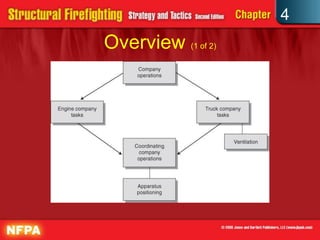
Overview (1 of 2)
4
              Overview (2 of 2)
• Primary responsibility is to work within
  the overall incident action plan.
  – Freelancing cannot be tolerated.
  – First-in units can go to work quickly using
    SOPs.
     • Allows IC time to evaluate options while
       maintaining control
4
Division of Labor Principle (1 of 3)
• Basis for the Industrial Revolution
• Developing job skills in a concentrated
  area allows greater productivity.
• “Jack of all trades, master of none”—
  overcome by developing a high level of
  expertise in a limited number of tasks
4
Division of Labor Principle (2 of 3)
• Stresses need for pre-assigning duties
  – Fire fighters should be cross-trained.
  – Ensures that everyone is familiar with what
    will be expected of them
4
Division of Labor Principle (3 of 3)
• Divides tasks into functional areas:
  – Command responsibilities
  – Engine company tasks
  – Truck company tasks
  – Emergency medical services (EMS)
  – Special operations
  – Support services
4
 Engine Company Operations
• Performing rescue operations
• Establishing a water supply
• Advancing and operating hose lines
4
  Engine Company Tasks (1 of 4)
• Usually first to arrive
  – First-in officer initiates the attack.
  – Provides a means of moving water from a
    water supply to the fire
• Life safety is the first priority.
  – Victims and fire fighters
4
  Engine Company Tasks (2 of 4)
• Life safety objectives
  – Place attack lines in position
  – Provide safe evacuation routes
• Conduct a cursory search
  – Occupants may only need direction and
    guidance.
4
  Engine Company Tasks (3 of 4)
• Position hose lines or remove
  occupants?
  – Difficult decision based on:
     •   Immediate danger to the occupants
     •   Available staffing and resources
     •   Time before additional resources arrive
     •   Extent of fire involvement
     •   Equipment available to perform rescue
4
  Engine Company Tasks (4 of 4)
• Life safety is top priority.
• IAP directs resources towards
  evacuation of endangered occupants.
4
    Truck Company Operations
•   Conduct primary search
•   Rescue trapped victims
•   Ventilate
•   Force entry
•   Ladder the building
•   Check for fire extension
•   Access concealed spaces
4
   Truck Company Tasks (1 of 3)
• “Ladder company” = “truck company”
• Aerial device not necessary at every fire
  or in every department
  – Still necessary to have truck company
    functions assigned
4
   Truck Company Tasks (2 of 3)
• Responsible for a wide variety of tasks
  – Staffing is crucial.
• Activities are limited during defensive
  attacks.
  – Elevated master streams
4
   Truck Company Tasks (3 of 3)
• Low-staffing situations
  – May need to assist engine company
     • Not the most effective use of personnel
4
                 Rescue
• Indirect activity for engine companies
  – Hose lines between victims and the fire
• Direct activity for truck companies
  – Ventilate
  – Primary search, remove victims
  – Ladder building
4
 Control and Coordination (1 of 3)
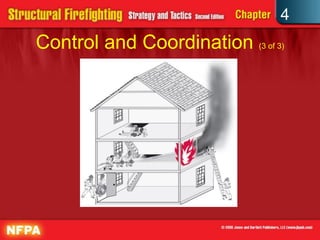
• IC coordinates all activities.
• Truck companies work in areas above
  the fire.
• Engine company works at controlling
  the fire.
4
 Control and Coordination (2 of 3)
• If the fire is not controlled, truck
  companies need to be notified to
  evacuate.
  – Retreat protected by engine company
4
Control and Coordination (3 of 3)
4
        Safety and Control
• Operating units must work as groups.
  – First-in truck company is exception to the
    rule
    • Permissible to split into separate crews
4
        Company Unity (1 of 2)
• It is not freelancing when a crew is split
  into separate teams.
  – Each crew should have a team leader.
• Other exceptions
  – Inside/outside crew
  – Must comply with two-in/two-out rules
4
        Company Unity (2 of 2)
• Operator may remain at apparatus.
• Company should remain together
  whenever possible.
• Company unity facilitates accountability.
  – Officer can verify safety of crew.
4
    Quint/Quad Companies
• Multi-function apparatus
  – Engine and truck company operations
  – Staffing may or may not be sufficient.
     • Dictates tasks able to be performed
• Activities covered by SOPs
4
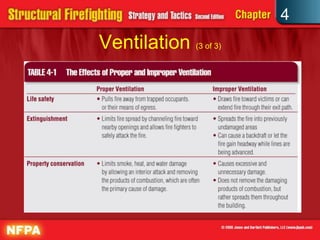
            Ventilation (1 of 3)
• One of the IC’s most important tactical
  considerations
  – Given a high priority
• Can have a positive effect on all three
  fire-ground priorities
4
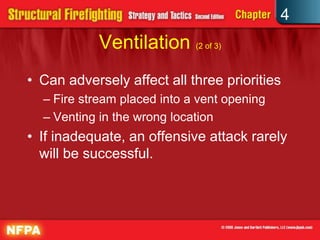
            Ventilation (2 of 3)
• Can adversely affect all three priorities
  – Fire stream placed into a vent opening
  – Venting in the wrong location
• If inadequate, an offensive attack rarely
  will be successful.
4
Ventilation (3 of 3)
4
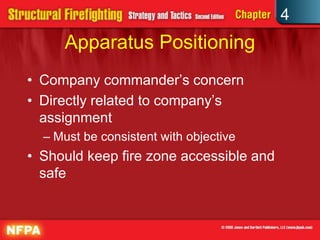
     Apparatus Positioning
• Company commander’s concern
• Directly related to company’s
  assignment
  – Must be consistent with objective
• Should keep fire zone accessible and
  safe
4
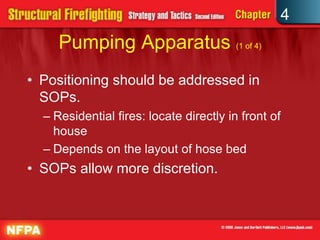
     Pumping Apparatus (1 of 4)
• Positioning should be addressed in
  SOPs.
  – Residential fires: locate directly in front of
    house
  – Depends on the layout of hose bed
• SOPs allow more discretion.
4
     Pumping Apparatus (2 of 4)
• Used to lay attack lines
  – Positioned close to curb line
     • Side discharges = aligned with entry point
     • Rear discharges = forward of entry point
4
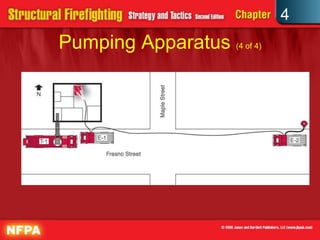
    Pumping Apparatus (3 of 4)
• SOPs may specify separate water
  supplies.
  – Attack pumper configuration
    • First engine company at front of building,
      second engine company provides supply
4
Pumping Apparatus (4 of 4)
4
          Aerial Apparatus
• Aerial device use
  – Obtain a safe operating angle
• Aerial device not being used
  – Parked out of way but close to entry point
     • Access to tools, ladders, and other equipment
4
Common Positioning Errors (1 of 3)
• Aerials placed under wires
• Unsafe and unstable positions
• Not allowing enough room to extend the
  outriggers
• Apparatus/staff cars blocking access to
  the fire area or front of the building
4
Common Positioning Errors (2 of 3)
• Pumpers placed where pre-connected
  attack lines are difficult to lay
• Blocking streets or fire hydrants
  – Large-diameter hose
4
Common Positioning Errors (3 of 3)
• Not securing essential attack positions
• Positioning where they cannot be
  quickly repositioned
  – Dead ends
• Responding through the fire area
  – Causes unnecessary congestion
4
            Summary (1 of 3)
• The IC improves efficiency by
  coordinating activities
  – Division-of-labor concept
• Engine company
  – Basic fire department unit
  – Primary duty is to apply water
4
              Summary (2 of 3)
• Engine company tasks
  – Obtaining a water source
  – Setting up and engaging pumps
  – Advancing hose lines into structure
  – Fulfills life safety priority by extinguishing
    fire
     • Building becomes much safer.
     • Checks areas for victims
4
           Summary (3 of 3)
• Truck company responsibilities
  – Gaining entry
  – Laddering building
  – Controlling fire spread
  – Evacuating occupants
  – Conducting primary and secondary
    searches

Chapter 4

  • 1.
  • 2.
    4 Learning Objectives (1 of 7) • Compare the division-of-labor concept as used in industry to company-level deployment. • Describe structural firefighting functional assignments.
  • 3.
    4 Learning Objectives (2 of 7) • Enumerate engine and ladder company fire-ground functions and tasks. • Analyze tactics for the first-arriving fire company in relation to life safety.
  • 4.
    4 Learning Objectives (3 of 7) • Apply engine and ladder company tasks to coordinating and controlling company-level deployment. • Explain the importance of company unity to incident organization and accountability.
  • 5.
    4 Learning Objectives (4 of 7) • List situations where splitting companies may be acceptable. • Evaluate the positive and negative aspects of pre-assigning tasks, tools, and fire-ground positions.
  • 6.
    4 Learning Objectives (5 of 7) • Assess proper and improper ventilation methods in regard to achieving the operational priorities of life safety, extinguishment, and property conservation. • Given the fire and victim locations, determine the best vent location.
  • 7.
    4 Learning Objectives (6 of 7) • Describe safe and efficient positioning of apparatus. • Apply engine and ladder company tasks at a structure fire.
  • 8.
    4 Learning Objectives (7 of 7) • Analyze company operations at a structure fire scenario. • Develop an incident action plan utilizing engine and ladder company functional assignments.
  • 9.
  • 10.
    4 Overview (2 of 2) • Primary responsibility is to work within the overall incident action plan. – Freelancing cannot be tolerated. – First-in units can go to work quickly using SOPs. • Allows IC time to evaluate options while maintaining control
  • 11.
    4 Division of LaborPrinciple (1 of 3) • Basis for the Industrial Revolution • Developing job skills in a concentrated area allows greater productivity. • “Jack of all trades, master of none”— overcome by developing a high level of expertise in a limited number of tasks
  • 12.
    4 Division of LaborPrinciple (2 of 3) • Stresses need for pre-assigning duties – Fire fighters should be cross-trained. – Ensures that everyone is familiar with what will be expected of them
  • 13.
    4 Division of LaborPrinciple (3 of 3) • Divides tasks into functional areas: – Command responsibilities – Engine company tasks – Truck company tasks – Emergency medical services (EMS) – Special operations – Support services
  • 14.
    4 Engine CompanyOperations • Performing rescue operations • Establishing a water supply • Advancing and operating hose lines
  • 15.
    4 EngineCompany Tasks (1 of 4) • Usually first to arrive – First-in officer initiates the attack. – Provides a means of moving water from a water supply to the fire • Life safety is the first priority. – Victims and fire fighters
  • 16.
    4 EngineCompany Tasks (2 of 4) • Life safety objectives – Place attack lines in position – Provide safe evacuation routes • Conduct a cursory search – Occupants may only need direction and guidance.
  • 17.
    4 EngineCompany Tasks (3 of 4) • Position hose lines or remove occupants? – Difficult decision based on: • Immediate danger to the occupants • Available staffing and resources • Time before additional resources arrive • Extent of fire involvement • Equipment available to perform rescue
  • 18.
    4 EngineCompany Tasks (4 of 4) • Life safety is top priority. • IAP directs resources towards evacuation of endangered occupants.
  • 19.
    4 Truck Company Operations • Conduct primary search • Rescue trapped victims • Ventilate • Force entry • Ladder the building • Check for fire extension • Access concealed spaces
  • 20.
    4 Truck Company Tasks (1 of 3) • “Ladder company” = “truck company” • Aerial device not necessary at every fire or in every department – Still necessary to have truck company functions assigned
  • 21.
    4 Truck Company Tasks (2 of 3) • Responsible for a wide variety of tasks – Staffing is crucial. • Activities are limited during defensive attacks. – Elevated master streams
  • 22.
    4 Truck Company Tasks (3 of 3) • Low-staffing situations – May need to assist engine company • Not the most effective use of personnel
  • 23.
    4 Rescue • Indirect activity for engine companies – Hose lines between victims and the fire • Direct activity for truck companies – Ventilate – Primary search, remove victims – Ladder building
  • 24.
    4 Control andCoordination (1 of 3) • IC coordinates all activities. • Truck companies work in areas above the fire. • Engine company works at controlling the fire.
  • 25.
    4 Control andCoordination (2 of 3) • If the fire is not controlled, truck companies need to be notified to evacuate. – Retreat protected by engine company
  • 26.
  • 27.
    4 Safety and Control • Operating units must work as groups. – First-in truck company is exception to the rule • Permissible to split into separate crews
  • 28.
    4 Company Unity (1 of 2) • It is not freelancing when a crew is split into separate teams. – Each crew should have a team leader. • Other exceptions – Inside/outside crew – Must comply with two-in/two-out rules
  • 29.
    4 Company Unity (2 of 2) • Operator may remain at apparatus. • Company should remain together whenever possible. • Company unity facilitates accountability. – Officer can verify safety of crew.
  • 30.
    4 Quint/Quad Companies • Multi-function apparatus – Engine and truck company operations – Staffing may or may not be sufficient. • Dictates tasks able to be performed • Activities covered by SOPs
  • 31.
    4 Ventilation (1 of 3) • One of the IC’s most important tactical considerations – Given a high priority • Can have a positive effect on all three fire-ground priorities
  • 32.
    4 Ventilation (2 of 3) • Can adversely affect all three priorities – Fire stream placed into a vent opening – Venting in the wrong location • If inadequate, an offensive attack rarely will be successful.
  • 33.
  • 34.
    4 Apparatus Positioning • Company commander’s concern • Directly related to company’s assignment – Must be consistent with objective • Should keep fire zone accessible and safe
  • 35.
    4 Pumping Apparatus (1 of 4) • Positioning should be addressed in SOPs. – Residential fires: locate directly in front of house – Depends on the layout of hose bed • SOPs allow more discretion.
  • 36.
    4 Pumping Apparatus (2 of 4) • Used to lay attack lines – Positioned close to curb line • Side discharges = aligned with entry point • Rear discharges = forward of entry point
  • 37.
    4 Pumping Apparatus (3 of 4) • SOPs may specify separate water supplies. – Attack pumper configuration • First engine company at front of building, second engine company provides supply
  • 38.
  • 39.
    4 Aerial Apparatus • Aerial device use – Obtain a safe operating angle • Aerial device not being used – Parked out of way but close to entry point • Access to tools, ladders, and other equipment
  • 40.
    4 Common Positioning Errors(1 of 3) • Aerials placed under wires • Unsafe and unstable positions • Not allowing enough room to extend the outriggers • Apparatus/staff cars blocking access to the fire area or front of the building
  • 41.
    4 Common Positioning Errors(2 of 3) • Pumpers placed where pre-connected attack lines are difficult to lay • Blocking streets or fire hydrants – Large-diameter hose
  • 42.
    4 Common Positioning Errors(3 of 3) • Not securing essential attack positions • Positioning where they cannot be quickly repositioned – Dead ends • Responding through the fire area – Causes unnecessary congestion
  • 43.
    4 Summary (1 of 3) • The IC improves efficiency by coordinating activities – Division-of-labor concept • Engine company – Basic fire department unit – Primary duty is to apply water
  • 44.
    4 Summary (2 of 3) • Engine company tasks – Obtaining a water source – Setting up and engaging pumps – Advancing hose lines into structure – Fulfills life safety priority by extinguishing fire • Building becomes much safer. • Checks areas for victims
  • 45.
    4 Summary (3 of 3) • Truck company responsibilities – Gaining entry – Laddering building – Controlling fire spread – Evacuating occupants – Conducting primary and secondary searches