LEARNING OBJECTIVES
Dr. James Malce Alo, RN, MAN, MAPsycho, PHD
What are Learning Objectives?
 are statements that describe what a learner will
  be able to do as a result of learning.
 sometimes called learning outcomes.
 are also statements that describe what a learner
  will be able to do as a result of teaching.
 Some definitions stress: is a sort of contract that
  teachers make with learners that describes what
  they will be able to do after learning that they
  could not do before, the 'added value' of teaching.

                             3/9/2013                   2
Factors can interfere with the
achievement of objectives:
  ◦ the existing knowledge of the learner,
  ◦ the relevance or usefulness of the material
    presented,
  ◦ the skills of the teacher.


                        3/9/2013                  3
What are the difference between
Aims and Objectives?
 Aims - general statements concerning the
  overall goals, ends or intentions of teaching.
 Objectives - are the individual stages that
  learners must achieve on the way in order
  to reach these goals.
    ◦ Example: A teacher might have an aim that a
      student should be able to take blood pressure
      using a sphygmomanometer.
      However to achieve this aim a series of objectives must
       be met. eg to explain procedure to patient, to position
       cuff correctly, to inflate to correct pressure.

                              3/9/2013                           4
 Aims are general, objectives are specific.
 There are more objectives than aims.
 Aims are like strategy, objective are like
  tactics.
    ◦ Aims and objectives can form hierarchical
      structures so that in complex curricula aims at one
      level might be seen as objectives at another.


                                3/9/2013                    5
What are the main categories of learning
objectives?
         Learning objectives are aimed at the three
          domains of learning:
          1. Knowledge/cognitive
          2. Skills/psychomotor
          3. Attitudes/affective


                             3/9/2013              6
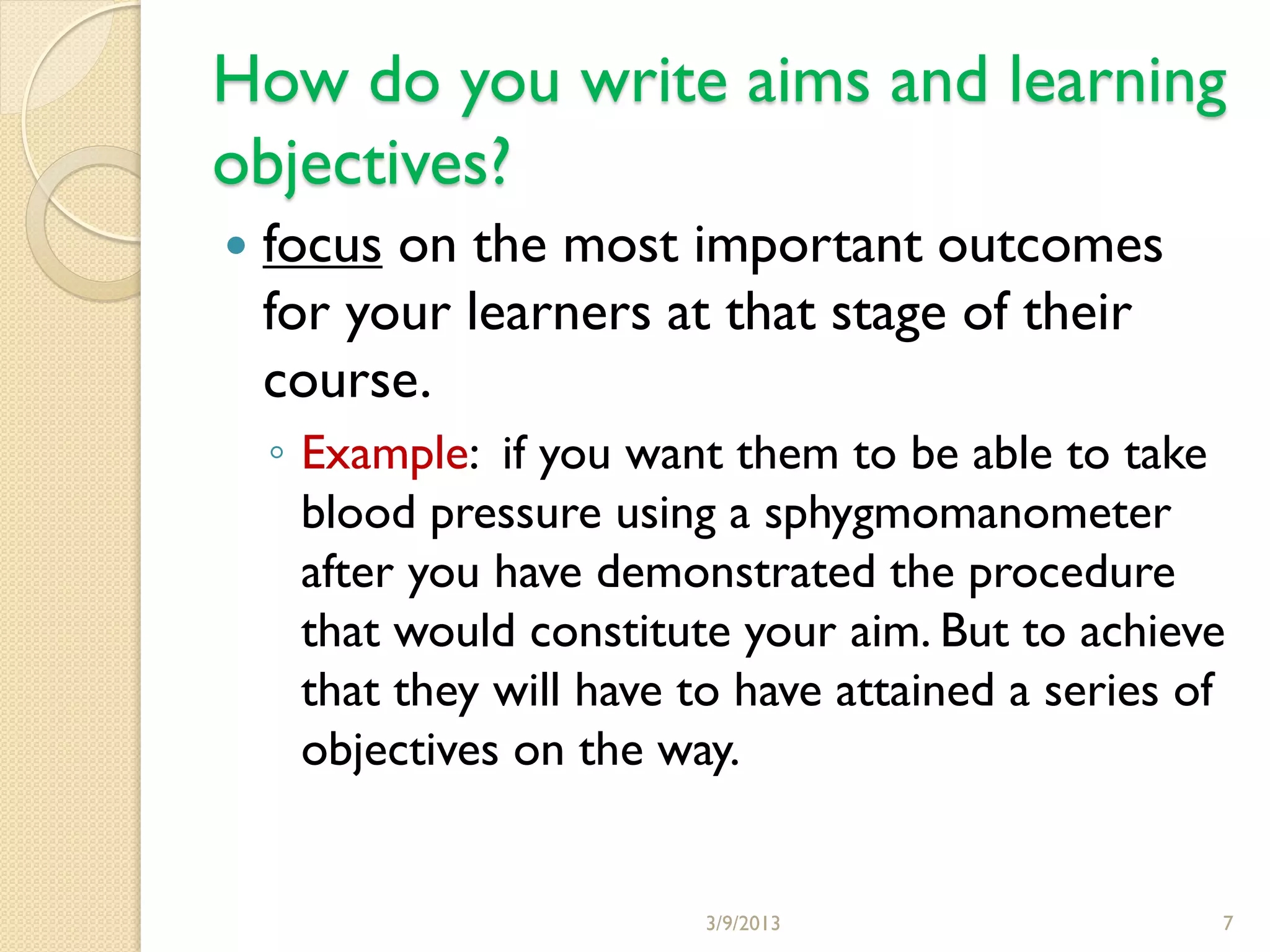
How do you write aims and learning
objectives?
   focus on the most important outcomes
    for your learners at that stage of their
    course.
    ◦ Example: if you want them to be able to take
      blood pressure using a sphygmomanometer
      after you have demonstrated the procedure
      that would constitute your aim. But to achieve
      that they will have to have attained a series of
      objectives on the way.


                          3/9/2013                   7
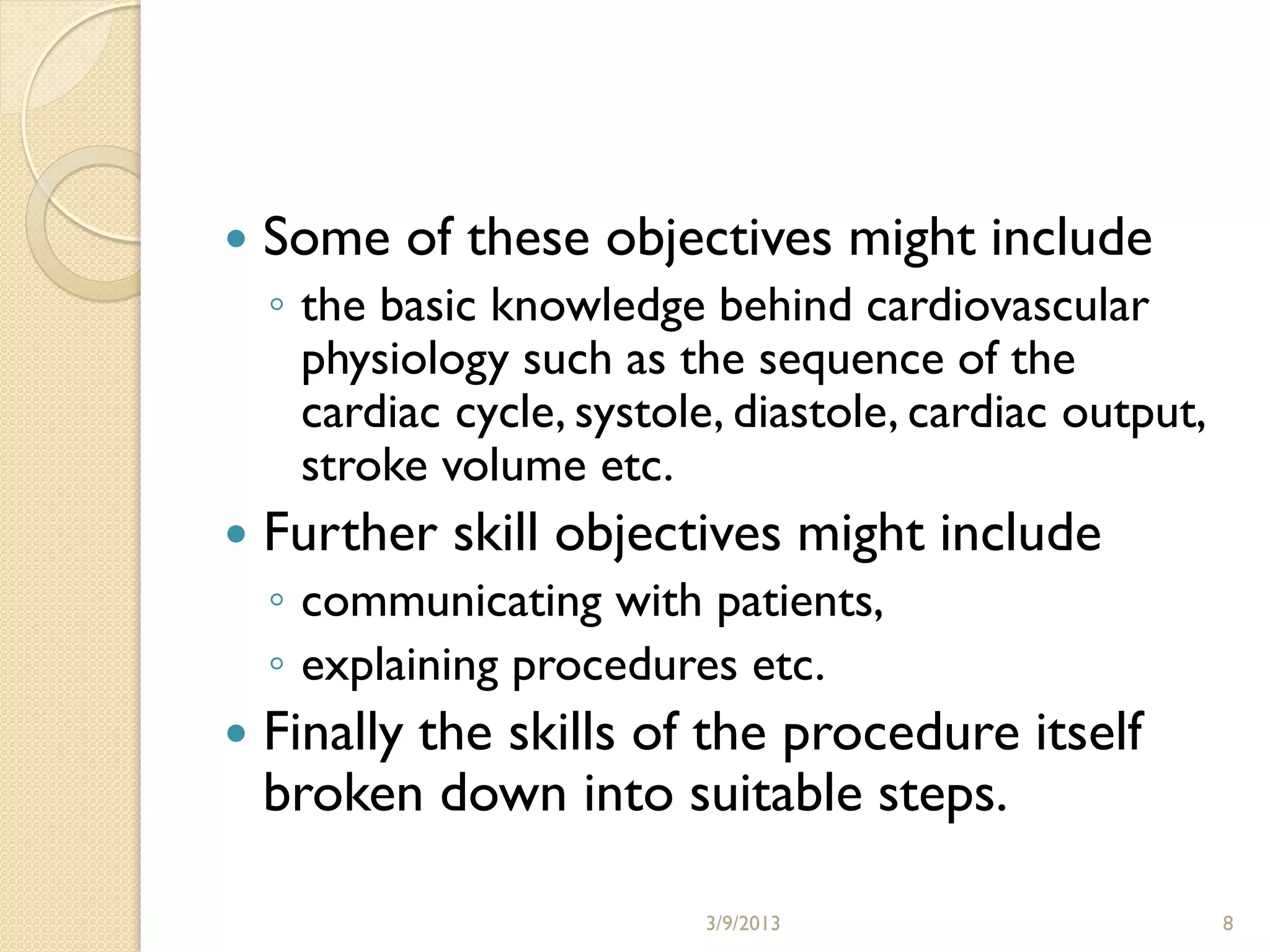
   Some of these objectives might include
    ◦ the basic knowledge behind cardiovascular
      physiology such as the sequence of the
      cardiac cycle, systole, diastole, cardiac output,
      stroke volume etc.
   Further skill objectives might include
    ◦ communicating with patients,
    ◦ explaining procedures etc.
   Finally the skills of the procedure itself
    broken down into suitable steps.

                           3/9/2013                       8
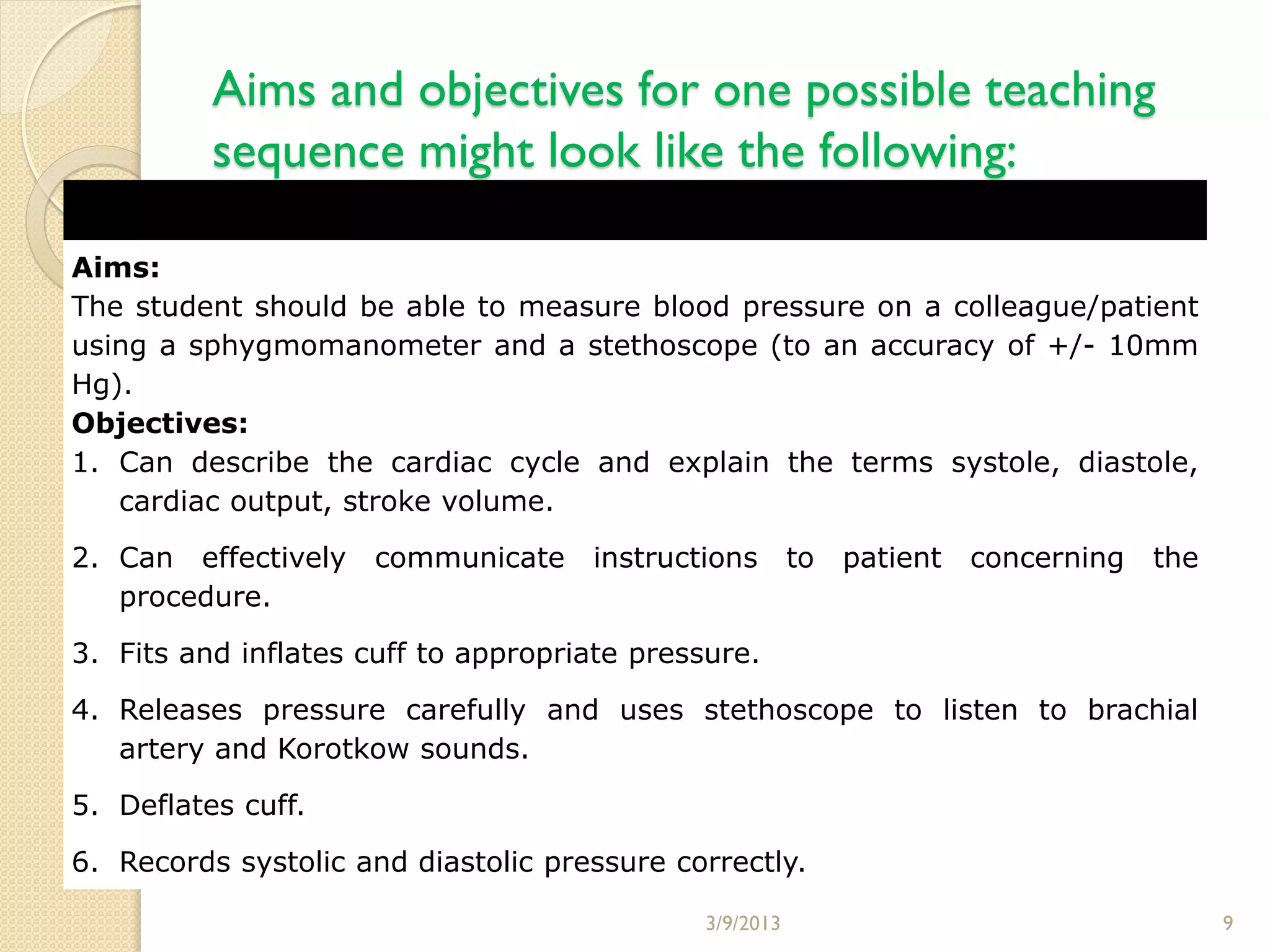
Aims and objectives for one possible teaching
          sequence might look like the following:

Aims:
The student should be able to measure blood pressure on a colleague/patient
using a sphygmomanometer and a stethoscope (to an accuracy of +/- 10mm
Hg).
Objectives:
1. Can describe the cardiac cycle and explain the terms systole, diastole,
   cardiac output, stroke volume.

2. Can effectively    communicate    instructions        to   patient   concerning   the
   procedure.

3. Fits and inflates cuff to appropriate pressure.

4. Releases pressure carefully and uses stethoscope to listen to brachial
   artery and Korotkow sounds.

5. Deflates cuff.

6. Records systolic and diastolic pressure correctly.

                                              3/9/2013                                     9
   In the case of more knowledge orientated
    aims and objectives imagine you are going
    to give a lecture with the aim of ensuring
    that students understand the relationship
    between protein structure and function
    and the various factors that influence
    enzyme reactions. Here you need to
    break the knowledge down into smaller
    components that logically build towards
    the final goal.

                       3/9/2013              10
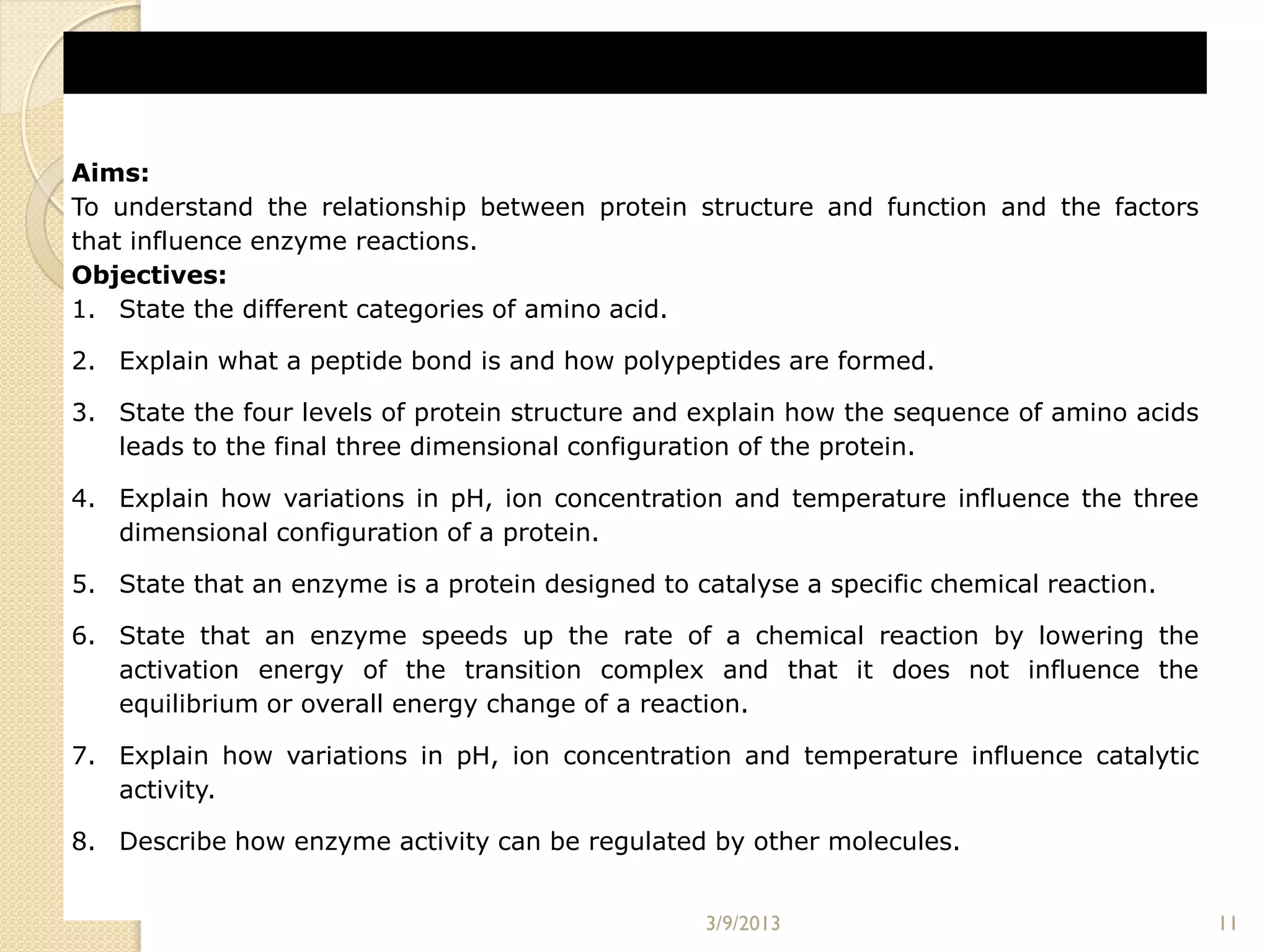
Aims:
To understand the relationship between protein structure and function and the factors
that influence enzyme reactions.
Objectives:
1. State the different categories of amino acid.

2. Explain what a peptide bond is and how polypeptides are formed.

3. State the four levels of protein structure and explain how the sequence of amino acids
   leads to the final three dimensional configuration of the protein.

4. Explain how variations in pH, ion concentration and temperature influence the three
   dimensional configuration of a protein.

5. State that an enzyme is a protein designed to catalyse a specific chemical reaction.

6. State that an enzyme speeds up the rate of a chemical reaction by lowering the
   activation energy of the transition complex and that it does not influence the
   equilibrium or overall energy change of a reaction.

7. Explain how variations in pH, ion concentration and temperature influence catalytic
   activity.

8. Describe how enzyme activity can be regulated by other molecules.


                                                  3/9/2013                                  11
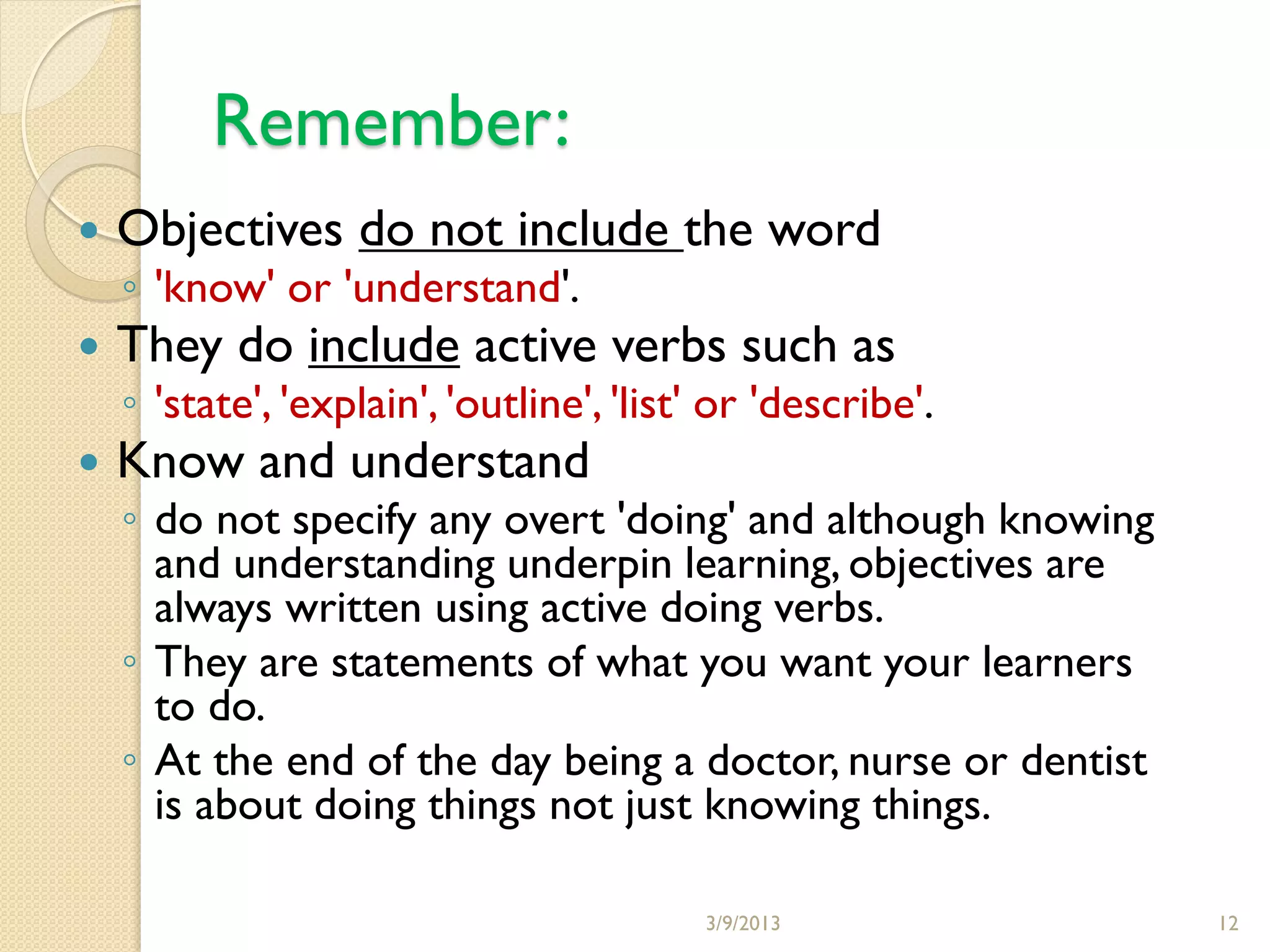
Remember:
   Objectives do not include the word
    ◦ 'know' or 'understand'.
   They do include active verbs such as
    ◦ 'state', 'explain', 'outline', 'list' or 'describe'.
   Know and understand
    ◦ do not specify any overt 'doing' and although knowing
      and understanding underpin learning, objectives are
      always written using active doing verbs.
    ◦ They are statements of what you want your learners
      to do.
    ◦ At the end of the day being a doctor, nurse or dentist
      is about doing things not just knowing things.

                                          3/9/2013             12
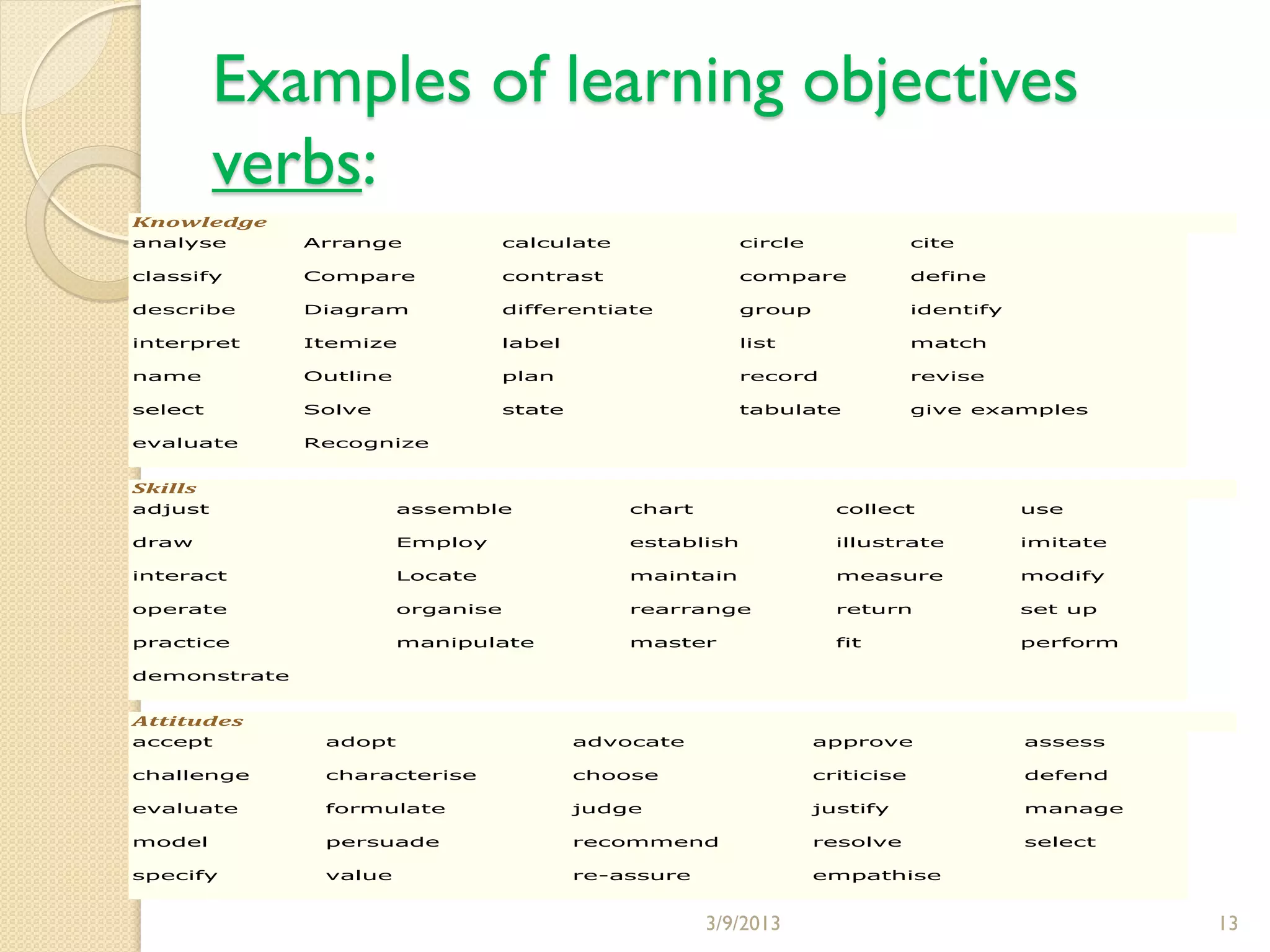
Examples of learning objectives
         verbs:
Knowledge
analyse       Arrange            calculate               circle               cite

classify      Compare            contrast                compare              define

describe      Diagram            differentiate           group                identify

interpret     Itemize            label                   list                 match

name          Outline            plan                    record               revise

select        Solve              state                   tabulate             give examples

evaluate      Recognize


Skills
adjust                  assemble             chart                  collect              use

draw                    Employ               establish              illustrate           imitate

interact                Locate               maintain               measure              modify

operate                 organise             rearrange              return               set up

practice                manipulate           master                 fit                  perform

demonstrate


Attitudes
accept         adopt                     advocate                 approve                assess

challenge      characterise              choose                   criticise              defend

evaluate       formulate                 judge                    justify                manage

model          persuade                  recommend                resolve                select

specify        value                     re-assure                empathise


                                                     3/9/2013                                      13
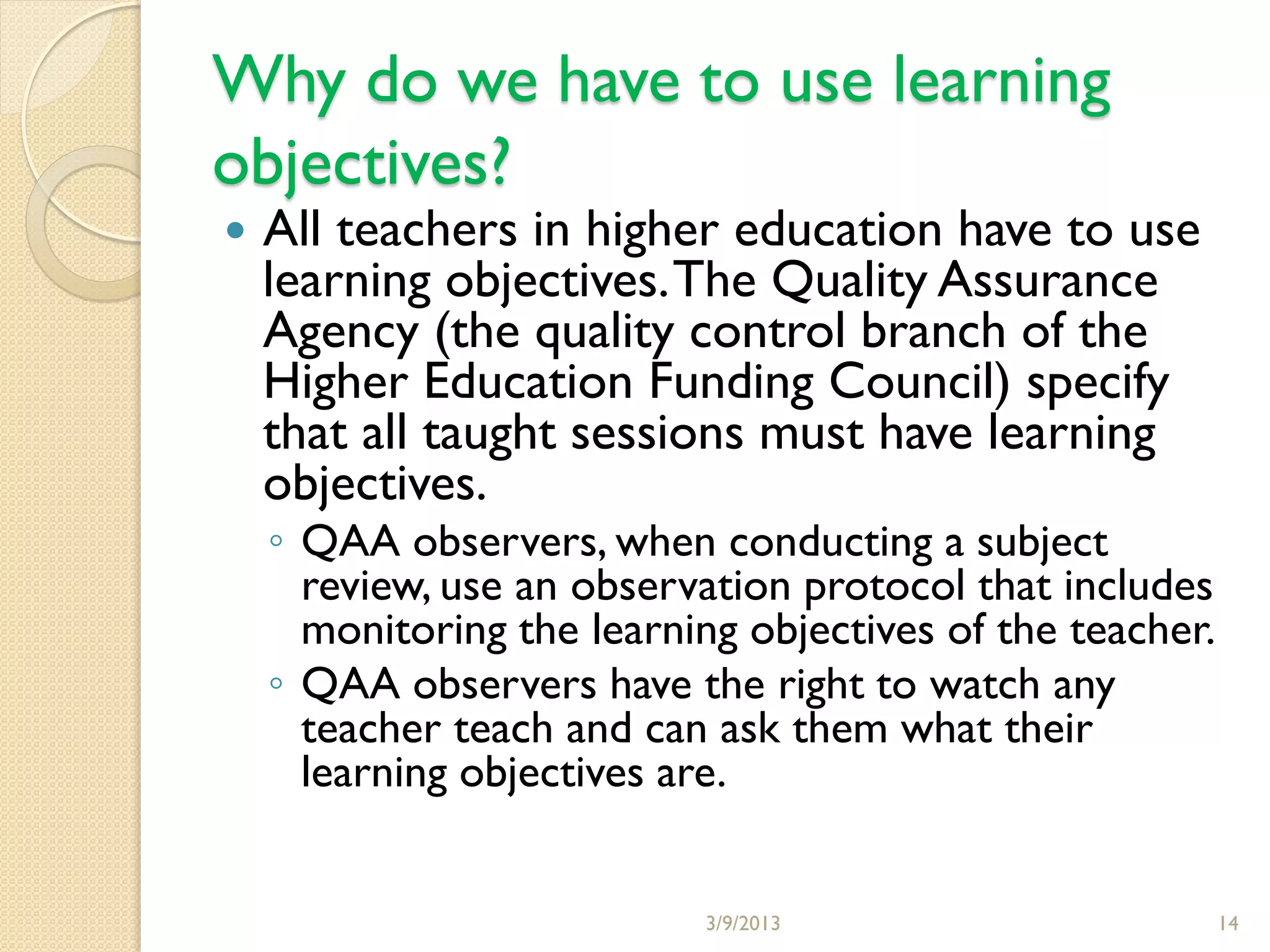
Why do we have to use learning
objectives?
   All teachers in higher education have to use
    learning objectives. The Quality Assurance
    Agency (the quality control branch of the
    Higher Education Funding Council) specify
    that all taught sessions must have learning
    objectives.
    ◦ QAA observers, when conducting a subject
      review, use an observation protocol that includes
      monitoring the learning objectives of the teacher.
    ◦ QAA observers have the right to watch any
      teacher teach and can ask them what their
      learning objectives are.


                            3/9/2013                       14
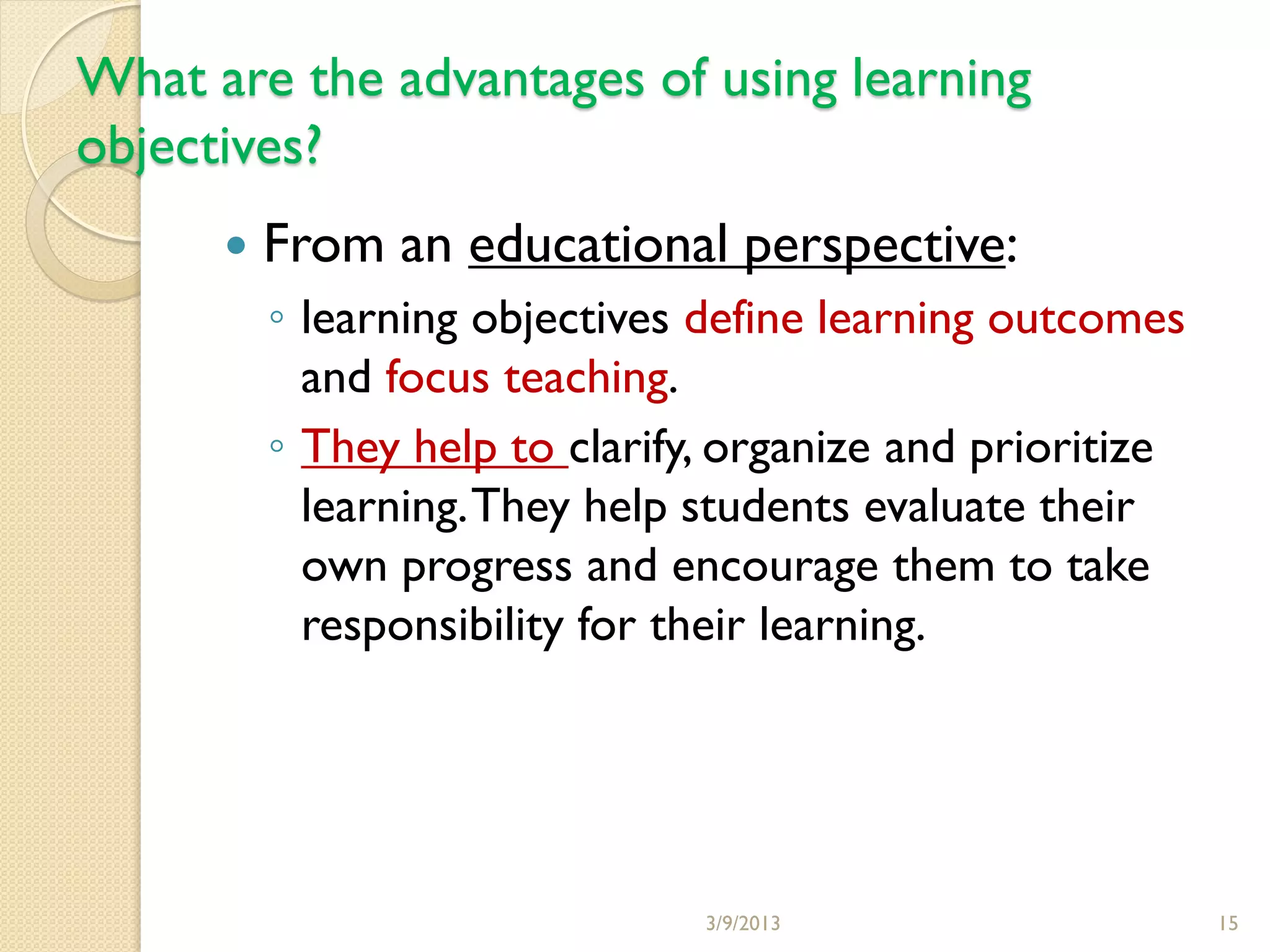
What are the advantages of using learning
objectives?
         From an educational perspective:
          ◦ learning objectives define learning outcomes
            and focus teaching.
          ◦ They help to clarify, organize and prioritize
            learning. They help students evaluate their
            own progress and encourage them to take
            responsibility for their learning.


                                3/9/2013                    15
If you believe in yourself,
nothing can keep you away,
      from your aim.

    THANK YOU.
    -DR. J.M. ALO


             3/9/2013          16

Learning objectives.drjma

  • 1.
    LEARNING OBJECTIVES Dr. JamesMalce Alo, RN, MAN, MAPsycho, PHD
  • 2.
    What are LearningObjectives?  are statements that describe what a learner will be able to do as a result of learning.  sometimes called learning outcomes.  are also statements that describe what a learner will be able to do as a result of teaching.  Some definitions stress: is a sort of contract that teachers make with learners that describes what they will be able to do after learning that they could not do before, the 'added value' of teaching. 3/9/2013 2
  • 3.
    Factors can interferewith the achievement of objectives: ◦ the existing knowledge of the learner, ◦ the relevance or usefulness of the material presented, ◦ the skills of the teacher. 3/9/2013 3
  • 4.
    What are thedifference between Aims and Objectives?  Aims - general statements concerning the overall goals, ends or intentions of teaching.  Objectives - are the individual stages that learners must achieve on the way in order to reach these goals. ◦ Example: A teacher might have an aim that a student should be able to take blood pressure using a sphygmomanometer.  However to achieve this aim a series of objectives must be met. eg to explain procedure to patient, to position cuff correctly, to inflate to correct pressure. 3/9/2013 4
  • 5.
     Aims aregeneral, objectives are specific.  There are more objectives than aims.  Aims are like strategy, objective are like tactics. ◦ Aims and objectives can form hierarchical structures so that in complex curricula aims at one level might be seen as objectives at another. 3/9/2013 5
  • 6.
    What are themain categories of learning objectives?  Learning objectives are aimed at the three domains of learning: 1. Knowledge/cognitive 2. Skills/psychomotor 3. Attitudes/affective 3/9/2013 6
  • 7.
    How do youwrite aims and learning objectives?  focus on the most important outcomes for your learners at that stage of their course. ◦ Example: if you want them to be able to take blood pressure using a sphygmomanometer after you have demonstrated the procedure that would constitute your aim. But to achieve that they will have to have attained a series of objectives on the way. 3/9/2013 7
  • 8.
    Some of these objectives might include ◦ the basic knowledge behind cardiovascular physiology such as the sequence of the cardiac cycle, systole, diastole, cardiac output, stroke volume etc.  Further skill objectives might include ◦ communicating with patients, ◦ explaining procedures etc.  Finally the skills of the procedure itself broken down into suitable steps. 3/9/2013 8
  • 9.
    Aims and objectivesfor one possible teaching sequence might look like the following: Aims: The student should be able to measure blood pressure on a colleague/patient using a sphygmomanometer and a stethoscope (to an accuracy of +/- 10mm Hg). Objectives: 1. Can describe the cardiac cycle and explain the terms systole, diastole, cardiac output, stroke volume. 2. Can effectively communicate instructions to patient concerning the procedure. 3. Fits and inflates cuff to appropriate pressure. 4. Releases pressure carefully and uses stethoscope to listen to brachial artery and Korotkow sounds. 5. Deflates cuff. 6. Records systolic and diastolic pressure correctly. 3/9/2013 9
  • 10.
    In the case of more knowledge orientated aims and objectives imagine you are going to give a lecture with the aim of ensuring that students understand the relationship between protein structure and function and the various factors that influence enzyme reactions. Here you need to break the knowledge down into smaller components that logically build towards the final goal. 3/9/2013 10
  • 11.
    Aims: To understand therelationship between protein structure and function and the factors that influence enzyme reactions. Objectives: 1. State the different categories of amino acid. 2. Explain what a peptide bond is and how polypeptides are formed. 3. State the four levels of protein structure and explain how the sequence of amino acids leads to the final three dimensional configuration of the protein. 4. Explain how variations in pH, ion concentration and temperature influence the three dimensional configuration of a protein. 5. State that an enzyme is a protein designed to catalyse a specific chemical reaction. 6. State that an enzyme speeds up the rate of a chemical reaction by lowering the activation energy of the transition complex and that it does not influence the equilibrium or overall energy change of a reaction. 7. Explain how variations in pH, ion concentration and temperature influence catalytic activity. 8. Describe how enzyme activity can be regulated by other molecules. 3/9/2013 11
  • 12.
    Remember:  Objectives do not include the word ◦ 'know' or 'understand'.  They do include active verbs such as ◦ 'state', 'explain', 'outline', 'list' or 'describe'.  Know and understand ◦ do not specify any overt 'doing' and although knowing and understanding underpin learning, objectives are always written using active doing verbs. ◦ They are statements of what you want your learners to do. ◦ At the end of the day being a doctor, nurse or dentist is about doing things not just knowing things. 3/9/2013 12
  • 13.
    Examples of learningobjectives verbs: Knowledge analyse Arrange calculate circle cite classify Compare contrast compare define describe Diagram differentiate group identify interpret Itemize label list match name Outline plan record revise select Solve state tabulate give examples evaluate Recognize Skills adjust assemble chart collect use draw Employ establish illustrate imitate interact Locate maintain measure modify operate organise rearrange return set up practice manipulate master fit perform demonstrate Attitudes accept adopt advocate approve assess challenge characterise choose criticise defend evaluate formulate judge justify manage model persuade recommend resolve select specify value re-assure empathise 3/9/2013 13
  • 14.
    Why do wehave to use learning objectives?  All teachers in higher education have to use learning objectives. The Quality Assurance Agency (the quality control branch of the Higher Education Funding Council) specify that all taught sessions must have learning objectives. ◦ QAA observers, when conducting a subject review, use an observation protocol that includes monitoring the learning objectives of the teacher. ◦ QAA observers have the right to watch any teacher teach and can ask them what their learning objectives are. 3/9/2013 14
  • 15.
    What are theadvantages of using learning objectives?  From an educational perspective: ◦ learning objectives define learning outcomes and focus teaching. ◦ They help to clarify, organize and prioritize learning. They help students evaluate their own progress and encourage them to take responsibility for their learning. 3/9/2013 15
  • 16.
    If you believein yourself, nothing can keep you away, from your aim. THANK YOU. -DR. J.M. ALO 3/9/2013 16