
SENSORY NERVOUS
SYSTEM
IAU- POST GRADUATE
Master Program
Faculty | Dr. James Malce Alo
Objective
• To understand the basic psychophysiology and functions of the
sensory system.
SENSORY NERVOUS SYSTEM
• is a part of the nervous system responsible for processing sensory
information.
• A sensory system consists of sensory neurons (including the sensory
receptor cells), neural pathways, and parts of the brain involved in
sensory perception.
• Commonly recognized sensory systems are those for vision, hearing,
touch, taste, smell, and balance. In short, senses are transducers from
the physical world to the realm of the mind where we interpret the
information, creating our perception of the world around us
The receptive field is the area of the body or
environment to which a receptor organ and
receptor cells respond.
Example: the part of the world an eye can
see, is its receptive field; the light that each rod or
cone can see, is its receptive field. Receptive fields
have been identified for the visual system, auditory
system and somatosensory system.
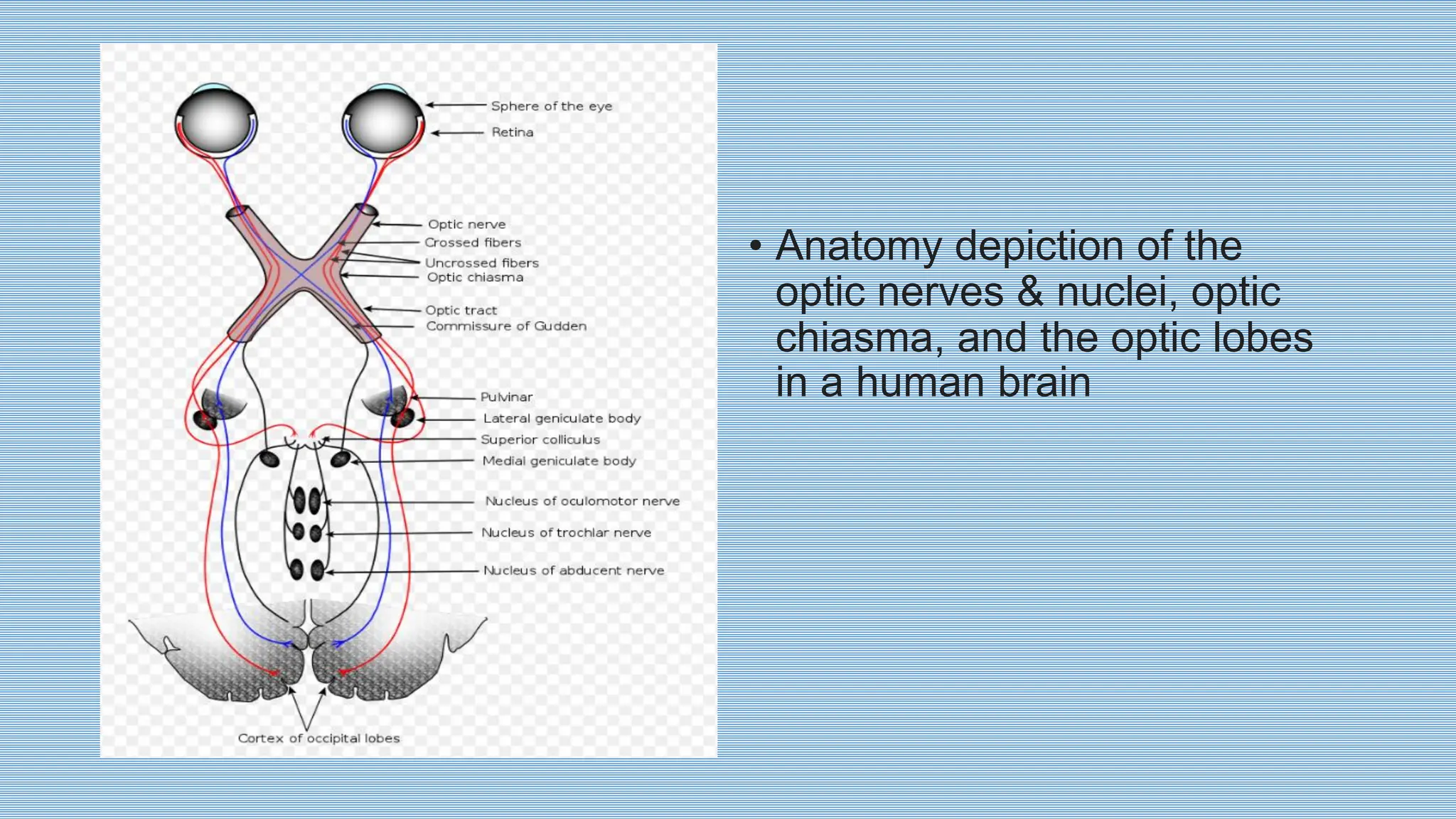
• Anatomy depiction of the
optic nerves & nuclei, optic
chiasma, and the optic lobes
in a human brain
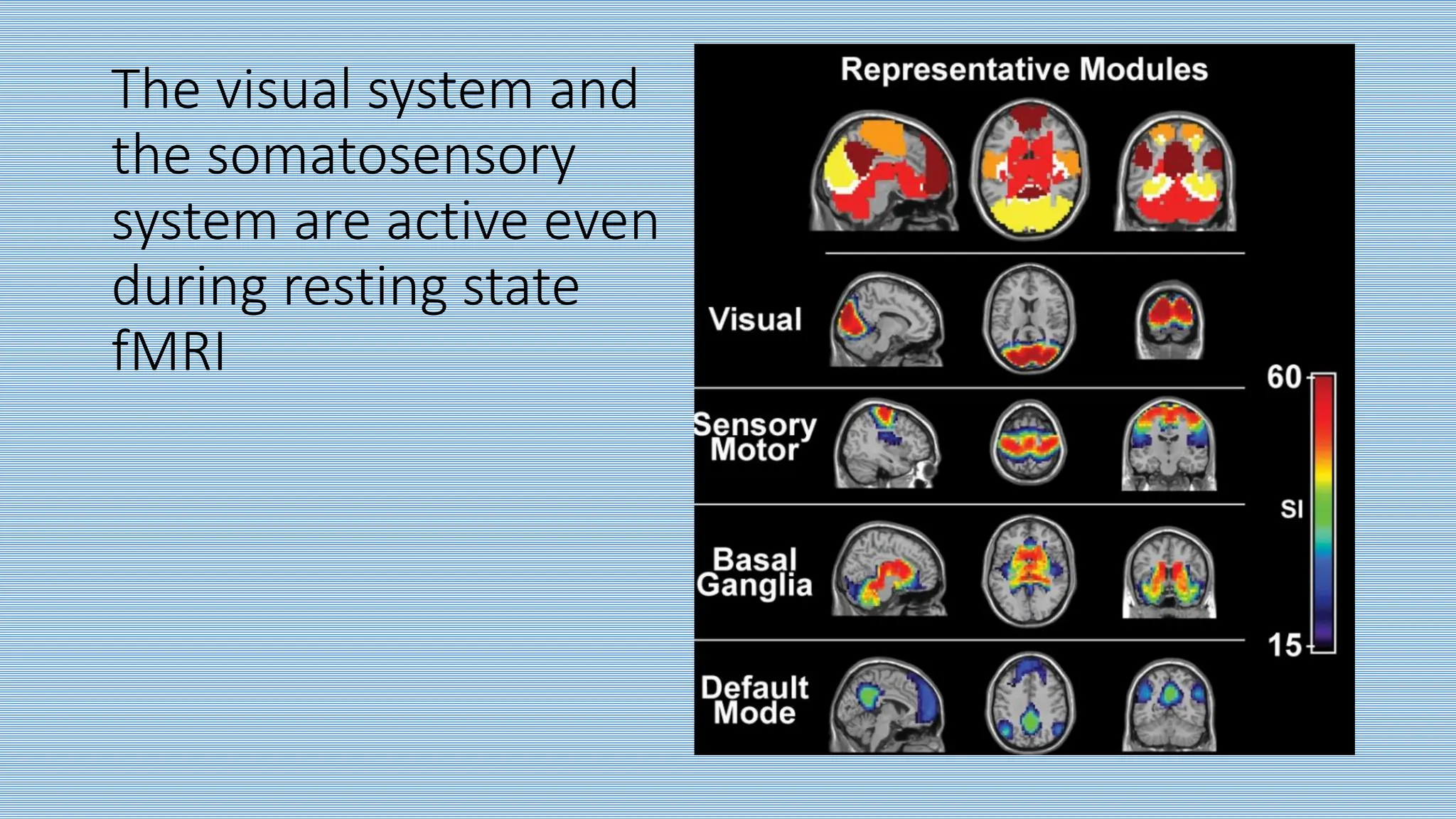
The visual system and
the somatosensory
system are active even
during resting state
fMRI
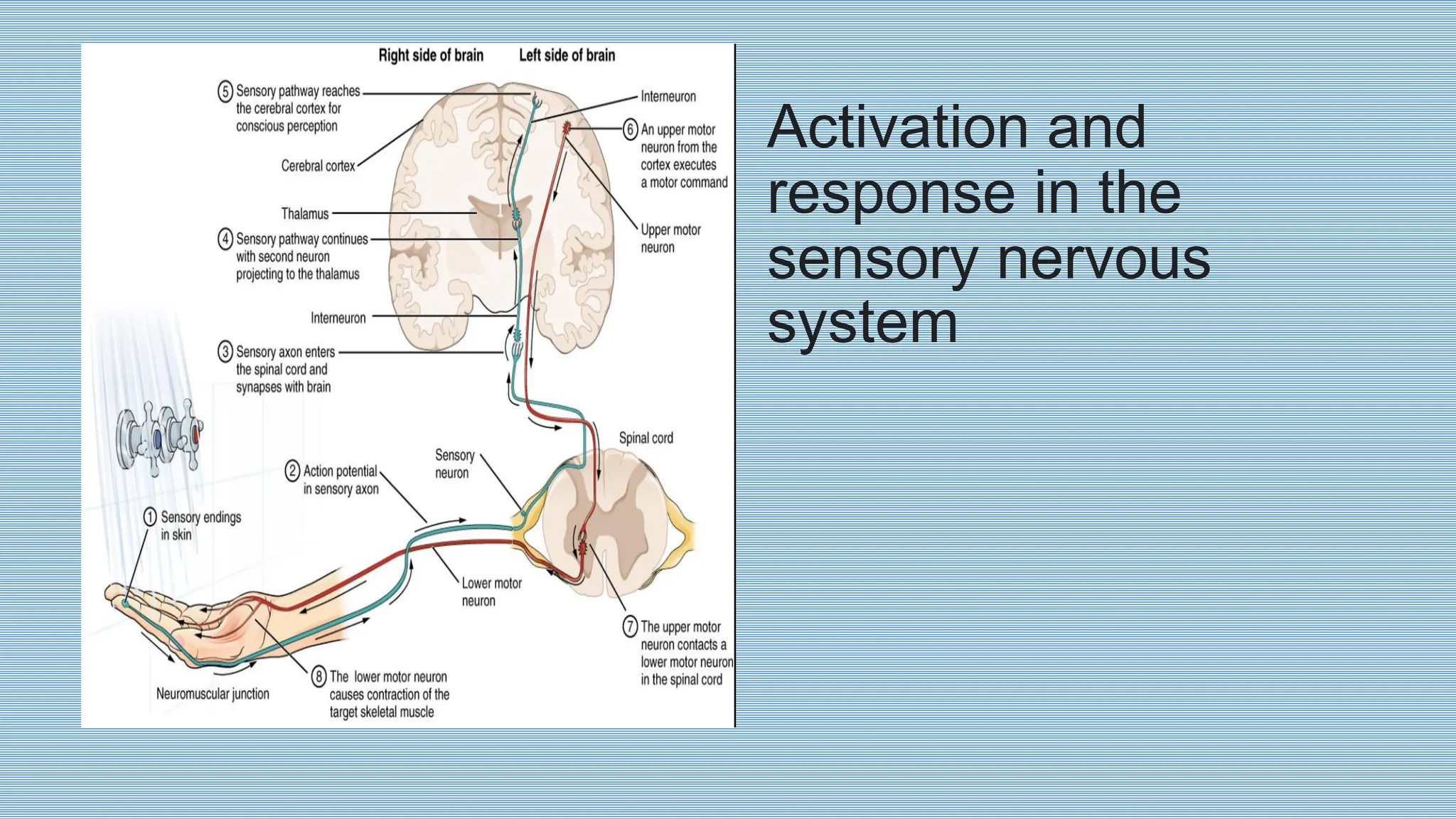
Activation and
response in the
sensory nervous
system
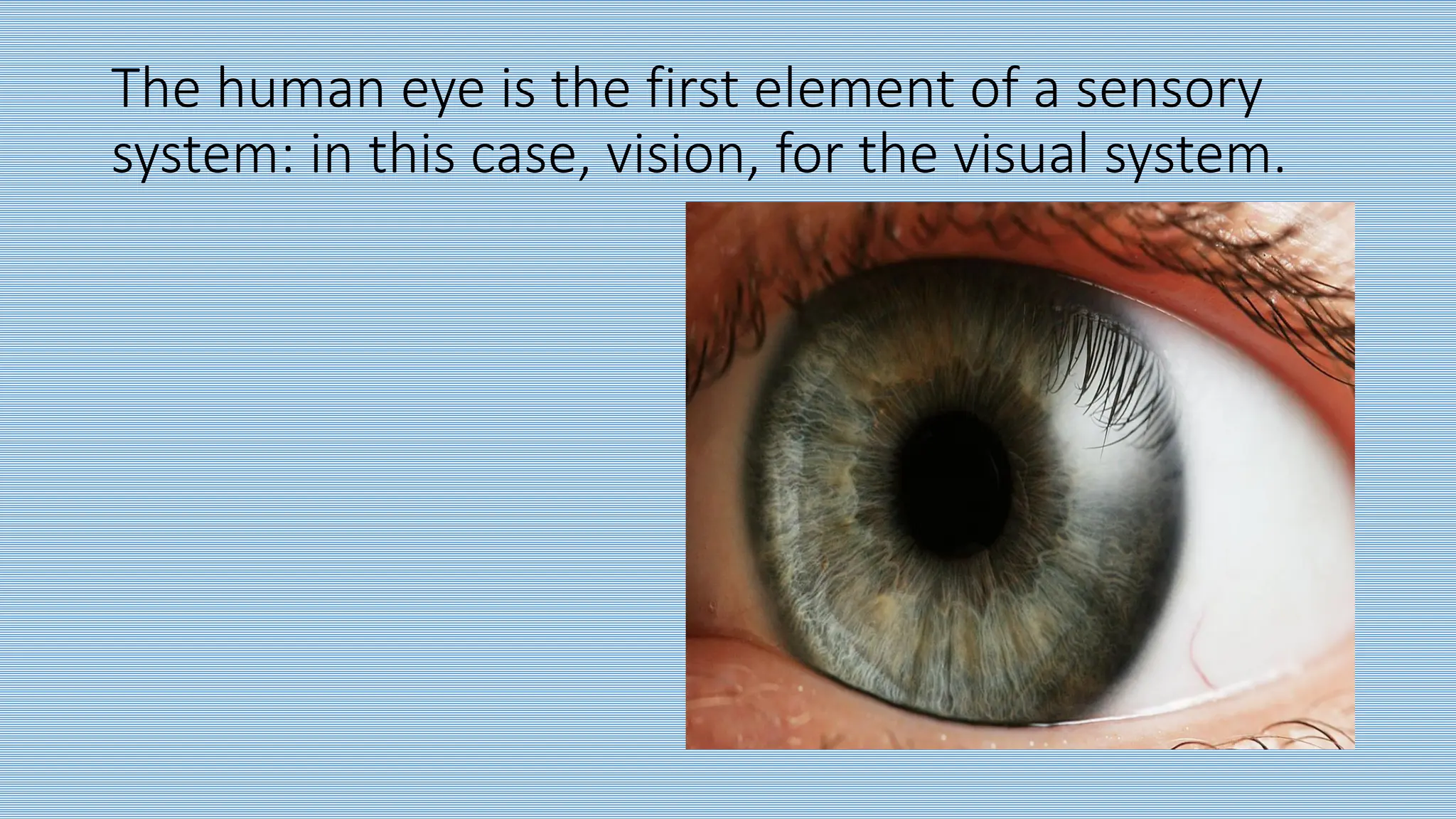
The human eye is the first element of a sensory
system: in this case, vision, for the visual system.
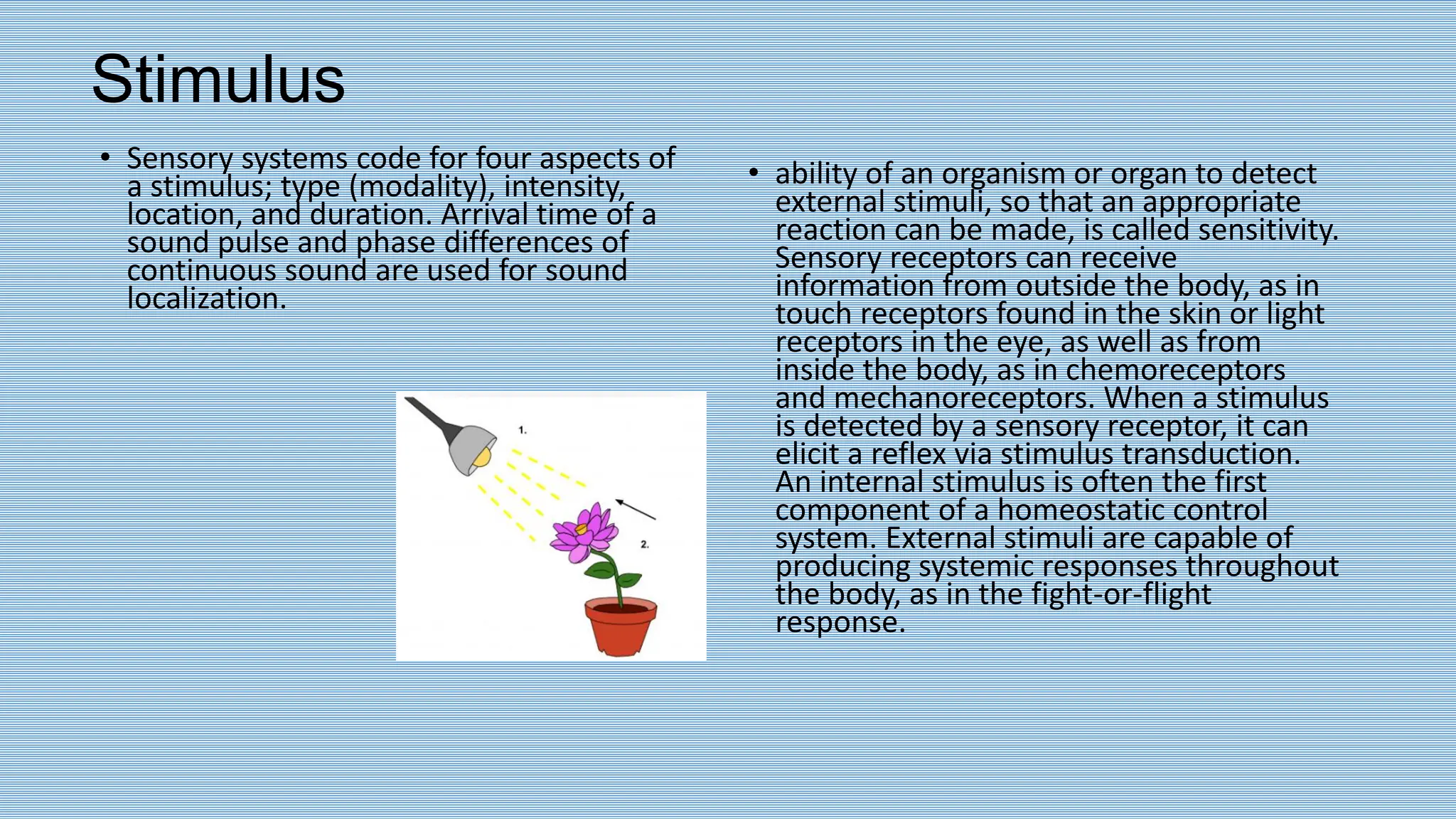
Stimulus
• Sensory systems code for four aspects of
a stimulus; type (modality), intensity,
location, and duration. Arrival time of a
sound pulse and phase differences of
continuous sound are used for sound
localization.
• ability of an organism or organ to detect
external stimuli, so that an appropriate
reaction can be made, is called sensitivity.
Sensory receptors can receive
information from outside the body, as in
touch receptors found in the skin or light
receptors in the eye, as well as from
inside the body, as in chemoreceptors
and mechanoreceptors. When a stimulus
is detected by a sensory receptor, it can
elicit a reflex via stimulus transduction.
An internal stimulus is often the first
component of a homeostatic control
system. External stimuli are capable of
producing systemic responses throughout
the body, as in the fight-or-flight
response.
Senses and receptors
• five ‘traditional’ human senses
which have become universally
accepted:
• touch,
• taste,
• smell,
• sight, and
• hearing.
• Other senses that have been
well-accepted in most mammals,
including humans, include
• nociception,
• equilibrioception,
• kinaesthesia, and
• thermoception.
Receptors
-sensation stems from the response of a specific receptor to a physical stimulus
• Chemoreceptors - detect certain
chemical stimuli
• Photoreceptors - capable of
phototransduction, a process which converts
light (electromagnetic radiation) into, among
other types of energy, a membrane potential.
• Mechanoreceptors - receptors
which respond to mechanical forces,
such as pressure or distortion
• Thermoreceptors - respond to
varying temperatures
• Nociceptors - respond to
potentially damaging stimuli by
sending signals to the spinal cord and
brain. Ex. pain
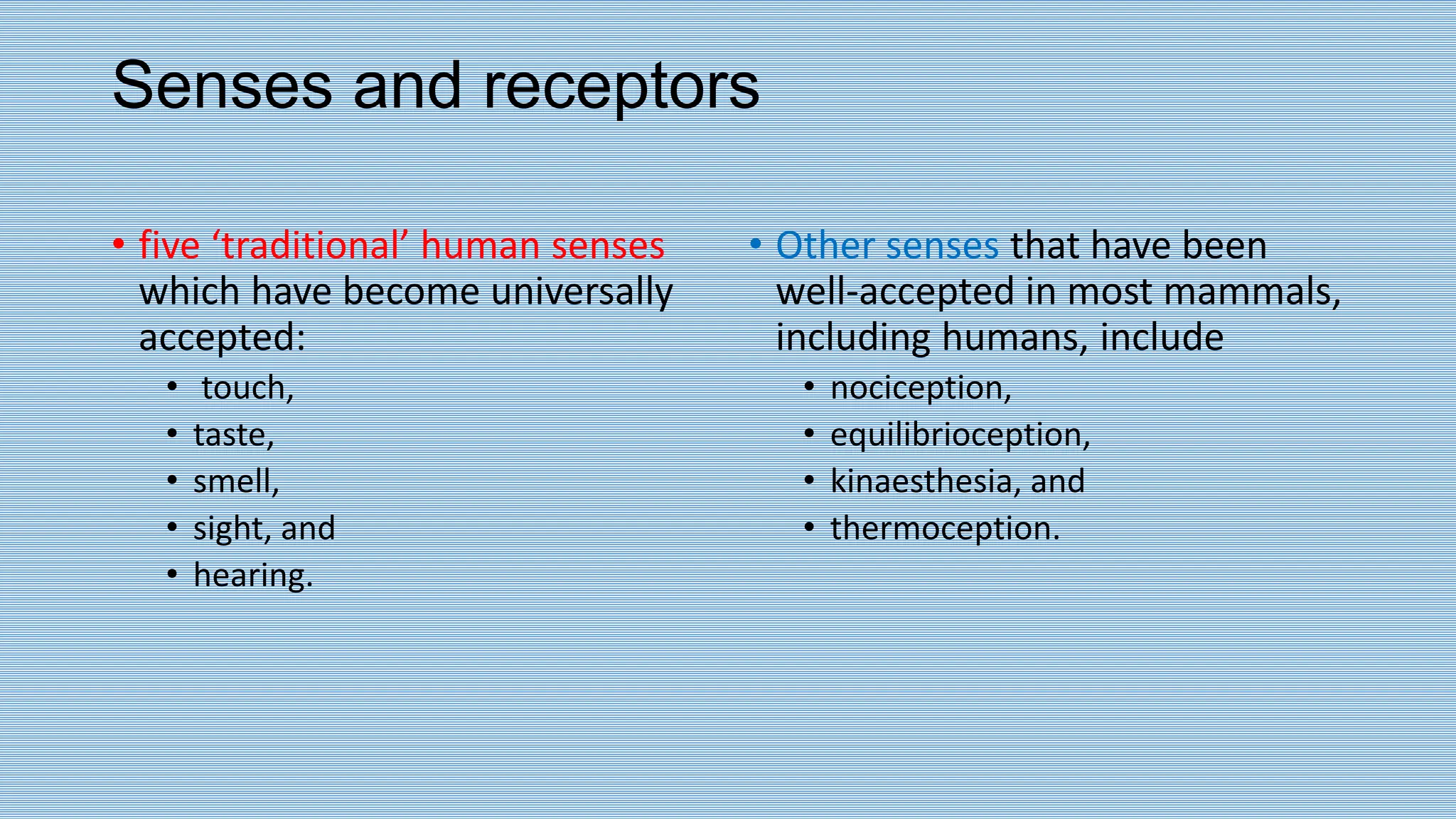
Sensory cortex
- All stimuli received by the receptors listed above are transduced
to an action potential
• Somatosensory cortex - Located in
the parietal lobe
• Visual cortex
• Auditory cortex
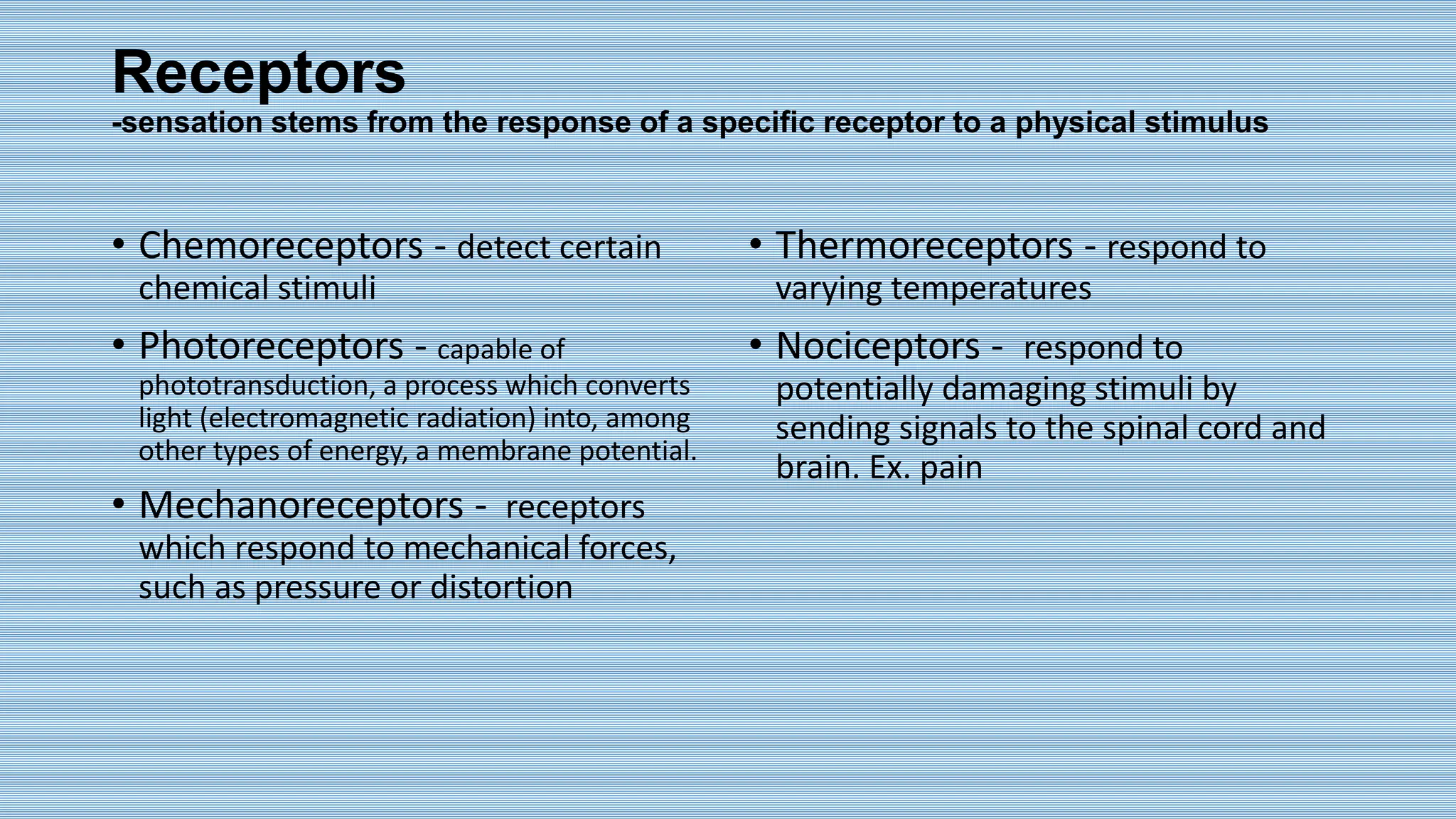
• Primary olfactory cortex
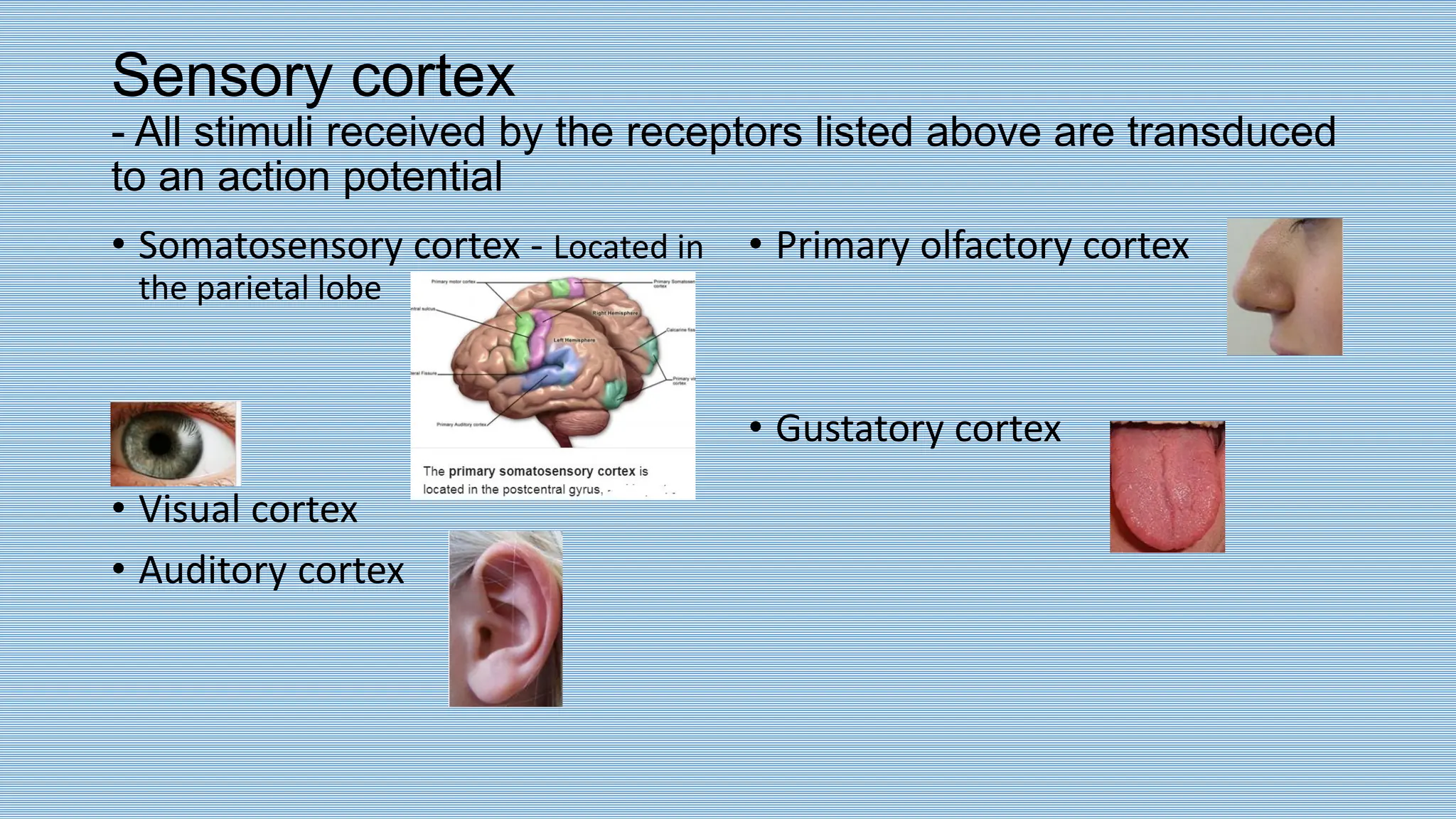
• Gustatory cortex
Human sensory system
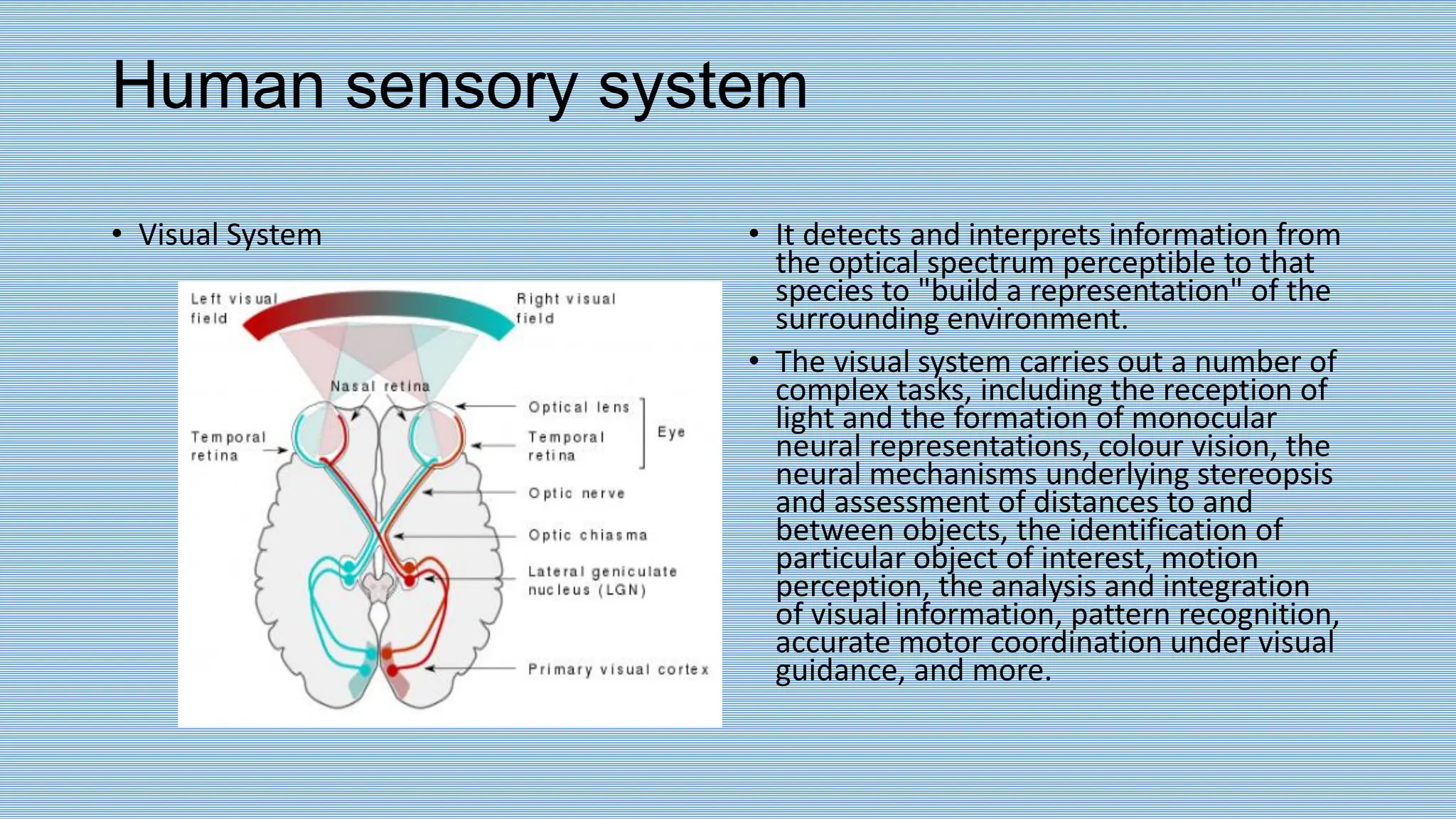
• Visual System • It detects and interprets information from
the optical spectrum perceptible to that
species to "build a representation" of the
surrounding environment.
• The visual system carries out a number of
complex tasks, including the reception of
light and the formation of monocular
neural representations, colour vision, the
neural mechanisms underlying stereopsis
and assessment of distances to and
between objects, the identification of
particular object of interest, motion
perception, the analysis and integration
of visual information, pattern recognition,
accurate motor coordination under visual
guidance, and more.
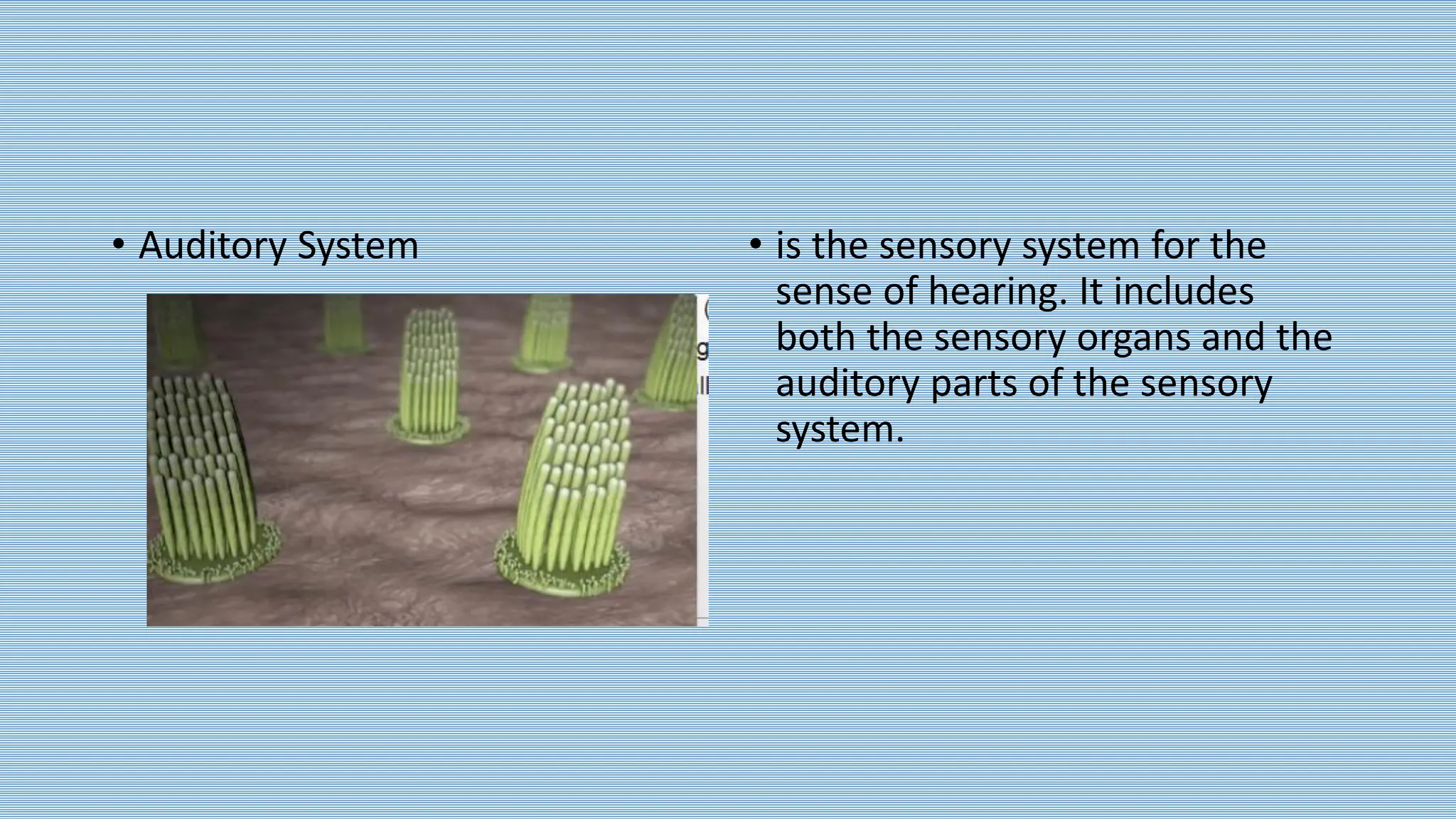
• Auditory System • is the sensory system for the
sense of hearing. It includes
both the sensory organs and the
auditory parts of the sensory
system.
Somatosensory
system
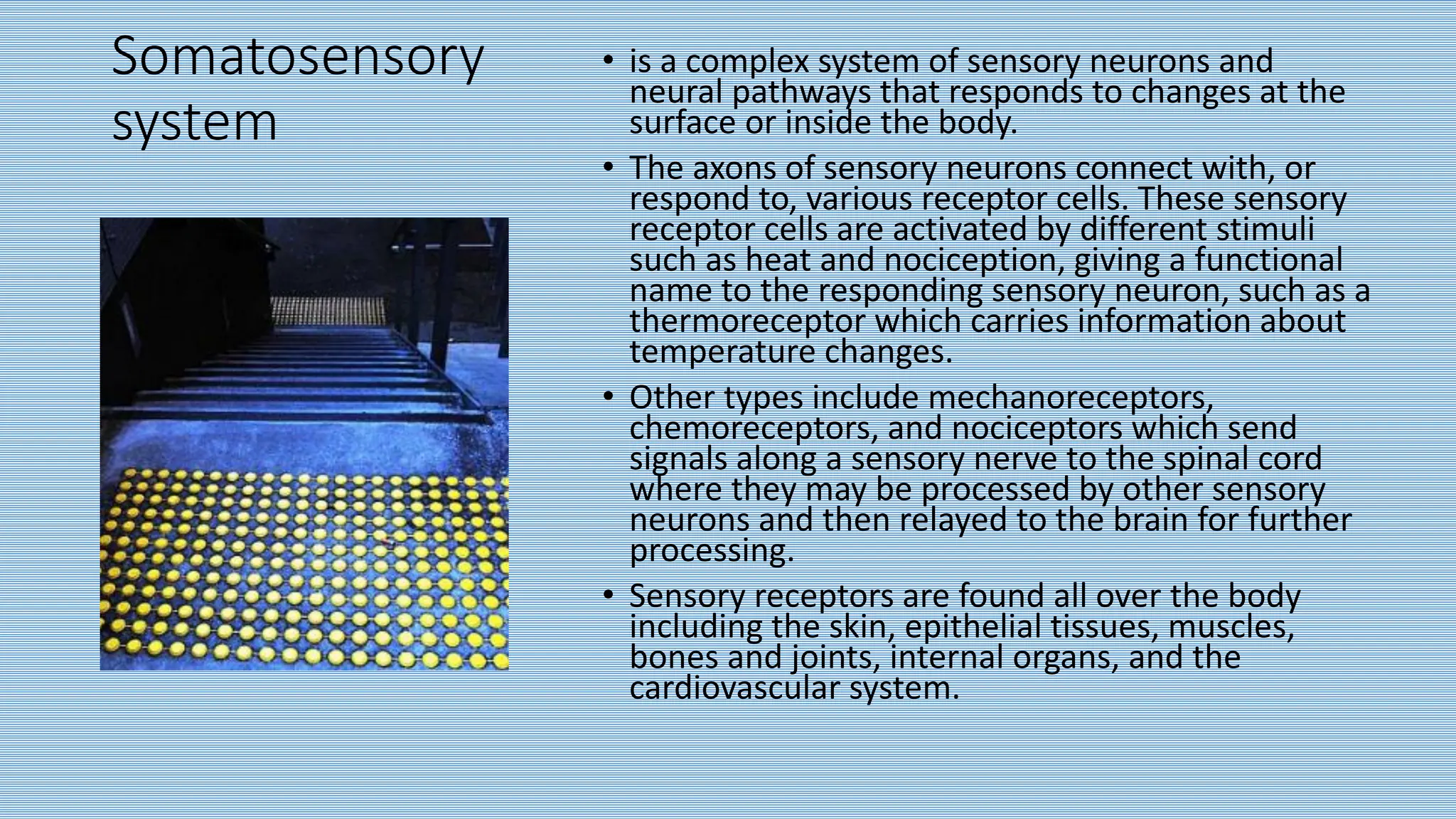
• is a complex system of sensory neurons and
neural pathways that responds to changes at the
surface or inside the body.
• The axons of sensory neurons connect with, or
respond to, various receptor cells. These sensory
receptor cells are activated by different stimuli
such as heat and nociception, giving a functional
name to the responding sensory neuron, such as a
thermoreceptor which carries information about
temperature changes.
• Other types include mechanoreceptors,
chemoreceptors, and nociceptors which send
signals along a sensory nerve to the spinal cord
where they may be processed by other sensory
neurons and then relayed to the brain for further
processing.
• Sensory receptors are found all over the body
including the skin, epithelial tissues, muscles,
bones and joints, internal organs, and the
cardiovascular system.
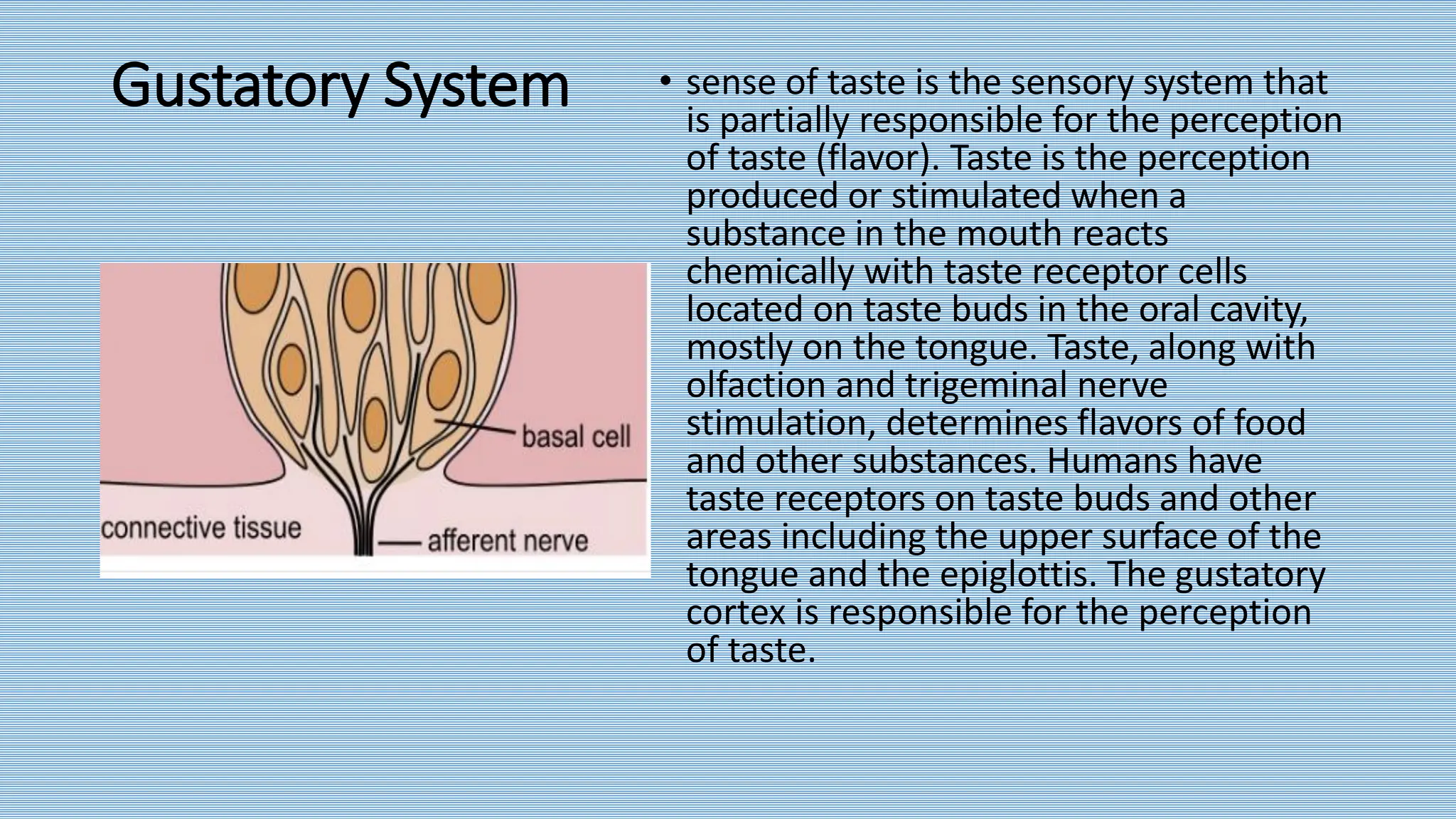
Gustatory System • sense of taste is the sensory system that
is partially responsible for the perception
of taste (flavor). Taste is the perception
produced or stimulated when a
substance in the mouth reacts
chemically with taste receptor cells
located on taste buds in the oral cavity,
mostly on the tongue. Taste, along with
olfaction and trigeminal nerve
stimulation, determines flavors of food
and other substances. Humans have
taste receptors on taste buds and other
areas including the upper surface of the
tongue and the epiglottis. The gustatory
cortex is responsible for the perception
of taste.
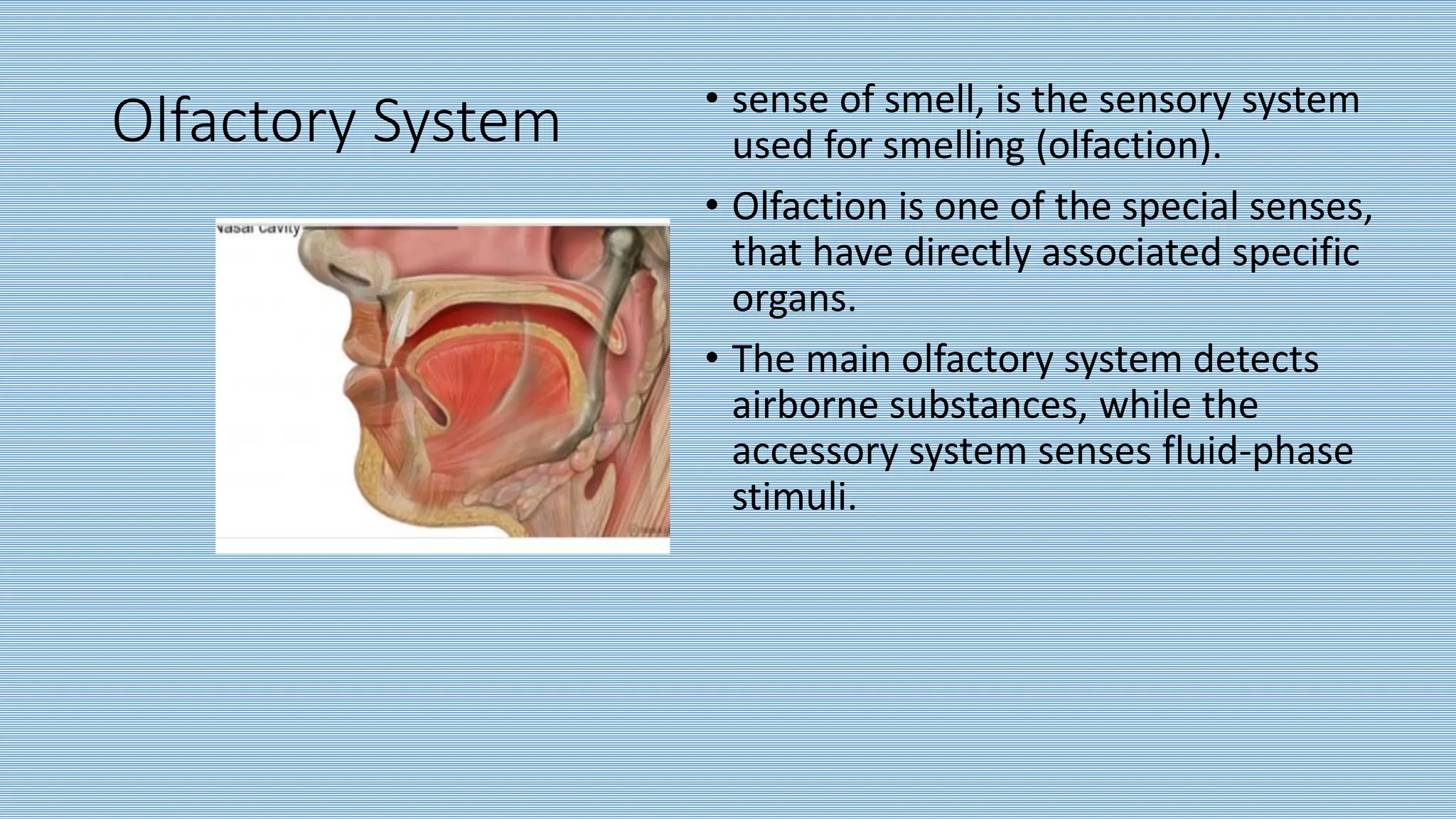
Olfactory System • sense of smell, is the sensory system
used for smelling (olfaction).
• Olfaction is one of the special senses,
that have directly associated specific
organs.
• The main olfactory system detects
airborne substances, while the
accessory system senses fluid-phase
stimuli.
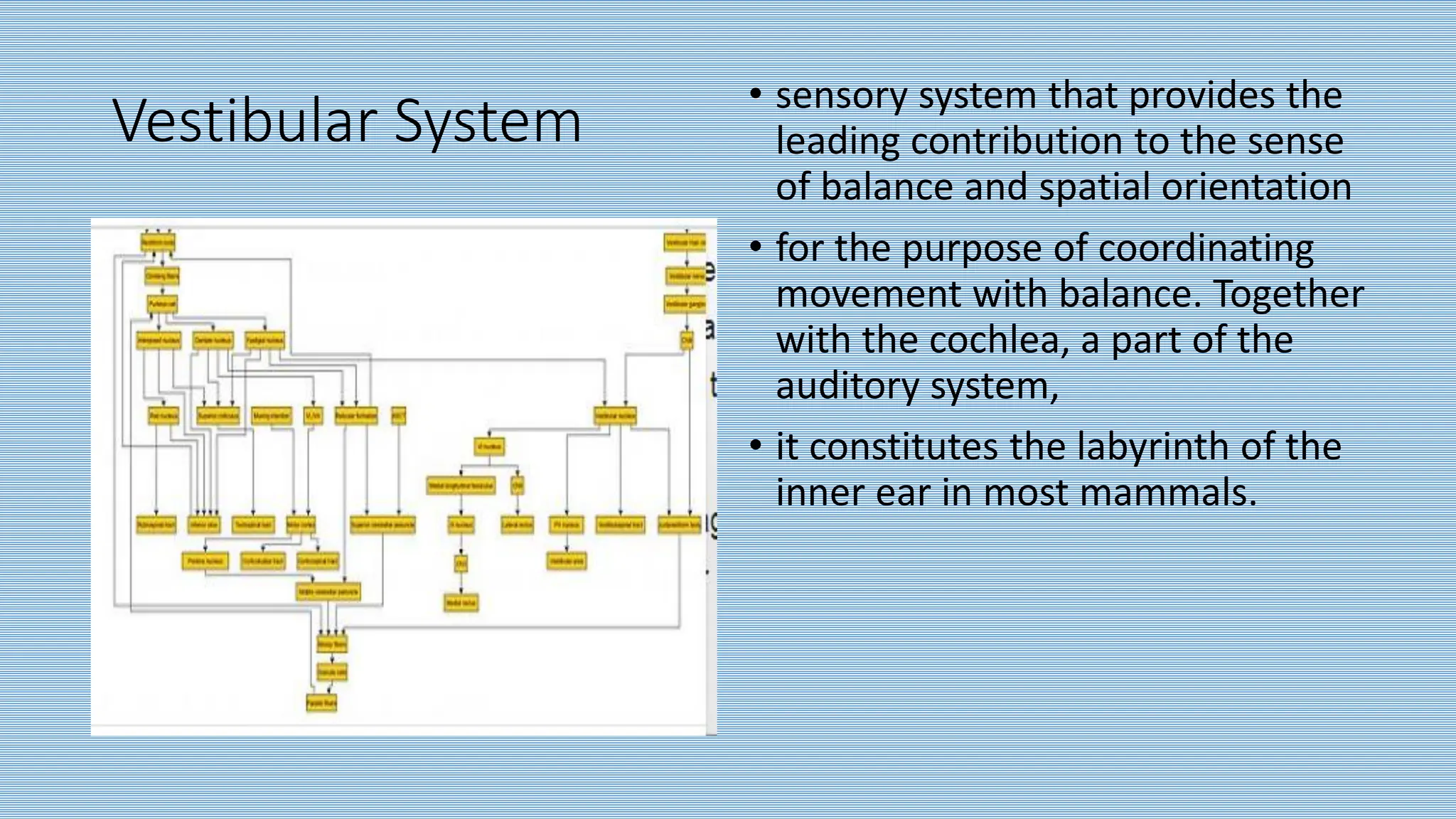
Vestibular System • sensory system that provides the
leading contribution to the sense
of balance and spatial orientation
• for the purpose of coordinating
movement with balance. Together
with the cochlea, a part of the
auditory system,
• it constitutes the labyrinth of the
inner ear in most mammals.
Thank yu

SENSORY NERVOUS SYSTEM,drjma.pdf

  • 1.
    SENSORY NERVOUS SYSTEM IAU- POSTGRADUATE Master Program Faculty | Dr. James Malce Alo
  • 2.
    Objective • To understandthe basic psychophysiology and functions of the sensory system.
  • 3.
    SENSORY NERVOUS SYSTEM •is a part of the nervous system responsible for processing sensory information. • A sensory system consists of sensory neurons (including the sensory receptor cells), neural pathways, and parts of the brain involved in sensory perception. • Commonly recognized sensory systems are those for vision, hearing, touch, taste, smell, and balance. In short, senses are transducers from the physical world to the realm of the mind where we interpret the information, creating our perception of the world around us
  • 4.
    The receptive fieldis the area of the body or environment to which a receptor organ and receptor cells respond. Example: the part of the world an eye can see, is its receptive field; the light that each rod or cone can see, is its receptive field. Receptive fields have been identified for the visual system, auditory system and somatosensory system.
  • 5.
    • Anatomy depictionof the optic nerves & nuclei, optic chiasma, and the optic lobes in a human brain
  • 6.
    The visual systemand the somatosensory system are active even during resting state fMRI
  • 7.
    Activation and response inthe sensory nervous system
  • 8.
    The human eyeis the first element of a sensory system: in this case, vision, for the visual system.
  • 9.
    Stimulus • Sensory systemscode for four aspects of a stimulus; type (modality), intensity, location, and duration. Arrival time of a sound pulse and phase differences of continuous sound are used for sound localization. • ability of an organism or organ to detect external stimuli, so that an appropriate reaction can be made, is called sensitivity. Sensory receptors can receive information from outside the body, as in touch receptors found in the skin or light receptors in the eye, as well as from inside the body, as in chemoreceptors and mechanoreceptors. When a stimulus is detected by a sensory receptor, it can elicit a reflex via stimulus transduction. An internal stimulus is often the first component of a homeostatic control system. External stimuli are capable of producing systemic responses throughout the body, as in the fight-or-flight response.
  • 10.
    Senses and receptors •five ‘traditional’ human senses which have become universally accepted: • touch, • taste, • smell, • sight, and • hearing. • Other senses that have been well-accepted in most mammals, including humans, include • nociception, • equilibrioception, • kinaesthesia, and • thermoception.
  • 11.
    Receptors -sensation stems fromthe response of a specific receptor to a physical stimulus • Chemoreceptors - detect certain chemical stimuli • Photoreceptors - capable of phototransduction, a process which converts light (electromagnetic radiation) into, among other types of energy, a membrane potential. • Mechanoreceptors - receptors which respond to mechanical forces, such as pressure or distortion • Thermoreceptors - respond to varying temperatures • Nociceptors - respond to potentially damaging stimuli by sending signals to the spinal cord and brain. Ex. pain
  • 12.
    Sensory cortex - Allstimuli received by the receptors listed above are transduced to an action potential • Somatosensory cortex - Located in the parietal lobe • Visual cortex • Auditory cortex • Primary olfactory cortex • Gustatory cortex
  • 13.
    Human sensory system •Visual System • It detects and interprets information from the optical spectrum perceptible to that species to "build a representation" of the surrounding environment. • The visual system carries out a number of complex tasks, including the reception of light and the formation of monocular neural representations, colour vision, the neural mechanisms underlying stereopsis and assessment of distances to and between objects, the identification of particular object of interest, motion perception, the analysis and integration of visual information, pattern recognition, accurate motor coordination under visual guidance, and more.
  • 14.
    • Auditory System• is the sensory system for the sense of hearing. It includes both the sensory organs and the auditory parts of the sensory system.
  • 15.
    Somatosensory system • is acomplex system of sensory neurons and neural pathways that responds to changes at the surface or inside the body. • The axons of sensory neurons connect with, or respond to, various receptor cells. These sensory receptor cells are activated by different stimuli such as heat and nociception, giving a functional name to the responding sensory neuron, such as a thermoreceptor which carries information about temperature changes. • Other types include mechanoreceptors, chemoreceptors, and nociceptors which send signals along a sensory nerve to the spinal cord where they may be processed by other sensory neurons and then relayed to the brain for further processing. • Sensory receptors are found all over the body including the skin, epithelial tissues, muscles, bones and joints, internal organs, and the cardiovascular system.
  • 16.
    Gustatory System •sense of taste is the sensory system that is partially responsible for the perception of taste (flavor). Taste is the perception produced or stimulated when a substance in the mouth reacts chemically with taste receptor cells located on taste buds in the oral cavity, mostly on the tongue. Taste, along with olfaction and trigeminal nerve stimulation, determines flavors of food and other substances. Humans have taste receptors on taste buds and other areas including the upper surface of the tongue and the epiglottis. The gustatory cortex is responsible for the perception of taste.
  • 17.
    Olfactory System •sense of smell, is the sensory system used for smelling (olfaction). • Olfaction is one of the special senses, that have directly associated specific organs. • The main olfactory system detects airborne substances, while the accessory system senses fluid-phase stimuli.
  • 18.
    Vestibular System •sensory system that provides the leading contribution to the sense of balance and spatial orientation • for the purpose of coordinating movement with balance. Together with the cochlea, a part of the auditory system, • it constitutes the labyrinth of the inner ear in most mammals.
  • 19.