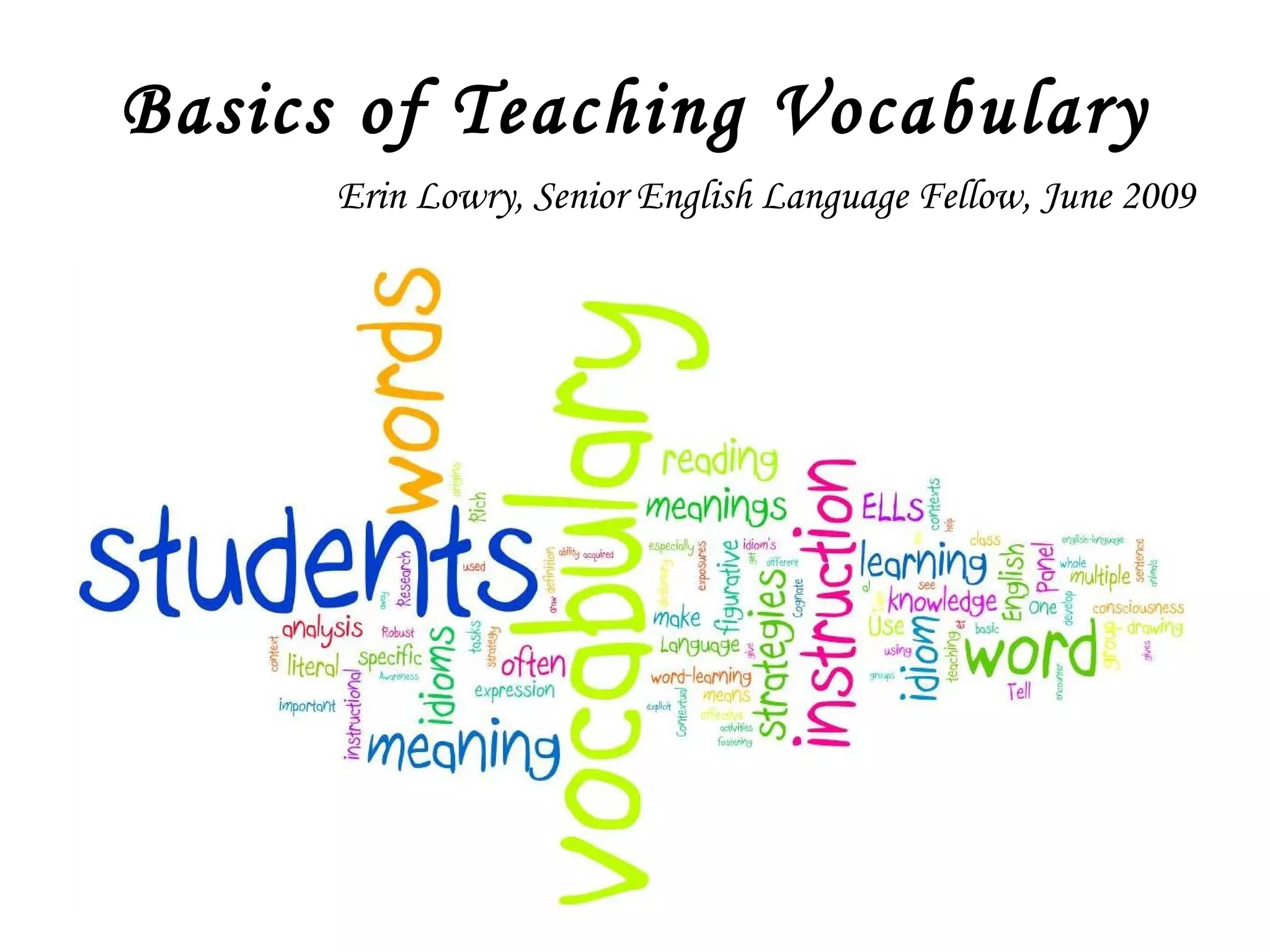






Basics of Teaching Vocabulary Erin Lowry, Senior English Language Fellow, June 2009
Overview Teaching new vocabulary and grammar in context Eliciting techniques Creating interaction in the classroom
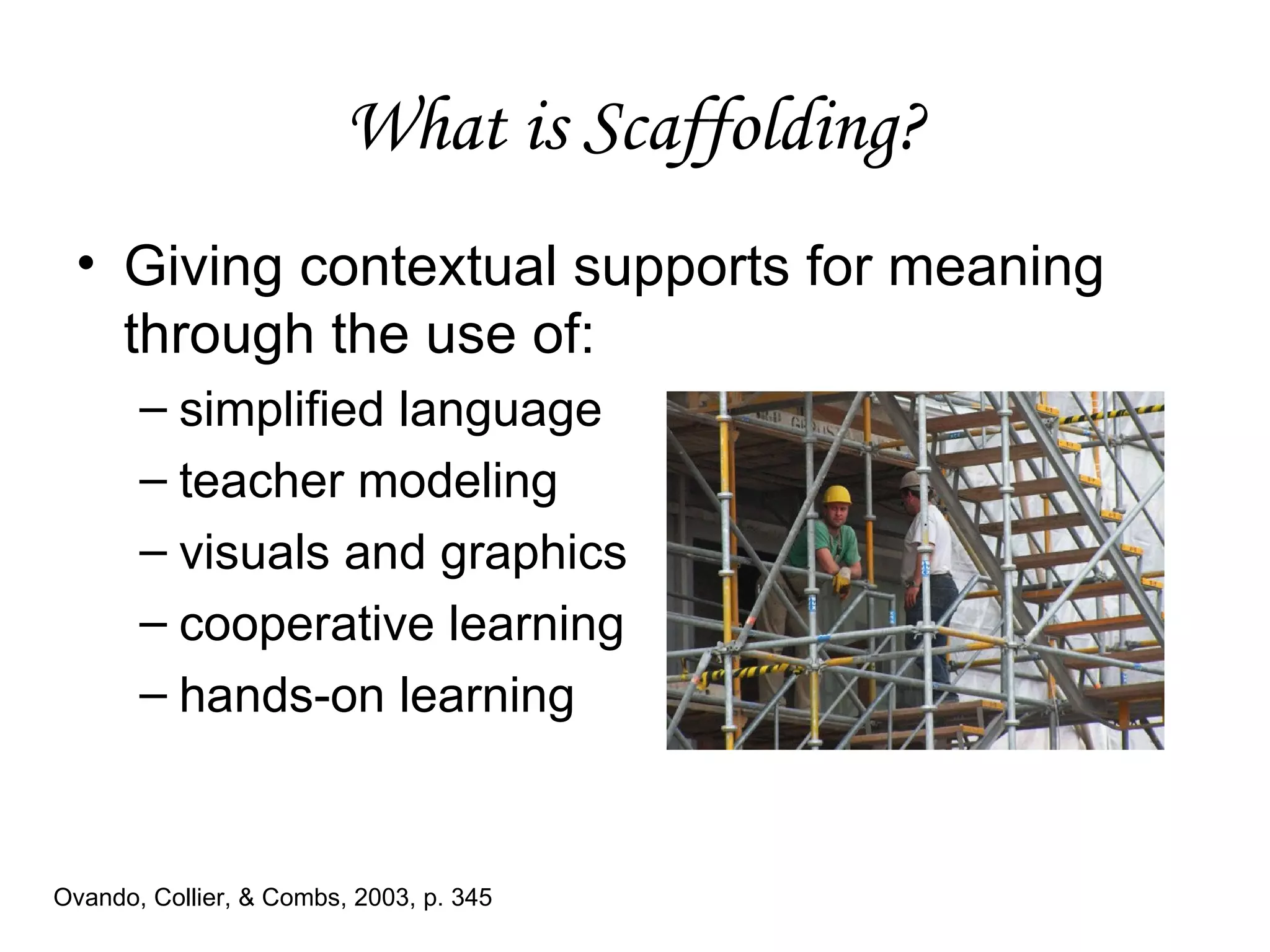
What is Scaffolding? Giving contextual supports for meaning through the use of: simplified language teacher modeling visuals and graphics  cooperative learning hands-on learning Ovando, Collier, & Combs, 2003, p. 345
Effective Scaffolding for Language Learners Simplifying the language By shortening selections, speaking in the present tense, and avoiding the use of idioms Asking for completion, not production Students choose answers from a list or complete a partially finished outline or paragraph Using visuals Present information and ask for students to respond using graphic organizers, tables, charts, outlines, and graphs
Teaching Vocabulary
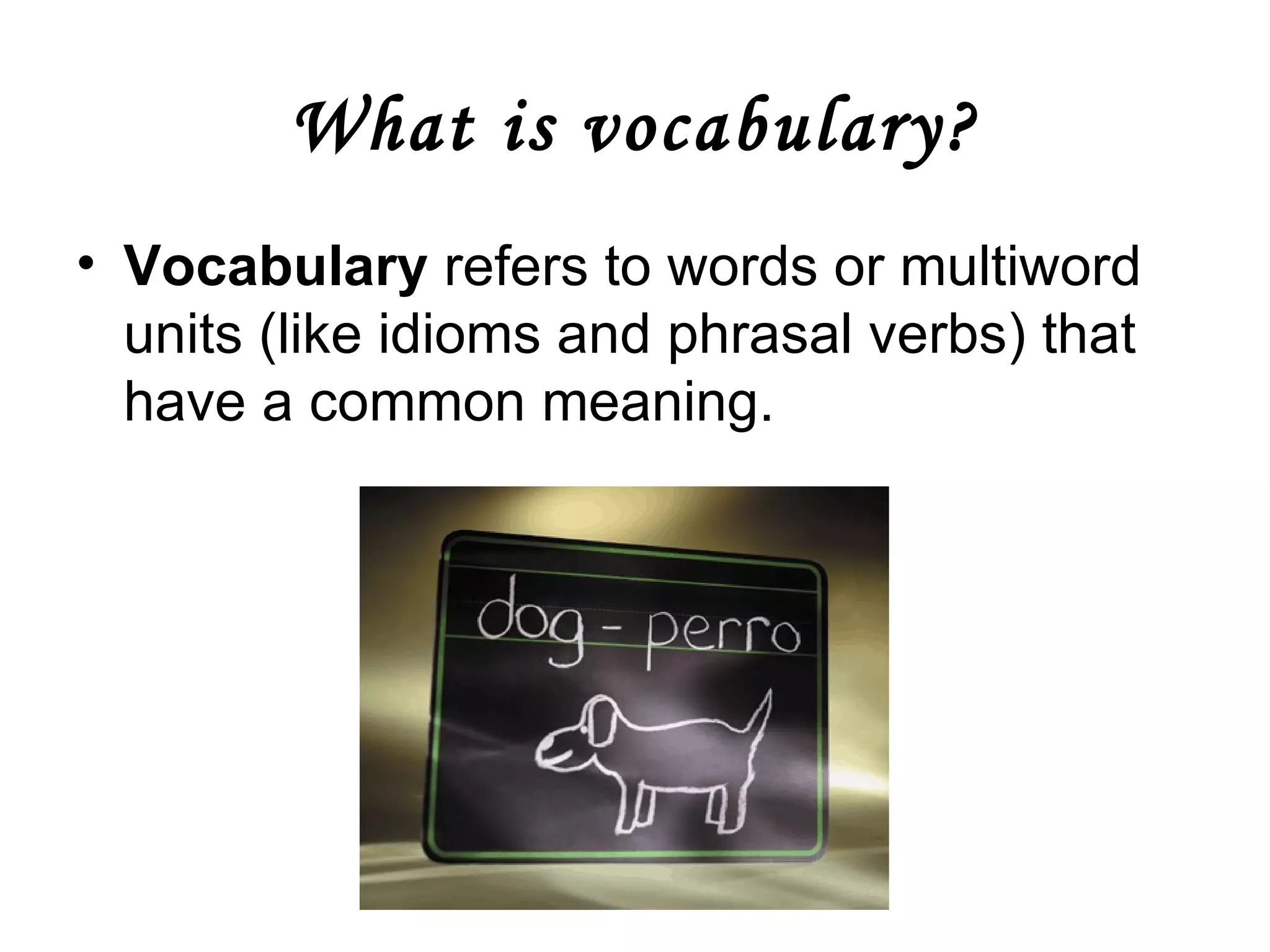
What is vocabulary? Vocabulary  refers to words or multiword units (like idioms and phrasal verbs) that have a common meaning.
5 Types of Vocabulary Single words Set phrases Variable phrases Phrasal verbs Idioms
Other Aspects of Vocabulary Polysemy Connotation and usage Part of speech Frequency Collocation
Important Goals Focus on the vocabulary Multiple retrievals Develop successful vocabulary learning strategies
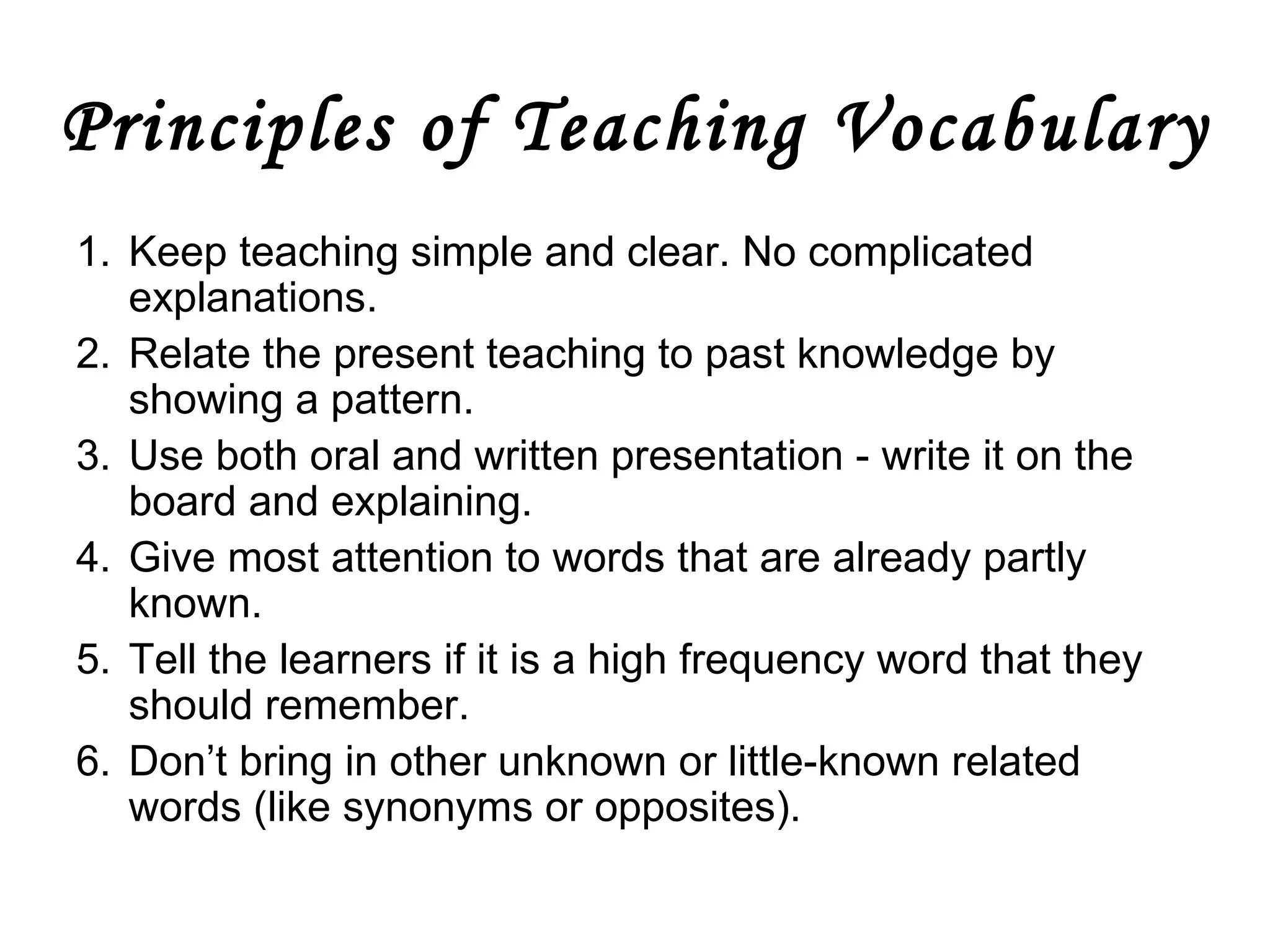
Principles of Teaching Vocabulary Keep teaching simple and clear. No complicated explanations. Relate the present teaching to past knowledge by showing a pattern. Use both oral and written presentation - write it on the board and explaining. Give most attention to words that are already partly known. Tell the learners if it is a high frequency word that they should remember. Don’t bring in other unknown or little-known related words (like synonyms or opposites).
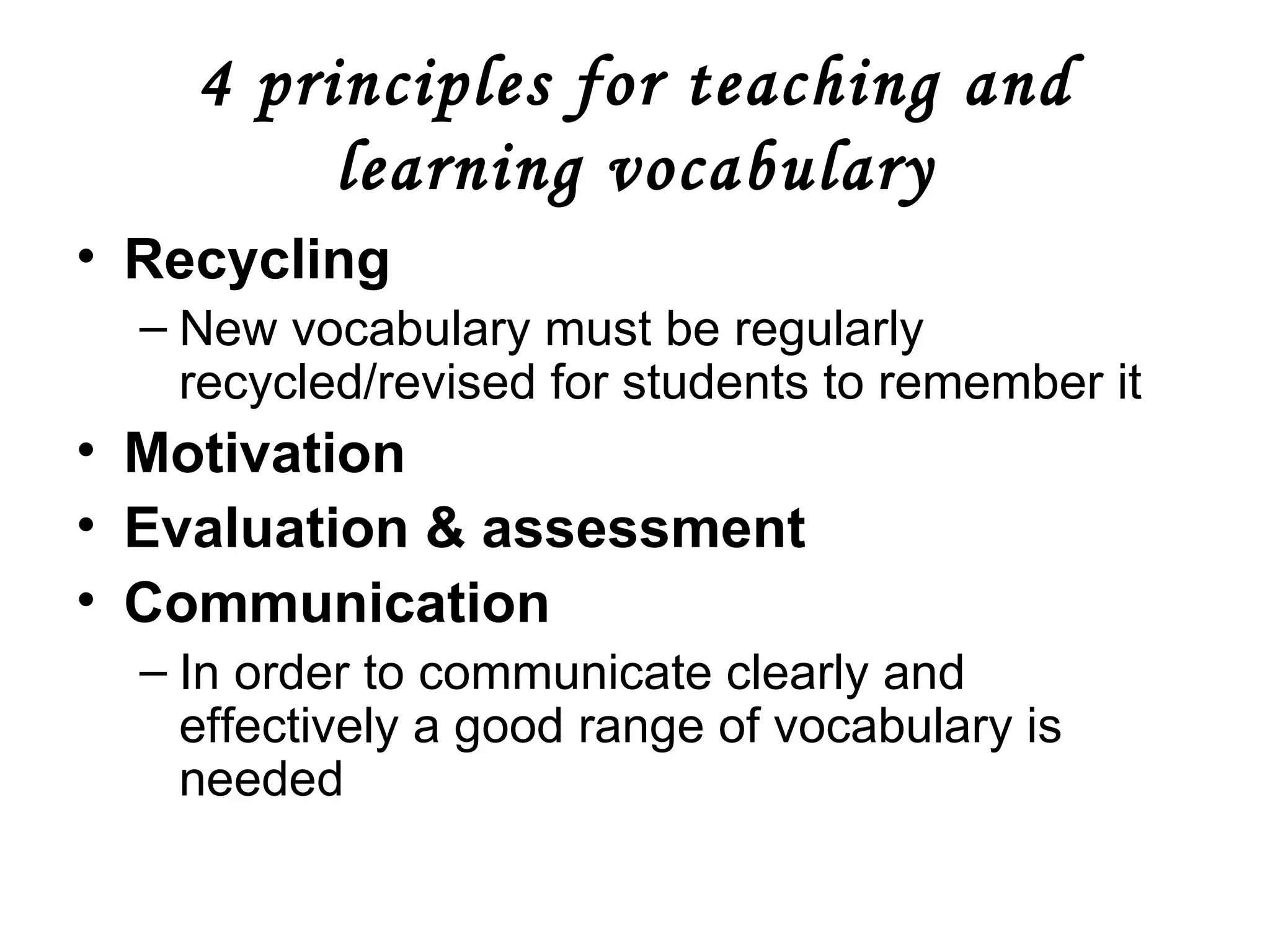
4 principles for teaching and learning vocabulary Recycling New vocabulary must be regularly recycled/revised for students to remember it Motivation Evaluation & assessment Communication In order to communicate clearly and effectively a good range of vocabulary is needed
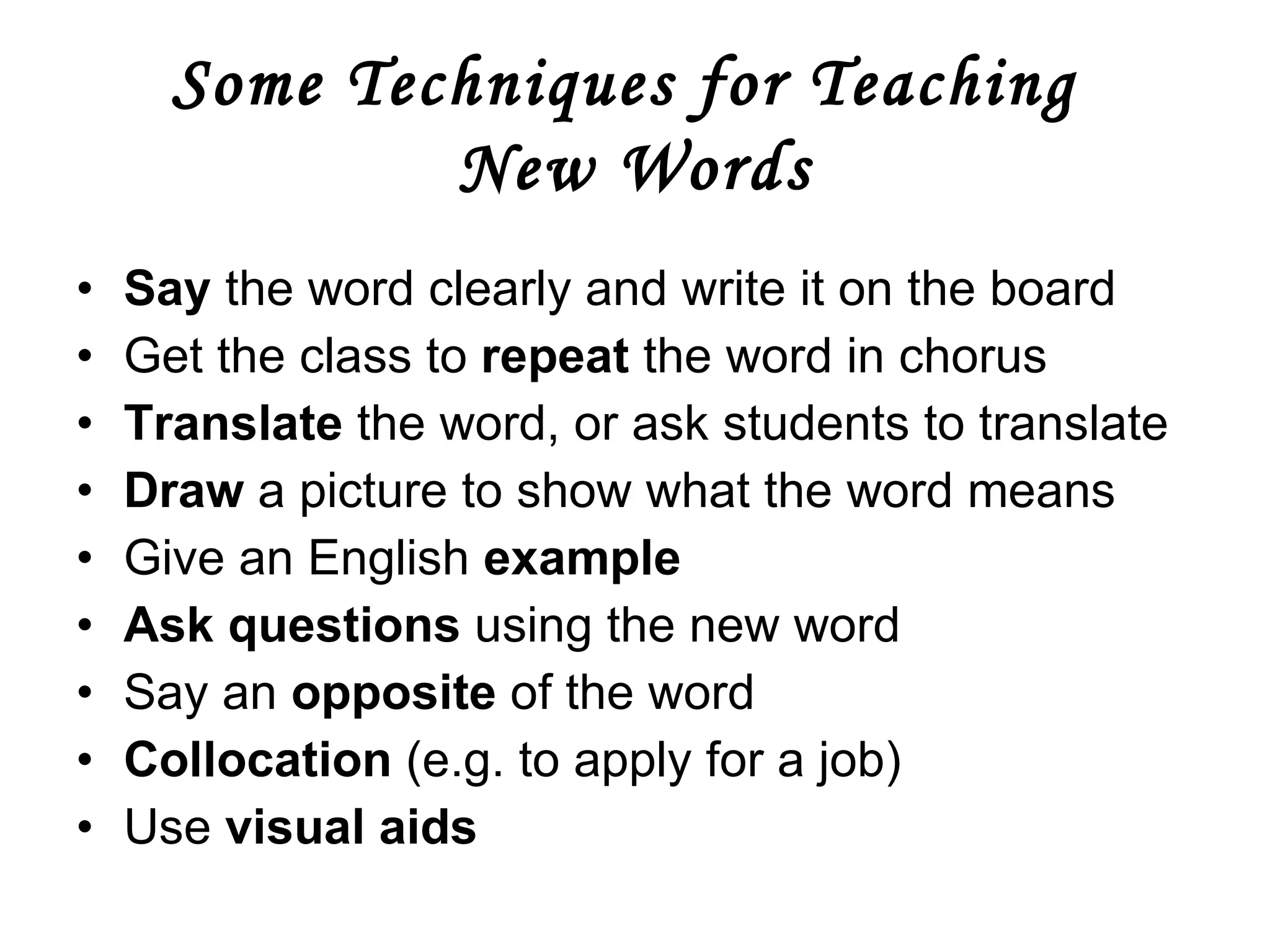
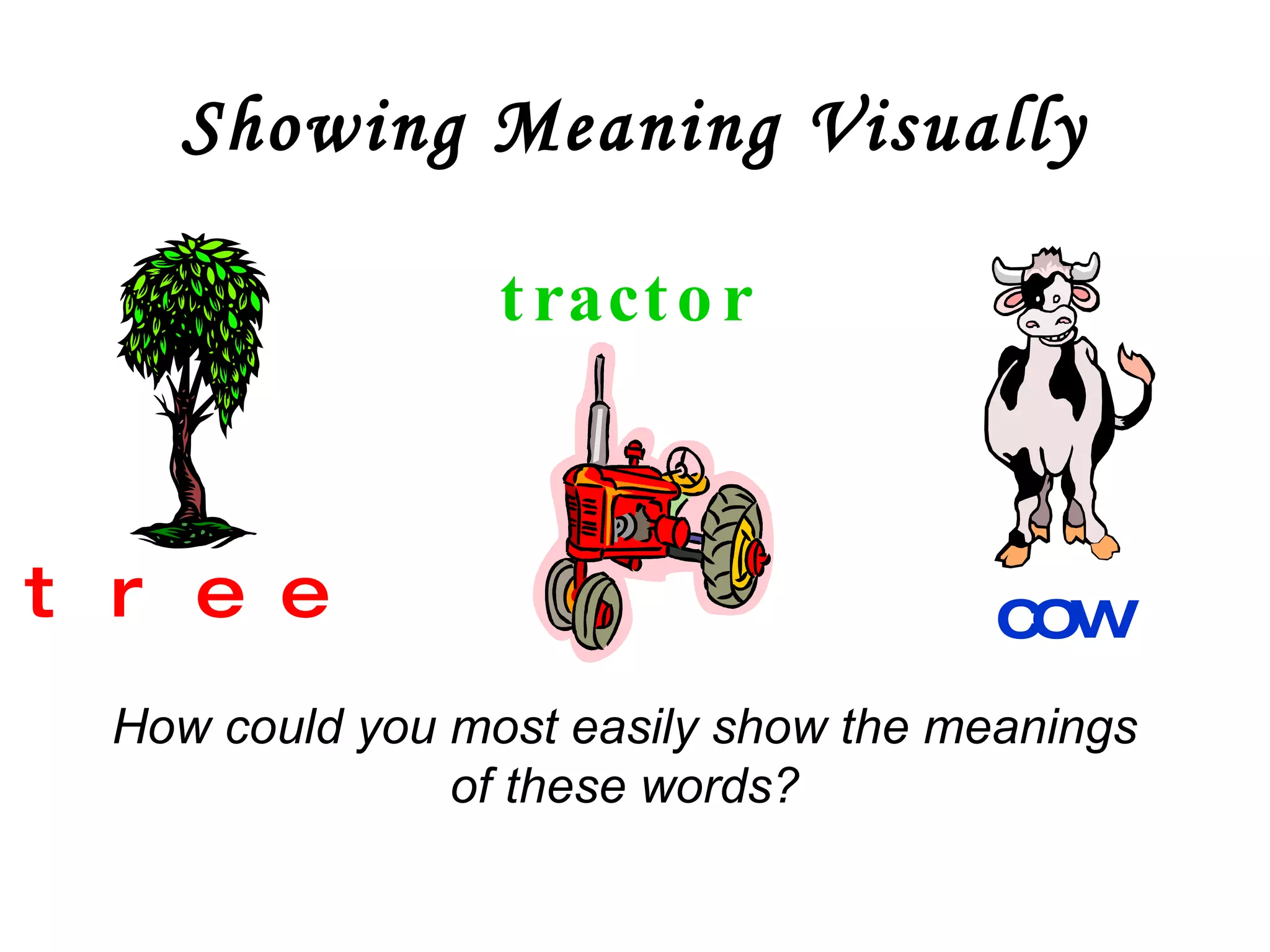
Some Techniques for Teaching  New Words Say  the word clearly and write it on the board Get the class to  repeat  the word in chorus Translate  the word, or ask students to translate  Draw  a picture to show what the word means Give an English  example Ask questions  using the new word Say an  opposite  of the word Collocation  (e.g. to apply for a job)  Use  visual aids   
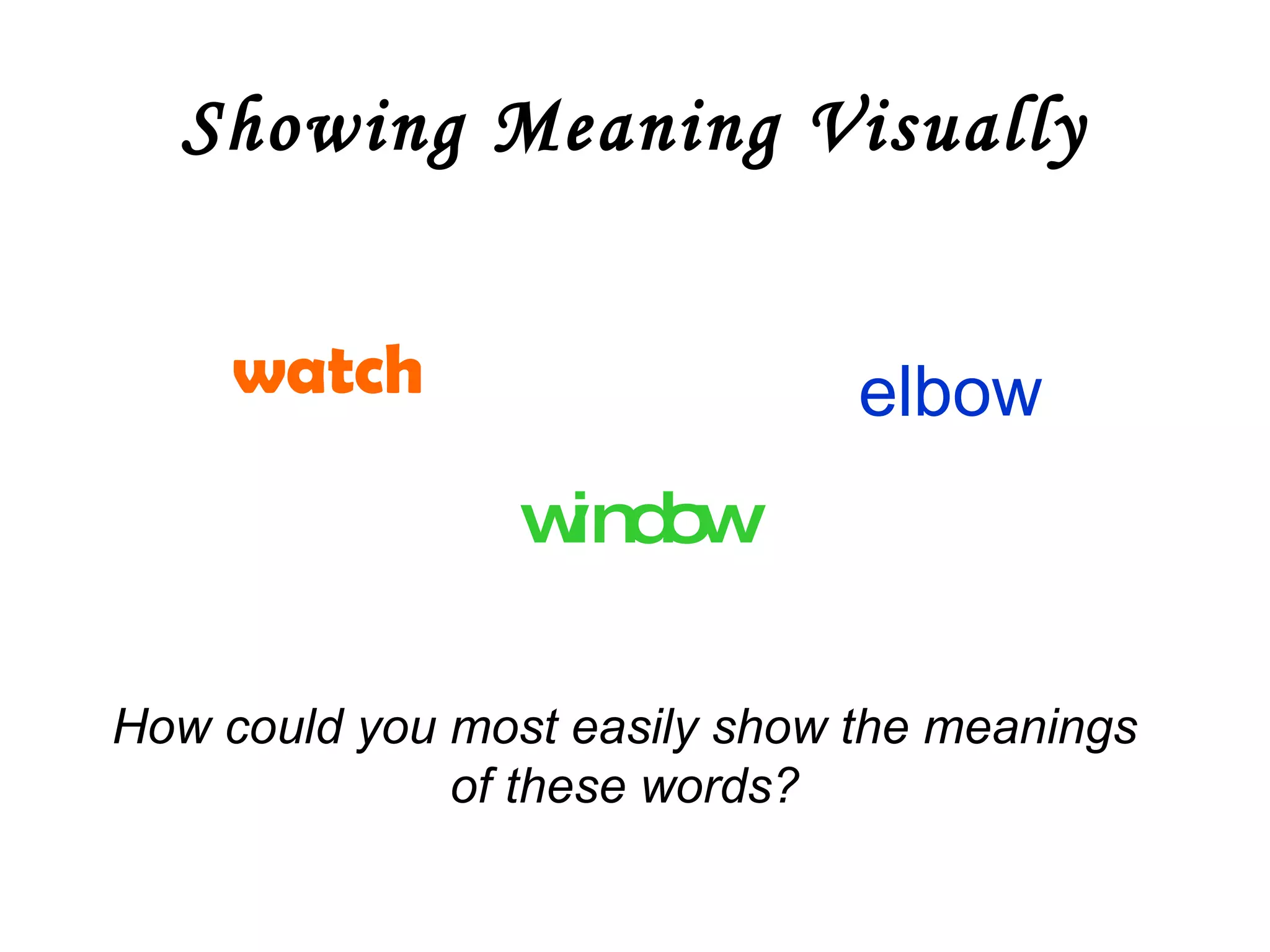
Showing Meaning Visually watch window elbow How could you most easily show the meanings of these words?
Showing Meaning Visually tree tractor cow How could you most easily show the meanings of these words?
Showing Meaning Visually sneeze dig   jump How could you most easily show the meanings of these words?
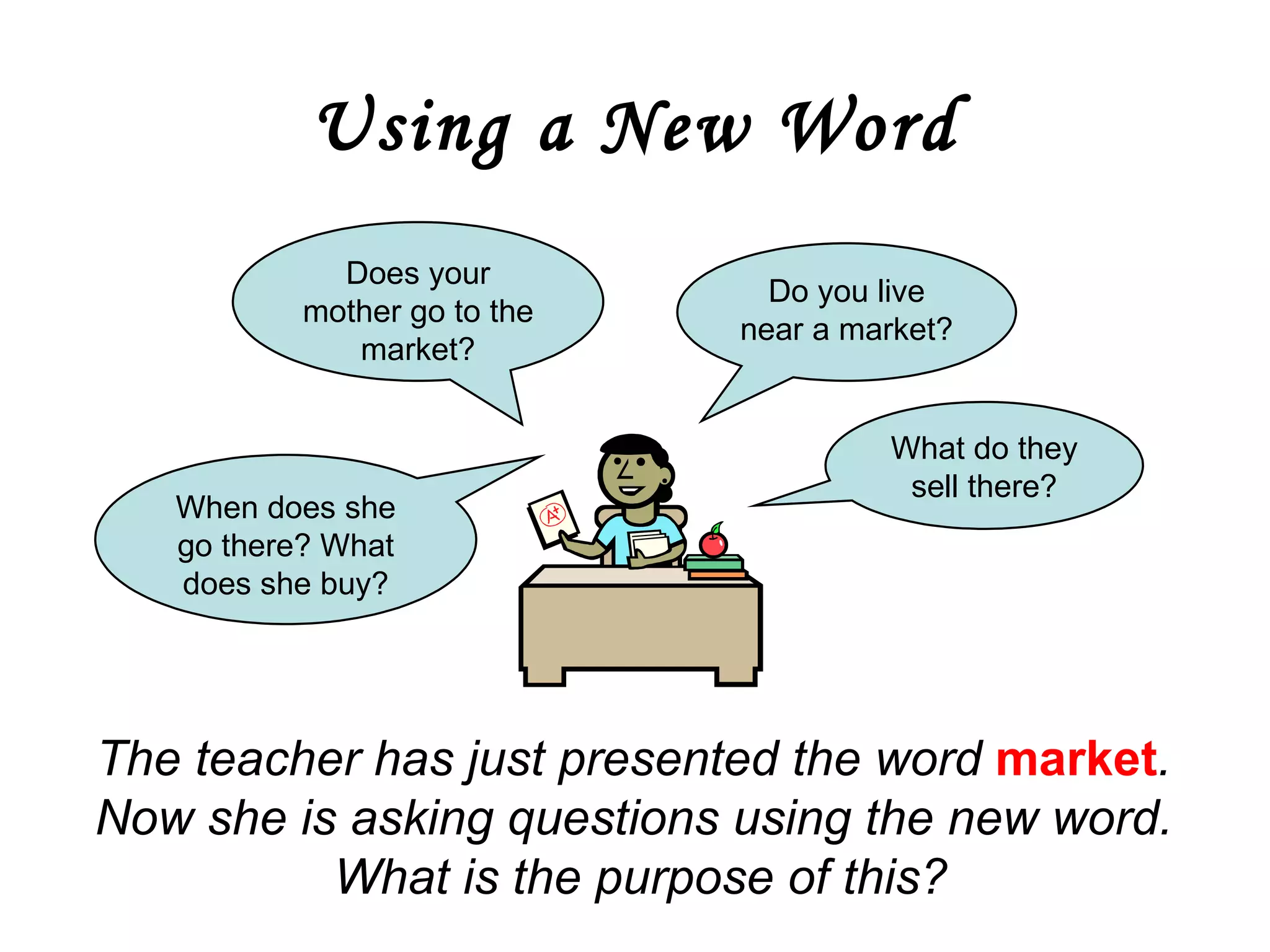
Using a New Word The teacher has just presented the word  market .  Now she is asking questions using the new word.  What is the purpose of this? Does your mother go to the market? What do they sell there? Do you live near a market? When does she go there? What does she buy?
Meaning-focused Input Learning from listening and reading Learning vocabulary this way isn’t always enough: The amount of vocabulary learning that occurs during the reading of a text is rather small.   It depends greatly on the learners' control of the reading skill.   The type of reading done influences vocabulary learning.
Meaning-focus Output Learning through speaking and writing   Learners’ attention is on communicating meaning   Research indicates that by carefully designing and monitoring the use of handouts for spoken tasks, instructors can have a major influence on their students' internalization of vocabulary
Vocabulary Strategies 3 effective ways for students to learn vocabulary: Guessing unknown words from context Learning the meanings of unknown words Studying word parts and mnemonic devices
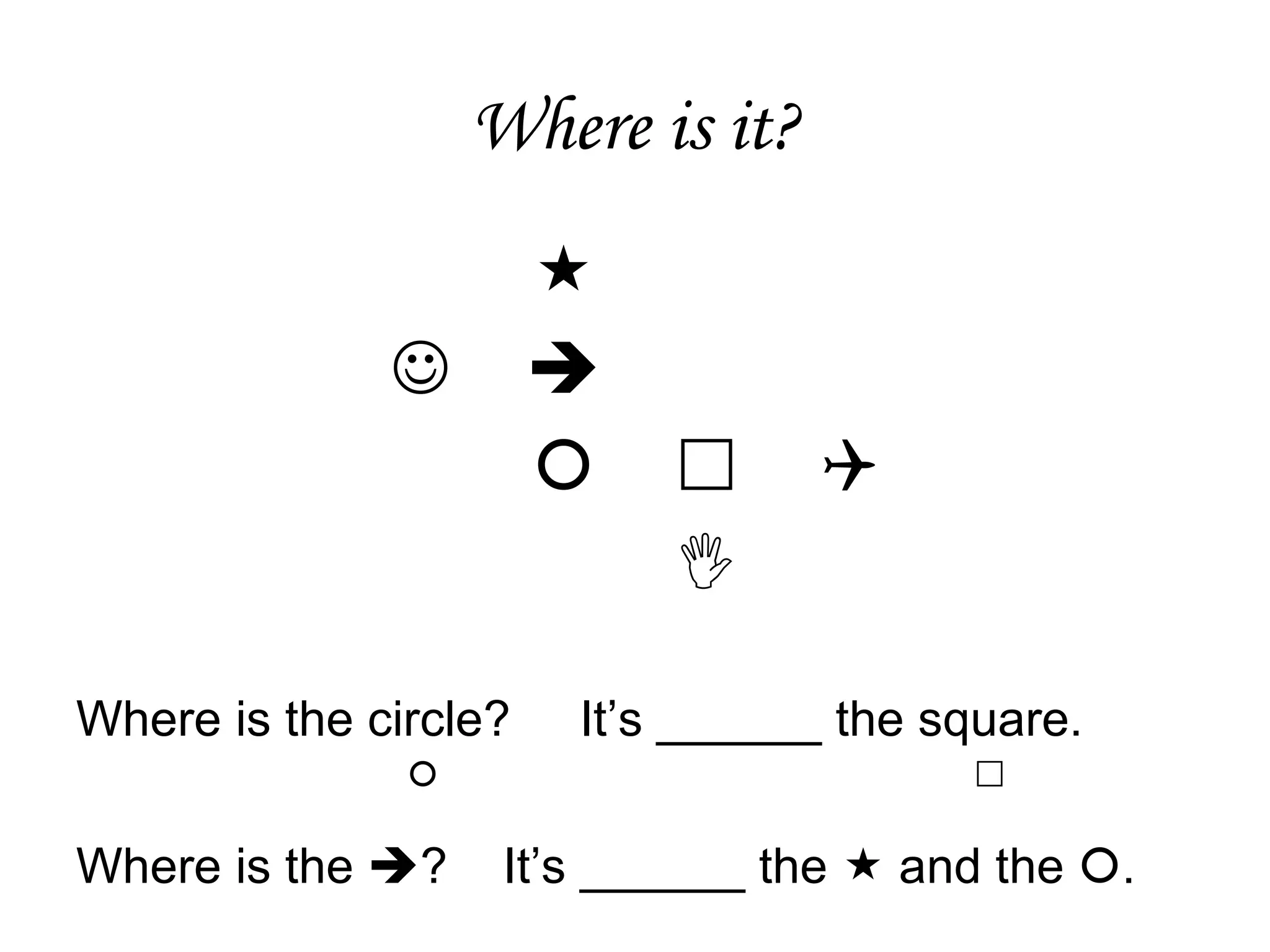
Where is it?        Where is the circle?  It’s ______ the square.     Where is the   ?  It’s ______ the    and the   .
Eliciting
What is eliciting? Getting information from people as opposed to giving it to them
Why elicit? Focuses students’ attention and makes them think Can be used to present new language as well as reviewing Encourages students to draw on previous knowledge Gives the teacher the opportunity to see what students know and don’t know
Getting Students to Guess Telling vs. eliciting new vocabulary Important part of language learning is developing the ability to make guesses Language follows rules, so we’re often able to guess things we’ve never been taught
Eliciting from Pictures Often best to ask fairly general questions that allow a variety of response Encourages more students to respond and say more If questions show that no one knows a new word, the teacher will present them
 
 
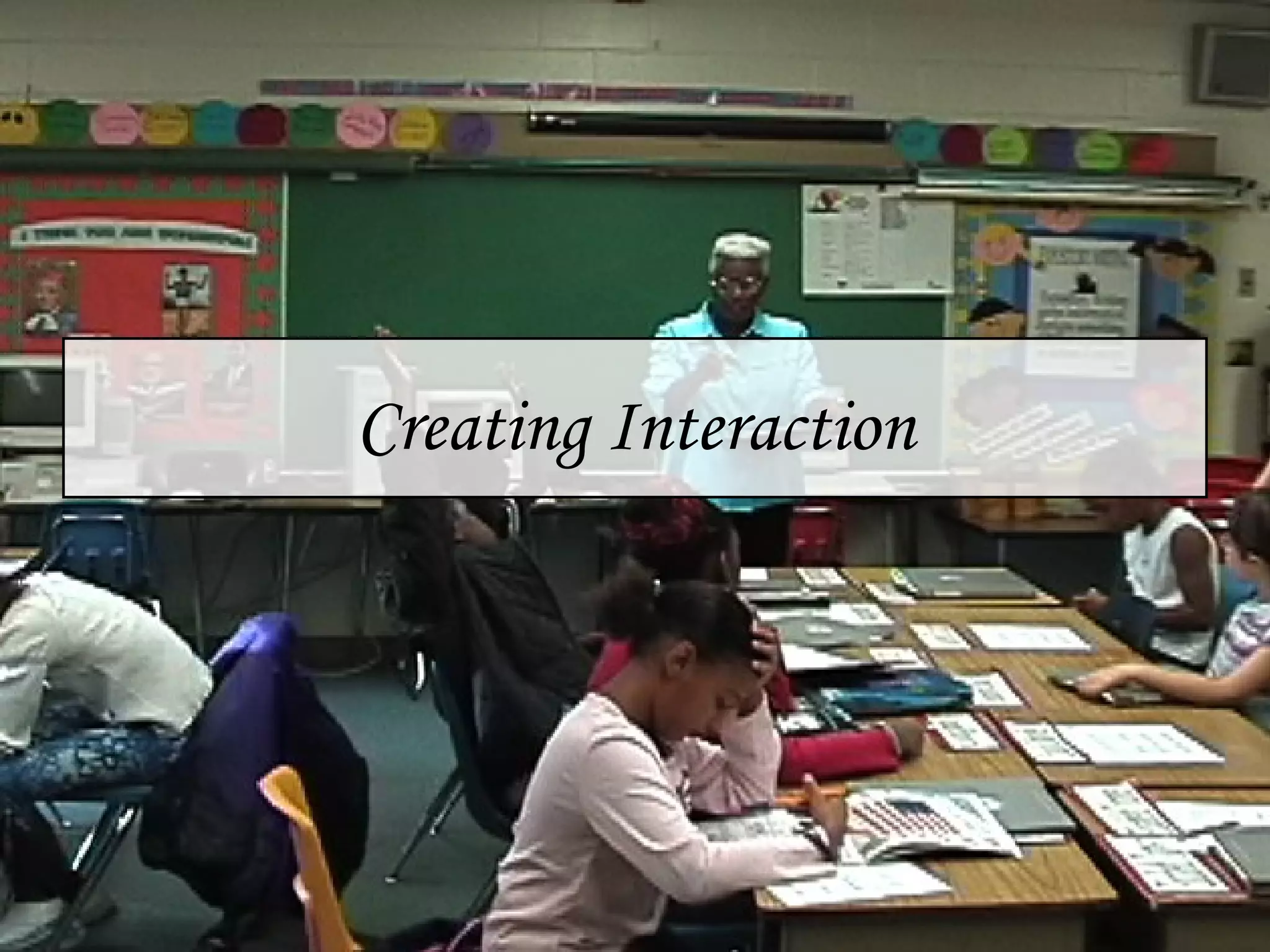
Creating Interaction
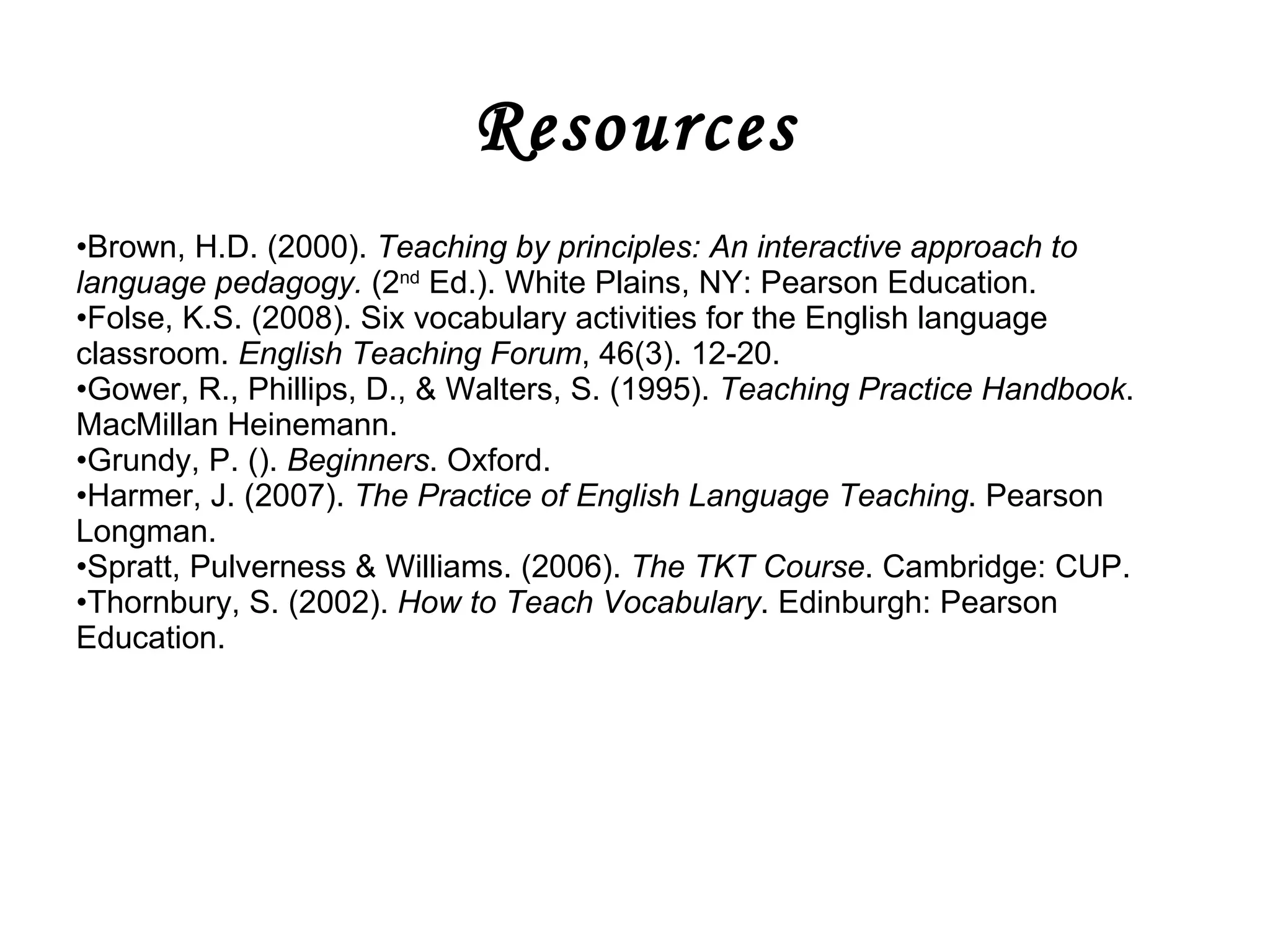
Resources Brown, H.D. (2000).  Teaching by principles: An interactive approach to language pedagogy.  (2 nd  Ed.). White Plains, NY: Pearson Education. Folse, K.S. (2008). Six vocabulary activities for the English language classroom.  English Teaching Forum , 46(3). 12-20. Gower, R., Phillips, D., & Walters, S. (1995).  Teaching Practice Handbook . MacMillan Heinemann. Grundy, P. ().  Beginners . Oxford.  Harmer, J. (2007).  The Practice of English Language Teaching . Pearson Longman. Spratt, Pulverness & Williams. (2006).  The TKT Course . Cambridge: CUP. Thornbury, S. (2002).  How to Teach Vocabulary . Edinburgh: Pearson Education.
Resources for Images Time Magazine www.timemagazine.com Newsweek www.newsweek.com New York Times www.nytimes.com National Geographic www.nationalgeographic.com
 

Basics Of Teaching Vocabulary

  • 1.
    Basics of TeachingVocabulary Erin Lowry, Senior English Language Fellow, June 2009
  • 2.
    Overview Teaching newvocabulary and grammar in context Eliciting techniques Creating interaction in the classroom
  • 3.
    What is Scaffolding?Giving contextual supports for meaning through the use of: simplified language teacher modeling visuals and graphics cooperative learning hands-on learning Ovando, Collier, & Combs, 2003, p. 345
  • 4.
    Effective Scaffolding forLanguage Learners Simplifying the language By shortening selections, speaking in the present tense, and avoiding the use of idioms Asking for completion, not production Students choose answers from a list or complete a partially finished outline or paragraph Using visuals Present information and ask for students to respond using graphic organizers, tables, charts, outlines, and graphs
  • 5.
  • 6.
    What is vocabulary?Vocabulary refers to words or multiword units (like idioms and phrasal verbs) that have a common meaning.
  • 7.
    5 Types ofVocabulary Single words Set phrases Variable phrases Phrasal verbs Idioms
  • 8.
    Other Aspects ofVocabulary Polysemy Connotation and usage Part of speech Frequency Collocation
  • 9.
    Important Goals Focuson the vocabulary Multiple retrievals Develop successful vocabulary learning strategies
  • 10.
    Principles of TeachingVocabulary Keep teaching simple and clear. No complicated explanations. Relate the present teaching to past knowledge by showing a pattern. Use both oral and written presentation - write it on the board and explaining. Give most attention to words that are already partly known. Tell the learners if it is a high frequency word that they should remember. Don’t bring in other unknown or little-known related words (like synonyms or opposites).
  • 11.
    4 principles forteaching and learning vocabulary Recycling New vocabulary must be regularly recycled/revised for students to remember it Motivation Evaluation & assessment Communication In order to communicate clearly and effectively a good range of vocabulary is needed
  • 12.
    Some Techniques forTeaching New Words Say the word clearly and write it on the board Get the class to repeat the word in chorus Translate the word, or ask students to translate Draw a picture to show what the word means Give an English example Ask questions using the new word Say an opposite of the word Collocation (e.g. to apply for a job) Use visual aids  
  • 13.
    Showing Meaning Visuallywatch window elbow How could you most easily show the meanings of these words?
  • 14.
    Showing Meaning Visuallytree tractor cow How could you most easily show the meanings of these words?
  • 15.
    Showing Meaning Visuallysneeze dig jump How could you most easily show the meanings of these words?
  • 16.
    Using a NewWord The teacher has just presented the word market . Now she is asking questions using the new word. What is the purpose of this? Does your mother go to the market? What do they sell there? Do you live near a market? When does she go there? What does she buy?
  • 17.
    Meaning-focused Input Learningfrom listening and reading Learning vocabulary this way isn’t always enough: The amount of vocabulary learning that occurs during the reading of a text is rather small.  It depends greatly on the learners' control of the reading skill.  The type of reading done influences vocabulary learning.
  • 18.
    Meaning-focus Output Learningthrough speaking and writing Learners’ attention is on communicating meaning  Research indicates that by carefully designing and monitoring the use of handouts for spoken tasks, instructors can have a major influence on their students' internalization of vocabulary
  • 19.
    Vocabulary Strategies 3effective ways for students to learn vocabulary: Guessing unknown words from context Learning the meanings of unknown words Studying word parts and mnemonic devices
  • 20.
    Where is it?       Where is the circle? It’s ______ the square.   Where is the  ? It’s ______ the  and the  .
  • 21.
  • 22.
    What is eliciting?Getting information from people as opposed to giving it to them
  • 23.
    Why elicit? Focusesstudents’ attention and makes them think Can be used to present new language as well as reviewing Encourages students to draw on previous knowledge Gives the teacher the opportunity to see what students know and don’t know
  • 24.
    Getting Students toGuess Telling vs. eliciting new vocabulary Important part of language learning is developing the ability to make guesses Language follows rules, so we’re often able to guess things we’ve never been taught
  • 25.
    Eliciting from PicturesOften best to ask fairly general questions that allow a variety of response Encourages more students to respond and say more If questions show that no one knows a new word, the teacher will present them
  • 26.
  • 27.
  • 28.
  • 29.
    Resources Brown, H.D.(2000). Teaching by principles: An interactive approach to language pedagogy. (2 nd Ed.). White Plains, NY: Pearson Education. Folse, K.S. (2008). Six vocabulary activities for the English language classroom. English Teaching Forum , 46(3). 12-20. Gower, R., Phillips, D., & Walters, S. (1995). Teaching Practice Handbook . MacMillan Heinemann. Grundy, P. (). Beginners . Oxford. Harmer, J. (2007). The Practice of English Language Teaching . Pearson Longman. Spratt, Pulverness & Williams. (2006). The TKT Course . Cambridge: CUP. Thornbury, S. (2002). How to Teach Vocabulary . Edinburgh: Pearson Education.
  • 30.
    Resources for ImagesTime Magazine www.timemagazine.com Newsweek www.newsweek.com New York Times www.nytimes.com National Geographic www.nationalgeographic.com
  • 31.