TEACHING VOCABULARY-LESSON PLAN
1 WARMER
   AS A STUDENT: Think of 2 English words that you have learnt
    in the classroom.
   HOW did you learn them?
   HOW made you remember them?
   AS A TEACHER: How can you teach difficult words before the
    students try speaking or reading or listening?
   TALK TO A PARTNER
   Feedback
2 WAYS TO PRESENT VOCABULARY
     Look at the 6 techniques on handout
     Make an AB pair
     Which ones have you used before?
     Which one is the best/worst? Why?
     Do you know any other ways to present vocabulary?

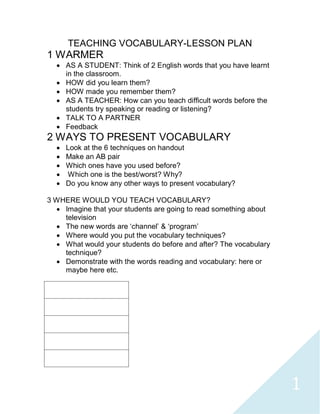
3 WHERE WOULD YOU TEACH VOCABULARY?
   Imagine that your students are going to read something about
    television
   The new words are ‘channel’ & ‘program’
   Where would you put the vocabulary techniques?
   What would your students do before and after? The vocabulary
    technique?
   Demonstrate with the words reading and vocabulary: here or
    maybe here etc.


                                                                   1
4 LINKING VOCABULARY TO THE
TECHNIQUES
  Look at the worksheet and the vocabulary below, which
   techniques would you use for each word?
  Elicit example from a student
  AB pair matching
5 CONCEPT CHECKING p.28
  Use pictures and words to explain CC
  Ask if they know the words, and then show the pictures to
   check the meaning
  Ask: Have you ever been arrested? Who do the police usually
   arrest?
  Have you ever been a patient in a hospital? Have you ever
   visited a patient in a hospital?
  Then students take two words each (the same words are okay)
   and write 3 concept checking questions-see worksheet
  Then the students try them on another AB pair
  Everybody give your opinions.
  Nb. If they can answer, then they have probably understood the
   word
6 Ways to present techniques
  Read through or draw attention to page


                                                                    2
WARMER
   AS A STUDENT: Think of 2 English words that you have learnt
    in the classroom.
   HOW did you learn them?
   HOW made you remember them?
   AS A TEACHER: How can you teach difficult words before the
    students try speaking or reading or listening?
   TALK TO A PARTNER


VOCABULARY TECHNIQUES
   Which vocabulary techniques have you used before?
   Which one is the best/worst? Explain why.
   Do you know any other ways to present vocabulary?


CONCEPT CHECKING
   On your own write take two words (the same words are okay)
    and write 3 concept checking questions
   Then make a small group and try them out
   Everybody give your opinions.

THESE ARE THE WORDS:

Team    fashionable   picnic   kangaroo   UFO float glasses


Words                            Concept checking questions
                                 1
                                 2
                                 3
                                 1
                                 2
                                 3


                                                                  3
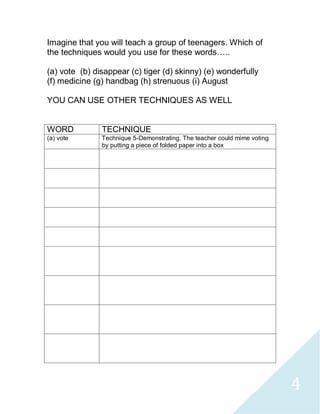
Imagine that you will teach a group of teenagers. Which of
the techniques would you use for these words…..

(a) vote (b) disappear (c) tiger (d) skinny) (e) wonderfully
(f) medicine (g) handbag (h) strenuous (i) August

YOU CAN USE OTHER TECHNIQUES AS WELL


WORD           TECHNIQUE
(a) vote       Technique 5-Demonstrating. The teacher could mime voting
               by putting a piece of folded paper into a box


                                                                          4
1. RELIA-show real objects or pictures to your students
The topic is cooking. A teacher brings the following kitchen tools into
the class and show them to your students.

                  bowl fork spoon knife spatula

The teacher then cooks something using the items and repeat the
new words as much as possible.

2. WORD BUILDING-Use parts of words to help students build
words or guess their meaning
Example: Prefixes
We can change the meaning of adjectives by putting a prefix in front
of it. Add the prefix un-,in- OR im- to these adjectives. You put these
in front of most adjectives beginning with m or p

Tidy           dependent          safe         exciting      mature
Happy          precise            adequate
Friendly       expensive
realistic


3. MATCHING-students match words to words (e.g. words to
synonyms or words to opposites) or sentences (e.g. to words
to definitions), or words to pictures

Find these nouns in the reading and match them with
the definitions below.

1 ghetto blaster ____ a large piece of material.
2 raids         __1___ a radio-cassette player with built in
speakers.
3 banner       ______ a surprise attack


                                                                          5
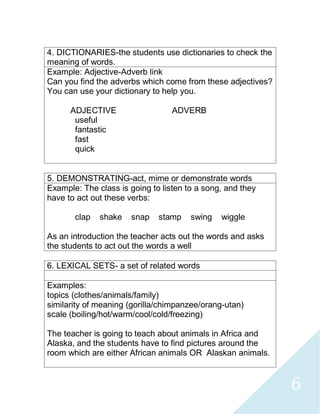
4. DICTIONARIES-the students use dictionaries to check the
meaning of words.
Example: Adjective-Adverb link
Can you find the adverbs which come from these adjectives?
You can use your dictionary to help you.

      ADJECTIVE                   ADVERB
       useful
       fantastic
       fast
       quick


5. DEMONSTRATING-act, mime or demonstrate words
Example: The class is going to listen to a song, and they
have to act out these verbs:

       clap   shake   snap    stamp    swing   wiggle

As an introduction the teacher acts out the words and asks
the students to act out the words a well

6. LEXICAL SETS- a set of related words

Examples:
topics (clothes/animals/family)
similarity of meaning (gorilla/chimpanzee/orang-utan)
scale (boiling/hot/warm/cool/cold/freezing)

The teacher is going to teach about animals in Africa and
Alaska, and the students have to find pictures around the
room which are either African animals OR Alaskan animals.


                                                             6
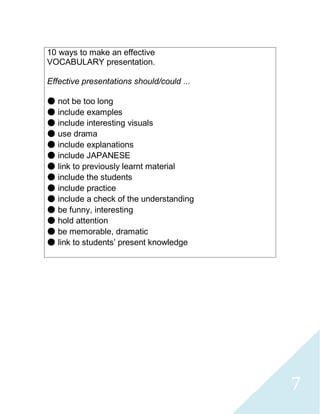
10 ways to make an effective
VOCABULARY presentation.

Effective presentations should/could ...

● not be too long
● include examples
● include interesting visuals
● use drama
● include explanations
● include JAPANESE
● link to previously learnt material
● include the students
● include practice
● include a check of the understanding
● be funny, interesting
● hold attention
● be memorable, dramatic
● link to students’ present knowledge


                                           7
WHERE WOULD YOU TEACH VOCABULARY?
  Imagine that your students are going to read something about
   television
  The new words are ‘channel’ & ‘program’
  Where would you put the vocabulary techniques?
  What would your students do before and after the
   reading/vocabulary technique?


                                                                  8

Tp teaching vocabulary lesson plan

  • 1.
    TEACHING VOCABULARY-LESSON PLAN 1WARMER  AS A STUDENT: Think of 2 English words that you have learnt in the classroom.  HOW did you learn them?  HOW made you remember them?  AS A TEACHER: How can you teach difficult words before the students try speaking or reading or listening?  TALK TO A PARTNER  Feedback 2 WAYS TO PRESENT VOCABULARY  Look at the 6 techniques on handout  Make an AB pair  Which ones have you used before?  Which one is the best/worst? Why?  Do you know any other ways to present vocabulary? 3 WHERE WOULD YOU TEACH VOCABULARY?  Imagine that your students are going to read something about television  The new words are ‘channel’ & ‘program’  Where would you put the vocabulary techniques?  What would your students do before and after? The vocabulary technique?  Demonstrate with the words reading and vocabulary: here or maybe here etc. 1
  • 2.
    4 LINKING VOCABULARYTO THE TECHNIQUES  Look at the worksheet and the vocabulary below, which techniques would you use for each word?  Elicit example from a student  AB pair matching 5 CONCEPT CHECKING p.28  Use pictures and words to explain CC  Ask if they know the words, and then show the pictures to check the meaning  Ask: Have you ever been arrested? Who do the police usually arrest?  Have you ever been a patient in a hospital? Have you ever visited a patient in a hospital?  Then students take two words each (the same words are okay) and write 3 concept checking questions-see worksheet  Then the students try them on another AB pair  Everybody give your opinions.  Nb. If they can answer, then they have probably understood the word 6 Ways to present techniques  Read through or draw attention to page 2
  • 3.
    WARMER AS A STUDENT: Think of 2 English words that you have learnt in the classroom.  HOW did you learn them?  HOW made you remember them?  AS A TEACHER: How can you teach difficult words before the students try speaking or reading or listening?  TALK TO A PARTNER VOCABULARY TECHNIQUES  Which vocabulary techniques have you used before?  Which one is the best/worst? Explain why.  Do you know any other ways to present vocabulary? CONCEPT CHECKING  On your own write take two words (the same words are okay) and write 3 concept checking questions  Then make a small group and try them out  Everybody give your opinions. THESE ARE THE WORDS: Team fashionable picnic kangaroo UFO float glasses Words Concept checking questions 1 2 3 1 2 3 3
  • 4.
    Imagine that youwill teach a group of teenagers. Which of the techniques would you use for these words….. (a) vote (b) disappear (c) tiger (d) skinny) (e) wonderfully (f) medicine (g) handbag (h) strenuous (i) August YOU CAN USE OTHER TECHNIQUES AS WELL WORD TECHNIQUE (a) vote Technique 5-Demonstrating. The teacher could mime voting by putting a piece of folded paper into a box 4
  • 5.
    1. RELIA-show realobjects or pictures to your students The topic is cooking. A teacher brings the following kitchen tools into the class and show them to your students. bowl fork spoon knife spatula The teacher then cooks something using the items and repeat the new words as much as possible. 2. WORD BUILDING-Use parts of words to help students build words or guess their meaning Example: Prefixes We can change the meaning of adjectives by putting a prefix in front of it. Add the prefix un-,in- OR im- to these adjectives. You put these in front of most adjectives beginning with m or p Tidy dependent safe exciting mature Happy precise adequate Friendly expensive realistic 3. MATCHING-students match words to words (e.g. words to synonyms or words to opposites) or sentences (e.g. to words to definitions), or words to pictures Find these nouns in the reading and match them with the definitions below. 1 ghetto blaster ____ a large piece of material. 2 raids __1___ a radio-cassette player with built in speakers. 3 banner ______ a surprise attack 5
  • 6.
    4. DICTIONARIES-the studentsuse dictionaries to check the meaning of words. Example: Adjective-Adverb link Can you find the adverbs which come from these adjectives? You can use your dictionary to help you. ADJECTIVE ADVERB useful fantastic fast quick 5. DEMONSTRATING-act, mime or demonstrate words Example: The class is going to listen to a song, and they have to act out these verbs: clap shake snap stamp swing wiggle As an introduction the teacher acts out the words and asks the students to act out the words a well 6. LEXICAL SETS- a set of related words Examples: topics (clothes/animals/family) similarity of meaning (gorilla/chimpanzee/orang-utan) scale (boiling/hot/warm/cool/cold/freezing) The teacher is going to teach about animals in Africa and Alaska, and the students have to find pictures around the room which are either African animals OR Alaskan animals. 6
  • 7.
    10 ways tomake an effective VOCABULARY presentation. Effective presentations should/could ... ● not be too long ● include examples ● include interesting visuals ● use drama ● include explanations ● include JAPANESE ● link to previously learnt material ● include the students ● include practice ● include a check of the understanding ● be funny, interesting ● hold attention ● be memorable, dramatic ● link to students’ present knowledge 7
  • 8.
    WHERE WOULD YOUTEACH VOCABULARY?  Imagine that your students are going to read something about television  The new words are ‘channel’ & ‘program’  Where would you put the vocabulary techniques?  What would your students do before and after the reading/vocabulary technique? 8