Approaches to Learner Autonomy in Language Learning Erin Lowry Senior English Language Fellow Centro Colombo Americano Armenia November 25, 2008
You cannot teach a man anything; you can only help him find it within himself. Galileo Galilei (1564-1642)
Learner Autonomy Defined Ability to take charge of one’s own learning Main idea behind  learner autonomy  is that students should take responsibility for their own learning, rather than be dependent on the teacher (Holec 1981) “ The autonomous learner is one that constructs knowledge from direct experience, rather than one who responds to someone’s instruction” (Benson 2001)     
Characteristics of Autonomy Concept based in natural tendency for learners to take control over their learning.  Autonomy may be displayed in different ways and to different degrees depending on each learner and learning situation. Learners who lack autonomy are capable of developing it given appropriate conditions and preparation.  Autonomous learning is more effective than non-autonomous learning.
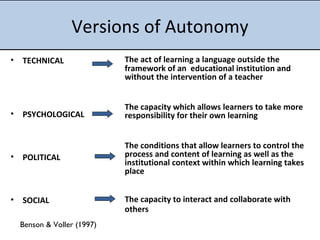
Versions of Autonomy TECHNICAL PSYCHOLOGICAL POLITICAL SOCIAL The act of learning a language outside the framework of an  educational institution and without the intervention of a teacher The capacity which allows learners to take more responsibility for their own learning The conditions that allow learners to control the process and content of learning as well as the institutional context within which learning takes place The capacity to interact and collaborate with others Benson & Voller (1997)
Characteristics of Autonomous  Language Learners Seven main attributes (see Omaggio, 1978,  cited in Wenden, 1998: 41-42): have insights into their learning styles and strategies take an active approach to the learning task at hand are willing to take risks are good guessers attend to form as well as to content, that is, place importance on accuracy as well as appropriacy develop the target language into a separate reference system and are willing to revise and reject hypotheses and rules that do not apply have a tolerant and outgoing approach to the target language
What Needs to Happen First Teacher becomes less of an instructor and more of a facilitator  Students discouraged from relying on the teacher as the main source of knowledge  Students’ capacity to learn for themselves is encouraged  Students encouraged to make decisions about what they learn  Students’ awareness of their own learning styles is encouraged Students encouraged to develop their own learning strategies
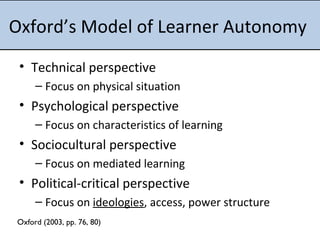
Oxford’s Model of Learner Autonomy  Technical perspective Focus on physical situation Psychological perspective Focus on characteristics of learning Sociocultural perspective Focus on mediated learning Political-critical perspective Focus on  ideologies , access, power structure Oxford (2003, pp. 76, 80)
Some Background Autonomy is generally seen as a characteristic of adults Independent learning doesn’t mean solitude Autonomous learners are also part of communities of practice Autonomy is not necessarily a characteristic that is seen as important in learning in all cultures
Designing Courses that Promote Autonomy Take into consideration Learner goals The language learning process Tasks and design Learner strategies Reflection on learning
Our Goals as Teachers Train learners to function better while studying Ensure learners continue to acquire the second language after formal studies end (Field 2007) Not use set methodologies Our job is to create learning opportunities, not to impose a method. There’s no one way to learn a language (Benson 2001)
FOSTERING AUTONOMY
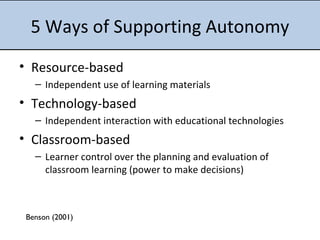
5 Ways of Supporting Autonomy Resource-based Independent use of learning materials Technology-based Independent interaction with educational technologies Classroom-based Learner control over the planning and evaluation of classroom learning (power to make decisions) Benson (2001)
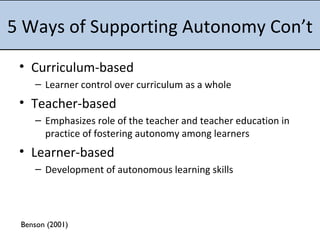
5 Ways of Supporting Autonomy Con’t Curriculum-based Learner control over curriculum as a whole Teacher-based Emphasizes role of the teacher and teacher education in practice of fostering autonomy among learners Learner-based Development of autonomous learning skills Benson (2001)
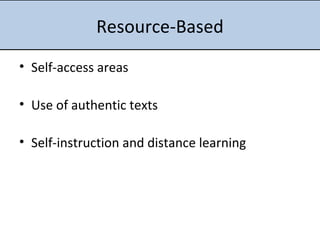
Resource-Based Self-access areas Use of authentic texts Self-instruction and distance learning
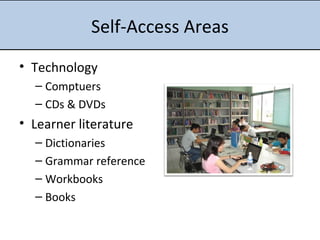
Self-Access Areas Technology Comptuers CDs & DVDs Learner literature Dictionaries Grammar reference Workbooks Books
Characteristics of Good Self-Access Materials classified by learners’ language level Suggestions on what to do next (pathways) Training for learners on how to use the resources and computers Making the area appropriate for learners  How to keep interest going Harmer (2007)
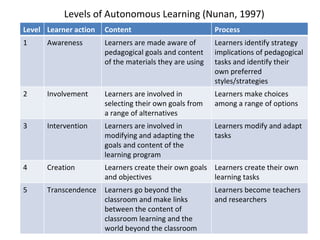
Levels of Autonomous Learning (Nunan, 1997) Level Learner action Content Process 1 Awareness Learners are made aware of pedagogical goals and content of the materials they are using Learners identify strategy implications of pedagogical tasks and identify their own preferred styles/strategies 2 Involvement Learners are involved in selecting their own goals from a range of alternatives  Learners make choices among a range of options 3 Intervention Learners are involved in modifying and adapting the goals and content of the learning program Learners modify and adapt tasks 4 Creation Learners create their own goals and objectives Learners create their own learning tasks 5 Transcendence Learners go beyond the classroom and make links between the content of classroom learning and the world beyond the classroom Learners become teachers and researchers
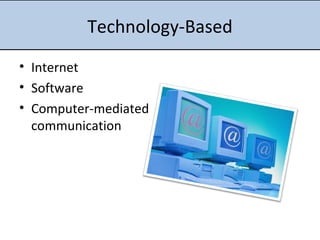
Technology-Based Internet Software Computer-mediated communication
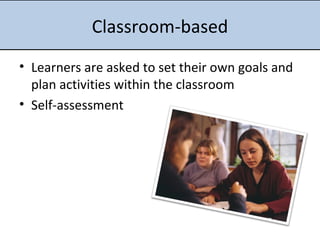
Classroom-based Learners are asked to set their own goals and plan activities within the classroom Self-assessment
Learner-based Learner development activities Language learning strategies & techniques (p.149) “ Good language learner”
Curriculum-based Process syllabus Inquiry-based learning Project-based learning Task-based learning
Teacher-based Teacher roles Teacher autonomy
Our Roles as Teachers Voller (1997) identifies three roles for teachers working on an  autonomous pedagogy the teacher as a facilitator the teacher as a counsellor the teacher as a resource
ACTIVITIES FOR AUTONOMOUS    LANGUAGE LEARNING
Strategy Training Learning strategies = the techniques you use to learn something 2 categories Metacognitive strategies Cognitive strategies
Metacognitive Strategies Thinking about your process of learning Planning Monitoring Problem-solving Evaluating
Cognitive Strategies Learners actually do something with the language in order to learn it, such as: Writing vocabulary lists Doing grammar exercises Listening to songs
Learning Journals Purpose Teacher-student channel Reactions Responses Open Formats Written, Online, Tapes, CDs  How often Public or private
Learning Contracts What am I going to learn? ( Objectives ) How am I going to learn it? ( Resources and Strategies ) How am I going to know that I have learned it? ( My evidence ) How am I going to prove that I have learned it? ( Verification by teachers and peers ) Schwarzer, Kahn & Smart (2000)
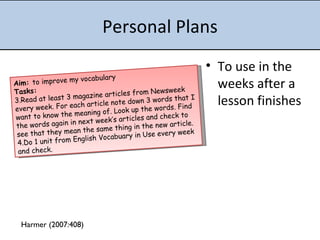
Personal Plans To use in the weeks after a lesson finishes Aim:  to improve my vocabulary Tasks: Read at least 3 magazine articles from Newsweek every week. For each article note down 3 words that I want to know the meaning of. Look up the words. Find the words again in next week’s articles and check to  see that they mean the same thing in the new article. Do 1 unit from English Vocabuary in Use every week and check.  Harmer (2007:408)
Learning Logs Individual student’s summary of what has been learned over a given period of time Beginner levels Teacher can help students summarize Young learners Circle appropriate drawings or adjectives
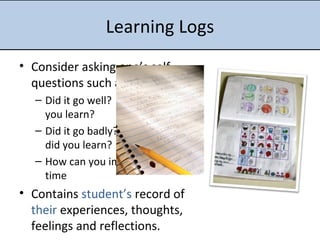
Learning Logs Consider asking one’s self questions such as: Did it go well?  Why?  What did you learn? Did it go badly?  Why? What did you learn? How can you improve for next time Contains  student’s  record of  their  experiences, thoughts, feelings and reflections.
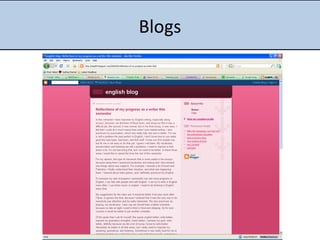
CALL / Technology Blogs Software Computer-mediated communication (CMC) Web 2.0 tools Wequests
Blogs
Websites
Webquests Presents student groups with a challenging task, scenario, or problem to solve using the Internet and its available resources Current events, controversial social and environmental topics work well
Reflection Incorporate reflective lessons into your teaching Have students consider: Their motivation Changes in attitudes and ideas Which skills they need for different kinds of assignments What is blocking their learning Any gaps in their knowledge or skills
Questions?  Companion website for workshop http://colombotech.pbwiki.com/Approaches-to-Autonomous-Learning   Email Erin [email_address]
Selected Resources Benson, P. (2001).  Teaching and researching autonomy in language learning . Harlow: Pearson Education.  Benson, P. & Voller, P. (Eds.). (1997).  Autonomy and independence in language learning . London: Longman.  Healey, D. (2007). Theory and research: autonomy and language learning. In J. Egbert & E. Hanson-Smith (Eds.).  CALL environments: research, practice, and critical issues  (2nd Ed.). Alexandria, VA: Teachers of English to Speakers of Other Languages, Inc.  Holec, H. (1981).  Autonomy in foreign language learning . Oxford: Pergamon. (First published 1979, Strasbourg: Council of Europe. Other resources cited on  http://colombotech.pbwiki.com/Approaches-to-Autonomous-Learning

Approaches To Learner Autonomy In Language Learning

  • 1.
    Approaches to LearnerAutonomy in Language Learning Erin Lowry Senior English Language Fellow Centro Colombo Americano Armenia November 25, 2008
  • 2.
    You cannot teacha man anything; you can only help him find it within himself. Galileo Galilei (1564-1642)
  • 3.
    Learner Autonomy DefinedAbility to take charge of one’s own learning Main idea behind learner autonomy is that students should take responsibility for their own learning, rather than be dependent on the teacher (Holec 1981) “ The autonomous learner is one that constructs knowledge from direct experience, rather than one who responds to someone’s instruction” (Benson 2001)     
  • 4.
    Characteristics of AutonomyConcept based in natural tendency for learners to take control over their learning. Autonomy may be displayed in different ways and to different degrees depending on each learner and learning situation. Learners who lack autonomy are capable of developing it given appropriate conditions and preparation. Autonomous learning is more effective than non-autonomous learning.
  • 5.
    Versions of AutonomyTECHNICAL PSYCHOLOGICAL POLITICAL SOCIAL The act of learning a language outside the framework of an educational institution and without the intervention of a teacher The capacity which allows learners to take more responsibility for their own learning The conditions that allow learners to control the process and content of learning as well as the institutional context within which learning takes place The capacity to interact and collaborate with others Benson & Voller (1997)
  • 6.
    Characteristics of Autonomous Language Learners Seven main attributes (see Omaggio, 1978, cited in Wenden, 1998: 41-42): have insights into their learning styles and strategies take an active approach to the learning task at hand are willing to take risks are good guessers attend to form as well as to content, that is, place importance on accuracy as well as appropriacy develop the target language into a separate reference system and are willing to revise and reject hypotheses and rules that do not apply have a tolerant and outgoing approach to the target language
  • 7.
    What Needs toHappen First Teacher becomes less of an instructor and more of a facilitator Students discouraged from relying on the teacher as the main source of knowledge Students’ capacity to learn for themselves is encouraged Students encouraged to make decisions about what they learn Students’ awareness of their own learning styles is encouraged Students encouraged to develop their own learning strategies
  • 8.
    Oxford’s Model ofLearner Autonomy Technical perspective Focus on physical situation Psychological perspective Focus on characteristics of learning Sociocultural perspective Focus on mediated learning Political-critical perspective Focus on ideologies , access, power structure Oxford (2003, pp. 76, 80)
  • 9.
    Some Background Autonomyis generally seen as a characteristic of adults Independent learning doesn’t mean solitude Autonomous learners are also part of communities of practice Autonomy is not necessarily a characteristic that is seen as important in learning in all cultures
  • 10.
    Designing Courses thatPromote Autonomy Take into consideration Learner goals The language learning process Tasks and design Learner strategies Reflection on learning
  • 11.
    Our Goals asTeachers Train learners to function better while studying Ensure learners continue to acquire the second language after formal studies end (Field 2007) Not use set methodologies Our job is to create learning opportunities, not to impose a method. There’s no one way to learn a language (Benson 2001)
  • 12.
  • 13.
    5 Ways ofSupporting Autonomy Resource-based Independent use of learning materials Technology-based Independent interaction with educational technologies Classroom-based Learner control over the planning and evaluation of classroom learning (power to make decisions) Benson (2001)
  • 14.
    5 Ways ofSupporting Autonomy Con’t Curriculum-based Learner control over curriculum as a whole Teacher-based Emphasizes role of the teacher and teacher education in practice of fostering autonomy among learners Learner-based Development of autonomous learning skills Benson (2001)
  • 15.
    Resource-Based Self-access areasUse of authentic texts Self-instruction and distance learning
  • 16.
    Self-Access Areas TechnologyComptuers CDs & DVDs Learner literature Dictionaries Grammar reference Workbooks Books
  • 17.
    Characteristics of GoodSelf-Access Materials classified by learners’ language level Suggestions on what to do next (pathways) Training for learners on how to use the resources and computers Making the area appropriate for learners How to keep interest going Harmer (2007)
  • 18.
    Levels of AutonomousLearning (Nunan, 1997) Level Learner action Content Process 1 Awareness Learners are made aware of pedagogical goals and content of the materials they are using Learners identify strategy implications of pedagogical tasks and identify their own preferred styles/strategies 2 Involvement Learners are involved in selecting their own goals from a range of alternatives Learners make choices among a range of options 3 Intervention Learners are involved in modifying and adapting the goals and content of the learning program Learners modify and adapt tasks 4 Creation Learners create their own goals and objectives Learners create their own learning tasks 5 Transcendence Learners go beyond the classroom and make links between the content of classroom learning and the world beyond the classroom Learners become teachers and researchers
  • 19.
    Technology-Based Internet SoftwareComputer-mediated communication
  • 20.
    Classroom-based Learners areasked to set their own goals and plan activities within the classroom Self-assessment
  • 21.
    Learner-based Learner developmentactivities Language learning strategies & techniques (p.149) “ Good language learner”
  • 22.
    Curriculum-based Process syllabusInquiry-based learning Project-based learning Task-based learning
  • 23.
  • 24.
    Our Roles asTeachers Voller (1997) identifies three roles for teachers working on an autonomous pedagogy the teacher as a facilitator the teacher as a counsellor the teacher as a resource
  • 25.
    ACTIVITIES FOR AUTONOMOUS LANGUAGE LEARNING
  • 26.
    Strategy Training Learningstrategies = the techniques you use to learn something 2 categories Metacognitive strategies Cognitive strategies
  • 27.
    Metacognitive Strategies Thinkingabout your process of learning Planning Monitoring Problem-solving Evaluating
  • 28.
    Cognitive Strategies Learnersactually do something with the language in order to learn it, such as: Writing vocabulary lists Doing grammar exercises Listening to songs
  • 29.
    Learning Journals PurposeTeacher-student channel Reactions Responses Open Formats Written, Online, Tapes, CDs How often Public or private
  • 30.
    Learning Contracts Whatam I going to learn? ( Objectives ) How am I going to learn it? ( Resources and Strategies ) How am I going to know that I have learned it? ( My evidence ) How am I going to prove that I have learned it? ( Verification by teachers and peers ) Schwarzer, Kahn & Smart (2000)
  • 31.
    Personal Plans Touse in the weeks after a lesson finishes Aim: to improve my vocabulary Tasks: Read at least 3 magazine articles from Newsweek every week. For each article note down 3 words that I want to know the meaning of. Look up the words. Find the words again in next week’s articles and check to see that they mean the same thing in the new article. Do 1 unit from English Vocabuary in Use every week and check. Harmer (2007:408)
  • 32.
    Learning Logs Individualstudent’s summary of what has been learned over a given period of time Beginner levels Teacher can help students summarize Young learners Circle appropriate drawings or adjectives
  • 33.
    Learning Logs Considerasking one’s self questions such as: Did it go well? Why? What did you learn? Did it go badly? Why? What did you learn? How can you improve for next time Contains student’s record of their experiences, thoughts, feelings and reflections.
  • 34.
    CALL / TechnologyBlogs Software Computer-mediated communication (CMC) Web 2.0 tools Wequests
  • 35.
  • 36.
  • 37.
    Webquests Presents studentgroups with a challenging task, scenario, or problem to solve using the Internet and its available resources Current events, controversial social and environmental topics work well
  • 38.
    Reflection Incorporate reflectivelessons into your teaching Have students consider: Their motivation Changes in attitudes and ideas Which skills they need for different kinds of assignments What is blocking their learning Any gaps in their knowledge or skills
  • 39.
    Questions? Companionwebsite for workshop http://colombotech.pbwiki.com/Approaches-to-Autonomous-Learning Email Erin [email_address]
  • 40.
    Selected Resources Benson,P. (2001). Teaching and researching autonomy in language learning . Harlow: Pearson Education. Benson, P. & Voller, P. (Eds.). (1997). Autonomy and independence in language learning . London: Longman. Healey, D. (2007). Theory and research: autonomy and language learning. In J. Egbert & E. Hanson-Smith (Eds.). CALL environments: research, practice, and critical issues (2nd Ed.). Alexandria, VA: Teachers of English to Speakers of Other Languages, Inc. Holec, H. (1981). Autonomy in foreign language learning . Oxford: Pergamon. (First published 1979, Strasbourg: Council of Europe. Other resources cited on http://colombotech.pbwiki.com/Approaches-to-Autonomous-Learning