TEACHING WRITING

   Isis Estévez Alvarado
    Elías Morales Rocha
W R I T I N G O R N O T W R I T I N G.
  (IT’S NOT A QUESTION)
WRITING IN THE CLASSROOM

Needs that require to work on writing skills:


 Academic study

 Examination, Preparation and Bussines English

 Writing involves different kind of mental process.
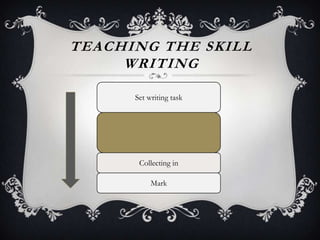
TEACHING THE SKILL
     WRITING

      Set writing task


       Collecting in

           Mark
YOU CAN DO AS TEACHER :
 Choose a topic

 choose a genre

 get ideas

 discuss ideas with others to get new perspectives

 find grammar and lexis suitable for the text

 study sample and model texts similar to what they want to write

 co-write sections of text in groups

 write a final version, find appropriate readers.
STAGES OF TEACHING
  WRITING (SEOW)

Planing.
             Responding
Drafting.
             Evaluating.
Revisng.
             Post-writing
Editing.
OLD SCHOOL WRITING
        VS
 CREATIVE WRITING
Write real letters / emails             Think of real people to whom
                                        students can write, eg Members of
                                        Parliament, manufacturing companies,
                                        fan clubs, local newspapers, other
                                        schools, etc. Send them. Get replies.
                                        Write back.
    Write your own newsletter,                Class magazine, school magazine,
magazine, blog, etc                     fan newsletter, local news, campaigning
                                        on environmental or political issues, etc.
     Advertise (ideas, school events,         Advertise around the school,
products, etc)                          around town; send in your ads to local
                                        papers.
      Send comments, replies to               There are now a wide number of
discussions, reviews, etc to websites   discussions, message boards and
                                        newsgroups specifically for students or
                                        for special-interest groups. Many shop
                                        and consumer sites invite reader reviews
                                        of books, products, events, etc.
Write questionnaires and then       These can be written in English
use them out In the street         or in the learners' own language.
                                   Write up the results. Publish them!
     Long-term projects                      These are a good way of
                                        integrating writing with other work.
                                        The aim could be a file or book at
                                        the end .
      Apply for things, fill in forms        This can be done directly
register for things, etc               online if students have Internet
                                        access or printed out on paper.
STEPS IN PLANING A WRITING COURSE
AND TRAINING TEACHERS OF WRITING


                STEP 1. ASCERTAINING
             G OA L S A N D I N S T I T U T I O N A L

                   CONSTRAINS:
            • MINISTRIES OF
              EDUCATION
            • EXAMININ AND
              AC C R E D I TATI O N
              AG E N C I E S.
Writing in 1L                    Writing in 2L

       Confortable                   I’m not the real me.
           Free.                  I’m choking in a word that
       Self-assured.                   won’t come out.
          Open.
           Loud
          Psotive

Institutional Constraints -----   Form committes, find ways.
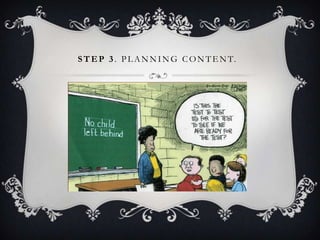
S T E P 3 . P L A N N I N G C O N T E N T.
STEP 3

 Is there a correct content of writing classes?


Social issues              Personal Experiences
Cultural Issues            Literature
Etc.
BRAINSTORMING
Rhetorical Model
Students need topics that allowed them to
generate ideas, find the forms to fit ideas
          and invite risk taking.
STEP 5. DRAWING UP A SYLABUS


TYPES OF THE SYLLABUS ORGANIZATION FOR WRITING
                             COURSES.

STRUCTURAL.- Organizated around grammar and sentece
patterns. (sentences, descriptions, analyses… etc)

FUNCTIONAL.- Organizated around Rhetorical activities:
describing, defining, explaining, arguing, persuading, comparing and
contrasting, classifying.
TOPICAL.- Organized around themes: housing, health, house, education
or abstractions like succes or courage.

SITUATIONAL.- Organized around situational transactions: Applying
for a jobs, writing letter to the newspaper, writing bussines memo etc.

SKILLS AND PROCESS.- Organized around skills ad process as
generating ideas, organizing ideas, revising, writing fluency, writing
efective.
S T E P 7 . - P R E PA R AT I N G AC T I V I T I E S
                   A N D RO L E S


 The teacher have to be student to.

 Think about what students will be doing and lerning in the
classroom rather than the comprehensiveness of the information we
will imparting.

 “Banking”: depositing knowledge in the learner’s head.
S T E P 9 . - E VA L UAT I N G T H E C O U R S E


 Use of questionenaires, reflective logs.


 PORTFOLIOS
 Include some specified types of writing: in-class writing and
revised work.
 Another teacher could be the evlatuator, and the teacher becomes
in a coach.
1.- Introduce the          Get students interested, maybe by reading a
topic                       text (article, letter; advert, etc) showing figures,
                            discussing some key issues, etc.

      2.- Introduce and        Make sure students are clear what they have to
summarise the main do. They need to know the genre (magazine article?
writing task            letter? formal report? etc), who they are writing for
                        and why. Avoid bland, 'genre-free text for no
                        particular audience' writing tasks.


        3.- Brainstorm            Whole class: use the board to collect as many
ideas                       ideas as possible. Small groups: speak and take notes.
        4.- Fast-write            A very good way to overcome 'blank page'
                            terror and get ideas flowing is to 'fast-write' (see
                            Section 7).
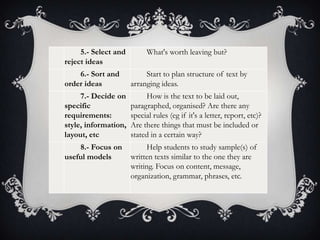
5 5.- Select and           What's worth leaving but?
reject ideas
6 6.- Sort and             Start to plan structure of text by
order ideas           arranging ideas.
 7 7.- Decide on           How is the text to be laid out,
specific              paragraphed, organised? Are there any
requirements:         special rules (eg if it's a letter, report, etc)?
style, information,   Are there things that must be included or
layout, etc           stated in a certain way?
8 8.- Focus on             Help students to study sample(s) of
useful models         written texts similar to the one they are
                      writing. Focus on content, message,
                      organization, grammar, phrases, etc.
9      9.- Plan the text      Use notes, sketches or cut-up cards to start
                        organising a possible shape for the text.
      10.- Get feedback       At various points, you, other students or
                        groups can read and make helpful comments /
                        suggestions about a text. This help may be on the
                        content and message, the organisation, the language,
                        etc.
      11.- Prepre             Students often benefit from preparing a draft
draft(s)                version before the final one. This gives them the
                        chance to get reader reactions and corrections. .
       12.-Edit                    Students carefully go through their own text,
                            checking if it says what they want it to, if it reads
                            clearly and smoothly, if its language is correct, eta.
       13.- Prepare final          Based on feedback, students write a finished
text                        text
       14.- Readers!              Rather than simply 'mark' a text, get other
                            students to respond to it in some^ more realistic
                            ways.
CLASSROOM ACTIVITIES AND
  STRATEGIES TO DEVELOP THE
        WRITING SKILL

 Text-starts

A lot of real-life writing involves looking at other texts and
summarising, reporting, responding to them, selecting ideas from
them, commenting on them, etc. Supplying 'text-starts' can be a good
way to provide useful writing work for students and practise reading /
writing skills that are useful in professional life and academic research.
FAST-WRITING

 start writing about the topic;
 not stop writing;
 not put their pen down at all;
 not worry about spelling, grammar, etc;
 write 'um, um, um' or 'rubbish' or something else if they can't think of
what to write;
 not stop to go back and read what they have written;
 keep writing till you say 'stop' (which will be after five / eight / ten minutes
or however long you think is appropriate for your group).
USING A DIALOGUE
             JOURNAL

  Be creative and adapt the activity to the situation
               and the learner's needs.
 Keeping a dialogue journal can be a practical way to help learners
                  develop reading and writing fluency:
 improve spelling and handwriting
 understand that writing is a means of communicating, and
 make reading and writing part of everyday life.
STEPS

1. Write a personal message in the journal that is designed to get a
response from the learner.


Examples: Start with a question such as

 "Have you planted your garden? What do you usually plant?"

 "What is the next event to celebrate? How will you celebrate it?"
2. Have the learner write a response and return the journal to the
    teacher to continue the dialogue.
 Have the class discuss and agree upon a question for the next entry in
   the journals.
 Have learners exchange journals and read each other's thoughts and
ideas.
3. Continue to exchange the journal in this way to keep the dialogue
going
CONFERENCE WRITING

Conference writing is an activity where writers
discuss and share their writing with an individual or
group.
WRITING FLUENCY ACTIVITY
  Fluency in writing, as in reading, should be one of the
                aims even of beginning lessons.
      This writing fluency activity helps learners learn to:
 transfer a flow of speech to written words on paper
 visualize spoken words, phrases, and sentences as they hear them
 write entire chunks of speech rather than syllable by syllable
 write fluidly rather than haltingly
WRITING FLUENCY ACTIVITY

 Begin working word by word. Progress as soon as possible to
phrases and then to entire sentences, according to the learners' ability.
 Encourage the learners to write the entire chunk (word, phrase, or
sentence) without stopping to correct mistakes.
 Encourage them to write quickly but legibly.
 Work on problem words only after a sentence has been written.
Do not stop during writing to sound out letters or make corrections.
FREE RESOURCES THAT WILL
I M P R OV E YO U R W R I T I N G S K I L L S


          1. Grammar, Punctuation & Co.

         Ultimate Style: The Rules Of Writing
 HyperGrammar
 Grammar Girl
 Grammar Girl provides short,
friendly tips to improve your writing.
Covering the grammar rules and word
choice guidelines that can confound even
the best writers. Grammar Girl makes
complex grammar questions simple with
memory tricks to help you recall and
apply those troublesome grammar rules.
2 . C O M M O N M I S TA K E S A N D
             P RO B L E M S
 Common Errors in English
A collection of common errors in English, with detailed explanations
and descriptions of each error.
 AskOxford: Better Writing
A very useful reference for classic errors and helpful hints with a
terrible site navigation.
 Dr. Grammar’s Frequently Asked Questions
Answers to common grammar questions related to English grammar,
with examples and additional explanations.
3. GENERAL WRITING
               SKILLS
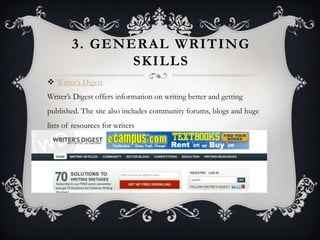
 Writer’s Digest
Writer’s Digest offers information on writing better and getting
published. The site also includes community forums, blogs and huge
lists of resources for writers
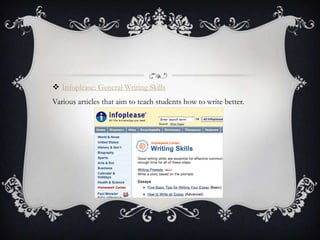
 Infoplease: General Writing Skills
Various articles that aim to teach students how to write better.
 The Elements of Style

A freely available online
version of the book “The
Elements of Style” by
William Strunk, Jr., the
classic reference book.
 Poynter Writing Tools

A blog dedicated to writers and
journalists. Poynter also
provides Fifty Writing Tools:
Quick List, a collection of
podcasts related to writing.
4. PRACTICAL GUIDES TO
 BETTER WRITING SKILLS
 Copywriting 101: An Introduction to Copywriting
This tutorial is designed to get you up and running with the basics of
writing great copy in ten easy lessons..
 A Guide to Writing Well
“This guide was mainly distilled from On
Writing Well by William Zinsser and The
Elements of Style by Strunk and White.
Other sources are listed in the bibliography.
My memory being stubborn and lazy, I
compiled this so I could easily refresh myself
on writing well. I hope it will also be helpful
to others.”
 Better to write for yourself and have no public, than to write
for the public and have no self. Cyril Connolly, The New Statesman

 The original writer is not one who imitates nobody, but one
whom nobody can imitate. ~François-René de Chateaubriand


                  THANKS

Teaching writing

  • 1.
    TEACHING WRITING Isis Estévez Alvarado Elías Morales Rocha
  • 2.
    W R IT I N G O R N O T W R I T I N G. (IT’S NOT A QUESTION)
  • 3.
    WRITING IN THECLASSROOM Needs that require to work on writing skills:  Academic study  Examination, Preparation and Bussines English  Writing involves different kind of mental process.
  • 4.
    TEACHING THE SKILL WRITING Set writing task Collecting in Mark
  • 5.
    YOU CAN DOAS TEACHER :  Choose a topic  choose a genre  get ideas  discuss ideas with others to get new perspectives  find grammar and lexis suitable for the text  study sample and model texts similar to what they want to write  co-write sections of text in groups  write a final version, find appropriate readers.
  • 6.
    STAGES OF TEACHING WRITING (SEOW) Planing. Responding Drafting. Evaluating. Revisng. Post-writing Editing.
  • 7.
    OLD SCHOOL WRITING VS CREATIVE WRITING
  • 8.
    Write real letters/ emails Think of real people to whom students can write, eg Members of Parliament, manufacturing companies, fan clubs, local newspapers, other schools, etc. Send them. Get replies. Write back. Write your own newsletter, Class magazine, school magazine, magazine, blog, etc fan newsletter, local news, campaigning on environmental or political issues, etc. Advertise (ideas, school events, Advertise around the school, products, etc) around town; send in your ads to local papers. Send comments, replies to There are now a wide number of discussions, reviews, etc to websites discussions, message boards and newsgroups specifically for students or for special-interest groups. Many shop and consumer sites invite reader reviews of books, products, events, etc.
  • 9.
    Write questionnaires andthen These can be written in English use them out In the street or in the learners' own language. Write up the results. Publish them! Long-term projects These are a good way of integrating writing with other work. The aim could be a file or book at the end . Apply for things, fill in forms This can be done directly register for things, etc online if students have Internet access or printed out on paper.
  • 10.
    STEPS IN PLANINGA WRITING COURSE AND TRAINING TEACHERS OF WRITING STEP 1. ASCERTAINING G OA L S A N D I N S T I T U T I O N A L CONSTRAINS: • MINISTRIES OF EDUCATION • EXAMININ AND AC C R E D I TATI O N AG E N C I E S.
  • 11.
    Writing in 1L Writing in 2L Confortable I’m not the real me. Free. I’m choking in a word that Self-assured. won’t come out. Open. Loud Psotive Institutional Constraints ----- Form committes, find ways.
  • 12.
    S T EP 3 . P L A N N I N G C O N T E N T.
  • 13.
    STEP 3 Isthere a correct content of writing classes? Social issues Personal Experiences Cultural Issues Literature Etc.
  • 14.
  • 15.
    Rhetorical Model Students needtopics that allowed them to generate ideas, find the forms to fit ideas and invite risk taking.
  • 16.
    STEP 5. DRAWINGUP A SYLABUS TYPES OF THE SYLLABUS ORGANIZATION FOR WRITING COURSES. STRUCTURAL.- Organizated around grammar and sentece patterns. (sentences, descriptions, analyses… etc) FUNCTIONAL.- Organizated around Rhetorical activities: describing, defining, explaining, arguing, persuading, comparing and contrasting, classifying.
  • 17.
    TOPICAL.- Organized aroundthemes: housing, health, house, education or abstractions like succes or courage. SITUATIONAL.- Organized around situational transactions: Applying for a jobs, writing letter to the newspaper, writing bussines memo etc. SKILLS AND PROCESS.- Organized around skills ad process as generating ideas, organizing ideas, revising, writing fluency, writing efective.
  • 18.
    S T EP 7 . - P R E PA R AT I N G AC T I V I T I E S A N D RO L E S  The teacher have to be student to.  Think about what students will be doing and lerning in the classroom rather than the comprehensiveness of the information we will imparting.  “Banking”: depositing knowledge in the learner’s head.
  • 19.
    S T EP 9 . - E VA L UAT I N G T H E C O U R S E  Use of questionenaires, reflective logs.  PORTFOLIOS  Include some specified types of writing: in-class writing and revised work.  Another teacher could be the evlatuator, and the teacher becomes in a coach.
  • 20.
    1.- Introduce the Get students interested, maybe by reading a topic text (article, letter; advert, etc) showing figures, discussing some key issues, etc. 2.- Introduce and Make sure students are clear what they have to summarise the main do. They need to know the genre (magazine article? writing task letter? formal report? etc), who they are writing for and why. Avoid bland, 'genre-free text for no particular audience' writing tasks. 3.- Brainstorm Whole class: use the board to collect as many ideas ideas as possible. Small groups: speak and take notes. 4.- Fast-write A very good way to overcome 'blank page' terror and get ideas flowing is to 'fast-write' (see Section 7).
  • 21.
    5 5.- Selectand What's worth leaving but? reject ideas 6 6.- Sort and Start to plan structure of text by order ideas arranging ideas. 7 7.- Decide on How is the text to be laid out, specific paragraphed, organised? Are there any requirements: special rules (eg if it's a letter, report, etc)? style, information, Are there things that must be included or layout, etc stated in a certain way? 8 8.- Focus on Help students to study sample(s) of useful models written texts similar to the one they are writing. Focus on content, message, organization, grammar, phrases, etc.
  • 22.
    9 9.- Plan the text Use notes, sketches or cut-up cards to start organising a possible shape for the text. 10.- Get feedback At various points, you, other students or groups can read and make helpful comments / suggestions about a text. This help may be on the content and message, the organisation, the language, etc. 11.- Prepre Students often benefit from preparing a draft draft(s) version before the final one. This gives them the chance to get reader reactions and corrections. . 12.-Edit Students carefully go through their own text, checking if it says what they want it to, if it reads clearly and smoothly, if its language is correct, eta. 13.- Prepare final Based on feedback, students write a finished text text 14.- Readers! Rather than simply 'mark' a text, get other students to respond to it in some^ more realistic ways.
  • 23.
    CLASSROOM ACTIVITIES AND STRATEGIES TO DEVELOP THE WRITING SKILL  Text-starts A lot of real-life writing involves looking at other texts and summarising, reporting, responding to them, selecting ideas from them, commenting on them, etc. Supplying 'text-starts' can be a good way to provide useful writing work for students and practise reading / writing skills that are useful in professional life and academic research.
  • 24.
    FAST-WRITING  start writingabout the topic;  not stop writing;  not put their pen down at all;  not worry about spelling, grammar, etc;  write 'um, um, um' or 'rubbish' or something else if they can't think of what to write;  not stop to go back and read what they have written;  keep writing till you say 'stop' (which will be after five / eight / ten minutes or however long you think is appropriate for your group).
  • 25.
    USING A DIALOGUE JOURNAL Be creative and adapt the activity to the situation and the learner's needs. Keeping a dialogue journal can be a practical way to help learners develop reading and writing fluency:  improve spelling and handwriting  understand that writing is a means of communicating, and  make reading and writing part of everyday life.
  • 26.
    STEPS 1. Write apersonal message in the journal that is designed to get a response from the learner. Examples: Start with a question such as  "Have you planted your garden? What do you usually plant?"  "What is the next event to celebrate? How will you celebrate it?"
  • 27.
    2. Have thelearner write a response and return the journal to the teacher to continue the dialogue.  Have the class discuss and agree upon a question for the next entry in the journals.  Have learners exchange journals and read each other's thoughts and ideas. 3. Continue to exchange the journal in this way to keep the dialogue going
  • 28.
    CONFERENCE WRITING Conference writingis an activity where writers discuss and share their writing with an individual or group.
  • 29.
    WRITING FLUENCY ACTIVITY Fluency in writing, as in reading, should be one of the aims even of beginning lessons. This writing fluency activity helps learners learn to:  transfer a flow of speech to written words on paper  visualize spoken words, phrases, and sentences as they hear them  write entire chunks of speech rather than syllable by syllable  write fluidly rather than haltingly
  • 30.
    WRITING FLUENCY ACTIVITY Begin working word by word. Progress as soon as possible to phrases and then to entire sentences, according to the learners' ability.  Encourage the learners to write the entire chunk (word, phrase, or sentence) without stopping to correct mistakes.  Encourage them to write quickly but legibly.  Work on problem words only after a sentence has been written. Do not stop during writing to sound out letters or make corrections.
  • 31.
    FREE RESOURCES THATWILL I M P R OV E YO U R W R I T I N G S K I L L S  1. Grammar, Punctuation & Co. Ultimate Style: The Rules Of Writing
  • 32.
  • 33.
     Grammar Girl Grammar Girl provides short, friendly tips to improve your writing. Covering the grammar rules and word choice guidelines that can confound even the best writers. Grammar Girl makes complex grammar questions simple with memory tricks to help you recall and apply those troublesome grammar rules.
  • 34.
    2 . CO M M O N M I S TA K E S A N D P RO B L E M S  Common Errors in English A collection of common errors in English, with detailed explanations and descriptions of each error.
  • 35.
     AskOxford: BetterWriting A very useful reference for classic errors and helpful hints with a terrible site navigation.
  • 36.
     Dr. Grammar’sFrequently Asked Questions Answers to common grammar questions related to English grammar, with examples and additional explanations.
  • 37.
    3. GENERAL WRITING SKILLS  Writer’s Digest Writer’s Digest offers information on writing better and getting published. The site also includes community forums, blogs and huge lists of resources for writers
  • 38.
     Infoplease: GeneralWriting Skills Various articles that aim to teach students how to write better.
  • 39.
     The Elementsof Style A freely available online version of the book “The Elements of Style” by William Strunk, Jr., the classic reference book.
  • 40.
     Poynter WritingTools A blog dedicated to writers and journalists. Poynter also provides Fifty Writing Tools: Quick List, a collection of podcasts related to writing.
  • 41.
    4. PRACTICAL GUIDESTO BETTER WRITING SKILLS  Copywriting 101: An Introduction to Copywriting This tutorial is designed to get you up and running with the basics of writing great copy in ten easy lessons..
  • 42.
     A Guideto Writing Well “This guide was mainly distilled from On Writing Well by William Zinsser and The Elements of Style by Strunk and White. Other sources are listed in the bibliography. My memory being stubborn and lazy, I compiled this so I could easily refresh myself on writing well. I hope it will also be helpful to others.”
  • 43.
     Better towrite for yourself and have no public, than to write for the public and have no self. Cyril Connolly, The New Statesman  The original writer is not one who imitates nobody, but one whom nobody can imitate. ~François-René de Chateaubriand THANKS