Gayla S. Keesee Education Specialist Paine College, Augusta, GA Mack Gipson, Jr. Tutorial & Enrichment Center rev. 10/2006 Active Reading
Active Reading Strategies Strategies you use for reading academic material are different from the ones used for more general reading tasks.
Active Reading Strategies The use of a study system can   make your reading more efficient.  increase comprehension by working with material more than once  and  with multi-sensory methods.  provide immediate steps for self-testing and review  incorporate active learning strategies.
Active Reading Strategies When you decide to incorporate a study/reading method, you might  begin with one course , or  one set of course materials , or begin initially with  adding the survey and question steps  to any of your assigned reading.
Active Reading Strategies When changing or modifying habits, it is sometimes easier to do so on a gradual basis.  The idea is to  adopt ,  revise , and  continue  to use active study strategies.
SQ3R SQ3R , an acronym for  S urvey,  Q uestion,  R ead,  R ecite,  R eview, is an example of a method that can be used with and adapted to various class materials.
SQ3R
S—Survey S-Survey:  After you have surveyed the material, you should know generally what it is about and how it is organized.
Survey Process The title and subtitle   topic and approach Chapter introduction or lead-in only if brief The first paragraph   overview, organization Boldfaced Headings   form mini outline The first sentence under each heading usually explains the heading—main idea
Survey Process Typographical Aids   italics ,  boldface , marginal notes,  colored ink ,  underlining , and lists Graphs, Charts and Pictures   point out important information—glance to see what is emphasized The final paragraph or Summary provides a condensed view of the chapter—key points End-of-Chapter material study/discussion questions, vocabulary lists, outlines—help decide what is important
After you Survey: Reflect on what you already know about the subject—background knowledge. Brainstorm!  Make a list of everything that comes to mind.
Q—Question Q-Question:   Try to form questions that you can answer as you read.   Initially, the easiest way to do this is to turn each boldfaced heading into a question.  As you become more familiar with the information, you can create more specific questions.
What is the Source  of the Material? Knowledge of the source will help you judge the accuracy and soundness of what you read. This is the first question to ask before you read.
Question Process Preview before you try to ask questions. Turn each major heading into a series of questions. As you read the section, look for the answer to your questions. Avoid asking questions that have one-word answers.
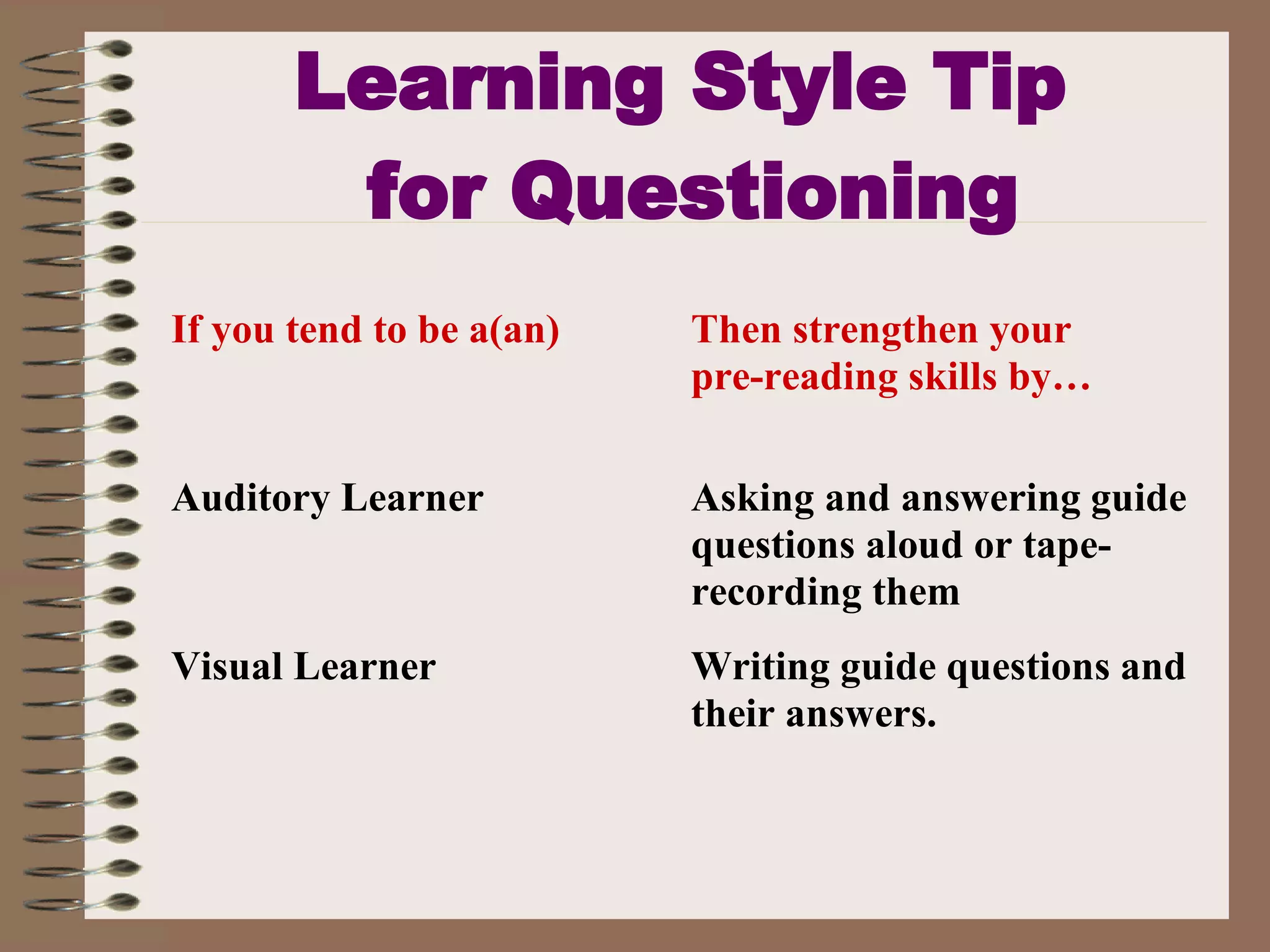
Learning Style Tip  for Questioning
R—Read R-Read:   Read the materials, section by section. As you read, look for the answer to the question you formed from the heading of that section.
R—Recite R-Recite:   After you finish each section, stop.  Can you  answer your question  for the section?  If not, look back and  find the answer . Check your recall again.  Summarize  the information in your own words.  Write answers  to your guide questions in the textbook  margin .
R—Review R-Review:   When you have finished the whole reading assignment, go back to each heading. Recall  your question and try to  answer  it.  If you can’t recall the answer, be sure to look back and  find the answer .  Then  test yourself  again.
Revising the SQ3R System Add an “Evaluate” Step Why  is the information  important ? How can I  use  it? How does it  fit  with the  class lectures ? How is the  chapter related  to previous ones? Is there enough  evidence  to support the ideas? Is the  author biased ?  Tone ?  Purpose ? Modify based on your Learning Style(s)
Adapting for Different Academic Disciplines Mathematics  - sample problems Literature  - interpreting, reacting, analyzing Sciences  – pre-reading for facts, principles, formulas and processes Social Sciences  - specialized vocabulary Ask:   What type of learning is required? Ask:   What must I do to learn this type of material?
SUMMARY What is the SQ3R system? Why is it effective? How can you adapt your reading-study system for different academic disciplines? What can you do to be sure that you understand your reading assignments?

Active Reading--SQ3R

  • 1.
    Gayla S. KeeseeEducation Specialist Paine College, Augusta, GA Mack Gipson, Jr. Tutorial & Enrichment Center rev. 10/2006 Active Reading
  • 2.
    Active Reading StrategiesStrategies you use for reading academic material are different from the ones used for more general reading tasks.
  • 3.
    Active Reading StrategiesThe use of a study system can make your reading more efficient. increase comprehension by working with material more than once and with multi-sensory methods. provide immediate steps for self-testing and review incorporate active learning strategies.
  • 4.
    Active Reading StrategiesWhen you decide to incorporate a study/reading method, you might begin with one course , or one set of course materials , or begin initially with adding the survey and question steps to any of your assigned reading.
  • 5.
    Active Reading StrategiesWhen changing or modifying habits, it is sometimes easier to do so on a gradual basis. The idea is to adopt , revise , and continue to use active study strategies.
  • 6.
    SQ3R SQ3R ,an acronym for S urvey, Q uestion, R ead, R ecite, R eview, is an example of a method that can be used with and adapted to various class materials.
  • 7.
  • 8.
    S—Survey S-Survey: After you have surveyed the material, you should know generally what it is about and how it is organized.
  • 9.
    Survey Process Thetitle and subtitle topic and approach Chapter introduction or lead-in only if brief The first paragraph overview, organization Boldfaced Headings form mini outline The first sentence under each heading usually explains the heading—main idea
  • 10.
    Survey Process TypographicalAids italics , boldface , marginal notes, colored ink , underlining , and lists Graphs, Charts and Pictures point out important information—glance to see what is emphasized The final paragraph or Summary provides a condensed view of the chapter—key points End-of-Chapter material study/discussion questions, vocabulary lists, outlines—help decide what is important
  • 11.
    After you Survey:Reflect on what you already know about the subject—background knowledge. Brainstorm! Make a list of everything that comes to mind.
  • 12.
    Q—Question Q-Question: Try to form questions that you can answer as you read. Initially, the easiest way to do this is to turn each boldfaced heading into a question. As you become more familiar with the information, you can create more specific questions.
  • 13.
    What is theSource of the Material? Knowledge of the source will help you judge the accuracy and soundness of what you read. This is the first question to ask before you read.
  • 14.
    Question Process Previewbefore you try to ask questions. Turn each major heading into a series of questions. As you read the section, look for the answer to your questions. Avoid asking questions that have one-word answers.
  • 15.
    Learning Style Tip for Questioning
  • 16.
    R—Read R-Read: Read the materials, section by section. As you read, look for the answer to the question you formed from the heading of that section.
  • 17.
    R—Recite R-Recite: After you finish each section, stop. Can you answer your question for the section? If not, look back and find the answer . Check your recall again. Summarize the information in your own words. Write answers to your guide questions in the textbook margin .
  • 18.
    R—Review R-Review: When you have finished the whole reading assignment, go back to each heading. Recall your question and try to answer it. If you can’t recall the answer, be sure to look back and find the answer . Then test yourself again.
  • 19.
    Revising the SQ3RSystem Add an “Evaluate” Step Why is the information important ? How can I use it? How does it fit with the class lectures ? How is the chapter related to previous ones? Is there enough evidence to support the ideas? Is the author biased ? Tone ? Purpose ? Modify based on your Learning Style(s)
  • 20.
    Adapting for DifferentAcademic Disciplines Mathematics - sample problems Literature - interpreting, reacting, analyzing Sciences – pre-reading for facts, principles, formulas and processes Social Sciences - specialized vocabulary Ask: What type of learning is required? Ask: What must I do to learn this type of material?
  • 21.
    SUMMARY What isthe SQ3R system? Why is it effective? How can you adapt your reading-study system for different academic disciplines? What can you do to be sure that you understand your reading assignments?