Strategies for Textbook ReadingStrategies for Textbook Reading
Chapter 1Chapter 1
SQ3R
SQ3RSQ3R
A Reading -Study StrategyA Reading -Study Strategy
Survey
Question
Read
Recite
Review
Step One -- SurveyStep One -- Survey
To survey the chapter means to preview the
chapter before you read it.
The Three Goals of Surveying – to get
A general overview
A feeling for the writer’s style and organization
A sense of what’s important
An idea of the chapter’s natural breaks or
divisions
How toHow to SurveySurvey (7 steps)(7 steps)
1. Read the title
2. Read any introductory material. Pay attention
to chapter outlines, lists of questions, goals,
and objectives.
3. Formulate a general question about the
chapter’s overall point or points.
4. Read each heading and the first sentence
following each heading.
Survey -- 7 Steps (continued)Survey -- 7 Steps (continued)
5.Look at all visual aids. Read all captions and
explanations accompanying the graphics.
6.Read all bold-printed or italicized words and
words in the margins.
7.Read end-of-the-chapter summaries and
questions, or read the last page if there is no
summary.
Why Survey?Why Survey?
Get the big picture
Decide what’s important
Know the main points
Connect what you already know to what
you don’t know
Prepare to read
Step Two -- QuestionStep Two -- Question
Turn chapter headings/subheadings into
questions to guide your reading
◦ Ask what?
◦ Ask who?
◦ Ask why?
◦ Ask how?
Where? and when? questions give you a
very limited answer.
Example Heading:Example Heading:
Language Symbolizes RealityLanguage Symbolizes Reality
Ask:
What does it mean to say language
symbolizes reality?
How does the nature of language affect
our verbal messages?
Why does language symbolize reality?
Why QuestionWhy Question
Stay focused
Gives purpose
Creates interest
Step Three -- ReadStep Three -- Read
 Never study read without a highlighter and pencil in
your hand.
 Read to answer your guide questions for each section
and subsection. Rereading is common. Read every
word.
 Underline and/or highlight. Be selective.
 Underline/highlight only the words and phrases you
need. When you go back and reread your underlining
or highlighting, the text should have meaning.
Read (continued)Read (continued)
Make notes in the margins.
Mark important text items such as dates,
names, concepts, and key points. Use circles,
stars, arrows, numbers.
Your goal is to read the chapter thoroughly
only once.
Why ReadWhy Read
To gain information
To prepare for lecture
To prepare for discussion
To prepare for tests
Vary Your Reading RateVary Your Reading Rate
 Adjust the speed with which you read!
◦ Don’t be afraid to SLOW DOWN if the text
becomes difficult
Reading Rates include:
• Scanning
• Skimming
• Study Reading
• Close or Analytical Reading
Step Four -- ReciteStep Four -- Recite
Put it in your own words
Write a summary or create an outline
Write notes (in book or on paper)
Create 3x5 (or 4x6) cards
To recite means to say something out loud.
After each section, stop and test your
comprehension
Recite the answers to your guide questions
Write out your own answers
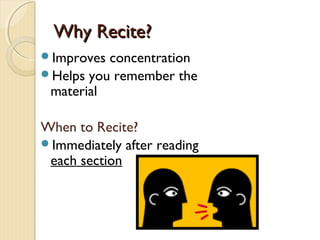
Why Recite?Why Recite?
Improves concentration
Helps you remember the
material
When to Recite?
Immediately after reading
each section
Review – after readingReview – after reading
Look at the headings and see what you
can remember about each one
Skim over your underlined/highligthed
words
Add margin notes and markings
Before tests
◦ MAKE AN INFORMAL OUTLINE!
(See page 19 in RFR for an example)
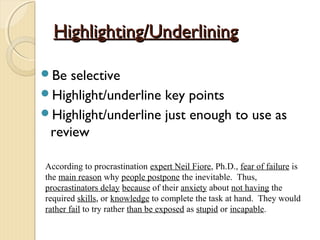
Highlighting/UnderliningHighlighting/Underlining
Be selective
Highlight/underline key points
Highlight/underline just enough to use as
review
According to procrastination expert Neil Fiore, Ph.D., fear of failure is
the main reason why people postpone the inevitable. Thus,
procrastinators delay because of their anxiety about not having the
required skills, or knowledge to complete the task at hand. They would
rather fail to try rather than be exposed as stupid or incapable.
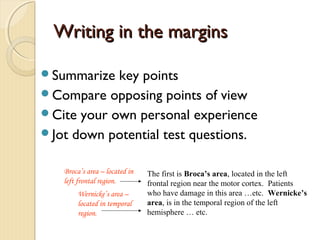
Writing in the marginsWriting in the margins
Summarize key points
Compare opposing points of view
Cite your own personal experience
Jot down potential test questions.
The first is Broca’s area, located in the left
frontal region near the motor cortex. Patients
who have damage in this area …etc. Wernicke’s
area, is in the temporal region of the left
hemisphere … etc.
Broca’s area – located in
left frontal region.
Wernicke’s area –
located in temporal
region.
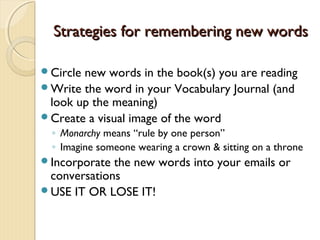
Strategies for remembering new wordsStrategies for remembering new words
Circle new words in the book(s) you are reading
Write the word in your Vocabulary Journal (and
look up the meaning)
Create a visual image of the word
◦ Monarchy means “rule by one person”
◦ Imagine someone wearing a crown & sitting on a throne
Incorporate the new words into your emails or
conversations
USE IT OR LOSE IT!

Sq3 r

  • 1.
    Strategies for TextbookReadingStrategies for Textbook Reading Chapter 1Chapter 1 SQ3R
  • 2.
    SQ3RSQ3R A Reading -StudyStrategyA Reading -Study Strategy Survey Question Read Recite Review
  • 3.
    Step One --SurveyStep One -- Survey To survey the chapter means to preview the chapter before you read it. The Three Goals of Surveying – to get A general overview A feeling for the writer’s style and organization A sense of what’s important An idea of the chapter’s natural breaks or divisions
  • 4.
    How toHow toSurveySurvey (7 steps)(7 steps) 1. Read the title 2. Read any introductory material. Pay attention to chapter outlines, lists of questions, goals, and objectives. 3. Formulate a general question about the chapter’s overall point or points. 4. Read each heading and the first sentence following each heading.
  • 5.
    Survey -- 7Steps (continued)Survey -- 7 Steps (continued) 5.Look at all visual aids. Read all captions and explanations accompanying the graphics. 6.Read all bold-printed or italicized words and words in the margins. 7.Read end-of-the-chapter summaries and questions, or read the last page if there is no summary.
  • 6.
    Why Survey?Why Survey? Getthe big picture Decide what’s important Know the main points Connect what you already know to what you don’t know Prepare to read
  • 7.
    Step Two --QuestionStep Two -- Question Turn chapter headings/subheadings into questions to guide your reading ◦ Ask what? ◦ Ask who? ◦ Ask why? ◦ Ask how? Where? and when? questions give you a very limited answer.
  • 8.
    Example Heading:Example Heading: LanguageSymbolizes RealityLanguage Symbolizes Reality Ask: What does it mean to say language symbolizes reality? How does the nature of language affect our verbal messages? Why does language symbolize reality?
  • 9.
    Why QuestionWhy Question Stayfocused Gives purpose Creates interest
  • 10.
    Step Three --ReadStep Three -- Read  Never study read without a highlighter and pencil in your hand.  Read to answer your guide questions for each section and subsection. Rereading is common. Read every word.  Underline and/or highlight. Be selective.  Underline/highlight only the words and phrases you need. When you go back and reread your underlining or highlighting, the text should have meaning.
  • 11.
    Read (continued)Read (continued) Makenotes in the margins. Mark important text items such as dates, names, concepts, and key points. Use circles, stars, arrows, numbers. Your goal is to read the chapter thoroughly only once.
  • 12.
    Why ReadWhy Read Togain information To prepare for lecture To prepare for discussion To prepare for tests
  • 13.
    Vary Your ReadingRateVary Your Reading Rate  Adjust the speed with which you read! ◦ Don’t be afraid to SLOW DOWN if the text becomes difficult Reading Rates include: • Scanning • Skimming • Study Reading • Close or Analytical Reading
  • 14.
    Step Four --ReciteStep Four -- Recite Put it in your own words Write a summary or create an outline Write notes (in book or on paper) Create 3x5 (or 4x6) cards To recite means to say something out loud. After each section, stop and test your comprehension Recite the answers to your guide questions Write out your own answers
  • 15.
    Why Recite?Why Recite? Improvesconcentration Helps you remember the material When to Recite? Immediately after reading each section
  • 16.
    Review – afterreadingReview – after reading Look at the headings and see what you can remember about each one Skim over your underlined/highligthed words Add margin notes and markings Before tests ◦ MAKE AN INFORMAL OUTLINE! (See page 19 in RFR for an example)
  • 17.
    Highlighting/UnderliningHighlighting/Underlining Be selective Highlight/underline keypoints Highlight/underline just enough to use as review According to procrastination expert Neil Fiore, Ph.D., fear of failure is the main reason why people postpone the inevitable. Thus, procrastinators delay because of their anxiety about not having the required skills, or knowledge to complete the task at hand. They would rather fail to try rather than be exposed as stupid or incapable.
  • 18.
    Writing in themarginsWriting in the margins Summarize key points Compare opposing points of view Cite your own personal experience Jot down potential test questions. The first is Broca’s area, located in the left frontal region near the motor cortex. Patients who have damage in this area …etc. Wernicke’s area, is in the temporal region of the left hemisphere … etc. Broca’s area – located in left frontal region. Wernicke’s area – located in temporal region.
  • 19.
    Strategies for rememberingnew wordsStrategies for remembering new words Circle new words in the book(s) you are reading Write the word in your Vocabulary Journal (and look up the meaning) Create a visual image of the word ◦ Monarchy means “rule by one person” ◦ Imagine someone wearing a crown & sitting on a throne Incorporate the new words into your emails or conversations USE IT OR LOSE IT!