Expository Writing
RUSSELL RODRIGO
What is Expository Writing?
 Expository writing is defined as presenting
reasons, explanations, or steps in a process
 Informational writing
 An expository essay should follow a logical
sequence and have three different main
points
 Logic and coherence is the main focus of an
expository essay
How is it different ?
 Expository writing does not tell a story
 Expository writing does not persuade a
reader but only gives facts and reasons
 Expository writing can also give the steps
of a process
WHAT IS AN EXPOSITORY ESSAY?An EXPOSITORY essay is a multi-paragraph essay with
a specific structure.
It explains a position or opinion that you have
regarding a topic or text.
It provides adequate textual evidence to support that
opinion.
AN EXPOSITORY ESSAY IS NOT …AN EXPOSITORY ESSAY IS NOT …
It is not a summary of the book.
It is not a book review or a book report.
It is not ONLY your opinion. You must base your ideas on
events from the text.
An EXPOSITORY essay contains ____
paragraphs.
All paragraphs have a name:
1st Paragraph(s) : Introductory Paragraph(s)
Paragraph #2, 3, 4 etc.: Body Paragraphs
Final Paragraph(s): Concluding Paragraph(s)
FORMAT OF AN EXPOSITORY ESSAY
Topic Sentences, Thesis Statements,
and Subtopic are the Heart
Thesis: a statement
discussing the topic
of your paper.
Subtopics: the main
ideas that support
your thesis.
Topic Sentences: a
statement that
discusses the topic
of each paragraph.
Definition of Terms
 Thesis Statement: The main idea of the whole
essay
 Transition words: Words such as first, second, as a
result, which make transitions easy in the essay.
 Main Ideas: Each paragraph should have a
main point or idea
 Supporting Details: Details support the main
ideas
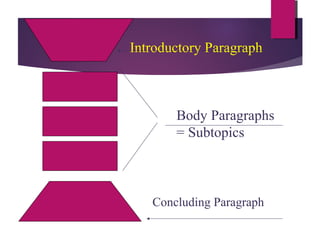
Introductory Paragraph
Body Paragraphs
= Subtopics
Concluding Paragraph
Expository Writing
 Introduction of an expository should include the
main idea and what the essay is about
 The three main reasons supporting this main idea
should also be included in the introduction
Thesis Statement
 The thesis statement can be first in the
paragraph, last in the paragraph or implied
throughout the paragraph
 OR more experienced writers use the inverted
pyramid style introduction.
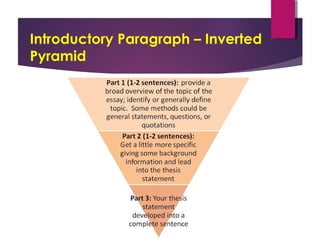
Introductory Paragraph – Inverted
Pyramid
Introduction
 Hook- Hook your reader with a
question, quote, short anecdote, or
personal experience statement
Body Paragraphs
Purpose of Body Paragraphs:Purpose of Body Paragraphs:
To support your topic statement using direct
quotations, specific textual detail, and strong
explanations.
Elements of a Body Paragraph:Elements of a Body Paragraph:
Topic Sentence
Textual Evidence
Explanation of Evidence
Concluding/ Transition Sentence
TOPIC SENTENCETOPIC SENTENCE
The first sentence in each body paragraph. It gives the reader
specific information about what will be explained in the body
paragraph. It is best to use words from the TOPIC STATEMENT in
this sentence.
TEXTUAL EVIDENCETEXTUAL EVIDENCE
Sentences in the body paragraph which use the AUTHOR’S
EXACT WORDS to help support your topic statement.
EXPLANATION OF EVIDENCEEXPLANATION OF EVIDENCE
Sentences in the body paragraph which explain to the reader
HOW YOUR TEXTUAL EVIDENCE SUPPORTS YOUR TOPIC
STATEMENT.
VOCABULARY OF BODY PARAGRAPHS
Expository writing contd.
 Paragraph two should introduce the first reason
and give details to support the first reason
 Paragraph three should introduce the second
reason and give details to support the second
reason
 Paragraph four should introduce the third
reason and give details to support the third
reason
 The conclusion should re-state all the reasons
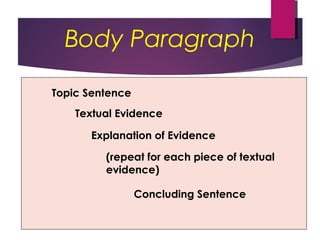
Body Paragraph
Topic Sentence
Explanation of Evidence
Textual Evidence
Concluding Sentence
(repeat for each piece of textual
evidence)
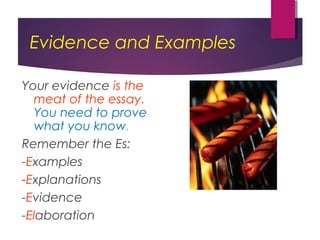
Evidence and Examples
Your evidence is the
meat of the essay.
You need to prove
what you know.
Remember the Es:
-Examples
-Explanations
-Evidence
-Elaboration
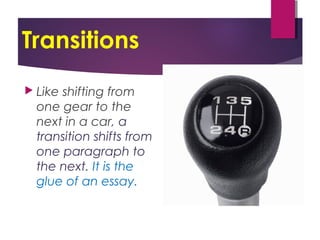
Transitions
 Like shifting from
one gear to the
next in a car, a
transition shifts from
one paragraph to
the next. It is the
glue of an essay.
Transition words
Add your transition words
First
Second
Third
Finally, or In Conclusion
Conclusion
 Conclusions restate
your thesis and
subtopics, and
remind your reader
what you wrote
about.
 Do not include any
new information in
your conclusion.
CONCLUDING PARAGRAPH
Purpose of Concluding Paragraph
•To summarize your main ideas for your reader, so they
leave your writing with clarity.
Elements of Concluding Paragraph
• Restate your topic statement
• Review body paragraphs
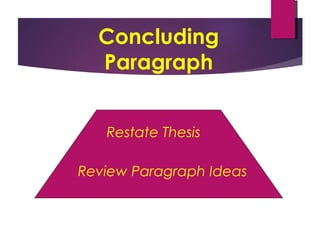
Concluding
Paragraph
Restate Thesis
Review Paragraph Ideas
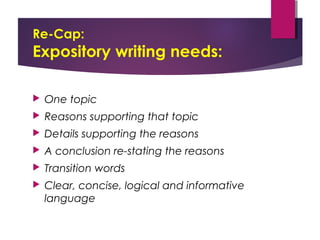
Re-Cap:
Expository writing needs:
 One topic
 Reasons supporting that topic
 Details supporting the reasons
 A conclusion re-stating the reasons
 Transition words
 Clear, concise, logical and informative
language
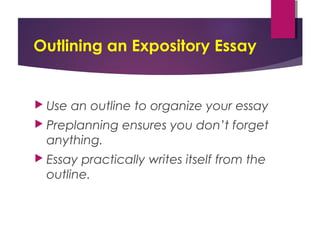
Outlining an Expository Essay
 Use an outline to organize your essay
 Preplanning ensures you don’t forget
anything.
 Essay practically writes itself from the
outline.
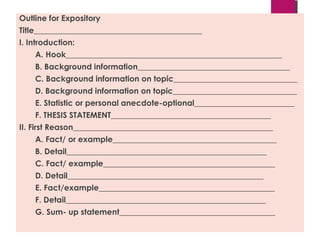
Outline for Expository
Title__________________________________________
I. Introduction:
A. Hook______________________________________________________
B. Background information______________________________________
C. Background information on topic_______________________________
D. Background information on topic_______________________________
E. Statistic or personal anecdote-optional_________________________
F. THESIS STATEMENT________________________________________
II. First Reason__________________________________________________
A. Fact/ or example_________________________________________
B. Detail__________________________________________________
C. Fact/ example___________________________________________
D. Detail_________________________________________________
E. Fact/example____________________________________________
F. Detail__________________________________________________
G. Sum- up statement_______________________________________
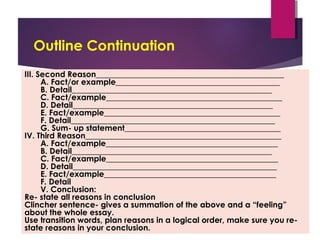
III. Second Reason_______________________________________________
A. Fact/or example_________________________________________
B. Detail__________________________________________________
C. Fact/example____________________________________________
D. Detail__________________________________________________
E. Fact/example____________________________________________
F. Detail___________________________________________________
G. Sum- up statement_______________________________________
IV. Third Reason_________________________________________________
A. Fact/example___________________________________________
B. Detail__________________________________________________
C. Fact/example___________________________________________
D. Detail___________________________________________________
E. Fact/example___________________________________________
F. Detail
V. Conclusion:
Re- state all reasons in conclusion
Clincher sentence- gives a summation of the above and a “feeling”
about the whole essay.
Use transition words, plan reasons in a logical order, make sure you re-
state reasons in your conclusion.
Outline Continuation
Editing your essay
 Check that you have all the elements
of an expository essay:
 Reasons
 Details
 Transition words
 Conclusion that re-states your topic
 Grammar
 Coherence, logic and clearly written
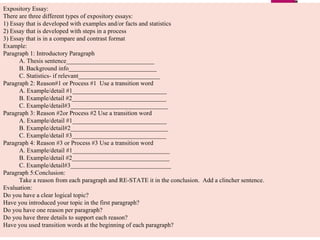
Expository Essay:
There are three different types of expository essays:
1) Essay that is developed with examples and/or facts and statistics
2) Essay that is developed with steps in a process
3) Essay that is in a compare and contrast format
Example:
Paragraph 1: Introductory Paragraph
A. Thesis sentence____________________________
B. Background info____________________________
C. Statistics- if relevant__________________________
Paragraph 2: Reason#1 or Process #1 Use a transition word
A. Example/detail #1______________________________
B. Example/detail #2______________________________
C. Example/detail#3_______________________________
Paragraph 3: Reason #2or Process #2 Use a transition word
A. Example/detail #1______________________________
B. Example/detail#2_______________________________
C. Example/detail #3______________________________
Paragraph 4: Reason #3 or Process #3 Use a transition word
A. Example/detail #1_______________________________
B. Example/detail #2_______________________________
C. Example/detail#3________________________________
Paragraph 5:Conclusion:
Take a reason from each paragraph and RE-STATE it in the conclusion. Add a clincher sentence.
Evaluation:
Do you have a clear logical topic?
Have you introduced your topic in the first paragraph?
Do you have one reason per paragraph?
Do you have three details to support each reason?
Have you used transition words at the beginning of each paragraph?

Expository Essay PowerPoint_russellrodrigo

  • 1.
  • 2.
    What is ExpositoryWriting?  Expository writing is defined as presenting reasons, explanations, or steps in a process  Informational writing  An expository essay should follow a logical sequence and have three different main points  Logic and coherence is the main focus of an expository essay
  • 3.
    How is itdifferent ?  Expository writing does not tell a story  Expository writing does not persuade a reader but only gives facts and reasons  Expository writing can also give the steps of a process
  • 4.
    WHAT IS ANEXPOSITORY ESSAY?An EXPOSITORY essay is a multi-paragraph essay with a specific structure. It explains a position or opinion that you have regarding a topic or text. It provides adequate textual evidence to support that opinion. AN EXPOSITORY ESSAY IS NOT …AN EXPOSITORY ESSAY IS NOT … It is not a summary of the book. It is not a book review or a book report. It is not ONLY your opinion. You must base your ideas on events from the text.
  • 5.
    An EXPOSITORY essaycontains ____ paragraphs. All paragraphs have a name: 1st Paragraph(s) : Introductory Paragraph(s) Paragraph #2, 3, 4 etc.: Body Paragraphs Final Paragraph(s): Concluding Paragraph(s) FORMAT OF AN EXPOSITORY ESSAY
  • 6.
    Topic Sentences, ThesisStatements, and Subtopic are the Heart Thesis: a statement discussing the topic of your paper. Subtopics: the main ideas that support your thesis. Topic Sentences: a statement that discusses the topic of each paragraph.
  • 7.
    Definition of Terms Thesis Statement: The main idea of the whole essay  Transition words: Words such as first, second, as a result, which make transitions easy in the essay.  Main Ideas: Each paragraph should have a main point or idea  Supporting Details: Details support the main ideas
  • 8.
    Introductory Paragraph Body Paragraphs =Subtopics Concluding Paragraph
  • 9.
    Expository Writing  Introductionof an expository should include the main idea and what the essay is about  The three main reasons supporting this main idea should also be included in the introduction
  • 10.
    Thesis Statement  Thethesis statement can be first in the paragraph, last in the paragraph or implied throughout the paragraph  OR more experienced writers use the inverted pyramid style introduction.
  • 11.
  • 12.
    Introduction  Hook- Hookyour reader with a question, quote, short anecdote, or personal experience statement
  • 13.
    Body Paragraphs Purpose ofBody Paragraphs:Purpose of Body Paragraphs: To support your topic statement using direct quotations, specific textual detail, and strong explanations. Elements of a Body Paragraph:Elements of a Body Paragraph: Topic Sentence Textual Evidence Explanation of Evidence Concluding/ Transition Sentence
  • 14.
    TOPIC SENTENCETOPIC SENTENCE Thefirst sentence in each body paragraph. It gives the reader specific information about what will be explained in the body paragraph. It is best to use words from the TOPIC STATEMENT in this sentence. TEXTUAL EVIDENCETEXTUAL EVIDENCE Sentences in the body paragraph which use the AUTHOR’S EXACT WORDS to help support your topic statement. EXPLANATION OF EVIDENCEEXPLANATION OF EVIDENCE Sentences in the body paragraph which explain to the reader HOW YOUR TEXTUAL EVIDENCE SUPPORTS YOUR TOPIC STATEMENT. VOCABULARY OF BODY PARAGRAPHS
  • 15.
    Expository writing contd. Paragraph two should introduce the first reason and give details to support the first reason  Paragraph three should introduce the second reason and give details to support the second reason  Paragraph four should introduce the third reason and give details to support the third reason  The conclusion should re-state all the reasons
  • 16.
    Body Paragraph Topic Sentence Explanationof Evidence Textual Evidence Concluding Sentence (repeat for each piece of textual evidence)
  • 17.
    Evidence and Examples Yourevidence is the meat of the essay. You need to prove what you know. Remember the Es: -Examples -Explanations -Evidence -Elaboration
  • 18.
    Transitions  Like shiftingfrom one gear to the next in a car, a transition shifts from one paragraph to the next. It is the glue of an essay.
  • 19.
    Transition words Add yourtransition words First Second Third Finally, or In Conclusion
  • 20.
    Conclusion  Conclusions restate yourthesis and subtopics, and remind your reader what you wrote about.  Do not include any new information in your conclusion.
  • 21.
    CONCLUDING PARAGRAPH Purpose ofConcluding Paragraph •To summarize your main ideas for your reader, so they leave your writing with clarity. Elements of Concluding Paragraph • Restate your topic statement • Review body paragraphs
  • 22.
  • 23.
    Re-Cap: Expository writing needs: One topic  Reasons supporting that topic  Details supporting the reasons  A conclusion re-stating the reasons  Transition words  Clear, concise, logical and informative language
  • 24.
    Outlining an ExpositoryEssay  Use an outline to organize your essay  Preplanning ensures you don’t forget anything.  Essay practically writes itself from the outline.
  • 25.
    Outline for Expository Title__________________________________________ I.Introduction: A. Hook______________________________________________________ B. Background information______________________________________ C. Background information on topic_______________________________ D. Background information on topic_______________________________ E. Statistic or personal anecdote-optional_________________________ F. THESIS STATEMENT________________________________________ II. First Reason__________________________________________________ A. Fact/ or example_________________________________________ B. Detail__________________________________________________ C. Fact/ example___________________________________________ D. Detail_________________________________________________ E. Fact/example____________________________________________ F. Detail__________________________________________________ G. Sum- up statement_______________________________________
  • 26.
    III. Second Reason_______________________________________________ A.Fact/or example_________________________________________ B. Detail__________________________________________________ C. Fact/example____________________________________________ D. Detail__________________________________________________ E. Fact/example____________________________________________ F. Detail___________________________________________________ G. Sum- up statement_______________________________________ IV. Third Reason_________________________________________________ A. Fact/example___________________________________________ B. Detail__________________________________________________ C. Fact/example___________________________________________ D. Detail___________________________________________________ E. Fact/example___________________________________________ F. Detail V. Conclusion: Re- state all reasons in conclusion Clincher sentence- gives a summation of the above and a “feeling” about the whole essay. Use transition words, plan reasons in a logical order, make sure you re- state reasons in your conclusion. Outline Continuation
  • 27.
    Editing your essay Check that you have all the elements of an expository essay:  Reasons  Details  Transition words  Conclusion that re-states your topic  Grammar  Coherence, logic and clearly written
  • 28.
    Expository Essay: There arethree different types of expository essays: 1) Essay that is developed with examples and/or facts and statistics 2) Essay that is developed with steps in a process 3) Essay that is in a compare and contrast format Example: Paragraph 1: Introductory Paragraph A. Thesis sentence____________________________ B. Background info____________________________ C. Statistics- if relevant__________________________ Paragraph 2: Reason#1 or Process #1 Use a transition word A. Example/detail #1______________________________ B. Example/detail #2______________________________ C. Example/detail#3_______________________________ Paragraph 3: Reason #2or Process #2 Use a transition word A. Example/detail #1______________________________ B. Example/detail#2_______________________________ C. Example/detail #3______________________________ Paragraph 4: Reason #3 or Process #3 Use a transition word A. Example/detail #1_______________________________ B. Example/detail #2_______________________________ C. Example/detail#3________________________________ Paragraph 5:Conclusion: Take a reason from each paragraph and RE-STATE it in the conclusion. Add a clincher sentence. Evaluation: Do you have a clear logical topic? Have you introduced your topic in the first paragraph? Do you have one reason per paragraph? Do you have three details to support each reason? Have you used transition words at the beginning of each paragraph?