Does the prospect
of writing a
book/article review
make you feel like this…?
Book/Article Review
• Book/Article reviews are usually one of the first
assignments given in the course of the semester.
• A book/article review looks at the quality,
meaning, and significance of a work of literature.
It is a reaction paper – focusing on purpose,
content, and authority – in which strengths and
weaknesses of the material are analyzed.
• It should examine what the author has tried to do,
evaluate how well the author has succeeded, and
presents evidence to support this evaluation.
Book/Article Review
• The first step is to READ the book/article.
• Allow yourself enough TIME to be able to
thoroughly read and evaluate the book/article.
• Read ACTIVELY and CRITICALLY!
– Engage with the text
– Highlight and Underline passages
– Write in the margins
– Make predictions (and test them)
– Ask questions (and answer them)
Book/Article Review
• Typical book/article reviews consist of two parts:
– Summary & Analysis
• Occasionally a professor will want additional info.
– Bibliographical Material
– Personal Opinion
– Career/Ministry Application
• There is no standard, discipline-specific way to
write a book/article review.
– Often a professor will provide guidelines and format.
– Otherwise, you may create your own outline.
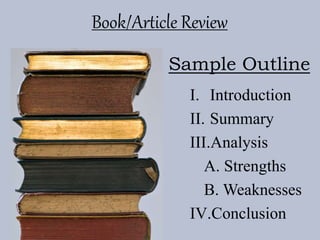
Book/Article Review
I. Introduction
II. Summary
III.Analysis
A. Strengths
B. Weaknesses
IV.Conclusion
Sample Outline
Book/Article Review
• Summary
– A summary is a brief, concisely written synopsis of the
book/article.
– A summary restates the author’s main point, purpose,
intent, and supporting details in your own words.
– Summaries are written to help you gain a better grasp
of the original, as well as show that you have read and
understand the assigned material.
Book/Article Review
• Summary Tips
– Summaries should be no longer than a quarter of your
paper.
• Usually a page or a two of summary is sufficient.
• The majority of your paper should be devoted to the analysis.
– Avoid a chapter-by-chapter summary.
– Avoid quoting heavily from the source.
• The summary should be in your own words.
Book/Article Review
• Analysis
– An analysis is a detailed evaluation of the thesis
(arguments) presented by the author.
– Relate the strengths and weaknesses of the
book/article.
• What is good and what is bad?
• What did the author do well? Not well?
• This does not communicate if you liked it or not.
Book/Article Review
• Analysis Tips
– You do not necessarily need to work chronologically
through the book/article as you discuss it.
• You can organize your paragraphs more usefully by themes,
methods, or other elements of the book.
– Keep comparisons to other books/articles brief so that
the book under review remains in the spotlight.
– Avoid excessive quotations or block quotes.
Book/Article Review
• Analysis Tips
– Review the book in front of you, not the book you wish
the author had written.
• Do not criticize the book for not being something it was
never intended to be.
– Present a balanced analysis.
• Avoid voicing strong agreement or disagreement.
• Harsh judgments are difficult to prove and can give readers
the sense that you were unfair in your assessment.
Book/Article Review
• Analysis Tips
– Don’t be afraid to disagree with the author.
– Cite specific examples to back up your assertions.
– A good analysis requires time and critical thinking.
• You must look “below the surface” and focus on the deeper
issues present in the book/article.
• As you read, constantly evaluate what you have read and
make notes of your questions and thoughts.
Book/Article Review
• Analysis Questions:
– Who is the audience? Did the author communicate
effectively to that audience?
– What sources were used? Does the author use many
quality academic sources to support what was written?
– What are the authors presuppositions/preconceived
notions? Does the author assume his/her readers to
have a certain background or information?
Book/Article Review
• Analysis Questions:
– Does the author have the necessary expertise to write
the book/article?
– How does this book/article relate to other sources on
the same topic?
– Does the author define and use appropriate, academic
terminology?
Book/Article Review
• Analysis Questions:
– Does the author present a clear thesis (argument)?
What is the purpose of the book/article?
– Does the author contribute anything new to the field?
– Does the author exhibit any bias? Does the author have
an inclusive worldview/writing style?
– Are there errors in the author’s logic?
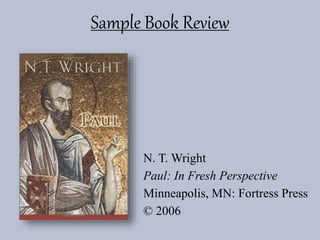
Sample Book Review
N. T. Wright
Paul: In Fresh Perspective
Minneapolis, MN: Fortress Press
© 2006
Sample Book Review
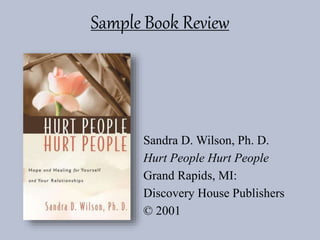
Sandra D. Wilson, Ph. D.
Hurt People Hurt People
Grand Rapids, MI:
Discovery House Publishers
© 2001
Sample Article Review
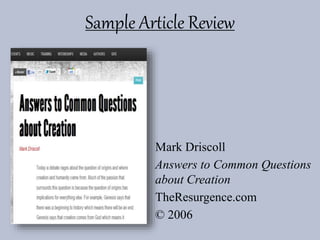
Mark Driscoll
Answers to Common Questions
about Creation
TheResurgence.com
© 2006
Sample Article Review
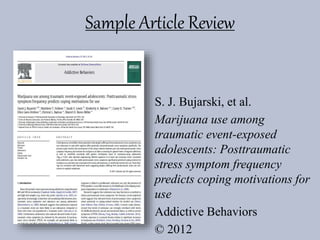
S. J. Bujarski, et al.
Marijuana use among
traumatic event-exposed
adolescents: Posttraumatic
stress symptom frequency
predicts coping motivations for
use
Addictive Behaviors
© 2012
REFERENCES
– Belcher, Wendy, “Writing the Academic Book Review.”
http://www.chicano.ucla.edu/press/siteart/jli_bookreviewguidelines.pdf
– Lee, Alexander D., Bart N. Green, Claire D. Johnson, and Julie Nyquist, “How to Write a
Scholarly Book Review for Publication in a Peer-Reviewed Jounal.” The Journal of Chiropractic
Education. http://www.journalchiroed.com/2010Spring/JCESpring2010Lee.pdf
– Purdue OWL, “Writing a Book Review.” http://owl.english.purdue.edu/owl/resource/704/1/
– The Writing Center at UNC-Chapel Hill, “Book Reviews.”
http://writingcenter.unc.edu/resources/handouts-demos/specific-writing-assignments/book-reviews
– The University of New South Wales, Learning Centre, “Writing a Critical Review.”
http://www.lc.unsw.edu.au/onlib/critrev.html
– Columbia University Writing Center,
http://www.columbia.edu/cu/ssw/write/handouts/summary.html
– Los Angeles Valley College Library, http://www.lavc.edu/library/bookreview.htm
– University of North Carolina at Chapel Hill Writing Center,
http://www.unc.edu/depts/wcweb/handouts/review.html
http://www.unc.edu/depts/wcweb/handouts/fallacies.html

Book review

  • 1.
    Does the prospect ofwriting a book/article review make you feel like this…?
  • 3.
    Book/Article Review • Book/Articlereviews are usually one of the first assignments given in the course of the semester. • A book/article review looks at the quality, meaning, and significance of a work of literature. It is a reaction paper – focusing on purpose, content, and authority – in which strengths and weaknesses of the material are analyzed. • It should examine what the author has tried to do, evaluate how well the author has succeeded, and presents evidence to support this evaluation.
  • 4.
    Book/Article Review • Thefirst step is to READ the book/article. • Allow yourself enough TIME to be able to thoroughly read and evaluate the book/article. • Read ACTIVELY and CRITICALLY! – Engage with the text – Highlight and Underline passages – Write in the margins – Make predictions (and test them) – Ask questions (and answer them)
  • 5.
    Book/Article Review • Typicalbook/article reviews consist of two parts: – Summary & Analysis • Occasionally a professor will want additional info. – Bibliographical Material – Personal Opinion – Career/Ministry Application • There is no standard, discipline-specific way to write a book/article review. – Often a professor will provide guidelines and format. – Otherwise, you may create your own outline.
  • 6.
    Book/Article Review I. Introduction II.Summary III.Analysis A. Strengths B. Weaknesses IV.Conclusion Sample Outline
  • 7.
    Book/Article Review • Summary –A summary is a brief, concisely written synopsis of the book/article. – A summary restates the author’s main point, purpose, intent, and supporting details in your own words. – Summaries are written to help you gain a better grasp of the original, as well as show that you have read and understand the assigned material.
  • 8.
    Book/Article Review • SummaryTips – Summaries should be no longer than a quarter of your paper. • Usually a page or a two of summary is sufficient. • The majority of your paper should be devoted to the analysis. – Avoid a chapter-by-chapter summary. – Avoid quoting heavily from the source. • The summary should be in your own words.
  • 10.
    Book/Article Review • Analysis –An analysis is a detailed evaluation of the thesis (arguments) presented by the author. – Relate the strengths and weaknesses of the book/article. • What is good and what is bad? • What did the author do well? Not well? • This does not communicate if you liked it or not.
  • 11.
    Book/Article Review • AnalysisTips – You do not necessarily need to work chronologically through the book/article as you discuss it. • You can organize your paragraphs more usefully by themes, methods, or other elements of the book. – Keep comparisons to other books/articles brief so that the book under review remains in the spotlight. – Avoid excessive quotations or block quotes.
  • 12.
    Book/Article Review • AnalysisTips – Review the book in front of you, not the book you wish the author had written. • Do not criticize the book for not being something it was never intended to be. – Present a balanced analysis. • Avoid voicing strong agreement or disagreement. • Harsh judgments are difficult to prove and can give readers the sense that you were unfair in your assessment.
  • 13.
    Book/Article Review • AnalysisTips – Don’t be afraid to disagree with the author. – Cite specific examples to back up your assertions. – A good analysis requires time and critical thinking. • You must look “below the surface” and focus on the deeper issues present in the book/article. • As you read, constantly evaluate what you have read and make notes of your questions and thoughts.
  • 14.
    Book/Article Review • AnalysisQuestions: – Who is the audience? Did the author communicate effectively to that audience? – What sources were used? Does the author use many quality academic sources to support what was written? – What are the authors presuppositions/preconceived notions? Does the author assume his/her readers to have a certain background or information?
  • 15.
    Book/Article Review • AnalysisQuestions: – Does the author have the necessary expertise to write the book/article? – How does this book/article relate to other sources on the same topic? – Does the author define and use appropriate, academic terminology?
  • 16.
    Book/Article Review • AnalysisQuestions: – Does the author present a clear thesis (argument)? What is the purpose of the book/article? – Does the author contribute anything new to the field? – Does the author exhibit any bias? Does the author have an inclusive worldview/writing style? – Are there errors in the author’s logic?
  • 17.
    Sample Book Review N.T. Wright Paul: In Fresh Perspective Minneapolis, MN: Fortress Press © 2006
  • 18.
    Sample Book Review SandraD. Wilson, Ph. D. Hurt People Hurt People Grand Rapids, MI: Discovery House Publishers © 2001
  • 19.
    Sample Article Review MarkDriscoll Answers to Common Questions about Creation TheResurgence.com © 2006
  • 20.
    Sample Article Review S.J. Bujarski, et al. Marijuana use among traumatic event-exposed adolescents: Posttraumatic stress symptom frequency predicts coping motivations for use Addictive Behaviors © 2012
  • 21.
    REFERENCES – Belcher, Wendy,“Writing the Academic Book Review.” http://www.chicano.ucla.edu/press/siteart/jli_bookreviewguidelines.pdf – Lee, Alexander D., Bart N. Green, Claire D. Johnson, and Julie Nyquist, “How to Write a Scholarly Book Review for Publication in a Peer-Reviewed Jounal.” The Journal of Chiropractic Education. http://www.journalchiroed.com/2010Spring/JCESpring2010Lee.pdf – Purdue OWL, “Writing a Book Review.” http://owl.english.purdue.edu/owl/resource/704/1/ – The Writing Center at UNC-Chapel Hill, “Book Reviews.” http://writingcenter.unc.edu/resources/handouts-demos/specific-writing-assignments/book-reviews – The University of New South Wales, Learning Centre, “Writing a Critical Review.” http://www.lc.unsw.edu.au/onlib/critrev.html – Columbia University Writing Center, http://www.columbia.edu/cu/ssw/write/handouts/summary.html – Los Angeles Valley College Library, http://www.lavc.edu/library/bookreview.htm – University of North Carolina at Chapel Hill Writing Center, http://www.unc.edu/depts/wcweb/handouts/review.html http://www.unc.edu/depts/wcweb/handouts/fallacies.html