Dr. William Vocke Senior Fellow www.carnegiecouncil.org
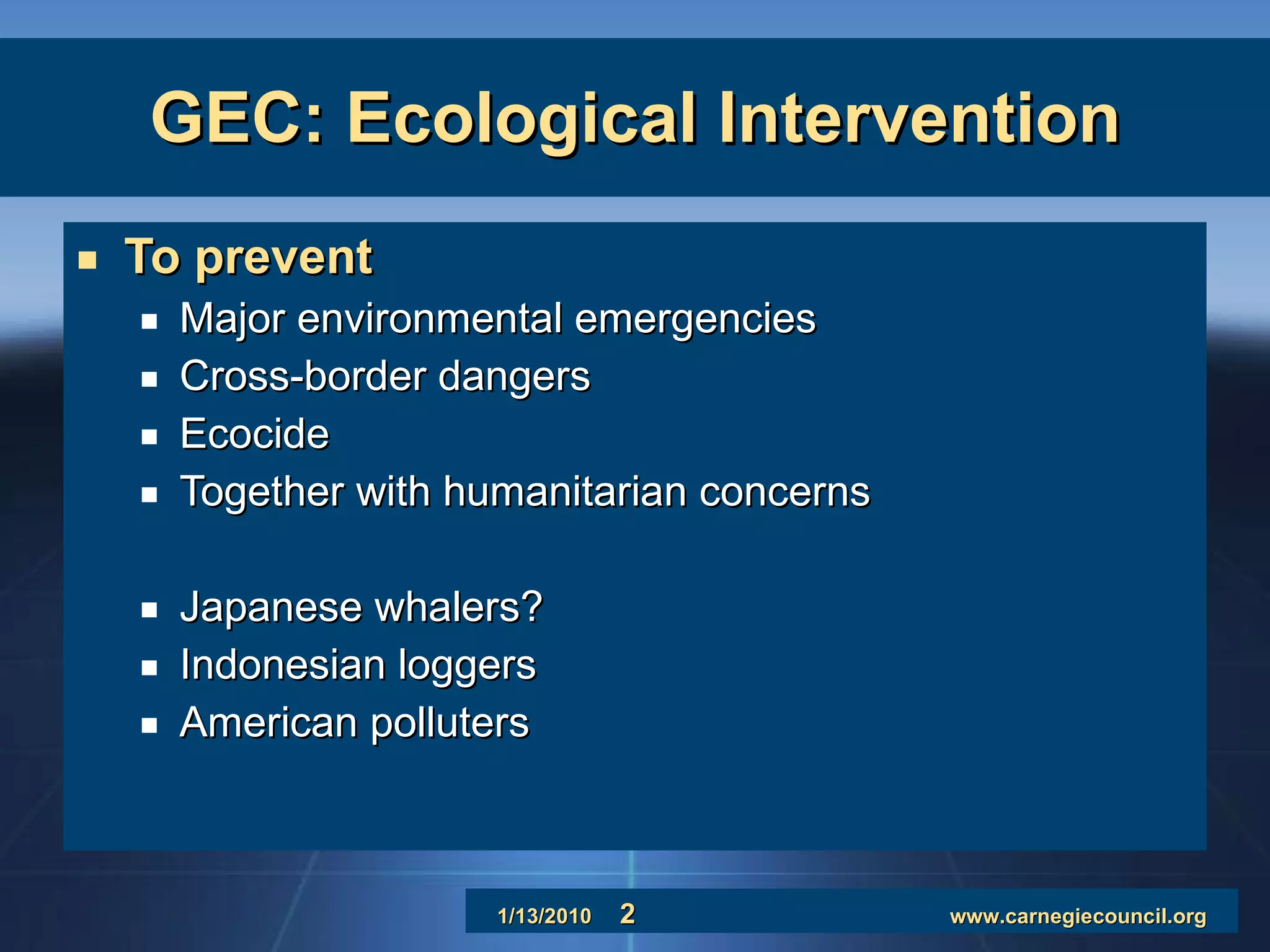
GEC: Ecological Intervention To prevent Major environmental emergencies Cross-border dangers Ecocide Together with humanitarian concerns Japanese whalers? Indonesian loggers American polluters
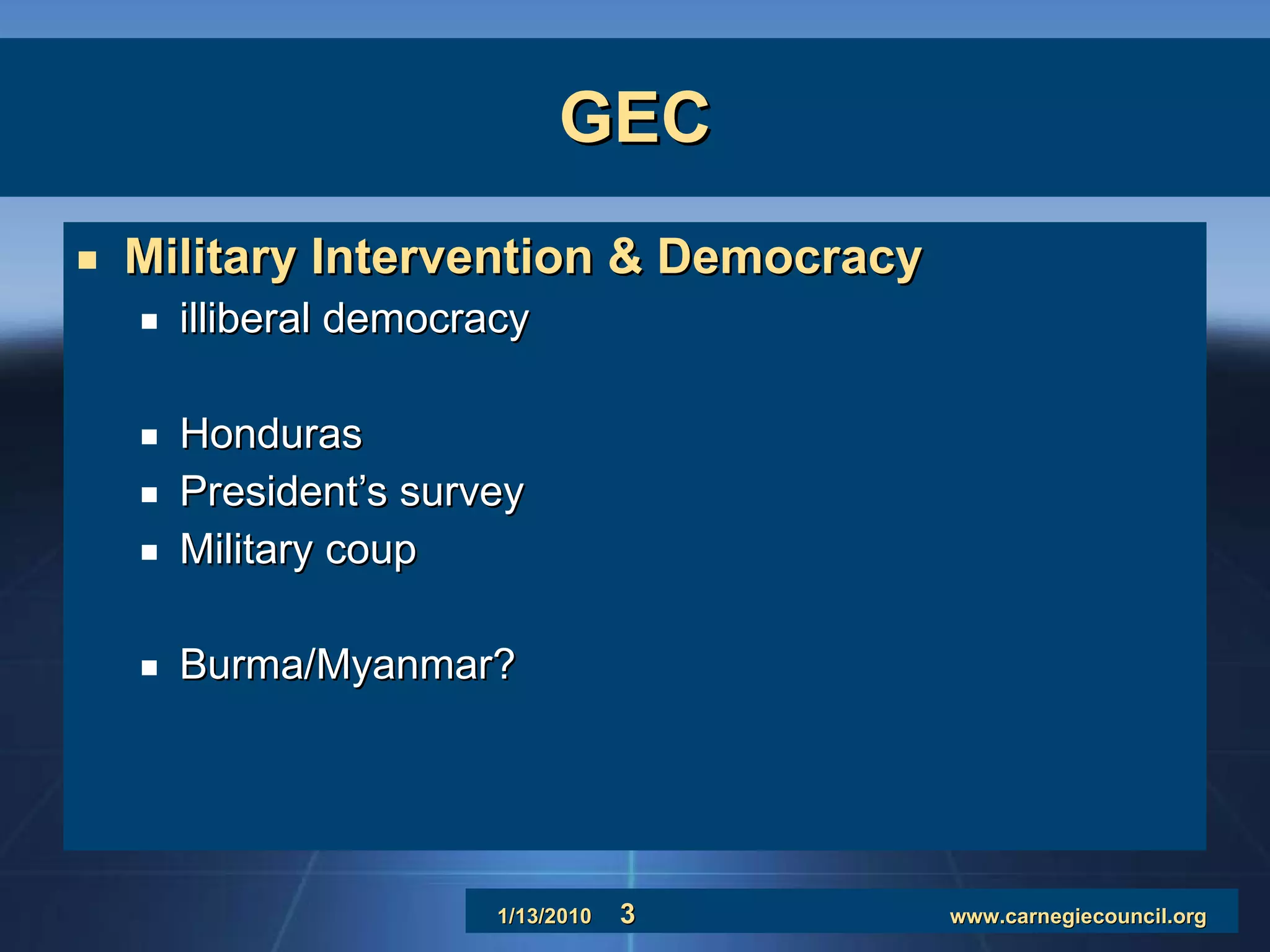
GEC Military Intervention & Democracy illiberal democracy Honduras President’s survey Military coup Burma/Myanmar?
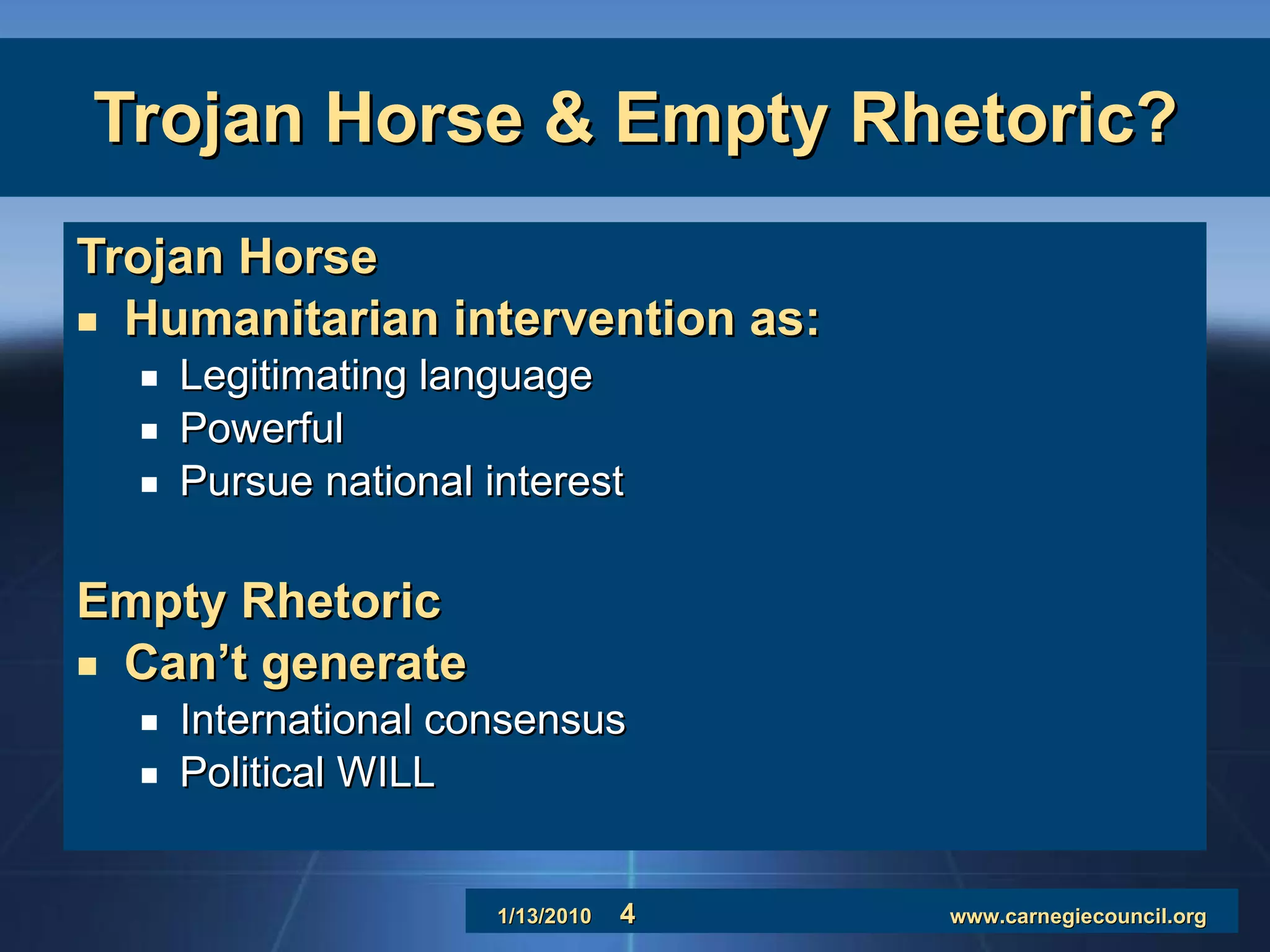
Trojan Horse & Empty Rhetoric? Trojan Horse Humanitarian intervention as: Legitimating language Powerful Pursue national interest Empty Rhetoric Can’t generate International consensus Political WILL
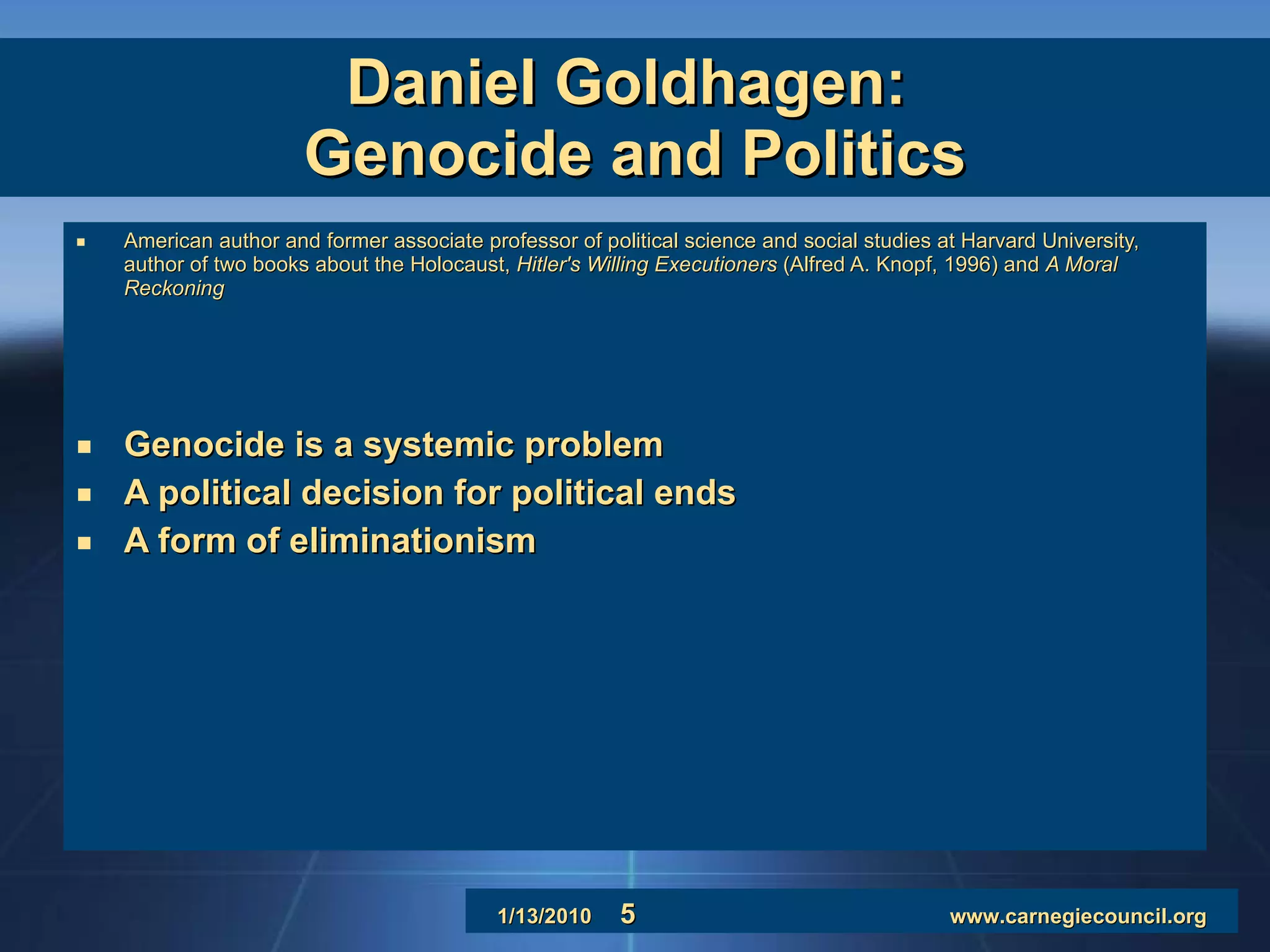
Daniel Goldhagen:  Genocide and Politics American author and former associate professor of political science and social studies at Harvard University, author of two books about the Holocaust,  Hitler's Willing Executioners  (Alfred A. Knopf, 1996) and  A Moral Reckoning   Genocide is a systemic problem A political decision for political ends A form of eliminationism
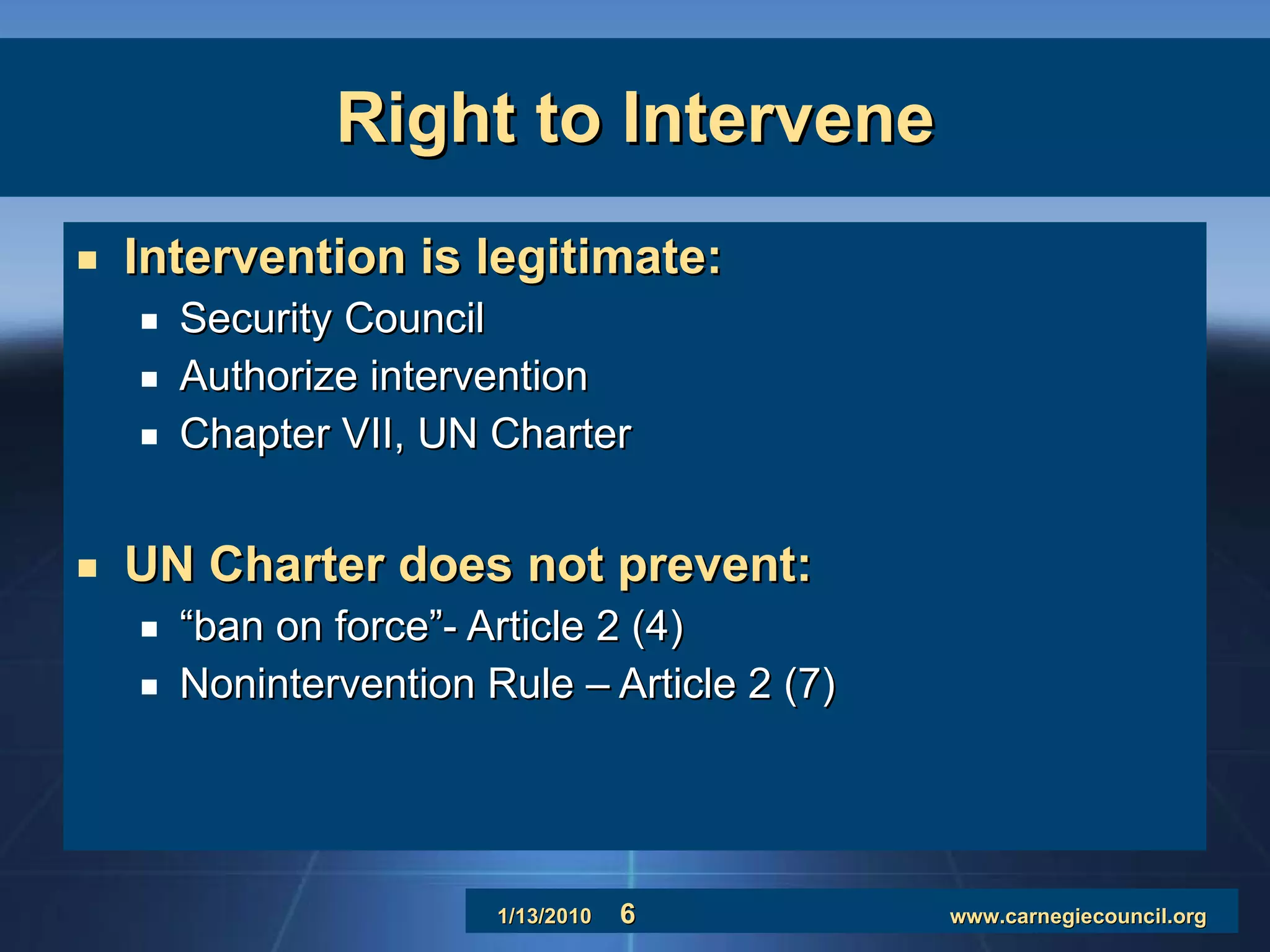
Right to Intervene Intervention is legitimate: Security Council  Authorize intervention Chapter VII, UN Charter UN Charter does not prevent: “ ban on force”- Article 2 (4) Nonintervention Rule – Article 2 (7)
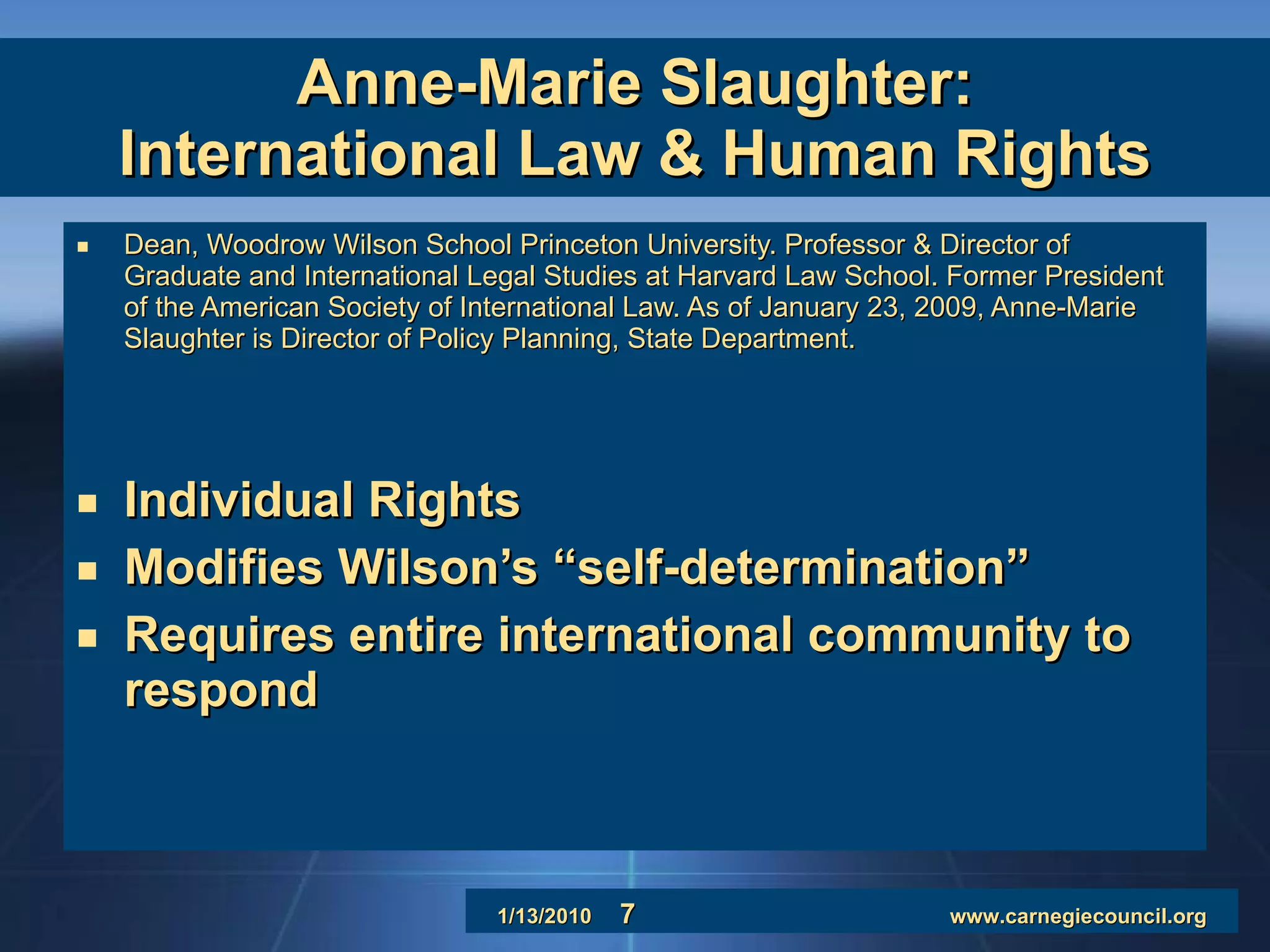
Anne-Marie Slaughter: International Law & Human Rights Dean, Woodrow Wilson School Princeton University. Professor & Director of Graduate and International Legal Studies at Harvard Law School. Former President of the American Society of International Law. As of January 23, 2009, Anne-Marie Slaughter is Director of Policy Planning, State Department. Individual Rights Modifies Wilson’s “self-determination” Requires entire international community to respond
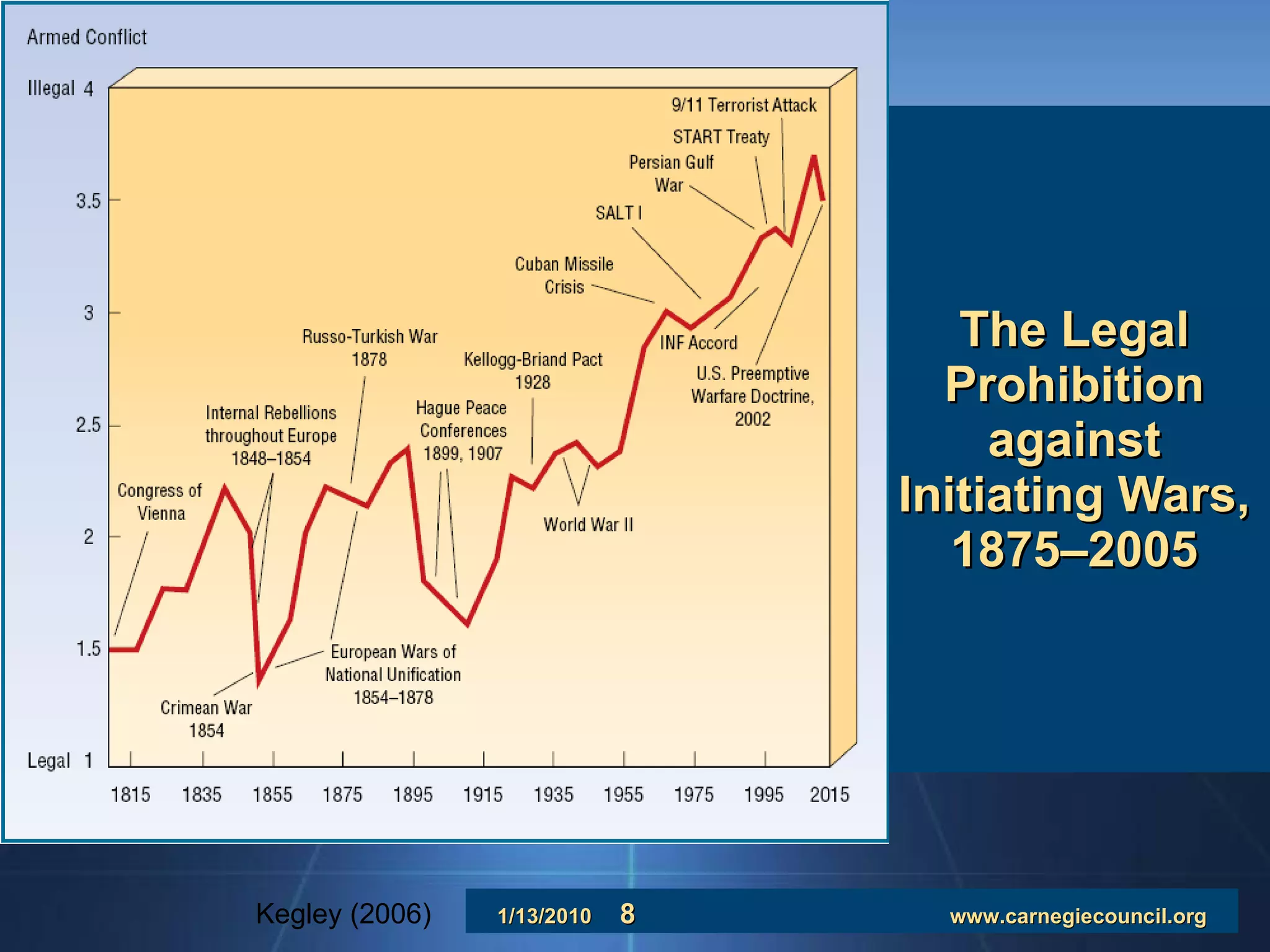
The Legal Prohibition against Initiating Wars, 1875–2005 Kegley (2006)
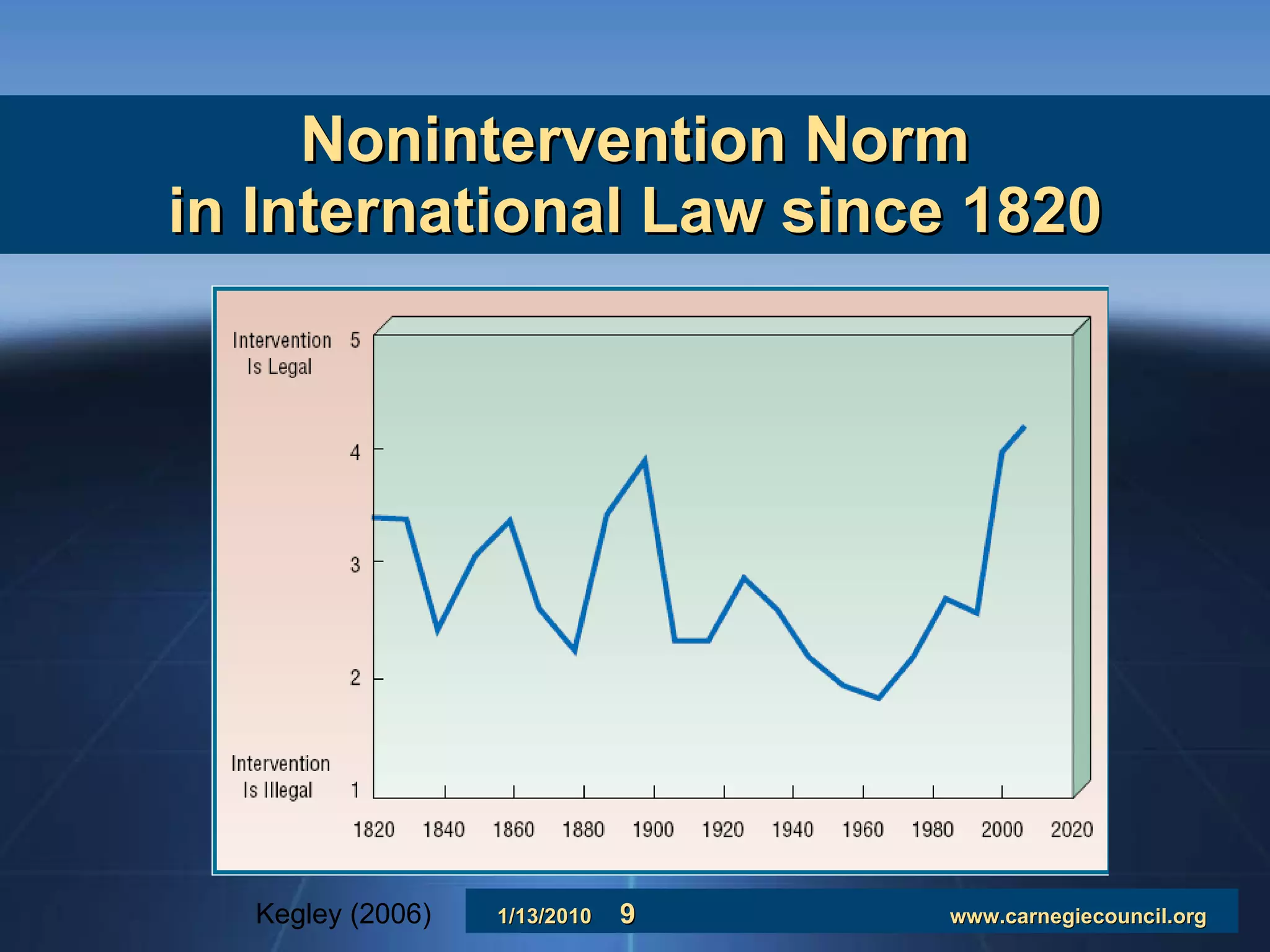
Nonintervention Norm in International Law since 1820 Kegley (2006)
UN & War UN 1. Indirect:  Social and economic roots of armed conflict WHO, FAO, UNESCO 2. Direct: Directly bring fighting under control Resolve armed conflicts Maintain peace
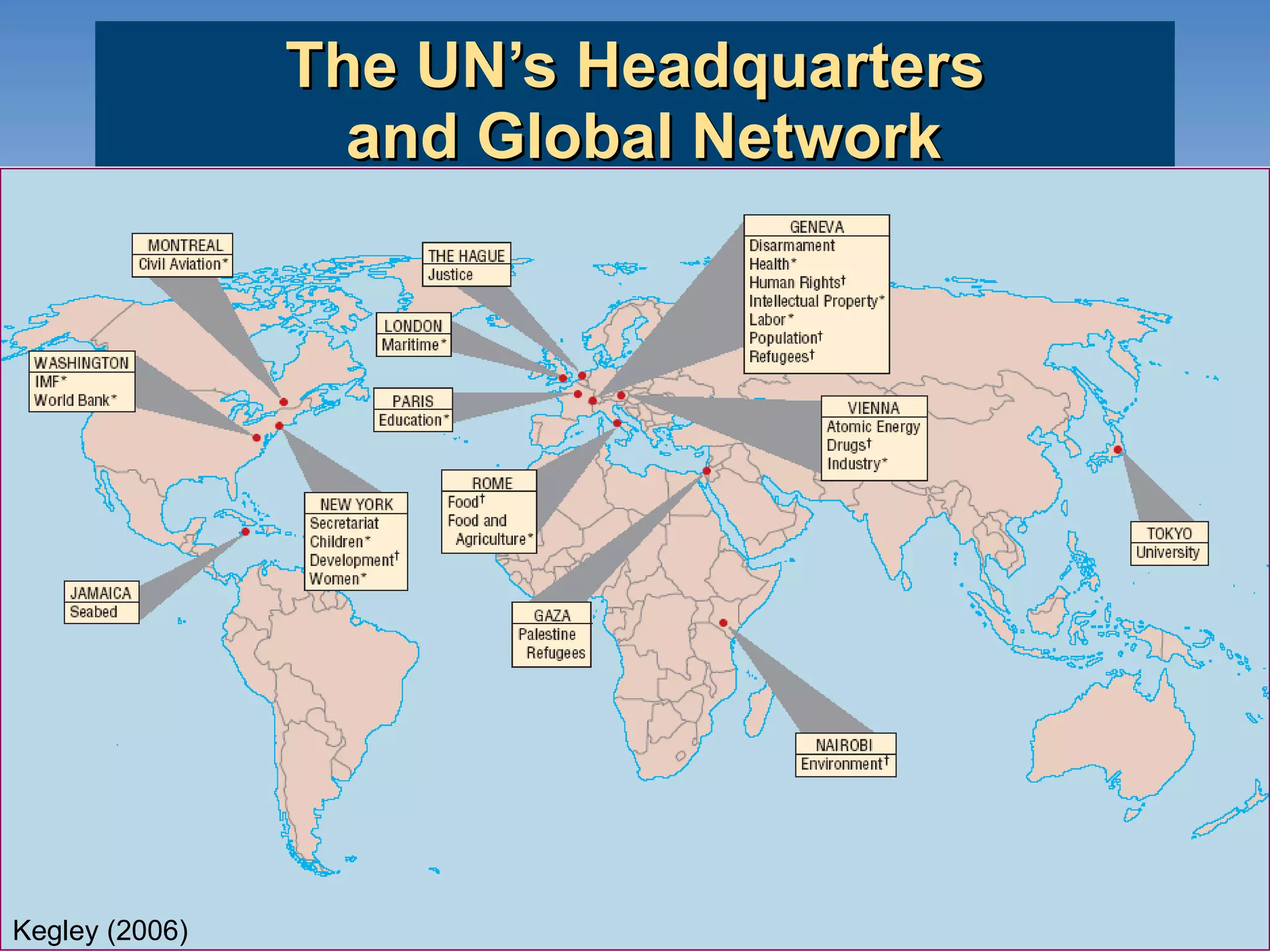
The UN’s Headquarters  and Global Network Kegley (2006)
UN and Peace Preventive diplomacy Peace keeping Peace making Peace building Peace enforcement
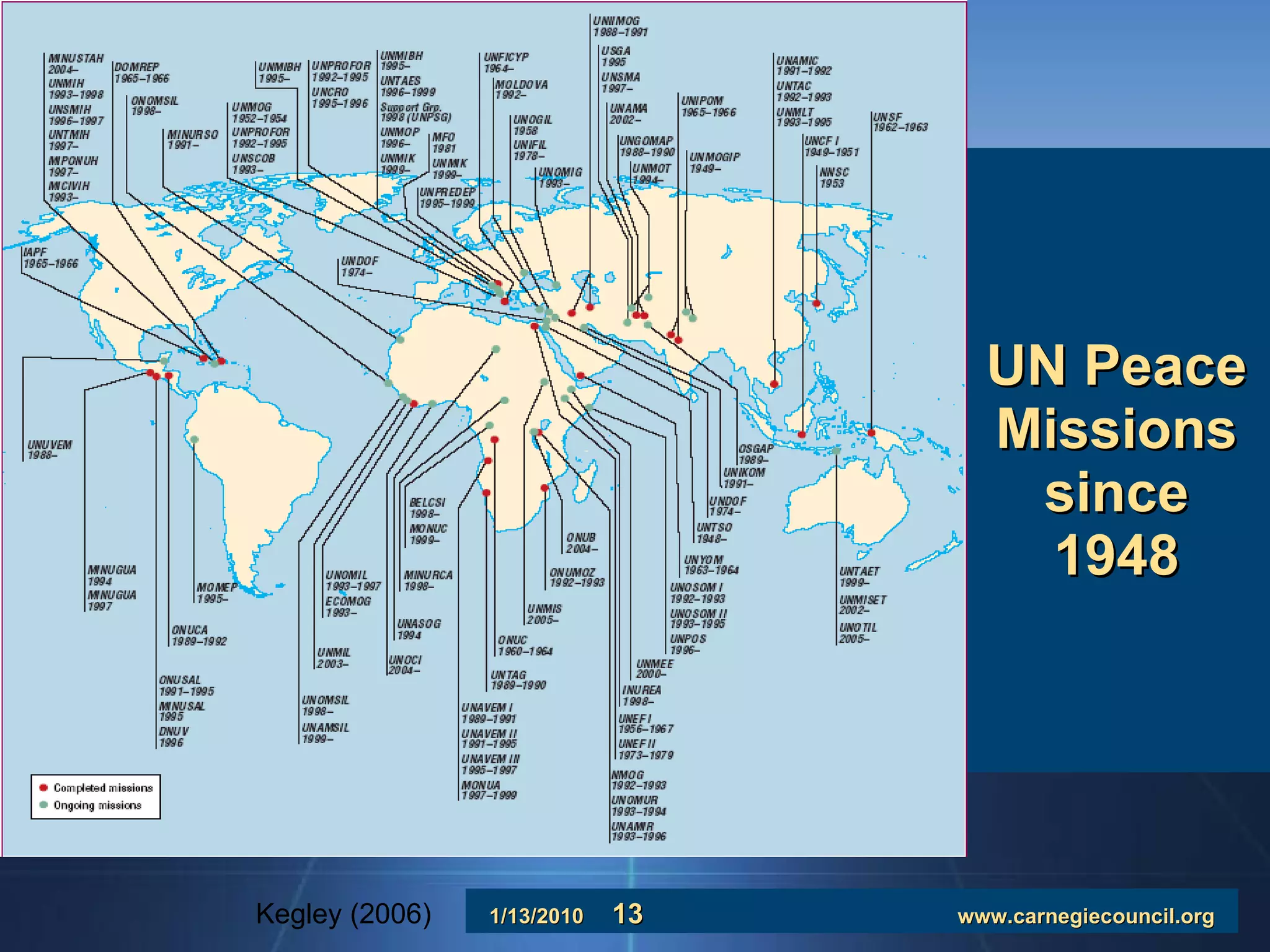
UN Peace Missions since 1948 Kegley (2006)
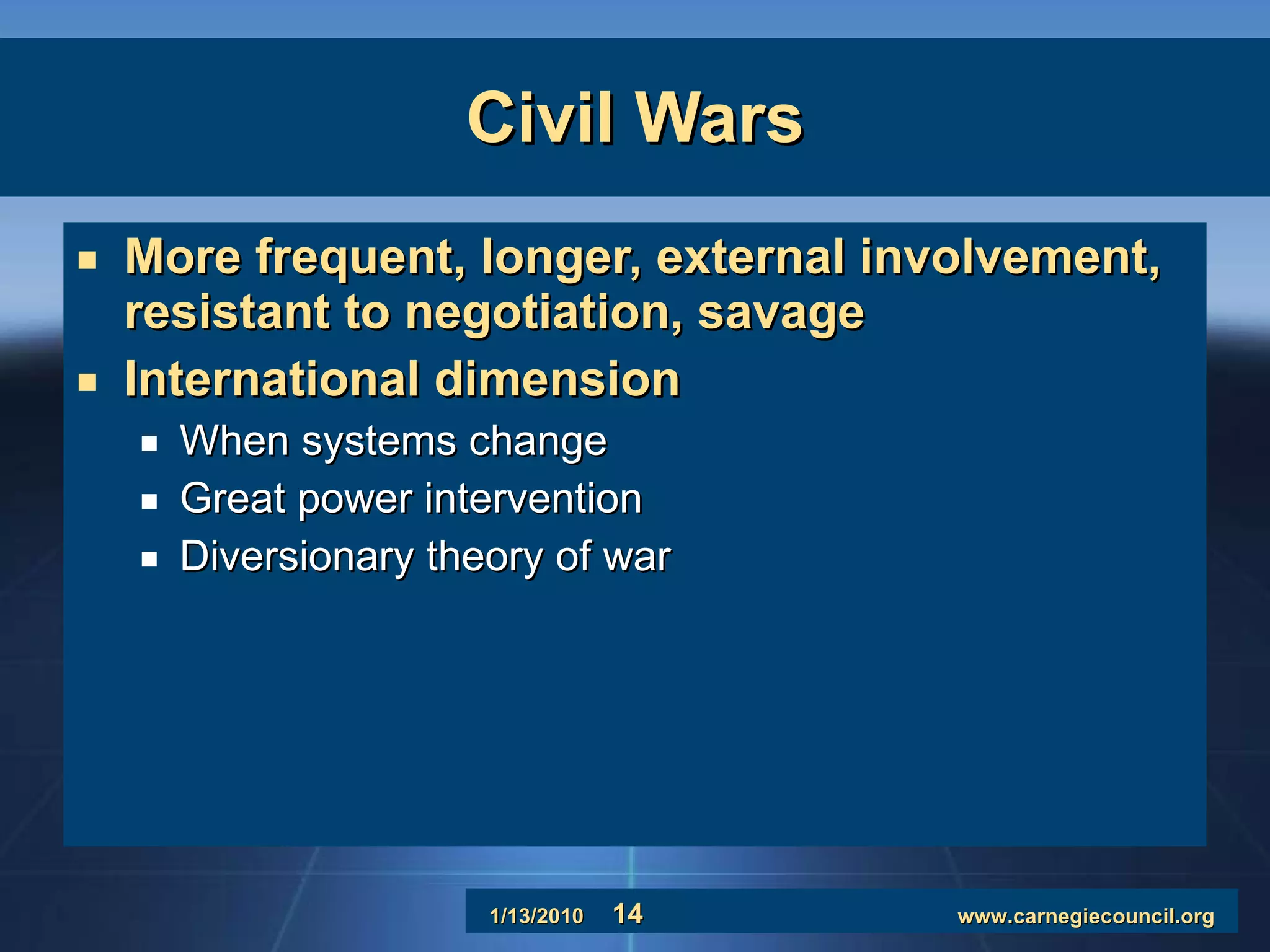
Civil Wars More frequent, longer, external involvement, resistant to negotiation, savage International dimension When systems change  Great power intervention Diversionary theory of war
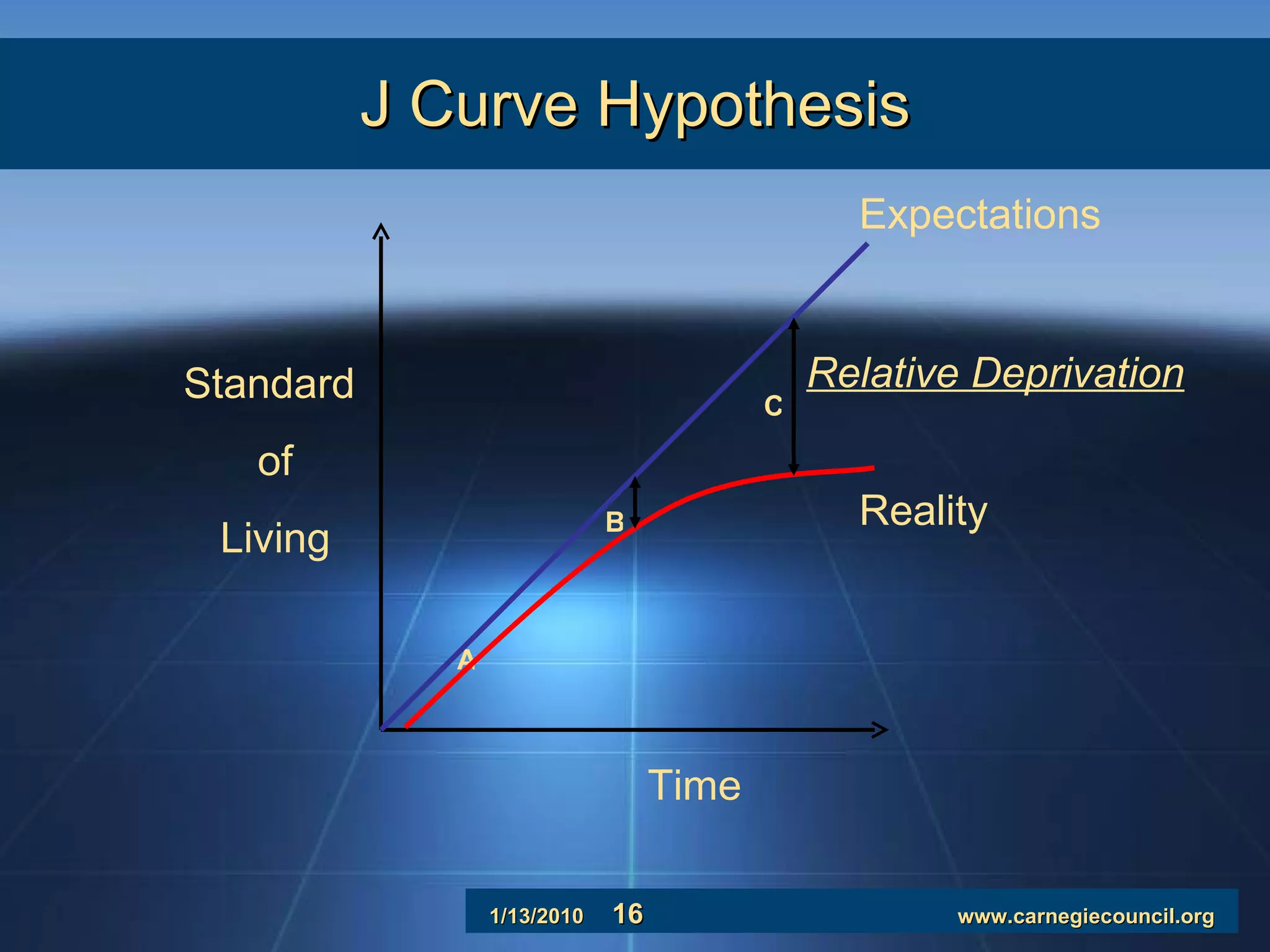
The Causes of Civil Wars Is violence necessary? Relative deprivation (graph) Demographic stress- young men Geography (mountains & resources) Secessionist revolts, irredentism Nationalism, ethnic warfare Failing states Economic growth
J Curve Hypothesis A B Standard  of Living Time Expectations Reality J Curve Hypothesis Relative Deprivation C
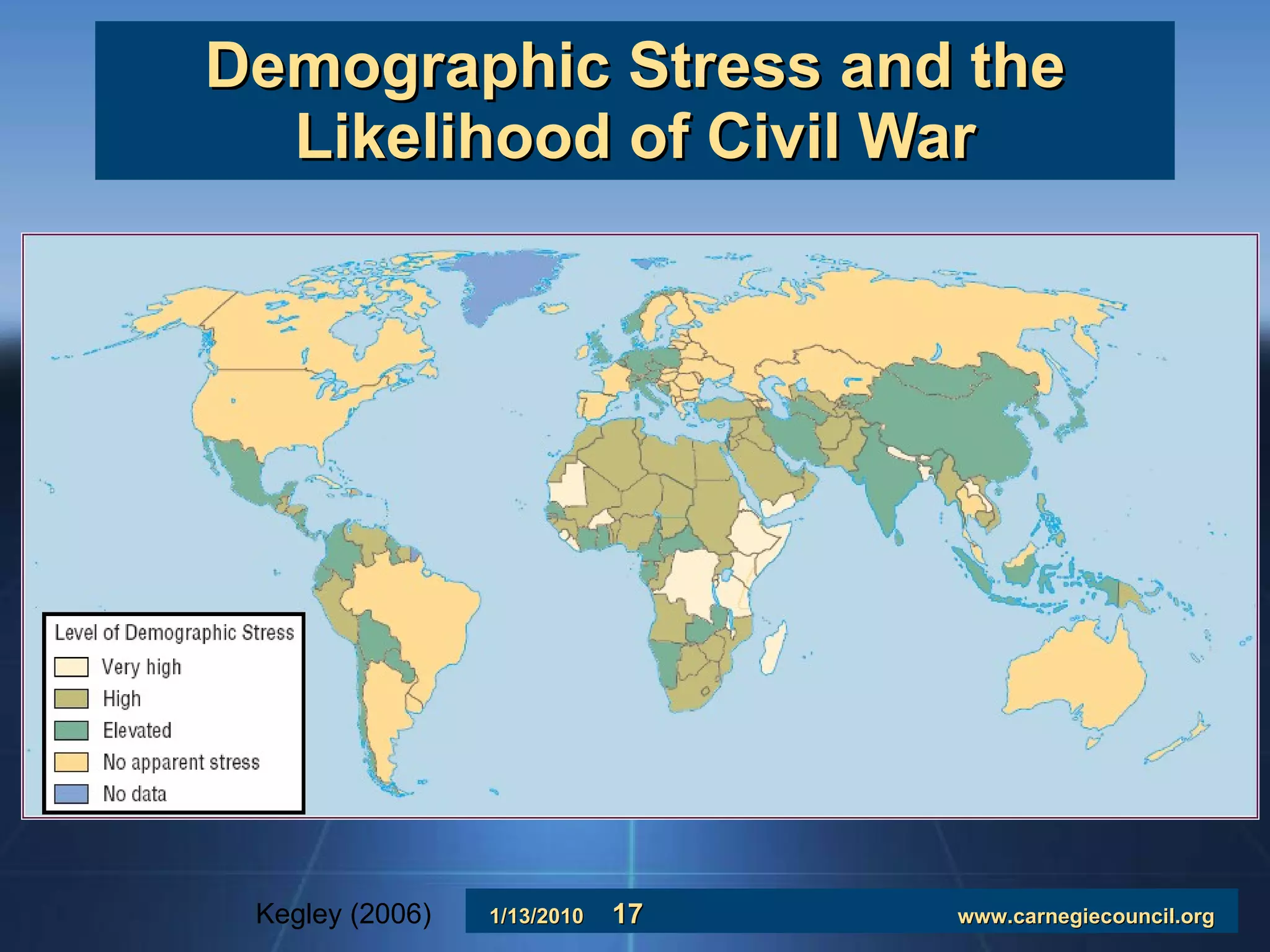
Demographic Stress and the Likelihood of Civil War Kegley (2006)
Other Global Issues Diseases: HIV/AIDS, SARS Harmful pests: Non-native species International organized crime: drugs Global migration crisis: 20 million refugees Failed states
GEC Am I My Brother’s Keeper Who do you help How
 
The Human Condition Global South:  2.7 billion people live on $2 or less per day life expectancy less than 60 years many lack basic sanitation many lack safe drinking water many lack adequate housing many undernourished
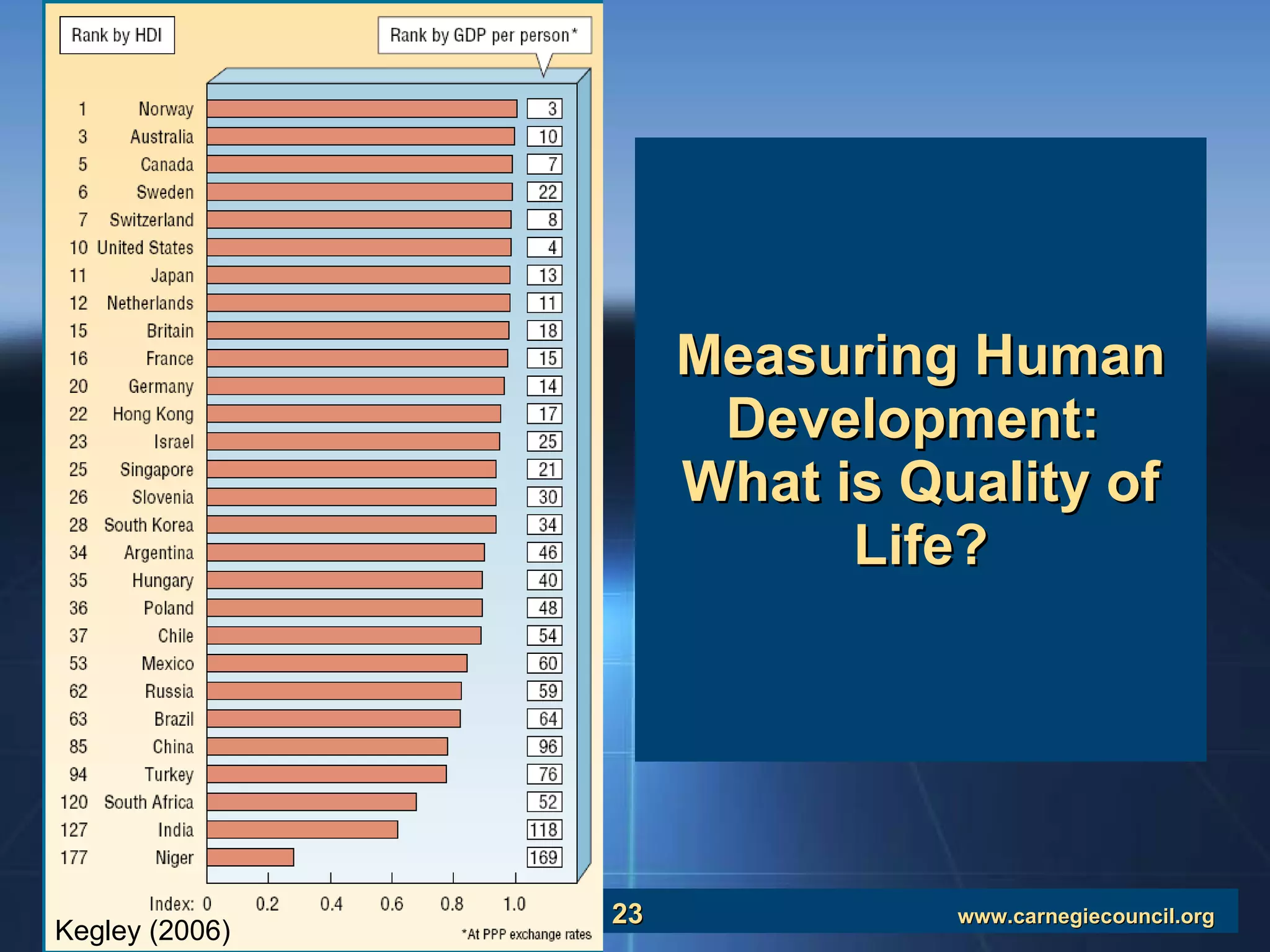
Measuring Human Development Dependency Theory (core & periphery) Human needs: basic physical, social, and political requirements needed for survival and security Human Development Index (HDI) combines life expectancy, literacy, income, and years of education better measure than per capita GNP, or PPP Integration vs. Fragmentation (Freeman)
Measuring Human Development:  What is Quality of Life? Kegley (2006)
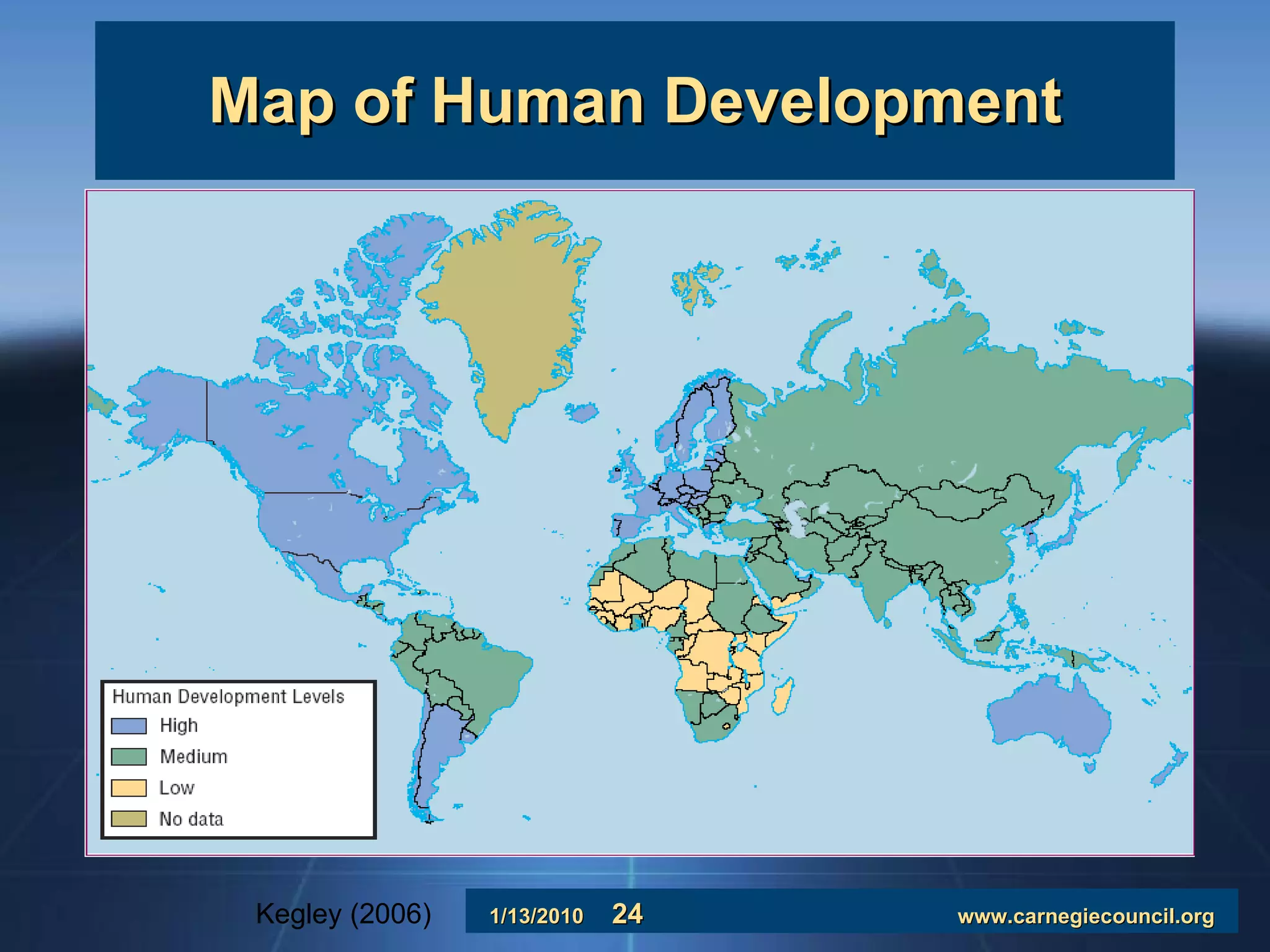
Map of Human Development Kegley (2006)
The Global Refugee Crisis Refugees: flee for safety to another country because of a well-founded fear of persecution; avg. 21 million people Internally displaced people: people involuntarily uprooted from their homes, but still in their own countries Failed states
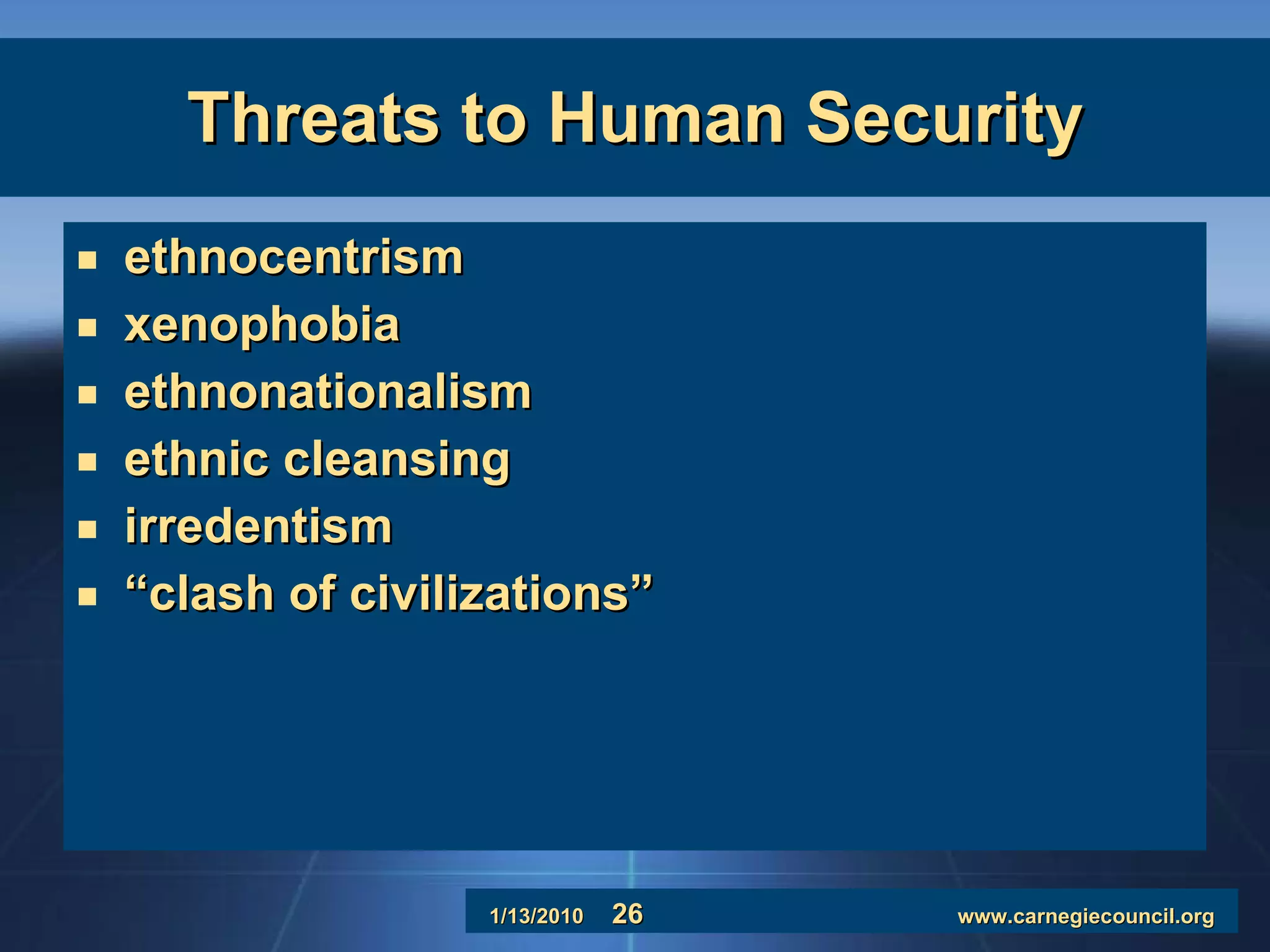
Threats to Human Security ethnocentrism xenophobia ethnonationalism ethnic cleansing irredentism “ clash of civilizations”
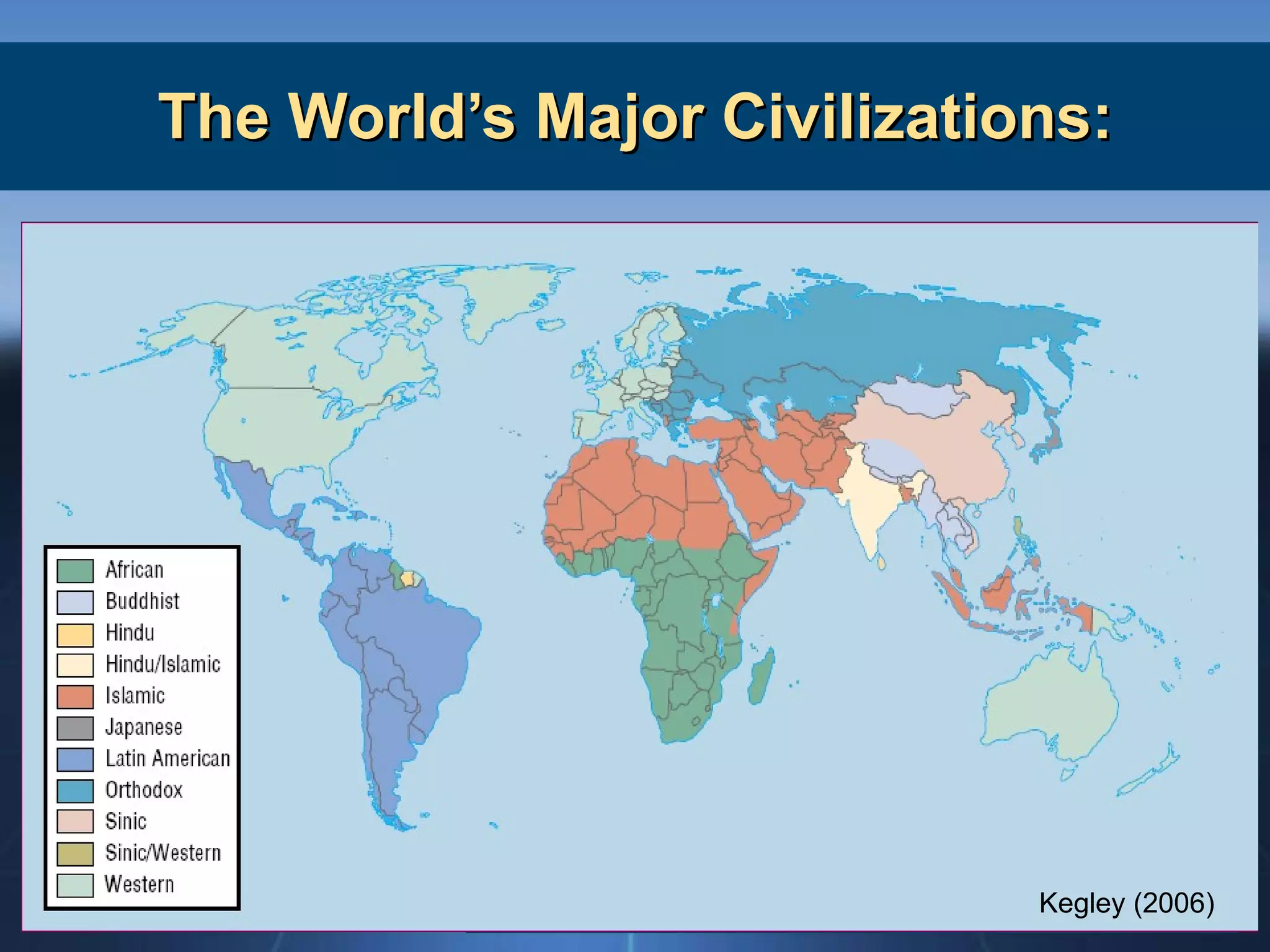
The World’s Major Civilizations: Kegley (2006)
Protecting Human Rights UN  Universal Declaration of Human Rights noncombatant immunity international regimes with enforcement powers revising international law prosecution of war criminals: Milosevic  humanitarian intervention
Five Goals of Sanctions 1. compliance: alter behavior of target 2. subversion: topple leader from power 3. deterrence: of objectionable behavior 4. international symbolism: send messages to other actors 5. domestic symbolism: to gain support from own populace by taking action
Sanctions punitive actions for previous objectionable behavior common tool of coercive diplomacy alternative to military force boycotts occasional successes, but often failure
Joel Rosenthal:  Duties, Fairness, & Ethics President, Carnegie Council for Ethics in International Affairs Agree on the history of Human Rights in 20 th  Century Pillars of Ethics Pluralism Rights & Responsibilities Fairness
 
Military Intervention Overt or covert use of force  Covert operations: secret activities can heighten tensions and lead to war nonintervention norm intervention can be for moral or humanitarian reasons
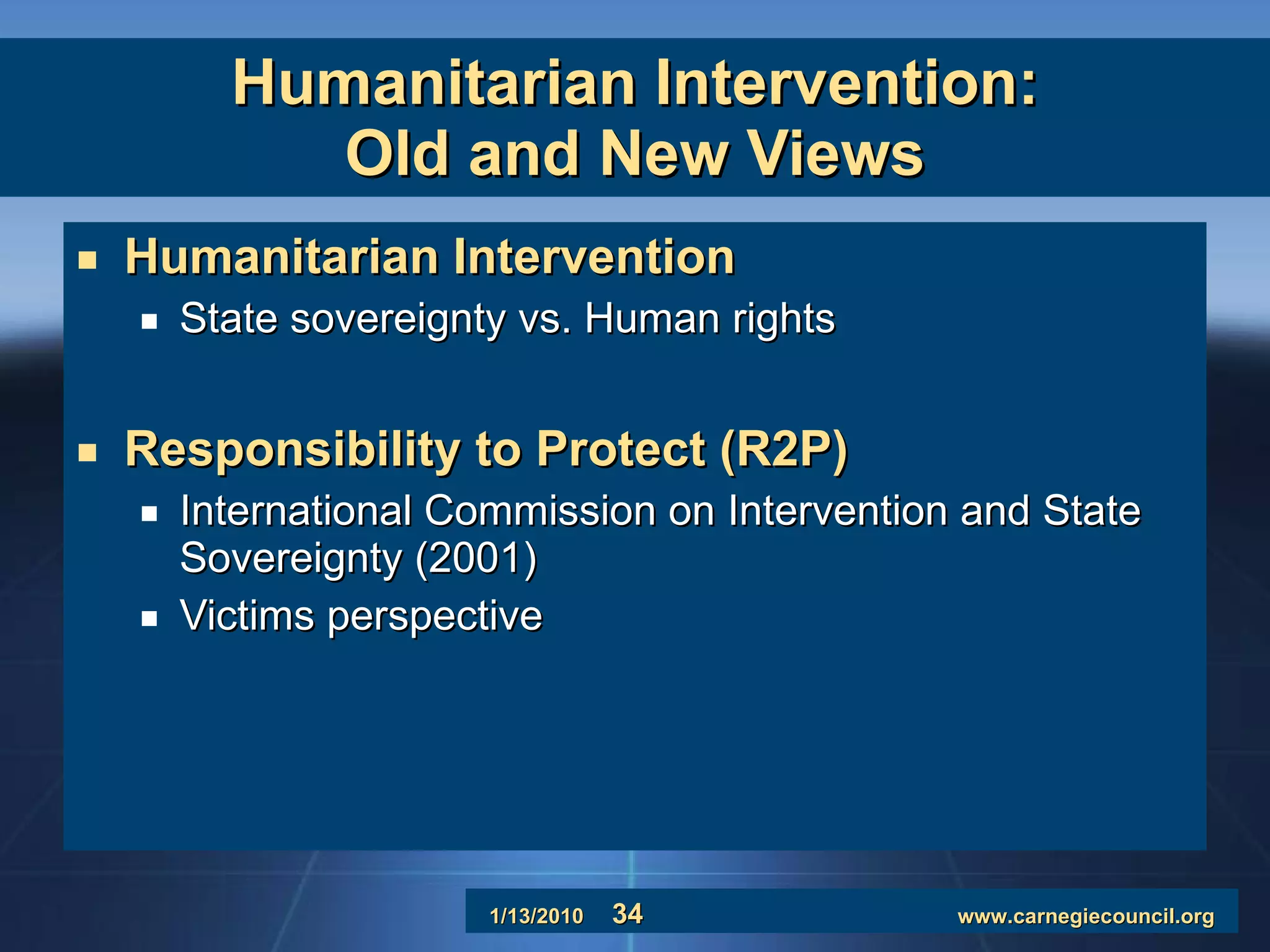
Humanitarian Intervention: Old and New Views Humanitarian Intervention State sovereignty vs. Human rights Responsibility to Protect (R2P) International Commission on Intervention and State Sovereignty (2001) Victims perspective
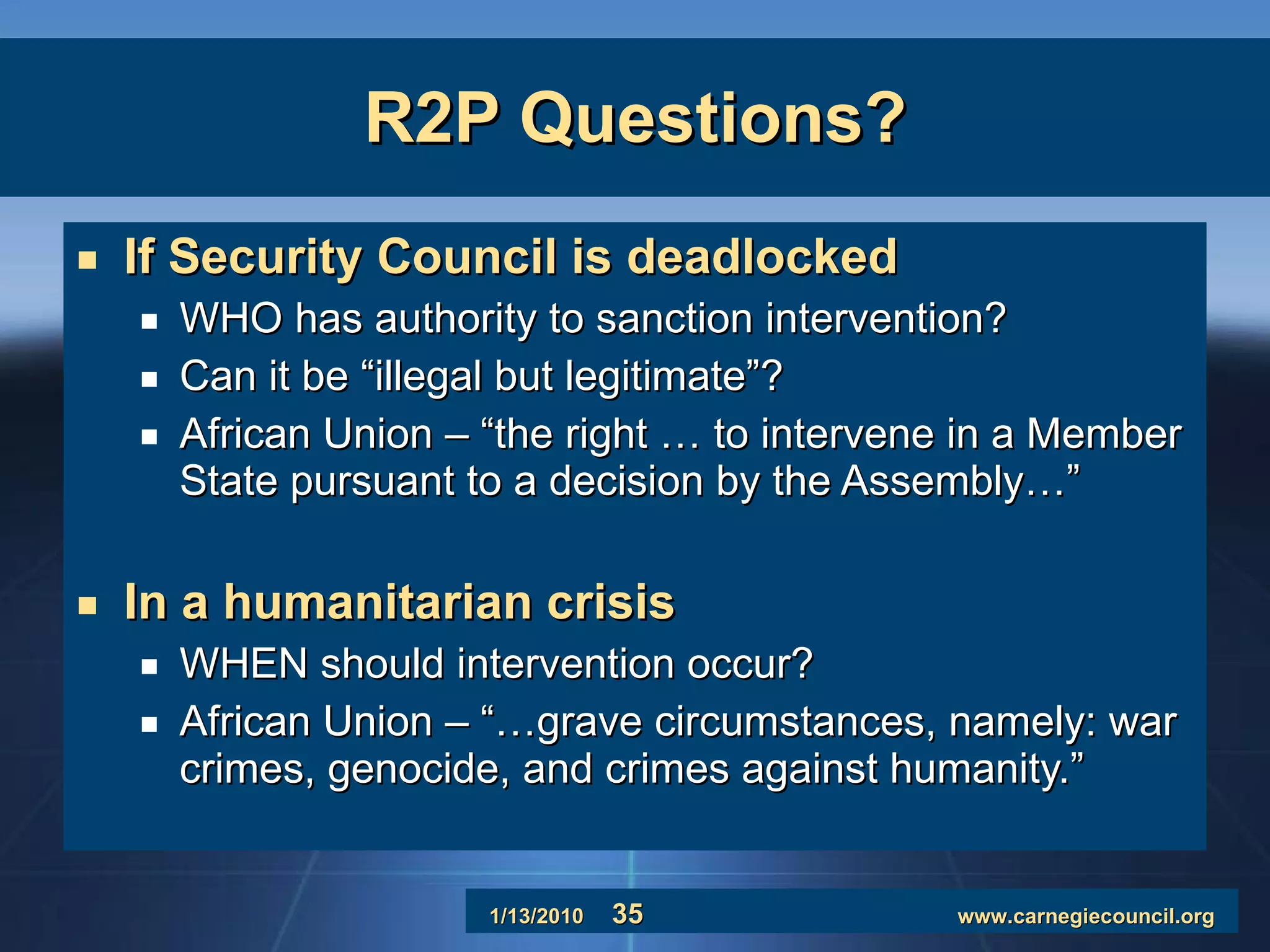
R2P Questions? If Security Council is deadlocked WHO has authority to sanction intervention? Can it be “illegal but legitimate”? African Union – “the right … to intervene in a Member State pursuant to a decision by the Assembly…” In a humanitarian crisis WHEN should intervention occur? African Union – “…grave circumstances, namely: war crimes, genocide, and crimes against humanity.”
Alex Bellamy:  Prevention & Intervention Professor of peace and conflict studies at the University of Queensland; books include  Kosovo and International Society  (2002),  Security Communities and Their Neighbours: Regional Fortresses or Global Integrators?  (2004),  Understanding Peacekeeping  (edited with Paul D. Williams and Stuart Griffin, 2004),  International Society and Its Critics  (editor, 2004),  Just Wars: From Cicero to Iraq  (2006),  Fighting Terror: Ethical Dilemmas  (2008), and  Responsibility to Protect  (2009).   Prevention is the best answer Security Council is politics Dafur – issue is making it work
 
Bellamy key measure for success for R2P is whether or not we can reduce the frequency of genocide and mass atrocities—that is, reduce the number of cases that get so bad that they come before the Council. second school of thought is that the measure of success for R2P is whether you can make the Council react more quickly to crises once they have occured
R2P: Who First: responsibility of the state to protect its own people.  Second: responsibility of the international community to assist the state  Third: duty of the international community to take timely and decisive action where a state is manifestly failing to protect its people Chapters VI, VII, and VIII; UN Charter
R2P: When Just cause thresholds Large-scale loss of life Ethic cleansing Precautionary principles Right intention Last resort Proportional means Reasonable prospects International consensus Legal Legitimate
Iraq War & R2P Prior General consensus- Security Council Liberal consensus- “illegal but legitimate” Unilateral requirement- demanded by circumstances War Credibility of US & UK diminished R2P language used to avoid intervention
Google China: “do no evil” Pro-technology groups Free market forces US Industries lobbies National Security advocates Civil Liberty advocates
Conclusion Humanitarian Intervention Has become a NORM Remains highly political R2P language Focuses on victim Argument for non-intervention Ultimately political Prevention become the goal Trojan Horse? Empty Rhetoric? Genuine Concern? YES, YES, YES  For America Values Politics Requires Global community
Daniel Goldhagen: Sovereignty & Genocide American author and former associate professor of political science and social studies at Harvard University, author of two books about the Holocaust,  Hitler's Willing Executioners  (Alfred A. Knopf, 1996) and  A Moral Reckoning   Trend- Genocide has become domestic Sovereignty protects states Sovereignty must be amended
Daniel Goldhagen: Prevent Mass Murder American author and former associate professor of political science and social studies at Harvard University, author of two books about the Holocaust,  Hitler's Willing Executioners  (Alfred A. Knopf, 1996) and  A Moral Reckoning   What is the life of 1 of 1M worth?
Thank You www.carnegiecouncil.org
Footnotes & References Video Clips  are indicated by a full-screen slide that is blank, has a person’s picture, or has the CCEIA logo.  These are available on YouTube, on the Carnegie Council channel. Pictures and maps are personal, from Flicker under Creative Commons open license, or available from free sources like .gov and Wikipedia. Some slides and maps are adapted from Charles Kegley,  World Politics in Transition  (2006) Basic source information is generally noted on the slides where appropriate. Definitional material is occasionally abstracted from Wikipedia.
Concepts Ethics: criteria for evaluating right and wrong  Morality: principles about how we should behave Civil society Human rights: political rights and civil liberties recognized as inalienable for all people Sanctions: punitive actions by one state against another for past objectionable behavior

Humanitarian Intervention

  • 1.
    Dr. William VockeSenior Fellow www.carnegiecouncil.org
  • 2.
    GEC: Ecological InterventionTo prevent Major environmental emergencies Cross-border dangers Ecocide Together with humanitarian concerns Japanese whalers? Indonesian loggers American polluters
  • 3.
    GEC Military Intervention& Democracy illiberal democracy Honduras President’s survey Military coup Burma/Myanmar?
  • 4.
    Trojan Horse &Empty Rhetoric? Trojan Horse Humanitarian intervention as: Legitimating language Powerful Pursue national interest Empty Rhetoric Can’t generate International consensus Political WILL
  • 5.
    Daniel Goldhagen: Genocide and Politics American author and former associate professor of political science and social studies at Harvard University, author of two books about the Holocaust, Hitler's Willing Executioners (Alfred A. Knopf, 1996) and A Moral Reckoning Genocide is a systemic problem A political decision for political ends A form of eliminationism
  • 6.
    Right to InterveneIntervention is legitimate: Security Council Authorize intervention Chapter VII, UN Charter UN Charter does not prevent: “ ban on force”- Article 2 (4) Nonintervention Rule – Article 2 (7)
  • 7.
    Anne-Marie Slaughter: InternationalLaw & Human Rights Dean, Woodrow Wilson School Princeton University. Professor & Director of Graduate and International Legal Studies at Harvard Law School. Former President of the American Society of International Law. As of January 23, 2009, Anne-Marie Slaughter is Director of Policy Planning, State Department. Individual Rights Modifies Wilson’s “self-determination” Requires entire international community to respond
  • 8.
    The Legal Prohibitionagainst Initiating Wars, 1875–2005 Kegley (2006)
  • 9.
    Nonintervention Norm inInternational Law since 1820 Kegley (2006)
  • 10.
    UN & WarUN 1. Indirect: Social and economic roots of armed conflict WHO, FAO, UNESCO 2. Direct: Directly bring fighting under control Resolve armed conflicts Maintain peace
  • 11.
    The UN’s Headquarters and Global Network Kegley (2006)
  • 12.
    UN and PeacePreventive diplomacy Peace keeping Peace making Peace building Peace enforcement
  • 13.
    UN Peace Missionssince 1948 Kegley (2006)
  • 14.
    Civil Wars Morefrequent, longer, external involvement, resistant to negotiation, savage International dimension When systems change Great power intervention Diversionary theory of war
  • 15.
    The Causes ofCivil Wars Is violence necessary? Relative deprivation (graph) Demographic stress- young men Geography (mountains & resources) Secessionist revolts, irredentism Nationalism, ethnic warfare Failing states Economic growth
  • 16.
    J Curve HypothesisA B Standard of Living Time Expectations Reality J Curve Hypothesis Relative Deprivation C
  • 17.
    Demographic Stress andthe Likelihood of Civil War Kegley (2006)
  • 18.
    Other Global IssuesDiseases: HIV/AIDS, SARS Harmful pests: Non-native species International organized crime: drugs Global migration crisis: 20 million refugees Failed states
  • 19.
    GEC Am IMy Brother’s Keeper Who do you help How
  • 20.
  • 21.
    The Human ConditionGlobal South: 2.7 billion people live on $2 or less per day life expectancy less than 60 years many lack basic sanitation many lack safe drinking water many lack adequate housing many undernourished
  • 22.
    Measuring Human DevelopmentDependency Theory (core & periphery) Human needs: basic physical, social, and political requirements needed for survival and security Human Development Index (HDI) combines life expectancy, literacy, income, and years of education better measure than per capita GNP, or PPP Integration vs. Fragmentation (Freeman)
  • 23.
    Measuring Human Development: What is Quality of Life? Kegley (2006)
  • 24.
    Map of HumanDevelopment Kegley (2006)
  • 25.
    The Global RefugeeCrisis Refugees: flee for safety to another country because of a well-founded fear of persecution; avg. 21 million people Internally displaced people: people involuntarily uprooted from their homes, but still in their own countries Failed states
  • 26.
    Threats to HumanSecurity ethnocentrism xenophobia ethnonationalism ethnic cleansing irredentism “ clash of civilizations”
  • 27.
    The World’s MajorCivilizations: Kegley (2006)
  • 28.
    Protecting Human RightsUN Universal Declaration of Human Rights noncombatant immunity international regimes with enforcement powers revising international law prosecution of war criminals: Milosevic humanitarian intervention
  • 29.
    Five Goals ofSanctions 1. compliance: alter behavior of target 2. subversion: topple leader from power 3. deterrence: of objectionable behavior 4. international symbolism: send messages to other actors 5. domestic symbolism: to gain support from own populace by taking action
  • 30.
    Sanctions punitive actionsfor previous objectionable behavior common tool of coercive diplomacy alternative to military force boycotts occasional successes, but often failure
  • 31.
    Joel Rosenthal: Duties, Fairness, & Ethics President, Carnegie Council for Ethics in International Affairs Agree on the history of Human Rights in 20 th Century Pillars of Ethics Pluralism Rights & Responsibilities Fairness
  • 32.
  • 33.
    Military Intervention Overtor covert use of force Covert operations: secret activities can heighten tensions and lead to war nonintervention norm intervention can be for moral or humanitarian reasons
  • 34.
    Humanitarian Intervention: Oldand New Views Humanitarian Intervention State sovereignty vs. Human rights Responsibility to Protect (R2P) International Commission on Intervention and State Sovereignty (2001) Victims perspective
  • 35.
    R2P Questions? IfSecurity Council is deadlocked WHO has authority to sanction intervention? Can it be “illegal but legitimate”? African Union – “the right … to intervene in a Member State pursuant to a decision by the Assembly…” In a humanitarian crisis WHEN should intervention occur? African Union – “…grave circumstances, namely: war crimes, genocide, and crimes against humanity.”
  • 36.
    Alex Bellamy: Prevention & Intervention Professor of peace and conflict studies at the University of Queensland; books include Kosovo and International Society (2002), Security Communities and Their Neighbours: Regional Fortresses or Global Integrators? (2004), Understanding Peacekeeping (edited with Paul D. Williams and Stuart Griffin, 2004), International Society and Its Critics (editor, 2004), Just Wars: From Cicero to Iraq (2006), Fighting Terror: Ethical Dilemmas (2008), and Responsibility to Protect (2009). Prevention is the best answer Security Council is politics Dafur – issue is making it work
  • 37.
  • 38.
    Bellamy key measurefor success for R2P is whether or not we can reduce the frequency of genocide and mass atrocities—that is, reduce the number of cases that get so bad that they come before the Council. second school of thought is that the measure of success for R2P is whether you can make the Council react more quickly to crises once they have occured
  • 39.
    R2P: Who First:responsibility of the state to protect its own people. Second: responsibility of the international community to assist the state Third: duty of the international community to take timely and decisive action where a state is manifestly failing to protect its people Chapters VI, VII, and VIII; UN Charter
  • 40.
    R2P: When Justcause thresholds Large-scale loss of life Ethic cleansing Precautionary principles Right intention Last resort Proportional means Reasonable prospects International consensus Legal Legitimate
  • 41.
    Iraq War &R2P Prior General consensus- Security Council Liberal consensus- “illegal but legitimate” Unilateral requirement- demanded by circumstances War Credibility of US & UK diminished R2P language used to avoid intervention
  • 42.
    Google China: “dono evil” Pro-technology groups Free market forces US Industries lobbies National Security advocates Civil Liberty advocates
  • 43.
    Conclusion Humanitarian InterventionHas become a NORM Remains highly political R2P language Focuses on victim Argument for non-intervention Ultimately political Prevention become the goal Trojan Horse? Empty Rhetoric? Genuine Concern? YES, YES, YES For America Values Politics Requires Global community
  • 44.
    Daniel Goldhagen: Sovereignty& Genocide American author and former associate professor of political science and social studies at Harvard University, author of two books about the Holocaust, Hitler's Willing Executioners (Alfred A. Knopf, 1996) and A Moral Reckoning Trend- Genocide has become domestic Sovereignty protects states Sovereignty must be amended
  • 45.
    Daniel Goldhagen: PreventMass Murder American author and former associate professor of political science and social studies at Harvard University, author of two books about the Holocaust, Hitler's Willing Executioners (Alfred A. Knopf, 1996) and A Moral Reckoning What is the life of 1 of 1M worth?
  • 46.
  • 47.
    Footnotes & ReferencesVideo Clips are indicated by a full-screen slide that is blank, has a person’s picture, or has the CCEIA logo. These are available on YouTube, on the Carnegie Council channel. Pictures and maps are personal, from Flicker under Creative Commons open license, or available from free sources like .gov and Wikipedia. Some slides and maps are adapted from Charles Kegley, World Politics in Transition (2006) Basic source information is generally noted on the slides where appropriate. Definitional material is occasionally abstracted from Wikipedia.
  • 48.
    Concepts Ethics: criteriafor evaluating right and wrong Morality: principles about how we should behave Civil society Human rights: political rights and civil liberties recognized as inalienable for all people Sanctions: punitive actions by one state against another for past objectionable behavior