Foundations
• Obligations inherent in the concept of sovereignty.
• The responsibility of the UN Security Council
• Specific legal obligations:
– human rights and protection declarations.
– covenants and treaties.
– humanitarian law.
• The developing practice of states, regional organizations
and the Security Council.
Elements
• The responsibility to prevent
– address root causes.
• The responsibility to react
– respond with appropriate measures.
• The responsibility to rebuild
– full assistance with recovery, reconstruction and reconciliation.
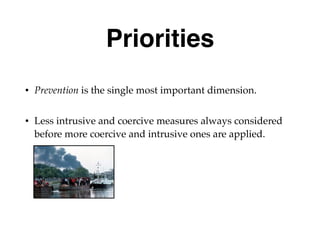
Priorities
• Prevention is the single most important dimension.
• Less intrusive and coercive measures always considered
before more coercive and intrusive ones are applied.
Principles for Military
Intervention
• Just cause threshold
• Precautionary principles
• Right authority
• Operational principles
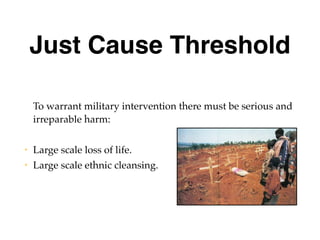
Just Cause Threshold
To warrant military intervention there must be serious and
irreparable harm:
• Large scale loss of life.
• Large scale ethnic cleansing.
Precautionary Principles
• Proportional means:
– scale, duration and intensity of should be the minimum
necessary.
• Reasonable prospects:
– reasonable chance of success.
– consequences of action not worse than the consequences of
inaction.
Right Authority
• Security Council most appropriate body.
• Authorization always sought prior to intervention.
• Security Council should deal promptly with requests.
• The Permanent Five members should agree not to apply
their veto power.
Right Authority/cont.
• If a proposal is rejected or not dealt with in a reasonable
time, alternative options are:
– General Assembly consideration under the “Uniting for Peace”
procedure.
– action by regional or sub-regional organizations.
• The Security Council must always consider its immense
responsibility.
– inaction may lead to concerned states resorting to other means.
– the nature and credibility of the United Nations may suffer.
Operational Principles
• Clear objectives at all times.
• Common military approach among involved partners:
– unity of command and clear communications.
• Acceptance of limitations, incrementalism and gradualism:
– objective human protection, not state defeat.
• Proportional rules of engagement that adhere to international
humanitarian law.
• Force protection not the principal objective.
• Maximum coordination with humanitarian organizations.
The Right to Intervene?
• Traditional term- has inherent problems.
• Focuses on the claims, rights and prerogatives of the
intervening states.
• Does not account for preventive effort or follow-up
assistance.
• Intrinsically more confrontational.
Objectives of a New
Approach
1. Clearer rules, procedures and criteria for determining
whether, when and how to intervene.
2. Legitimate military intervention when necessary and
after all other approaches have failed.
3. Effective military intervention carried out only for the
purposes proposed, that minimizes the human costs.
4. Eliminate the causes of conflict while enhancing the
prospects for durable and sustainable peace.
Human Security
• Security of people:
– physical safety.
– economic and social well being.
– dignity and worth as human beings.
– human rights and fundamental freedoms.
• The Universal Declaration of human Rights (1948)
embodies the moral code, political consensus and legal
synthesis of human rights.
R2P
Responsibility for protecting the lives of citizens lies with:
1. The sovereign state.
2. Domestic authorities acting in partnership with external
actors.
3. International organizations.
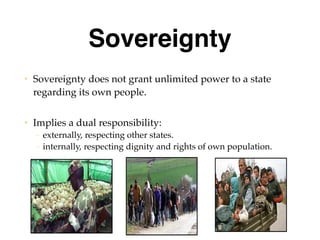
Sovereignty
• Sovereignty does not grant unlimited power to a state
regarding its own people.
• Implies a dual responsibility:
– externally, respecting other states.
– internally, respecting dignity and rights of own population.
Meaning of Intervention
• “Intervention” potentially covers a large number of
activities.
– controversial term.
• This report- “action taken against a state, without its
consent, for claimed humanitarian or protective purposes.”
UN Intervention
• Legitimate because it is authorized by a representative
international body.
• Unilateral intervention illegitimate because of self-
interests.
• States must renounce unilateral use of force for national
purposes.
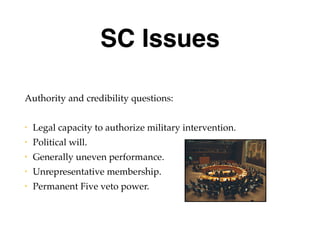
SC Issues
Authority and credibility questions:
• Legal capacity to authorize military intervention.
• Political will.
• Generally uneven performance.
• Unrepresentative membership.
• Permanent Five veto power.
SC Past Performance
• Often fallen short of responsibilities.
• Due to factors such as:
– sheer lack of interest.
– concern about political impacts.
– disagreements between permanent 5 members.
– reluctance to bear the financial and personnel burdens of
international action.
SC - Report Conclusions
• Security Council most appropriate body for decisions
about:
– overriding state sovereignty.
– mobilizing military resources.
• Goal - to make the Security Council work better than it has.
SC - Improvements
• A “code of conduct” for the use of the veto.
– a permanent member would not obstruct passing an otherwise
majority resolution.
• Clear, responsible and consistent leadership.
– never abdicating responsibility.
– valuing human life above politics.
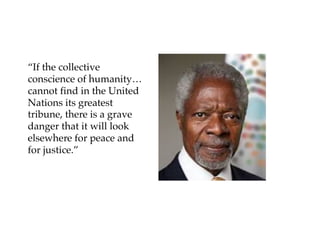
“If the collective
conscience of humanity…
cannot find in the United
Nations its greatest
tribune, there is a grave
danger that it will look
elsewhere for peace and
for justice.”
Responsibility to Prevent
• Failed prevention can have international consequences.
• Strong support from the international community is often
needed:
– development assistance.
– support for local initiatives to advance good governance, human
rights and/or rule of law.
– mediation efforts.
Prevention Resources
• Organization of African Unity - 1993 Mechanism for
Conflict Prevention , Management and Settlement.
• Organization for Security and Cooperation in Europe -
developed a number of mechanisms for preventing conflict
in Europe.
• Increasingly significant role of NGOs.
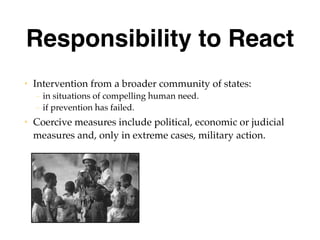
Responsibility to React
• Intervention from a broader community of states:
– in situations of compelling human need.
– if prevention has failed.
• Coercive measures include political, economic or judicial
measures and, only in extreme cases, military action.
Measures
• Sanctions
– do not directly interfere with the capacity of a domestic authority to
operate.
– often indiscriminate - need to avoid doing more harm than good.
– in Iraq sanctions are resulting in massive harm to the civilian
population.
Types of Sanctions
• Military
– arms embargoes.
– ending military cooperation and training programs.
• Economic
– financial sanctions targeting assets.
– restrictions on income generating activities.
– aviation bans.
• Political and Diplomatic
– restrictions on diplomatic representation.
– restrictions on travel.
– expulsion from international or regional bodies.
Military Action
• Should only occur in extreme situations.
– what constitutes ‘extreme’ situations?
• The starting point should be the principle of non-
intervention.
– equivalent to the Hippocratic principle - ‘do no harm’.
• Need to satisfy the threshold conditions and precautionary
principles.
Responsibility to Rebuild
• In the past:
– responsibility to rebuild not recognized.
– exit of the interveners poorly managed.
– commitment to reconstruction inadequate.
– underlying problems that produced the original intervention
action not addressed.
• Genuine commitment to reconstitute public safety and
order needed if military intervention is taken.
• International and local partnerships -with progressive
transferring of authority and responsibility to local
authorities.
Responsibility to Rebuild/
cont.
• True reconciliation is best generated by ground level
reconstruction efforts.
• Requires more than purely diplomatic and military action:
– creation or strengthening of national institutions.
– monitoring elections.
– promoting human rights.
– providing for reintegration and rehabilitation and development.
Responsibility to Rebuild/
cont.
• Critical priorities to avoid resurgence of the conflict:
– reconciliation and respect for human rights of all populations.
– political inclusiveness and national unity.
– repatriation and resettlement of refugees and displaced persons.
– reintegration of ex-combatants into productive society.
– domestic and international resources for reconstruction and
economic recovery.

R2P.pdf

  • 1.
    Foundations • Obligations inherentin the concept of sovereignty. • The responsibility of the UN Security Council • Specific legal obligations: – human rights and protection declarations. – covenants and treaties. – humanitarian law. • The developing practice of states, regional organizations and the Security Council.
  • 2.
    Elements • The responsibilityto prevent – address root causes. • The responsibility to react – respond with appropriate measures. • The responsibility to rebuild – full assistance with recovery, reconstruction and reconciliation.
  • 3.
    Priorities • Prevention isthe single most important dimension. • Less intrusive and coercive measures always considered before more coercive and intrusive ones are applied.
  • 4.
    Principles for Military Intervention •Just cause threshold • Precautionary principles • Right authority • Operational principles
  • 5.
    Just Cause Threshold Towarrant military intervention there must be serious and irreparable harm: • Large scale loss of life. • Large scale ethnic cleansing.
  • 6.
    Precautionary Principles • Proportionalmeans: – scale, duration and intensity of should be the minimum necessary. • Reasonable prospects: – reasonable chance of success. – consequences of action not worse than the consequences of inaction.
  • 7.
    Right Authority • SecurityCouncil most appropriate body. • Authorization always sought prior to intervention. • Security Council should deal promptly with requests. • The Permanent Five members should agree not to apply their veto power.
  • 8.
    Right Authority/cont. • Ifa proposal is rejected or not dealt with in a reasonable time, alternative options are: – General Assembly consideration under the “Uniting for Peace” procedure. – action by regional or sub-regional organizations. • The Security Council must always consider its immense responsibility. – inaction may lead to concerned states resorting to other means. – the nature and credibility of the United Nations may suffer.
  • 9.
    Operational Principles • Clearobjectives at all times. • Common military approach among involved partners: – unity of command and clear communications. • Acceptance of limitations, incrementalism and gradualism: – objective human protection, not state defeat. • Proportional rules of engagement that adhere to international humanitarian law. • Force protection not the principal objective. • Maximum coordination with humanitarian organizations.
  • 10.
    The Right toIntervene? • Traditional term- has inherent problems. • Focuses on the claims, rights and prerogatives of the intervening states. • Does not account for preventive effort or follow-up assistance. • Intrinsically more confrontational.
  • 11.
    Objectives of aNew Approach 1. Clearer rules, procedures and criteria for determining whether, when and how to intervene. 2. Legitimate military intervention when necessary and after all other approaches have failed. 3. Effective military intervention carried out only for the purposes proposed, that minimizes the human costs. 4. Eliminate the causes of conflict while enhancing the prospects for durable and sustainable peace.
  • 12.
    Human Security • Securityof people: – physical safety. – economic and social well being. – dignity and worth as human beings. – human rights and fundamental freedoms. • The Universal Declaration of human Rights (1948) embodies the moral code, political consensus and legal synthesis of human rights.
  • 13.
    R2P Responsibility for protectingthe lives of citizens lies with: 1. The sovereign state. 2. Domestic authorities acting in partnership with external actors. 3. International organizations.
  • 14.
    Sovereignty • Sovereignty doesnot grant unlimited power to a state regarding its own people. • Implies a dual responsibility: – externally, respecting other states. – internally, respecting dignity and rights of own population.
  • 15.
    Meaning of Intervention •“Intervention” potentially covers a large number of activities. – controversial term. • This report- “action taken against a state, without its consent, for claimed humanitarian or protective purposes.”
  • 16.
    UN Intervention • Legitimatebecause it is authorized by a representative international body. • Unilateral intervention illegitimate because of self- interests. • States must renounce unilateral use of force for national purposes.
  • 17.
    SC Issues Authority andcredibility questions: • Legal capacity to authorize military intervention. • Political will. • Generally uneven performance. • Unrepresentative membership. • Permanent Five veto power.
  • 18.
    SC Past Performance •Often fallen short of responsibilities. • Due to factors such as: – sheer lack of interest. – concern about political impacts. – disagreements between permanent 5 members. – reluctance to bear the financial and personnel burdens of international action.
  • 19.
    SC - ReportConclusions • Security Council most appropriate body for decisions about: – overriding state sovereignty. – mobilizing military resources. • Goal - to make the Security Council work better than it has.
  • 20.
    SC - Improvements •A “code of conduct” for the use of the veto. – a permanent member would not obstruct passing an otherwise majority resolution. • Clear, responsible and consistent leadership. – never abdicating responsibility. – valuing human life above politics.
  • 21.
    “If the collective conscienceof humanity… cannot find in the United Nations its greatest tribune, there is a grave danger that it will look elsewhere for peace and for justice.”
  • 22.
    Responsibility to Prevent •Failed prevention can have international consequences. • Strong support from the international community is often needed: – development assistance. – support for local initiatives to advance good governance, human rights and/or rule of law. – mediation efforts.
  • 23.
    Prevention Resources • Organizationof African Unity - 1993 Mechanism for Conflict Prevention , Management and Settlement. • Organization for Security and Cooperation in Europe - developed a number of mechanisms for preventing conflict in Europe. • Increasingly significant role of NGOs.
  • 24.
    Responsibility to React •Intervention from a broader community of states: – in situations of compelling human need. – if prevention has failed. • Coercive measures include political, economic or judicial measures and, only in extreme cases, military action.
  • 25.
    Measures • Sanctions – donot directly interfere with the capacity of a domestic authority to operate. – often indiscriminate - need to avoid doing more harm than good. – in Iraq sanctions are resulting in massive harm to the civilian population.
  • 26.
    Types of Sanctions •Military – arms embargoes. – ending military cooperation and training programs. • Economic – financial sanctions targeting assets. – restrictions on income generating activities. – aviation bans. • Political and Diplomatic – restrictions on diplomatic representation. – restrictions on travel. – expulsion from international or regional bodies.
  • 27.
    Military Action • Shouldonly occur in extreme situations. – what constitutes ‘extreme’ situations? • The starting point should be the principle of non- intervention. – equivalent to the Hippocratic principle - ‘do no harm’. • Need to satisfy the threshold conditions and precautionary principles.
  • 28.
    Responsibility to Rebuild •In the past: – responsibility to rebuild not recognized. – exit of the interveners poorly managed. – commitment to reconstruction inadequate. – underlying problems that produced the original intervention action not addressed. • Genuine commitment to reconstitute public safety and order needed if military intervention is taken. • International and local partnerships -with progressive transferring of authority and responsibility to local authorities.
  • 29.
    Responsibility to Rebuild/ cont. •True reconciliation is best generated by ground level reconstruction efforts. • Requires more than purely diplomatic and military action: – creation or strengthening of national institutions. – monitoring elections. – promoting human rights. – providing for reintegration and rehabilitation and development.
  • 30.
    Responsibility to Rebuild/ cont. •Critical priorities to avoid resurgence of the conflict: – reconciliation and respect for human rights of all populations. – political inclusiveness and national unity. – repatriation and resettlement of refugees and displaced persons. – reintegration of ex-combatants into productive society. – domestic and international resources for reconstruction and economic recovery.