Just War
TheoryIB Global Politics
UWC Costa Rica
What do you
think Just War
Theory is?
What do you
think Just War
Theory is?
Here’s a clue…
Just War Theory –
Michael Walzer
Just War Theory: The
Basics
Just War Theory specifies
conditions for judging if it
is just to go to war and
conditions for how the
war should be fought
Extensively developed by Christian
theologians - attempts to reconcile
three things
• Taking human life is seriously wrong
• States have a duty to defend their citizens,
and defend justice
• Protecting innocent human life and
defending important moral values
sometimes requires willingness to use
force and violence
How do we decide if a war is
just?
• Series of criteria – all of which must be
met if a war is to be considered just
• Criteria split into two categories:
– Jus ad bellum (the right to go to war)
– Jus in bello (the right conduct in war)
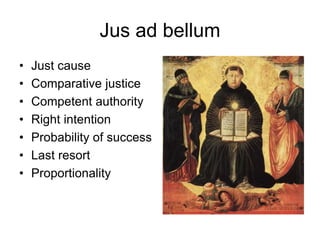
Jus ad bellum
• Just cause
• Comparative justice
• Competent authority
• Right intention
• Probability of success
• Last resort
• Proportionality
Jus ad bellum 1 – Just cause
• The reason for going to war needs to be just
and cannot therefore be solely for recapturing
things taken or punishing people who have
done wrong; innocent life must be in
imminent danger and intervention must be to
protect life
• "Force may be used only to correct a grave,
public evil, i.e., aggression or massive
violation of the basic human rights of whole
populations.”
(US Catholic Conference, 1993)
Jus ad bellum 2 – Comparative
justice
• While there may be rights and wrongs on
all sides of a conflict, to overcome the
presumption against the use of force, the
injustice suffered by one party must
significantly outweigh that suffered by the
other
Jus ad bellum 3 – Competent
authority
• Only duly constituted public authorities may wage war
• Dictatorships (i.e. Hitler's Regime) or a deceptive military
actions (i.e. the 1968 US bombing of Cambodia) are typically
considered as violations of this criterion.
• ‘The importance of this condition is key. Plainly, we cannot
have a genuine process of judging a just war within a system
that represses the process of genuine justice. A just war must
be initiated by a political authority within a political system that
allows distinctions of justice’
Taken directly from
http://oregonstate.edu/instruct/phl201/modules/just_war_theory/criteria_intro.html
Jus ad bellum 4 – Right
intention
• Force may be used only in a truly just
cause and solely for that purpose
• Correcting a suffered wrong is considered
a right intention, while material gain or
maintaining economies is not
• E.g. ceasefire at end of first Gulf War
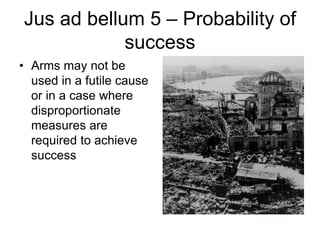
Jus ad bellum 5 – Probability of
success
• Arms may not be
used in a futile cause
or in a case where
disproportionate
measures are
required to achieve
success
Jus ad bellum 6 – Last resort
• Force may be used only after all peaceful
and viable alternatives have been
seriously tried and exhausted or are
clearly not practical
Jus ad bellum 7 - Proportionality
• The anticipated benefits of waging a war
must be proportionate to its expected evils
or harms
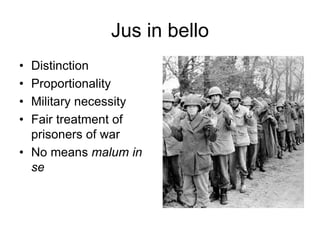
Jus in bello
• Distinction
• Proportionality
• Military necessity
• Fair treatment of
prisoners of war
• No means malum in
se
Jus in bello 1 - Distinction
• Just war conduct should be governed by
the principle of distinction.
• The acts of war should be directed
towards enemy combatants, and not
towards non-combatants caught in
circumstances they did not create.
Jus in bello 2 - Proportionality
• Just war conduct should be governed by
the principle of proportionality
• Combatants must make sure that the harm
caused to civilians or civilian property is
not excessive in relation to the concrete
and direct military advantage anticipated
by an attack on a legitimate military
objective
Jus in bello 3 – military
necessity
• Just war conduct should be governed by
the principle of military necessity
• An attack or action must be intended to
help in the defeat of the enemy
Jus in bello 4 – Fair treatment of
POWs
• Enemy combatants who surrendered or
who are captured no longer pose a threat
• It is therefore wrong to torture them or
otherwise mistreat them
Jus in bello 5 - No means
malum in se
• This means wrong or evil in itself
• Combatants may not use weapons or
other methods of warfare that are
considered evil, such as mass rape,
forcing enemy combatants to fight against
their own side or using weapons whose
effects cannot be controlled (e.g.,
nuclear/biological weapons).
Just War and Humanitarian
Intervention
“We are in no position morally or
politically to do that. So would have
to be somebody else who went into
Darfur”
What does Walzer make this
claim?
Just War and Iraq
“We needed what Colin Powell called smart
sanctions, because the sanction system was
hurting ordinary Iraqi civilians, but there
should have been a way--and I have spoken
to some of the people who were running the
embargo who say there were ways--to deal
just with weapons and not to prevent food
and medicine from reaching the people”
Was the Iraq War a just war?
How does this relate to our understanding of
humanitarian intervention?
Just War and Terrorism
“It is the deliberate killing of people
who are known not to be
government employees,
government agents, soldiers,
police, the deliberate killing of
people like you and me”
Can terrorism ever be justified?

Just war theory

  • 1.
    Just War TheoryIB GlobalPolitics UWC Costa Rica
  • 2.
    What do you thinkJust War Theory is?
  • 3.
    What do you thinkJust War Theory is? Here’s a clue…
  • 4.
    Just War Theory– Michael Walzer
  • 5.
    Just War Theory:The Basics Just War Theory specifies conditions for judging if it is just to go to war and conditions for how the war should be fought
  • 6.
    Extensively developed byChristian theologians - attempts to reconcile three things • Taking human life is seriously wrong • States have a duty to defend their citizens, and defend justice • Protecting innocent human life and defending important moral values sometimes requires willingness to use force and violence
  • 7.
    How do wedecide if a war is just? • Series of criteria – all of which must be met if a war is to be considered just • Criteria split into two categories: – Jus ad bellum (the right to go to war) – Jus in bello (the right conduct in war)
  • 8.
    Jus ad bellum •Just cause • Comparative justice • Competent authority • Right intention • Probability of success • Last resort • Proportionality
  • 9.
    Jus ad bellum1 – Just cause • The reason for going to war needs to be just and cannot therefore be solely for recapturing things taken or punishing people who have done wrong; innocent life must be in imminent danger and intervention must be to protect life • "Force may be used only to correct a grave, public evil, i.e., aggression or massive violation of the basic human rights of whole populations.” (US Catholic Conference, 1993)
  • 10.
    Jus ad bellum2 – Comparative justice • While there may be rights and wrongs on all sides of a conflict, to overcome the presumption against the use of force, the injustice suffered by one party must significantly outweigh that suffered by the other
  • 11.
    Jus ad bellum3 – Competent authority • Only duly constituted public authorities may wage war • Dictatorships (i.e. Hitler's Regime) or a deceptive military actions (i.e. the 1968 US bombing of Cambodia) are typically considered as violations of this criterion. • ‘The importance of this condition is key. Plainly, we cannot have a genuine process of judging a just war within a system that represses the process of genuine justice. A just war must be initiated by a political authority within a political system that allows distinctions of justice’ Taken directly from http://oregonstate.edu/instruct/phl201/modules/just_war_theory/criteria_intro.html
  • 12.
    Jus ad bellum4 – Right intention • Force may be used only in a truly just cause and solely for that purpose • Correcting a suffered wrong is considered a right intention, while material gain or maintaining economies is not • E.g. ceasefire at end of first Gulf War
  • 13.
    Jus ad bellum5 – Probability of success • Arms may not be used in a futile cause or in a case where disproportionate measures are required to achieve success
  • 14.
    Jus ad bellum6 – Last resort • Force may be used only after all peaceful and viable alternatives have been seriously tried and exhausted or are clearly not practical
  • 15.
    Jus ad bellum7 - Proportionality • The anticipated benefits of waging a war must be proportionate to its expected evils or harms
  • 16.
    Jus in bello •Distinction • Proportionality • Military necessity • Fair treatment of prisoners of war • No means malum in se
  • 17.
    Jus in bello1 - Distinction • Just war conduct should be governed by the principle of distinction. • The acts of war should be directed towards enemy combatants, and not towards non-combatants caught in circumstances they did not create.
  • 18.
    Jus in bello2 - Proportionality • Just war conduct should be governed by the principle of proportionality • Combatants must make sure that the harm caused to civilians or civilian property is not excessive in relation to the concrete and direct military advantage anticipated by an attack on a legitimate military objective
  • 19.
    Jus in bello3 – military necessity • Just war conduct should be governed by the principle of military necessity • An attack or action must be intended to help in the defeat of the enemy
  • 20.
    Jus in bello4 – Fair treatment of POWs • Enemy combatants who surrendered or who are captured no longer pose a threat • It is therefore wrong to torture them or otherwise mistreat them
  • 21.
    Jus in bello5 - No means malum in se • This means wrong or evil in itself • Combatants may not use weapons or other methods of warfare that are considered evil, such as mass rape, forcing enemy combatants to fight against their own side or using weapons whose effects cannot be controlled (e.g., nuclear/biological weapons).
  • 22.
    Just War andHumanitarian Intervention
  • 23.
    “We are inno position morally or politically to do that. So would have to be somebody else who went into Darfur” What does Walzer make this claim?
  • 24.
  • 25.
    “We needed whatColin Powell called smart sanctions, because the sanction system was hurting ordinary Iraqi civilians, but there should have been a way--and I have spoken to some of the people who were running the embargo who say there were ways--to deal just with weapons and not to prevent food and medicine from reaching the people” Was the Iraq War a just war? How does this relate to our understanding of humanitarian intervention?
  • 26.
    Just War andTerrorism
  • 27.
    “It is thedeliberate killing of people who are known not to be government employees, government agents, soldiers, police, the deliberate killing of people like you and me” Can terrorism ever be justified?