Universal Peace Federation

Principles of
Ambassadors for
Peace
Ambassadors for Peace:
A global alliance of leaders
     aligned with core
    universal principles
Ambassador for Peace principles
   Are applicable at all times, and in all
    places.
    Establish the “common ground” for
    cooperation among diverse peoples.
    Form the basis for universal
    standards of peaceful behavior.
    Are found in the scriptures of the
    major religions.
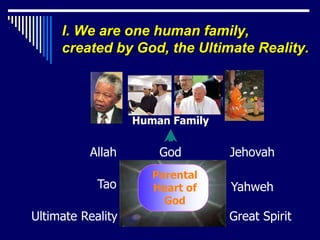
I. We are one human family,
     created by God, the Ultimate Reality.


                   Human Family


          Allah        God        Jehovah
                      Parental
            Tao       Heart of    Yahweh
                        God
Ultimate Reality                  Great Spirit
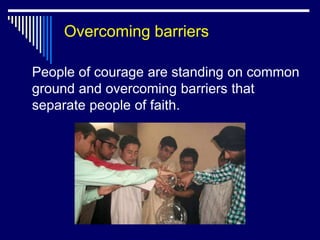
Overcoming barriers

People of courage are standing on common
ground and overcoming barriers that
separate people of faith.
Religious teachings

“Have we not one father? Has not one God made us all?” – Jewish and
Christian scriptures, Malachi 2:10
“Our Father who art in heaven, hallowed be thy name.” - Christianity, Matthew
6:9
-“All [human] creatures are God’s children, and those dearest to God are those
who treat His children kindly.” – Islam. Hadith of Baihaqi
“Thou art Father, Mother, Friend, Brother. With Thee as succorer in all places,
What fear have I?” - Sikhism, Adi Granth, Majh M.5
“You men are all my children, And I am your Father.” - Buddhism, Lotus Sutra 3
“Heaven and Earth are the father and mother of the ten thousand things. Men
are the sensibility of the ten thousand things.” – Confucianism. Book of History
5.1.1: The Great Declaration
“God! Give us wisdom as a father gives to his sons. Guide us, O Much-
invoked, in this path. May we live in light.” – Hinduism, Rig Veda 7.32.26
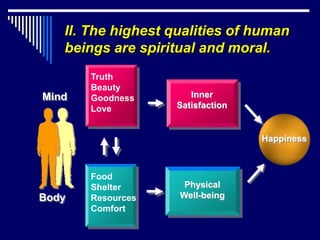
II. The highest qualities of human
   beings are spiritual and moral.
       Truth
       Beauty
Mind   Goodness       Inner
       Love        Satisfaction


                                  Happiness


       Food
       Shelter       Physical
Body   Resources    Well-being
       Comfort
Aiming for high goals


  Achieve our potential and develop our
character.
  Build loving relationships and family
bonds.
  Make a difference to society.
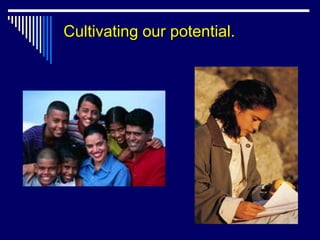
Cultivating our potential.
Religious teachings

“Then the Lord God formed man out of the dust of the ground, and breathed
into his nostrils the breath of life; and man became a living being.” - Jewish
and Christian scriptures, Genesis 2:7
“And He originated the creation of man out of clay, Then He fashioned his
progeny of an extraction of mean water, Then He shaped him, and breathed
His spirit in him.” - Islam, Qur’an 32:8-9
“Now my breath and spirit goes to the immortal, and this body ends in ashes;
OM O Mind! Remember. Remember the deeds. Remember the actions.”
– Hinduism. Isha Upanishad 17
“Even ornamental royal chariots wear out. So too the body reaches old age.
But the Dhamma of the Good grows not old.” – Buddhism. Dhammapada
147.51
“O shrewd businessman, do only profitable business; Deal only in that
commodity which shall accompany you after death.” Sikhism. Adi Granth,
Sri Raga M.1, p. 22
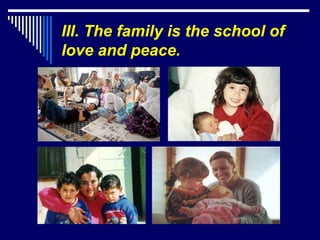
III. The family is the school of
love and peace.
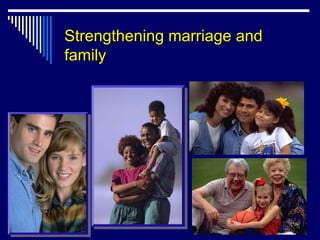
Strengthening marriage and
family
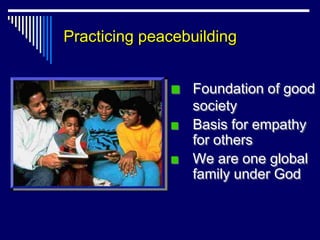
Practicing peacebuilding


                 Foundation of good
                 society
                 Basis for empathy
                 for others
                 We are one global
                 family under God
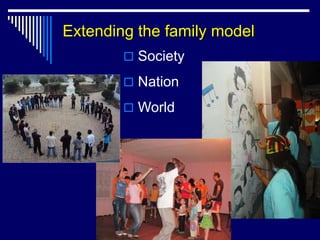
Extending the family model
         Society

         Nation

         World
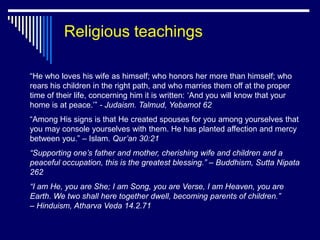
Religious teachings

“He who loves his wife as himself; who honors her more than himself; who
rears his children in the right path, and who marries them off at the proper
time of their life, concerning him it is written: „And you will know that your
home is at peace.‟” - Judaism. Talmud, Yebamot 62
“Among His signs is that He created spouses for you among yourselves that
you may console yourselves with them. He has planted affection and mercy
between you.” – Islam. Qur’an 30:21
“Supporting one’s father and mother, cherishing wife and children and a
peaceful occupation, this is the greatest blessing.” – Buddhism, Sutta Nipata
262
“I am He, you are She; I am Song, you are Verse, I am Heaven, you are
Earth. We two shall here together dwell, becoming parents of children.”
– Hinduism, Atharva Veda 14.2.71
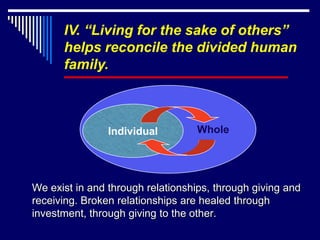
IV. “Living for the sake of others”
      helps reconcile the divided human
      family.


                Individual         Whole


We exist in and through relationships, through giving and
receiving. Broken relationships are healed through
investment, through giving to the other.
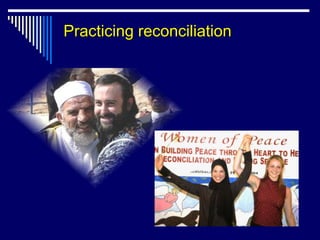
Practicing reconciliation
Applying religious teachings

You have heard that it was said, “You shall love
your neighbor and hate your enemy.” But I say
to you, love your enemies and pray for those
who persecute you, so that you may be sons of
your Father who is in heaven.
                  Matthew 5:43-48
The good deed and the evil deed are not alike.
Repel the evil deed with one which is better,
then lo!, he with whom you had enmity
shall become a bosom friend.
                  Qur’an 41.34
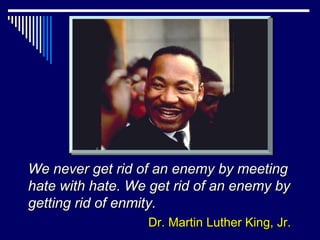
We never get rid of an enemy by meeting
hate with hate. We get rid of an enemy by
getting rid of enmity.
                  Dr. Martin Luther King, Jr.
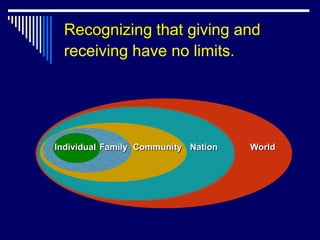
Recognizing that giving and
 receiving have no limits.


Individual Family Community Nation   World
Religious teachings

“All men are responsible for one another.” - Judaism. Talmud, Sanhedrin
27b
“Give and it will be given to you...for the measure you give will be the
measure your receive.” - Christianity, Luke 6.38
“Give not with the thought to gain, and be patient unto thy Lord.” - Islam,
Qur’an 74.6-7
“The man of perfect virtue, wishing to be established himself, seeks also to
establish others; wishing to be enlarged himself, he seeks also to enlarge
others.” – Confucianism, Analects 6.28.2
“The ignorant work for their own profit, Arjuna; the wise work for the welfare
of the world, without thought to themselves.” – Hinduism, Bhagavad Gita,
3.10-26
“Without selfless service are no objectives fulfilled; in service lies the purest
action.” Sikhism, Adi Granth, Maru M.1, p. 992
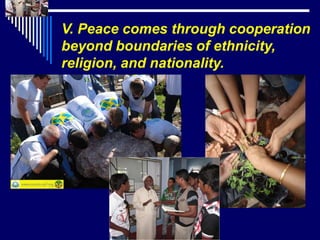
V. Peace comes through cooperation
beyond boundaries of ethnicity,
religion, and nationality.
Religious teachings

“My house shall be called a house of prayer for all peoples.” – Judaism,
Isaiah 56:7
“If possible, so far as it depends upon you, live peaceably with all.”
– Christianity, Romans 12:18-21
“O mankind! We created you from a single pair of a male and a female and
made you into nations and tribes, that you might know each other [not that
you might despise each other]. - Islam, Qur’an 49.13
“Let us have concord with our own people and concord with people who are
strangers to us.” Hinduism, Atharva Veda 7.52.1-2
“When the Great Tao prevailed, the world was a commonwealth; men of
talent and virtue were selected, mutual confidence was emphasized, and
brotherhood was cultivated.” – Confucianism, Book of Ritual
Drawing on spiritual resources


•   Religious traditions teach compassion,
    love for one‟s neighbor, and consideration
    for those in need.
•   The power to end the cycles of
    resentment, violence, and retribution
    comes from an internal, spiritual source.
Engaging in joint efforts

Foster interreligious and
international understanding and
cooperation.
Strengthen marriage and family.
Promote a culture of peace and
service.
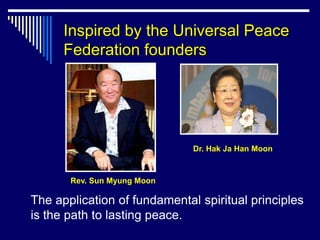
Inspired by the Universal Peace
      Federation founders


                              Dr. Hak Ja Han Moon


       Rev. Sun Myung Moon

The application of fundamental spiritual principles
is the path to lasting peace.
Become an Ambassador for
    Peace and apply the
     principles to bring
 reconciliation, healing, and
         hope to our
families, communities, nation
 s, and our troubled world.

     www.upf.org

Ambassador for Peace Principles

  • 1.
    Universal Peace Federation Principlesof Ambassadors for Peace
  • 2.
    Ambassadors for Peace: Aglobal alliance of leaders aligned with core universal principles
  • 3.
    Ambassador for Peaceprinciples  Are applicable at all times, and in all places. Establish the “common ground” for cooperation among diverse peoples. Form the basis for universal standards of peaceful behavior. Are found in the scriptures of the major religions.
  • 4.
    I. We areone human family, created by God, the Ultimate Reality. Human Family Allah God Jehovah Parental Tao Heart of Yahweh God Ultimate Reality Great Spirit
  • 5.
    Overcoming barriers People ofcourage are standing on common ground and overcoming barriers that separate people of faith.
  • 6.
    Religious teachings “Have wenot one father? Has not one God made us all?” – Jewish and Christian scriptures, Malachi 2:10 “Our Father who art in heaven, hallowed be thy name.” - Christianity, Matthew 6:9 -“All [human] creatures are God’s children, and those dearest to God are those who treat His children kindly.” – Islam. Hadith of Baihaqi “Thou art Father, Mother, Friend, Brother. With Thee as succorer in all places, What fear have I?” - Sikhism, Adi Granth, Majh M.5 “You men are all my children, And I am your Father.” - Buddhism, Lotus Sutra 3 “Heaven and Earth are the father and mother of the ten thousand things. Men are the sensibility of the ten thousand things.” – Confucianism. Book of History 5.1.1: The Great Declaration “God! Give us wisdom as a father gives to his sons. Guide us, O Much- invoked, in this path. May we live in light.” – Hinduism, Rig Veda 7.32.26
  • 7.
    II. The highestqualities of human beings are spiritual and moral. Truth Beauty Mind Goodness Inner Love Satisfaction Happiness Food Shelter Physical Body Resources Well-being Comfort
  • 8.
    Aiming for highgoals Achieve our potential and develop our character. Build loving relationships and family bonds. Make a difference to society.
  • 9.
  • 10.
    Religious teachings “Then theLord God formed man out of the dust of the ground, and breathed into his nostrils the breath of life; and man became a living being.” - Jewish and Christian scriptures, Genesis 2:7 “And He originated the creation of man out of clay, Then He fashioned his progeny of an extraction of mean water, Then He shaped him, and breathed His spirit in him.” - Islam, Qur’an 32:8-9 “Now my breath and spirit goes to the immortal, and this body ends in ashes; OM O Mind! Remember. Remember the deeds. Remember the actions.” – Hinduism. Isha Upanishad 17 “Even ornamental royal chariots wear out. So too the body reaches old age. But the Dhamma of the Good grows not old.” – Buddhism. Dhammapada 147.51 “O shrewd businessman, do only profitable business; Deal only in that commodity which shall accompany you after death.” Sikhism. Adi Granth, Sri Raga M.1, p. 22
  • 11.
    III. The familyis the school of love and peace.
  • 12.
  • 13.
    Practicing peacebuilding Foundation of good society Basis for empathy for others We are one global family under God
  • 14.
    Extending the familymodel  Society  Nation  World
  • 15.
    Religious teachings “He wholoves his wife as himself; who honors her more than himself; who rears his children in the right path, and who marries them off at the proper time of their life, concerning him it is written: „And you will know that your home is at peace.‟” - Judaism. Talmud, Yebamot 62 “Among His signs is that He created spouses for you among yourselves that you may console yourselves with them. He has planted affection and mercy between you.” – Islam. Qur’an 30:21 “Supporting one’s father and mother, cherishing wife and children and a peaceful occupation, this is the greatest blessing.” – Buddhism, Sutta Nipata 262 “I am He, you are She; I am Song, you are Verse, I am Heaven, you are Earth. We two shall here together dwell, becoming parents of children.” – Hinduism, Atharva Veda 14.2.71
  • 16.
    IV. “Living forthe sake of others” helps reconcile the divided human family. Individual Whole We exist in and through relationships, through giving and receiving. Broken relationships are healed through investment, through giving to the other.
  • 17.
  • 18.
    Applying religious teachings Youhave heard that it was said, “You shall love your neighbor and hate your enemy.” But I say to you, love your enemies and pray for those who persecute you, so that you may be sons of your Father who is in heaven. Matthew 5:43-48 The good deed and the evil deed are not alike. Repel the evil deed with one which is better, then lo!, he with whom you had enmity shall become a bosom friend. Qur’an 41.34
  • 19.
    We never getrid of an enemy by meeting hate with hate. We get rid of an enemy by getting rid of enmity. Dr. Martin Luther King, Jr.
  • 20.
    Recognizing that givingand receiving have no limits. Individual Family Community Nation World
  • 21.
    Religious teachings “All menare responsible for one another.” - Judaism. Talmud, Sanhedrin 27b “Give and it will be given to you...for the measure you give will be the measure your receive.” - Christianity, Luke 6.38 “Give not with the thought to gain, and be patient unto thy Lord.” - Islam, Qur’an 74.6-7 “The man of perfect virtue, wishing to be established himself, seeks also to establish others; wishing to be enlarged himself, he seeks also to enlarge others.” – Confucianism, Analects 6.28.2 “The ignorant work for their own profit, Arjuna; the wise work for the welfare of the world, without thought to themselves.” – Hinduism, Bhagavad Gita, 3.10-26 “Without selfless service are no objectives fulfilled; in service lies the purest action.” Sikhism, Adi Granth, Maru M.1, p. 992
  • 22.
    V. Peace comesthrough cooperation beyond boundaries of ethnicity, religion, and nationality.
  • 23.
    Religious teachings “My houseshall be called a house of prayer for all peoples.” – Judaism, Isaiah 56:7 “If possible, so far as it depends upon you, live peaceably with all.” – Christianity, Romans 12:18-21 “O mankind! We created you from a single pair of a male and a female and made you into nations and tribes, that you might know each other [not that you might despise each other]. - Islam, Qur’an 49.13 “Let us have concord with our own people and concord with people who are strangers to us.” Hinduism, Atharva Veda 7.52.1-2 “When the Great Tao prevailed, the world was a commonwealth; men of talent and virtue were selected, mutual confidence was emphasized, and brotherhood was cultivated.” – Confucianism, Book of Ritual
  • 24.
    Drawing on spiritualresources • Religious traditions teach compassion, love for one‟s neighbor, and consideration for those in need. • The power to end the cycles of resentment, violence, and retribution comes from an internal, spiritual source.
  • 25.
    Engaging in jointefforts Foster interreligious and international understanding and cooperation. Strengthen marriage and family. Promote a culture of peace and service.
  • 26.
    Inspired by theUniversal Peace Federation founders Dr. Hak Ja Han Moon Rev. Sun Myung Moon The application of fundamental spiritual principles is the path to lasting peace.
  • 27.
    Become an Ambassadorfor Peace and apply the principles to bring reconciliation, healing, and hope to our families, communities, nation s, and our troubled world. www.upf.org