Conflict between Nations
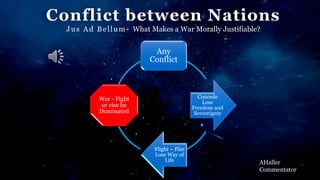
Jus Ad Bellum- What Makes a War Morally Justifiable?
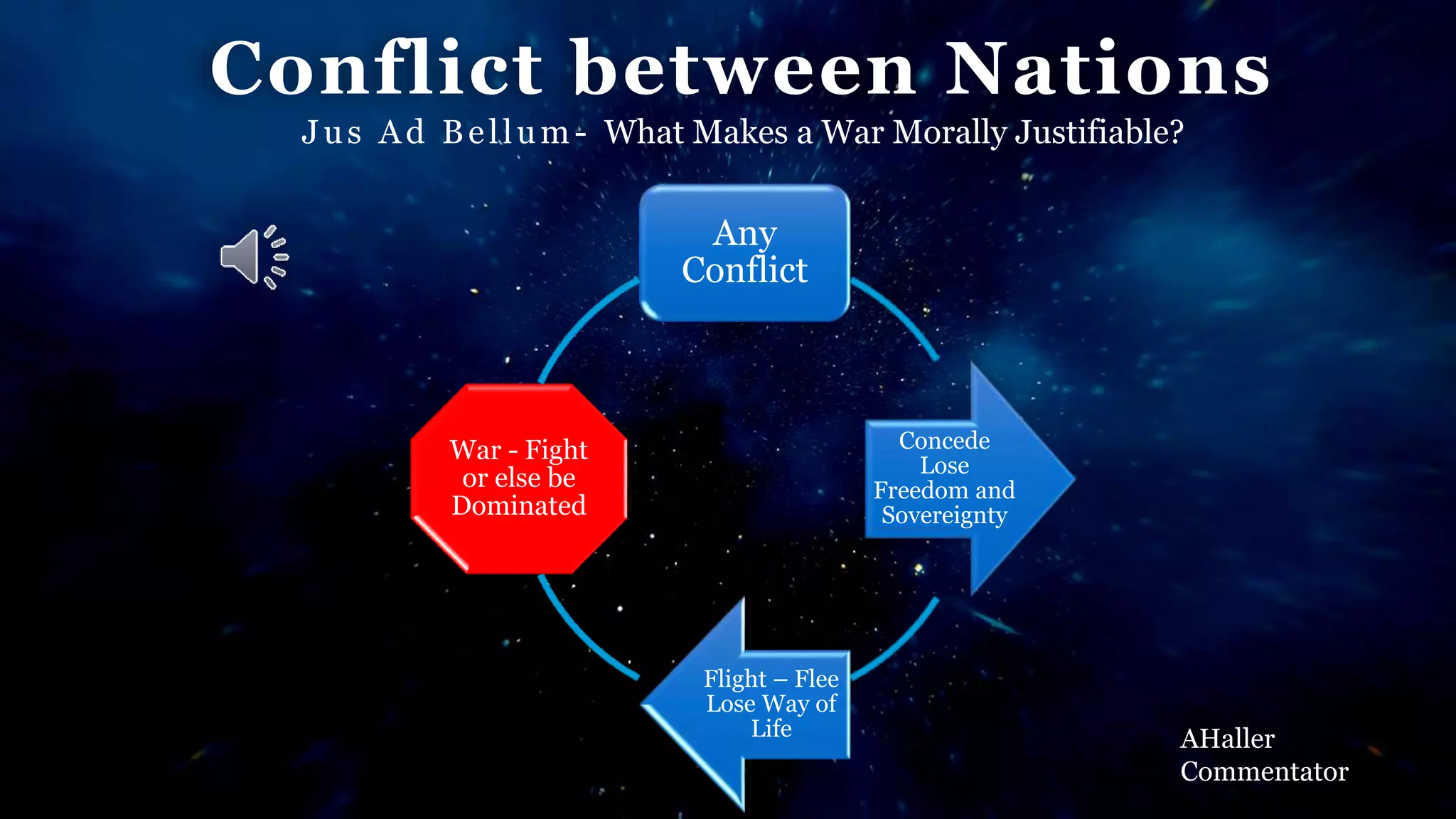
Any
Conflict
Concede
Lose
Freedom and
Sovereignty
Flight – Flee
Lose Way of
Life
War - Fight
or else be
Dominated
AHaller
Commentator
From a Western Perspective
• Geneva Conventions
• The Geneva Conventions establish standards for
humanitarian treatment in war.
• They define the basic rights of wartime prisoners,
established protections for the wounded and sick,
and provided protections for the civilians in and
around a war-zone.
• They defines the rights and protections afforded to
non-combatants. The treaties have been ratified, in
their entirety or with reservations, by 196 countries.
The Geneva Conventions do not address the use of
weapons of war
• Hague Conventions
• They contain rules regulating warfare.
• The rules emanating from these Conventions govern
the use of means and methods of warfare, conduct of
hostilities and occupation.
• The Geneva Conventions primarily governed the
protection of war victims. Conventional, biological,
and chemical warfare are addressed by the Hague
Conventions.
A Historical Perspective
Catholic theologians St. Thomas Aquinas
and St. Augustine advanced the concept of a
just war.
A moral abhorrence towards war with a
readiness to accept that war stated it may
sometimes be necessary.
How does one determine when to resort to
the use of violence? What criteria does one
use?
How might the use of arms might be
restrained and made more humane to
achieve long lasting peace and justice?
Just war tradition found its expression in the Hague
and the Geneva Conventions.
American Catholics in World War I were told. "Our
Lord Jesus Christ does not stand for peace at any
price...If by Pacifism is meant the teaching that the
use of force is never justifiable, then, however well
meant, it is mistaken…“
Armed conflicts such as World War II and the Cold
War were judged according to the norms that St.
Augustine and St. Aquinas had advocated.
We must remember how common war appears in
world history. Eras of a sustained peace are truly the
exception in history.
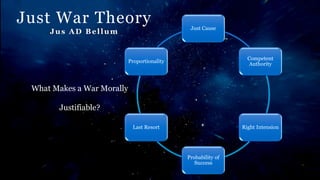
Just War Theory
Jus AD Bellum
Just Cause
Competent
Authority
Right Intension
Probability of
Success
Last Resort
Proportionality
What Makes a War Morally
Justifiable?
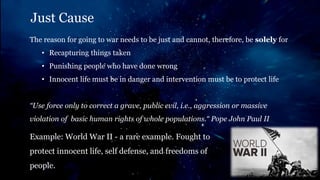
Just Cause
The reason for going to war needs to be just and cannot, therefore, be solely for
• Recapturing things taken
• Punishing people who have done wrong
• Innocent life must be in danger and intervention must be to protect life
“Use force only to correct a grave, public evil, i.e., aggression or massive
violation of basic human rights of whole populations.“ Pope John Paul II
Example: World War II - a rare example. Fought to
protect innocent life, self defense, and freedoms of
people.
Example:
Dictatorships or deceptive military actions are typically considered as
violations of this criterion.
Competent Authority
Only duly constituted public authorities may wage war not rogue
independent groups. A just war must be initiated by a political authority
within a political system that allows distinctions of justice.
Right Intentions
• A state must only terminate a war under the conditions agreed upon.
• Revenge is not permitted.
• The victor state must also be willing to apply the same level of
objectivity and investigation into any war crimes its armed forces may
have committed.
Probability of Success
Arms may not be used in a futile cause or in a case where
disproportionate measures are required to achieve success.
Example:
• Avoid the unnecessary loss of life. Avoid risking lives where the
chance of success would be highly improbable
• There must be a reasonable chance of success unless faced with “live
free or die”. Surrender means torture or death.
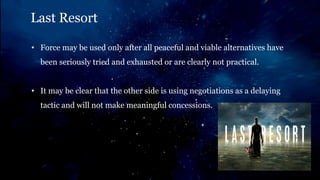
Last Resort
• Force may be used only after all peaceful and viable alternatives have
been seriously tried and exhausted or are clearly not practical.
• It may be clear that the other side is using negotiations as a delaying
tactic and will not make meaningful concessions.
Proportionality
• The anticipated benefits of waging a war must be proportionate to its
expected evils or harms.
• This principle is also known as the principle of macro-proportionality,
so as to distinguish it from the jus in bello principle of proportionality.
• In modern terms, just war is waged in terms of self-defense, or in
defense of another (with sufficient evidence).
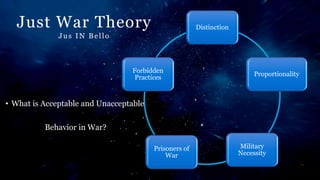
Just War Theory
Jus IN Bello
• What is Acceptable and Unacceptable
Behavior in War?
Distinction
Proportionality
Military
Necessity
Prisoners of
War
Forbidden
Practices
Distinction
The acts of war should be directed towards enemy combatants, and not
towards non-combatants. Prohibited
• acts include bombing civilian residential areas having no legitimate
military targets
• committing acts of terrorism or reprisal against civilians or
prisoners of war (POWs) or attacking neutral targets.
• attacking enemy combatants who have surrendered or who have
been captured or who are injured or shipwrecked and pose no
immediate lethal threat.
Proportionality
• Combatants must make sure that the harm caused to civilians or civilian
property is not excessive in relation to the concrete and direct military
advantage anticipated by an attack on a legitimate military objective.
• Discern the correct balance between the restriction imposed by a
corrective measure and the severity of the nature of the prohibited act.
Military Necessity
• An attack or action must be intended to help in the defeat of the enemy;
it must be an attack on a legitimate military objective.
• The harm caused to civilians or civilian property must be proportional
and not excessive in relation to the concrete and direct military
advantage anticipated.
• This principle is meant to limit excessive and unnecessary death and
destruction.
Prisoners of War Examples
American POWs by Japan
American POWs by Vietnam
Soviet POWs by the Nazis
Nazi POWs by the Soviets
Per the Geneva conventions the Allies
gave basic medical, provision, and shelter
to their enemies
The Allies did visit horror on civilian
populations to speed up the end of the
war.
Peace was achieved sooner rather than
later when casualties would have been
innumerable.
• Enemy combatants who
surrendered or who are captured
and no longer pose a threat must
be treated fairly.
• Torture or denial of basic food,
water, shelter , or medical
attention are forbidden
Forbidden Practices
• Combatants may not use weapons or other methods of warfare
considered evil.
• Rape, forcing enemy combatants to fight against their own side or
using weapons whose effects cannot be controlled such as nuclear or
biological weapons.
Entering into Evil: Rare but sometimes moral leaders need to
enter into evil. Commit one evil so a greater one does not happen.
• Churchill’s bombing of the French fleet so Hitler could not claim it.
• Churchill’s failure to forewarn Coventry least thus revealing he
knew Hitler’s encrypted communications
Ending a war: Jus post bellum
Justice after a war: peace treaties, reconstruction, environmental remediation, war crimes
trials, and war reparations need addressing.
In World War II the Nuremburg trials held responsible those who committed war crimes.
Just cause for termination:
• Surrender: a formal apology, compensations, war crimes trials and rehabilitation.
• Just goals of the war cannot be reached. Excessive force is unwarranted.
Right intention:
• A state terminate a war under the conditions agreed upon in the above criteria.
Revenge is not permitted. The victor state must also be willing to apply the same
level of objectivity and investigation into any war crimes committed.
Public declaration: made by a legitimate authority, and the terms must be accepted by a
legitimate authority.
Discrimination: Punitive measures are to be limited to those directly responsible for the
conflict. Truth and reconciliation may be better punishing war crimes.
Proportionality: Draconian measures are prohibited.
Conflict between Nations
Jus Ad Bellum- What Makes a War Morally Justifiable?
AHaller
Commentator
Peace, as taught by Sacred Scripture and the experience of men itself, is
more than just the absence of war. And the Christian is aware that on
earth a human society that is completely and always peaceful is,
unfortunately, an utopia and that the ideologies which present it as easily
attainable only nourish vain hopes. The cause of peace will not go
forward by denying the possibility and the obligation to defend it.”
Pope John Paul II

Just War Theory Using Zoom (2).pptx

  • 1.
    Conflict between Nations JusAd Bellum- What Makes a War Morally Justifiable? Any Conflict Concede Lose Freedom and Sovereignty Flight – Flee Lose Way of Life War - Fight or else be Dominated AHaller Commentator
  • 2.
    From a WesternPerspective • Geneva Conventions • The Geneva Conventions establish standards for humanitarian treatment in war. • They define the basic rights of wartime prisoners, established protections for the wounded and sick, and provided protections for the civilians in and around a war-zone. • They defines the rights and protections afforded to non-combatants. The treaties have been ratified, in their entirety or with reservations, by 196 countries. The Geneva Conventions do not address the use of weapons of war • Hague Conventions • They contain rules regulating warfare. • The rules emanating from these Conventions govern the use of means and methods of warfare, conduct of hostilities and occupation. • The Geneva Conventions primarily governed the protection of war victims. Conventional, biological, and chemical warfare are addressed by the Hague Conventions.
  • 3.
    A Historical Perspective Catholictheologians St. Thomas Aquinas and St. Augustine advanced the concept of a just war. A moral abhorrence towards war with a readiness to accept that war stated it may sometimes be necessary. How does one determine when to resort to the use of violence? What criteria does one use? How might the use of arms might be restrained and made more humane to achieve long lasting peace and justice? Just war tradition found its expression in the Hague and the Geneva Conventions. American Catholics in World War I were told. "Our Lord Jesus Christ does not stand for peace at any price...If by Pacifism is meant the teaching that the use of force is never justifiable, then, however well meant, it is mistaken…“ Armed conflicts such as World War II and the Cold War were judged according to the norms that St. Augustine and St. Aquinas had advocated. We must remember how common war appears in world history. Eras of a sustained peace are truly the exception in history.
  • 4.
    Just War Theory JusAD Bellum Just Cause Competent Authority Right Intension Probability of Success Last Resort Proportionality What Makes a War Morally Justifiable?
  • 5.
    Just Cause The reasonfor going to war needs to be just and cannot, therefore, be solely for • Recapturing things taken • Punishing people who have done wrong • Innocent life must be in danger and intervention must be to protect life “Use force only to correct a grave, public evil, i.e., aggression or massive violation of basic human rights of whole populations.“ Pope John Paul II Example: World War II - a rare example. Fought to protect innocent life, self defense, and freedoms of people.
  • 6.
    Example: Dictatorships or deceptivemilitary actions are typically considered as violations of this criterion. Competent Authority Only duly constituted public authorities may wage war not rogue independent groups. A just war must be initiated by a political authority within a political system that allows distinctions of justice.
  • 7.
    Right Intentions • Astate must only terminate a war under the conditions agreed upon. • Revenge is not permitted. • The victor state must also be willing to apply the same level of objectivity and investigation into any war crimes its armed forces may have committed.
  • 8.
    Probability of Success Armsmay not be used in a futile cause or in a case where disproportionate measures are required to achieve success. Example: • Avoid the unnecessary loss of life. Avoid risking lives where the chance of success would be highly improbable • There must be a reasonable chance of success unless faced with “live free or die”. Surrender means torture or death.
  • 9.
    Last Resort • Forcemay be used only after all peaceful and viable alternatives have been seriously tried and exhausted or are clearly not practical. • It may be clear that the other side is using negotiations as a delaying tactic and will not make meaningful concessions.
  • 10.
    Proportionality • The anticipatedbenefits of waging a war must be proportionate to its expected evils or harms. • This principle is also known as the principle of macro-proportionality, so as to distinguish it from the jus in bello principle of proportionality. • In modern terms, just war is waged in terms of self-defense, or in defense of another (with sufficient evidence).
  • 11.
    Just War Theory JusIN Bello • What is Acceptable and Unacceptable Behavior in War? Distinction Proportionality Military Necessity Prisoners of War Forbidden Practices
  • 12.
    Distinction The acts ofwar should be directed towards enemy combatants, and not towards non-combatants. Prohibited • acts include bombing civilian residential areas having no legitimate military targets • committing acts of terrorism or reprisal against civilians or prisoners of war (POWs) or attacking neutral targets. • attacking enemy combatants who have surrendered or who have been captured or who are injured or shipwrecked and pose no immediate lethal threat.
  • 13.
    Proportionality • Combatants mustmake sure that the harm caused to civilians or civilian property is not excessive in relation to the concrete and direct military advantage anticipated by an attack on a legitimate military objective. • Discern the correct balance between the restriction imposed by a corrective measure and the severity of the nature of the prohibited act.
  • 14.
    Military Necessity • Anattack or action must be intended to help in the defeat of the enemy; it must be an attack on a legitimate military objective. • The harm caused to civilians or civilian property must be proportional and not excessive in relation to the concrete and direct military advantage anticipated. • This principle is meant to limit excessive and unnecessary death and destruction.
  • 15.
    Prisoners of WarExamples American POWs by Japan American POWs by Vietnam Soviet POWs by the Nazis Nazi POWs by the Soviets Per the Geneva conventions the Allies gave basic medical, provision, and shelter to their enemies The Allies did visit horror on civilian populations to speed up the end of the war. Peace was achieved sooner rather than later when casualties would have been innumerable. • Enemy combatants who surrendered or who are captured and no longer pose a threat must be treated fairly. • Torture or denial of basic food, water, shelter , or medical attention are forbidden
  • 16.
    Forbidden Practices • Combatantsmay not use weapons or other methods of warfare considered evil. • Rape, forcing enemy combatants to fight against their own side or using weapons whose effects cannot be controlled such as nuclear or biological weapons. Entering into Evil: Rare but sometimes moral leaders need to enter into evil. Commit one evil so a greater one does not happen. • Churchill’s bombing of the French fleet so Hitler could not claim it. • Churchill’s failure to forewarn Coventry least thus revealing he knew Hitler’s encrypted communications
  • 17.
    Ending a war:Jus post bellum Justice after a war: peace treaties, reconstruction, environmental remediation, war crimes trials, and war reparations need addressing. In World War II the Nuremburg trials held responsible those who committed war crimes. Just cause for termination: • Surrender: a formal apology, compensations, war crimes trials and rehabilitation. • Just goals of the war cannot be reached. Excessive force is unwarranted. Right intention: • A state terminate a war under the conditions agreed upon in the above criteria. Revenge is not permitted. The victor state must also be willing to apply the same level of objectivity and investigation into any war crimes committed. Public declaration: made by a legitimate authority, and the terms must be accepted by a legitimate authority. Discrimination: Punitive measures are to be limited to those directly responsible for the conflict. Truth and reconciliation may be better punishing war crimes. Proportionality: Draconian measures are prohibited.
  • 18.
    Conflict between Nations JusAd Bellum- What Makes a War Morally Justifiable? AHaller Commentator Peace, as taught by Sacred Scripture and the experience of men itself, is more than just the absence of war. And the Christian is aware that on earth a human society that is completely and always peaceful is, unfortunately, an utopia and that the ideologies which present it as easily attainable only nourish vain hopes. The cause of peace will not go forward by denying the possibility and the obligation to defend it.” Pope John Paul II

Editor's Notes

  • #2 https://unsplash.com/photos/AXu2aZ3YgP8
  • #3 https://unsplash.com/photos/AXu2aZ3YgP8
  • #4 https://unsplash.com/photos/AXu2aZ3YgP8
  • #5 https://unsplash.com/photos/AXu2aZ3YgP8
  • #6 https://unsplash.com/photos/AXu2aZ3YgP8
  • #7 https://unsplash.com/photos/AXu2aZ3YgP8
  • #8 https://unsplash.com/photos/AXu2aZ3YgP8
  • #9 https://unsplash.com/photos/AXu2aZ3YgP8
  • #10 https://unsplash.com/photos/AXu2aZ3YgP8
  • #11 https://unsplash.com/photos/AXu2aZ3YgP8
  • #12 https://unsplash.com/photos/AXu2aZ3YgP8
  • #13 https://unsplash.com/photos/AXu2aZ3YgP8
  • #14 https://unsplash.com/photos/AXu2aZ3YgP8
  • #15 https://unsplash.com/photos/AXu2aZ3YgP8
  • #16 https://unsplash.com/photos/AXu2aZ3YgP8
  • #17 https://unsplash.com/photos/AXu2aZ3YgP8
  • #18 https://unsplash.com/photos/AXu2aZ3YgP8
  • #19 https://unsplash.com/photos/AXu2aZ3YgP8