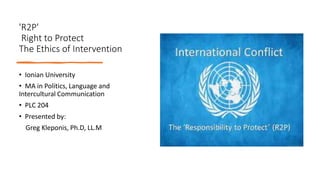
'R2P'
Right to Protect
The Ethics of Intervention
• Ionian University
• MA in Politics, Language and
Intercultural Communication
• PLC 204
• Presented by:
Greg Kleponis, Ph.D, LL.M
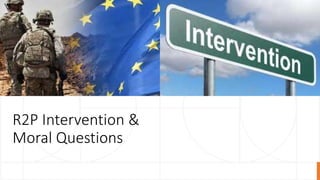
R2P Intervention &
Moral Questions
Third Party
Intervention
• Always a sense of 'unease'
• Often not a matter of 'could' but of 'should'
• Third parties have an effect on dynamics
• Do not guarantee good outcomes
• Questions:
• Who invited them
• Why
• Do they understand their own roles
• Actions likely to benefit or detract
• More complicated as-if intervention
becomes coercive or forcible
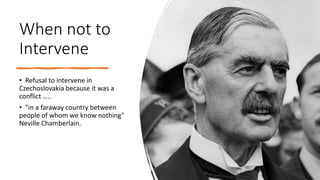
When not to
Intervene
• Refusal to intervene in
Czechoslovakia because it was a
conflict …..
• "in a faraway country between
people of whom we know nothing"
Neville Chamberlain.
TE Lawrence
• Do not try to do too much with
your own hands. Better the Arabs
do it tolerably than that you do it
perfectly. It is their war, and you
are to help them, not to win it for
them. Actually, also, under the
very odd conditions of Arabia,
your practical work will not be as
good as, perhaps, you think it is.
5 Main
Conflict
Resolution
Roles
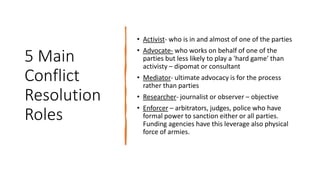
• Activist- who is in and almost of one of the parties
• Advocate- who works on behalf of one of the
parties but less likely to play a 'hard game' than
activisty – dipomat or consultant
• Mediator- ultimate advocacy is for the process
rather than parties
• Researcher- journalist or observer – objective
• Enforcer – arbitrators, judges, police who have
formal power to sanction either or all parties.
Funding agencies have this leverage also physical
force of armies.
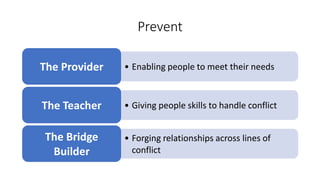
Prevent
• Enabling people to meet their needs
The Provider
• Giving people skills to handle conflict
The Teacher
• Forging relationships across lines of
conflict
The Bridge
Builder
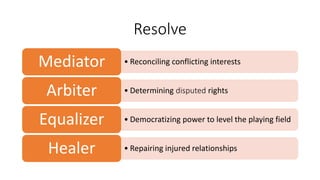
Resolve
• Reconciling conflicting interests
Mediator
• Determining disputed rights
Arbiter
• Democratizing power to level the playing field
Equalizer
• Repairing injured relationships
Healer
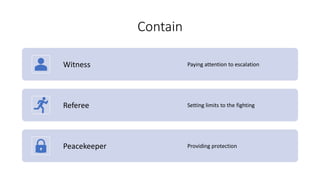
Contain
Witness Paying attention to escalation
Referee Setting limits to the fighting
Peacekeeper Providing protection
2 Types of Parties to Conflict
Powerful 'In-Parties'
They want classic 'neutral' conflict resolution fro
the third parties in order to preserve the status –
quo
Powerless 'Out-Parties'
Seek assistance in their quest for power, justice
and change
Principle of Impartiality
• Whatever role an intervener plays, conflict resolution is
incomplete unless the interest of all affected are properly
taken into account
• Focus on 'Human Needs' and "Win-Win' outcomes
• Red Cross- "The Red Cross makes no discrimination as to
nationality, race, religious belief, class or political opinions. It
endeavours to relieve the suffering of individuals, being
guided solely by their needs, and to give priority to the most
urgent cases of of distress"
• Doesn't take sides
• Medicin Sans Frontieres- not afraid to call out authorities or
to intervene without permission- highly controversial
Principle of Mutuality
The Hippocratic Oath
of Intervention
• Fundamental Principle
• Must determine that the intervention is
seen to be likely to more good than harm.
"First do no Harm"
• Must be two way or double headed
arrow.
<--------->
• If not then its' likely intervener is just
doing what 'they themselves want
• Demands that local initiatives and
capabilities be empowered
• Interventions carried out without damage
to local economies and with respect to
local culture
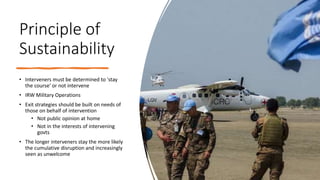
Principle of
Sustainability
• Interveners must be determined to 'stay
the course' or not intervene
• IRW Military Operations
• Exit strategies should be built on needs of
those on behalf of intervention
• Not public opinion at home
• Not in the interests of intervening
govts
• The longer interveners stay the more likely
the cumulative disruption and increasingly
seen as unwelcome
Principle of Complementarity
• Relations between different interveners
• Interveners and their actions should
complement one another
• Competitive Altruism
• Prohibiting damaging rivalries
• Unnecessary Duplications
• Failures of communication
• Shift from military centric 'negative
peace' to more non-military task
building toward 'positive peace'
Principle of
Reflexivity
• Interveners need to look at themselves
• Motives
• Aims
• Interests
• What kind of advocacy to they pursue &
why
• What authority
• Interveners purposes must not be incompatible
with declared aim of intervention.
• Example - organizations that run to disasters to
raise their own profile or pull extra funding-
Incompatible with this principle
Principle of
Consistency
• Equal provocation or challenge
should get equal response
• Avoid accusations of double
standards or hypocrisy
• Being 'consistent' in both
evaluation, approach and
response to challenges across
different national, political,
geographic and economic
environments.
Principle of
Accountability The relationship between interveners and those in whose name
they claim to act.
Interveners or those organizations that they endorse or sponsor
should be prepared to answer for their motives and actions.
'Quo Warranto'- by what authority to you intervene
'Quis custodiet ipsos custodes' - who judges the judges
On-going and comparative assessments of effectiveness of
present and past operations
'Lessons-learned' to improve performance
Principle of
Universality
• In order for intervention to be considered a truly
cosmopolitan enterprise it must reflect the
normative values of the international community.
• Authorized bot a global or regional international
organization and it purports
to undertake internationally recognized values that
are cross-culturally endorsed.
The
Responsibility
to Protect
• What Role – If any does coercion and use of
armed force have in conflict intervention
resolutions -
• Pacifists- "make peace by peaceful means"
• No place for 'just war' criteria –conflict is a
search for truth and neither party has 'the
answer' final and valid. Intervener must
take actions to persuade only
• 'Just War' - "Jus ad Bellum" - Just war decision
• Faced with murderous opponents of peace
processes or assaults on human rights –
there is legitimate role for armed forces as
neutralizers or protectors
• Currently there is a search for criteria for
intervention and roles and responsibilities of
the international community to intervene
Possible
Conditions
• Kofi Annan suggestions
• Threats are 'egregious' - no realistic non-military
alternatives
• Collective action through UN Security Council
has failed
• Humanitarian objective is paramount
• Legitimate interest of international community
• UN Charter Chapter VII
• Last resort
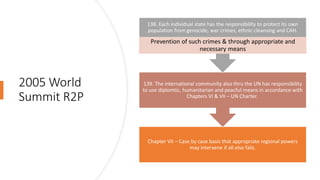
2005 World
Summit R2P
Chapter VII – Case by case basis that appropriate regional powers
may intervene if all else fails.
139. The international community also thru the UN has responsibility
to use diplomtic, humanitarian and peacful means in accordance with
Chapters VI & VII – UN Charter.
138. Each individual state has the responsibility to protect its own
population from genocide, war crimes, ethnic cleansing and CAH.
Prevention of such crimes & through appropriate and
necessary means
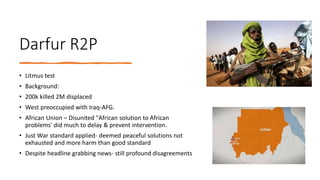
Darfur R2P
• Litmus test
• Background:
• 200k killed 2M displaced
• West preoccupied with Iraq-AFG.
• African Union – Disunited "African solution to African
problems' did much to delay & prevent intervention.
• Just War standard applied- deemed peaceful solutions not
exhausted and more harm than good standard
• Despite headline grabbing news- still profound disagreements
Just War Criteria
• Thomas Acquinas(14th c) 3 things must exist:
• Authority of sovereign on whose command war is waged
• Just cause is required
• Right intention of those waging war – must intend to
promote good and avoid evil.
• Jus Ad Bellum- criteria to determine when it is right to wage war
• Jus in Bello- how the war should be rightly fought
• You can see how these definitions could be quite subjective
War Decision
Criteria
• Just Cause: different from traditional war in that
force is to be used to defend international
norms, decolonization norms, democratic norms,
confict settlement norms, humanitarian & anti-
terrorism
• Legitimate Authority: Interventions multilateral –
UNSC approval
• Right Intention: Tricky- is it for oil....strategic
advantage...hegemony
• Prospect of Success: anticipated success and
balance of benefit-loss- not just military victory
but also reconstruction and nation building
• Last Resort: Consider the principle of escalation
or continuum of coercion.
• Minimum force necessary at each successive
level
Conclusion
• Seizure of territory by groups prepared to commit barbarity.
• IS, Boko Haram etc
• How to defeat apart from military force and expulsion
• Is forcible intervention ethically legitimate in all cases of human tragedy
R2P still problematic
• All agree that firm and carefully applied ethical criteria form essential consideration for those
who intervene in conflict.
• Acts of commission and acts of omission carry moral risks.
• Continuum of force or spectrum of force apply the minimum necessary until the next step is
required.
What do we agree on

R2P.pdf

  • 1.
    'R2P' Right to Protect TheEthics of Intervention • Ionian University • MA in Politics, Language and Intercultural Communication • PLC 204 • Presented by: Greg Kleponis, Ph.D, LL.M
  • 2.
  • 3.
    Third Party Intervention • Alwaysa sense of 'unease' • Often not a matter of 'could' but of 'should' • Third parties have an effect on dynamics • Do not guarantee good outcomes • Questions: • Who invited them • Why • Do they understand their own roles • Actions likely to benefit or detract • More complicated as-if intervention becomes coercive or forcible
  • 4.
    When not to Intervene •Refusal to intervene in Czechoslovakia because it was a conflict ….. • "in a faraway country between people of whom we know nothing" Neville Chamberlain.
  • 5.
    TE Lawrence • Donot try to do too much with your own hands. Better the Arabs do it tolerably than that you do it perfectly. It is their war, and you are to help them, not to win it for them. Actually, also, under the very odd conditions of Arabia, your practical work will not be as good as, perhaps, you think it is.
  • 6.
    5 Main Conflict Resolution Roles • Activist-who is in and almost of one of the parties • Advocate- who works on behalf of one of the parties but less likely to play a 'hard game' than activisty – dipomat or consultant • Mediator- ultimate advocacy is for the process rather than parties • Researcher- journalist or observer – objective • Enforcer – arbitrators, judges, police who have formal power to sanction either or all parties. Funding agencies have this leverage also physical force of armies.
  • 7.
    Prevent • Enabling peopleto meet their needs The Provider • Giving people skills to handle conflict The Teacher • Forging relationships across lines of conflict The Bridge Builder
  • 8.
    Resolve • Reconciling conflictinginterests Mediator • Determining disputed rights Arbiter • Democratizing power to level the playing field Equalizer • Repairing injured relationships Healer
  • 9.
    Contain Witness Paying attentionto escalation Referee Setting limits to the fighting Peacekeeper Providing protection
  • 10.
    2 Types ofParties to Conflict Powerful 'In-Parties' They want classic 'neutral' conflict resolution fro the third parties in order to preserve the status – quo Powerless 'Out-Parties' Seek assistance in their quest for power, justice and change
  • 11.
    Principle of Impartiality •Whatever role an intervener plays, conflict resolution is incomplete unless the interest of all affected are properly taken into account • Focus on 'Human Needs' and "Win-Win' outcomes • Red Cross- "The Red Cross makes no discrimination as to nationality, race, religious belief, class or political opinions. It endeavours to relieve the suffering of individuals, being guided solely by their needs, and to give priority to the most urgent cases of of distress" • Doesn't take sides • Medicin Sans Frontieres- not afraid to call out authorities or to intervene without permission- highly controversial
  • 12.
    Principle of Mutuality TheHippocratic Oath of Intervention • Fundamental Principle • Must determine that the intervention is seen to be likely to more good than harm. "First do no Harm" • Must be two way or double headed arrow. <---------> • If not then its' likely intervener is just doing what 'they themselves want • Demands that local initiatives and capabilities be empowered • Interventions carried out without damage to local economies and with respect to local culture
  • 13.
    Principle of Sustainability • Intervenersmust be determined to 'stay the course' or not intervene • IRW Military Operations • Exit strategies should be built on needs of those on behalf of intervention • Not public opinion at home • Not in the interests of intervening govts • The longer interveners stay the more likely the cumulative disruption and increasingly seen as unwelcome
  • 14.
    Principle of Complementarity •Relations between different interveners • Interveners and their actions should complement one another • Competitive Altruism • Prohibiting damaging rivalries • Unnecessary Duplications • Failures of communication • Shift from military centric 'negative peace' to more non-military task building toward 'positive peace'
  • 15.
    Principle of Reflexivity • Intervenersneed to look at themselves • Motives • Aims • Interests • What kind of advocacy to they pursue & why • What authority • Interveners purposes must not be incompatible with declared aim of intervention. • Example - organizations that run to disasters to raise their own profile or pull extra funding- Incompatible with this principle
  • 16.
    Principle of Consistency • Equalprovocation or challenge should get equal response • Avoid accusations of double standards or hypocrisy • Being 'consistent' in both evaluation, approach and response to challenges across different national, political, geographic and economic environments.
  • 17.
    Principle of Accountability Therelationship between interveners and those in whose name they claim to act. Interveners or those organizations that they endorse or sponsor should be prepared to answer for their motives and actions. 'Quo Warranto'- by what authority to you intervene 'Quis custodiet ipsos custodes' - who judges the judges On-going and comparative assessments of effectiveness of present and past operations 'Lessons-learned' to improve performance
  • 18.
    Principle of Universality • Inorder for intervention to be considered a truly cosmopolitan enterprise it must reflect the normative values of the international community. • Authorized bot a global or regional international organization and it purports to undertake internationally recognized values that are cross-culturally endorsed.
  • 19.
    The Responsibility to Protect • WhatRole – If any does coercion and use of armed force have in conflict intervention resolutions - • Pacifists- "make peace by peaceful means" • No place for 'just war' criteria –conflict is a search for truth and neither party has 'the answer' final and valid. Intervener must take actions to persuade only • 'Just War' - "Jus ad Bellum" - Just war decision • Faced with murderous opponents of peace processes or assaults on human rights – there is legitimate role for armed forces as neutralizers or protectors • Currently there is a search for criteria for intervention and roles and responsibilities of the international community to intervene
  • 20.
    Possible Conditions • Kofi Annansuggestions • Threats are 'egregious' - no realistic non-military alternatives • Collective action through UN Security Council has failed • Humanitarian objective is paramount • Legitimate interest of international community • UN Charter Chapter VII • Last resort
  • 21.
    2005 World Summit R2P ChapterVII – Case by case basis that appropriate regional powers may intervene if all else fails. 139. The international community also thru the UN has responsibility to use diplomtic, humanitarian and peacful means in accordance with Chapters VI & VII – UN Charter. 138. Each individual state has the responsibility to protect its own population from genocide, war crimes, ethnic cleansing and CAH. Prevention of such crimes & through appropriate and necessary means
  • 22.
    Darfur R2P • Litmustest • Background: • 200k killed 2M displaced • West preoccupied with Iraq-AFG. • African Union – Disunited "African solution to African problems' did much to delay & prevent intervention. • Just War standard applied- deemed peaceful solutions not exhausted and more harm than good standard • Despite headline grabbing news- still profound disagreements
  • 23.
    Just War Criteria •Thomas Acquinas(14th c) 3 things must exist: • Authority of sovereign on whose command war is waged • Just cause is required • Right intention of those waging war – must intend to promote good and avoid evil. • Jus Ad Bellum- criteria to determine when it is right to wage war • Jus in Bello- how the war should be rightly fought • You can see how these definitions could be quite subjective
  • 24.
    War Decision Criteria • JustCause: different from traditional war in that force is to be used to defend international norms, decolonization norms, democratic norms, confict settlement norms, humanitarian & anti- terrorism • Legitimate Authority: Interventions multilateral – UNSC approval • Right Intention: Tricky- is it for oil....strategic advantage...hegemony • Prospect of Success: anticipated success and balance of benefit-loss- not just military victory but also reconstruction and nation building • Last Resort: Consider the principle of escalation or continuum of coercion. • Minimum force necessary at each successive level
  • 25.
    Conclusion • Seizure ofterritory by groups prepared to commit barbarity. • IS, Boko Haram etc • How to defeat apart from military force and expulsion • Is forcible intervention ethically legitimate in all cases of human tragedy R2P still problematic • All agree that firm and carefully applied ethical criteria form essential consideration for those who intervene in conflict. • Acts of commission and acts of omission carry moral risks. • Continuum of force or spectrum of force apply the minimum necessary until the next step is required. What do we agree on