March 23rd, 2010 Yerevan CORRUPTION SURVEY OF ENTERPRISES  2009 Mobilizing Action Against Corruption
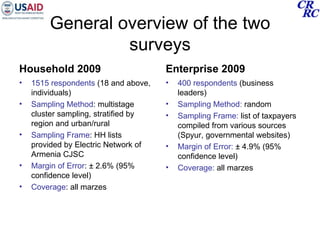
General overview of the two surveys Household 2009 1515 respondents  (18 and above, individuals) Sampling Method : multistage cluster sampling, stratified by region and urban/rural Sampling Frame : HH lists provided by Electric Network of Armenia CJSC Margin of Error : ± 2.6% (95% confidence level) Coverage : all marzes Enterprise 2009 400 respondents  (business leaders) Sampling Method:  random Sampling Frame:  list of taxpayers compiled from various sources (Spyur, governmental websites) Margin of Error:  ± 4.9% (95% confidence level) Coverage:  all marzes
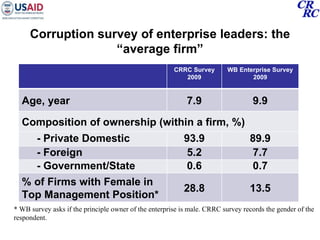
Corruption survey of enterprise leaders: the “average firm” * WB survey asks if the principle owner of the enterprise is male. CRRC survey records the gender of the respondent. CRRC Survey 2009 WB Enterprise Survey 2009 Age, year 7.9 9.9 Composition of ownership (within a firm, %) - Private Domestic  93.9 89.9 - Foreign  5.2 7.7 - Government/State 0.6 0.7 % of Firms with Female in Top Management Position* 28.8 13.5
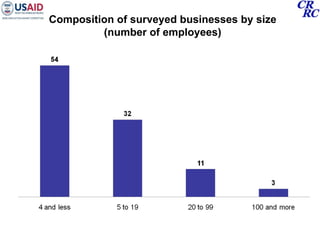
Composition of surveyed businesses by size (number of employees)
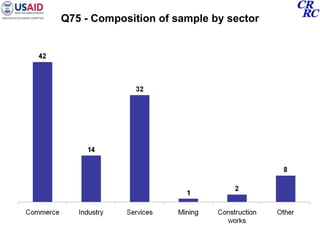
Q75 - Composition of sample by sector
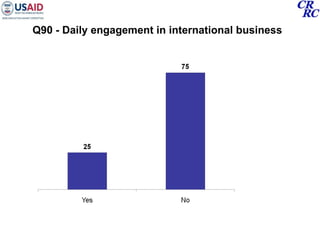
Q90 - Daily engagement in international business
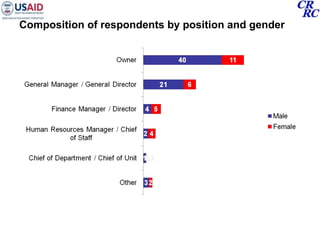
Composition of respondents by position and gender
What keeps businesses back?
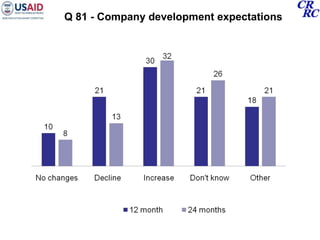
Q 81 - Company development expectations
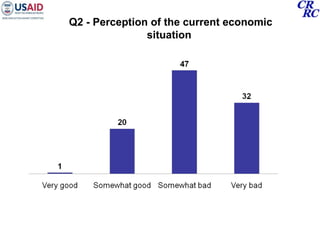
Q2 - Perception of the current economic situation
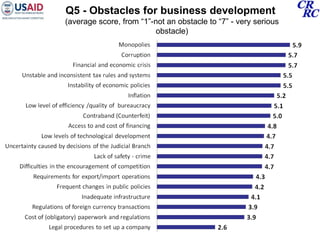
Q5 - Obstacles for business development  (average score, from “1”- not an obstacle to “7” - very serious obstacle)
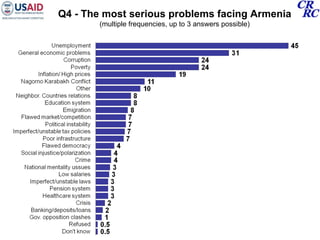
Q4 - The most serious problems facing Armenia (multiple frequencies, up to 3 answers possible)
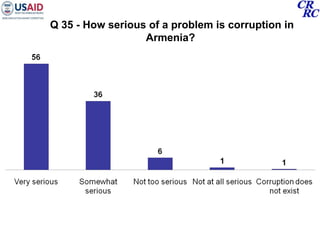
Q 35 - How serious of a problem is corruption in Armenia?
Public Candor, Private Caution
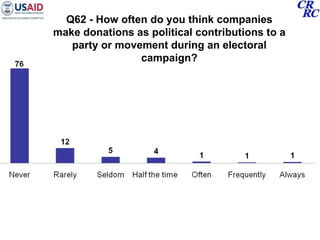
Q62 - How often do you think companies make donations as political contributions to a party or movement during an electoral campaign?
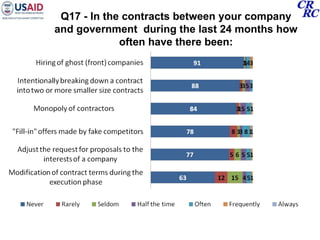
Q17 - In the contracts between your company and government  during the last 24 months how often have there been:
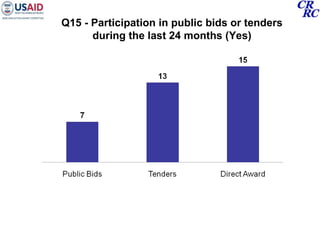
Q15 - Participation in public bids or tenders during the last 24 months (Yes)
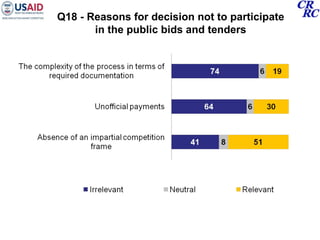
Q18 - Reasons for decision not to participate in the public bids and tenders
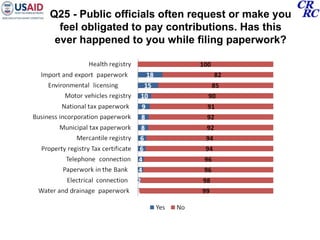
Q25 - Public officials often request or make you feel obligated to pay contributions. Has this ever happened to you while filing paperwork?
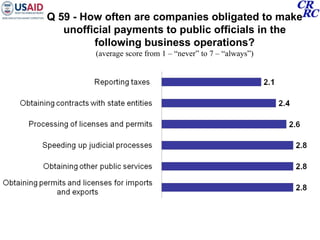
Q 59 - How often are companies obligated to make unofficial payments to public officials in the following business operations? (average score from 1 – “n ever” to  7 – “a lways”)
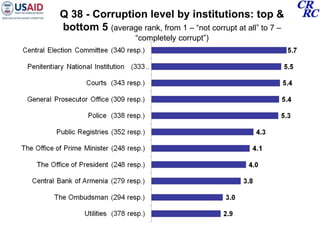
Q 38 - Corruption level by institutions: top & bottom 5  (average rank, from 1 – “not corrupt at all” to 7 – “completely corrupt”)
Q28 - The judicial system… (average score from 1 – “ strongly disagree” to 7 – “completely agree”)
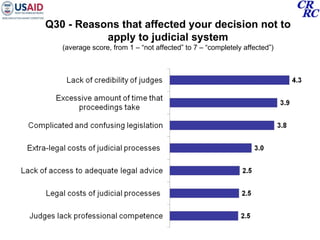
Q30 - Reasons that affected your decision not to apply to judicial system (average score, from 1 – “ not affected” to 7 – “completely affected”)
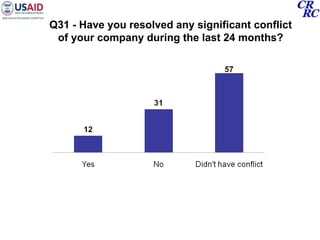
Q31 - Have you resolved any significant conflict of your company during the last 24 months?
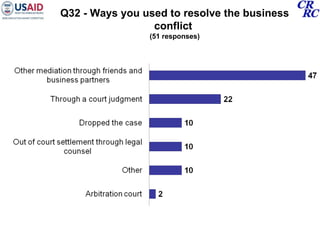
Q32 - Ways you used to resolve the business conflict  (51 responses)
Q33 - During the past 12 months, have you heard of anyone paying bribes to obtain a public service?
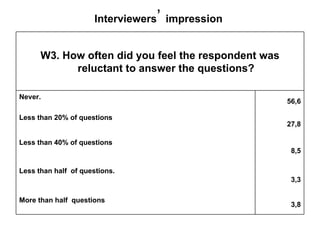
Interviewers ’  impression  W3. How often did you feel the respondent was reluctant to answer the questions? Never. 56,6 Less than 20% of questions 27,8 Less than 40% of questions 8,5 Less than half  of questions. 3,3 More than half  questions 3,8
Public Consensus
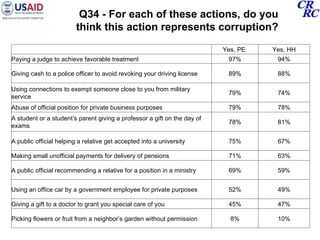
Q34 - For each of these actions, do you think this action represents corruption?    Yes, PE  Yes, HH Paying a judge to achieve favorable treatment  97% 94% Giving cash to a police officer to avoid revoking your driving license  89% 88% Using connections to exempt someone close to you from military service  79% 74% Abuse of official position for private business purposes  79% 78% A student or a student’s parent giving a professor a gift on the day of exams  78% 81% A public official helping a relative get accepted into a university  75% 67% Making small unofficial payments for delivery of pensions  71% 63% A public official recommending a relative for a position in a ministry  69% 59% Using an office car by a government employee for private purposes  52% 49% Giving a gift to a doctor to grant you special care of you  45% 47% Picking flowers or fruit from a neighbor’s garden without permission  8% 10%
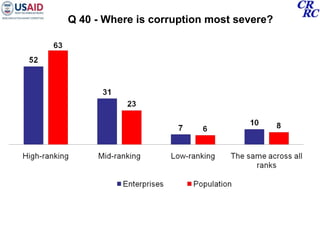
Q 40 - Where is corruption most severe?
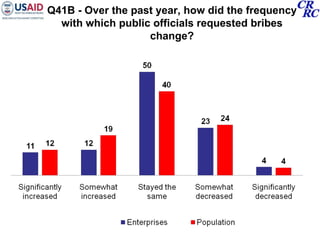
Q41B - Over the past year, how did the frequency with which public officials requested bribes change?
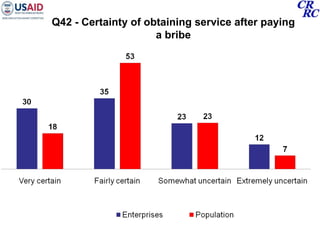
Q42 - Certainty of obtaining service after paying a bribe
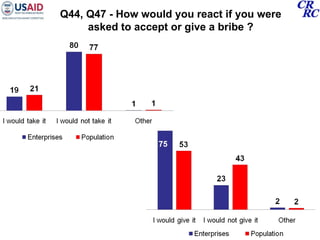
Q44, Q47 - How would you react if you were asked to accept or give a bribe ?
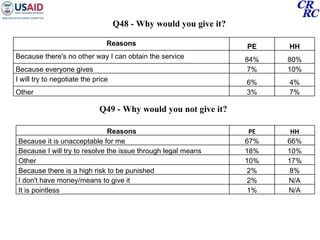
Q48 - Why would you give it? Q49 - Why would you not give it? Reasons PE HH Because there's no other way I can obtain the service 84% 80% Because everyone gives 7% 10% I will try to negotiate the price 6% 4% Other 3% 7% Reasons  PE HH Because it is unacceptable for me 67% 66% Because I will try to resolve the issue through legal means 18% 10% Other 10% 17% Because there is a high risk to be punished 2% 8% I don't have money/means to give it 2% N/A It is pointless 1% N/A
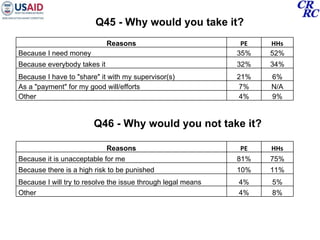
Reasons PE HHs Because I need money 35% 52% Because everybody takes it 32% 34% Because I have to "share" it with my supervisor(s) 21% 6% As a "payment" for my good will/efforts 7% N/A Other 4% 9% Q45 - Why would you take it? Q46 - Why would you not take it? Reasons PE HHs Because it is unacceptable for me 81% 75% Because there is a high risk to be punished 10% 11% Because I will try to resolve the issue through legal means 4% 5% Other 4% 8%
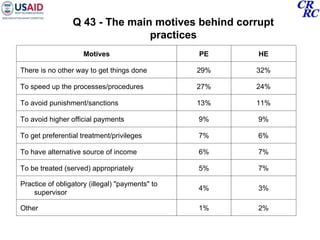
Q 43 - The main motives behind corrupt practices Motives PE HE There is no other way to get things done  29% 32% To speed up the processes/procedures  27% 24% To avoid punishment/sanctions  13% 11% To avoid higher official payments  9% 9% To get preferential treatment/privileges  7% 6% To have alternative source of income  6% 7% To be treated (served) appropriately  5% 7% Practice of obligatory (illegal) "payments" to  supervisor  4% 3% Other  1% 2%
Change
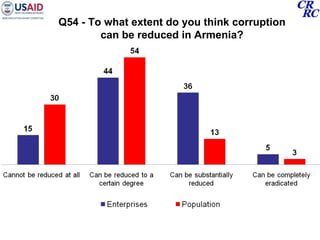
Q54 - To what extent do you think corruption can be reduced in Armenia?
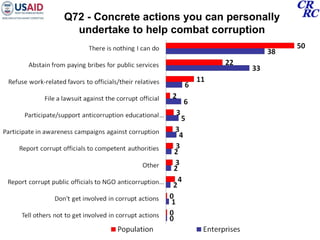
Q72 - Concrete actions you can personally undertake to help combat corruption
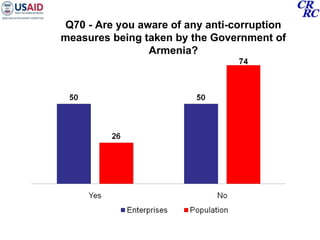
Q70 - Are you aware of any anti-corruption measures being taken by the Government of Armenia?
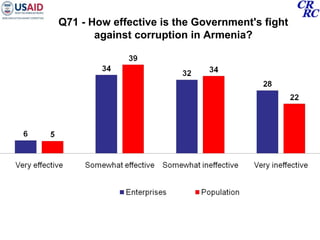
Q71 - How effective is the Government's fight against corruption in Armenia?
Q66 - Mention three entities which you believe could head strategies in the fight against corruption?  (open ended question, up to 3 answers possible)
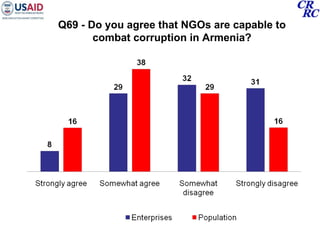
Q69 - Do you agree that NGOs are capable to combat corruption in Armenia?
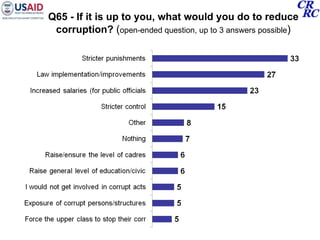
Q65 - If it is up to you, what would you do to reduce corruption?  ( open-ended question, up to 3 answers possible )
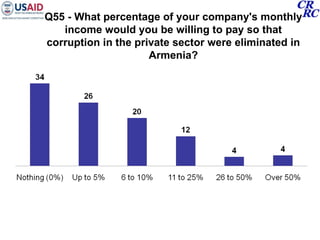
Q55 - What percentage of your company's monthly income would you be willing to pay so that corruption in the private sector were eliminated in Armenia?

Corruption Survey of Enterprises 2009

  • 1.
    March 23rd, 2010Yerevan CORRUPTION SURVEY OF ENTERPRISES 2009 Mobilizing Action Against Corruption
  • 2.
    General overview ofthe two surveys Household 2009 1515 respondents (18 and above, individuals) Sampling Method : multistage cluster sampling, stratified by region and urban/rural Sampling Frame : HH lists provided by Electric Network of Armenia CJSC Margin of Error : ± 2.6% (95% confidence level) Coverage : all marzes Enterprise 2009 400 respondents (business leaders) Sampling Method: random Sampling Frame: list of taxpayers compiled from various sources (Spyur, governmental websites) Margin of Error: ± 4.9% (95% confidence level) Coverage: all marzes
  • 3.
    Corruption survey ofenterprise leaders: the “average firm” * WB survey asks if the principle owner of the enterprise is male. CRRC survey records the gender of the respondent. CRRC Survey 2009 WB Enterprise Survey 2009 Age, year 7.9 9.9 Composition of ownership (within a firm, %) - Private Domestic 93.9 89.9 - Foreign 5.2 7.7 - Government/State 0.6 0.7 % of Firms with Female in Top Management Position* 28.8 13.5
  • 4.
    Composition of surveyedbusinesses by size (number of employees)
  • 5.
    Q75 - Compositionof sample by sector
  • 6.
    Q90 - Dailyengagement in international business
  • 7.
    Composition of respondentsby position and gender
  • 8.
  • 9.
    Q 81 -Company development expectations
  • 10.
    Q2 - Perceptionof the current economic situation
  • 11.
    Q5 - Obstaclesfor business development (average score, from “1”- not an obstacle to “7” - very serious obstacle)
  • 12.
    Q4 - Themost serious problems facing Armenia (multiple frequencies, up to 3 answers possible)
  • 13.
    Q 35 -How serious of a problem is corruption in Armenia?
  • 14.
  • 15.
    Q62 - Howoften do you think companies make donations as political contributions to a party or movement during an electoral campaign?
  • 16.
    Q17 - Inthe contracts between your company and government during the last 24 months how often have there been:
  • 17.
    Q15 - Participationin public bids or tenders during the last 24 months (Yes)
  • 18.
    Q18 - Reasonsfor decision not to participate in the public bids and tenders
  • 19.
    Q25 - Publicofficials often request or make you feel obligated to pay contributions. Has this ever happened to you while filing paperwork?
  • 20.
    Q 59 -How often are companies obligated to make unofficial payments to public officials in the following business operations? (average score from 1 – “n ever” to 7 – “a lways”)
  • 21.
    Q 38 -Corruption level by institutions: top & bottom 5 (average rank, from 1 – “not corrupt at all” to 7 – “completely corrupt”)
  • 22.
    Q28 - Thejudicial system… (average score from 1 – “ strongly disagree” to 7 – “completely agree”)
  • 23.
    Q30 - Reasonsthat affected your decision not to apply to judicial system (average score, from 1 – “ not affected” to 7 – “completely affected”)
  • 24.
    Q31 - Haveyou resolved any significant conflict of your company during the last 24 months?
  • 25.
    Q32 - Waysyou used to resolve the business conflict (51 responses)
  • 26.
    Q33 - Duringthe past 12 months, have you heard of anyone paying bribes to obtain a public service?
  • 27.
    Interviewers ’ impression W3. How often did you feel the respondent was reluctant to answer the questions? Never. 56,6 Less than 20% of questions 27,8 Less than 40% of questions 8,5 Less than half of questions. 3,3 More than half questions 3,8
  • 28.
  • 29.
    Q34 - Foreach of these actions, do you think this action represents corruption?   Yes, PE Yes, HH Paying a judge to achieve favorable treatment 97% 94% Giving cash to a police officer to avoid revoking your driving license 89% 88% Using connections to exempt someone close to you from military service 79% 74% Abuse of official position for private business purposes 79% 78% A student or a student’s parent giving a professor a gift on the day of exams 78% 81% A public official helping a relative get accepted into a university 75% 67% Making small unofficial payments for delivery of pensions 71% 63% A public official recommending a relative for a position in a ministry 69% 59% Using an office car by a government employee for private purposes 52% 49% Giving a gift to a doctor to grant you special care of you 45% 47% Picking flowers or fruit from a neighbor’s garden without permission 8% 10%
  • 30.
    Q 40 -Where is corruption most severe?
  • 31.
    Q41B - Overthe past year, how did the frequency with which public officials requested bribes change?
  • 32.
    Q42 - Certaintyof obtaining service after paying a bribe
  • 33.
    Q44, Q47 -How would you react if you were asked to accept or give a bribe ?
  • 34.
    Q48 - Whywould you give it? Q49 - Why would you not give it? Reasons PE HH Because there's no other way I can obtain the service 84% 80% Because everyone gives 7% 10% I will try to negotiate the price 6% 4% Other 3% 7% Reasons PE HH Because it is unacceptable for me 67% 66% Because I will try to resolve the issue through legal means 18% 10% Other 10% 17% Because there is a high risk to be punished 2% 8% I don't have money/means to give it 2% N/A It is pointless 1% N/A
  • 35.
    Reasons PE HHsBecause I need money 35% 52% Because everybody takes it 32% 34% Because I have to "share" it with my supervisor(s) 21% 6% As a "payment" for my good will/efforts 7% N/A Other 4% 9% Q45 - Why would you take it? Q46 - Why would you not take it? Reasons PE HHs Because it is unacceptable for me 81% 75% Because there is a high risk to be punished 10% 11% Because I will try to resolve the issue through legal means 4% 5% Other 4% 8%
  • 36.
    Q 43 -The main motives behind corrupt practices Motives PE HE There is no other way to get things done 29% 32% To speed up the processes/procedures 27% 24% To avoid punishment/sanctions 13% 11% To avoid higher official payments 9% 9% To get preferential treatment/privileges 7% 6% To have alternative source of income 6% 7% To be treated (served) appropriately 5% 7% Practice of obligatory (illegal) "payments" to supervisor 4% 3% Other 1% 2%
  • 37.
  • 38.
    Q54 - Towhat extent do you think corruption can be reduced in Armenia?
  • 39.
    Q72 - Concreteactions you can personally undertake to help combat corruption
  • 40.
    Q70 - Areyou aware of any anti-corruption measures being taken by the Government of Armenia?
  • 41.
    Q71 - Howeffective is the Government's fight against corruption in Armenia?
  • 42.
    Q66 - Mentionthree entities which you believe could head strategies in the fight against corruption? (open ended question, up to 3 answers possible)
  • 43.
    Q69 - Doyou agree that NGOs are capable to combat corruption in Armenia?
  • 44.
    Q65 - Ifit is up to you, what would you do to reduce corruption? ( open-ended question, up to 3 answers possible )
  • 45.
    Q55 - Whatpercentage of your company's monthly income would you be willing to pay so that corruption in the private sector were eliminated in Armenia?

Editor's Notes

  • #4 In WB survey only firms with minimum of 5 workers were surveyed
  • #17 Calculations made based on 80 responses
  • #22 Top 5 & bottom 5
  • #26 (51 responses)