Introduction to Satellite Tactical & Strategic Intercept  Delma MSS  Satellite Intercept
Personal Satellite Communications Significant growth in services & uptake Terminal size reduced Low cost of usage Can be used where no GSM coverage exists Data & fax services now available Delma MSS  Satellite Intercept
Satellite Communications LEO – Low Earth Orbit  - Iridium, Teledesic MEO – Medium Earth Orbit  - Globalstar, ICO international, GEO - Geostationary  - Thuraya, Garuda, Inmarsat,  ICO, MSV Delma MSS Satellite Intercept
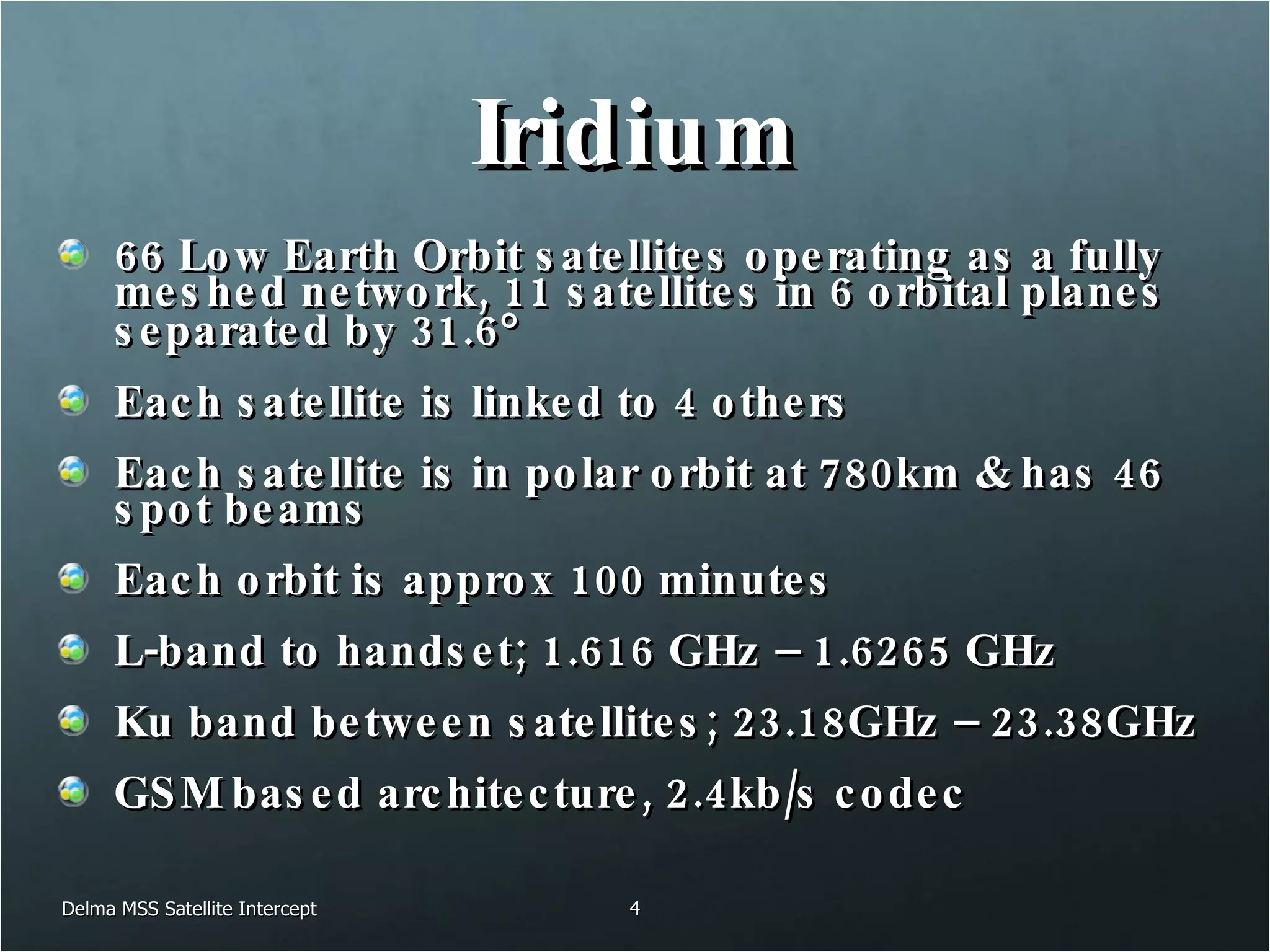
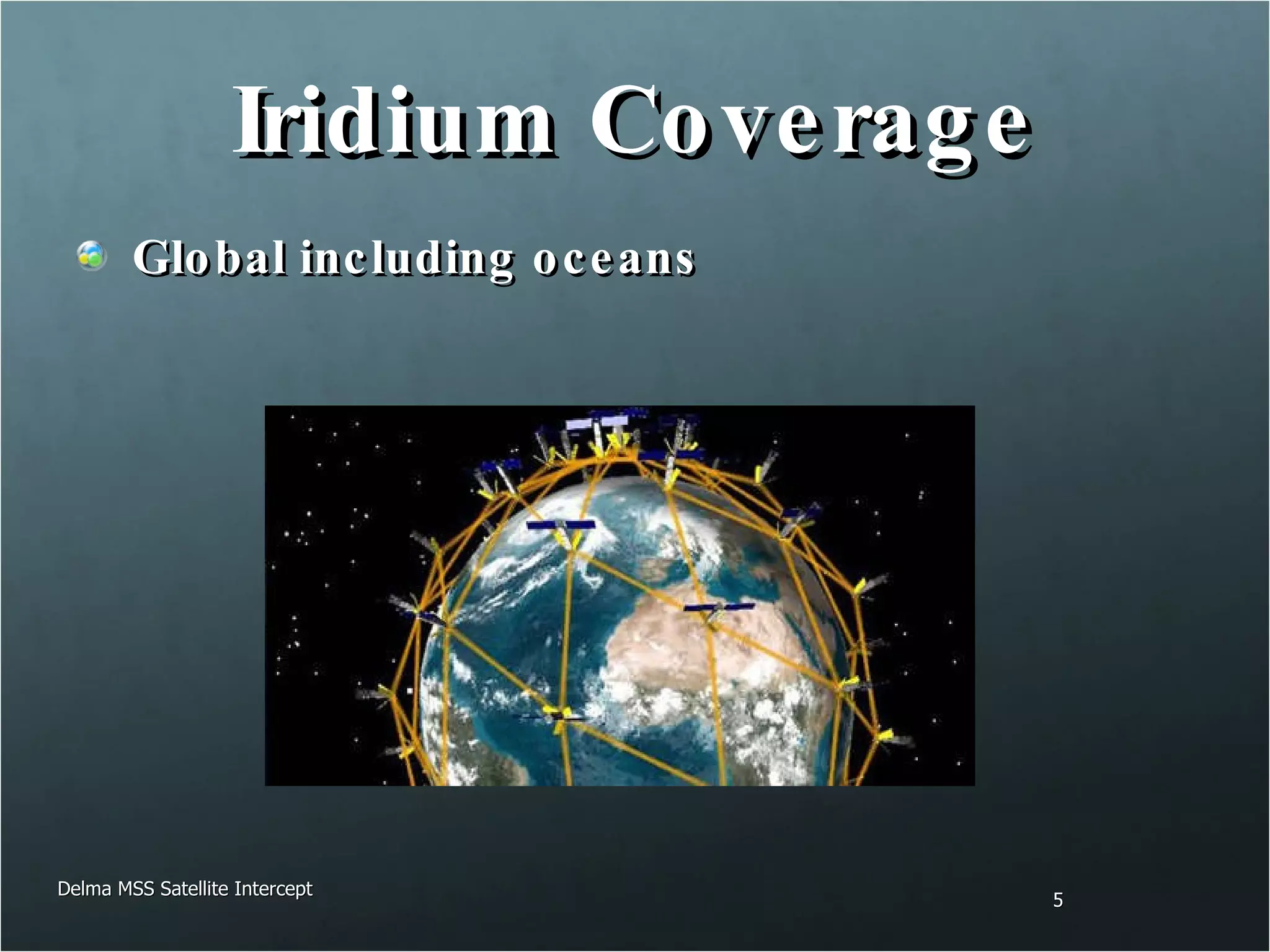
Iridium 66 Low Earth Orbit satellites operating as a fully meshed network, 11 satellites in 6 orbital planes separated by 31.6  Each satellite is linked to 4 others Each satellite is in polar orbit at 780km & has 46 spot beams Each orbit is approx 100 minutes L-band to handset; 1.616 GHz – 1.6265 GHz Ku band between satellites; 23.18GHz – 23.38GHz GSM based architecture, 2.4kb/s codec Delma MSS Satellite Intercept
Iridium Coverage Global including oceans Delma MSS Satellite Intercept
Teledesic 288 Low Earth Orbit Satellites planned Backed by Bill Gates Data communication to 100Mb/s Suspended in 2002 Delma MSS Satellite Intercept
Globalstar 48 Medium Earth Orbit satellites in 8 orbital planes Uses Qualcom’s CDMA technology L-band to handsets Several ground stations for routing calls to the terrestrial network Some issues with satellite failures Delma MSS Satellite Intercept
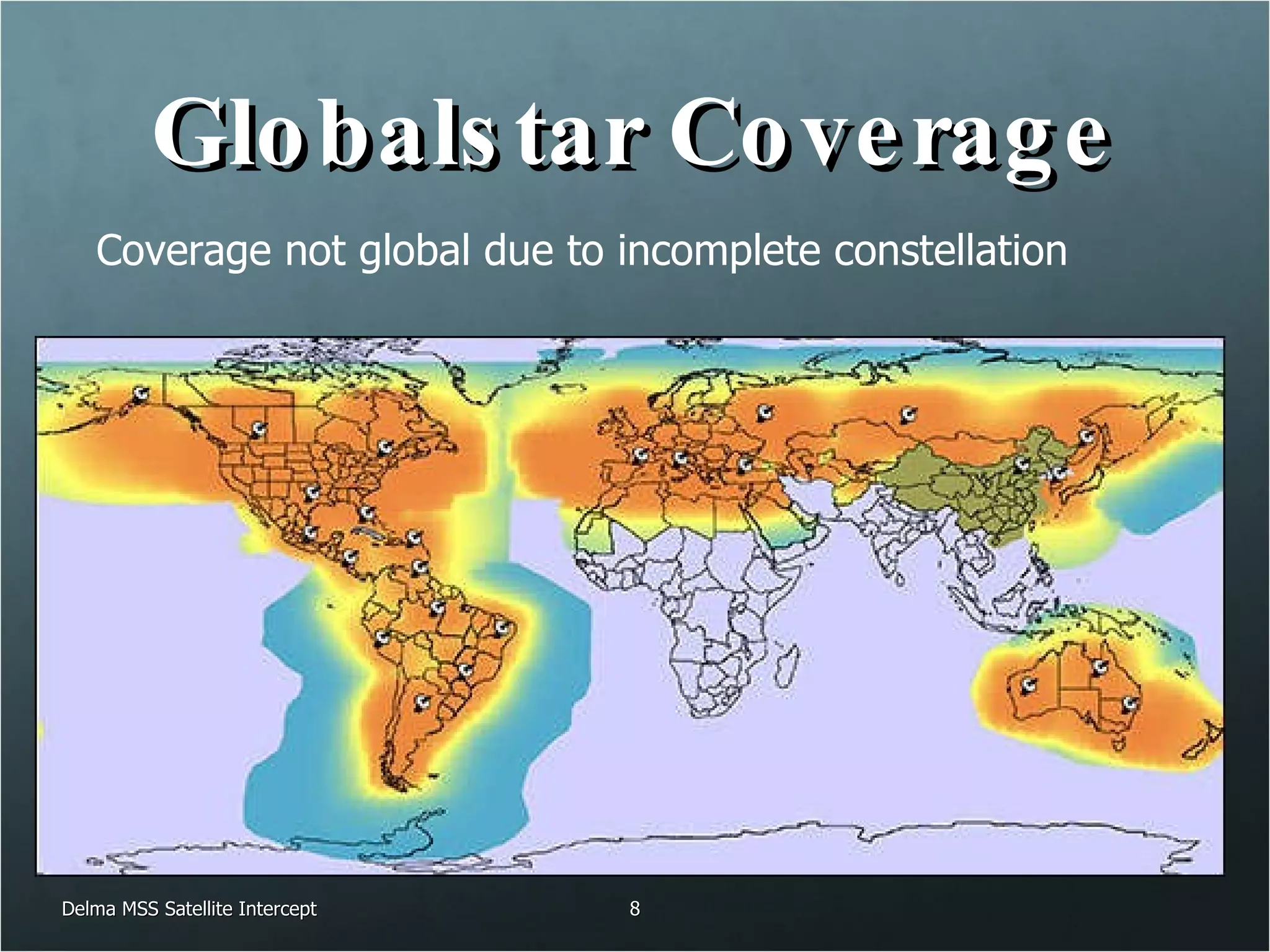
Globalstar Coverage Delma MSS Satellite Intercept Coverage not global due to incomplete constellation
ICO 10 Medium Earth Orbit satellites; 10,390km Uses 12 Earth stations and terrestrial switching  Uses TDMA technology (GSM-like) 1 satellite in orbit, 4-5 ready Contractual problems – not operational Incorporates Odessey Delma MSS Satellite Intercept
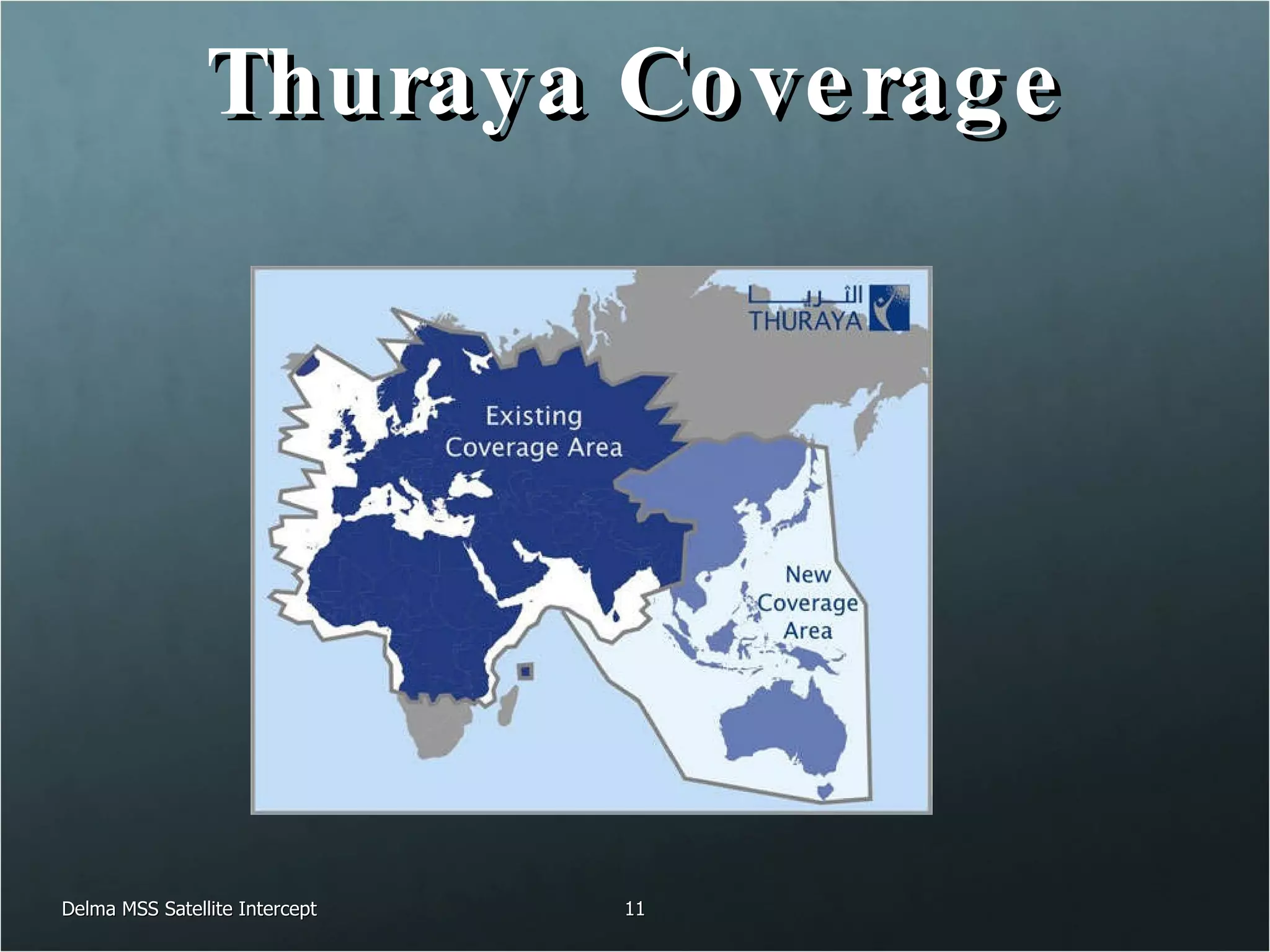
Thuraya Geostationary satellites - 1 active over Sudan, 1 (new) over Borneo Communicates with handset at L-band ( 1.525GHz – 1.559GHz, 1.6265GHz – 1.6605GHz ) Communicates with ground at C-band GSM phase 2-type technology Very successful operationally – in excess of 6,000 calls per day Delma MSS Satellite Intercept
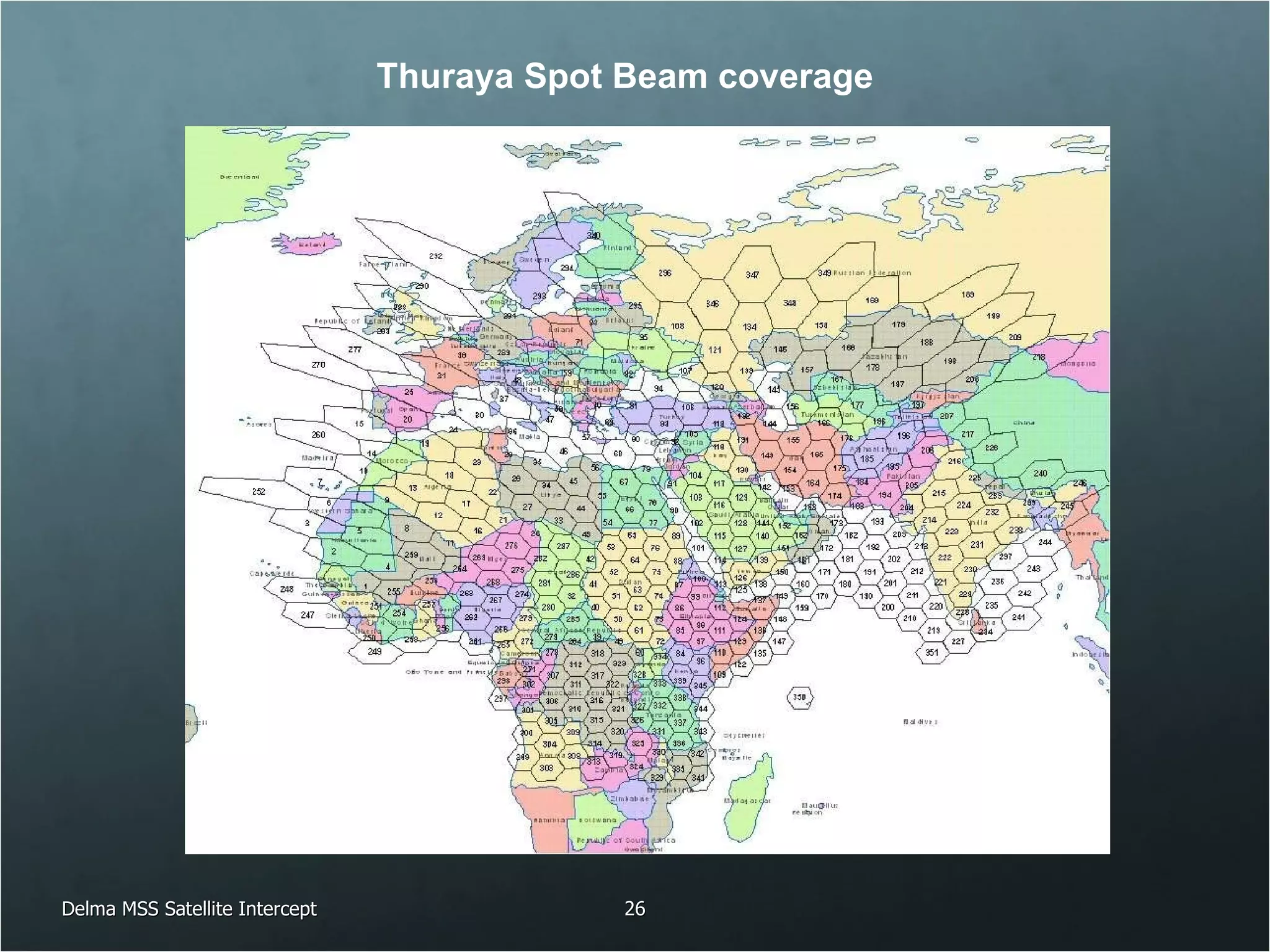
Thuraya Coverage Delma MSS Satellite Intercept
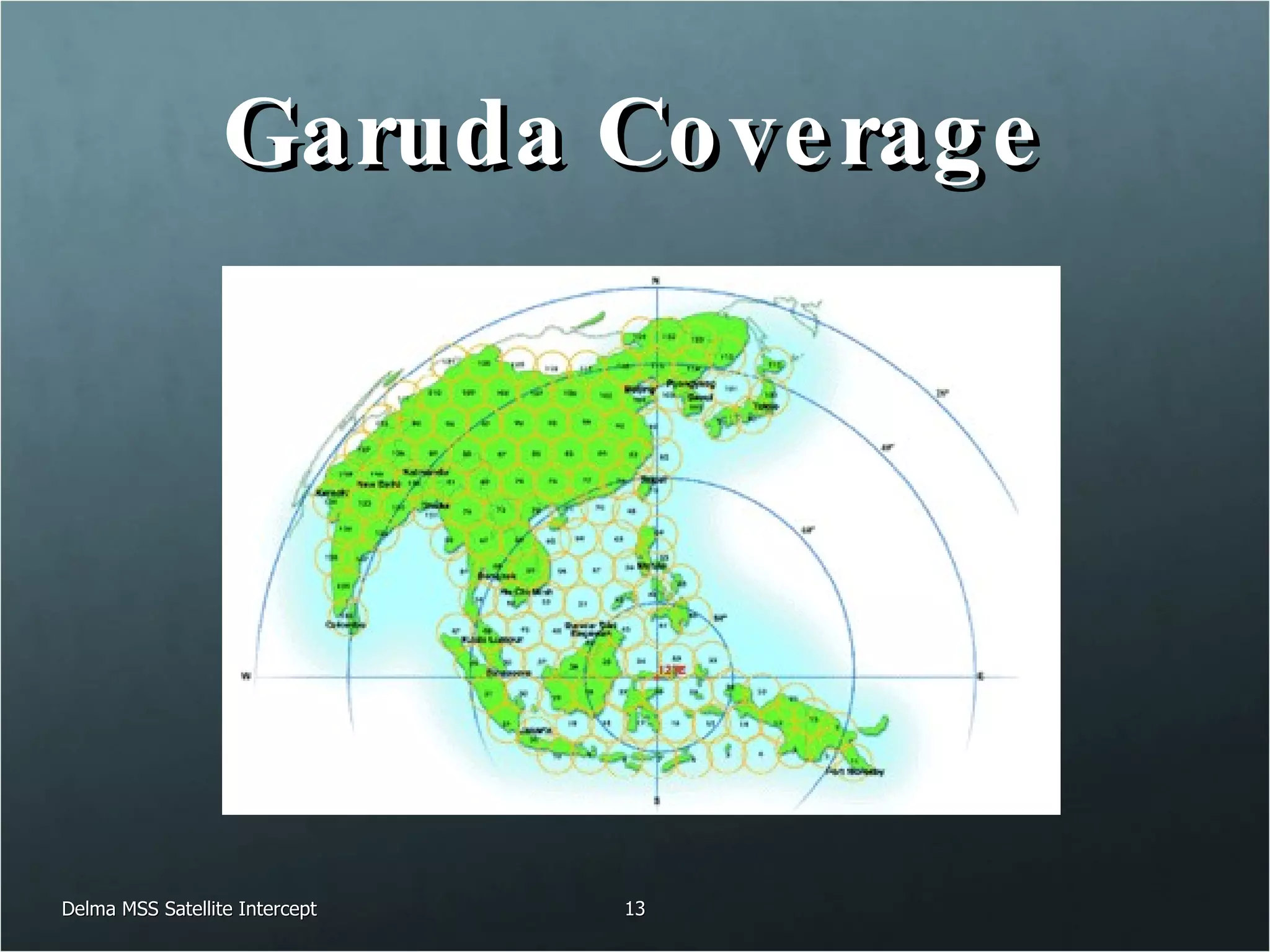
Garuda (ACeS) 1 Geostationary satellite Coverage of Far East CDMA technology 140 spot beams Now linked to Inmarsat (2006) Delma MSS Satellite Intercept
Garuda Coverage Delma MSS Satellite Intercept
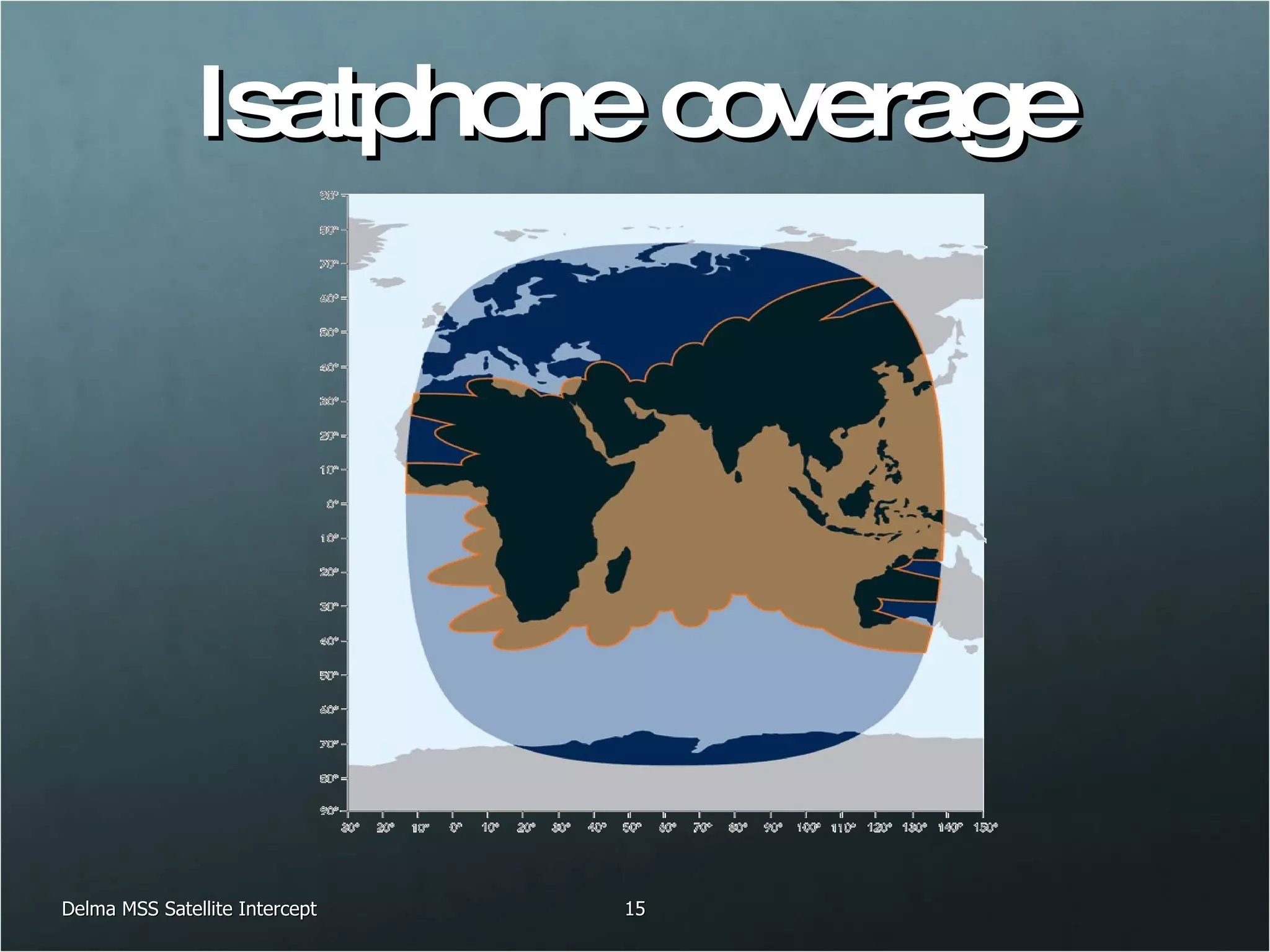
Isatphone Derived from ACeS Uses newest Inmarsat 4 satellite Planned global expansion in 2009 Similar to Thuraya GSM-like technology Delma MSS Satellite Intercept
Delma MSS Satellite Intercept Isatphone coverage
ICO New ICO service using geostationary satellite First launch imminent Centred on USA & Canada Mobile video & data Not yet operational Delma MSS Satellite Intercept
MSV Coverage USA, Canada & Caribbean 2 new satellites due to be launched in 2009 Will cover mobile broadband data 4G system for USA for mobile data & voice communication Not yet operational Delma MSS Satellite Intercept
Inmarsat Oldest and most established Inmarsat 3 first to use spot beam technology Inmarsat M & mini-M voice & data services – laptop size terminals & antennas Inmarsat 4 more powerful satellites Initially, Inmarsat RBGAN packet data service Inmarsat BGAN services now can use large handheld terminals Concentration on data – mobile office apps Delma MSS Satellite Intercept
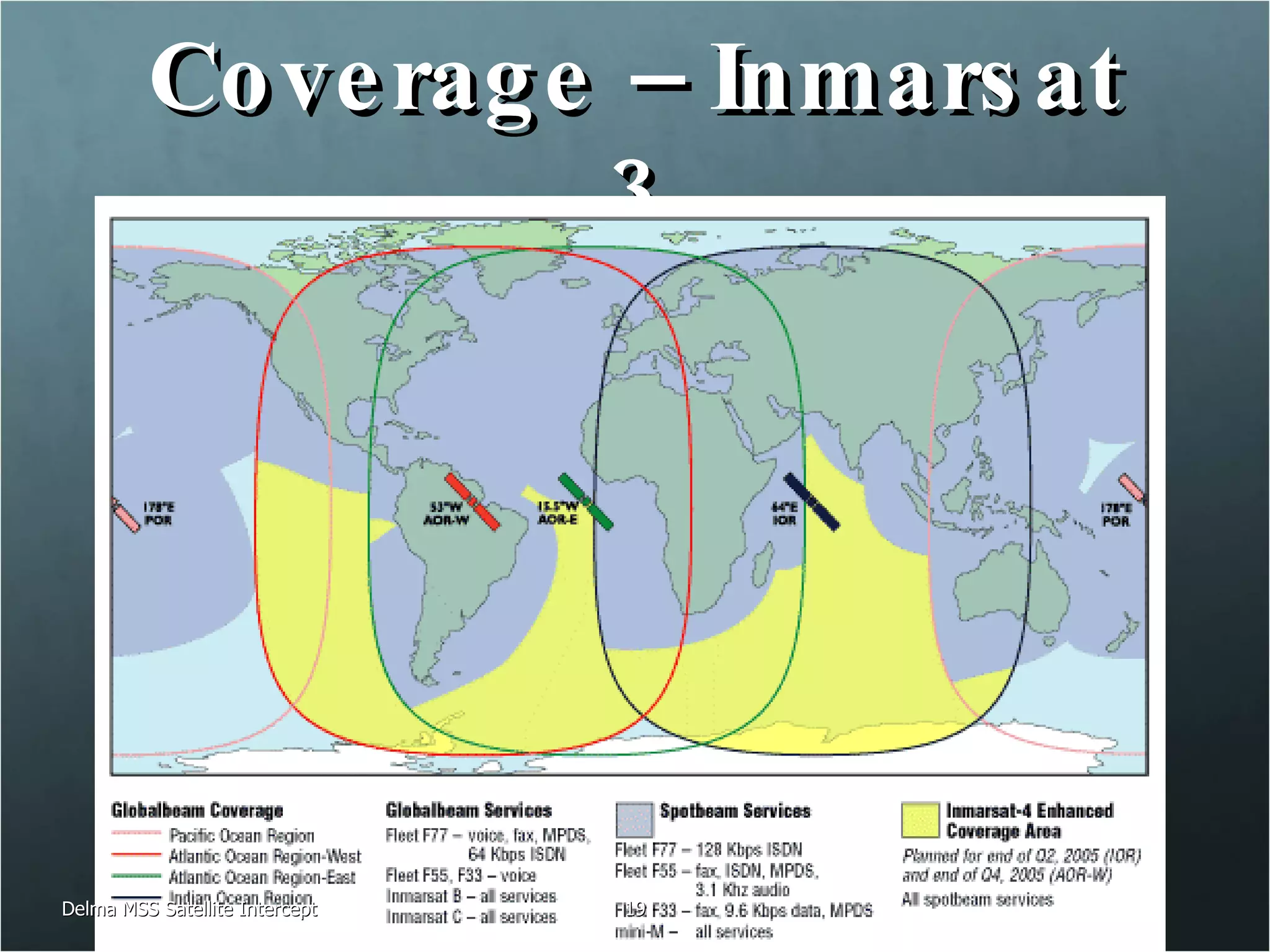
Coverage – Inmarsat 3 Delma MSS Satellite Intercept
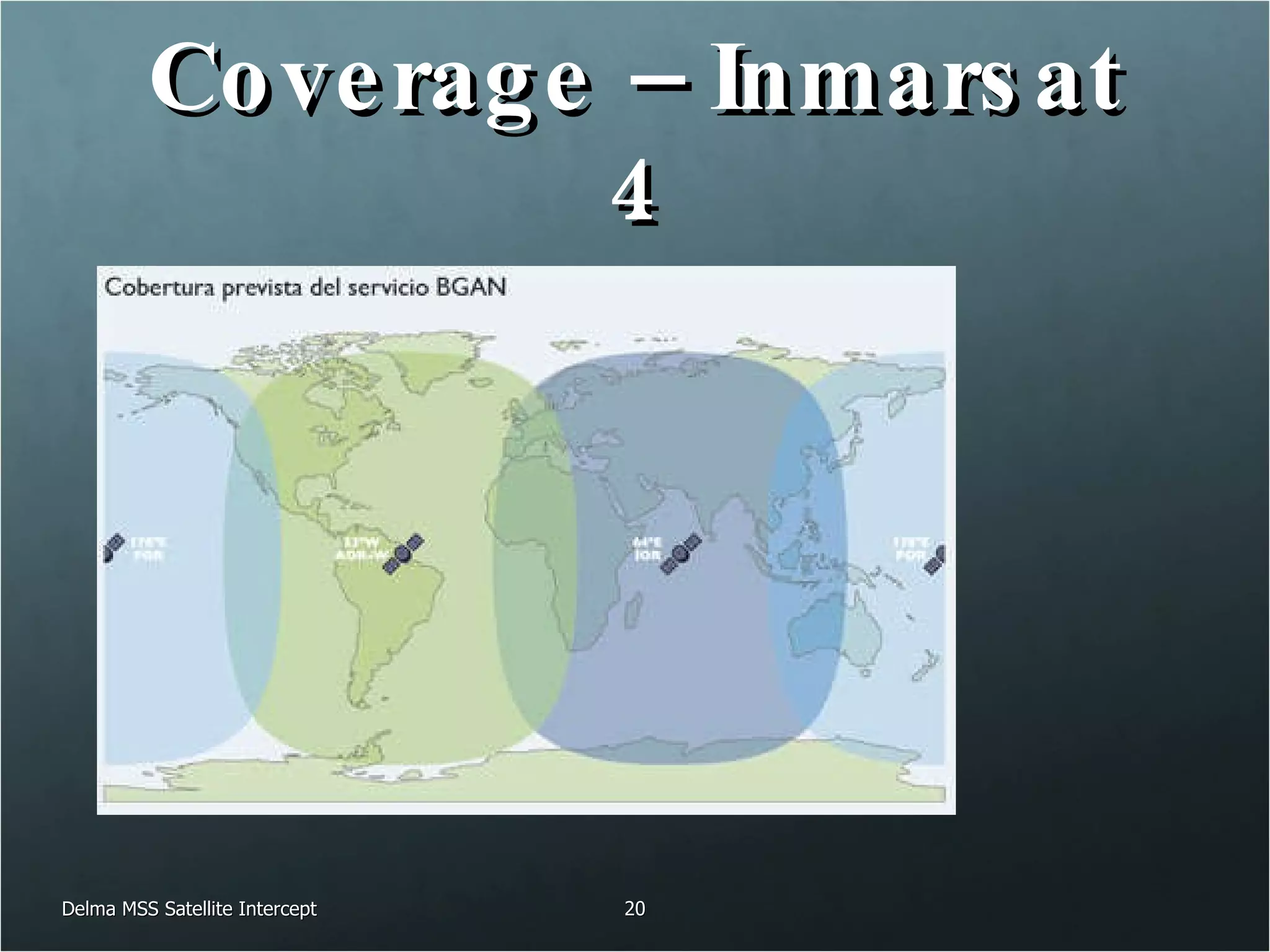
Coverage – Inmarsat 4 Delma MSS Satellite Intercept
Capabilities of Delma MSS Fully functioning Thuraya monitoring systems, both strategic and tactical Tactical & strategic monitoring for Inmarsat 3 (Inmarsat M & mini-M) Work in progress on Inmarsat 4 (BGAN) Tactical system for Iridium available but not produced by Delma MSS Direct Partners Delma MSS Satellite Intercept
VSAT Several operators Provide broadband data & TV services Monitoring systems been demonstrated Specific to operator Main requirement to locate terminals! Delma MSS Satellite Intercept
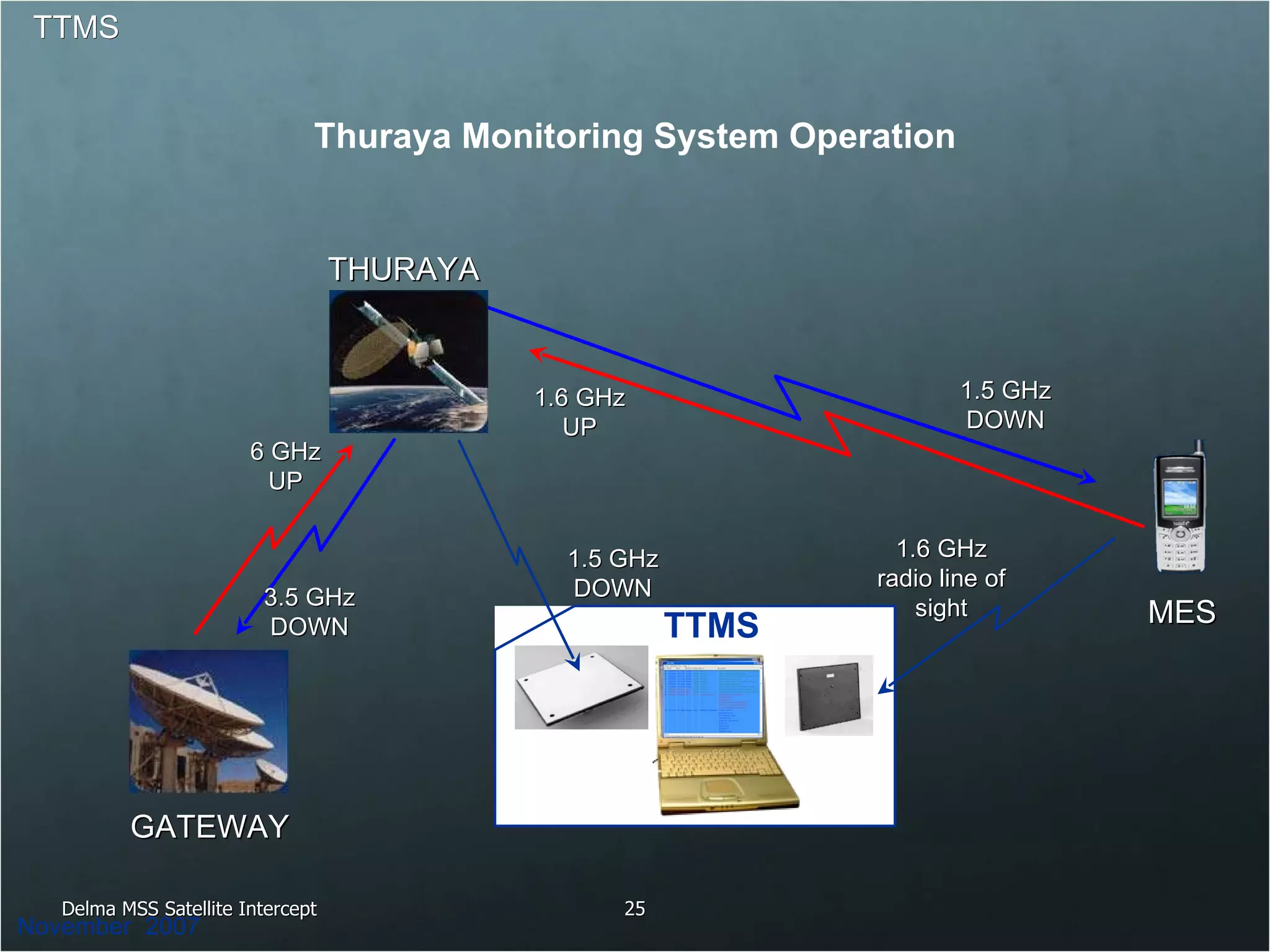
Thuraya Tactical Monitoring System (TTMS) Thuraya Tactical Monitoring System TTMS Receives L-band from satellite Receives L-band line-of-site from handset Thuraya Strategic Monitoring System TSMS Receives L-band from satellite Receives C-band from satellite Delma MSS Satellite Intercept
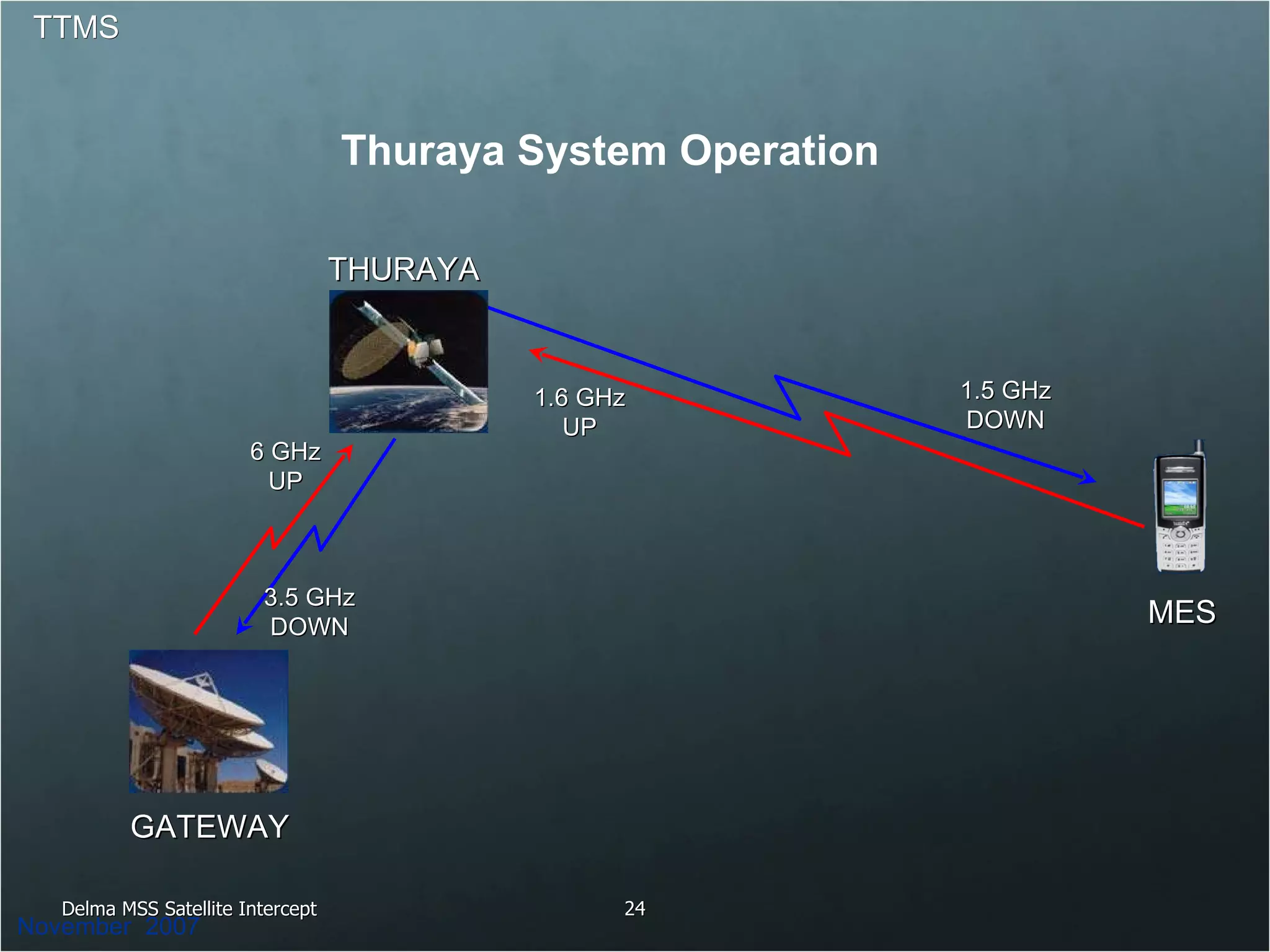
TTMS GATEWAY THURAYA MES 1.5 GHz DOWN 1.6 GHz UP 3.5 GHz DOWN 6 GHz UP Thuraya System Operation November  2007 Delma MSS Satellite Intercept
TTMS GATEWAY THURAYA MES 1.5 GHz DOWN 1.6 GHz UP 3.5 GHz DOWN 6 GHz UP 1.5 GHz DOWN TTMS 1.6 GHz radio line of sight Thuraya Monitoring System Operation November  2007 Delma MSS Satellite Intercept
Delma MSS Satellite Intercept Thuraya Spot Beam coverage
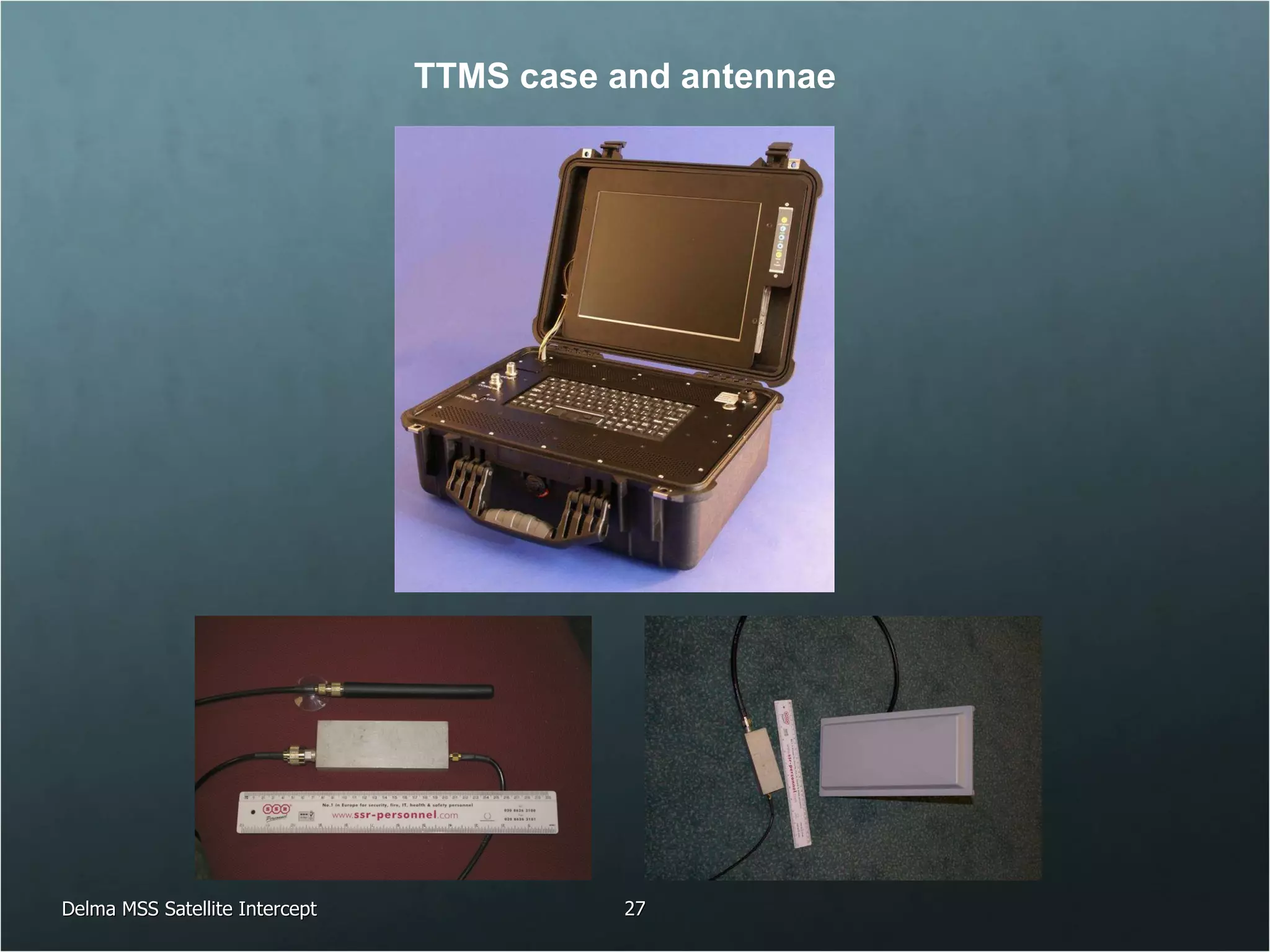
Delma MSS Satellite Intercept TTMS case and antennae
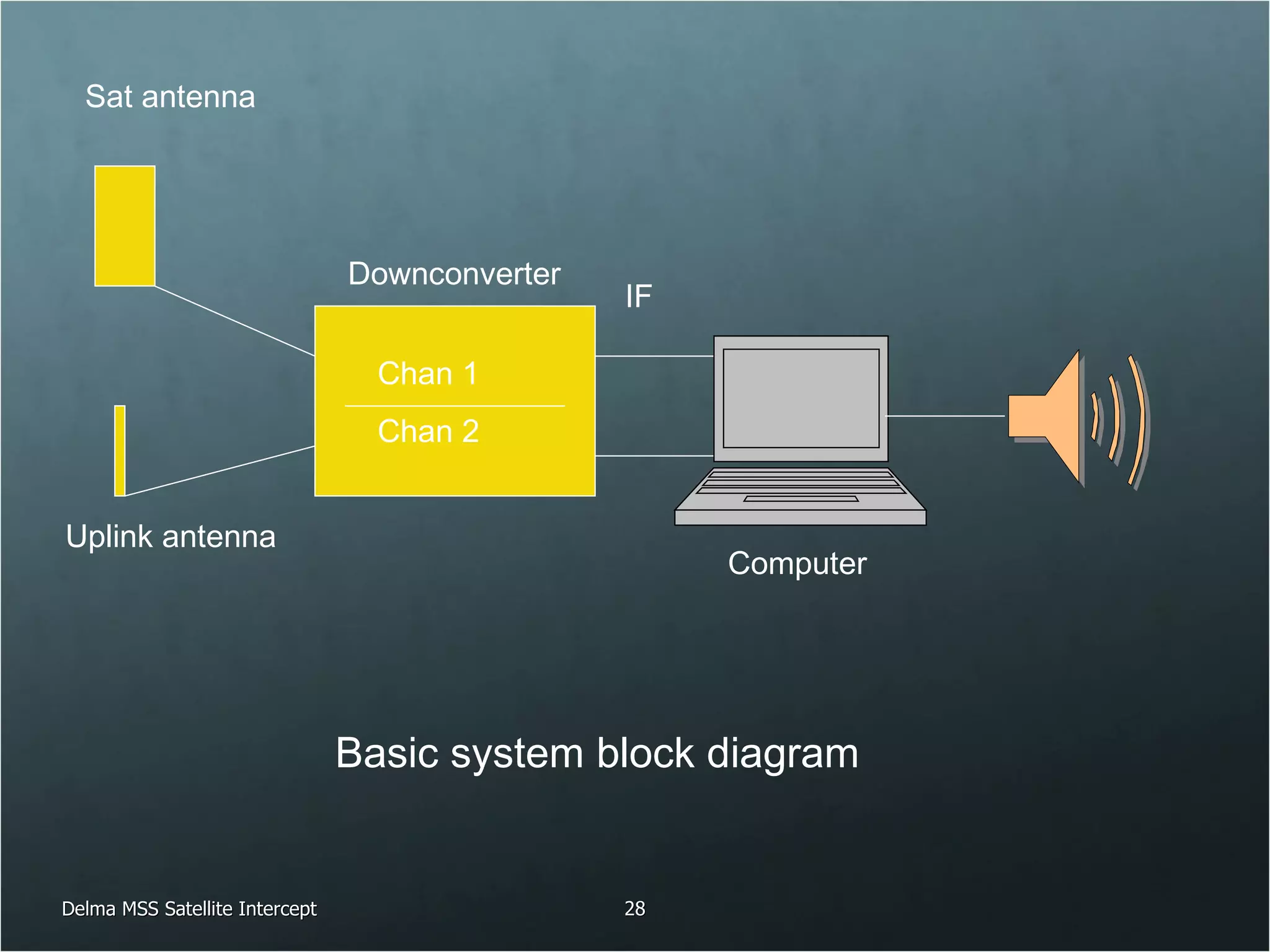
IF Sat antenna Uplink antenna Downconverter Computer Basic system block diagram Chan 1 Chan 2 Delma MSS Satellite Intercept
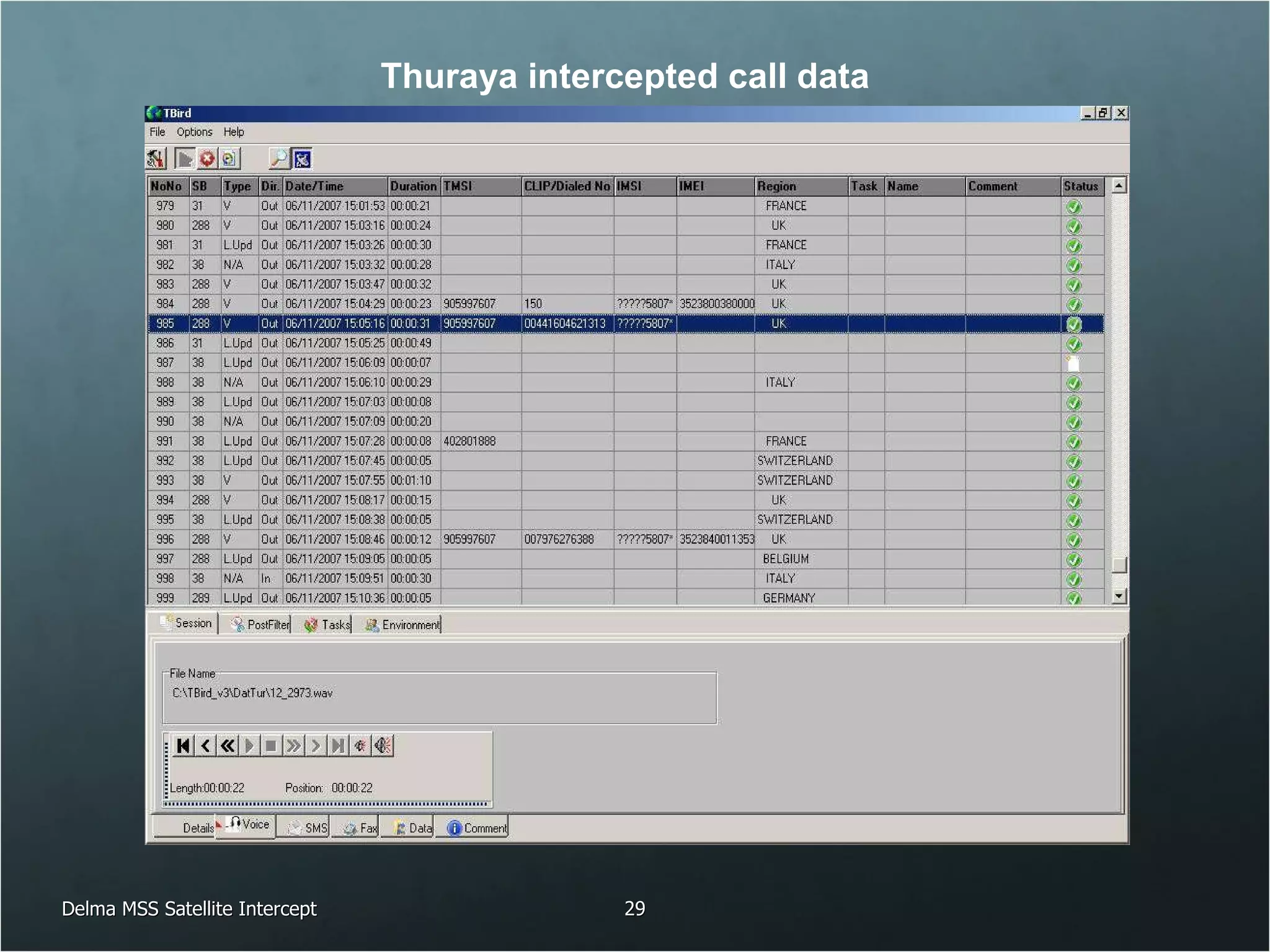
Delma MSS Satellite Intercept Thuraya intercepted call data
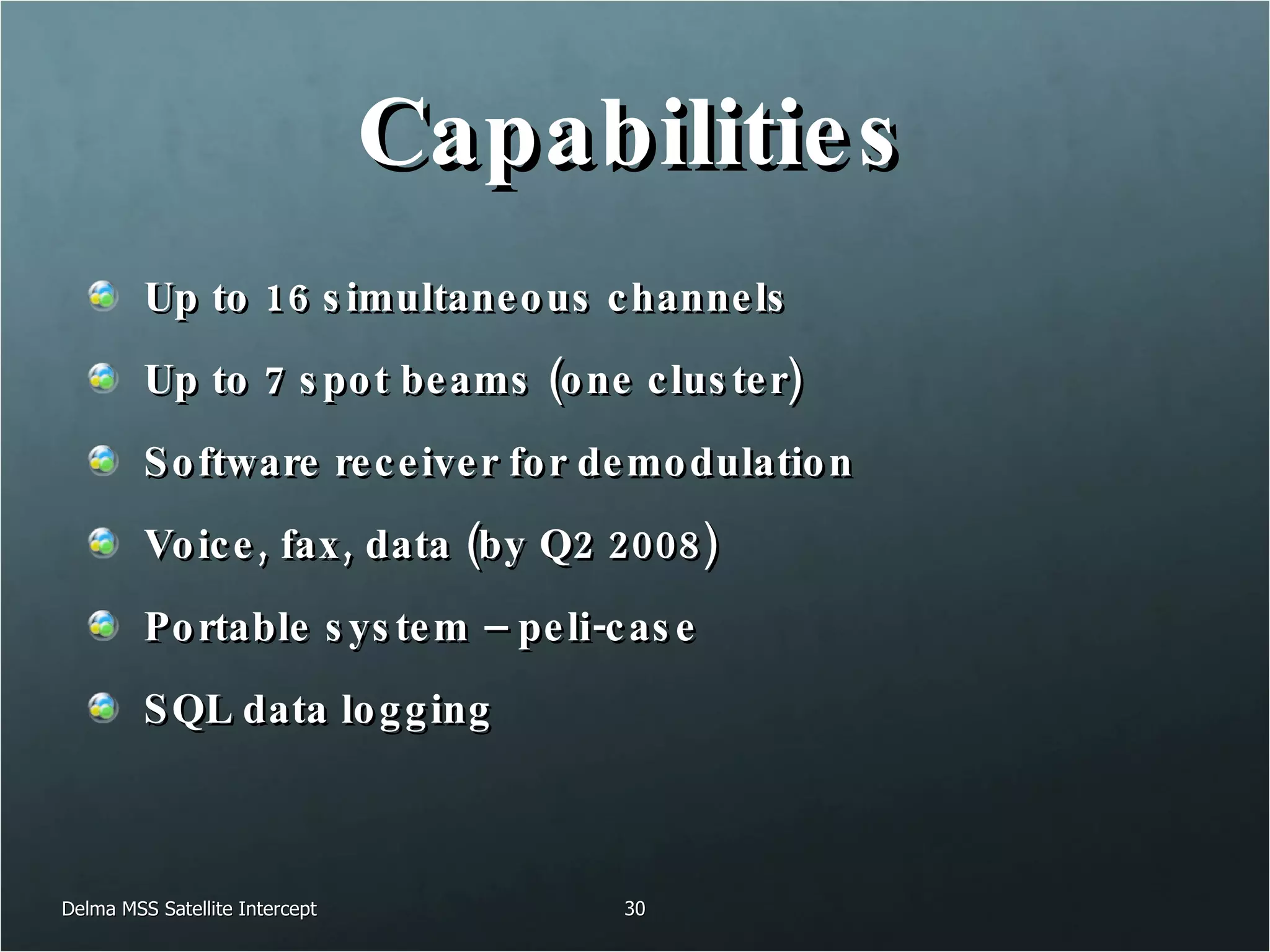
Capabilities Up to 16 simultaneous channels Up to 7 spot beams (one cluster) Software receiver for demodulation Voice, fax, data (by Q2 2008) Portable system – peli-case SQL data logging Delma MSS Satellite Intercept
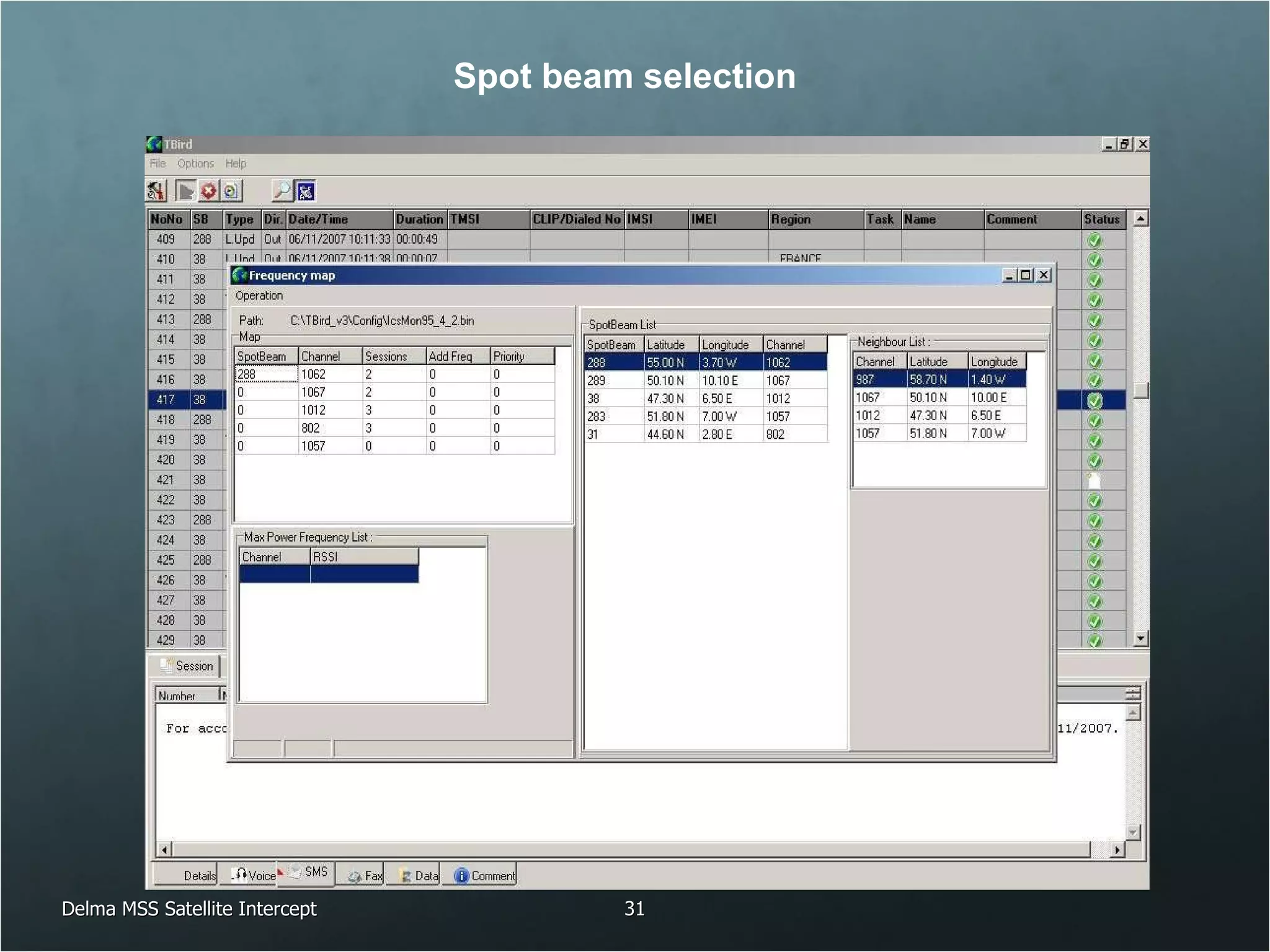
Delma MSS Satellite Intercept Spot beam selection
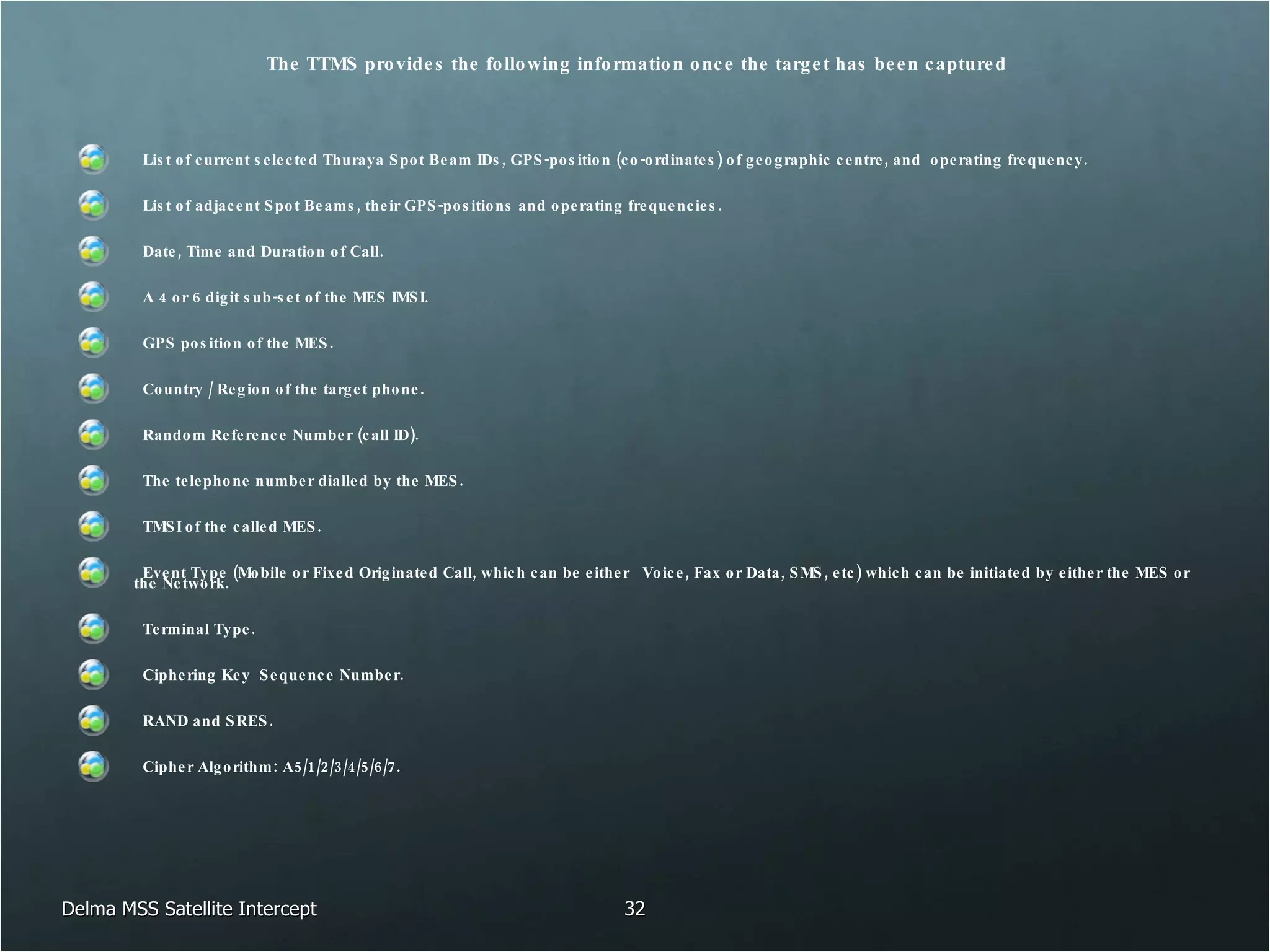
The TTMS provides the following information once the target has been captured List of current selected Thuraya Spot Beam IDs, GPS-position (co-ordinates) of geographic centre, and  operating frequency. List of adjacent Spot Beams, their GPS-positions and operating frequencies.  Date, Time and Duration of Call. A 4 or 6 digit sub-set of the MES IMSI. GPS position of the MES. Country / Region of the target phone. Random Reference Number (call ID). The telephone number dialled by the MES. TMSI of the called MES. Event Type (Mobile or Fixed Originated Call, which can be either  Voice, Fax or Data, SMS, etc) which can be initiated by either the MES or the Network.  Terminal Type. Ciphering Key  Sequence Number.  RAND and SRES.  Cipher Algorithm: A5/1/2/3/4/5/6/7. Delma MSS Satellite Intercept
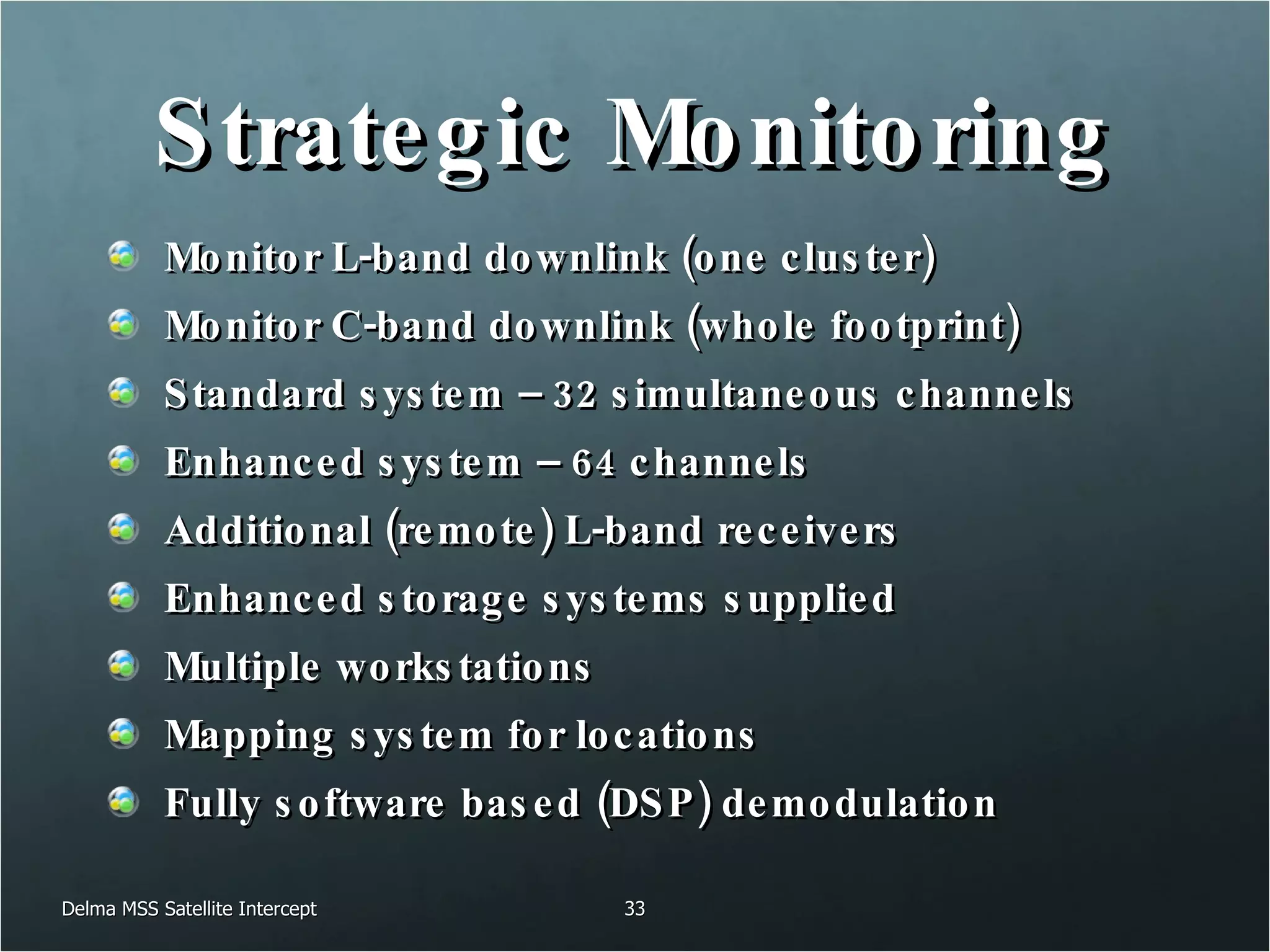
Strategic Monitoring Monitor L-band downlink (one cluster) Monitor C-band downlink (whole footprint) Standard system – 32 simultaneous channels Enhanced system – 64 channels Additional (remote) L-band receivers Enhanced storage systems supplied Multiple workstations Mapping system for locations Fully software based (DSP) demodulation Delma MSS Satellite Intercept
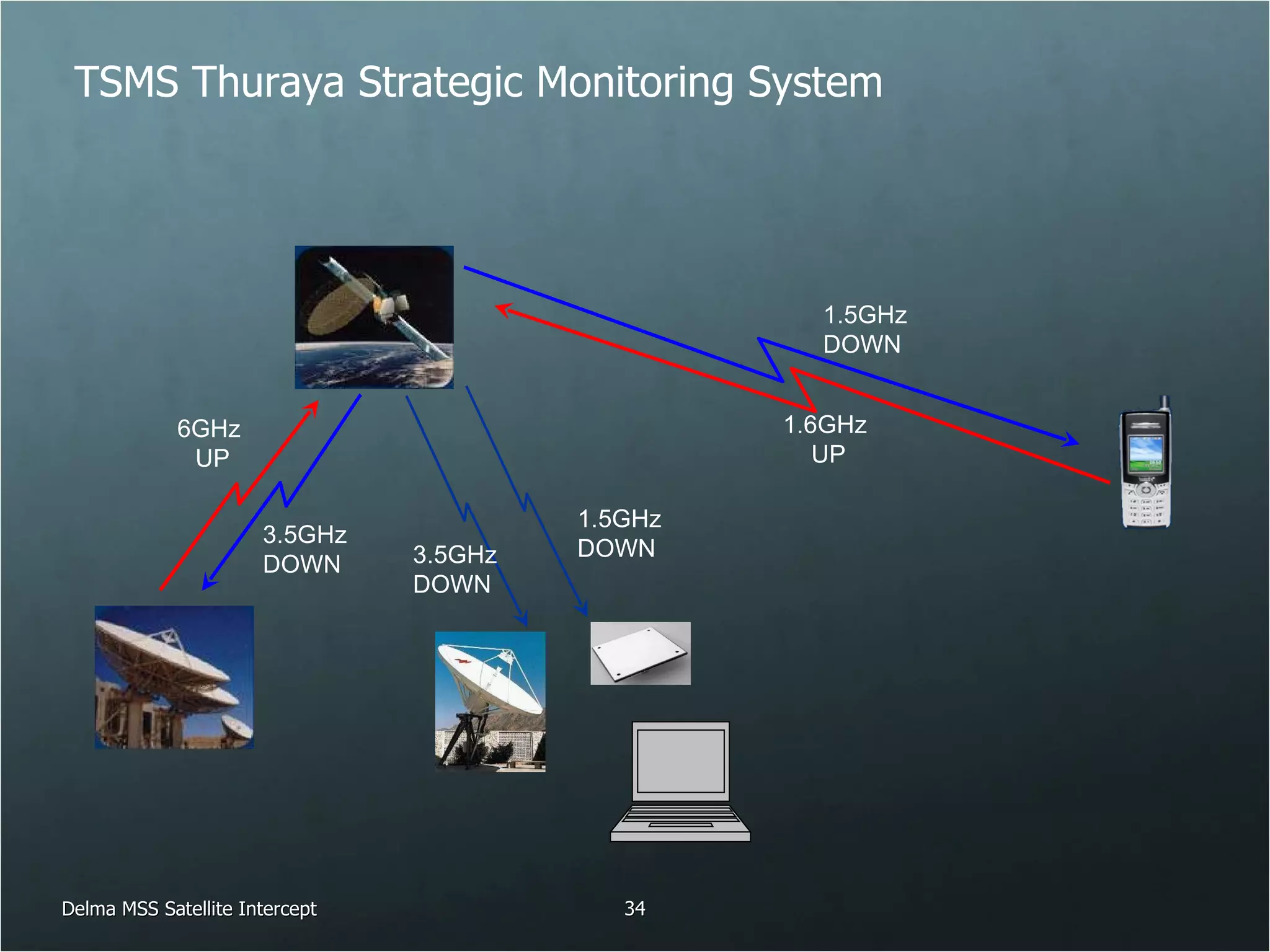
6GHz  UP 3.5GHz  DOWN 1.5GHz DOWN 1.6GHz  UP 1.5GHz DOWN 3.5GHz  DOWN TSMS Thuraya Strategic Monitoring System Delma MSS Satellite Intercept
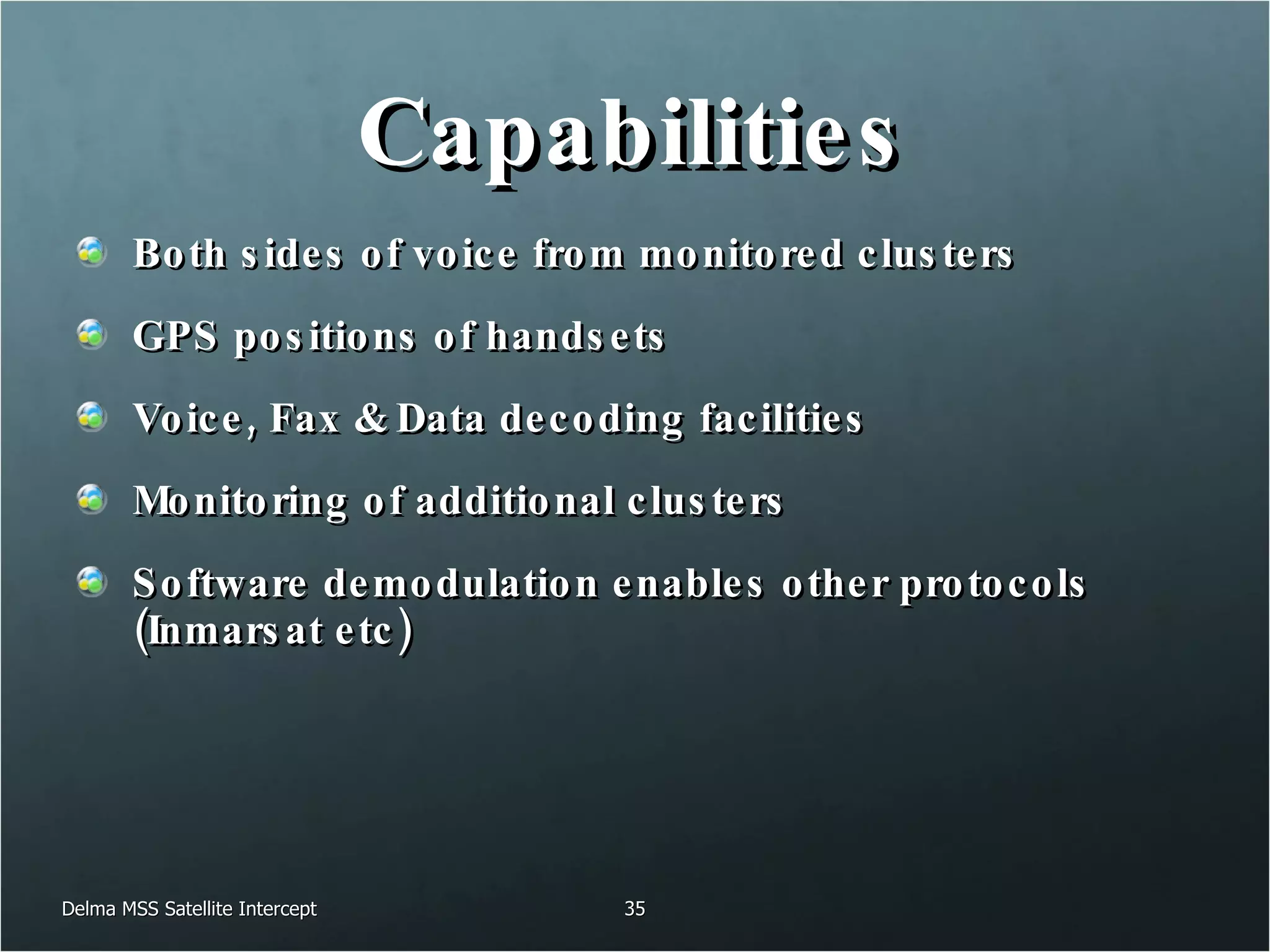
Capabilities Both sides of voice from monitored clusters GPS positions of handsets Voice, Fax & Data decoding facilities Monitoring of additional clusters Software demodulation enables other protocols (Inmarsat etc) Delma MSS Satellite Intercept
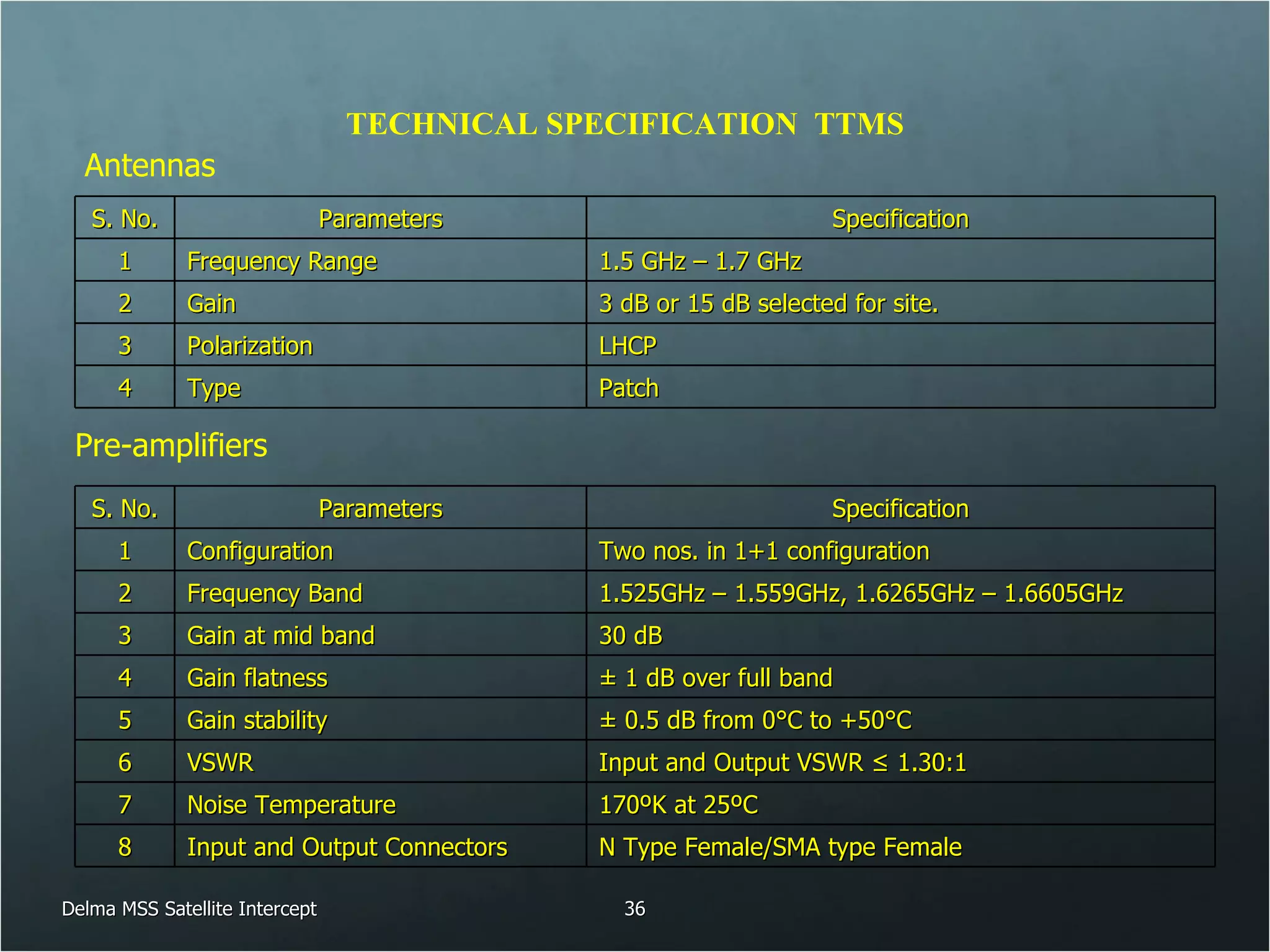
TECHNICAL SPECIFICATION  TTMS Antennas Pre-amplifiers Delma MSS Satellite Intercept S. No. Parameters Specification 1 Frequency Range 1.5 GHz – 1.7 GHz 2 Gain 3 dB or 15 dB selected for site. 3 Polarization LHCP 4 Type Patch S. No. Parameters Specification 1 Configuration Two nos. in 1+1 configuration 2 Frequency Band 1.525GHz – 1.559GHz, 1.6265GHz – 1.6605GHz 3 Gain at mid band 30 dB 4 Gain flatness ± 1 dB over full band 5 Gain stability ± 0.5 dB from 0°C to +50°C 6 VSWR Input and Output VSWR ≤ 1.30:1 7 Noise Temperature 170 ºK at 25ºC 8 Input and Output Connectors N Type Female/SMA type Female
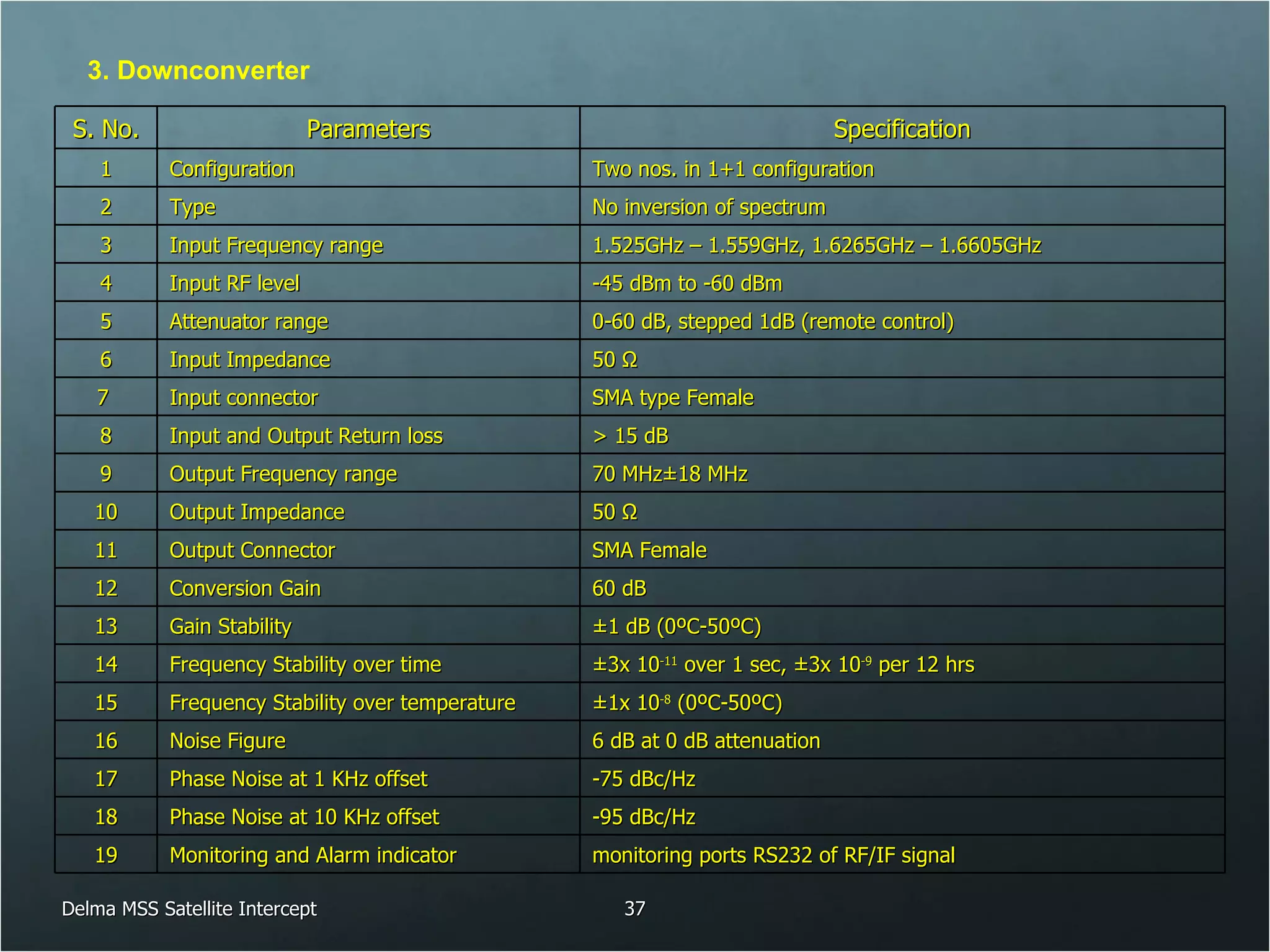
3. Downconverter Delma MSS Satellite Intercept S. No. Parameters Specification 1 Configuration Two nos. in 1+1 configuration 2 Type No inversion of spectrum 3 Input Frequency range 1.525GHz – 1.559GHz, 1.6265GHz – 1.6605GHz 4 Input RF level -45 dBm to -60 dBm 5 Attenuator range 0-60 dB ,  stepped  1 dB (remote control) 6 Input Impedance 50 Ω 7  Input connector SMA type Female 8 Input and Output Return loss > 15 dB 9 Output Frequency range 70 MHz±18 MHz 10 Output Impedance 50 Ω 11 Output Connector SMA Female 12 Conversion Gain 60 dB 13 Gain Stability ±1 dB (0ºC-50ºC) 14 Frequency Stability over time ±3x 10 -11  over 1 sec, ±3x 10 -9  per 12 hrs 15 Frequency Stability over temperature ±1x 10 -8  (0ºC-50ºC) 16 Noise Figure 6 dB at 0 dB attenuation 17 Phase Noise at 1 KHz offset -75 dBc/Hz 18 Phase Noise at 1 0  KHz offset -95 dBc/Hz 1 9 Monitoring and Alarm indicator monitoring ports RS232 of RF/IF signal
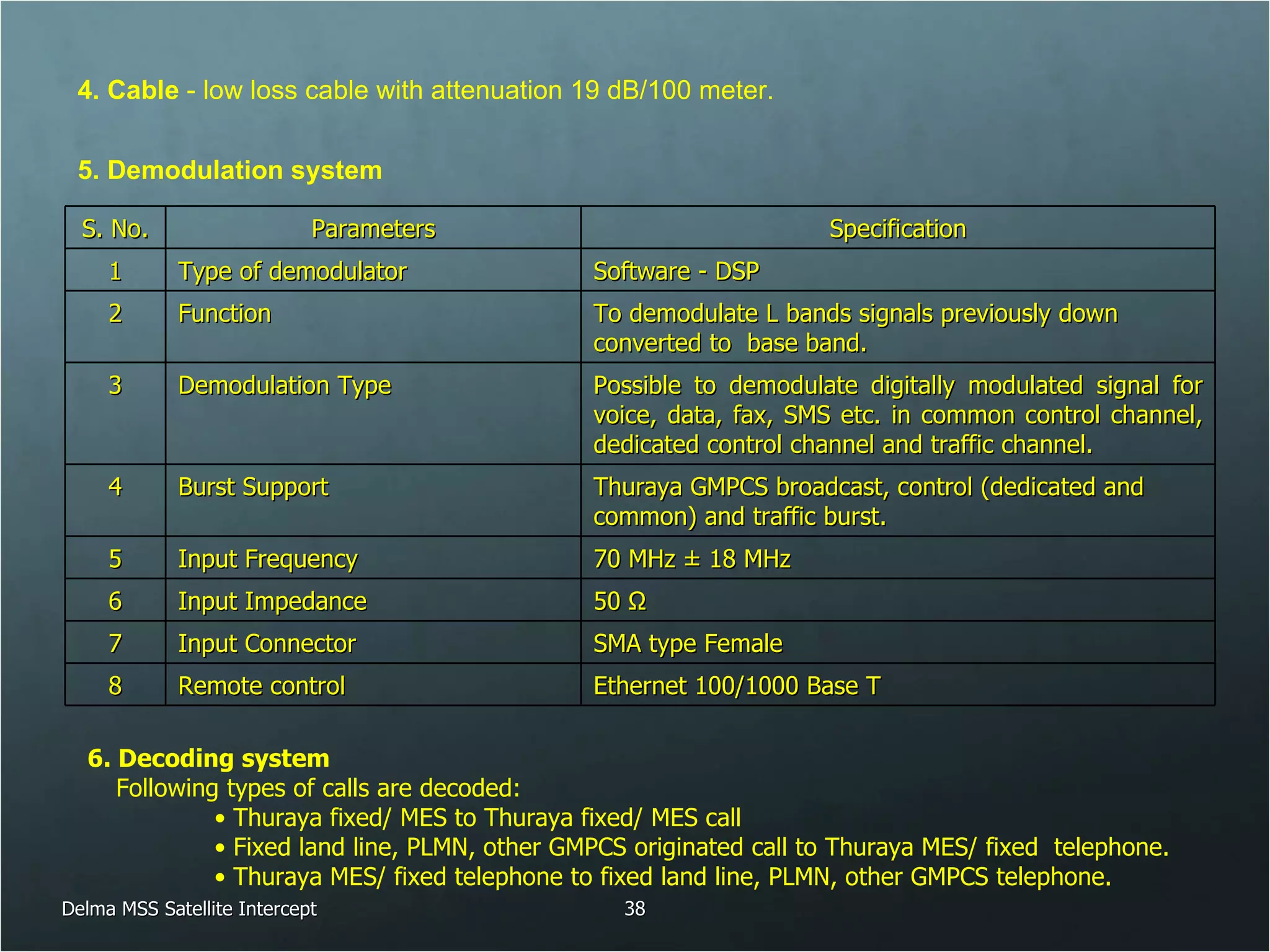
4. Cable  -   low loss cable with attenuation 19 dB/100 meter. 5. Demodulation system 6. Decoding system Following types of calls are decoded: •  Thuraya fixed/ MES to Thuraya fixed/ MES call •  Fixed land line, PLMN, other GMPCS originated call to Thuraya MES/ fixed  telephone. •  Thuraya MES/ fixed telephone to fixed land line, PLMN, other GMPCS telephone. Delma MSS Satellite Intercept S. No. Parameters Specification 1 Type of demodulator Software - DSP 2 Function To demodulate L bands signals previously down converted to  base band. 3 Demodulation Type Possible to demodulate digitally modulated signal for voice, data, fax, SMS etc. in common control channel, dedicated control channel and traffic channel. 4 Burst Support Thuraya GMPCS broadcast, control (dedicated and common) and traffic burst. 5 Input Frequency 70 MHz ± 18 MHz 6 Input Impedance 50 Ω 7 Input Connector SMA type Female 8 Remote control Ethernet 100/1000 Base T
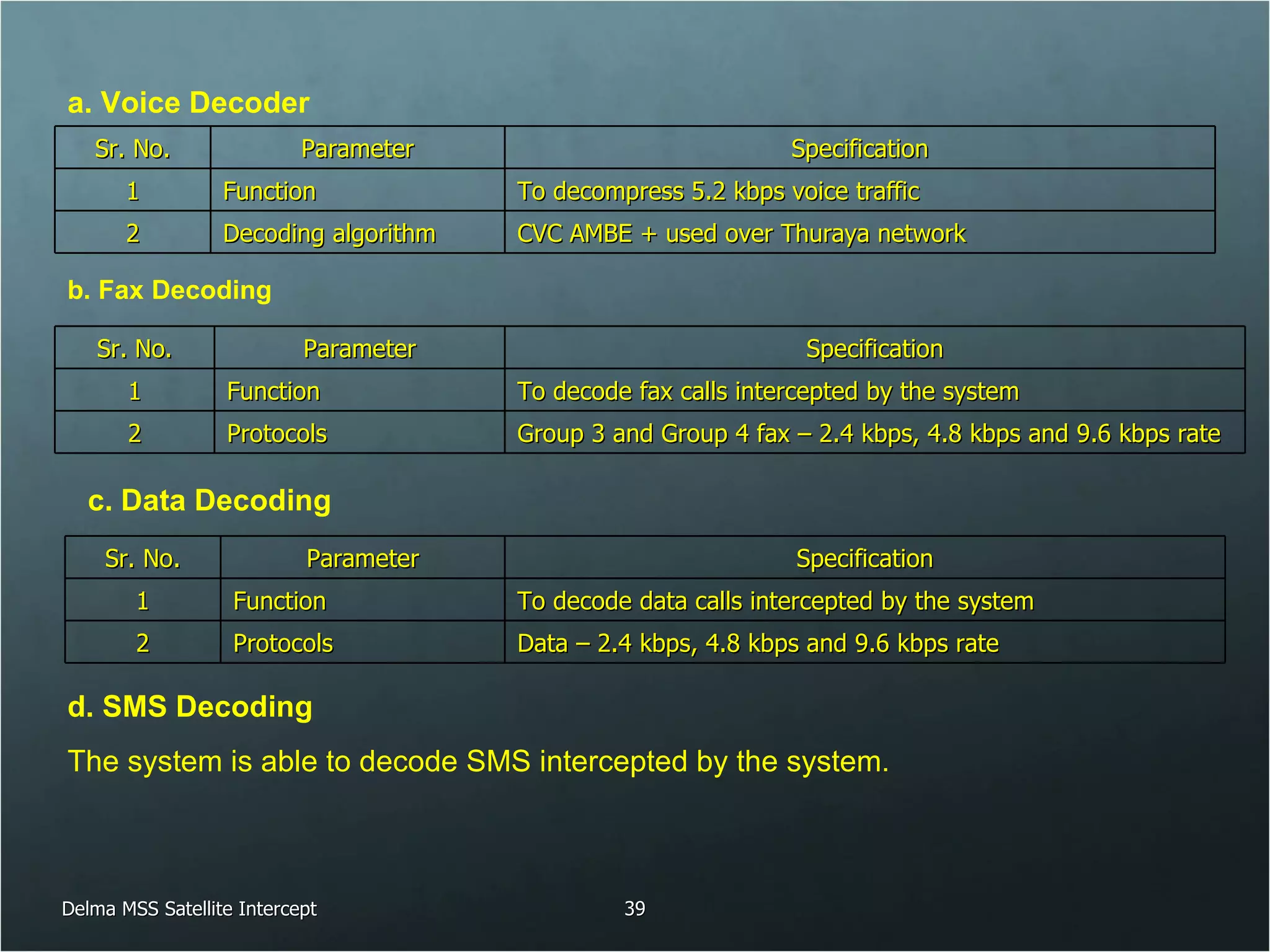
a. Voice Decoder b. Fax Decoding c. Data Decoding d. SMS Decoding The system is able to decode SMS intercepted by the system. Delma MSS Satellite Intercept Sr. No. Parameter Specification 1 Function To decompress 5.2 kbps voice traffic 2 Decoding algorithm CVC AMBE + used over Thuraya network Sr. No. Parameter Specification 1 Function To decode fax calls intercepted by the system 2 Protocols Group 3 and Group 4 fax – 2.4 kbps, 4.8 kbps and 9.6 kbps rate Sr. No. Parameter Specification 1 Function To decode data calls intercepted by the system 2 Protocols Data – 2.4 kbps, 4.8 kbps and 9.6 kbps rate
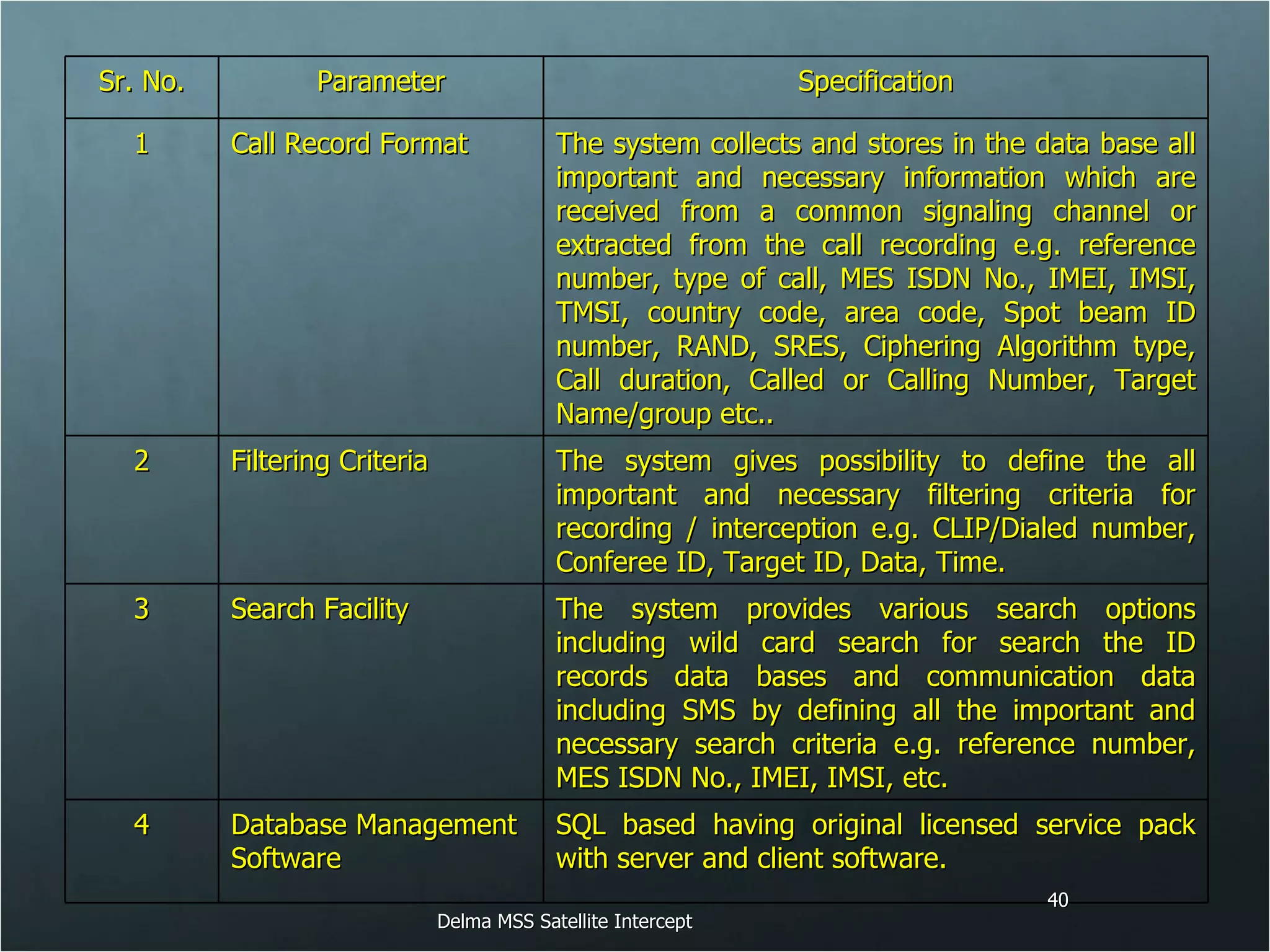
Delma MSS Satellite Intercept Sr. No. Parameter Specification 1 Call Record Format The system collects and stores in the data base all important and necessary information which are received from a common signaling channel or extracted from the call recording e.g. reference number, type of call, MES ISDN No., IMEI, IMSI, TMSI, country code, area code, Spot beam ID number, RAND, SRES, Ciphering Algorithm type, Call duration, Called or Calling Number, Target Name/group etc.. 2 Filtering Criteria The system gives possibility to define the all important and necessary filtering criteria for recording / interception e.g. CLIP/Dialed number, Conferee ID, Target ID, Data, Time. 3 Search Facility The system provides various search options including wild card search for search the ID records data bases and communication data including SMS by defining all the important and necessary search criteria e.g. reference number, MES ISDN No., IMEI, IMSI, etc. 4 Database Management Software SQL based having original licensed service pack with server and client software.

Satellite Interception

  • 1.
    Introduction to SatelliteTactical & Strategic Intercept Delma MSS Satellite Intercept
  • 2.
    Personal Satellite CommunicationsSignificant growth in services & uptake Terminal size reduced Low cost of usage Can be used where no GSM coverage exists Data & fax services now available Delma MSS Satellite Intercept
  • 3.
    Satellite Communications LEO– Low Earth Orbit - Iridium, Teledesic MEO – Medium Earth Orbit - Globalstar, ICO international, GEO - Geostationary - Thuraya, Garuda, Inmarsat, ICO, MSV Delma MSS Satellite Intercept
  • 4.
    Iridium 66 LowEarth Orbit satellites operating as a fully meshed network, 11 satellites in 6 orbital planes separated by 31.6  Each satellite is linked to 4 others Each satellite is in polar orbit at 780km & has 46 spot beams Each orbit is approx 100 minutes L-band to handset; 1.616 GHz – 1.6265 GHz Ku band between satellites; 23.18GHz – 23.38GHz GSM based architecture, 2.4kb/s codec Delma MSS Satellite Intercept
  • 5.
    Iridium Coverage Globalincluding oceans Delma MSS Satellite Intercept
  • 6.
    Teledesic 288 LowEarth Orbit Satellites planned Backed by Bill Gates Data communication to 100Mb/s Suspended in 2002 Delma MSS Satellite Intercept
  • 7.
    Globalstar 48 MediumEarth Orbit satellites in 8 orbital planes Uses Qualcom’s CDMA technology L-band to handsets Several ground stations for routing calls to the terrestrial network Some issues with satellite failures Delma MSS Satellite Intercept
  • 8.
    Globalstar Coverage DelmaMSS Satellite Intercept Coverage not global due to incomplete constellation
  • 9.
    ICO 10 MediumEarth Orbit satellites; 10,390km Uses 12 Earth stations and terrestrial switching Uses TDMA technology (GSM-like) 1 satellite in orbit, 4-5 ready Contractual problems – not operational Incorporates Odessey Delma MSS Satellite Intercept
  • 10.
    Thuraya Geostationary satellites- 1 active over Sudan, 1 (new) over Borneo Communicates with handset at L-band ( 1.525GHz – 1.559GHz, 1.6265GHz – 1.6605GHz ) Communicates with ground at C-band GSM phase 2-type technology Very successful operationally – in excess of 6,000 calls per day Delma MSS Satellite Intercept
  • 11.
    Thuraya Coverage DelmaMSS Satellite Intercept
  • 12.
    Garuda (ACeS) 1Geostationary satellite Coverage of Far East CDMA technology 140 spot beams Now linked to Inmarsat (2006) Delma MSS Satellite Intercept
  • 13.
    Garuda Coverage DelmaMSS Satellite Intercept
  • 14.
    Isatphone Derived fromACeS Uses newest Inmarsat 4 satellite Planned global expansion in 2009 Similar to Thuraya GSM-like technology Delma MSS Satellite Intercept
  • 15.
    Delma MSS SatelliteIntercept Isatphone coverage
  • 16.
    ICO New ICOservice using geostationary satellite First launch imminent Centred on USA & Canada Mobile video & data Not yet operational Delma MSS Satellite Intercept
  • 17.
    MSV Coverage USA,Canada & Caribbean 2 new satellites due to be launched in 2009 Will cover mobile broadband data 4G system for USA for mobile data & voice communication Not yet operational Delma MSS Satellite Intercept
  • 18.
    Inmarsat Oldest andmost established Inmarsat 3 first to use spot beam technology Inmarsat M & mini-M voice & data services – laptop size terminals & antennas Inmarsat 4 more powerful satellites Initially, Inmarsat RBGAN packet data service Inmarsat BGAN services now can use large handheld terminals Concentration on data – mobile office apps Delma MSS Satellite Intercept
  • 19.
    Coverage – Inmarsat3 Delma MSS Satellite Intercept
  • 20.
    Coverage – Inmarsat4 Delma MSS Satellite Intercept
  • 21.
    Capabilities of DelmaMSS Fully functioning Thuraya monitoring systems, both strategic and tactical Tactical & strategic monitoring for Inmarsat 3 (Inmarsat M & mini-M) Work in progress on Inmarsat 4 (BGAN) Tactical system for Iridium available but not produced by Delma MSS Direct Partners Delma MSS Satellite Intercept
  • 22.
    VSAT Several operatorsProvide broadband data & TV services Monitoring systems been demonstrated Specific to operator Main requirement to locate terminals! Delma MSS Satellite Intercept
  • 23.
    Thuraya Tactical MonitoringSystem (TTMS) Thuraya Tactical Monitoring System TTMS Receives L-band from satellite Receives L-band line-of-site from handset Thuraya Strategic Monitoring System TSMS Receives L-band from satellite Receives C-band from satellite Delma MSS Satellite Intercept
  • 24.
    TTMS GATEWAY THURAYAMES 1.5 GHz DOWN 1.6 GHz UP 3.5 GHz DOWN 6 GHz UP Thuraya System Operation November 2007 Delma MSS Satellite Intercept
  • 25.
    TTMS GATEWAY THURAYAMES 1.5 GHz DOWN 1.6 GHz UP 3.5 GHz DOWN 6 GHz UP 1.5 GHz DOWN TTMS 1.6 GHz radio line of sight Thuraya Monitoring System Operation November 2007 Delma MSS Satellite Intercept
  • 26.
    Delma MSS SatelliteIntercept Thuraya Spot Beam coverage
  • 27.
    Delma MSS SatelliteIntercept TTMS case and antennae
  • 28.
    IF Sat antennaUplink antenna Downconverter Computer Basic system block diagram Chan 1 Chan 2 Delma MSS Satellite Intercept
  • 29.
    Delma MSS SatelliteIntercept Thuraya intercepted call data
  • 30.
    Capabilities Up to16 simultaneous channels Up to 7 spot beams (one cluster) Software receiver for demodulation Voice, fax, data (by Q2 2008) Portable system – peli-case SQL data logging Delma MSS Satellite Intercept
  • 31.
    Delma MSS SatelliteIntercept Spot beam selection
  • 32.
    The TTMS providesthe following information once the target has been captured List of current selected Thuraya Spot Beam IDs, GPS-position (co-ordinates) of geographic centre, and operating frequency. List of adjacent Spot Beams, their GPS-positions and operating frequencies. Date, Time and Duration of Call. A 4 or 6 digit sub-set of the MES IMSI. GPS position of the MES. Country / Region of the target phone. Random Reference Number (call ID). The telephone number dialled by the MES. TMSI of the called MES. Event Type (Mobile or Fixed Originated Call, which can be either Voice, Fax or Data, SMS, etc) which can be initiated by either the MES or the Network. Terminal Type. Ciphering Key Sequence Number. RAND and SRES. Cipher Algorithm: A5/1/2/3/4/5/6/7. Delma MSS Satellite Intercept
  • 33.
    Strategic Monitoring MonitorL-band downlink (one cluster) Monitor C-band downlink (whole footprint) Standard system – 32 simultaneous channels Enhanced system – 64 channels Additional (remote) L-band receivers Enhanced storage systems supplied Multiple workstations Mapping system for locations Fully software based (DSP) demodulation Delma MSS Satellite Intercept
  • 34.
    6GHz UP3.5GHz DOWN 1.5GHz DOWN 1.6GHz UP 1.5GHz DOWN 3.5GHz DOWN TSMS Thuraya Strategic Monitoring System Delma MSS Satellite Intercept
  • 35.
    Capabilities Both sidesof voice from monitored clusters GPS positions of handsets Voice, Fax & Data decoding facilities Monitoring of additional clusters Software demodulation enables other protocols (Inmarsat etc) Delma MSS Satellite Intercept
  • 36.
    TECHNICAL SPECIFICATION TTMS Antennas Pre-amplifiers Delma MSS Satellite Intercept S. No. Parameters Specification 1 Frequency Range 1.5 GHz – 1.7 GHz 2 Gain 3 dB or 15 dB selected for site. 3 Polarization LHCP 4 Type Patch S. No. Parameters Specification 1 Configuration Two nos. in 1+1 configuration 2 Frequency Band 1.525GHz – 1.559GHz, 1.6265GHz – 1.6605GHz 3 Gain at mid band 30 dB 4 Gain flatness ± 1 dB over full band 5 Gain stability ± 0.5 dB from 0°C to +50°C 6 VSWR Input and Output VSWR ≤ 1.30:1 7 Noise Temperature 170 ºK at 25ºC 8 Input and Output Connectors N Type Female/SMA type Female
  • 37.
    3. Downconverter DelmaMSS Satellite Intercept S. No. Parameters Specification 1 Configuration Two nos. in 1+1 configuration 2 Type No inversion of spectrum 3 Input Frequency range 1.525GHz – 1.559GHz, 1.6265GHz – 1.6605GHz 4 Input RF level -45 dBm to -60 dBm 5 Attenuator range 0-60 dB , stepped 1 dB (remote control) 6 Input Impedance 50 Ω 7 Input connector SMA type Female 8 Input and Output Return loss > 15 dB 9 Output Frequency range 70 MHz±18 MHz 10 Output Impedance 50 Ω 11 Output Connector SMA Female 12 Conversion Gain 60 dB 13 Gain Stability ±1 dB (0ºC-50ºC) 14 Frequency Stability over time ±3x 10 -11 over 1 sec, ±3x 10 -9 per 12 hrs 15 Frequency Stability over temperature ±1x 10 -8 (0ºC-50ºC) 16 Noise Figure 6 dB at 0 dB attenuation 17 Phase Noise at 1 KHz offset -75 dBc/Hz 18 Phase Noise at 1 0 KHz offset -95 dBc/Hz 1 9 Monitoring and Alarm indicator monitoring ports RS232 of RF/IF signal
  • 38.
    4. Cable - low loss cable with attenuation 19 dB/100 meter. 5. Demodulation system 6. Decoding system Following types of calls are decoded: • Thuraya fixed/ MES to Thuraya fixed/ MES call • Fixed land line, PLMN, other GMPCS originated call to Thuraya MES/ fixed telephone. • Thuraya MES/ fixed telephone to fixed land line, PLMN, other GMPCS telephone. Delma MSS Satellite Intercept S. No. Parameters Specification 1 Type of demodulator Software - DSP 2 Function To demodulate L bands signals previously down converted to base band. 3 Demodulation Type Possible to demodulate digitally modulated signal for voice, data, fax, SMS etc. in common control channel, dedicated control channel and traffic channel. 4 Burst Support Thuraya GMPCS broadcast, control (dedicated and common) and traffic burst. 5 Input Frequency 70 MHz ± 18 MHz 6 Input Impedance 50 Ω 7 Input Connector SMA type Female 8 Remote control Ethernet 100/1000 Base T
  • 39.
    a. Voice Decoderb. Fax Decoding c. Data Decoding d. SMS Decoding The system is able to decode SMS intercepted by the system. Delma MSS Satellite Intercept Sr. No. Parameter Specification 1 Function To decompress 5.2 kbps voice traffic 2 Decoding algorithm CVC AMBE + used over Thuraya network Sr. No. Parameter Specification 1 Function To decode fax calls intercepted by the system 2 Protocols Group 3 and Group 4 fax – 2.4 kbps, 4.8 kbps and 9.6 kbps rate Sr. No. Parameter Specification 1 Function To decode data calls intercepted by the system 2 Protocols Data – 2.4 kbps, 4.8 kbps and 9.6 kbps rate
  • 40.
    Delma MSS SatelliteIntercept Sr. No. Parameter Specification 1 Call Record Format The system collects and stores in the data base all important and necessary information which are received from a common signaling channel or extracted from the call recording e.g. reference number, type of call, MES ISDN No., IMEI, IMSI, TMSI, country code, area code, Spot beam ID number, RAND, SRES, Ciphering Algorithm type, Call duration, Called or Calling Number, Target Name/group etc.. 2 Filtering Criteria The system gives possibility to define the all important and necessary filtering criteria for recording / interception e.g. CLIP/Dialed number, Conferee ID, Target ID, Data, Time. 3 Search Facility The system provides various search options including wild card search for search the ID records data bases and communication data including SMS by defining all the important and necessary search criteria e.g. reference number, MES ISDN No., IMEI, IMSI, etc. 4 Database Management Software SQL based having original licensed service pack with server and client software.