PROJECT ON Affiliated to  UNDER THE GUIDENCE OF  B.M. NAVEEN KUMAR BY NIKHIL R AND GIRISH CSE ‘A’
Point of view To implement a  Voice Based Security System to provide  security to your  system. The system is based on  Voice-to-phoneme algorithm and  phonetic transcription.
What is Voice Based Security System (VBSS)? Voice Based Security System uses a person's voice print to uniquely identify individuals using biometric speaker verification technology. A voice-tag application, which converts human speech into an abstract representation and then uses this representation to recognize (or classify) users. The VBSS will analyze the pitch and words and compares it with the data inside the system and recognizes the user to grant permission. Personal information like the banking passwords, Bank amount details, Intelligence Data, Criminal data, Case Files of the Lawyers,  Critical Defense information etc.. can be secured using VBSS.
Why voice based security system (VBSS)? Today password is going to be the major security factor which is prone to hackers. The password is not sufficient enough today to secure critical data.  Voice Based Security System  can deliver biometric security technology to the market at a lower cost than anyone else in the industry, with no reoccurring maintenance costs such as database management or complicated user training. The system can be supportable across a wide range of platforms including the embedded platforms.
Drawbacks of the existing system HMMs are directly used as the abstract speech representations in voice-tag applications. This approach has enjoyed considerable success as it is a language independent and achieves high speech recognition accuracy while maintaining the low CPU requirement for the HMM-based voice-tag. As long as the targeted number of voice-tags is restricted to two or there dozen in an application, the memory consumption of this strategy is not so good. Another attribute of the HMM-based voice-tag is its speaker-dependence.
Scope of the proposed system The proposed system is a speaker-independent voice-tag application. A voice-to-phoneme algorithm which maximizes user convenience during  voice-tag enrollment while improving recognition accuracy. Admin must be able to create, modify and delete a user from entering the system.  For user convenience, the number of example utterances per voice-tag during enrollment is minimal. VBSS is designed to overcome the difficulties of CPU and Memory space.
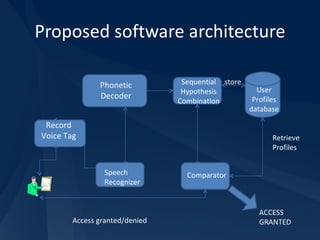
Proposed software architecture Record Voice Tag Phonetic Decoder Speech Recognizer Comparator Sequential Hypothesis Combination User Profiles database Access granted/denied store Retrieve Profiles ACCESS GRANTED
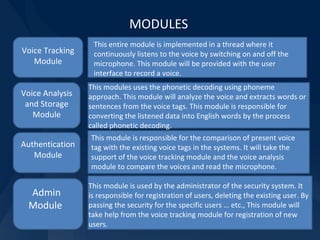
MODULES Voice Tracking Module This entire module is implemented in a thread where it continuously listens to the voice by switching on and off the microphone. This module will be provided with the user interface to record a voice. Voice Analysis and Storage Module This modules uses the phonetic decoding using phoneme approach. This module will analyze the voice and extracts words or sentences from the voice tags. This module is responsible for converting the listened data into English words by the process called phonetic decoding.  Authentication Module Admin Module This module is responsible for the comparison of present voice tag with the existing voice tags in the systems. It will take the support of the voice tracking module and the voice analysis module to compare the voices and read the microphone.  This module is used by the administrator of the security system. It is responsible for registration of users, deleting the existing user. By passing the security for the specific users … etc., This module will take help from the voice tracking module for registration of new users.
References It is based on the IEEE 2005 paper Voice-to-phoneme  conversion algorithms for the speaker-independent voice-tag applications in embedded platforms.  " Biometric technologies - those that use..voice.. - will be the most important IT innovations of the next several years. " -Bill Gates at Gartner Group Itexpo '97
Thank you

VOICE BASED SECURITY SYSTEM

  • 1.
    PROJECT ON Affiliatedto UNDER THE GUIDENCE OF B.M. NAVEEN KUMAR BY NIKHIL R AND GIRISH CSE ‘A’
  • 2.
    Point of viewTo implement a Voice Based Security System to provide security to your system. The system is based on Voice-to-phoneme algorithm and phonetic transcription.
  • 3.
    What is VoiceBased Security System (VBSS)? Voice Based Security System uses a person's voice print to uniquely identify individuals using biometric speaker verification technology. A voice-tag application, which converts human speech into an abstract representation and then uses this representation to recognize (or classify) users. The VBSS will analyze the pitch and words and compares it with the data inside the system and recognizes the user to grant permission. Personal information like the banking passwords, Bank amount details, Intelligence Data, Criminal data, Case Files of the Lawyers, Critical Defense information etc.. can be secured using VBSS.
  • 4.
    Why voice basedsecurity system (VBSS)? Today password is going to be the major security factor which is prone to hackers. The password is not sufficient enough today to secure critical data. Voice Based Security System can deliver biometric security technology to the market at a lower cost than anyone else in the industry, with no reoccurring maintenance costs such as database management or complicated user training. The system can be supportable across a wide range of platforms including the embedded platforms.
  • 5.
    Drawbacks of theexisting system HMMs are directly used as the abstract speech representations in voice-tag applications. This approach has enjoyed considerable success as it is a language independent and achieves high speech recognition accuracy while maintaining the low CPU requirement for the HMM-based voice-tag. As long as the targeted number of voice-tags is restricted to two or there dozen in an application, the memory consumption of this strategy is not so good. Another attribute of the HMM-based voice-tag is its speaker-dependence.
  • 6.
    Scope of theproposed system The proposed system is a speaker-independent voice-tag application. A voice-to-phoneme algorithm which maximizes user convenience during voice-tag enrollment while improving recognition accuracy. Admin must be able to create, modify and delete a user from entering the system. For user convenience, the number of example utterances per voice-tag during enrollment is minimal. VBSS is designed to overcome the difficulties of CPU and Memory space.
  • 7.
    Proposed software architectureRecord Voice Tag Phonetic Decoder Speech Recognizer Comparator Sequential Hypothesis Combination User Profiles database Access granted/denied store Retrieve Profiles ACCESS GRANTED
  • 8.
    MODULES Voice TrackingModule This entire module is implemented in a thread where it continuously listens to the voice by switching on and off the microphone. This module will be provided with the user interface to record a voice. Voice Analysis and Storage Module This modules uses the phonetic decoding using phoneme approach. This module will analyze the voice and extracts words or sentences from the voice tags. This module is responsible for converting the listened data into English words by the process called phonetic decoding. Authentication Module Admin Module This module is responsible for the comparison of present voice tag with the existing voice tags in the systems. It will take the support of the voice tracking module and the voice analysis module to compare the voices and read the microphone. This module is used by the administrator of the security system. It is responsible for registration of users, deleting the existing user. By passing the security for the specific users … etc., This module will take help from the voice tracking module for registration of new users.
  • 9.
    References It isbased on the IEEE 2005 paper Voice-to-phoneme conversion algorithms for the speaker-independent voice-tag applications in embedded platforms. " Biometric technologies - those that use..voice.. - will be the most important IT innovations of the next several years. " -Bill Gates at Gartner Group Itexpo '97
  • 10.

Editor's Notes

  • #2 www.forrester.com © 2003, Forrester Research, Inc.
  • #3 www.forrester.com © 2003, Forrester Research, Inc.
  • #9 www.forrester.com © 2003, Forrester Research, Inc.
  • #10 www.forrester.com © 2003, Forrester Research, Inc.
  • #11 www.forrester.com © 2003, Forrester Research, Inc.