Robust Real-Time Object DetectionAuthor: Paul Viola, Michael J. Jones
International Journal of Computer Vision 57(2), 137–154, 2004
Presented by ERLI – M10115801
Background & Motivation
• Detecting object on real time
• Detecting face
Outline
Introduction
Image Representation – Integral Image
Learning Algorithm – AdaBoost
Cascade Classifier
Experiment and Result
Introduction
Object Detection
Detection System
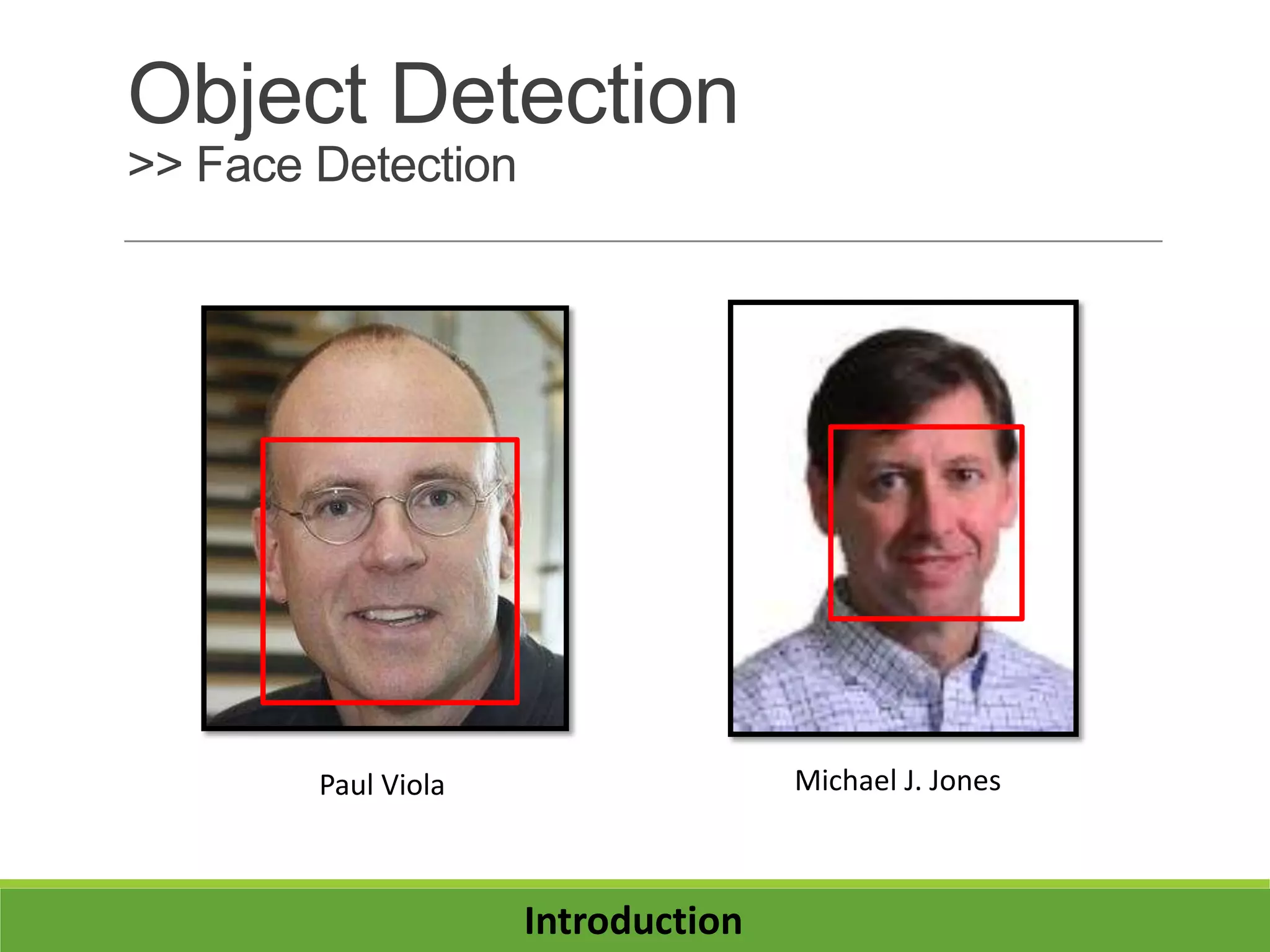
Object Detection
>> Face Detection
Paul Viola Michael J. Jones
Introduction
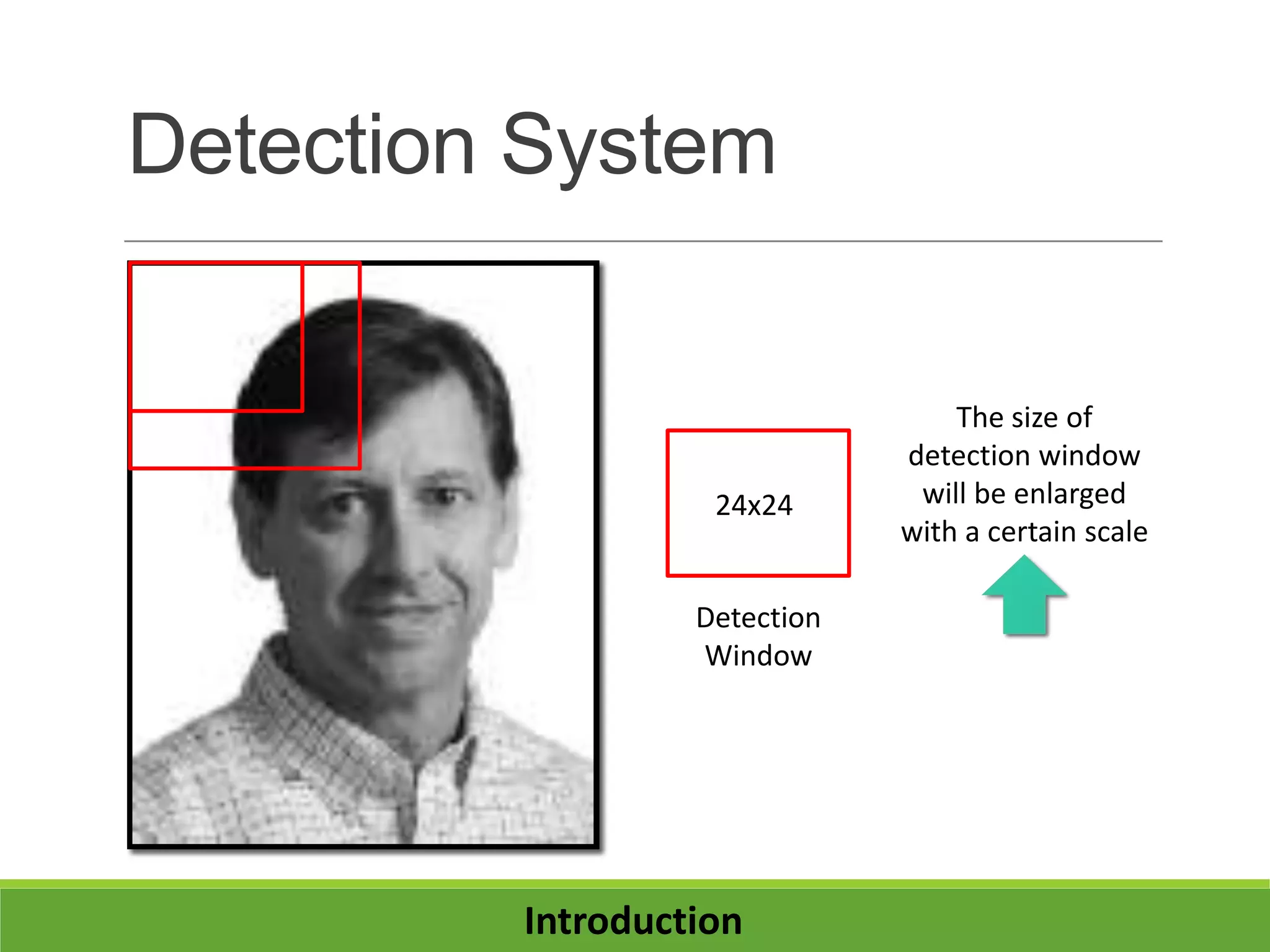
Detection System
24x24
Detection
Window
The size of
detection window
will be enlarged
with a certain scale
Introduction
Image
Representation
Integral Image
Integral Image Feature
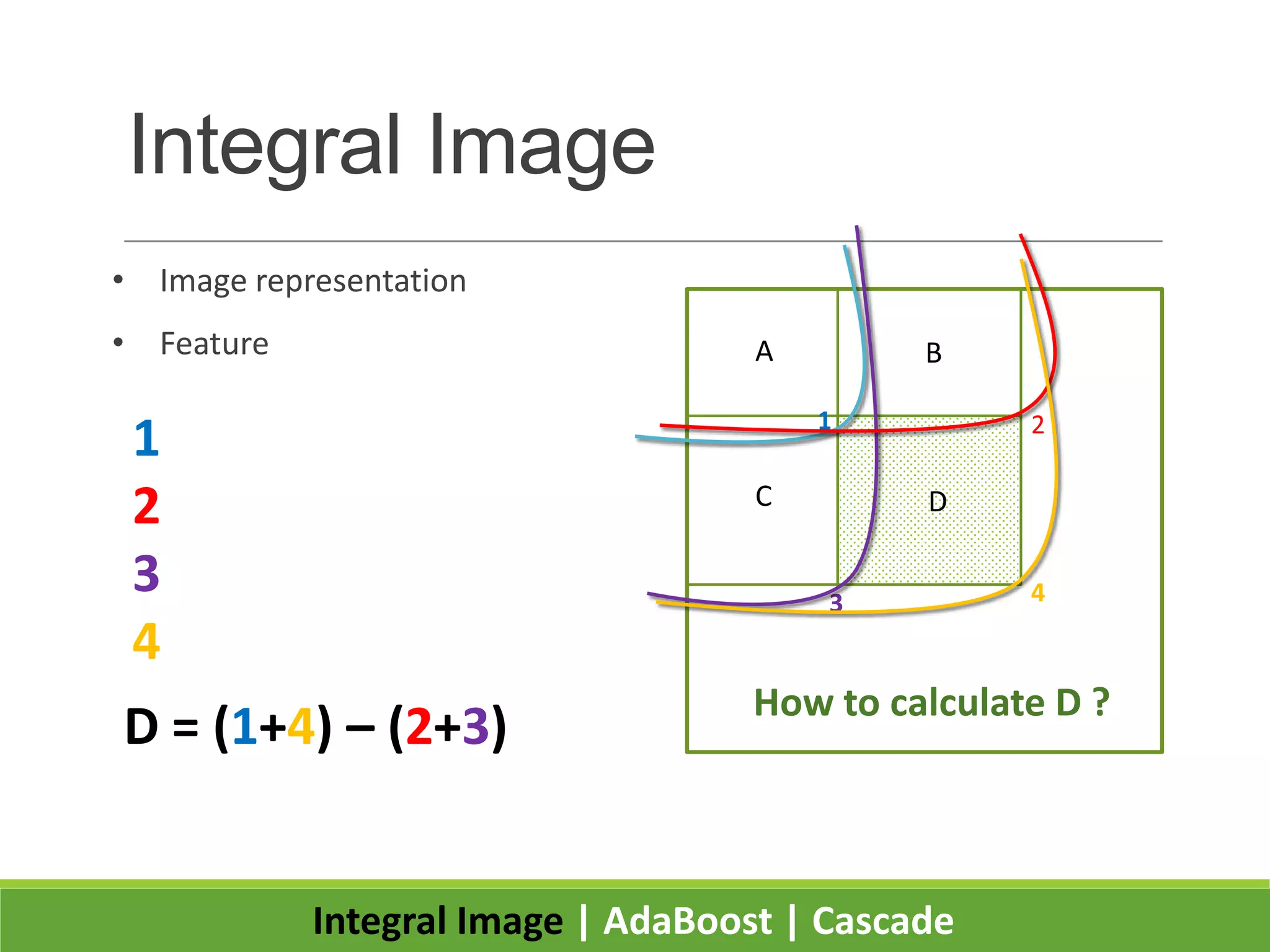
Integral Image
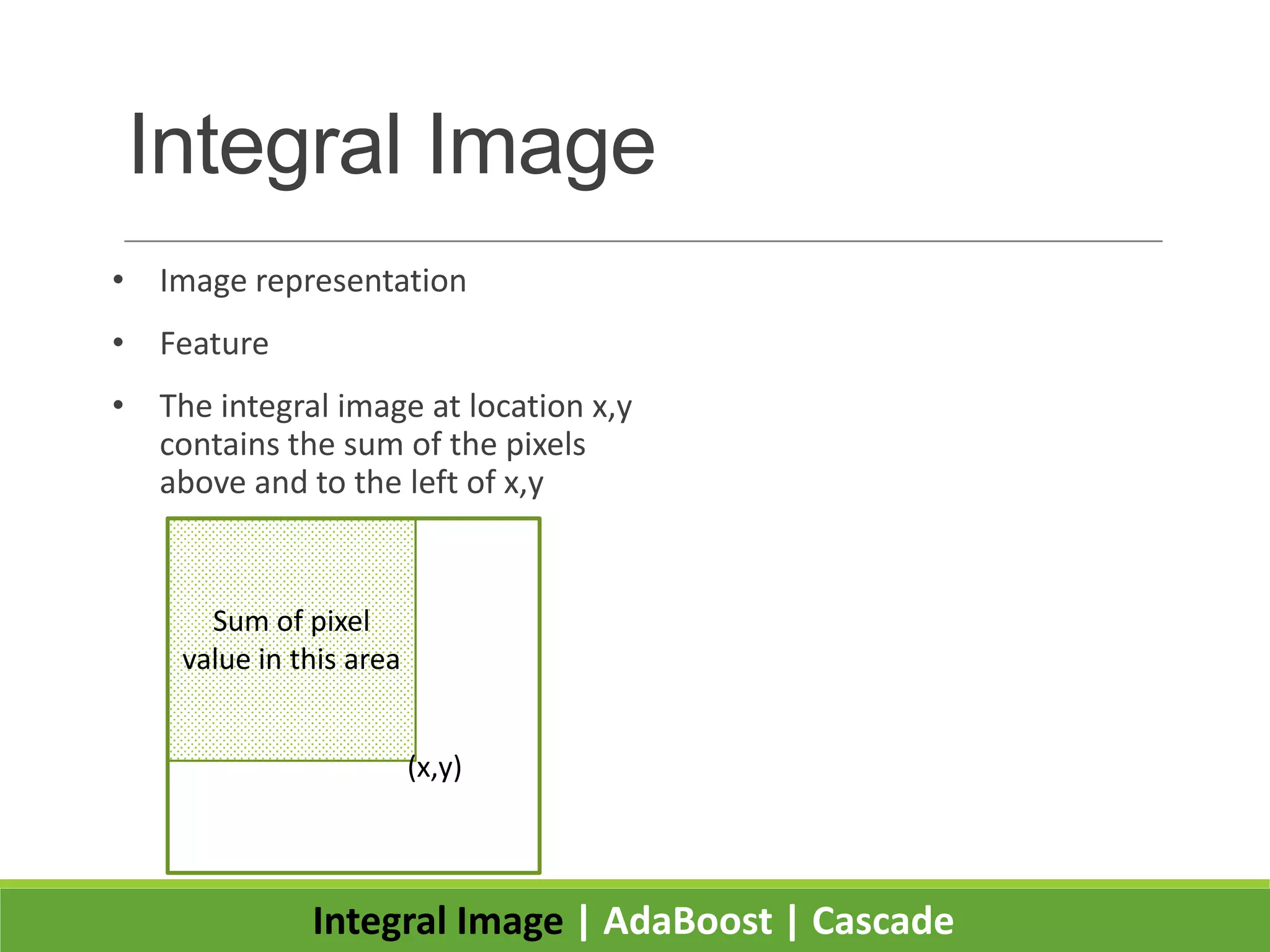
• Image representation
• Feature
• The integral image at location x,y
contains the sum of the pixels
above and to the left of x,y
Integral Image | AdaBoost | Cascade
Sum of pixel
value in this area
(x,y)
Integral Image
• Image representation
• Feature
• The integral image at location x,y
contains the sum of the pixels
above and to the left of x,y
Integral Image | AdaBoost | Cascade
Sum of pixel
value in this area
(x,y)
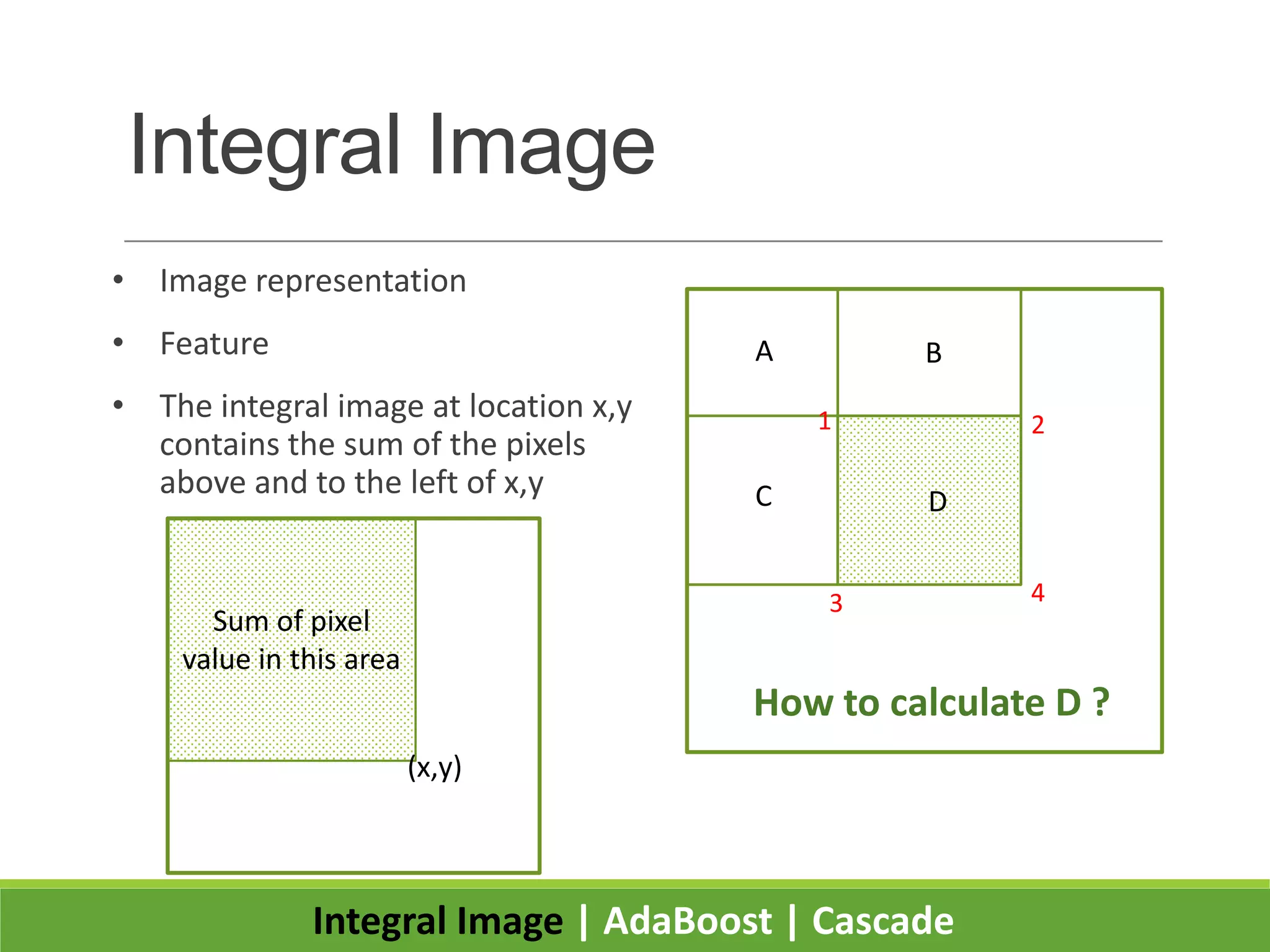
How to calculate D ?
A B
C D
1 2
3 4
Integral Image
• Image representation
• Feature
Integral Image | AdaBoost | Cascade
How to calculate D ?
D = (1+4) – (2+3)
A B
C D
1 2
3 4
1
2
3
4
Integral Image Feature
Integral Image | AdaBoost | Cascade
Detection window
A
B
C
D
Detection window
Detection window Detection window
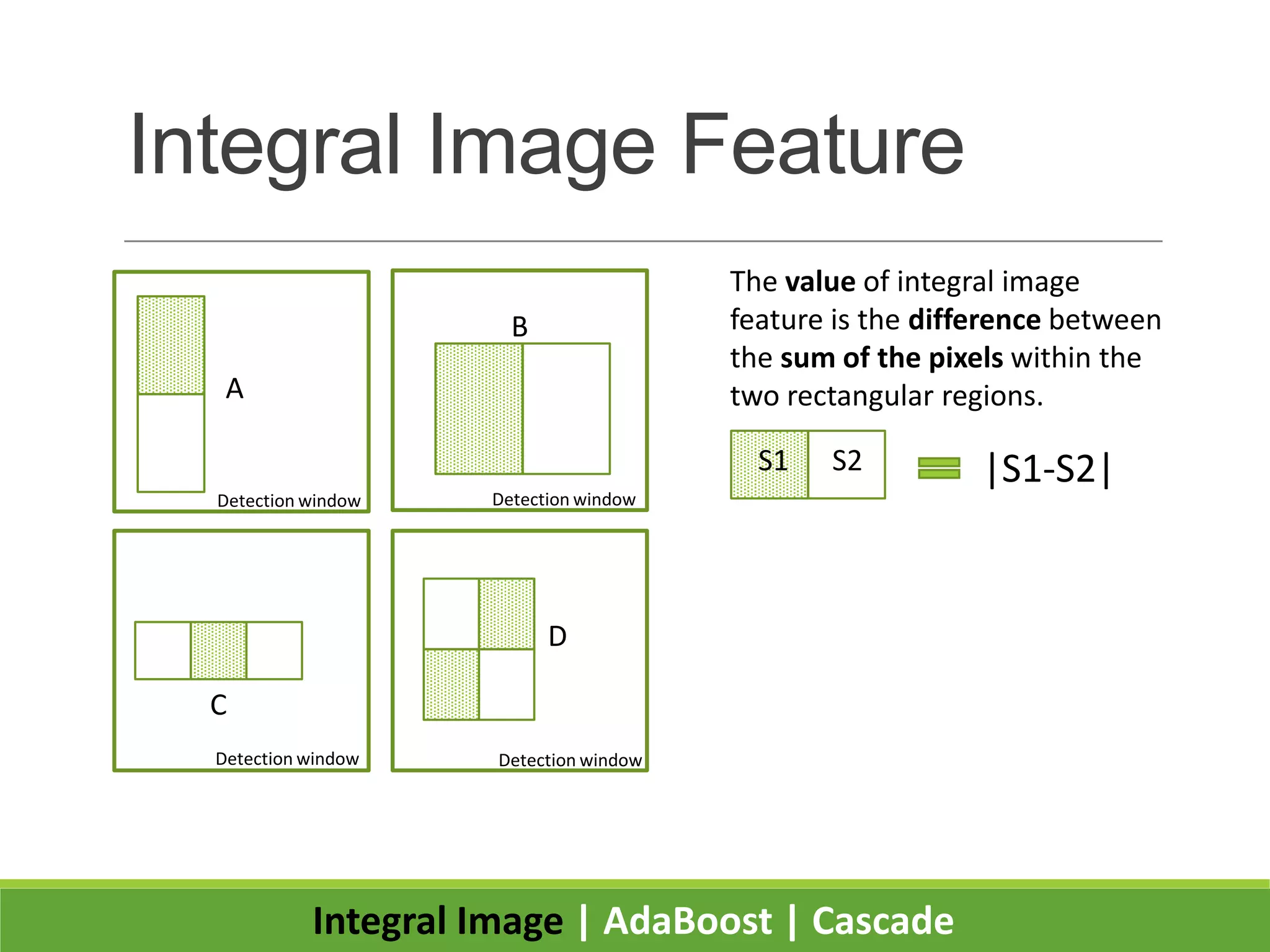
The value of integral image
feature is the difference between
the sum of the pixels within the
two rectangular regions.
S1 S2 |S1-S2|
Integral Image Feature
Integral Image | AdaBoost | Cascade
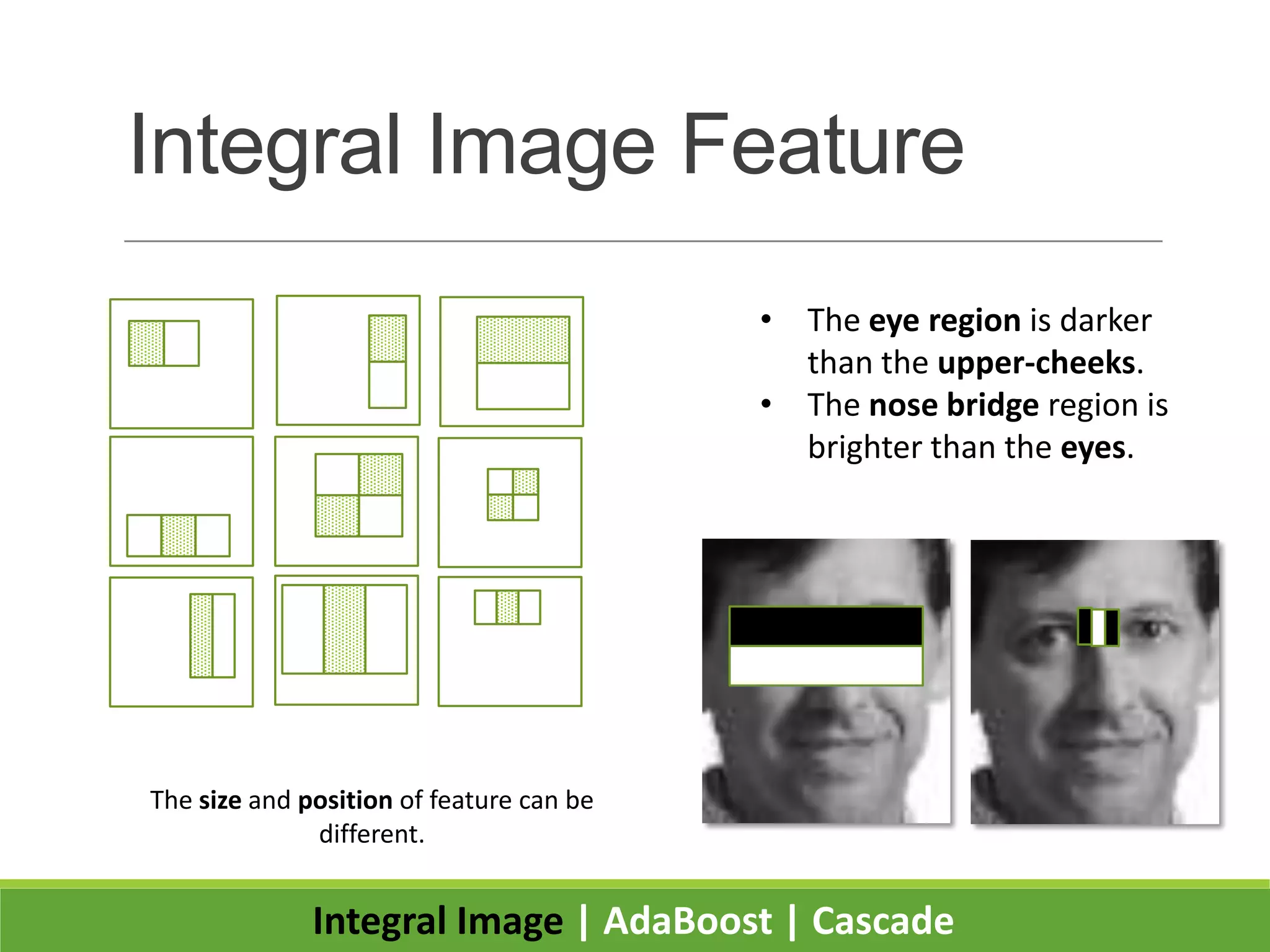
The size and position of feature can be
different.
• The eye region is darker
than the upper-cheeks.
• The nose bridge region is
brighter than the eyes.
Integral Image
• Different size and position of integral image give so many possible
features
• How do we obtain the best representing features possible?
• How can we refrain from wasting time on image background? (i.e.
non-object)
Integral Image | AdaBoost | Cascade
Good Feature Not Good Feature
AdaBoost…
AdaBoost
Weak Classifier
Strong Classifier
AdaBoost
Weak Classifier
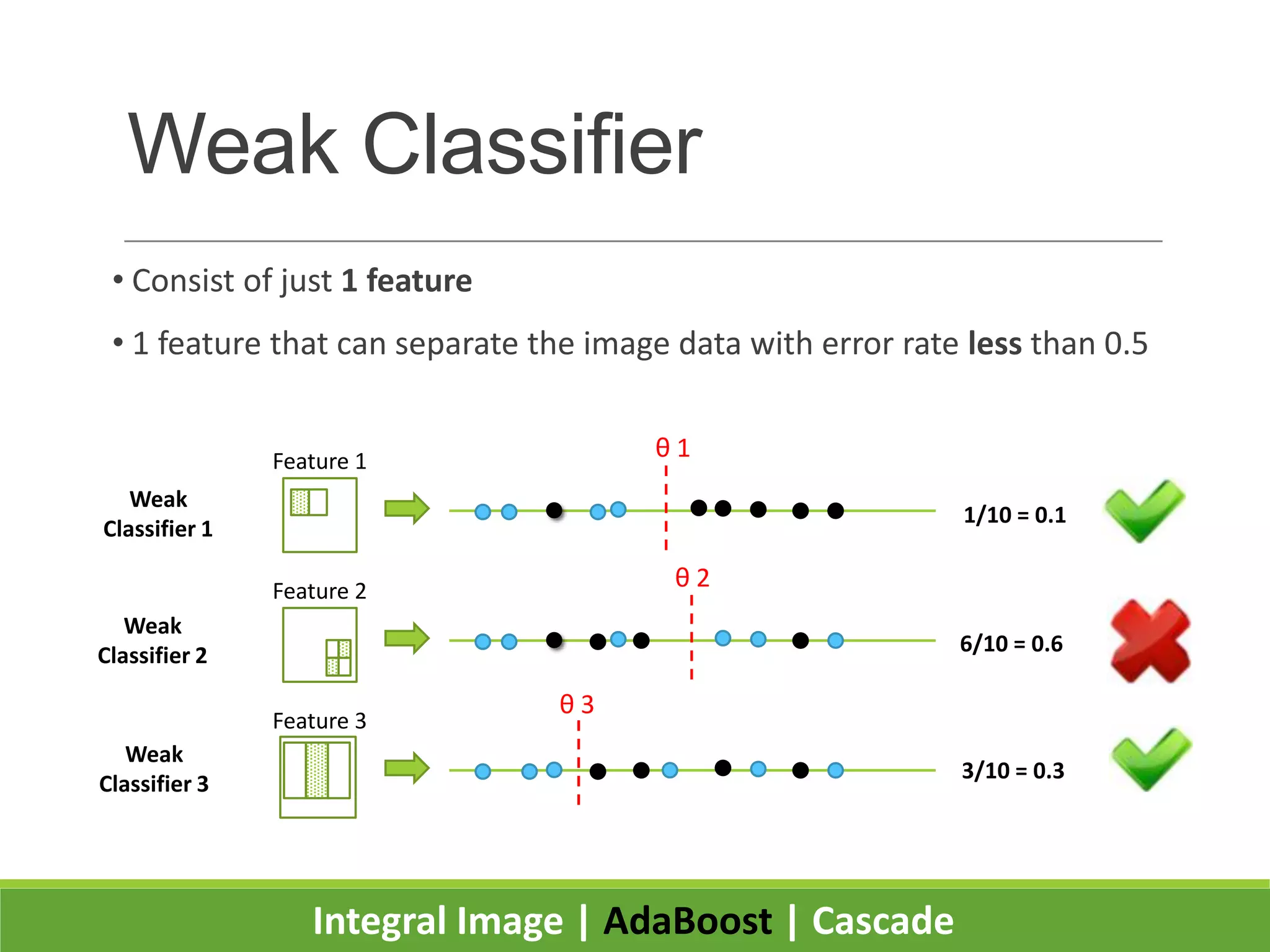
• Consist of just 1 feature
• 1 feature that can separate the image data with error rate less than 0.5
Feature 1
Feature 2
Feature 3
θ 1
θ 2
θ 3
Weak
Classifier 1
Weak
Classifier 2
Weak
Classifier 3
1/10 = 0.1
6/10 = 0.6
3/10 = 0.3
Integral Image | AdaBoost | Cascade
Strong Classifier
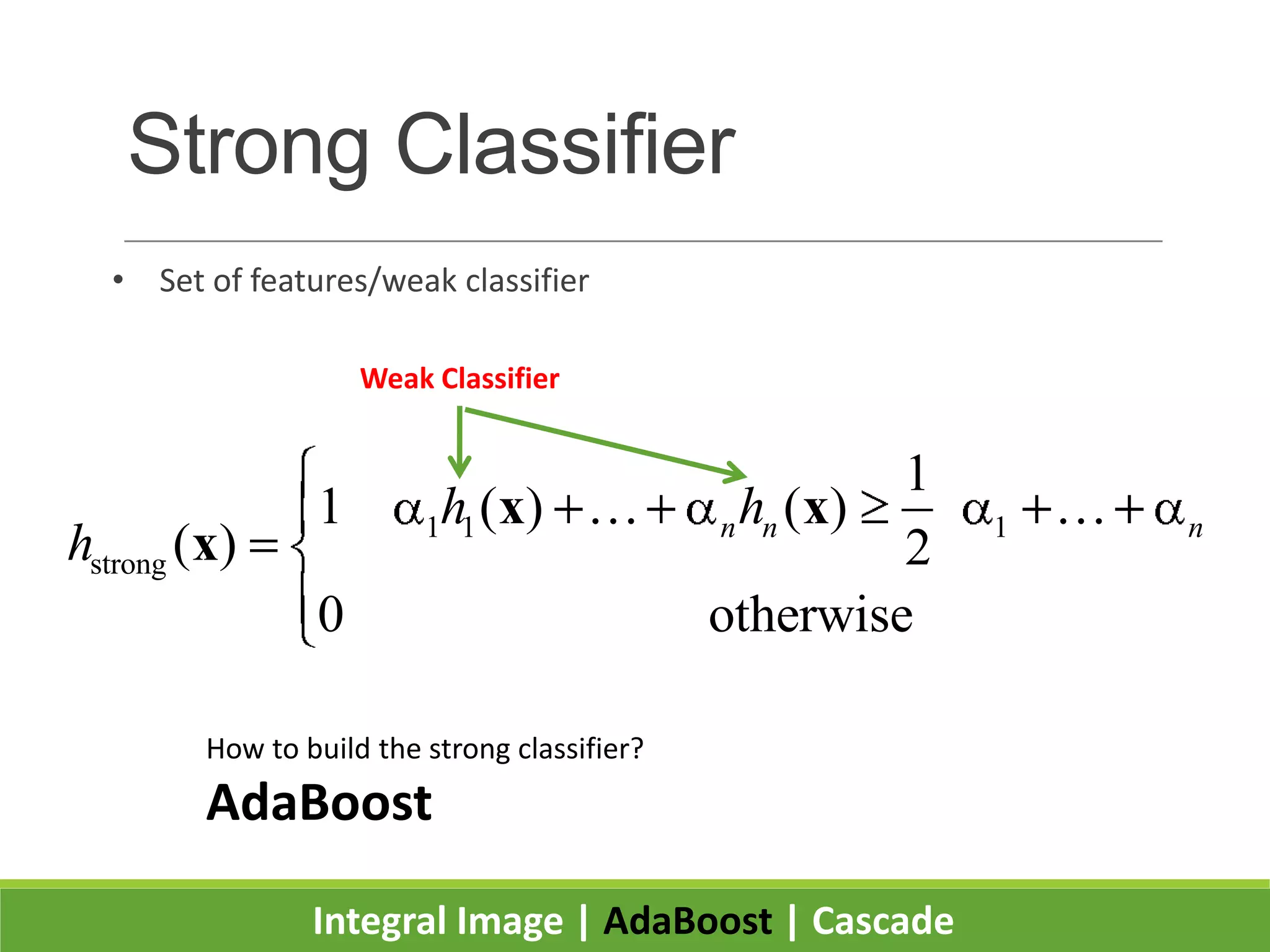
• Set of features/weak classifier
Integral Image | AdaBoost | Cascade
1 1 1
strong
1
1 ( ) ( )
( ) 2
0 otherwise
n n nh h
h
x x
x
 
Weak Classifier
How to build the strong classifier?
AdaBoost
AdaBoost
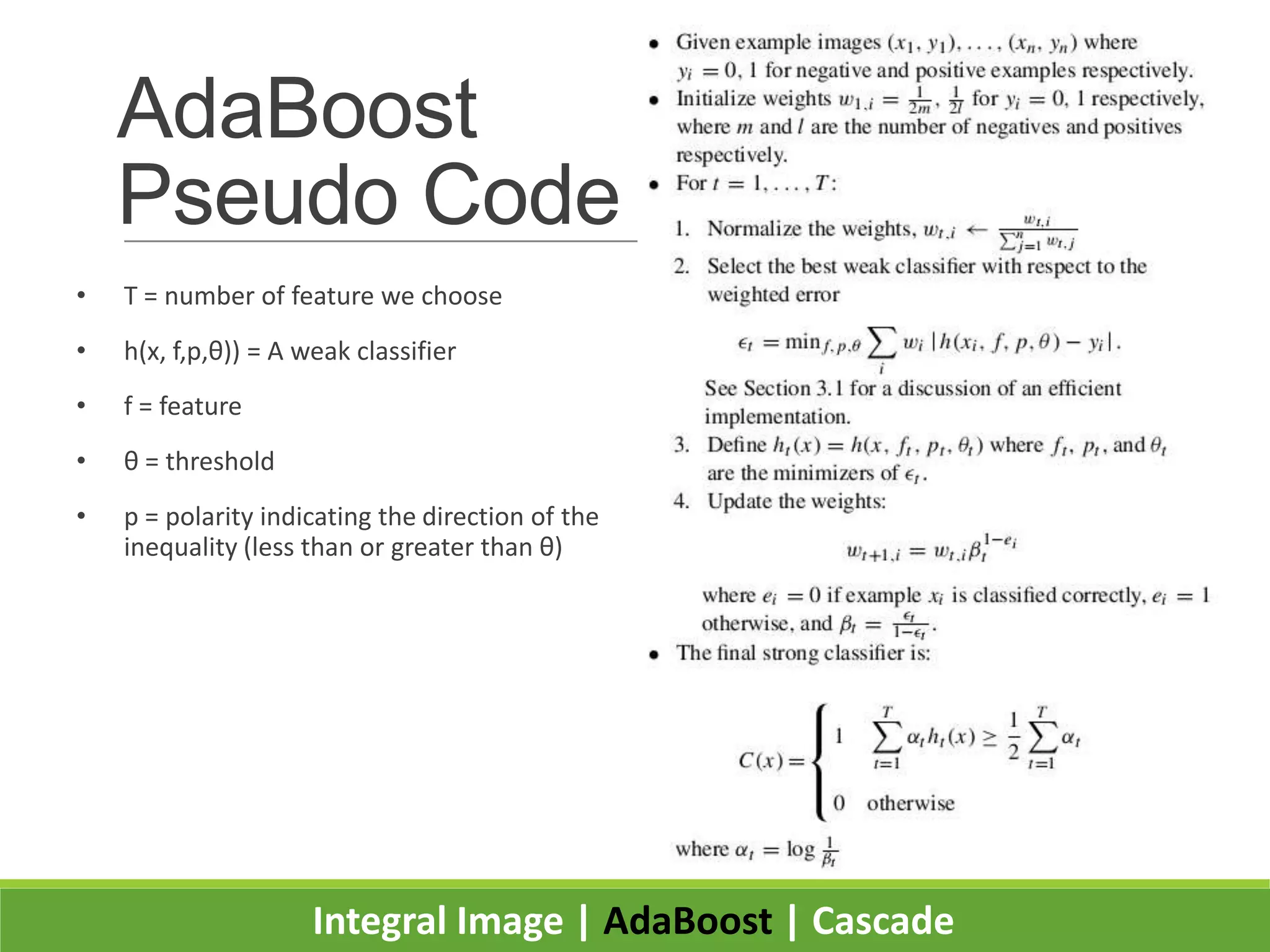
Pseudo Code
• T = number of feature we choose
• h(x, f,p,θ)) = A weak classifier
• f = feature
• θ = threshold
• p = polarity indicating the direction of the
inequality (less than or greater than θ)
Integral Image | AdaBoost | Cascade
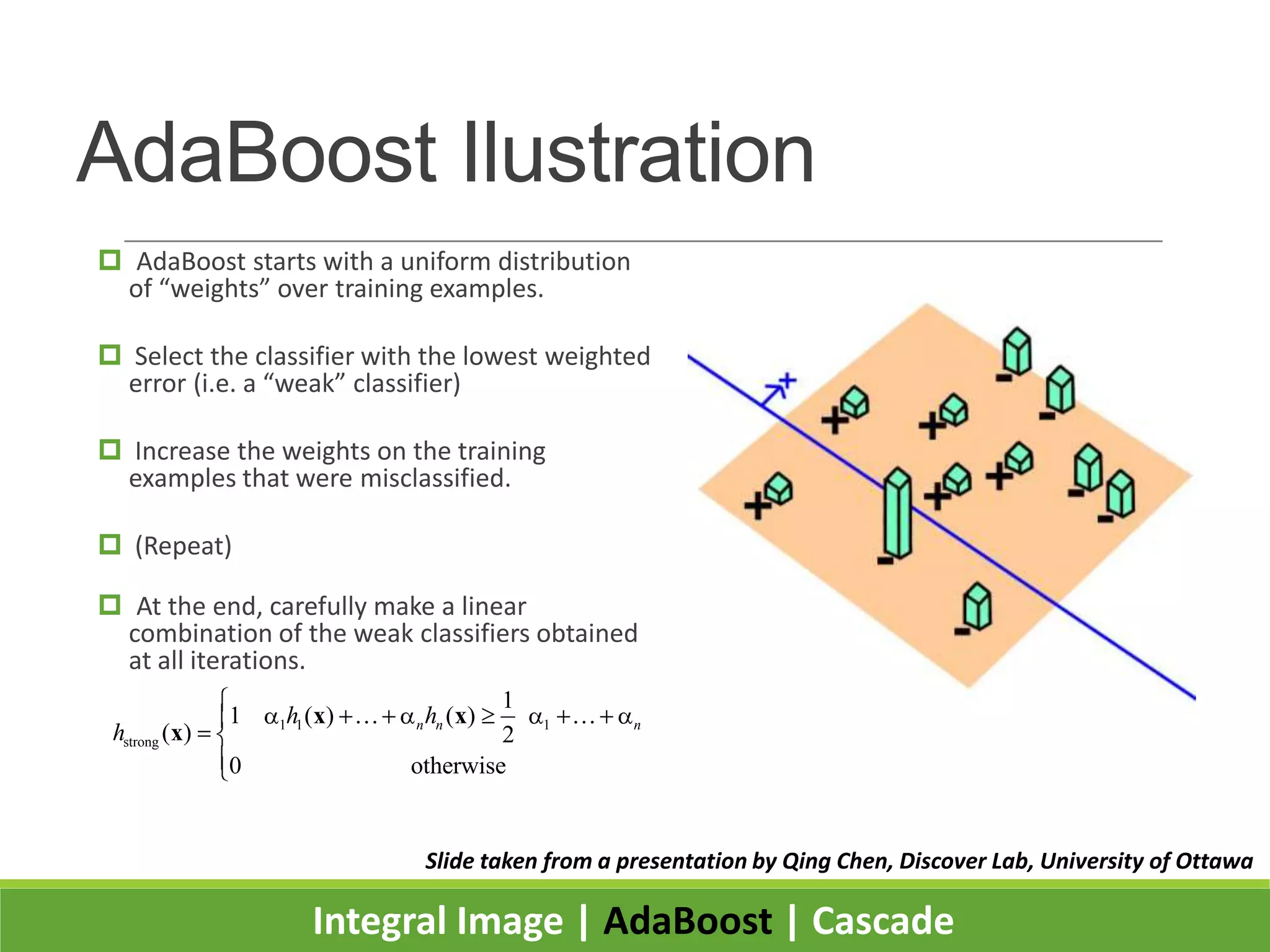
 AdaBoost starts with a uniform distribution
of “weights” over training examples.
 Select the classifier with the lowest weighted
error (i.e. a “weak” classifier)
 Increase the weights on the training
examples that were misclassified.
 (Repeat)
 At the end, carefully make a linear
combination of the weak classifiers obtained
at all iterations.
AdaBoost Ilustration
1 1 1
strong
1
1 ( ) ( )
( ) 2
0 otherwise
n n nh h
h
x x
x
 
Slide taken from a presentation by Qing Chen, Discover Lab, University of Ottawa
Integral Image | AdaBoost | Cascade
Classifier
• By increasing the number of features per classifier, we:
◦ Increase detection accuracy.
◦ Decrease detection speed.
• Experiments showed that a 200 feature classifier
makes a good face detector:
◦ Takes 0.7 seconds to scan an 384 by 288 pixel image.
• Problem: Not real time! (At most 0.067 seconds
needed).
Integral Image | AdaBoost | Cascade
Cascade of Classifier…
Cascade Classfifier
Cascade
Cascade of Classifier
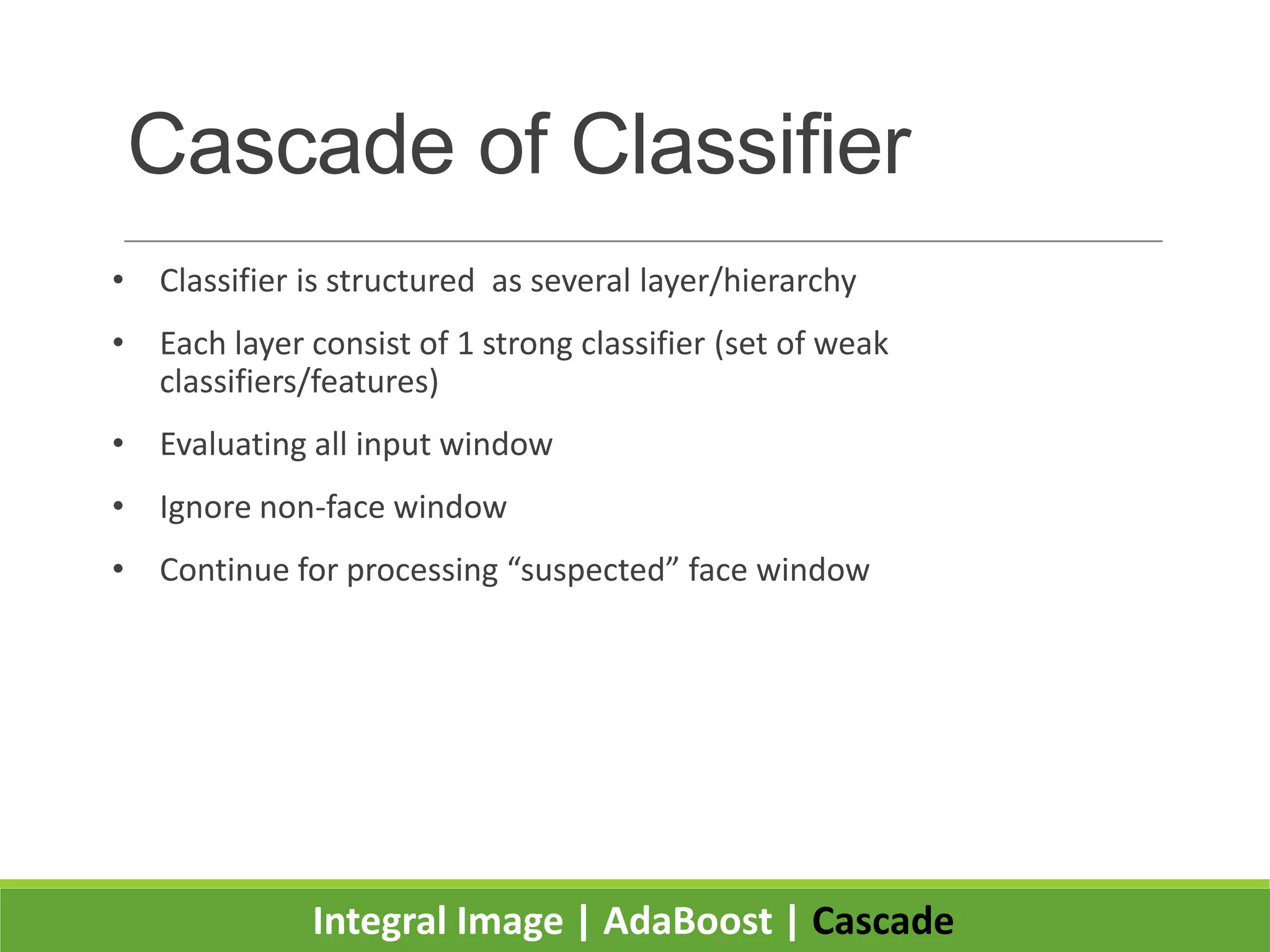
• Classifier is structured as several layer/hierarchy
• Each layer consist of 1 strong classifier (set of weak
classifiers/features)
• Evaluating all input window
• Ignore non-face window
• Continue for processing “suspected” face window
Integral Image | AdaBoost | Cascade
Cascade of Classifier
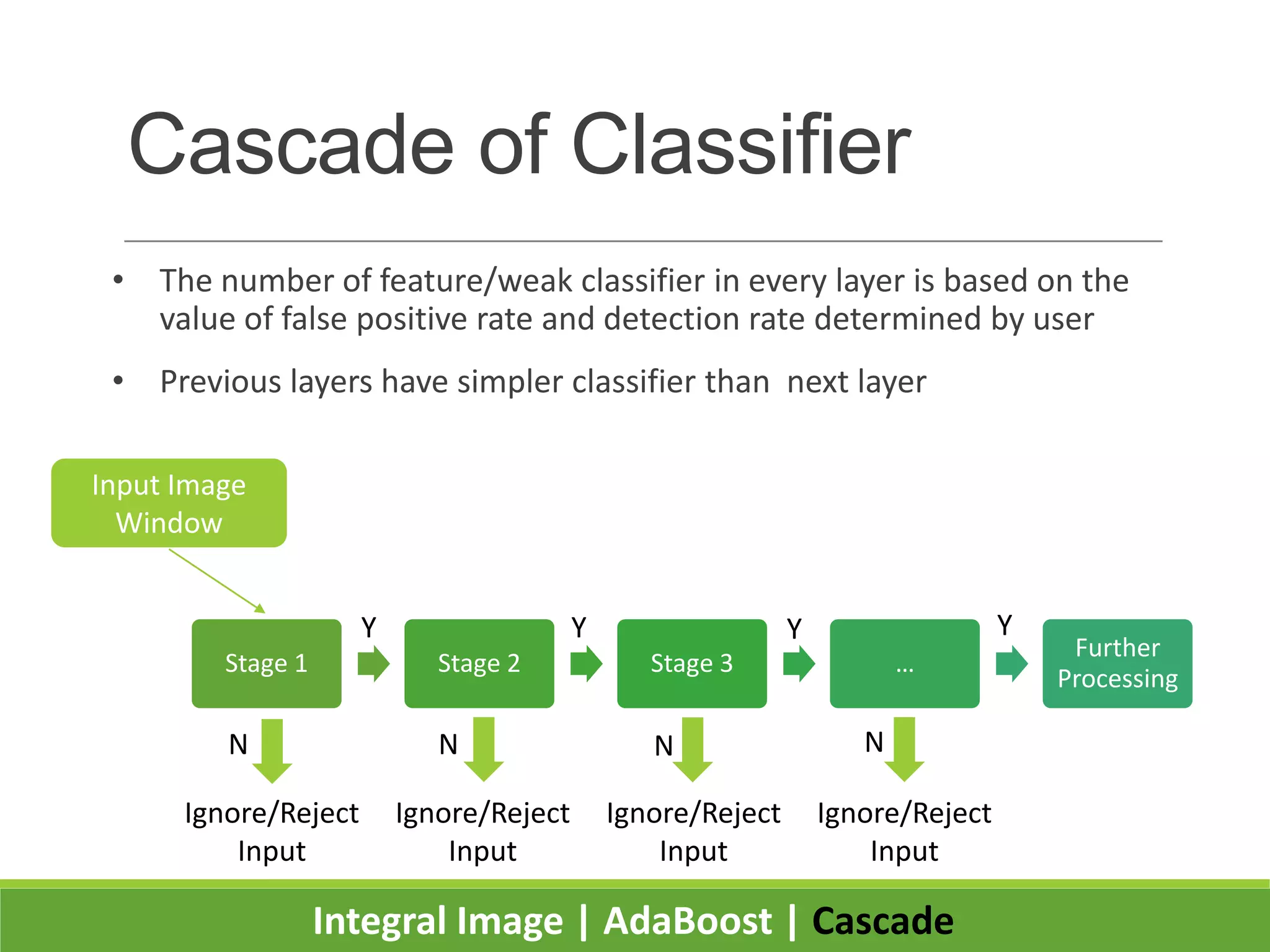
• The number of feature/weak classifier in every layer is based on the
value of false positive rate and detection rate determined by user
• Previous layers have simpler classifier than next layer
Integral Image | AdaBoost | Cascade
Stage 1 Stage 2 Stage 3 …
Further
Processing
Input Image
Window
Ignore/Reject
Input
Ignore/Reject
Input
Ignore/Reject
Input
Ignore/Reject
Input
Y
N
Y
N
Y
N
Y
N
Cascade of Classifier
Integral Image | AdaBoost | Cascade
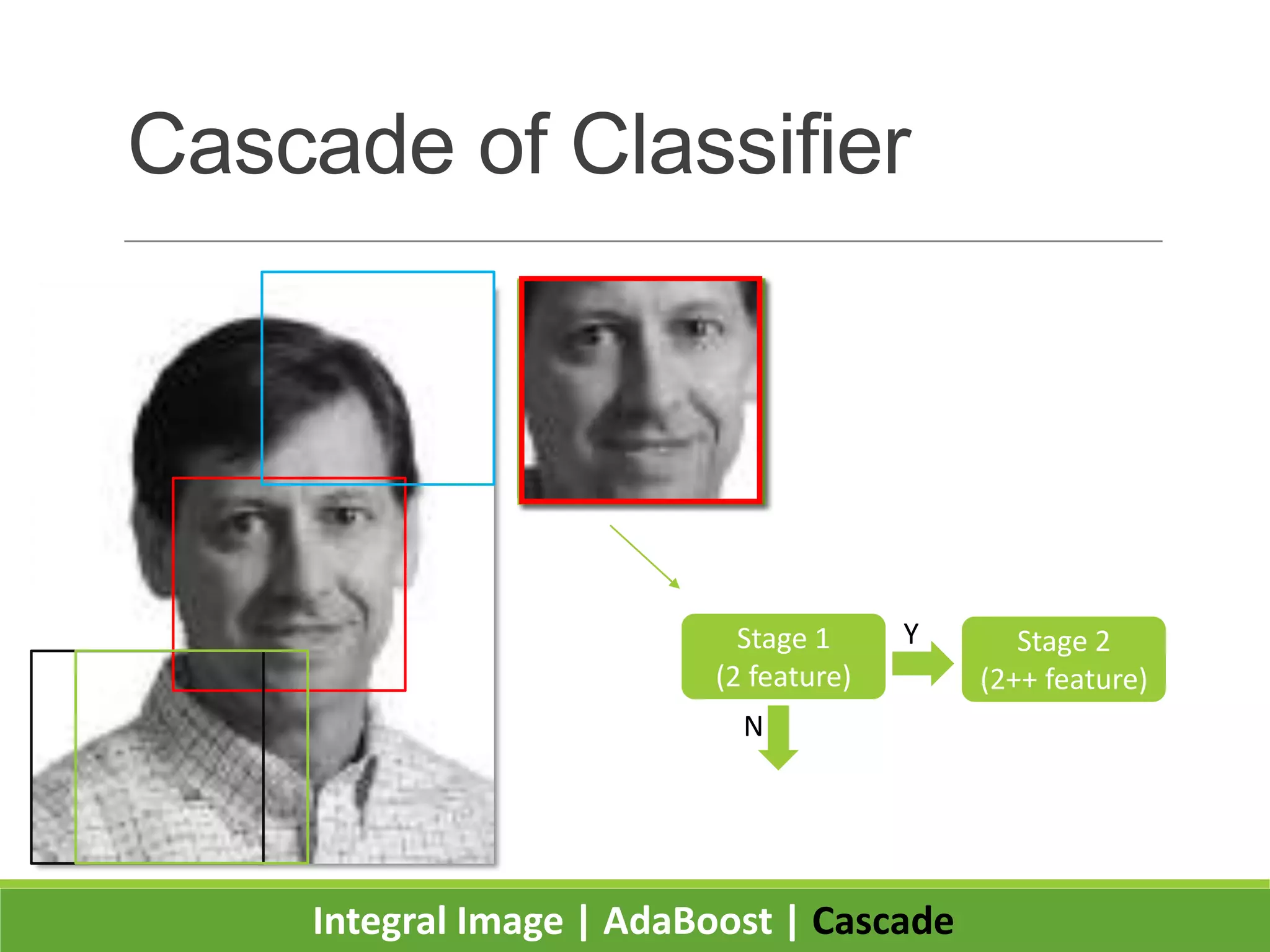
Stage 1
(2 feature)
N
Y Stage 2
(2++ feature)
Cascade of
Classifier
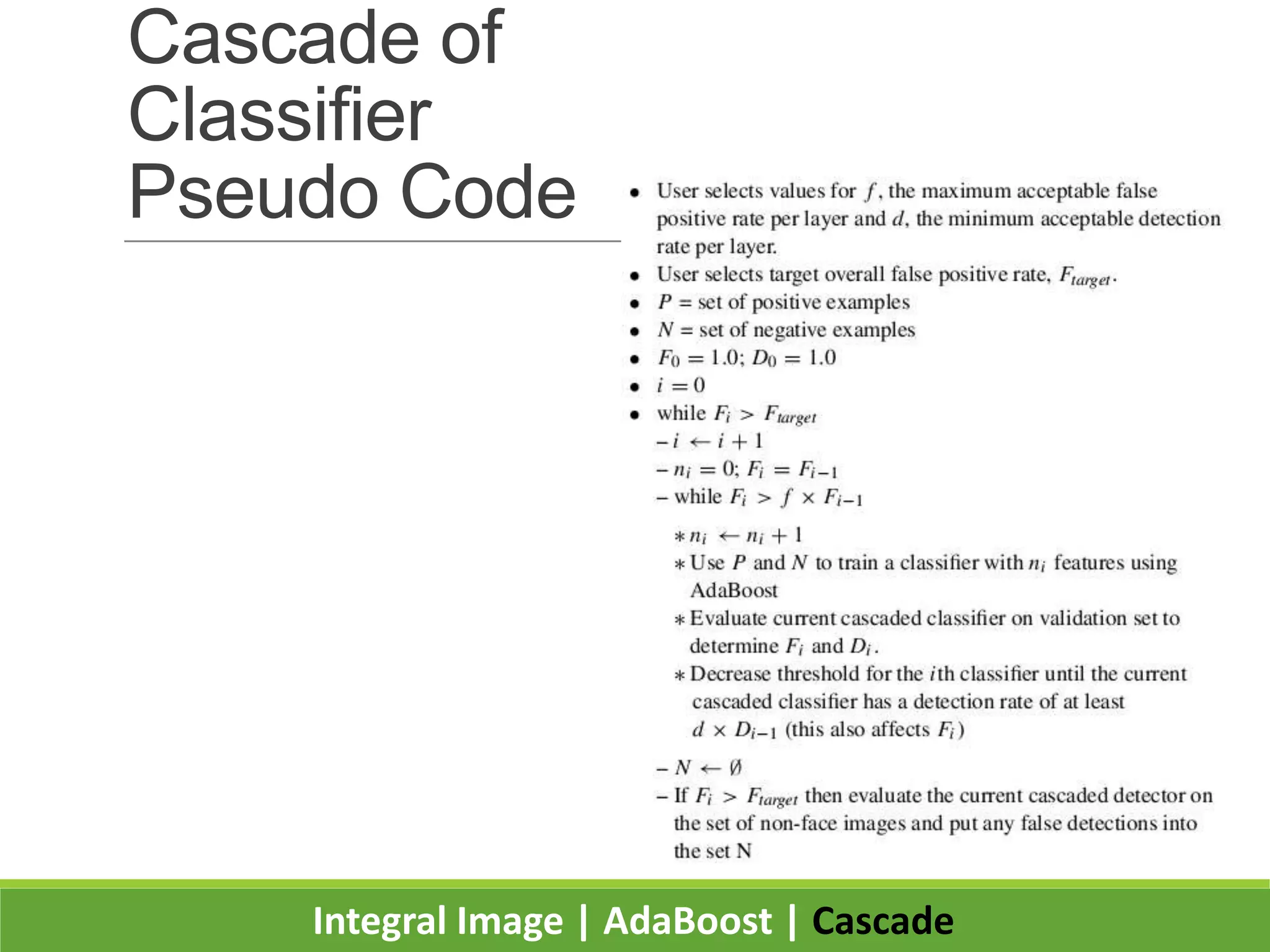
Pseudo Code
Integral Image | AdaBoost | Cascade
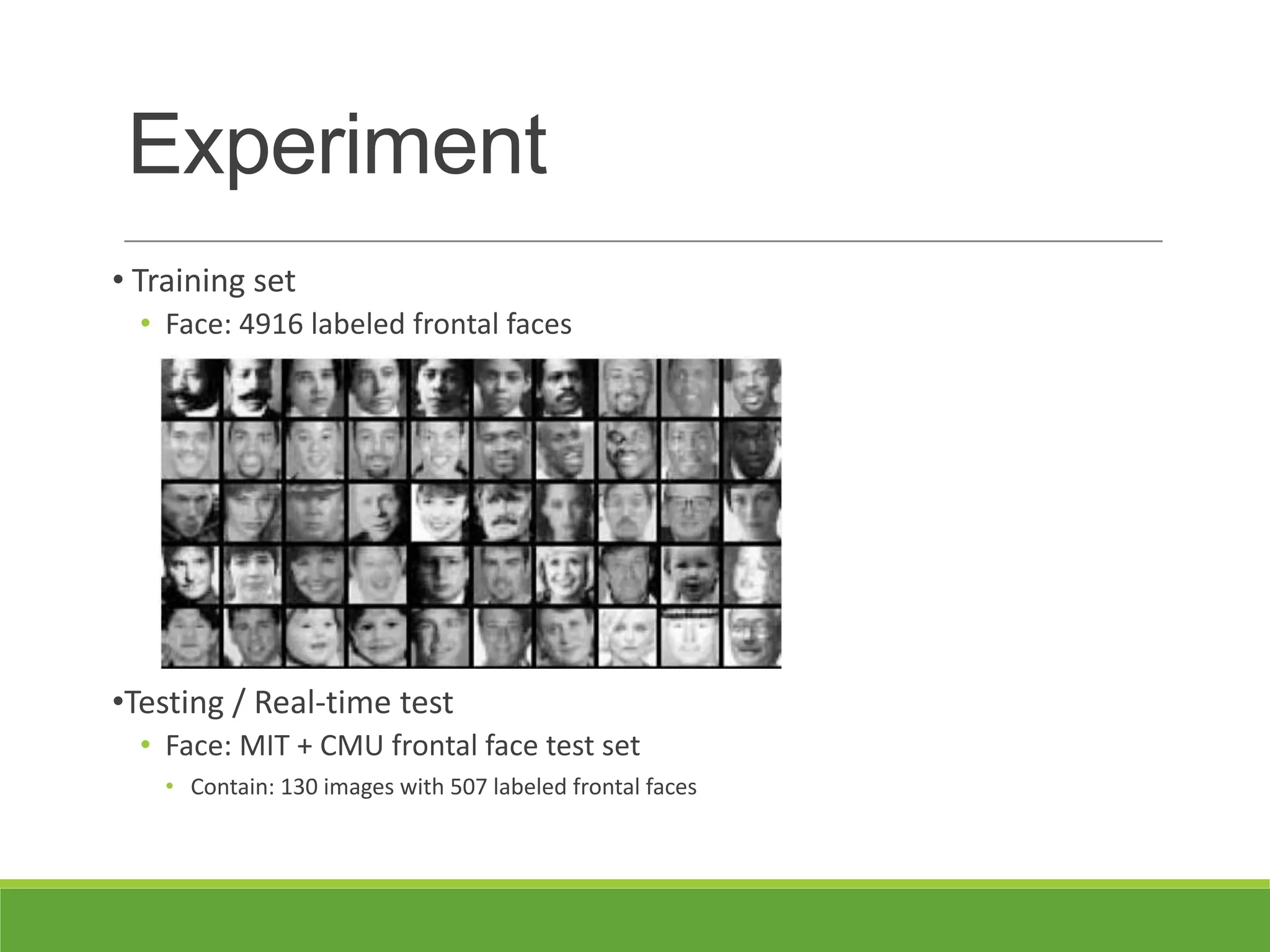
Experiment
• Training set
• Face: 4916 labeled frontal faces
•Testing / Real-time test
• Face: MIT + CMU frontal face test set
• Contain: 130 images with 507 labeled frontal faces
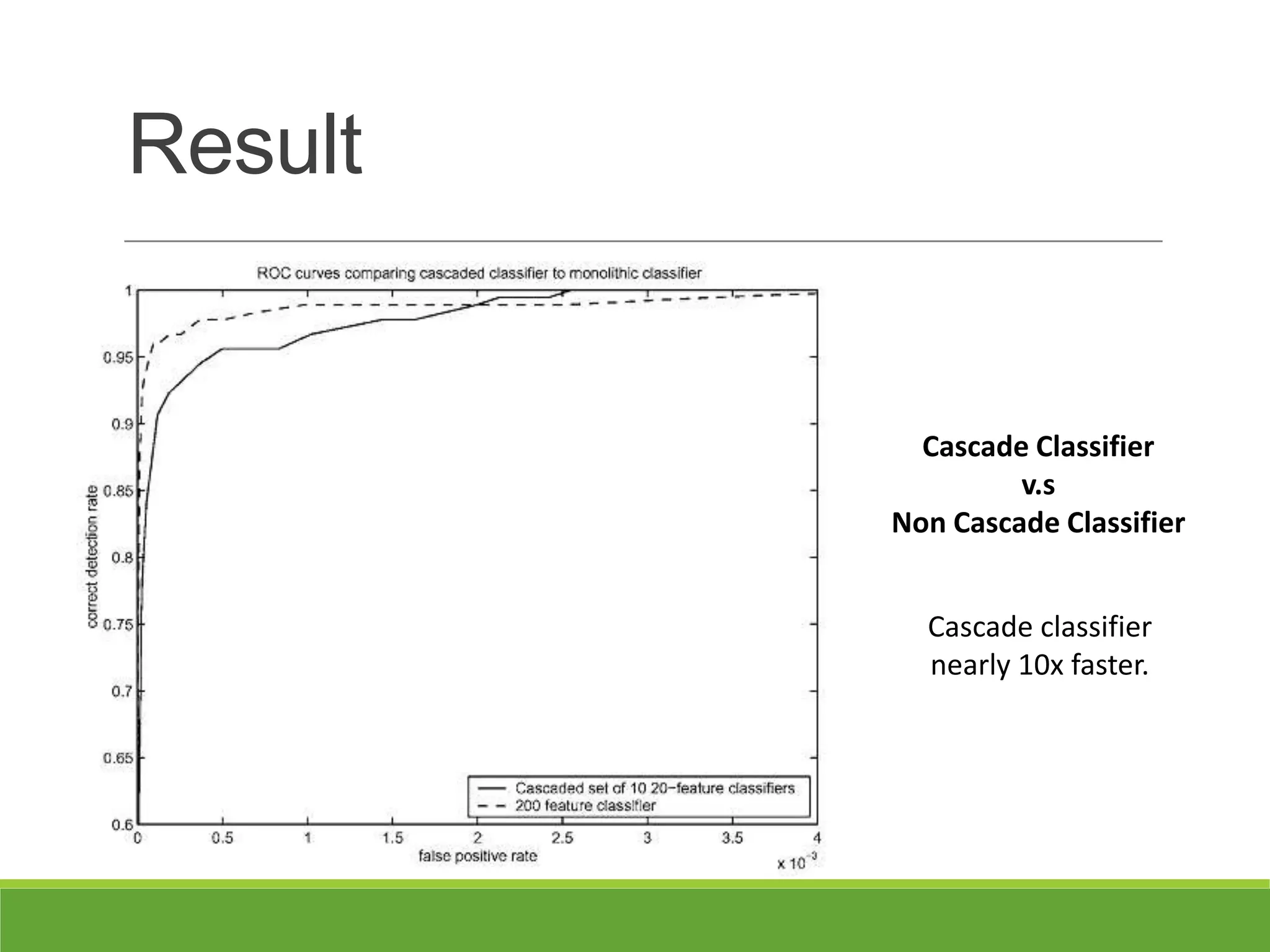
Result
Cascade Classifier
v.s
Non Cascade Classifier
Cascade classifier
nearly 10x faster.
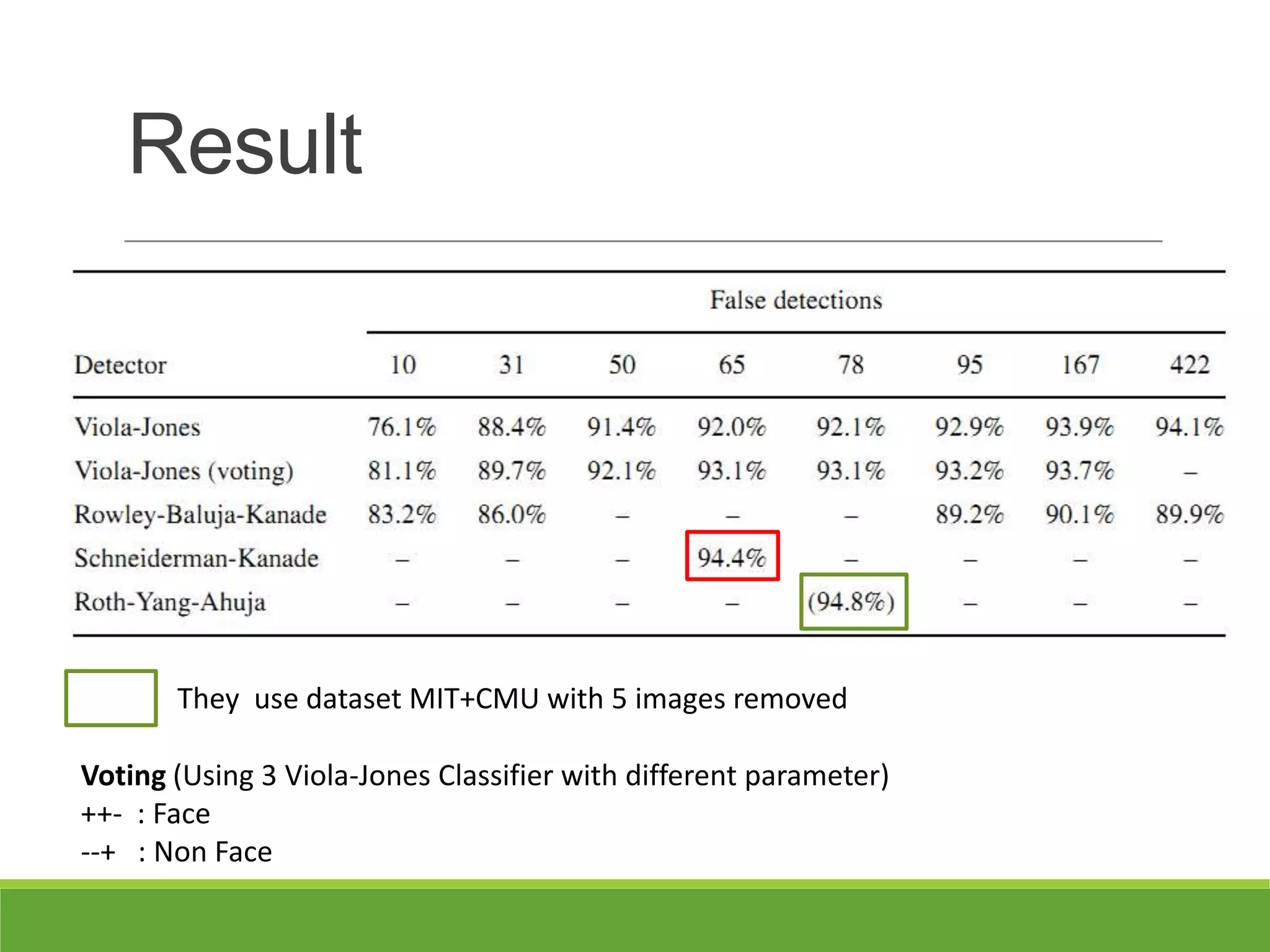
Result
They use dataset MIT+CMU with 5 images removed
Voting (Using 3 Viola-Jones Classifier with different parameter)
++- : Face
--+ : Non Face
Failure Mode
• Informal observation suggests that the face detector can detect
faces that are tilted up to about ±15 degrees in plane and about ± 45
degrees out of plane
• Harsh backlighting in which the faces are very dark while the
background is relatively light sometimes causes failures
• Proposed algorithm will also fail on significantly occluded faces
Robust real time object detection

Robust real time object detection

  • 1.
    Robust Real-Time ObjectDetectionAuthor: Paul Viola, Michael J. Jones International Journal of Computer Vision 57(2), 137–154, 2004 Presented by ERLI – M10115801
  • 2.
    Background & Motivation •Detecting object on real time • Detecting face
  • 3.
    Outline Introduction Image Representation –Integral Image Learning Algorithm – AdaBoost Cascade Classifier Experiment and Result
  • 4.
  • 5.
    Object Detection >> FaceDetection Paul Viola Michael J. Jones Introduction
  • 6.
    Detection System 24x24 Detection Window The sizeof detection window will be enlarged with a certain scale Introduction
  • 7.
  • 8.
    Integral Image • Imagerepresentation • Feature • The integral image at location x,y contains the sum of the pixels above and to the left of x,y Integral Image | AdaBoost | Cascade Sum of pixel value in this area (x,y)
  • 9.
    Integral Image • Imagerepresentation • Feature • The integral image at location x,y contains the sum of the pixels above and to the left of x,y Integral Image | AdaBoost | Cascade Sum of pixel value in this area (x,y) How to calculate D ? A B C D 1 2 3 4
  • 10.
    Integral Image • Imagerepresentation • Feature Integral Image | AdaBoost | Cascade How to calculate D ? D = (1+4) – (2+3) A B C D 1 2 3 4 1 2 3 4
  • 11.
    Integral Image Feature IntegralImage | AdaBoost | Cascade Detection window A B C D Detection window Detection window Detection window The value of integral image feature is the difference between the sum of the pixels within the two rectangular regions. S1 S2 |S1-S2|
  • 12.
    Integral Image Feature IntegralImage | AdaBoost | Cascade The size and position of feature can be different. • The eye region is darker than the upper-cheeks. • The nose bridge region is brighter than the eyes.
  • 13.
    Integral Image • Differentsize and position of integral image give so many possible features • How do we obtain the best representing features possible? • How can we refrain from wasting time on image background? (i.e. non-object) Integral Image | AdaBoost | Cascade Good Feature Not Good Feature AdaBoost…
  • 14.
  • 15.
    Weak Classifier • Consistof just 1 feature • 1 feature that can separate the image data with error rate less than 0.5 Feature 1 Feature 2 Feature 3 θ 1 θ 2 θ 3 Weak Classifier 1 Weak Classifier 2 Weak Classifier 3 1/10 = 0.1 6/10 = 0.6 3/10 = 0.3 Integral Image | AdaBoost | Cascade
  • 16.
    Strong Classifier • Setof features/weak classifier Integral Image | AdaBoost | Cascade 1 1 1 strong 1 1 ( ) ( ) ( ) 2 0 otherwise n n nh h h x x x   Weak Classifier How to build the strong classifier? AdaBoost
  • 17.
    AdaBoost Pseudo Code • T= number of feature we choose • h(x, f,p,θ)) = A weak classifier • f = feature • θ = threshold • p = polarity indicating the direction of the inequality (less than or greater than θ) Integral Image | AdaBoost | Cascade
  • 18.
     AdaBoost startswith a uniform distribution of “weights” over training examples.  Select the classifier with the lowest weighted error (i.e. a “weak” classifier)  Increase the weights on the training examples that were misclassified.  (Repeat)  At the end, carefully make a linear combination of the weak classifiers obtained at all iterations. AdaBoost Ilustration 1 1 1 strong 1 1 ( ) ( ) ( ) 2 0 otherwise n n nh h h x x x   Slide taken from a presentation by Qing Chen, Discover Lab, University of Ottawa Integral Image | AdaBoost | Cascade
  • 19.
    Classifier • By increasingthe number of features per classifier, we: ◦ Increase detection accuracy. ◦ Decrease detection speed. • Experiments showed that a 200 feature classifier makes a good face detector: ◦ Takes 0.7 seconds to scan an 384 by 288 pixel image. • Problem: Not real time! (At most 0.067 seconds needed). Integral Image | AdaBoost | Cascade Cascade of Classifier…
  • 20.
  • 21.
    Cascade of Classifier •Classifier is structured as several layer/hierarchy • Each layer consist of 1 strong classifier (set of weak classifiers/features) • Evaluating all input window • Ignore non-face window • Continue for processing “suspected” face window Integral Image | AdaBoost | Cascade
  • 22.
    Cascade of Classifier •The number of feature/weak classifier in every layer is based on the value of false positive rate and detection rate determined by user • Previous layers have simpler classifier than next layer Integral Image | AdaBoost | Cascade Stage 1 Stage 2 Stage 3 … Further Processing Input Image Window Ignore/Reject Input Ignore/Reject Input Ignore/Reject Input Ignore/Reject Input Y N Y N Y N Y N
  • 23.
    Cascade of Classifier IntegralImage | AdaBoost | Cascade Stage 1 (2 feature) N Y Stage 2 (2++ feature)
  • 24.
  • 25.
    Experiment • Training set •Face: 4916 labeled frontal faces •Testing / Real-time test • Face: MIT + CMU frontal face test set • Contain: 130 images with 507 labeled frontal faces
  • 26.
    Result Cascade Classifier v.s Non CascadeClassifier Cascade classifier nearly 10x faster.
  • 27.
    Result They use datasetMIT+CMU with 5 images removed Voting (Using 3 Viola-Jones Classifier with different parameter) ++- : Face --+ : Non Face
  • 28.
    Failure Mode • Informalobservation suggests that the face detector can detect faces that are tilted up to about ±15 degrees in plane and about ± 45 degrees out of plane • Harsh backlighting in which the faces are very dark while the background is relatively light sometimes causes failures • Proposed algorithm will also fail on significantly occluded faces