

Robust Real-time FaceRobust Real-time Face
DetectionDetection
byby
Paul Viola and Michael Jones, 2002Paul Viola and Michael Jones, 2002
Presentation by Kostantina Palla & Alfredo Kalaitzis
School of Informatics
University of Edinburgh
February 20, 2009
OverviewOverview
 Robust – very high Detection Rate (True-Positive
Rate) & very low False-Positive Rate… always.
 Real Time – For practical applications at least 2
frames per second must be processed.
 Face Detection – not recognition. The goal is to
distinguish faces from non-faces (face detection is the
first step in the identification process)
Three goals & a conlcusionThree goals & a conlcusion
1. Feature Computation: what features? And how
can they be computed as quickly as possible
2. Feature Selection: select the most
discriminating features
3. Real-timeliness: must focus on potentially
positive areas (that contain faces)
4. Conclusion: presentation of results and
discussion of detection issues.
How did Viola & Jones deal with these challenges?
1. Feature Computation
The “Integral” image representation
2. Feature Selection
The AdaBoost training algorithm
3. Real-timeliness
A cascade of classifiers
Three solutionsThree solutions
FeaturesFeatures
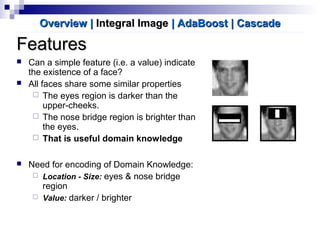
 Can a simple feature (i.e. a value) indicate
the existence of a face?
 All faces share some similar properties
 The eyes region is darker than the
upper-cheeks.
 The nose bridge region is brighter than
the eyes.
 That is useful domain knowledge
 Need for encoding of Domain Knowledge:
 Location - Size: eyes & nose bridge
region
 Value: darker / brighter
OverviewOverview || Integral ImageIntegral Image | AdaBoost| AdaBoost | Cascade| Cascade
Rectangle featuresRectangle features
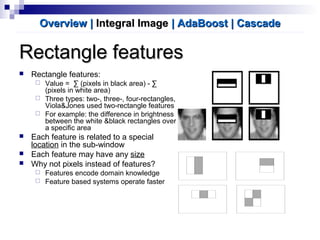
 Rectangle features:
 Value = ∑ (pixels in black area) - ∑
(pixels in white area)
 Three types: two-, three-, four-rectangles,
Viola&Jones used two-rectangle features
 For example: the difference in brightness
between the white &black rectangles over
a specific area
 Each feature is related to a special
location in the sub-window
 Each feature may have any size
 Why not pixels instead of features?
 Features encode domain knowledge
 Feature based systems operate faster
Overview |Overview | Integral ImageIntegral Image | AdaBoost| AdaBoost | Cascade| Cascade
Integral Image RepresentationIntegral Image Representation
(also check back-up slide #1)(also check back-up slide #1)
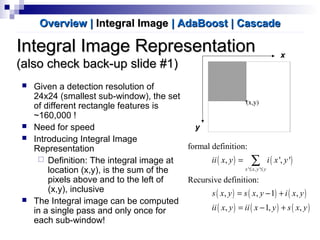
 Given a detection resolution of
24x24 (smallest sub-window), the set
of different rectangle features is
~160,000 !
 Need for speed
 Introducing Integral Image
Representation
 Definition: The integral image at
location (x,y), is the sum of the
pixels above and to the left of
(x,y), inclusive
 The Integral image can be computed
in a single pass and only once for
each sub-window!
( ) ( )
( ) ( ) ( )
( ) ( ) ( )
' , '
formal definition:
, ', '
Recursive definition:
, , 1 ,
, 1, ,
x x y y
ii x y i x y
s x y s x y i x y
ii x y ii x y s x y
≤ ≤
=
= − +
= − +
∑
Overview |Overview | Integral ImageIntegral Image | AdaBoost| AdaBoost | Cascade| Cascade
y
x
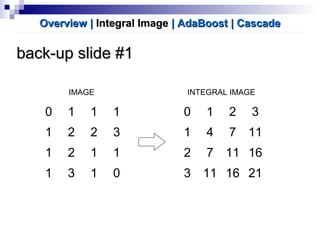
back-up slide #1back-up slide #1
Overview |Overview | Integral ImageIntegral Image | AdaBoost| AdaBoost | Cascade| Cascade
0 1 1 1
1 2 2 3
1 2 1 1
1 3 1 0
IMAGE
0 1 2 3
1 4 7 11
2 7 11 16
3 11 16 21
INTEGRAL IMAGE
Rapid computation of rectangular featuresRapid computation of rectangular features
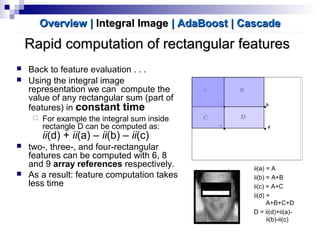
 Back to feature evaluation . . .
 Using the integral image
representation we can compute the
value of any rectangular sum (part of
features) in constant time
 For example the integral sum inside
rectangle D can be computed as:
ii(d) + ii(a) – ii(b) – ii(c)
 two-, three-, and four-rectangular
features can be computed with 6, 8
and 9 array references respectively.
 As a result: feature computation takes
less time
ii(a) = A
ii(b) = A+B
ii(c) = A+C
ii(d) =
A+B+C+D
D = ii(d)+ii(a)-
ii(b)-ii(c)
Overview |Overview | Integral ImageIntegral Image | AdaBoost| AdaBoost | Cascade| Cascade
Three goalsThree goals
1. Feature Computation: features must be
computed as quickly as possible
2. Feature Selection: select the most
discriminating features
3. Real-timeliness: must focus on potentially
positive image areas (that contain faces)
How did Viola & Jones deal with these challenges?
Overview |Overview | Integral ImageIntegral Image | AdaBoost| AdaBoost | Cascade| Cascade
Feature selectionFeature selection
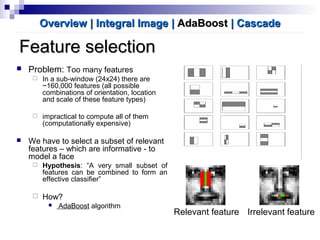
 Problem: Too many features
 In a sub-window (24x24) there are
~160,000 features (all possible
combinations of orientation, location
and scale of these feature types)
 impractical to compute all of them
(computationally expensive)
 We have to select a subset of relevant
features – which are informative - to
model a face
 Hypothesis: “A very small subset of
features can be combined to form an
effective classifier”
 How?
 AdaBoost algorithm
Overview | Integral ImageOverview | Integral Image || AdaBoostAdaBoost | Cascade| Cascade
Relevant feature Irrelevant feature
AdaBoostAdaBoost
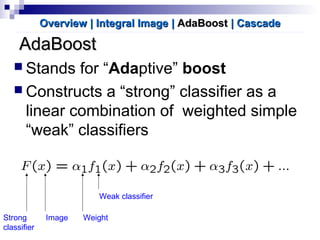
 Stands for “Adaptive” boost
 Constructs a “strong” classifier as a
linear combination of weighted simple
“weak” classifiers
Overview | Integral ImageOverview | Integral Image || AdaBoostAdaBoost | Cascade| Cascade
Strong
classifier
Weak classifier
WeightImage
AdaBoost -AdaBoost - CharacteristicsCharacteristics
 Features as weak classifiers
Each single rectangle feature may be regarded
as a simple weak classifier
 An iterative algorithm
AdaBoost performs a series of trials, each time
selecting a new weak classifier
 Weights are being applied over the set of
the example images
During each iteration, each example/image
receives a weight determining its importance
Overview | Integral ImageOverview | Integral Image || AdaBoostAdaBoost | Cascade| Cascade
AdaBoost -AdaBoost - Getting the idea…Getting the idea…
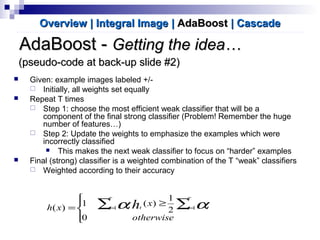
 Given: example images labeled +/-
 Initially, all weights set equally
 Repeat T times
 Step 1: choose the most efficient weak classifier that will be a
component of the final strong classifier (Problem! Remember the huge
number of features…)
 Step 2: Update the weights to emphasize the examples which were
incorrectly classified
 This makes the next weak classifier to focus on “harder” examples
 Final (strong) classifier is a weighted combination of the T “weak” classifiers
 Weighted according to their accuracy
Overview | Integral ImageOverview | Integral Image || AdaBoostAdaBoost | Cascade| Cascade




≥
= ∑ ∑= =
otherwise
x
xh
T
t
T
t ttt h
0
2
1
)(1
)( 1 1αα
(pseudo-code at back-up slide #2)(pseudo-code at back-up slide #2)
AdaBoost –AdaBoost – Feature SelectionFeature Selection
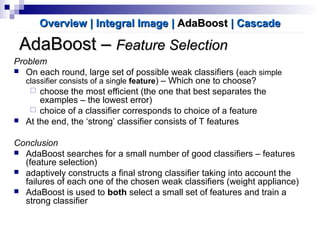
Problem
 On each round, large set of possible weak classifiers (each simple
classifier consists of a single feature) – Which one to choose?
 choose the most efficient (the one that best separates the
examples – the lowest error)
 choice of a classifier corresponds to choice of a feature
 At the end, the ‘strong’ classifier consists of T features
Conclusion
 AdaBoost searches for a small number of good classifiers – features
(feature selection)
 adaptively constructs a final strong classifier taking into account the
failures of each one of the chosen weak classifiers (weight appliance)
 AdaBoost is used to both select a small set of features and train a
strong classifier
Overview | Integral ImageOverview | Integral Image || AdaBoostAdaBoost | Cascade| Cascade
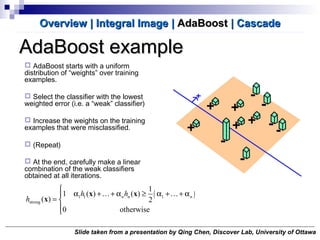
 AdaBoost starts with a uniform
distribution of “weights” over training
examples.
 Select the classifier with the lowest
weighted error (i.e. a “weak” classifier)
 Increase the weights on the training
examples that were misclassified.
 (Repeat)
 At the end, carefully make a linear
combination of the weak classifiers
obtained at all iterations.
AdaBoost exampleAdaBoost example
( )1 1 1
strong
1
1 ( ) ( )
( ) 2
0 otherwise
n n nh h
h

α + + α ≥ α + + α
= 

x x
x
K K
Slide taken from a presentation by Qing Chen, Discover Lab, University of Ottawa
Overview | Integral ImageOverview | Integral Image || AdaBoostAdaBoost | Cascade| Cascade
Now we have a good face detectorNow we have a good face detector
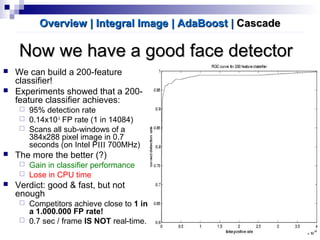
 We can build a 200-feature
classifier!
 Experiments showed that a 200-
feature classifier achieves:
 95% detection rate
 0.14x10⁻³
FP rate (1 in 14084)
 Scans all sub-windows of a
384x288 pixel image in 0.7
seconds (on Intel PIII 700MHz)
 The more the better (?)
 Gain in classifier performance
 Lose in CPU time
 Verdict: good & fast, but not
enough
 Competitors achieve close to 1 in
a 1.000.000 FP rate!
 0.7 sec / frame IS NOT real-time.
Overview | Integral ImageOverview | Integral Image | AdaBoost| AdaBoost || CascadeCascade
Three goalsThree goals
1. Feature Computation: features must be
computed as quickly as possible
2. Feature Selection: select the most
discriminating features
3. Real-timeliness: must focus on potentially
positive image areas (that contain faces)
How did Viola & Jones deal with these challenges?
Overview | Integral ImageOverview | Integral Image | AdaBoost| AdaBoost || CascadeCascade
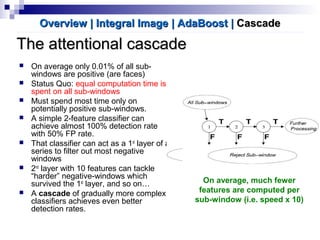
The attentional cascadeThe attentional cascade
 On average only 0.01% of all sub-
windows are positive (are faces)
 Status Quo: equal computation time is
spent on all sub-windows
 Must spend most time only on
potentially positive sub-windows.
 A simple 2-feature classifier can
achieve almost 100% detection rate
with 50% FP rate.
 That classifier can act as a 1st
layer of a
series to filter out most negative
windows
 2nd
layer with 10 features can tackle
“harder” negative-windows which
survived the 1st
layer, and so on…
 A cascade of gradually more complex
classifiers achieves even better
detection rates.
Overview | Integral ImageOverview | Integral Image | AdaBoost| AdaBoost || CascadeCascade
On average, much fewer
features are computed per
sub-window (i.e. speed x 10)
Training a cascade of classifiersTraining a cascade of classifiers
Overview | Integral ImageOverview | Integral Image | AdaBoost| AdaBoost || CascadeCascade
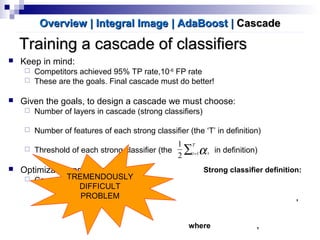
Strong classifier definition:
,
where ,
 Keep in mind:
 Competitors achieved 95% TP rate,10-6
FP rate
 These are the goals. Final cascade must do better!
 Given the goals, to design a cascade we must choose:
 Number of layers in cascade (strong classifiers)
 Number of features of each strong classifier (the ‘T’ in definition)
 Threshold of each strong classifier (the in definition)
 Optimization problem:
 Can we find optimum combination?
∑=
T
t t1
2
1
α
TREMENDOUSLY
DIFFICULT
PROBLEM
A simple framework for cascade trainingA simple framework for cascade training
Overview | Integral ImageOverview | Integral Image | AdaBoost| AdaBoost || CascadeCascade
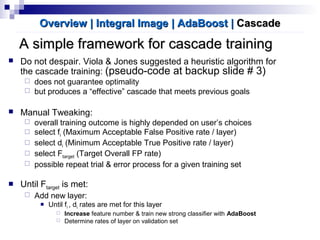
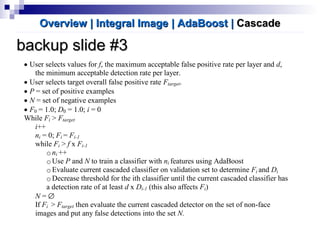
 Do not despair. Viola & Jones suggested a heuristic algorithm for
the cascade training: (pseudo-code at backup slide # 3)
 does not guarantee optimality
 but produces a “effective” cascade that meets previous goals
 Manual Tweaking:
 overall training outcome is highly depended on user’s choices
 select fi (Maximum Acceptable False Positive rate / layer)
 select di (Minimum Acceptable True Positive rate / layer)
 select Ftarget (Target Overall FP rate)
 possible repeat trial & error process for a given training set
 Until Ftarget is met:
 Add new layer:
 Until fi , di rates are met for this layer
 Increase feature number & train new strong classifier with AdaBoost
 Determine rates of layer on validation set
backup slide #3backup slide #3
• User selects values for f, the maximum acceptable false positive rate per layer and d,
the minimum acceptable detection rate per layer.
• User selects target overall false positive rate Ftarget.
• P = set of positive examples
• N = set of negative examples
• F0 = 1.0; D0 = 1.0; i = 0
While Fi > Ftarget
i++
ni = 0; Fi = Fi-1
while Fi > f x Fi-1
oni ++
oUse P and N to train a classifier with ni features using AdaBoost
oEvaluate current cascaded classifier on validation set to determine Fi and Di
oDecrease threshold for the ith classifier until the current cascaded classifier has
a detection rate of at least d x Di-1 (this also affects Fi)
N = ∅
If Fi > Ftarget then evaluate the current cascaded detector on the set of non-face
images and put any false detections into the set N.
Overview | Integral ImageOverview | Integral Image | AdaBoost| AdaBoost || CascadeCascade
Three goalsThree goals
1. Feature Computation: features must be
computed as quickly as possible
2. Feature Selection: select the most
discriminating features
3. Real-timeliness: must focus on potentially
positive image areas (that contain faces)
How did Viola & Jones deal with these challenges?
Overview | Integral ImageOverview | Integral Image | AdaBoost| AdaBoost || CascadeCascade
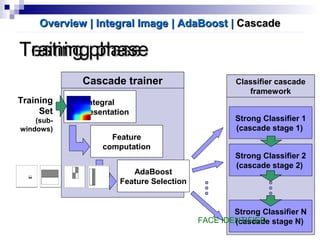
Training
Set
(sub-
windows)
Integral
Representation
Feature
computation
AdaBoost
Feature Selection
Cascade trainer
Testing phaseTesting phaseTraining phaseTraining phase
Strong Classifier 1
(cascade stage 1)
Strong Classifier N
(cascade stage N)
Classifier cascade
framework
Strong Classifier 2
(cascade stage 2)
FACE IDENTIFIED
Overview | Integral ImageOverview | Integral Image | AdaBoost| AdaBoost || CascadeCascade
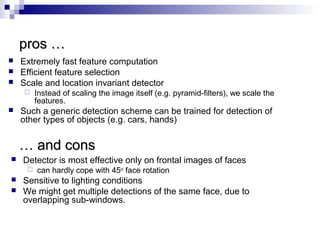
pros …pros …
 Extremely fast feature computation
 Efficient feature selection
 Scale and location invariant detector
 Instead of scaling the image itself (e.g. pyramid-filters), we scale the
features.
 Such a generic detection scheme can be trained for detection of
other types of objects (e.g. cars, hands)
…… and consand cons
 Detector is most effective only on frontal images of faces
 can hardly cope with 45o
face rotation
 Sensitive to lighting conditions
 We might get multiple detections of the same face, due to
overlapping sub-windows.
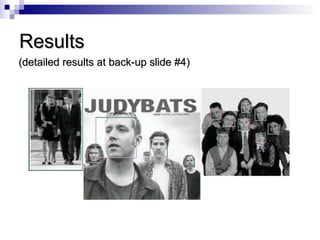
ResultsResults
(detailed results at back-up slide #4)(detailed results at back-up slide #4)
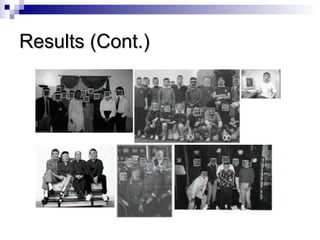
Results (Cont.)Results (Cont.)
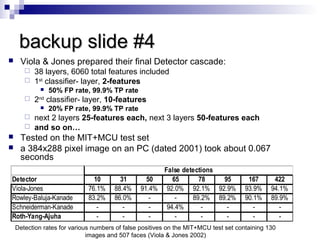
 Viola & Jones prepared their final Detector cascade:
 38 layers, 6060 total features included
 1st
classifier- layer, 2-features
 50% FP rate, 99.9% TP rate
 2nd
classifier- layer, 10-features
 20% FP rate, 99.9% TP rate
 next 2 layers 25-features each, next 3 layers 50-features each
 and so on…
 Tested on the MIT+MCU test set
 a 384x288 pixel image on an PC (dated 2001) took about 0.067
seconds
Detector 10 31 50 65 78 95 167 422
Viola-Jones 76.1% 88.4% 91.4% 92.0% 92.1% 92.9% 93.9% 94.1%
Rowley-Baluja-Kanade 83.2% 86.0% - - 89.2% 89.2% 90.1% 89.9%
Schneiderman-Kanade - - - 94.4% - - - -
Roth-Yang-Ajuha - - - - - - - -
False detections
Detection rates for various numbers of false positives on the MIT+MCU test set containing 130
images and 507 faces (Viola & Jones 2002)
backup slide #4backup slide #4
Thank you for listening!Thank you for listening!

Robust Real Time Face Detection

  • 1.
    Robust Real-time FaceRobustReal-time Face DetectionDetection byby Paul Viola and Michael Jones, 2002Paul Viola and Michael Jones, 2002 Presentation by Kostantina Palla & Alfredo Kalaitzis School of Informatics University of Edinburgh February 20, 2009
  • 2.
    OverviewOverview  Robust –very high Detection Rate (True-Positive Rate) & very low False-Positive Rate… always.  Real Time – For practical applications at least 2 frames per second must be processed.  Face Detection – not recognition. The goal is to distinguish faces from non-faces (face detection is the first step in the identification process)
  • 3.
    Three goals &a conlcusionThree goals & a conlcusion 1. Feature Computation: what features? And how can they be computed as quickly as possible 2. Feature Selection: select the most discriminating features 3. Real-timeliness: must focus on potentially positive areas (that contain faces) 4. Conclusion: presentation of results and discussion of detection issues. How did Viola & Jones deal with these challenges?
  • 4.
    1. Feature Computation The“Integral” image representation 2. Feature Selection The AdaBoost training algorithm 3. Real-timeliness A cascade of classifiers Three solutionsThree solutions
  • 5.
    FeaturesFeatures  Can asimple feature (i.e. a value) indicate the existence of a face?  All faces share some similar properties  The eyes region is darker than the upper-cheeks.  The nose bridge region is brighter than the eyes.  That is useful domain knowledge  Need for encoding of Domain Knowledge:  Location - Size: eyes & nose bridge region  Value: darker / brighter OverviewOverview || Integral ImageIntegral Image | AdaBoost| AdaBoost | Cascade| Cascade
  • 6.
    Rectangle featuresRectangle features Rectangle features:  Value = ∑ (pixels in black area) - ∑ (pixels in white area)  Three types: two-, three-, four-rectangles, Viola&Jones used two-rectangle features  For example: the difference in brightness between the white &black rectangles over a specific area  Each feature is related to a special location in the sub-window  Each feature may have any size  Why not pixels instead of features?  Features encode domain knowledge  Feature based systems operate faster Overview |Overview | Integral ImageIntegral Image | AdaBoost| AdaBoost | Cascade| Cascade
  • 7.
    Integral Image RepresentationIntegralImage Representation (also check back-up slide #1)(also check back-up slide #1)  Given a detection resolution of 24x24 (smallest sub-window), the set of different rectangle features is ~160,000 !  Need for speed  Introducing Integral Image Representation  Definition: The integral image at location (x,y), is the sum of the pixels above and to the left of (x,y), inclusive  The Integral image can be computed in a single pass and only once for each sub-window! ( ) ( ) ( ) ( ) ( ) ( ) ( ) ( ) ' , ' formal definition: , ', ' Recursive definition: , , 1 , , 1, , x x y y ii x y i x y s x y s x y i x y ii x y ii x y s x y ≤ ≤ = = − + = − + ∑ Overview |Overview | Integral ImageIntegral Image | AdaBoost| AdaBoost | Cascade| Cascade y x
  • 8.
    back-up slide #1back-upslide #1 Overview |Overview | Integral ImageIntegral Image | AdaBoost| AdaBoost | Cascade| Cascade 0 1 1 1 1 2 2 3 1 2 1 1 1 3 1 0 IMAGE 0 1 2 3 1 4 7 11 2 7 11 16 3 11 16 21 INTEGRAL IMAGE
  • 9.
    Rapid computation ofrectangular featuresRapid computation of rectangular features  Back to feature evaluation . . .  Using the integral image representation we can compute the value of any rectangular sum (part of features) in constant time  For example the integral sum inside rectangle D can be computed as: ii(d) + ii(a) – ii(b) – ii(c)  two-, three-, and four-rectangular features can be computed with 6, 8 and 9 array references respectively.  As a result: feature computation takes less time ii(a) = A ii(b) = A+B ii(c) = A+C ii(d) = A+B+C+D D = ii(d)+ii(a)- ii(b)-ii(c) Overview |Overview | Integral ImageIntegral Image | AdaBoost| AdaBoost | Cascade| Cascade
  • 10.
    Three goalsThree goals 1.Feature Computation: features must be computed as quickly as possible 2. Feature Selection: select the most discriminating features 3. Real-timeliness: must focus on potentially positive image areas (that contain faces) How did Viola & Jones deal with these challenges? Overview |Overview | Integral ImageIntegral Image | AdaBoost| AdaBoost | Cascade| Cascade
  • 11.
    Feature selectionFeature selection Problem: Too many features  In a sub-window (24x24) there are ~160,000 features (all possible combinations of orientation, location and scale of these feature types)  impractical to compute all of them (computationally expensive)  We have to select a subset of relevant features – which are informative - to model a face  Hypothesis: “A very small subset of features can be combined to form an effective classifier”  How?  AdaBoost algorithm Overview | Integral ImageOverview | Integral Image || AdaBoostAdaBoost | Cascade| Cascade Relevant feature Irrelevant feature
  • 12.
    AdaBoostAdaBoost  Stands for“Adaptive” boost  Constructs a “strong” classifier as a linear combination of weighted simple “weak” classifiers Overview | Integral ImageOverview | Integral Image || AdaBoostAdaBoost | Cascade| Cascade Strong classifier Weak classifier WeightImage
  • 13.
    AdaBoost -AdaBoost -CharacteristicsCharacteristics  Features as weak classifiers Each single rectangle feature may be regarded as a simple weak classifier  An iterative algorithm AdaBoost performs a series of trials, each time selecting a new weak classifier  Weights are being applied over the set of the example images During each iteration, each example/image receives a weight determining its importance Overview | Integral ImageOverview | Integral Image || AdaBoostAdaBoost | Cascade| Cascade
  • 14.
    AdaBoost -AdaBoost -Getting the idea…Getting the idea…  Given: example images labeled +/-  Initially, all weights set equally  Repeat T times  Step 1: choose the most efficient weak classifier that will be a component of the final strong classifier (Problem! Remember the huge number of features…)  Step 2: Update the weights to emphasize the examples which were incorrectly classified  This makes the next weak classifier to focus on “harder” examples  Final (strong) classifier is a weighted combination of the T “weak” classifiers  Weighted according to their accuracy Overview | Integral ImageOverview | Integral Image || AdaBoostAdaBoost | Cascade| Cascade     ≥ = ∑ ∑= = otherwise x xh T t T t ttt h 0 2 1 )(1 )( 1 1αα (pseudo-code at back-up slide #2)(pseudo-code at back-up slide #2)
  • 15.
    AdaBoost –AdaBoost –Feature SelectionFeature Selection Problem  On each round, large set of possible weak classifiers (each simple classifier consists of a single feature) – Which one to choose?  choose the most efficient (the one that best separates the examples – the lowest error)  choice of a classifier corresponds to choice of a feature  At the end, the ‘strong’ classifier consists of T features Conclusion  AdaBoost searches for a small number of good classifiers – features (feature selection)  adaptively constructs a final strong classifier taking into account the failures of each one of the chosen weak classifiers (weight appliance)  AdaBoost is used to both select a small set of features and train a strong classifier Overview | Integral ImageOverview | Integral Image || AdaBoostAdaBoost | Cascade| Cascade
  • 16.
     AdaBoost startswith a uniform distribution of “weights” over training examples.  Select the classifier with the lowest weighted error (i.e. a “weak” classifier)  Increase the weights on the training examples that were misclassified.  (Repeat)  At the end, carefully make a linear combination of the weak classifiers obtained at all iterations. AdaBoost exampleAdaBoost example ( )1 1 1 strong 1 1 ( ) ( ) ( ) 2 0 otherwise n n nh h h  α + + α ≥ α + + α =   x x x K K Slide taken from a presentation by Qing Chen, Discover Lab, University of Ottawa Overview | Integral ImageOverview | Integral Image || AdaBoostAdaBoost | Cascade| Cascade
  • 17.
    Now we havea good face detectorNow we have a good face detector  We can build a 200-feature classifier!  Experiments showed that a 200- feature classifier achieves:  95% detection rate  0.14x10⁻³ FP rate (1 in 14084)  Scans all sub-windows of a 384x288 pixel image in 0.7 seconds (on Intel PIII 700MHz)  The more the better (?)  Gain in classifier performance  Lose in CPU time  Verdict: good & fast, but not enough  Competitors achieve close to 1 in a 1.000.000 FP rate!  0.7 sec / frame IS NOT real-time. Overview | Integral ImageOverview | Integral Image | AdaBoost| AdaBoost || CascadeCascade
  • 18.
    Three goalsThree goals 1.Feature Computation: features must be computed as quickly as possible 2. Feature Selection: select the most discriminating features 3. Real-timeliness: must focus on potentially positive image areas (that contain faces) How did Viola & Jones deal with these challenges? Overview | Integral ImageOverview | Integral Image | AdaBoost| AdaBoost || CascadeCascade
  • 19.
    The attentional cascadeTheattentional cascade  On average only 0.01% of all sub- windows are positive (are faces)  Status Quo: equal computation time is spent on all sub-windows  Must spend most time only on potentially positive sub-windows.  A simple 2-feature classifier can achieve almost 100% detection rate with 50% FP rate.  That classifier can act as a 1st layer of a series to filter out most negative windows  2nd layer with 10 features can tackle “harder” negative-windows which survived the 1st layer, and so on…  A cascade of gradually more complex classifiers achieves even better detection rates. Overview | Integral ImageOverview | Integral Image | AdaBoost| AdaBoost || CascadeCascade On average, much fewer features are computed per sub-window (i.e. speed x 10)
  • 20.
    Training a cascadeof classifiersTraining a cascade of classifiers Overview | Integral ImageOverview | Integral Image | AdaBoost| AdaBoost || CascadeCascade Strong classifier definition: , where ,  Keep in mind:  Competitors achieved 95% TP rate,10-6 FP rate  These are the goals. Final cascade must do better!  Given the goals, to design a cascade we must choose:  Number of layers in cascade (strong classifiers)  Number of features of each strong classifier (the ‘T’ in definition)  Threshold of each strong classifier (the in definition)  Optimization problem:  Can we find optimum combination? ∑= T t t1 2 1 α TREMENDOUSLY DIFFICULT PROBLEM
  • 21.
    A simple frameworkfor cascade trainingA simple framework for cascade training Overview | Integral ImageOverview | Integral Image | AdaBoost| AdaBoost || CascadeCascade  Do not despair. Viola & Jones suggested a heuristic algorithm for the cascade training: (pseudo-code at backup slide # 3)  does not guarantee optimality  but produces a “effective” cascade that meets previous goals  Manual Tweaking:  overall training outcome is highly depended on user’s choices  select fi (Maximum Acceptable False Positive rate / layer)  select di (Minimum Acceptable True Positive rate / layer)  select Ftarget (Target Overall FP rate)  possible repeat trial & error process for a given training set  Until Ftarget is met:  Add new layer:  Until fi , di rates are met for this layer  Increase feature number & train new strong classifier with AdaBoost  Determine rates of layer on validation set
  • 22.
    backup slide #3backupslide #3 • User selects values for f, the maximum acceptable false positive rate per layer and d, the minimum acceptable detection rate per layer. • User selects target overall false positive rate Ftarget. • P = set of positive examples • N = set of negative examples • F0 = 1.0; D0 = 1.0; i = 0 While Fi > Ftarget i++ ni = 0; Fi = Fi-1 while Fi > f x Fi-1 oni ++ oUse P and N to train a classifier with ni features using AdaBoost oEvaluate current cascaded classifier on validation set to determine Fi and Di oDecrease threshold for the ith classifier until the current cascaded classifier has a detection rate of at least d x Di-1 (this also affects Fi) N = ∅ If Fi > Ftarget then evaluate the current cascaded detector on the set of non-face images and put any false detections into the set N. Overview | Integral ImageOverview | Integral Image | AdaBoost| AdaBoost || CascadeCascade
  • 23.
    Three goalsThree goals 1.Feature Computation: features must be computed as quickly as possible 2. Feature Selection: select the most discriminating features 3. Real-timeliness: must focus on potentially positive image areas (that contain faces) How did Viola & Jones deal with these challenges? Overview | Integral ImageOverview | Integral Image | AdaBoost| AdaBoost || CascadeCascade
  • 24.
    Training Set (sub- windows) Integral Representation Feature computation AdaBoost Feature Selection Cascade trainer TestingphaseTesting phaseTraining phaseTraining phase Strong Classifier 1 (cascade stage 1) Strong Classifier N (cascade stage N) Classifier cascade framework Strong Classifier 2 (cascade stage 2) FACE IDENTIFIED Overview | Integral ImageOverview | Integral Image | AdaBoost| AdaBoost || CascadeCascade
  • 25.
    pros …pros … Extremely fast feature computation  Efficient feature selection  Scale and location invariant detector  Instead of scaling the image itself (e.g. pyramid-filters), we scale the features.  Such a generic detection scheme can be trained for detection of other types of objects (e.g. cars, hands) …… and consand cons  Detector is most effective only on frontal images of faces  can hardly cope with 45o face rotation  Sensitive to lighting conditions  We might get multiple detections of the same face, due to overlapping sub-windows.
  • 26.
    ResultsResults (detailed results atback-up slide #4)(detailed results at back-up slide #4)
  • 27.
  • 28.
     Viola &Jones prepared their final Detector cascade:  38 layers, 6060 total features included  1st classifier- layer, 2-features  50% FP rate, 99.9% TP rate  2nd classifier- layer, 10-features  20% FP rate, 99.9% TP rate  next 2 layers 25-features each, next 3 layers 50-features each  and so on…  Tested on the MIT+MCU test set  a 384x288 pixel image on an PC (dated 2001) took about 0.067 seconds Detector 10 31 50 65 78 95 167 422 Viola-Jones 76.1% 88.4% 91.4% 92.0% 92.1% 92.9% 93.9% 94.1% Rowley-Baluja-Kanade 83.2% 86.0% - - 89.2% 89.2% 90.1% 89.9% Schneiderman-Kanade - - - 94.4% - - - - Roth-Yang-Ajuha - - - - - - - - False detections Detection rates for various numbers of false positives on the MIT+MCU test set containing 130 images and 507 faces (Viola & Jones 2002) backup slide #4backup slide #4
  • 29.
    Thank you forlistening!Thank you for listening!

Editor's Notes

  • #3 קצת על המאמר פורסם ב 2001 מתעסק במטלת ה Object detection, והודגם ספציפית על מטלת ה Face detection. גם כן המוטיבציה מאחורי היוזמה. עם דגש משמעותי על מהירות מערכת real time face detection הראשונה בעולם מומש, שוכלל והורחב בין השאר ממומש בחבילת OpenCV הדוגמאות שלי מעט יותר משוכלל, אבל אותו עיקרון בעיות האם זה משנה היכן המאמר פורסם? האומנם first real-time face detection? International journal of computer vision
  • #4 בשר המאמר מתחיל בעצם עכשיו – עד עכשיו הדגמה.
  • #5 בשר המאמר מתחיל בעצם עכשיו – עד עכשיו הדגמה.
  • #6 אבני הבניין של ה Classifiers באמצעותם אנו מייצגים אובייקטים. פיצ'ר היא פונקציה שמחשבת הפרשים בין אזורים מבלניים בתמונה מתואר ויזואלית ע"י מלבן מחולק לתתי מלבנים, שחלקם לבנים וחלקם אפורים. ההפרש שמחושב הוא בין המלבנים בצבעים השונים. למשל... במאמר אנחנו משתמשים בארבעה סוגי פיצ'רים מידע נוסף 3 rectangular features types: two-rectangle feature type (horizontal/vertical) three-rectangle feature type four-rectangle feature type Doesn’t operate on raw grayscale pixel values but rather on values obtained from applying simple filters to the pixels.
  • #7 נדגים את השימוש בפיצ'רים על פרצופים. פנים ניתן לתאר היטב באמצעות פיצרים יש חלקים בולטים יותר כגון האף המצח והלחיים שסופגות יותר אור. לעומתן איזורים שקועים יותר כגון ארובות העיניים, שמוצללות יותר. בנוסף לשיער, פה, ומבנה הגולגולת. כך שיש לנו הפרשי בהירות מובהקים. למשל... מה קורה אם נבנה classifier סופי משני הפיצ'רים הללו? נקבל 100% detection rate, 40% false positive rate אלו תוצאות לא מספקות לשם זיהוי אבל נעזר בתוצאות בהמשך לשם סינון ראשוני של חלונות רקע. מכאן הלאה האלגוריתם שלנו לא יתעסק ישירות עם הפיקסלים בתמונה, אלא אך ורק באמצעות חישובי פיצ'רים – קרי הפרשים. שיפורים אולי אפילו לשים תמונה מוכרת יותר
  • #8 הגדרה: בע"פ: היצוג האינטגרלי של תמונה בנקודה X,Y הוא סכום הפיקסלים שמעל ומשמאל לנקודה, כולל. פרומאלית: רקורסיבית חישוב במעבר אחד סיבוכיות זמן כגודל התמונה
  • #9 הגדרה: בע"פ: היצוג האינטגרלי של תמונה בנקודה X,Y הוא סכום הפיקסלים שמעל ומשמאל לנקודה, כולל. פרומאלית: רקורסיבית חישוב במעבר אחד סיבוכיות זמן כגודל התמונה
  • #11 בשר המאמר מתחיל בעצם עכשיו – עד עכשיו הדגמה.
  • #12 לא מספיק למצוא את הפיצרים הכי טובים אם היינו בחורים את 200 הפיצרים הכי טובים (על סמך אחוז detection rate) – היינו מקבלים פחות או יותר את אותו סוג הפיצ'ר (שבמקרה של פנים היה איזור העיניים כהה יותר מגשר האף) חשוב לנו מגוון מייצג של פייצ'ירם. יחודיים. בלי מגוון מאפיינים מייחדים – שיעור ה FALSE POSITIVE שלנו עולה בהרבה. לכן חשוב מגוון מאפיינים – כדי לייחד
  • #13 מידע נוסף AdaBoost is adaptive in the sense that subsequent classifiers built are tweaked in favor of those instances misclassified by previous classifiers.
  • #14 מידע נוסף AdaBoost is adaptive in the sense that subsequent classifiers built are tweaked in favor of those instances misclassified by previous classifiers.
  • #15 מידע נוסף AdaBoost is adaptive in the sense that subsequent classifiers built are tweaked in favor of those instances misclassified by previous classifiers.
  • #16 מידע נוסף AdaBoost is adaptive in the sense that subsequent classifiers built are tweaked in favor of those instances misclassified by previous classifiers.
  • #17 לספר לאנשים מה הם רואים כל Weak classifier ממושקל (a) לפי ההצלחה שלו בפני עצמו. ה Classifier החזק מנצחי לפי Weighted majority של המשקלים הללו. מידע נוסף לצירוף הלינארי בסוף הם קוראים Perceptron.
  • #18 מידע נוסף AdaBoost is adaptive in the sense that subsequent classifiers built are tweaked in favor of those instances misclassified by previous classifiers.
  • #19 בשר המאמר מתחיל בעצם עכשיו – עד עכשיו הדגמה.
  • #23 הגדרה: בע"פ: היצוג האינטגרלי של תמונה בנקודה X,Y הוא סכום הפיקסלים שמעל ומשמאל לנקודה, כולל. פרומאלית: רקורסיבית חישוב במעבר אחד סיבוכיות זמן כגודל התמונה
  • #24 בשר המאמר מתחיל בעצם עכשיו – עד עכשיו הדגמה.
  • #25 בשר המאמר מתחיל בעצם עכשיו – עד עכשיו הדגמה.
  • #27 תוצאות אמיתיות מהניסוי