Facial Expression
Recognition/Removal
      Robot Vision CAP4453


                             Alejandro Avilés
                               Rafael Dahis
CVPR 2010


Facial Expression Recognition/Removal               2
Introduction
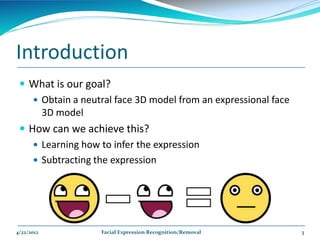
  What is our goal?
     Obtain a neutral face 3D model from an expressional face
      3D model
  How can we achieve this?
     Learning how to infer the expression
     Subtracting the expression


4/22/2012          Facial Expression Recognition/Removal         3
Motivations
  3D Facial expression removal benefits…

       Performance of 3D face recognition


       Improve 3D gender classification methods


       Analyzing complex expressions


       Face synthesis

4/22/2012            Facial Expression Recognition/Removal   4
Background
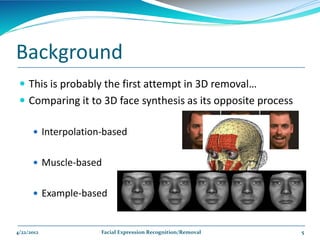
  This is probably the first attempt in 3D removal…
  Comparing it to 3D face synthesis as its opposite process

       Interpolation-based


       Muscle-based


       Example-based


4/22/2012            Facial Expression Recognition/Removal     5
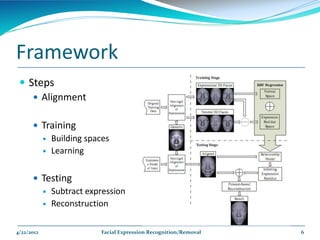
Framework
  Steps
     Alignment


       Training
         Building spaces
         Learning


       Testing
         Subtract expression
         Reconstruction


4/22/2012              Facial Expression Recognition/Removal   6
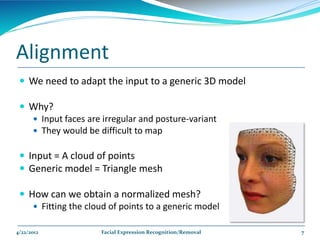
Alignment
  We need to adapt the input to a generic 3D model

  Why?
    Input faces are irregular and posture-variant
    They would be difficult to map


  Input = A cloud of points
  Generic model = Triangle mesh

  How can we obtain a normalized mesh?
     Fitting the cloud of points to a generic model

4/22/2012            Facial Expression Recognition/Removal   7
Alignment –                      1st       step
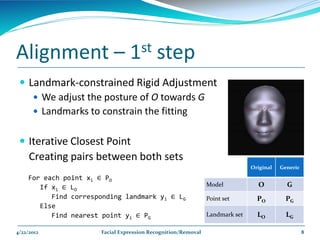
  Landmark-constrained Rigid Adjustment
     We adjust the posture of O towards G
     Landmarks to constrain the fitting


  Iterative Closest Point
     Creating pairs between both sets
                                                                              Original   Generic

    For each point xi ∈ PO
       If xi ∈ LO                                              Model            O          G
          Find corresponding landmark yi ∈ LG                  Point set        PO         PG
       Else
          Find nearest point yi ∈ PG                           Landmark set     LO         LG

4/22/2012              Facial Expression Recognition/Removal                                       8
Alignment –                           2nd         step
  Energy-based Generic Model Adaptation
     The generic mesh G is deformed to wrap O
     It is a energy minimization problem


  First, we have to explain these two energy measures
     Eg = Geometric Error
               Measures the quality of the wrapping
       Es = Smooth Error
               Measures the smoothness of the process

4/22/2012                   Facial Expression Recognition/Removal   9
Alignment –                            2nd         step
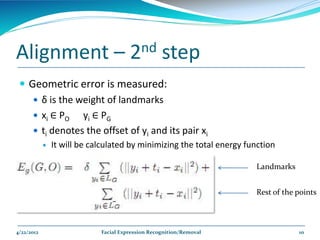
  Geometric error is measured:
     δ is the weight of landmarks
     xi ∈ PO   yi ∈ PG
     ti denotes the offset of yi and its pair xi
               It will be calculated by minimizing the total energy function

                                                                       Landmarks


                                                                       Rest of the points


4/22/2012                    Facial Expression Recognition/Removal                 10
Alignment –                    2nd         step
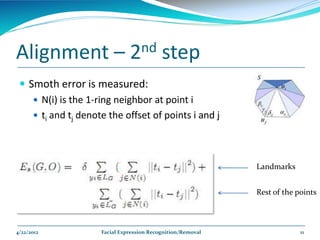
  Smoth error is measured:
     N(i) is the 1-ring neighbor at point i
     ti and tj denote the offset of points i and j


                                                             Landmarks


                                                             Rest of the points


4/22/2012            Facial Expression Recognition/Removal                11
Alignment –                           2nd         step
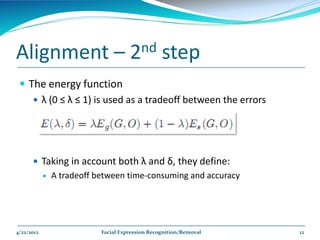
  The energy function
     λ (0 ≤ λ ≤ 1) is used as a tradeoff between the errors


       Taking in account both λ and δ, they define:
               A tradeoff between time-consuming and accuracy


4/22/2012                   Facial Expression Recognition/Removal   12
Alignment –                       2nd         step
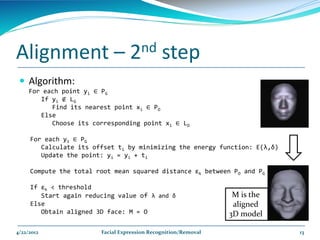
  Algorithm:
     For each point yi ∈ PG
        If yi ∉ LG
           Find its nearest point xi ∈ PO
        Else
           Choose its corresponding point xi ∈ LO

     For each yi ∈ PG
        Calculate its offset ti by minimizing the energy function: E(λ,δ)
        Update the point: yi = yi + ti

     Compute the total root mean squared distance εk between PO and PG

     If εk < threshold
        Start again reducing value of λ and δ                    M is the
     Else                                                        aligned
        Obtain aligned 3D face: M = O                           3D model

4/22/2012               Facial Expression Recognition/Removal               13
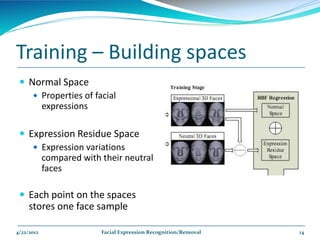
Training – Building spaces
  Normal Space
     Properties of facial
      expressions

  Expression Residue Space
     Expression variations
      compared with their neutral
      faces

  Each point on the spaces
     stores one face sample

4/22/2012             Facial Expression Recognition/Removal   14
Training – Building spaces
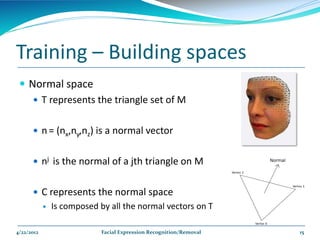
  Normal space
     T represents the triangle set of M


       n = (nx,ny,nz) is a normal vector


       nj is the normal of a jth triangle on M


       C represents the normal space
               Is composed by all the normal vectors on T

4/22/2012                    Facial Expression Recognition/Removal   15
Training – Building spaces
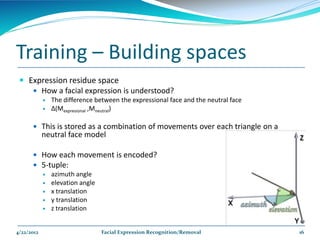
  Expression residue space
     How a facial expression is understood?
               The difference between the expressional face and the neutral face
               Δ(Mexpresional ,Mneutral)

       This is stored as a combination of movements over each triangle on a
            neutral face model

       How each movement is encoded?
       5-tuple:
         azimuth angle
         elevation angle
         x translation
         y translation
         z translation


4/22/2012                        Facial Expression Recognition/Removal              16
Training – Relationship model
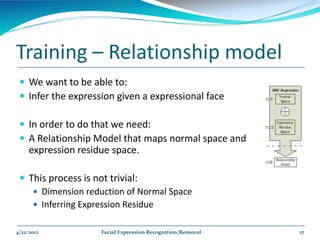
  We want to be able to:
  Infer the expression given a expressional face

  In order to do that we need:
  A Relationship Model that maps normal space and
     expression residue space.

  This process is not trivial:
     Dimension reduction of Normal Space
     Inferring Expression Residue


4/22/2012            Facial Expression Recognition/Removal   17
Training – Relationship model
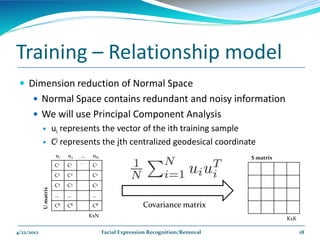
  Dimension reduction of Normal Space
       Normal Space contains redundant and noisy information
       We will use Principal Component Analysis
                      ui represents the vector of the ith training sample
                      Cj represents the jth centralized geodesical coordinate
                        u1   u2   …    uN                                           S matrix
                                  …
                       C1    C1        C1
                       C2    C2        C2
                       C3    C3        C3
            U matrix


                       …     …         …
                       CK    CK        CK                  Covariance matrix
                                      KxN
                                                                                               KxK

4/22/2012                                   Facial Expression Recognition/Removal                    18
Training – Relationship model
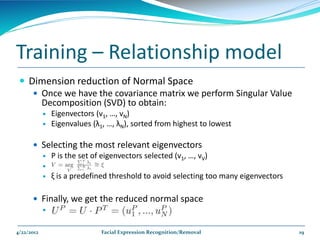
  Dimension reduction of Normal Space
     Once we have the covariance matrix we perform Singular Value
      Decomposition (SVD) to obtain:
               Eigenvectors (v1, …, vN)
               Eigenvalues (λ1, …, λN), sorted from highest to lowest

       Selecting the most relevant eigenvectors
         P is the set of eigenvectors selected (v1, …, vV)
            
               ξ is a predefined threshold to avoid selecting too many eigenvectors

       Finally, we get the reduced normal space
            


4/22/2012                      Facial Expression Recognition/Removal                   19
Training – Relationship model
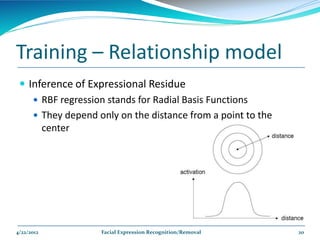
  Inference of Expressional Residue
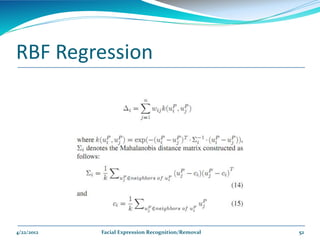
     RBF regression stands for Radial Basis Functions
     They depend only on the distance from a point to the
      center


4/22/2012          Facial Expression Recognition/Removal     20
Training – Relationship model
  Inference of Expressional Residue
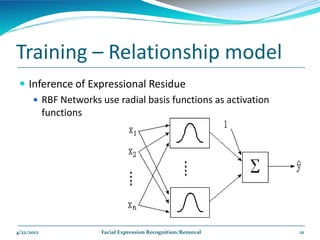
     RBF Networks use radial basis functions as activation
      functions


4/22/2012           Facial Expression Recognition/Removal     21
Training – Relationship model
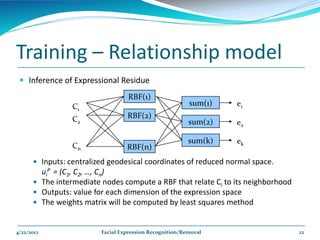
  Inference of Expressional Residue
                                  RBF(1)
                 C1                                      sum(1)   e1
                 C2               RBF(2)
                                                         sum(2)   e2

                                                         sum(k)   ek
                 Cn               RBF(n)
       Inputs: centralized geodesical coordinates of reduced normal space.
        uiP = (C1, C2, …, Cn)
       The intermediate nodes compute a RBF that relate Ci to its neighborhood
       Outputs: value for each dimension of the expression space
       The weights matrix will be computed by least squares method


4/22/2012                Facial Expression Recognition/Removal                    22
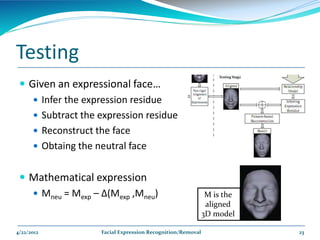
Testing
  Given an expressional face…
     Infer the expression residue
     Subtract the expression residue
     Reconstruct the face
     Obtaing the neutral face


  Mathematical expression
    Mneu = Mexp – Δ(Mexp ,Mneu)                            M is the
                                                            aligned
                                                           3D model

4/22/2012          Facial Expression Recognition/Removal               23
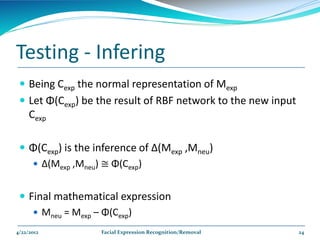
Testing - Infering
  Being Cexp the normal representation of Mexp
  Let Φ(Cexp) be the result of RBF network to the new input
     Cexp

  Φ(Cexp) is the inference of Δ(Mexp ,Mneu)
    Δ(Mexp ,Mneu) ≅ Φ(Cexp)


  Final mathematical expression
     Mneu = Mexp – Φ(Cexp)

4/22/2012          Facial Expression Recognition/Removal       24
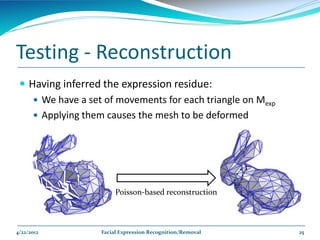
Testing - Reconstruction
  Having inferred the expression residue:
     We have a set of movements for each triangle on Mexp
     Applying them causes the mesh to be deformed


                        Poisson-based reconstruction


4/22/2012          Facial Expression Recognition/Removal     25
Experiments
      BU-3DFED (Binghamton University 3D Facial Expression
       Database)

      44 males 56 females
      Each made 6 different expressions and 1 neutral face
      Each expression had 4 levels of intensity

      Total number of face models = 700

4/22/2012           Facial Expression Recognition/Removal     26
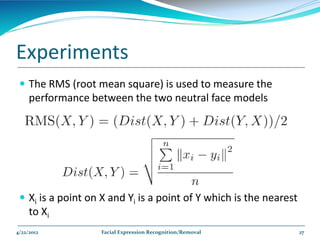
Experiments
  The RMS (root mean square) is used to measure the
     performance between the two neutral face models


  Xi is a point on X and Yi is a point of Y which is the nearest
     to Xi
4/22/2012          Facial Expression Recognition/Removal            27
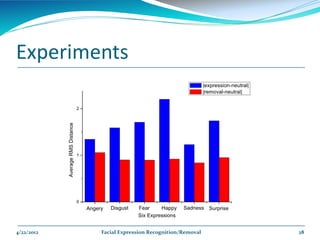
Experiments


4/22/2012   Facial Expression Recognition/Removal   28
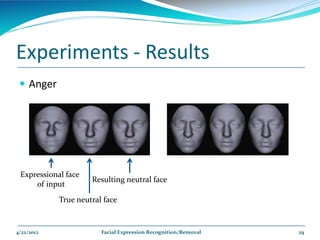
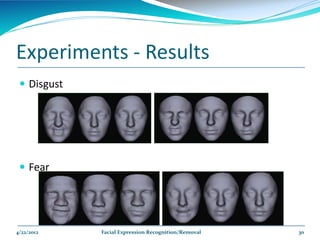
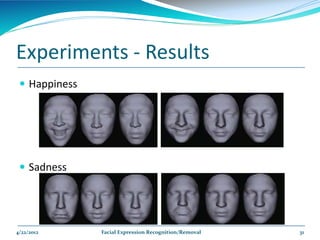
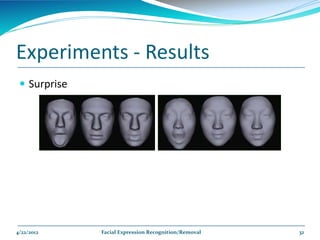
Experiments - Results
  Anger


 Expressional face
                     Resulting neutral face
     of input
            True neutral face


4/22/2012               Facial Expression Recognition/Removal   29
Experiments - Results
  Disgust


  Fear


4/22/2012    Facial Expression Recognition/Removal   30
Experiments - Results
  Happiness


  Sadness


4/22/2012      Facial Expression Recognition/Removal   31
Experiments - Results
  Surprise


4/22/2012     Facial Expression Recognition/Removal   32
CVPR 2008


4/22/2012   Facial Expression Recognition/Removal               33
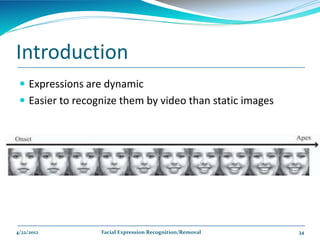
Introduction
  Expressions are dynamic
  Easier to recognize them by video than static images


4/22/2012         Facial Expression Recognition/Removal   34
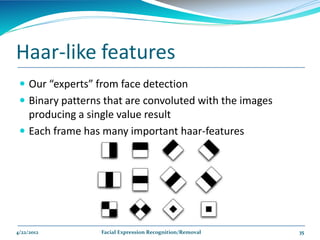
Haar-like features
  Our “experts” from face detection
  Binary patterns that are convoluted with the images
   producing a single value result
  Each frame has many important haar-features


4/22/2012         Facial Expression Recognition/Removal   35
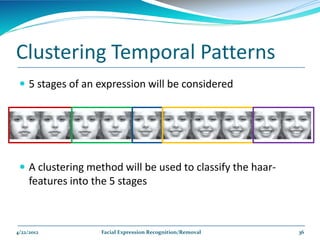
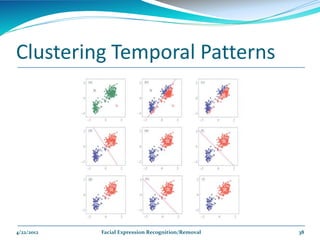
Clustering Temporal Patterns
  5 stages of an expression will be considered


  A clustering method will be used to classify the haar-
     features into the 5 stages


4/22/2012           Facial Expression Recognition/Removal   36
Clustering Temporal Patterns
  K-Means
     N → number of clusters
     N random vectors will be initialized, representing the center of
      the clusters

       For each point in the database:
         Which is the closest vector to me?
         That's the cluster I belong to!


       Recalculate cluster descriptor vectors: they must represent the
        mass-center of the points in the cluster
       Repeat until there's no more changes


4/22/2012                Facial Expression Recognition/Removal            37
Clustering Temporal Patterns


4/22/2012   Facial Expression Recognition/Removal   38
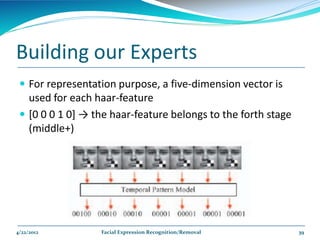
Building our Experts
  For representation purpose, a five-dimension vector is
   used for each haar-feature
  *0 0 0 1 0+ → the haar-feature belongs to the forth stage
   (middle+)


4/22/2012         Facial Expression Recognition/Removal        39
Building our Experts
  A normalized histogram is calculated, considering all the
   features in the sequence
  Ex for 7 features: [0 0 1/7 2/7 4/7]


4/22/2012          Facial Expression Recognition/Removal       40
Building our Experts
  We will convert the binary vector to decimal
    [ 0/7 0/7 1/7 2/7 4/7 ]
    = [ 1 2 4 8 16 ]
    = 0 + 0 + 4/7 + 16/7 + 64/7 = 84/7 = 12


4/22/2012         Facial Expression Recognition/Removal   41
Building our Experts
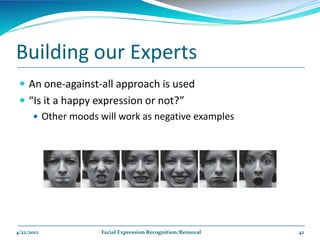
  An one-against-all approach is used
  “Is it a happy expression or not?”
     Other moods will work as negative examples


4/22/2012         Facial Expression Recognition/Removal   42
Building our Experts
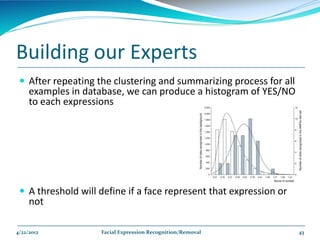
  After repeating the clustering and summarizing process for all
     examples in database, we can produce a histogram of YES/NO
     to each expressions


  A threshold will define if a face represent that expression or
     not

4/22/2012           Facial Expression Recognition/Removal           43
Building our Experts
  That is one weak classifier
  The final strong classifier is build by Adaboost


4/22/2012          Facial Expression Recognition/Removal   44
Testing
  For a new sequence:
     Calculate the haar-features
     Cluster into stages
     Summarize (output a decimal)
     Compare this value with the threshold of each expression


4/22/2012          Facial Expression Recognition/Removal         45
Experiments
  Cohn-Kanade faces database
     100 students, from 18 to 30
     65% woman, 35% man
     15% african-american, 5% asian or latin
     Each performed 23 poses, including prototypical expressions


  In this work, they used 90 of those expressions (60 for training,
   30 for testing)
  Experiments were made with sequences of 7 and 9 frames


4/22/2012            Facial Expression Recognition/Removal          46
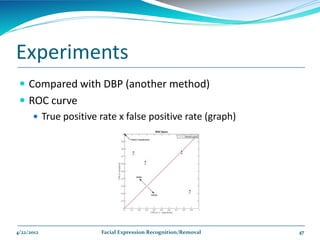
Experiments
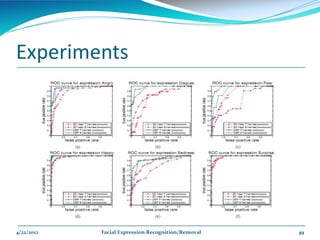
  Compared with DBP (another method)
  ROC curve
     True positive rate x false positive rate (graph)


4/22/2012            Facial Expression Recognition/Removal   47
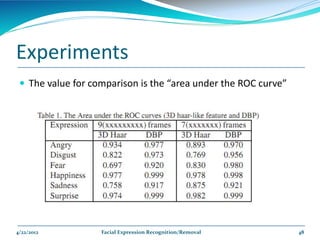
Experiments
  The value for comparison is the “area under the ROC curve”


4/22/2012          Facial Expression Recognition/Removal        48
Experiments


4/22/2012   Facial Expression Recognition/Removal   49
4/22/2012   Facial Expression Recognition/Removal   50
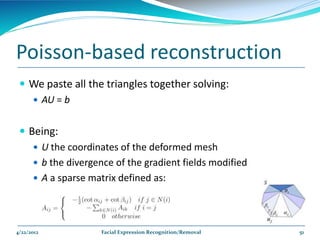
Poisson-based reconstruction
  We paste all the triangles together solving:
    AU = b


  Being:
     U the coordinates of the deformed mesh
     b the divergence of the gradient fields modified
     A a sparse matrix defined as:


4/22/2012           Facial Expression Recognition/Removal   51
RBF Regression


4/22/2012   Facial Expression Recognition/Removal   52

Facial Expression Recognition / Removal

  • 1.
    Facial Expression Recognition/Removal Robot Vision CAP4453 Alejandro Avilés Rafael Dahis
  • 2.
    CVPR 2010 Facial ExpressionRecognition/Removal 2
  • 3.
    Introduction  Whatis our goal?  Obtain a neutral face 3D model from an expressional face 3D model  How can we achieve this?  Learning how to infer the expression  Subtracting the expression 4/22/2012 Facial Expression Recognition/Removal 3
  • 4.
    Motivations  3DFacial expression removal benefits…  Performance of 3D face recognition  Improve 3D gender classification methods  Analyzing complex expressions  Face synthesis 4/22/2012 Facial Expression Recognition/Removal 4
  • 5.
    Background  Thisis probably the first attempt in 3D removal…  Comparing it to 3D face synthesis as its opposite process  Interpolation-based  Muscle-based  Example-based 4/22/2012 Facial Expression Recognition/Removal 5
  • 6.
    Framework  Steps  Alignment  Training  Building spaces  Learning  Testing  Subtract expression  Reconstruction 4/22/2012 Facial Expression Recognition/Removal 6
  • 7.
    Alignment  Weneed to adapt the input to a generic 3D model  Why?  Input faces are irregular and posture-variant  They would be difficult to map  Input = A cloud of points  Generic model = Triangle mesh  How can we obtain a normalized mesh?  Fitting the cloud of points to a generic model 4/22/2012 Facial Expression Recognition/Removal 7
  • 8.
    Alignment – 1st step  Landmark-constrained Rigid Adjustment  We adjust the posture of O towards G  Landmarks to constrain the fitting  Iterative Closest Point Creating pairs between both sets Original Generic For each point xi ∈ PO If xi ∈ LO Model O G Find corresponding landmark yi ∈ LG Point set PO PG Else Find nearest point yi ∈ PG Landmark set LO LG 4/22/2012 Facial Expression Recognition/Removal 8
  • 9.
    Alignment – 2nd step  Energy-based Generic Model Adaptation  The generic mesh G is deformed to wrap O  It is a energy minimization problem  First, we have to explain these two energy measures  Eg = Geometric Error  Measures the quality of the wrapping  Es = Smooth Error  Measures the smoothness of the process 4/22/2012 Facial Expression Recognition/Removal 9
  • 10.
    Alignment – 2nd step  Geometric error is measured:  δ is the weight of landmarks  xi ∈ PO yi ∈ PG  ti denotes the offset of yi and its pair xi  It will be calculated by minimizing the total energy function Landmarks Rest of the points 4/22/2012 Facial Expression Recognition/Removal 10
  • 11.
    Alignment – 2nd step  Smoth error is measured:  N(i) is the 1-ring neighbor at point i  ti and tj denote the offset of points i and j Landmarks Rest of the points 4/22/2012 Facial Expression Recognition/Removal 11
  • 12.
    Alignment – 2nd step  The energy function  λ (0 ≤ λ ≤ 1) is used as a tradeoff between the errors  Taking in account both λ and δ, they define:  A tradeoff between time-consuming and accuracy 4/22/2012 Facial Expression Recognition/Removal 12
  • 13.
    Alignment – 2nd step  Algorithm: For each point yi ∈ PG If yi ∉ LG Find its nearest point xi ∈ PO Else Choose its corresponding point xi ∈ LO For each yi ∈ PG Calculate its offset ti by minimizing the energy function: E(λ,δ) Update the point: yi = yi + ti Compute the total root mean squared distance εk between PO and PG If εk < threshold Start again reducing value of λ and δ M is the Else aligned Obtain aligned 3D face: M = O 3D model 4/22/2012 Facial Expression Recognition/Removal 13
  • 14.
    Training – Buildingspaces  Normal Space  Properties of facial expressions  Expression Residue Space  Expression variations compared with their neutral faces  Each point on the spaces stores one face sample 4/22/2012 Facial Expression Recognition/Removal 14
  • 15.
    Training – Buildingspaces  Normal space  T represents the triangle set of M  n = (nx,ny,nz) is a normal vector  nj is the normal of a jth triangle on M  C represents the normal space  Is composed by all the normal vectors on T 4/22/2012 Facial Expression Recognition/Removal 15
  • 16.
    Training – Buildingspaces  Expression residue space  How a facial expression is understood?  The difference between the expressional face and the neutral face  Δ(Mexpresional ,Mneutral)  This is stored as a combination of movements over each triangle on a neutral face model  How each movement is encoded?  5-tuple:  azimuth angle  elevation angle  x translation  y translation  z translation 4/22/2012 Facial Expression Recognition/Removal 16
  • 17.
    Training – Relationshipmodel  We want to be able to:  Infer the expression given a expressional face  In order to do that we need:  A Relationship Model that maps normal space and expression residue space.  This process is not trivial:  Dimension reduction of Normal Space  Inferring Expression Residue 4/22/2012 Facial Expression Recognition/Removal 17
  • 18.
    Training – Relationshipmodel  Dimension reduction of Normal Space  Normal Space contains redundant and noisy information  We will use Principal Component Analysis  ui represents the vector of the ith training sample  Cj represents the jth centralized geodesical coordinate u1 u2 … uN S matrix … C1 C1 C1 C2 C2 C2 C3 C3 C3 U matrix … … … CK CK CK Covariance matrix KxN KxK 4/22/2012 Facial Expression Recognition/Removal 18
  • 19.
    Training – Relationshipmodel  Dimension reduction of Normal Space  Once we have the covariance matrix we perform Singular Value Decomposition (SVD) to obtain:  Eigenvectors (v1, …, vN)  Eigenvalues (λ1, …, λN), sorted from highest to lowest  Selecting the most relevant eigenvectors  P is the set of eigenvectors selected (v1, …, vV)   ξ is a predefined threshold to avoid selecting too many eigenvectors  Finally, we get the reduced normal space  4/22/2012 Facial Expression Recognition/Removal 19
  • 20.
    Training – Relationshipmodel  Inference of Expressional Residue  RBF regression stands for Radial Basis Functions  They depend only on the distance from a point to the center 4/22/2012 Facial Expression Recognition/Removal 20
  • 21.
    Training – Relationshipmodel  Inference of Expressional Residue  RBF Networks use radial basis functions as activation functions 4/22/2012 Facial Expression Recognition/Removal 21
  • 22.
    Training – Relationshipmodel  Inference of Expressional Residue RBF(1) C1 sum(1) e1 C2 RBF(2) sum(2) e2 sum(k) ek Cn RBF(n)  Inputs: centralized geodesical coordinates of reduced normal space. uiP = (C1, C2, …, Cn)  The intermediate nodes compute a RBF that relate Ci to its neighborhood  Outputs: value for each dimension of the expression space  The weights matrix will be computed by least squares method 4/22/2012 Facial Expression Recognition/Removal 22
  • 23.
    Testing  Givenan expressional face…  Infer the expression residue  Subtract the expression residue  Reconstruct the face  Obtaing the neutral face  Mathematical expression  Mneu = Mexp – Δ(Mexp ,Mneu) M is the aligned 3D model 4/22/2012 Facial Expression Recognition/Removal 23
  • 24.
    Testing - Infering  Being Cexp the normal representation of Mexp  Let Φ(Cexp) be the result of RBF network to the new input Cexp  Φ(Cexp) is the inference of Δ(Mexp ,Mneu)  Δ(Mexp ,Mneu) ≅ Φ(Cexp)  Final mathematical expression  Mneu = Mexp – Φ(Cexp) 4/22/2012 Facial Expression Recognition/Removal 24
  • 25.
    Testing - Reconstruction  Having inferred the expression residue:  We have a set of movements for each triangle on Mexp  Applying them causes the mesh to be deformed Poisson-based reconstruction 4/22/2012 Facial Expression Recognition/Removal 25
  • 26.
    Experiments  BU-3DFED (Binghamton University 3D Facial Expression Database)  44 males 56 females  Each made 6 different expressions and 1 neutral face  Each expression had 4 levels of intensity  Total number of face models = 700 4/22/2012 Facial Expression Recognition/Removal 26
  • 27.
    Experiments  TheRMS (root mean square) is used to measure the performance between the two neutral face models  Xi is a point on X and Yi is a point of Y which is the nearest to Xi 4/22/2012 Facial Expression Recognition/Removal 27
  • 28.
    Experiments 4/22/2012 Facial Expression Recognition/Removal 28
  • 29.
    Experiments - Results  Anger Expressional face Resulting neutral face of input True neutral face 4/22/2012 Facial Expression Recognition/Removal 29
  • 30.
    Experiments - Results  Disgust  Fear 4/22/2012 Facial Expression Recognition/Removal 30
  • 31.
    Experiments - Results  Happiness  Sadness 4/22/2012 Facial Expression Recognition/Removal 31
  • 32.
    Experiments - Results  Surprise 4/22/2012 Facial Expression Recognition/Removal 32
  • 33.
    CVPR 2008 4/22/2012 Facial Expression Recognition/Removal 33
  • 34.
    Introduction  Expressionsare dynamic  Easier to recognize them by video than static images 4/22/2012 Facial Expression Recognition/Removal 34
  • 35.
    Haar-like features Our “experts” from face detection  Binary patterns that are convoluted with the images producing a single value result  Each frame has many important haar-features 4/22/2012 Facial Expression Recognition/Removal 35
  • 36.
    Clustering Temporal Patterns  5 stages of an expression will be considered  A clustering method will be used to classify the haar- features into the 5 stages 4/22/2012 Facial Expression Recognition/Removal 36
  • 37.
    Clustering Temporal Patterns  K-Means  N → number of clusters  N random vectors will be initialized, representing the center of the clusters  For each point in the database:  Which is the closest vector to me?  That's the cluster I belong to!  Recalculate cluster descriptor vectors: they must represent the mass-center of the points in the cluster  Repeat until there's no more changes 4/22/2012 Facial Expression Recognition/Removal 37
  • 38.
    Clustering Temporal Patterns 4/22/2012 Facial Expression Recognition/Removal 38
  • 39.
    Building our Experts  For representation purpose, a five-dimension vector is used for each haar-feature  *0 0 0 1 0+ → the haar-feature belongs to the forth stage (middle+) 4/22/2012 Facial Expression Recognition/Removal 39
  • 40.
    Building our Experts  A normalized histogram is calculated, considering all the features in the sequence  Ex for 7 features: [0 0 1/7 2/7 4/7] 4/22/2012 Facial Expression Recognition/Removal 40
  • 41.
    Building our Experts  We will convert the binary vector to decimal [ 0/7 0/7 1/7 2/7 4/7 ] = [ 1 2 4 8 16 ] = 0 + 0 + 4/7 + 16/7 + 64/7 = 84/7 = 12 4/22/2012 Facial Expression Recognition/Removal 41
  • 42.
    Building our Experts  An one-against-all approach is used  “Is it a happy expression or not?”  Other moods will work as negative examples 4/22/2012 Facial Expression Recognition/Removal 42
  • 43.
    Building our Experts  After repeating the clustering and summarizing process for all examples in database, we can produce a histogram of YES/NO to each expressions  A threshold will define if a face represent that expression or not 4/22/2012 Facial Expression Recognition/Removal 43
  • 44.
    Building our Experts  That is one weak classifier  The final strong classifier is build by Adaboost 4/22/2012 Facial Expression Recognition/Removal 44
  • 45.
    Testing  Fora new sequence:  Calculate the haar-features  Cluster into stages  Summarize (output a decimal)  Compare this value with the threshold of each expression 4/22/2012 Facial Expression Recognition/Removal 45
  • 46.
    Experiments  Cohn-Kanadefaces database  100 students, from 18 to 30  65% woman, 35% man  15% african-american, 5% asian or latin  Each performed 23 poses, including prototypical expressions  In this work, they used 90 of those expressions (60 for training, 30 for testing)  Experiments were made with sequences of 7 and 9 frames 4/22/2012 Facial Expression Recognition/Removal 46
  • 47.
    Experiments  Comparedwith DBP (another method)  ROC curve  True positive rate x false positive rate (graph) 4/22/2012 Facial Expression Recognition/Removal 47
  • 48.
    Experiments  Thevalue for comparison is the “area under the ROC curve” 4/22/2012 Facial Expression Recognition/Removal 48
  • 49.
    Experiments 4/22/2012 Facial Expression Recognition/Removal 49
  • 50.
    4/22/2012 Facial Expression Recognition/Removal 50
  • 51.
    Poisson-based reconstruction We paste all the triangles together solving:  AU = b  Being:  U the coordinates of the deformed mesh  b the divergence of the gradient fields modified  A a sparse matrix defined as: 4/22/2012 Facial Expression Recognition/Removal 51
  • 52.
    RBF Regression 4/22/2012 Facial Expression Recognition/Removal 52